Glashütte Original and the Long Shadow of the ’70s
Editorial
Glashütte Original and the Long Shadow of the ’70s

A year ago, on behalf of Revolution, I sat down for a video call with artist, collector and long-time friend of Glashütte Original Michael Moebius (@moebiusart) to talk about the PanoMaticCalendar “Blue of Dawn.” At least, that was the plan. We did talk about the watch, but the conversation segued into painting, color, memory and the people at Glashütte Original. Moebius had been collecting watches from the manufacture for years and had got to know it well. By the end of our conversation — which was scheduled for 30 minutes but lasted for more than two hours — the PanoMaticCalendar had become a jumping-off point rather than the entire subject of the interview.
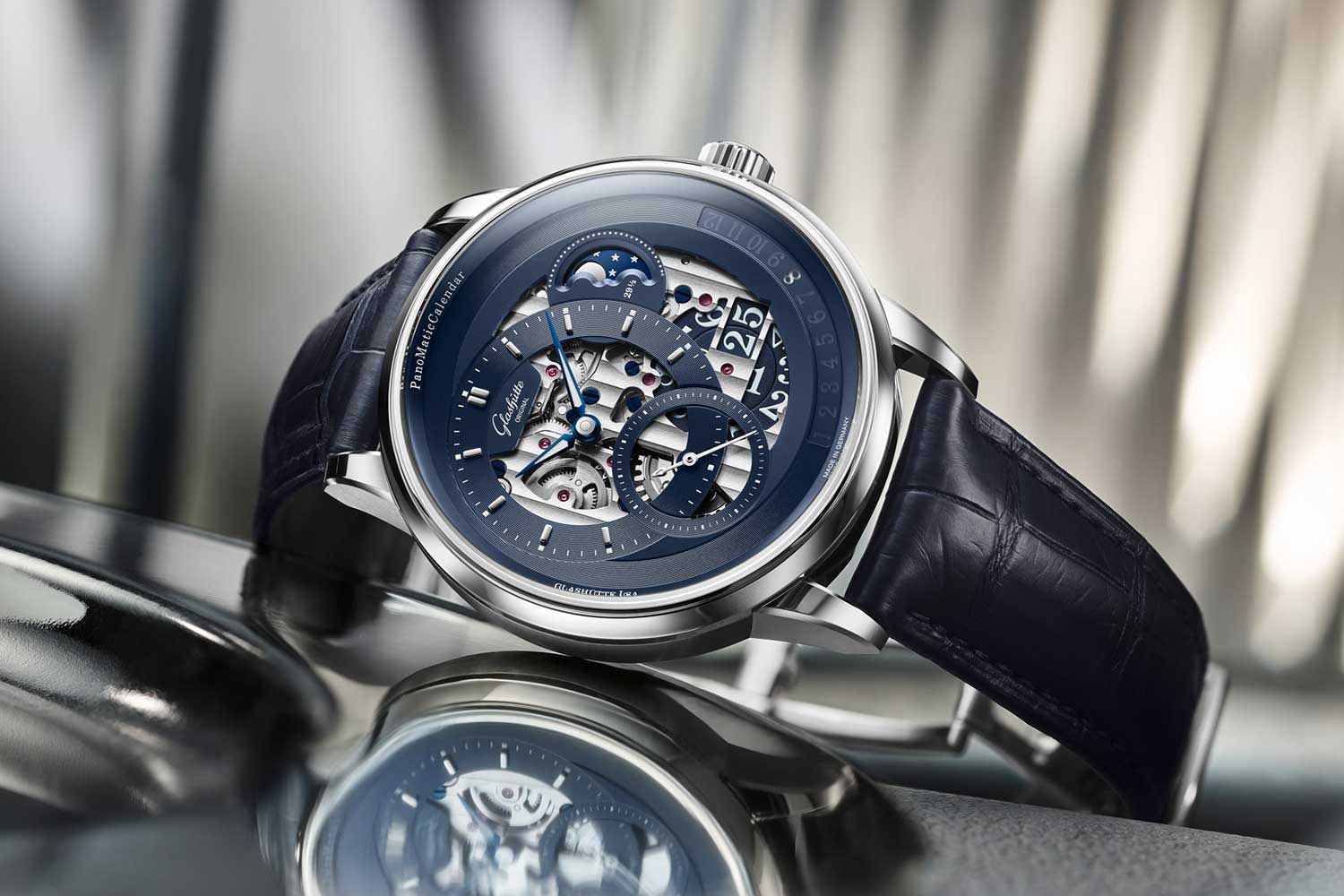
PanoMaticCalendar “Blue of Dawn”
Twelve months later, I find myself with Moebius in Saxony. We spend the first day in his Dresden studio, surrounded by paintings in various stages of completion. The bright colors and pop-art realism of his “Bubblegum” portraits are immediately recognizable, but there is plenty else to look at. His work leads to more discussion on art, music and the things he remembers from growing up. Watches are barely referenced.
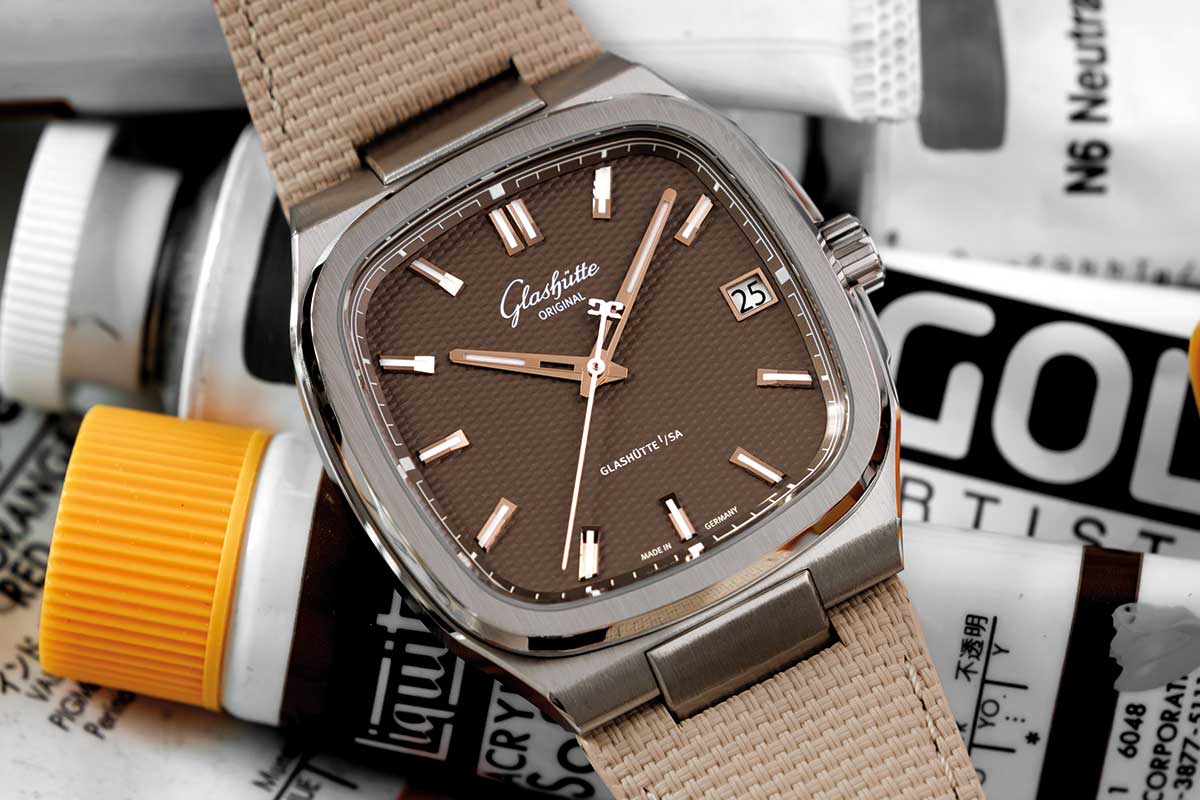
The following day, we meet up again in Glashütte and there is finally a watch on the table between us. The new 70s (the punchier moniker for the watch previously known as the Seventies) could hardly be more different from the Pano collection we were looking at last year. The latter is asymmetrical and deliberately off-center; the former is built around a square, television-shaped case with a more standard dial arrangement. Moebius looks at it, turns it over a few times and soon we are talking about the decade that inspired the piece and Moebius’s memories of East Germany at that time.
“When I think back to the 1970s,” he says, “I see the world through the eyes of a young boy growing up on the eastern side of the Berlin Wall. Much of life felt gray, repetitive and restrictive. Yet from a child’s perspective, the world was still full of color. A child does not understand the system in which he grows up. I was always searching for imagination and color, often through Disney cartoons, which were not officially accessible to us at the time. Perhaps that was part of their magic. To me, they felt like small windows into another world.”
Moebius does not romanticize those years. He talks about them in terms of childhood memories, what surrounded him and what caught his attention. The Disney cartoons offered an alternative to everyday life and enabled him to dream and hope. Nearly five decades later, his paintings are full of the same expression and movement that inspired him as a small boy.
Those influences come up again when I ask what first drew him to Glashütte Original. He does not mention a particular movement or a certain complication, instead he talks about a strength of character that survived the political realities of the time. “Looking back today,” he says, “I realize that Glashütte Original was already creating timeless classics in the East. [The brand] possesses an identity that even the political realities of that era could not destroy. The fact that they never stopped crafting fine mechanical watches by hand is, to me, one of the most remarkable stories in watchmaking.” This is the same way he talks about art. Fashion and trends interest him less than people or companies with a strong, unique identity.
-
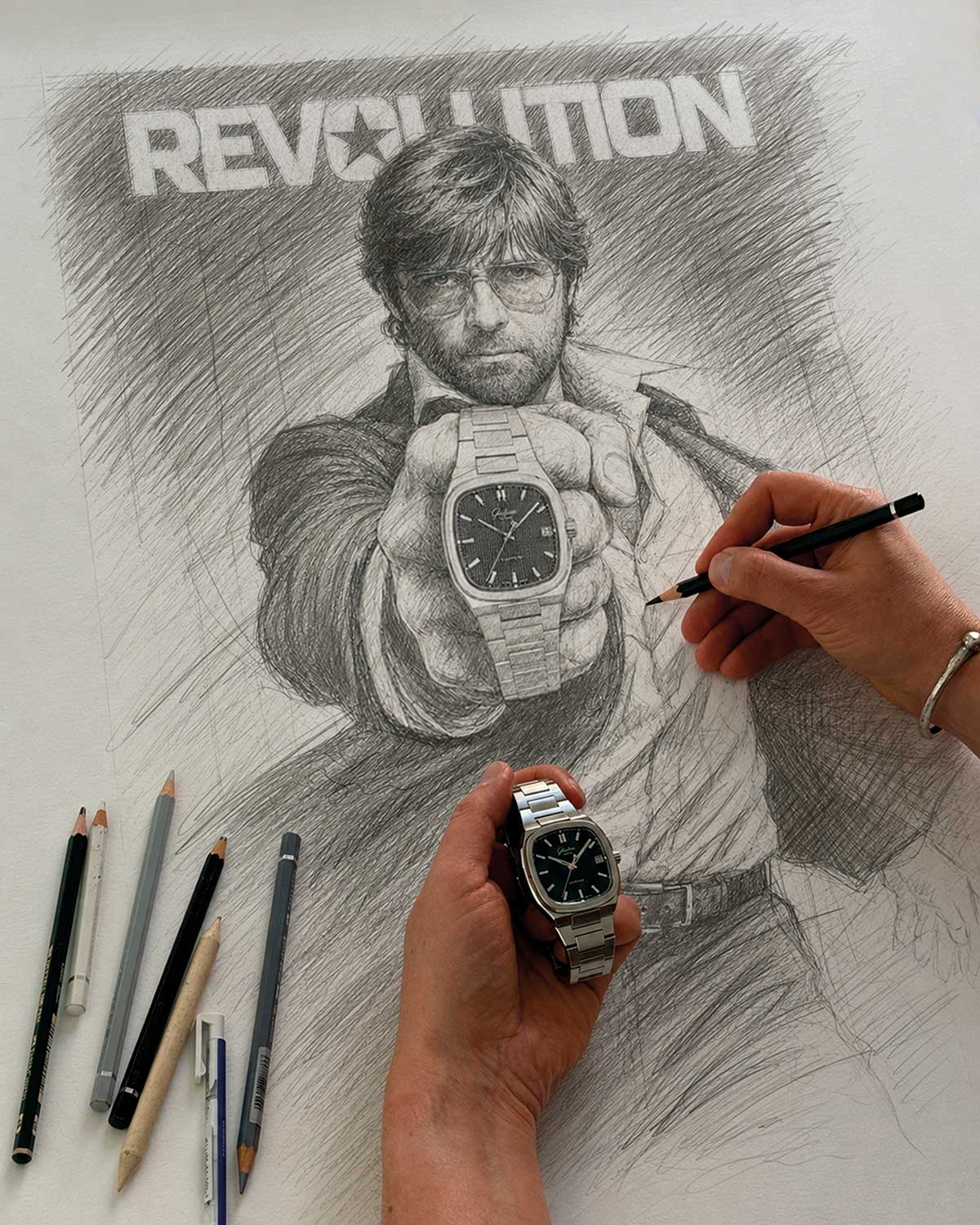
- The essence of what Glashütte Original calls “analog magic”: Michael Moebius sketching the Revolution cover with the 70s watch (©Revolution / Photography René Gaens)
-
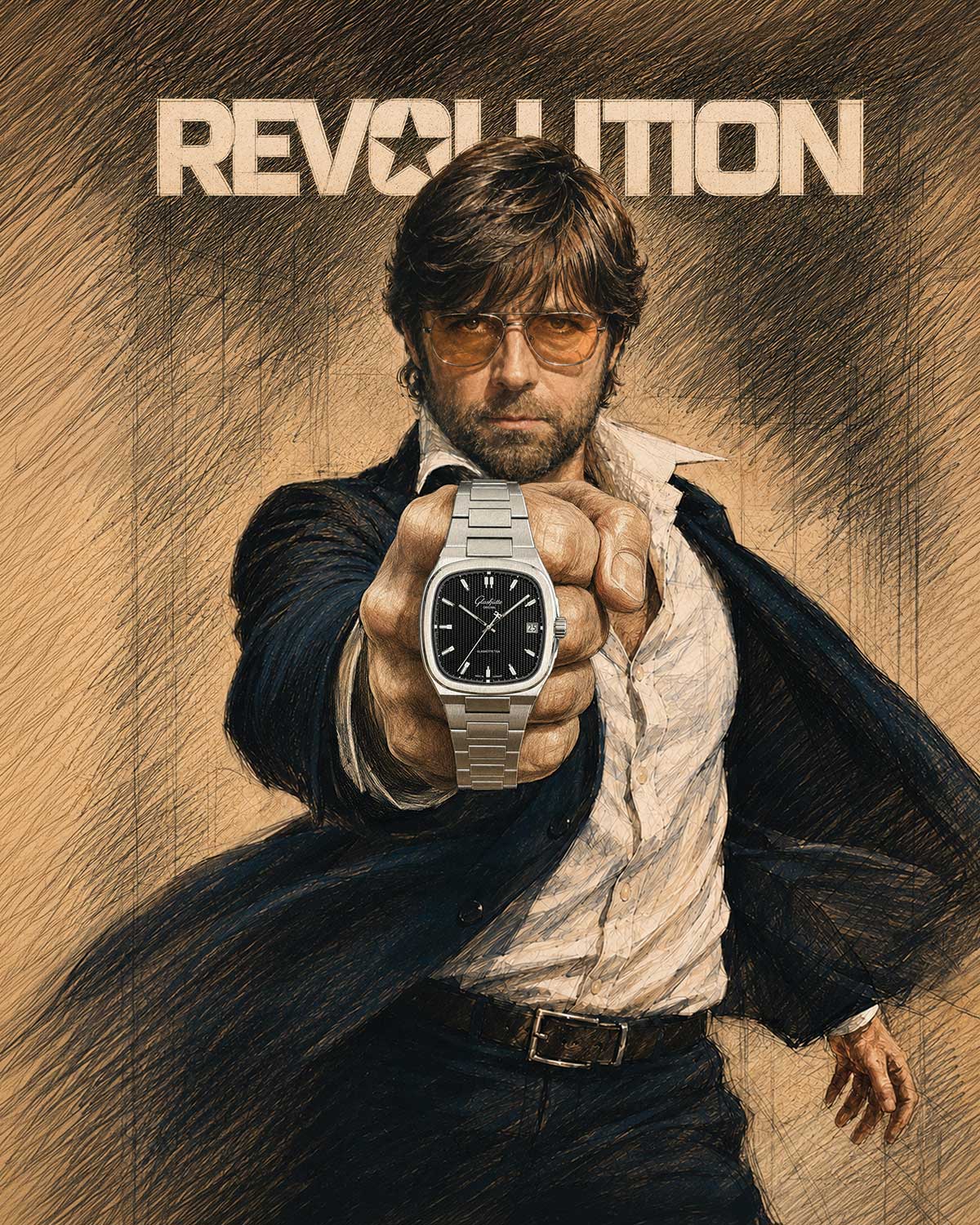
- The Revolution cover with the 70s watch by Moebius (©Revolution)
A Square Deal
The 70s had not been high on Moebius’s wish list. For years he had concentrated on the Pano collection, whose decentralized displays appealed to the way he looks at objects. The 70s is more regular and, on paper at least, less obviously his sort of watch. Holding it in his hand for the first time, he changed his mind quickly.
“I liked it immediately when I held it. It appealed to both the hand and the eye at the same time. Some watches impress through complexity; the 70s impressed me through its sense of ease, its elegant architecture and its quiet confidence. The 70s and the Pano are two completely different watches, yet both carry the unmistakable signature of Glashütte Original. For me, it always depends on the occasion and personal style as to which watch feels right. The 70s has not changed my view of Glashütte Original. If anything, it has reinforced it. What impresses me is GO’s ability to create a distinctive statement through simplicity alone.”
As he talks, the watch rarely stays still. He turns it over, catches the light on the dial, uses his finger to trace the bracelet into the case and then goes back to the dial. We are several minutes in before the movement gets any attention at all.
“Proportion is essential to me,” he says. “I love the asymmetrical watches of Glashütte Original with their decentralized displays. The 70s takes a different approach. It is about calmness and balance. The large dial gives the design room to breathe. Often with watches you discover details that you later begin to question and they are fascinating in their own way. Glashütte Original has created many wonderful watches that thrive on this. The 70s, however, feels completely clear in its design language.”
He puts the watch down, then reaches for it again a few moments later, smiling as he says: “It actually reminds me of a beautiful monitor framed by an elegant bezel. The large dial feels almost like a stage or a canvas.”
I ask whether being an artist changes the way he collects. He pauses before answering. “A collector will always be a collector, whether they are creative or not. They naturally see a watch through the lens of passion. Perhaps the difference is that an artist sometimes notices additional possibilities, perspectives or design opportunities. I think the combination is the key.”
He picks up the 70s again. “The shape and the color complement each other perfectly,” he says. “And honestly, I find all three color variations [the watch is available with a silver or brown dial, or in a limited edition black version] remarkably successful. It offers an extraordinary amount of creative space. That is one of the reasons it appeals to me so strongly as an artist.”
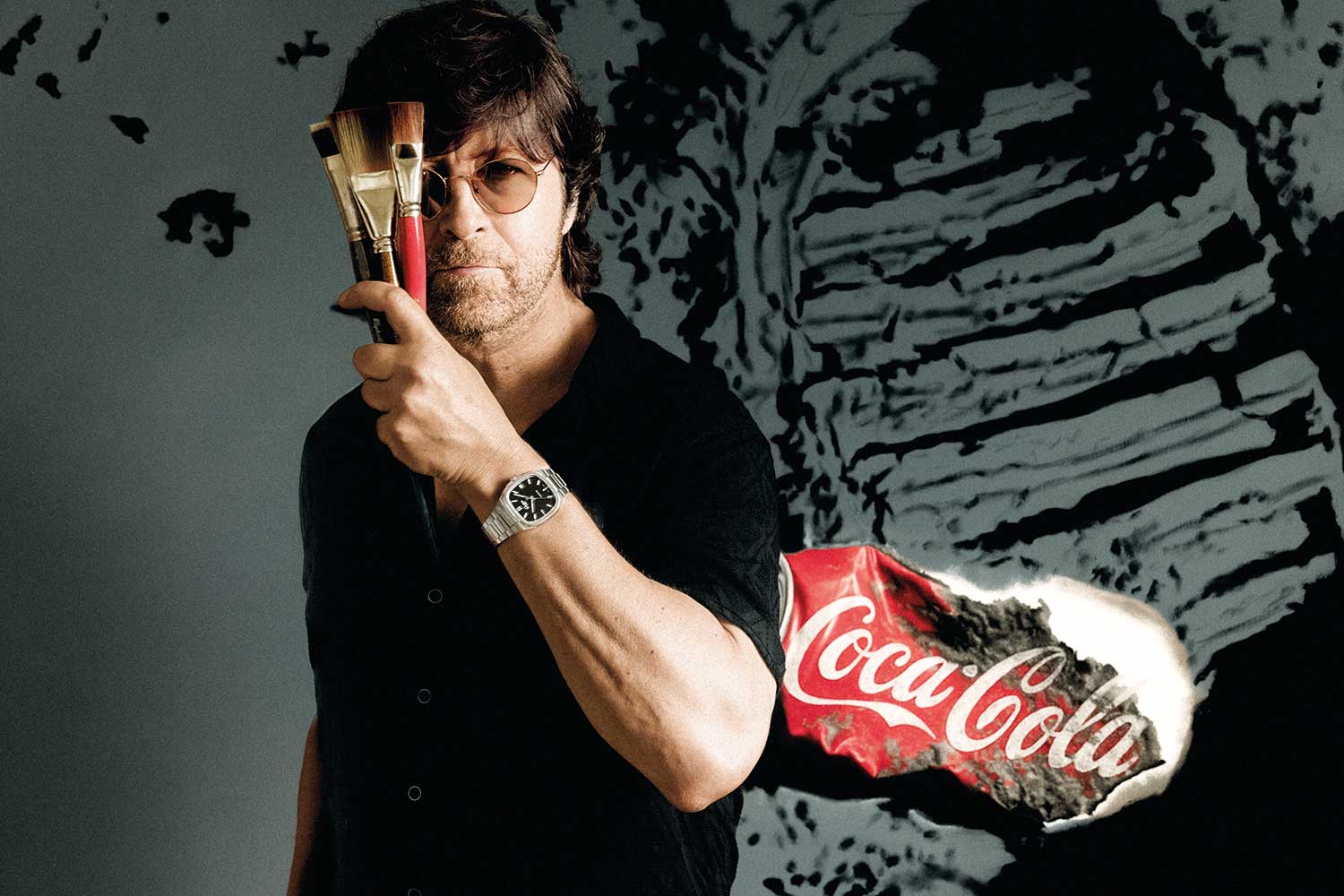
Moebius wearing the Glashütte Original 70s “Vinyl Record” Limited Edition (©Revolution / Photography René Gaens)
Built From Experience
I left Dresden thinking as much about Moebius’s childhood as the 70s watch. The following morning, I met with Glashütte Original CEO Roland von Keith, who grew up on the other side of the Wall to Moebius. His memories of the same period are very different, but he keeps coming back to how people in the East made things, fixed things and found ways around what they could not buy.
Von Keith had spent more than three decades in the watch industry before being appointed as CEO of Glashütte Original in 2018. When he talks about the German town, though, he is more interested in what he found there than in what he brought with him. Much of that goes back to Glashütter Uhrenbetriebe, or GUB, the state-owned combine that controlled watch production in the town before reunification. For von Keith, the legacy of those years is found less in particular watches than in the skills and working practices that were passed on.
“People often imagine that those living in East Germany had no idea what was happening elsewhere,” he says. “That simply isn’t true. Most people could access West German television, listen to West German radio and knew exactly what was happening. They understood design. They understood engineering. They knew what the rest of the world was doing, even if they couldn’t always participate in it in the same way.
“Being separated from the West was, in many respects, a blessing in disguise. If you cannot simply buy what you need, you must develop your own solutions. If outsourcing is not an option, you learn to do things yourself, and over time you become exceptionally good at it. That way of thinking became part of the culture here.”
Where Moebius describes growing up in East Germany from a child’s point of view, looking for color wherever he could find it, von Keith comes at the same period from another direction. For the watchmakers of GUB, if something could not be bought or outsourced, they had to work out how to make it themselves. Doing things in-house was simply how the place worked.
“As watches produced during the GDR [German Democratic Republic] era were not considered luxury goods but reliable items worn daily,” von Keith says, “the focus was on robustness, solidity, longevity and functionality. Those are characteristics that remain important to Glashütte Original today. Of course, expectations have changed and today’s collectors look for different things, but the idea that a watch should first be something you genuinely enjoy wearing has never disappeared.”
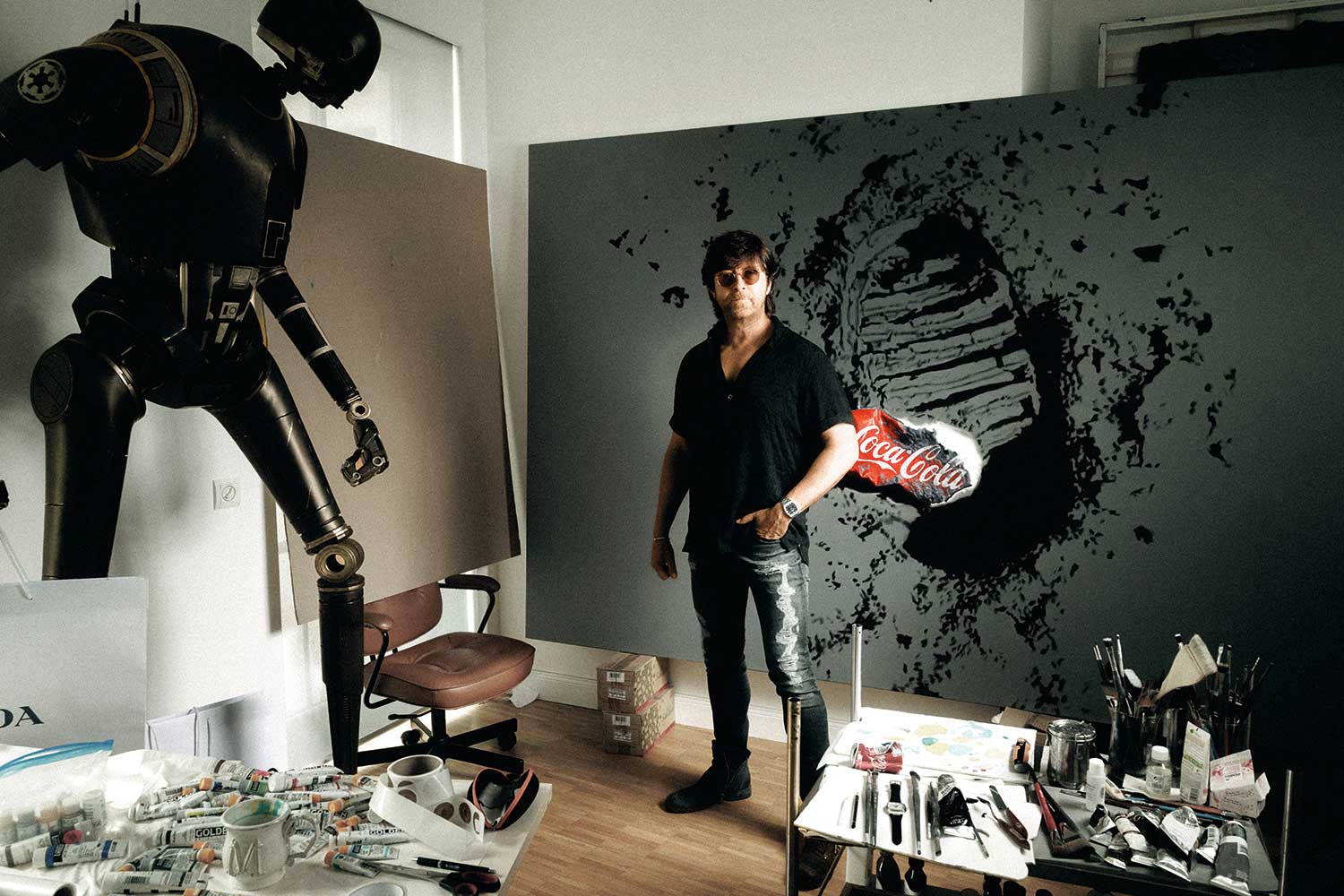
Michael Moebius in his Dresden studio. Behind him is a new work titled First Trash, reflecting on the contrast between human progress and the traces we leave behind. To his right is a mechanical robot sculpture carrying luxury shopping bags (©Revolution / Photography René Gaens)
Reshaping The Past
This is the attitude that led to a fresh take on the Seventies. Fifteen years is a long time for a watch to sit in a collection and over that period, collectors come to know what changes they will and won’t accept.
With the 70s, Glashütte Original wanted to make fairly substantial changes without making people wonder where the old watch had gone.
“The brand itself has evolved,” von Keith says. “Customer expectations have changed, so it was time to bring the 70s collection into the present. But that didn’t mean starting again. [The watch] wasn’t born in one day. We had prototype after prototype. We changed the angles, softened the case, refined the proportions, looked at the bracelet, then started again. We kept asking ourselves how we could improve the watch without losing the character people already recognized.”
The new watch is still immediately recognizable but the changes are substantial. The television-shaped case now measures 39mm by 39mm and 9.6mm thick, with softer transitions between brushed and polished surfaces. It sits lower on the wrist, the bracelet, which can be adjusted by 3mm per side, integrates more neatly with the case, and both bracelet and rubber strap can be changed without tools, as can the butterfly clasp.
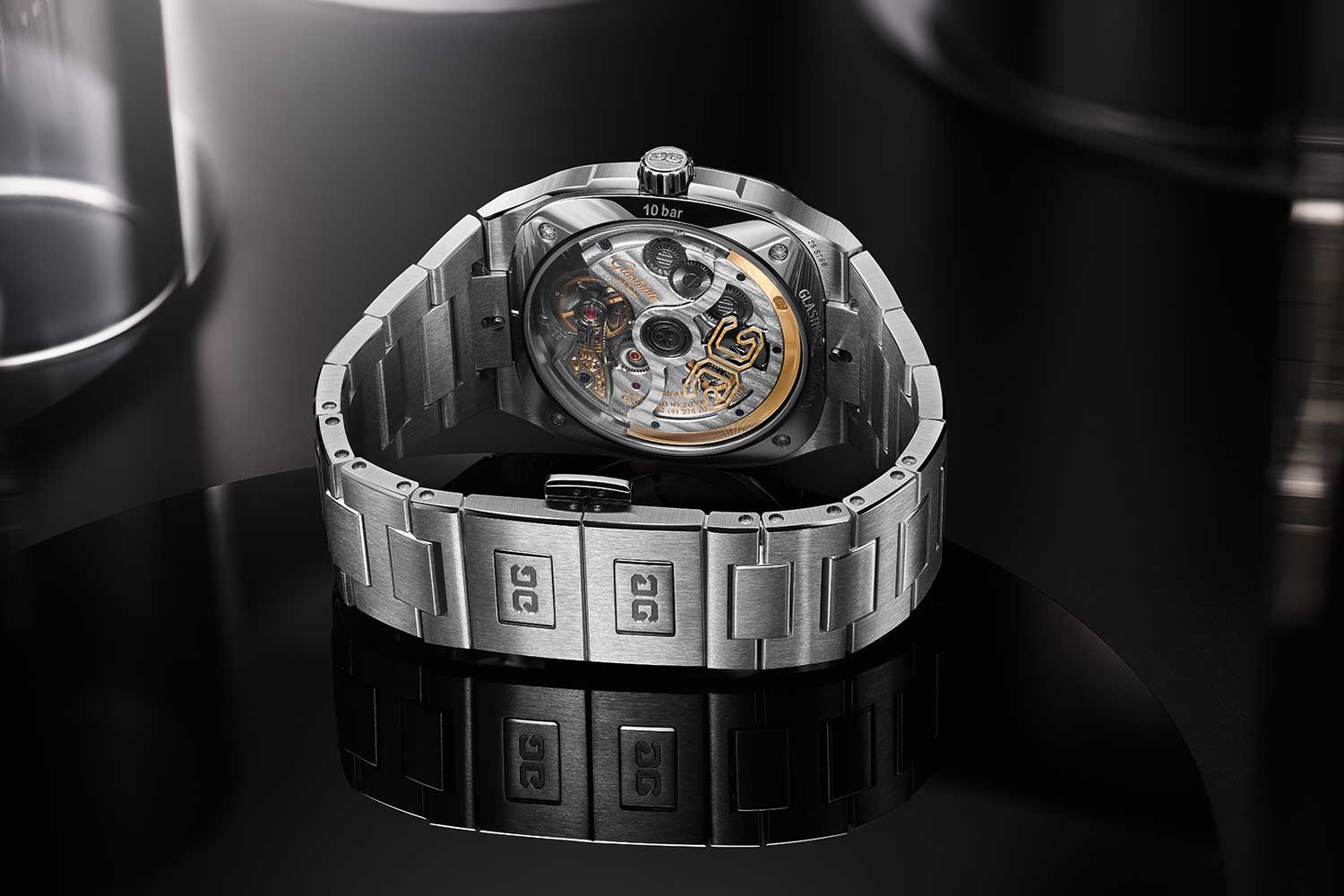
The newly designed bracelet of the Glashütte Original 70s (©Revolution / Photography René Gaens)
Von Keith talks about ergonomics as much as he does about design. “A high-end watch has to be mechanically perfect and aesthetically pleasing,” he says, “but it also has to be comfortable to wear. The bracelet connects the watch with its wearer. If that relationship isn’t right, the experience is never complete.”
A lot of work has gone into the dial too. All three versions use a new Hexagrid embossed surface that shifts noticeably with the light. The rehaut is slimmer, the hands and indexes have been refined, the solid-gold markers are brushed and the Panorama Date is less prominent than before. Inside is the Caliber 36: the rhodium-black 36-10 in the limited edition and the 36-11 in the two core models. Both have a 100-hour power reserve and a silicon hairspring. The three-quarter plate, skeletonized rotor, 21-karat gold oscillating weight and blued screws are familiar Glashütte details, as is the hand-engraved balance cock beside the balance wheel.
The names make the references fairly clear. The black limited edition is “Vinyl Record,” the silver watch “Stereo Panel” and the brown version “Tweed Amp.” Their dials interpret the grooves of a record, the brushed aluminum of old hi-fi equipment and the fabric covering of 1970s amplifiers and speakers. Von Keith is keen, though, to not overstate the historical connection. The 70s is not based on a forgotten GUB watch or a single archival reference. The link with the past is more about how Glashütte works: making things in-house, developing its own solutions and retaining skills within the manufacture. Moebius had arrived at something similar the day before when he talked about experience feeding creativity.
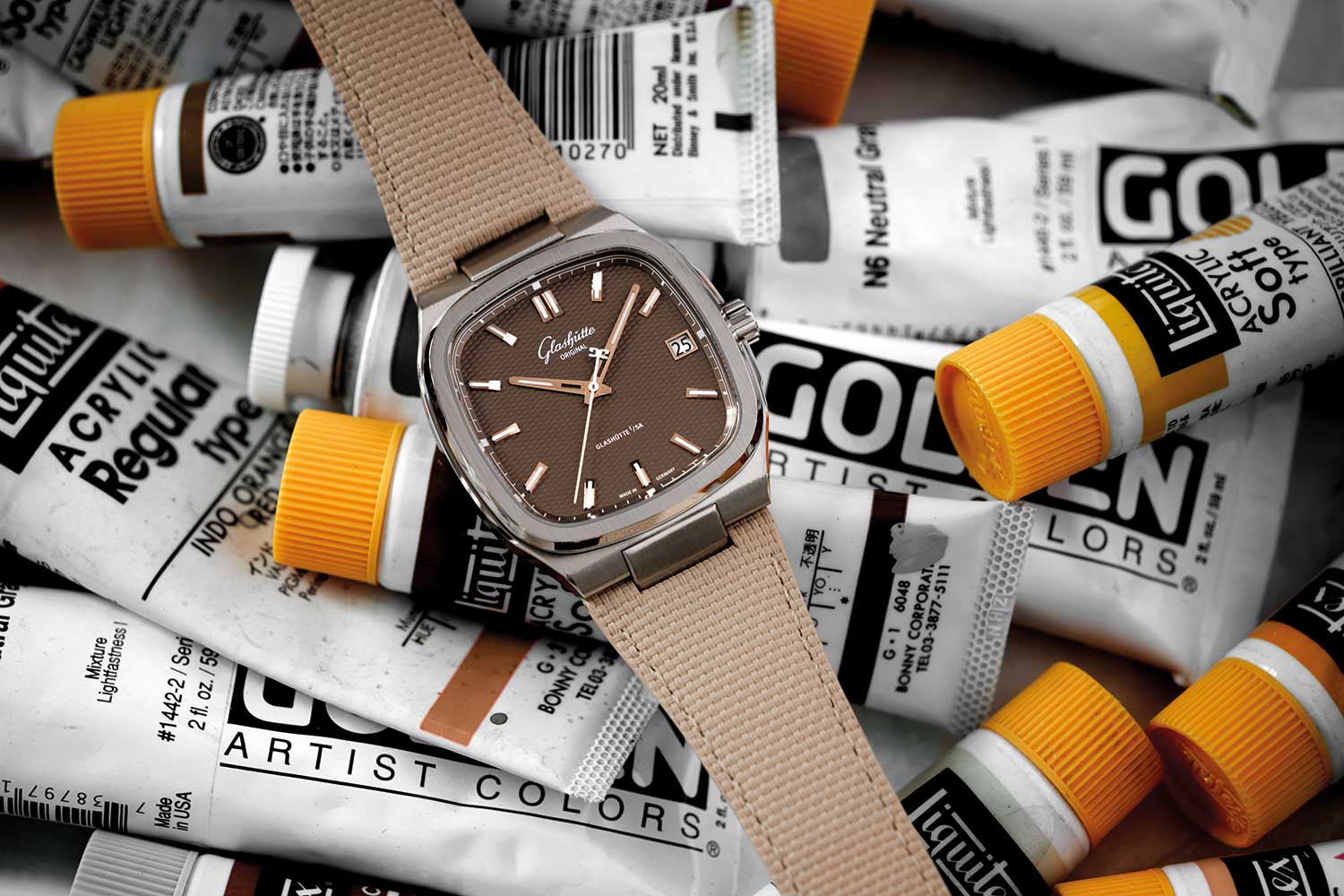
The earthy tones of the core collection 70s “Tweed Amp” model (©Revolution / Photography René Gaens)
People Power
Previous incarnations of the 70s (Seventies) have not really called out to Moebius. Today, after spending time with the latest model, he is not especially interested in listing its individual features. What interests him is how these come together as a whole. “I discovered the 70s relatively late because my attention has long been focused on the Pano collection,” he says. “What I have gradually came to appreciate is not complexity, but completeness. The 70s has clarity and elegance that reveal themselves over time. For me today, it is unquestionably one of the essential pieces in a [Glashütte Original] collection.”
I ask how that reflects his changing taste in watches. “Today I appreciate watches that offer a greater sense of openness and allow you to experience the engineering, materials and dial layout. In the past, many watches felt more confined. Today, I am drawn to generosity and transparency.” Looking down at the watch, he continues, “I am fascinated by the new case design, the extraordinary texture of the dial and the integration of the bracelet. There is an impressive amount of development and innovation hidden within those details. The longer you look at the watch, the more nuances you discover. And to me, that is what great design is all about.”
Although both deeply connected to Glashütte Original, von Keith and Moebius come at the new watch from very different directions. Von Keith talks about the people who make it. He rarely talks about the 70s in terms of a single designer. Instead, he reels off the teams involved: movement constructors, dial makers, case specialists and bracelet engineers. Each is responsible for a different part of the watch, but they work closely together and skills are passed on between teams and generations.
Moebius is more interested in what happens when all those elements come together. “For Michael,” von Keith says with a smile, “a watch is a sensory experience.” Having watched Moebius with the 70s over the past two days, talking about it and examining it, I know what he means. He notices the shape and feel of the watch and the way light plays across it before he starts talking about what’s on the inside.
Glashütte Original refers to the new 70s as “analog magic,” a phrase I would normally consign fairly quickly to the PR department. But spend time with the watch and it starts to make sense. Somebody decided how sharp the edge of the case should be. The bracelet was refined again and again, and the Hexagrid dial took months to develop. Most owners will never know how much work went into any of this.
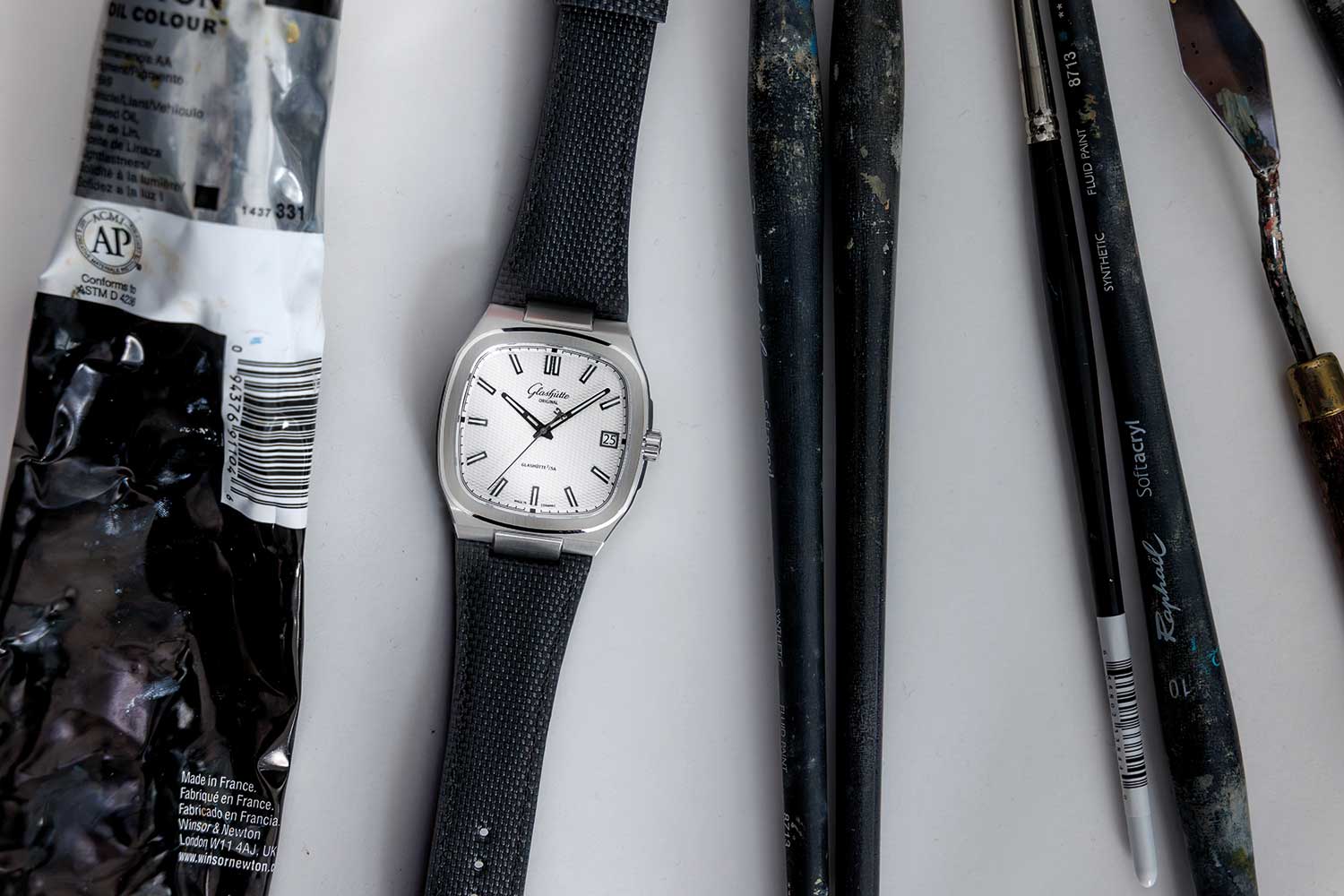
The Glashütte Original 70s “Stereo Panel” with silver Hexagrid dial and embossed rubber strap (©Revolution / Photography René Gaens)
Toward the end of our time together, I ask Moebius whether timeless design really exists. He smiles. “Yes,” he says. “Otherwise, we would not still be talking about certain designs from the 1970s or other decades today. There is also a certain irony in discussing timelessness when talking about a watch. But in terms of design, proportion and engineering, I absolutely believe timelessness exists.”
Moebius and von Keith grew up on opposite sides of a divided Germany and remember those years very differently. Yet when they talk about Glashütte Original, both return to the same things: making, problem-solving and the people who know how to do both. The 70s may not be a GUB watch, but it comes from a place that has not forgotten how it learned to make watches.
Tech Specs: Glashütte Original 70s “Stereo Panel,” “Tweed Amp” and “Vinyl Record” Limited Edition
Movement Self-winding Caliber 36-11 (70s “Stereo Panel” and “Tweed Amp”) or Caliber 36-10 with black rhodium plating (70s “Vinyl Record” Limited Edition); 100-hour power reserve
Functions Hours, minutes, central seconds; Panorama date
Case 39mm × 39mm × 9.6mm; stainless steel; water resistant to 100m
Dial Silver, brown or black with Hexagrid embossed texture; solid gold applied hour markers with Super-LumiNova
Strap Integrated stainless steel bracelet or rubber, both equipped with a tool-free quick-change system; interchangeable butterfly clasp; on-the-fly bracelet adjustment (3mm per side)
Price USD 13,200 – USD 14,500 (70s “Stereo Panel” and “Tweed Amp”); USD 16,300 (70s “Vinyl Record” Limited Edition)
This story is from the latest edition of Revolution USA, available from the 17th of September.
Glashütte Original
You may also like
Editorial
Last Week In Watches: Blancpain Returns to 1968, Norqain Goes Titanium, Czapek Turns Aqua Blue and more
Aug 24, 2026
Editorial
Last Week In Watches: Blancpain Returns to 1968, Norqain Goes Titanium, Czapek Turns Aqua Blue and more
Aug 24, 2026
Editorial
The Revolutionary List: 24 Technically Brilliant Watches – Glashütte Original Senator Chronometer Tourbillon
Dec 12, 2025
Editorial
The Revolutionary List: 24 Technically Brilliant Watches – Glashütte Original Senator Chronometer Tourbillon
Dec 12, 2025

Editorial
Glashütte Original Marks 180 Years With The PanoMaticCalendar “Blue Of Dawn”
Aug 27, 2025
Editorial
Glashütte Original Marks 180 Years With The PanoMaticCalendar “Blue Of Dawn”
Aug 27, 2025