
A Closer Look: Anton Suhanov Flamingo Singapore Edition

On a Saturday afternoon at IAMWATCH, Anton Suhanov looked a little weary behind his booth, while his wife cheerfully greeted visitors. But his eyes brightened when asked to explain the oversized balance wheel of his latest creation, the Flamingo.
He later assured me he wasn’t tired, though the flight from St. Petersburg and the steady stream of visitors since morning would have made for a long day. Still, the attention was perhaps to be expected, given the enthusiasm in the event hall and the fact that a Russian watchmaker with a character of his own was making a rare appearance in Singapore.
Born in St. Petersburg in 1983, Suhanov has spent close to two decades in watchmaking, though he only established his name as an independent watchmaker fairly recently. His achievements are nonetheless impressive, from winning the Young Talents Competition of F.P. Journe and the GPHG Horological Revelation award to becoming a member of the AHCI, an association of independent watchmakers whose rigorous admission process includes a two-year candidacy and presentations of their work at multiple exhibitions.
He studied mechanical engineering at Petersburg Polytechnic University and earned a master’s degree there. In 2007, Suhanov joined the workshop of Konstantin Chaykin, another figure synonymous with Russian watchmaking. He spent 11 years there as chief designer before founding his own brand in 2018.
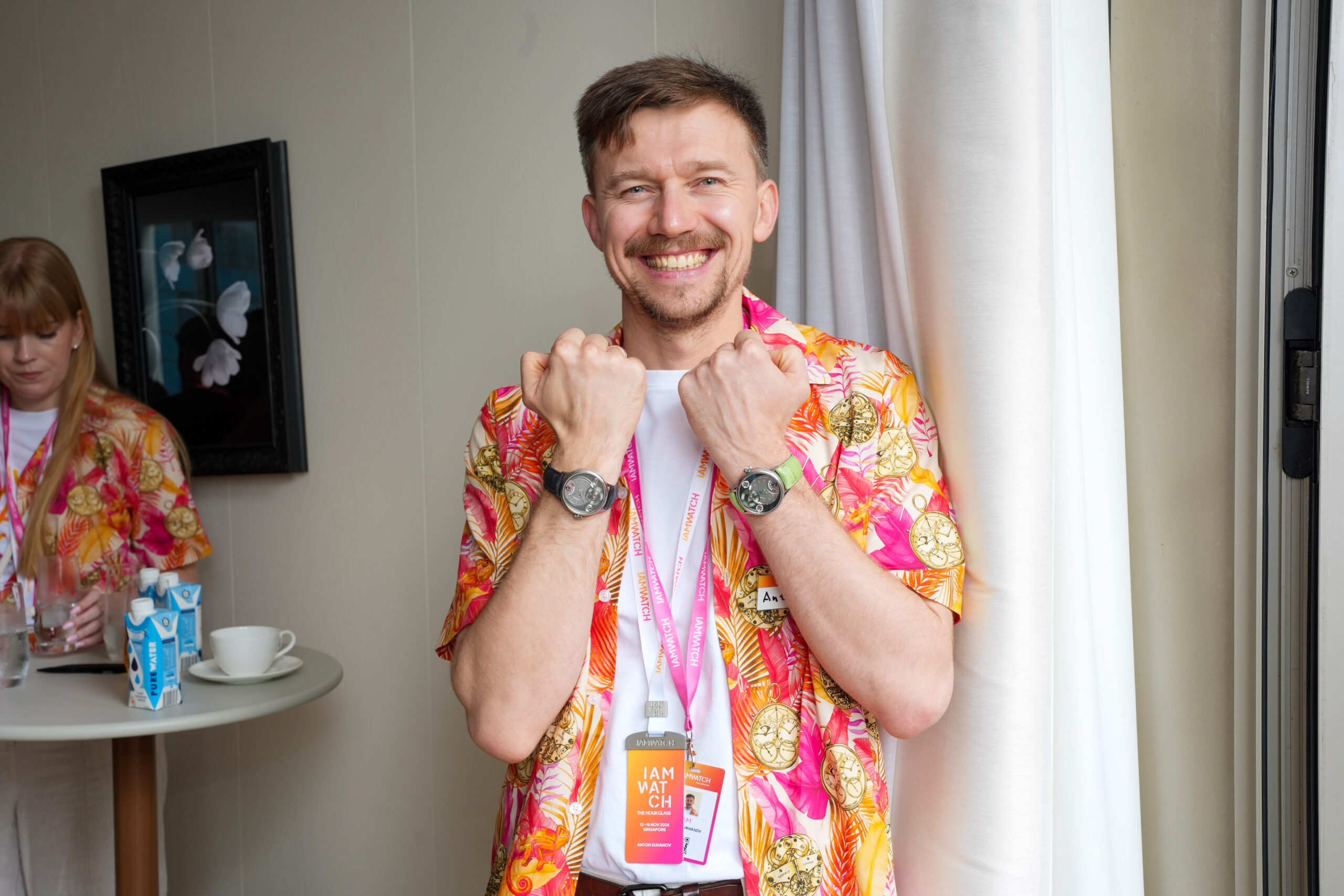
Anton Suhanov double-wristing the Flamingo, wearing a shirt created specifically for IAMWATCH with a tropical floral print and the George Daniels Space Traveller.
Suhanov started his brand well before the post-Covid explosion of independent watchmaking. Yet his name has not become as widely known as one might expect. Much of his early work was in clocks rather than wristwatches. But wonderful clocks they were. Creative and complex, they included a triple-axis tourbillon clock that won him the F.P. Journe award in 2016.
It was only in 2021 that he turned to wristwatches with the Racer Jumping Hour GMT, an intriguing retrograde display styled like a car’s speedometer. Beneath it was a thoughtfully detailed module that transformed the ETA 2824 into something far more interesting than the base movement might suggest. His second watch, the Chronotope, was again an unusual take on the standard day-date complication, with another heavily modified ETA 2824 that barely resembled the original.
There is a certain appeal to this kind of watchmaking. Rather than follow established trends, Suhanov takes familiar movements and displays and gives them a character of their own. It is the sort of originality that attracts collectors looking for something different.
That said, Suhanov did not stop at modifying movements. With his skills and restless imagination, it was only a matter of time before he developed something from scratch. The result is the Flamingo, his third wristwatch, unveiled earlier this year. Its oversized — very oversized, in fact — balance wheel at 12 o’clock, which glows in the dark, immediately sets it apart from an ordinary off-the-shelf movement.
There are two versions of the Flamingo: the original edition and a special creation for IAMWATCH in Singapore, which had just arrived in time for the show, fresh off the press the weekend before.
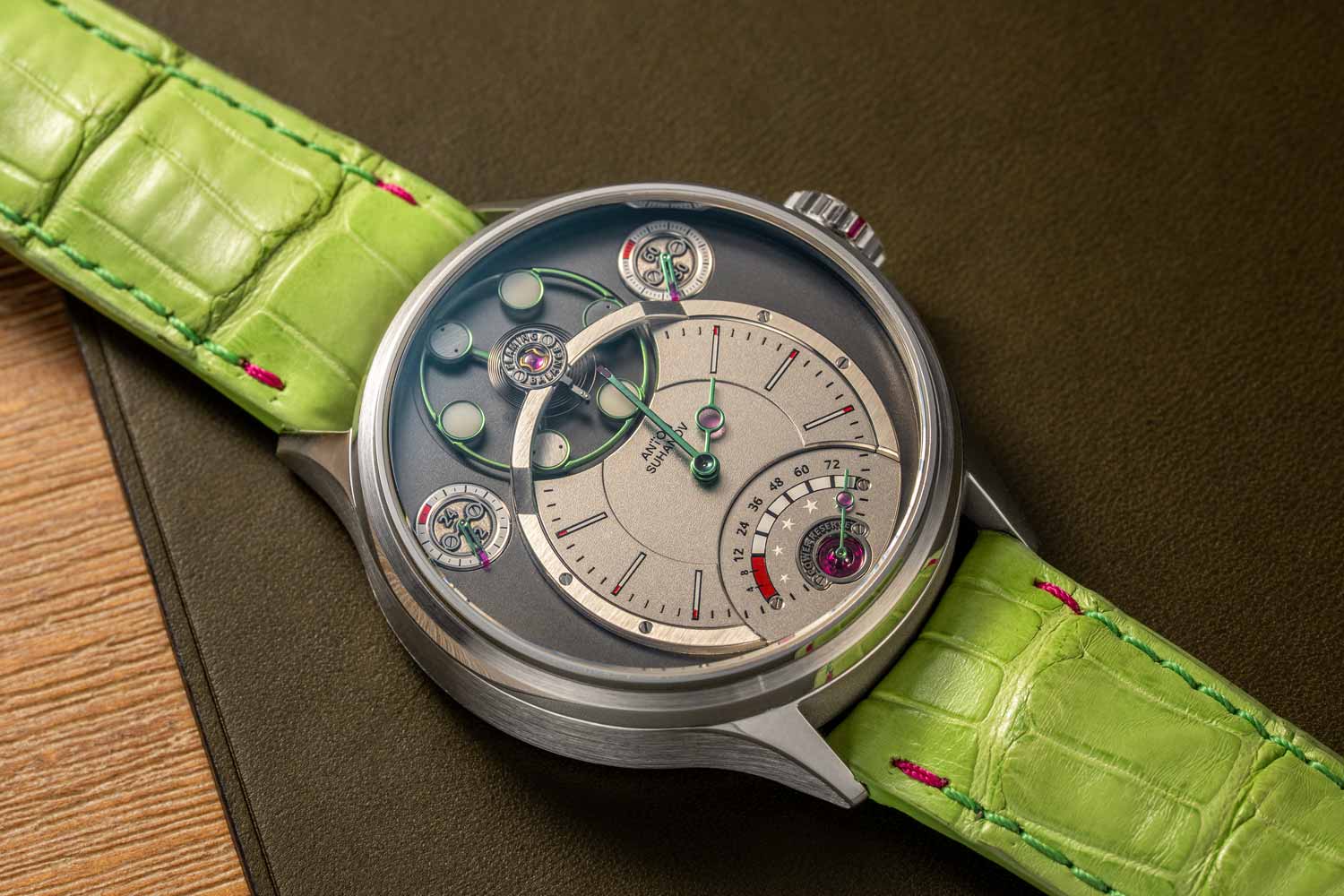
The Flamingo Singapore Edition, with five stars beneath the power-reserve scale alluding to the city-state’s flag. (Image: Revolution ©)
The flaming balance
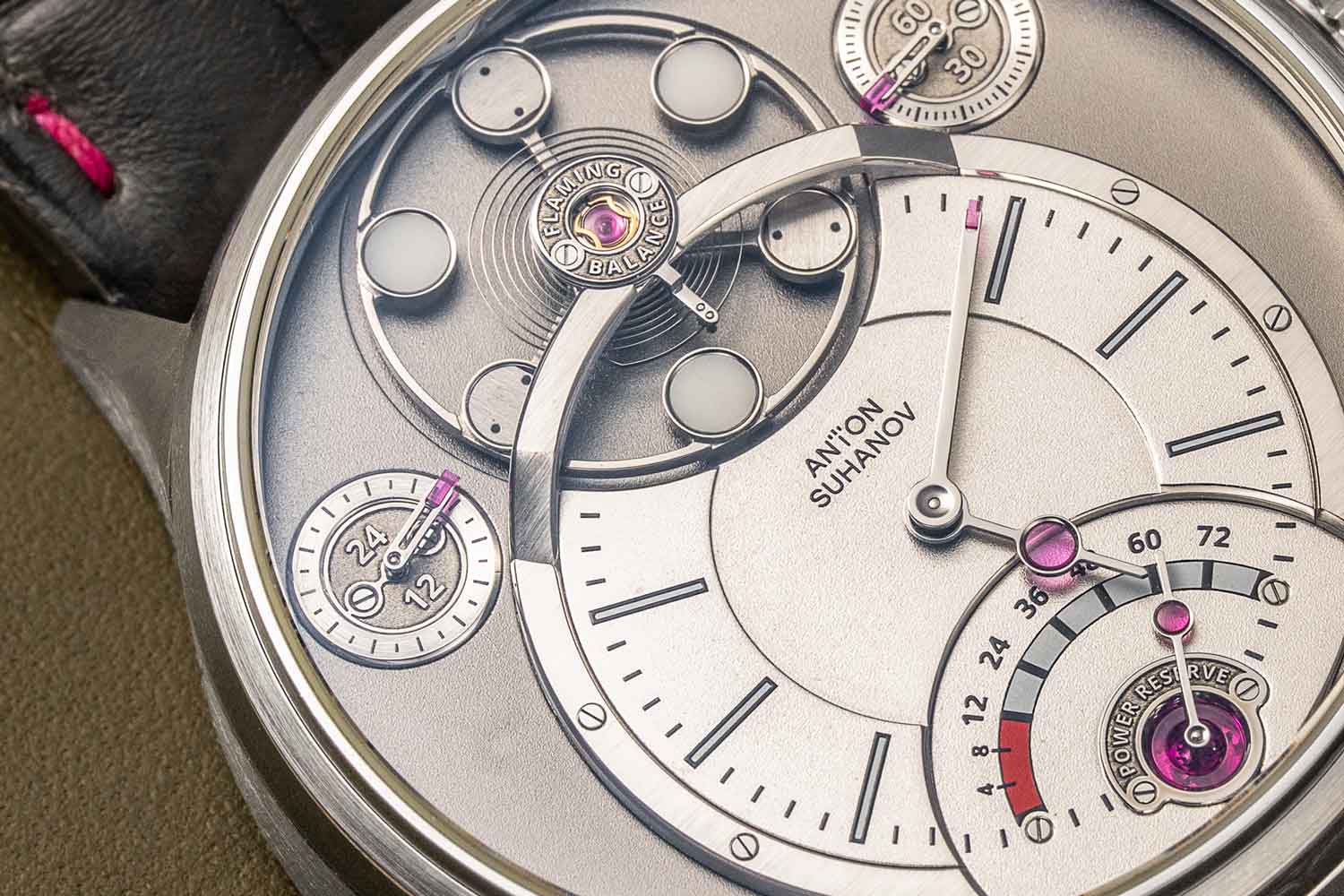
The new Flamingo doesn’t look like a time-only watch with a power-reserve indicator. It appears much more complex, thanks to the clever arrangement of elements on the dial, particularly the large balance wheel at 12 o’clock. Named the “Flaming Balance” by the watchmaker, the balance wheel measures a whopping 15.7 mm, more than a third of the 42 mm case diameter. According to the watchmaker’s own research, it could be the largest balance wheel ever created, excluding the very slow balances operating below 2.5 Hz found in clocks.
But its size alone doesn’t explain why it is called the Flaming Balance. That has more to do with its construction, which comprises three weights and three spokes filled with luminous material. These light up in the dark, hence the name. If its size isn’t convincing enough, the construction of the balance wheel certainly establishes it as an original creation by the watchmaker.
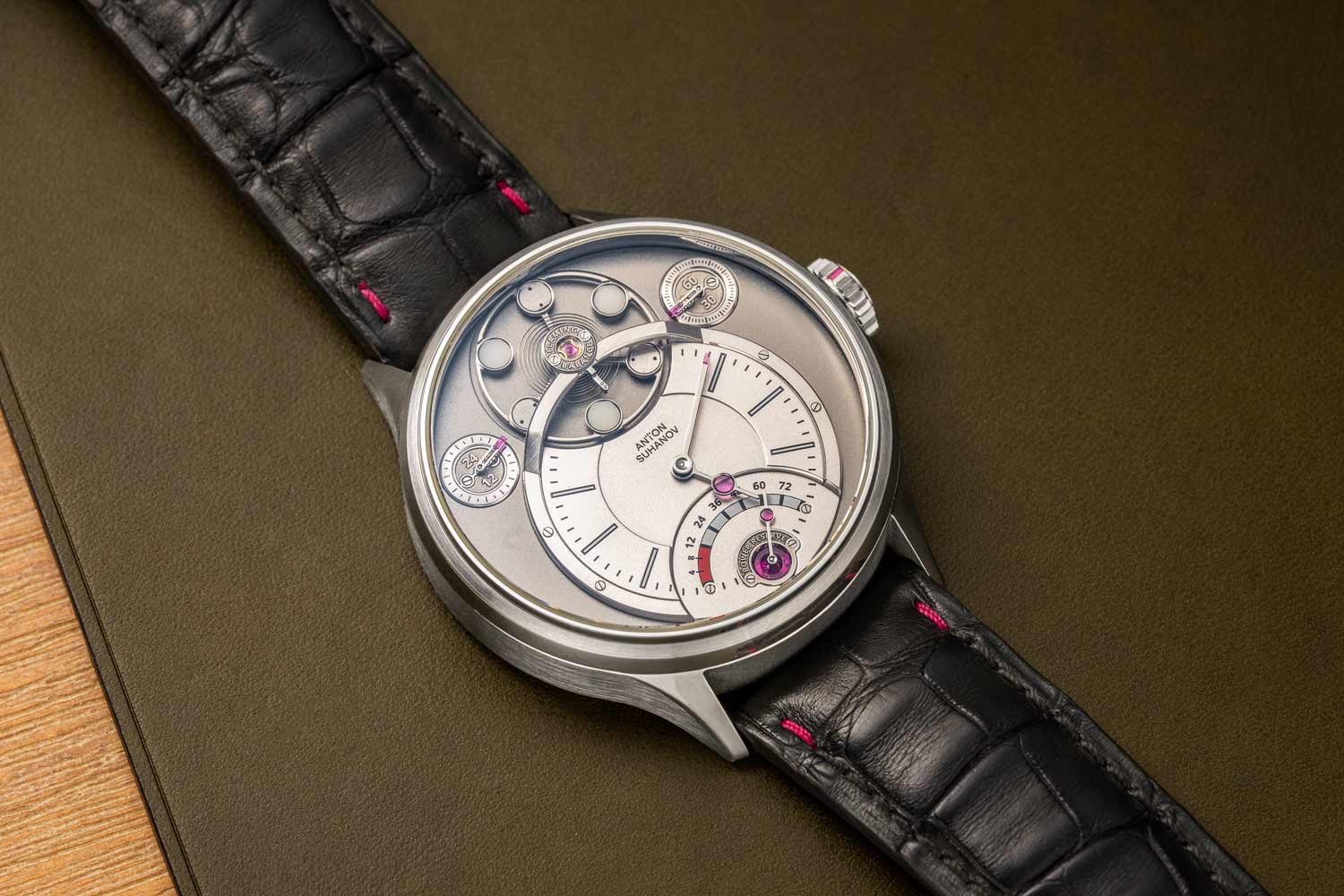
The original edition, which has reportedly sold out. (Image: Revolution ©)
As intriguing as the balance wheel is, it is the overall design that makes the watch appealing. The symmetry and coherence of the dial layout make it easy on the eyes, with the large balance wheel mirrored by the power-reserve indicator, the two separated by a ring of hour markers. Two small sub-dials, styled in a distinctly contemporary manner that brings to mind the work of Greubel Forsey, in the best possible way, sit in the upper left and right corners, tucking away the less prominent information: a 24-hour indicator and running seconds. There is a certain depth to the dial, thanks to the bridges and plates set at slightly different heights. But it is perhaps the contrast between the large and small displays that gives the dial its visual hierarchy, separating the foreground from the background and avoiding the pitfall of being either too complex or too flat.
The hands, meanwhile, are just as interesting as the dial. They all have pink tips, thanks to synthetic ruby, a material traditionally used in movements as a functional component to reduce friction. Always one to think outside the box, Suhanov had already brought ruby to the hands of his previous wristwatch, but here they are even more prominent. The hour hand, with its large, round ruby tip, is a take on the lollipop seconds hand, creating a lighthearted contrast against the grey background while maintaining a modern, less saturated palette.
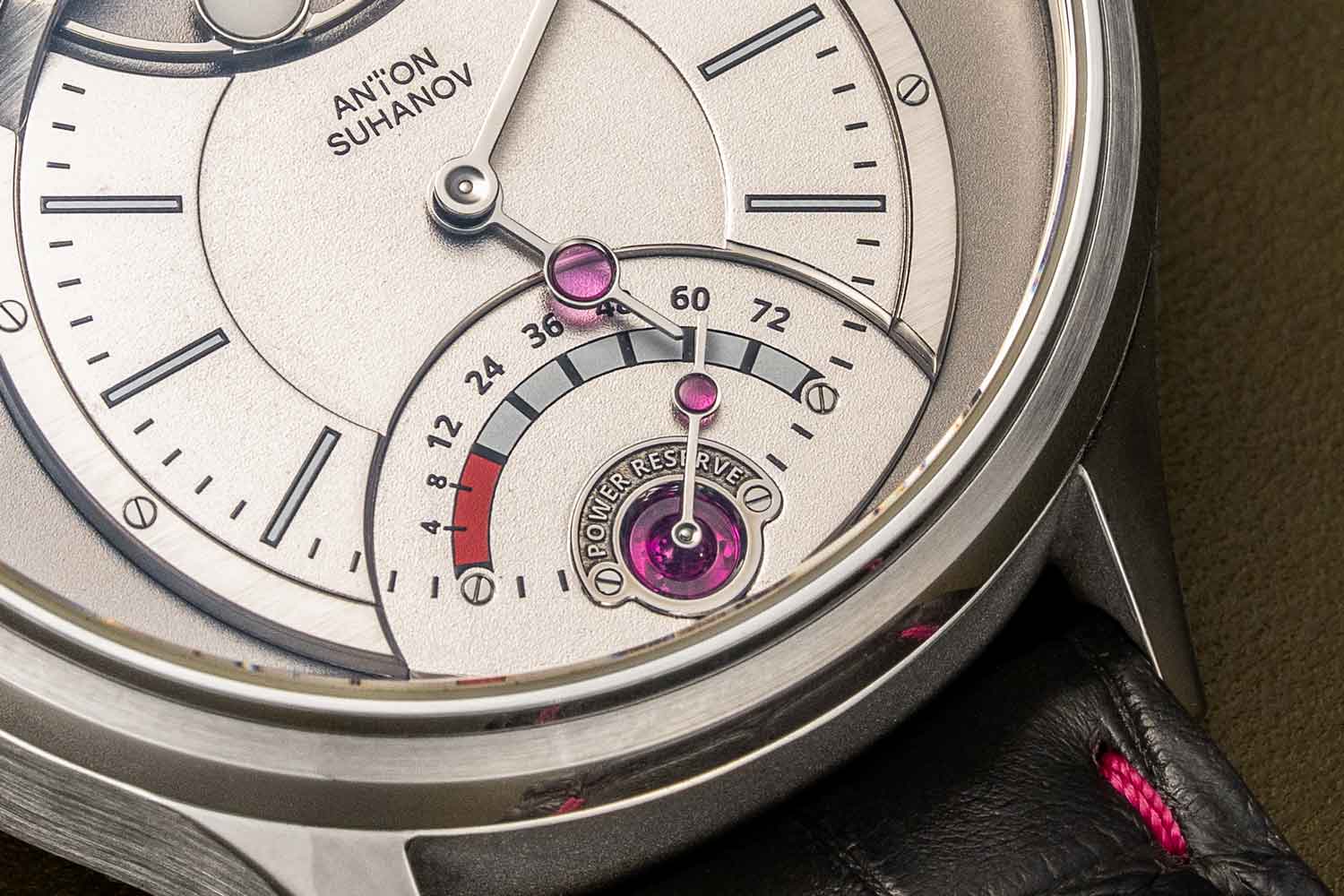
The jewelled hands. (Image: Revolution ©)
On the limited edition created for IAMWATCH, the palette receives a slight update, with the hands and balance wheel finished in green. The colour creates a stronger contrast, while remaining very much in harmony with the rest of the design. According to the watchmaker, green came to mind because of Singapore’s Garden City concept. This explains the generous use of green across the dial, movement and strap, just as Singapore weaves greenery into its modern urban landscape.
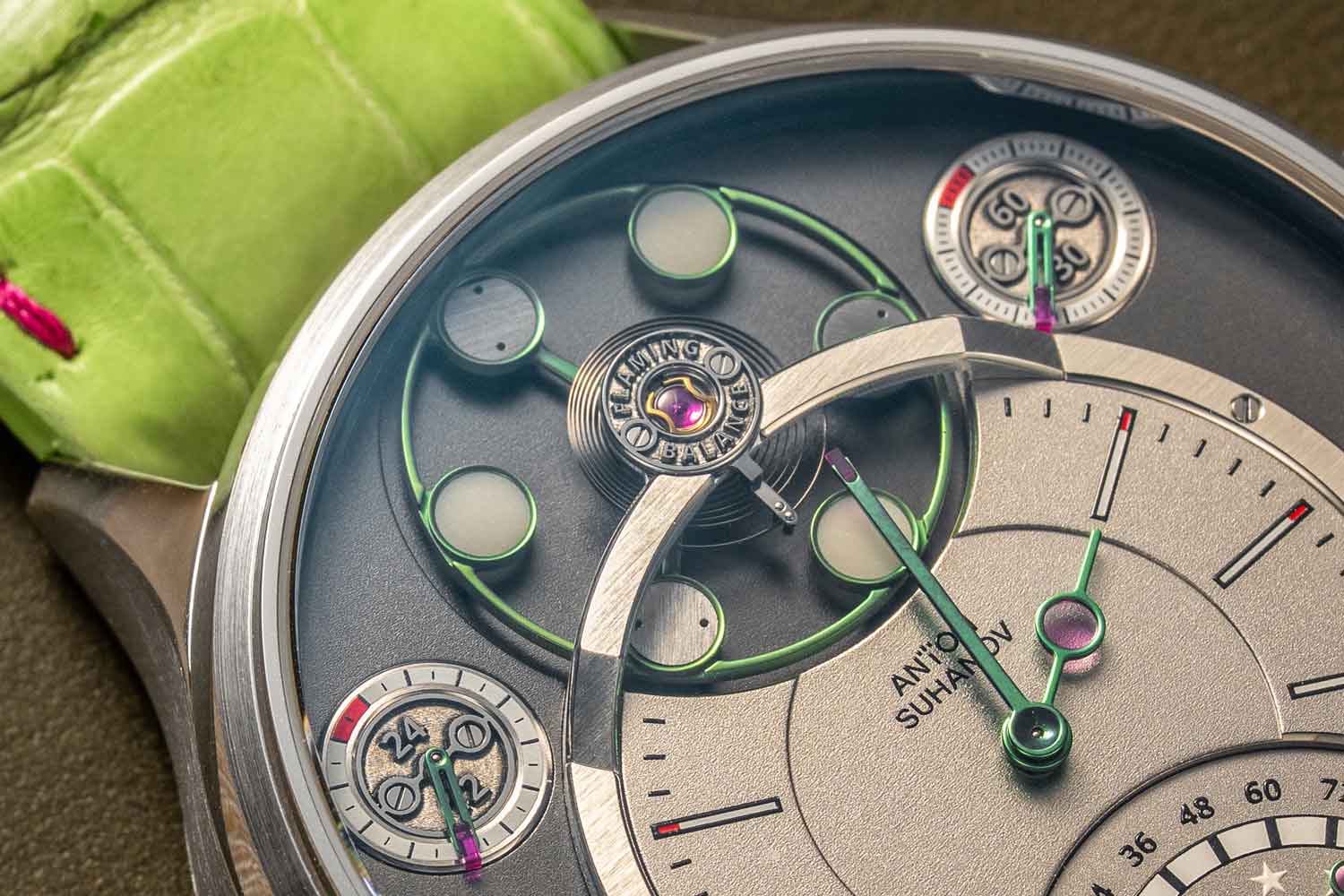
The dial also gains extra pink accents on the baton indices, in addition to the green. (Image: Revolution ©)
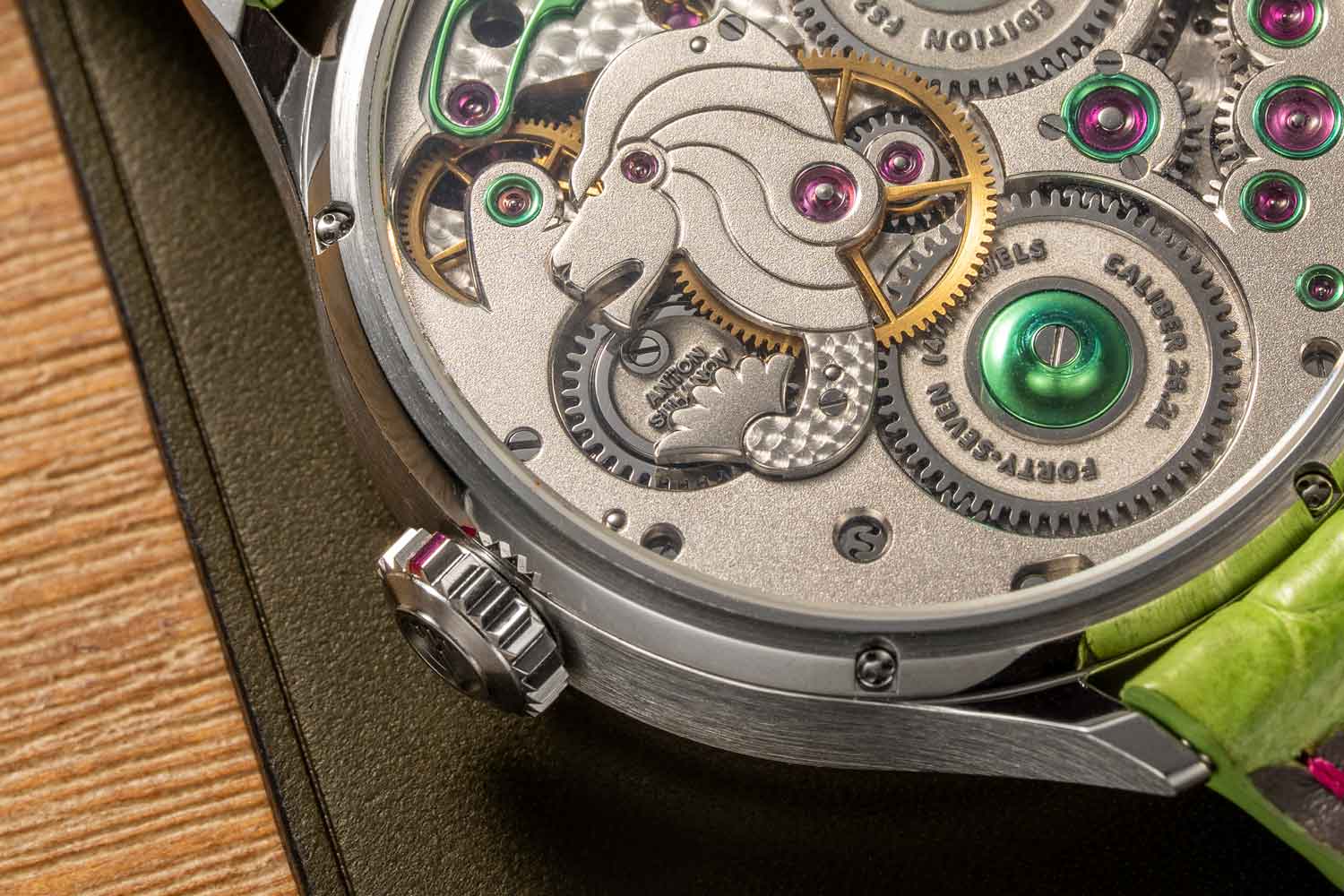
The crown jewel of Singapore, no pun intended. (Image: Revolution ©)
A city in the movement
Turning the watch over reveals a movement the watchmaker must be proud of: his first wristwatch movement designed and built entirely in his own workshop. My initial impression is that it looks nothing like the kind of movement newcomers to independent watchmaking might aspire to create – think multi-layered plates and bridges, frosted finishes and the like. Its appearance is perhaps slightly old-school, but that is precisely what makes it appealing.
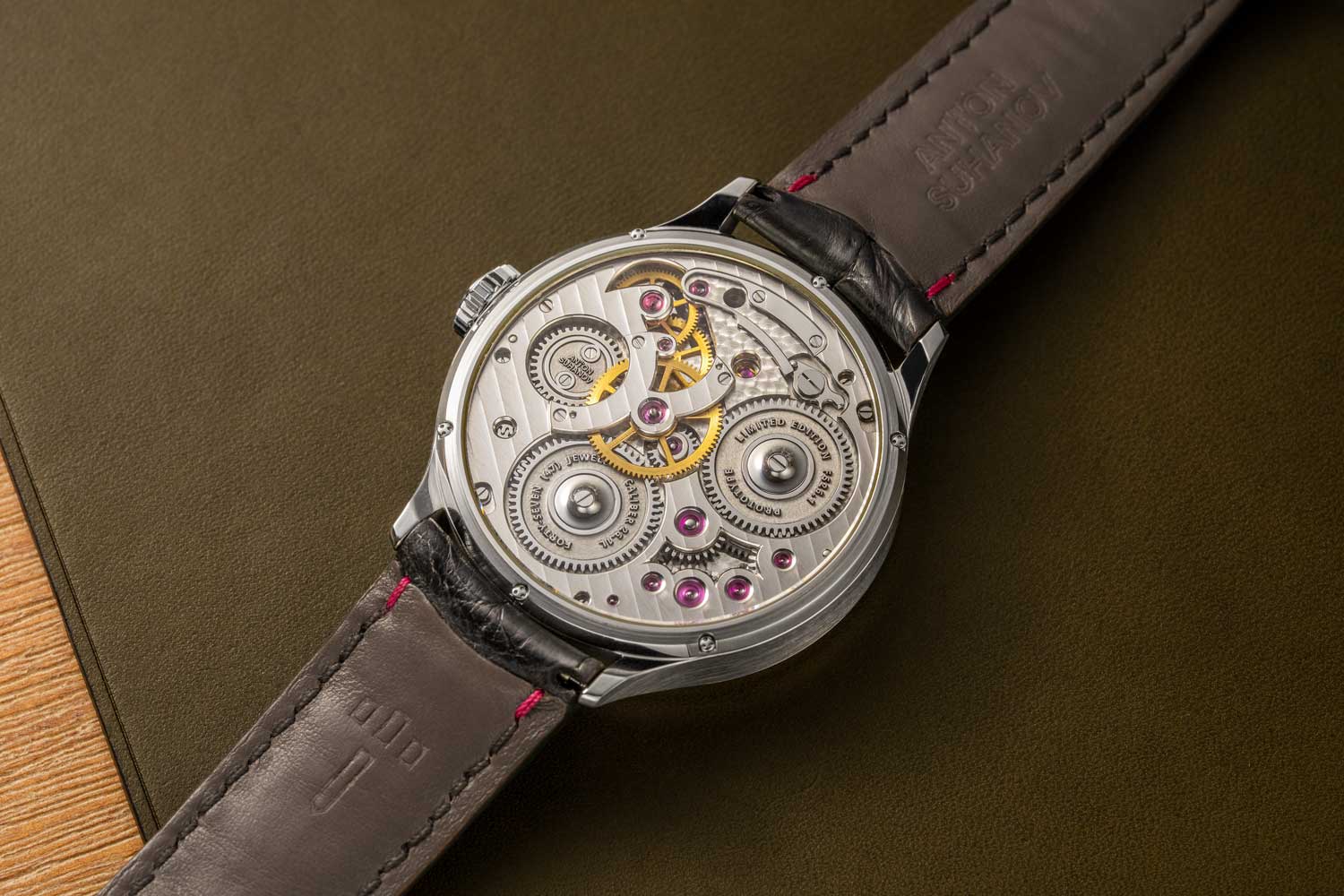
The in-house Su26.1L. (Image: Revolution ©)
Far removed from the usual circles of Swiss watchmaking, the movement’s layout reflects its Russian origins and the character of its creator. Originality, after all, is perhaps the most valuable quality of independent watchmaking today, and, ironically, what really made each independent brand stand out in the past.
Almost the entire caseback is occupied by the winding mechanism. This is perhaps even more apparent on the Singapore edition, where the Merlion’s tail waggles when the watch is wound, drawing attention to the movement of the other components. Starting at the crown, a crown wheel connects to the first barrel, which in turn links to the second barrel via an intermediate wheel. A long click spring and click then lock the barrel ratchet wheel. Even the four jewels between the two barrels are part of this system, serving the train that drives the power-reserve indicator. This is a particularly clever display: during the final 12 hours of power reserve, the hand moves twice as fast to emphasise the need to wind the watch. The watch offers a handsome three and a half days of running time on a full wind.
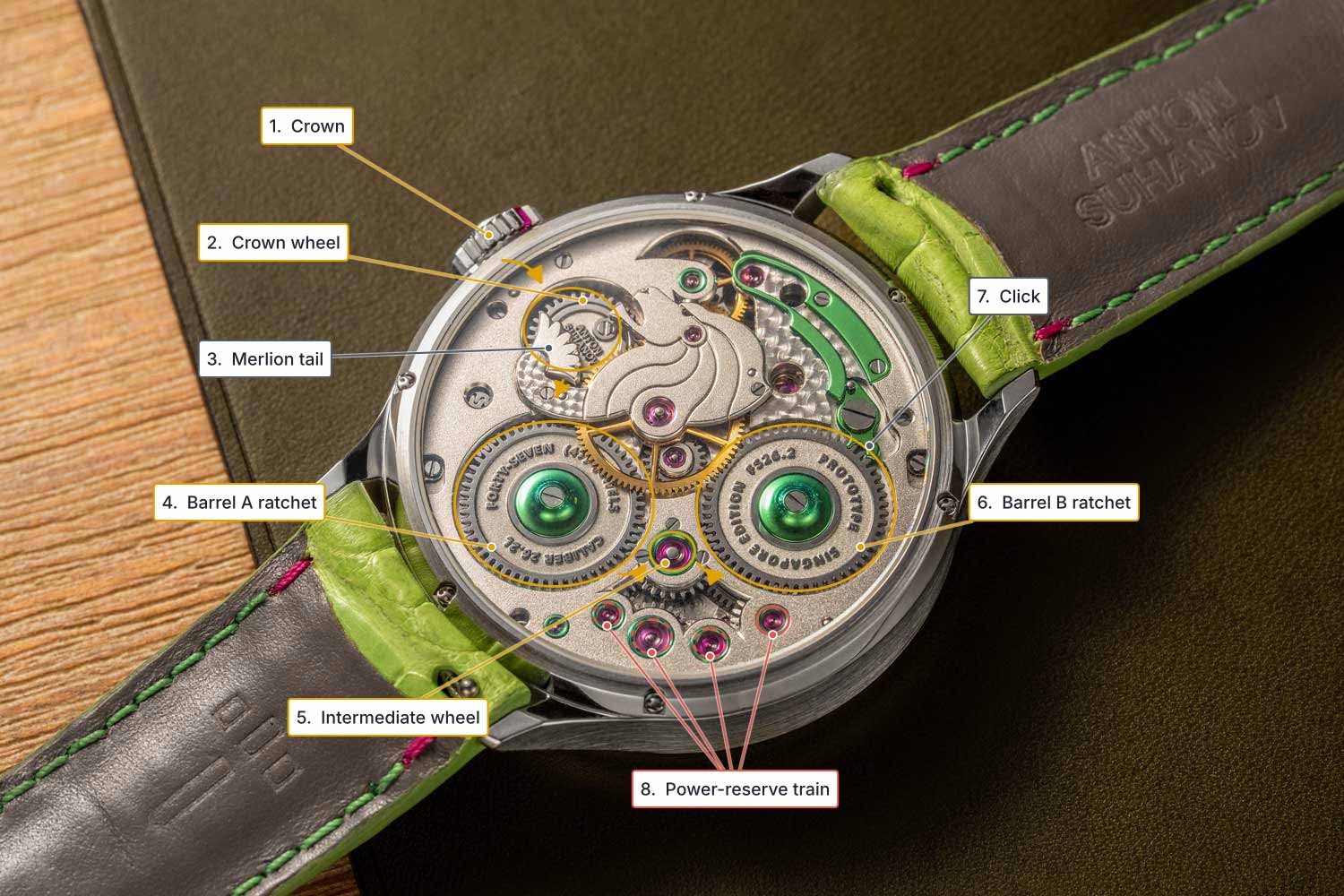
A more colourful back on the Singapore edition. (Image: Revolution ©)
While the Merlion on the back makes the Singapore connection obvious, the original edition also draws inspiration from Suhanov’s hometown, albeit in a much subtler manner. The Y-shaped bridge for the second and third wheels evokes the outline of a district in St. Petersburg. The logo on the crown wheel is positioned such that the movement resembles a map, with the workshop’s location marked by the logo. On the dial side, meanwhile, the balance bridge extending from the hour dial is inspired by one of the city’s drawbridges. These are the nitty-gritty details that only true St. Petersburg enthusiasts might recognise, but they look good in their own right and should appeal even to those without a connection to the city.
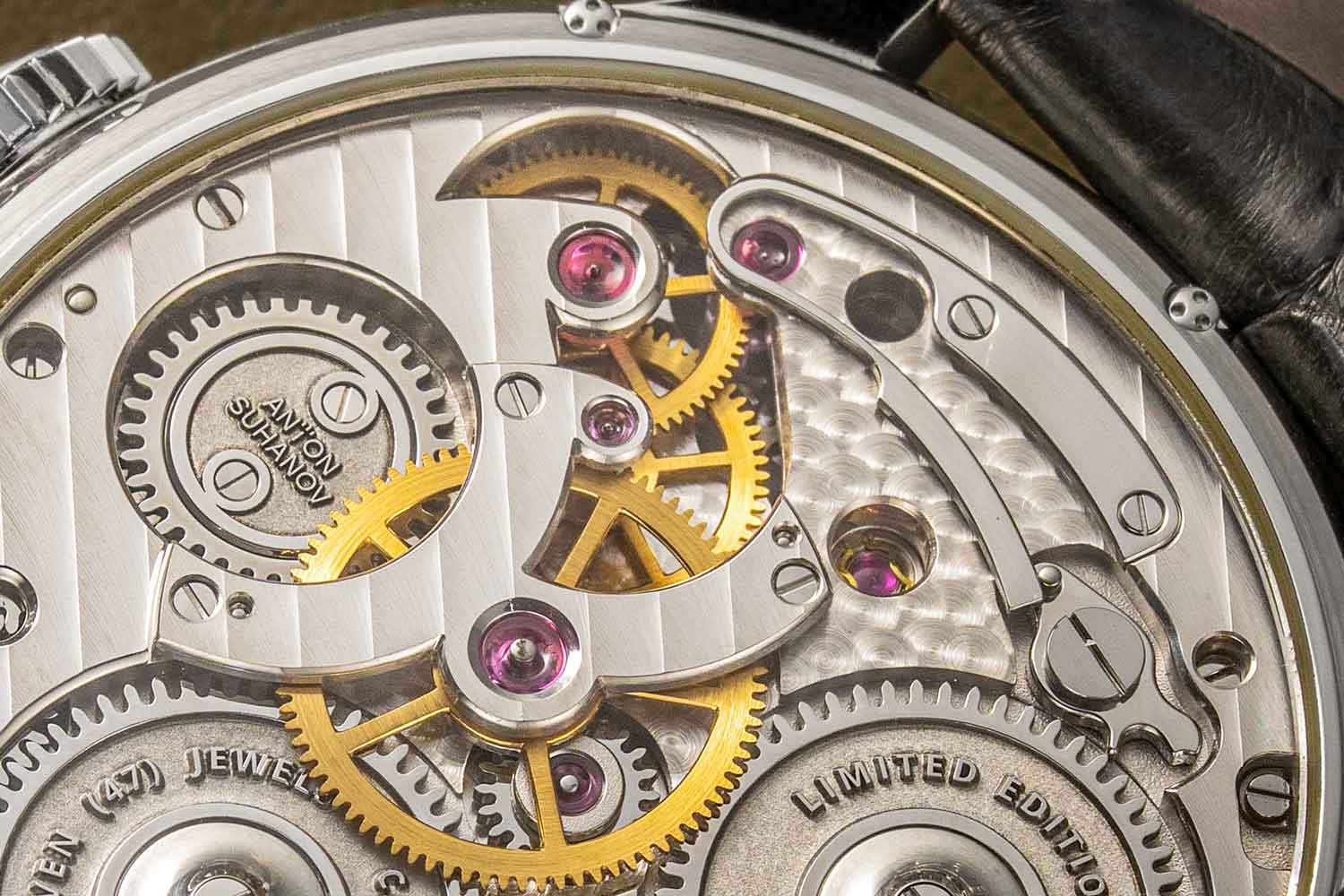
The original edition’s bridge for the second and third wheels has more interior angles than the Merlion bridge, whose outline is smoother and more flowing. (Image: Revolution ©)
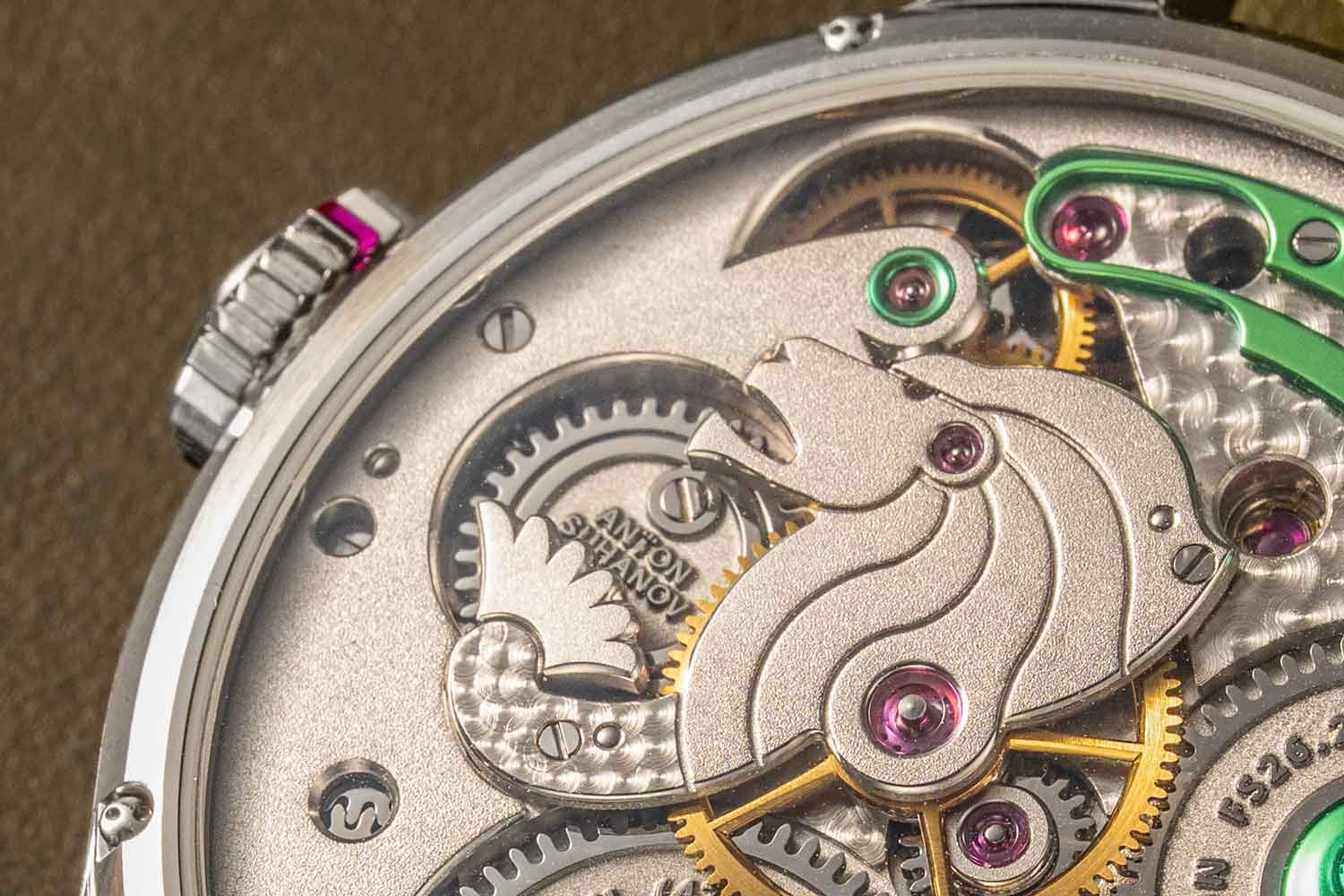
The Merlion, meanwhile, gains a wagging tail, making it almost like an automaton. Almost! (Image: Revolution ©)
The Singapore edition is again more colourful on the back, with plenty of green. The choice is amusingly electric, almost reminiscent of the 1990s or early 2000s, as is the increased use of perlage, now a relatively uncommon sight in independent watchmaking. The movement may look old-school, perhaps a little homespun, but that is precisely why it looks cool. A couple of years ago, it might have seemed basic, but times have changed, and this aesthetic feels interesting again. This is not to say that the finishing is lacking; quite the opposite. It is beautifully executed, particularly around the opening between the two barrels, which contains seven internal angles.
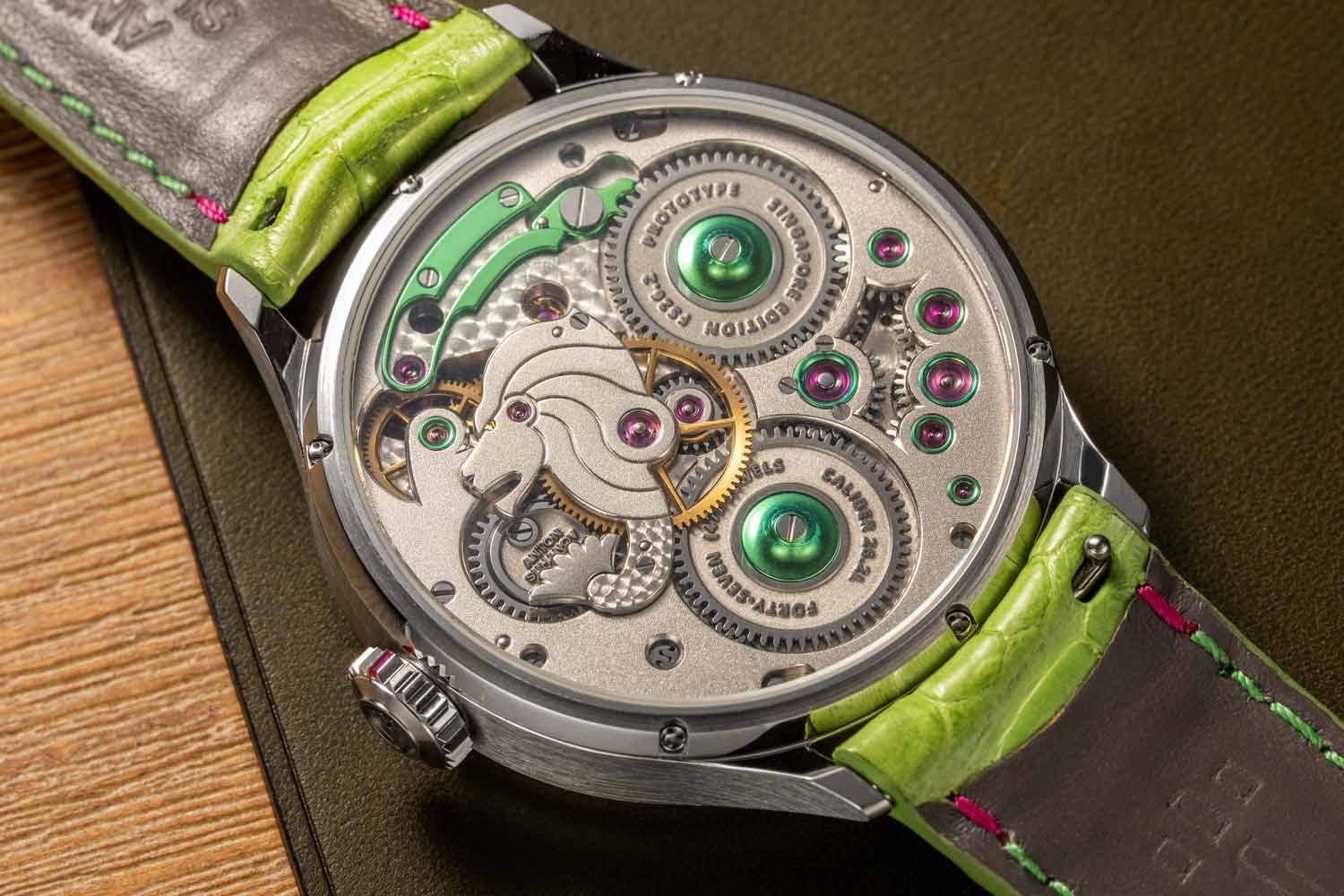
An unusual choice of green. (Image: Revolution ©)
And finally, there is the matter of price, a topic that can sometimes seem irrelevant in independent watchmaking, where demand often far exceeds supply. At CHF 55,000, the Flamingo can hardly be called affordable, but the price seems acceptable, at least judging by the market: the original edition of 38 pieces has sold out, despite having been unveiled only a few months ago. The Singapore edition, a smaller run of 18 pieces, is priced slightly higher at CHF 60,000, a premium that seems reasonable.
Concluding thoughts
Anton Suhanov has achieved more than his relatively low profile might suggest, for much of his earlier work was in the obscure world of clockmaking. Perhaps that best demonstrates how he simply does what he loves, without much concern for recognition.
The same passion and creativity have since found their way into his wristwatches, with the Flamingo being his first creation designed and built entirely in-house. With his imagination turning even the simplest displays into something unexpected, this time-only watch is an interesting piece. It will be worth watching what else Suhanov comes up with, particularly as he continues to develop his own approach to movement design.
A promising future to look forward to. (Image: Revolution ©)
Tech Specs: Anton Suhanov Flamingo
Movement: Calibre Su26.1L; hand-wound; 84 hours power reserve; 18,000 vibrations per hour (2.5 Hz)
Functions: Hours, minutes, small seconds, 24-hour indicator, and power-reserve indicator
Case: 42 mm x 11.5 mm; stainless steel; water resistant to 30 m
Strap: Grey alligator leather; stainless steel pin buckle
Limited edition: 38 pieces for the original edition; 18 pieces for the Singapore edition
Price: CHF 55,000 for the original edition; CHF 60,000 for the Singapore edition

Advertisement