Up Close: IWC Big Pilot’s Watch Perpetual Calendar ProSet Le Petit Prince
Reviews
Up Close: IWC Big Pilot’s Watch Perpetual Calendar ProSet Le Petit Prince

The perpetual calendar has been a staple complication for Schaffhausen watchmaker IWC ever since Kurt Klaus’ ingenious perpetual calendar debuted at Baselworld in 1985. Its appeal went beyond its ingenious crown-operated setting system.
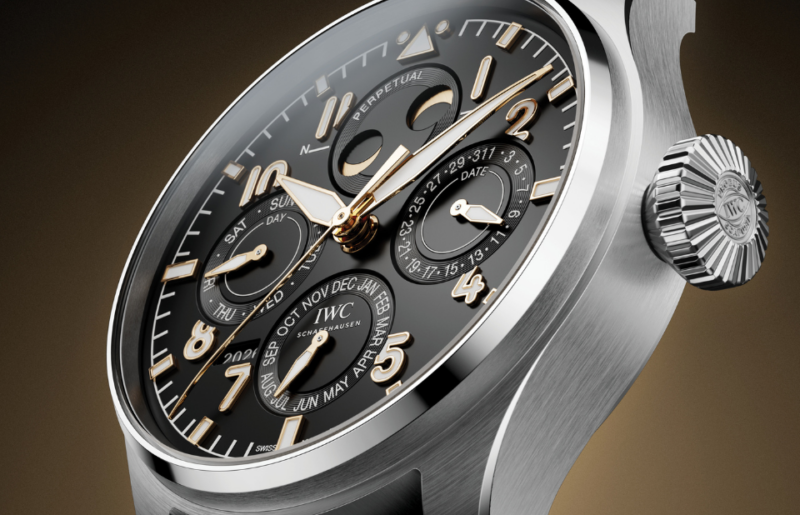
Across many of IWC’s watch families, the perpetual calendar also became known for its beautiful, oversized four-counter layout, a traditional design that nevertheless stands out in the world of perpetual calendars. One of its most recognisable expressions is the Big Pilot’s Watch Perpetual Calendar, whose busy dial captures the spirit of a pilot’s cockpit.
Four decades after Kurt Klaus’ original perpetual calendar debuted, IWC unveiled its latest evolution at Watches & Wonders this year, the ProSet. The system not only allows all adjustments to be made through the crown, but also both forwards and backwards. This eliminates the need to wait for time to catch up when a perpetual calendar has been accidentally advanced too far, or to send the watch back to the factory to have it corrected. With ProSet, you can simply turn back time.
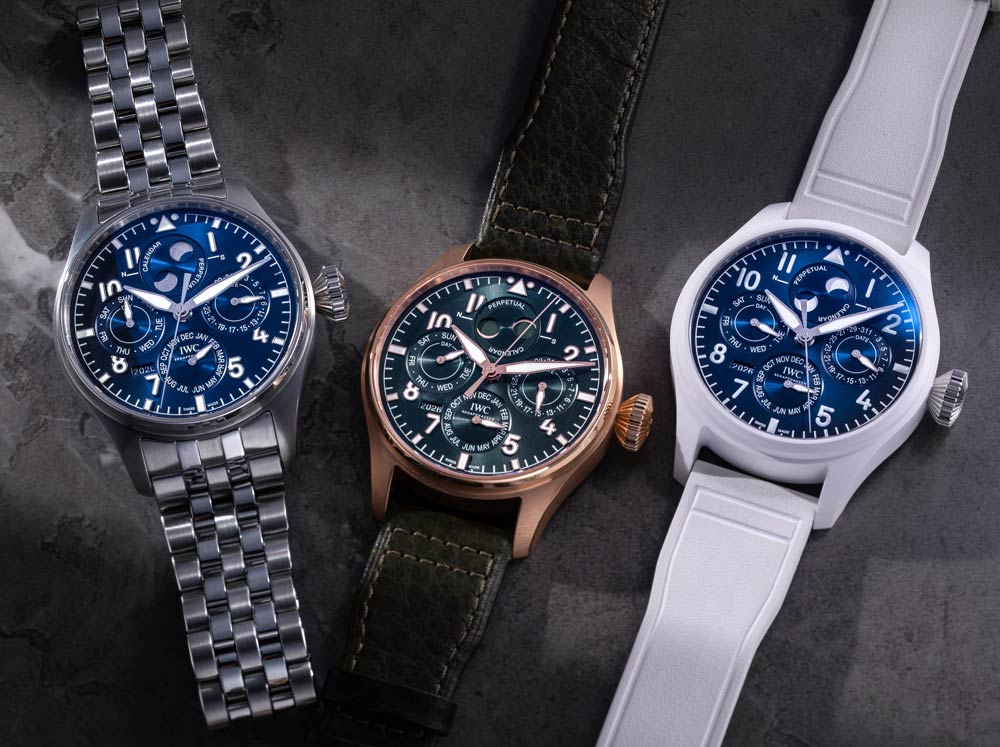
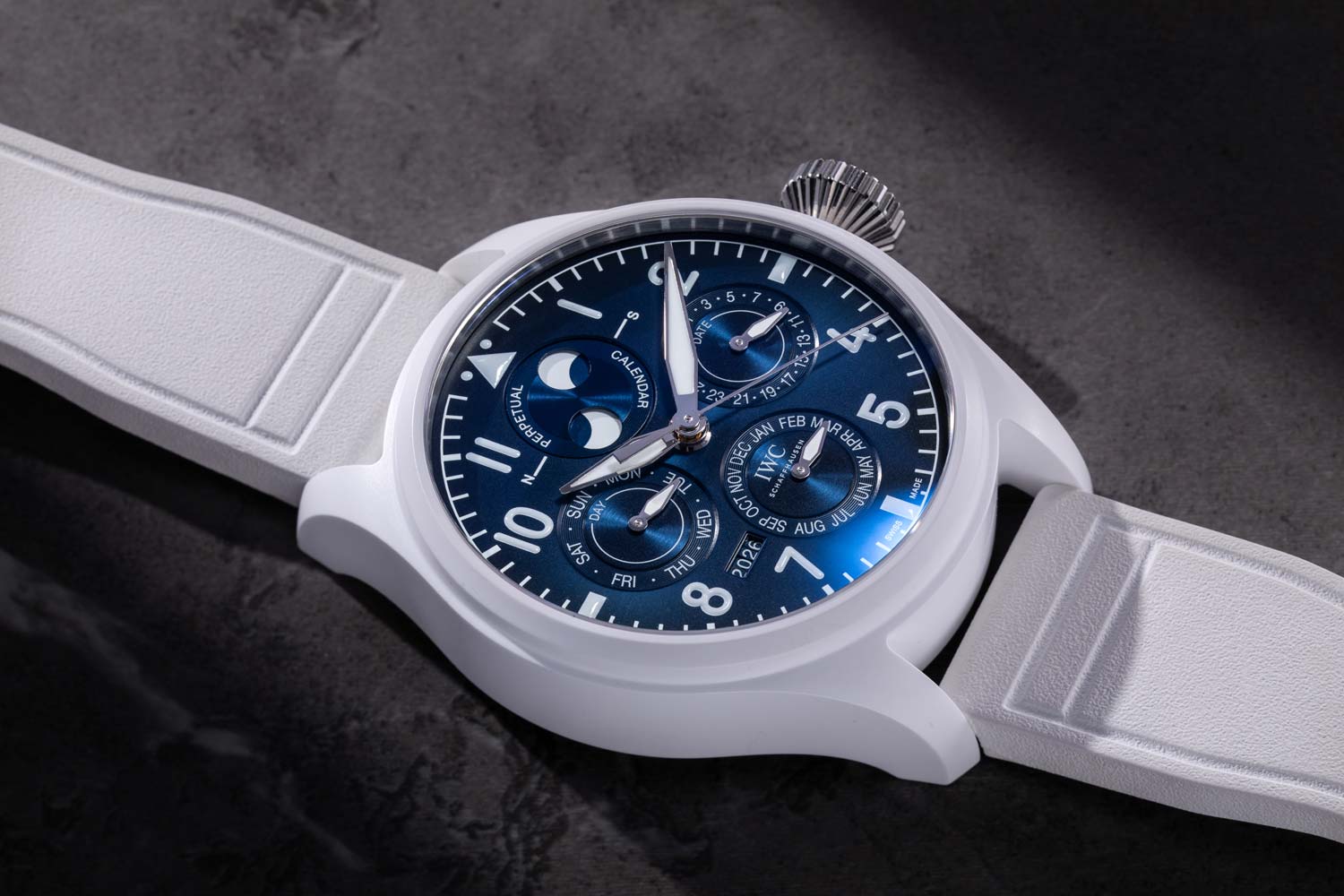
The new system makes its debut in the Big Pilot’s Watch Perpetual Calendar ProSet Le Petit Prince, with a blue dial now synonymous with the brand, paired with a futuristic-looking white ceramic case.
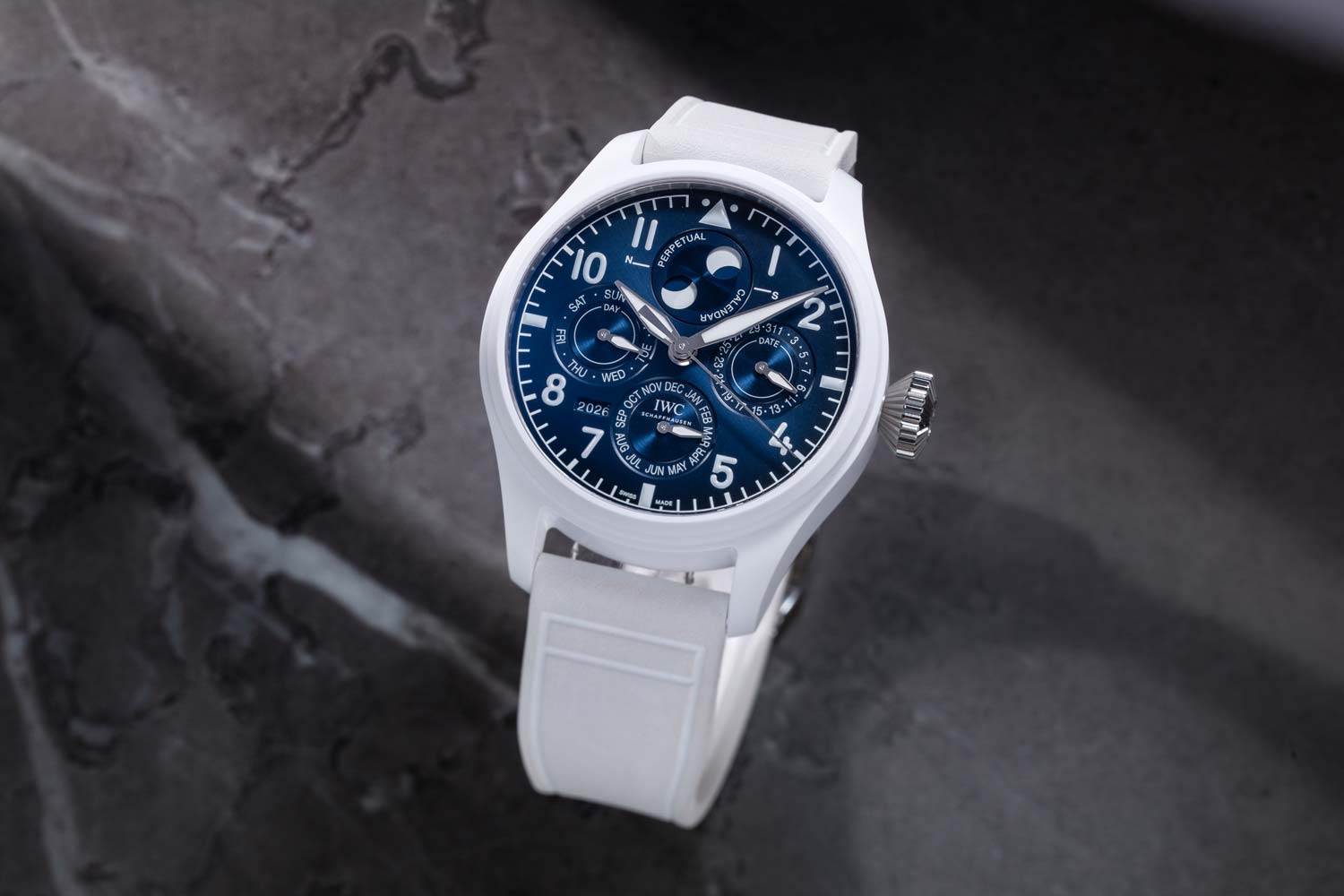
The new Big Pilot’s Watch Perpetual Calendar ProSet Le Petit Prince (Image: Revolution ©)
Within the realm of perpetual
The story of the perpetual calendar on the wrist dates back to 1925, when Patek Philippe created the world’s first known perpetual calendar wristwatch. Yet innovation in the complication moved at a surprisingly slow pace. It was not until 1955 that Audemars Piguet introduced the first leap-year indication with its ref. 5516.
For much of the mid-20th century, Patek Philippe and Audemars Piguet remained among the most prominent names in perpetual calendar wristwatches, with relatively few watchmakers producing them at the time.
After the quartz crisis of the 1970s and 1980s, mechanical watchmaking entered a renaissance. It was during this period that the development of the perpetual calendar once again took a significant leap forward. Here, we will highlight a few improvements, particularly those perpetual calendars that can be set via the crown.
In 1985, IWC unveiled the world’s first perpetual calendar that could be adjusted entirely through the crown, eliminating the need for recessed pushers on the case. The day and date could also be quick-set without having to cycle through the time, while all the calendar indications, including the month, year and moon phase, remained synchronised when the date was changed (which is neither necessarily good nor bad: when adjusting the calendar by a few days, having everything fully synchronised is ideal, but when setting it several months or even years ahead, full synchronisation means having to advance it day by day, potentially hundreds of times). It was also relatively accessible, with the perpetual calendar module fitted onto a Valjoux 7750, resulting in one of the most affordable perpetual calendar chronographs of its time.

The IWC Da Vinci Perpetual Calendar Ref. 3755 in black ceramic from 1986, the second iteration of Kurt Klaus’ perpetual calendar (Image: IWC)
The next major innovation arrived a decade later, in 1996, with the Ulysse Nardin Perpetual Ludwig, developed by watchmaker and astrophysicist Dr Ludwig Oechslin. It was the world’s first perpetual calendar that could be adjusted backwards. Notably, the date and month can be quick-set together, while the day of the week has to be adjusted independently by advancing or reversing the hour hand. Its significance lies in the fact that it broke with the traditional logic of the perpetual calendar – for the first time, it replaced the traditional grand lever mechanism with a system of gears.
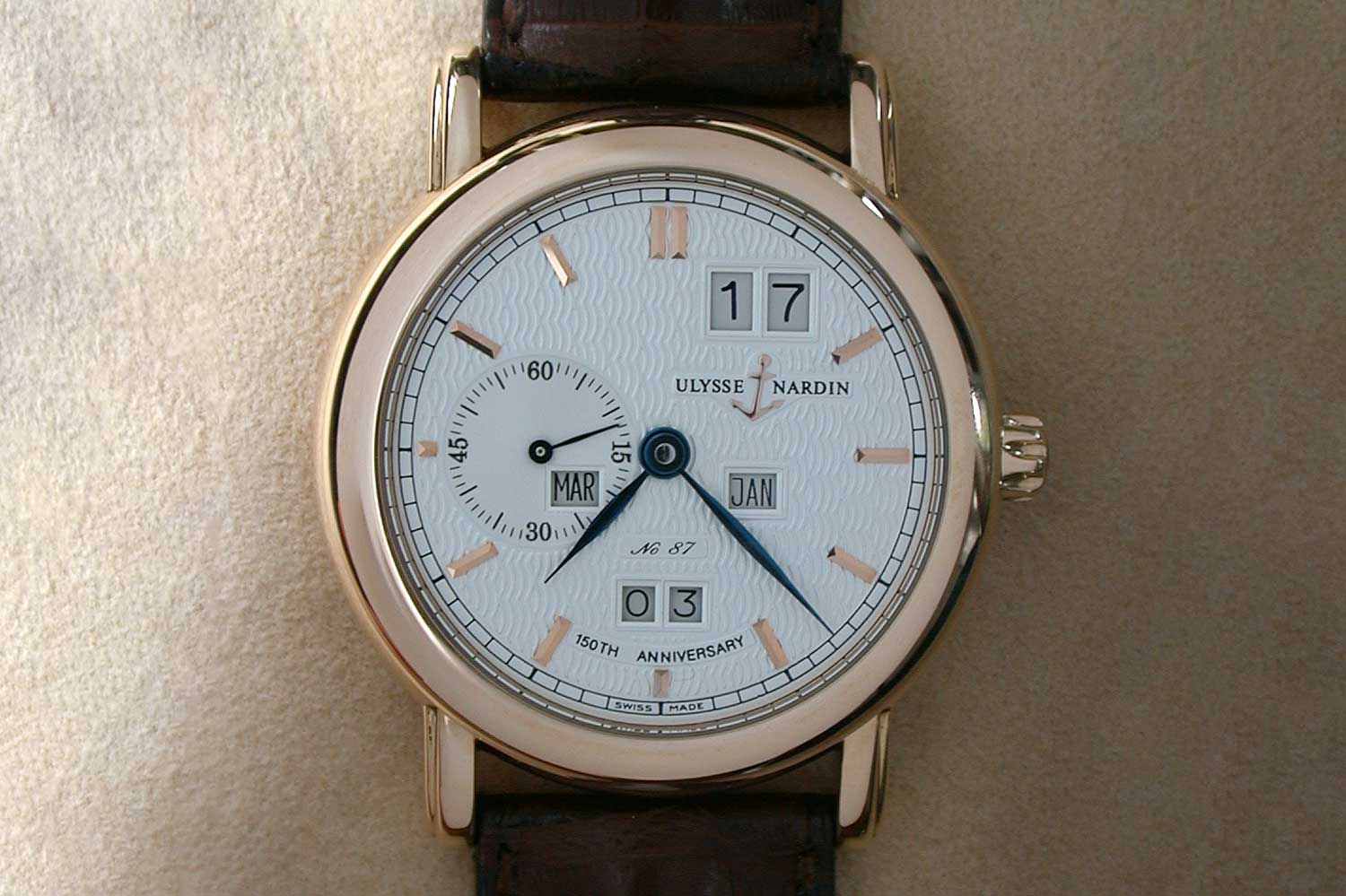
An example of the Ulysse Nardin Perpetual Ludwig from 1996
Another decade passed before the arrival of the H. Moser & Cie. Perpetual 1 in 2005, developed with the help of independent watchmaker Andreas Strehler. The Perpetual 1 combines features from the two watches above, namely crown adjustment and the ability to adjust the calendar both forwards and backwards, while improving the display with an instantaneous jumping date. Quick-setting of the date and month is also possible, but it does lack a day-of-the-week display. This improves the usability and technical sophistication of the perpetual calendar, and was so innovative that it also helped put the brand on the map of modern watchmaking, partly thanks to its very clever and minimalist dial, which looks nothing like you would expect from a perpetual calendar.
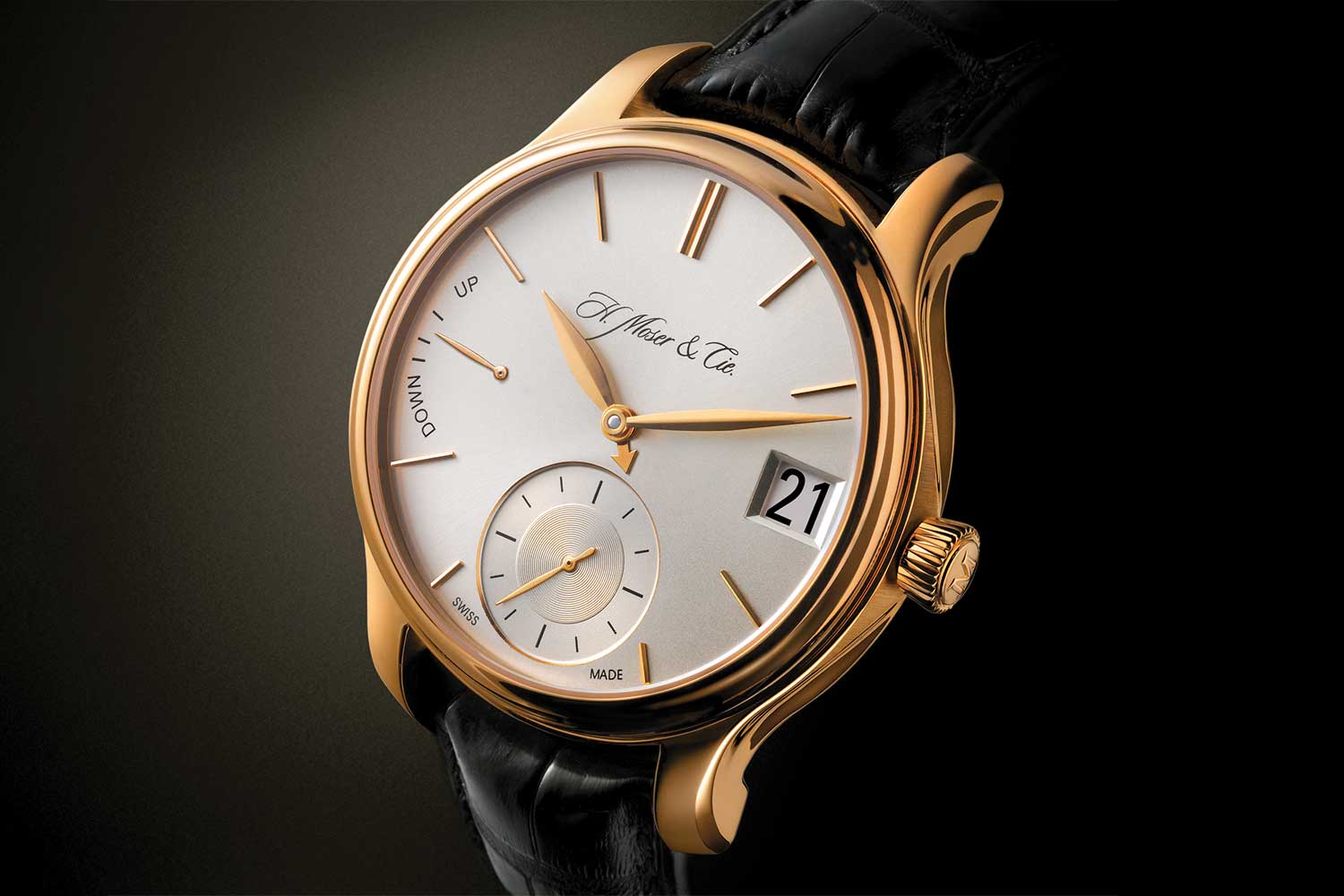
The H. Moser & Cie. Perpetual 1 from 2005. (Image: H. Moser & Cie.)
A few other perpetual calendars are also worth mentioning because they can be set via the crown, which remains a rarity to this day. Only a handful can be operated in this way.
In 2007, Panerai released a co-branded watch with Ferrari that contained a perpetual calendar module that could be set forwards and backwards, but without quick-setting. This means that you have to cycle through the time (fortunately via hour-hand jumping in hourly increments) to change the calendar indications.
Then there is the F.P. Journe Quantième Perpétuel, which can be adjusted via the crown for the day and date, but only forwards. The day and date can be quick-set, but they are independent of each other and have to be set separately. The month is adjusted via a trigger hidden under the upper right lug. What is special about this watch is its instantaneous date, day and month, giving the owner a satisfying, loud click at midnight as all the displays jump together, rather than slowly rolling over.
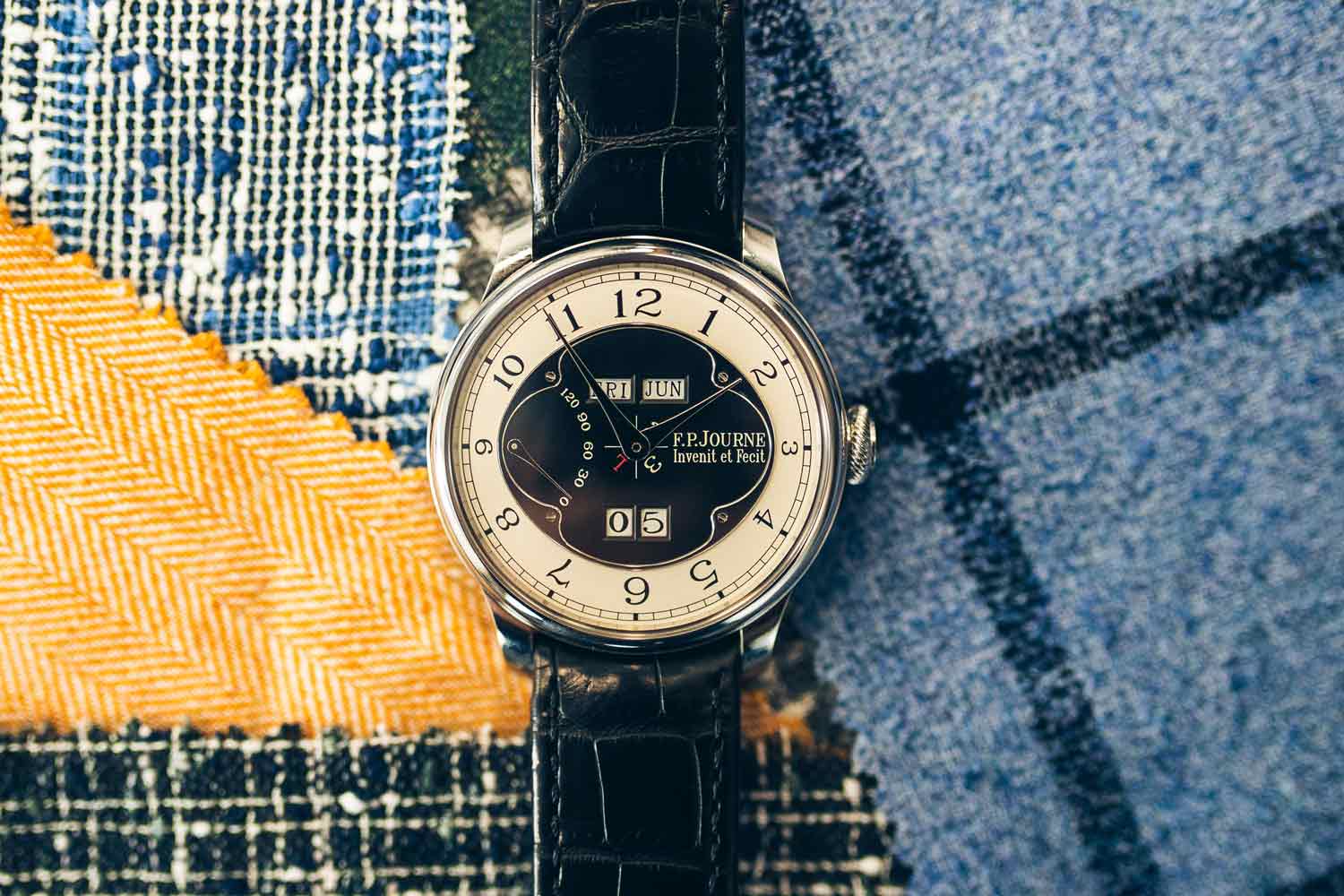
The F.P. Journe Quantième Perpétuel Black Label in 40 mm. (Image: F.P. Journe)
In 2015, the Greubel Forsey Quantième Perpétuel à Équation took the perpetual calendar to another level. It has a highly legible inline display for the day, date and month, along with a complete perpetual calendar display including the four-digit year (although it omits the moon phase). It even adds other functions such as the equation of time. Most impressively, it combines crown adjustment in both directions with quick-setting and instantaneous jumping. In terms of functionality, it is at the top level of what a perpetual calendar can do. If we are nitpicking, the only improvement would be independent control of the different indicators, instead of having them hard-coded to remain synchronised.

The incredible Greubel Forsey Quantième Perpétuel à Équation (Image: Greubel Forsey)
Most recently, there is the Audemars Piguet Perpetual Calendar Cal. 7138, unveiled during the brand’s 150th anniversary. Notably, it is the only perpetual calendar in which all calendar indications – date, month, day and moon phase – can be individually adjusted via the crown, meaning one need not cycle through multiple dates to change the month. However, it can only be adjusted forwards. It is worth mentioning here because it is one of the few crown-adjusted perpetual calendars that still uses the traditional grand lever, which is also why it cannot be adjusted backwards. It is a nice combination of old-school and modern qualities.

The latest Audemars Piguet Royal Oak Selfwinding Perpetual Calendar with Calibre 7138. (Image: Revolution ©)
Finally, there is the IWC ProSet, which can be set both forwards and backwards via the crown. Functionally, it achieves the same thing as the Ulysse Nardin, Moser and Panerai in that the calendar can be adjusted forwards and backwards through the crown. Notably, quick-setting is also possible. However, it is the only perpetual calendar among these that retains a classical four-subdial layout. The other innovative perpetual calendars have adopted more unconventional displays.
For someone looking for a classical-looking perpetual calendar with the modern convenience of crown adjustment in both directions, the IWC ProSet is the only one.
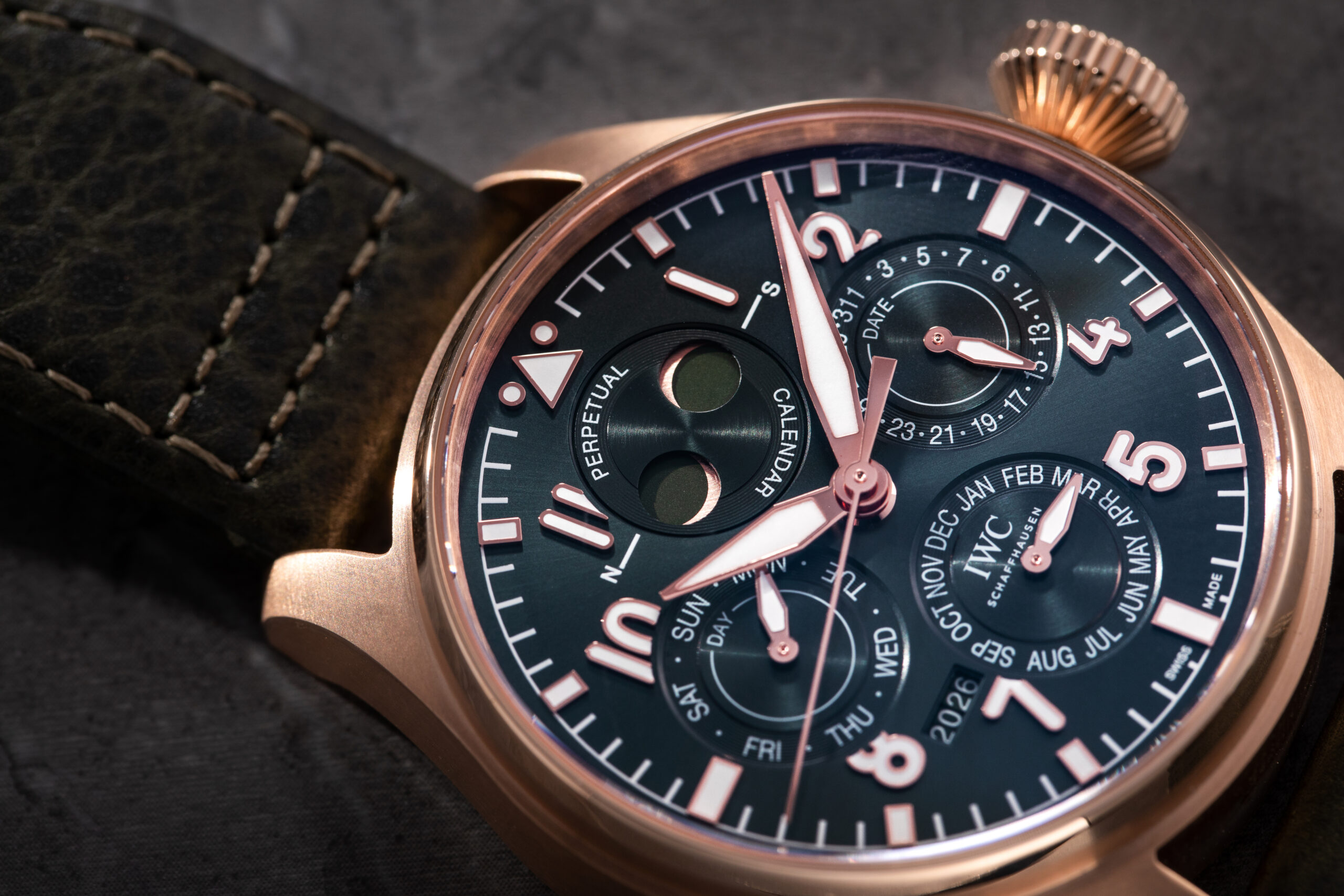
The IWC ProSet that still retains the old-school four-counter layout. (Image: Revolution ©)
Below is a table that summarises the innovations in perpetual calendars that can be set via the crown, along with several traits relating to usability, such as forward or backward adjustment, quick-setting, synchronised or independent calendar setting, instantaneous jumping, and the presence of a dead zone, or a dangerous period for changing the calendar.
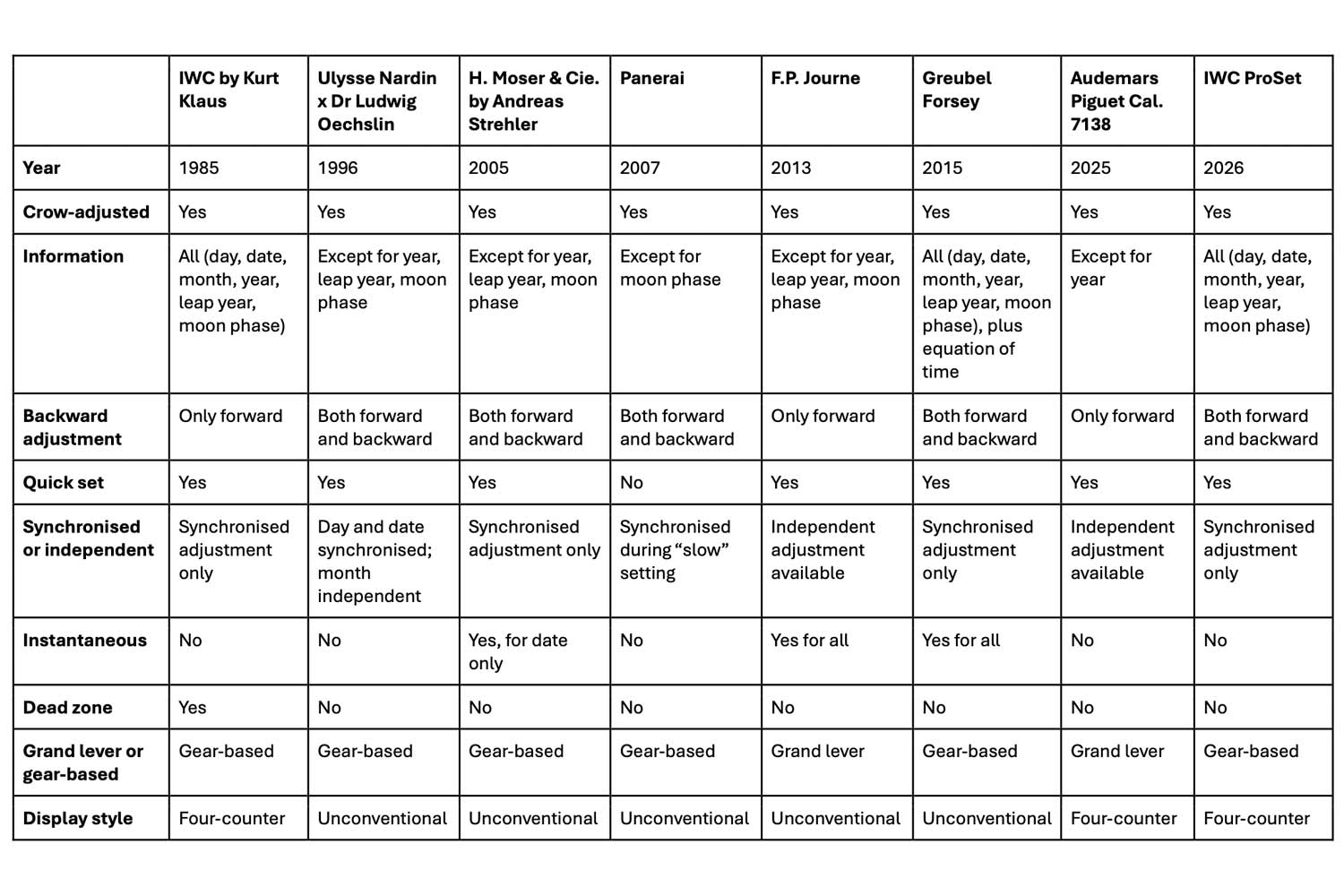
A table comparing perpetual calendar wristwatches that can be set using the crown. (Image: Revolution ©)
The table makes one thing clear: perpetual calendars have certainly improved over the years, but none is perfect. Each has its own quirks and strengths, whether in its design or underlying mechanics. Even the top-of-the-game Greubel Forsey cannot set every indicator independently.
The two latest entries in the table, both introduced in 2026, are particularly interesting. They represent two very different approaches to perpetual calendar innovation. Both can be fully adjusted via the crown, but that is where the similarities stop. All indicators on the AP can be set independently, but it cannot be adjusted backwards. The IWC can go backwards, but calendar adjustments involving months may require cycling through hundreds of days.
It is quite cool to see these two streams of innovation developing side by side. Collectors can choose their side depending on their own habits when setting a calendar.
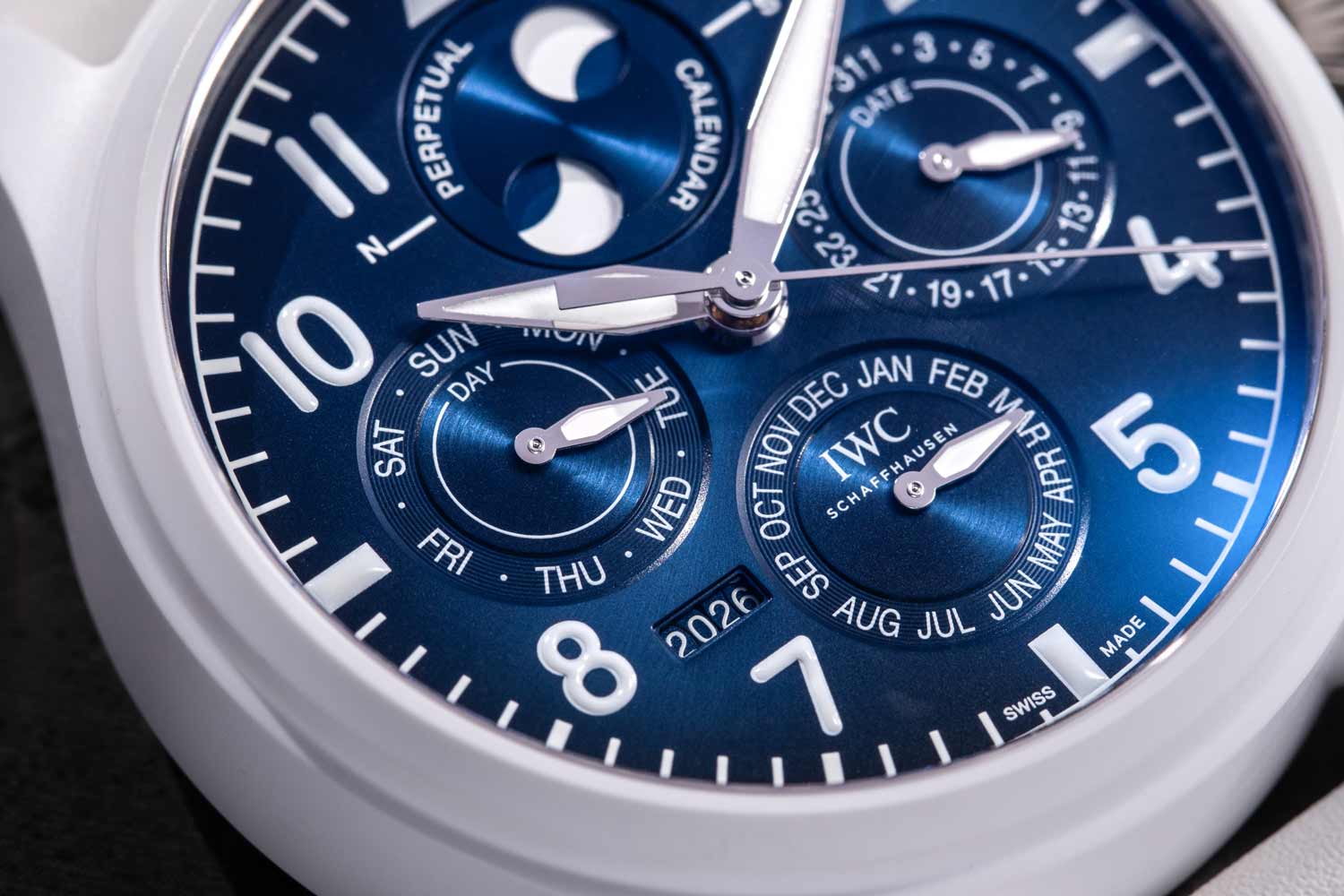
A new milestone beginning in 2026 (Image: Revolution ©)
Turning back time
The biggest advancement of the ProSet over the original IWC perpetual calendar by Kurt Klaus lies in the fact that it can be set backwards. This seemingly small increase in functionality actually comes from a radical change under the dial. Put simply, the perpetual calendar module is no longer the same. It is an entirely new construction from the ground up.
The traditional perpetual calendar relies on a grand lever, which controls the system as it climbs and falls through peaks and valleys, triggering the forward motion of the calendar displays, often with different sizes of jumps. This mechanical setup, with its tension springs and cams, can only work in one direction. Reverse the movement and the geometry of the climbing motion no longer works, meaning the jump size is no longer the same. In other words, the calendar can jump forwards from February 28 to March 1, but the same jump cannot be made backwards. In fact, reversing the mechanism is entirely impossible because of the way the geometry locks.
For a perpetual calendar to be set backwards, the traditional design therefore has to be put aside. That means no more grand lever. Instead, it needs gears. Fully rounded gears, despite variations in their tooth profiles, can physically turn in either direction. Removing the grand lever and relying on a gear-based system therefore meant a complete redesign of the perpetual calendar module from the ground up for IWC.
One of the most important parts of the mechanism is the programme wheel, which incorporates four key elements: a month-length wheel, a leap-year wheel, three flexible fingers and a pair of cams. Together, they account for the different lengths of the months and the four-year leap-year cycle.
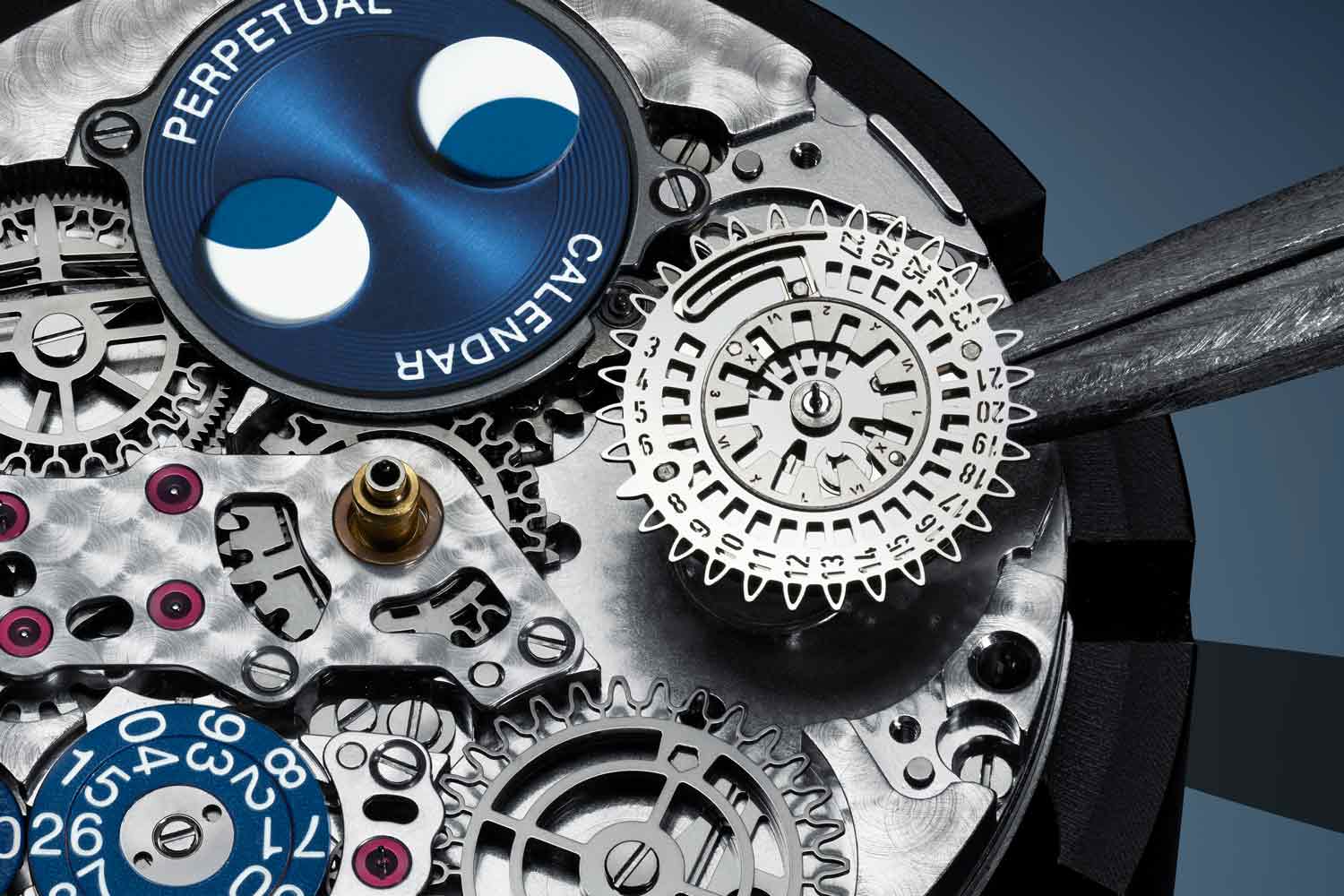
Placing the programme wheel on the perpetual calendar module (Image: IWC)
Power reaches the calendar from the hour wheel through a planetary reduction train to derive a 24-hour rotation. A second wheel is stacked with the 24-hour wheel and rotates as one with it. This carries the ordinary date-driving finger, which engages the date wheel once a day to advance the date by one position.
The date wheel has 31 teeth for the normal daily change, while a separate month-end wheel carries three flexible fingers that can extend to effectively form three additional teeth for the extra advances required at the end of shorter months. A pair of cams – a month cam and a leap year cam – effectively form the program wheel through which the four different month lengths are encoded. The pair controls when and how many fingers extend. As the date wheel rotates, the fingers follow the contours of the cams, which push them out or allow them to retract according to the length of the month. None extends for a 31-day month, one for a 30-day month, two for February in a leap year, and all three for February in a normal year.
Essentially, the number of extended teeth determines how many days the calendar needs to skip to reach the 1st of the next month. The extended fingers then engage the 24-hour wheel during its nightly change, making the calendar skip the required number of days and advance directly to the 1st of the next month.
At the end of February, the leap-year cam comes into play. Completing one revolution every four years, it controls the third retractable finger, which extends in a normal year but remains retracted in a leap year. This gives the mechanism the distinction it needs to treat February as either 28 or 29 days. The number of extended fingers then determines how many teeth the 24-hour wheel engages during the nightly change, allowing the calendar to advance correctly to 1 March.
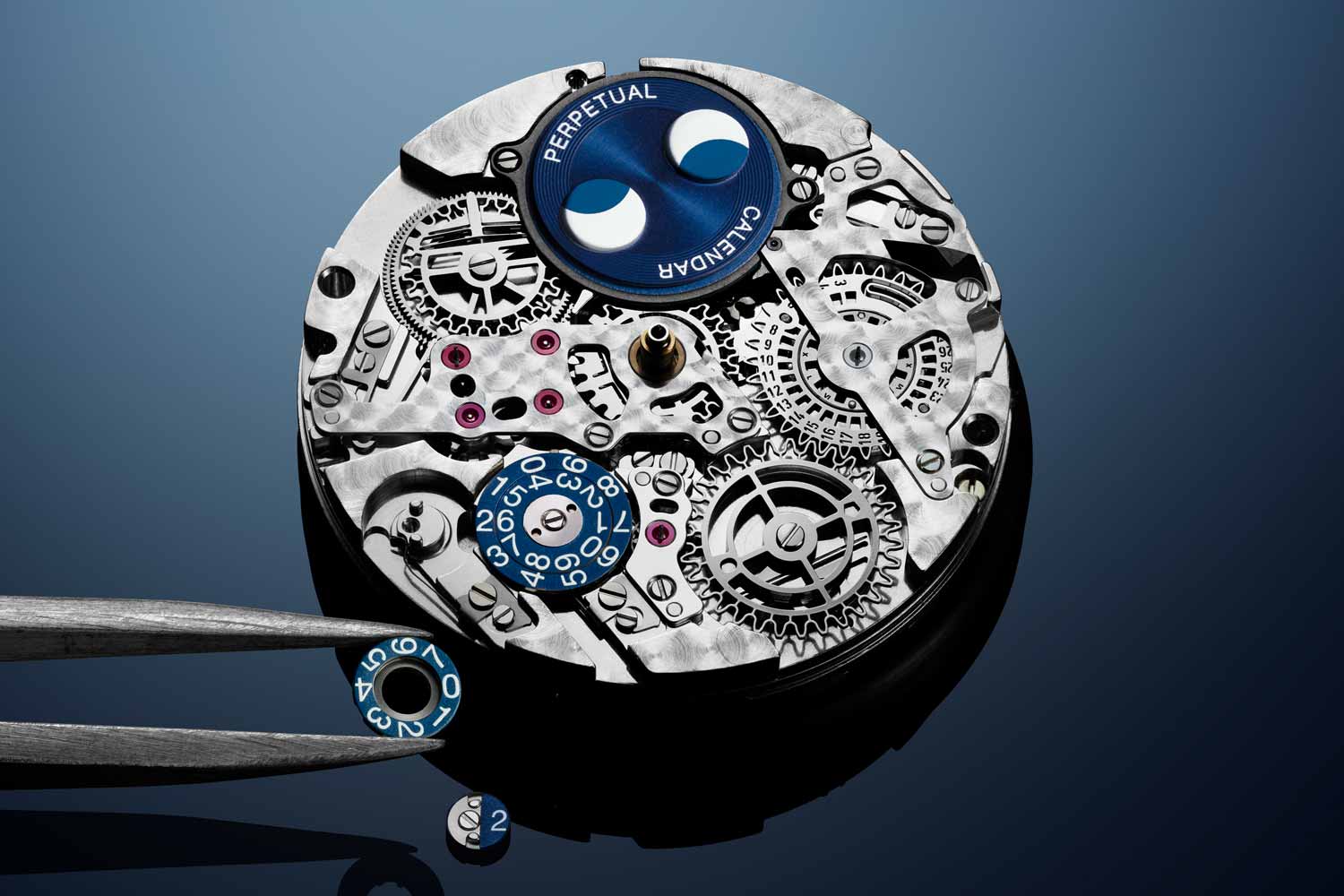
Note the four-digit year disc. In the original version, the first two digits, “20”, are fixed, whereas here the first digit, “2”, is fixed and the second rotates from 0 to 7. (Image: IWC)
The complexity of this mechanism also presents a significant manufacturing challenge. IWC uses LIGA, a precision process in which light creates an exact pattern before the component is built up in metal through electroplating. This allows IWC to produce precise components with complex geometries that would be difficult to achieve using conventional industrial methods.
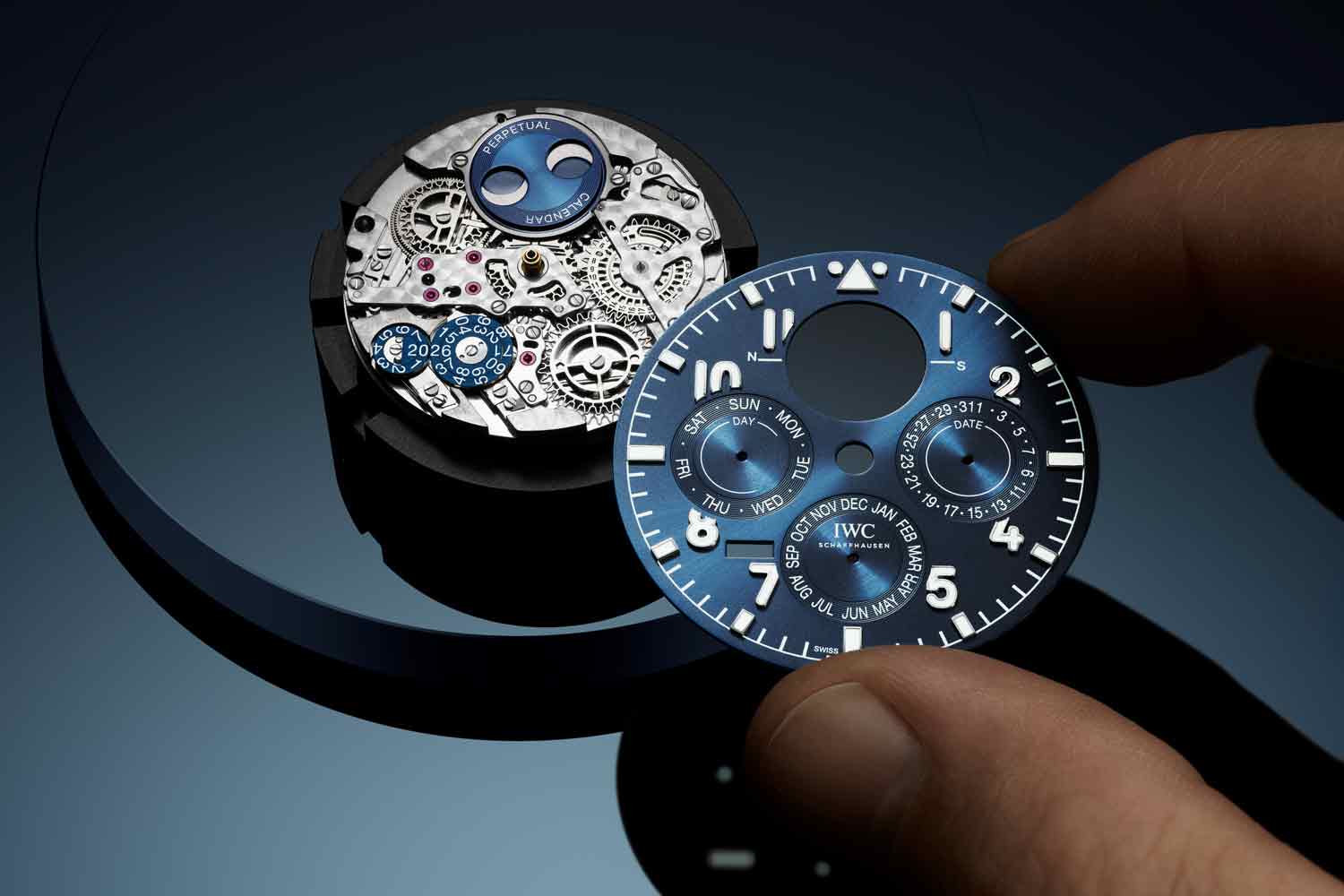
A slew of gears with hollowed-out teeth thanks to LIGA (Image: IWC)
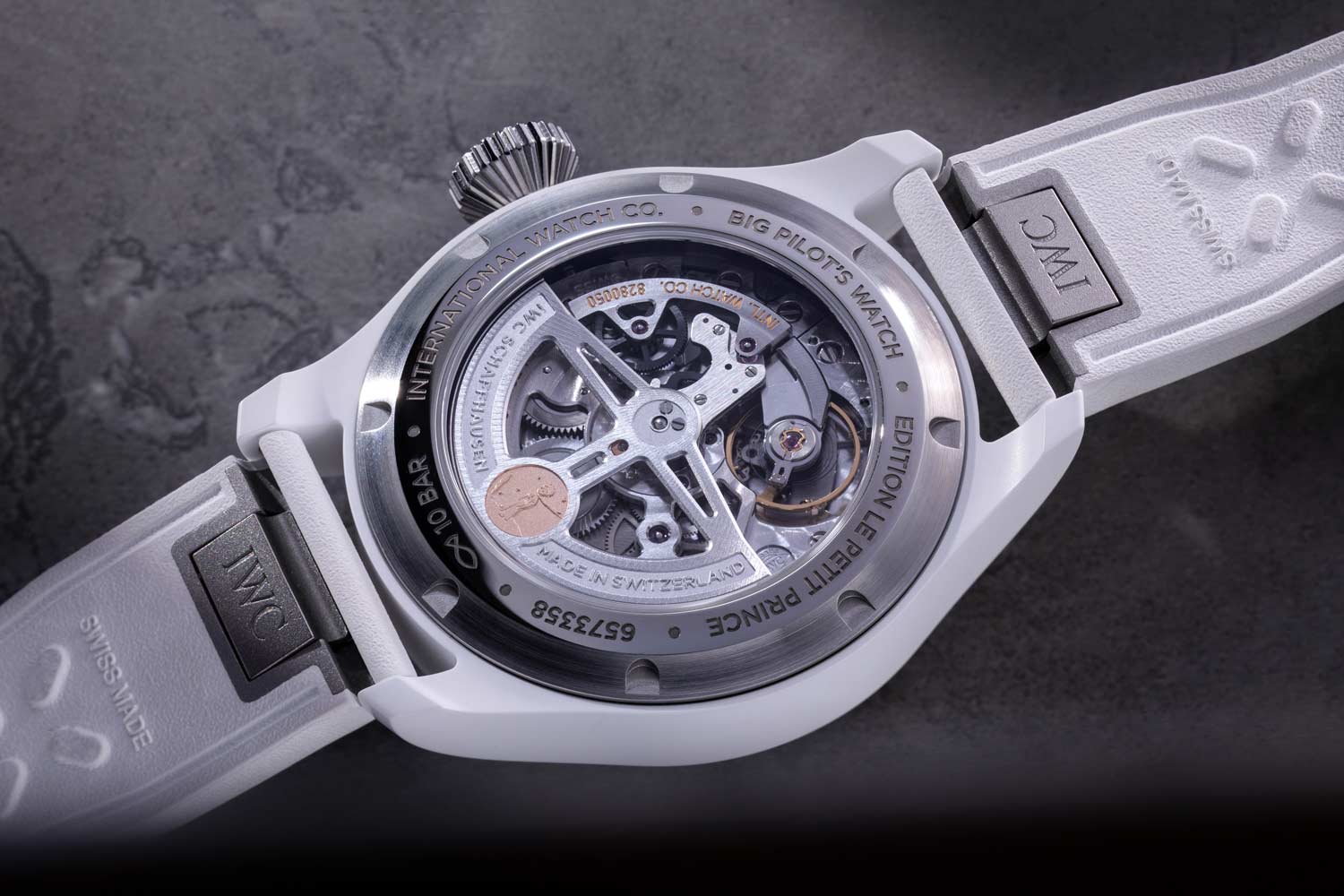
Inside the Big Pilot’s Watch Perpetual Calendar, however, is the Calibre 82665. This comes as a bit of a surprise. Big Pilot’s Watches typically use movements with a seven-day power reserve. But this is the smaller 43 mm Big Pilot’s Watch rather than the 46mm model. As a result, it uses a base movement with a 60-hour power reserve, similar to the movements found in the Portugieser and the 43 mm time-only Big Pilot’s Watch.
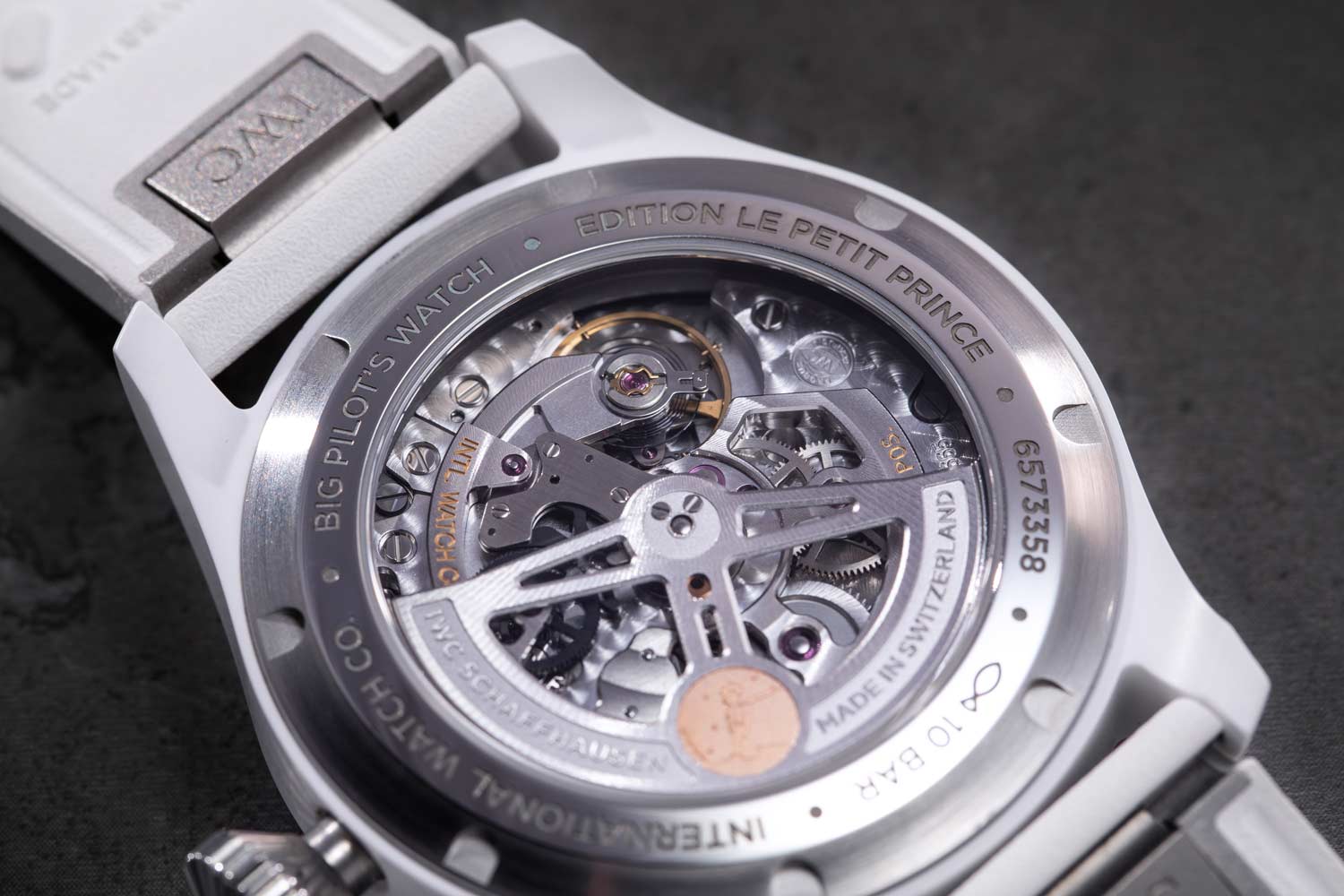
White ceramic for the Little Prince
The ProSet makes its debut in the Big Pilot’s Watch, and among the lineup, the Le Petit Prince is the most eye-catching. Its signature blue dial is now paired with a striking white ceramic case, giving the watch a distinctly more futuristic look (though the crown, case back and buckle are in steel). The case is now 43mm, making it a much more wearable size.
That futuristic character is particularly appropriate because the calendar display has also been redesigned to look colder and more technical. Personally, I find the previous perpetual calendar more attractive because its display is more traditional and romantic (especially on a Portugieser). It still works fine on an instrument line though.
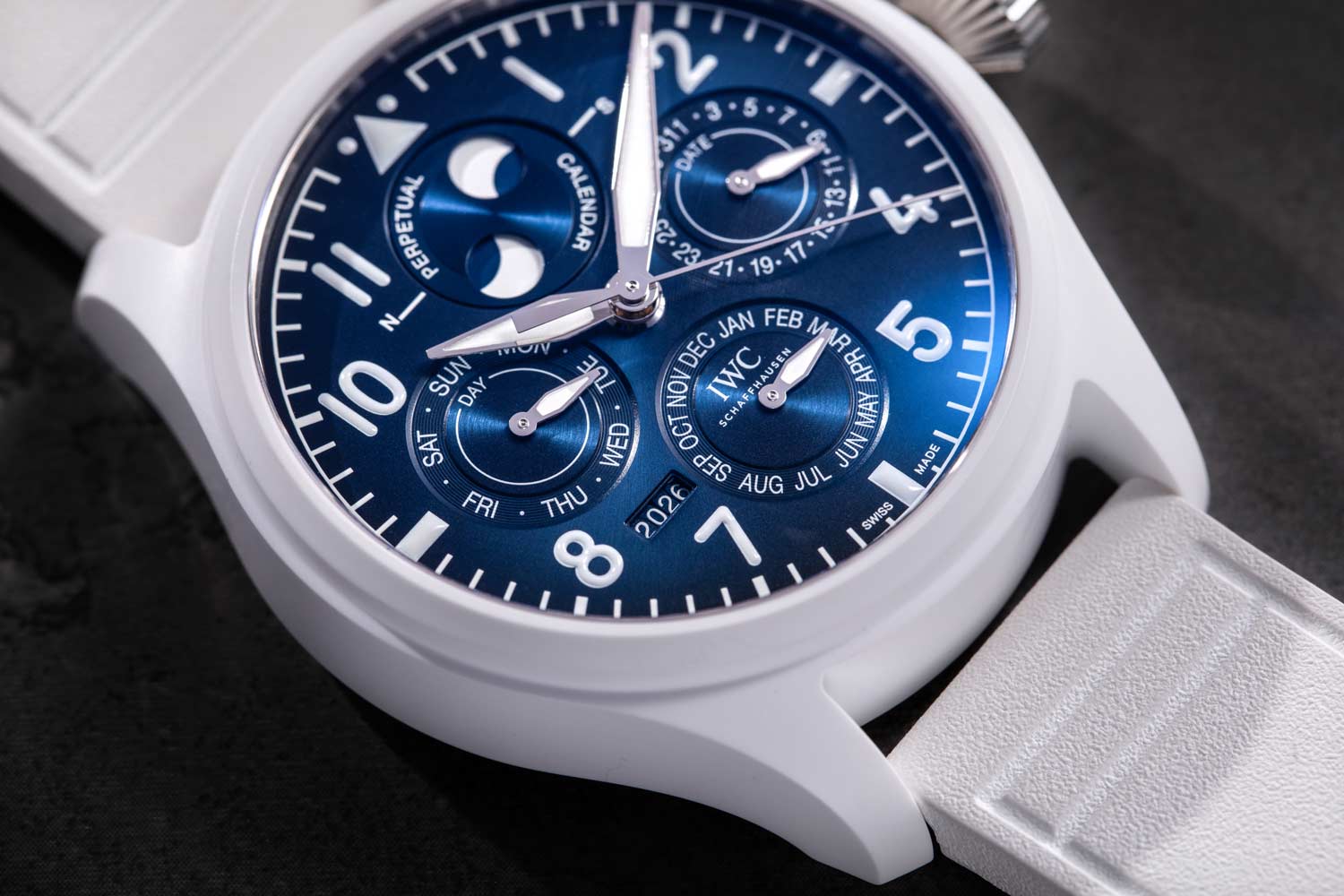
The earlier generation had a small seconds display at 9 o’clock, which gave the subdial more character. The ProSet moves the seconds to the centre and leaves the small seconds subdial empty. The result is a cleaner and less busy dial. It has a more clinical look, but some may prefer this cleaner and more contemporary aesthetic.
One thing I do find interesting is the price. In 2012, when I was still a student, IWC launched its first perpetual calendar in a ceramic case. It was a Top Gun model with an ice-cool matte black ceramic case and was my absolute dream watch at the time. It retailed for around USD 38,600. Today, the new ProSet version is USD 43,100 at retail (albeit with a shorter 60-hour power reserve instead of seven days). That is perhaps one of the few watches in the industry that hasn’t seen a huge price increase. Over the past decade or so, many watches have doubled or even tripled in retail price.
Concluding thoughts
In the world of perpetual calendars, there are three main streams. The traditionalists seek to improve the established mechanism through small and incremental steps. The ultra-futuristic designs radically rethink how a perpetual calendar works but are often too complex to produce at scale. In between are watches that bring meaningful mechanical innovation while still being practical to produce in reasonable numbers.
The IWC ProSet belongs to this third category. A perpetual calendar that can be adjusted both forwards and backwards, with everything controlled through the crown, is nothing new on its own. But combining this level of innovation with a mechanism that can be produced at reasonable scale is something the watch industry needs right now. In fact, it may be long overdue.
Tech Specs: IWC Big Pilot’s Watch Perpetual Calendar ProSet Le Petit Prince
Reference: IW339601
Movement: Cal. 82665; automatic; 60 hours power reserve; 28,800 vibrations per hour (4 Hz)
Functions: Hours, minutes, seconds, and perpetual calendar
Case: 42.9 mm x 14.3 mm; white ceramic and stainless steel; water resistant to 100 m
Strap: White rubber strap with stainless steel pin buckle
Availability: At IWC boutiques and authorised retailers
Limited edition: No
Price: USD 43,100
IWC

You may also like
News
Last Week In Watches: Rolex Revives the Padellone, Hublot Goes Full Koons
Sep 21, 2026
News
Last Week In Watches: Rolex Revives the Padellone, Hublot Goes Full Koons
Sep 21, 2026
Editorial
IWC Takes Its Mercedes-AMG Petronas Team Chronograph to Singapore
Aug 27, 2026
Editorial
IWC Takes Its Mercedes-AMG Petronas Team Chronograph to Singapore
Aug 27, 2026
Editorial
Last Week In Watches: IWC Mercedes-Benz 140th Anniversary, Total Solar Eclipse MoonSwatch, Zandvoort TAG Heuer and more
Aug 17, 2026
Editorial
Last Week In Watches: IWC Mercedes-Benz 140th Anniversary, Total Solar Eclipse MoonSwatch, Zandvoort TAG Heuer and more
Aug 17, 2026