
Louis Erard Unveils Its Most Striking Vianney Halter Collaboration Yet
News
Louis Erard Unveils Its Most Striking Vianney Halter Collaboration Yet

Louis Erard has been on a roll in recent years, collaborating with a host of names in the industry to bring distinctive designs to its watches. Collectors have enjoyed relatively accessible pieces bearing design cues from the likes of Alain Silberstein, Konstantin Chaykin, Kudoke and, of course, Vianney Halter.
Vianney Halter, in fact, is one of the brand’s favourite collaborators. The two have now teamed up for the third time, this time on the Futur Antérieur, which is arguably their best collaboration yet. This time, the watch goes beyond incorporating subtle design elements such as the hands and dials, adopting the distinctive case with raised porthole bezels that made the original 1998 model so recognisable.

Two versions are offered, with either a silver or gold-coloured dial. Each is limited to 178 pieces, while a further 78 sets pair both versions together.
Nostalgic and antique
Whether one was around to experience the rise of independent watchmaking in the 1990s or not, chances are they have come across the Antiqua, created by watchmaker Vianney Halter and designer Jeff Barnes. Presented at Baselworld in 1998, the Antiqua was Halter’s first independent creation. Before that, he had worked in the industry restoring vintage watches and later creating movements for other companies through Techniques Horlogères Appliquées, which he co-founded with François-Paul Journe and Denis Flageollet.
The 1998 Antiqua was Halter’s first creation, yet it immediately became his most recognisable, thanks to its distinctive case design. A perpetual calendar, it features four sub-dials, each framed by a porthole that protrudes from the case, giving the watch a strangely nostalgic and satisfyingly steampunk, almost sci-fi aesthetic. Just as importantly, the quality of the case and dial is exceptional. The combination of brushing and polishing, along with the rivets across the case, gives it the feel of a complex, finely built machine. It was an unusual level of detail and execution that really set the watch apart in the 1990s.

The original Antiqua, seen here in a rare, early version signed “Halter Barnes” (Image: The Hour Glass)
Collaboration cues
Louis Erard first teamed up with Vianney Halter in 2020, bringing Halter’s signature dial and hand designs to Louis Erard’s familiar regulator layout. This subtle approach was taken a step further in 2024, with a second collaboration featuring an asymmetrical dial layout reminiscent of Halter’s Antiqua. So far, however, the collaborative pieces have remained largely two-dimensional, with flat dials housed in conventional cases.
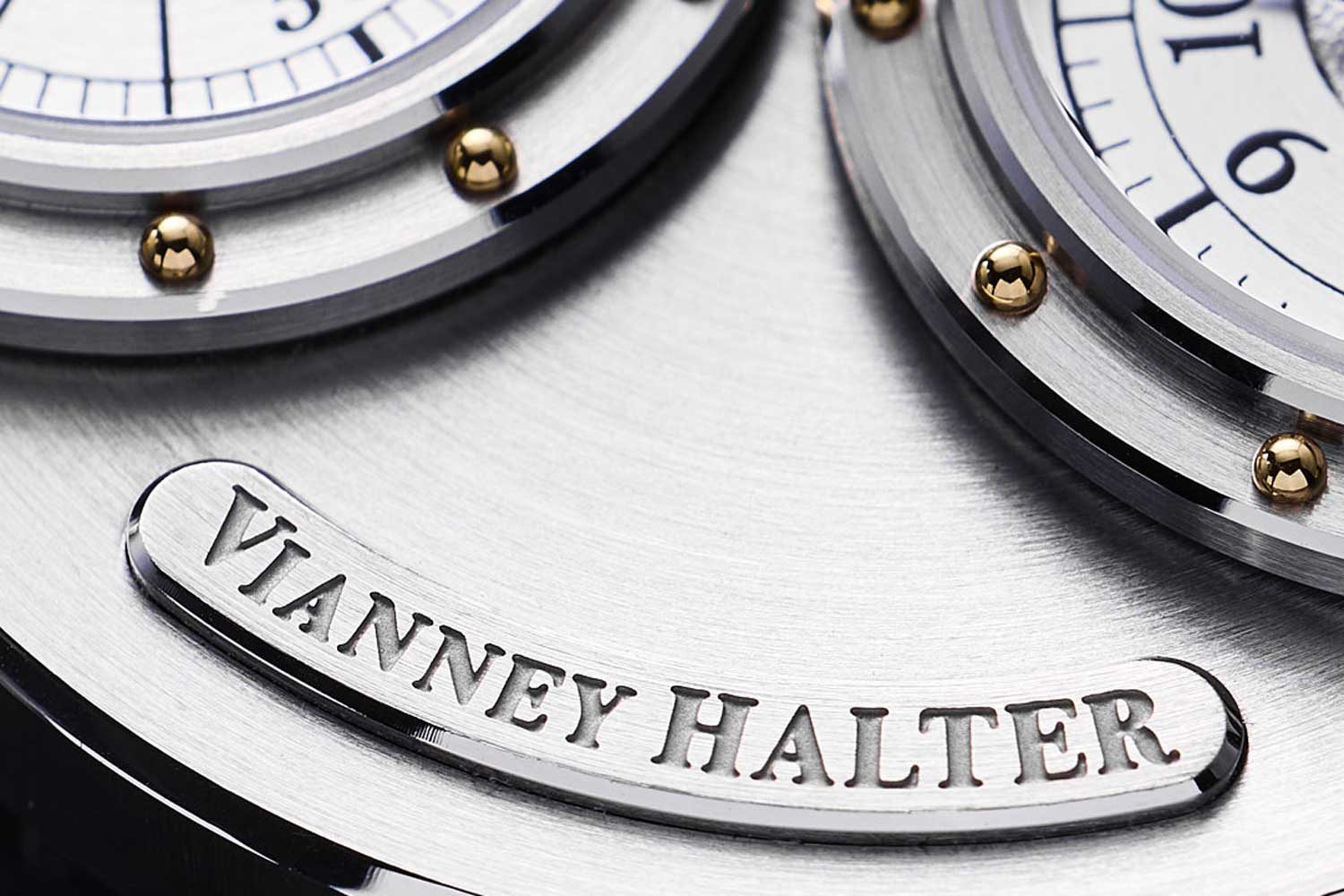
This time, Louis Erard has gone much further, creating a three-dimensional, asymmetrical case that comes remarkably close to the Antiqua. As a time-only watch, it has two sub-dials instead of the four found on the original perpetual calendar. Both protrude beautifully from the round case, each framed by a raised bezel shaped like a porthole. Just as importantly, these bezels receive the kind of finishing for which Halter is known, with contrasting brushed surfaces and polished bevels, complemented by polished yellow-gilt rivets.
With only two dials, there is more room on the case for additional decoration. Louis Erard has used this space for two raised plates, each machine-engraved with the names of the two collaborators. These details give the dial a pleasing sense of rhythm and symmetry, despite its rather steampunk and unusual appearance at first glance.
Beautifully detailed
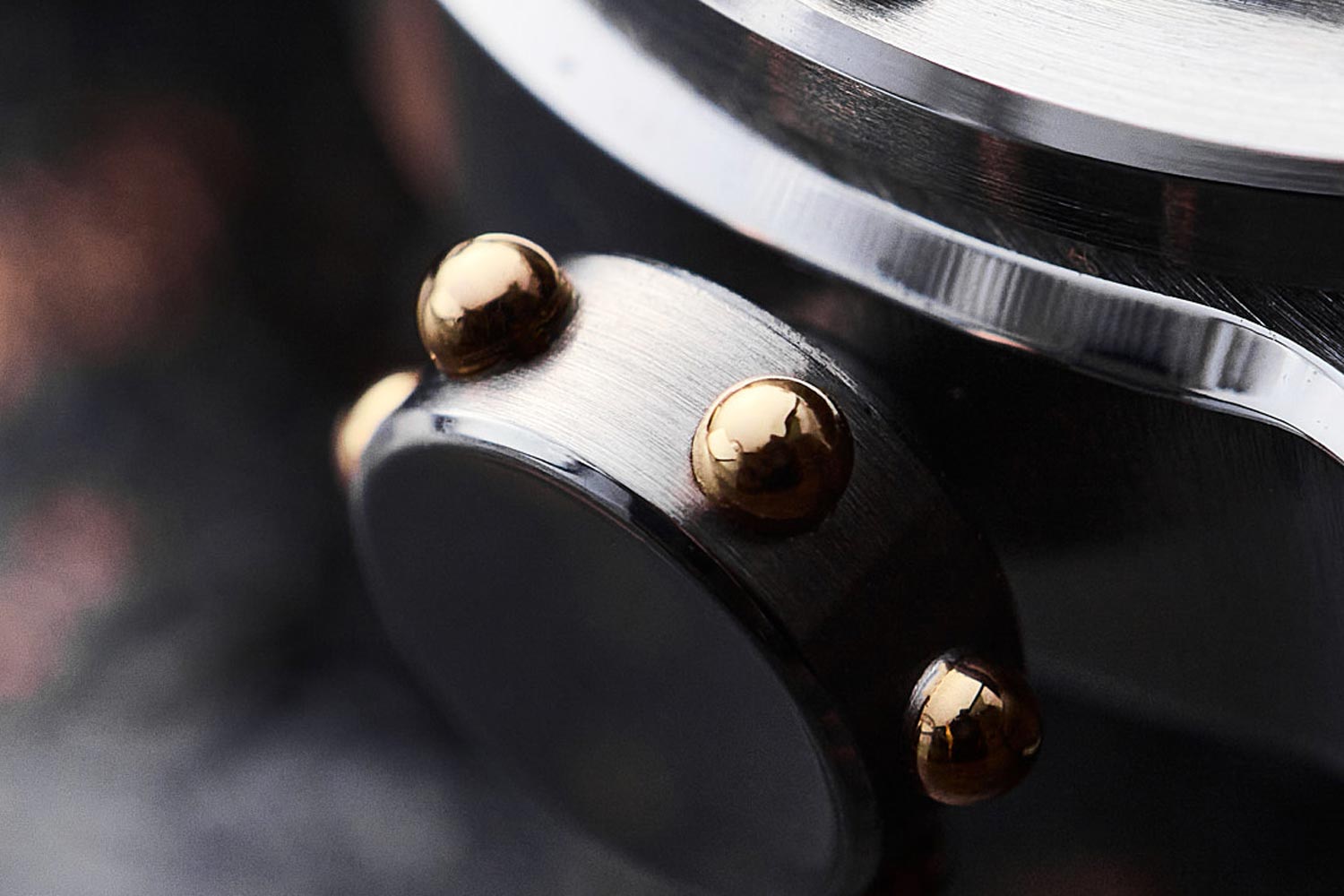
Even the crown is decorated with rivets and a bevel
Overall, the front of the case is impressive and deeply nostalgic, although the finishing of the caseback falls slightly short, at least compared with the vintage original. Nevertheless, this is by far the closest Louis Erard has come to capturing Halter’s design language, surpassing not only its previous collaborations but also those he has undertaken with other brands.
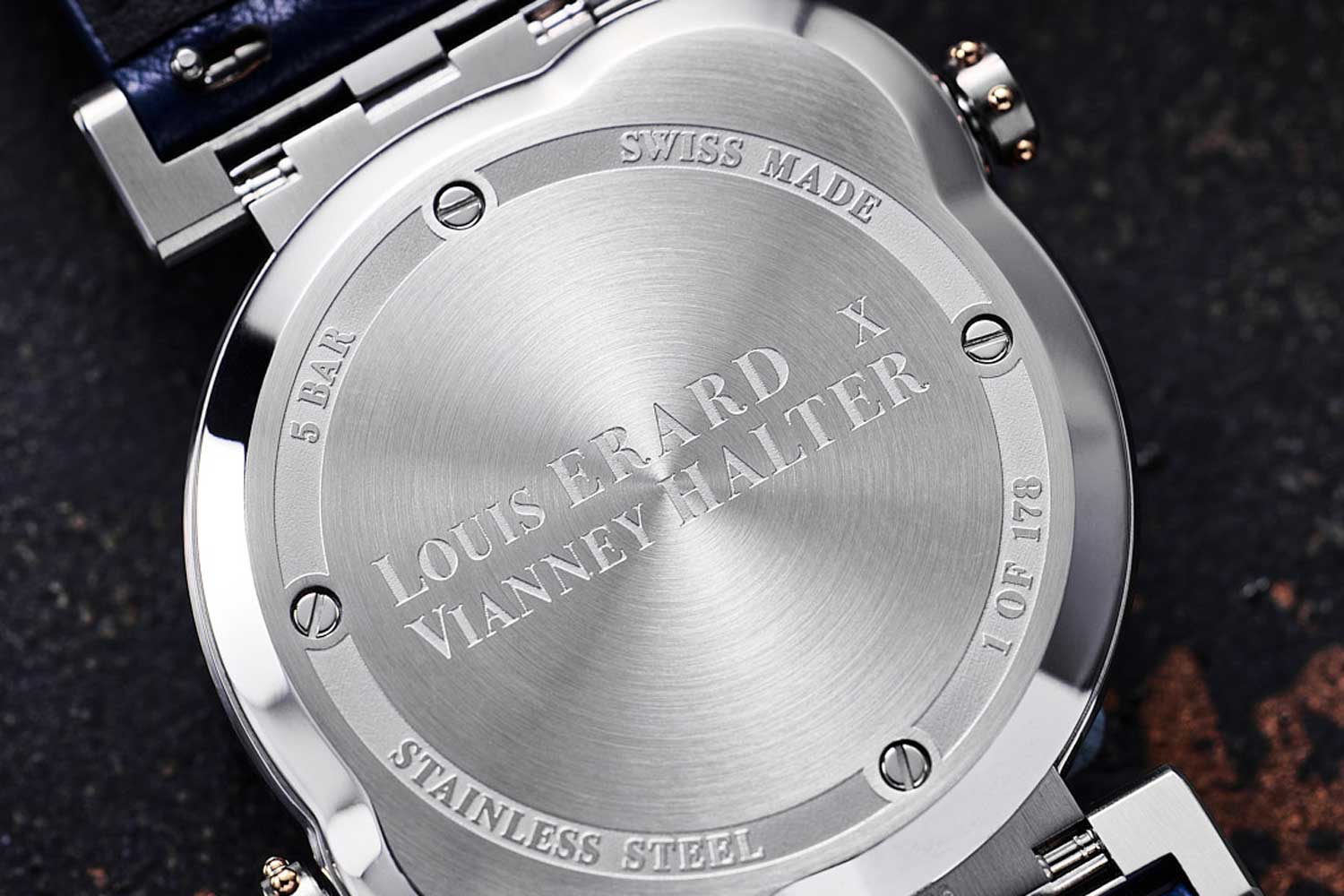
A simple back
Two in one
Reading the time is relatively easy and intuitive, with the sub-dial at four o’clock displaying the hours and minutes, while the one at ten o’clock indicates the seconds. The way this separation is achieved, however, is rather unexpected. Rather than developing a mechanism to split the indications, Louis Erard has opted for two small movements, each powering its own sub-dial. This means the hours and minutes are essentially independent of the seconds, although both movements have hacking seconds. Each is powered by a Sellita SW100, whose compact dimensions help keep the overall case relatively slim at 38 mm wide and just 8.85 mm thick.
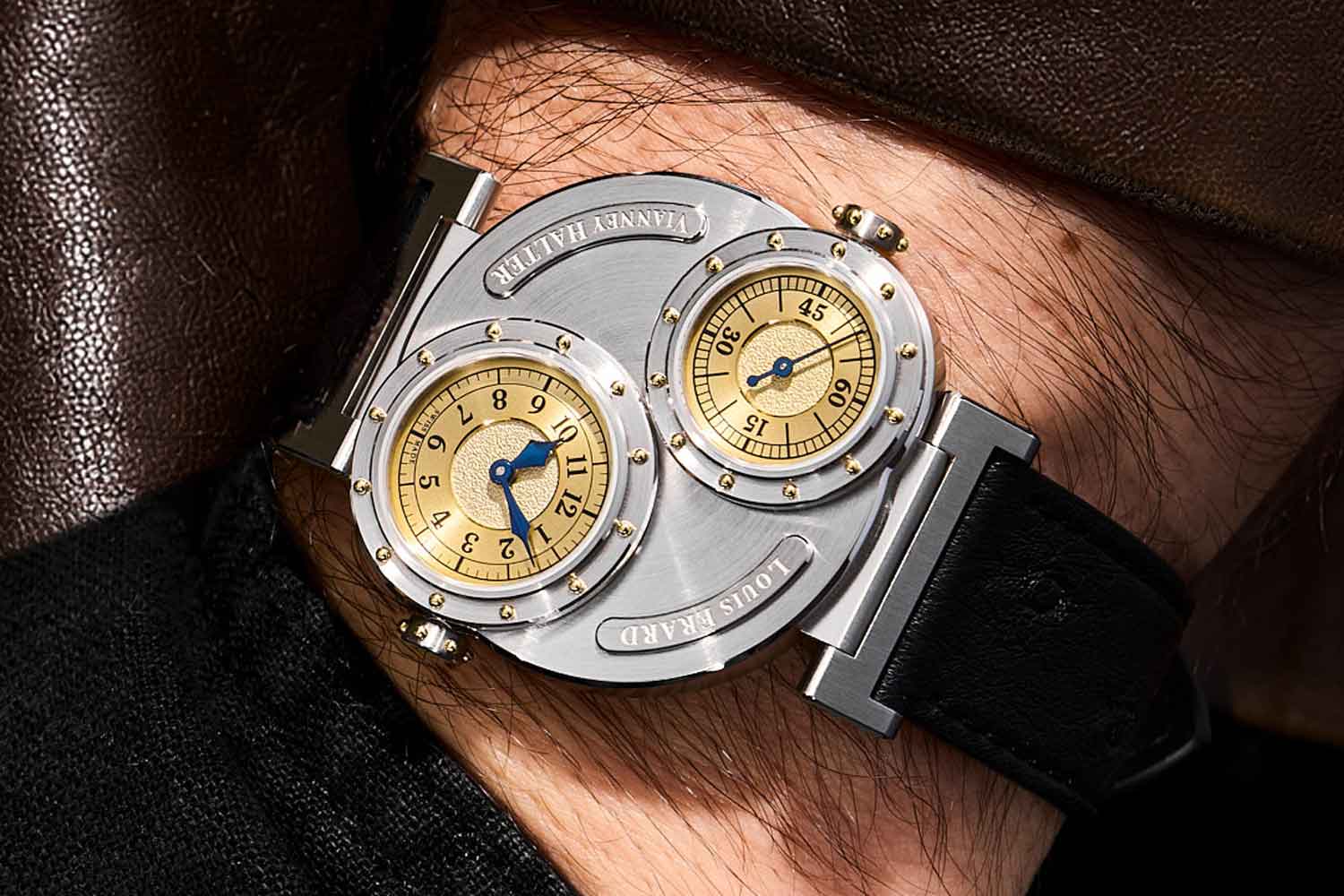
Looking sleek on the wrist
Having two movements in a single watch is not usually the most desirable solution, but in this case, it is forgivable given the beauty of the case and dials. And the case is indeed commendable, not only for its finishing but also for the amount of work that has gone into it. It is unusual for a brand to create a completely new case for a small run of just 178 pieces each. Even the lugs are unique to the design and packed with details. Cases in watchmaking are usually produced in large batches, and changing the case size is already an economic challenge, at least according to most brands. Here, Louis Erard has created an entirely new case just for a limited edition. That’s something else, assuming it won’t be reproduced too extensively.
Tech Specs: Louis Erard x Vianney Halter Futur Antérieur
Reference: 22243AA01.BOA02 (Gold); 22243AA07.BOA05 (Silver)
Movement: Twin Sellita SW100; automatic; 42 hours power reserve; 28,800 vibrations per hour (4 Hz)
Functions: Hours, minutes, and seconds
Case: 38 mm x 44 mm x 8.85 mm; stainless steel; water-resistant to 50 m
Strap: Black ostrich leather (Gold); blue ostrich leather (Silver)
Limited edition: 178 pieces per colour; 78 sets of two watches
Price: CHF 4,950 each (excluding tax); CHF 9,900 per set (excluding tax)

You may also like
News
Last Week in Watches: Moser Goes Off-Grid, the Vacheron Constantin Overseas Turns 30
Sep 28, 2026
News
Last Week in Watches: Moser Goes Off-Grid, the Vacheron Constantin Overseas Turns 30
Sep 28, 2026

Editorial
Past Future Perfect with Bvlgari Octo Finissimo Dual Time x Vianney Halter
Sep 2, 2026
Editorial
Past Future Perfect with Bvlgari Octo Finissimo Dual Time x Vianney Halter
Sep 2, 2026

Editorial
New Chapters in Seddiqi’s Legacy
Jan 29, 2026
Editorial
New Chapters in Seddiqi’s Legacy
Jan 29, 2026