A Closer Look: Parmigiani Tonda PF Chronographe Mystérieux
Reviews
A Closer Look: Parmigiani Tonda PF Chronographe Mystérieux

One of the most talked about watches at W&W 2026 was the Parmigiani Tonda PF Chronographe Mystérieux, launched on the 30th anniversary of the brand founded by the legendary Michel Parmigiani. In many ways, the watch is entirely in keeping with the trajectory of the company, which on one hand is capable of extraordinary technical ambition, yet increasingly, since 2021, has been guided by simplicity and a highly cultivated sense of visual calm. The Chronographe Mystérieux is also the third instalment in a trilogy of watches dedicated to the exploration of hidden complications, following the Tonda PF GMT Rattrapante of 2022 and the Tonda PF Minute Rattrapante launched in 2023.
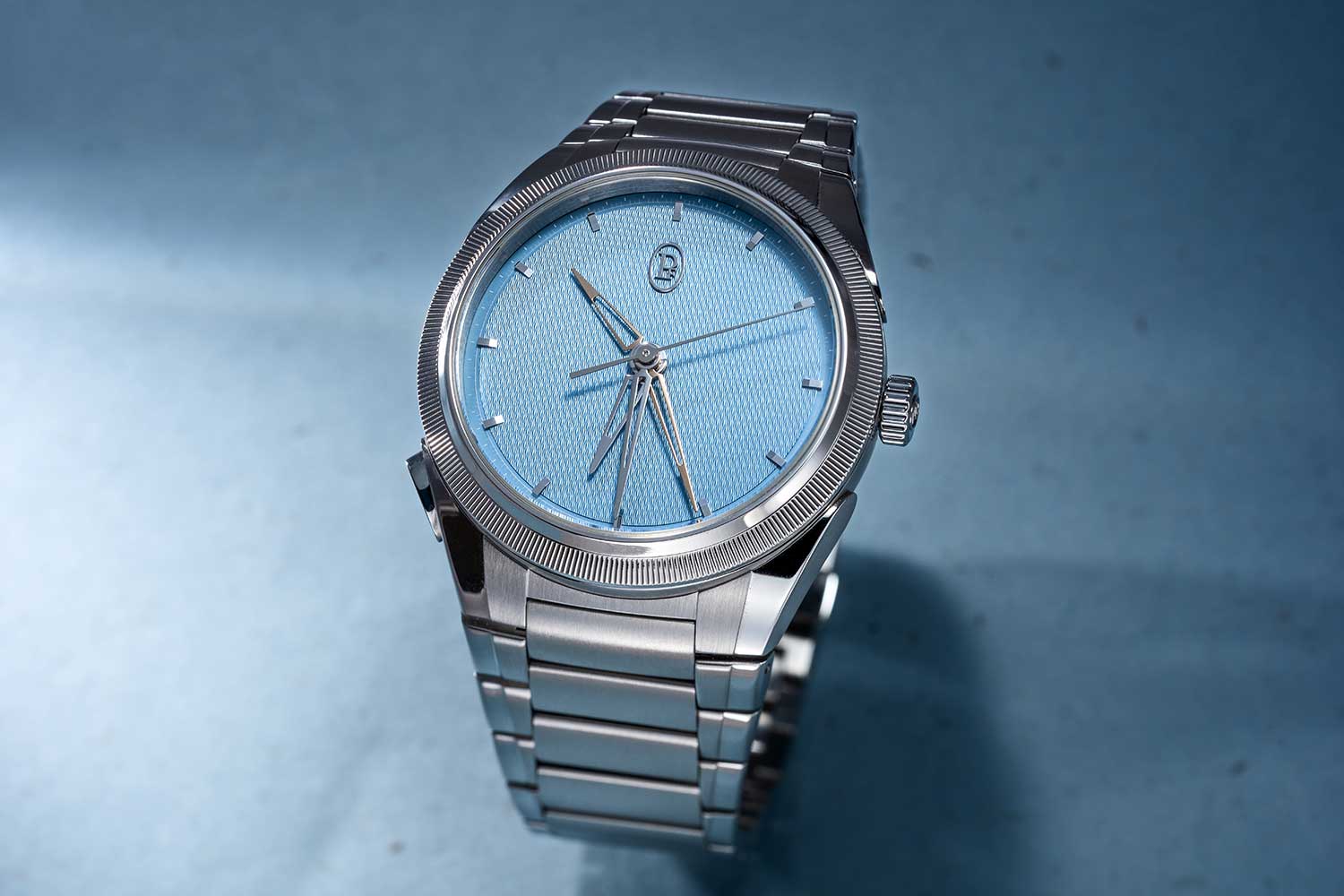
Parmigiani Fleurier Tonda PF Chronograph Mystérieux (©Revolution)
-
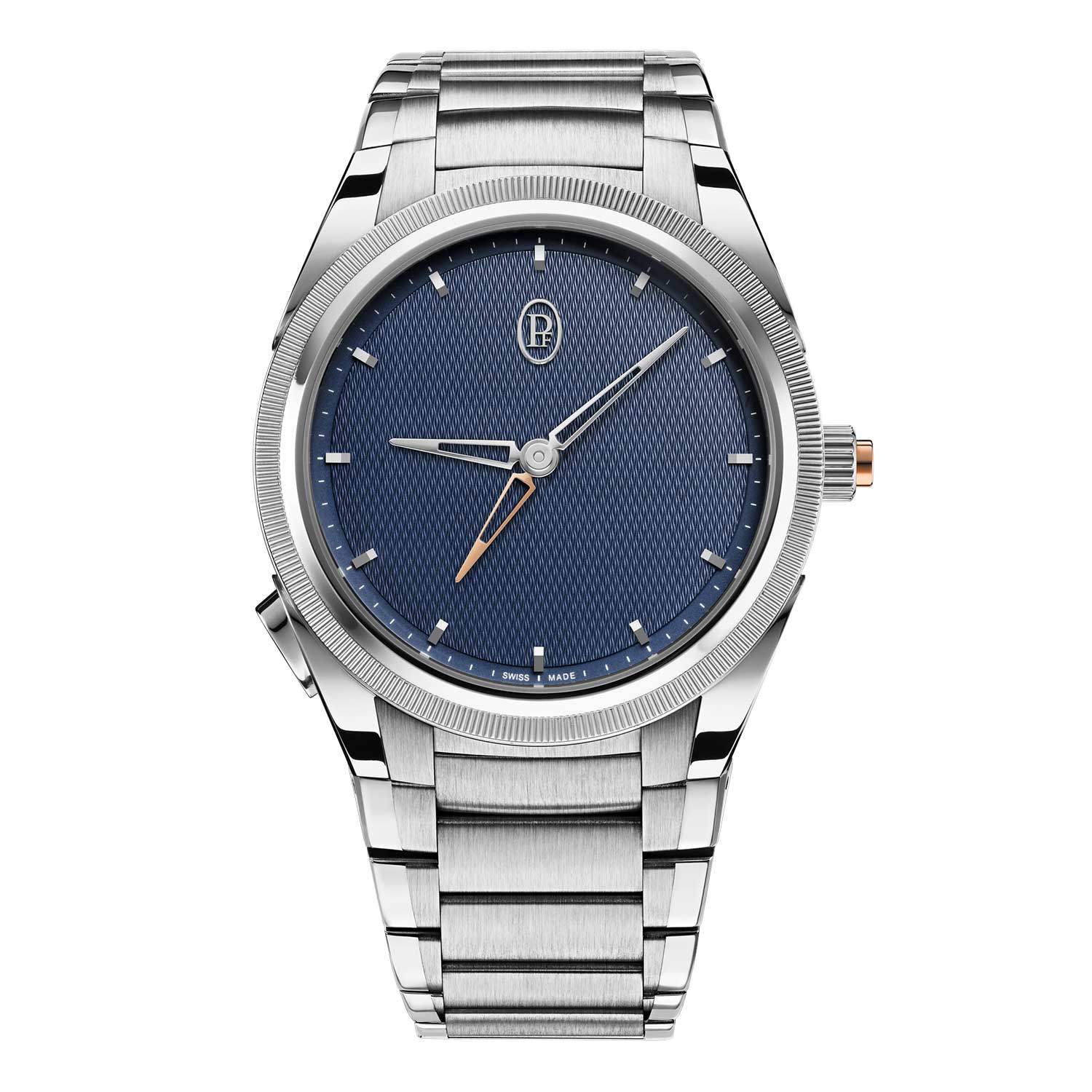
- 2022: Tonda PF GMT Rattrapante
-
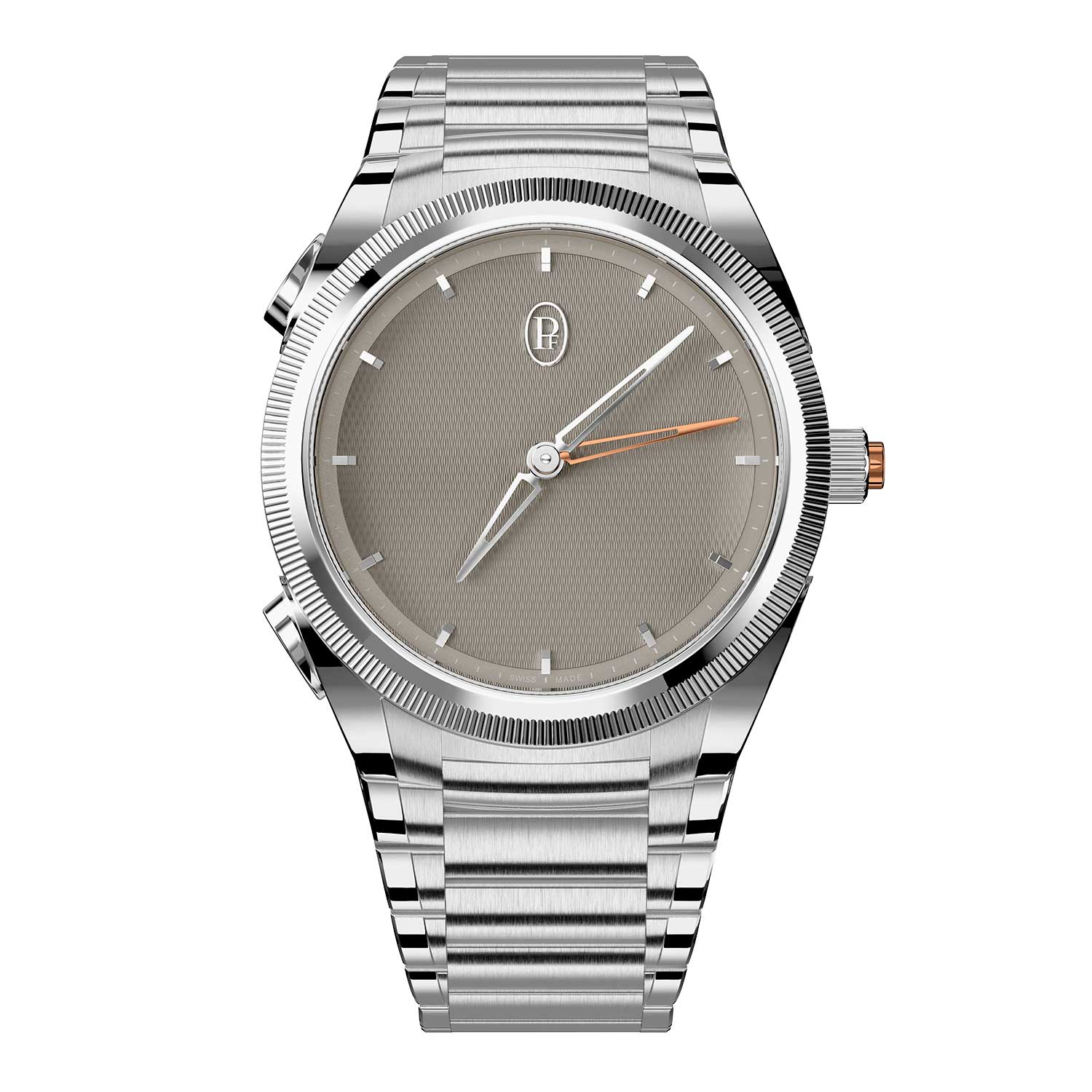
- 2023: Tonda PF Minute Rattrapante
In these watches, “rattrapante” does not refer to a split-seconds chronograph, but instead to the idea of one indicator temporarily separating from another before eventually reuniting with it. The GMT Rattrapante concealed a second time-zone hand beneath the local hour hand that could be separated in one-hour increments before instantly re-synchronising with the home hour hand via the shortest rotational path, while the Minute Rattrapante transformed the same principle into a countdown display through a pair of superimposed minute hands.
The Chronographe Mystérieux extends the idea further, applying it to the chronograph itself. It does not bear the rattrapante moniker, given that the term signifies something very different in the world of chronographs. Yet beneath the mysterious display is a mechanism that, in certain respects, is not so far removed from the solutions employed in a traditional split-seconds chronograph. It is also a flyback chronograph of sorts, and is best described as both an inventive and highly complex rearrangement of classical chronograph mechanics.
Yet, the watch has in spirit, perhaps more in common with the mechanical curiosities of horology – automatons, mystery clocks, kinetic sculptures and poetic complications in which the objective was never really utility at all, but the bending of mechanics toward an almost irrational end.
The chronograph is of a monopusher design, with the start, stop and reset functions all actuated via a single pusher at 8 o’clock, while the column wheel features three times as many ratchet teeth as columns. When the chronograph is inactive, there is little to suggest that the watch houses a chronograph at all. The complication remains entirely latent until summoned into action, at which point the dial undergoes a remarkably theatrical transformation. The rhodium-plated chronograph minute and hour hands separate from their solid gold timekeeping counterparts and fly back to zero, while the central seconds hand assumes its second identity as the chronograph seconds hand, likewise snapping back to zero before all three begin recording elapsed time. When the chronograph is stopped, all three hands display the measured time. Resetting the chronograph does not send the timing hands back to zero; instead, they reunite with their timekeeping counterparts, while the seconds hand simply resumes its natural progression around the dial. In an instant, the watch returns to complete restraint.
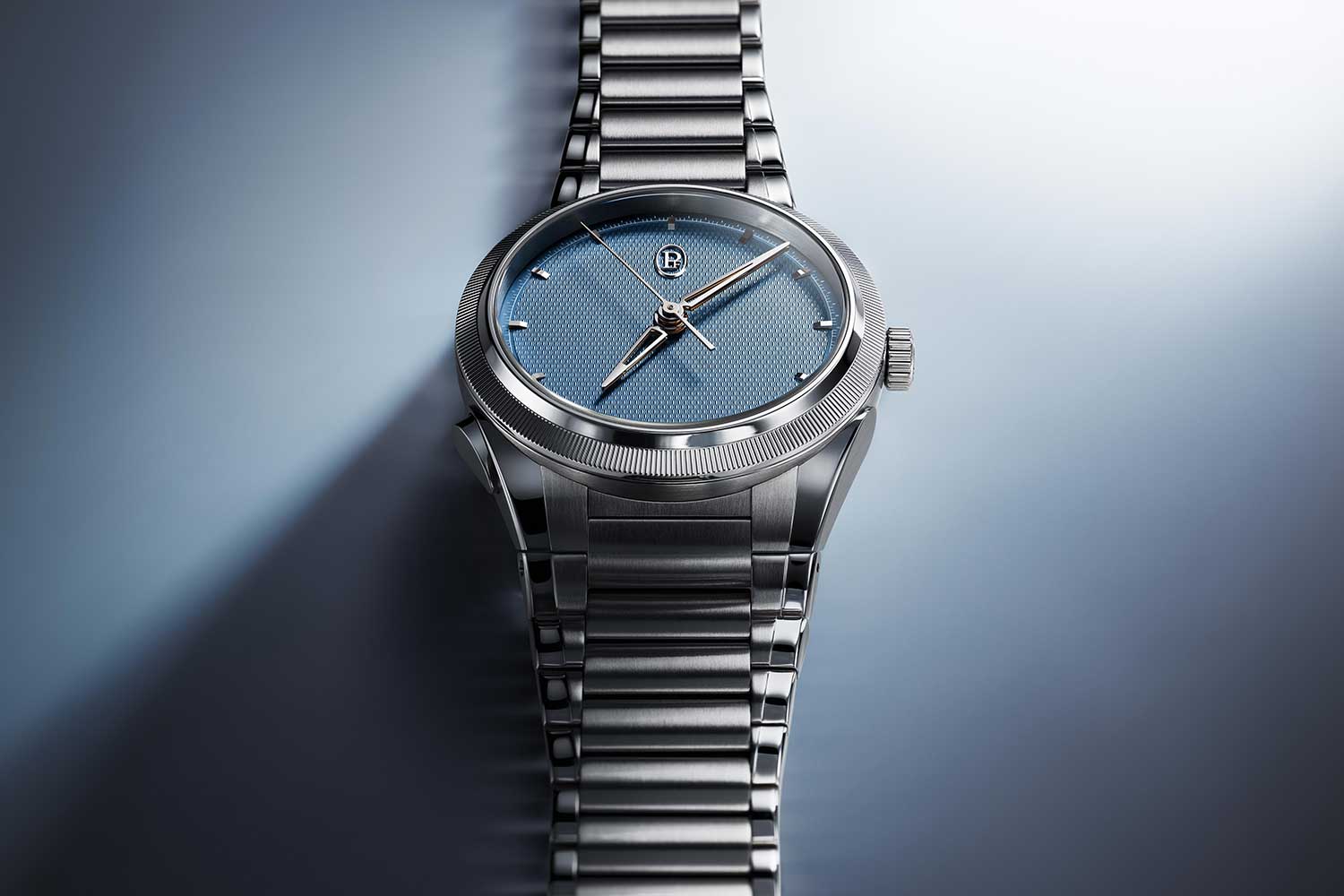
Parmigiani Fleurier Tonda PF Chronograph Mystérieux
Neither central chronographs nor chronographs with five central hands are new to watchmaking. A minor weakness of such chronographs is that the elapsed minute and hour hands, being thicker than the seconds hand, tend to remain clustered around the midday position when the chronograph is not in use. This is the first time where the chronograph indications emerge from, and later disappear back into, the ordinary time display itself, preserving the visual serenity for which the modern Tonda PF collection is known.
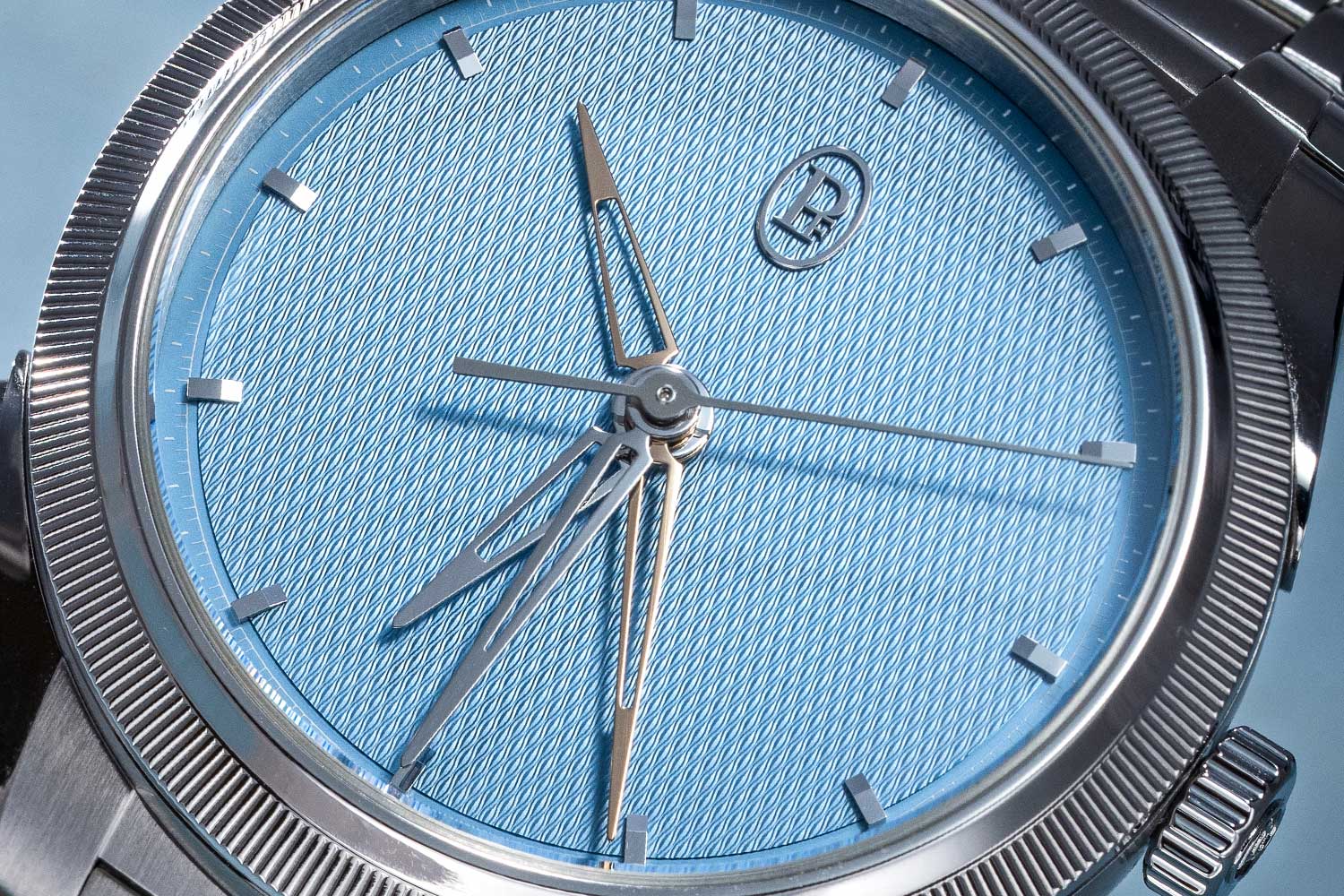
Parmigiani Fleurier Tonda PF Chronograph Mystérieux (©Revolution)
The mechanism is patent pending, so the specifics of the construction cannot yet be disclosed, but the available images do reveal the broader operating principles behind the system. The chronograph employs a classic vertical clutch. From the bridge side of the movement, it is possible to deduce that the fourth wheel is positioned at the centre of the movement, while part of the clutch clamps is visible beside the column wheel, indicating that the clutch disc is likewise centrally located.
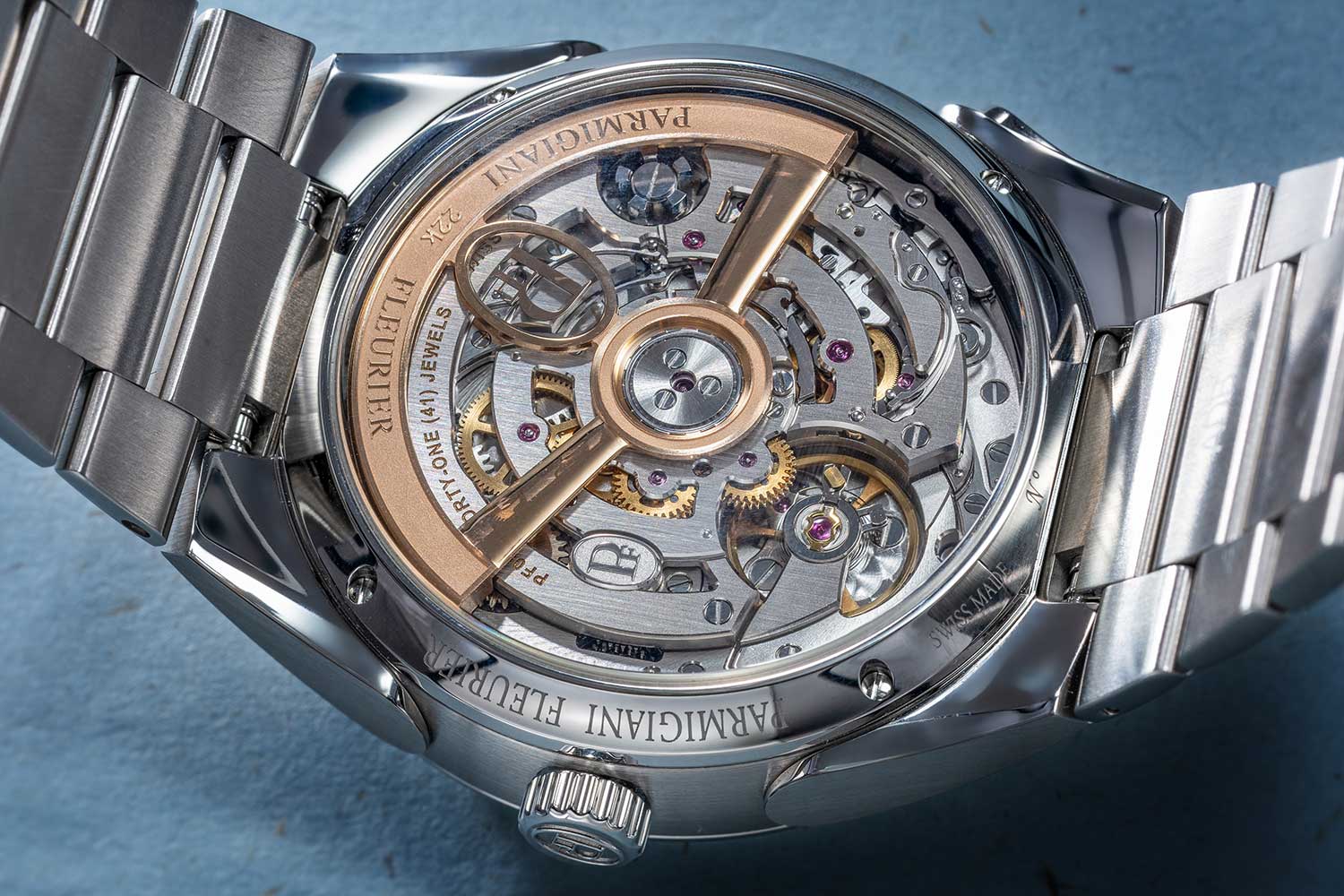
Parmigiani Fleurier Tonda PF Chronograph Mystérieux (©Revolution)
Ironically, the part that appears most difficult to execute is the central seconds hand itself, because it must effectively switch identities. It cannot simply be attached to the clutch disc, since it must continue running during ordinary timekeeping. Yet neither can it be fixed to the fourth wheel, because it must also be capable of freezing when the chronograph is stopped. The mechanism hence demands some form of intermediary solution that allows the hand to transition between the ordinary going train and the chronograph mechanism itself.
What is apparent from the images is that the minute recording wheel is coupled to an intermediate, ordinary minute wheel during normal running in much the same way the chronograph runner and split-seconds wheels are coupled in a rattrapante chronograph. A drive lever is attached to the ordinary minute wheel, while the minute recording wheel carries a heart cam. Held against the heart cam by a spring, the drive lever maintains both wheels in phase so they rotate together as one. The same principle is applied to the hour wheel, both of which are visible on the dial side of the movement. This would require some form of isolator, again much like that of a split-seconds chronograph, capable of temporarily separating the chronograph minute wheel from the continuously rotating current time minute wheel.
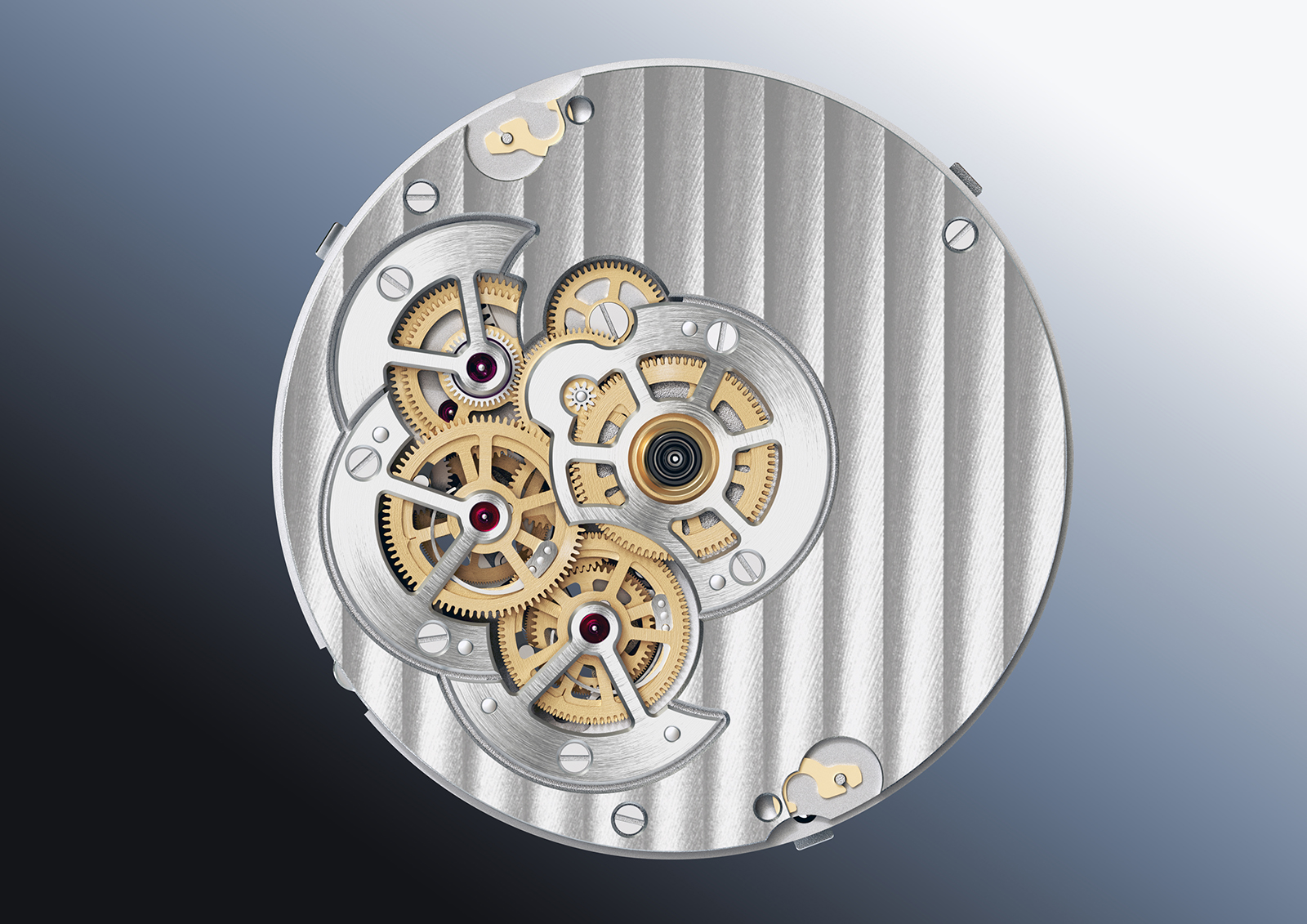
The superimposed sets of minute and hour wheels are visible on the dial side of the movement
During normal running, the clamps remain closed and the isolator disengaged. In this state, the chronograph minute and hour wheels are coupled to their ordinary timekeeping counterparts through the spring-loaded drive levers acting on the heart cams, causing both sets of wheels to rotate together in phase, and consequently each set of superimposed hands rotates as one.
When the chronograph is activated, an isolator comes into action, lifting the drive lever away from the heart cam and uncoupling the chronograph minute wheel from its ordinary timekeeping counterpart. The same occurs at the hour wheel. Once separated, a one-piece reset hammer falls onto the heart cams, returning chronograph hands to zero. At the same time, the clutch clamps open, bringing the clutch disc into frictional engagement with the continuously rotating fourth wheel, while two oscillating pinions slide into the chronograph train. One connects the finger piece on the chronograph seconds wheel to the chronograph minute wheel, while the other connects the minute finger piece to the chronograph hour wheel.
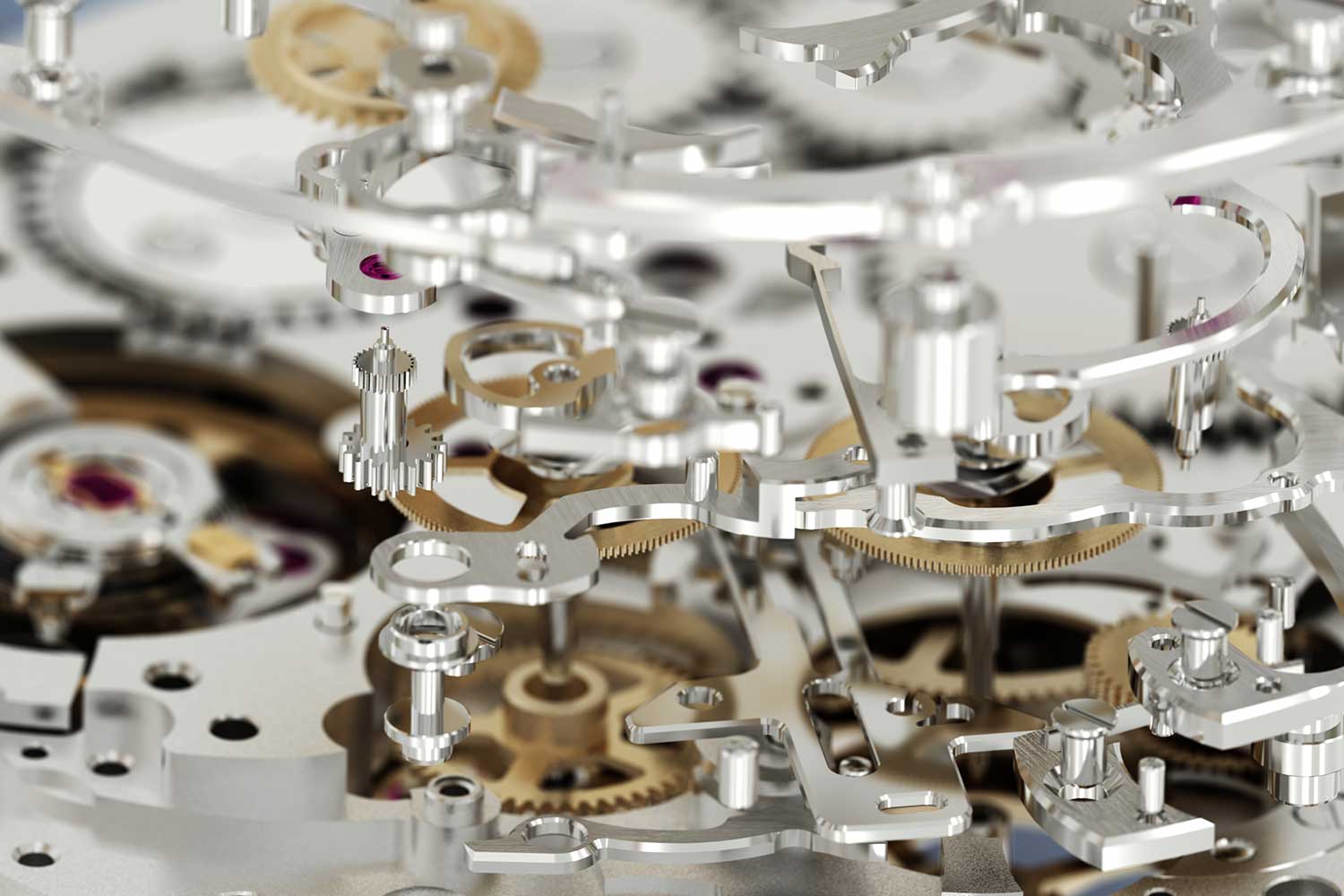
A one-piece reset hammer and oscillating pinion can be seen in this exploded view
When the chronograph is stopped, the clamps close once more, disengaging the chronograph train and freezing the elapsed time display. The isolator, however, remains active, keeping the chronograph minute and hour wheels separated from their ordinary timekeeping counterparts so the measured time is preserved.
Upon reset, the isolator disengages, allowing the spring-loaded drive levers to fall back onto their respective heart cams. In doing so, the chronograph minute and hour wheels are physically dragged back into phase with the ordinary minute and hour wheels until equilibrium is restored between the cams and drive levers, re-synchronising the chronograph hands with the live timekeeping hands in a manner not entirely unlike the rejoining of a split-seconds hand.
All of this is extremely difficult to pull off as a large number of actions must occur in a tight and highly specific sequence within a single transition of state. Given the sheer number of intermediate wheels involved, backlash, inertia, parasitic friction must be carefully managed. What makes the achievement even more remarkable is that even with the density of components concentrated on the central axis, while incorporating automatic winding, it remains sufficiently slim to fit within a case that, at 13mm thick, is only marginally thicker than the standard 5Hz Tonda PF Chronograph at 12.72mm.
The Calibre PF053 has a power reserve of 60 hours and beats at 28,800 vibrations per hour. It is fitted with a 22k rose gold oscillating weight and is attractively finished throughout with a combination of hand and machine-applied decoration. The bridges feature straight graining with clean, machine-executed anglage, while the rotor combines sandblasted and polished surfaces for a refined appearance.
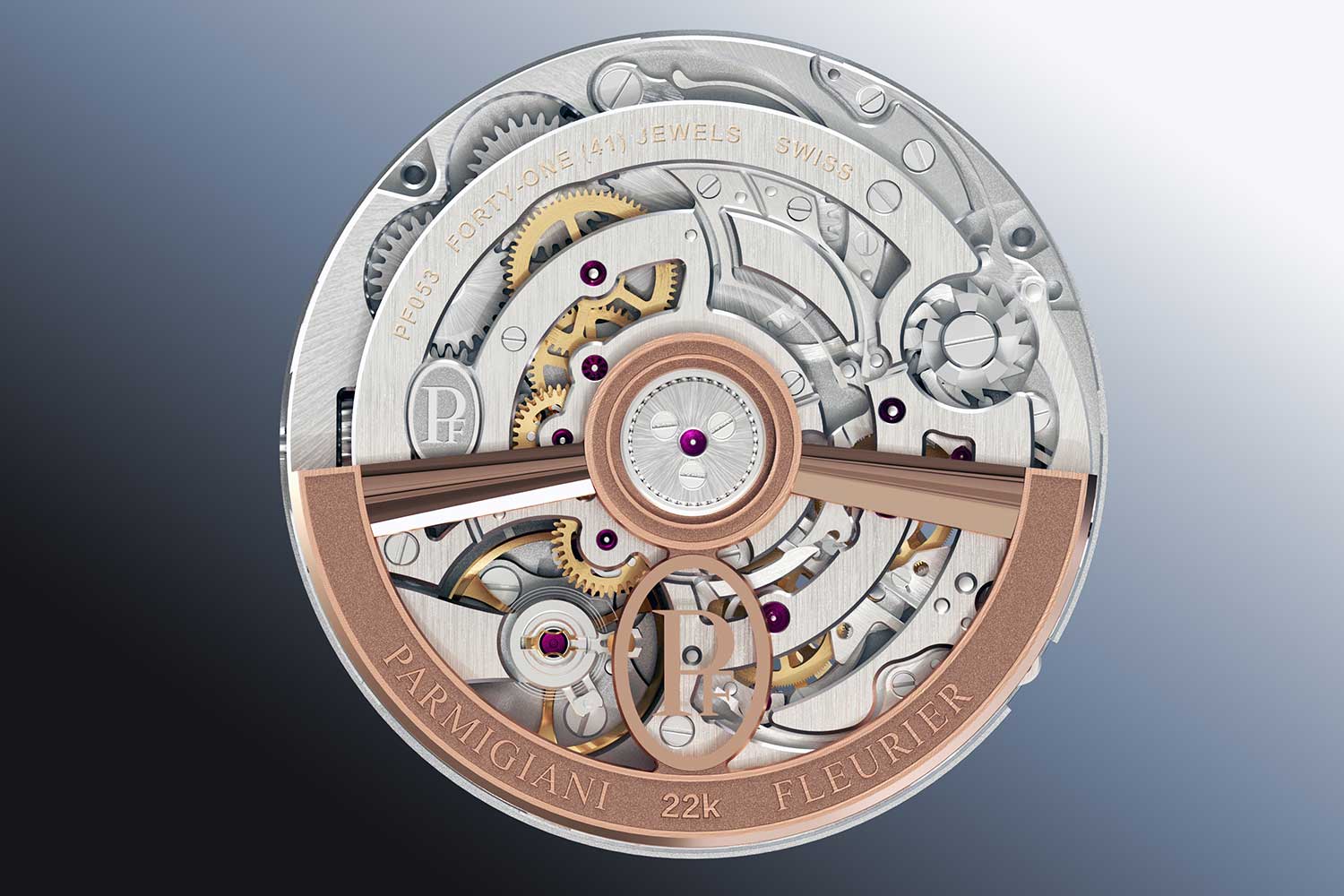
The PF053 movement
It is fairly clear that part of the brief was to create a chronograph of genuinely original conception while keeping it within reach of a broader audience than such a mechanism would normally imply. At CHF 36,900, it makes a remarkably strong case for itself. Still, after encountering the sheer inventiveness and conceptual audacity elsewhere in the movement, it would have been more appropriate to see a more refined alternative or a free-sprung balance with timing weights in place of an Etachron regulator. In any case, the chronograph is impossible to resist. The transformation is so fluid, so improbable looking that the mind momentarily stops parsing the mechanism and simply experiences the effect.
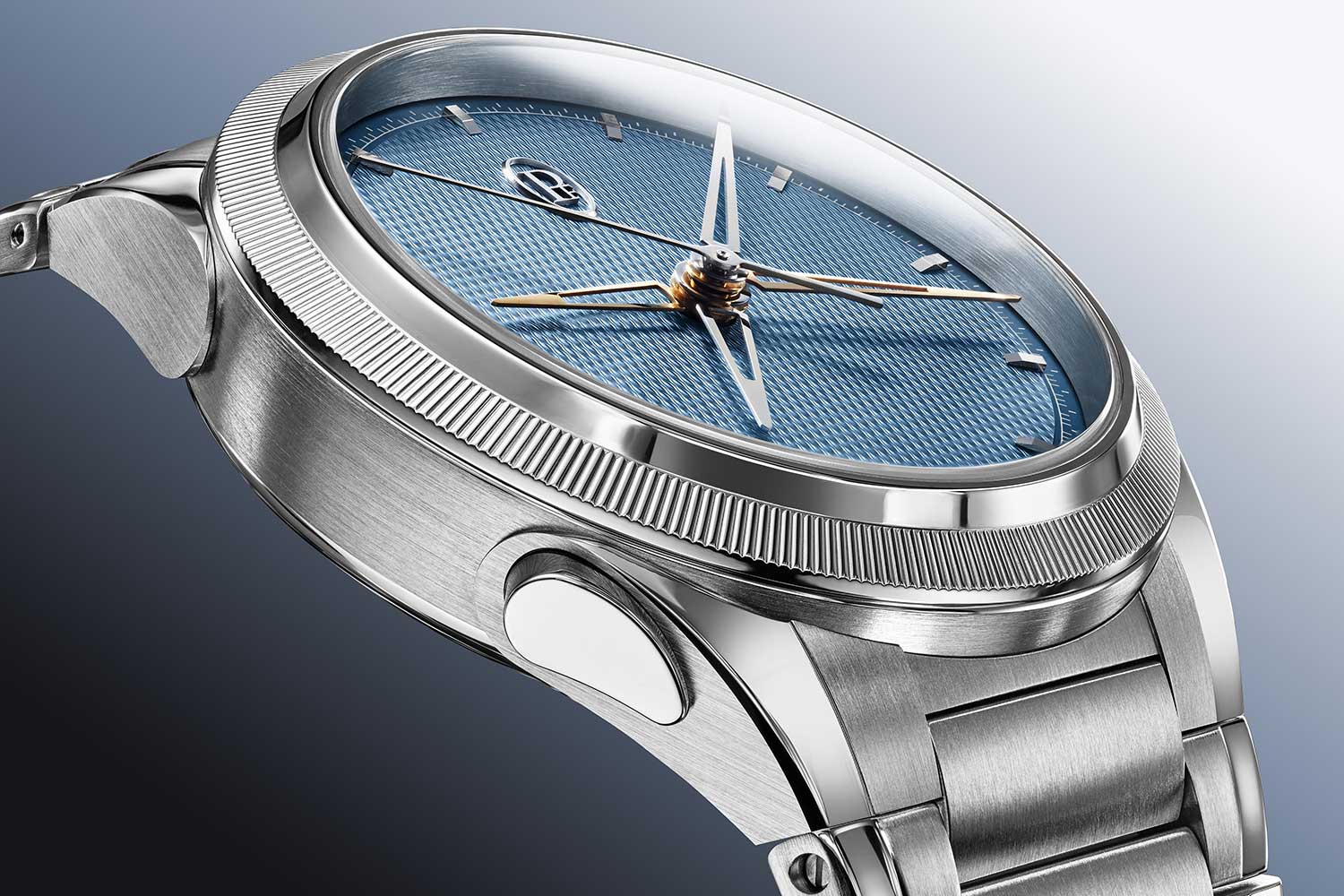
Everything else, meanwhile, is the Tonda PF integrated bracelet sports watch as we have come to know it. Depth rated to 100m, the case is 40mm in stainless steel and topped by the slim fluted bezel that has become a signature of the collection, executed here in platinum as on the Tonda PF Micro-Rotor. Above it is a slim polished vertical lip that helps break up the visual height of the watch. The caseband is satin-brushed, while the upper surfaces of the lugs are polished, separated by a small lengthwise bevel. The chronograph pusher follows the contour of the distinctive curved lugs and is hence visually subdued within the profile of the case. Seen briefly on someone’s wrist, it would be easy to mistake the watch for the Tonda PF Micro-Rotor, with the additional height of the case being about the only clue that something vastly more complicated lies beneath the dial.
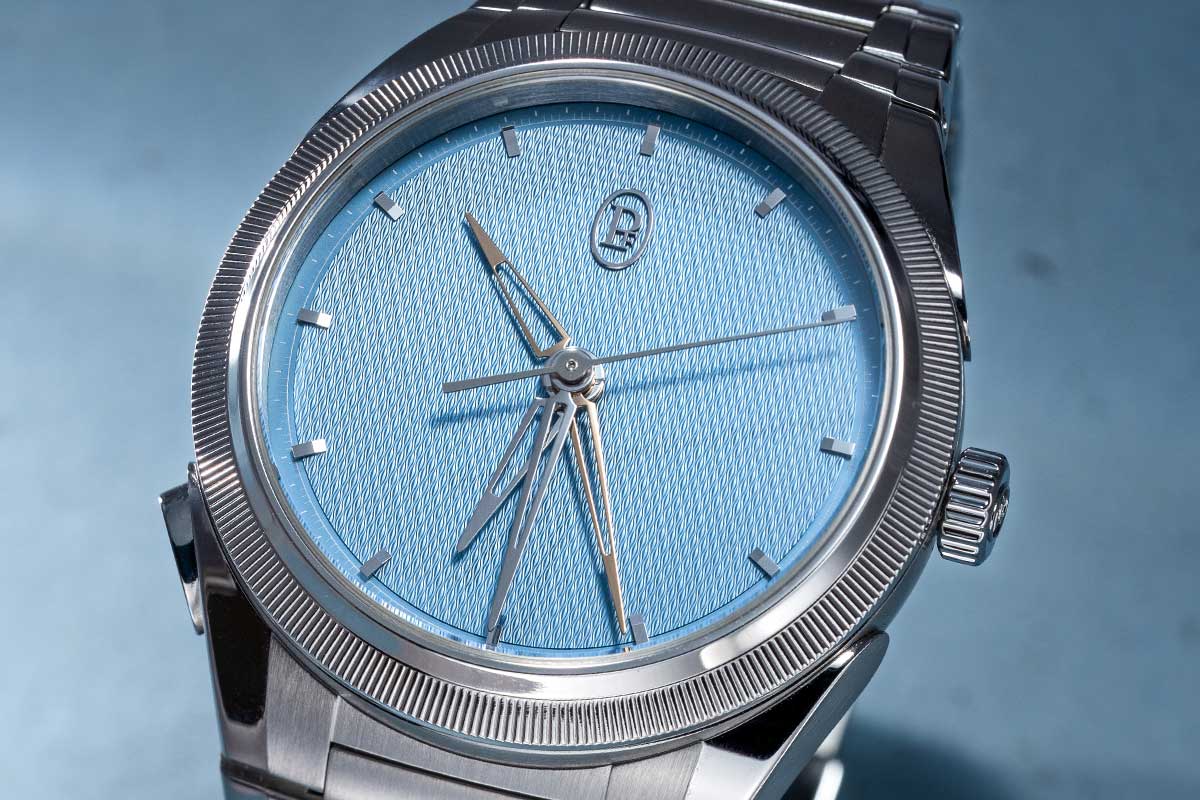
The applied faceted indexes are in rhodium-plated 18k gold and mirror-polished, making them highly legible despite their diminutive size. A narrow recessed outer minutes and seconds track frames the dial, with the hour markers crossing over it. The dial itself is impressive. It features an extremely fine barleycorn guilloché pattern of such delicacy that, until the recent appearance of a video showing the dial being turned on a straight-line engine, many had assumed the pattern was CNC-machined. Parmigiani has further confirmed that the dial of the watch in question is indeed authentically engine-turned.
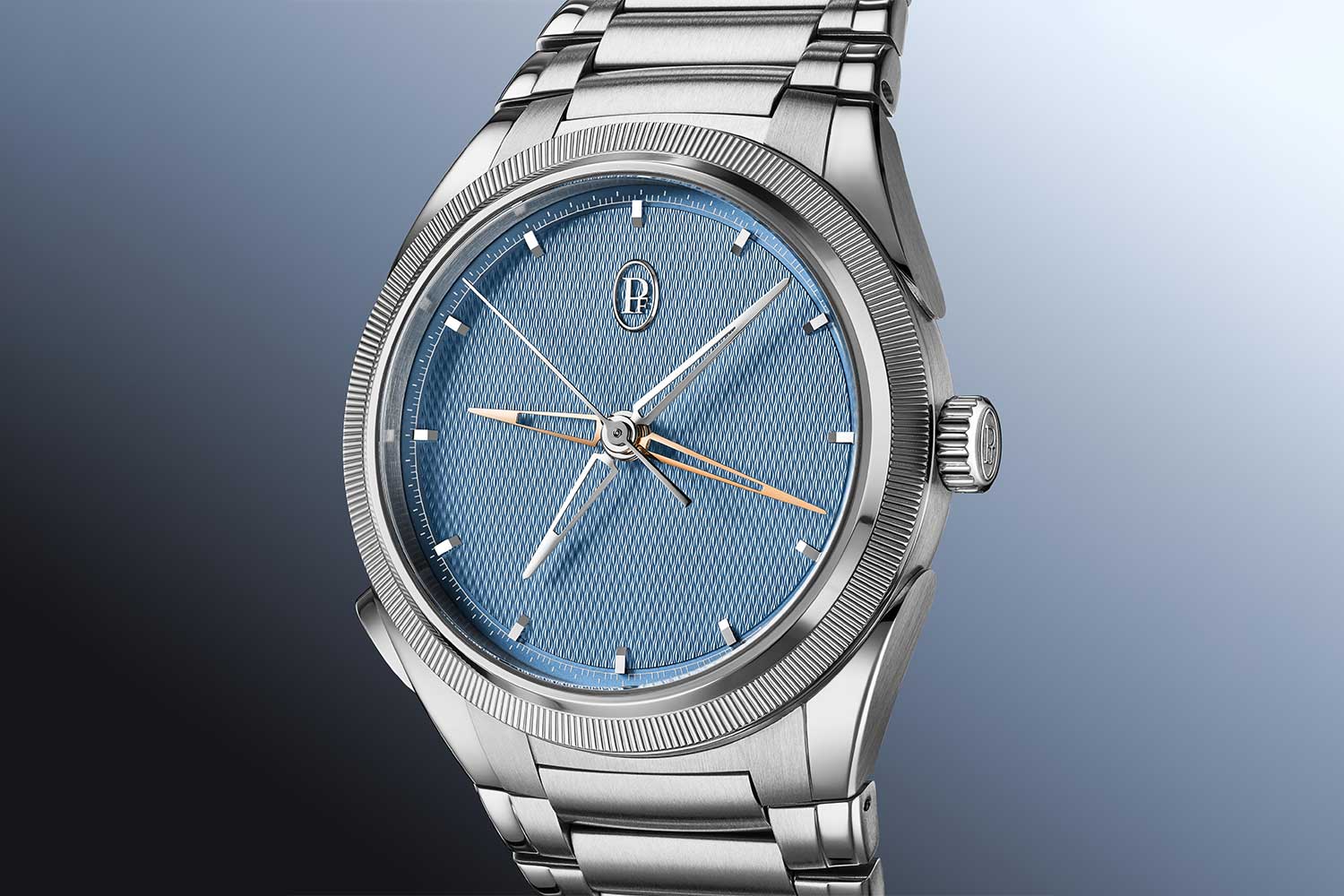
The mineral blue dial hand-finished in Parmigiani’s signature grain d’Orge guilloche
In mineral blue, the effect is one of disarming serenity. It is difficult to reconcile the uninterrupted expanse of the dial with the considerable mechanical activity taking place beneath it, and that tension is what gives the Tonda PF Chronographe Mystérieux much of its fascination. Whether that is enough to tempt someone who already owns a Tonda PF Micro-Rotor is another matter. From a distance, and to almost everyone else, it will appear to be little more than a time-only watch. But that has always been part of the appeal of watches whose greatest virtues are reserved for their owner. It is also the sort of watch that makes the eventual publication of its patent genuinely worth looking forward to. The best sleight of hand in watchmaking has a tendency to become more impressive, not less, once its workings are understood, and there is every reason to believe this is one of them.
Tech Specs: Parmigiani Fleurier Tonda PF Chronograph Mystérieux
Reference PFC908-1020001-100182
Movement: Self-winding Manufacture Movement PF053; 60-hour power reserve; 28,800vph (4Hz)
Functions Hours, minutes, central seconds; central chronograph (concealed until activated)
Case 40mm × 13mm; stainless steel with platinum knurled bezel; water-resistant to 100m
Dial Mineral blue with hand-applied grain d’Orge guilloché
Strap Stainless steel integrated bracelet with butterfly folding clasp
Price CHF 36,900
Parmigiani Fleurier
You may also like
News
Last Week in Watches: Patek Philippe Takes Milan, G-Shock Turns to Blue Sapphire
Oct 5, 2026
News
Last Week in Watches: Patek Philippe Takes Milan, G-Shock Turns to Blue Sapphire
Oct 5, 2026
Editorial
The Tonda PF Skeleton Reveals Its Inner Beauty in Milano Blue and Gold
Aug 31, 2026
Editorial
The Tonda PF Skeleton Reveals Its Inner Beauty in Milano Blue and Gold
Aug 31, 2026
Editorial
Parmigiani Fleurier’s Tonda PF Sport Chronograph Ultra Cermet gets a Mineral Blue Makeover
Jun 30, 2026
Editorial
Parmigiani Fleurier’s Tonda PF Sport Chronograph Ultra Cermet gets a Mineral Blue Makeover
Jun 30, 2026