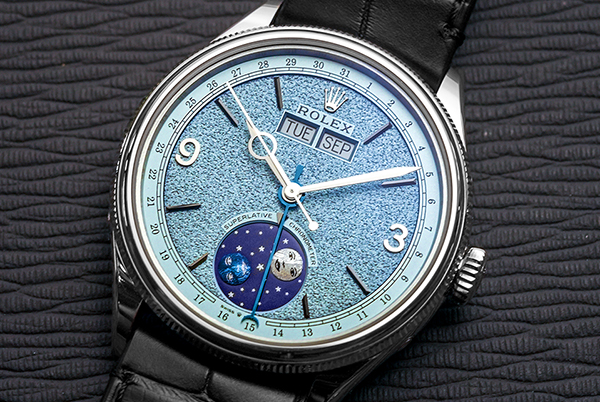
A Closer Look: Rolex Perpetual Padellone
Editorial
A Closer Look: Rolex Perpetual Padellone

The discovery of Rolex’s patent filing for an instantaneous annual calendar has made the wait for this year’s launches rather more interesting, but even with the advance notice, the return of the Padellone lands hard. Introduced in 1949, the ref. 8171 was affectionately dubbed the Padellone, which translates to “large frying pan” in Italian. It offered a complete calendar in its simplest form, shortly before the professional watches began arriving in quick succession and established the identity we know today. The brief excursion into complete calendars left it as something of an outlier, and over the decades the ref. 8171 and the oyster-cased ref. 6062 became objects of fascination for collectors. Given that it is a complication thoroughly of its epoch, and one that was not unique to the company, there was little reason to expect a second act. But now it has one, and Rolex has put some serious engineering behind it. The calendar has been upgraded to an instantaneous annual calendar, built on the highly innovative, high-frequency movement launched in the Land-Dweller.
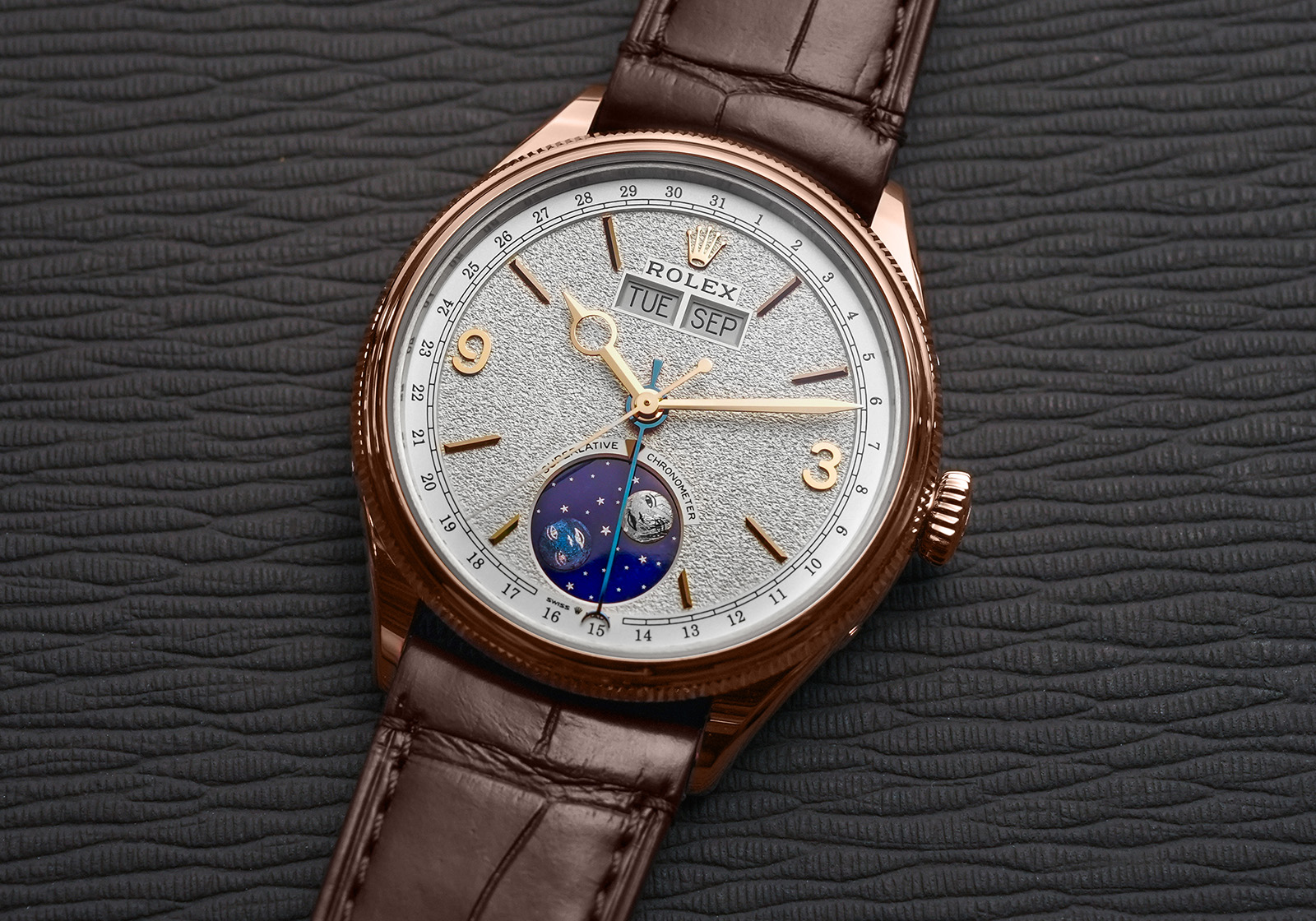
Rolex Perpetual Padellone in Everose Gold and alligator strap (©Revolution)
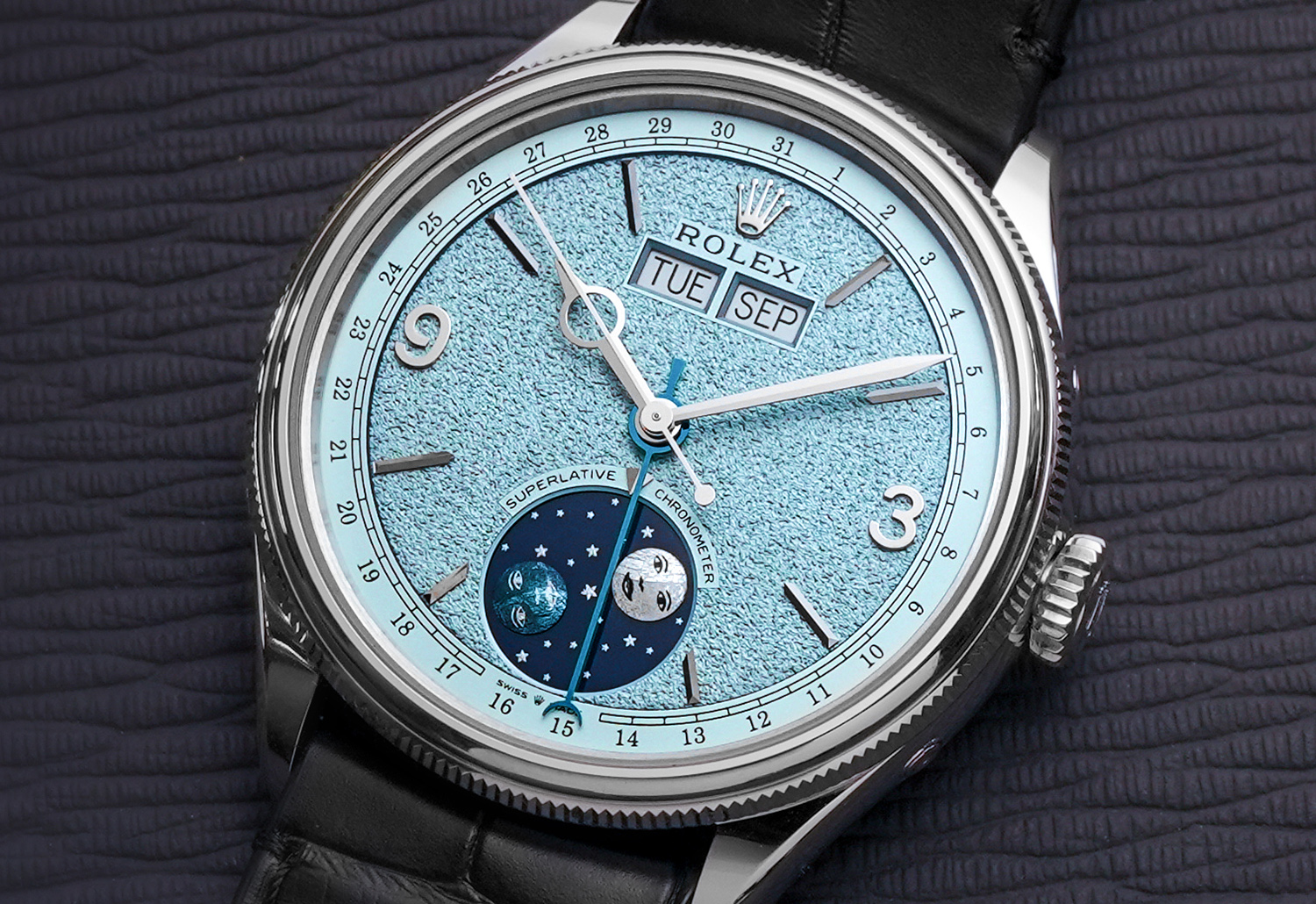
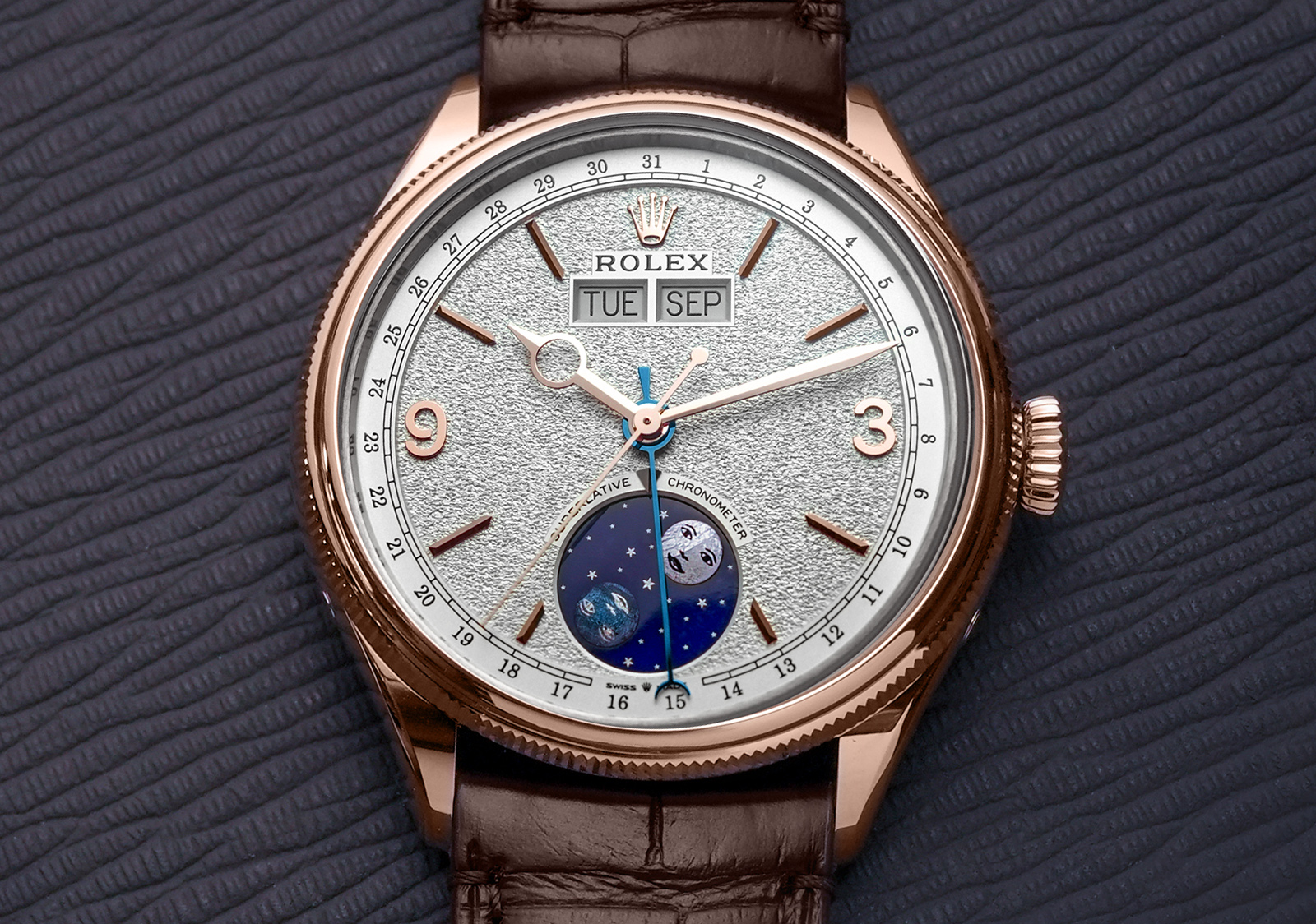
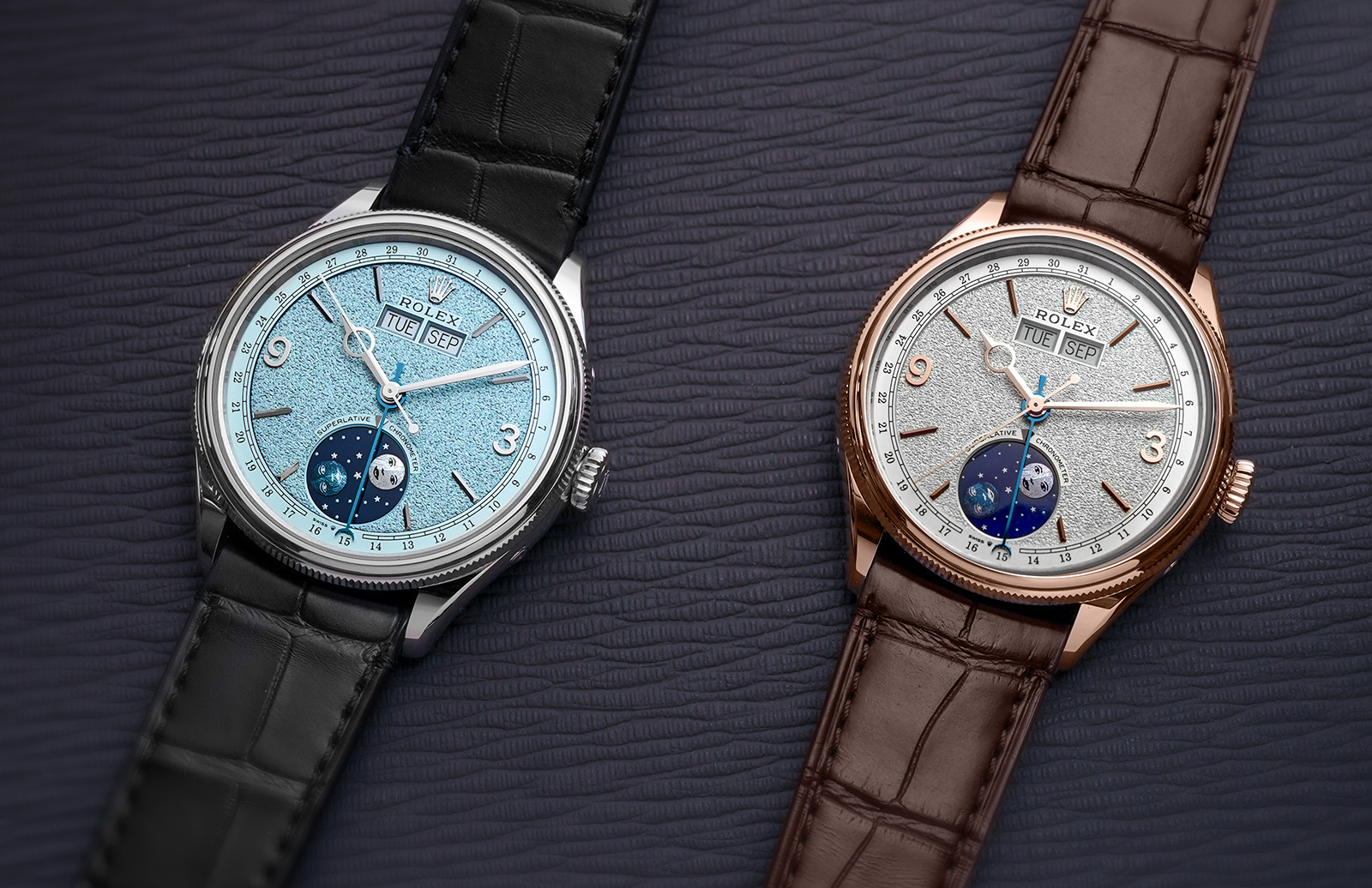
The Perpetual Padellone measures 39mm in diameter and 12.2mm thick and is water-resistant to 50m. It comes in two metals – 950 platinum with an ice blue dial, and 18ct Everose gold with an “intense” white dial. The Everose can be had on leather or on the matching Settimo bracelet, introduced on the yellow gold 1908 last year. Rolex’s bracelets are exemplary and the seven-link Settimo is no exception. It is supple, exceptionally elegant, and well suited to the dressier sensibilities of the watch. Five narrow links sit between two slightly wider outer links, all polished, and the concealed folding Crownclasp preserves the continuity of the pattern when closed.
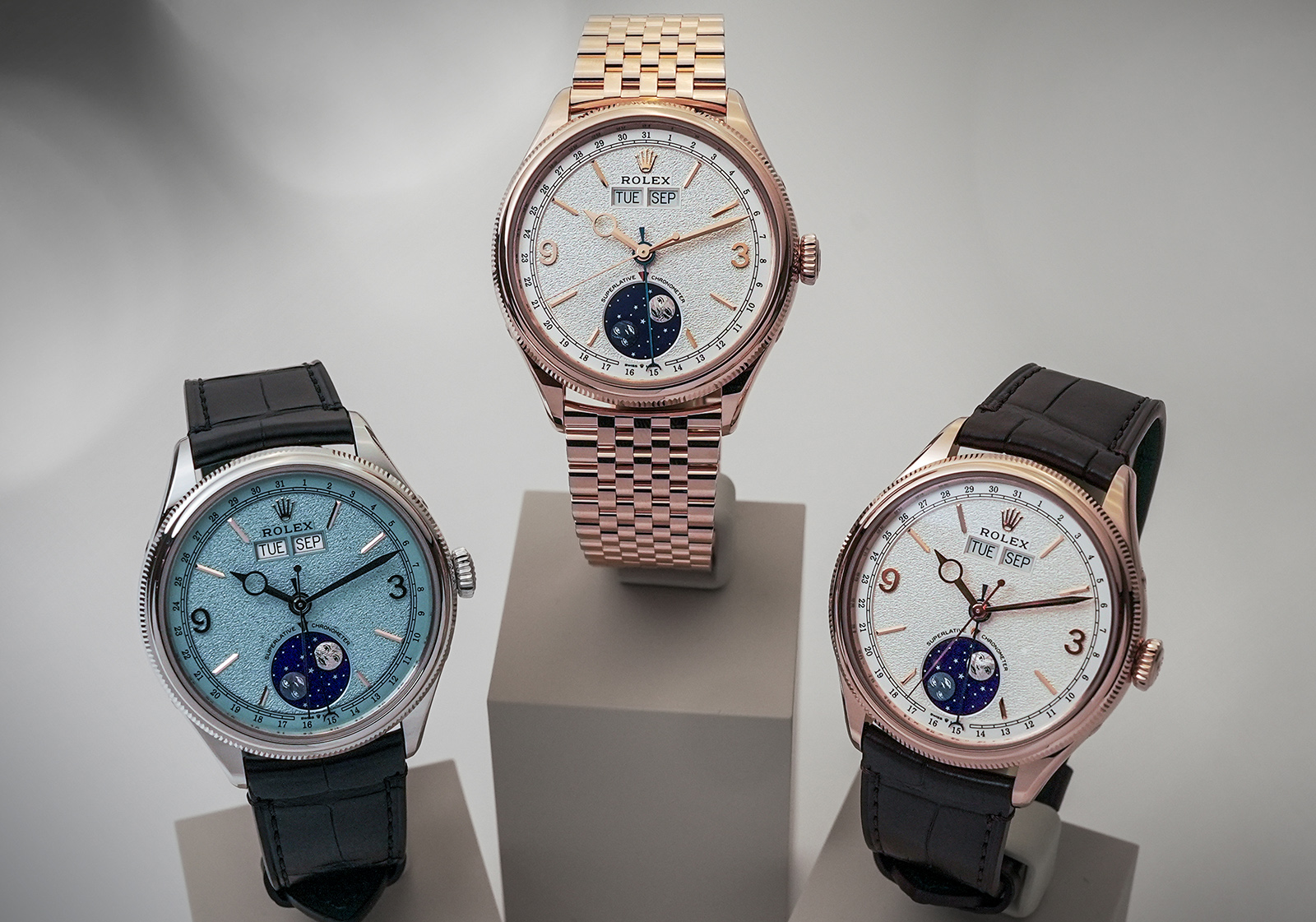
(©Revolution)
Although the gap between the case and the end link is divisive, the curved end link keeps it closer to the case than a straight one would. Its attachment is more elaborate than it first appears and was the subject of a patent application. Each side of the end link contains a blind bore that houses a separate spring-loaded pin, the outer tip of which engages a hole in the adjacent lug. The pins can be set at an angle to one another, which allows the end link to follow the curvature of the case more closely. Each pin is held captive by a tubular retainer threaded into the mouth of its bore. The retainers can be unscrewed for servicing, while access openings beneath the end link allow a technician to retract the pins with a tool to remove the bracelet.
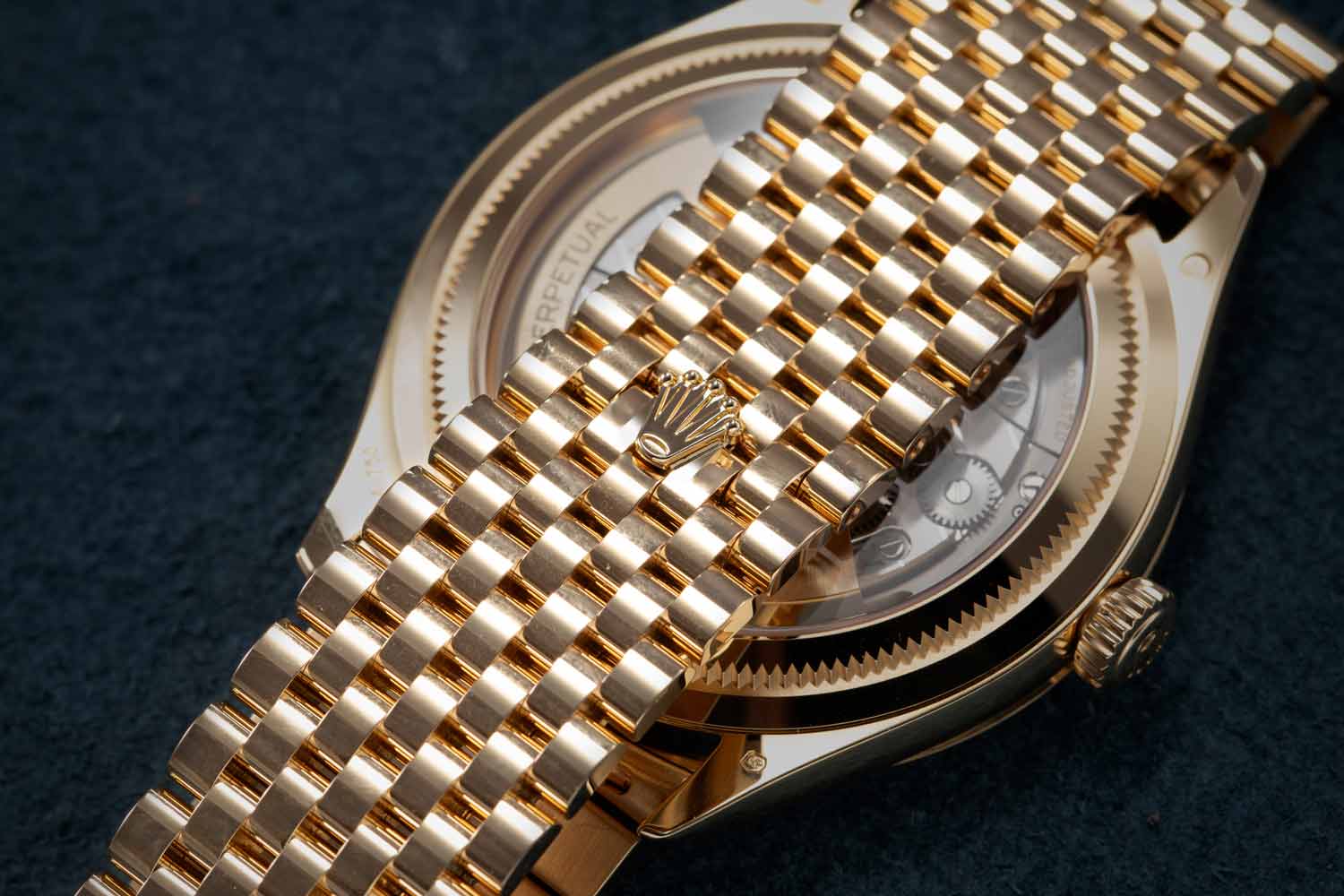
The incredibly refined 7-link Settimo bracelet with an invisible folding Crownclasp on the yellow gold 1908 (©Revolution)
The most distinctive element of the watch is the grained texture of the dial, achieved through laser engraving. To me it’s what makes the design come alive and sing, and it sets the Padellone apart from everything in the 1908 collection as well as the discontinued Cellini Moonphase.
The watch has a central seconds hand, which seems only appropriate for a modern high-grade chronometer. It retains the attractive observatory-style hour hand of the 1908 – superficially Breguet-like, but with a larger circular loop and distinct triangular tip, paired here with a sword-shaped minute hand.
(©Revolution)
(©Revolution)
The calendar follows a classic and readily legible arrangement, with the day and month in twin apertures at 12 o’clock and the moonphase at six. A blue central hand with a crescent tip indicates the date on a peripheral scale, set against a satin-finished border around the grained dial. The moonphase disc is blue enamel, with meteorite representations of the full and new moons. The full moon has a black pad-printed face, while the new moon is distinguished by a dark blue PVD coating and a silver pad-printed face. The stars are also pad-printed in silver.
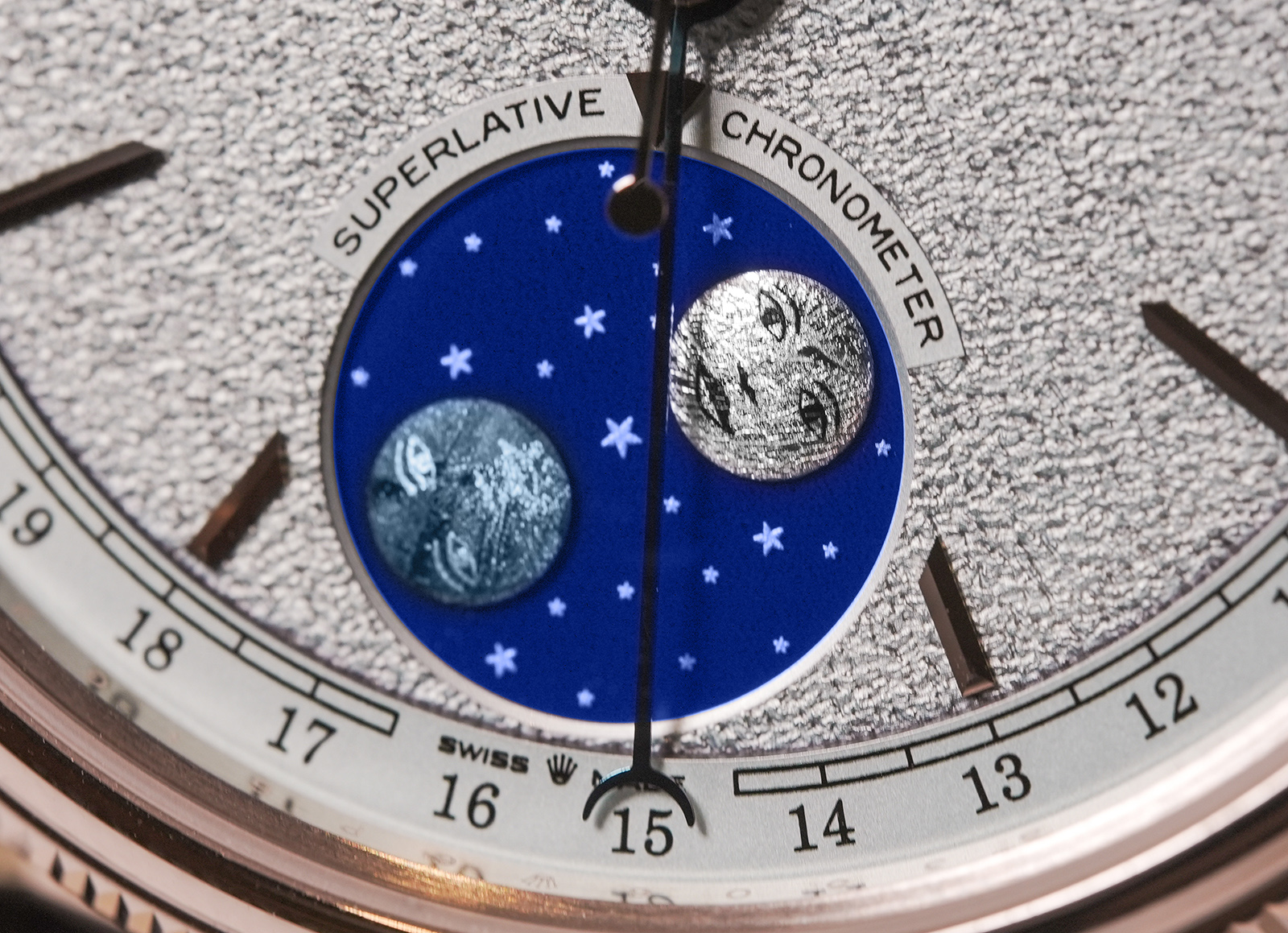
The double-hemisphere moonphase indicator is similar to that of the 2017 Cellini Moonphase. The base of the moonphase disc is blue Grand Feu enamel, while the two moons are made from meteorite, featuring a Mona Lisa-like expression similar to the one found in the original ‘Padellone’ and Ref. 6062 (©Revolution)
The platinum version is particularly arresting. Ice blue is characteristic of Rolex platinum watches, but here the grained texture and deep blue of the moonphase give it a character quite different from its counterparts in the Oyster collection. A moon with a face is an old convention, but on a Rolex, it has a disarming whimsy.
(©Revolution)
The calendar is set via four correctors in the case flanks, with the month corrector at 2 o’clock, the date at 4, the moonphase at 8 and the day at 10. It is tempting to wish for an all-in-one crown-operated system, but that convenience has its own trade-offs. If every indication advances together via the crown through a quickset date, changing the month means cycling through a month’s worth of dates. Independent correction through the crown avoids this, as in the Audemars Piguet calibre 7138, but the elaborate system of levers and correction gearing needed to select and adjust each display individually would run counter to the mechanical simplicity that makes Haplos compelling. Rolex, for its part, says the correctors are a tribute to the 8171 – and notes they can be operated in any order without damaging the watch.
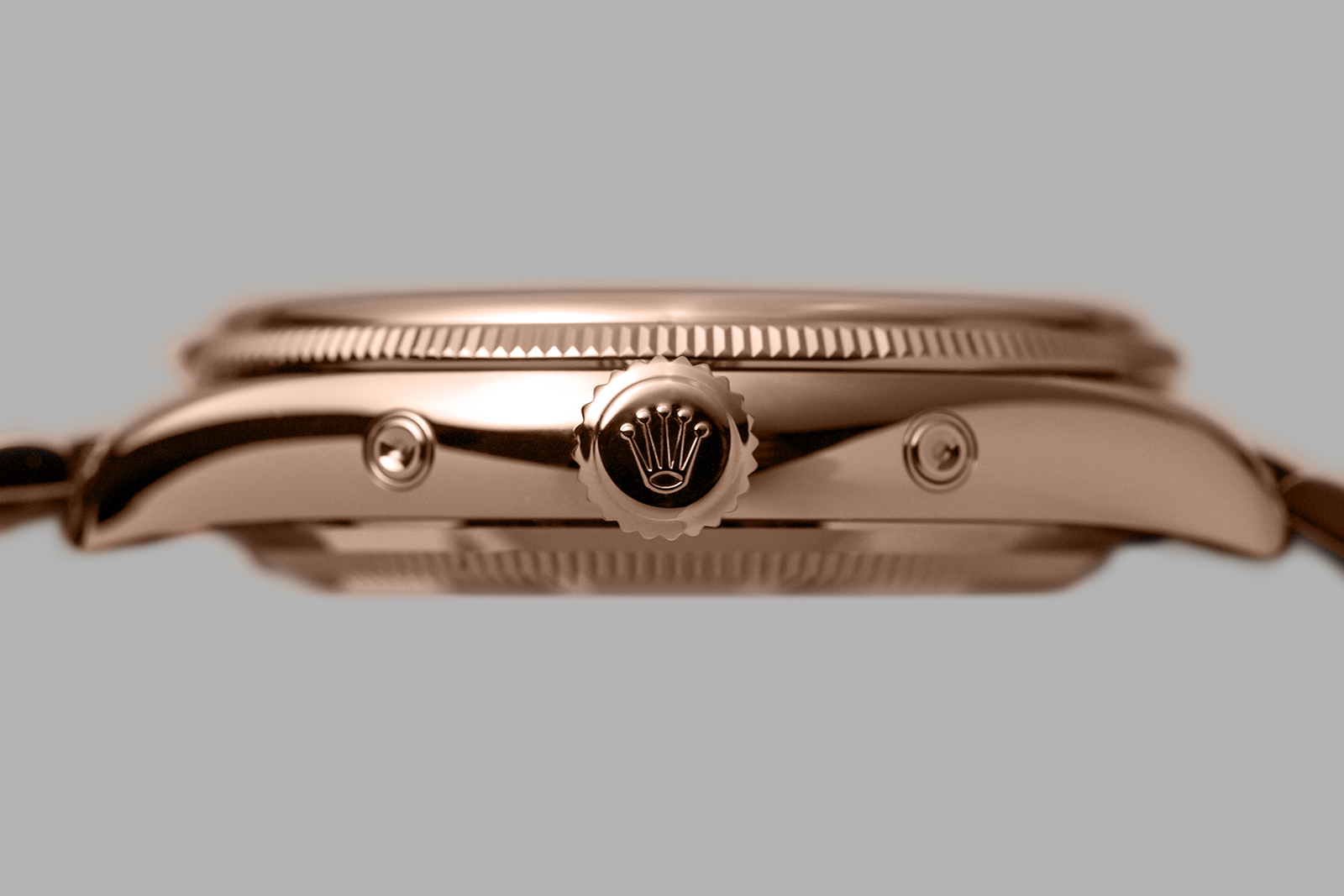
The Perpetual Padellone uses traditional recessed pushers that can be operated in any sequence without damaging the watch (©Revolution)
Ingeniously Compact Haplos Annual Calendar
Unlike perpetual calendars, which tend to follow a well-established template with the occasional maverick departure, annual calendars vary considerably in their dial design and mechanics right from the outset. Patek Philippe’s patent on its original mechanism may have encouraged other manufacturers to find their own solutions, with remarkably diverse results. At one end is the five-part simplicity of Ochs und Junior’s gear-based annual calendar, which has a program wheel with truncated teeth; at the other are constructions such as Lange’s, whose complexity and reliance on a grand lever resembles a traditional perpetual calendar. Rolex’s Saros is cam- and lever-free, taking yet a different and highly unusual approach, in which the date ring keeps track of the months itself, dragging a satellite gear round a fixed wheel, with the ratio between them bringing a tooth into reach of a finger in the short months to advance the date an extra step. All depart dramatically from Patek’s design. Hence, the very different starting points make the ingenuity of each solution best understood in relation to what it was designed to achieve.
For the Padellone, the goal was to preserve the classic complete calendar layout of adjacent day and month apertures, a central date hand and a moonphase at six o’clock, while adding automatic correction for 30-day months and an instantaneous change of the day, date and month, as in the Saros. What makes the solution interesting is how little the mechanics depart from those of a simple calendar to achieve both. Haplos, from the Ancient Greek for “simple”, is a particularly apt name for the mechanism, as its simplicity is striking.
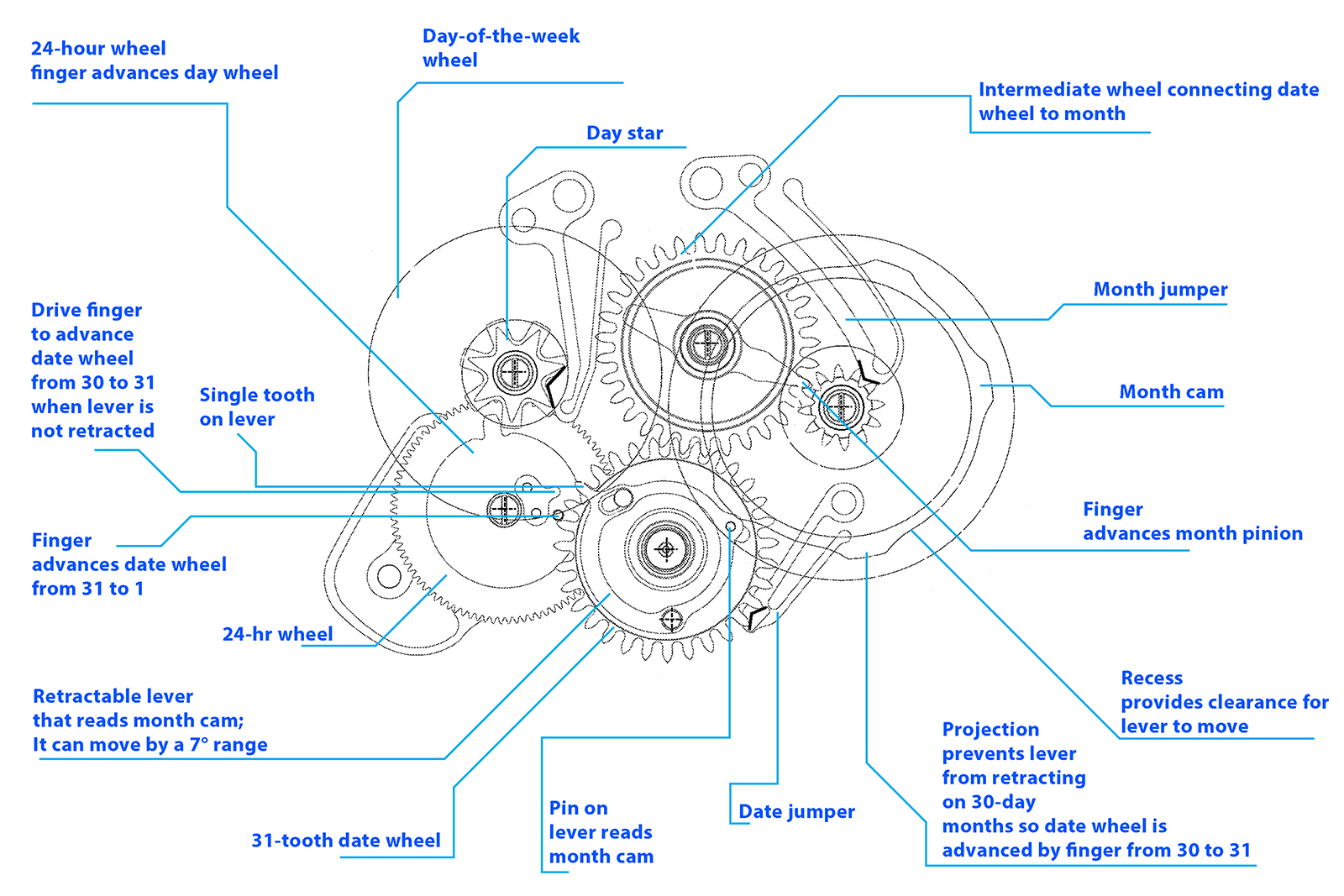
The most notable feature is that the lever is pivoted on the date wheel itself and is carried around with it. It has both a pin that reads the month cam and a single tooth that receives the additional impulse needed at the end of a 30-day month. The part that determines whether an extra advance is required is therefore also the part through which the advance is delivered.
This arrangement is made possible by the position of the month cam, which sits off-centre beside the date wheel and is formed on the underside of the month display disc itself. Its radial projections encode the 30-day months, while the lower portions correspond to the 31-day months. As the date wheel approaches the end of its monthly revolution, the pin on the lever comes into position to encounter the cam. The cam then determines whether the lever can retreat under pressure or must remain in place to receive the impulse.
The calendar drive comprises a 24-hour wheel and a finger piece that advances the day-of-the-week star while carrying two date-driving fingers. This arrangement is otherwise the same as in a simple complete calendar, which requires just one finger each for the day and date.
The two date-driving fingers act at different heights. One finger supplies the ordinary daily advance by indexing the teeth of the date wheel, while an additional finger encounters the single tooth on the lever at the transition from the 30th to the 31st. In a 31-day month, the month cam leaves sufficient clearance for the pin to move. Hence, the additional finger pushes against the single tooth on the lever, causing the lever to pivot aside without advancing the date wheel. The ordinary finger then moves the date wheel from 30 to 31. In a 30-day month, a projection on the cam blocks the pin and prevents the lever from retracting, so the additional finger turns the entire date wheel by one step, from 30 to 31. The ordinary finger then immediately supplies the next, from 31 to 1. Both advances occur in swift succession during the same rapid release, so the wearer sees an instantaneous change.
The ingenuity lies in using the month cam only to permit or prevent the retreat of the lever. The additional finger itself pushes the tooth on the lever aside whenever the cam allows the lever to move, so no spring is needed to press the lever against the cam. The cam itself forms part of the month display disc, and just one intermediate wheel connects this assembly to the date wheel. The intermediate wheel also has 31 teeth and carries a finger that advances the month pinion once per revolution. At the end of a 30-day month, this occurs during the second step of the date change, as the date passes from 31 to 1.
The month-driving finger performs another useful function. It remains between the teeth of the month pinion as a physical stop against an additional jump. The month jumper can consequently be weaker, since it no longer has to prevent overtravel on its own. Although the stop acts after the jump, the weaker jumper reduces the resistance that the drive must overcome during each instantaneous change. Together with the reduced inertia of the combined month disc and cam, as well as the short train, this lowers the energy demand.
The economy is especially useful when the indications must jump instantaneously. A single cam and spring-loaded roller lever supply the energy for the day, date and month changes. The cam rotates with the finger piece that carries the two date-driving fingers. Throughout the daily cycle, the cam lifts the roller lever and loads its spring. At midnight, the roller passes the highest point of the cam, and the spring drives the cam and finger piece rapidly forwards to power all the indications.
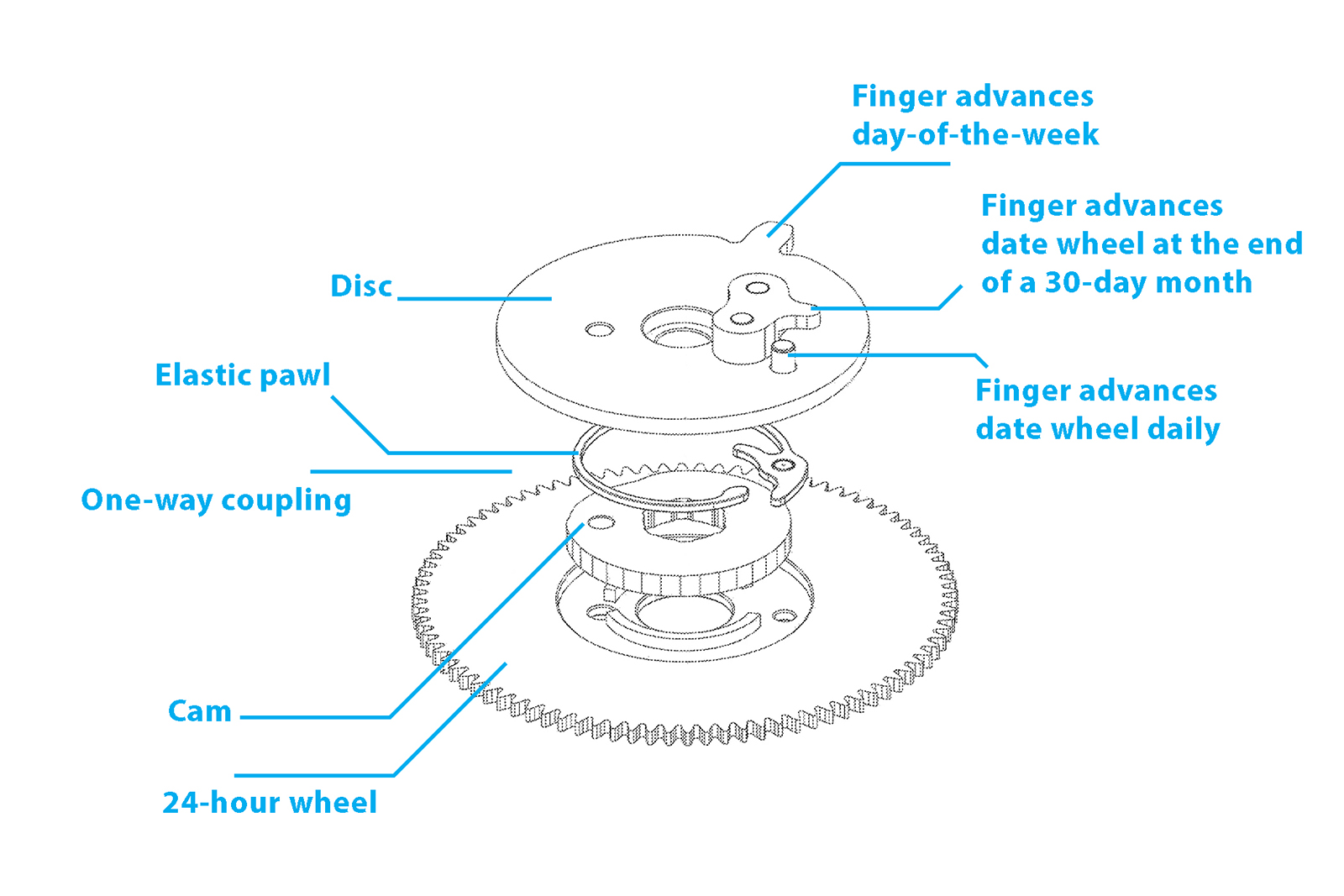
The finger piece receives its normal drive from the 24-hour wheel through a one-way coupling with a curved elastic pawl. This transmits rotation during the charging cycle but allows the finger piece to accelerate ahead of the 24-hour wheel when the spring releases to jump the displays. The same coupling allows the 24-hour wheel to turn backwards during time-setting while the calendar-driving components remain stationary. Turning the hands counterclockwise across midnight, for instance, will not desynchronize the calendar displays.
In all, the Haplos is simple, compact and economical in its use of energy, but its accomplishment lies in how similar the mechanism remains to that of historical triple calendars, with only a month cam, a small lever and an additional date-driving finger needed to turn a simple calendar into an annual calendar.
The mechanism was built such that the indications can be adjusted in any order and at any time. But the hour must already be set to the correct half of the day – the daytime half – because the calendar changes at midnight. A tip from the manual is to pull the crown to the first position and advance the hands. If the date and day jump when the hour hand reaches 12, that was midnight, and the correct time should be set before adjusting the calendar.
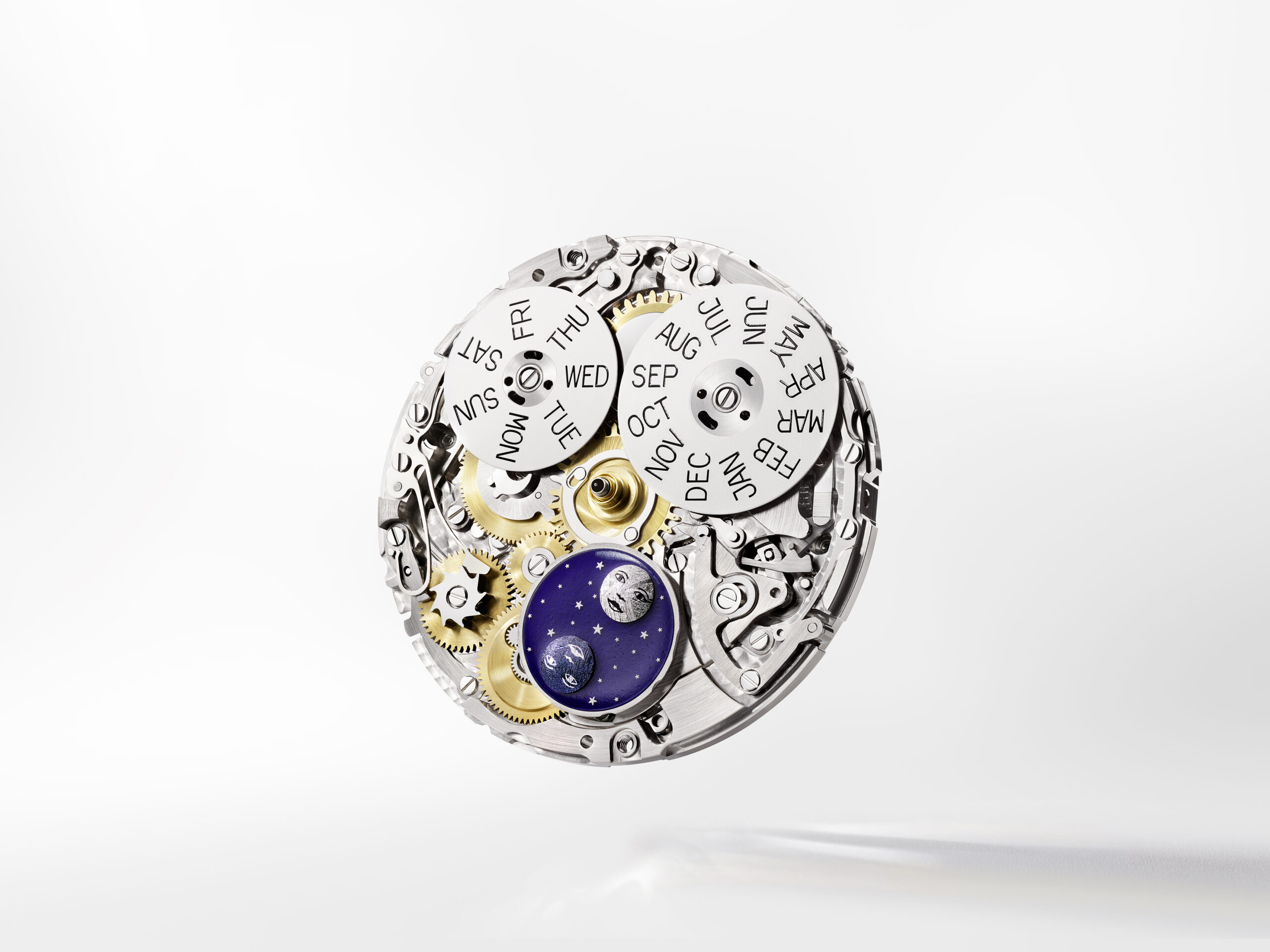
The train for the moonphase display includes a differential (to the left of the moon disk) that permits independent adjustment
The moonphase, on the other hand, like that in the Cellini Moonphase, is driven separately by the motion works through a differential. The planet carrier receives power from the motion works, while one of its two central pinions is held stationary by the correction star and its jumper spring. As the carrier turns, a compound planet rotates around the stationary pinion and drives the second central pinion, which transmits motion to the moonphase display. The same differential also acts as a safety device that permits independent correction. A press of the corrector advances the star and turns the normally stationary pinion. With the carrier held against the correction torque through its connection to the cannon pinion, the compound planet transmits this rotation to the moonphase display without moving the hands.
High-frequency movement with a Dynapulse escapement
The Calibre 7190 is based on the Calibre 7135, which debuted in the Land-Dweller in 2025. It belongs to the relatively thin 71XX family and shares the 7135’s Dynapulse escapement and oscillator. It runs at 5Hz, or 36,000 vibrations per hour, with a power reserve of approximately 66 hours.
A higher frequency means that disturbances are averaged out over more oscillations per second, resulting in greater rate stability in face of shocks a wristwatch would face. High-beat calibres remain uncommon in mass produced movements. Other notable examples that come to mind include Grand Seiko, Zenith and Chopard, of which only one relies on a non-Swiss lever escapement, with Rolex being the other, and the Dynapulse has the additional distinction of being self-starting.
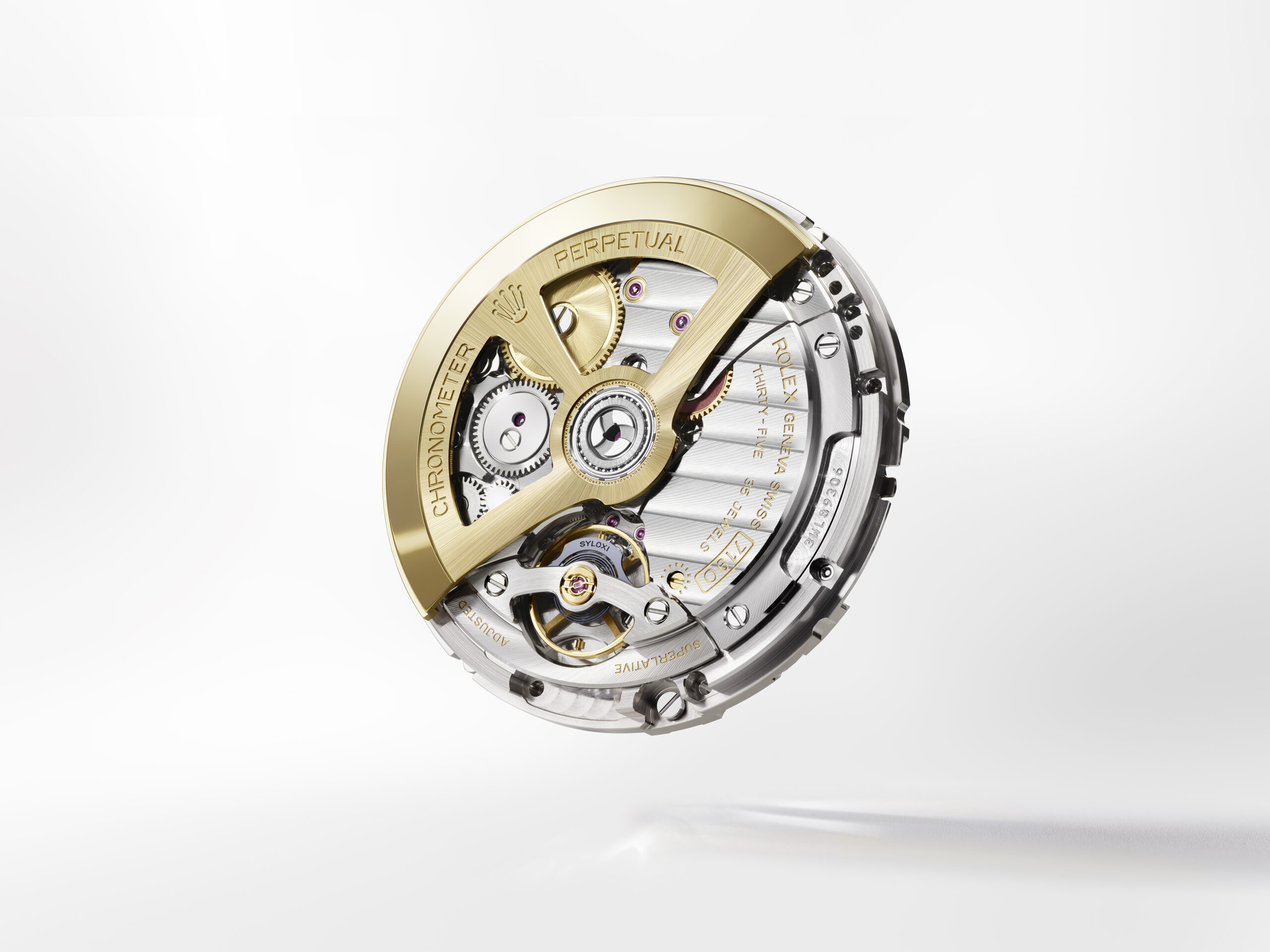
Calibre 7190
The Dynapulse is a double-wheel, tangential-impulse silicon escapement. Its main advantage is greater efficiency, as the impulse relies on rolling contact, which virtually eliminates the sliding friction associated with a Swiss lever escapement. It has also perfectly addressed the drawbacks of the early Dual Ulysse escapement. One of the most notable aspects is that each escape wheel performs both locking and impulse with the same tooth. During the locking phase, the rounded tooth tip rests against a shallow V-shaped surface on the intermediate lever. The returning balance moves the lever until the tooth tip passes the edge of this surface and engages the adjacent impulse surface. The tooth then drives the lever, which transmits energy to the balance, before a tooth on the opposite escape wheel takes up the next locking position.
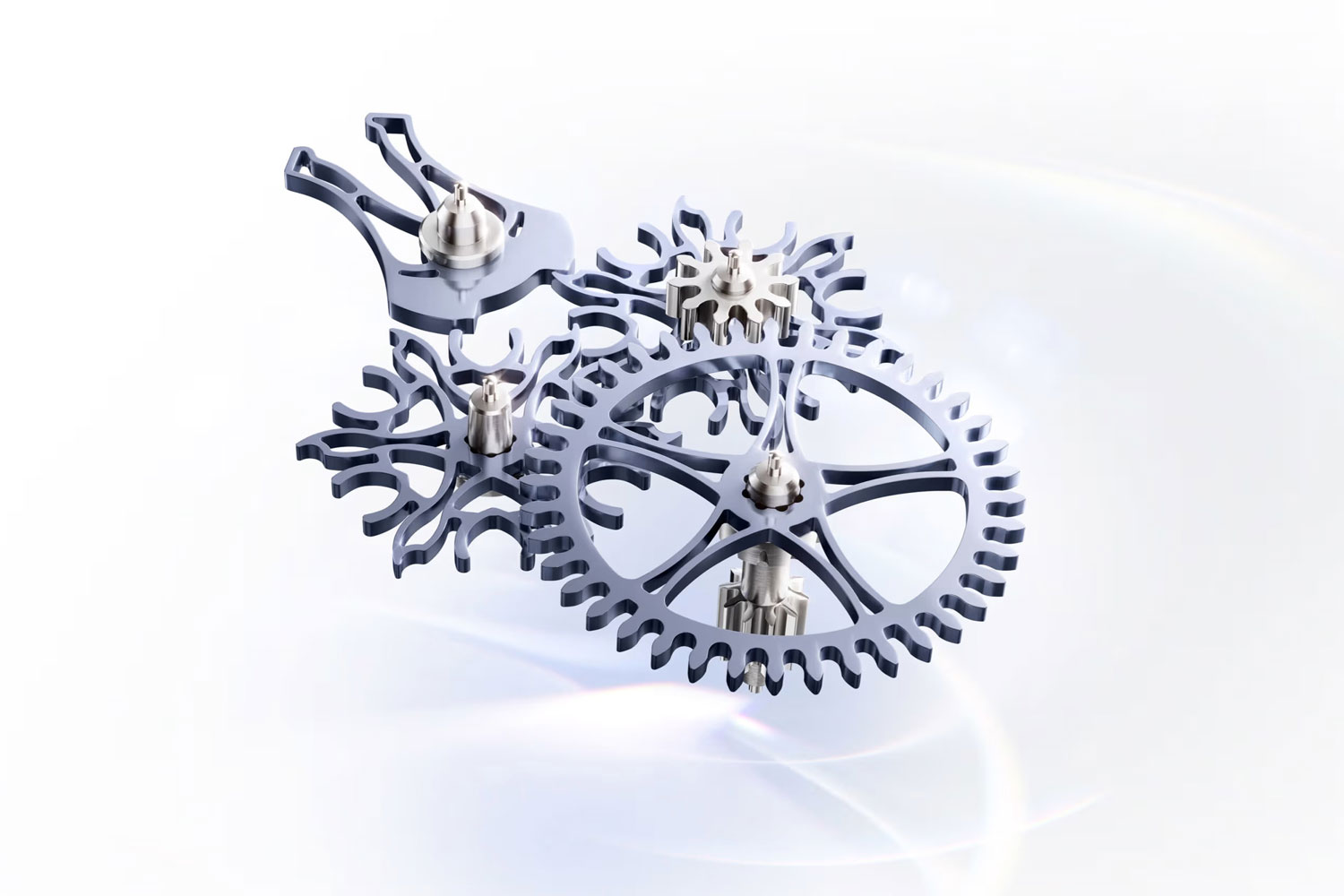
The Dynapulse escapement
The escapement also dispenses with the guard pin by incorporating its safety function into the fork horns, and does not rely on banking pins to maintain its locking position. The locking surfaces of the lever direct the force exerted by the locked escape wheel tooth through or very close to the pivot of the lever, so it produces little or no torque that would turn the lever out of position. The tooth tip seats in a shallow V-shaped recess with inclined flanks that resist accidental displacement and provide a stable locking position.
At the same time, each fork horn has an inner surface that works with the impulse jewel. Near its free end, the horn widens towards the fork opening to form a safety projection, which remains clear of the balance assembly during normal operation. If a shock turns the lever towards an unintended unlocking while the impulse jewel is outside the fork, the tip of one projection meets the cylindrical peripheral surface of the balance roller. This contact arrests the lever before the escape wheel tooth can move from the locking recess onto the impulse surface. The projections can also contact the impulse jewel as it enters or leaves the fork to prevent accidental unlocking
The tooth design is a masterpiece in its own right. Each escape wheel has six large teeth, with two slender, curved teeth between each pair. The large teeth have tips that lock against and deliver impulses to an intermediate lever, which in turn transmits energy to the balance, while their lower flanks mesh with the slender teeth of the opposite wheel. The slender teeth form horseshoe-shaped pairs, with small protrusions at their ends that engage the large teeth of the other wheel. Their inner flanks are recessed to provide clearance and remove unnecessary material, while their outer flanks also participate in the meshing. This effectively combines the meshing and escapement functions in a single plane and reduces the inertia of the wheels, which must repeatedly accelerate and stop. Rolex states the Dynapulse is 30% more efficient than the Swiss lever, a figure double the gain achieved by the Chronergy.
The oscillator has been reconsidered just as thoroughly, with particular attention to magnetic resistance and operation at high frequency. The free-sprung balance uses optimised brass, a non-ferromagnetic alloy with higher electrical resistivity to reduce eddy-current drag in strong magnetic fields. Its density allows the required moment of inertia within the available dimensions.
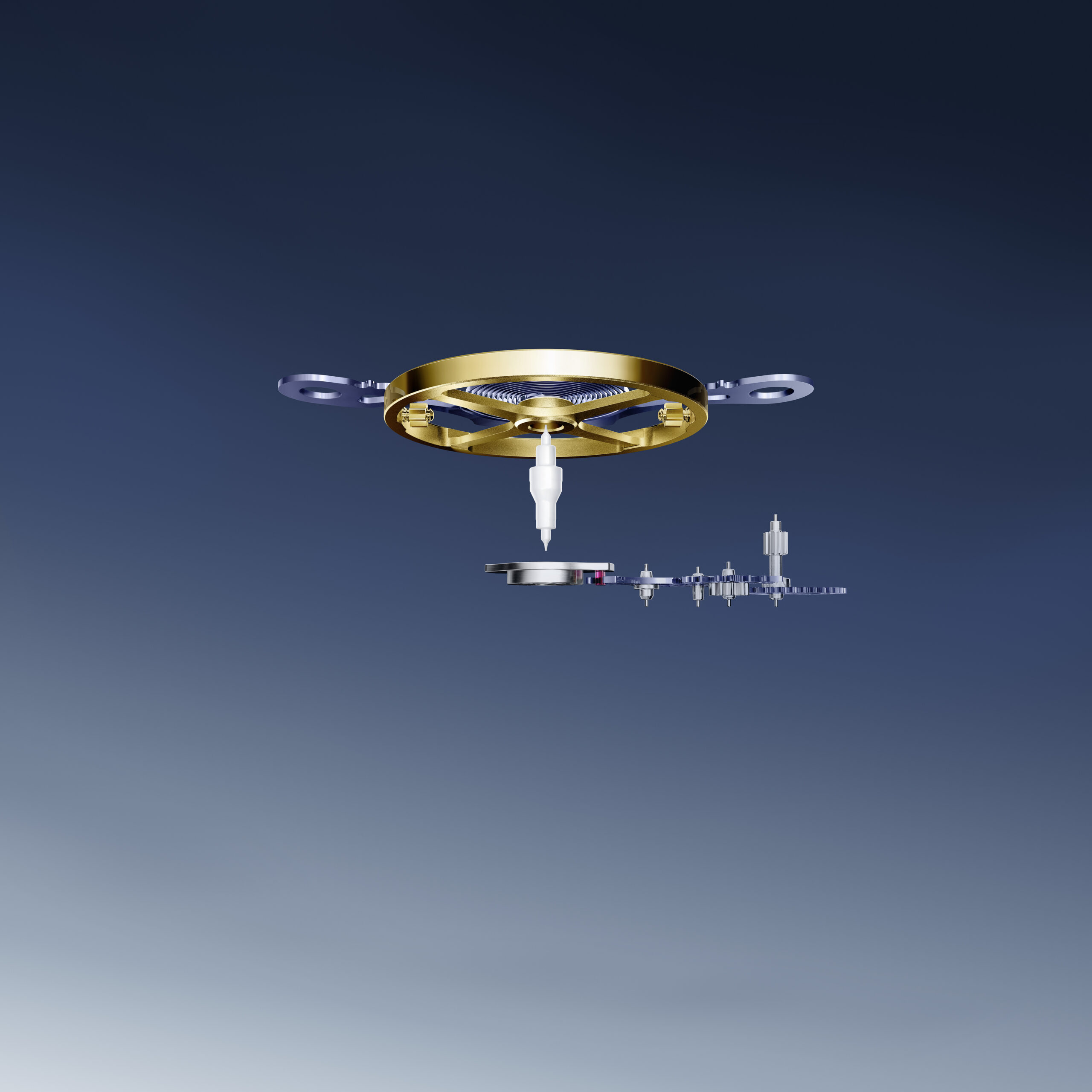
Cal. 7190’s oscillator with ceramic balance staff, optimized brass balance wheel and the Syloxi hairspring with improved stiffness
The balance staff is made of ceramic, shaped by a femtosecond laser and highly polished at the pivots to provide hard, non-magnetic bearing surfaces with low friction. The Paraflex shock absorbers have also been optimised for the ceramic staff. Their double-cone internal structure allows greater mobility, with two conical surfaces on the jewel carrier that engage corresponding seats within the bearing body to centre it. The leaf spring has been enhanced, so the force it exerts on the endstone varies less as the assembly moves under a shock. This helps limit stresses on the pivots, while the spring and conical seats restore the assembly to its correct position after impact. Finally, the Syloxi hairspring has been re-profiled with increased effective stiffness to suit the 5Hz frequency.
The fact that all of this sits behind a classic calendar face is one of the more pleasurable ironies of the Padellone. It also gives the watch a certain ease with its own technical sophistication. There is no suggestion that the owner needs to appreciate the engineering before they can appreciate the watch, which is great given how much there is to explain. One can enjoy it simply as a handsome calendar watch, then discover that behind almost every apparent convention is a decision worth examining, and that interest – as well as practical gains in performance – should serve it well long after the surprise of its arrival has passed.
There is no shortage of annual calendars in this or a similar price bracket, each with its own priorities and solutions, but the Padellone combines an instantaneous changeover with what is the most technologically advanced base movement in its class. This combination alone gives it a particularly strong case, even in a crowded field.
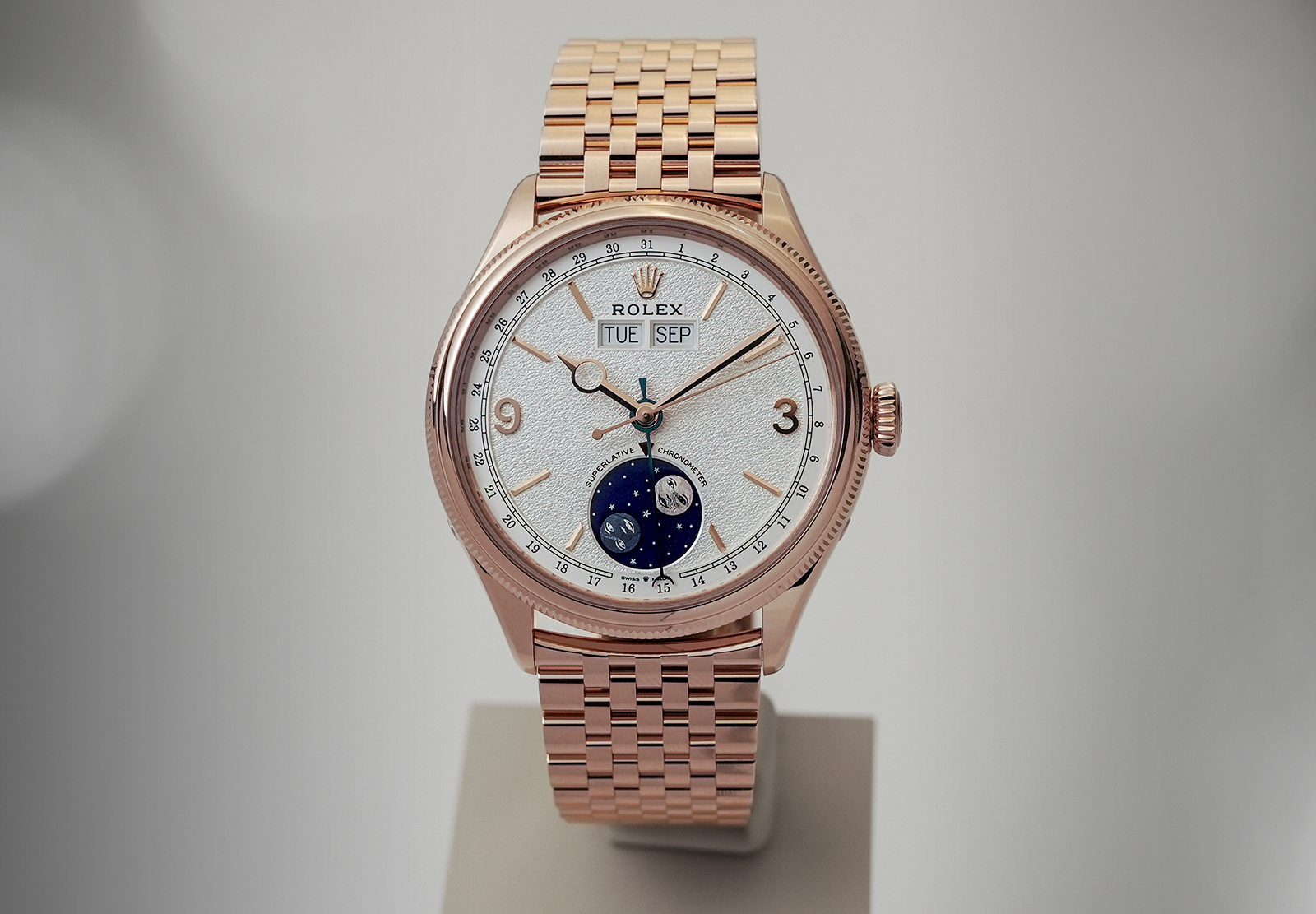
The Everose Perpetual Padellone paired with the Settimo bracelet (©Revolution)
Tech Specs: Rolex Perpetual Padellone M53506-0002
Ref M53506-0002
Movement Self-winding Caliber 7190; 66-hour power reserve; 5Hz or 36,000vph
Functions Hours, minutes and seconds; stop seconds; instantaneous complete annual calendar with Haplos system: moonphase indicator
Case 39mm × 12.2mm; 950 platinum; water resistant to 50m
Dial Ice-blue, matte with grained finish; blue enamel moon disk with full and new moon in meteorite; applied Arabic numerals and hour markers in 18K white gold
Strap Matte black alligator leather with Dualclasp
Price CHF 59,000
Tech Specs: Rolex Perpetual Padellone M53505-0002
Ref M53505-0002
Movement Self-winding Caliber 7190; 66-hour power reserve; 5Hz, 36,000vph
Functions Hours, minutes and seconds; stop seconds; instantaneous complete annual calendar with Haplos system: moonphase indicator
Case 39mm × 12.2mm; 18K Everose gold; water resistant to 50m
Dial Intense white, matte with grained finish; blue enamel moon disk with full and new moon in meteorite; applied Arabic numerals and hour markers in 18K pink gold
Strap Matte brown alligator leather with Dualclasp
Price CHF 52,500
Tech Specs: Rolex Perpetual Padellone M53505-0003
Ref M53505-0003
Movement Self-winding Caliber 7190; 66-hour power reserve; 5Hz, or 36,000vph
Functions Hours, minutes and seconds; stop seconds; instantaneous complete annual calendar with Haplos system: moonphase indicator
Case 39mm × 12.2mm; 18K Everose gold; water resistant to 50m
Dial Intense white, matte with grained finish; blue enamel moon disk with full and new moon in meteorite; applied Arabic numerals and hour markers in 18K pink gold
Strap Settimo bracelet with concealed folding Crownclasp
Price CHF 64,800
Rolex
You may also like
News
Last Week In Watches: Rolex Revives the Padellone, Hublot Goes Full Koons
Sep 21, 2026
News
Last Week In Watches: Rolex Revives the Padellone, Hublot Goes Full Koons
Sep 21, 2026
Editorial
Rolex’s Future Is Complicated: The New Perpetual Padellone Family
Sep 16, 2026
Editorial
Rolex’s Future Is Complicated: The New Perpetual Padellone Family
Sep 16, 2026

Editorial
Drake’s ‘Ice Gradient’ Daytona isn’t the only Rolex Piece Unique Out There
Aug 21, 2026
Editorial
Drake’s ‘Ice Gradient’ Daytona isn’t the only Rolex Piece Unique Out There
Aug 21, 2026