


Introducing the Patek Philippe Ref. 5978P Milano 2026 Limited Edition
Editorial
Introducing the Patek Philippe Ref. 5978P Milano 2026 Limited Edition

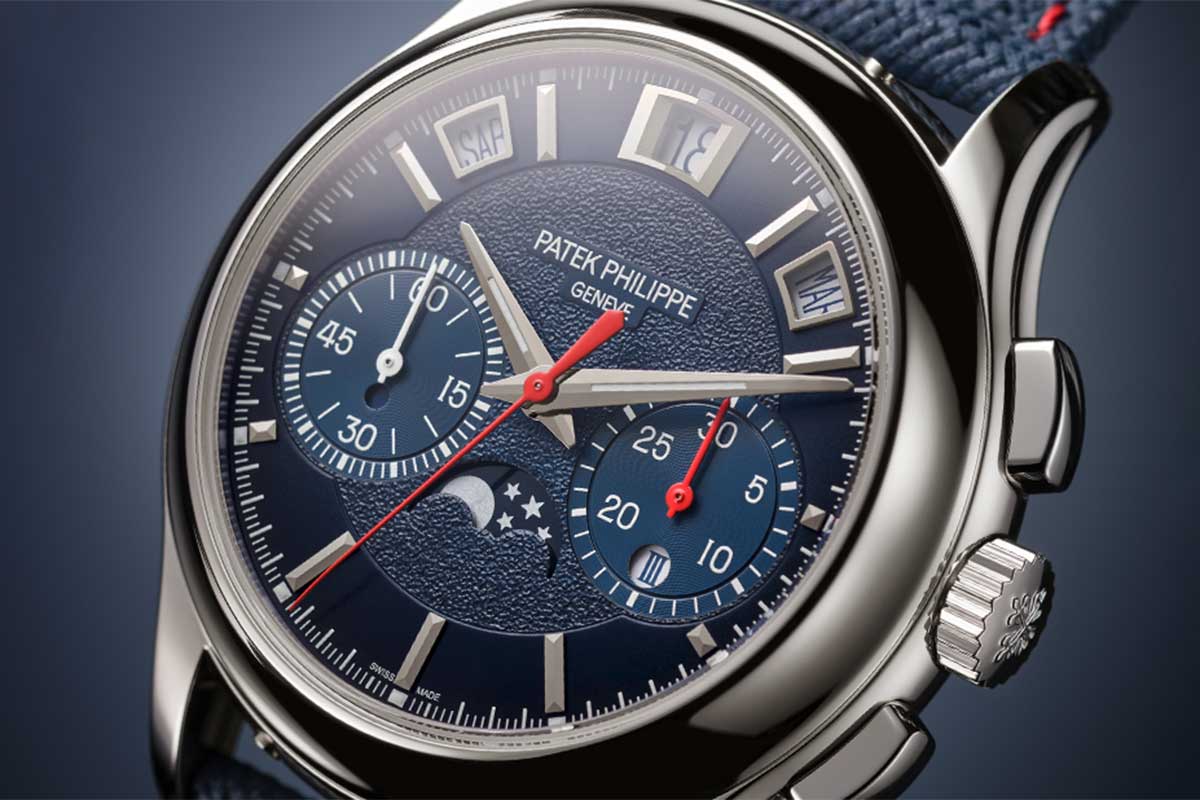
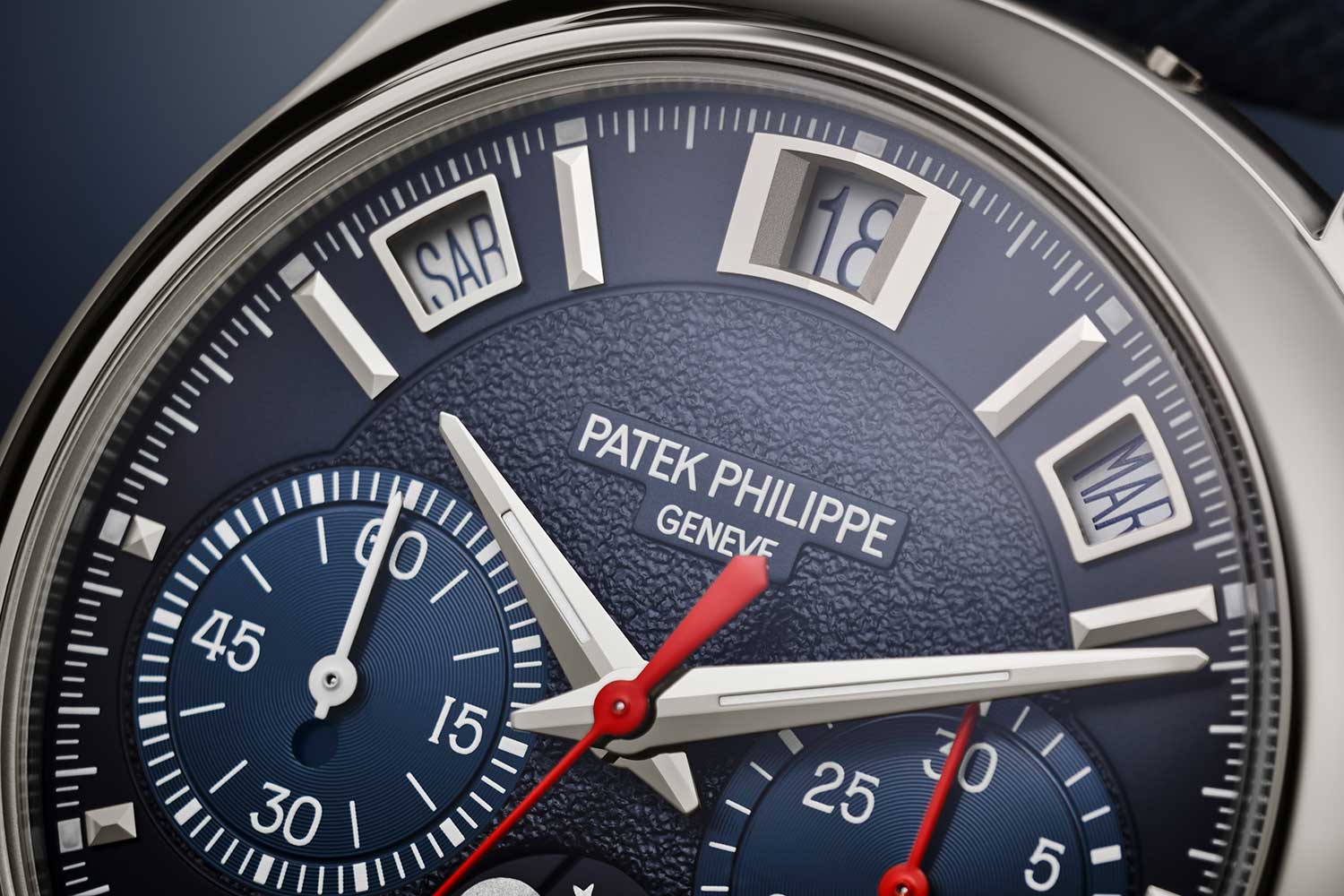
The headliner for Patek Philippe’s Grand Art Exhibition in Milan is the new ref. 5978P-010, a limited edition of 120 pieces that pairs an instantaneous perpetual calendar with a chronograph equipped with an instantaneous jumping minute counter. It is, in essence, the CH 29-535 PS that dates to 2009 with an instantaneous perpetual calendar module that first debuted in 2008. Given that both mechanisms date back almost two decades, it is something of a surprise that the company has never combined them until now. The perpetual calendar chronograph has such a strong lineage at Patek that the emphasis has been on continuity. An instantaneous calendar with aperture displays means a departure from that iconic dial design. But if ever there was a reason to break with tradition, it is the opportunity to bring together two complications that are each among the finest examples of their kind.
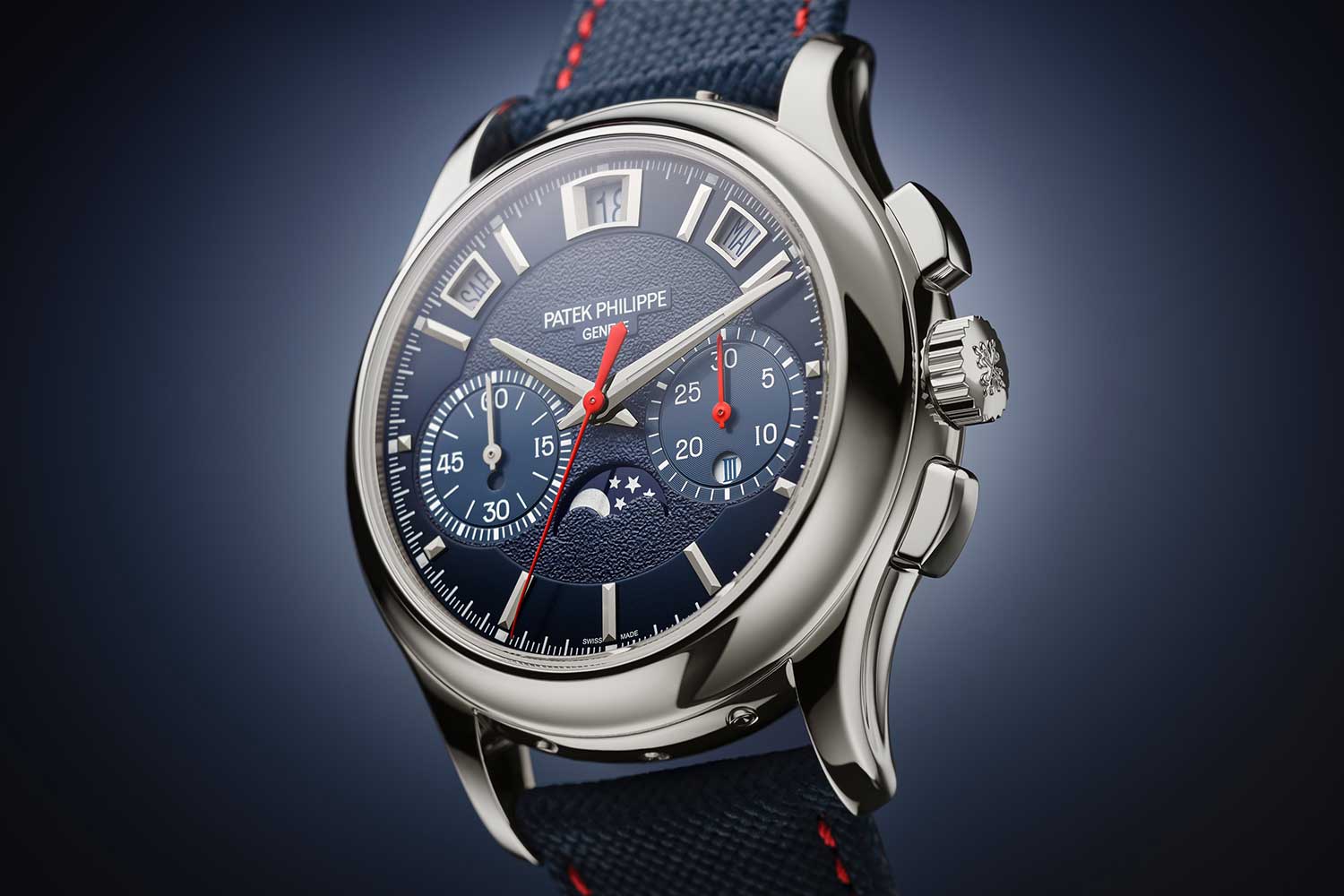
The trade-off to this union, however, is the size, as the day and month discs sit above the date ring and require additional height. The 5978P measures 42mm in diameter and 14.45mm thick, compared with 41mm by 12.4mm for the 5270. Whether it is a price worth paying depends on how much visual and intellectual pleasure one takes in an entirely disc-based instantaneous perpetual calendar.
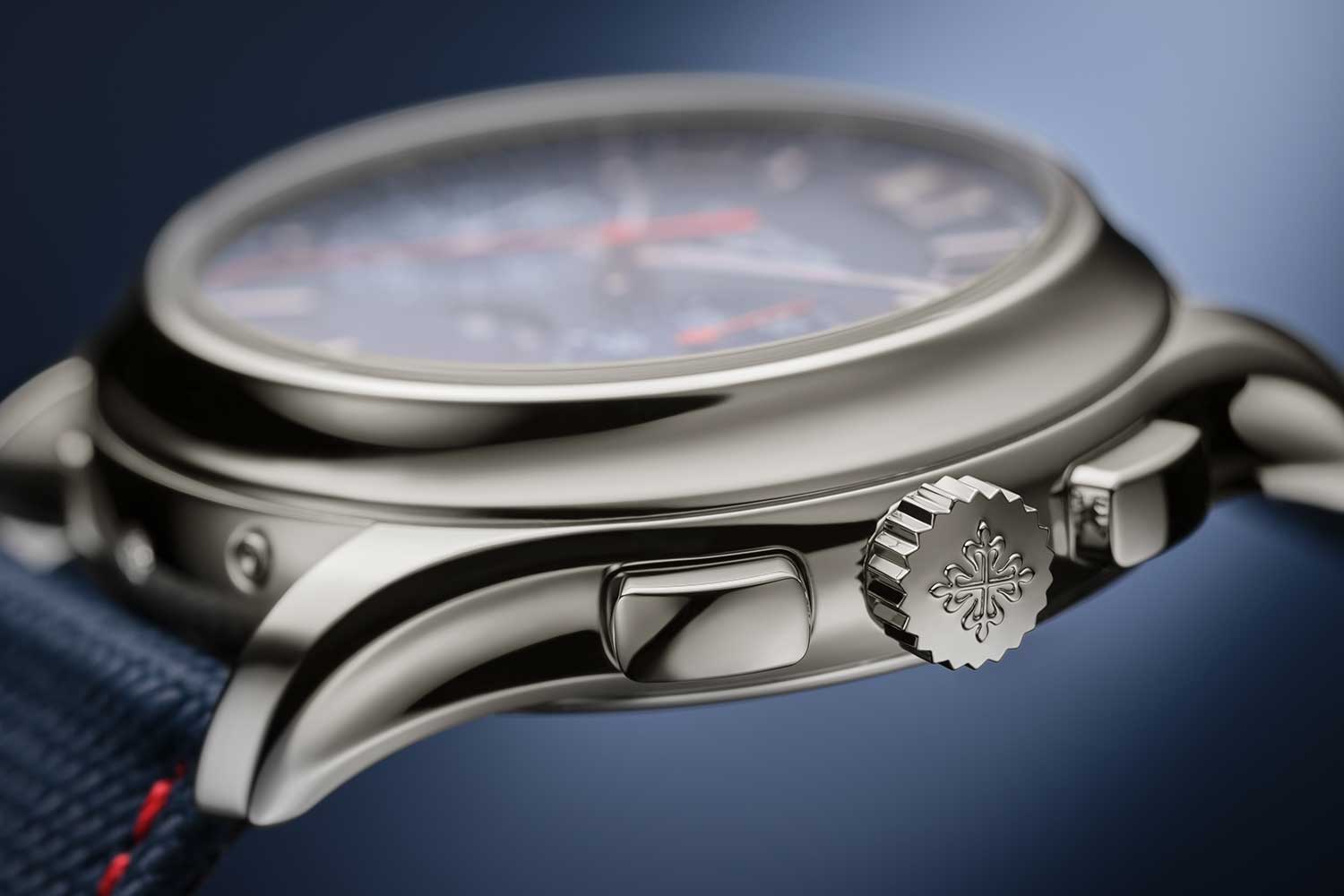
The platinum case has the same diameter and concave bezel as the Quadruple Complication Ref. 5308, but its lug flanks now curve gently inwards, which give it a more elegant profile. The calendar apertures are aligned in an arc above a recessed, textured dial centre, with inlaid snailed counters at 3 and 9 o’clock. The navy blue sunburst dial darkens towards its rim, while red chronograph seconds and minute hands distinguish elapsed time from the calendar and ordinary time indications. The display includes a moonphase at 6 o’clock, a day/night aperture at 8 and a leap-year aperture at 4, and notably, the day and month indications are in Italian.
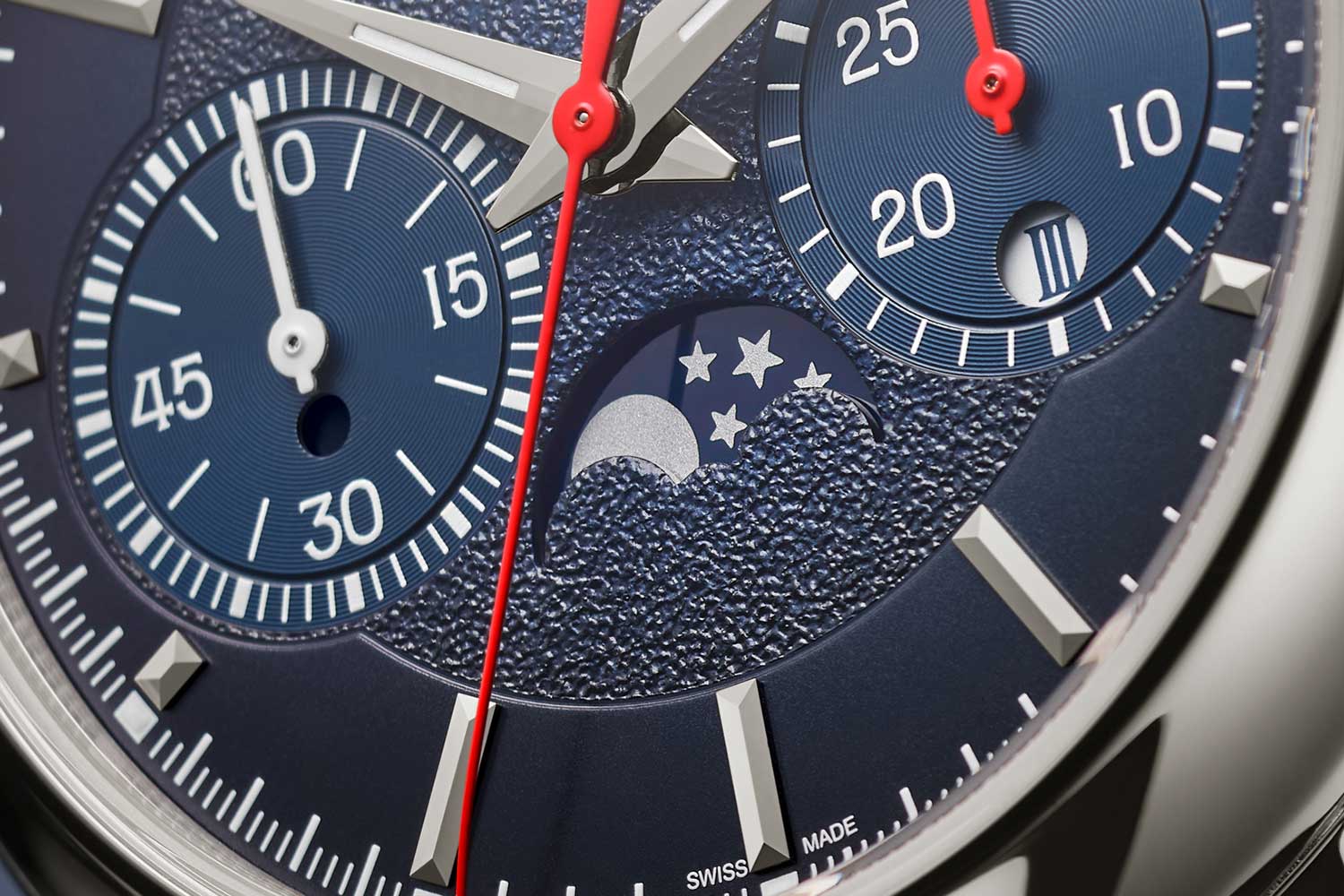
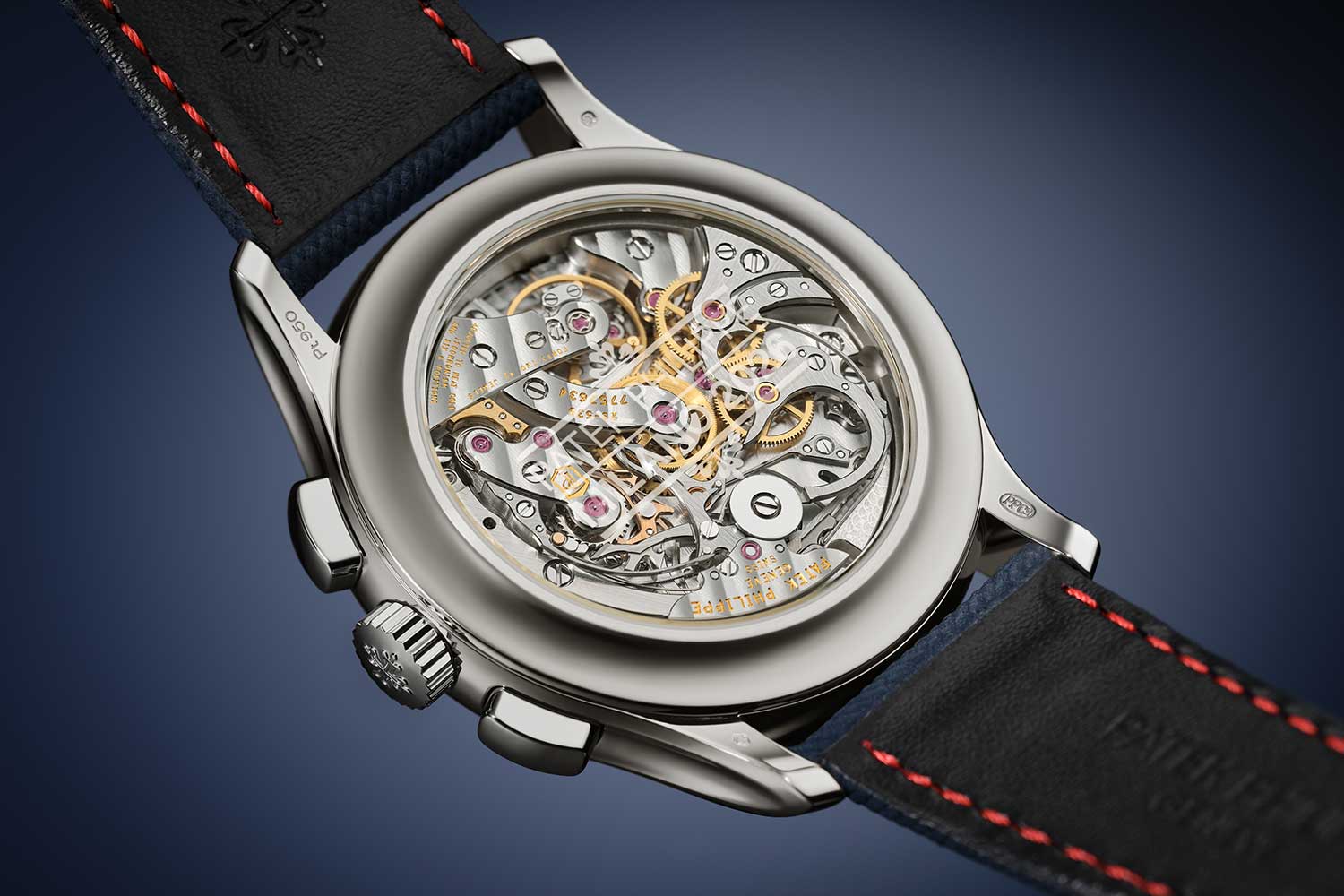
The instantaneous perpetual calendar module has been used sparingly at Patek, and until now, always in the company of a minute repeater. Its home has always been the slim, automatic R 27 minute repeating calibre. It first debuted in the Ref. 5207 of 2008, which also included a tourbillon, before it appeared in the Ref. 5208 with a monopusher chronograph in 2011 and, most recently, in the Quadruple Complication Ref. 5308, created for the Watch Art Grand Exhibition in Tokyo in 2023. The Ref. 5978P is hence its first appearance both in a watch without a chiming complication and in a manually wound movement.
Instantaneous Perpetual Calendar
Apart from this particular module, all perpetual calendars in Patek’s catalogue use dragging or semi-instantaneous displays, with the changeover taking place over several hours around midnight. Patek seems to have made a point of compensating for it in this module, as a complete disc-based perpetual calendar that jumps instantaneously is exceptionally rare.
Like the vast majority of perpetual calendars on the market, it relies on a multi-part grand lever. Apart from its own pivot, the lever has three pivots that carry four parts – a date pawl, a month lever, and a month finger and day finger that share the third pivot. To understand how Patek achieves an instantaneous changeover with large discs, it helps to first consider the mechanics of a conventional perpetual calendar.
At the heart of it is a grand lever that is lifted once every 24 hours to advance a 31-tooth date wheel. A month cam that encodes the varying lengths of the months governs how far the lever travels – shorter in 31-day months and further in shorter months. At the end of the month, a separate arm on the grand lever catches a snail cam coupled to the date star. The longer travel allows this arm to catch the snail earlier and advance the date through the additional positions required to reach the 1st of the following month.
Patek Philippe has kept the basic principle of a grand lever but adds an ingenious refinement. The month cam determines both the lever’s travel and the duration over which its return spring is charged, so as to limit the torque demanded from the movement. It is this variable charging duration that sets the mechanism apart from other instantaneous calendars, in which the charging period is fixed by a snail cam.
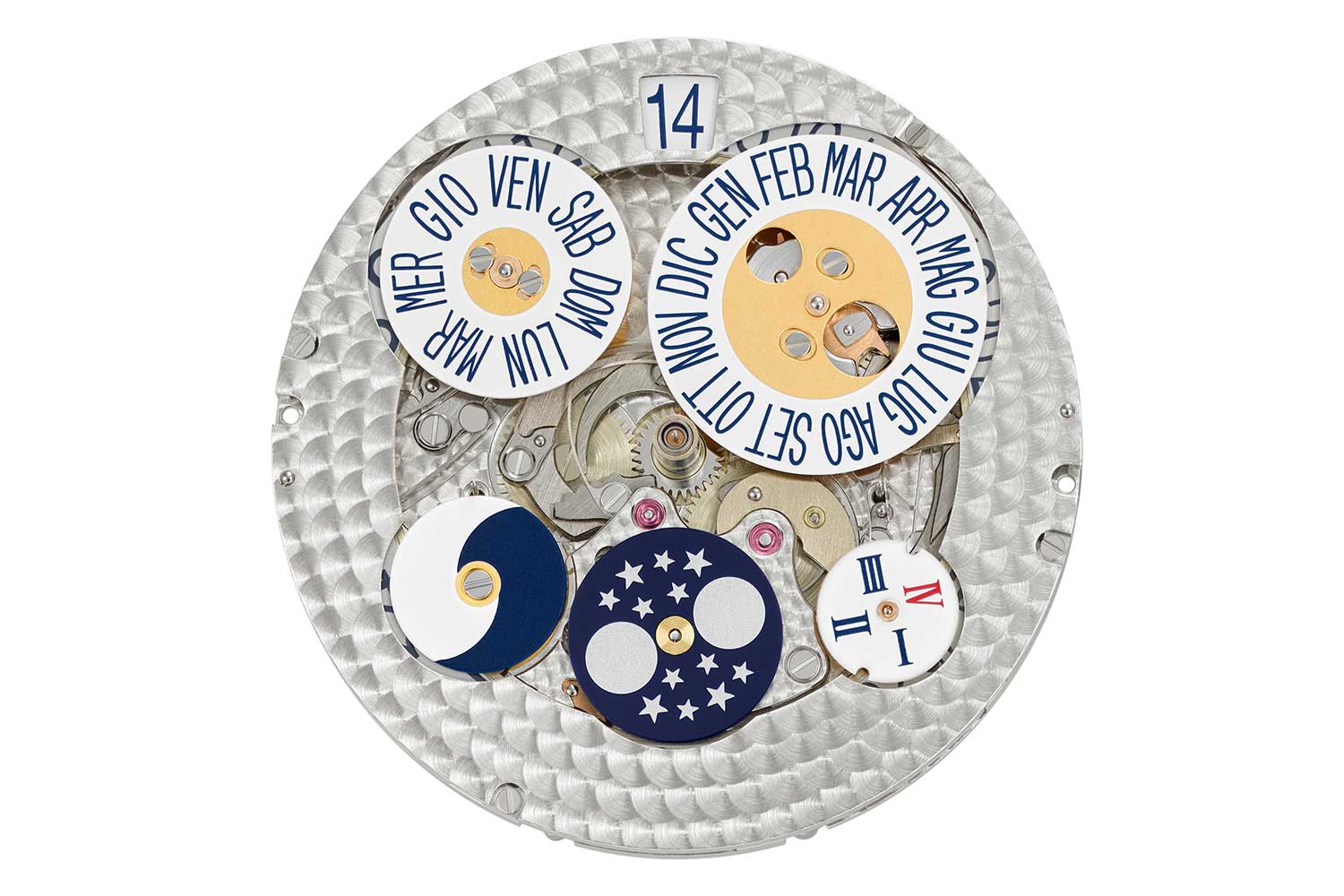
As a general rule, Patek’s perpetual calendars with three subdials employ a 48-month cam, while those with disc displays, including this one, use a 12-month cam with a satellite leap-year cam that distinguishes between the 28 and 29 days of February.
A 24-hour snail cam drives a separate pivoted drive lever each day. This drive lever has four notches, one for each possible month length. A smaller month lever, mounted on the grand lever, reads the month cam and positions its opposite end in the path of the appropriate notch. The drive lever initially moves freely but when the notch contacts the month lever, it will begin to lift the grand lever against its spring.
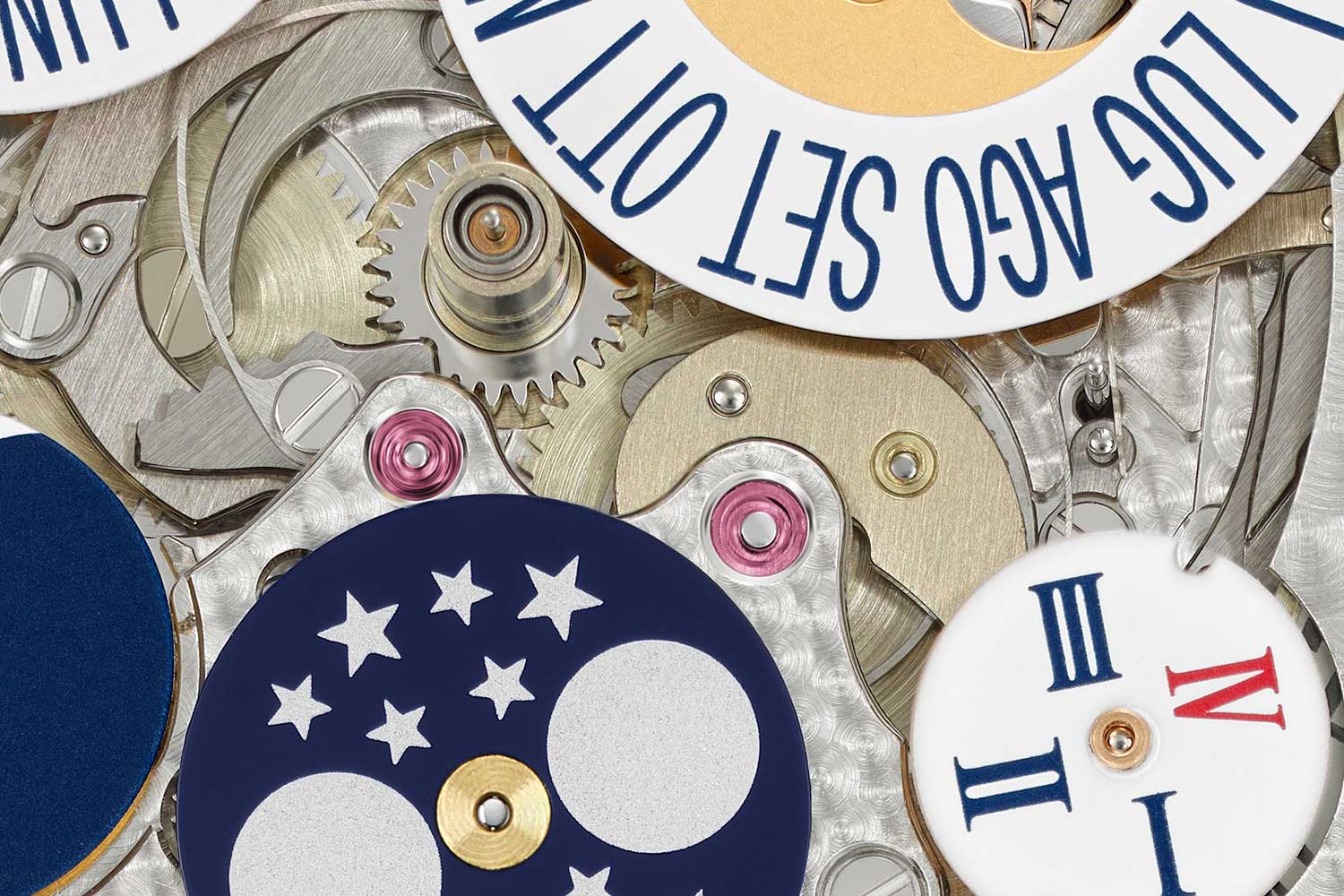
A closer look at drive lever and its four notches (above the moon disc), which engage the free end of the month lever according to the month length. The visible spring holds the drive lever against the 24-hour cam (on the right) and, at rest, the month lever against the month cam (beneath the month disc).
In a 31-day month, contact occurs later, so the lift takes about six hours and produces a shorter travel. In a 28-day February, contact occurs almost immediately, so the lift extends over nearly 24 hours and produces the longest travel. At midnight, the 24-hour snail cam releases the drive lever, and the spring returns the grand lever to advance the displays. In essence, the mechanism spreads the work of charging the spring over a longer period for a larger advance, so even the four-position jump from February 28 to March 1 places a modest demand on the movement. Without this variable charging duration, the greater lift required for February would have to occur within the same charging period as the smaller lift for a 31-day month. The movement would have to deflect the spring further in the same time, which would demand greater torque and cause a disturbance to balance amplitude. By starting the larger lift earlier, the additional work is not concentrated into the hours before midnight.
When the spring is released, the day finger on the grand lever advances the day star and its attached day disc by one position. The date pawl likewise provides the ordinary advance of the date ring. Both remain engaged with their respective teeth after the advance to prevent overtravel.
At the end of the month, the pin on the month finger enters a notch in the date ring before midnight. As the grand lever returns, this finger carries the ring directly to 1, through two positions after a 30-day month, three after February 29 and four after February 28. A hook on the same finger advances the month star by one position, along with the attached month disc and month cam. The grand lever also has a tooth sector that meshes with a pinion that acts as a regulator to moderate the speed of its return.
What’s also notable is that the calendar has a relatively large date on a single ring. The ring rests on rollers, and its drive teeth are recessed into the rear face rather than cut through the disc. This leaves more of the front surface available for larger numerals within the given ring width.
Chronograph with Instantaneous Jumping Minutes
The base calibre CH 29-535 PS is among the finest chronograph movements on the market. 17 years after its debut, it remains unequalled in the way it preserves tradition while also addressing the shortcomings that tradition has handed down. Among its various strengths, not least its beauty, it offers the best solution to two persistent problems in horizontal clutch chronographs – the tendency of the seconds hand to jump as the clutch engages and the irregular transmission of power through conventional triangular teeth.
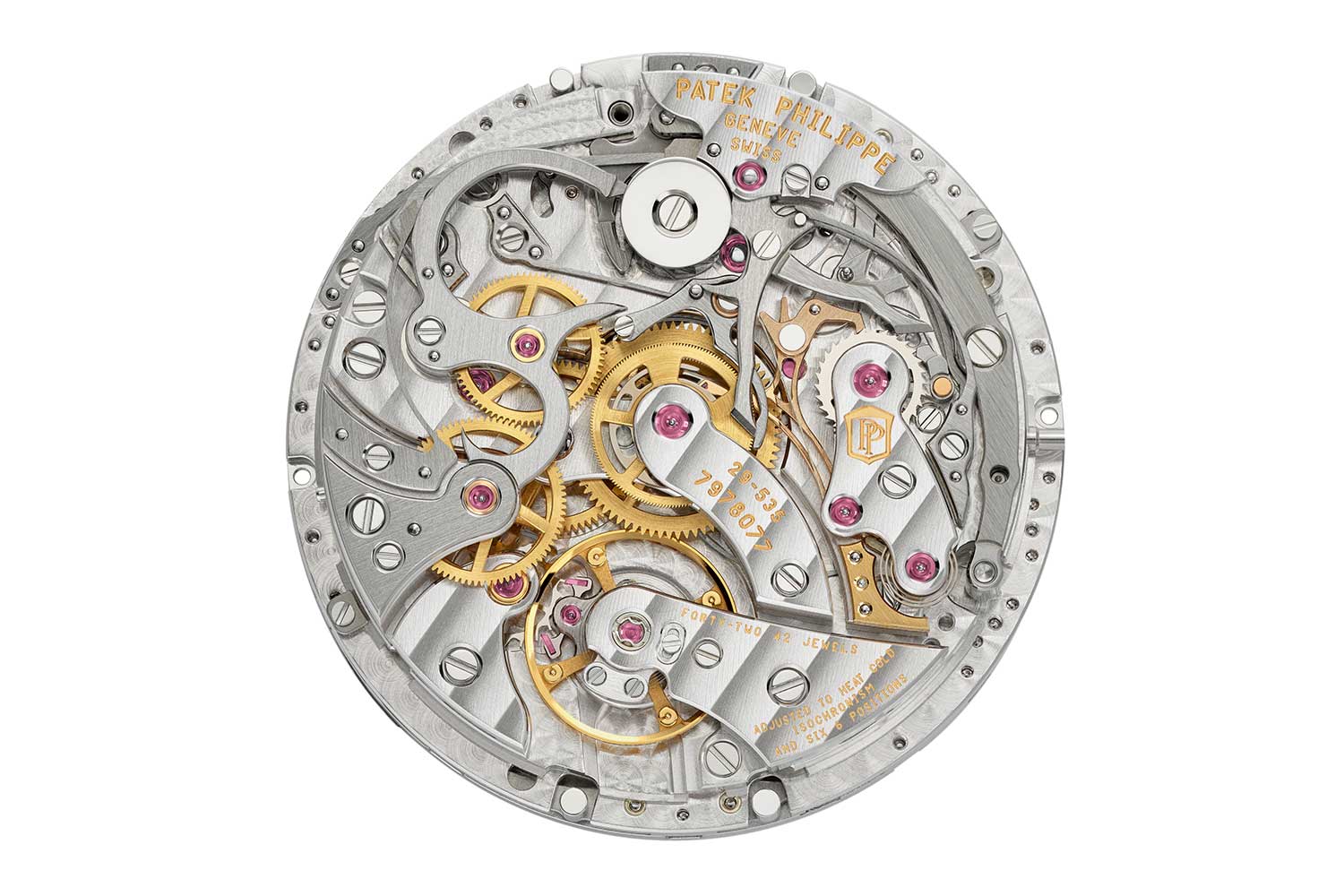
Patek addresses both through carefully calculated tooth profiles on the drive, clutch and chronograph seconds wheels. The inactive flanks of the clutch and chronograph wheel teeth follow the teeth’s path into engagement, which reduces the risk that contact between them will force the seconds hand backwards. This profile also limits recoil when the clutch disengages. The convex active flanks improve power transmission once engaged, with less wear and smaller torque fluctuations than the tip-to-flank contact of conventional triangular teeth. The teeth of the clutch wheel also mesh at different depths with the other two wheels, so their inner and outer portions can each have a profile suited to the wheel they engage.

Drive (left), clutch (above) and chronograph seconds wheel (right). Their asymmetrical tooth profiles reduce backward recoil at engagement and improve the smoothness of power transmission
The function that makes this particular combination in the new reference compelling is the instantaneous jumping minute counter, a feature that fell by the wayside as makers sought to cut costs, before its revival in high-end chronographs from the likes of A. Lange & Söhne and Patek Philippe, specifically in this movement.
Most chronographs today have a semi-instantaneous minute counter, in which the chronograph minute hand creeps forwards slightly before it jumps to the next minute marker. A true instantaneous counter, however, makes the entire advance in a single, crisp snap, a refinement historically associated with high-grade chronograph pocket watches. The basic mechanism is common to all such watches, but Patek Philippe introduced several refinements.
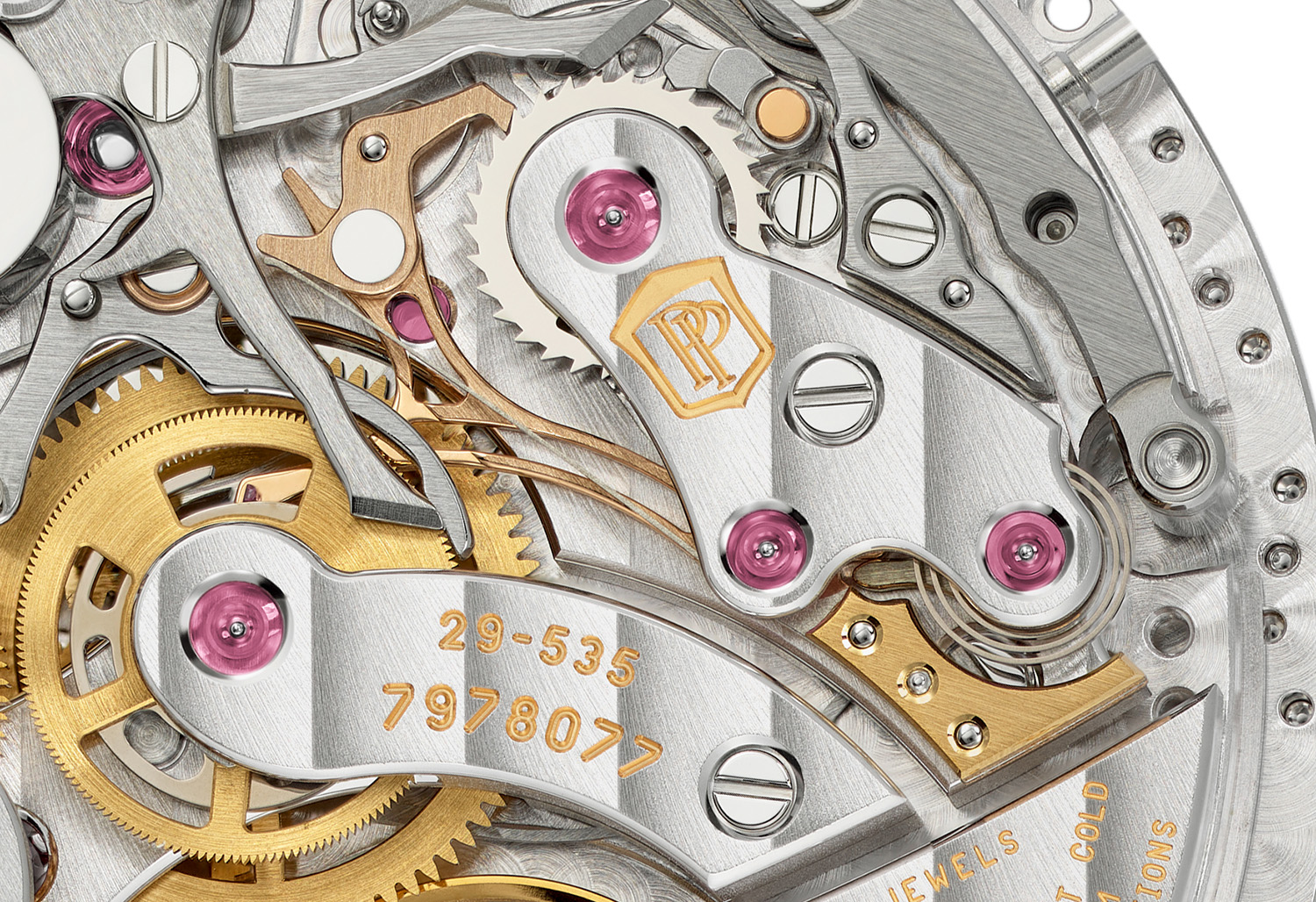
The instantaneous jumping minutes mechanism
A snail cam on the chronograph seconds shaft controls the minute advance. As it completes one revolution each minute, its rising profile lifts a spring-loaded lever and progressively loads the spring. At the top of the minute, the lever falls from the highest point of the cam to the lowest, and a pawl on the lever advances the minute wheel with ratchet teeth by one tooth. Patek introduced an eccentric that allows the angular position of the cam to be adjusted so that the jump coincides exactly with the passage of the second hand through zero.
This arrangement, however, introduces a problem during reset. When the seconds hand returns to zero counterclockwise, the steep face between the highest and lowest points of a conventional snail cam strikes the nose of the lever. The shaft stops abruptly, but the momentum of the hand causes it to flex, which can loosen its attachment or even break it. A clockwise reset does not encounter such an obstruction. Patek’s solution is a curved slot beneath the outer end of the snail cam. During a counterclockwise reset, the lever’s nose can enter this slot instead of colliding with a solid face. The seconds assembly is thus free to travel slightly beyond zero and settle through a few oscillations, just as it does during a clockwise reset.
In all, the combination of complications is compelling but the size is a price paid on the wrist for improvements most apparent at the moment of changeover. The 5270 remains the more persuasive proposition in terms of proportions and classical beauty while the 5978P offers a more sophisticated calendar, rather than a better watch in every respect. But the appeal lies in how both mechanisms are representatives of the best in their field. Neither an instantaneous perpetual calendar nor an instantaneous minute counter is necessary for either complication to fulfil its purpose. But they are desirable because, as with everything mechanical watchmaking stands for, the manner in which a watch performs its task matters as much as the task itself.
Tech Specs: Patek Philippe Instantaneous Perpetual Calendar Chronograph Ref. 5978P-010
Movement Manually wound Calibre CH 29-535 PS QI; 55–65h power reserve; 4Hz (28,800 vph)
Functions Hours, minutes, small seconds, chronograph with instantaneous 30-minute counter, instantaneous perpetual calendar with day, date, month and leap-year indications; day/night indication; moonphase
Case 42mm diameter × 14.45mm in height including crystal; 950 platinum; sapphire caseback inscribed “Patek Philippe Milano 2026”; water-resistant to 30m
Dial Navy blue sunburst with black gradient rim and recessed, textured centre; applied white gold hour markers; white gold hour and minute hands with luminescent coating; red chronograph hands; snailed subdials
Strap Navy blue fabric-pattern composite strap with red stitching and platinum triple-blade fold-over safety clasp
Limited Edition 120 watches for Milano 2026

You may also like
Editorial
The Impossibly Smooth Ressence Type 10 DN (Dark Knight)
Oct 21, 2026
Editorial
The Impossibly Smooth Ressence Type 10 DN (Dark Knight)
Oct 21, 2026

Editorial
Master of Control: Robert Pattinson
Oct 21, 2026
Editorial
Master of Control: Robert Pattinson
Oct 21, 2026

Editorial
The Family Business Rewritten
Oct 20, 2026
Editorial
The Family Business Rewritten
Oct 20, 2026