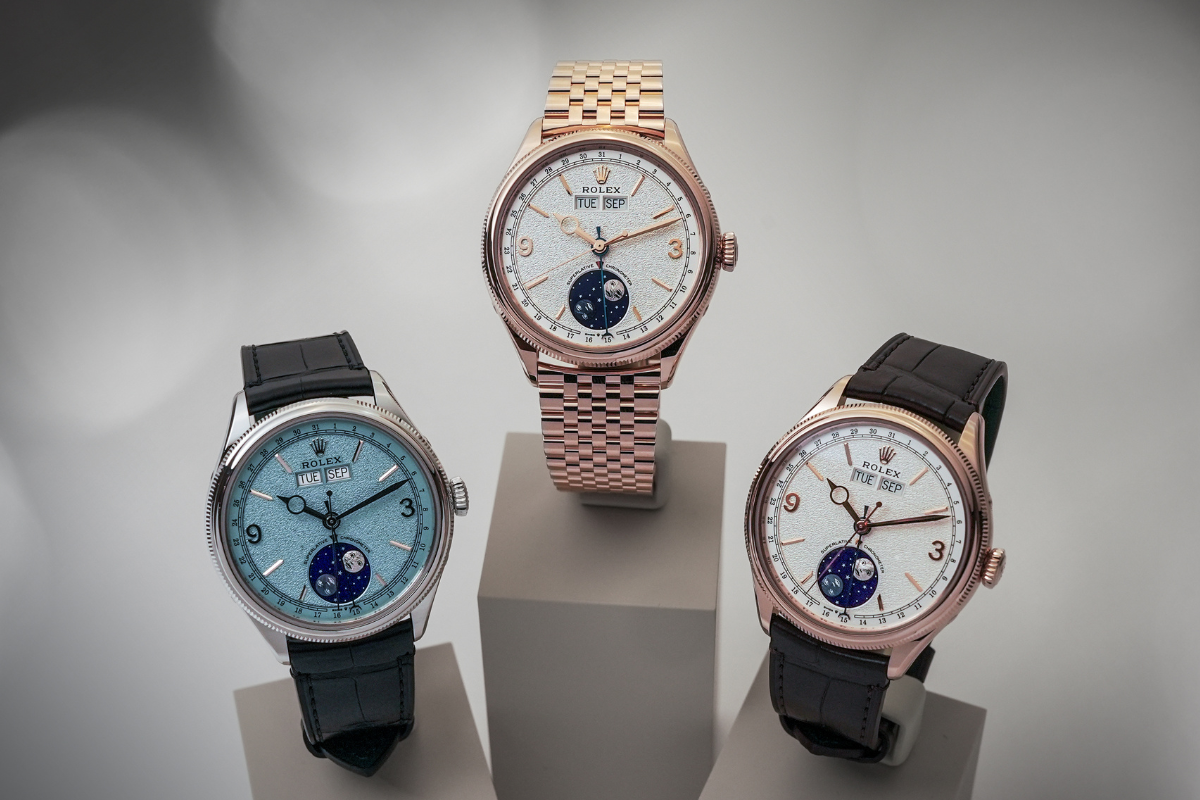
Rolex’s Future Is Complicated: The New Perpetual Padellone Family
Editorial
Rolex’s Future Is Complicated: The New Perpetual Padellone Family

Summary
In the world of festive salutations, my favorite is the Italian toast, “Cent’anni” — wishing that you and yours should live for 100 years. It is precisely at the centenary of its iconic Oyster that the mightiest watch brand that’s ever lived finds itself casting its eyes simultaneously into its past as well as its future. Because Rolex’s new Perpetual Padellone family nods to its revered “Dato-Compax” Chronograph, Ref. 8171 “Padellone” and Ref. 6062 — triple-calendar complicated watches from its halcyon past — while introducing an all-new, instantaneous, energy-efficient annual calendar that unabashedly symbolizes one big part of Rolex’s future.
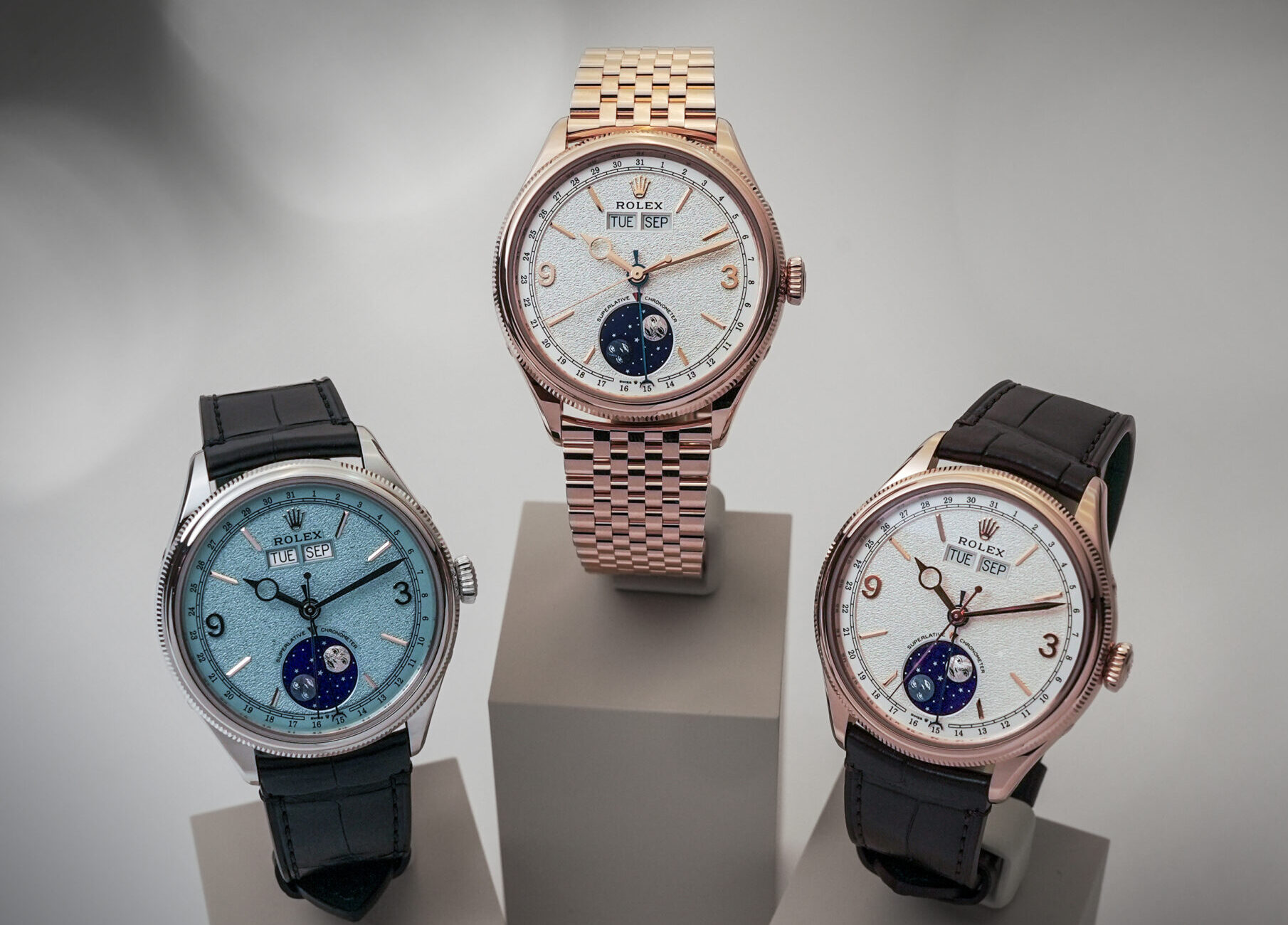
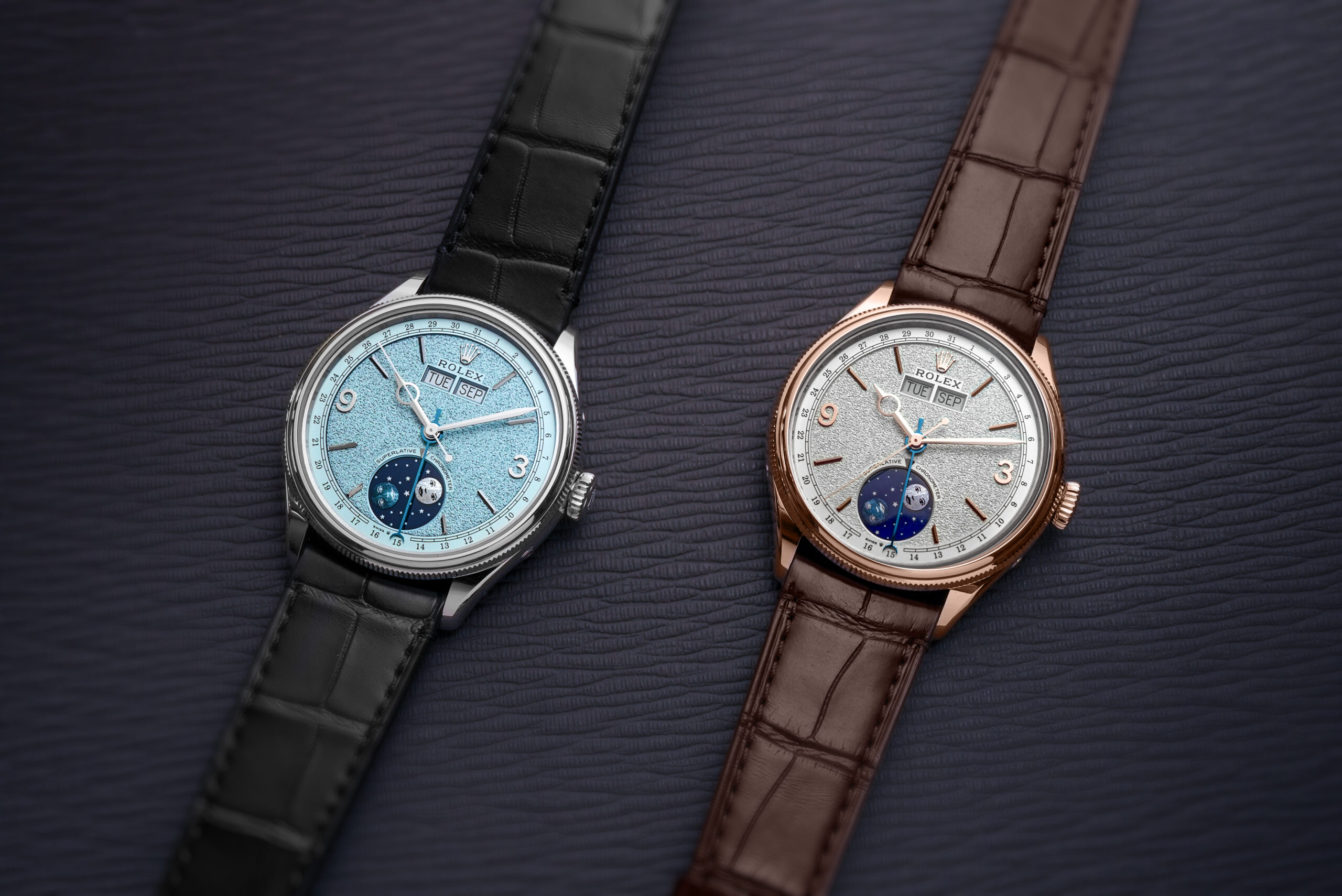
The new Rolex Perpetual Padellone family in Platinum and Everose Gold (©Revolution)
The watches are stunning objects of brand elevation as Rolex re-enters the complication category for the first time in more than 70 years, doing so with both intelligent technical innovation and a charming design that finds the perfect balance between nostalgia and modernity. Clearly, I am a fan of the new watches. I actually wept with emotion when I set eyes on them. But for a moment, let’s look beyond the watches themselves and at the greater significance they represent.
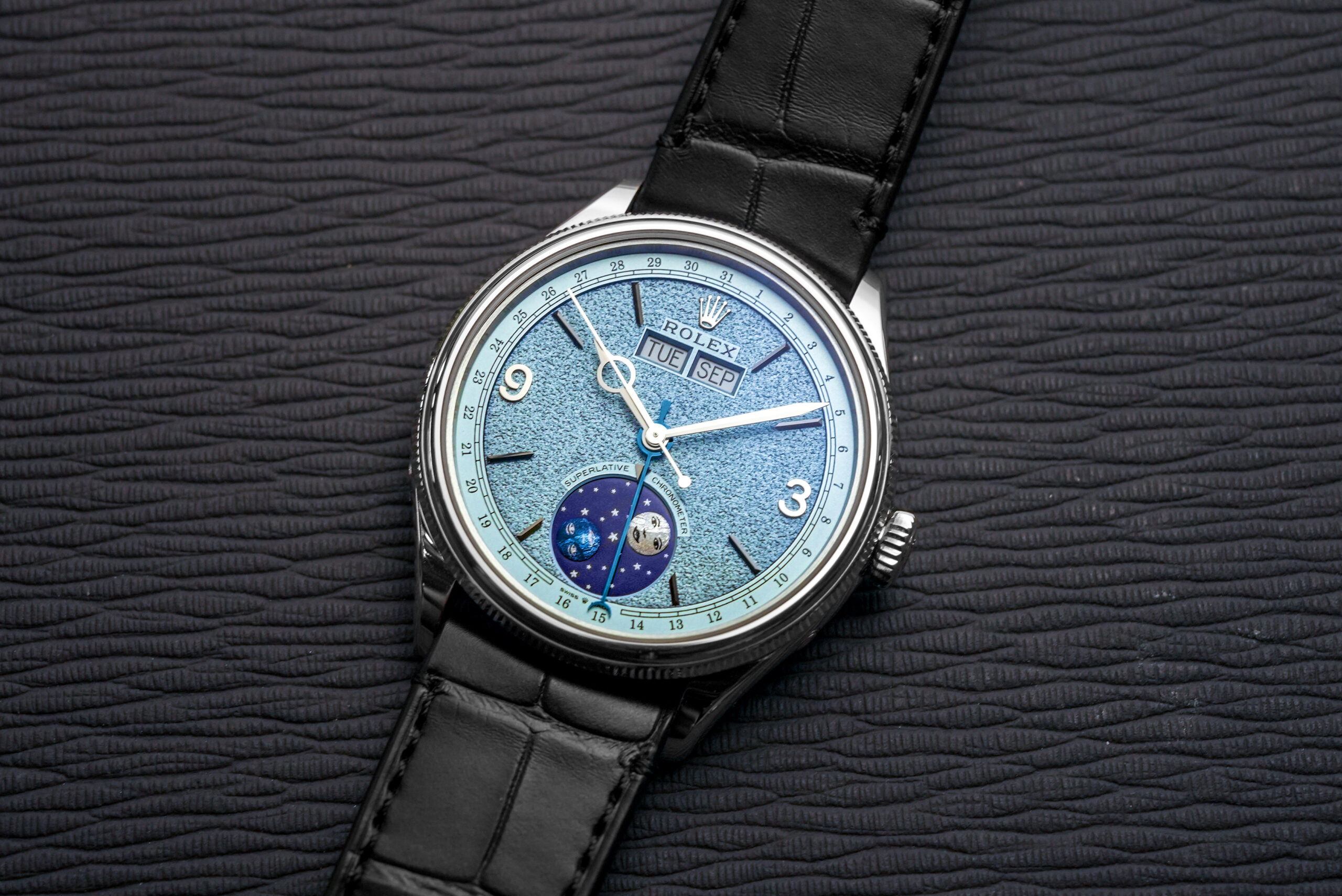
Rolex re-enters the complication category for the first time in more than 70 years with the Perpetual Padellone’s Annual Calendar (©Revolution)
Let’s start by contextualizing Rolex’s position in the world we live in. With CHF 11 billion in estimated wholesale turnover in 2025, the size of its business far eclipses that of any other luxury watch brand on the planet. Its pre-owned market, estimated at around USD 5.6 billion in 2025, means that Rolex is not only the top-performing watch brand in the primary market, but also the runaway leader in the secondary market, representing an incredible double tap of unrivaled commercial dominance. It should also be noted that more than 10 percent of that pre-owned business is accounted for by Rolex Certified Pre-Owned (RCPO) — a program we explored in greater detail here — a figure that is rapidly increasing and even more impressive considering that RCPO was only launched in 2022. But perhaps the most important statistic is that Rolex’s turnover at retail is estimated at CHF 16 billion, meaning that in 2025 Rolex injected CHF 5 billion worth of value into the watch ecosystem through its retailer partnerships. I think it is clear that if Rolex wanted to retail every single one of the estimated 1.15 million watches it made in 2025 itself, it could have done so very easily, as demand still far outstrips the supply represented by even this lofty number.
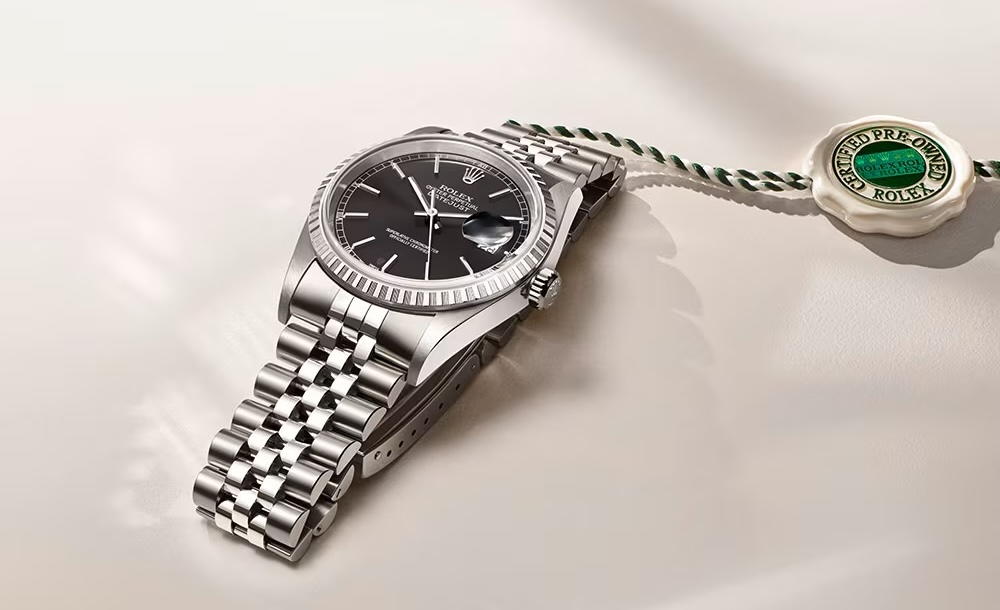
Although the Rolex Certified Pre-Owned or RCPO was only launched in 2022, it has rapidly gained a dominant share of the secondary market. Pictured here: a RCPO Datejust 36 from 2002
But it didn’t. Because Rolex, its board of directors and its dynamic CEO Jean-Frédéric Dufour understand that they are the guardians of the Swiss watch industry and feel an unwavering commitment to support the entire ecosystem that consists of its retailers, the traditional media, the watch fairs and a multitude of associated events and charitable initiatives. Because Rolex is willing to give up this staggering sum to ensure the long-term viability of our industry, it is not an overreach to say that the entirety of the Swiss watch industry is built on Rolex’s back.
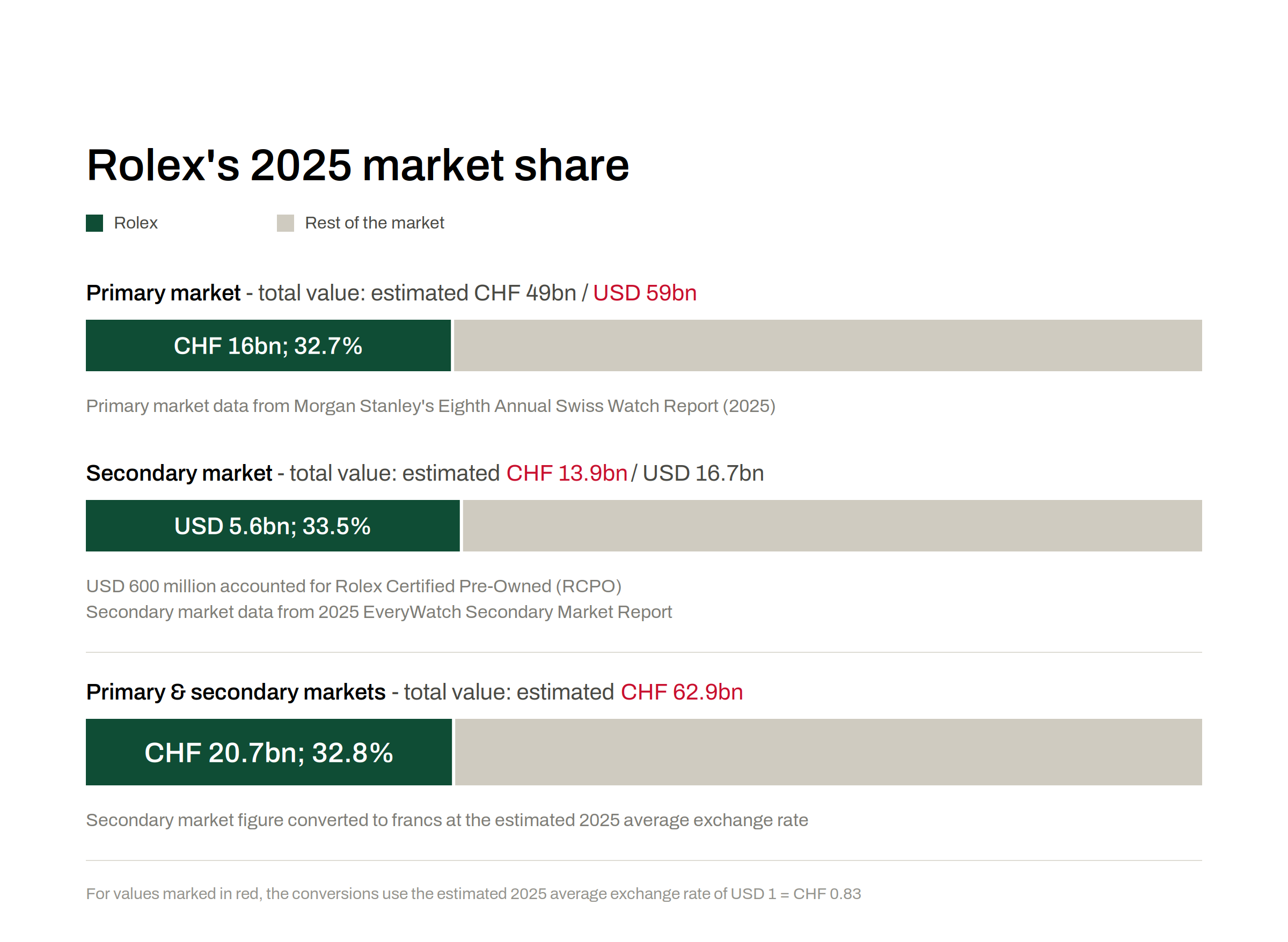
A graph of Rolex’s 2025 market share in both the primary and secondary markets (Sources: Morgan Stanley and EveryWatch)
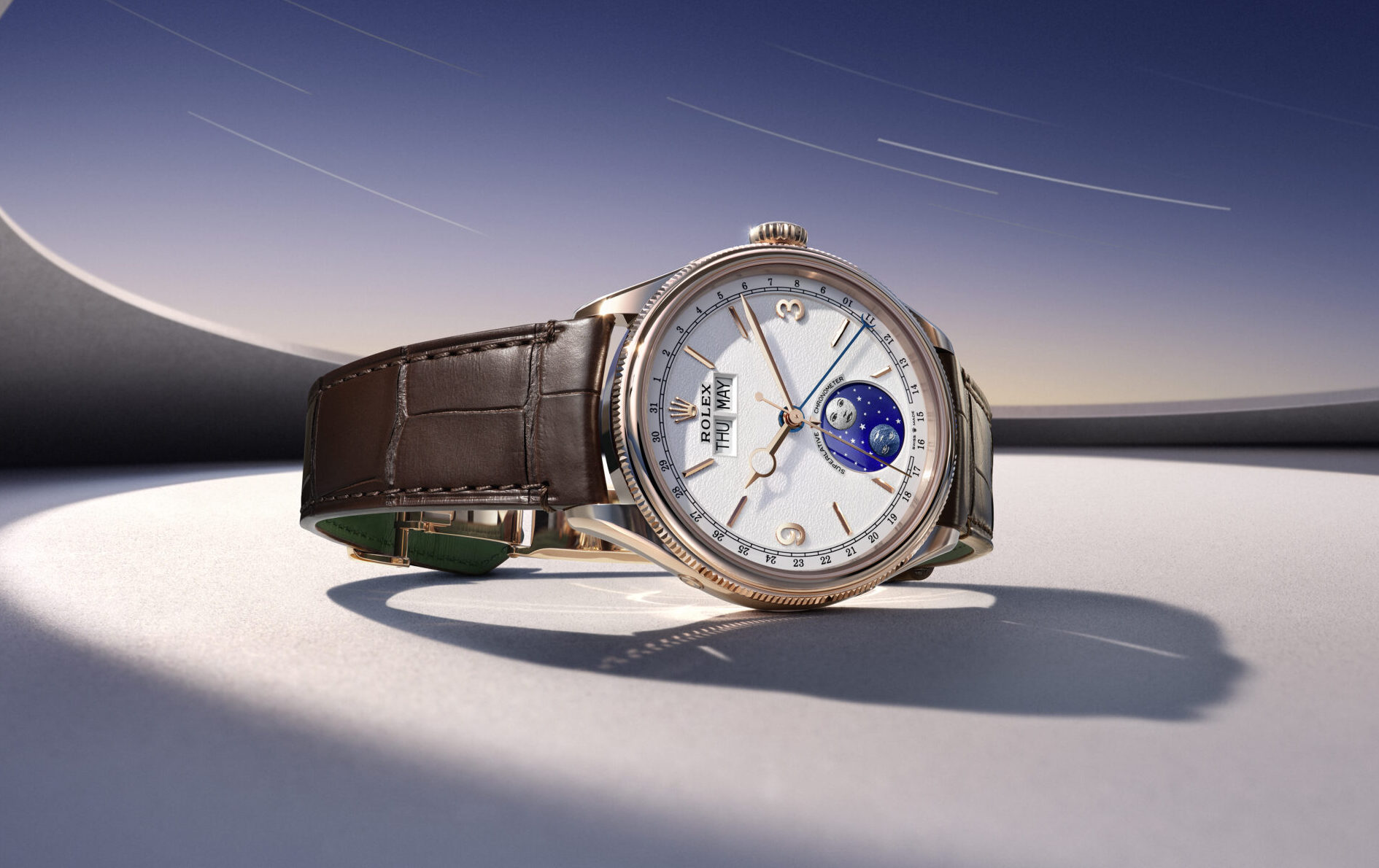
The Rolex Perpetual Padellone in Everose Gold and alligator strap
OK, now that we have that straight, let’s talk about the watch that’s just been launched for Rolex’s celebration of the Oyster’s 100th anniversary and the extraordinary meaning that underlies it. Rolex has had six leaders throughout its existence, four of whom have been instrumental in shaping the brand. While Bruno Meier and Gian Riccardo Marini performed admirable jobs as custodians of Rolex, the ones who have left the greatest impact are as follows. The first was the incredible Hans Wilsdorf, who built the world’s greatest watch brand and created the architectural blueprint of the modern wristwatch. The second was André Heiniger, who steered the brand’s focus toward its professional models, the sports watches that became some of the best-known, most iconic and most sought-after timepieces of the 20th century. The third, Patrick Heiniger, led Rolex’s extraordinary verticalization of its manufacturing, down to the melting and casting of its own gold alloys.
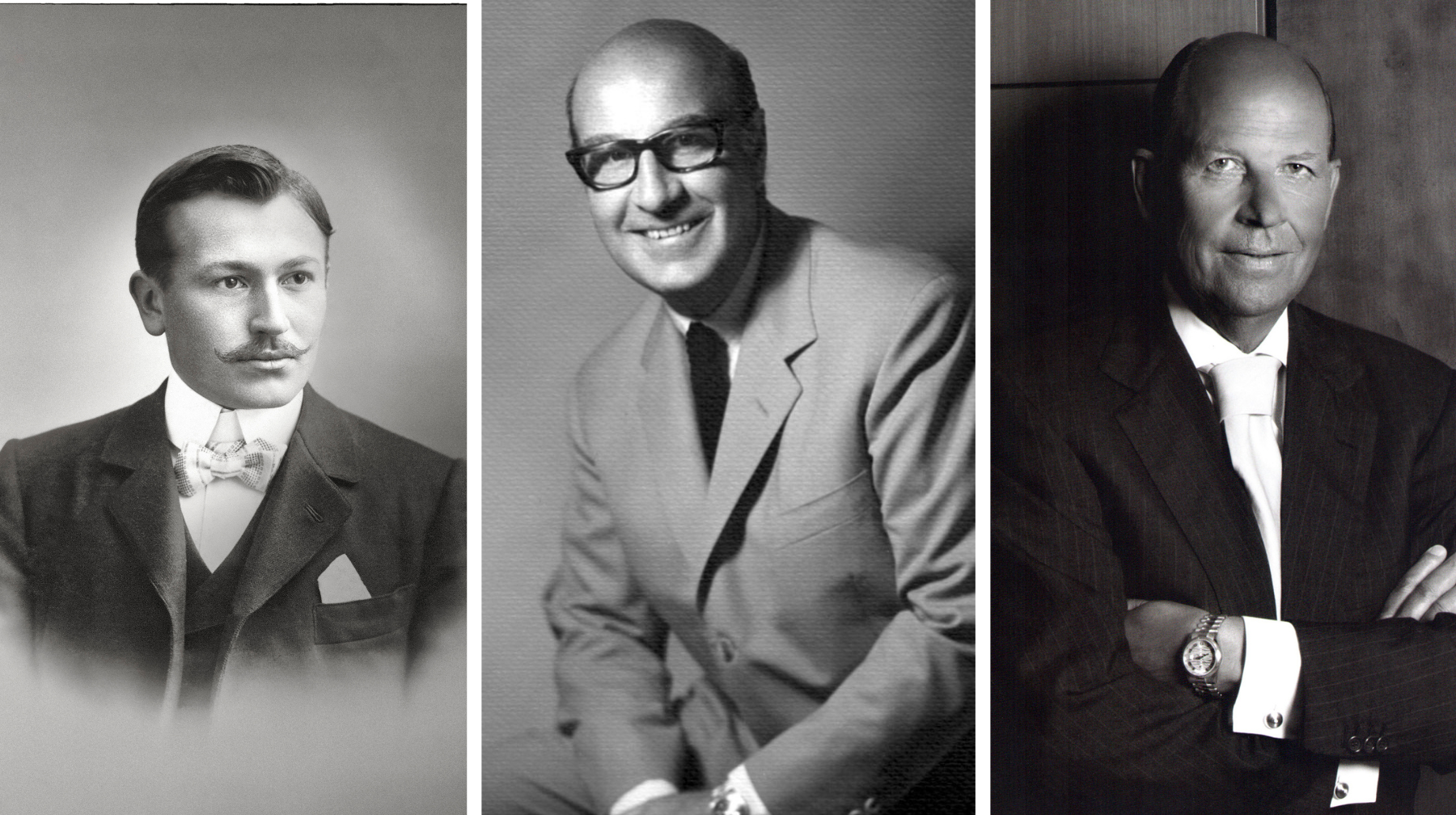
Hans Wilsdorf (Founder, President of Rolex from 1905-1960), André Heiniger (President and Director General of Rolex from 1963-1992) and Patrick Heiniger (President and CEO of Rolex from 1992-2008)
The fourth most influential leader is the sixth and present CEO Jean-Frédéric Dufour, who, I would say, with due respect to his predecessors, has re-aligned Rolex most clearly with the original vision of the brand’s founder Hans Wilsdorf — a vision that was never limited to Rolex as a sports watch brand. I believe that, without relinquishing his brand’s position as the “King of Sports Watches,” he is also brilliantly steering Rolex to become far more than that.

Bruno Meier (CEO of Rolex from 2008-2011), Gian Riccardo Marini (President and Director General of Rolex from 2011-2014) and Jean-Frédéric Dufour (CEO of Rolex from 2014-present)
One big example is that over the past few years, he has not dramatically increased the number of watches Rolex produces: an estimated 1.05 million in 2021 versus about 1.15 million in 2025. Yet he has been able to grow the company’s estimated turnover from CHF 8.05 billion in 2021 to CHF 11 billion in 2025, by dramatically increasing the average price of a Rolex from CHF 11,500 in 2021 to nearly CHF 14,000 as of 2025. Dufour has achieved this by increasing both the value of the average Rolex and its quality in a massive way. He has also made major gains in territory once considered to be outside Rolex’s sports watch focus, particularly at the USD 30,000 to USD 100,000 price level. Today, I would say that precious-metal and even gem-set Rolexes, from sports models like the Daytona, GMT-Master, Submariner and Sky-Dweller to the dressier Oysters such as the Day-Date and Datejust, now totally dominate this landscape in terms of desirability.
But there has been one category of watch that Rolex has openly avoided participating in since 1953, with the one exception of the Sky-Dweller — more on that later — and that is the realm of complicated timepieces. So the significance of this extraordinary family of timepieces named Perpetual Padellone and distinguished by its superb new instantaneous yet energy-efficient annual calendar, configured to pay tribute to Rolex’s most iconic triple-calendar watches, including the Ref. 8171 “Padellone” and the resplendent Ref. 6062, is immense. Because it is emphatically stating that the future for Rolex is, if you excuse the pun, getting complicated.
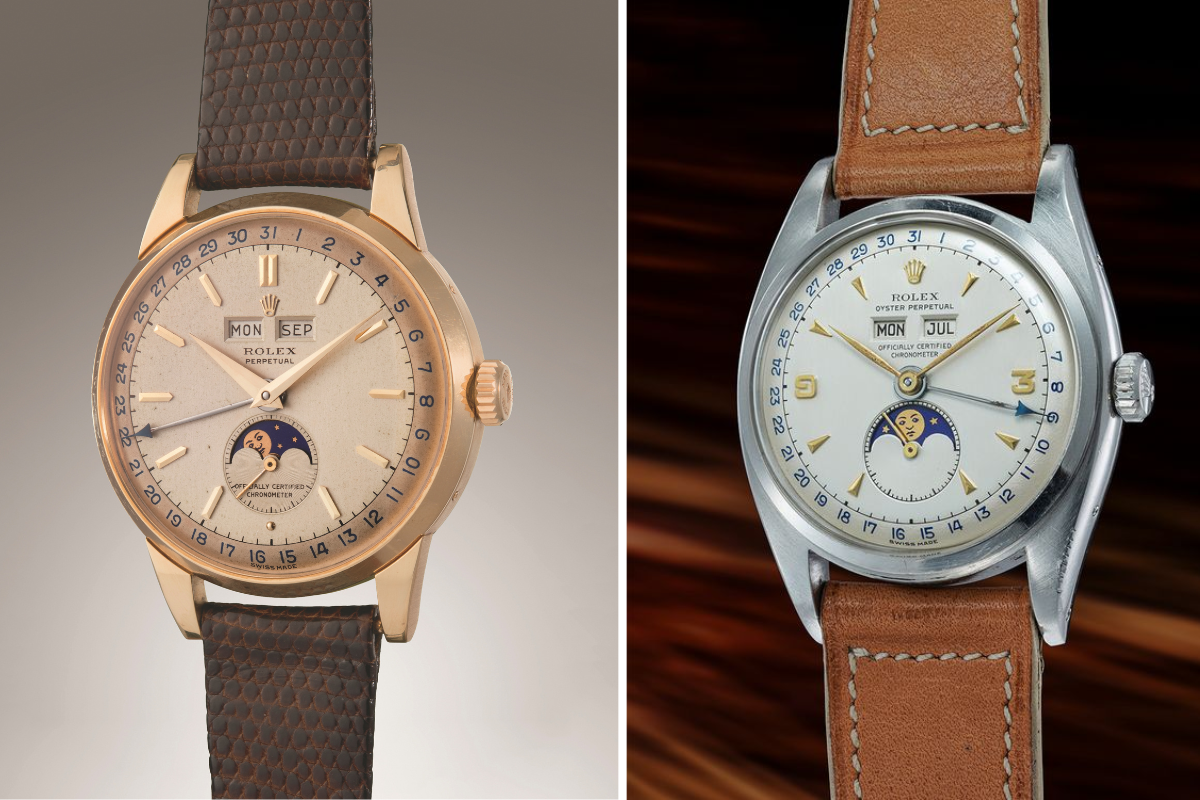
Rolex Ref. 8171 aka ‘Padellone’ and Ref. 6062, a triple calendar with moonphase watch housed in a 36mm Oyster case (Image: Phillips)
From a business perspective, this opens an all-new chapter for Rolex — an era of complicated watches, a realm where it can carve out a whole new segment for itself. From a technical perspective, this innovative annual calendar is aligned with the technical innovation represented by Caliber 7135 and its DynaPulse escapement, which powers the 2025 Land-Dweller. And for watch lovers like me, the launch of the new Perpetual Padellone brings with it immense poignancy because it pays tribute to the extraordinary timepieces created by Hans Wilsdorf toward the end of his leadership at Rolex. With the shift in focus in 1953, marked by the launch of both the Submariner and Explorer models, the triple-calendar watches somehow fell by the wayside. They, of course, became revered in collector culture. But until now, they seemed relegated to the distant past. To see their spirit somehow reborn in the new Perpetual Padellone truly tugs at the heartstrings for anyone who loves Rolex history and has this jaded old watch journalist wiping away tears of joy.
The Perpetual Padellone is powered by the new Caliber 7190 which includes the Dynapulse escapement, and is protected by 30 patent applications, two exclusive to the Padellone (©Revolution)
Before we take a deep dive into this new Rolex family, let’s first look back at the brand’s history with date and calendar watches, in particular the triple-calendar masterpieces from the late 1940s and early ’50s.
The Full Story of Rolex Calendar Watches: From the Datejust to the Cellini Moonphase
While, today, Rolex is synonymous with water-resistant sports watches, the display of date and calendar functions has quietly run through the brand’s history since the 1940s. This is their story, starting with the Datejust…
1945: The Datejust
It’s funny to me that in the predominantly digital world in which we live, a certain demographic of watch nerds is always trying to remove the date from their watches, bemoaning its intrusive visual disruption of what would otherwise be the perfect act of Zen minimalist horological haiku on their dial. However, in the context of 1945, a waterproof, automatic winding, shock-resistant wristwatch featuring the vital information of hours, minutes, seconds and the date was the very symbol of modernism itself. That was exactly the impetus under which the Datejust was launched in 1945.
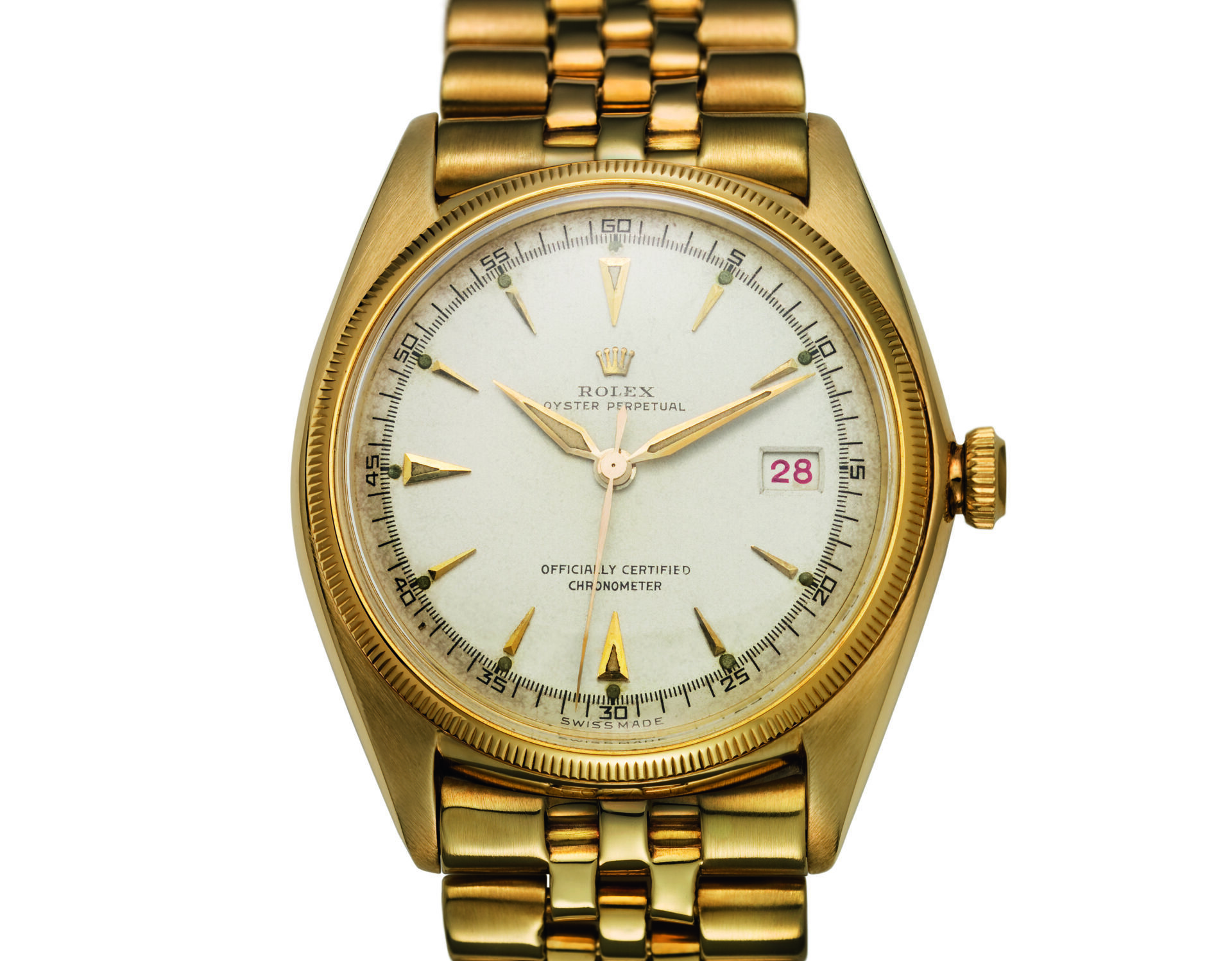
The first Rolex Datejust from 1945
Housed in a 36mm Oyster case with a screw-down crown and caseback, it was the first widely water-resistant watch of its kind. It was really the first watch that didn’t have to be babied when you were washing your hands. Just as important was what was happening inside: a self-winding movement that displayed the date in a simple window at 3 o’clock, later enhanced with a Cyclops magnifier in 1953.
Combining an automatic movement with a clear date display, Rolex created what became the ultimate everyday watch — a title that, 81 years later, I would say the Datejust still holds. It also established the model-line approach that Rolex still follows: a simple, recognizable watch that remains consistent over time.
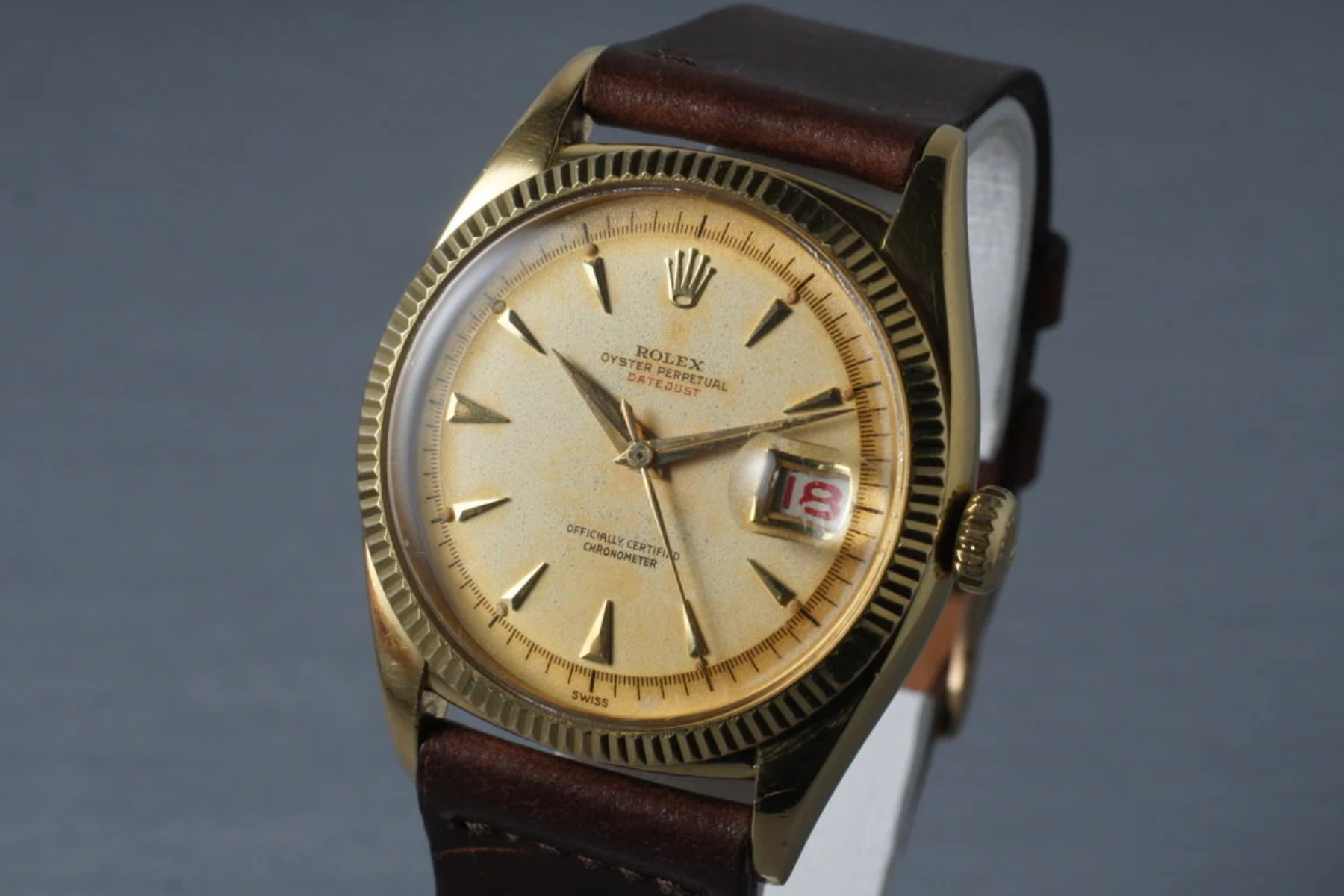
Datejust Ref. 6305 with Cyclops, which was first introduced in 1953 (Image: H.Q. Milton Timepieces)
Late 1940s–50s: The “Dato-Compax” Chronographs
Starting just two years later in 1947, Rolex built a very different kind of watch. I should imagine that walking around with a three-counter chronograph, in the context of 1947, with both minute and hour totalizers, and, on top of that, a triple-calendar display with a pointer date read off a track at the perimeter of the dial, and two windows, on the left displaying the day of the week and on the right displaying the month, would be akin to walking around with a supercomputer strapped to your wrist today. The chronograph function evoked everything from the burgeoning discipline of auto sports to the adventure of modern aviation, while the triple calendar represented a literal feast of vital information normally contained in a pocket organizer or wall calendar. At the time, this was Rolex’s most complicated wristwatch, and it would eventually become known by collectors as the “Jean-Claude Killy.” after the skiing legend and long-time Rolex ambassador who became closely associated with it.
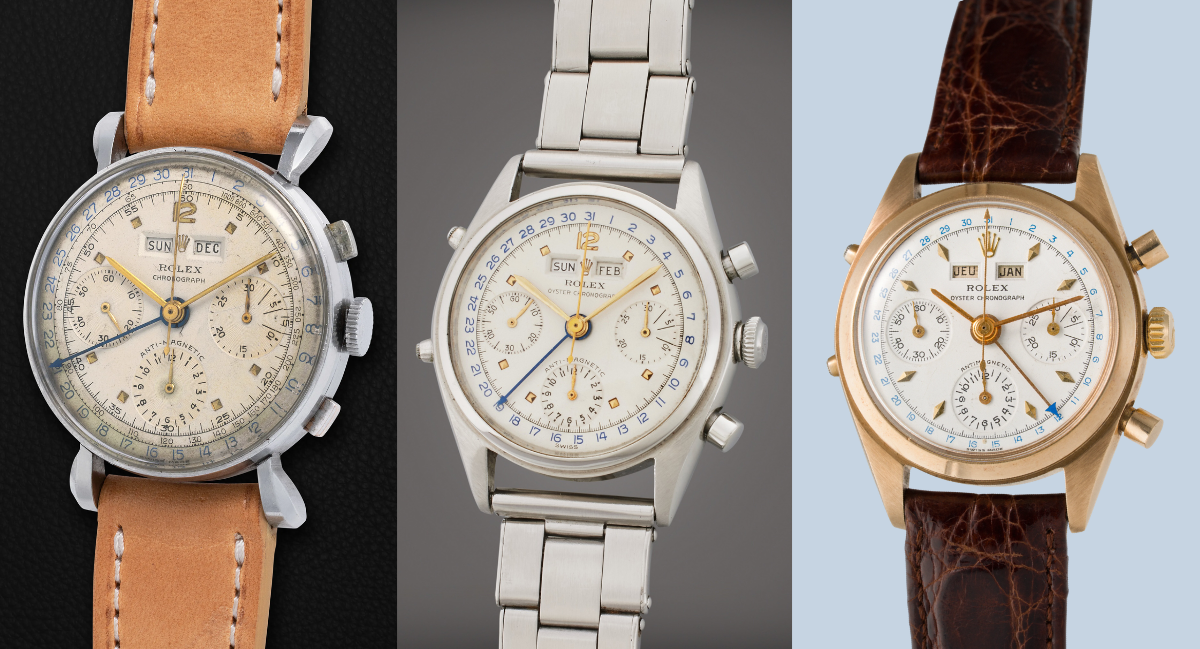
Ref. 4768 (Image: EveryWatch), Ref. 4767 (Image: Sotheby’s) and Ref. 5036 (Image: EveryWatch)
This family ran through several references as the design matured:
- Ref. 4768 — the earliest version, with a non-Oyster snap-back case and fancy lugs reminiscent of the 8171
- Ref. 4767 — added an Oyster-style screw-back case, still with the chronograph and full calendar
- Ref. 5036 — a transitional reference bridging older and newer design elements
- Ref. 6036 — moved to a monobloc Oyster case (one-piece case body with a separate back)
- Ref. 6236 — introduced a proper three-piece Oyster case with a separate bezel, along with a more modern dial layout and closed “6” numeral on the date track
These chronograph-calendars were far rarer than Rolex’s famous chronograph of the era, the Daytona-precursor lineage. Production was extremely limited, with some references believed to have been made in only a few hundred examples or fewer. Yet, historically, they’ve traded for less at auction — reflecting how collector taste has favored simpler, sportier designs over complicated ones.
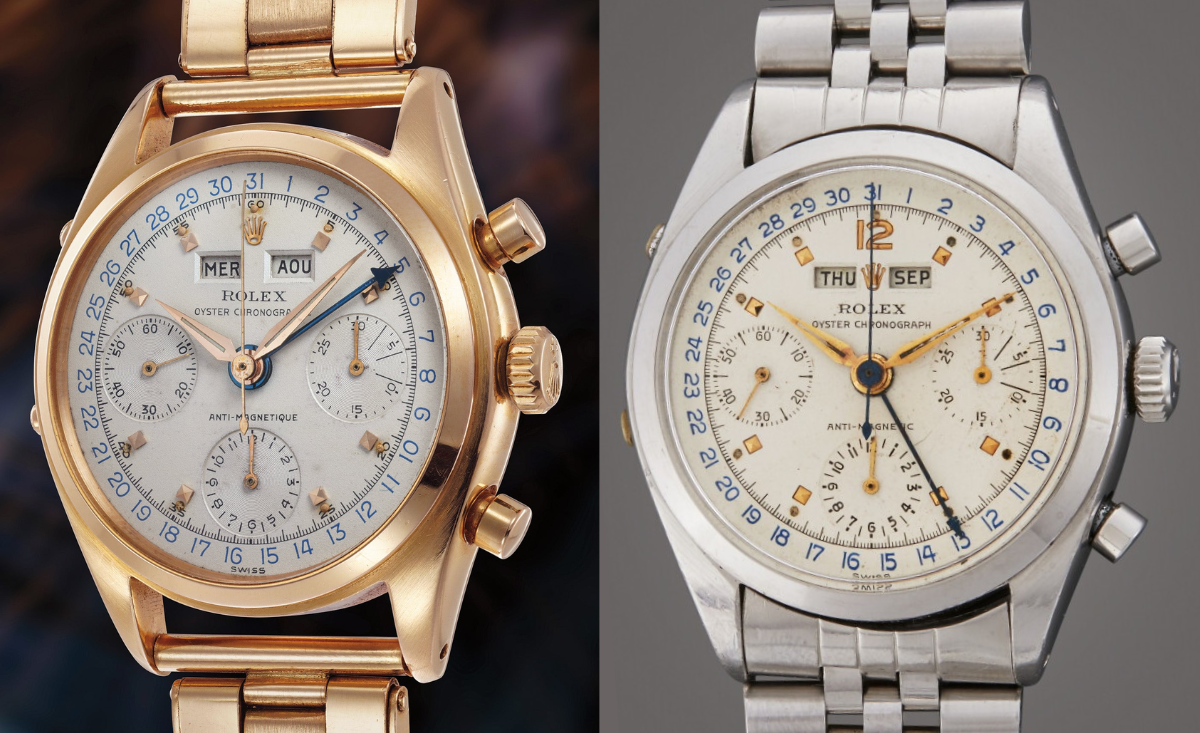
Ref. 6036 (Image: Phillips) and Ref. 6236 (Image: Sotheby’s)
1949–53: The Reference 8171 “Padellone”
In 1949, four years after the Datejust, Rolex released the Ref. 8171 “Padellone” — a large, flat-sided 38mm watch with a thin bezel, day and month windows below 12 o’clock, a date scale around the edge, and a hand-engraved moonphase above 6 o’clock. It remains one of the most whimsical and charming designs Rolex has ever produced. The Padellone is simply gorgeous and remarkably large sized even by today’s standards.
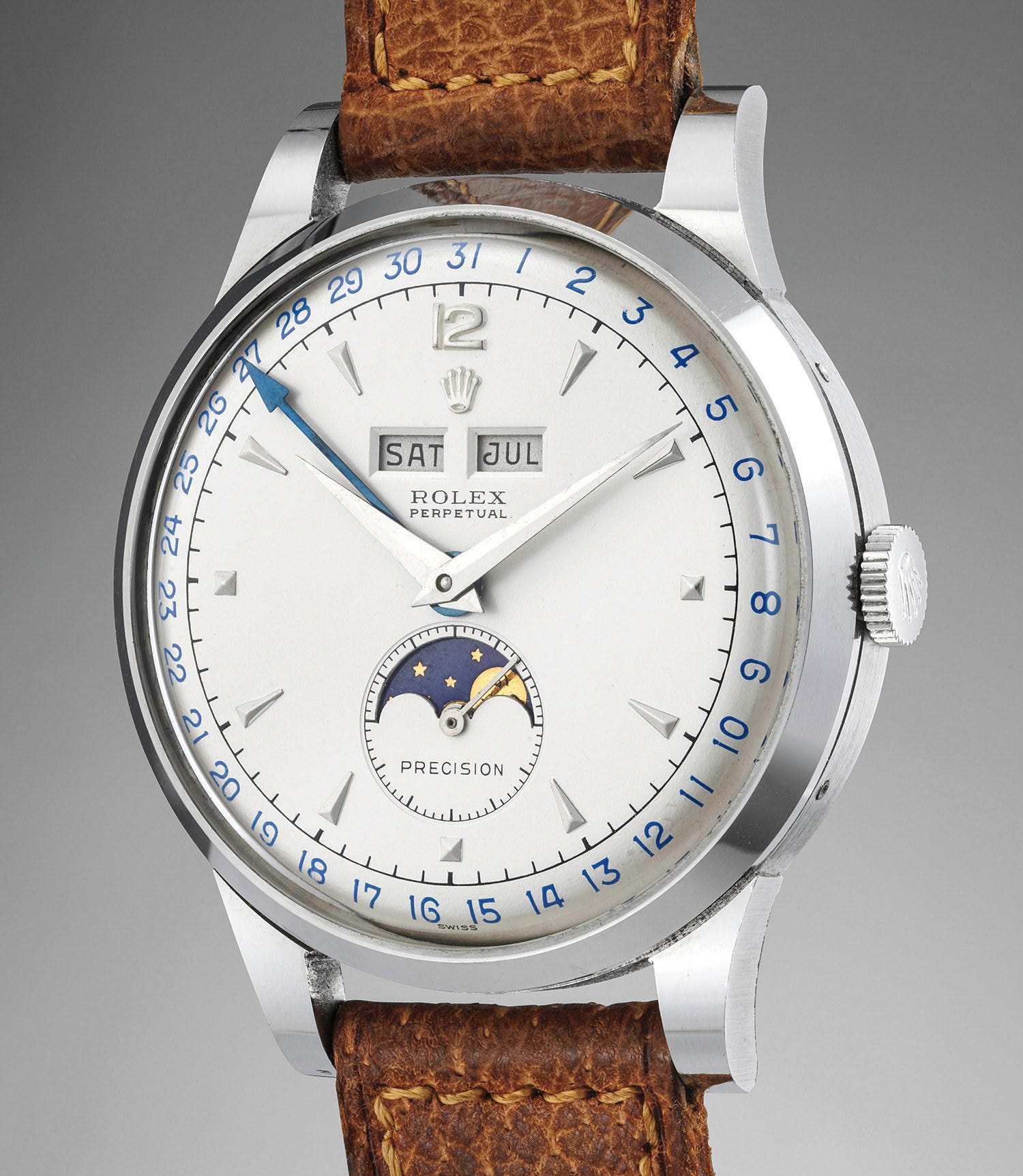
A stainless-steel example of the Rolex Ref. 8171 “Padellone” (Image: Phillips)
Reinforcing its status as an anomaly, the Ref. 8171’s case was not waterproof, which was unusual for a company already building its identity around the Oyster case. No one has ever fully explained why. The line lasted only a few years, ending production in 1953s, and was never revived. An act of beauty as mysterious as the Mona Lisa-like expression of the moonphase indicator itself.
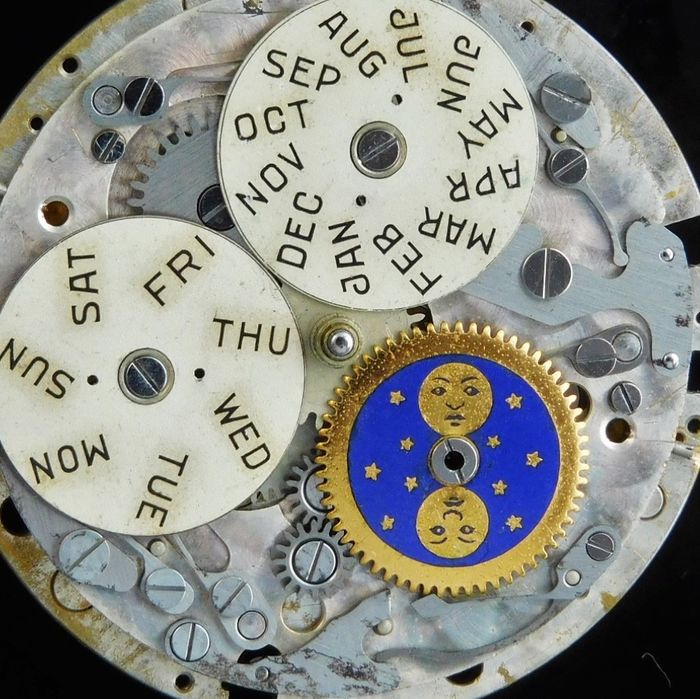
The Day, Month and Moonphase wheels on the Ref. 8171
Roughly 1,200 examples were made in total between 1949 and 1953, with about 600 in stainless steel, making steel the most commonly seen (though still coveted) version. Because the case wasn’t water resistant, many surviving pieces suffered moisture damage over the decades, making well-preserved examples especially prized. The reference has appealed to a small, tight-knit, highly knowledgeable collector community rather than achieving mainstream popularity.
1950–53: The Reference 6062
Just a year after the Ref. 8171 appeared, Rolex introduced what many collectors, myself included, believe to be the single most beautiful Rolex ever created. This was the Ref. 6062, which was unveiled at the 1950 Basel Fair. It was essentially the same triple-calendar-moonphase compilation that we see in the Ref. 8171, but now inside a spectacular 36mm waterproof Oyster case, not dissimilar from a Datejust’s. It is the only vintage Rolex to combine a genuinely complicated automatic movement with its famous waterproof case. Beyond this superb combination of complication with water resistance, the Ref. 6062 is a masterpiece of design with beautifully stylized dials made and supplied by specialist dial makers such as Stern Frères, whose owners also owned Patek Philippe by this point.
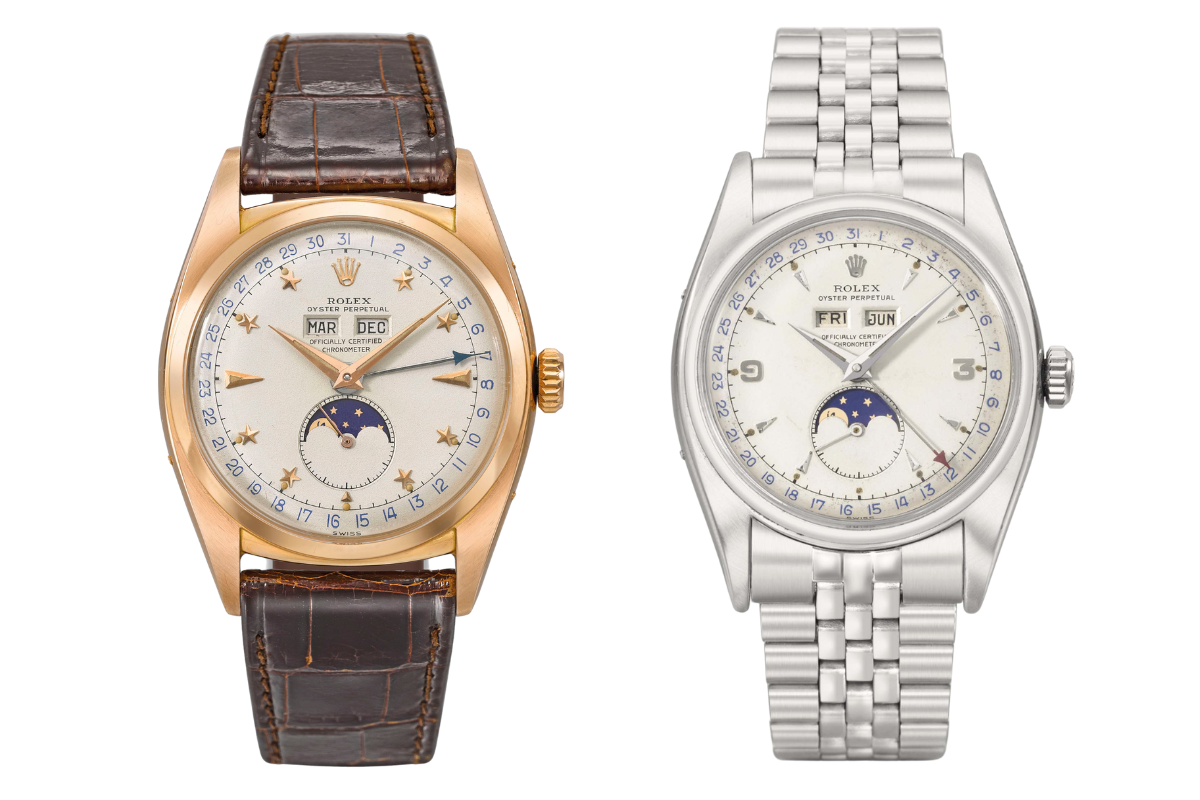
Ref. 6062 with “stelline”- and “explorer”-style hour markers (Image: Christie’s)
- Dial types — six original dial variations exist, most easily told apart by their hour markers: two generations of star (“stelline,” Italian for “little stars”) dials, plus versions with dagger-shaped, Explorer-style, pyramid-shaped (“Egyptian”) and triangular hour markers. Rare black-lacquer dials exist too, including three known examples with diamond indexes
- Case metals — produced in yellow gold (the majority), pink gold and steel, with total production across all metals estimated to be under 1,000 pieces
- Movement — Caliber 655, an automatic base movement with a calendar module added, chronometer-certified
- Case makers — steel cases came from Spillman, gold cases from Genex (part of bracelet maker Gay Frères, which Rolex later acquired in 1998)
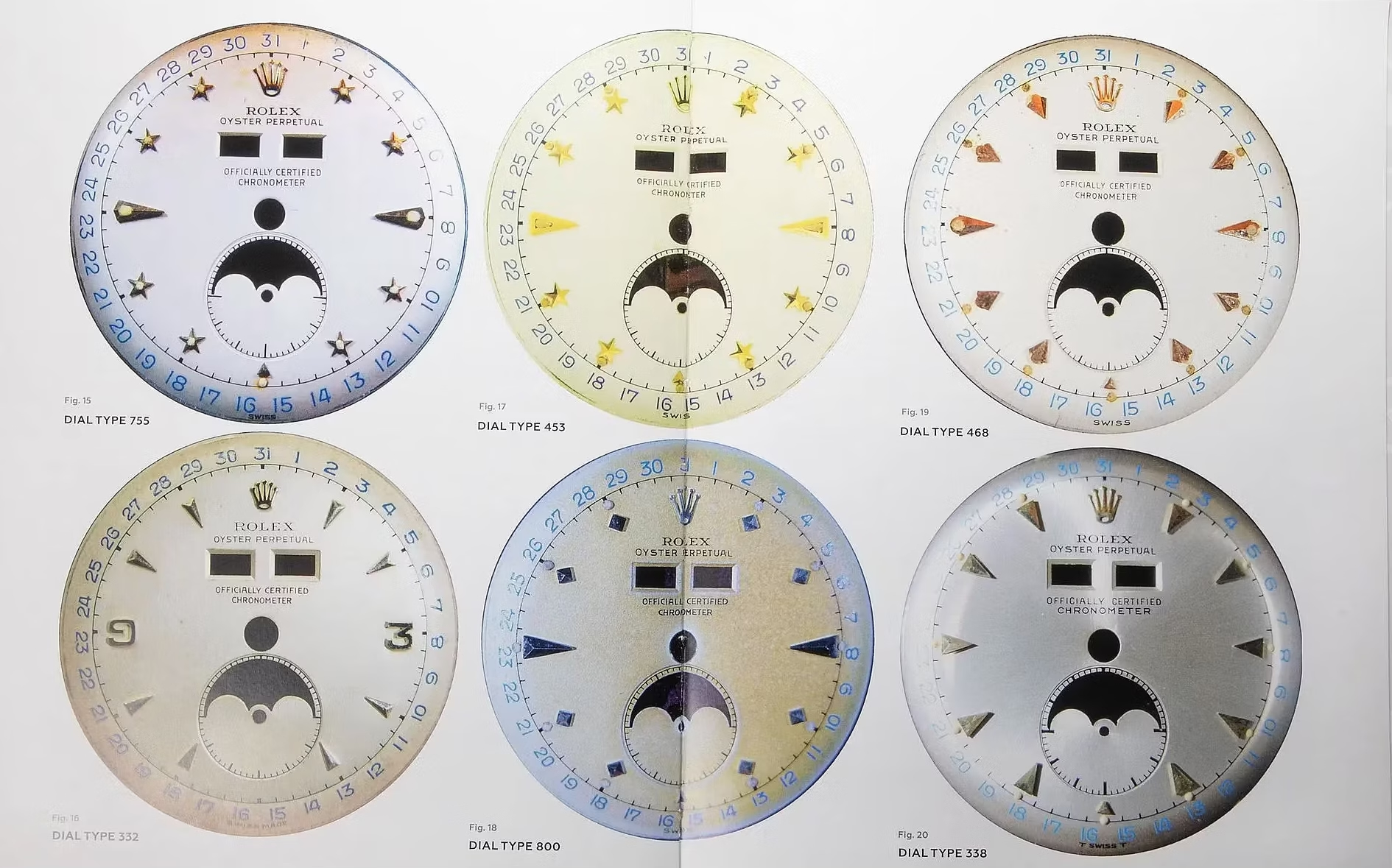
The six dial variations of the Ref. 6062 (Image: Monaco Legend Group)
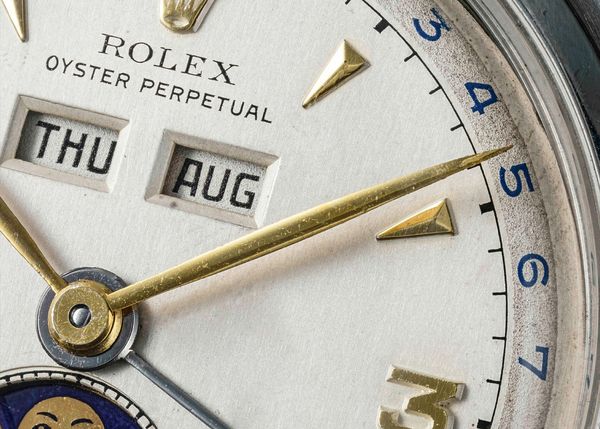
A close-up on the two-tone dial of a stainless steel Rolex ref. 6062 with “explorer” dial (Image: Phillips)
The Ref. 6062 has, amongst its litany of achievements, status as one of the most valuable Rolex watches ever sold at auction: the “Bao Dai,” a black dial, diamond-marker example once owned by Vietnam’s last emperor, sold for roughly USD 5 million in 2017, though should it come to market today, the belief is its selling price would be considerably more. Another watch in that configuration (one of three known to exist) was sold at a Monaco Legend Auction in 2025 for approximately USD 6.2 million.
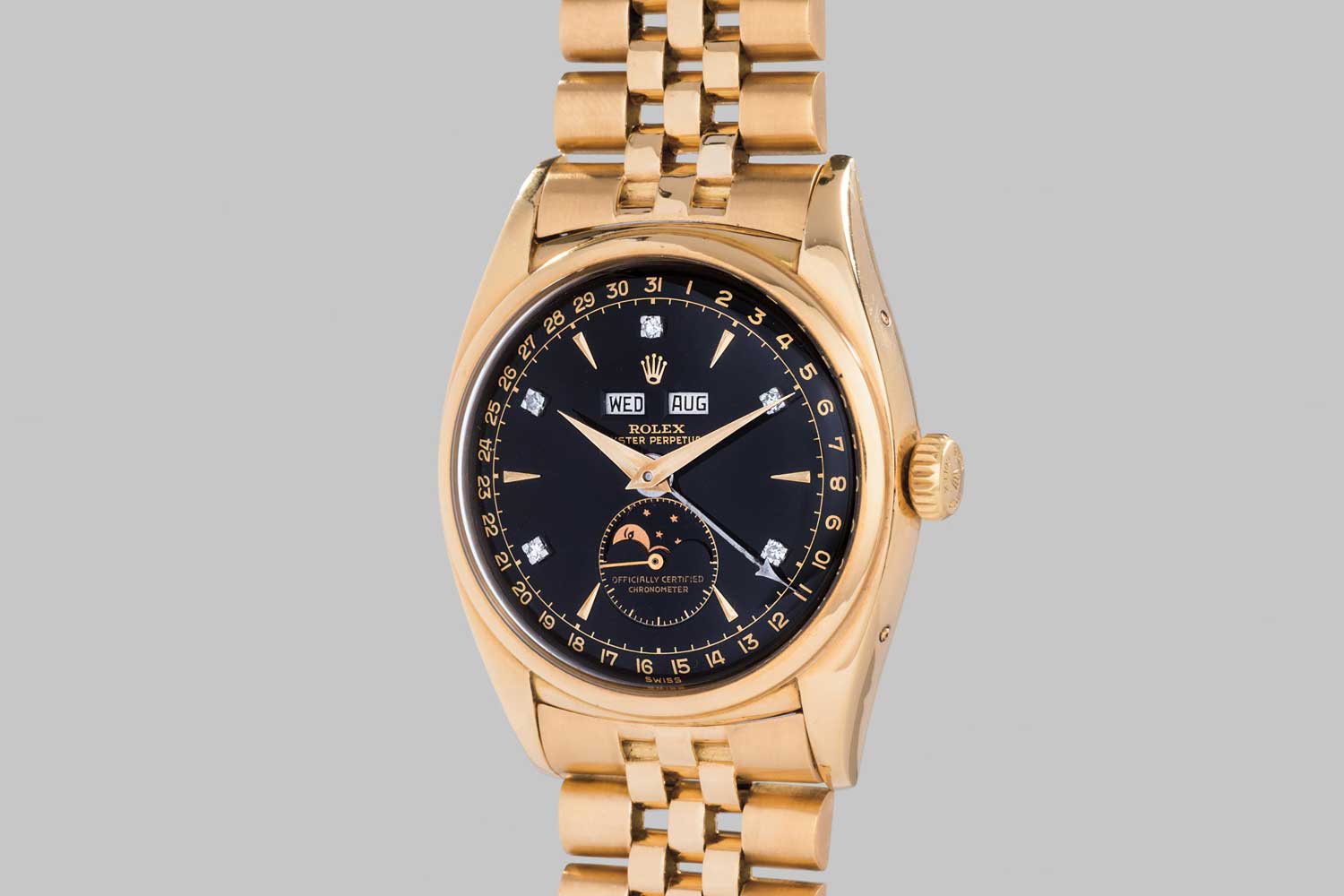
The Rolex Ref. 6062 “Bao Dai”, formerly the property of last Emperor of Vietnam, sold for roughly USD 5 million in 2017 (Image: Phillips)
Both the Ref. 8171 and Ref. 6062 were discontinued in 1953 — the same year Rolex pivoted decisively toward the tool-watch identity it’s known for today, launching the Submariner and Explorer. Neither moonphase reference was ever brought back, and Rolex wouldn’t make another watch combining a moonphase display with a full calendar for more than 60 years.
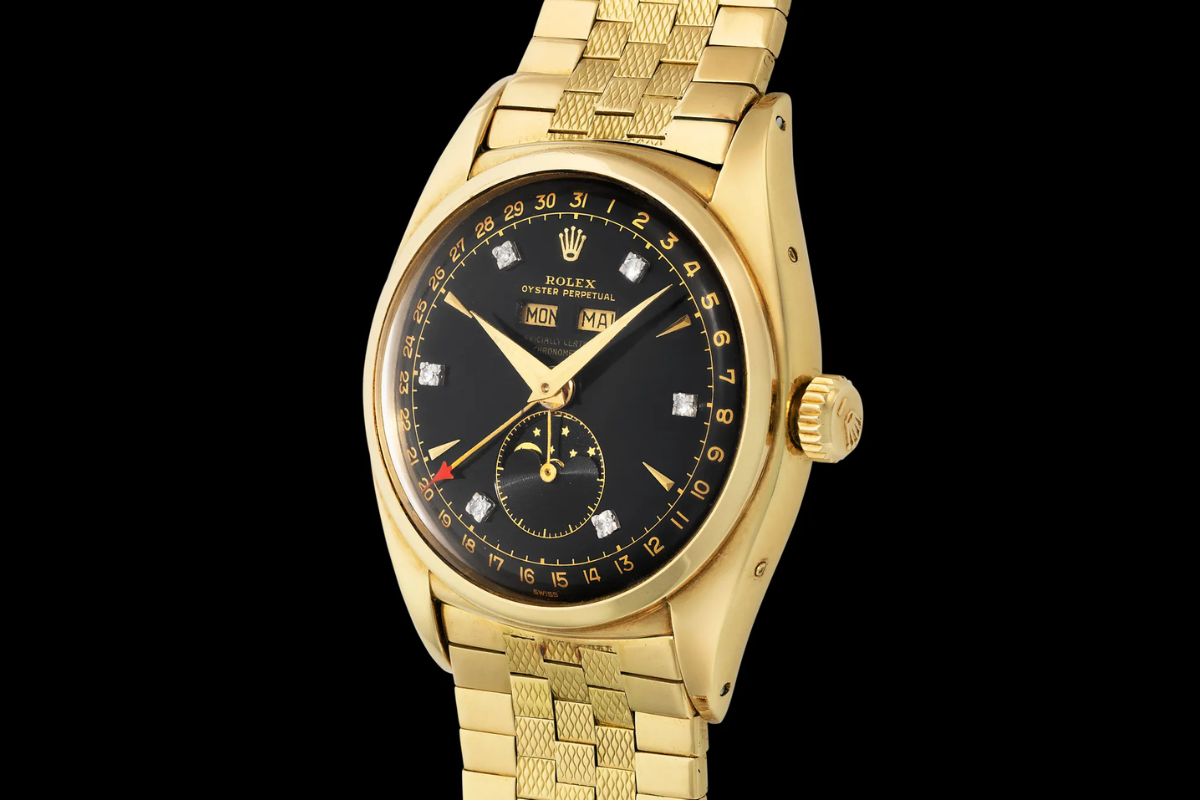
Another Rolex Ref. 6062 with the same configuration as the “Bao Dai” was sold at a Monaco Legend Auction in 2025 for approximately USD 6.2 million (Image: Monaco Legend Group)
This is purely my opinion, but one line of thought is that by the 1950s, we have a period of transition in leadership from Hans Wilsdorf to André Heiniger. While Wilsdorf clearly didn’t see any limits to his brand as expressed by these three wonderful triple-calendar models, it seemed that Heiniger preferred to focus on Rolex’s Professional Watches, which would see the brand dominating the tool-watch and sports category for the rest of the 20th century and beyond.
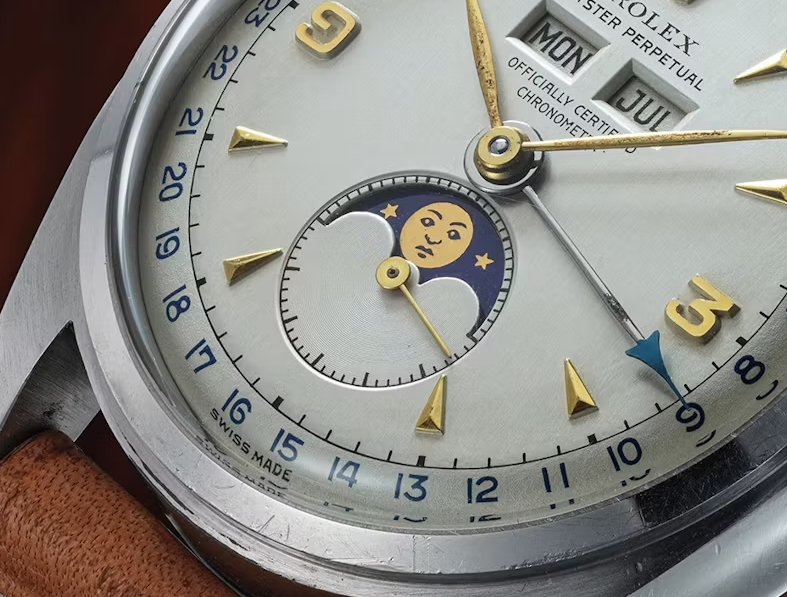
The moonphase indicator on the Ref. 6062 has a similar Mona Lisa-like expression, found in the Ref. 8171 “Padellone” (Image: Phillips)
1956: The Day-Date Takes Over as Rolex’s Flagship Calendar
The one exception to the focus on sports watches was Rolex’s Day-Date. In 1956, Rolex followed the discontinued Ref. 8171 and Ref. 6062 with a far simpler, and far more successful, idea. It was the first wristwatch to spell out the day of the week in full, in a window at 12 o’clock, alongside a date window at 3 o’clock — the layout is still copied by day-date watches from other brands today.
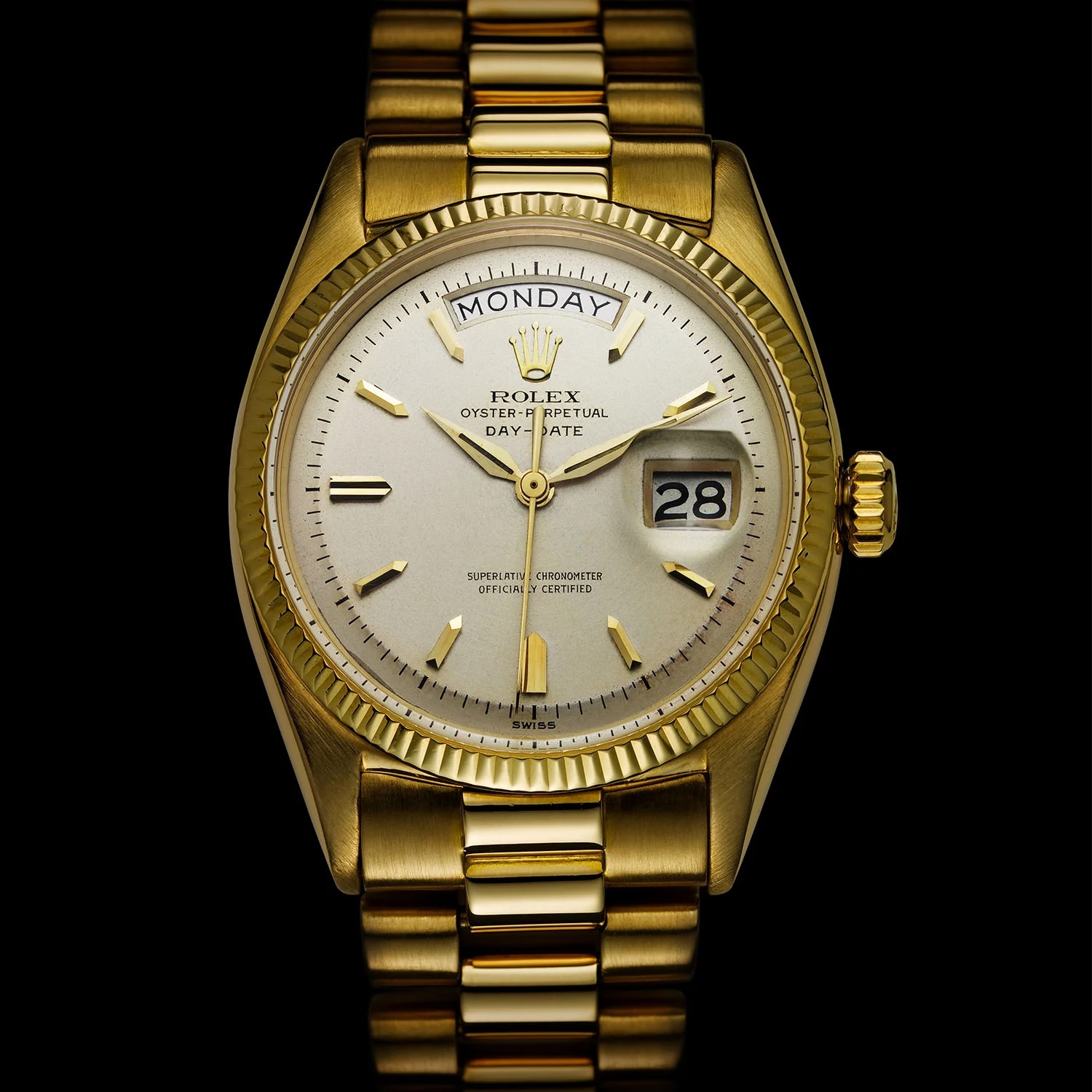
Rolex Day-Date Ref. 6611
The Day-Date has stayed in continuous production ever since, evolving through many reference generations:
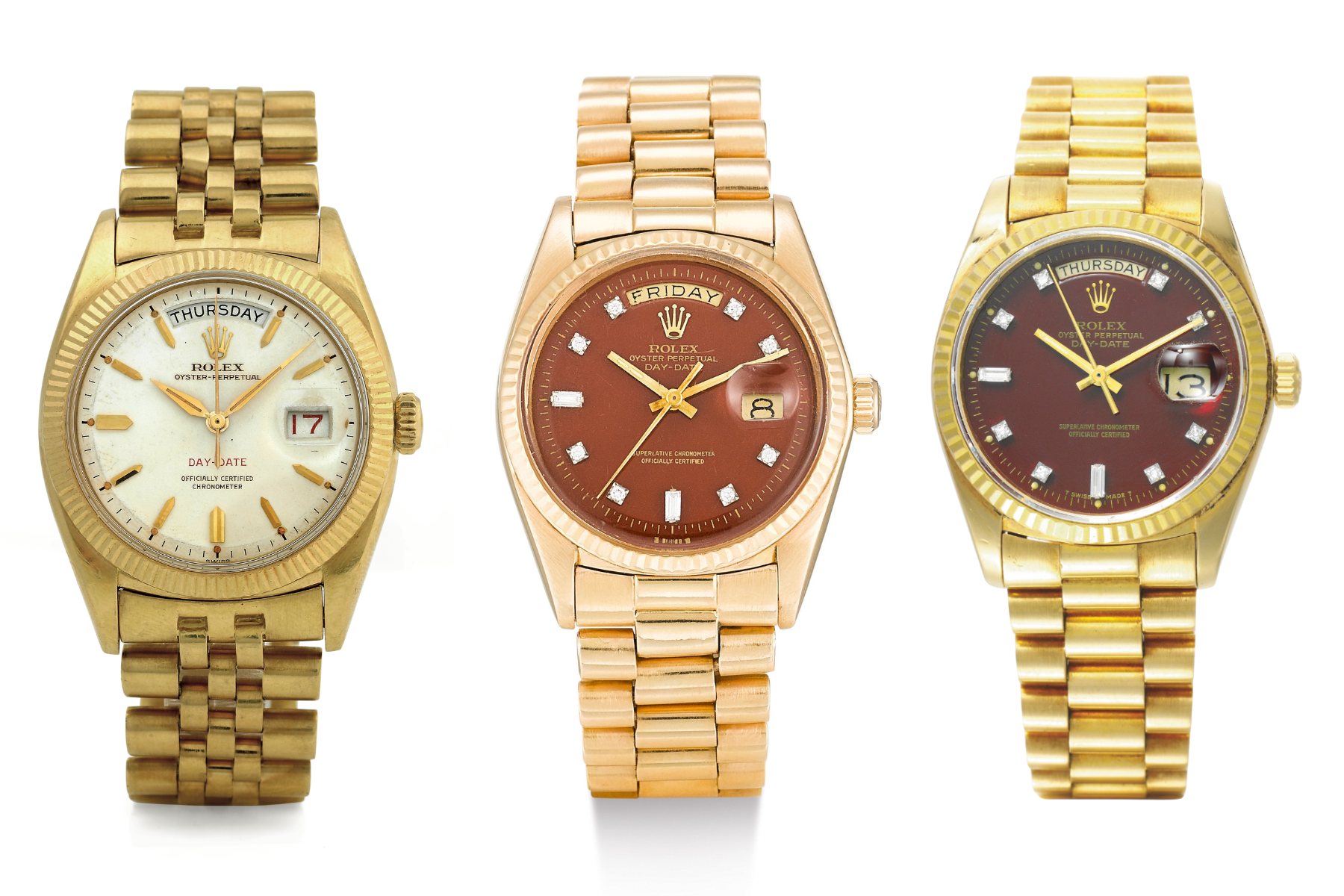
Rolex Ref. 6511 (the original Day-Date with fluted bezel), Ref. 1803 and Ref. 18038
- Refs. 6510/6511 (1956–57) — the original 36mm models, available in yellow, pink or white gold, initially offered on the Jubilee bracelet and subsequently on the new President bracelet
- Ref. 6611 (1957–59) — fixed early movement issues with Caliber 1055 and introduced the “Superlative Chronometer Officially Certified” dial text still used today; a handful of stainless steel Ref. 6611s are known and are generally believed to be prototypes, since the Day-Date has otherwise only ever been offered in precious metals
- Ref. 1803 (1959–76) — the last Day-Date with an acrylic crystal and the “pie-pan” dial profile; one of the most affordable vintage Day-Dates today
- Ref. 1803X (1977–88) — moved to a sapphire crystal, a flat dial, and Caliber 3055 with quick-set date
- Oysterquartz Ref. 1901X (1977–2003) — a quartz-powered variant developed during the 1970s Quartz Crisis, more accurate than its mechanical siblings but visually distinct with an integrated bracelet case
- Ref. 1823X (1988–2000) — added double quick-set (day and date) via Caliber 3155
- Ref. 11823X (2000–19) — broader lugs, a solid (rather than hollow) President bracelet and, on some examples, anti-counterfeiting engraving on the rehaut
- Day-Date II, Ref. 21823X (2008–15) — a larger 41mm case introduced for Rolex’s centennial, though its bulkier proportions proved less popular with collectors
- Day-Date 40, Ref. 22823X (2015–present) — refined the larger Day-Date II into a 40mm case with slimmer proportions, running Caliber 3255 with the efficient Chronergy escapement and a 70-hour power reserve
- Day-Date 36, Ref. 12823X (2019-present) — 36mm case upgraded with Caliber 3255
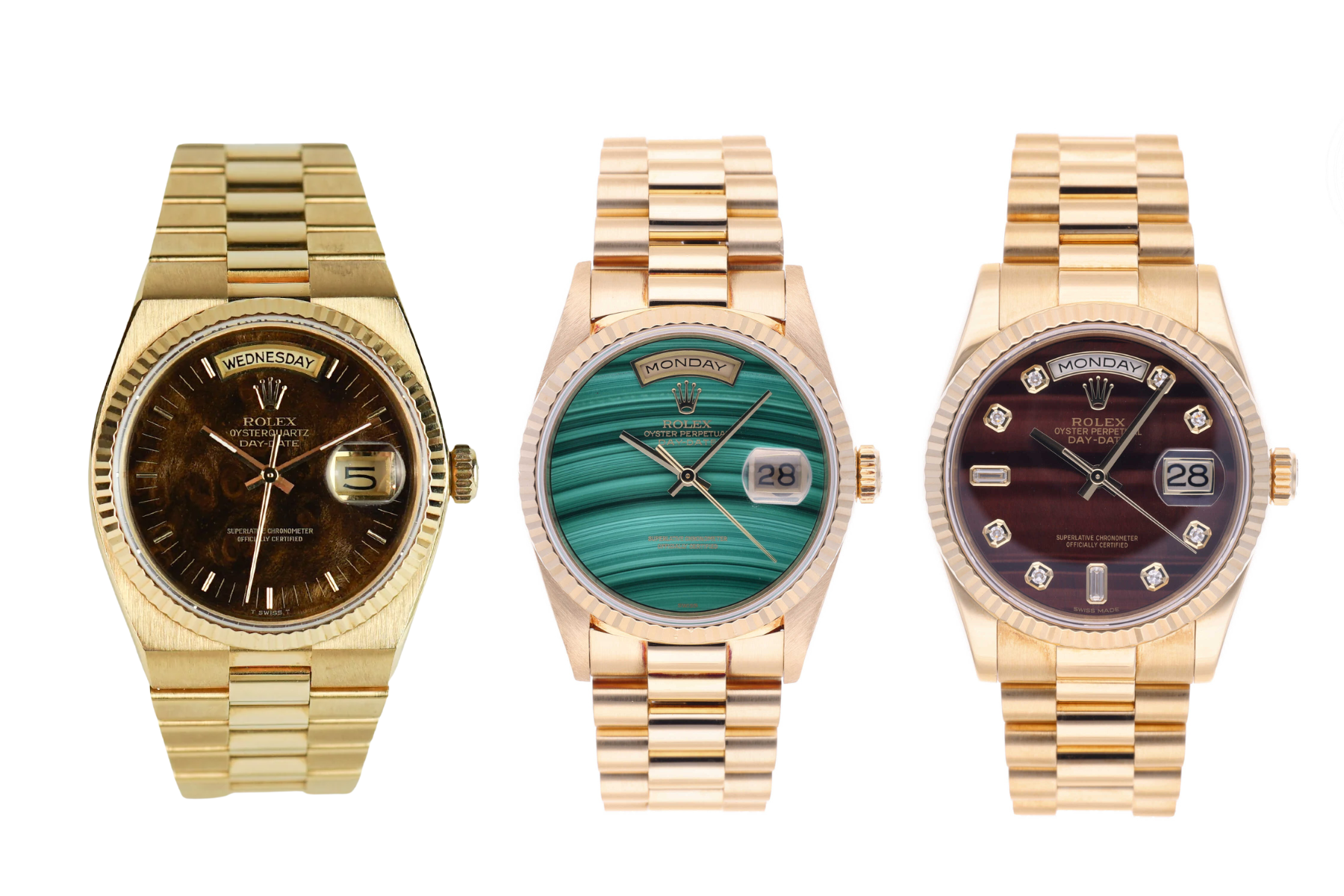
Rolex Oysterquartz Ref. 19018, Day-Date Ref. 18238 and Ref. 118238
Today, the Day-Date remains Rolex’s exclusive precious-metal flagship, offered only in yellow gold, Everose gold, white gold and platinum.
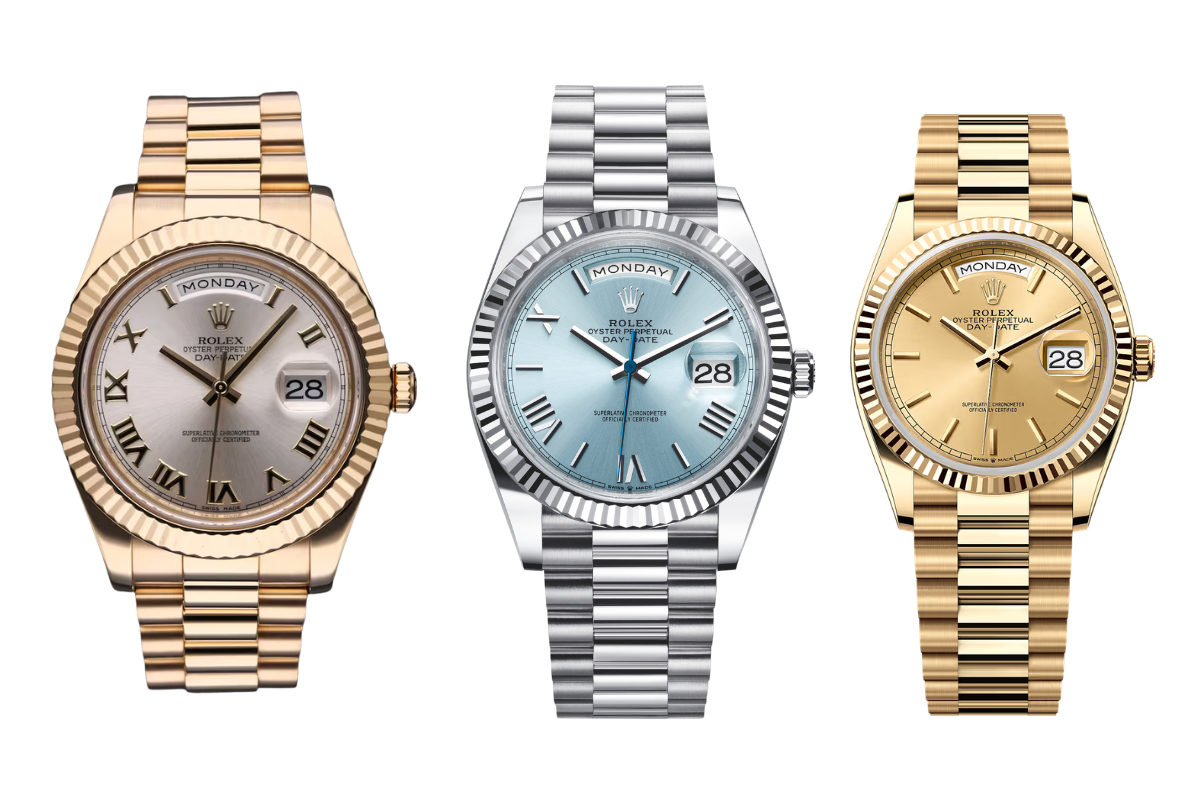
The modern Rolex Day-Date II (Ref. 218238), Day-Date 40 (Ref. 228238), and Day-Date 36 (Ref. 128238)
2012: The Sky-Dweller Brings Rolex’s First New Complication in a Generation
OK, I know that I said that since 1953, Rolex has largely eschewed any form of complicated watches. But the obvious anomaly is the incredible Sky-Dweller, one of the world’s most functionally innovative annual calendars. To begin, let me explain what an annual calendar is. It is a timepiece that automatically accounts for the different lengths of the months, requiring correction only once a year, at the end of February. An annual calendar is generally less mechanically complex than a perpetual calendar. However, it should be said that the Sky-Dweller was also one of the most unconventional annual calendars introduced for two reasons.
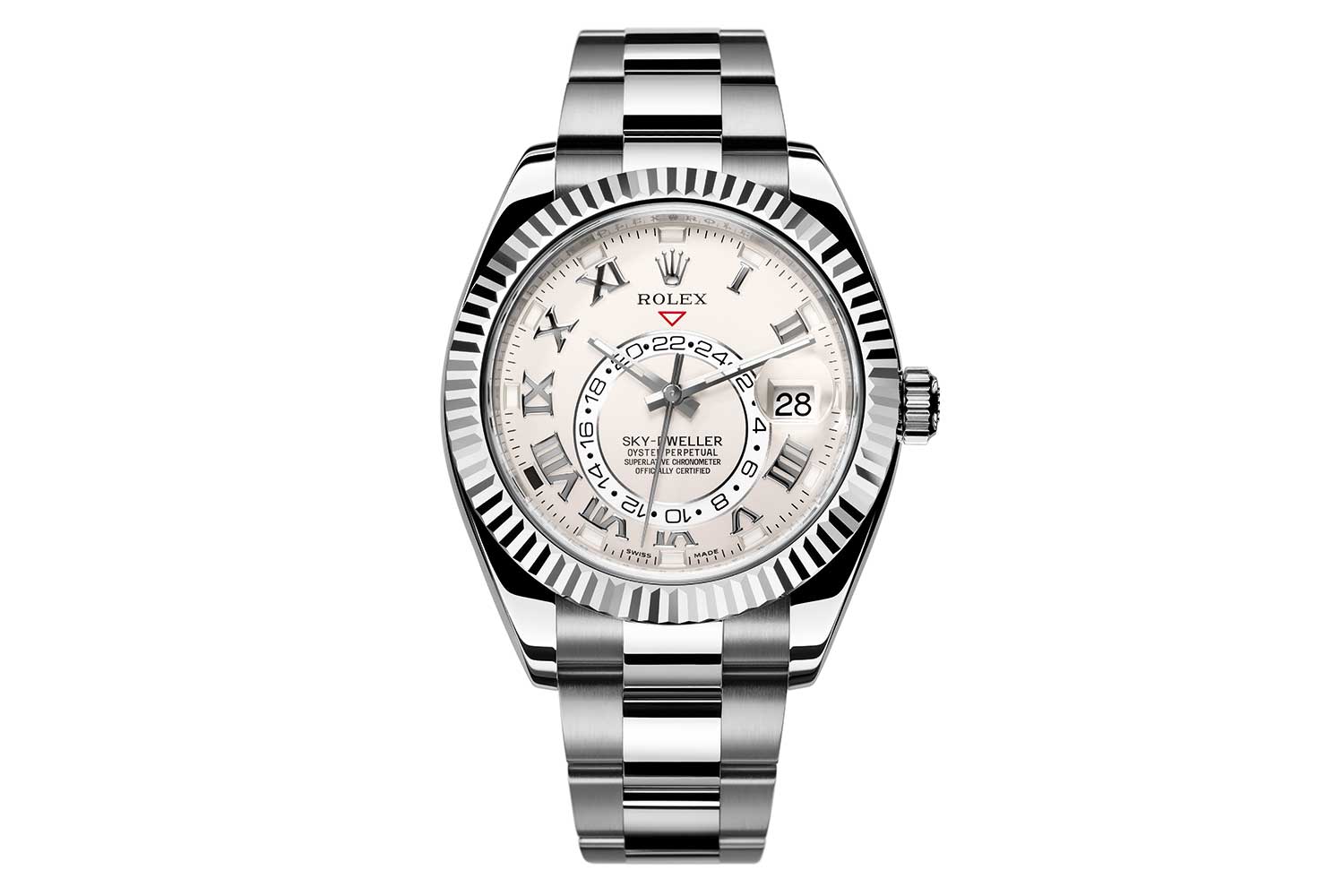
The first Sky-Dweller model launched in 2012
Firstly, because instead of a conventional month display, it showed the month through an aperture above the hour markers, which also doubled as month indicators. Secondly, because setting the watch occurred through the combined operation of the crown with the Ring Command bezel. It is by nature a big watch at 42mm, though this would be considered average to mid-size in the context of 2012.
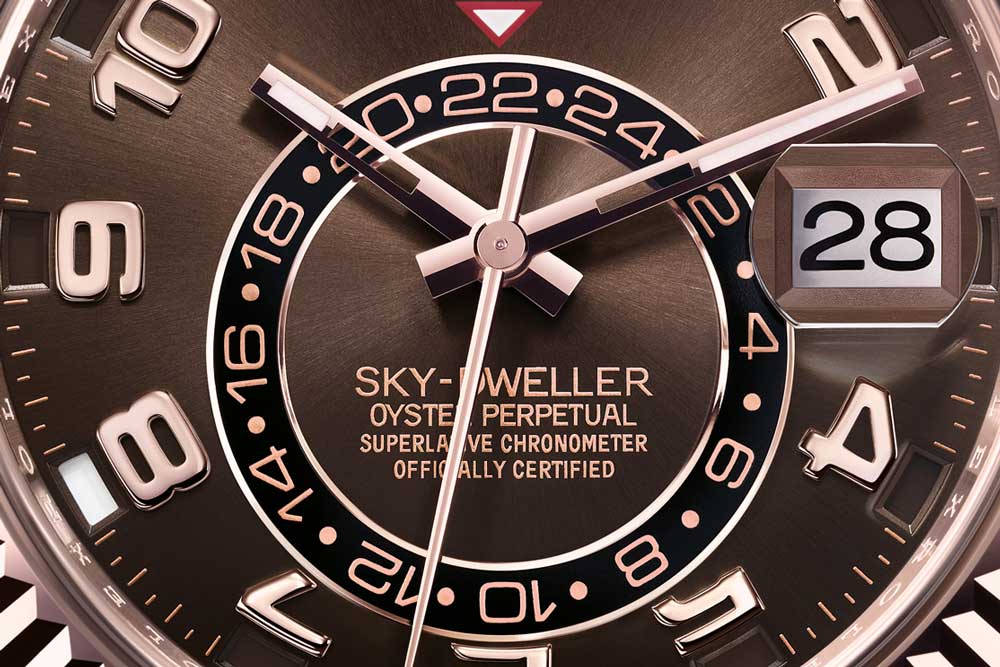
24-hour disc displaying another time zone on the Sky-Dweller
The Sky-Dweller combines two functions:
- A dual-time-zone display — a fixed red triangle and rotating 24-hour disk below 12 o’clock show the “reference” time (typically home time), while the center hands show local time; the hour hand can be adjusted independently in one-hour increments
- An annual calendar — built around a mechanism Rolex calls Saros, requiring manual adjustment only once a year, at the end of February. The month is shown via a small window that moves around the hour markers
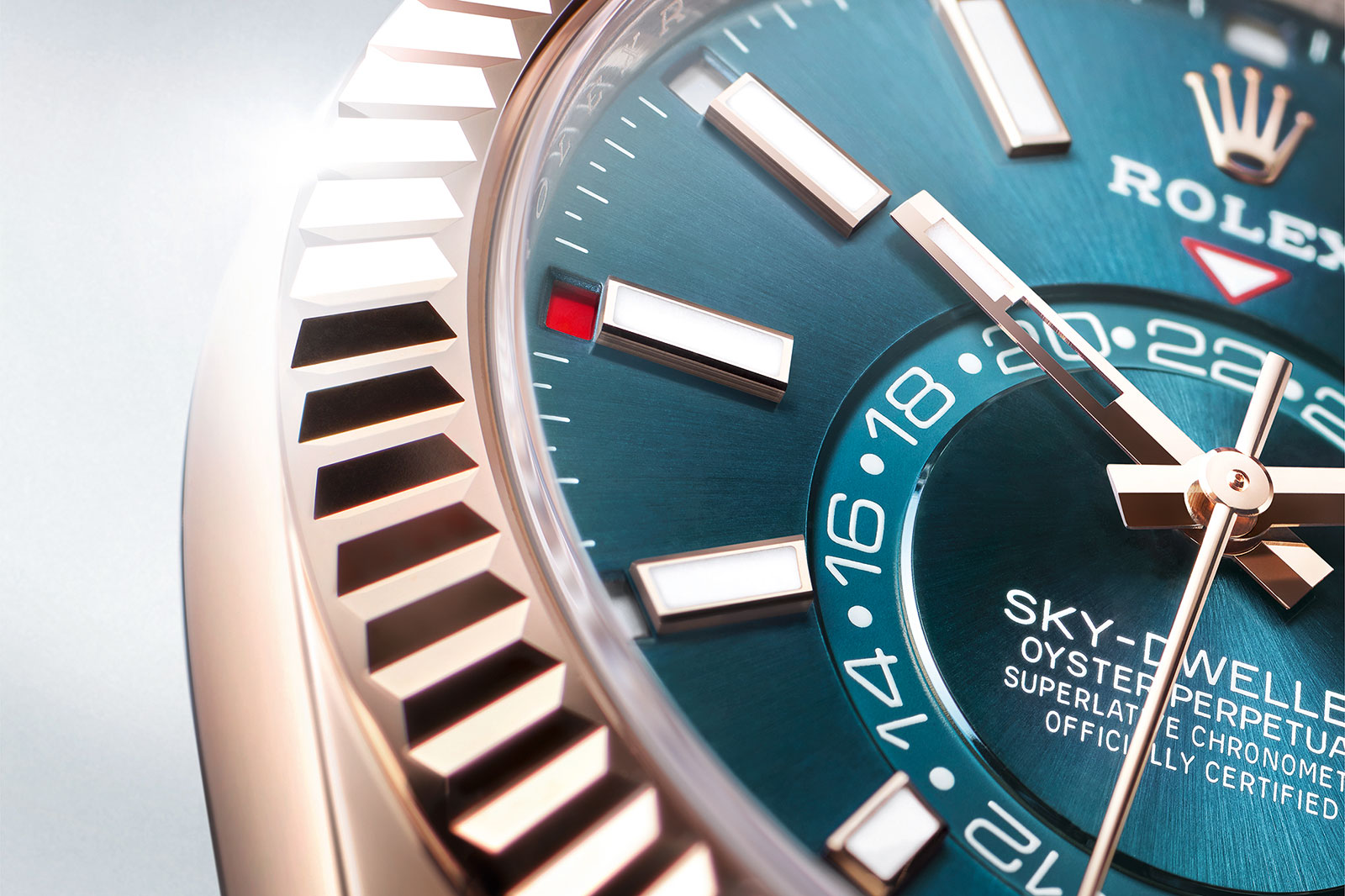
Rolex Sky-Dweller’s Saros Annual Calendar: In this image, the discreet month indicator turns a contrasting red at the 9 o’clock marker to signify September, the ninth month of the year
It’s powered by Caliber 9001, protected by seven patents, and was originally offered in Everose gold, yellow gold and white gold at 42mm, before Oystersteel versions were introduced in 2017.
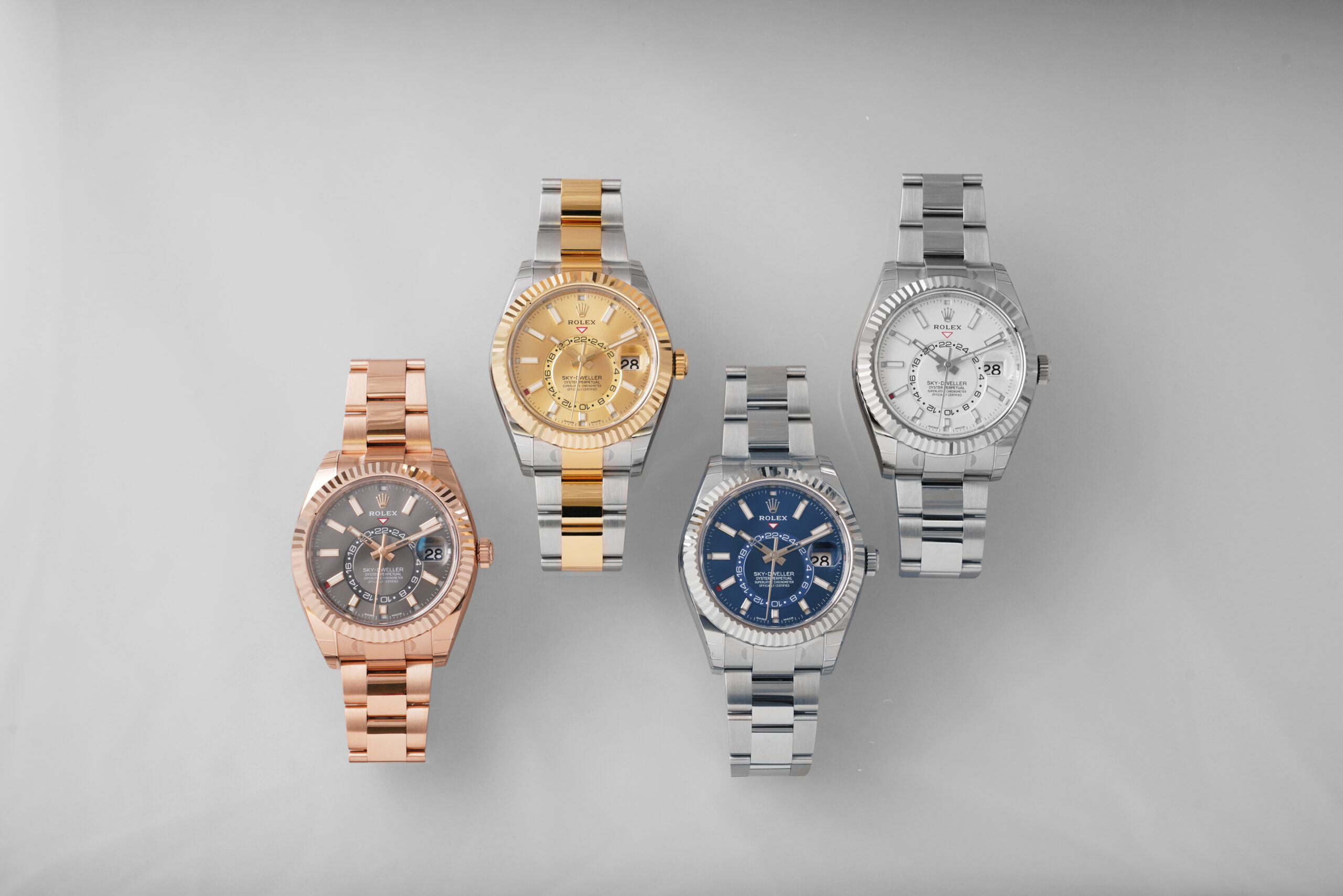
The Sky-Dweller family
2017: The Cellini Moonphase Brings the Moonphase Back
Sixty-four years after the Ref. 8171 and Ref. 6062 disappeared, Rolex revived the moonphase in 2017 with the Cellini Moonphase — the first Rolex moonphase watch since the 1950s.
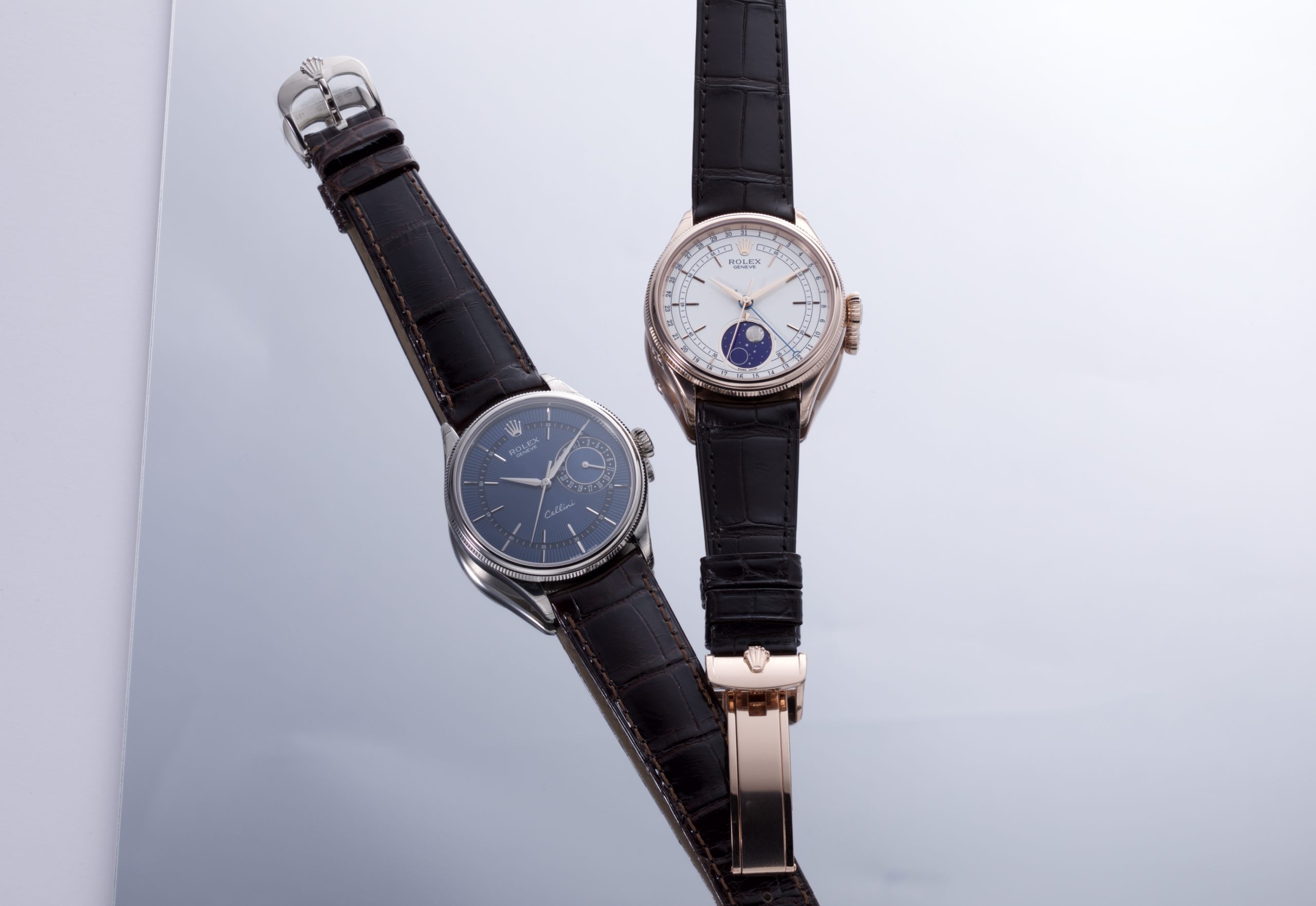
Rolex Cellini Date and the Cellini Moonphase
Unlike its vintage ancestors, the Cellini Moonphase isn’t a true Oyster, though it borrows heavily from that design language: a 39mm round case with fluted bezel and caseback rims, 50 meters of water resistance, and a domed back reminiscent of 1950s Rolex “Ovettone” cases.
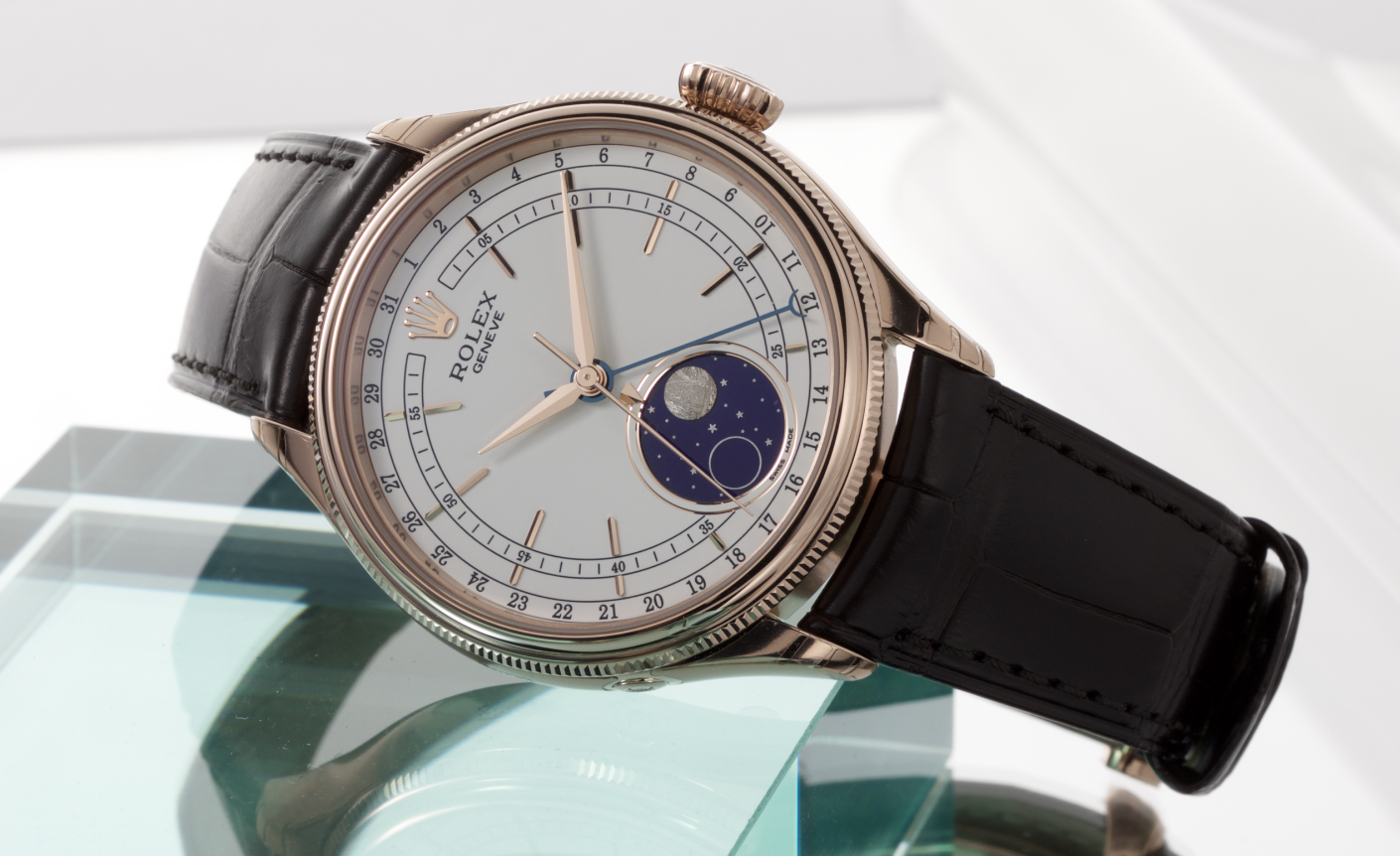
Rolex Cellini Moonphase
The dial is unarguably gorgeous. Its moonphase disk is fired enamel, similar in spirit to the Ref. 6062’s champlevé enamel moon disk, but the moon itself is cut from meteorite and etched to reveal its natural Widmanstätten crystal pattern, then rhodium-plated and domed. The watch runs Caliber 3195, a Superlative Chronometer accurate to within ± 2 seconds per day after casing, while its moonphase display is accurate to within a day every 122 years.
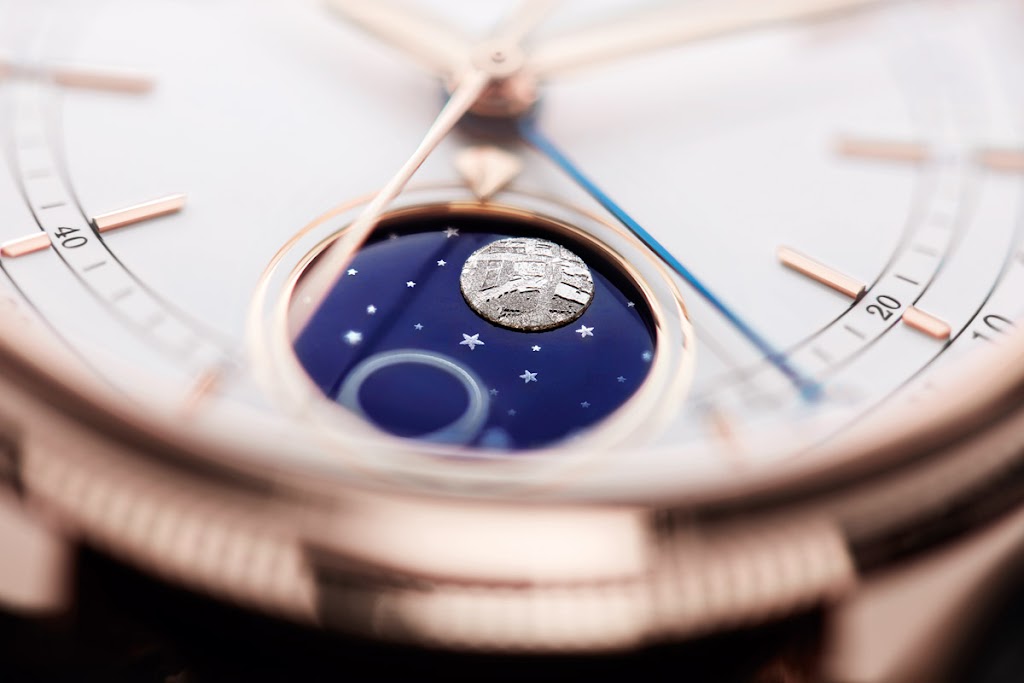
The moon phase disc on the Rolex Cellini Moonphase features an applique made from a slice of iron meteorite (Image: TimeAndWatches)
The Golden Age of the Triple Calendar
It’s funny but when I asked the legendary watch retailer Michael Tay, Group Managing Director of The Hour Glass, what some of his favorite vintage Rolex watches were, he sent me one photograph with a Dato-Compax beside a Ref. 8171, beside a Ref. 6062. For many collectors, these three timepieces form the “holy trinity” of complicated Rolexes and inevitably prompt the question: “What if?”
What if Rolex decided to come back into complicated watches and re-embrace this stunning configuration, how would they do it? The answer to that question actually began to emerge from a patent that Rolex quietly deposited in 2024 for a highly compact, energy-efficient, instantaneous calendar mechanism. Look closely at the following image and you’ll see that the calendar mechanism adopts a configuration reminiscent of Rolex’s famous triple calendars, with a centrally mounted date pointer, an aperture displaying the day on the left and the month on the right. My thoughts were leading up to the launch of the Perpetual Padellone on September 15. Could this be a coincidence?
Technical Breakdown of Rolex’s Annual Calendar Patent
To walk us through this patent, I have asked Cheryl Chia, Revolution’s Technical Editor, to break down her findings.
Rolex’s Ingeniously Compact Instantaneous Annual Calendar
The guiding principle is to preserve the layout of Rolex’s complete calendars from the 1950s while upgrading the mechanism to an annual calendar, and naturally, the changeover must be instantaneous, as in the existing Saros annual calendar. The classic arrangement of a mid-century triple or complete calendar places the day and month apertures side by side, with a central hand for the date and possibly a moonphase display at 6 o’clock. Such calendars typically use a gradual changeover, meaning dragging displays, with the indications advancing over several minutes or hours, rather than jumping instantaneously. Additionally, these are simple calendars that do not account for months with fewer than 31 days.
The annual calendar was invented by Patek Philippe in 1996 as a more affordable alternative to the perpetual calendar while being more sophisticated than the simple calendar. Unlike the program cam in a perpetual calendar, which encodes four different month lengths, an annual calendar’s encodes only 30- and 31-day months, so the owner needs to correct it once a year, at the end of February. The central idea of Patek’s invention was to rely primarily on rotating components such as compound gears and driving fingers, rather than the grand lever and associated springs typical of traditional perpetual calendars, so as to create a simpler, more robust mechanism. The trade-off, however, is that the mechanism relies on long, complex transmission chains spread across multiple levels, and famously boasts a higher part count than Patek’s perpetual calendars. This construction takes up space and consumes energy, which makes instantaneous jumps harder to achieve. The Patek annual calendar mechanism instead uses a gradual changeover that takes roughly four hours to complete.
Rolex has addressed such drawbacks with a compact, planar and energy-efficient annual calendar that allows the day, date and month to jump instantaneously. There are several features in the mechanism that stand out. The first is that the month display and the month program are machined as a single component, with the program cam formed on the underside of the month disk. This eliminates any intermediate train between the display and the cam, which sits off-center beside the central 31-tooth date wheel. The outward radial projections of the cam encode 30-day months, while the spaces between them correspond to the 31-day months.
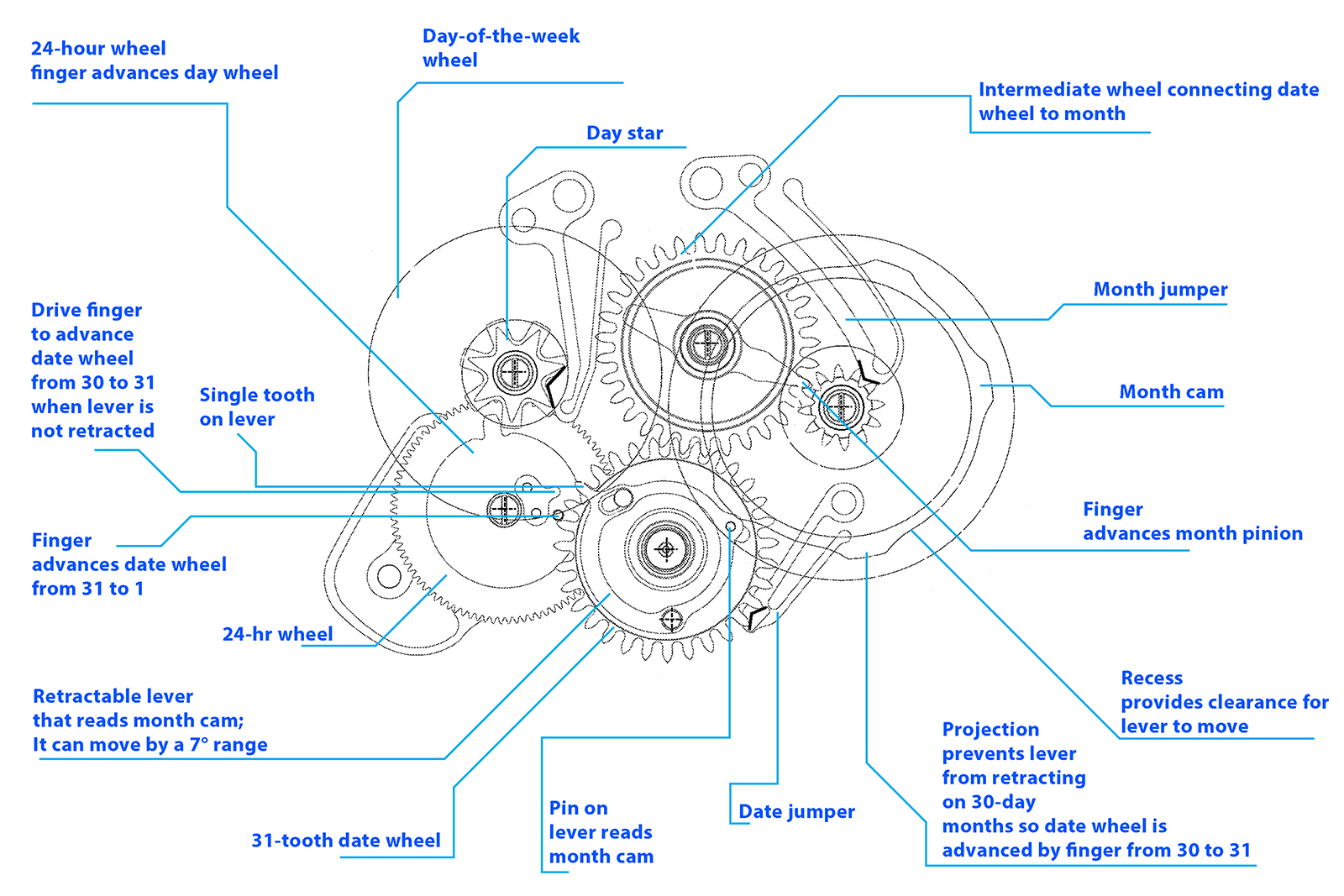
The second is that although the mechanism relies on a lever, the lever is compact, pivoted directly on the date wheel and carried around with it. It serves as a retractable tooth and carries a pin that interacts directly with the month cam. Its freedom to move determines whether the date receives an additional advance at the end of a 30-day month. In a 30-day month, the month cam blocks the pin and prevents the lever from retreating, so the calendar drive advances the date wheel by an extra step via the single tooth on the lever which, together with the ordinary daily advance, takes the date from the 30th to the 1st of the following month.
The calendar drive comprises a 24-hour wheel and a disk (a finger piece) that carries two date-driving fingers. One advances the date wheel by one tooth every day, while the other encounters a single tooth on the retractable lever as the date reaches the end of the month. At the transition from the 30th to the 31st of a long month, the month cam leaves sufficient clearance for the pin to move, so the lever yields under the pressure of the second finger. The stroke therefore will not produce an advance, and the ordinary daily finger moves the display to the 31st. In a 30-day month, the radial projection on the month cam prevents the lever from retracting. The second finger must then turn the date wheel by one step, after which the ordinary finger supplies the next, taking the date from the 30th to the 1st. The two date-driving fingers act in swift succession, so the change takes only a fraction of a second and appears as a single instantaneous jump.
The economy of the arrangement lies in the fact that the part which reads the month cam also has a tooth through which the date wheel is driven. Pin and tooth sit on the same small lever located on the date wheel itself, while the finger piece that advances the day-of-the-week also carries the two fingers to advance the date wheel. Furthermore, the lever does not require a spring to oppose its retraction. A single intermediate wheel, also with 31 teeth and in mesh with the date wheel, carries a finger that advances the month disk via its pinion once per revolution. At the end of a 30-day month, this occurs during the second step of the date jump.
An equally useful detail is what happens after the month has advanced. Its driving finger remains between the teeth of the month pinion as a physical stop. The month jumper can therefore exert less force, since it no longer has to prevent an extra jump on its own. Together with the reduced inertia of the combined month disk and cam, this lowers the energy required for the change and limits the disturbance to balance amplitude.
The instantaneous action comes from the connection between the 24-hour wheel and the disk. The 24-hour wheel receives power through gearing connected to the hour wheel and drives the disk through a one-way coupling with a curved elastic pawl. The pawl transmits rotation in the normal direction but yields if the 24-hour wheel turns backwards, so the calendar-driving components remain stationary. Turning the hands counterclockwise across midnight, for instance, will not desynchronize the calendar displays. Besides the two date-driving fingers, the disk has a finger that advances the day-of-the-week display.
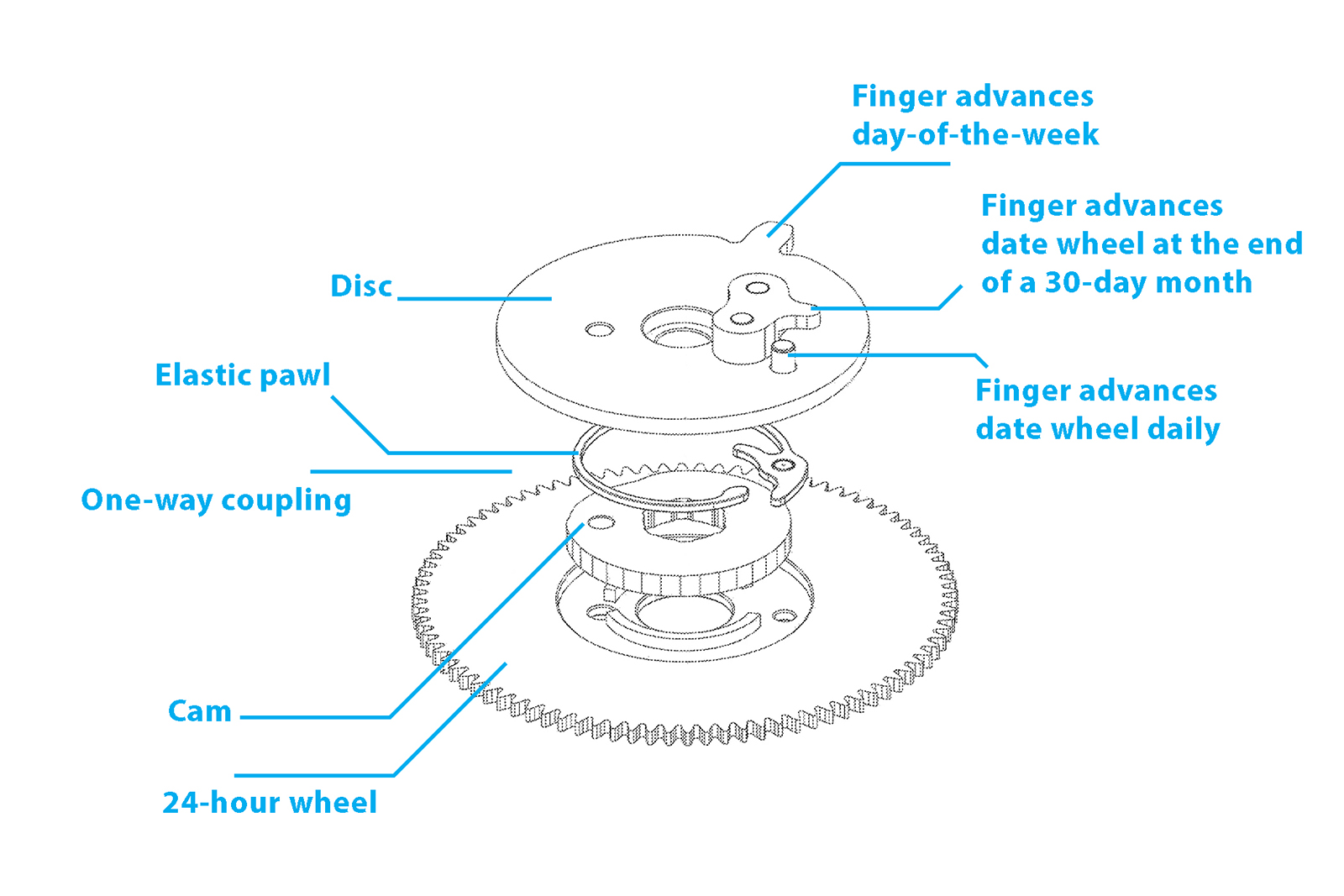
A cam rotates with the disk and its fingers, while a spring-loaded roller lever bears against its perimeter. As the cam turns through its daily cycle, it lifts the lever and loads its spring. At midnight, the roller passes the highest point of the cam and the spring releases its stored energy. The one-way coupling allows the cam, disk and fingers to accelerate ahead of the continuously driven 24-hour wheel as the spring releases its energy to power the date and day jumps, and the month jump when due. Because all the indications are driven by the 24-hour wheel through short drive paths, only one cam and spring-loaded lever is needed.
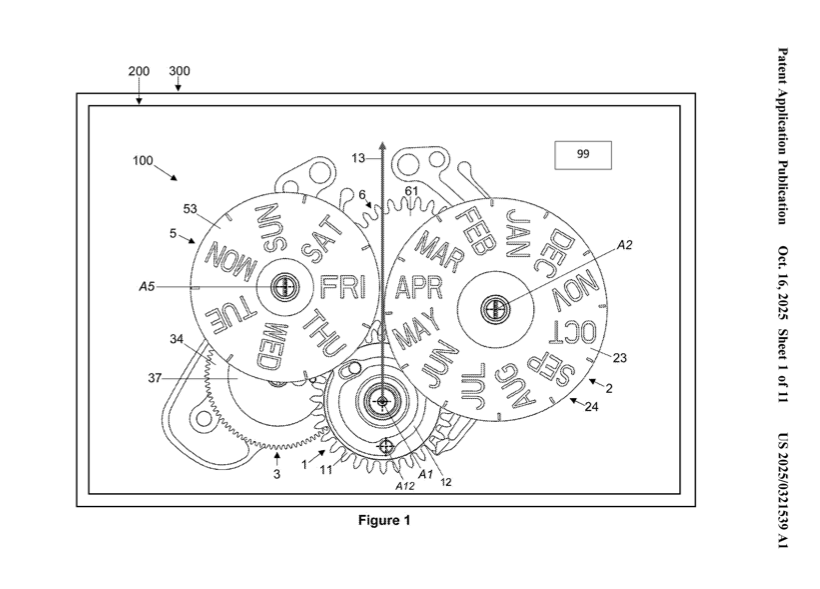
In short, the solutions are particularly clever within the layout constraints of a classic triple calendar. The mechanism is compact, simple and economical in its use of energy, with a month cam integrated into the month display disk, a retractable lever on the date wheel that contacts the cam directly, a single cam and spring-loaded lever that power all the instantaneous jumps, a month-driving finger that doubles as a stop after the jump, which allows a weaker month jumper, while just one intermediate wheel connects the date wheel to the month display with no need for compound gearing.
A Time for Elegance — The new Perpetual Padellone family
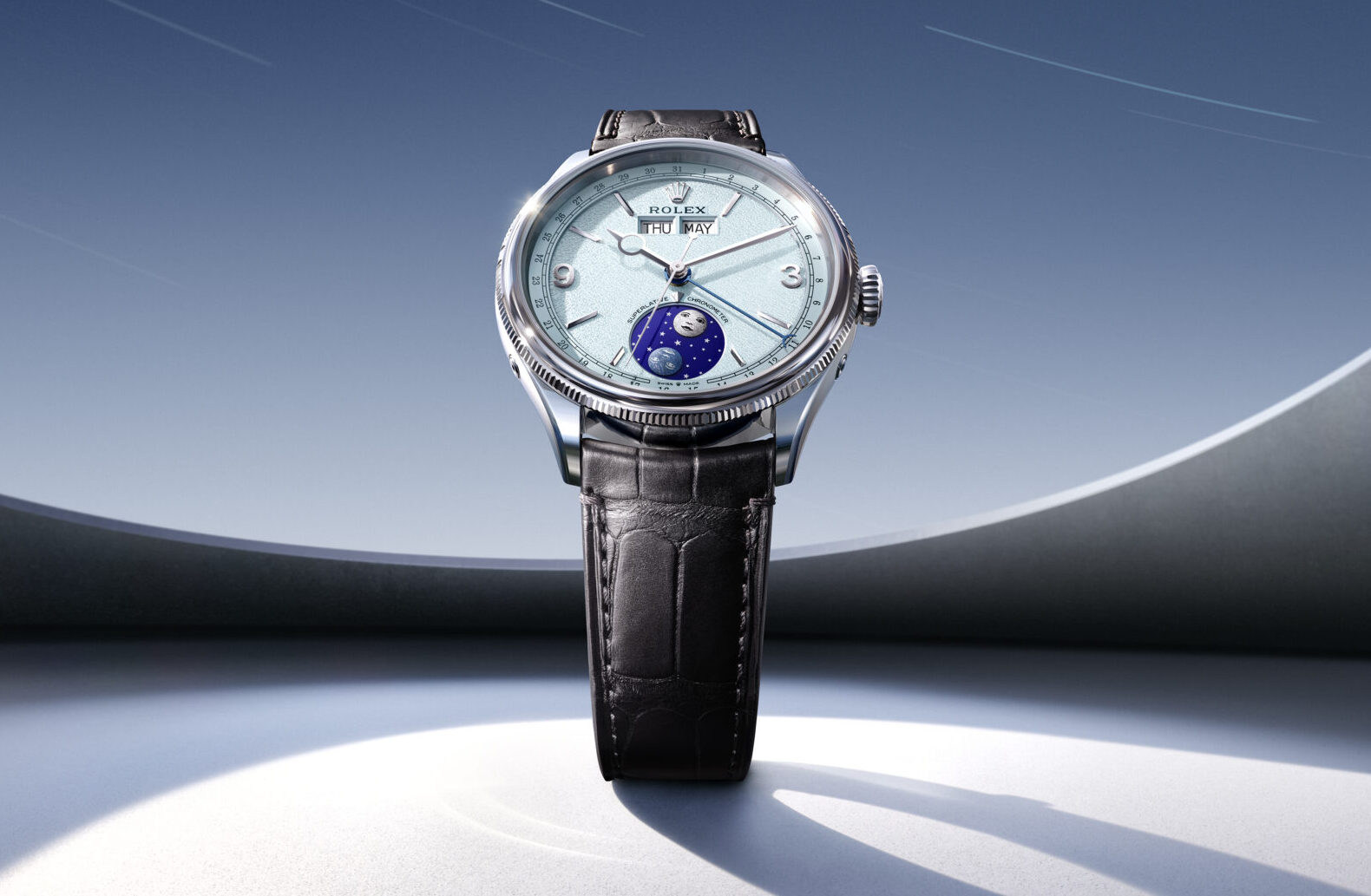
The Rolex Perpetual Padellone in Platinum and alligator strap
Rolex inevitably plans for the long term. In terms of strategy, the brand is invariably playing Garry Kasparov-level chess moves that become clear only as time passes. But when they do, they elicit a collective sigh of awe from the watch cognoscenti for their masterful gamesmanship. So it is safe to say that by the time we first set eyes on the Perpetual 1908 model in 2023, it had already been planned that this would become the home for Rolex and Jean-Frédéric Dufour’s vision of future complicated timekeepers.
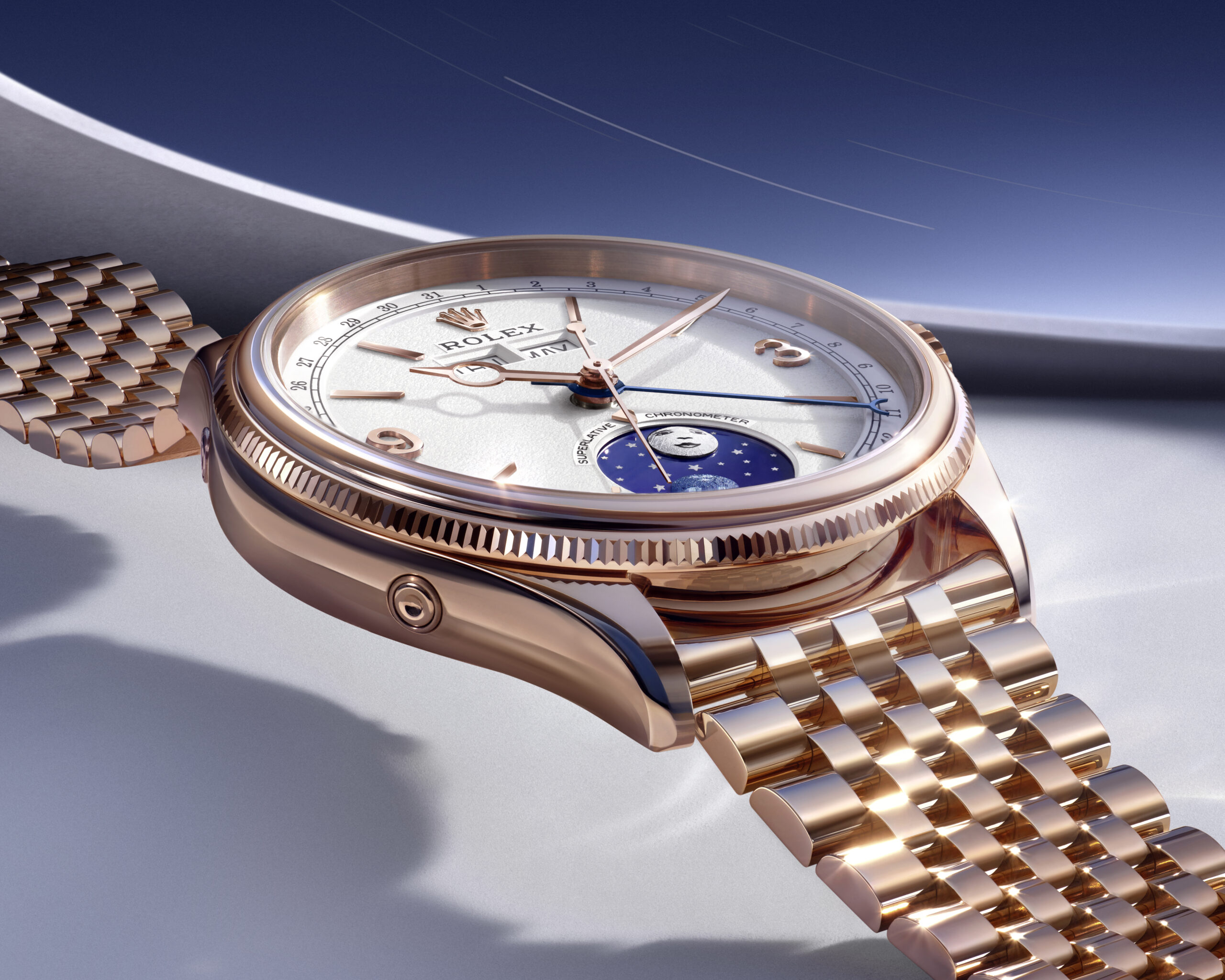
The Everose Perpetual Padellone paired with the Settimo bracelet
At first, we simply understood the 1908 to be launched as a slim dress-watch successor to the Cellini family. On the wrist, it redirected the Oyster case into a decidedly elegant direction highly reminiscent of timepieces made under the Wilsdorf era. Key to this was the Caliber 71XX family of movements, which represent an all-new generation of thin, high-performance movements for Rolex. In the 1908, we discovered the 7140, which, while appealingly thin, also combined two of Rolex’s key innovations, the Syloxi silicon hairspring and the Chronergy escapement — a redesign of the lever escapement that improved its efficiency by 15 percent. The movement was beautifully finished with a solid gold oscillating mass, which could be viewed through the transparent caseback, and the entire watch was also one-third smaller than models in the Oyster Perpetual collection, making it the ideal platform to house future complications.
-
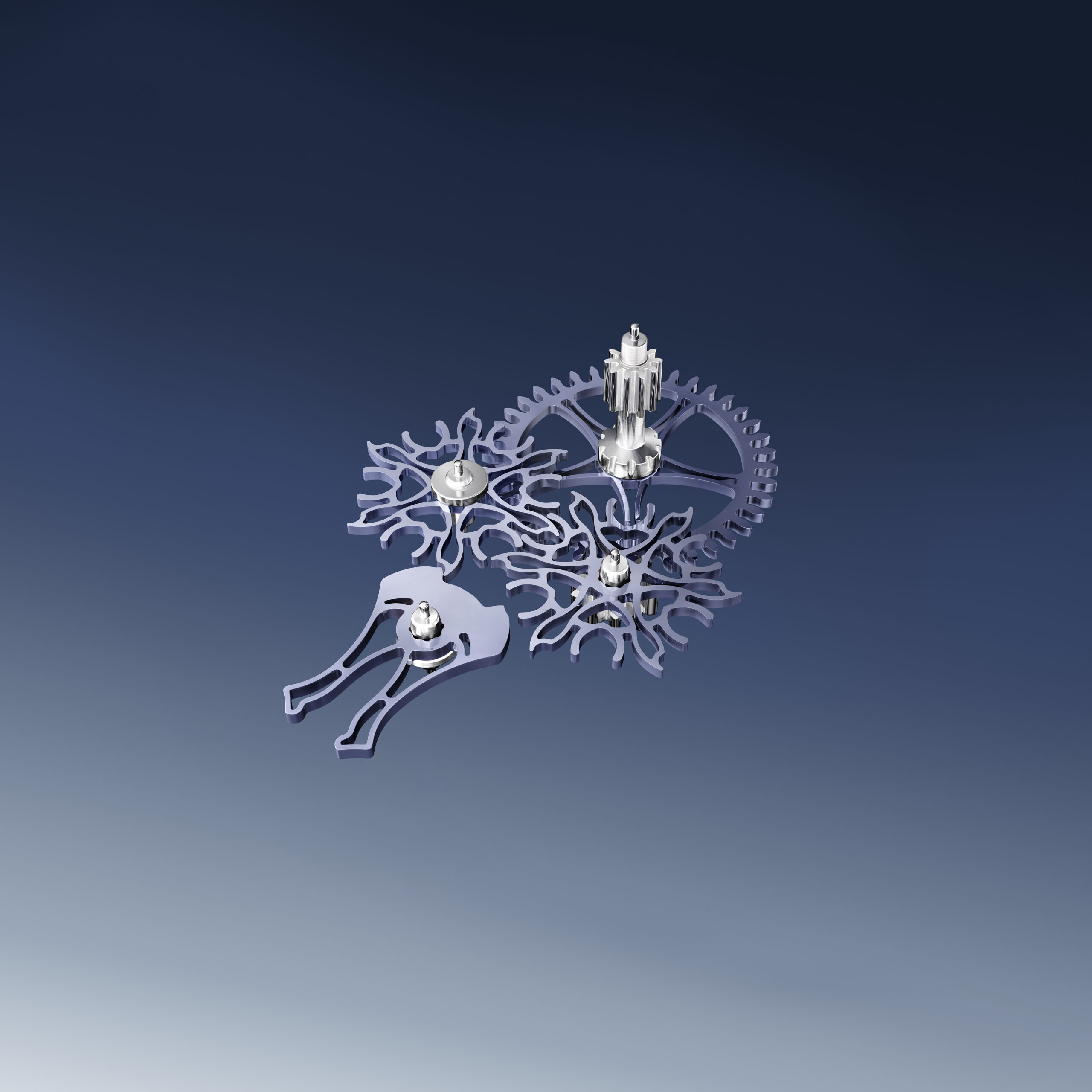
- The DynaPulse escapement
-
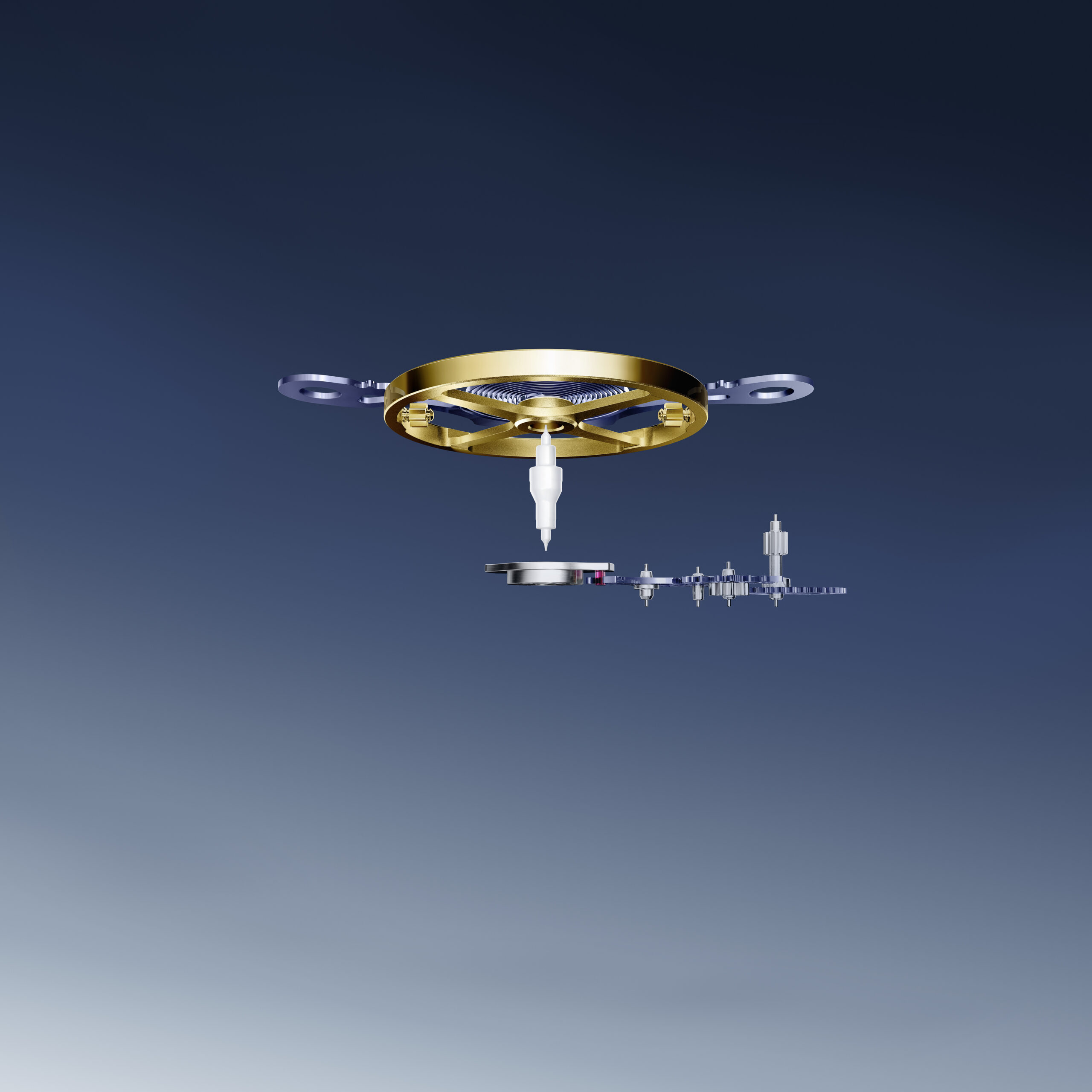
- Cal. 7190’s oscillator with ceramic axis, optimized brass balance wheel, and the Syloxi silicon hairspring
When launched, the 1908 immediately garnered a highly favorable response and became a viable elegant alternative to the Oyster Perpetual or Datejust in precious metal. Its styling expressed a certain retro heritage vibe through the combination of an Explorer-style dial and Observatory hands. A year later, Rolex followed up on the first matte dial models with a genuinely stunning ice-blue guilloché à main platinum iteration. Now on September 15, in the year of our Lord two thousand twenty-six, we understand the full vision that underscored the creation of the stunning Perpetual Padellone family.
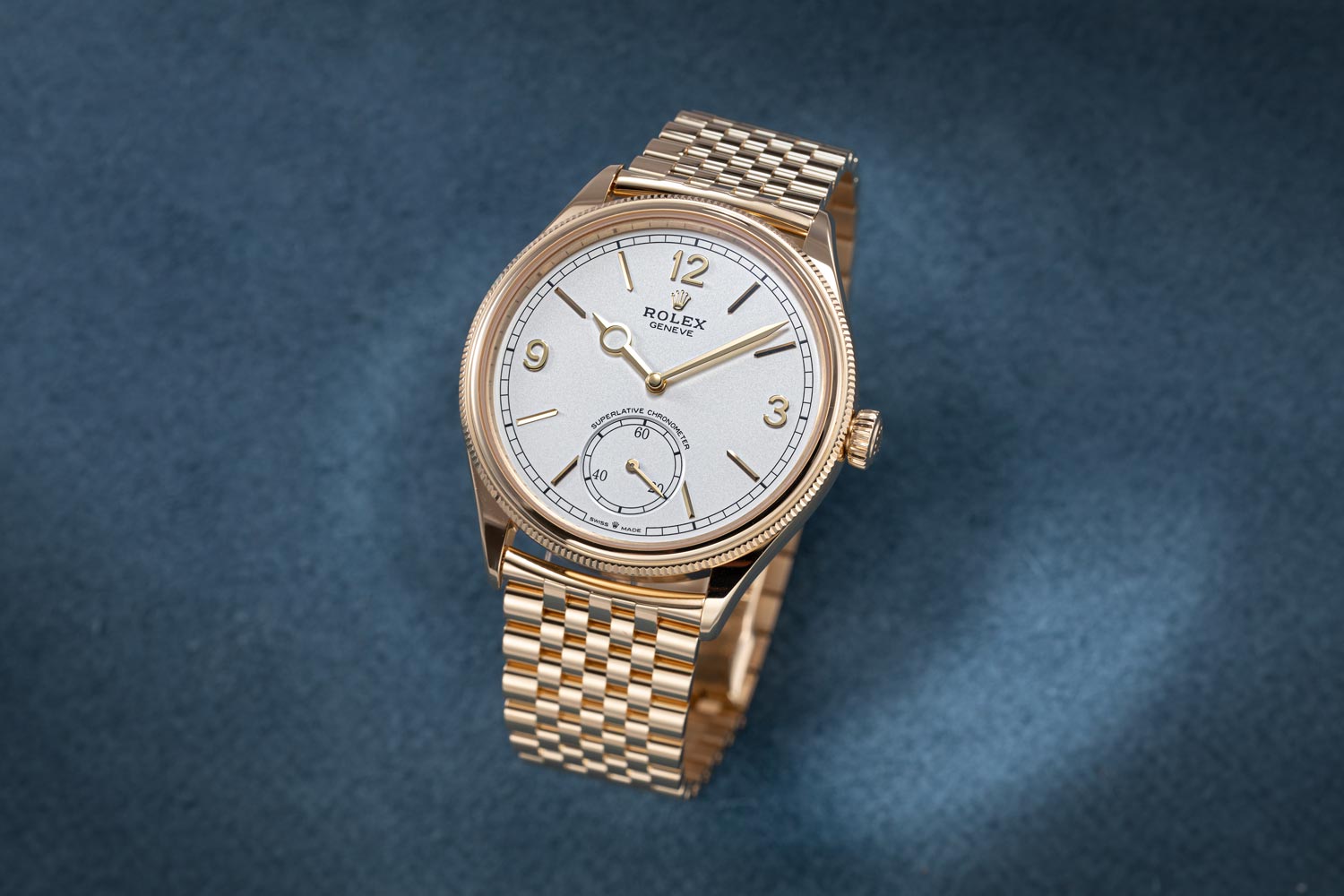
The Rolex 1908 Perpetual on the Settimo bracelet, launched in 2025 (©Revolution)
Housed in the 1908 case, we have Rolex’s instantaneous, energy-efficient annual calendar, configured like the triple date in the 8171, with a central pointer date and two windows at 12 o’clock, with day on the left and month on the right. The watch is jaw-droppingly gorgeous, the result of a brilliant combination of nostalgic design, traditional craft and modern technology.
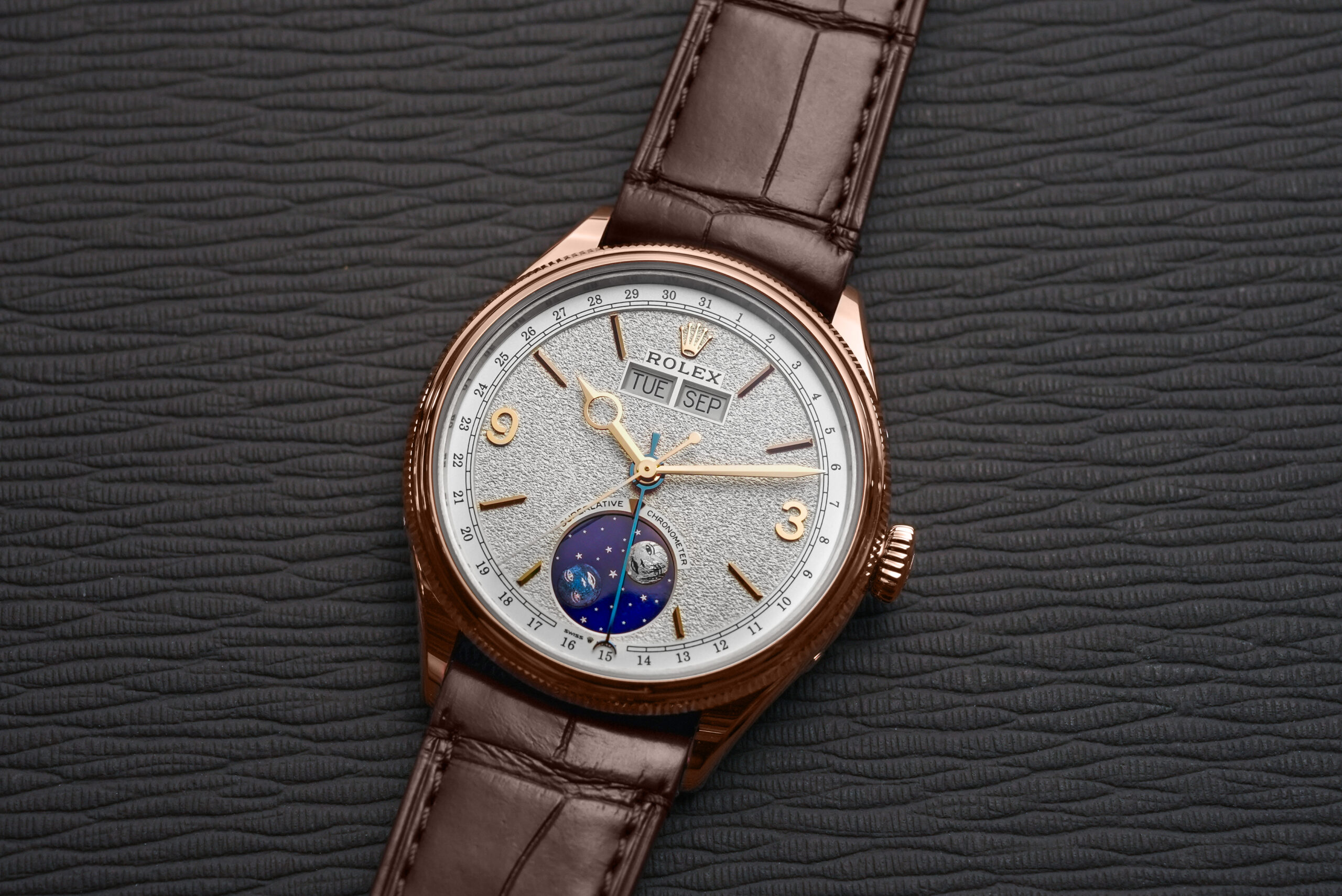
The Rolex Perpetual Padellone in Everose Gold and alligator strap (©Revolution)
The grained or frosted finish on the dial that was traditionally applied with steel brushes is now created using laser engraving, and I have to applaud Rolex for the subtle modulation in the texture and finesse of the dial. At 6 o’clock, in a wonderful play of contrasts, you have a double-hemisphere moonphase indicator that comes from the 2017 Cellini Moonphase indicator. The base of the moon is crafted from a shimmering sea of blue grand feu enamel decorated with stars, while the two moons are crafted from meteorite. The full moon is silver and you can easily discern the pattern of the meteorite, while the new moon is also in meteorite but treated with dark blue PVD.
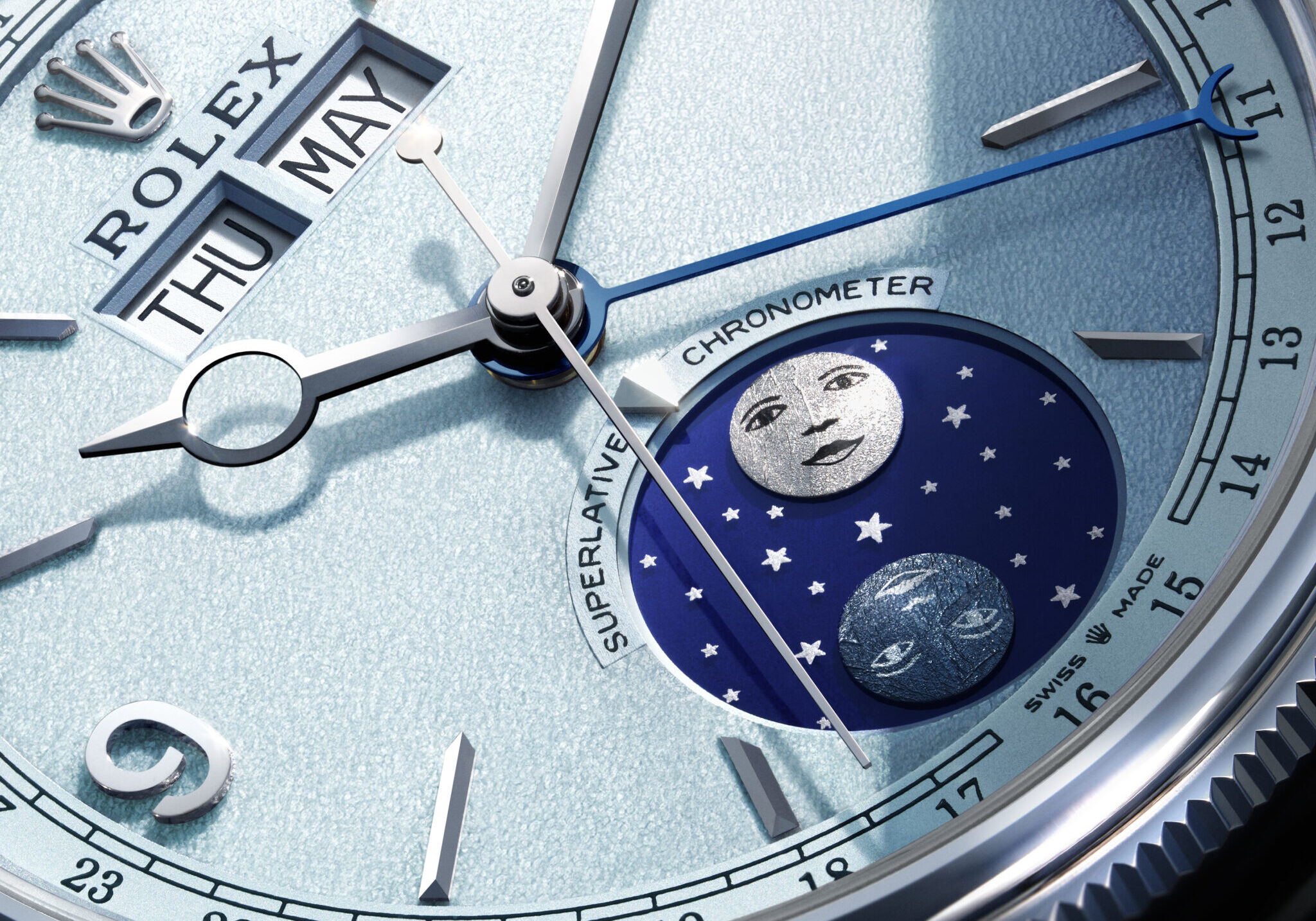
The double-hemisphere moonphase indicator is similar to that of the 2017 Cellini Moonphase. The base of the moonphase disc is crafted from blue Grand Feu enamel, while the two moons are made from meteorite, featuring a Mona Lisa-like expression similar to the one found in the original ‘Padellone’ and Ref. 6062.
The 1908 case measures 39mm in diameter with a thickness of 12.2mm. On the wrist, it feels perfectly proportioned and balanced. The lug-to-lug width is 45.1mm, just a touch smaller than the 45.2mm dimension of the 1908. Inside the watch, rather than the Caliber 7140 found in the 1908 that I had speculated would be the base of the new 7190 movement that is 5.56mm thick, Rolex provided an unexpected and incredibly cool surprise.
The base movement is actually the Caliber 7135, the same movement launched in the Land-Dweller with the awesome DynaPulse escapement, the very first all-new widely produced Swiss escapement design since the Co-Axial was launched in 1999 by Omega. This represents an evolution of Breguet’s natural escapement, now made in silicon with a central impulse rocker. That means that the Perpetual Padellone family is powered by a 5Hz movement representing the very highest level of chronometric performance in the industry. One nice touch is that the watch’s center seconds hand moves with a distinctive smoothness, thanks to the 5Hz oscillation speed. The super-efficient annual calendar is powered by what Rolex calls a Haplos system. The two most important parts in this innovation are the carrier finger and the annual lever that communicate with each other to activate the instantaneous date change from the end of a month to the next, allowing for an instantaneous changeover from 30 to 1 where applicable.
-
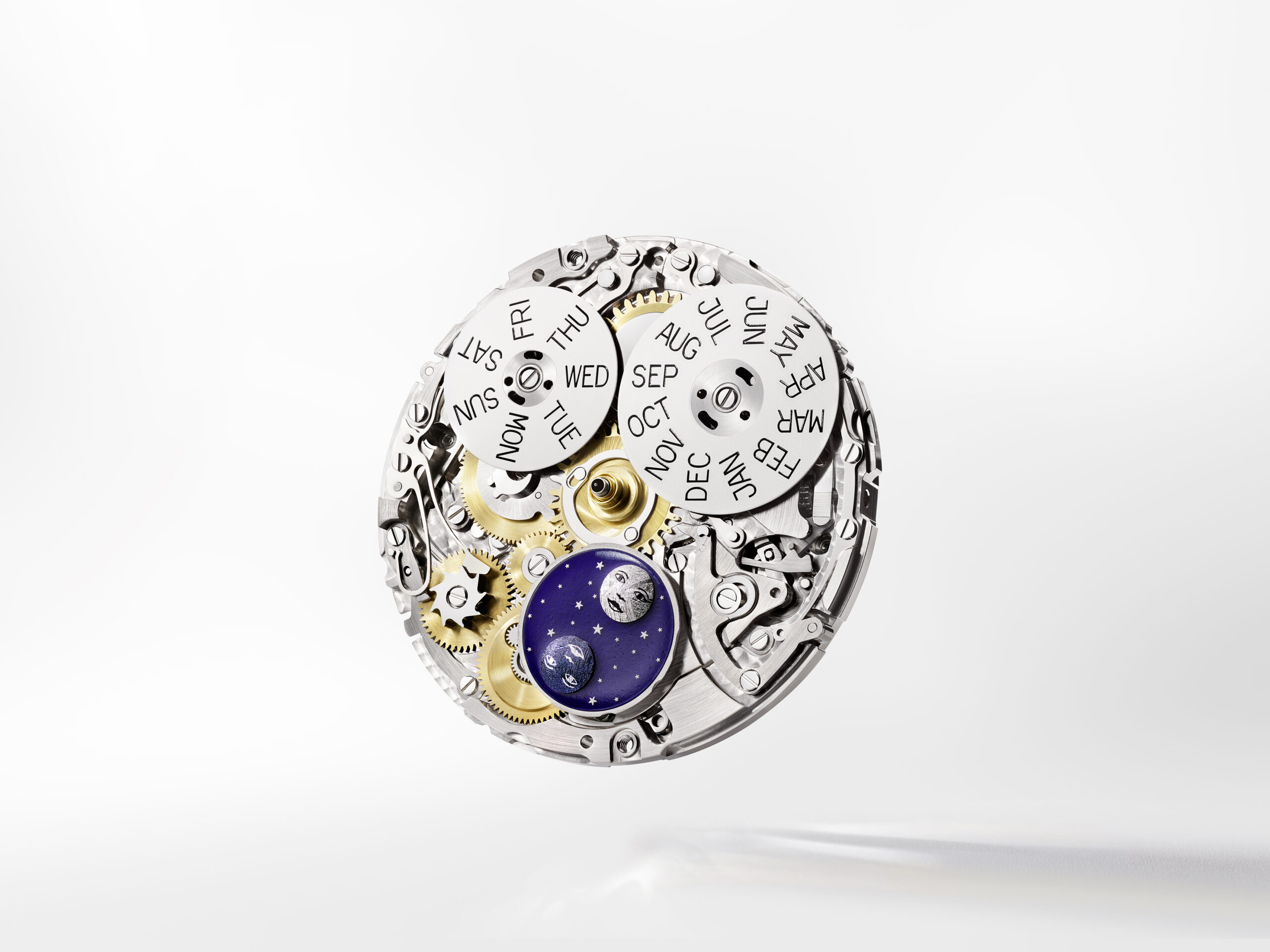
- The annual calendar and moonphase discs on the Caliber 7190
-
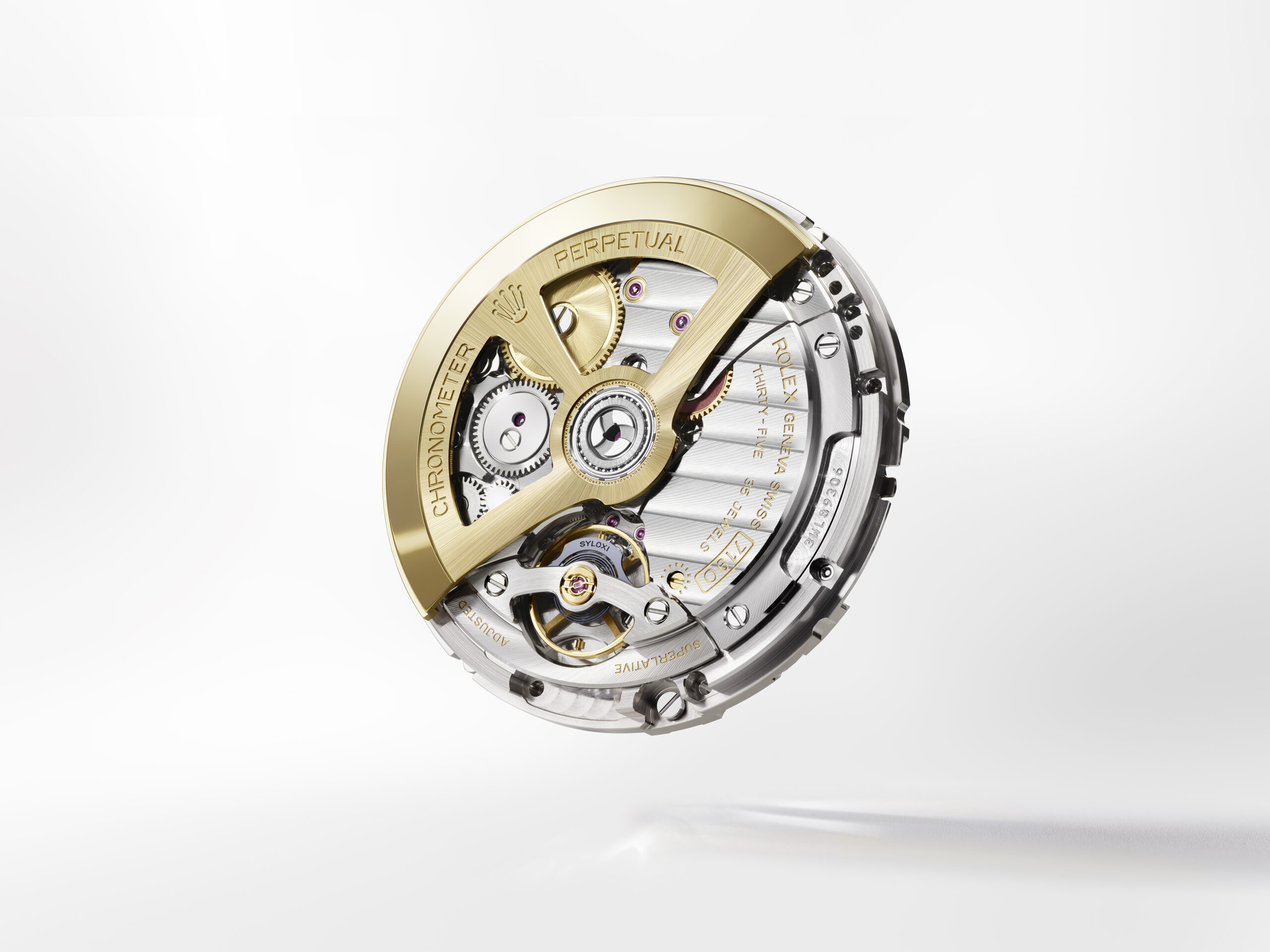
- Caliber 7190 equipped on the Perpetual Padellone
Now if you look at the caseband of the Perpetual Padellone family, you will immediately notice pushers for the calendar information. The question is, of course, why not try to operate everything through the crown as many modern annual calendars do? The response was that this was a tribute to the 8171, but what is important is that the pushers can be operated in any sequence without damaging the watch.
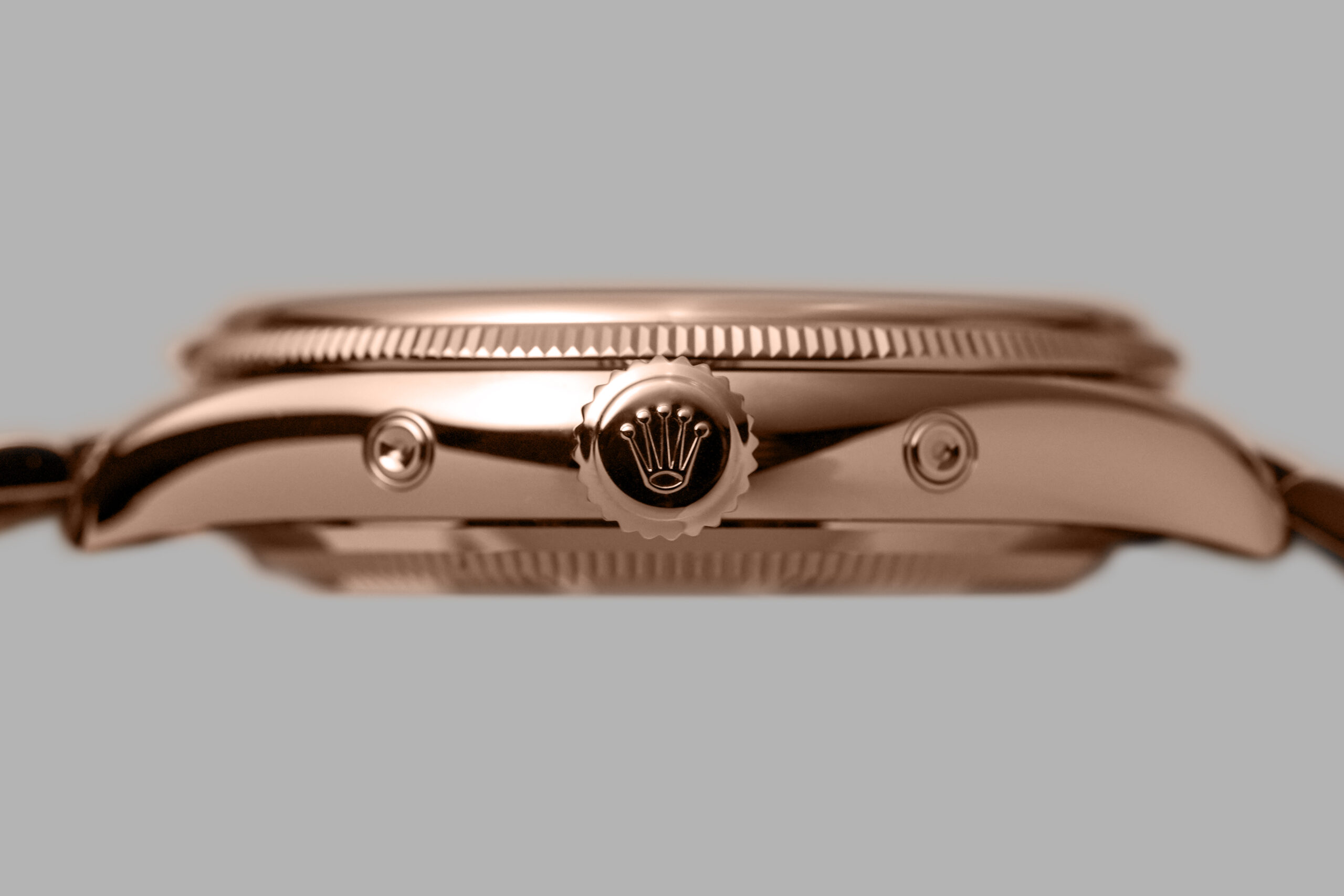
The Perpetual Padellone family uses traditional pushers that can be operated in any sequence without damaging the watch (©Revolution)
The Perpetual Padellone comes in three versions at launch. The first is an Everose gold watch with an intense white dial on a brown alligator strap. The second, and my favorite, is an Everose gold watch with the Settimo bracelet launched in the yellow gold 1908 — although even as I say that, I will admit my heart is torn between that version and the resplendent and achingly beautiful platinum version with the ice-blue frosted dial.
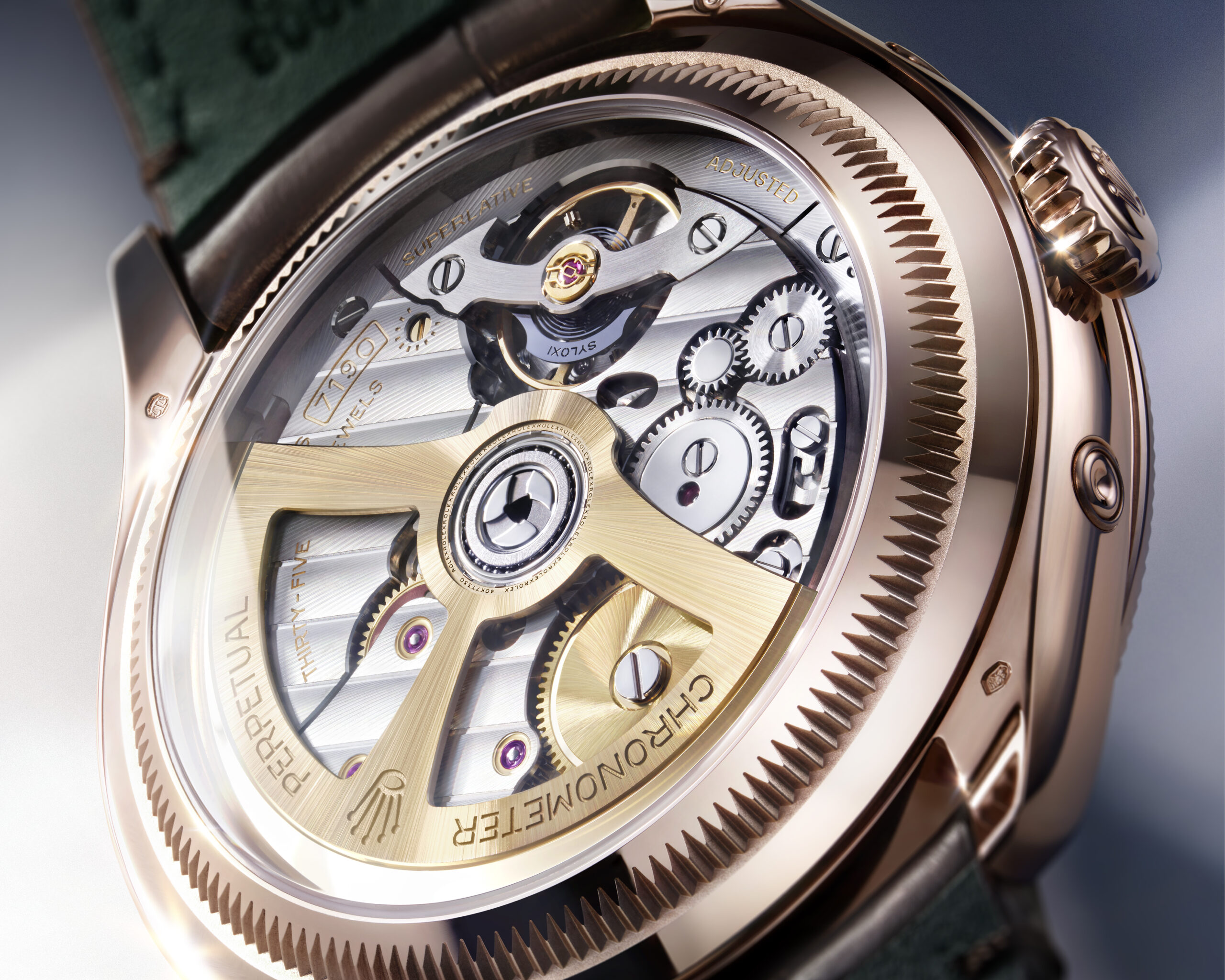
The Caliber 7190 is visible through the sapphire caseback on the Perpetual Padellone
What is just as remarkable is the pricing strategy of these timepieces. The Everose gold watch on strap, Ref. M53505-0002, is priced at CHF 48,500, the Everose gold watch on bracelet, Ref. M53505-0003, is priced at CHF 60,800 and the platinum watch, Ref. M53506-0002, is priced at CHF 55,000. All prices are excluding VAT. These watches are an absolute bargain from a value perspective and are proof positive that Rolex’s future in complicated watches is here now and in force.
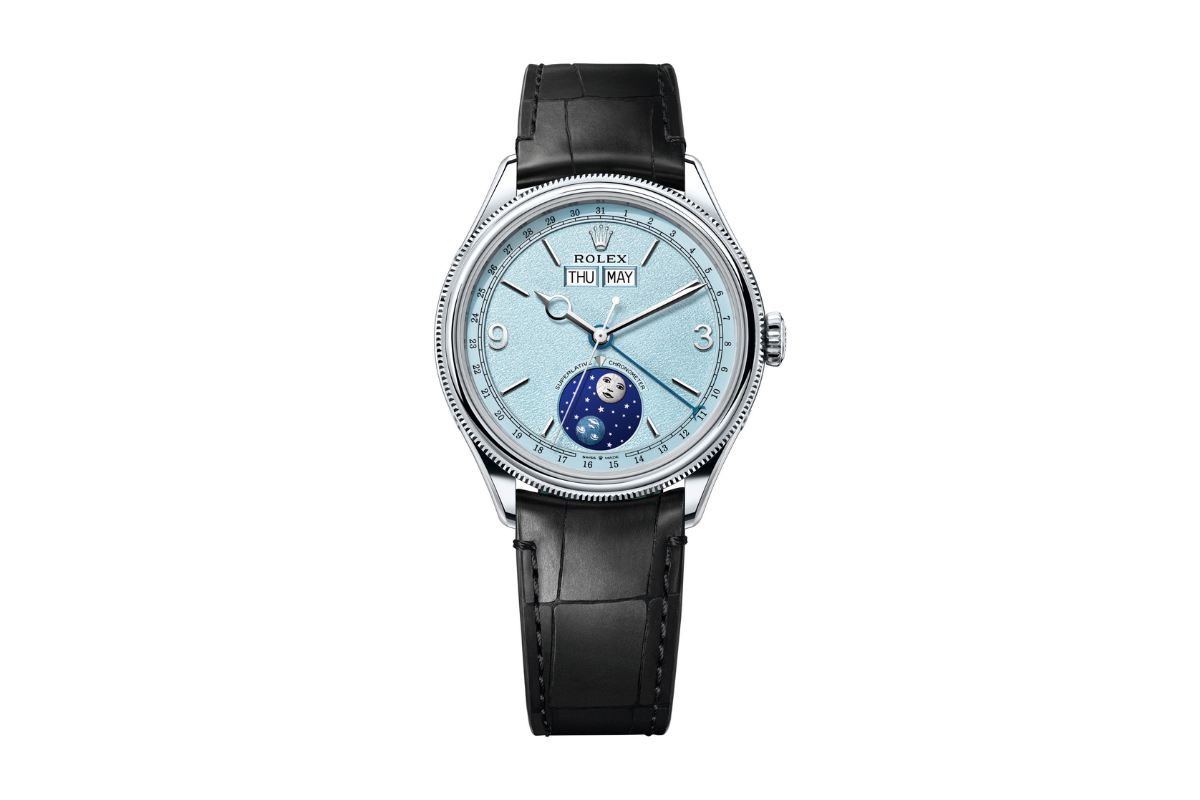
Rolex Perpetual Padellone M53506-0002
Tech Specs: Rolex Perpetual Padellone M53506-0002
Ref M53506-0002
Movement Self-winding Caliber 7190; 66-hour power reserve
Functions Hours, minutes and seconds; stop seconds; instantaneous complete annual
calendar with Haplos system: moonphase indicator
Case 39mm × 12.2mm; 950 platinum; water resistant to 50m
Dial Ice-blue, matte with grained finish; blue enamel moon disk with full and new moon in meteorite; applied Arabic numerals and hour markers in 18K white gold
Strap Matte black alligator leather with Dualclasp
Price CHF 59,000
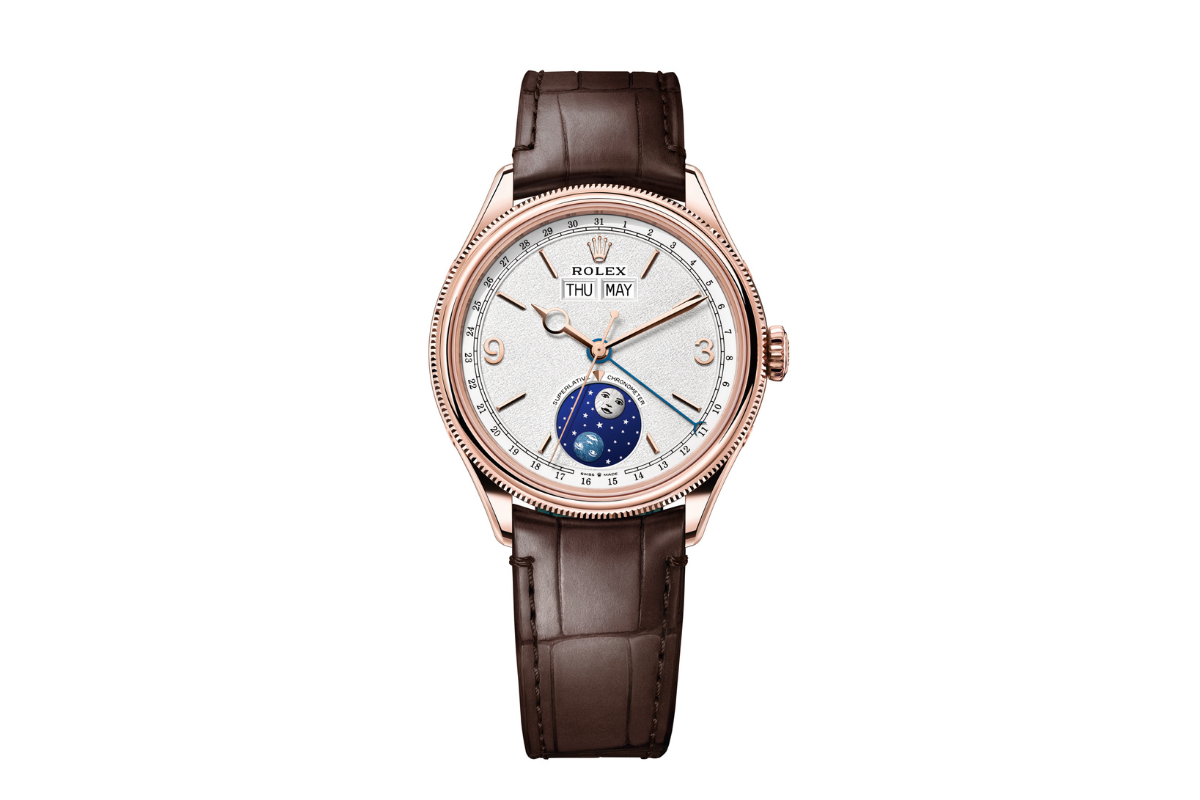
Rolex Perpetual Padellone M53505-0002
Tech Specs: Rolex Perpetual Padellone M53505-0002
Ref M53505-0002
Movement Self-winding Caliber 7190; 66-hour power reserve
Functions Hours, minutes and seconds; stop seconds; instantaneous complete annual
calendar with Haplos system: moonphase indicator
Case 39mm × 12.2mm; 18K Everose gold; water resistant to 50m
Dial Intense white, matte with grained finish; blue enamel moon disk with full and new moon in meteorite; applied Arabic numerals and hour markers in 18K pink gold
Strap Matte brown alligator leather with Dualclasp
Price CHF 59,000
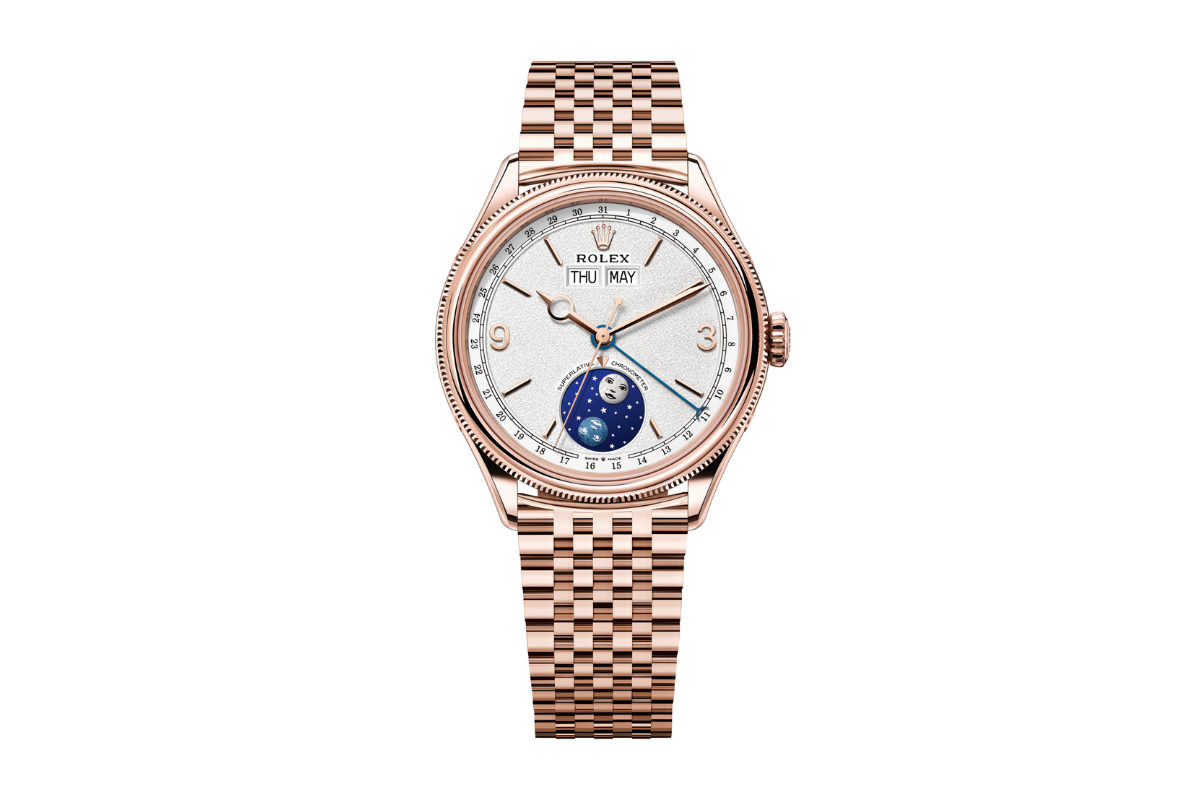
Rolex Perpetual Padellone M53505-0003
Tech Specs: Rolex Perpetual Padellone M53505-0003
Ref M53505-0003
Movement Self-winding Caliber 7190; 66-hour power reserve
Functions Hours, minutes and seconds; stop seconds; instantaneous complete annual
calendar with Haplos system: moonphase indicator
Case 39mm × 12.2mm; 18K Everose gold; water resistant to 50m
Dial Intense white, matte with grained finish; blue enamel moon disk with full and new moon in meteorite; applied Arabic numerals and hour markers in 18K pink gold
Strap Settimo bracelet with concealed folding Crownclasp
Price CHF 64,800
Rolex
You may also like
Editorial
A Closer Look: Rolex Perpetual Padellone
Sep 22, 2026
Editorial
A Closer Look: Rolex Perpetual Padellone
Sep 22, 2026
News
Last Week In Watches: Rolex Revives the Padellone, Hublot Goes Full Koons
Sep 21, 2026
News
Last Week In Watches: Rolex Revives the Padellone, Hublot Goes Full Koons
Sep 21, 2026

Editorial
Drake’s ‘Ice Gradient’ Daytona isn’t the only Rolex Piece Unique Out There
Aug 21, 2026
Editorial
Drake’s ‘Ice Gradient’ Daytona isn’t the only Rolex Piece Unique Out There
Aug 21, 2026