The Mountain and the Mechanism: Daniel JeanRichard, Louis Richard, and the Making of Swiss Watchmaking

“The legend may be embellished, but the truth is equally powerful: Daniel JeanRichard was the man who turned the possibilities of the Jura into a tradition that would last for centuries.”
— Stephen Foskett, Grail Watch, 2025
It is a nice feeling that even after 25 years as a watch journalist, I can have my mind completely blown. Let me give you some context. I have been writing a series called “Masters of Chronometry” on the fathers of modern timekeeping and, in the course of that research, I have become genuinely obsessed with the detent escapement — that most pure and most uncompromising of all chronometer mechanisms. I have spent considerable time learning about the pivoted detent as developed by the French — Pierre Le Roy and Ferdinand Berthoud. A brilliant escapement with an Achilles’ heel which was its need for oil, the enemy of any mechanism required to perform consistently over months at sea. I have tried to understand the spring detent as refined by John Arnold and Thomas Earnshaw — the flat blade spring that abolished the pivots, using a gold passing spring that acts as a one-way trapdoor, the mechanism that gave the Royal Navy its longitude capability and underpinned British naval dominance. So I thought I had developed — let us call it — a decent familiarity with the detent escapement.
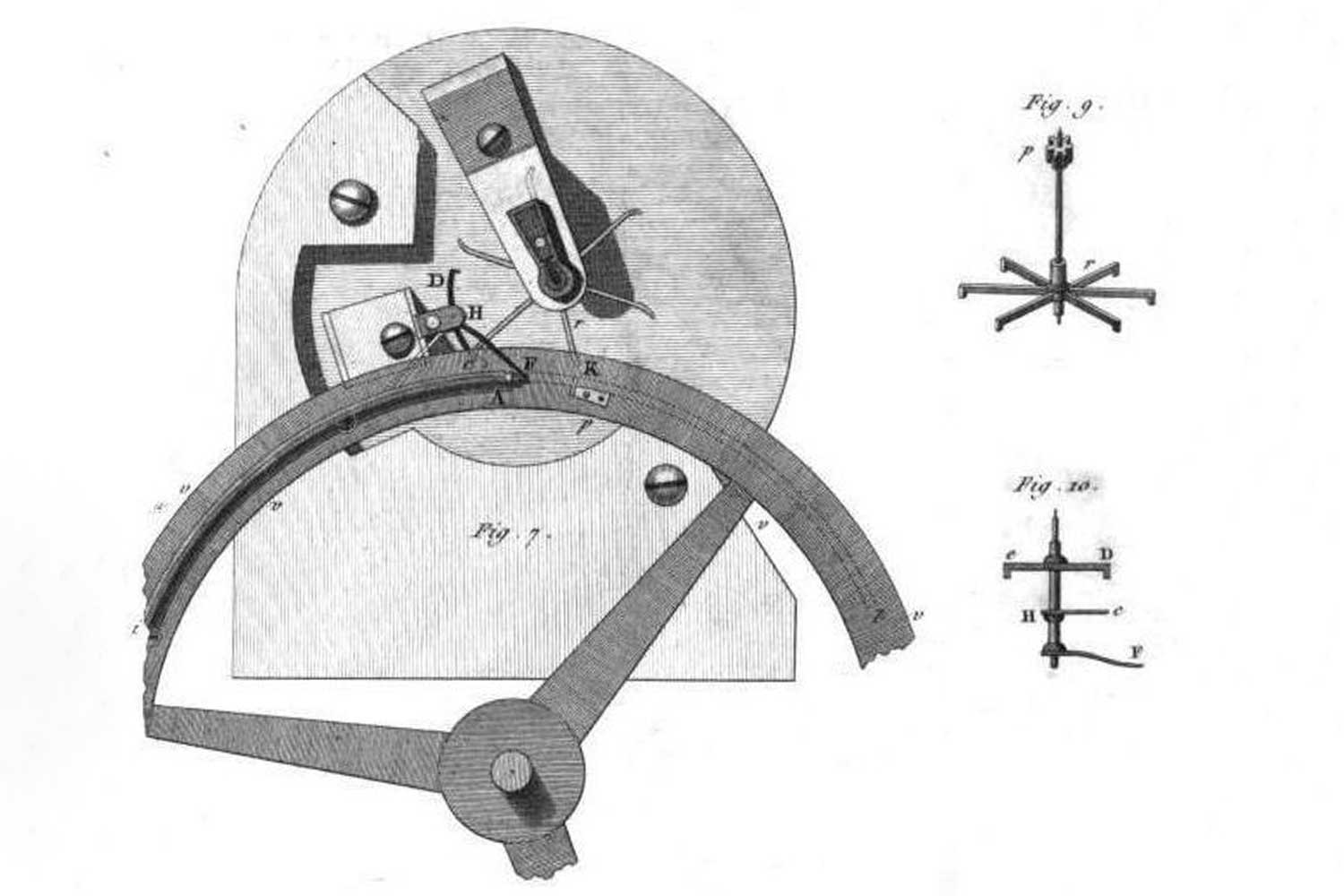
Figure 7. Pierre LeRoy’s Detent Escapement (Image: Wikipedia)
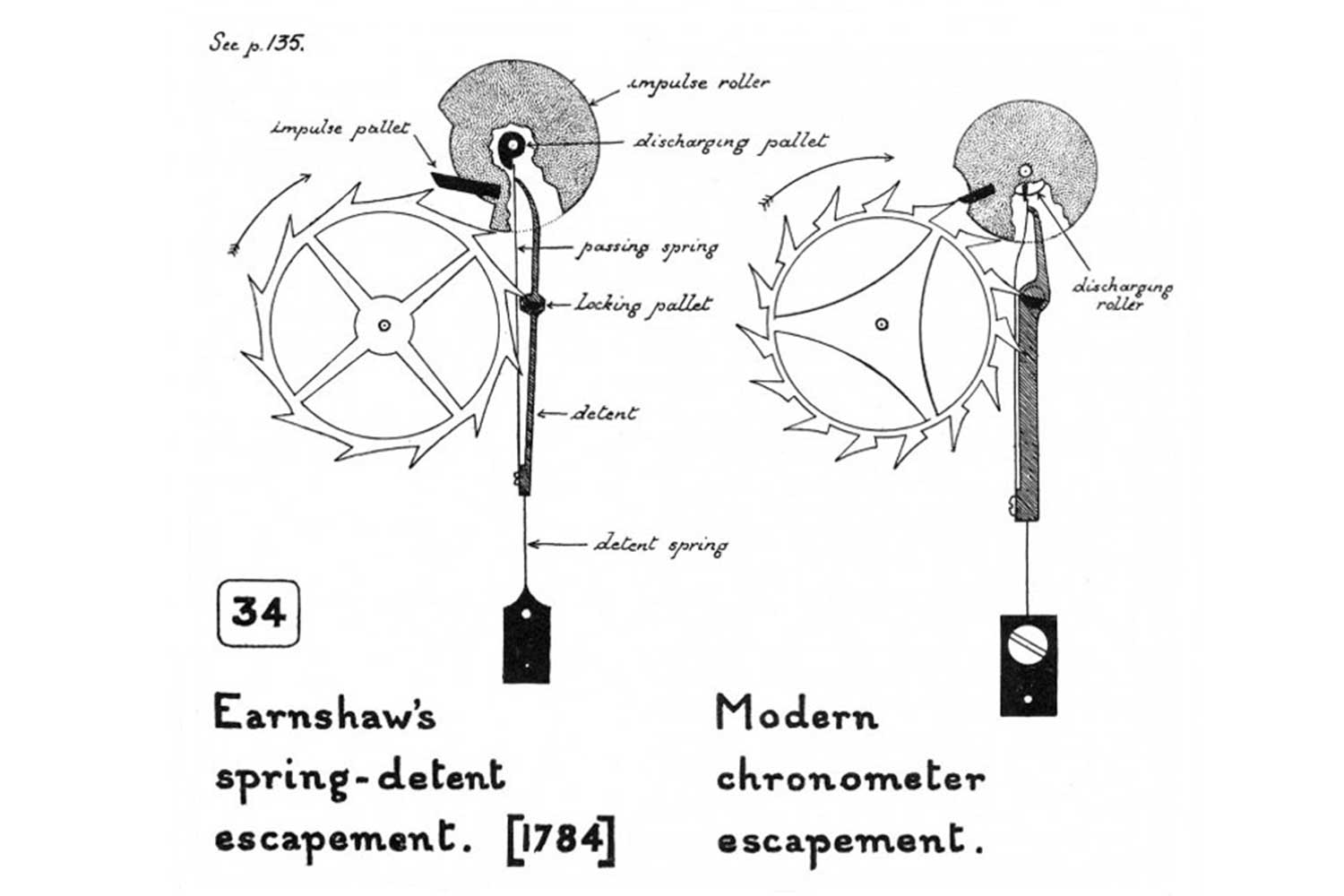
The drawings of detent escapement types (Image taken from ‘The Marine Chronometer: Its History and Development’ by R.T. Gould)
Cut to earlier this year in May, there I was, leafing bucolically through the auction catalog for the Phillips XXIII sale in Geneva amid my morning ablutions, when I encountered something I had never heard of in the form of Lot 108: a triple-detent escapement. “What the hell? Am I reading this correctly?” The object on the page was a pocket chronometer made in Le Locle, Switzerland, around 1860, by a watchmaker named Louis JeanRichard.
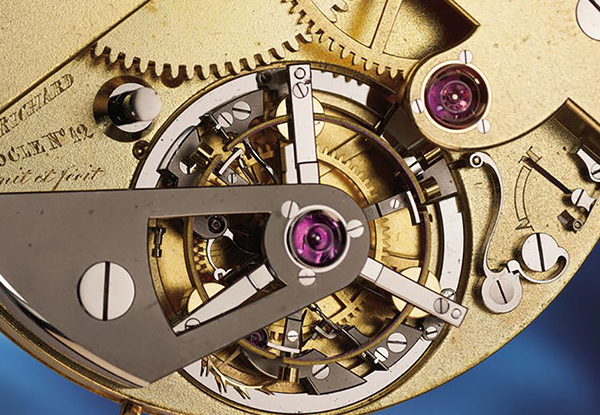
The watch, 56mm in diameter in an 18K yellow gold case, bore on its movement the engraving “Invenit et Fecit” — invented and made — the same declaration that John Arnold had written on the first timekeeper he ever called a chronometer. The movement contained a tourbillon with a one-minute rotation, a three-arm bi-metallic compensation balance with gold timing screws, a helical balance spring in the Arnold tradition and 14 large ruby jewels. It had been accompanied, since at least 1990, by a detailed technical report on Richard and his mechanisms, and by the eighth issue of the Revue Française de l’Horlogerie Ancienne. It had formerly been owned by Harlow Shapley, Director of the Harvard College Observatory and Emeritus Professor of Astronomy at Harvard — and clearly a watch collecting badass — which is, for reasons I will explain later, a provenance of uncommon poetry. Phillips had estimated it at CHF 100,000 to CHF 200,000. But it was the technical description that hit me like a high-speed horological freight train.
-
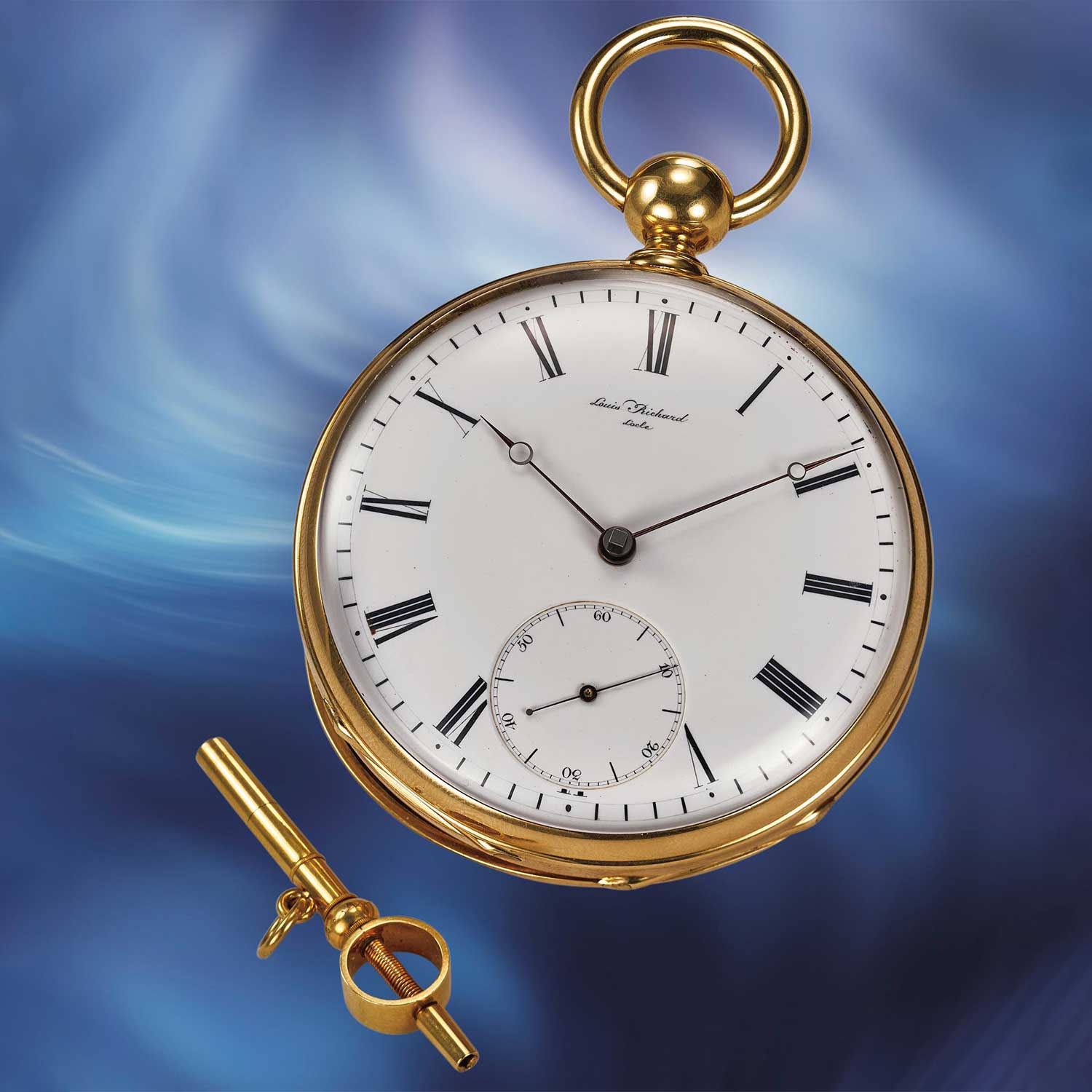
- Lot 108: Louis Richard “Triple Detent Constant Force One Minute Tourbillon Chronometer” (Image: Phillips)
-
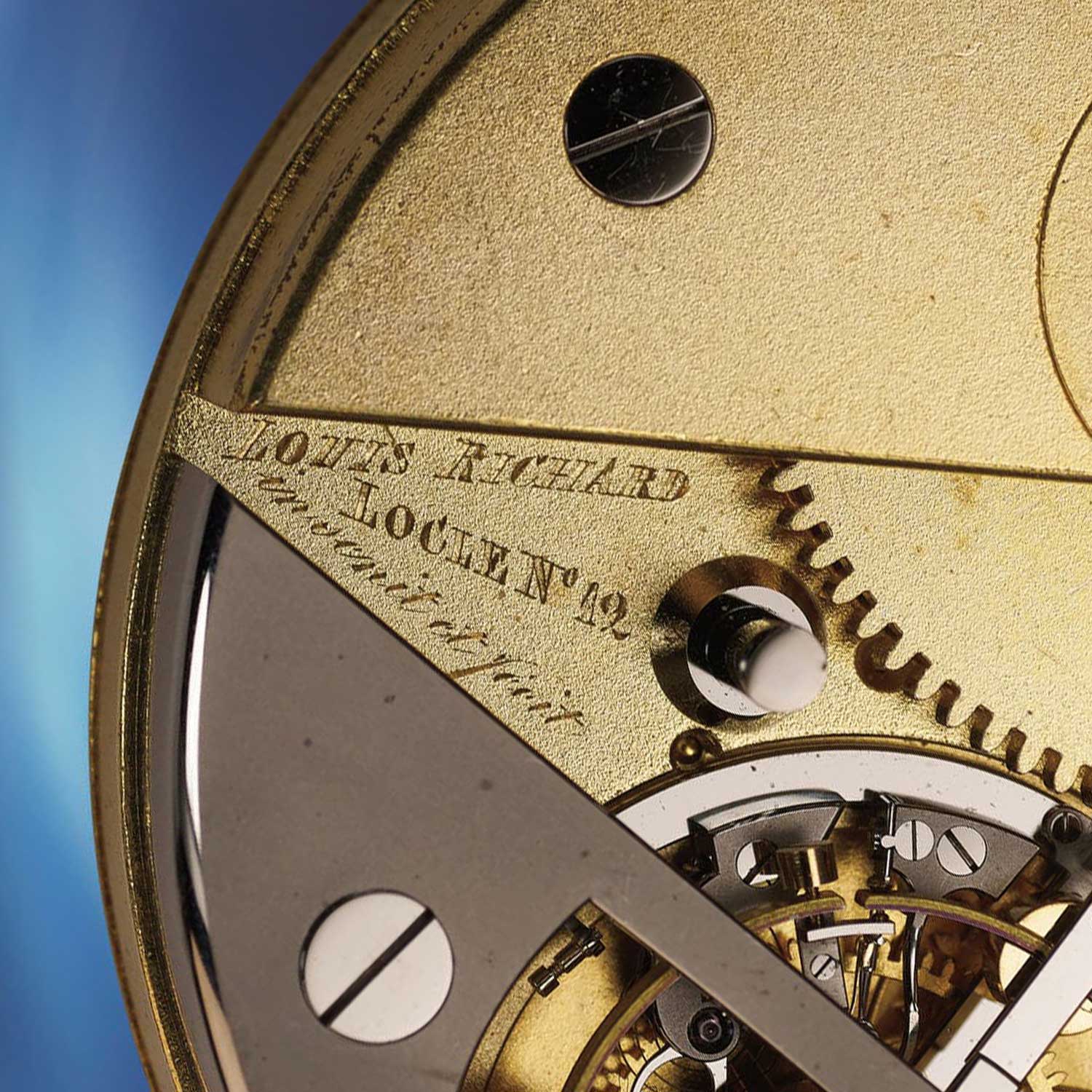
- The engraving “Invenit et Fecit” on the movement — invented and made — the same declaration that John Arnold had written on the first timekeeper he ever called a chronometer (Image: Phillips)
Now cue Richard Strauss’ Also sprach Zarathustra, because this was the moment of revelation. The tourbillon carriage incorporated Louis JeanRichard’s patented triple detent. Let us rewind and replay that.
A triple-detent escapement — which I would learn meant three separate detents for rest, impulse and disengagement. Just as incredible was that it had a remontoir function built into the escapement. The escape wheel rewinds the spiral after each impulse, and the spiral drives the pivoted detent to give the next impulse to the balance. The balance thus receives a consistent impulse even as mainspring torque falls. Phillips’ catalog described Lot 108 as the only known timepiece in the history of watchmaking to combine a triple-detent escapement, a spring remontoir and a tourbillon.
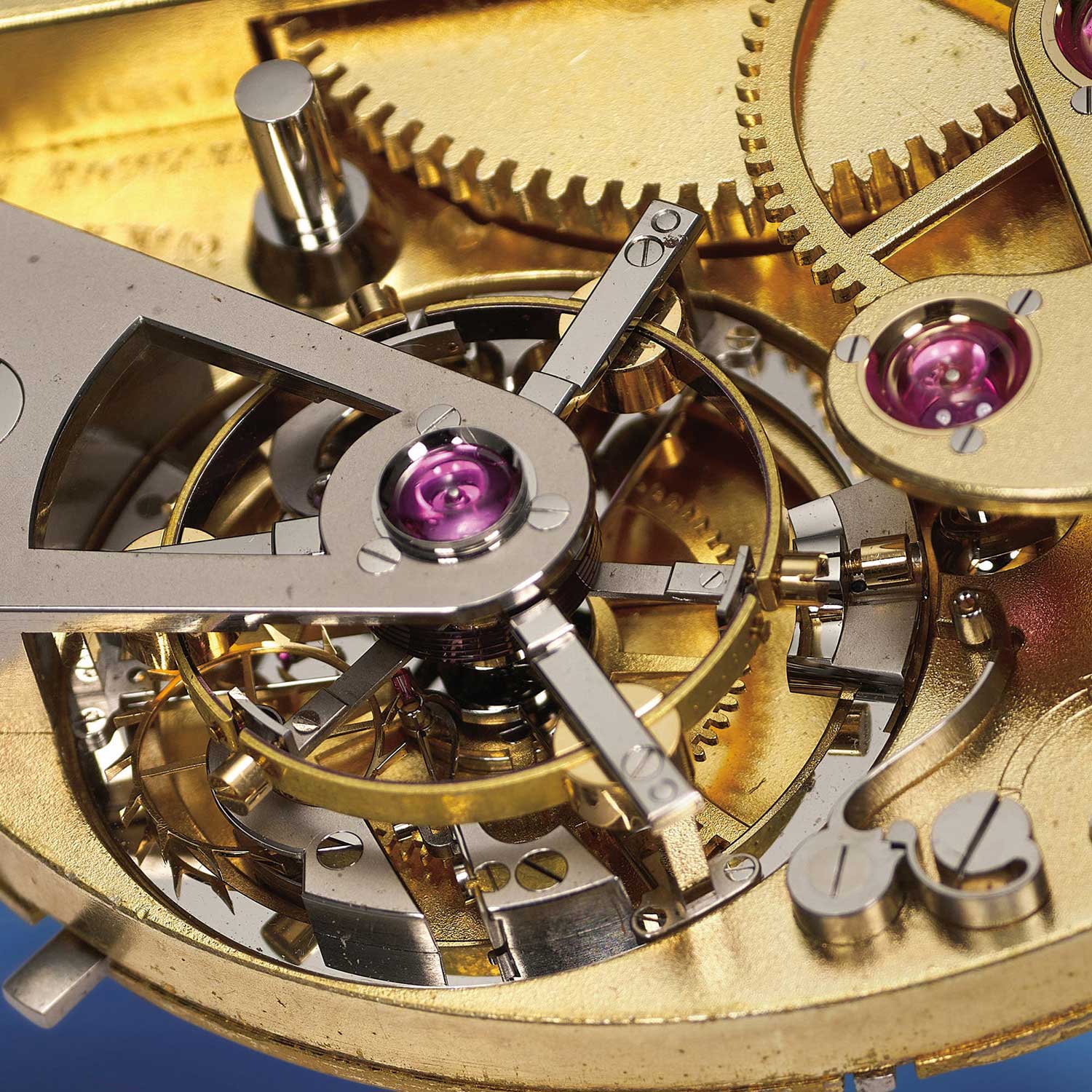
Lot 108: Louis Richard “Triple Detent Constant Force One Minute Tourbillon Chronometer” (Image: Phillips)
The bidding opened and then went ballistic. When the hammer finally fell, the Louis JeanRichard Triple-Detent Tourbillon Chronometer had sold for CHF 3,968,000 — a world record for a pocket chronometer, achieved in what became the highest-grossing watch auction in history at CHF 74.8 million in total. I found myself reaching for my notebook and writing the name “Louis JeanRichard” in the biggest of big-ass letters.
I wanted to know who this man was. I wanted to know where this mechanism had come from and why it existed in only one example. Following that thread back, I ended up going through the entire history of the JeanRichard family — a name I knew from the modern watch brand but had never investigated properly. I found, to my considerable surprise, that there was almost no serious long-form account of this family available in English. A defunct brand website. A few paragraphs in auction catalogs. Some encyclopedia entries, none of them substantial. For a family that produced both the organizational innovation that made Swiss watchmaking industrially possible and one of the most technically audacious pocket chronometers in the history of the craft, the JeanRichards have been remarkably under-served by horological literature. And so that motivated me to go back to the beginning of the story — which starts not with Louis but with his grandfather Daniel JeanRichard.
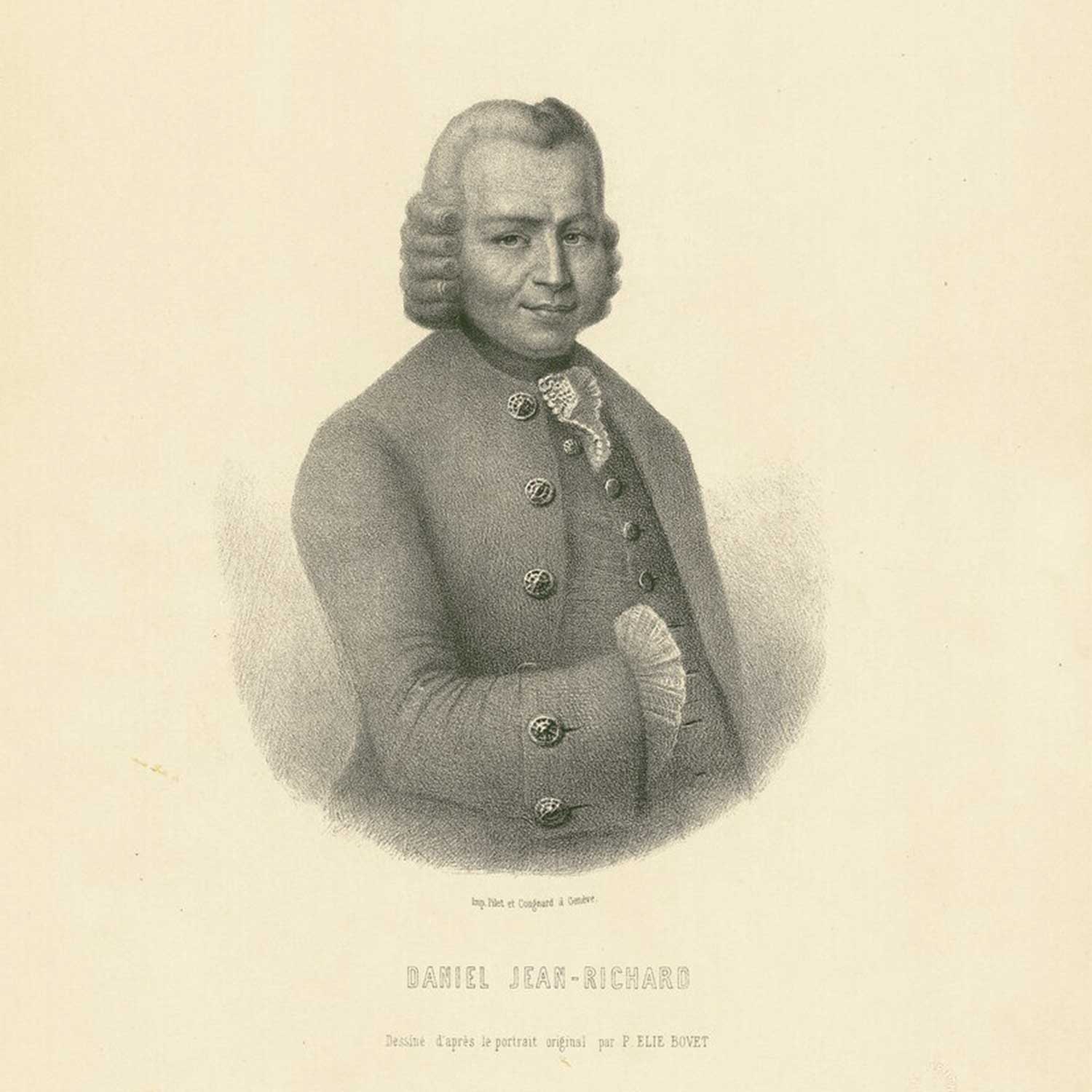
Portrait of Daniel JeanRichard, circa 1830 (Image: Wikimedia Common)
There is a mountain range in the western part of Switzerland that does not look, at first acquaintance, like the birthplace of anything. The Jura — that long limestone spine running northeast from Geneva toward Basel, its slopes covered in fir forest, its valleys isolated by deep snow for five months of every year — was, in the 17th century, one of the poorer and more agriculturally marginal regions of the Swiss Confederation. Living there was a challenge accepted only by the most hardcore Protestant farmers descended from Huguenots, who had force-marched here from France after the Edict of Fontainebleau. The soil was thin. The winters were long. The farmers who worked the land during the brief warm months had no obvious occupation during the cold ones. What they had, in abundance, was time, patience, and hands that had learned precision from generations of working with limited materials in demanding conditions. What they lacked was a system — a way of organizing those hands into something that could compete with the established workshops of Geneva, where the watchmakers’ guilds jealously controlled every aspect of the craft to exclude everyone who was not already inside the walls.
That all changed with a man named Daniel JeanRichard, who set about modernizing the watch industry and uniting its competences through his établissage system — a form of organized division of labor that would become the precursor to the modern manufacture. One hundred and fifty years later, one of the beneficiaries of JeanRichard’s foundational work was his grandson Louis JeanRichard, who around 1860 created a watch so mechanically ambitious that it is believed to be the only one of its kind in the entire history of watchmaking — a mechanism of such extraordinary complexity that it just set a world record for the highest price paid for a pocket chronometer. This is the story of the family and the watchmaking tradition it helped to create.
Daniel JeanRichard and the Legend of the English Watch
Around 1679 — the precise year varies by source, as does almost every detail of Daniel JeanRichard’s early biography — a traveling horse dealer named Péter passed through the village of La Sagne in the Neuchâtel Jura with a damaged English pocket watch. He left it for repair with the JeanRichard household. The story goes that the young Daniel, who had never seen such an object, took it apart, made drawings of every component, studied its mechanism, reassembled it and then — in the version of the legend that later chroniclers liked best — proceeded to build a working replica from scratch using tools he invented as he went, completing it within a year and a half. His neighbors, astonished, began placing orders. An industry was born.
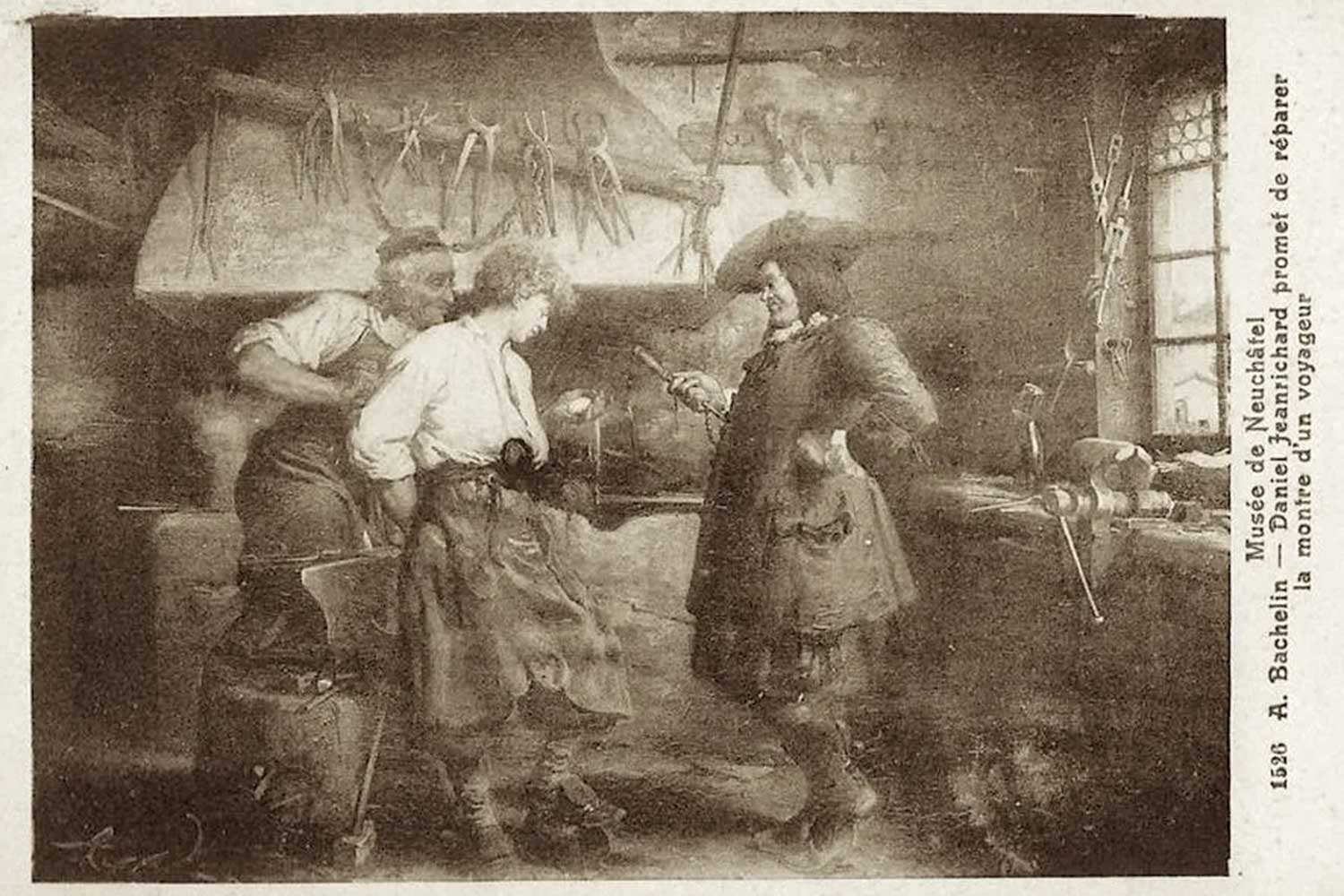
A classic postcard depicting Daniel JeanRichard examining a visitor’s English watch (Image: Grail Watch)
Historians caution us, rightly, to treat this as myth. Daniel’s birth year is disputed — 1665 or 1672, depending on the source — which means he was either seven or 14 when the horse trader arrived, the later age perhaps better suited for the prodigy the legend requires. Estate inventories from Le Locle in the 1660s record pocket watches alongside clocks and hourglasses, so the object was not quite the miraculous novelty of the story, though it was certainly rare. The earliest written version appears in a 1766 topographical description by the pastor Frédéric Samuel Ostervald, nearly a century after the events it describes — long enough for a useful story to become a true one in the memory of a community.
What is not disputed, and what matters more than the legend, is who Daniel JeanRichard actually was and what he actually did. To understand that properly, you need to begin one generation earlier — with his father David, a figure consistently treated as mere backstory who deserves rather more than that.
David JeanRichard was a master gunsmith and clockmaker of considerable skill, active in Neuchâtel, documented as a repairer of tower clocks, a producer of firearms and a designer of machinery for silk weaving. He was a precision mechanician of the first order — a man who worked at the intersection of metalwork, mechanism and measurement, who understood tolerances and tools and the specific demands of objects that must perform reliably under use. The household into which Daniel was born was not a farming household that happened to pick up a watch. It was a workshop already operating at a high level of mechanical sophistication. It is for this reason that the traveler undoubtedly left his English pocket watch there. The name JeanRichard — a curious compound arising, the sources tell us, because one ancestor bore the Christian name Jean which was carried forward as a double surname through subsequent generations — was already associated with mechanical competence before Daniel ever took a watch apart.
What David produced was not a self-taught prodigy working in isolation but a son with exceptional natural ability, trained from childhood in a workshop that was already one of the most technically advanced in the Jura. This matters because it positions Daniel’s achievement correctly: not as the miraculous emergence of genius from nothing — as much as we love those kinds of stories — but as the transformation of an existing mechanical tradition into something entirely new. He took what his father had taught him — the handling of metal, the tolerance of precision, the vocabulary of mechanism — and applied it to a craft then confined to guild workshops in Geneva, and he made that craft portable, distributable and open. By 1692, Daniel was named a master clockmaker. By 1703, a formal apprenticeship contract called him “honorable and expert Sir Daniel JeanRichard, master maker of pocket watches.” He spent time in La Neuveville, a town with connections to Geneva artisans, where he absorbed the techniques of small-scale watch and case production. He returned to Le Locle carrying those techniques back to the mountains. And then he did something that no guild master in Geneva would have done, and that changed the history of the industry.
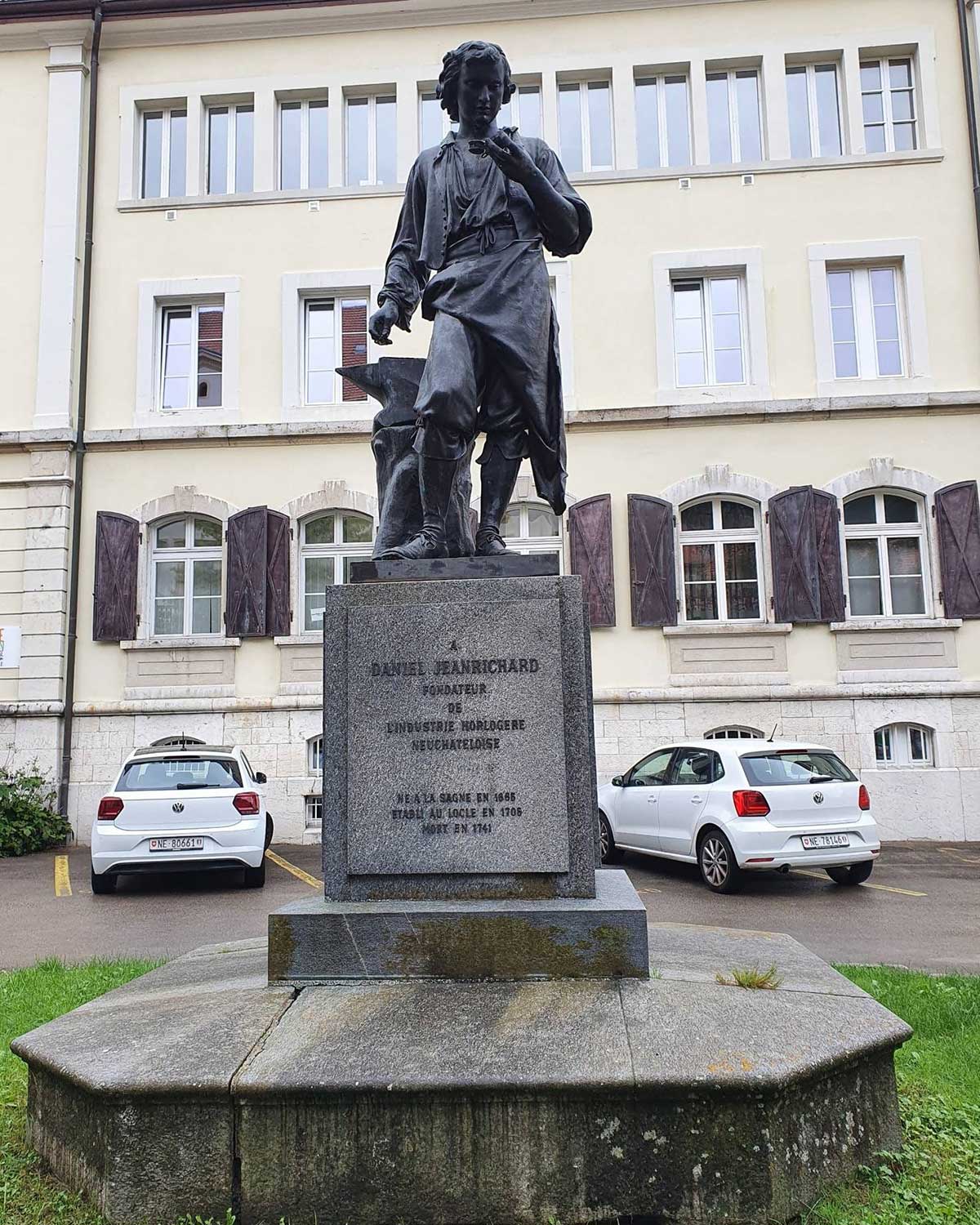
The statue of Daniel JeanRichard in the center of Le Locle
He shared everything he knew. Not with a few carefully selected apprentices under iron-clad contracts, as the Genevan guild system required, but with the farmers and craftsmen of the Jura valleys — openly, systematically and with the explicit goal of spreading the work as widely as possible. His influence reached men like Brandt, Courvoisier, Perrelet, Jaquet-Droz and Robert — names that would become central to Swiss watchmaking for the next two centuries. He designed and improved tools that allowed less skilled workers to produce high-quality components to consistent tolerances. And he organized the production of watches around a principle that was, for the time, genuinely radical: the division of labor.
The Établissage System: How a Mountain Became an Industry
The system Daniel JeanRichard helped establish — and which his apprentices spread throughout the Jura over the following decades — was called établissage, and it is worth understanding precisely what it was, because it is the organizational innovation that made Swiss watchmaking possible at industrial scale and, in some ways, more remarkable than anything a single watchmaker working alone ever produced.
In the Geneva guild system, a watch was made by a small number of highly skilled master craftsmen who controlled every stage of production from raw material to finished movement. This produced exceptional quality but at exceptional cost, and deliberately so: the guilds existed to protect the economic position of those masters, and restriction of supply was their primary tool. The établissage system inverted this logic entirely. An établisseur — the person who coordinated the operation — distributed the production of a watch’s components across a network of specialized workers, each making one type of part and nothing else. A farmer who spent the summer growing rye spent the winter making balance wheels. His neighbor made mainspring barrels. Another made escape wheels. Another made pinions. Another made watch cases. The work came to them; they did not come to the work. The établisseur collected the components, arranged their assembly by a master watchmaker and sold the finished watch.
The economic logic was irresistible. Specialization produced skill, and skill produced quality. A balance wheel maker who made thousands of balance wheels became extraordinarily good at making balance wheels — better, in that specific operation, than a generalist craftsman who made them occasionally as one step among many. The Jura farmers took to it with the enthusiasm of people who previously had nothing useful to do for five months of every year. By the time of JeanRichard’s death in 1741, there were several hundred watchmakers in and around Le Locle and La Chaux-de-Fonds. The new system had given birth to more than a hundred specialist professions — chain smiths, axle makers, hinge makers, escapement adjusters, makers of pinions, gongs, keys and assorted watch parts — most of which survive in some form to the present day. By 1850, Switzerland was producing approximately 2.2 million watches a year. The Jura had become the watchmaking capital of the world, and Daniel JeanRichard’s établissage system was the reason.
It is worth pausing to appreciate what JeanRichard had defied in creating this. The Genevan guild of watchmakers was not merely a professional association. It was a legal and economic power structure with the authority to control apprenticeships, restrict tools, enforce contracts and suppress competition — designed, with considerable deliberate ingenuity, to keep watch production low, quality artificially controlled, and prices high enough to exclude everyone not already inside its walls. JeanRichard’s achievement was not just technical. It was systemic: he created an alternative structure that was more efficient, more inclusive, and ultimately more powerful than the one it replaced, armed only with knowledge he was willing to share and a network of mountain farmers who were willing to learn.
The next generation of Jura watchmakers that JeanRichard’s system produced included Abraham-Louis Perrelet, born in Le Locle in 1729, inventor of the self-winding watch and the first watchmaker in Le Locle to produce cylinder, duplex escapements. The établissage system also spread south into the Vallée de Joux. The seed JeanRichard sowed in the thin soil of the Jura’s highlands bore fruit across two centuries and three countries. He is remembered with a statue in the center of Le Locle, apron askew, examining a watch. A modest monument for a man who reorganized an industry.
Louis Jean Richard: The Observatory in the Workshop
One hundred and seven years after Daniel JeanRichard opened his workshop near Le Locle, his grandson was born in the same town. Louis JeanRichard arrived in 1812 into a watchmaking tradition that Daniel had done more than anyone to create, and he proceeded to push it to its absolute technical limit.
He was, from the beginning, a man possessed by a single idea: absolute accuracy. Not the accuracy that satisfies a customer or passes a certification trial, but accuracy measured against the movement of the stars. As a young man, Louis acquired astronomical instruments in Paris and set them up in his workshop, regulating his chronometers not by any reference clock or rating certificate but by direct celestial observation — by the transit of known stars across the meridian, calculated against published ephemerides, compared to the rate of the instrument in hand. His workshop became, in effect, a private observatory. He installed an ice chamber and a heated oven to test his chronometers across a range of temperatures that no pocket watch would encounter in normal use, but that his instruments needed to master to perform at the standard he set for them.
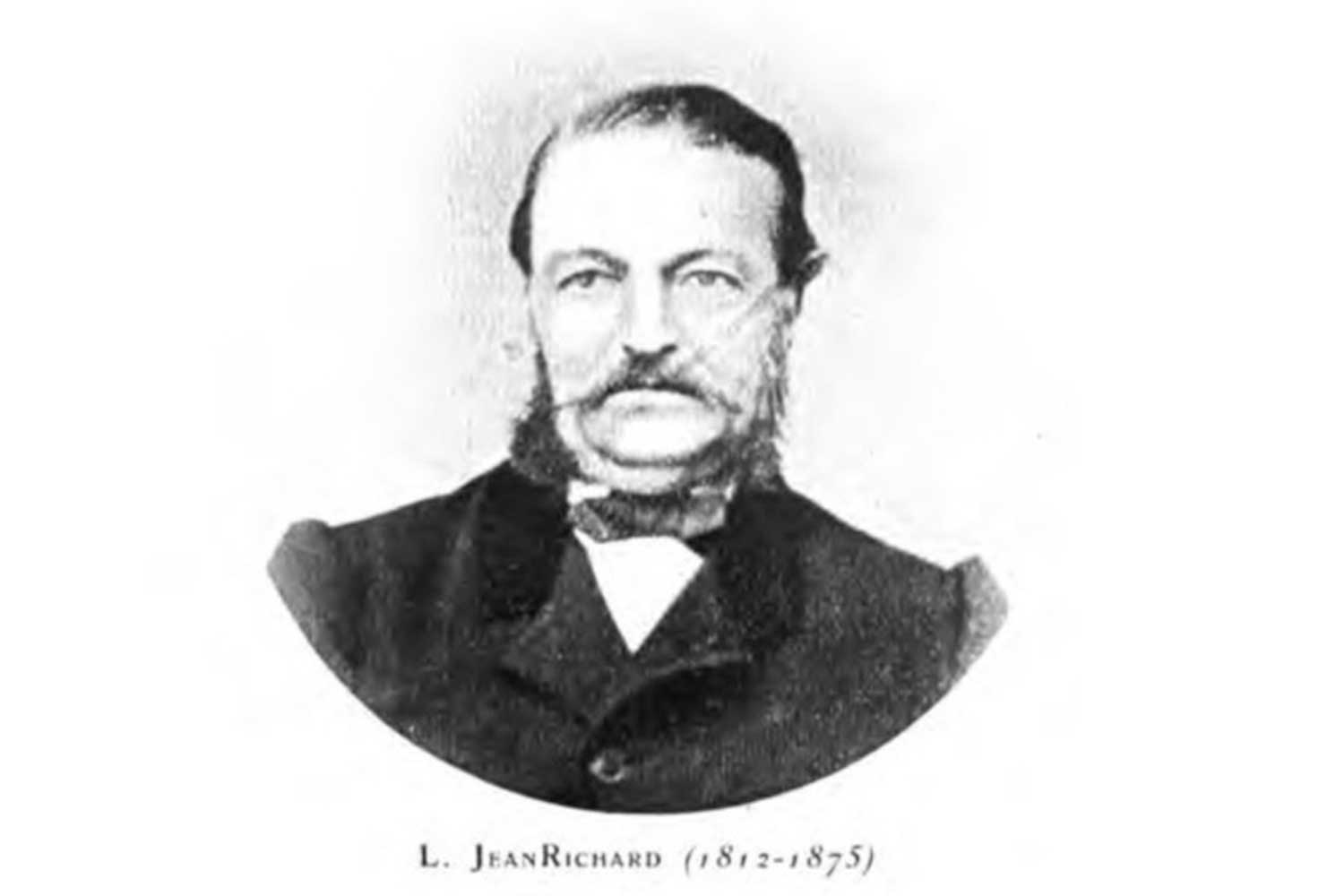
Portrait of Louis Jean Richard
In 1839, he submitted a chronometer with free escapement — by which the Phillips catalog means a detached or detent-type escapement, the specific form of which is documented in the Revue Française de l’Horlogerie Ancienne No. 8 that accompanied the watch — and constant force to the Société d’Émulation of Neuchâtel and received a gold medal for it. The Société d’Émulation was a serious organization that judged instruments against rigorous performance standards. A gold medal in 1839 for a pocket chronometer was not decorative but specific: the instrument had performed at a level that the most knowledgeable horological judges in Neuchâtel considered exceptional. At just age 27, Richard was still young and had decades of further refinement ahead of him.
In 1851, he exhibited a marine chronometer at the Great Exhibition in London’s Crystal Palace and received a Prize Medal. The award placed Richard in the first rank of living chronometer makers. And then he went back to Le Locle and continued working on the problem that had occupied him since the beginning: how to build a portable timekeeper so accurate that its errors, measured against the stars, would be essentially unmeasurable.
The Three Enemies of Precision: Why the Triple-Detent Tourbillon Exists
To understand what Louis built in around 1860, you must first understand the three problems that every serious 19th-century chronometer maker was attempting to solve simultaneously, because his Triple-Detent Tourbillon with remontoir is not a single invention. It is a synthesis of three separate solutions to three separate problems, combined in a single movement with an integration so complete that each solution reinforces and enables the others. The three problems are: the inconsistency of the mainspring, the positional errors of the balance and the mechanical interference of the escapement itself.
The first problem — the mainspring — is the oldest and most fundamental. A mechanical watch is powered by a coiled ribbon of steel that stores energy when wound and releases it as it unwinds. The physics are inexorable: a fully wound mainspring exerts more force than one half unwound, which exerts more than one nearly spent. The torque delivered to the escapement is not constant. It varies continuously from the moment the watch is wound to the moment it stops. A balance receiving varying torque will not oscillate at a perfectly constant amplitude, and a balance that does not oscillate at constant amplitude will not keep a perfectly constant rate. The chain and fusée — used by John Arnold in his marine chronometers — equalized the torque mechanically. The constant-force mechanism, or remontoir, solved it differently: by interposing a small secondary spring between the mainspring and the escapement, wound repeatedly at fixed intervals by the mainspring, always to the same tension, always delivering the same torque. The escapement saw only the constant, controlled output of the remontoir spring, as steady as a ticking clock.
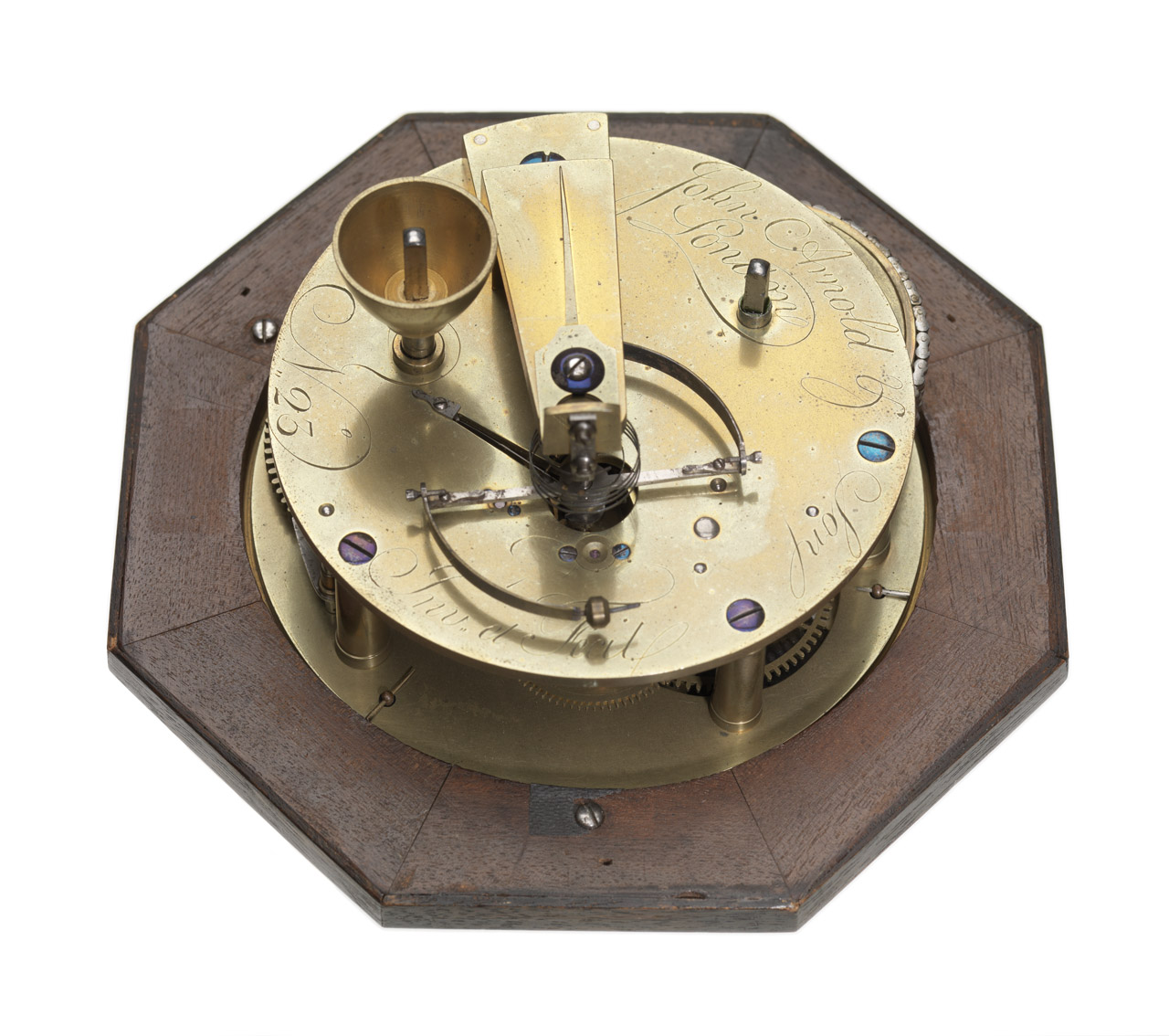
A John Arnold marine chronometer circa 1784 with a chain-and-fusee drive, which converts the fading pull of an unwinding mainspring into steady power (Image: Royal Museums Greenwich)
The second problem — positional error — is the one that Breguet addressed with the tourbillon. The balance wheel and hairspring of a pocket watch are sensitive to gravity. When the watch lies flat, the balance oscillates in a horizontal plane and gravity acts uniformly, and the errors cancel. In any other position — hanging vertically in a waistcoat pocket, or tilted at an angle in a traveling case — the balance oscillates partly against gravity and partly with it, introducing a systematic rate error that varies with position. Breguet’s solution, patented in 1801 and first commercially produced in 1805, was to mount the entire escapement in a rotating cage completing one revolution per minute. As the cage rotated, the positional errors accumulated in one orientation were cancelled by those of the opposite orientation, and the average error approached zero. The tourbillon did not eliminate positional error. It averaged it out of existence. It was, and remains, one of the most brilliant mechanical arguments ever made.
The third problem — escapement interference — is the subtlest and perhaps the most technically interesting. Every escapement must touch the balance: it must deliver an impulse to maintain the balance’s oscillation, and it must lock and unlock the escape wheel in synchrony with the balance’s swing. Every contact is a disturbance. The lever escapement, the mechanism in almost every mechanical watch made today, contacts the balance twice per oscillation. The detent escapement, developed for marine chronometers by Pierre Le Roy and refined by John Arnold and Thomas Earnshaw, contacts the balance only once per complete oscillation: less interference, less energy stolen, less rate disturbance per unit time. But the standard detent — whether pivoted as in the French tradition, or spring-mounted as in the English one — uses a single detent performing two functions simultaneously: locking the escape wheel and receiving the unlocking signal from the balance. Hence, the locking must be firm enough to hold the escape wheel against any disturbance; the unlocking must be light enough not to disturb the balance.
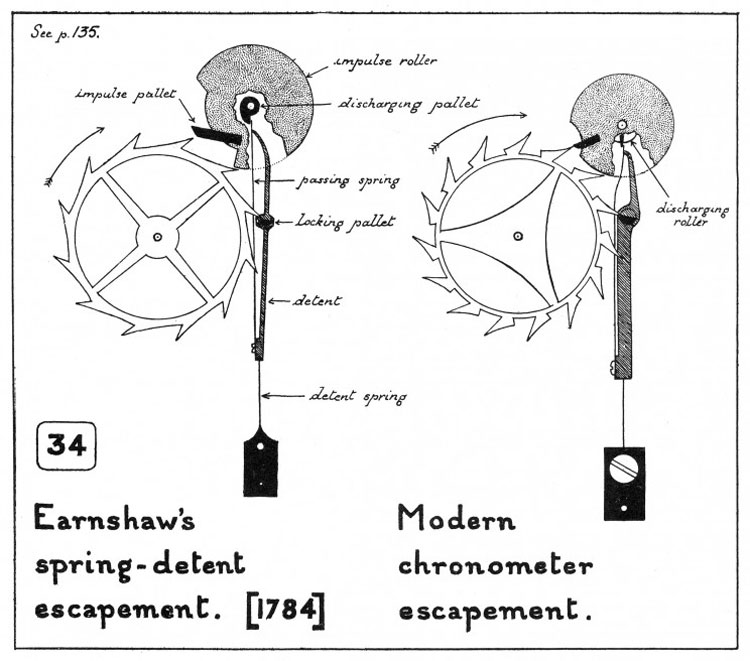
Drawing of a detent escapementfrom “The Marine Chronometer, its history and development” by Rupert Gould (London, 1923)
Louis Richard’s answer was the triple-detent constant-force escapement. The escape wheel rewound a spiral spring to the same position after every impulse. As the mainspring ran down, this kept both the resistance the balance encountered at unlocking and the strength of the impulse it received more consistent. That it appeared in a pocket chronometer made in Le Locle by the grandson of the man who taught farmers to make watch parts is the kind of historical irony that the Jura mountains seem to produce with some regularity.
The Triple Detent: Three Functions, Three Components, One Perfect Cycle
To understand the triple-detent escapement, you must first understand the standard detent chronometer escapement, because Richard’s innovation is best grasped as a systematic solution to the specific limitations of what came before it.
In the standard spring-detent escapement of the Arnold-Earnshaw tradition, a single locking piece — mounted on a flat steel blade spring fixed to the movement plate — performs the following cycle on every oscillation of the balance. The escape wheel is locked: one of its teeth rests against the locking pallet of the detent, holding the wheel stationary. The balance swings in the impulse direction. A small discharging pallet on the balance staff contacts a gold passing spring on the detent, which deflects the detent and releases the locked escape wheel tooth. As the wheel turns, another tooth delivers the impulse to the balance, maintaining its oscillation. The detent springs back. The escape wheel advances exactly one tooth and is locked again. The balance swings through its supplementary arc and returns. On the return swing, the discharging pallet merely deflects the gold passing spring without moving the detent — the one-way trapdoor function that is the Arnold escapement’s most elegant feature — and the cycle begins again. The entire sequence involves one detent performing three roles: locking, receiving the unlock signal and springing back to relock. This is mechanically efficient but introduces a fundamental compromise: the detent spring must return the locking pallet promptly enough to catch the next tooth, while offering as little resistance as possible when the balance unlocks it
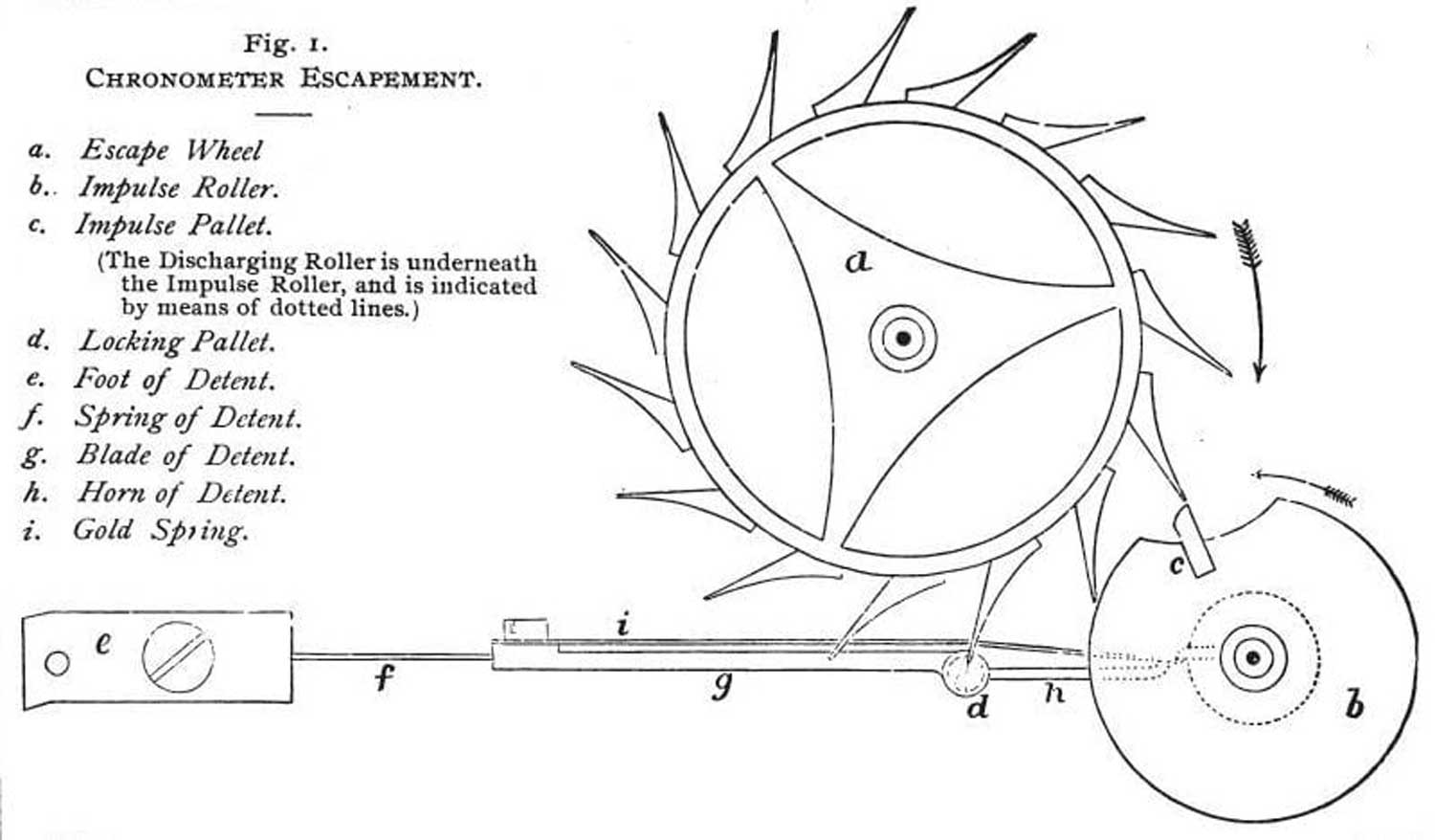
The Earnshaw chronometer escapement from ‘Britten’s Watch & Clock Makers Handbook, Dictionary, and Guide’ by F.J. Britten
Richard’s triple detent addresses this compromise by distributing the three functions across three separate components: a rest spring detent, an impulse pivoted detent and a disengagement spring detent.
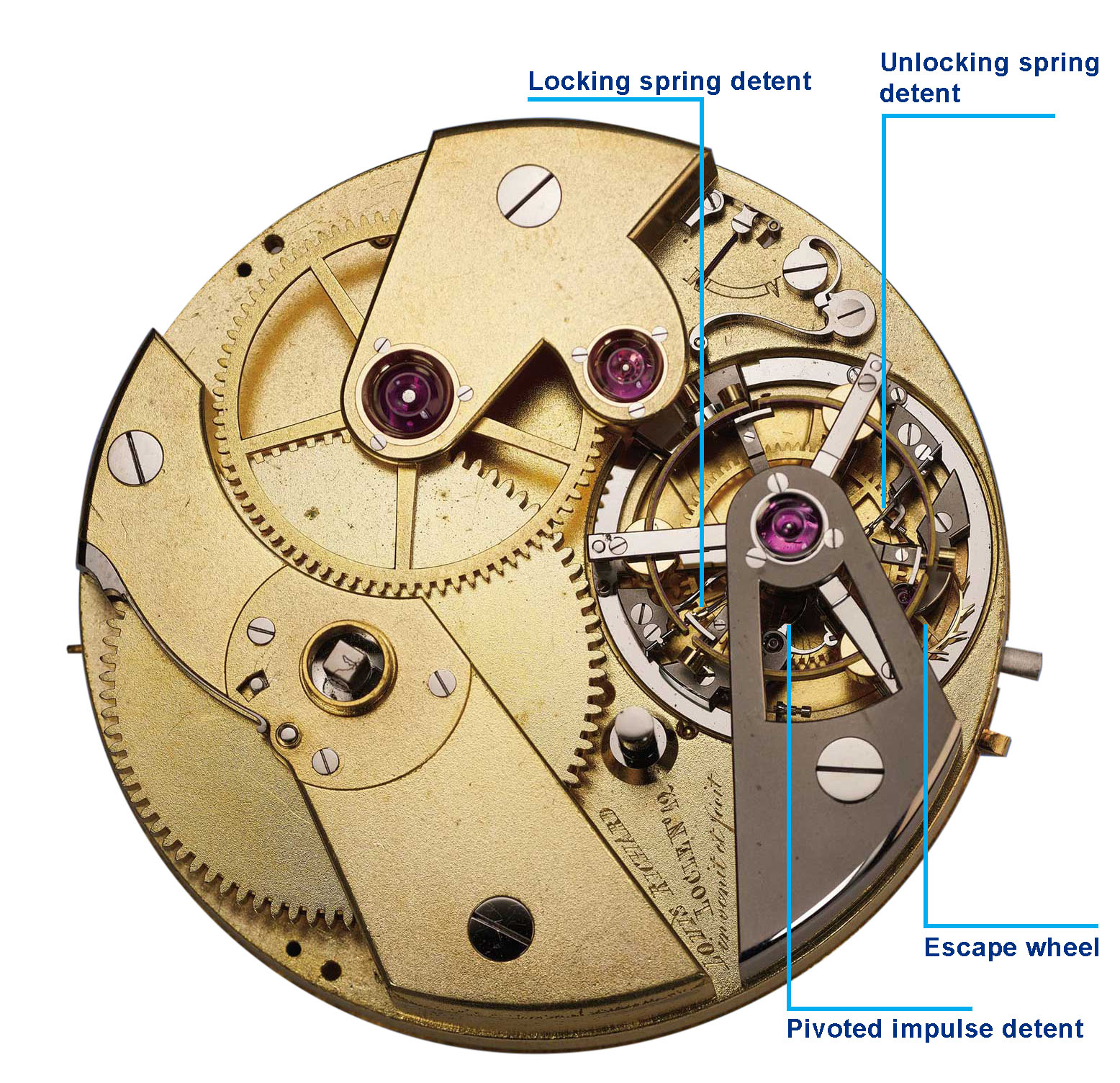
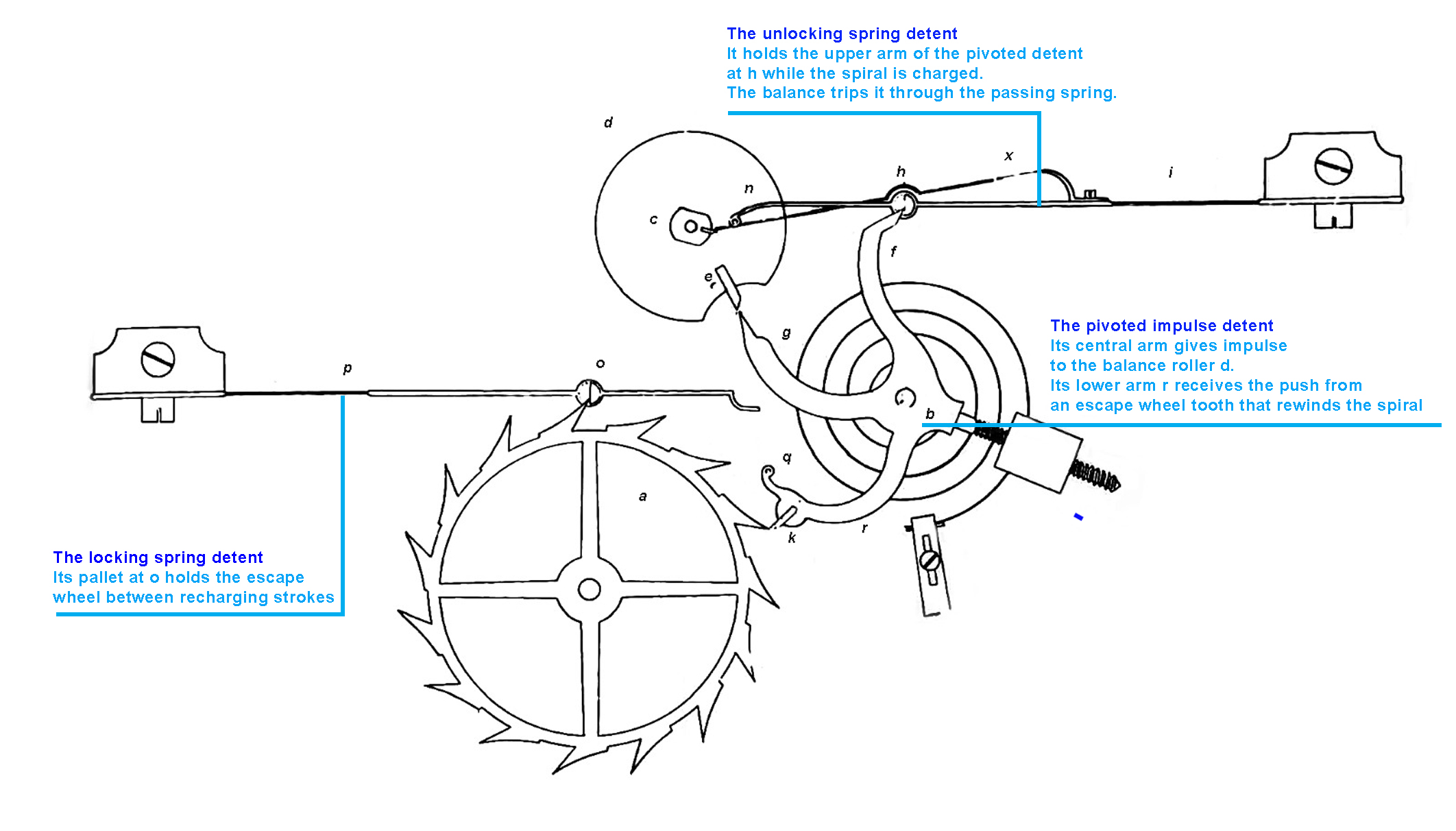
The triple-detent constant-force escapement comprises two spring detents and a three-armed pivoted impulse detent driven by a spiral spring. The escape wheel recharges the spiral spring immediately after every impulse, once per complete oscillation of the balance
At the start of the cycle, both spring detents are engaged. The left-hand detent p holds an escape wheel tooth at o, while the upper detent i catches the upper arm of the three-armed impulse detent at h. This holds the spiral spring around pivot b in its wound state.
As the balance swings in the impulse direction, the unlocking roller c acts through the passing spring x to flex the upper detent i. The catch at h releases the impulse detent, and the spiral spring turns it about b. Its left arm pushes against the impulse pallet on the large balance roller d. Throughout the impulse, the escape wheel remains locked at o.
Only after the impulse finger has cleared the balance pallet does the pivoted detent trip the left-hand detent p. The drawing suggests that the hook q on its lower arm acts on the bent end of p, lifting the locking pallet clear of the escape wheel tooth. The released wheel then advances under power from the going train. One of its teeth pushes against the rearming pallet on the lower arm, turning the impulse detent back and rewinding its spiral. By the end of the stroke, the upper detent has caught the impulse detent again at h, and the left-hand detent has caught the next wheel tooth at o.
On the balance’s return swing, the unlocking roller bends the passing spring aside without releasing the upper detent. The spiral stays wound until the next impulse swing. Because the upper detent catches the impulse detent at the same position each time, the spiral begins each impulse from the same state of wind even as the torque available to rearm it varies.
Richard’s contemporaries, examining his chronometers against the stars, found rate errors so small as to be at the limit of their ability to measure them.
The Movement in Detail: 14 Rubies and a Latch
The movement of the Triple-Detent Tourbillon Chronometer is a document of 19th-century technical achievement at its most uncompromising. The three-arm bi-metallic compensation balance — its cut rim segments of brass and steel adjusting the effective inertia of the wheel with temperature change, the gold timing screws threaded with precision that still impresses those who examine them — is free-sprung and fitted with a helical hairspring in the Arnold tradition. The tourbillon carriage, partially polished and partially matte, carries Richard’s patented triple-detent system together with the pivoted constant-force spiral and 14 large ruby jewels bearing the going train’s friction surfaces. The frosted gilt plates, matte steel bridge and polished steel screws are the visual language of a maker who understood that the quality of a movement’s finish is not decorative but functional: a well-finished surface is a consistent surface, and consistency is the precondition of everything else.
Of particular ingenuity is a detail that reveals the character of the man who made it: the tourbillon frame is secured by a latch linked to a slide lever positioned between 5 and 6 o’clock beneath the hinged front bezel. An additional lever, marked A-M for Arrêt-Marche — stop and go — allows the tooth of the third wheel to be locked, permitting removal of the tourbillon cage for adjustment or servicing without releasing the tension of the mainspring. This means the most delicate component of the most complex mechanism in the watch can be extracted, examined, adjusted and replaced without disturbing the power state of the movement — without losing the winding, without releasing the mainspring’s accumulated energy. It is the provision of a man who intended his chronometer to be not merely admired but used, regulated and maintained at the highest level over its working life. Louis Richard built his instruments to be as serviceable as they were precise.
-
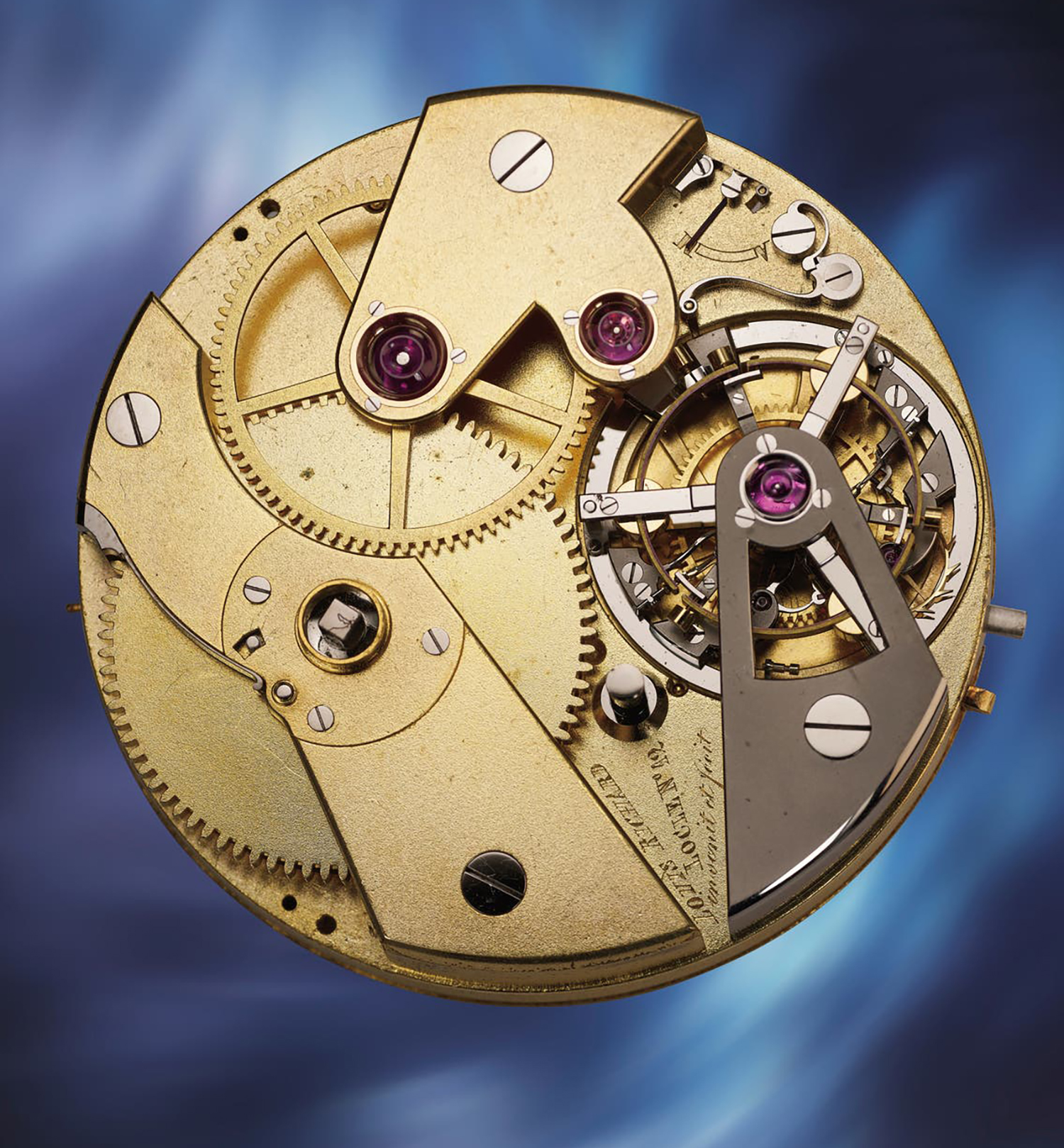
- A screw controls the third-wheel lock. Turned from M (marche) to A (arrêt), it lets a spring-loaded pin engage the teeth of the third wheel on the dial side. With the going train held fast, the watchmaker can remove the tourbillon carriage for adjustment while the mainspring remains wound
-
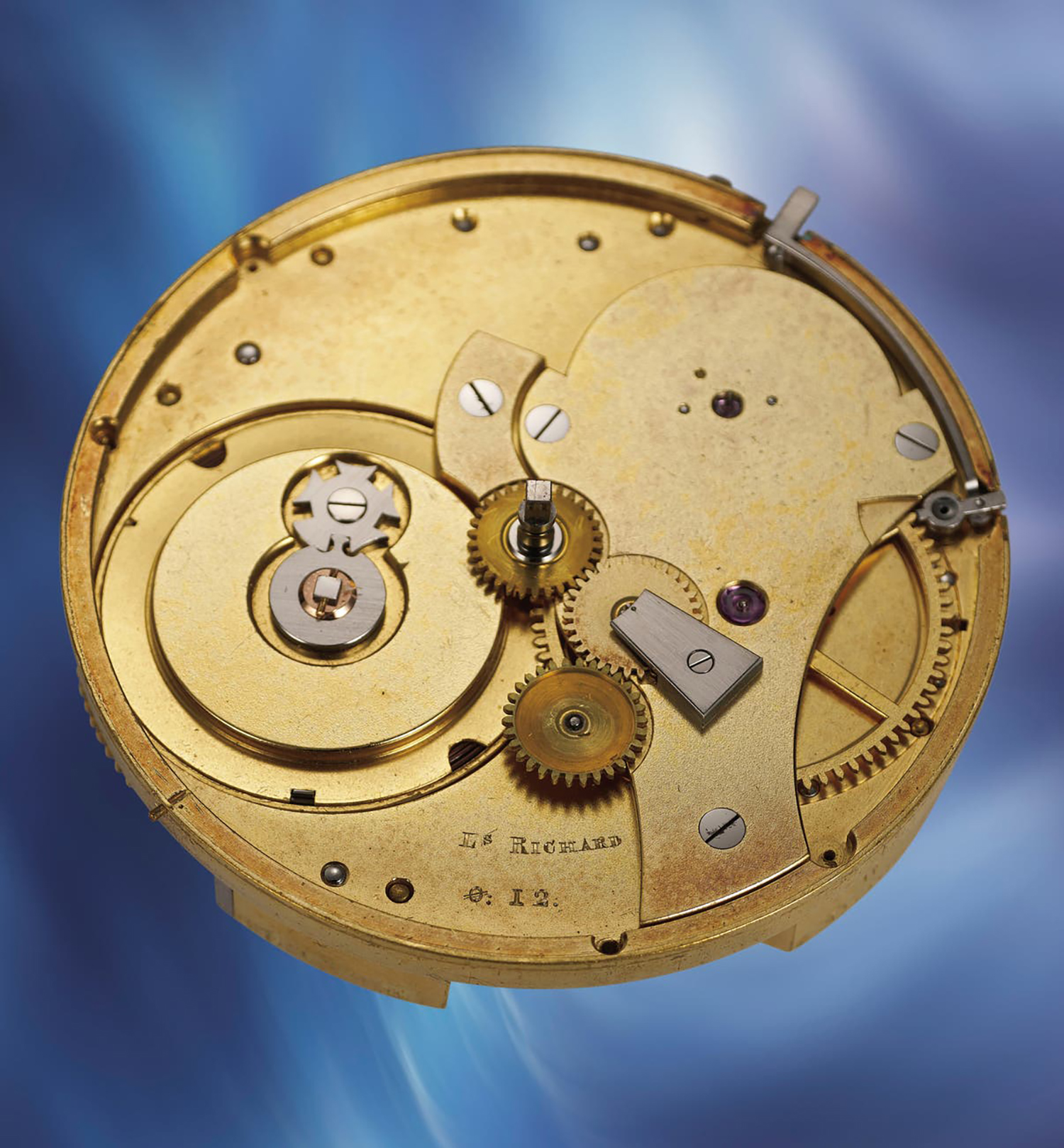
- A separate slide (visible between 2 to 3 o’clock) operates the lever that stops the carriage
The watch is signed on both dial and movement, and the mainplate carries the engraving “Invenit et Fecit” — invented and made — the same declaration that John Arnold wrote on the dial of No. 36, the first timekeeper he called a chronometer. It is a claim of the same order: that the instrument is not a compilation of received solutions but an original act of mechanical reasoning, conceived and realized by the same mind. The claim is justified.
The Astronomer and the Watch: Harlow Shapley and the Object’s Life
A watch of this complexity and originality does not always find its way to the people best equipped to appreciate it. Louis Richard’s Triple-Detent Tourbillon Chronometer has been fortunate in its owners. The most remarkable of them was Harlow Shapley, who owned the watch from some point before its last recorded sale in 1990 and who was, by any measure, an appropriate custodian for an instrument of this kind.
Shapley was born in Nashville, Missouri, in 1885 and died in Boulder, Colorado, in 1972. He served as Director of the Harvard College Observatory from 1921 to 1952 — one of the longest directorships in the observatory’s history — and was the first to create a graduate astronomy program at Harvard. His scientific contributions were foundational: he used Cepheid variable stars to determine the correct position of the Sun within the Milky Way, establishing that the Solar System is not at the galaxy’s center but roughly two-thirds of the way out. In 1953, he proposed the concept of the habitable zone around stars — what we now call the Goldilocks zone — decades before the term was coined. He received the Henry Draper Medal, the Gold Medal of the Royal Astronomical Society, the Bruce Medal and other honorary degrees.
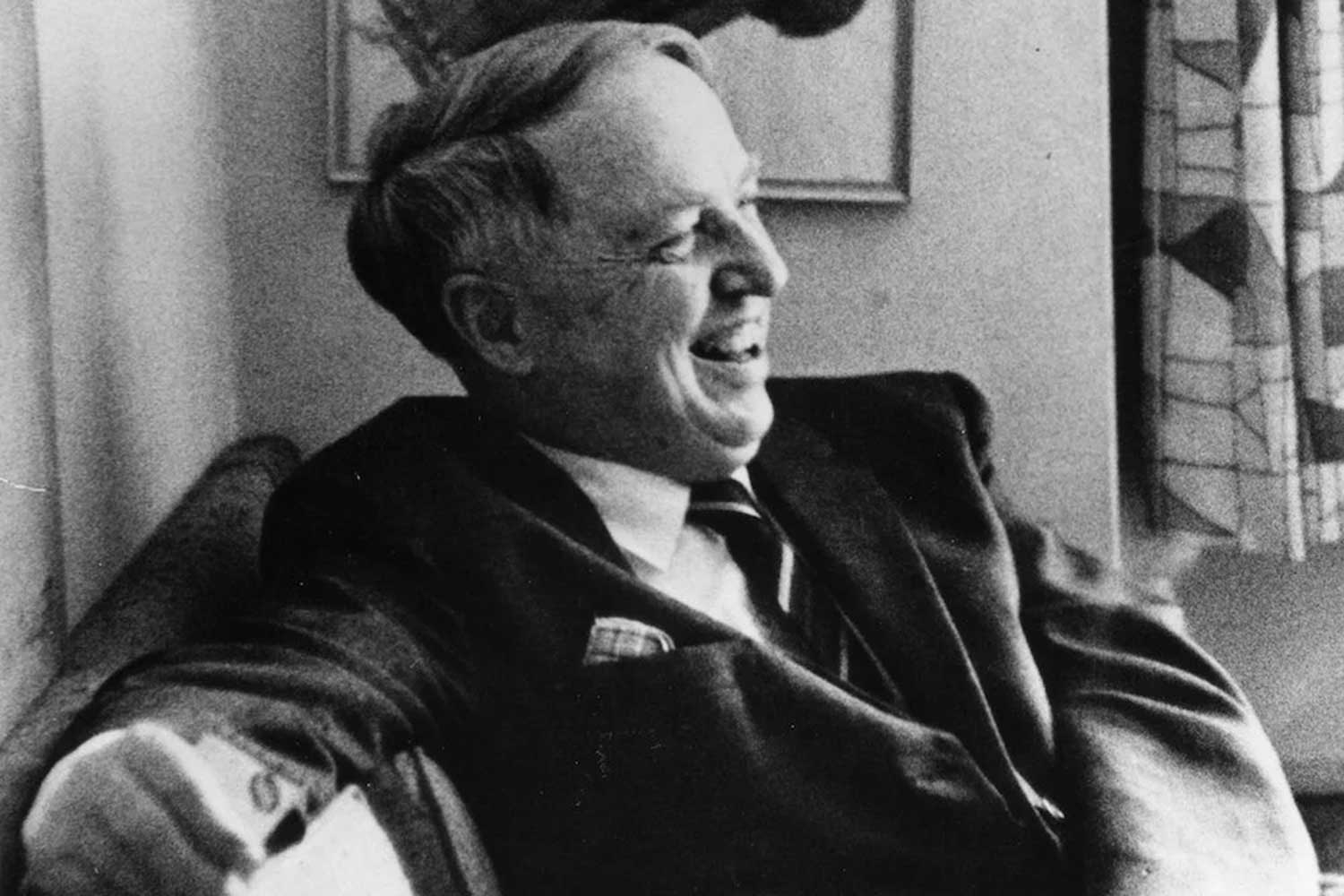
Harlow Shapley (Photo: John Hubley. ESVA Shapley, Harlow B1)
That the man who spent his career measuring the precise positions and distances of stars across the galaxy should own the pocket chronometer of a man who regulated his watches by stellar transit is not merely a biographical coincidence. It is a kind of historical rhyme. Both men — Shapley in his observatory on the hill in Cambridge and Richard in his workshop in Le Locle, with its ice chamber and oven — were engaged in the same fundamental project: the reduction of uncertainty through measurement, the replacement of approximation with precision, the insistence that the world can be known more exactly than it had been known before. The watch passed from a maker who used the stars to regulate time into the hands of a scientist who used time to measure the stars.
It sold in May 2026 at Phillips in Geneva for CHF 3,968,000 — a world record for a pocket chronometer. The Geneva Watch Auction: XXIII achieved CHF 74.8 million in total, the highest-grossing watch auction ever held, with 14 lots surpassing CHF 1 million and 43 world records set. The Louis Richard watch was the third-highest lot of the sale — behind the Patek Philippe Ref. 2523 World Timer at CHF 7,961,000 and F.P. Journe Chronomètre à Résonance “Souscription No. 18” at CHF 4,875,500, and ahead of the Patek Philippe Sky Moon Tourbillon Ref. 6002G at CHF 3,242,000 and Akrivia AK-06 at CHF 3,000,000. Those are the names that define the most serious level of contemporary collecting. Louis Richard’s Triple-Detent Tourbillon Chronometer established its benchmark price, not because of rarity alone, but because a room full of the most informed watch collectors in the world had finally understood what it was. A pocket chronometer from a workshop in Le Locle, made by the grandson of the man who taught Jura farmers to make watch parts, recognized as the most valuable of its kind ever to come to market. It took 160 years. But precision, as Louis Richard understood better than almost anyone, is worth waiting for.
Principal Sources and Further Reading
- Daniels, George. The Art of Breguet. London: Sotheby Parke Bernet, 1975.
- Foskett, Stephen. “Reconsidering the Folklore of Daniel JeanRichard.” Grail Watch, September 26, 2025.
- Gould, Rupert T. The Marine Chronometer: Its History and Development. London: J.D. Potter, 1923.
- Ostervald, Frédéric Samuel. Description des Montagnes et des Vallées Qui Font Partie de la Principauté de Neuchâtel et Valangin. Neuchâtel, 1766.
- Phillips Auctioneers. “Lot 108: Louis Richard Triple-Detent Constant-Force One Minute Tourbillon Chronometer.” The Geneva Watch Auction: XXIII, May 2026.
- WatchTime. “The Man Behind the Brand: Daniel JeanRichard.” January 16, 2010.
The Louis Richard Triple-Detent Constant-Force Tourbillon Chronometer (Movement No. 12, Case No. 11846 12) was offered as Lot 108 at the Phillips Geneva Watch Auction: XXIII, May 9–10, 2026, where it sold for CHF 3,968,000, setting a world record for a pocket chronometer. The auction achieved CHF 74.8 million in total, the highest-grossing watch auction ever held. A regulator by Louis Richard dated 1842 is preserved at the Musée International d’Horlogerie, La Chaux-de-Fonds. A statue of Daniel JeanRichard stands in the center of Le Locle, Switzerland.

Advertisement