The Complete Story of the Multi-Axis Tourbillon
Editorial
The Complete Story of the Multi-Axis Tourbillon

Summary
The first lines to my favourite book written by Tom Wolfe, The Right Stuff — chronicling the creation of America’s first astronaut program — go like this: “There was a demon that lived in the air. They said whoever challenged him would die. His controls would freeze up, his plane would buffet wildly, and he would disintegrate. The demon lived at Mach 1 on the meter, seven hundred and fifty miles an hour, where the air could no longer move out of the way. He lived behind a barrier through which they said no man would ever pass. They called it the sound barrier.”
But in watchmaking an even more insidious demon existed, and it would take horology’s Chuck Yeager — a bad ass known as Abraham-Louis Breguet — to defeat it. Because that demon was invisible. A silent predator that lives in every direction all at once. It pressed inexorably downward, pulling at steel and iron, destroying the delicate pulse of a balance spring. For centuries, watchmakers fought this demon without ever truly defeating it, because gravity is the ultimate motherf**ker. Like the unstoppable horror movie villain Jason Voorhees, it lurks dormant but ever present. It waited for the pocket watch slipped vertically into a waistcoat, where the regulating organ suffers asymmetrical error day on day, hour after hour. Then somewhere at the dawn of the nineteenth century, Abraham-Louis Breguet understood that if time itself was to be mastered, then this invisible demon had to be compelled into fighting itself. His answer was the tourbillon: a revolving cage in perpetual motion, carrying the escapement and balance through an endless ballet of positions so that gravity’s errors could no longer accumulate in one direction. It was not merely an invention. It was watchmaking’s greatest military victory — mechanical warfare of the highest order. Breguet’s tourbillon pummelled the demon known as gravity itself into submission.
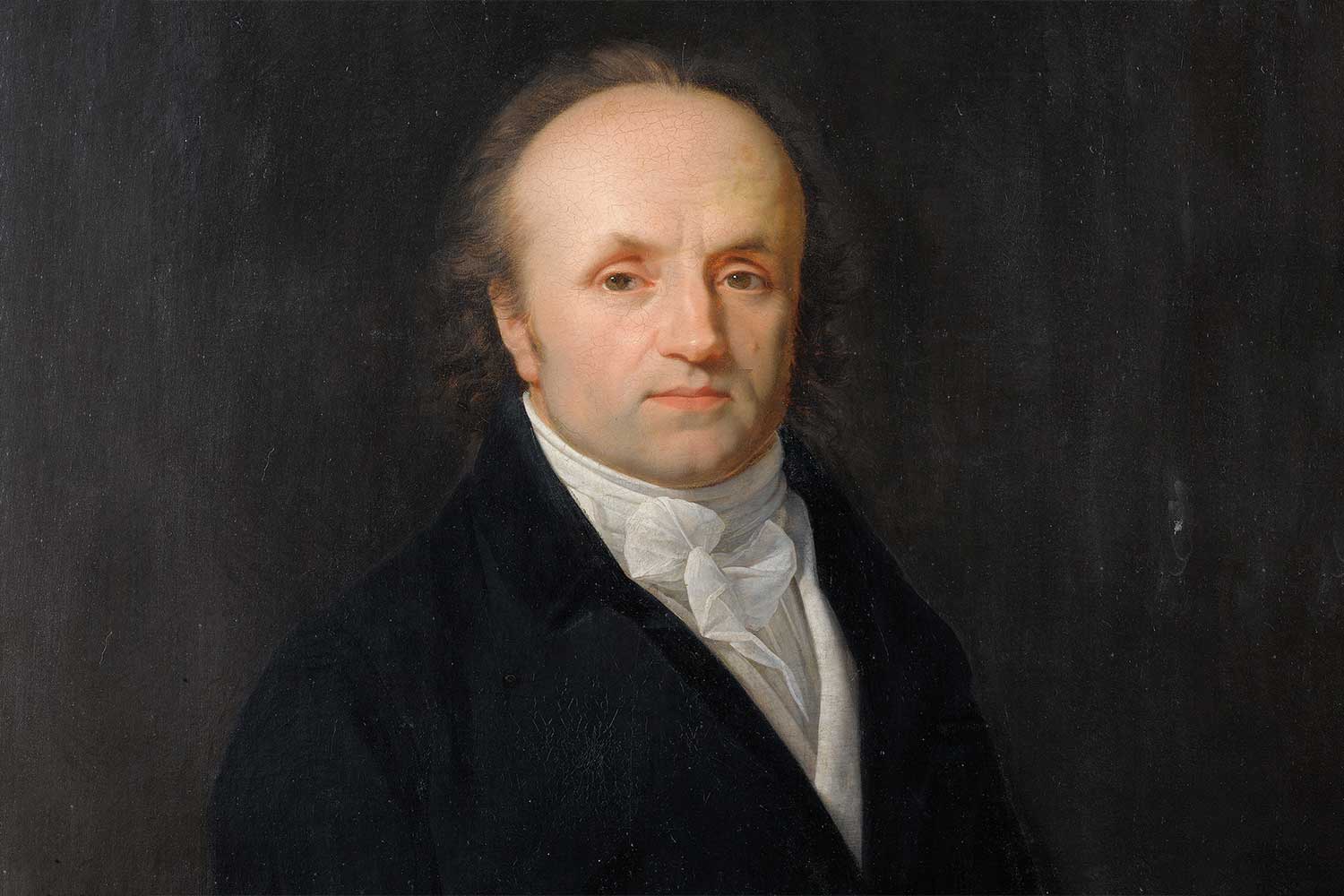
Abraham-Louis Breguet
For nearly two centuries, the tourbillon existed as a kind of sacred complication — rare, elusive, and almost ecclesiastical in its aura. Its proprietors the anointed ones, wielding its superpower at will. When it came to chronometric one-upmanship, the tourbillon was often the pathway to victory. But creating one was the sole domain of only the greatest maisons and watchmakers. Amongst the most legendary of these was Girard-Perregaux’s Three Golden Bridges, the gold medal winner at the Paris Universal Exhibition of 1889. Crafted by tourbillon specialist Ernest Guignard — whose lyre-shaped cage would be referenced a century later by F.P. Journe — the Three Golden Bridges were extraordinary examples of staggering architectural beauty combined with unrivalled performance. In the mid-twentieth century Patek Philippe would submit multiple tourbillons to the Neuchâtel Observatory trials, often made by master watchmaker André Bornand. In 1947 Omega created twelve wristwatch tourbillon movements under the name Calibre 301, specifically to do battle at these competitions.
-
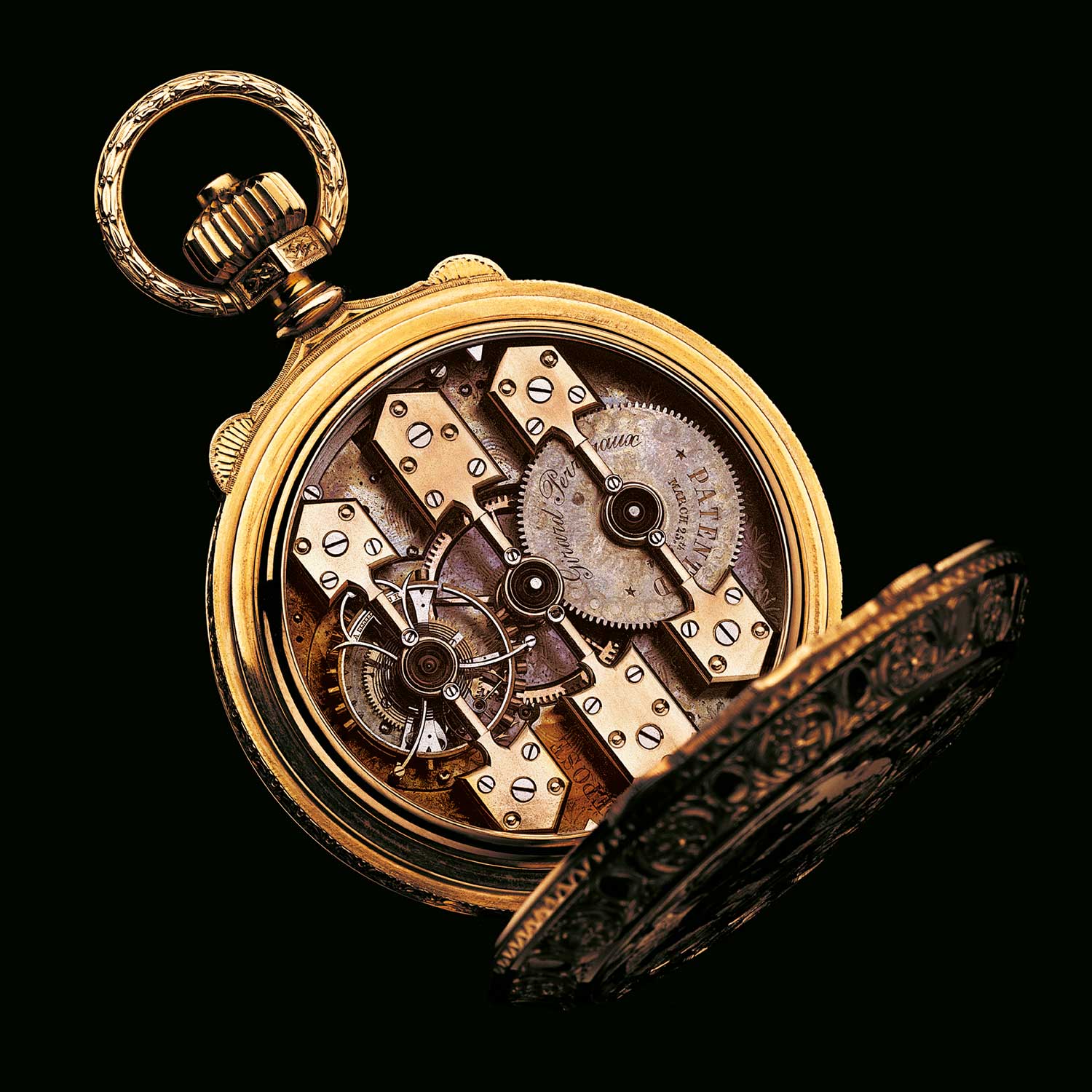
- Girard-Perregaux “La Esmeralda” Tourbillon pocket watch with three gold bridge winning the 1889 Paris Universal Exhibition
-
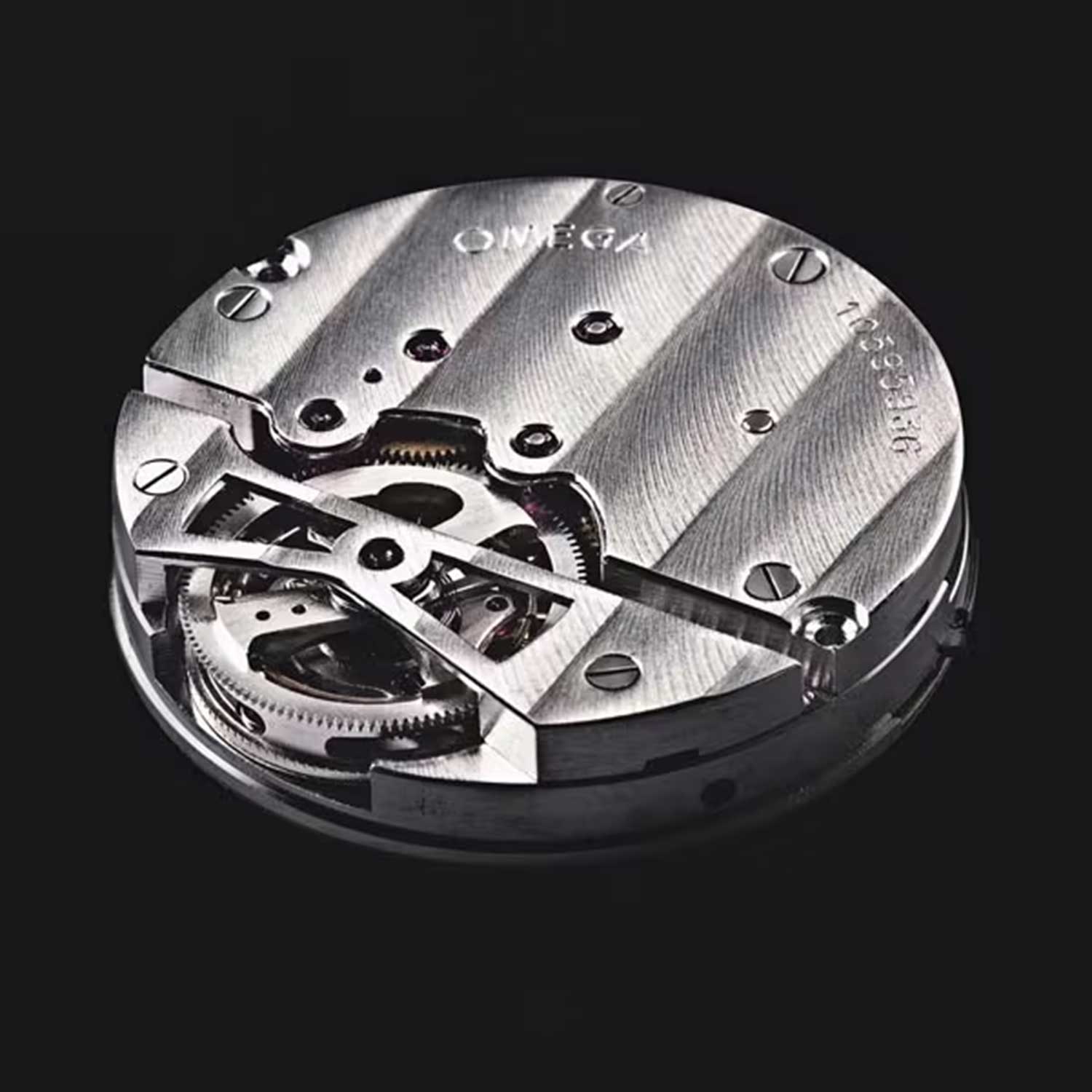
- The Omega Caliber 30 I, one of the world’s first tourbillon wristwatch movement created in 1947
But with the onset of the Quartz Crisis and the vast proliferation of inexpensive electronic watches capable of far greater accuracy than even the best regulated tourbillon, this complication all but vanished.
Then came the slow rebirth of Swiss horology in the 1980s and ’90s, which transformed the tourbillon from a hidden chronometric device into emotional theatre. The first wristwatch tourbillon Reference 25643 featuring the Calibre 2870 from Audemars Piguet arrived in 1986 like a quiet shockwave through a world that had almost forgotten what mechanical audacity looked like. Designed by the brilliant Jacqueline Dimier, it was a precision instrument reimagined as a living sculpture of time itself, replete with an Egyptological design flourish. At just 4.8mm in thickness it would remain the world’s thinnest self-winding tourbillon until the introduction of the Bvlgari Octo Finissimo Tourbillon Automatic in 2018 at 3.95mm. It was also the first timepiece to place the tourbillon dial-side, making it the visual focus. The cage, located at the lower right, was exposed like a beating heart suspended in space — strategically positioned to remain visible even if the watch was worn beneath an elegant jacket sleeve.
-
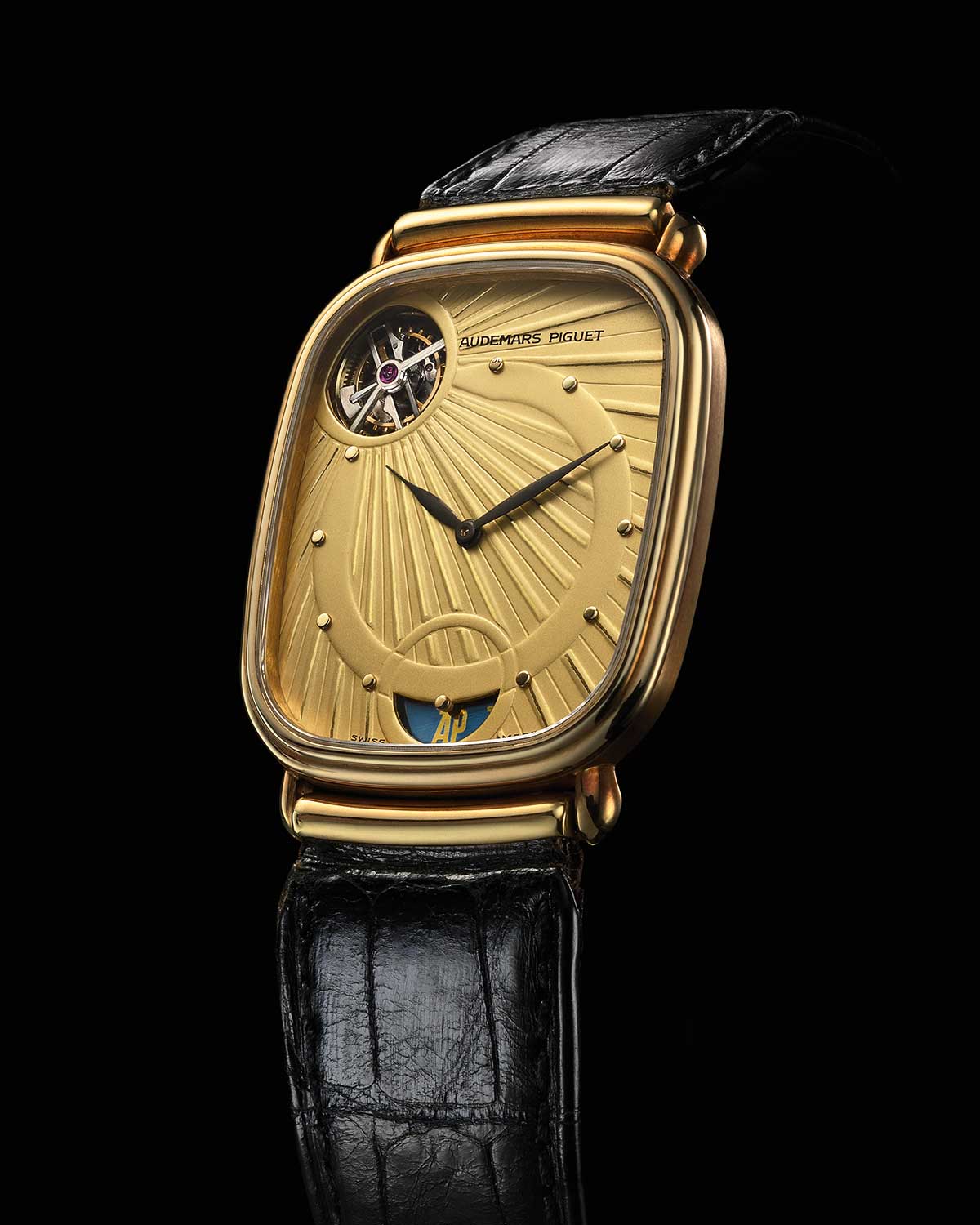
- 1986: Audemars Piguet Ref. 25643
-
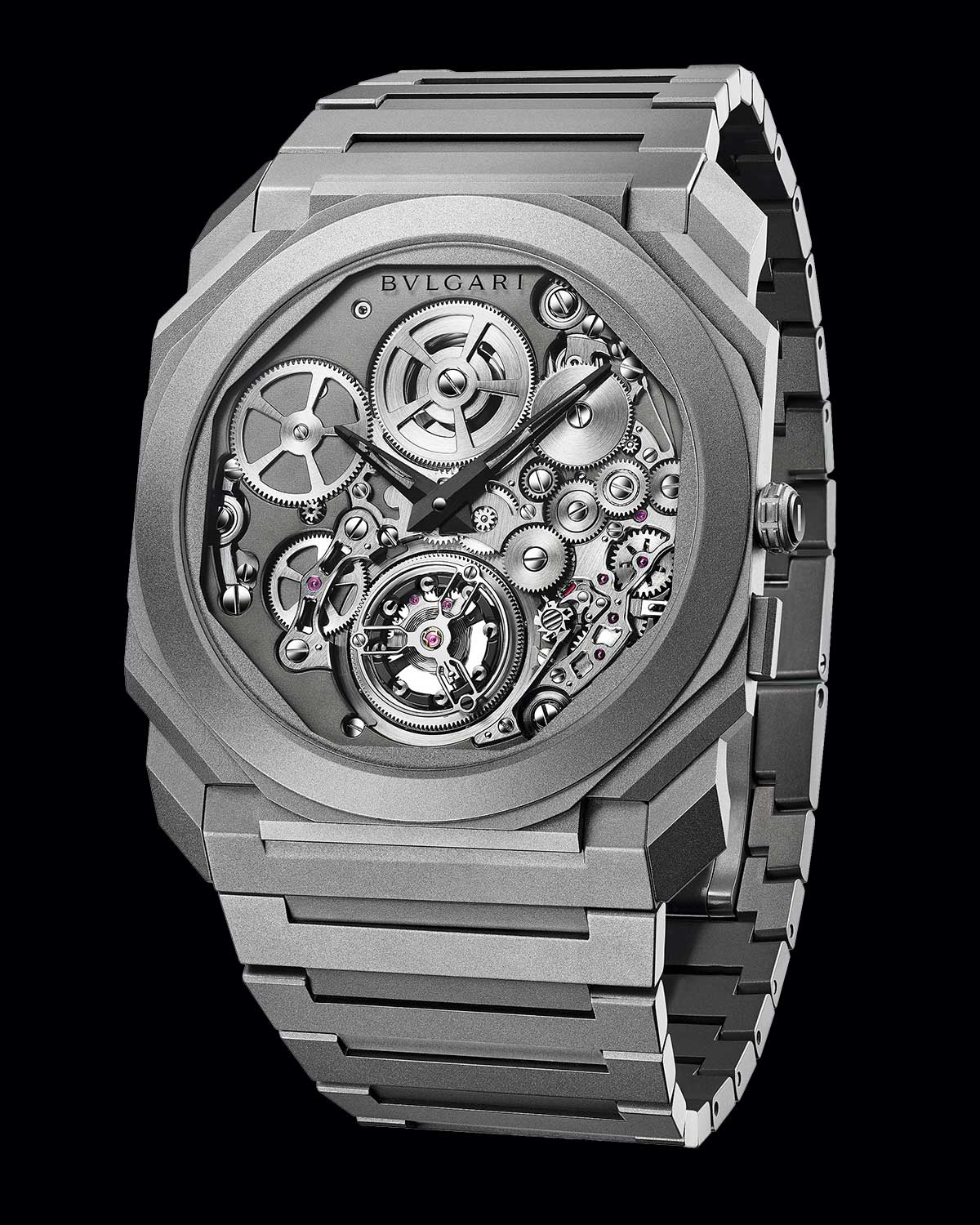
- 2018: Bvlgari Octo Finissimo Tourbillon Automatic
Suddenly, chronometry was no longer the tourbillon’s raison d’etre. It was performance art. The rotating cage became hypnotic theatre. The steady rotation of the balance wheel was no longer just a statistical averaging of positional errors — it became choreography worthy of George Balanchine. In so doing, Audemars Piguet effectively shifted the emotional axis of haute horlogerie. The tourbillon was no longer solely about combating the demon gravity. It was about turning that battle into beauty. From that point onward, collectors no longer merely wanted accuracy; they also wanted kinetic sculpture.
That same year Reinhard Meis published Das Tourbillon, further elevating the complication’s mythical status. By 1986, the commonly cited figure was that only around 250 watchmakers in history had successfully made a true tourbillon — a number Meis arrived at after explicitly documenting approximately 120 historically identified tourbillon makers from the era of Breguet onward. To have made a tourbillon placed a watchmaker into an extraordinarily small fraternity stretching back to the OG of horological bad assery, Breguet himself. The first generation of 1980s and ’90s tourbillon revivalists included Franck Muller, Daniel Roth and François Bodet at Breguet, Vincent Calabrese and Blancpain, and the legendary Günter Blümlein who in 1994, together with Renaud & Papi, unveiled the Pour le Mérite Tourbillon with its famous chain and fusée. Notably, all their watches featured the tourbillon on the front of the dial.
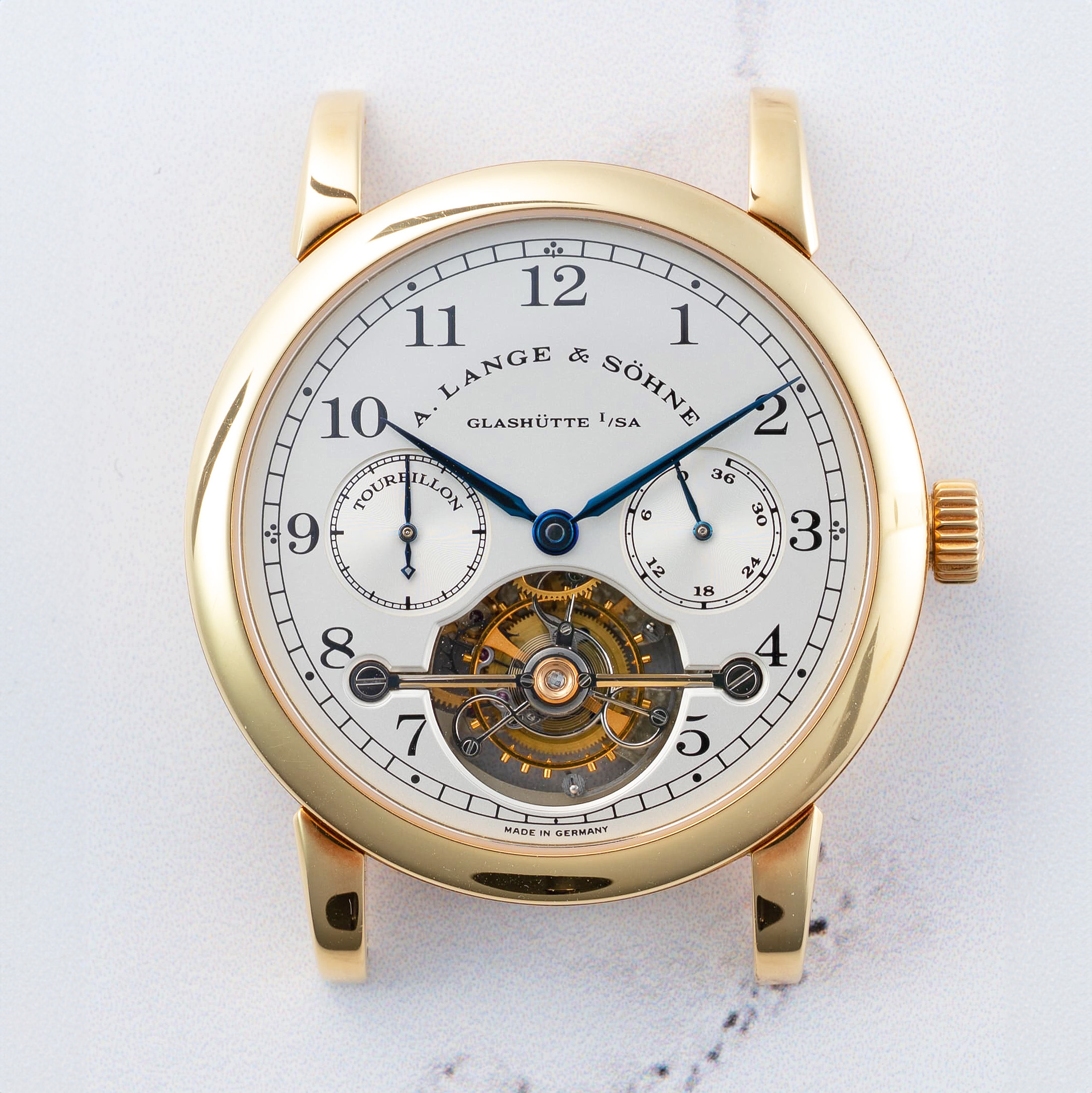
1994: A. Lange & Söhne Tourbillon “Pour le Mérite”
But Breguet’s original victory, magnificent as it was, remained incomplete. The tourbillon addressed vertical positions admirably. It did far less for the horizontal positions — dial up, dial down — encountered whenever the watch is laid flat. And even in the vertical plane, it averages rather than eliminates positional error. The idea that a tourbillon could be made to rotate simultaneously on multiple axes, sweeping the oscillator through three-dimensional space and averaging out errors in every conceivable position, was understood in principle long before it was achieved in practice. That gap between theoretical understanding and physical realisation is where the story of the multiple-axis tourbillon begins — and it begins not in Geneva or the Vallée de Joux, but in England.
Late 1970s–Early ’80s: Anthony G. Randall and the First Double-Axis Patent
The intellectual parentage of every multiple-axis tourbillon wristwatch made today belongs to a British horologist named Anthony G. Randall — a man who remains one of the great unsung heroes of this story. A physicist by training — he graduated from the University of Manchester in 1960 before turning to watchmaking — Randall was as comfortable with theoretical mechanics as he was with a watchmaker’s loupe. Through the early 1970s he pursued systematic research into constant-force escapements, thermal compensation, and the problem of magnetism in precision timekeepers. His investigations into positional error led him, inevitably, to the tourbillon and its limitations.
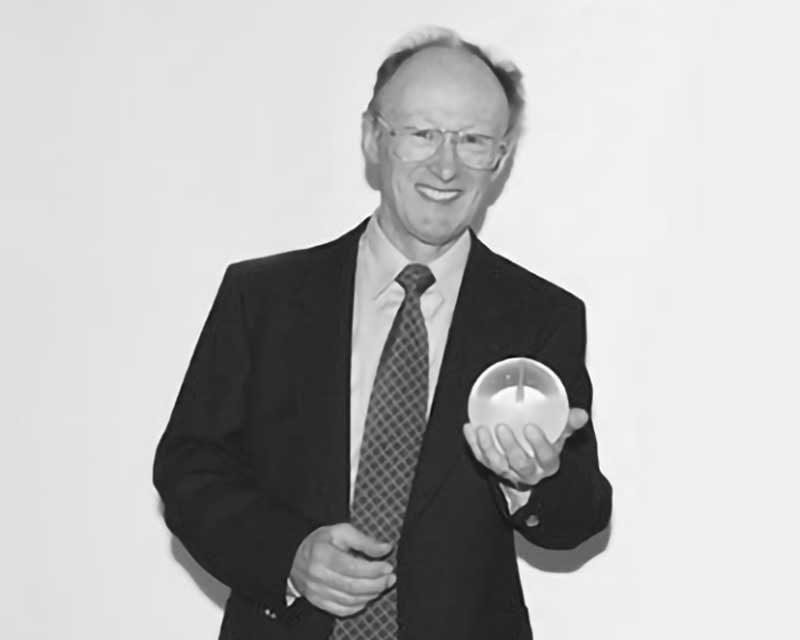
Anthony G. Randall (Image: Musée international d’horlogerie)
His research activities inspired him to develop special tourbillons, one of which was a rotating double-axis model, patented as GB 2027232 in August 1978. The concept was as beautiful as it was logical: if a single-axis tourbillon cage averages positional errors across one plane of rotation, a cage rotating simultaneously on two independent axes would sweep the oscillator through a far greater portion of the positional sphere — a much wider, richer, more comprehensive assault on gravity’s insidious clutches.
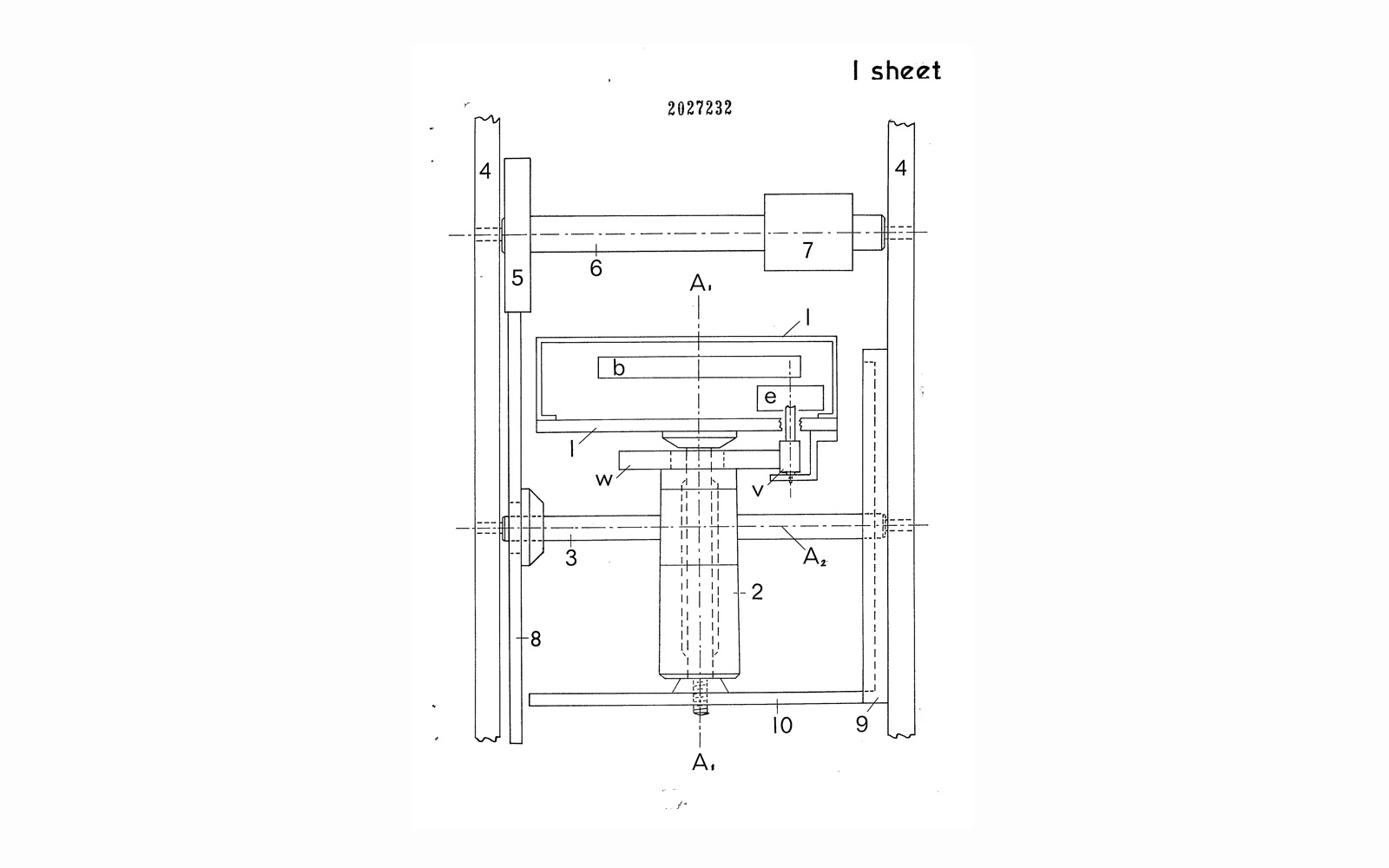
Diagram of the double-axis tourbillon from Randall’s patent. The balance and hairspring (b) and escapement (e) are mounted within the rotating framework (1), which turns about the vertical axis A₁ on bearings housed in the tube (2). The tube is carried by shaft (3), which rotates about the horizontal axis A₂ between the main plates (4). Power from the going train is transmitted through pinion (7), shaft (6) and gear (5) to gear (8), causing shaft (3) to rotate. A fixed gear (9) and its mating gear (10) act as a planetary gear train to rotate framework (1) about A₁, while the fixed gear (W) and pinion (V) transmit power into the rotating framework to drive the escapement. The regulating organ rotates simultaneously about two mutually perpendicular axes, continuously changing its orientation relative to gravity to average out positional errors.
The double-axis version was first built by Randall’s countryman Richard Good in a carriage clock in 1980. This was not yet a wristwatch complication — the engineering challenges of miniaturisation, weight, and energy transmission made that far beyond reach. But the working model proved the principle. Good’s carriage clock sat quietly in the English horological community, a kind of existence proof for a complication the rest of watchmaking would not seriously engage with for another two decades. Sometimes the most important ideas wait patiently for the world to catch up.
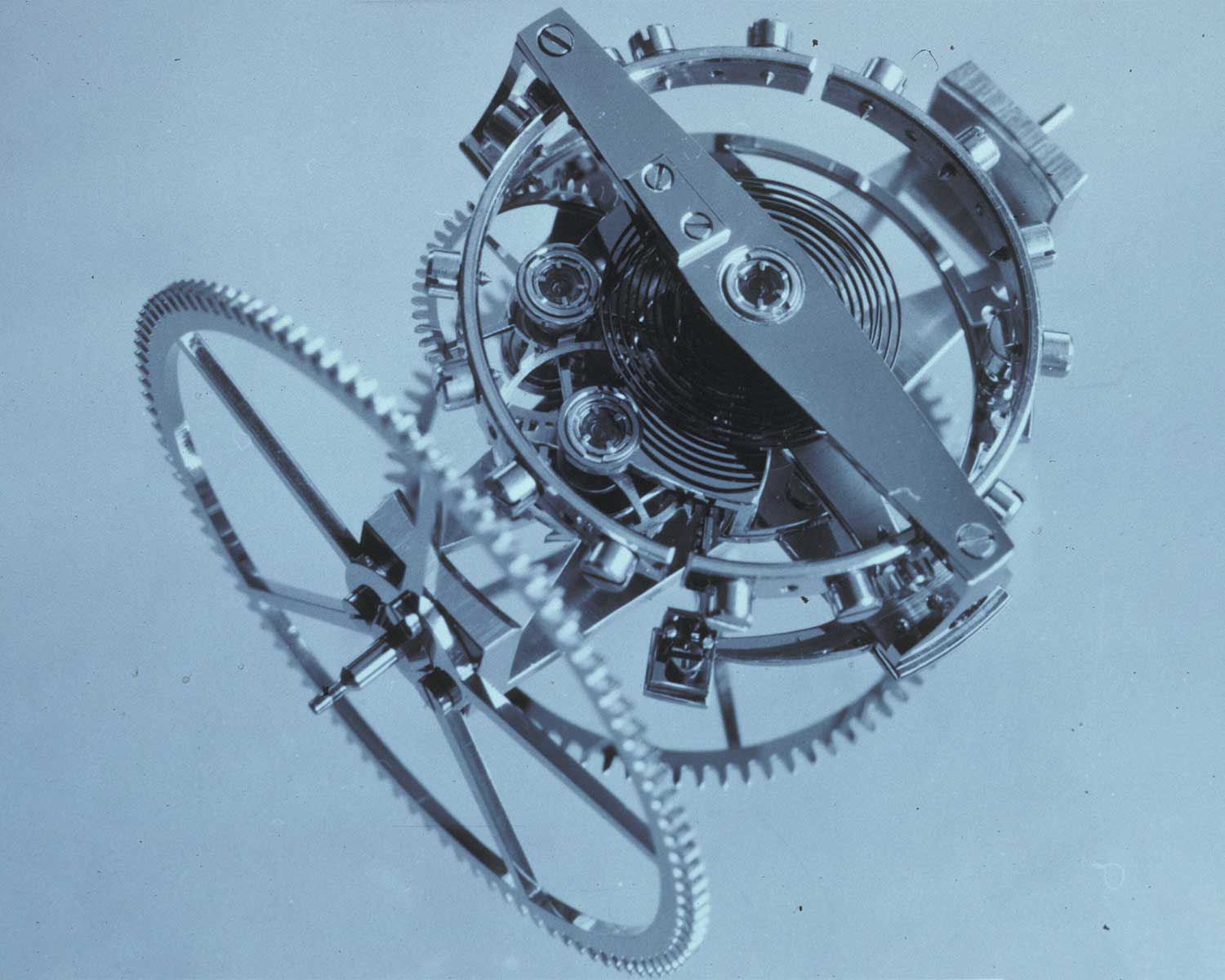
Anthony G. Randall’s double axis tourbillon as installed in a carriage clock (Image: Wikipedia)
It is worth pausing to appreciate Randall’s wider stature. Since the 1970s he worked as a restorer, designer, consultant, researcher, historian and author — a career eventually recognised with the Prix Gaïa in 2003 in the Craftsmanship-Creation category. The double-axis tourbillon was one achievement among many, but it proved to be his most consequential — the seed from which everything in the pages that follow would eventually grow.
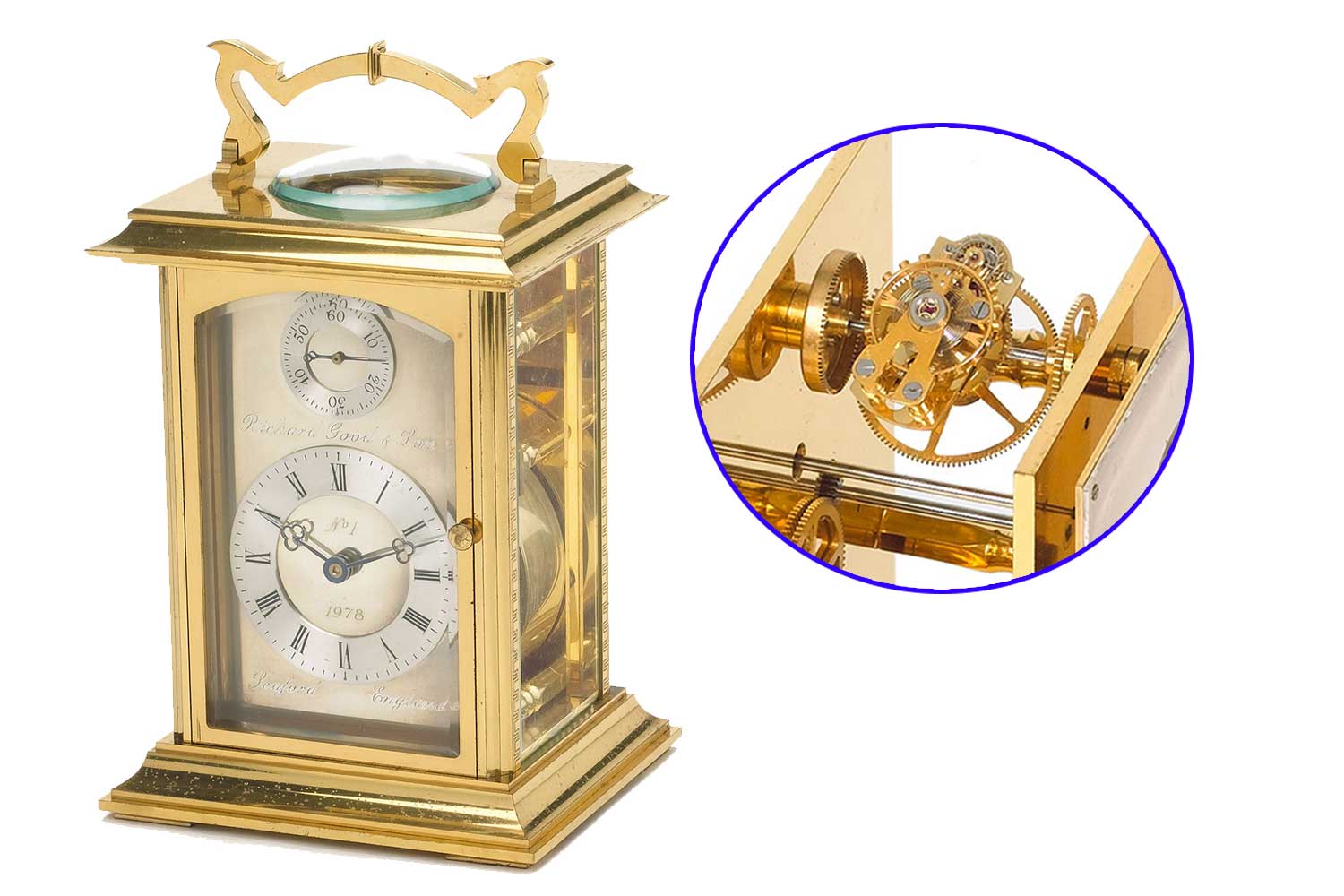
A unique Richard Good’s twin-axis tourbillon carriage clock (Image: Bonhams)
1978–2004: The Long Silence and the Technical Rationale for Revival
Between Randall’s 1978 patent and the explosion of multiple-axis tourbillons in 2004, the idea was periodically revisited but never commercially pursued. Standard tourbillons were already extraordinarily difficult to produce; the gains offered by multiple axes appeared, to most, to be outweighed by the sheer audacity of attempting them. The wall between concept and reality was thick. The idea sat and waited, like a great piece of music that nobody yet had the orchestral chops to perform.
The technical rationale, however, became more compelling as the wristwatch replaced the pocket watch. A wristwatch inhabits a chaotic three-dimensional environment, rotating through countless orientations as the wearer moves — an infinitely more complex gravitational landscape than the gentleman’s waistcoat for which Breguet’s original invention was designed. A single-axis tourbillon, optimised for the vertical pocket watch, provides only partial compensation in this context. A tourbillon that sweeps the oscillator through all possible orientations in space — ideally covering the full positional sphere — would theoretically turn gravity’s infinite variety of attacks into a single, cancellable average. This was the engineering ambition — some would say obsession — that drove the four landmark workshops of 2004.
2004: The Year the Multi-Axis Tourbillon Became Real
No single year in the history of the tourbillon equals 2004 for sheer density of achievement. In what appears at first glance to be a remarkable coincidence — but was in fact a convergence driven by the same technical maturity, the same commercial hunger, and the same restless creative energy moving through the industry — four entities introduced multiple-axis tourbillon complications within months of each other: Thomas Prescher, Franck Muller, Jaeger-LeCoultre, and Greubel Forsey. Each approached the problem from a completely different direction. Each produced something that could not have come from any of the others. Together, they transformed the multiple-axis tourbillon from a theoretical curiosity gathering dust in an English carriage clock into the most exciting new sub-genre in haute horlogerie.
But it was also an aesthetic trend that set the stage for the first multi-axis tourbillons, that of rapidly swelling watch case sizes. Says watch collector and former GPHG jury member Ahmed Shary Rahman, “You have to concede that the birth of the multiple axis tourbillon in wristwatch format was only possible because of a general shift in taste towards larger timepieces.” Any tourbillon with more than one axis of rotation means that the tourbillon will occupy a greater height. As the prevailing taste in watches throughout the 80s and 90’s was for slim, compact timepieces it made the appearance of a multi-axis tourbillon incongruous. But all that changed with the onset of the new millennium specifically 2001 where we suddenly have the appearance of two ground breaking timepieces. The first is Ulysse Nardin’s Freak a watch with no hands and no crown where the movement tells time often considered the first act of mechanical expressionist art in horology. The second is Richard Mille’s RM 01, the first overtly futurist timepiece in watchmaking history. Both of these timepieces use depth and transparency as their visual leitmotif and both are accordingly thick, the Freak because its movement is driven by a mainspring that occupies the entire bottom layer of the watch case and the Richard Mille because it utilizes three dimensional “F1 inspired” architecture as its key point of distinction.
-
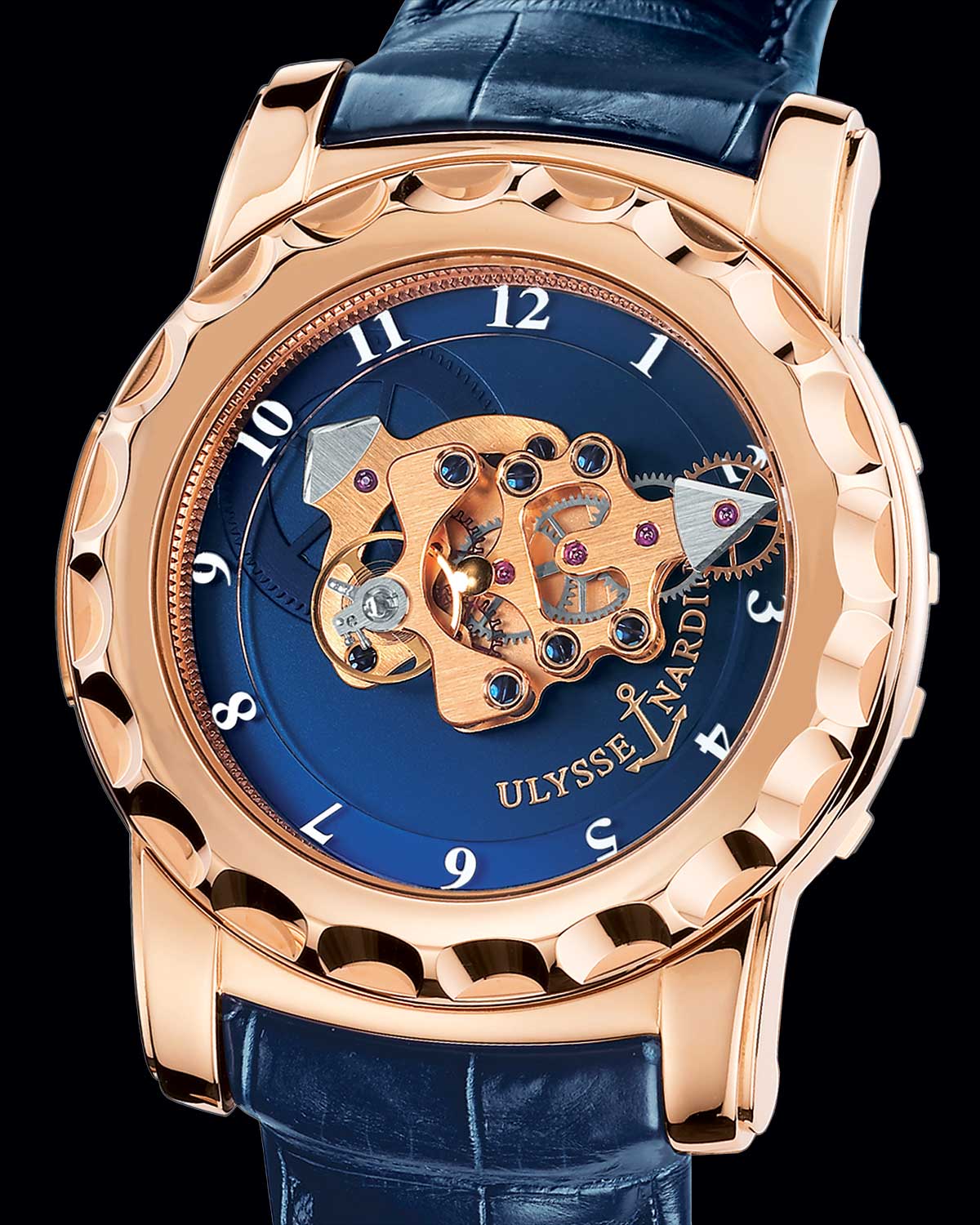
- 2001: Ulysse Nardin Freak
-
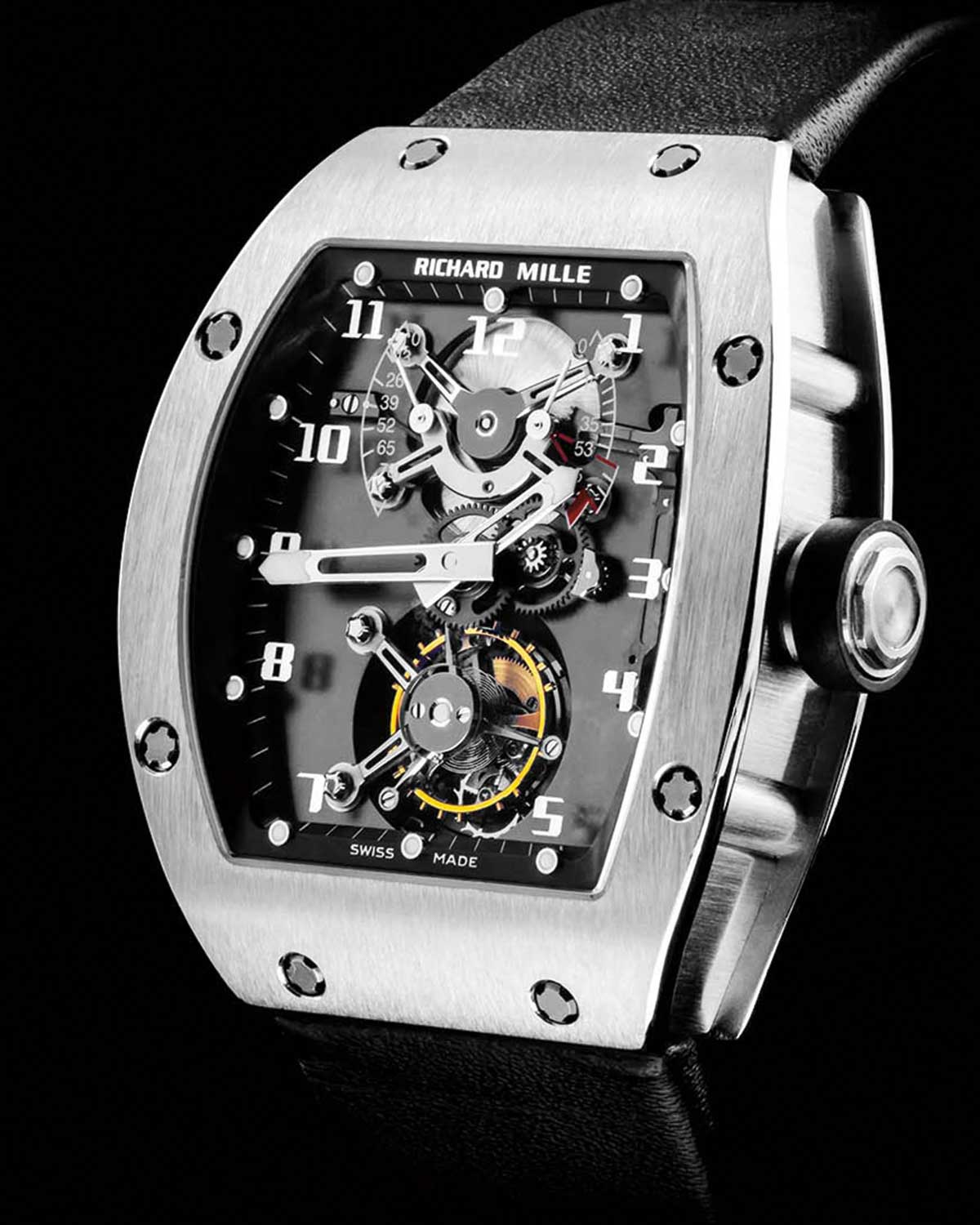
- 2001: Richard Mille RM 01
Watch Episode I of Masters of Chronometry, Revolution’s new video series tracing watchmaking’s pursuit of precision from the 17th century to today, beginning with the rise of the multi-axis tourbillon.
Thomas Prescher
2004: The Triple-Axis Flying Tourbillon
Of the four 2004 debuts, Thomas Prescher’s is arguably the most ambitious purely on engineering grounds alone. The reason for this is that his were the only timepieces that also integrated a remontoire d’egalite into their construction. This was presumably because he realized that the inertia of twin axis tourbillon would tend to exaggerate the weakening of torque coming from his mainspring and this was a way to ensure his balance could achieve a consistent amplitude despite these challenges. A German-born former Naval Officer, turned independent watchmaker who trained at Audemars Piguet and Gübelin before establishing his own workshop in the Swiss town of Twann on the shores of Lake Biel, Prescher had spent years working on multi-axis mechanics in pocket watch form, building up technical knowledge. He explains that as a young watchmaking student he became obsessed with the work of Anthony Randall. One key advantage that Prescher had over his heroes Randall and Good was that he represented the first generation of independent watchmakers that had full access to CAD/CAM tools and CNC machining. This represents a huge advance in terms of the precision with which micro-components could be made. Prescher the prodigious autodidact taught himself to use CNC over the course of 18 months.
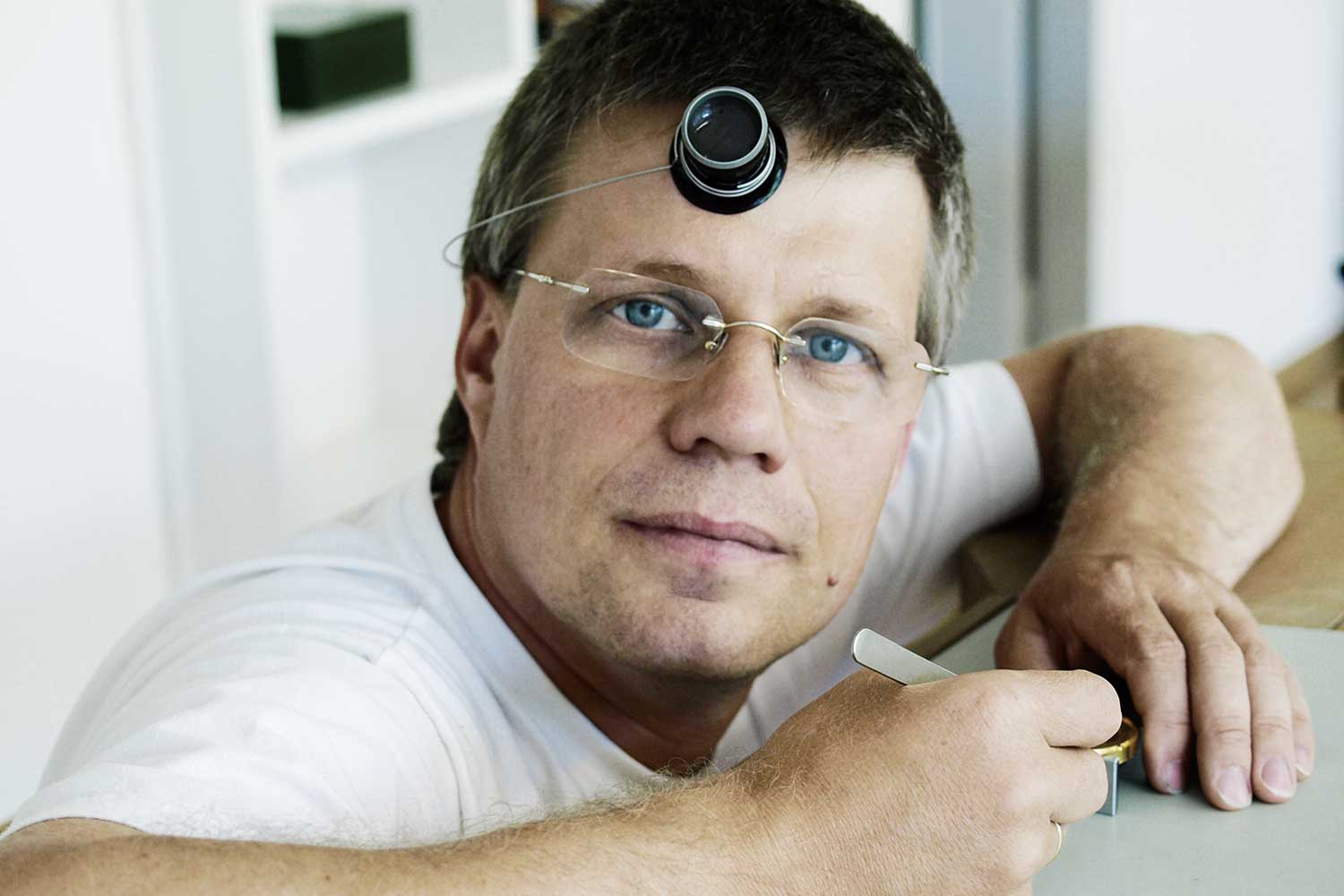
Thomas Prescher
In 2004, he arrived at Baselworld with a Trilogy of wristwatches fitted with single, double and triple-axis tourbillons. The last two were world firsts. This trilogy which I first saw in 2004 at Michael Tay’s watch fair named Tempus was incredible impressive. To further distinguish each of the watches Prescher has put them in different shaped cases. The single axis tourbillon had a square case, the double axis a cushion case and the triple axis tourbillon a round case. The architecture of his movements is unique and immediately identifiable because the tourbillons seem to float in space. The double axis tourbillon has a traditional minimalistic steel cage for its first axis of rotation while the second axis is achieved as the pinion of the first cage is born by a thin shaft that spins it around 360 degrees.
-
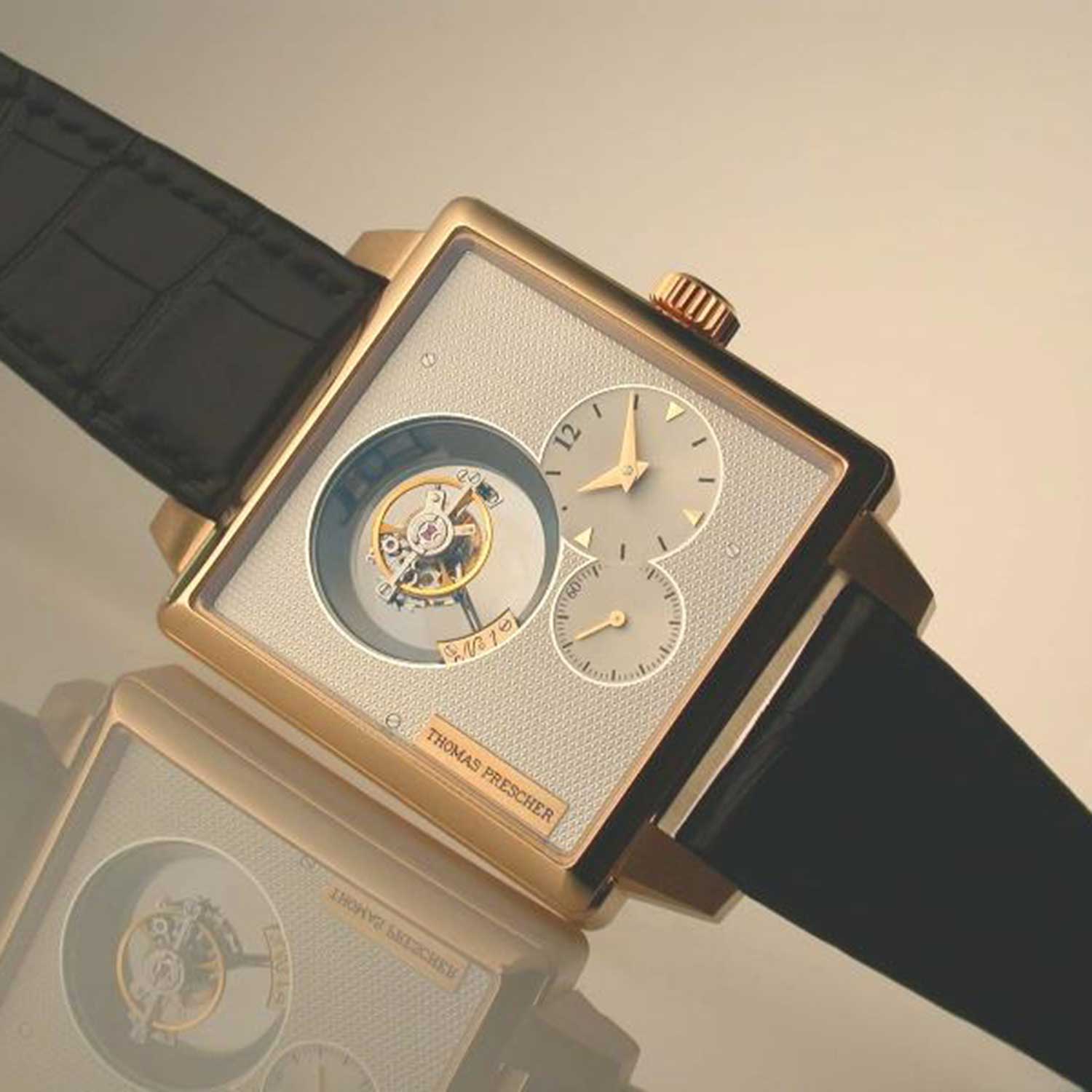
- Thomas Prescher Single Axis Tourbillon
-
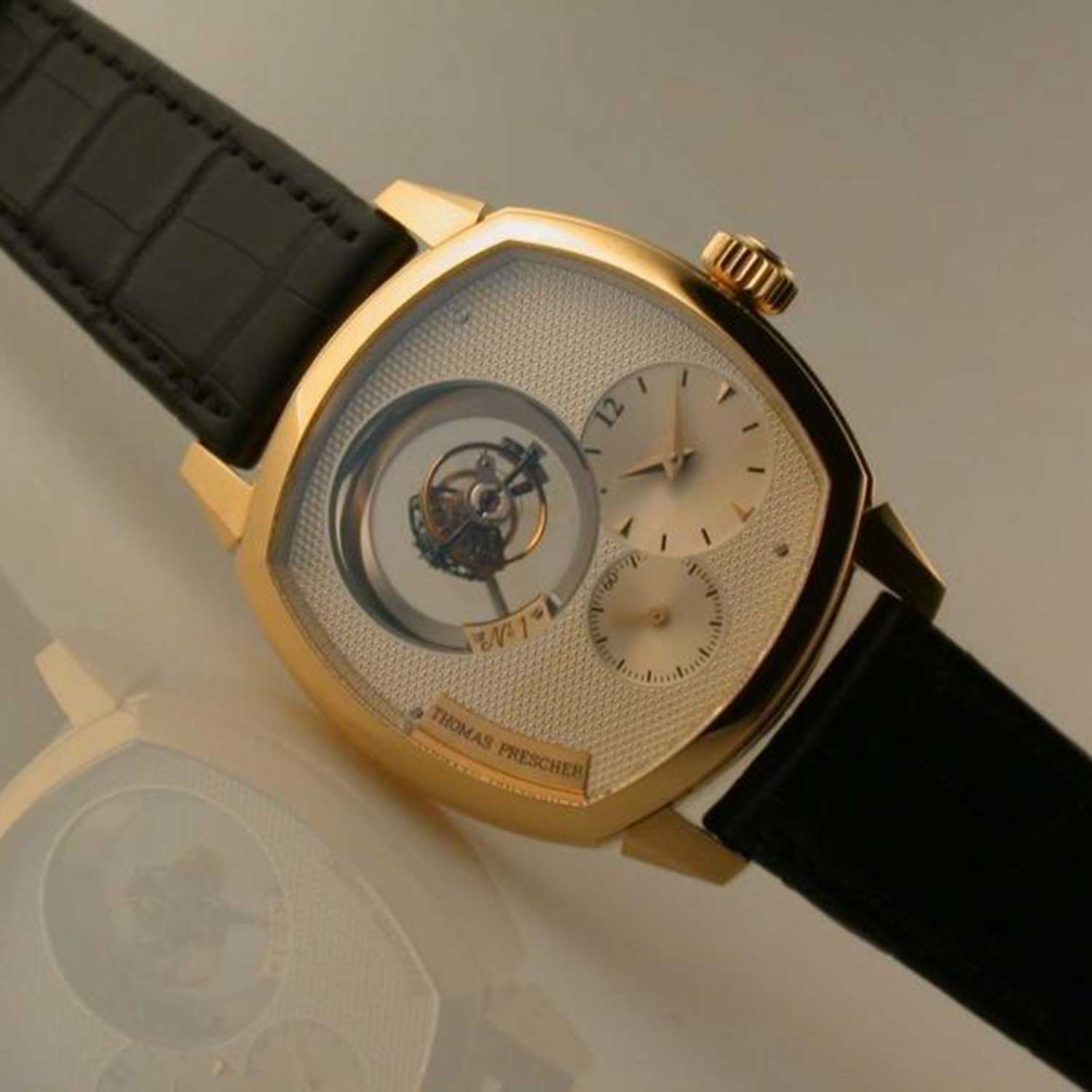
- Thomas Prescher Double Axis Tourbillon
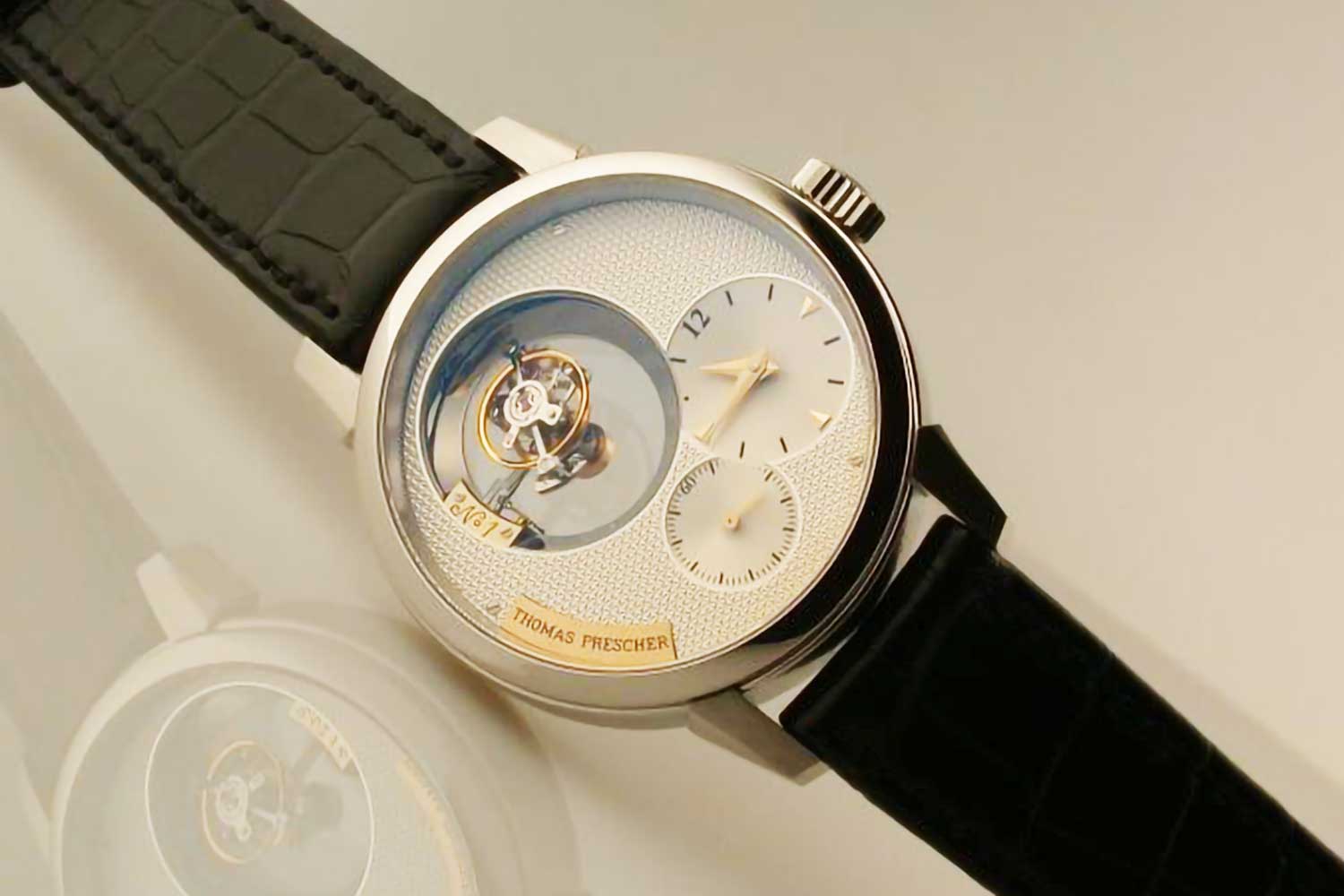
2004: Thomas Prescher Triple Axis Tourbillon
The triple axis tourbillon is effectively the same however the drive shaft also makes a circular rotation around its own aperture. The first axis of rotation is one minute, the second axis is also one minute and the third axis is one hour. As such in the triple axis tourbillon the third axis which has a little arrow attached to it is also used as a minute indicator. The entire inner ring of the tourbillon aperture is mirror polished and so you can see the reflection of the tourbillon making its very beautiful dance through space. Because the first and second axis of the tourbillon is a 90 degrees to one another the resulting timepiece is very thick at 16.1mm.
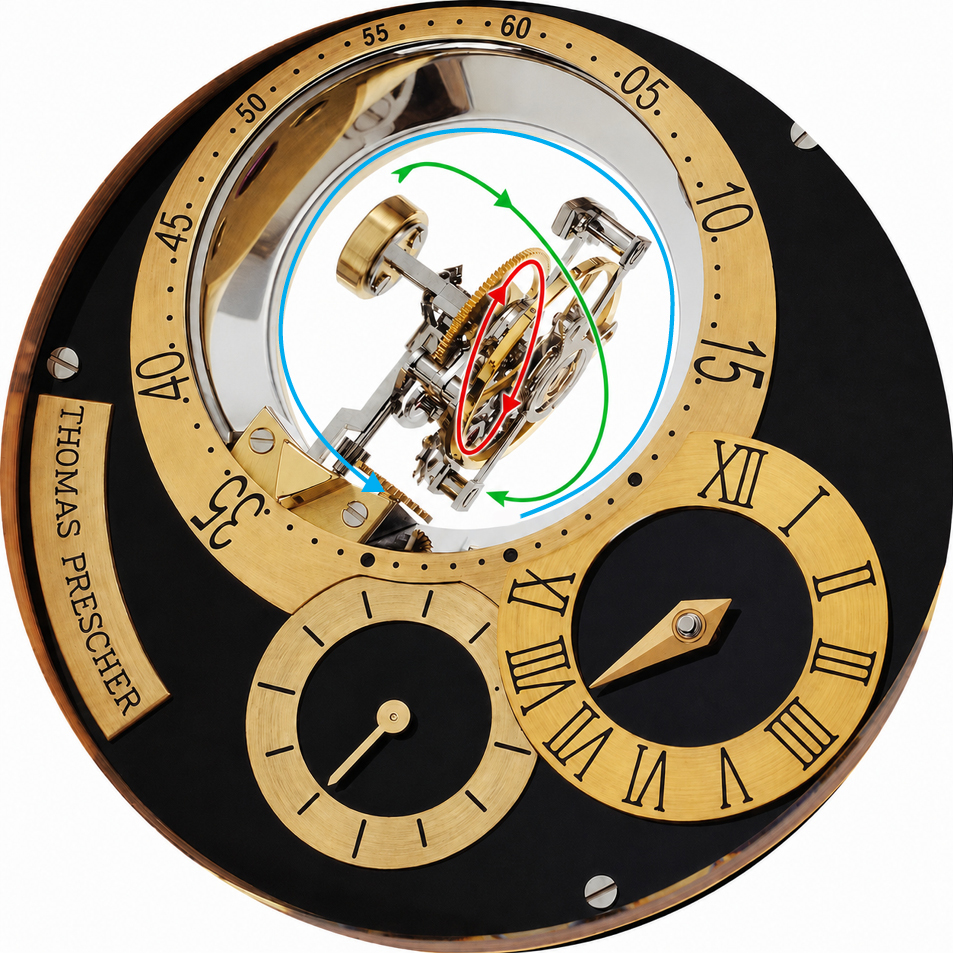
What made the Triple Axis Tourbillon Regulator genuinely unprecedented was not merely the third axis but the flying construction — the tourbillon supported from one side only, with no upper bridge obscuring the view, floating in space as three axes spin simultaneously in different planes.
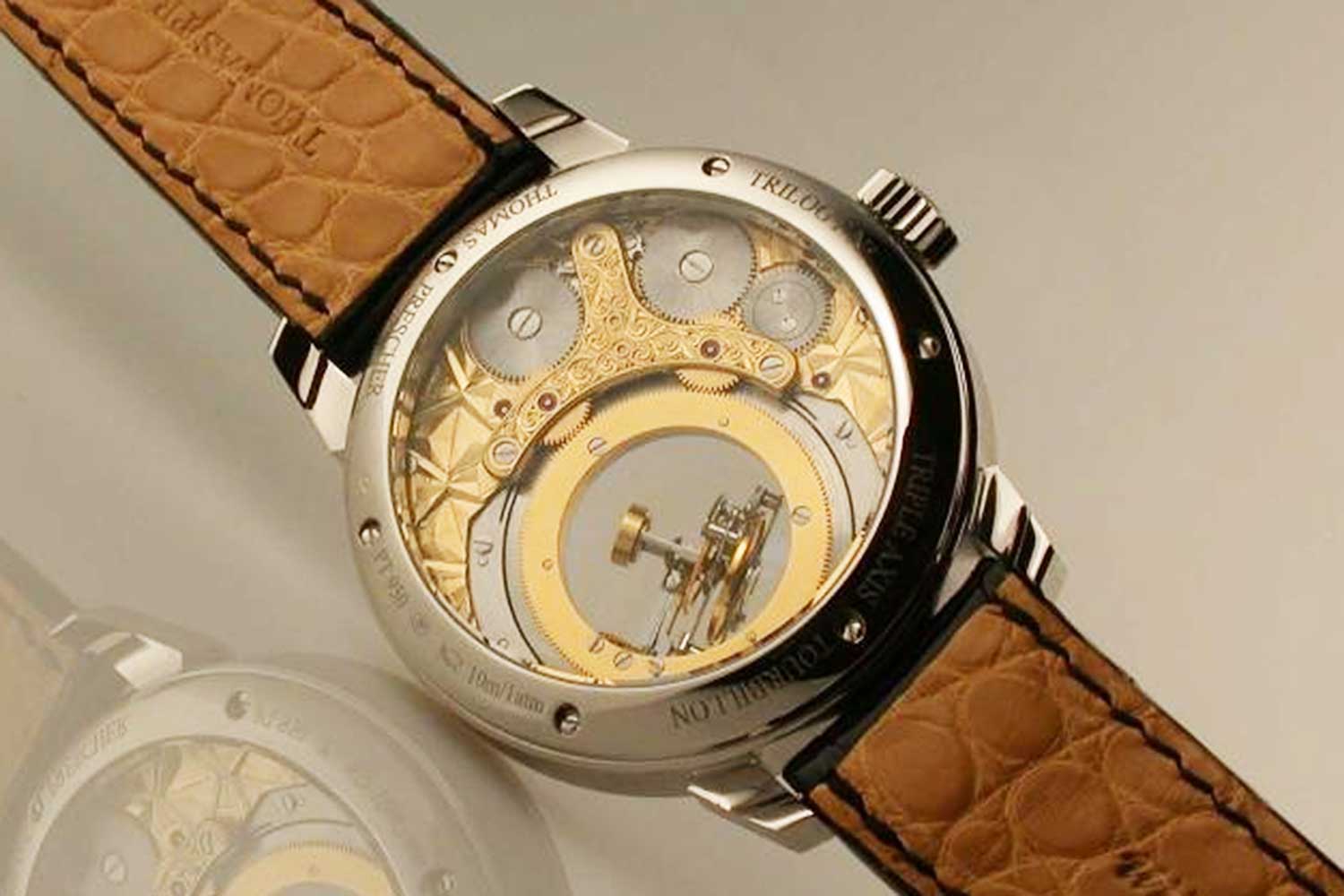
Caliber TP 3W6A.3
The specifications of Calibre TP 3W6A.3 repay close examination:
Thomas Prescher Triple-Axis Flying Tourbillon (Caliber TP 3W6A.3) — Key Specifications
- Case: Platinum 950 or 18K gold; 43mm (diameter) × 16.1mm (thickness)
- Movement: Manual winding; 37mm × 6.46mm
- Total components: 327
- Jewels: 47
- Power reserve: 40 hours from two mainspring barrels in parallel
- Frequency: 21,600vph (3Hz)
- Balance wheel material: Copper-beryllium (CuBe2)
- First axis: One revolution per 60 seconds
- Second axis: One revolution per 60 seconds
- Third axis: One revolution per 60 minutes
- Cage diameter: 13.4mm
- Tourbillon rotation height: 12.2mm
- Total tourbillon assembly weight: 2.879 grams (all three axes with bearing)
- Constant-force mechanism: Positioned inside the first-axis cage; recharges six times per second using Jeanneret’s inertia acceleration system
The constant-force / remontoire device inside the tourbillon cage turns around the first axis, transmitting energy directly to the escapement six times per second with every beat of the oscillating balance.
All of this in consideration the practical difficulty of what Prescher achieved cannot be overstated. Most of the industry believed fitting a triple-axis tourbillon inside a wristwatch was simply impossible — the movement too tall, the rotating mass too heavy to allow enough energy to reach the balance. Prescher disagreed, systematically, alone, at his bench in Twann. He found solutions where others had found only obstacles, producing the world’s first Triple-Axis Flying Tourbillon with constant force in the carriage in a wristwatch — taking direct inspiration from Randall’s theoretical work and Good’s carriage clock, and then going further than either had dreamed.
The case measures 43 mm in diameter and 16.1 mm in height, available in platinum 950 or 18-karat gold. The dial, in Prescher’s signature regulator layout, features his proprietary Triangular Guilloché motif — an engine-turned pattern of constantly changing direction, a deliberate visual echo of the tourbillon’s three-dimensional motion.
Franck Muller Revolution Series and the People Behind It
If Prescher was the lone wolf, Franck Muller was the horological Wolfpack — and what a pack it was. Where Prescher worked as an independent driven by pure technical obsession, Franck Muller under co-founder and CEO Vartan Sirmakes had explicitly, publicly, and somewhat defiantly positioned itself as the “Master of Complications.” That was not a marketing slogan. It was a covenant. And a covenant demands perpetual escalation. The Revolution series was the expression of that commitment by assembling an extraordinary group of watchmakers capable of making the idea of a multi-axis tourbillon real.

Franck Muller
The Team
The intellectual and mechanical engine of the Revolution series was a concentration of talent that has rarely been equalled under one roof in modern watchmaking. Four figures deserve particular recognition.
Pierre-Michel Golay is perhaps the most quietly influential watchmaker in Franck Muller’s history, after Muller himself. By this point Golay was already immensely respected as the technical mind behind Gerald Genta watches and the creator of the brand’s fabled grande et petite sonnerie. Thus it was already as a legend, Golay joined the Watchland group in 2002 to head its research and development division, a role that placed him at the centre of every major technical initiative. At Franck Muller, Golay with the help of his talented brother Jean-Pierre who would also soon join him, Golay would go on to create the Aeternitas Mega the world’s most complicated watch.

Pierre-Michel Golay
Michel Navas and Enrico Barbasini arrived at Franck Muller together in 2002, and between them represent one of the great creative partnerships in contemporary horology — the kind that comes along once in a generation. Navas had trained within a watchmaking family, graduated at the top of his class, and joined Audemars Piguet in 1980, where by his own account he assembled the world’s first automatic tourbillon wristwatch in 1986. He moved to Gérald Genta in 1987, and it was there in Genta’s Geneva workshop that he met Barbasini. Barbasini’s background was gloriously unorthodox: the son of an Italian opera singer who repaired cars on Sunday mornings, he came to watchmaking through a passion for mechanics, guided in part by Pierre-Michel Golay himself — his father’s best friend. Both men subsequently spent time at Patek Philippe before joining Franck Muller. At Genthod, working between the workbench and the development studio, Navas and Barbasini played key roles in developing Franck Muller’s complicated watch program over two to three intensive years. They were the hands and minds that turned the Revolution 2 and 3 from concept into calibre.

Michel Navas and Enrico Barbasini
Matthias Buttet served as technical director at Franck Muller and was the fourth member of the Watchland Wolfpack. Where Golay provided the philosophical gravitas of the senior master watchmaker, and Navas and Barbasini the creative and mechanical execution, Buttet’s strength lay in engineering rigour — the industrial translation of radical ideas into movements that could actually be made, repeatedly and reliably. Together, these four horological horsemen formed a complementary unit whose combined output defined the Franck Muller identity during its most fertile period.
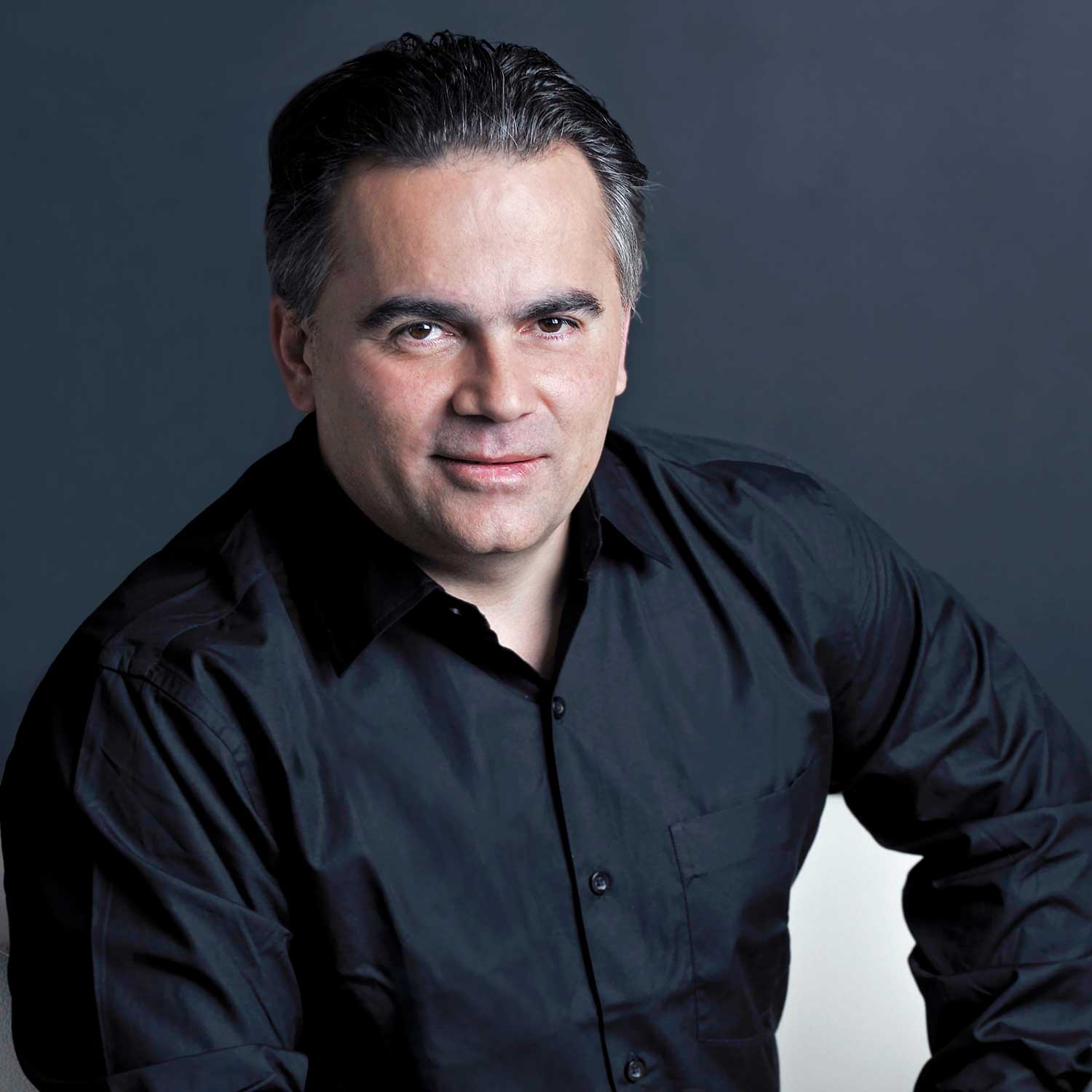
Mathias Buttet
2003: The Revolution 2 Double-Axis Tourbillon Wristwatch
Before the triple-axis Revolution 3 came the double-axis Revolution 2, presented in 2003 — and it is this watch, not its more famous successor, that holds the most historically significant claim: the world’s first multi-axis tourbillon wristwatch. It is a title that history has not always been sufficiently careful to attribute. Franck Muller’s team drew directly on the intellectual legacy of Randall and Good, leveraging modern CNC manufacturing to miniaturise the biaxial tourbillon principle that had existed only in carriage clock format bringing it, at last, to the wrist.
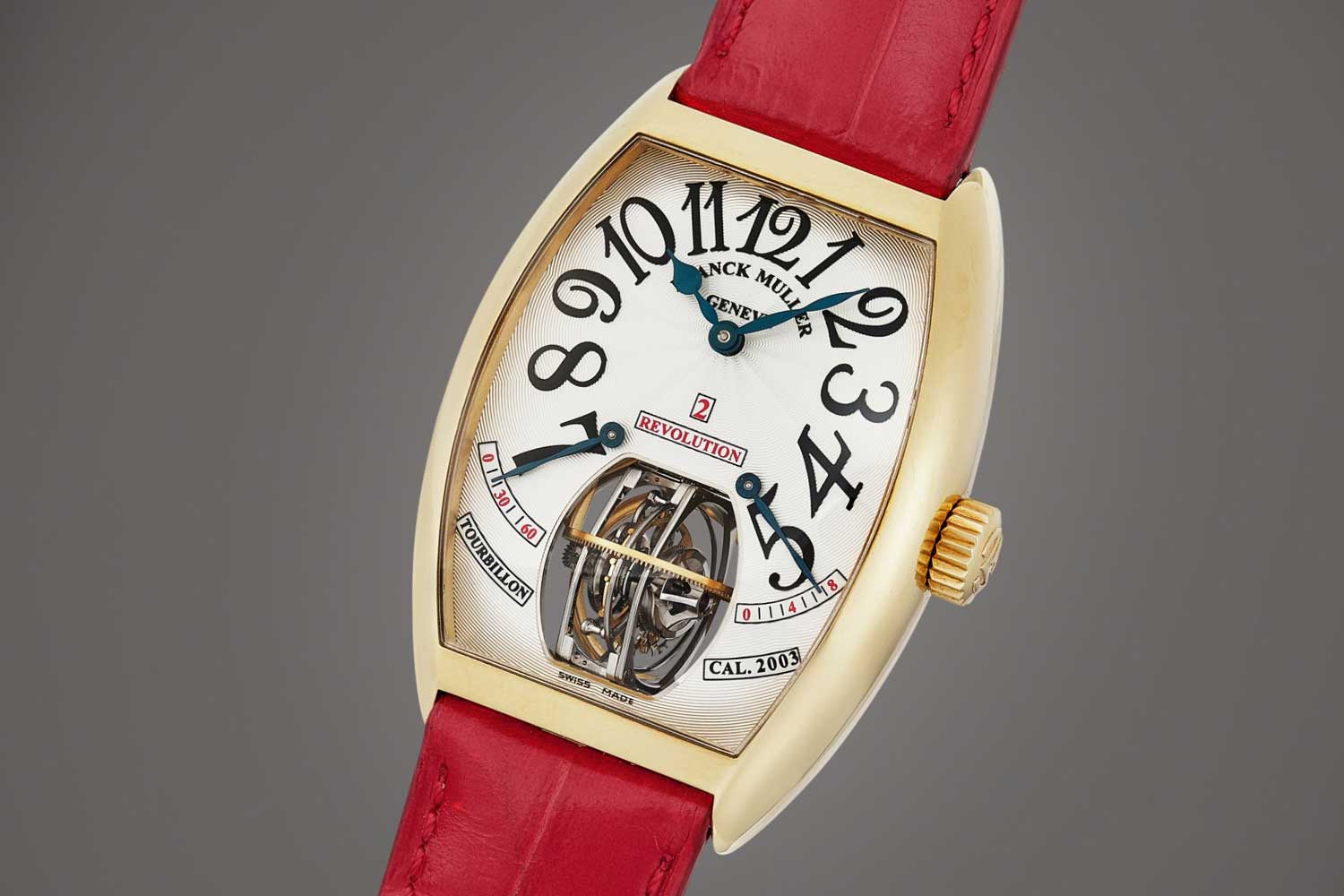
2003: Franck Muller Revolution 2 (Image: Sotheby’s)
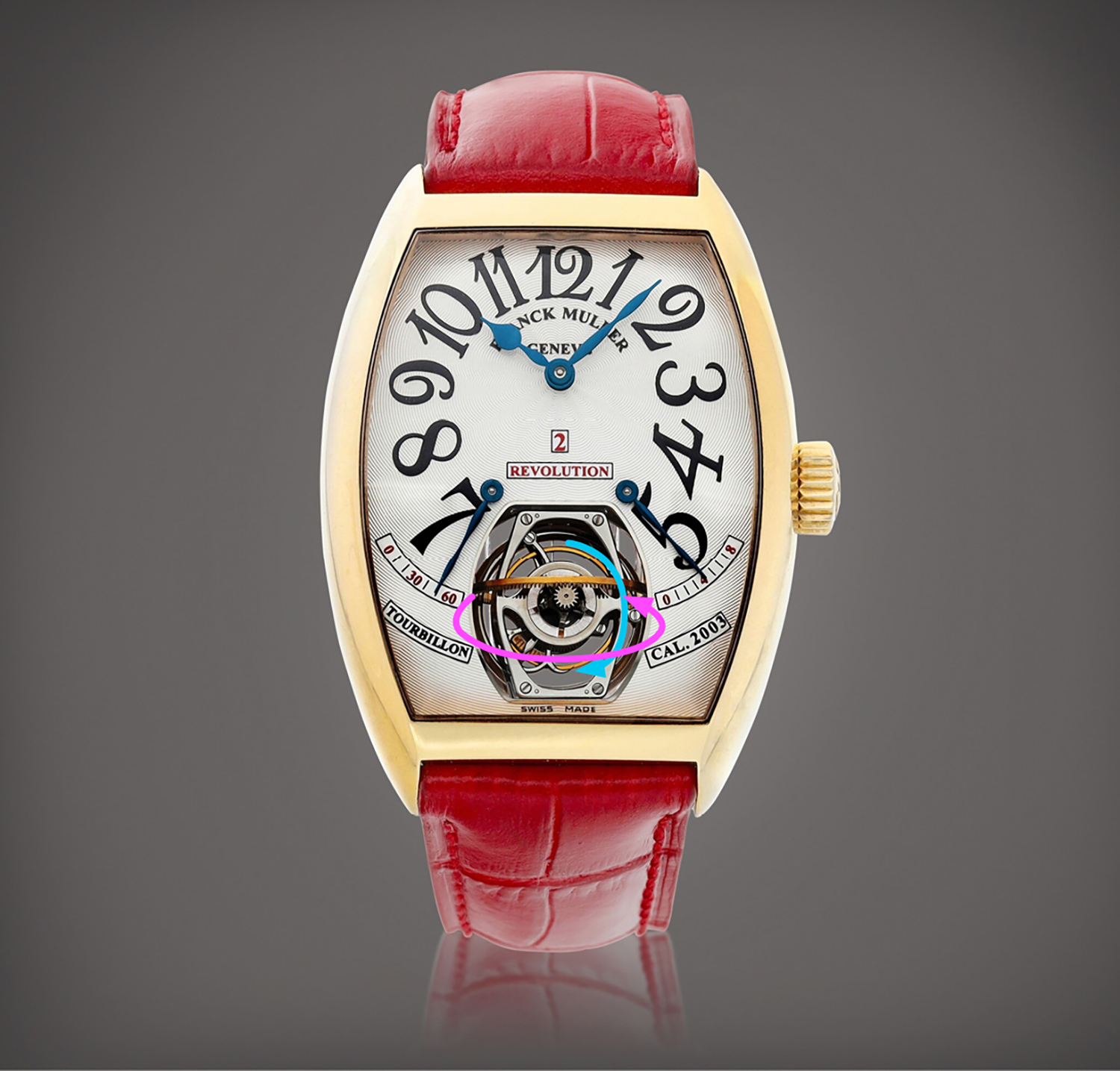
The Revolution 2 revolves around two axes, compensating for gravitational error not only in the vertical positions addressed by a conventional tourbillon but also in the horizontal positions encountered when the watch is laid flat.
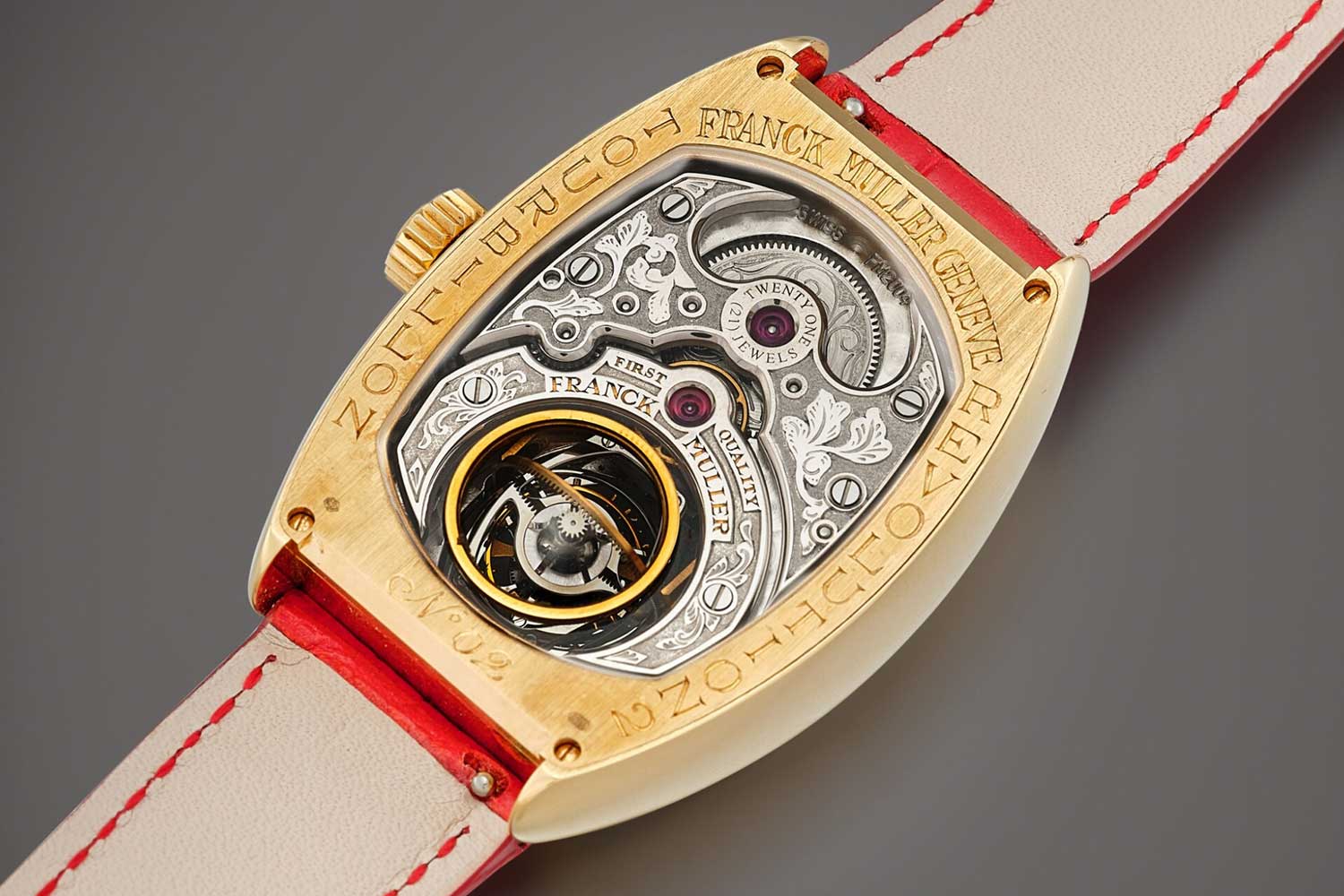
Caliber 2003 (Image: Sotheby’s)
Franck Muller Revolution 2 (Caliber 2003) — Key Specifications
- Case: Platinum 950; 35.3mm (diameter) × 48.7mm (lug-to-lug) × 11.6mm (thickness)
- Movement: Manual winding; 31.15mm × 37.45mm; 2.25mm (movement plate height)
- Total components: 259
- Jewels: 21
- Power reserve: 70 hours
- Frequency: 18,000vph (2.5Hz)
- First axis (inner/seconds carriage): One revolution per 60 seconds
- Second axis (middle carriage): One revolution per 8 minutes
- Displays: Retrograde minutes and seconds
- Finishing: Hand-engraved Art Deco motif, Côtes de Genève, circular graining, hand chamfering
The retrograde 8 minutes (right side) and 60 seconds (left side) displays on the dial actually charted the rotational speed of the Revolution 2’s rotational axes, a charmingly unique Franck Muller touch. On either side of the tourbillon aperture these hands sweep and snap back, making the rate of the two cages directly legible as a visual rhythm superimposed on the timekeeping display.
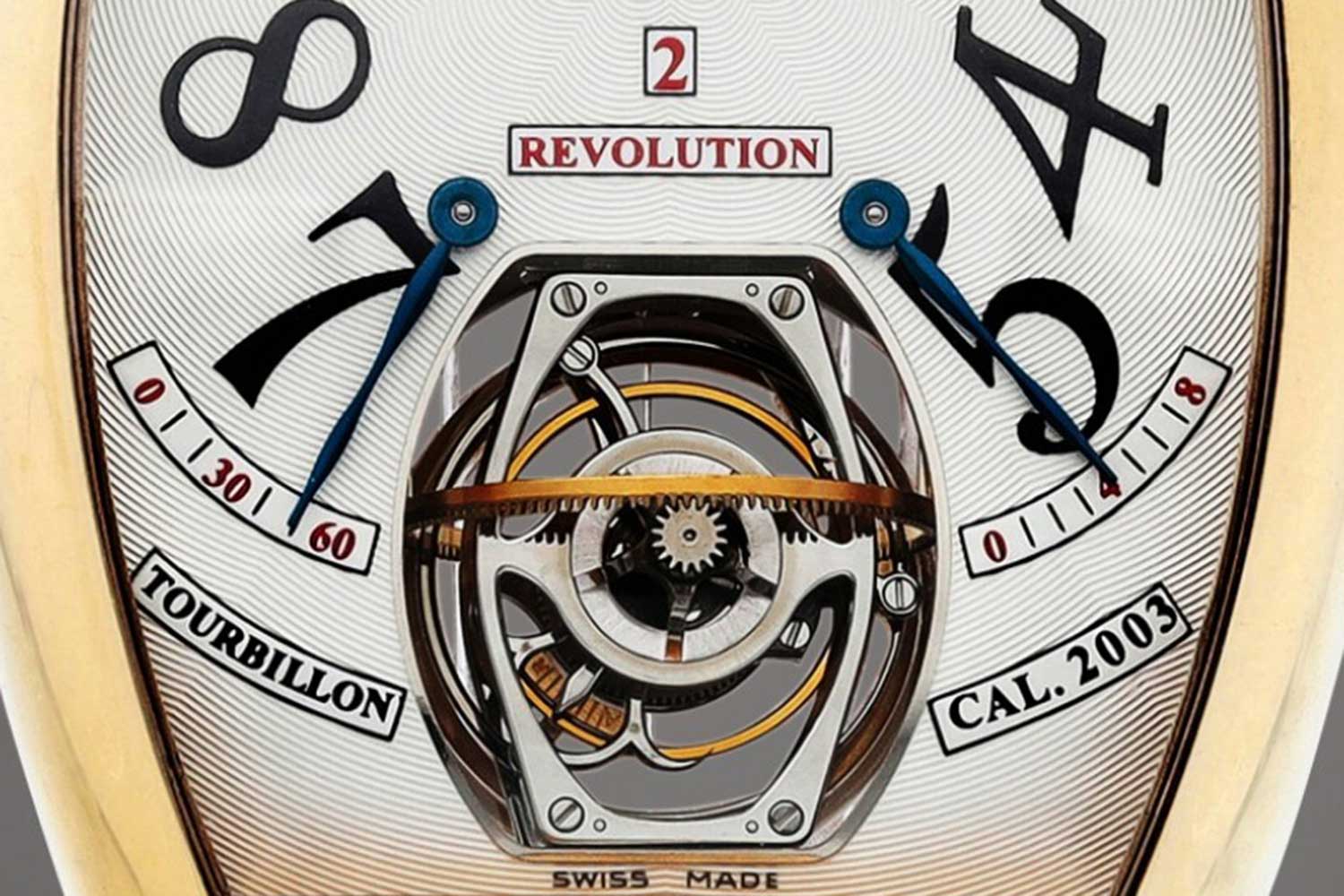
2003: Franck Muller Revolution 2 (Image: Sotheby’s)
2004: The Revolution 3 Triple-Axis Tourbillon Wristwatch
Having demonstrated that two axes could be realised in wristwatch form, the logical step was a third. In 2004, after years of development, Franck Muller presented the Revolution 3 — the world’s first tri-axial tourbillon wristwatch — in the iconic Cintrée Curvex case. Three carriages, three axes, one movement. The rotational speeds were from the inner cage to the outer, 60 seconds, 8 minutes and one hour. The architecture extends the Revolution 2’s logic by adding an outermost cage rotating on the horizontal axis, completing a full revolution once per hour.
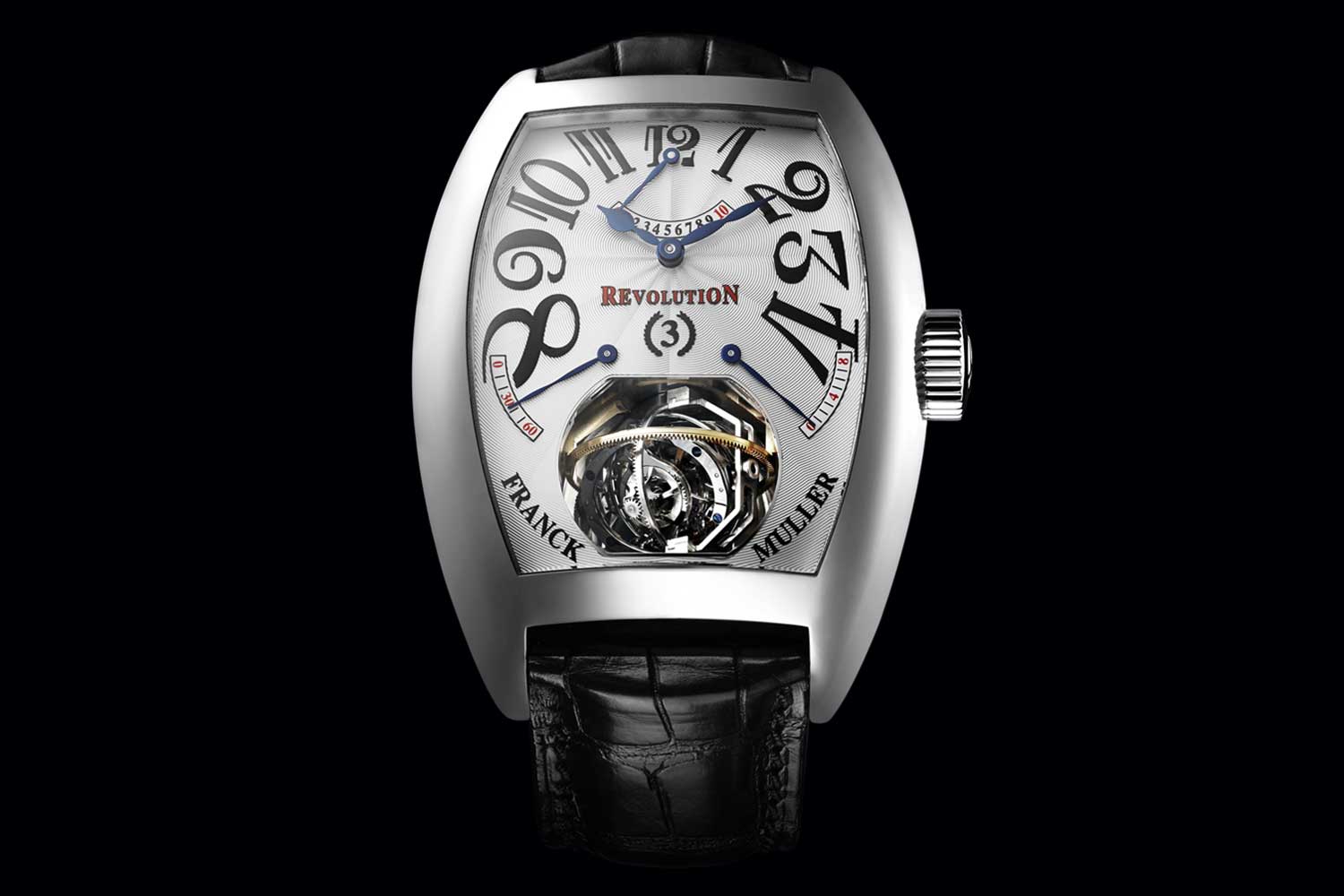
2004: Franck Muller Revolution 3
The Revolution 3’s architecture differs meaningfully from Prescher’s near-simultaneous achievement. Where Prescher used a flying construction with the outermost cage rotating on a large, fixed peripheral contrate wheel and a constant-force device, Franck Muller deployed three concentrically nested carriages — a different approach to the same problem, with the enormous energy demand addressed by a ten-day power reserve that is itself a feat of engineering.
The innermost cage contains the balance, escape wheel and escape pinion and rotates on a first axis. This cage is mounted inside a second rotating cage, itself housed within a third outer cage rotating relative to the movement. Crucially, the three axes are perpendicular to one another.
Energy is transmitted through these continuously rotating cages as follows. The outer cage is driven directly by the centre wheel via a pinion fixed to the carriage. As this outer cage rotates, a pinion mounted on it meshes with a fixed wheel attached to the movement, which forces the intermediate cage to rotate on its own axis. The rotation of the innermost cage is then generated through a contrate wheel and pinion gearing, with the contrate wheel being fixed to the outer cage and meshing with a pinion attached to the innermost carriage. This creates a cascading system of nested motion while continuously transmitting power to the escapement.
Additionally, the cage gives the impression of a flying construction because its supports are positioned above and below the carriage within the same plane of the movement, rather than through a conventional bridge extending over it from the dial side.
Franck Muller Revolution 3 Caliber (Original Cintrée Curvex) — Key Specifications
- Case: Platinum 950 or 18-karat gold; 41.2 × 55.5 × 15.5 mm
- Movement: Manually wound; 34.73 × 41.40 mm; height 16.60 mm
- Components: 315
- Power reserve: 10 days
- Frequency: 18,000vph (2.5 Hz)
- First axis (innermost/balance wheel axis): One revolution per 60 seconds
- Second axis (vertical axis): One revolution per 8 minutes
- Third axis (outermost/horizontal axis): One revolution per 60 minutes
- Finishing: Hand-engraved Art Deco motif, Côtes de Genève, circular graining, hand-chamfered
Three carriages also meant enormous frictional losses and inertia to overcome which was not a problem for this massive 55.5 x 41.2 x 15.5 mm timepiece’s mighty ten days of power reserve. Like the Revolution 2, two retrograde indications display the progression of the eight-minute and 60-second cages respectively, giving the dial an animated quality entirely in keeping with Franck Muller’s visual language. The brand subsequently jettisoned the rotational speed displays and added a retrograde date perpetual calendar with power reserve indicator to the Revolution 3 architecture in the Evolution 3-1, pushing the complication density to a level that few houses have approached before or since.
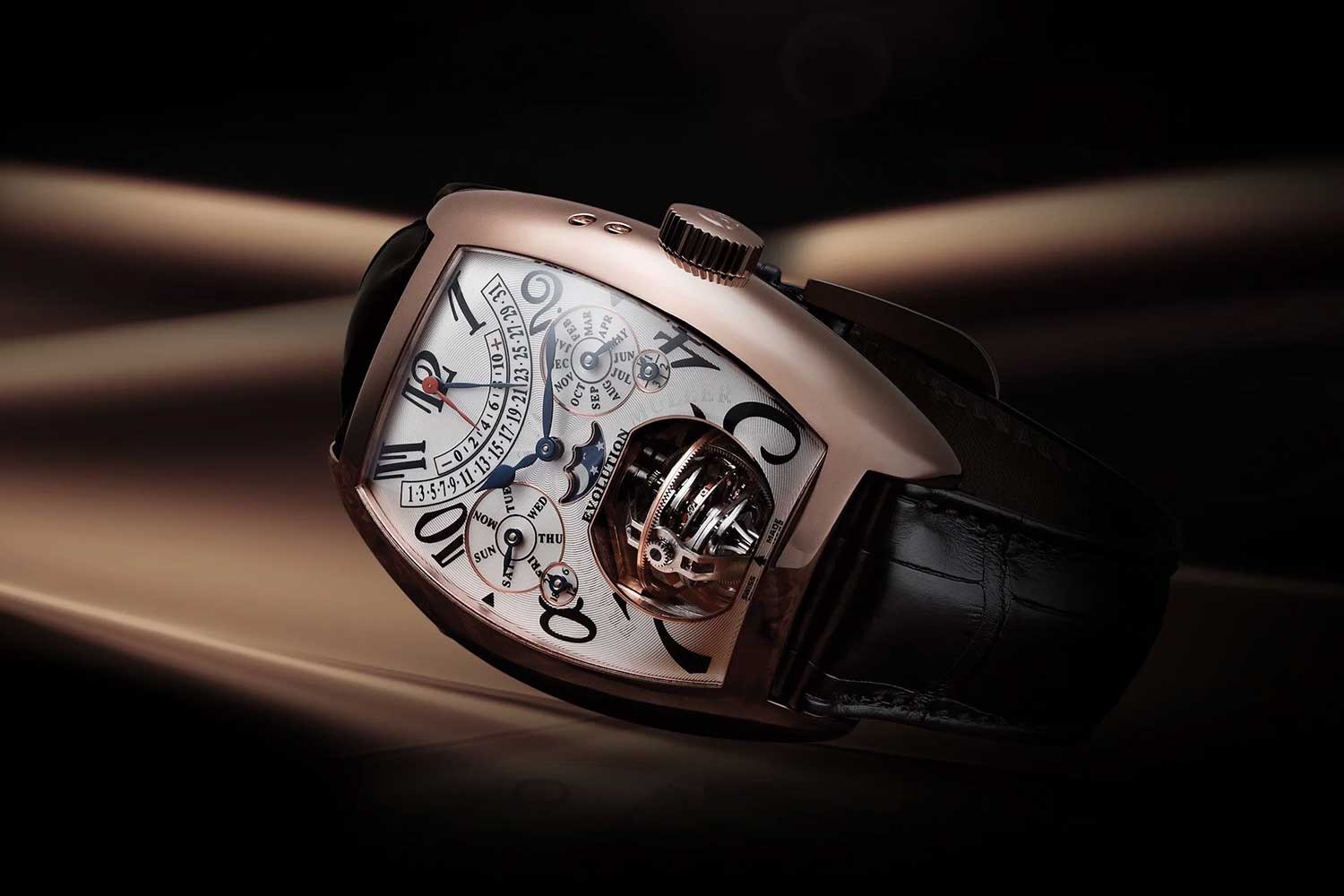
2005: Franck Muller Evolution 3-1
As of this year (2026) the Revolution 3 has since been rehoused in the Vanguard case in skeleton form, visible from both front and back through a hemispherically domed sapphire crystal. The core architecture — three concentric carriages at those specific rotation rates — has remained consistent across all variants.
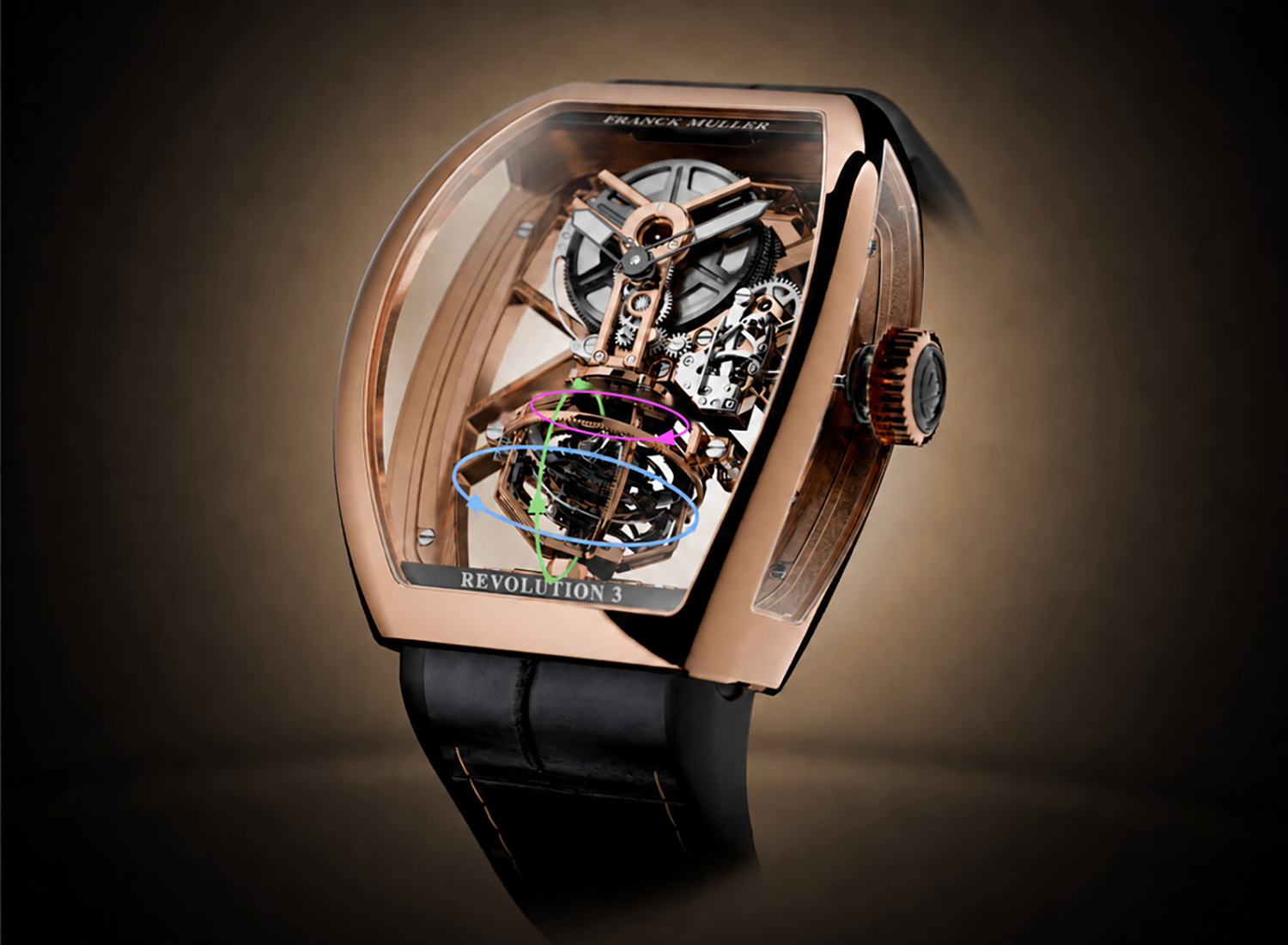
2026: Franck Muller Revolution 3 Skeleton. The tri-axial tourbillon comprises three nested cages rotating about mutually perpendicular axes. Power passes progressively from the outer cage to the middle cage and finally to the innermost cage carrying the balance and escapement, allowing the oscillator to be continuously reoriented in three dimensions. This greatly reduces positional rate variation and makes the watch substantially independent of its orientation relative to gravity
In 2004, after the Revolution 3 was finalised, Navas, Barbasini and Buttet departed Franck Muller to found BNB Concept — the name taken from the initial letters of their surnames — in Crans-près-Céligny near Geneva. BNB rapidly became one of the most significant complications specialists in the industry, growing from four employees at founding to over 230 by 2008. Its clients included Bell & Ross, Jacob & Co., DeWitt and Hublot. Navas and Barbasini exited in 2007 to found La Fabrique du Temps; Buttet continued until BNB’s bankruptcy in 2010, when Hublot absorbed its assets and 29 employees, with Buttet joining as R&D Director. La Fabrique du Temps was acquired by Louis Vuitton in 2011, where Navas and Barbasini continue to create some of the most ambitious complicated movements in the LVMH universe. The diaspora of talent that left Genthod in 2004 went on to reshape multiple corners of the industry. That is the measure of the talent of the A Team that Vartan Sirmakes of Franck Muller had assembled.
The Jaeger-LeCoultre Gyrotourbillons
The Creator: Éric Coudray
Of all the individual watchmakers whose names are attached to the multiple-axis tourbillon, Éric Coudray may be the most fascinating. He lives a reportedly hermetic existence and looks like watchmaking’s Jim Morrison. He is a man who describes his life’s work as “tinkering with metal” and somehow, in so doing, produced some of the most significant mechanisms in modern horology. Born in 1965 in Foncine-le-Haut in the French Jura — a region whose winters, he has cheerfully admitted, made watchmaking attractive primarily because it meant working indoors — Coudray came from a watchmaking family: his father and grandfather were both in the trade. He studied at the École d’Horlogerie in Besançon and then at the Technicum in La Chaux-de-Fonds, qualifying in the restoration of antique watches. After a brief period as a restorer near Paris, he joined Jaeger-LeCoultre in Le Sentier on 3 January 1989.

Éric Coudray
Coudray spent his first years at JLC in the homologation department under Gabriel Locatelli, where his team’s job was to destroy watches — deliberately subjecting prototype movements to extremes of shock, temperature and wear to identify failure modes before series production. It was unglamorous work for someone of his creative temperament, but it gave him something invaluable: an unusually deep understanding of what a movement must survive in practice, not just in theory. Violence, it turns out, was an excellent teacher for Coudray. At the same time rumours of his prodigy-level horological creativity circulated in Le Sentier eventually landing in the ear of a young man named Stephane Belmont.

Stéphane Belmont
In 2001, Belmont, then product and development director at JLC, invited Coudray to breakfast at the Hôtel Bellevue Le Rocheray and asked what he would like to work on if there were no limits. Coudray had kept his idea — a spherical multi-axis tourbillon for the wristwatch — largely to himself, convinced that what interested him would not interest anyone else. Belmont loved the idea and so did his father the brand’s CEO the legendart Henry-John Belmont. Coudray was given a dedicated studio and a small team, and the Gyrotourbillon began in earnest.
The idea had roots going back to watchmaking school, where Coudray had been struck by the same clock created by Anthony Randall that had so profoundly influenced Thomas Prescher. “My idea was not exactly the same, but it’s a similar idea with the same philosophy,” Coudray said. “I thought it would be great to transpose this (Randall’s multi-axis tourbillon) to a wristwatch, but I thought it would be too big. But JLC told me they would create a box around it, and that’s how it happened.” The thread connecting Randall’s English carriage clock to the Gyrotourbillon’s aluminium sphere — across two decades, two countries, and two entirely different technical traditions — is one of the more beautiful continuities in this story.
The movement took nearly three years of intense development and required JLC to implement 3D CAD modelling — then barely established in the Vallée de Joux — to calculate the geometry of parts that had never existed before and could not be verified by traditional methods. Coudray was not alone: the full development team included Thierry Grenier-Boley, André Reymond, Jacques Coulet, and the watch’s designer was 25-year-old Magali Métrailler. But the fundamental concept — the spherical cage architecture, the perpendicular balance mounting, the two-fixed-wheel power transmission — was Coudray’s invention. He was awarded the Prix Gaïa in the Craftsmanship-Creation category in 2012.
The Architecture and Power Transmission
Of the 2004 debuts, the JLC Gyrotourbillon 1 is the most architecturally radical — a complete reinvention rather than an escalation of what already existed. Rather than adapting the conventional tourbillon cage into a multi-axis form, Coudray conceived an entirely new geometry requiring perfect equilibrium in all positions, all new parts, and 3D modelling to calculate components whose shapes simply had no precedent.
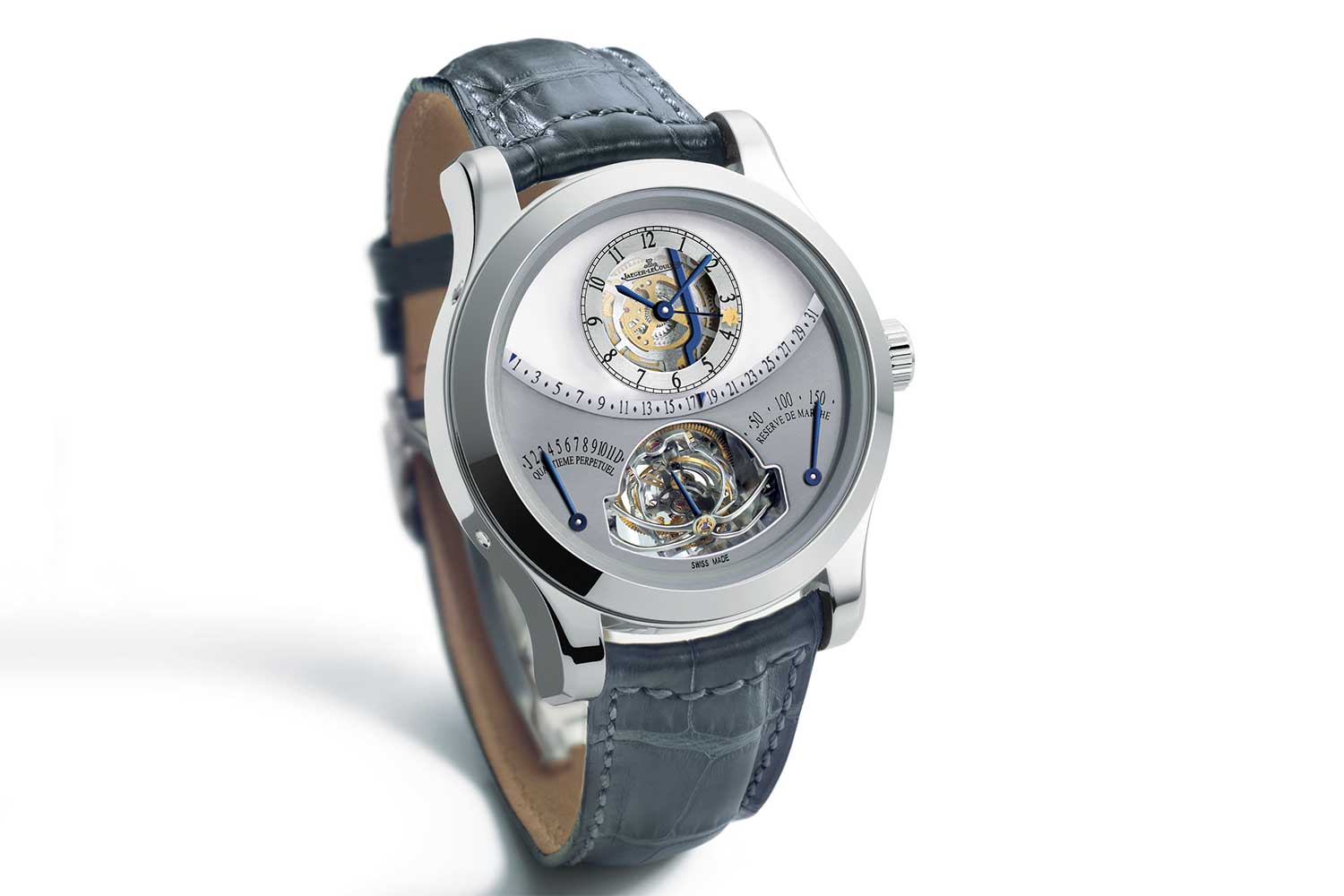
2004: Jaeger-LeCoultre Gyrotourbillon 1
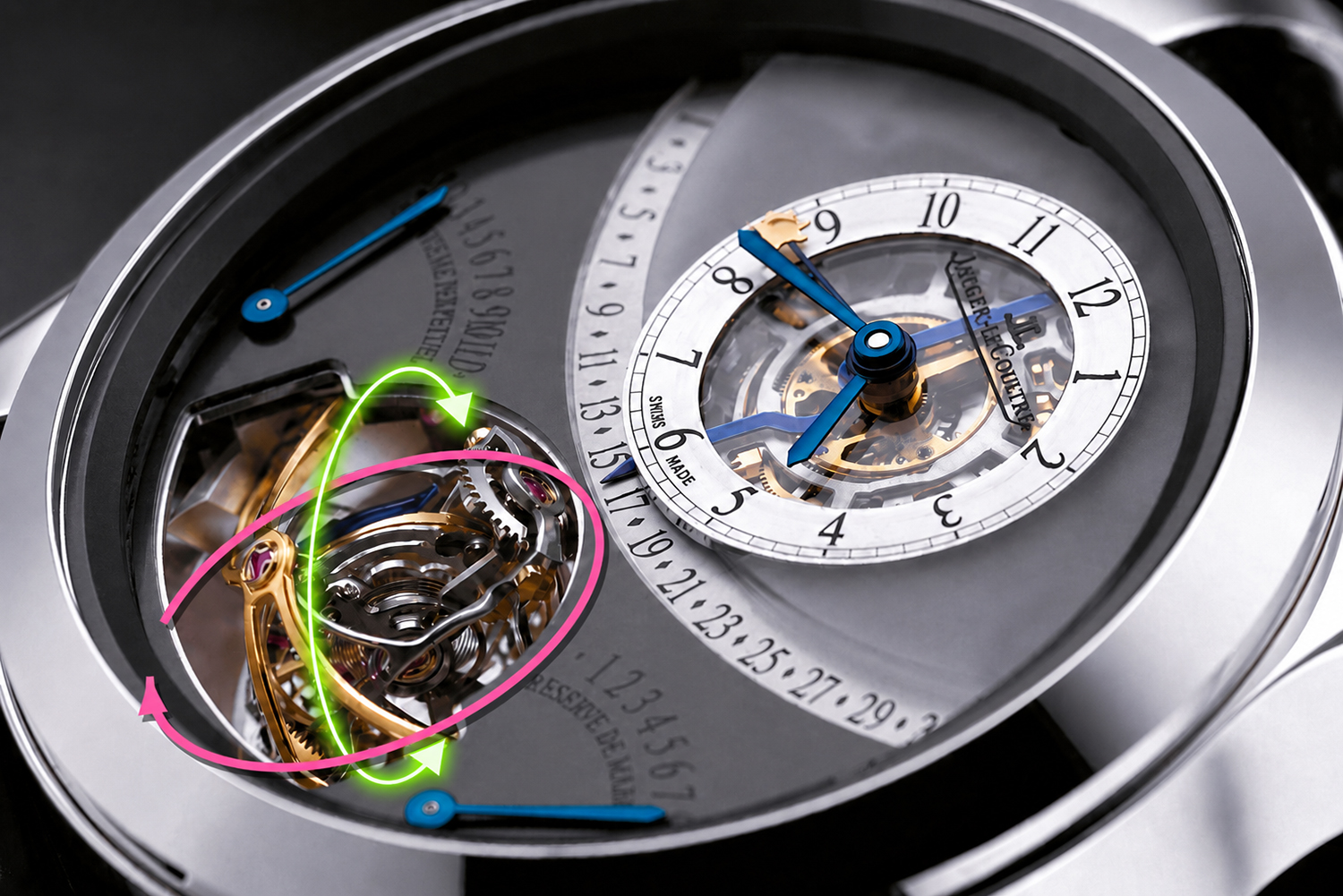
Unlike a conventional multi-axis tourbillon, the balance is mounted perpendicular to the inner cage rather than co-axially with it. At the same time, the inner cage is inclined (30°- 40° preferred according to patent) relative to the movement plate to reduce the height of the movement. These features essentially allow the balance to sample a much larger portion of 3D space than a conventional double-axis tourbillon
The most distinctive feature is the perpendicular balance mounting. Meaning the balance was position perpendicular to the first axis of rotation. In the other tourbillons the balance staff lies on the same axis as the inner cage. In the Gyrotourbillon, as the inner cage turns, the plane of the balance’s oscillation continuously shifts relative to the outer cage; as the outer cage turns, it shifts again relative to the movement plate. The result is a compound spatial motion that theoretically sweeps the oscillator through a far richer positional vocabulary than nested concentric cages alone can achieve.
How Power Reaches the Balance: The Two-Fixed-Wheel System
The fundamental engineering challenge of any multi-axis tourbillon is transmitting energy from stationary mainspring barrels through continuously rotating cages to the escapement. A conventional single-axis tourbillon solves this with one fixed fourth wheel: the cage rotates around it, the escape-wheel pinion orbits the fixed wheel, the escape wheel turns relative to the cage. The Gyrotourbillon required two such fixed wheels, one per axis, arranged in a nested hierarchy.
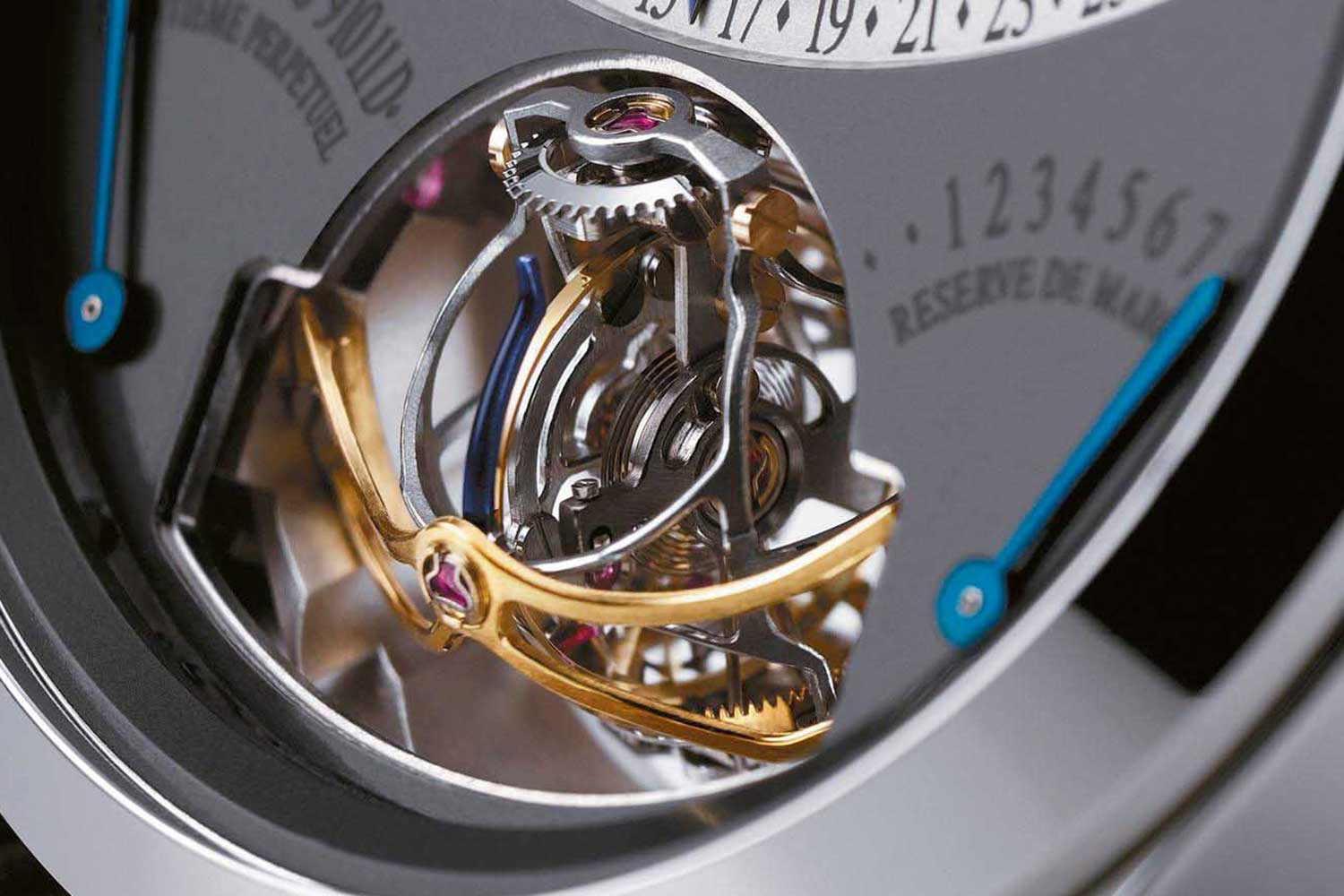
2004: The Jaeger-LeCoultre Gyrotourbillon 1 where the balance is mounted perpendicular to the first cage, allowing the oscillator to shift continuously through space as the two cages rotate on different axes.
Energy from the twin mainspring barrels flows through the conventional going train to the base of the Gyrotourbillon assembly. Here the first fixed wheel, mounted stationary on the movement plate, engages the outer cage. A driving wheel rotates the outer cage around its axis — one revolution per minute. As the outer cage turns, a pinion fixed to it rolls around the stationary first fixed wheel, producing a second derived rotation that drives the inner cage relative to the outer cage. The gear ratio is chosen so that the inner cage completes one revolution every 24 seconds — approximately 2.5 times for each revolution of the outer cage — and crucially in the opposite direction.
The two cages therefore counter-rotate. This is not incidental — it is a deliberate design feature that further diversifies the positional sweep of the balance, ensuring the oscillator does not retrace the same spatial path in a short cycle. Within the inner cage, the escape wheel pinion rotates on a fixed wheel mounted on the outer cage. Every beat of the balance releases the escape wheel, which feeds an impulse back through the pallet fork, maintaining oscillation. Twenty-one thousand six hundred times per hour, across two perpetually rotating cages, through two fixed-wheel gear stages.

In the Jaeger-LeCoultre Gyrotourbillon, the two cages rotate on different axes, creating a constantly shifting spherical motion around the regulating organ. (Video credit: WatchTime)
The entire tourbillon assembly is machined from aluminium to minimise rotating mass. Every gram saved at the periphery of the cage reduces the energy demand on the going train and improves the quality of the impulse delivered to the balance. Despite this, Calibre 177 requires two vertically stacked barrels to supply eight days of power reserve.
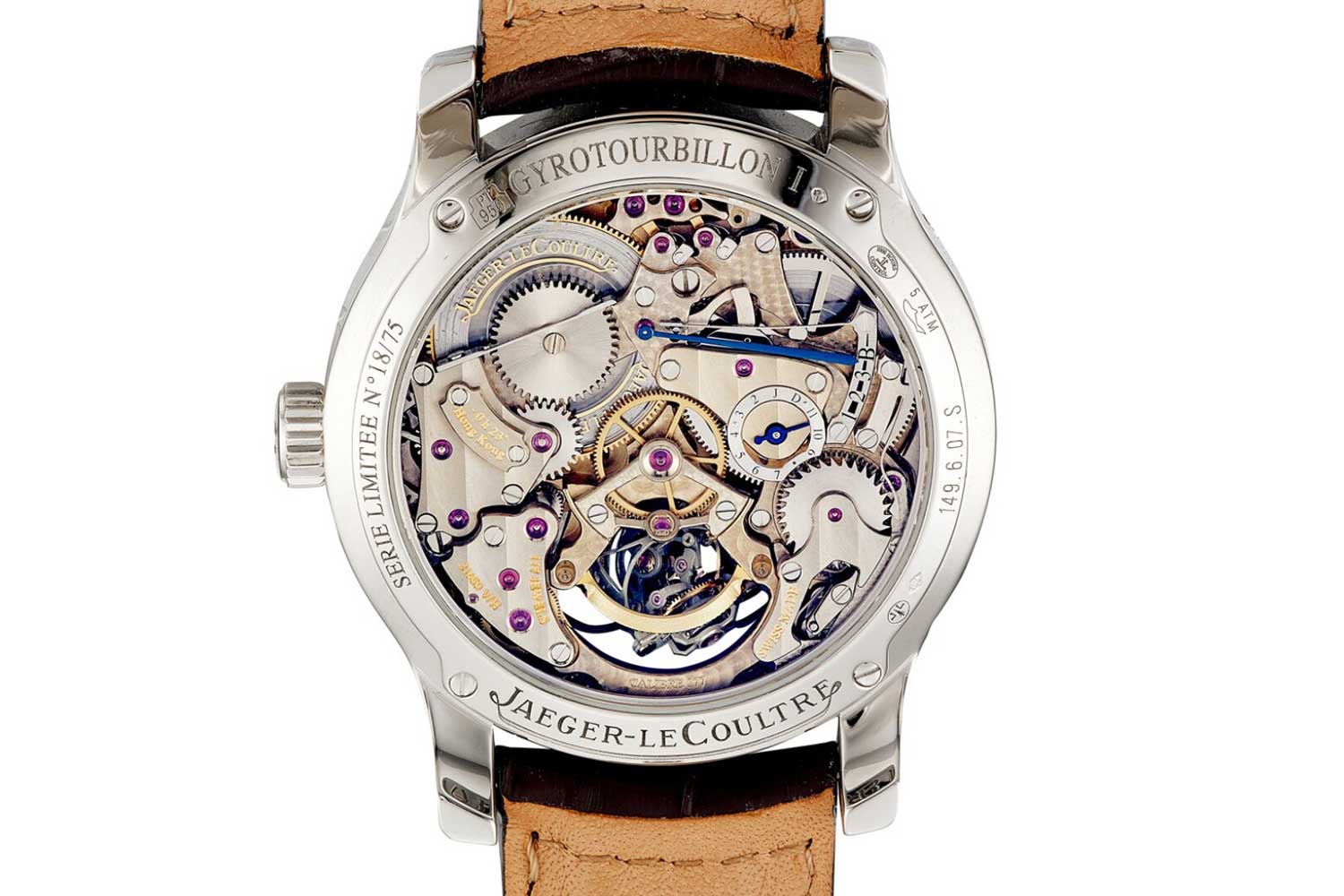
2007: Jaeger-LeCoultre Gyrotourbillon 1 (Image: Sotheby’s)
Jaeger-LeCoultre Gyrotourbillon 1 (Caliber 177) — Key Specifications
- Case: Platinum 950, later also produced in 18K rose gold open-worked versions; 43mm (diameter) × 15mm (thickness)
- Movement: Manual winding
- Total components: 679
- Jewels: 117
- Power reserve: Eight days from two vertically stacked barrels
- Frequency: 21,600vph (3Hz)
- First axis (inner counter-rotating cage): One revolution per 24 seconds; aluminum construction
- Second axis (outer cage): One revolution per 60 seconds; aluminum construction
- Balance spring: Flat
- Positional coverage: Approximately 70 percent of all positions
- Additional complications: Perpetual calendar with four retrograde hands (month, leap year, two date hands), equation of time, power reserve indication
- Production: Initial platinum run of 75 pieces; later 30 open-worked rose gold examples (2012)
- Price: EUR 290,000 at 2004 launch
The Gyrotourbillon 1 won the Technical Innovation and Complication Watch Prize at the Grand Prix d’Horlogerie de Genève in November 2004. Production remained limited throughout its run at approximately 20 units per year.
Over the years Jaeger-LeCoultre has created several different versions of the Gyrotourbillon. In 2008 it introduced the Gyrtourbillon 2 Hybris Mechanica Calibre174 conceived to fit a Reverso case and featuring a helical balance spring. 2013 saw the launch of the Gyro 3 Calibre 176, which was the first flying Gyrtourbillon and now featuring a spherical hairspring. In 2016 JLC created the Gyro 4 which accelerated the rotational speed of the first cage to 16 seconds. In 2019 the Gyrotourbillon was combined with a Westminster Chime minute repeater, perpetual calendar and remontoire d’egalite.
-
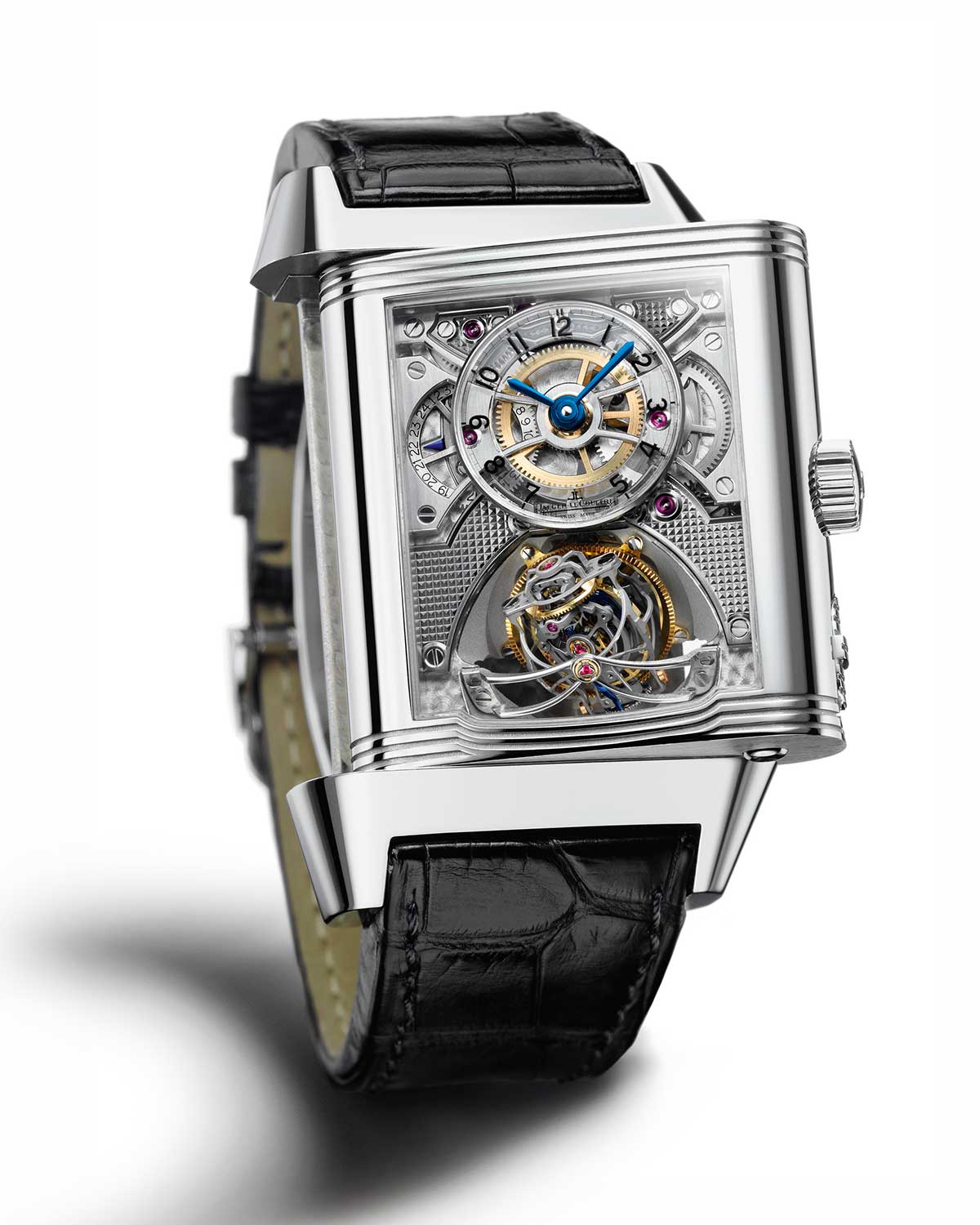
- 2008: Jaeger-LeCoultre Reverso Hybris Mechanica Calibre 174 (Gyrotourbillon 2)
-
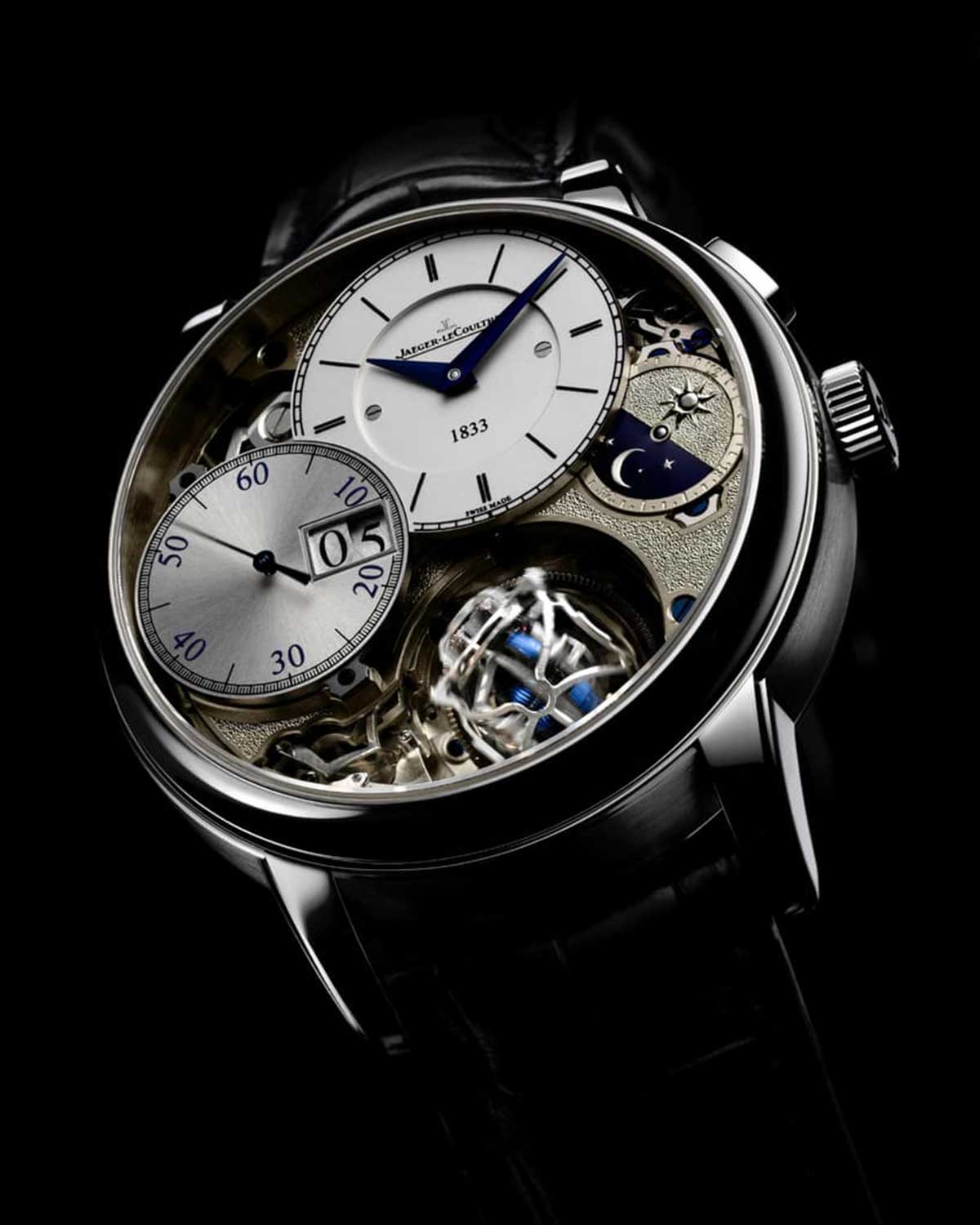
- 2013: Jaeger-LeCoultre Master Hybis Mechanica Calibre 176 (Gyrotourbillon 3)
-
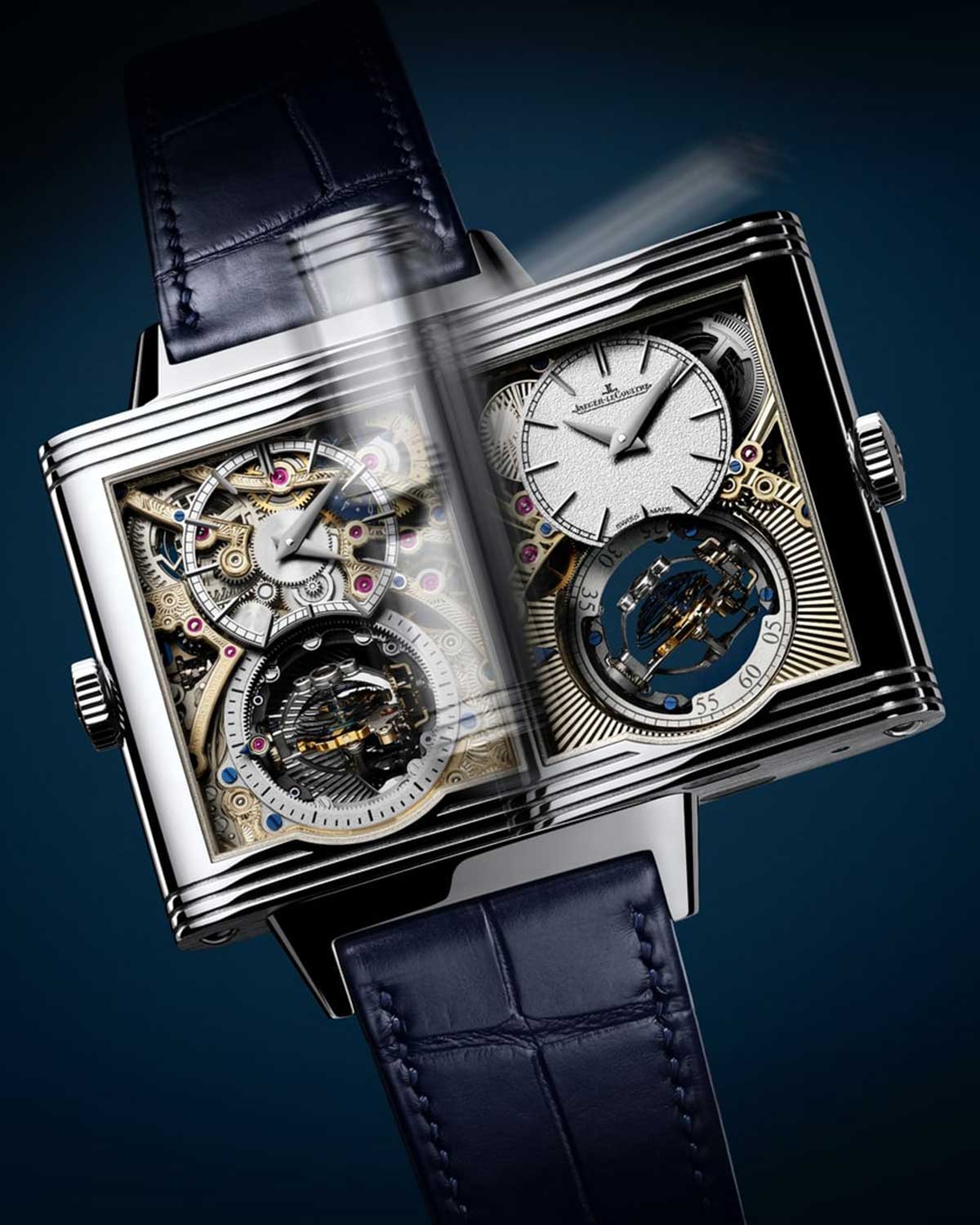
- 2016: Jaeger-LeCoultre Reverso Hybris Mechanica Clibre 179 (Gyrotourbillon 4)
-
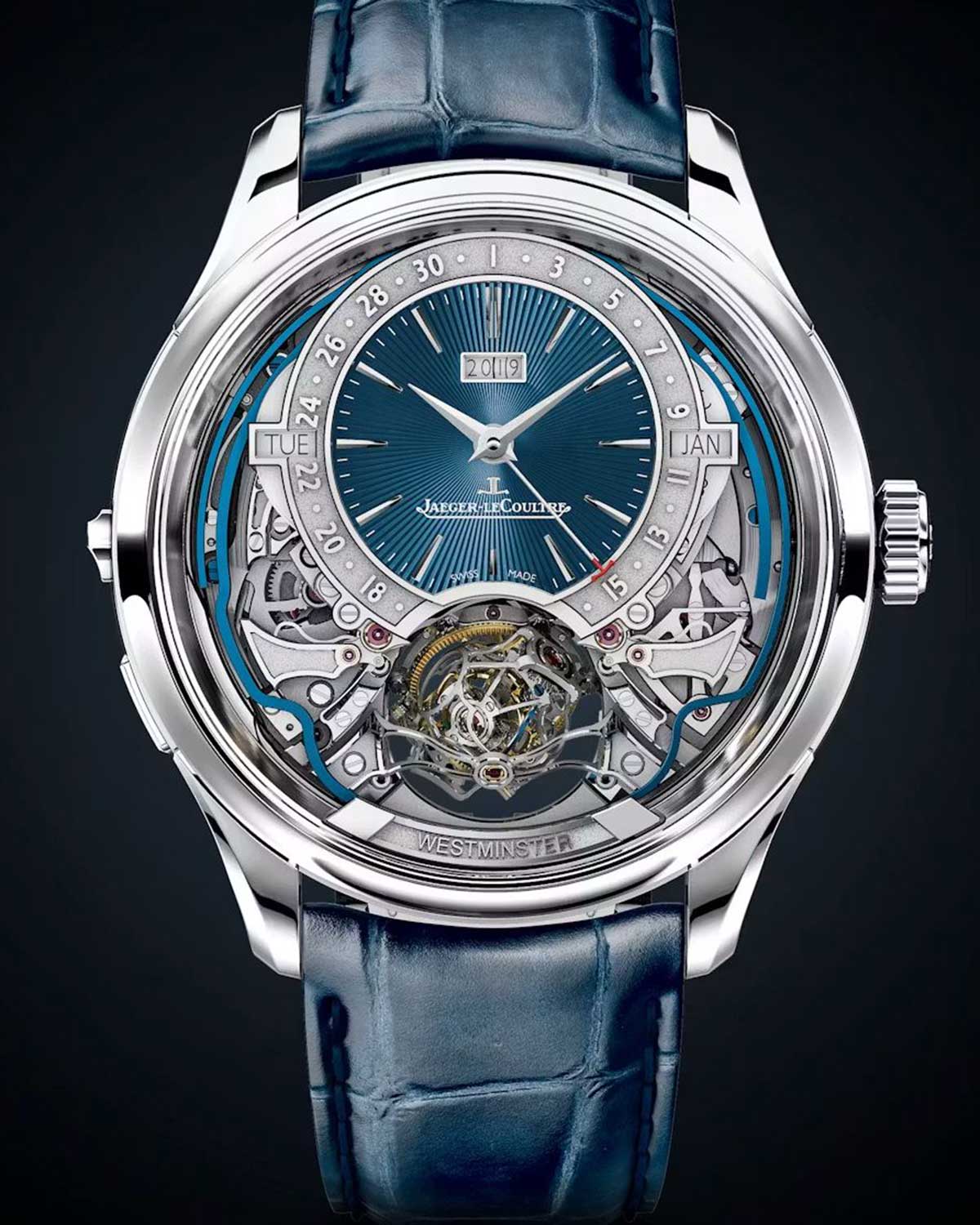
- 2019: Jaeger-LeCoultre Master Grande Tradition Gyrotourbillon Westminster Perpétuel (Calibre 184)
This year Jaeger LeCoultre has launched the spectacular Gyrotourbillon Stratosphere which adds a third rotational axis to the mix. Revolution’s technical editor Cheryl Chia explains that this allows the balance to sweep through a complex spatial trajectory exposing it to nearly all possible orientations in 3D space- 98 percent as opposed to 70 percent for the original Gyro. Thankfully the new Gyro Strasophere belongs to the newly created Hybris Inventica family which focus on just one single innovation combined with the maison’s dexterity with metiers d’art allowing the full focus to be concentrated on this remarkable achievement rather than combining it with complications.
You can read Chia’s story about the watch here.
The Greubel Forsey Multi-Axis Tourbillons
2004: The Double Tourbillon 30°
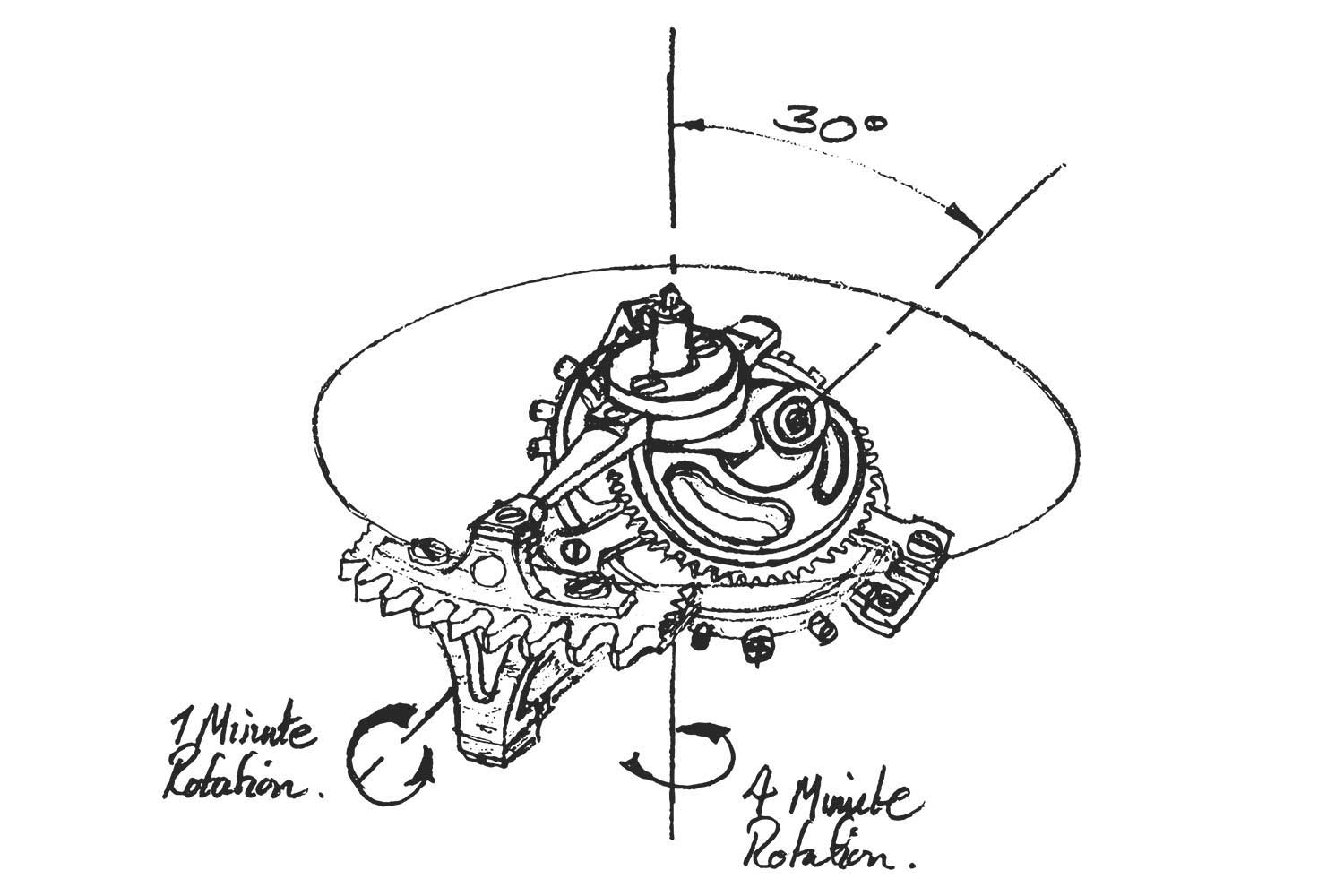
In 2004 Frenchman Robert Greubel and English watchmaker Stephen Forsey unveiled their much anticipated first timepieces. And the Double Tourbillon 30 Degree immediately proclaimed the full intent of the duo to craft meaningful advancements to real watchmaking while also achieving the what can only be described as the highest level of finishing to ever exist in series made watchmaking. What do I mean by meaningful watchmaking? I mean that Greubel Forsey were reconnected watchmaking with its 18th century roots by trying to wring the last ounce of accuracy our of an anachronistic but profoundly beautiful mechanical system. They decided to do this by creating a tourbillon that like Prescher and Coudray’s would adopt a far greater number of positions in space. Where the other 2004 debuts pursued the logic of mutiple axis positioned perpendicular to each other, Robert Greubel and Stephen Forsey took a different approach entirely. They designed a system of two distinct tourbillon cages, one nested inside the other, with the inner cage inclined at a precise angle of 30 degrees to the outer. This inclination is not arbitrary: it is calculated so that the inner tourbillon’s balance staff spends the minimum possible time in the fully horizontal or fully vertical positions where rate deviation is greatest.
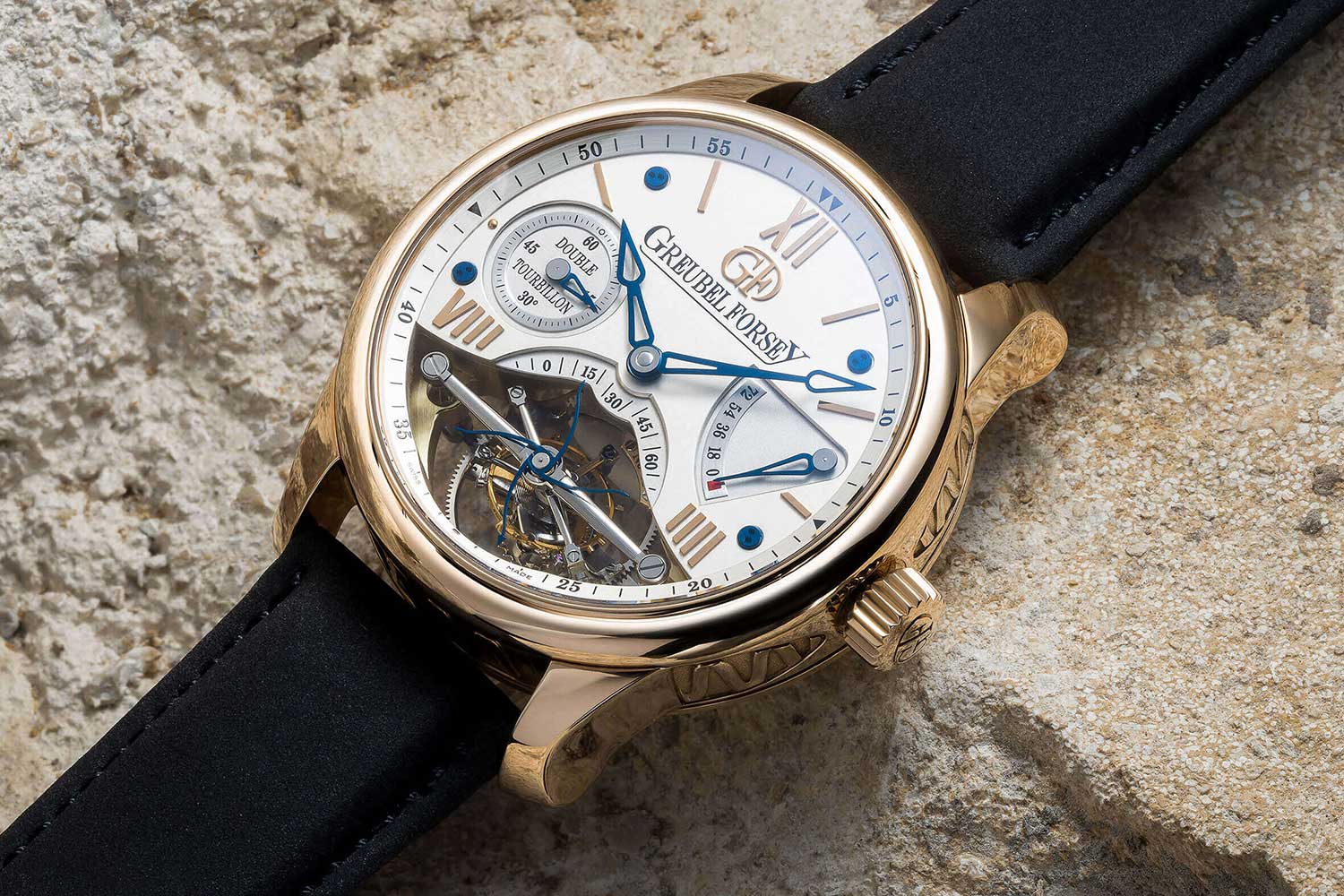
2004: Greubel Forsey Double Tourbillon 30°
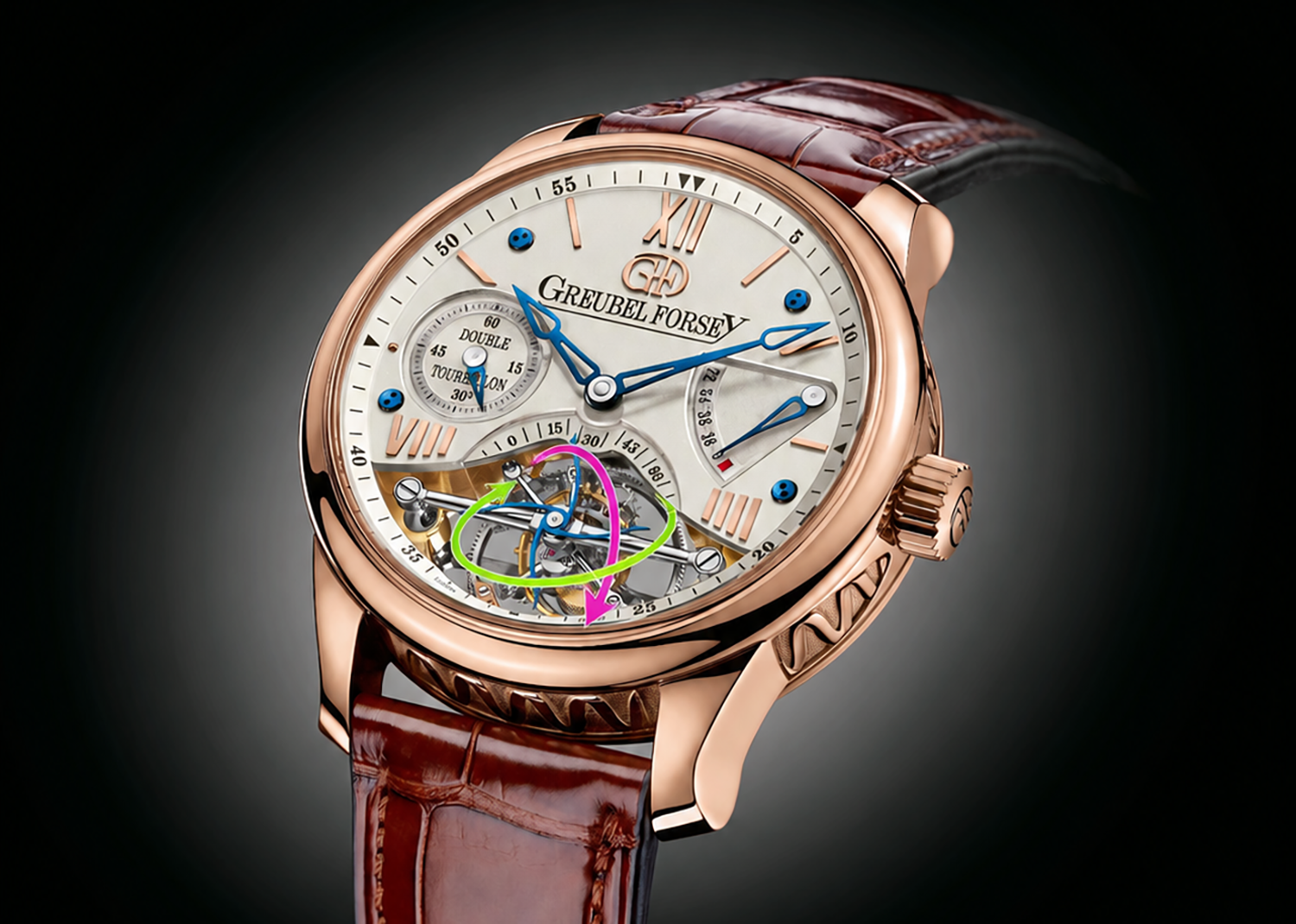
By mounting the tourbillon at a 30° angle and in an outer cage that rotates on the same plane of the movement, a large balance could be used while keeping the case at a reasonable height. At the same time, tilting the balance off the vertical plane avoided the most extreme gravitational effects while still correcting for a second axis of movement
The specification of Calibre GF02 reflects the complexity of the architecture:
Greubel Forsey Double Tourbillon 30° (Caliber GF02) — Key Specifications
- Case (Edition Historique, 2010): Platinum 950 and 18K red gold; 44.5mm (diameter) × 16.1mm (thickness)
- Movement: Manual winding; 36.4mm × 9.65mm
- Total components: 304 (128 parts just for the tourbillon)
- Jewels: 39
- Power reserve: 72 hours
- Frequency: 21,600vph (3Hz)
- First axis (inner inclined cage): One revolution per 60 seconds; inclined at 30°
- Second axis (outer cage): One revolution per 4 minutes
- Functions: Hours, minutes, small seconds and power reserve indicator
- Finishing: Signature Greubel Forsey hand finishing throughout, including black polished steel components and conical polished arms
- Price: CHF 460,000 in red gold; CHF 500,000 in platinum
Their rationale was that the chances of the watch resting at precisely 30 degrees — the one position where the balance staff would be perfectly vertical — are drastically reduced by the natural resting position on a nightstand or any horizontal position where modern timepiece with ardillon buckles spend the vast majority of their time. The inner tourbillon turns once per minute, carrying the escapement, sitting at that critical 30-degree angle to ensure the oscillator experiences a balanced exposure to gravity through its full 360 degrees of travel. The Double Tourbillon 30° went through multiple iterations — the Contemporain Vision (2004), the Technique (skeletal, showcasing the finishing), the Asymétrique (repositioning the cage), and the Edition Historique (a limited commemorative closing the line in 2010). Each evolution refined the aesthetic without ever touching the core mechanical proposition.
2008: The Quadruple Tourbillon à Différentiel Sphérique
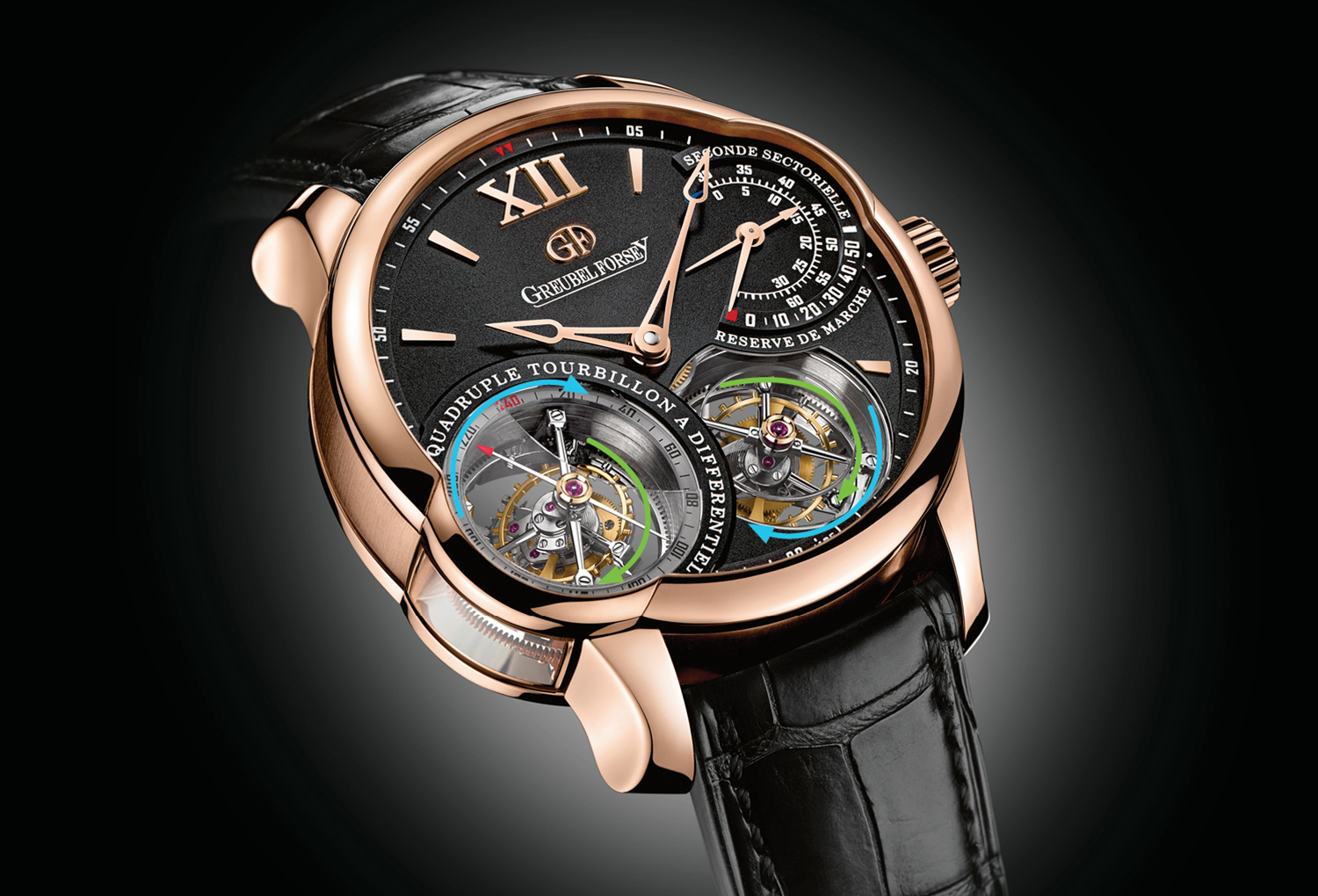
The Quadruple Tourbillon, introduced in 2005 (patented 2004), represents not an escalation of axis count but a totally different approach. The concept begins with their foundational Double Tourbillon 30° architecture. Rather than adding a third axis, Greubel and Forsey duplicated the entire system wholesale. The Quadruple Tourbillon houses two complete Double Tourbillon 30° mechanisms side by side within a single movement — four tourbillon cages in total, each pair sharing the same nested 30°-inclined inner cage rotating in 60 seconds within a level outer cage rotating in four minutes. Critically, the two Double Tourbillon systems are not simply placed side by side in the same orientation — they are inverted relative to each other. One system is mounted with the top of its tourbillon assembly facing the dial; the other is flipped 180 degrees, with its top facing the case back. The two mechanisms are therefore mirror images in their vertical orientation, each presenting the 30°-inclined inner cage to gravity from an opposing direction at any given moment. This inversion is not architectural flourish — it is mechanically deliberate, ensuring that the gravitational errors generated by each pair of cages are phase-offset against each other as completely as possible, maximising the error-cancellation that the spherical differential then distils into a single averaged output.
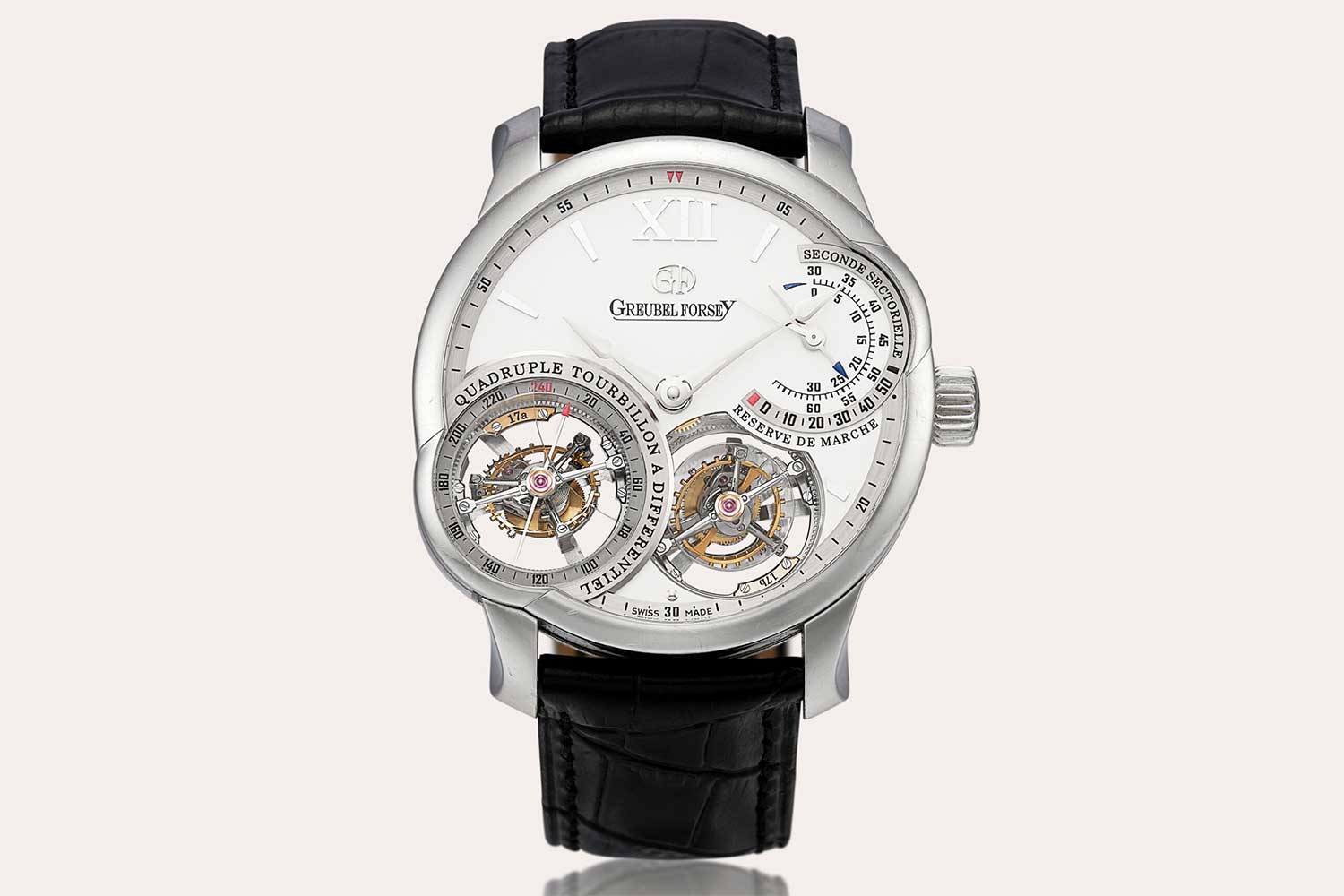
2008: Greubel Forsey Quadruple Tourbillon à Différentiel Sphérique (Image: Sotheby’s).
The Spherical Differential: How It Works
The spherical differential is the mechanism that makes the Quadruple Tourbillon coherent rather beyond its mechanically extravagant. Comprising 28 individual parts, it functions on the same principle as an automobile differential — distributing torque between two outputs while allowing them to rotate at different speeds. It divides one input equally into two outputs, and at the same time combines two inputs (the rate outputs of the two Double Tourbillon systems) and extracts their arithmetic mean as the single output that drives the time display. If one gains two seconds per day and the other loses two — because they are presenting to gravity in opposing orientations — the differential outputs exactly zero deviation.
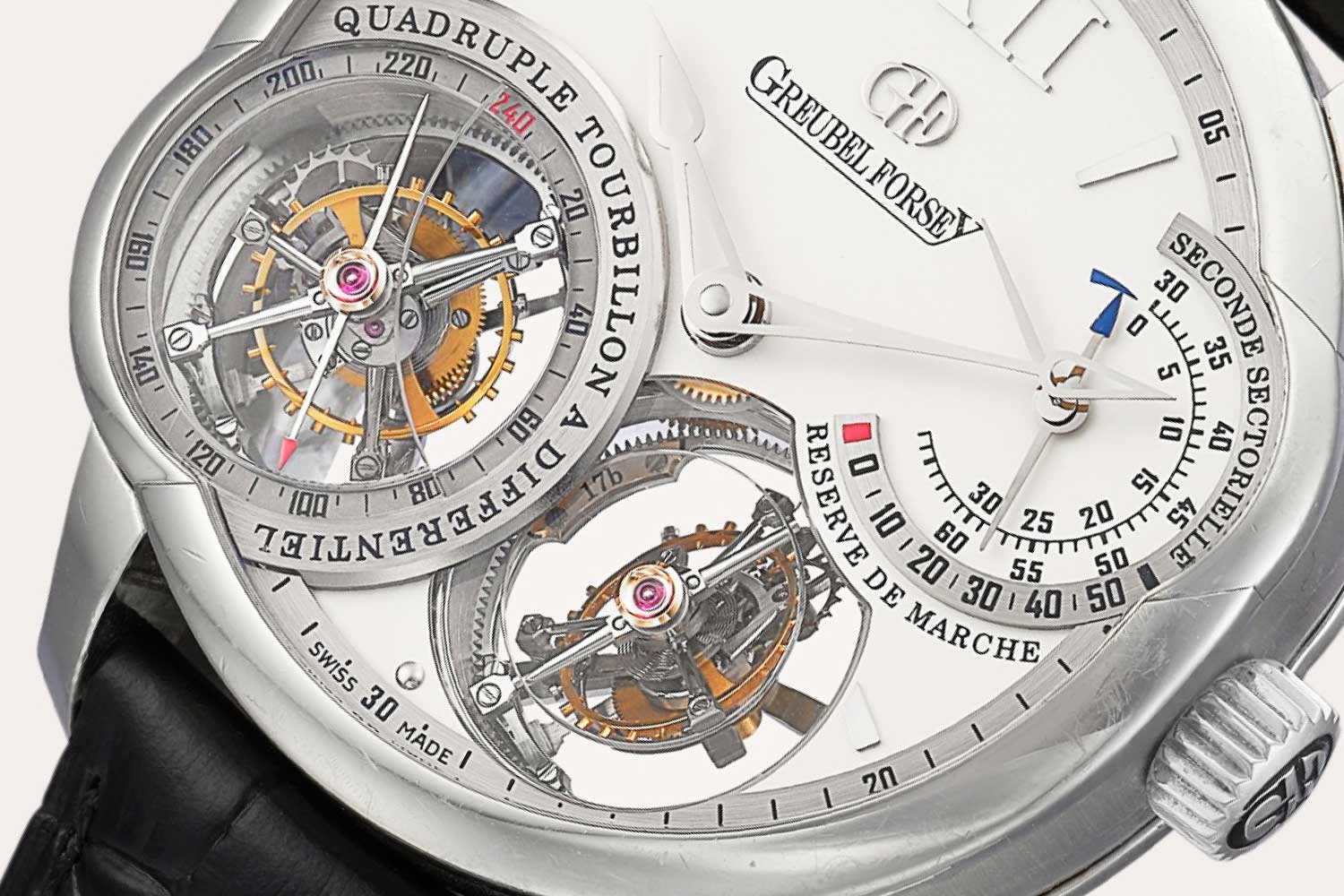
2008: Greubel Forsey Quadruple Tourbillon à Différentiel Sphérique (Image: Sotheby’s). The outer cage is directly driven by the differential. The fourth wheel drives a central shaft carrying a planet carrier and a bevel satellite pinion. The satellite meshes simultaneously with two identical bevel gears, each connected to the outer cage of one tourbillon. As the shaft rotates continuously, it carries the satellite around with it, transmitting power equally to both tourbillons. At the same time, the differential averages the rotational speeds of the two oscillators before transmitting the result to the motion works
The Movement Architecture and Specifications
The movement is a feat of three-dimensional architecture in its own right. The two Double Tourbillon systems are arranged asymmetrically across the dial, transparent sapphire tourbillon bridges chosen specifically to allow unobstructed visual access to all four cages simultaneously. The aerial ballet of four tourbillon axes spinning at different rates and orientations — inverted, asynchronous, perpetually in motion — is one of the great visual spectacles in watchmaking.
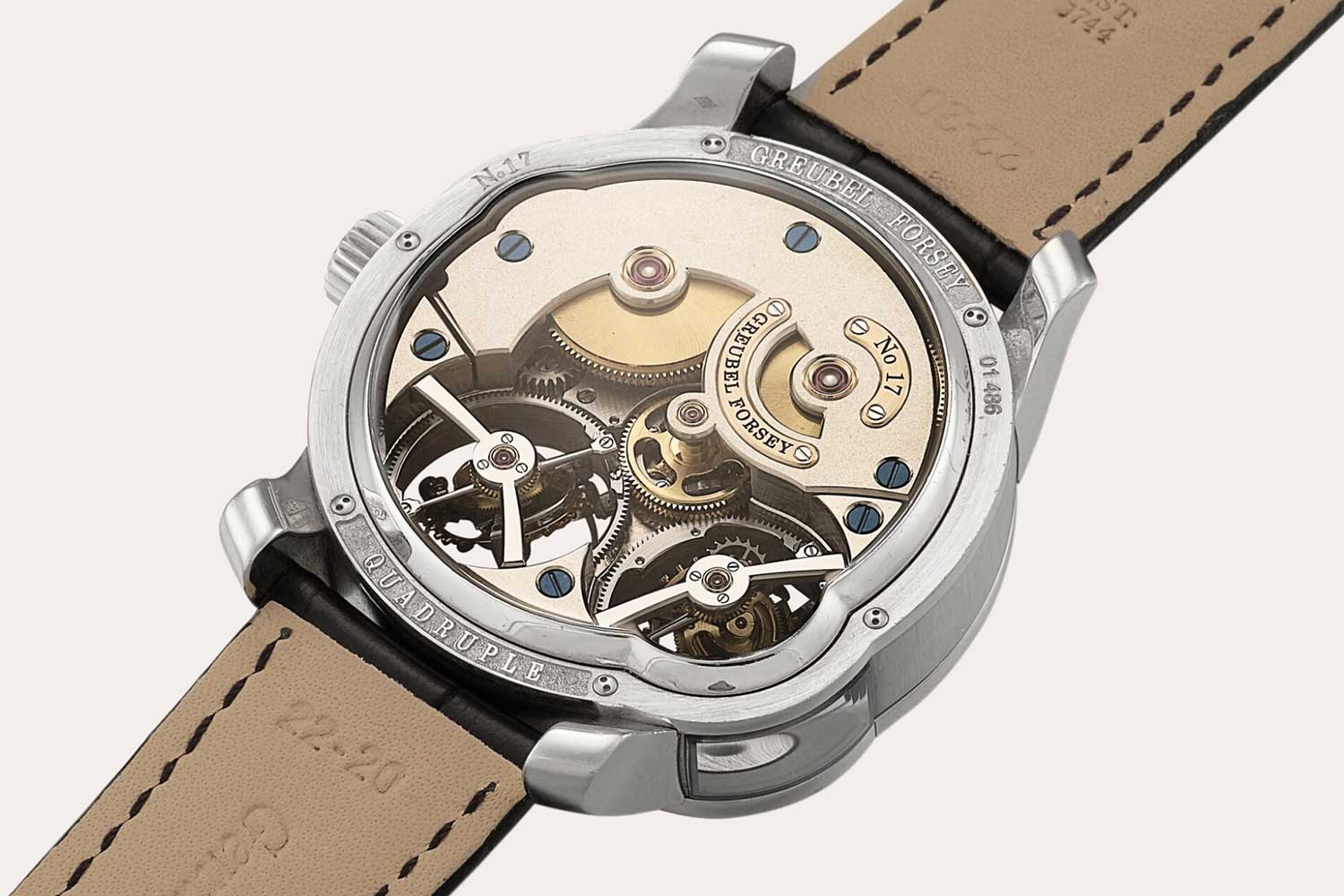
2008: Greubel Forsey Quadruple Tourbillon à Différentiel Sphérique (Image: Sotheby’s)
Greubel Forsey Quadruple Tourbillon à Différentiel Sphérique (Caliber GF03) — Key Specifications
- Case (original): 950 Platinum, 18K red gold or titanium; 43.5mm (diameter) × 16.11mm (thickness)
- Movement: Manual winding; 36.4mm × 9.7mm
- Total components: 531 (128 parts for each double tourbillon cage assembly, and 28 parts for spherical differential)
- Jewels: 63, set in olive-domed gold chatons
- Power reserve: 50 hours from twin fast-rotating barrels (each completing one revolution per 3.2 hours); one barrel fitted with a slipping spring
- Frequency: 21,600vph (3Hz)
- Balance wheel: Free-sprung with white gold mean-time screws; 10.7mm (diameter)
- Balance spring: Flat, with Phillips terminal curve and Geneva-style stud
- First axis (inner inclined cage): One revolution per 60 seconds; inclined at 30° (× 2 systems)
- Second axis (outer cage): One revolution per 4 minutes (× 2 systems)
- Weight of each double-tourbillon cage assembly: 1.17 grams
- Functions: Hours, minutes, small seconds and power reserve indication
- Mainplates: Nickel silver with nickel-palladium finish, hand beveling, straight-grained flanks, polished countersinks
- Tourbillon bridges: Black polished steel, hand beveling, polished countersinks; four in total
The fast-rotating twin barrels deserve particular mention. Where a conventional barrel completes one revolution in eight to twelve hours, the Quadruple Tourbillon’s barrels turn once every 3.2 hours — keeping the mainspring operating in the middle of its torque curve throughout the power reserve, delivering a more consistent driving force to all four cages. One barrel is fitted with a slipping spring: at full wind, rather than stressing the entire gear train, it allows a slight slip that prevents the over-tension that would degrade isochronism. It is the kind of detail that no one would ever see, and that Greubel Forsey insists upon anyway.
Variants and Evolution
The Quadruple Tourbillon à Différentiel Sphérique has appeared in multiple forms since 2005. The Quadruple Tourbillon Secret (2009) reversed the visual logic entirely: the tourbillons are hidden from the dial side and visible only through the case back — a deliberately provocative inversion of the usual display hierarchy that asks the collector to seek rather than merely receive. The Invention Piece 2 presented the two Double Tourbillon systems in their inverted positions, revealing both faces of each cage simultaneously through an open-heart architecture.
-
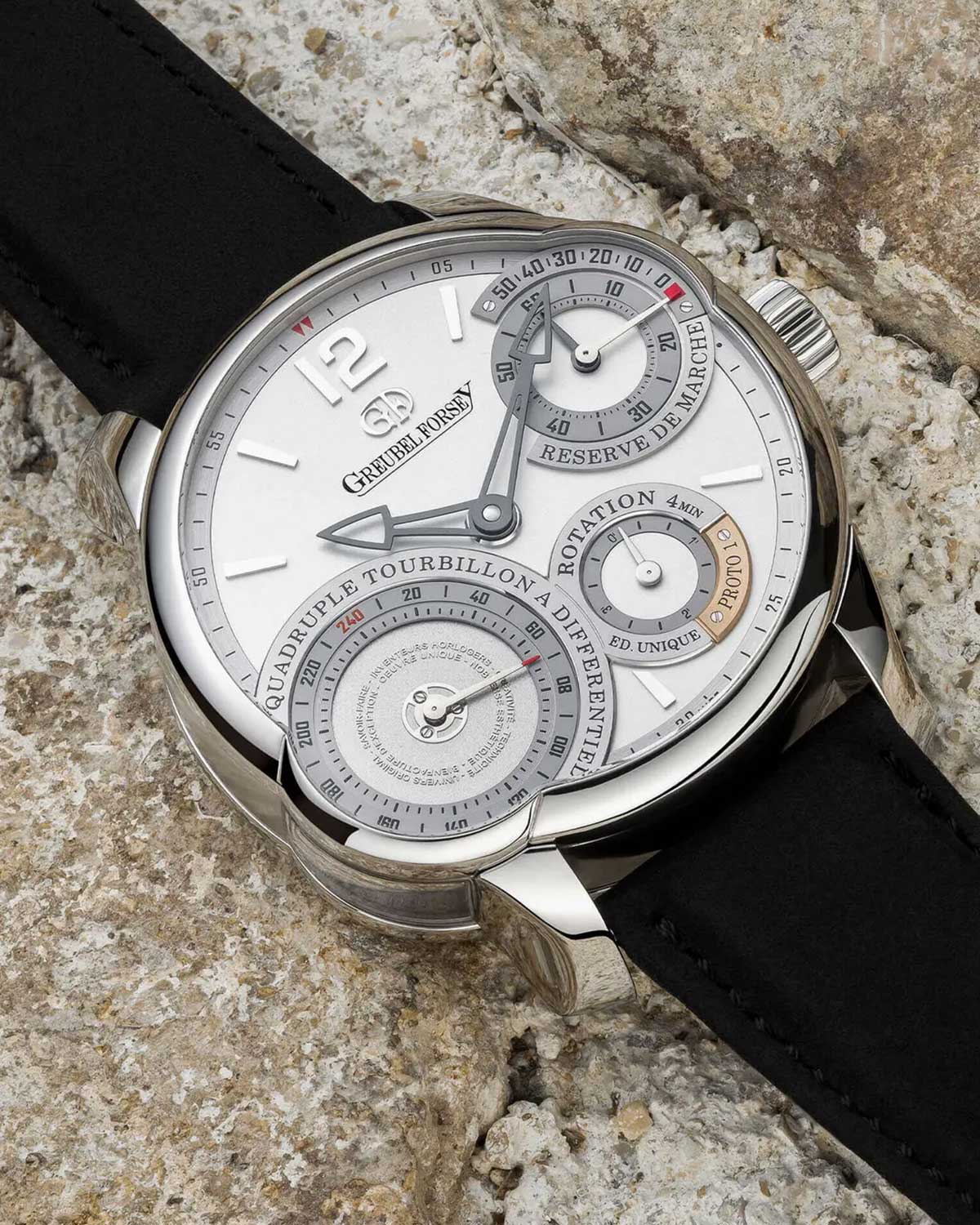
- 2012: Greubel Forsey Quadruple Tourbillon Secret
-
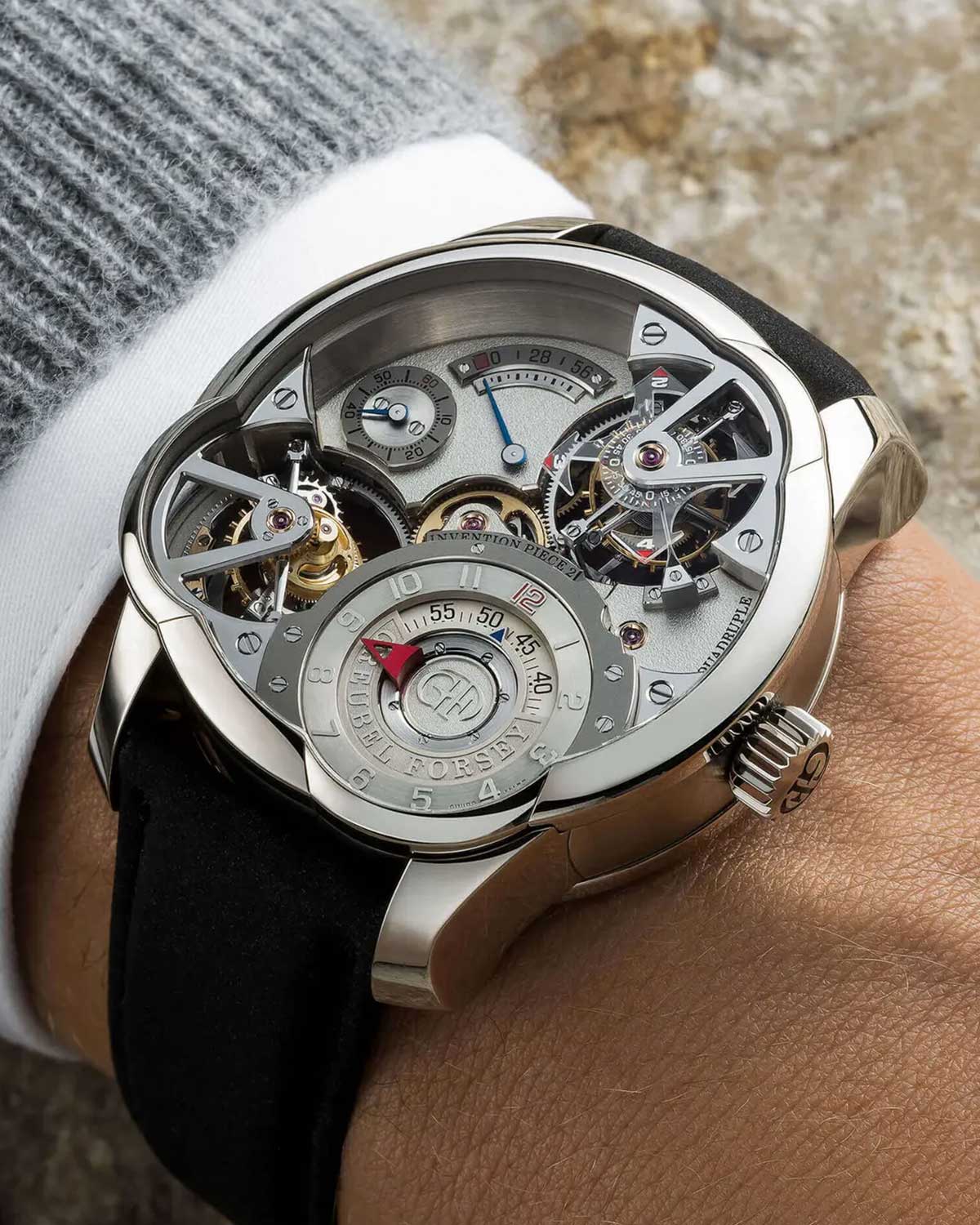
- 2011: Greubel Forsey Invention Piece 2
The GMT Quadruple Tourbillon (first shown 2011, titanium edition 2021) is arguably the most complex expression of the architecture — combining the four tourbillons and spherical differential with Greubel Forsey’s celebrated rotating terrestrial globe, a titanium sphere that turns once every 24 hours, displaying universal time on the dial via a 24-hour ring around the equator and 24 major cities with daylight saving time indicators on the case back. Eight hundred and five components, three fast-rotating barrels, 72 hours of power reserve.
-
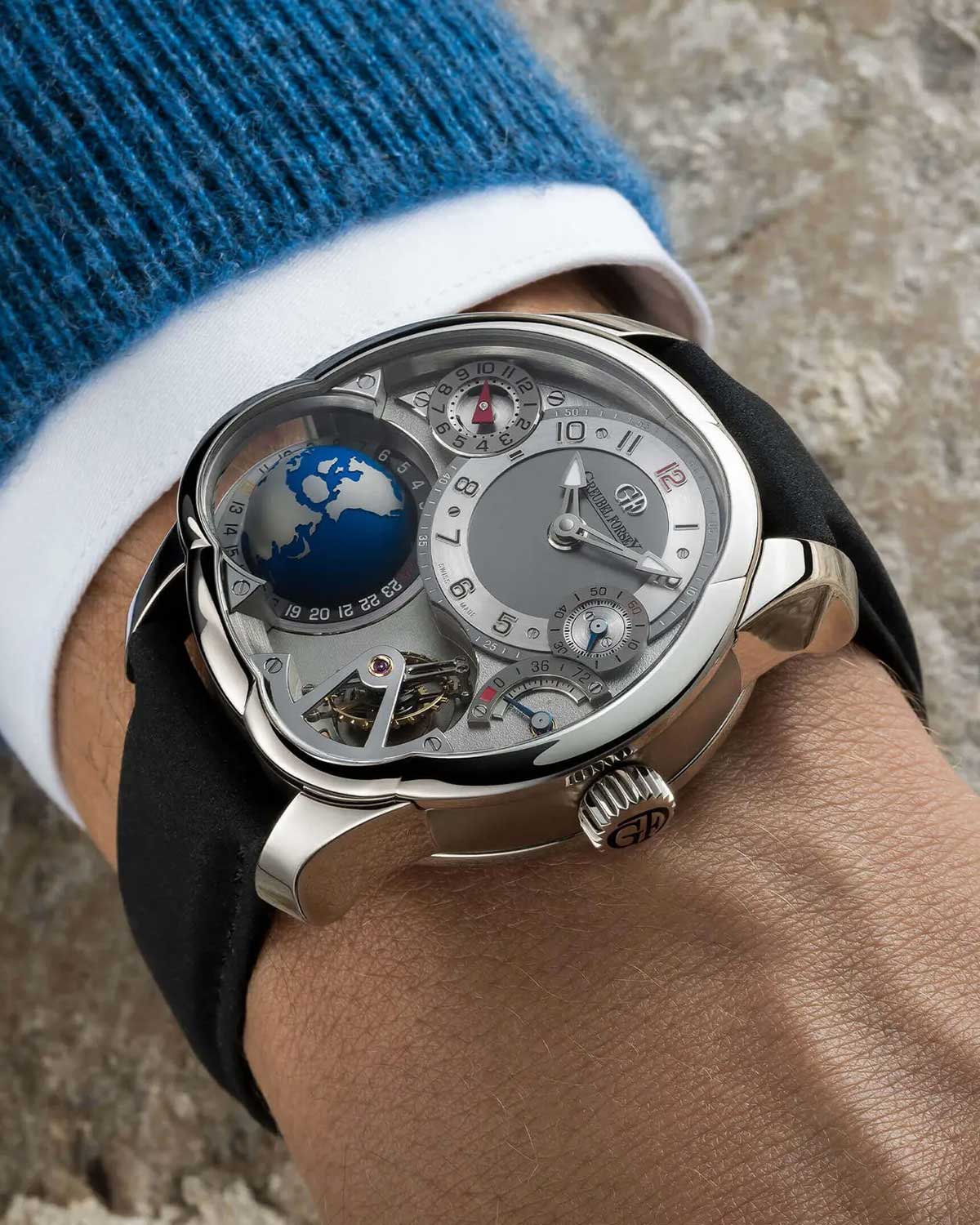
- 2011: Greubel Forsey GMT Quadruple Tourbillon
-
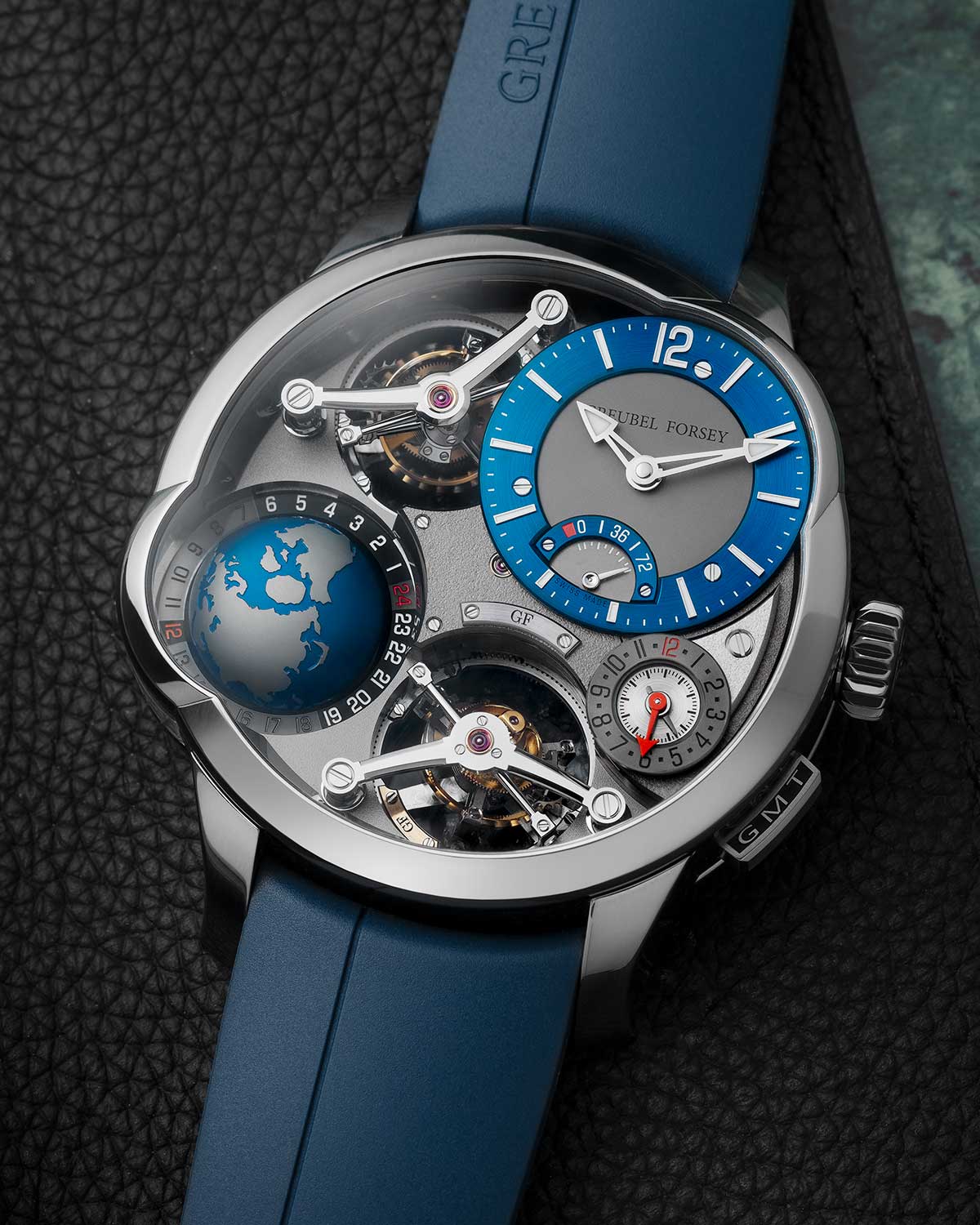
- 2021: Greubel Forsey GMT Quadruple Tourbillon Titanium Edition
The Second Generation: New Voices, New Visions
If 2004 was the year the multiple-axis tourbillon announced itself to the world through four near-simultaneous landmark debuts, the decade that followed saw the idea ripple outward — absorbed, reinterpreted, and in several cases radically reinvented by a new cast of watchmakers. Some were independents working alone at the bench in cities far from the Vallée de Joux. Others were the creative directors of small brands built around a single animating vision. What unites them is an understanding that the multi-axis tourbillon had become not merely a technical specification but a creative medium — and that the question of what to do with it was as much an artistic as an engineering one.
Aaron Becsei
2008: The Bexei Primus
Among the most remarkable stories in independent watchmaking of the past two decades is that of Aaron Becsei, a third-generation watchmaker from Budapest, Hungary, who built his first wristwatch at the age of 29 — and made it a triple-axis tourbillon. And by “made,” I mean even down to the milling and finishing of his own case. That this feat was accomplished by a single person, working alone in a workshop in Budapest with no manufacture behind him, places it in a category shared by only a handful of watchmakers in history. Becsei’s family had been in horology for three generations. His father and grandfather were respected restorers and repairers of fine vintage watches and clocks in Hungary — a country where high mechanical watch manufacturing had not been practiced for over a century. From childhood, Becsei was immersed in movements, helping at the bench, learning to see how things worked and how to fix them when they did not. Unlike his predecessors, however, he felt the pull not to restore but to create. He trained formally in watchmaking and then studied CAD/CAM engineering at the School of Technical Sciences in Budapest — a combination of hand skills and computational design thinking that would prove essential to what followed. His graduation thesis on a tourbillon clock was awarded a prize by the Chamber of Engineering. In 2005, he was admitted to the Académie Horlogère des Créateurs Indépendants (AHCI) as a candidate; by 2009, he had been elected a full member.

Aaron Becsei
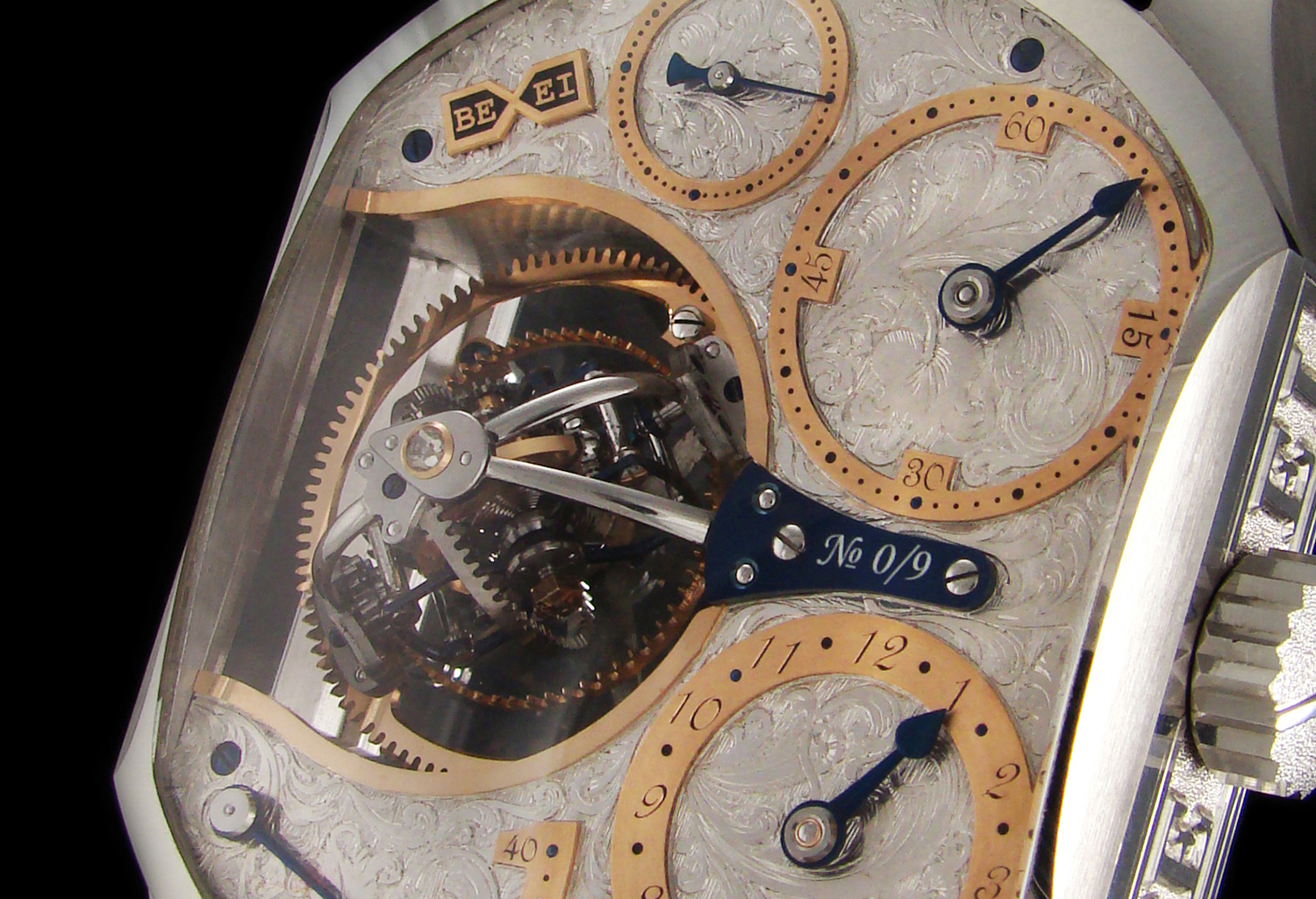
The Bexei Primus — he named his brand after the English pronunciation of his name — was conceived in the first quarter of 2006 and presented at Baselworld 2008. Becsei spent approximately six months on the design alone — every gear, wheel, pinion, bridge, plate, case, crown and buckle was drawn by hand and later produced entirely in his Budapest workshop. The only parts he did not make himself were the mainspring, hairspring, jewels and sapphire crystal. Every other component — including the dial, case parts and hands — came from his bench. The tourbillon cages, requiring parts so small they demanded microscope-assisted machining and assembly, took well over a year to develop and get running reliably.
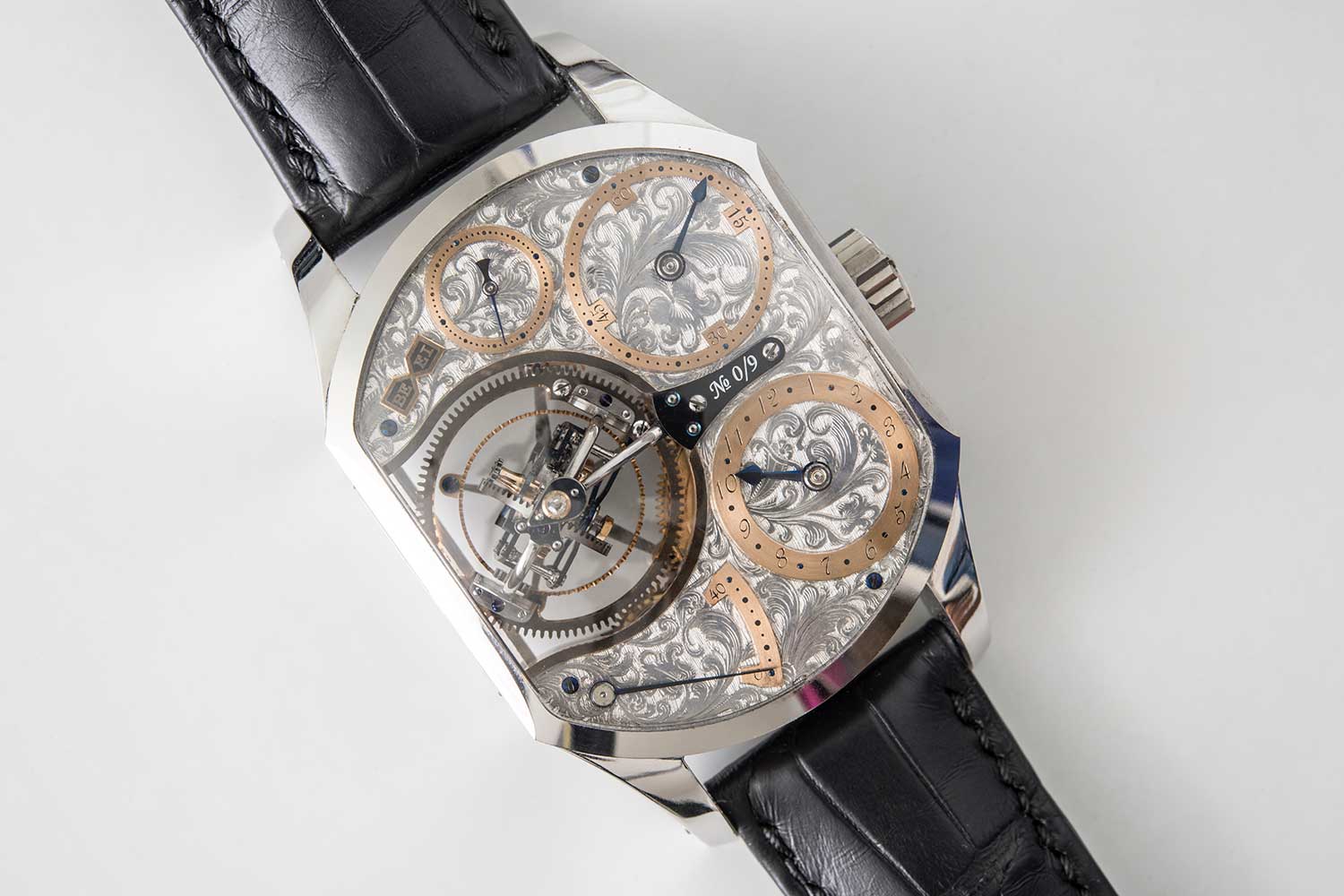
2008: Bexei Primus Triple Axis Tourbillon
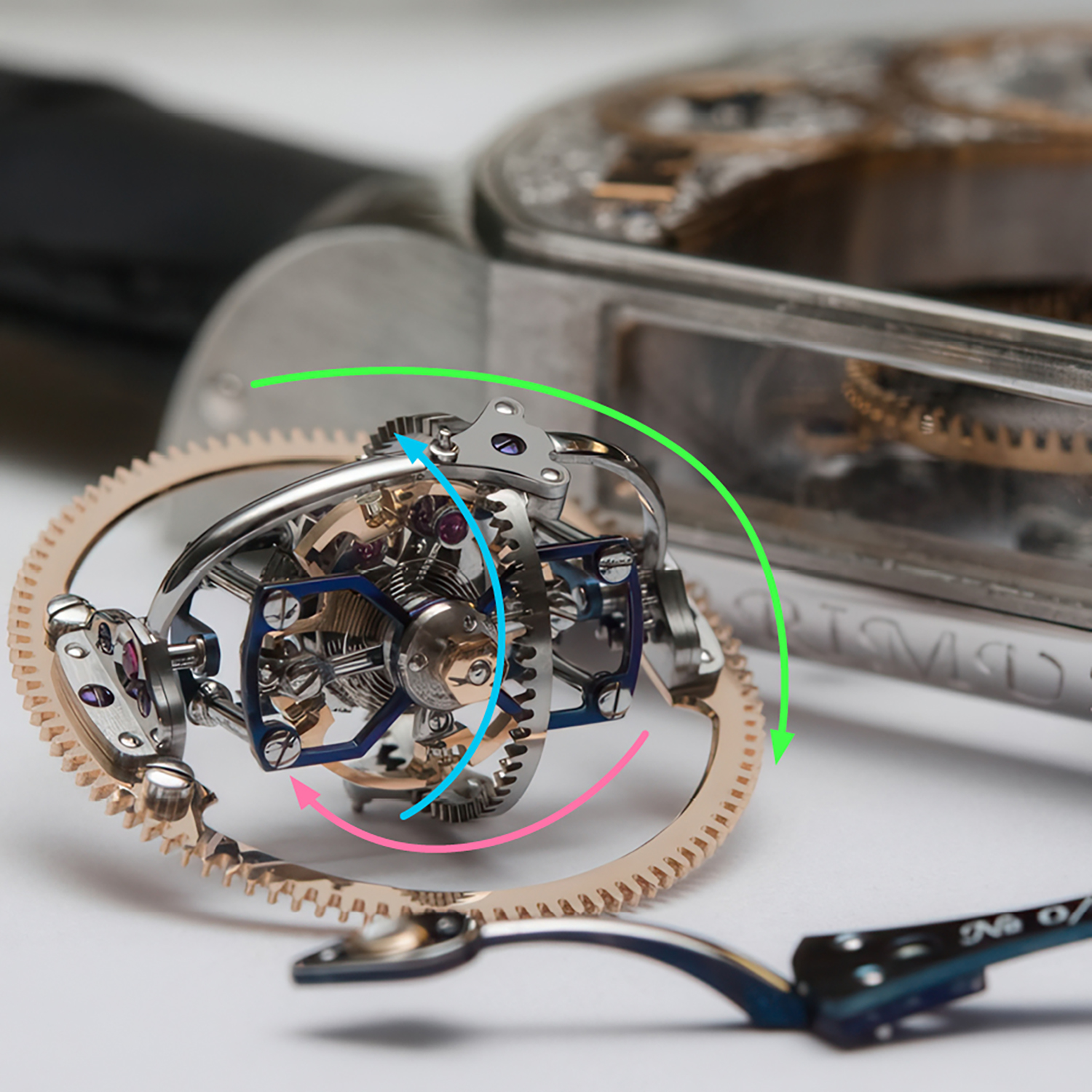
What made the Primus technically distinctive — and earned it a patent — was Becsei’s decision to eliminate ball bearings entirely from the triple-axis construction. Other triple-axis tourbillons, including Prescher’s, use ball bearings on at least some axes to reduce friction at the high speeds involved. Becsei redesigned the geometry of the outer cage so that its unique form allowed jewel bearings to be used for all three axes — a solution he described as being driven by respect for traditional watchmaking, where ball bearings have no place in the vocabulary of haute horlogerie. The patented cage geometry that makes this possible is entirely his own invention. The rotational speed of the innermost cage is 30 seconds, followed by the second cage with a rotational speed of 2.5 minutes, while the third cage completed a full rotation every 12.5 minutes.
The novelty lies in the construction of the outer cage. Instead of being made as a single frame, it is divided into two sections. The upper portion forms the visible frame that supports the middle cage, while the lower portion forms the inner fixed crown wheel that drives the innermost cage. Between these two sections sits the stationary outer crown wheel around which the middle cage rotates. This split construction creates space above and below the stationary crown wheel for conventionally pivoted jewel bearings, eliminating the need for ball bearings.
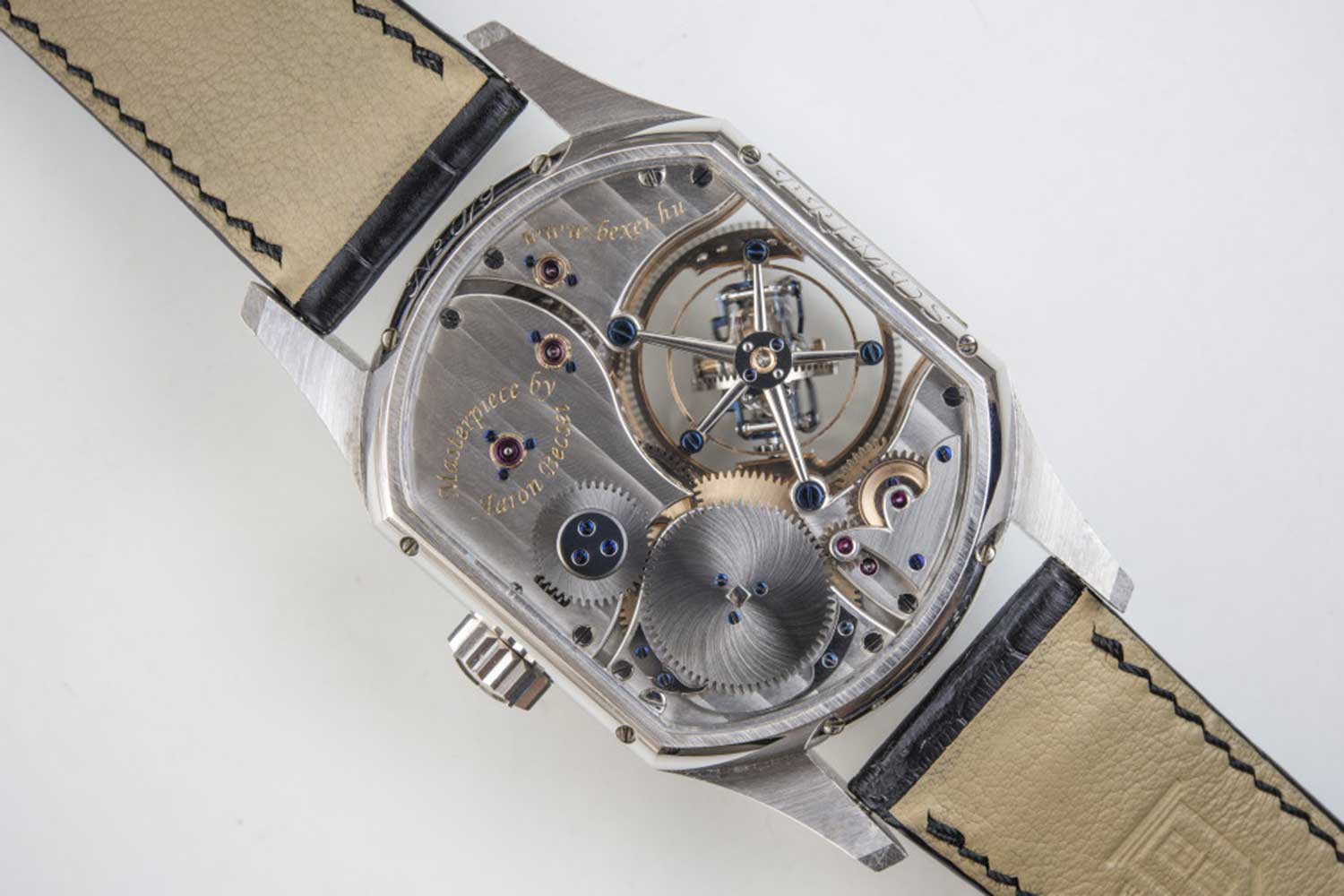
2008: Bexei Primus Triple Axis Tourbillon
Bexei Primus — Key Specifications
- Case: 18K white gold; 38mm (width) × 46mm (length) × 17.9mm (thickness); sapphire crystal side window for lateral tourbillon view
- Movement: Manual winding; triple-axis tourbillon with patented jewel bearings throughout
- Power reserve: 40 hours
- First axis (inner cage): One revolution per 30 seconds
- Second axis (middle cage): One revolution per 2.5 minutes
- Third axis (outer cage): One revolution per 12.5 minutes
- Tourbillon system weight: 1.5 grams
- Positional coverage: Balance wheel assumes 3,750 positions every 12.5 minutes
- Functions: Hours, minutes, small seconds and power reserve indicator
- Production: Fewer than eight movements per year; each watch unique and made collaboratively with the client
Becsei has since produced the Dignitas as a simpler companion model, but the Primus remains the center piece of his atelier — a watch that stands as proof that the most technically demanding complication in watchmaking is still within reach of a single person working alone, provided this person is sufficiently gifted, sufficiently obsessive, and sufficiently stubborn to simply refuse to believe the thing is impossible.
Cabestan
2015: The Triple-Axis Tourbillon
The glorious yet tragic story of Cabestan runs through multiple creative partnerships, false starts and pivots before arriving at its most technically ambitious creation — and it begins not with a watchmaker but with Jean-François Ruchonnet, a virtual imaging entrepreneur who disrupted the world in 2007 with a stunning prototype for a watch with a vertically mounted movement, a chain-and-fusée constant-force transmission, a vertical tourbillon, and time displayed on rotating drums. According to watchmaker Vianney Halter, the inside story is that this was actually a timepiece he created for his own collection. But as he was facing challenges, he instead licensed the entire concept to Ruchonnet. The concept was inspired by yachting — Cabestan is the old French spelling of “capstan,” the deck winch used to tension ropes on a sailing vessel. While the initial announcement was that the timepiece was a collaboration with Vianney Halter; soon Ruchonnet parted company with the Saint Croix-based enfant terrible of independent watchmaking. According to Ruchonnet, the technical problems of realizing so unconventional a movement proved intractable without specialist help. Enter Éric Coudray — the same Éric Coudray who had conceived the Gyrotourbillon at Jaeger-LeCoultre. Freshly departed from Jaeger-LeCoultre in 2008, it was Coudray who took the Cabestan Winch Vertical Tourbillon and made it work, redesigning much of the movement into the Caliber CAB EC 101. The chain-and-fusée mechanism — a concept dating to the earliest days of mechanical watchmaking, used here to deliver perfectly constant torque throughout the entire power reserve — became Cabestan’s defining signature. And for a while, the watch was one of the coolest timepieces on the planet. But that’s when the problems started.
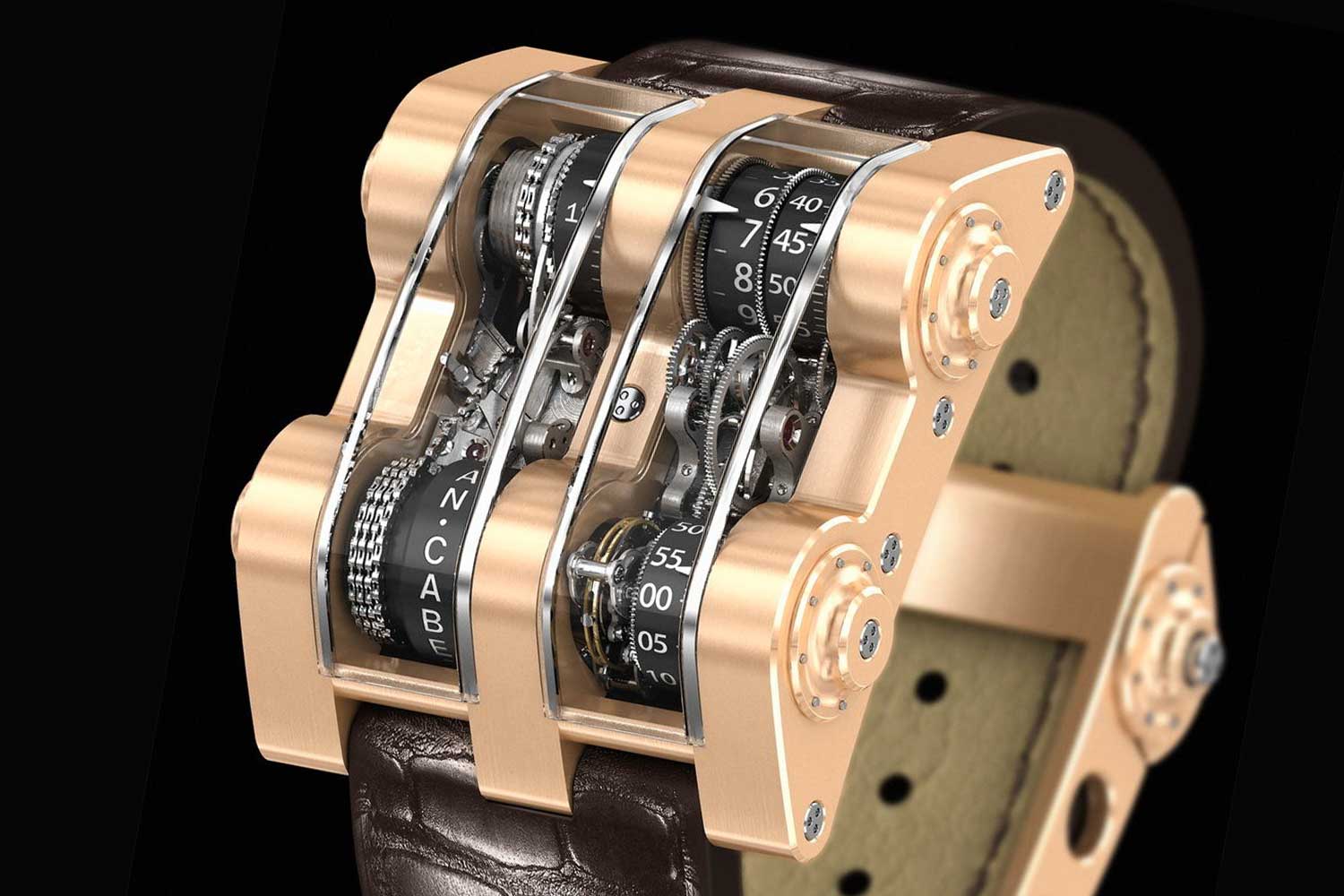
2008: Cabestan Winch Vertical Tourbillon
Éric Coudray, a genuinely beloved member of the watchmaking fraternity, rarely speaks publicly in negative terms, but in a 2024 profile by Europa Star, he gave one of the clearest indications that his years with Cabestan were personally and financially painful. Reflecting on his roughly eight-year involvement with the brand, Coudray said he emerged from the experience “financially drained,” explaining that he had “lost hundreds of hours” of work that were supposed to be converted into company shares but were ultimately denied to him when he left the company.
The article also notes that he remains reluctant to discuss the period in depth, describing a certain “reserve” or lingering frustration surrounding his time there. Despite being instrumental in developing and stabilizing many of Cabestan’s most technically ambitious watches — including refining the Winch Tourbillon Vertical and creating later concepts such as the Triple-Axis Tourbillon — he appears to have felt that the commercial and ownership side of the venture did not reward his contribution appropriately.
This is particularly significant because Coudray was not an outsourced constructor. Contemporary coverage frequently described him as the “soul” of Cabestan, its designer and engineer, and the technical force behind the brand’s identity. Yet the company itself went through repeated financial and organizational struggles before being restructured under new ownership around 2012–13. What emerges from his comments is less bitterness about the watches themselves and more disappointment over the business relationship. Mechanically, Cabestan was a fertile laboratory for Coudray’s ideas — vertical tourbillons, chain-and-fusée systems, extreme three-dimensional architecture.
Two years after the brand’s acquisition in 2013 by Lionel Betoux, the brand’s most technically impressive development arrived thanks to Coudray: the Triple-Axis Tourbillon. It remains to this day the only triple-axis tourbillon in the world to incorporate a chain-and-fusée constant-force transmission — a combination that layers two of watchmaking’s most demanding constructions into a single movement, one of them five centuries old and one barely 20 years old. The tourbillon itself is a flying construction rotating at the fastest speeds ever seen in a triple-axis wristwatch at the time of its launch — with Coudray choosing axis rates that prioritize visual animation as much as positional coverage. It is never still for a perceptible instant.
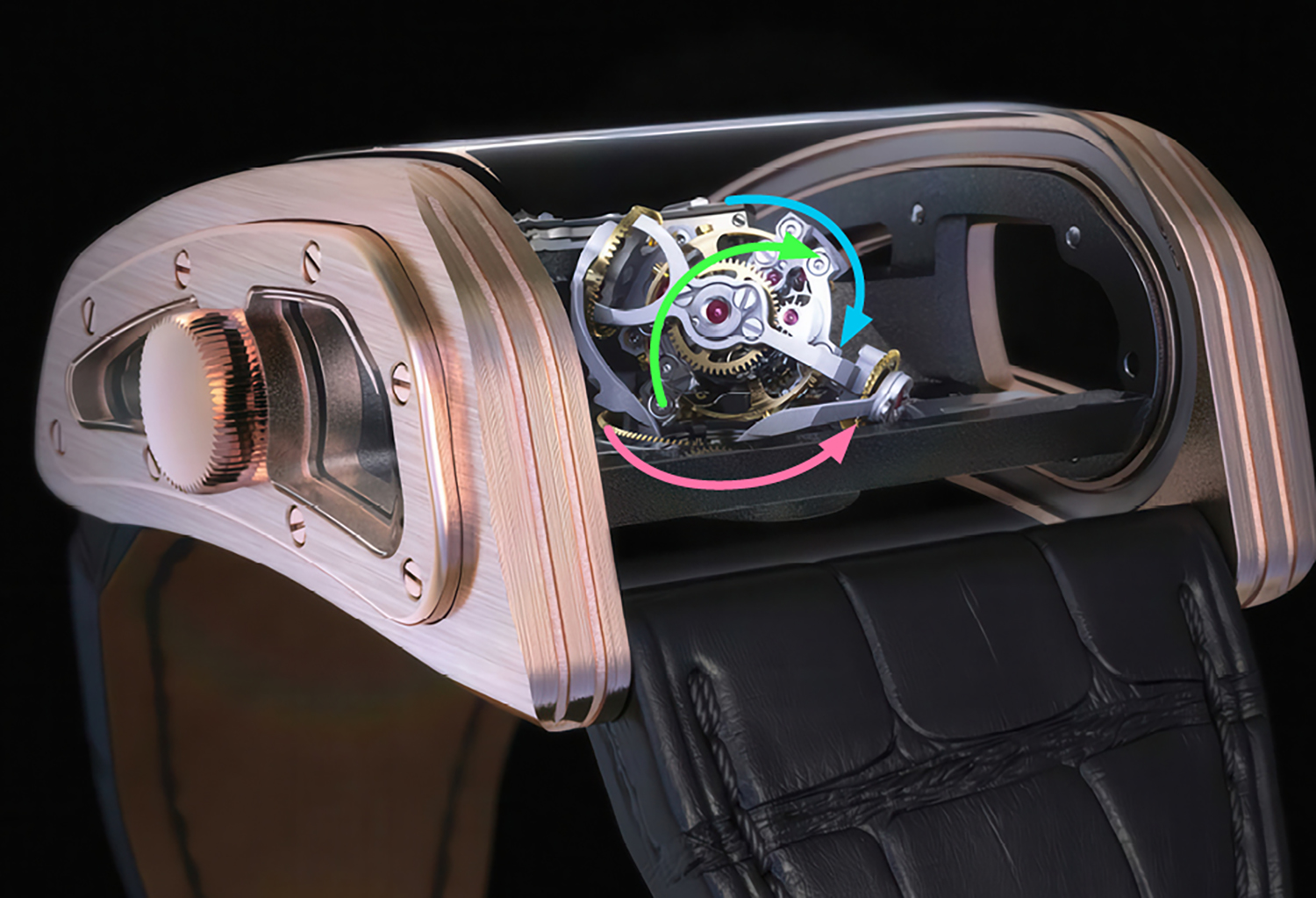
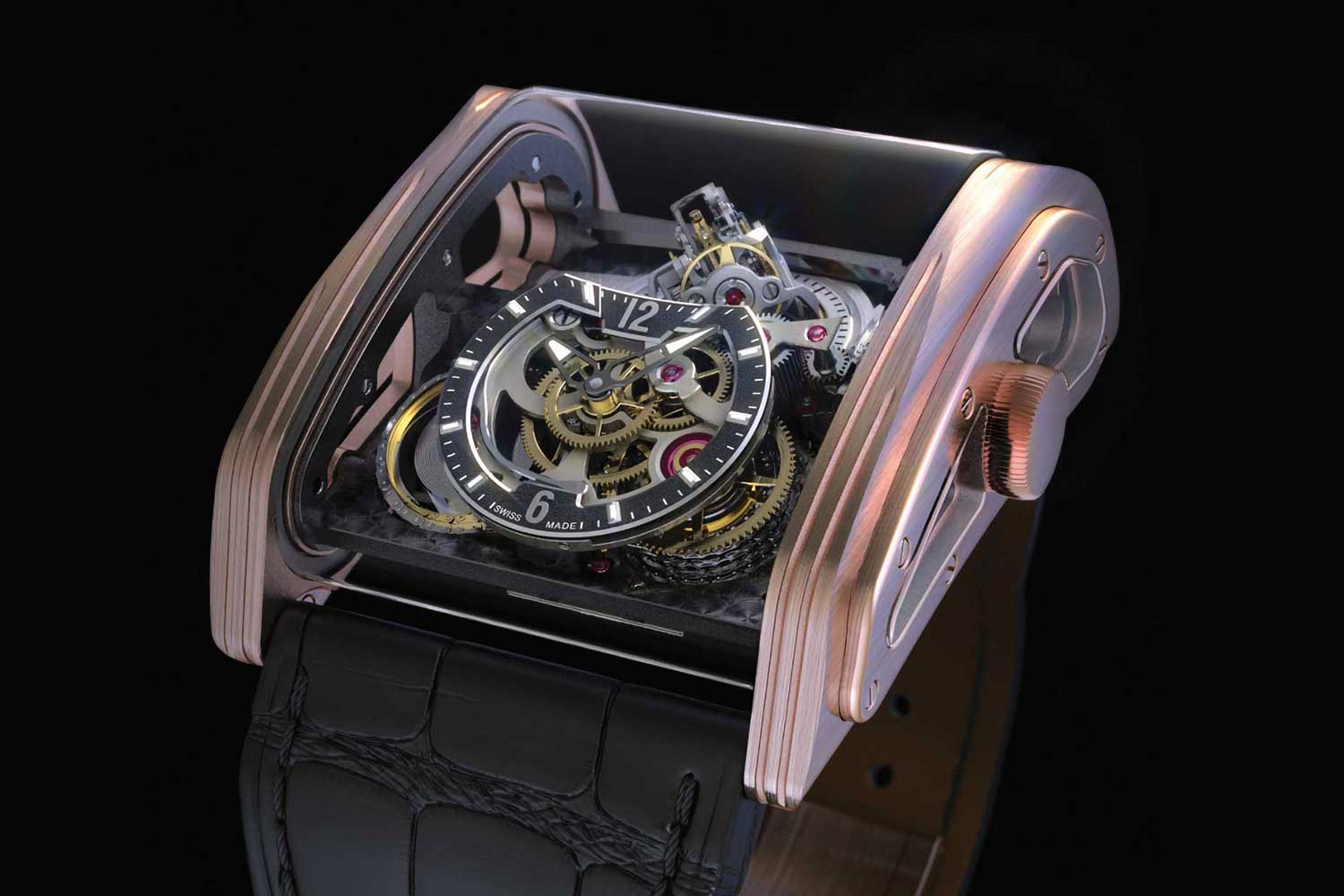
2015: Cabestan Triple-Axis Tourbillon
Cabestan Triple-Axis Tourbillon (Caliber CAB EC 17) — Key Specifications
- Case: 18K rose gold or white gold, titanium, black PVD titanium, or platinum; 50.25mm × 45.5mm × 22.3mm; sapphire crystal formed as a single curved tube around the case
- Movement: Manual winding; German silver construction; designed and built by Éric Coudray
- Total components: 1,044 (978 parts in updated CAB 0017 full sapphire version)
- Power reserve: 50 hours
- Frequency: 21,600vph (3Hz)
- First axis (baseplate axis): One revolution per 60 seconds; also serves as small seconds display
- Second axis: One revolution per 19 seconds
- Third axis (outer axis): One revolution per 17 seconds
- Chain-and-fusée system: 305 links; 202 rivets; 204mm chain length; hand assembled
- Price: CHF 250,000 for the standard version; CHF 265,000 for the full sapphire version (2017, limited to 50 pieces)
With sad inevitability, Cabestan ceased activity around 2020. For those who appreciate the collision of historical mechanism and extreme modern engineering — the chain-and-fusée has been in use for five centuries and the triple-axis tourbillon for barely two decades — the Cabestan Triple-Axis Tourbillon is one of the most intellectually satisfying wristwatch complications ever produced and a testimony to Coudray’s on-going mastery of this realm of watchmaking.
Cecil Purnell
2019: The Escape II Double Spherion
Sadly, Coudray’s association with ill-fated brands didn’t end with Cabestan. Indeed, he would go on to create one of his most ambitious movements for another brand that closed in doors in December 2024: Cecil Purnell. The Purnell story is a family story in the truest sense. Cecil Purnell was a British soldier who, after the First World War, settled in Besançon — the historical capital of French watchmaking — and learned the craft. His grandson Jonathan Purnell founded the brand in 2006 with the declaration of an unwavering ambition: tourbillon watches only, always. Before engaging Éric Coudray, Purnell developed 13 manufacture tourbillon calibers — however, none of these watches proved to be particularly noteworthy and some of them were even the subject of controversy regarding their origin. All that changed with Coudray’s involvement..
The collaboration produced the Escape I in 2017, introducing the Spherion — Coudray’s name for the triple-axis tourbillon he had evolved from the Gyrotourbillon concept, now operating at speeds that would have been mechanically impossible without a fundamental rethinking of the escapement. The key was reviving the tourbillon lever escapement of Albert H. Potter, a largely forgotten New York watchmaker who moved to Geneva in 1875 and whose design eliminated the conventional fixed fourth wheel and escape wheel, replacing them with a single large fixed escape-wheel ring with inward-facing teeth. The balance wheel and pallet fork interact directly with this ring — without any reduction gear pinion — which dramatically cuts the energy demand of each impulse and allows the cage to spin at speeds that would destroy a conventional escapement architecture. Indeed, the Potter escapement had been used once before by Jean-Pierre Golay, Pierre-Michel’s brother, to create Franck Muller’s Thunderbolt tourbillon with a 5-second rotational speed.
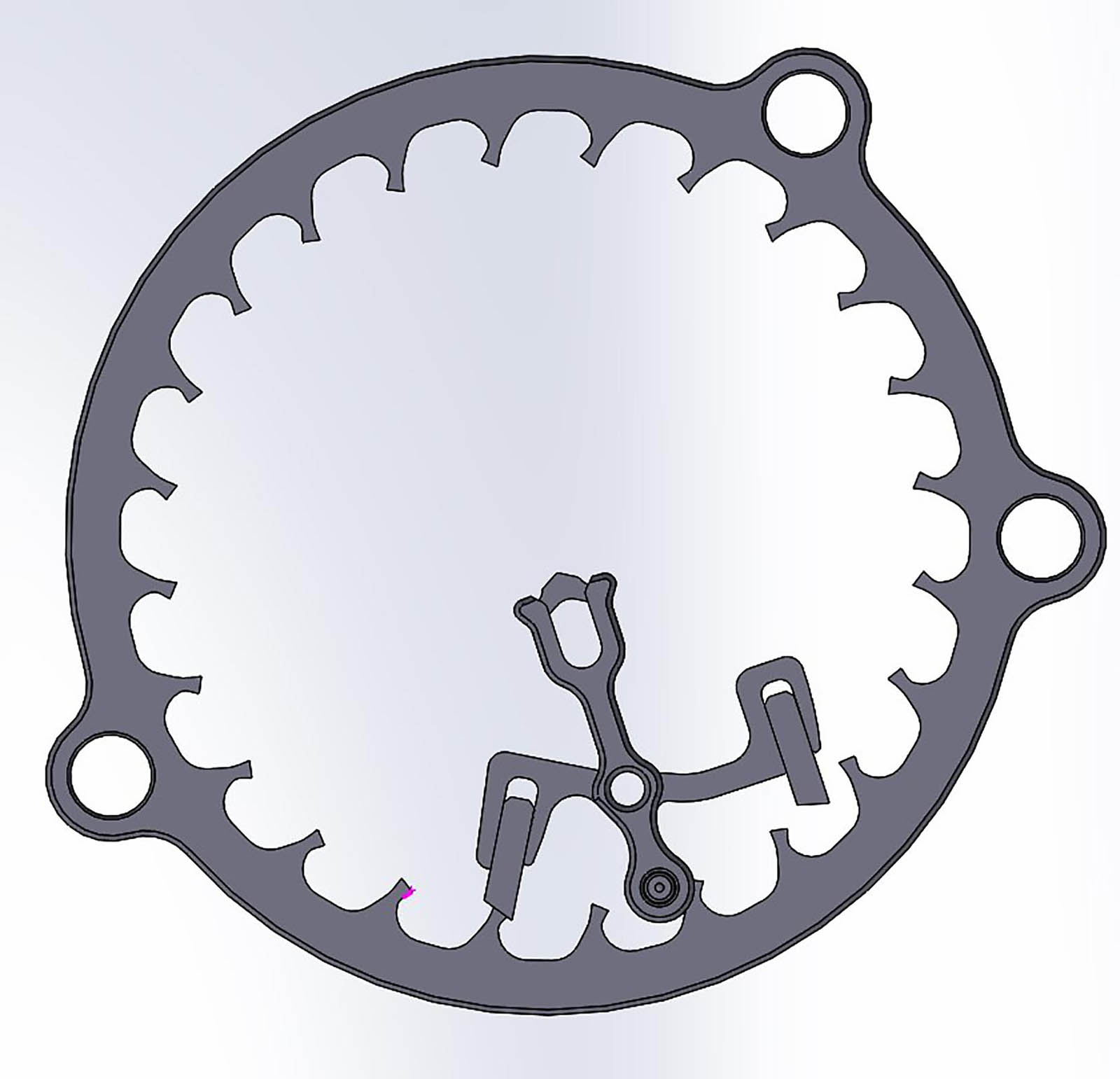
Instead of carrying a conventional escape wheel, the cage runs against a fixed escape wheel ring with internal teeth. The pallet fork locks and unlocks the stationary ring directly. This eliminates any intermediate reduction gearing and allows the cage to rotate at much higher speeds.
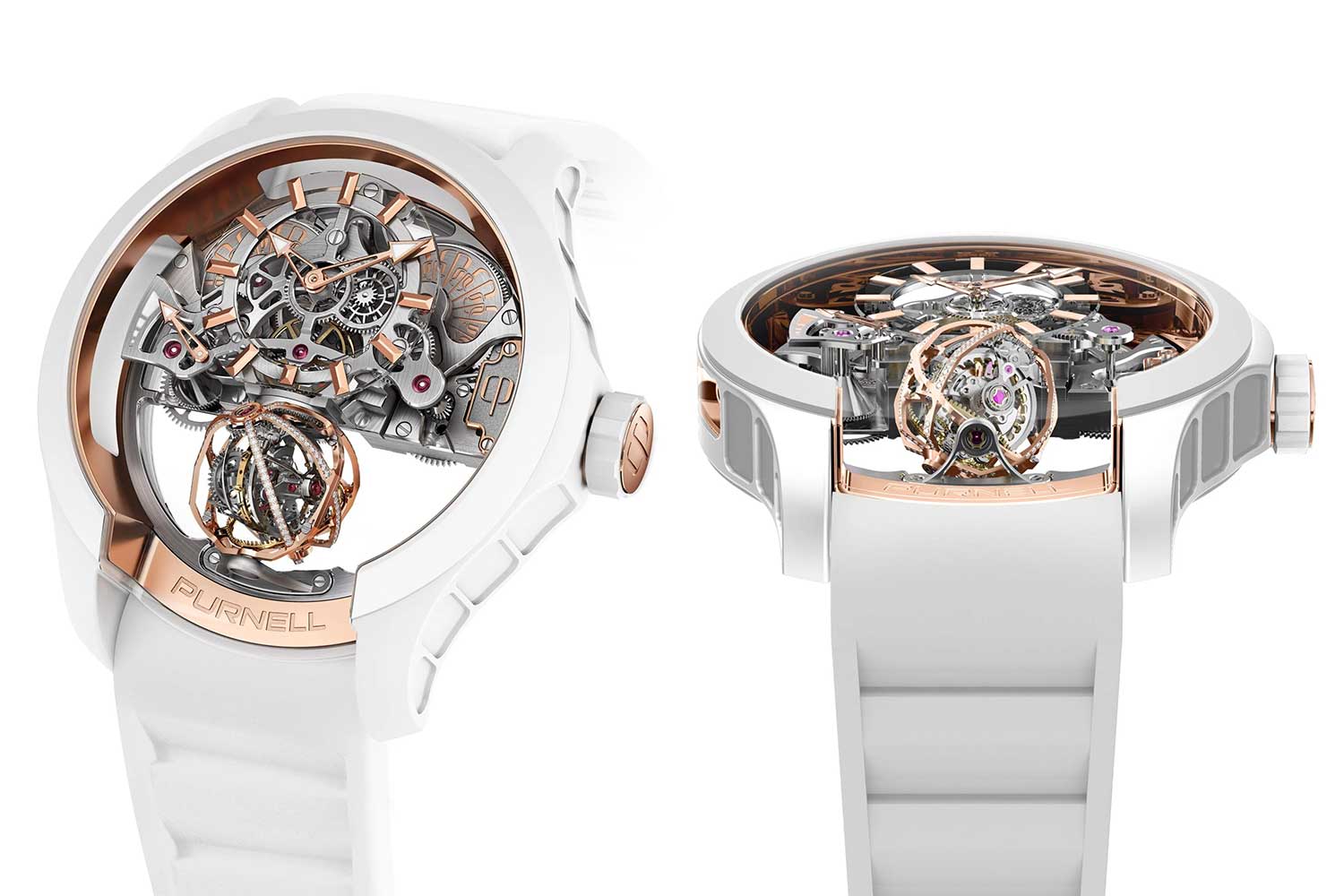
2017: Purnell Escape I a.k.a. Escape Primo
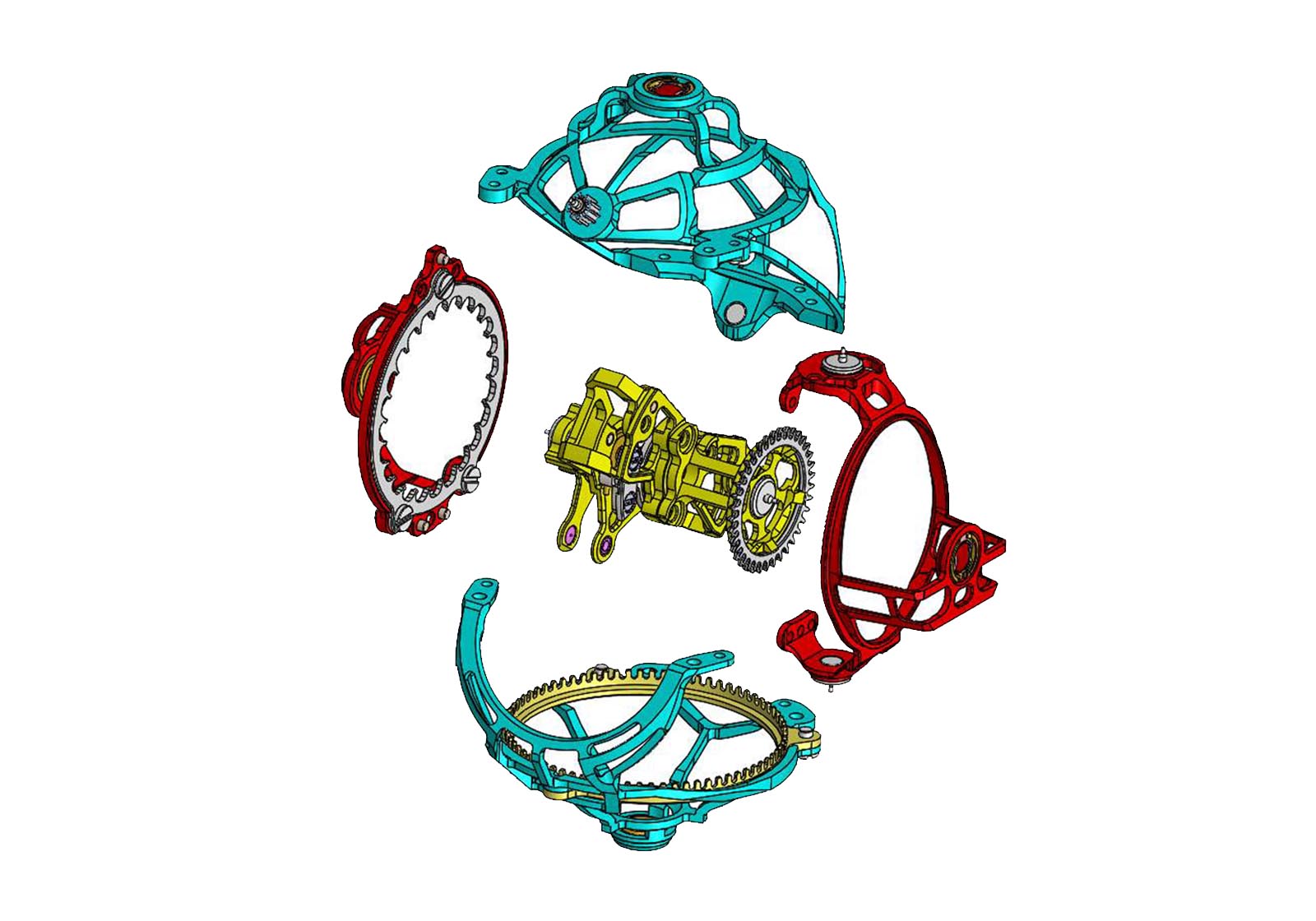
The large Potter escape wheel with internal toothing is fixed to the second cage in red while the first cage in yellow carries the balance wheel and pallet fork
The Escape II of 2019 doubled the entire system. Two Spherion triple-axis tourbillon assemblies sit side by side, connected by a differential that causes them to rotate in opposite directions and outputs the average of their combined rates to drive the display. Six rotating tourbillon cages in a single wristwatch — the most of any watch ever made. Six mainsprings in four barrels to power them, delivering 32 hours of reserve and requiring 185 turns of the crown to wind fully. Purnell’s website calls Coudray “the Mozart of multi-axis tourbillons.” Having seen what he built there, it is difficult to argue.
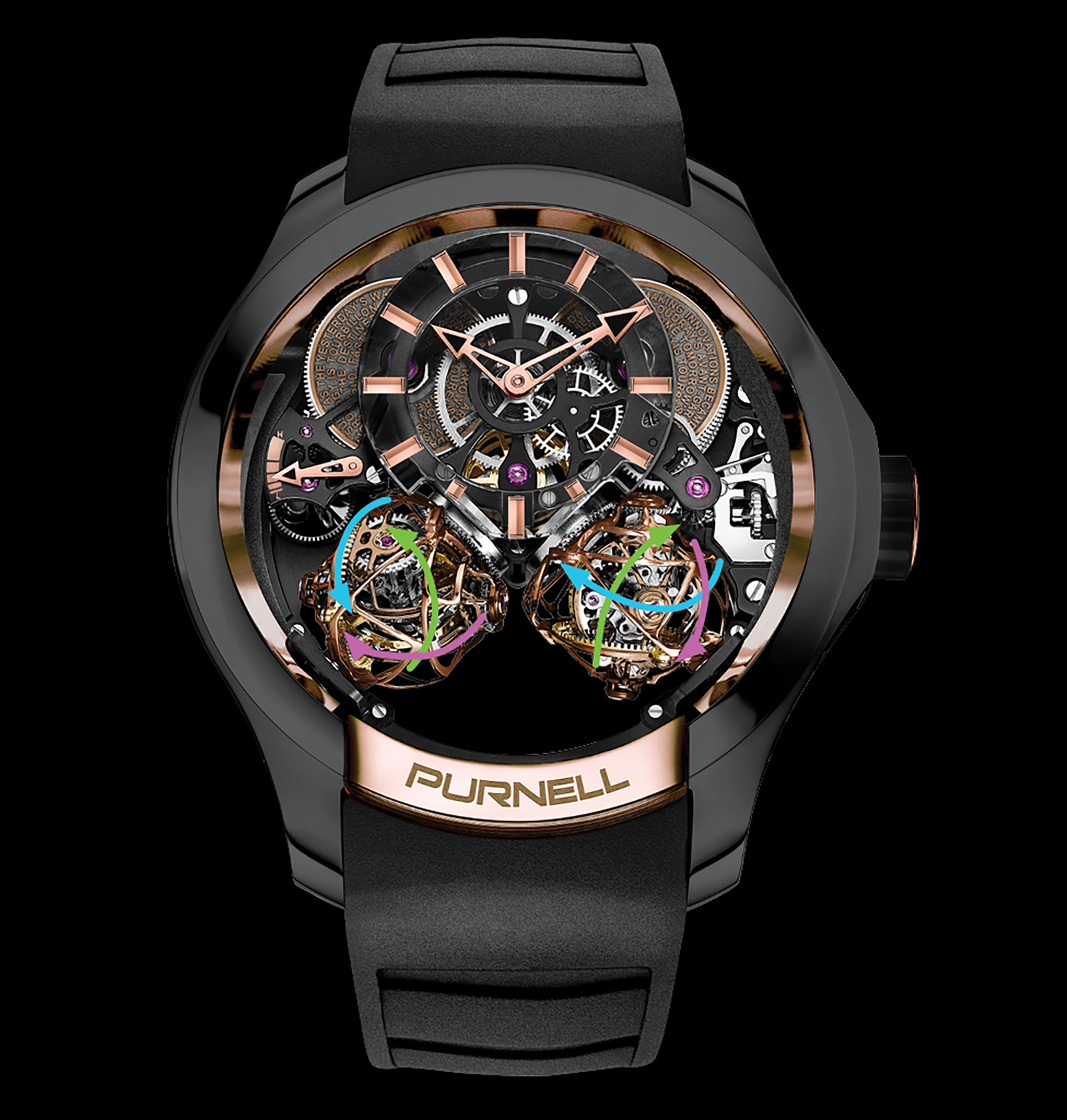
The twin flying triple-axis tourbillons each comprise three titanium cages rotating once every 8, 16 and 30 seconds. Their exceptional speed is made possible by the Potter escapement, which replaces the conventional fixed fourth wheel and reduction pinion with a large fixed escape wheel ring internal teeth. Mounted on the middle cage, the ring allows the innermost cage to rotate directly around it, eliminating the reduction gearing that normally limits a tourbillon to one revolution per minute
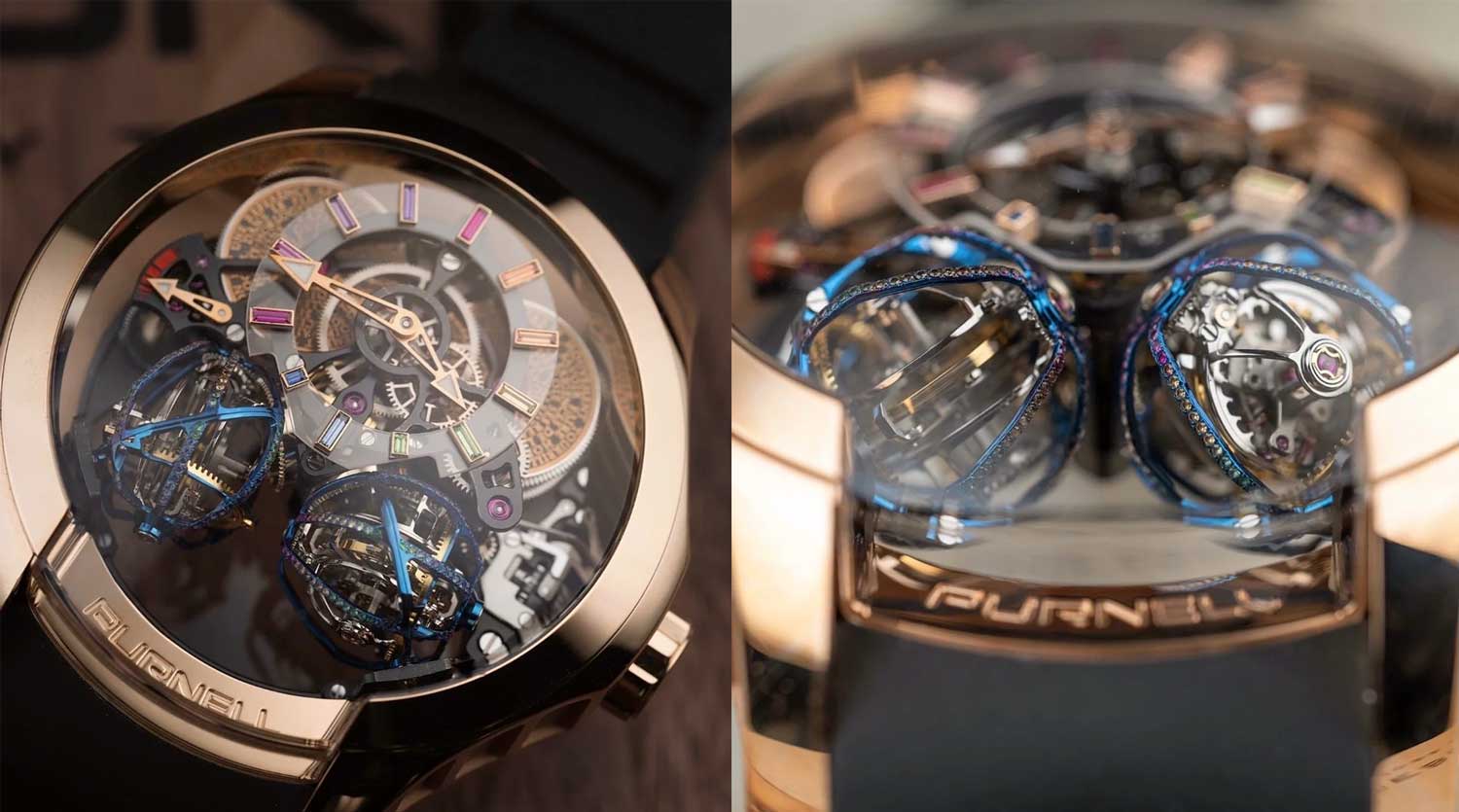
2019: Purnell Escape II Double Spherion (Image: ChronoCollectible)
Purnell Escape II Double Spherion (Caliber CP03) — Key Specifications
- Case: Grade 5 titanium, Grade 5 titanium with black DLC, or 18K rose gold; 48mm (diameter) × 19mm (thickness); monobloc sapphire crystal with front, back and side openings
- Movement: Manual winding
- Total components: 386
- Jewels: 67
- Total movement weight: 15.7 grams
- Power reserve: 32 hours
- Frequency: 21,600vph (3Hz)
- Tourbillon configuration: Two triple-axis Spherion tourbillons linked by a differential and rotating in opposite directions
- First axis (inner cage): One revolution per 8 seconds
- Second axis (middle cage): One revolution per 16 seconds
- Third axis (outer cage): One revolution per 30 seconds
- Each Spherion weight: 0.79562 grams in blued titanium
- Power supply: Six mainsprings in four barrels aligned in parallel
- Winding: Approximately 185 crown turns for full wind; reduction gears assist winding effort
- Power reserve indication: Suspended mobile cone mainspring sensor at 9 o’clock
- Production: Limited edition of 20 pieces per reference in titanium and rose gold
- Price: CHF 425,000 in titanium; CHF 475,000 in rose gold; CHF 1.2 million in diamond-set sapphire (unique piece)
The Escape II Absolute Sapphire (2021) took the concept to its visual extreme: full sapphire case, sapphire dial, sapphire movement bridges, each outer cage set with 152 brilliant-cut diamonds — 304 diamonds in total across both Spherions. A unique piece, it is perhaps the most visually theatrical multi-axis tourbillon wristwatch ever constructed. By this time, Éric Coudray had found himself a permanent role at TEC Ebauches S.A., a well-respected expert in movement manufacturing which built all the Spherion movements for Purnell. As such, this time, when the ill-fated enterprise Purnell watches folded, Coudray was protected.
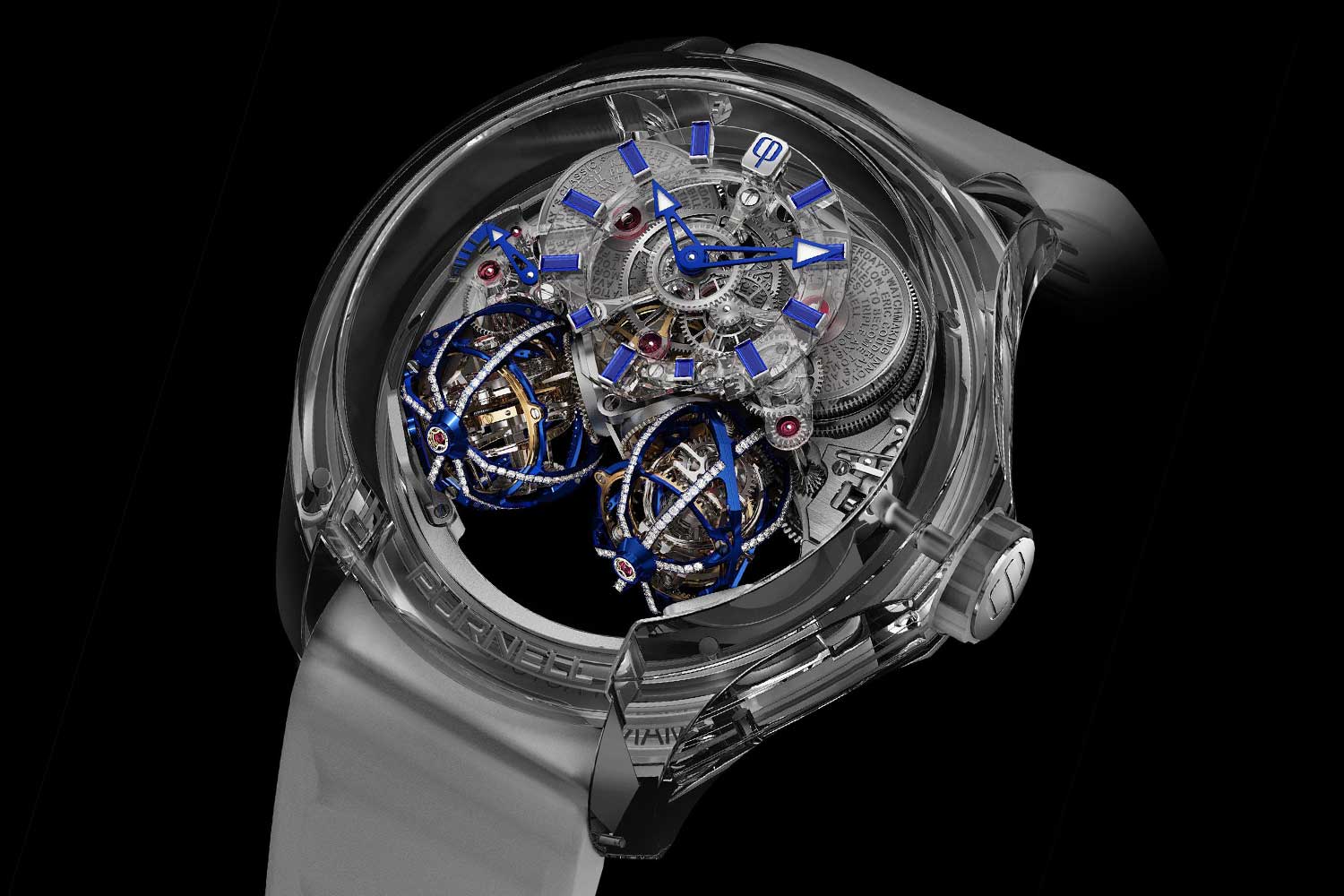
2021: Purnell Escape II Absolute Sapphire
MB&F
2019: The Thunderdome
By 2019, Éric Coudray, now happily part of TEC Ebauches S.A., was widely regarded the master of pushing the boundaries of multi-axis tourbillons. His approach to horology has always favored movement, dimensionality and cinematic energy. That philosophy reached a new peak in the Legacy Machine Thunderdome, a collaboration with MB&F. MB&F founder Maximilian Büsser reportedly challenged Coudray to create “the craziest, most cinematic three-axis tourbillon ever,” and the result was the extraordinary “TriAx” regulating mechanism. Instead of relying on a conventional stacked multi-axis tourbillon construction, Coudray conceived an architecture combining two traditional tourbillon axes with a third rotational axis executed in the form of a high-speed carrousel. This distinction is crucial because, unlike a tourbillon cage driven from within the escapement structure itself, the carrousel rotates the entire regulating assembly via an external drive system, allowing for greater stability and dramatic rotational speed while reducing the mass and energy penalties that would otherwise make such a mechanism impractical.
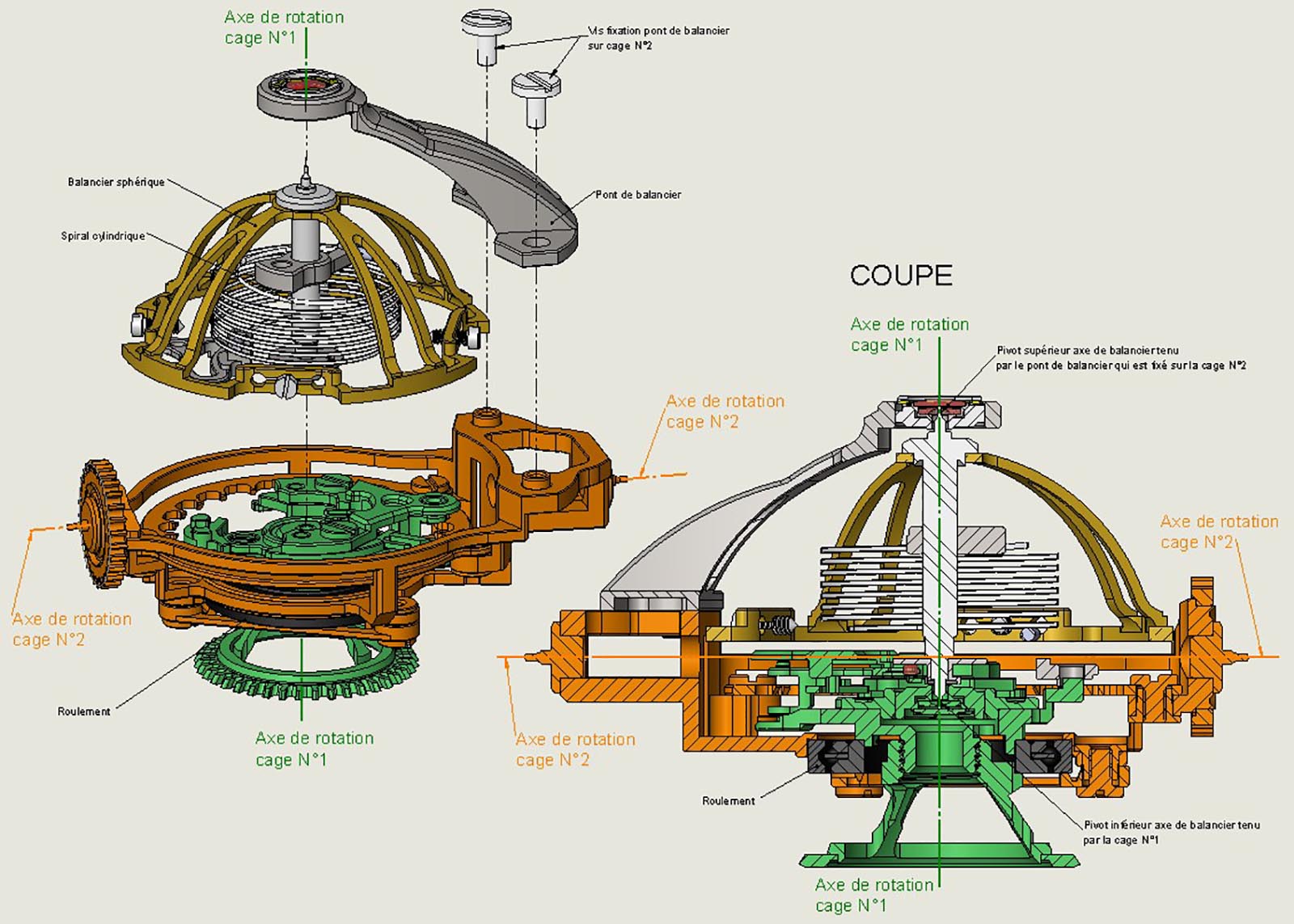
The balance wheel has curved arms to form a domed structure that encloses the hairspring. By relocating the hairspring within the balance itself, the design allows the centre of gravity of the sprung balance assembly to be shifted along the balance staff. As it is located outside and above the innermost cage in green rather than inside it, it is an exo tourbillon. The green cage contains the pallet fork, which locks and unlocks the fixed escape wheel on the second cage in orange.
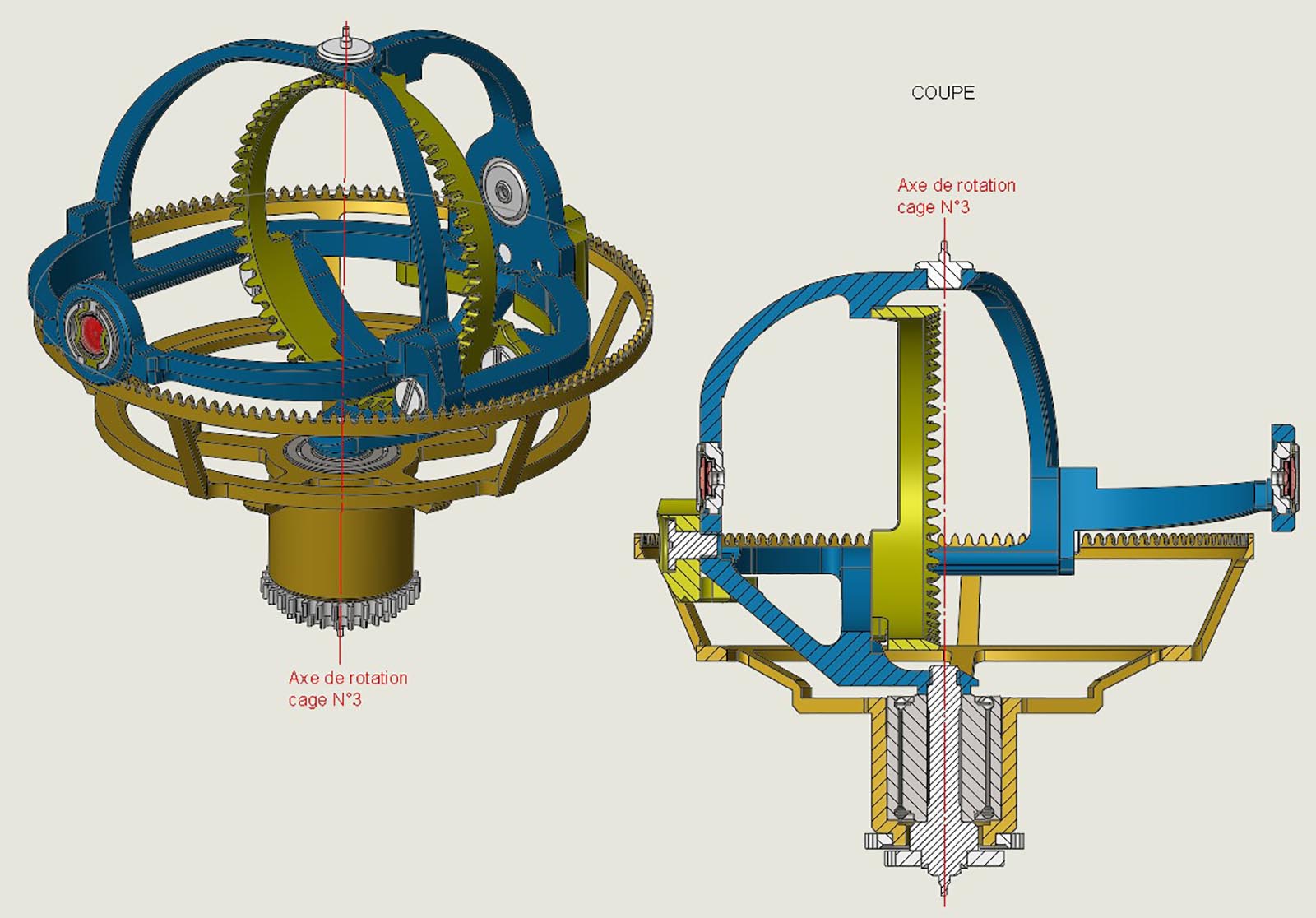
The outermost cage in blue is pivotably attached to a carrier in yellow. There are two coaxial driving wheels at the base of the carrier tube. One drives the outermost cage, while the other drives the carrier itself. The carrier then drives the second cage via a fixed wheel. Independently, the outer cage carries a fixed wheel, which drives the innermost cage, making this a carrousel
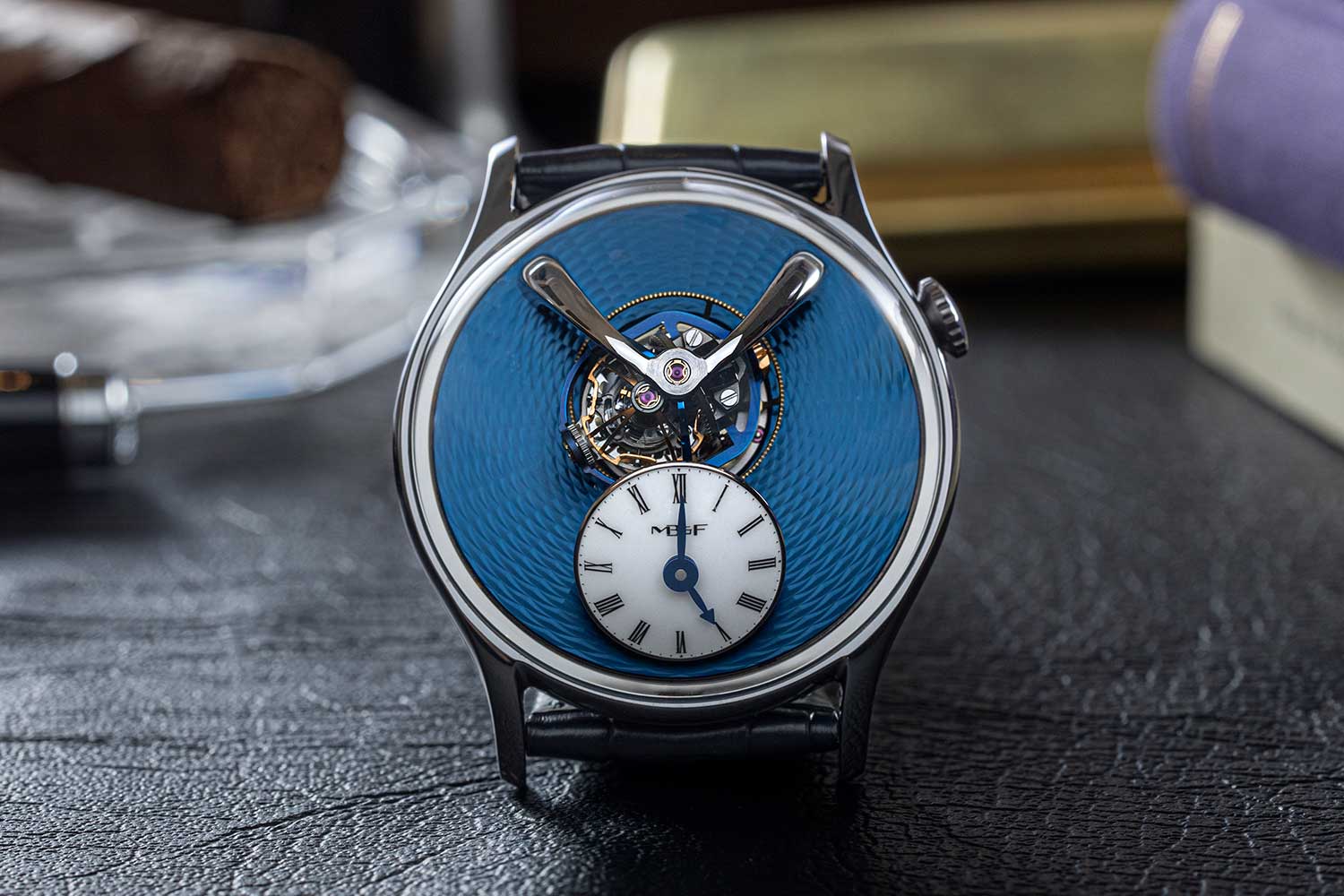
2019: MB&F Thunderdome (©Revolution)
The resulting regulator rotates on three axes at astonishing speeds: 8 seconds, 12 seconds and 20 seconds, respectively, creating a hypnotic gyroscopic effect beneath the towering sapphire dome. By incorporating the carrousel as one of the rotational axes, Coudray achieved an extraordinary sense of spatial motion while maintaining the efficiency needed to keep the mechanism reliable and wearable. The architecture also contributes to the visual openness of the Thunderdome, making the regulator appear almost detached from the movement itself.
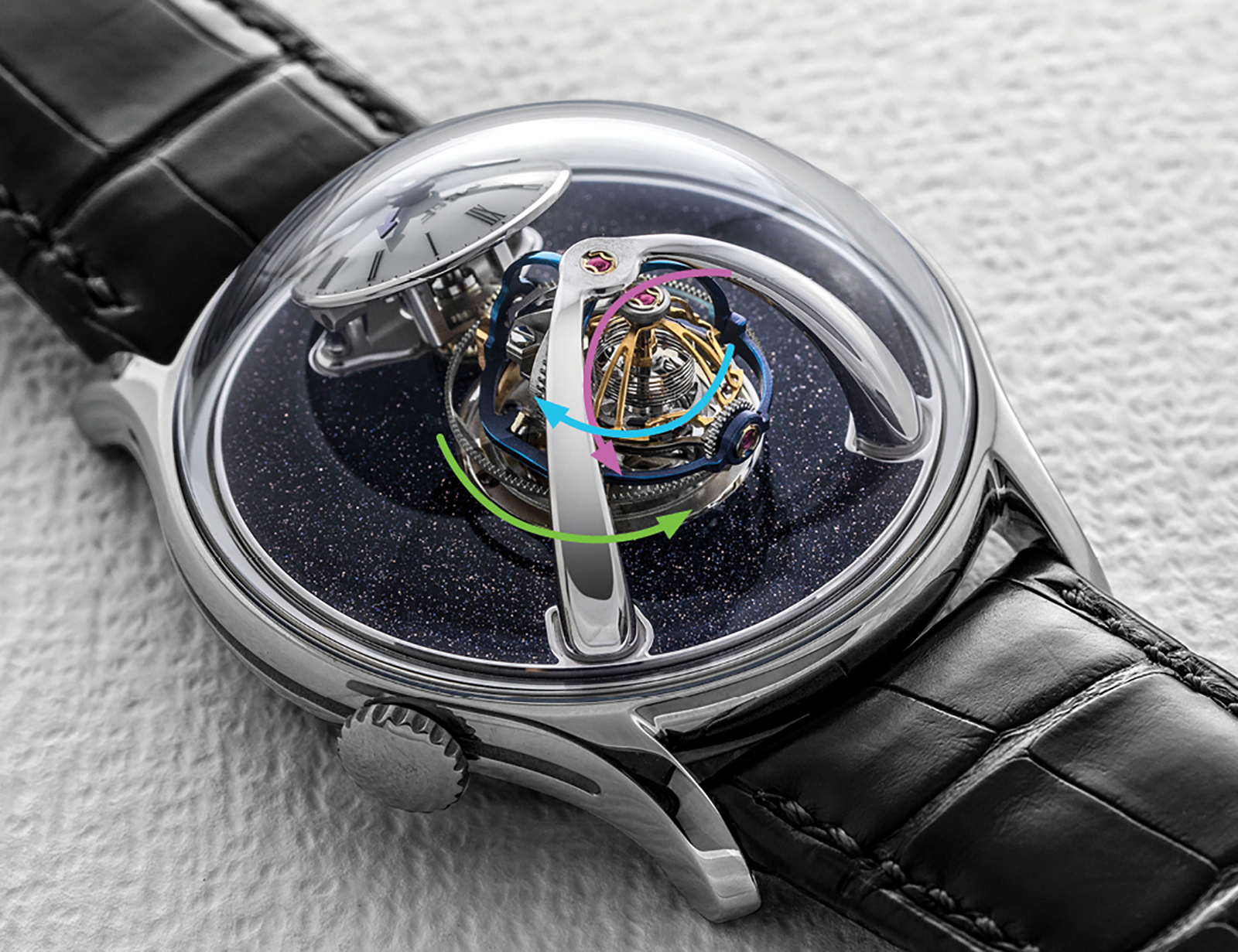
MB&F Thunderdome (Caliber with TriAx mechanism, created in collaboration with Éric Coudray) — Key Specifications
- Case: Platinum 950 or tantalum (The Hour Glass edition); 44mm (diameter) × 22.2mm (thickness)
- Movement: Manual winding; 35mm (diameter)
- Total components: 413
- Jewels: 63
- Power reserve: 45 hours
- Frequency: 21,600vph (3Hz)
- First axis (innermost): One revolution per 8 seconds
- Second axis (middle): One revolution per 12 seconds
- Third axis (outermost): One revolution per 20 seconds
- Display: Hours and minutes displayed on a 58-degree vertically tilted dial; power reserve indicator on the back of the movement
- Production: Limited edition of 33 pieces in platinum and 10 pieces in tantalum
- Price: USD 280,000 at 2019 launch
Like the Spherion, one of the most ingenious aspects of the Thunderdome is Coudray’s revival and reinterpretation of the rare Potter escapement, also used in the Purnell Spherion. Named after 19th-century inventor Albert H. Potter, the escapement differs fundamentally from the mobile escape-wheel systems used in most rotating tourbillons. In the Thunderdome, Coudray employed Potter’s fixed escape wheel, an unconventional solution that dramatically reduced mass and freed up physical space within the rotating assembly. This allowed him to create the watch’s spectacular hemispherical balance wheel and helical hairspring configuration. The Potter escapement was not chosen merely for novelty. Its architecture solved several practical challenges created by the ultra-fast triple-axis regulator. Because the escape wheel remains fixed, the rotating cages can be lighter and more energy efficient, helping to manage power consumption despite the extraordinary rotational speeds. The design also opened the visual center of the movement, allowing the entire regulating system to float dramatically in space beneath the sapphire dome.
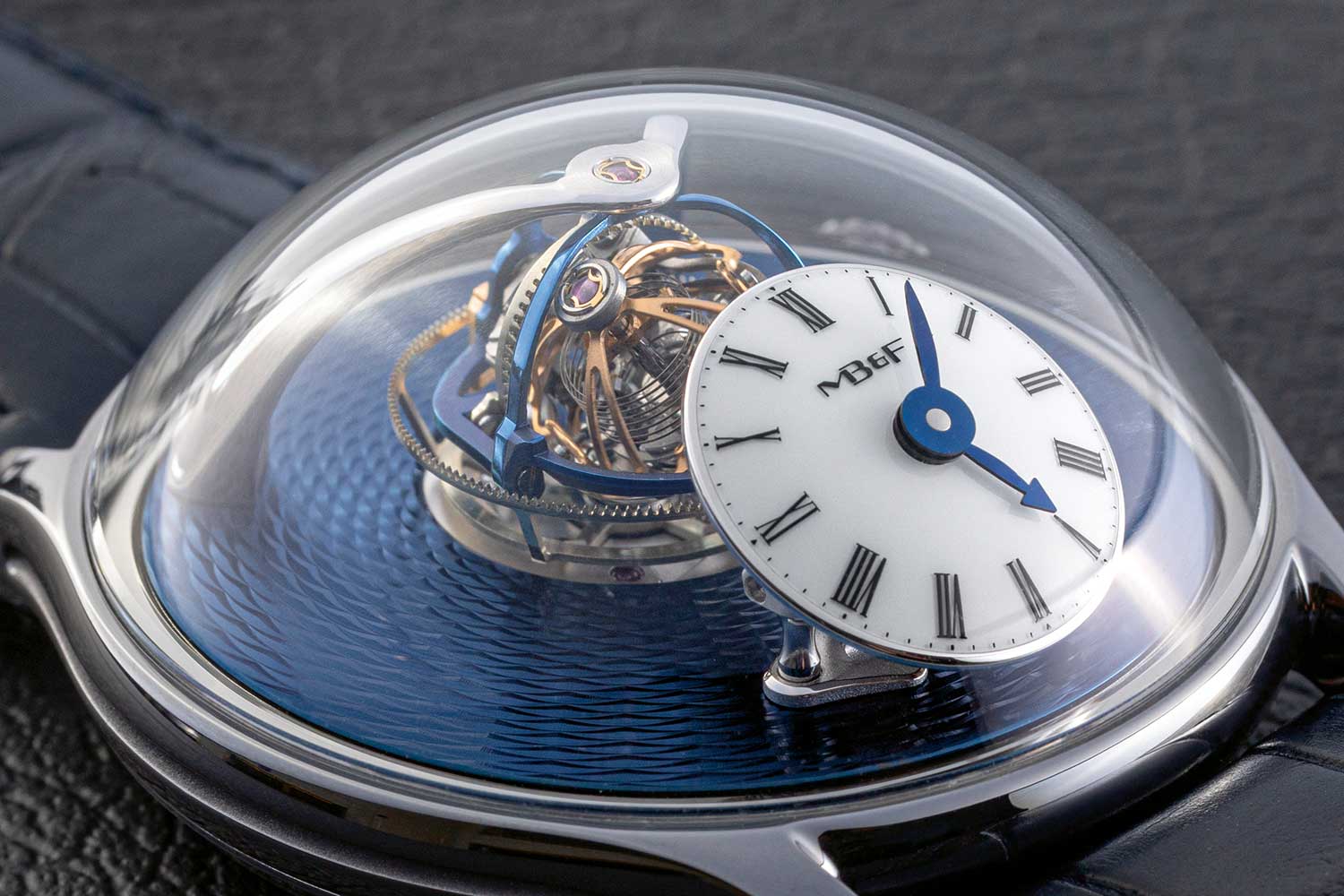
2019: MB&F Thunderdome (©Revolution)
Vianney Halter
2013: The Deep Space Tourbillon
Vianney Halter occupies a unique position in independent watchmaking iconoclast and is a singular creative force for whom the watch is an expressive vehicle for groundbreaking ideas. His Antiqua of 1998, with its retro-futuristic porthole dials and science-fiction aesthetic, is widely credited with helping catalyze the renaissance of independent watchmaking at the turn of the millennium. But Halter has always moved slowly, on his own terms, and the Deep Space Tourbillon — his next major statement after a 15-year creative pause — did not arrive until 2013. He is not a man who can be hurried. He is also a man who, when he finally arrives, does not disappoint.
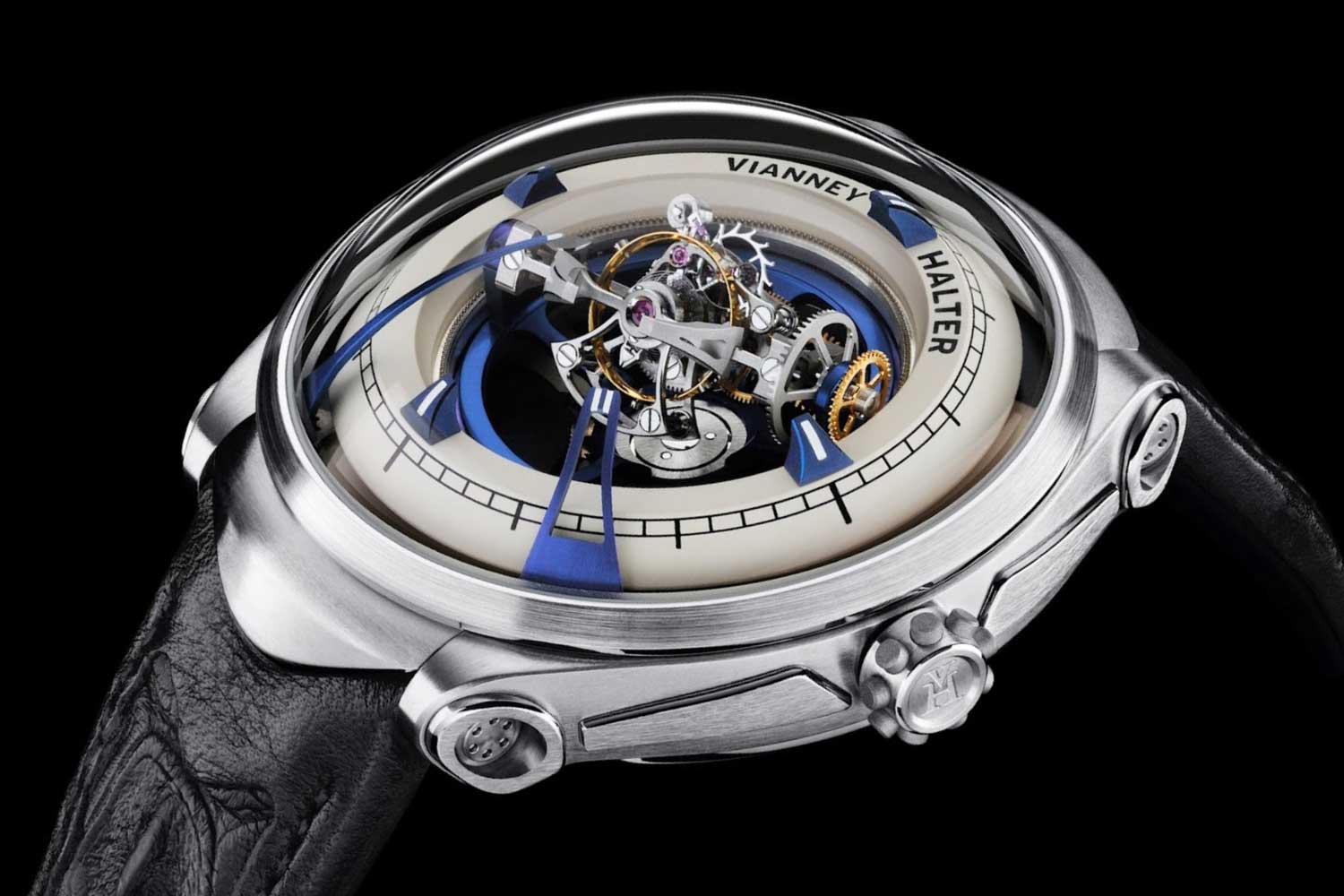
2013: Vianney Halter Deep Space Tourbillon
The Deep Space Tourbillon emerged from a specific cosmological idea: a representation of the four dimensions of spacetime — three spatial dimensions and one temporal dimension — rendered as a physical object on the wrist. The three axes of the tourbillon represent the three spatial dimensions; the orbiting time display represents the fourth. The case is titanium, 46mm × 48mm, dominated by a 40.6mm sapphire dome that allows the triple-axis tourbillon to sit at the center of the dial as though suspended in free space. Two curved blued titanium hands lean inward from the watch periphery and spread across the dome above the tourbillon — like arms cradling the cosmos. The dial surface beneath is a solid engraved silver ring, time displayed as jumping minutes. The tourbillon — Caliber VH113, developed entirely in-house — rotates on three axes with periods of 40 seconds, 6 minutes and 30 minutes, rates chosen so that no two axes ever fall into synchrony.
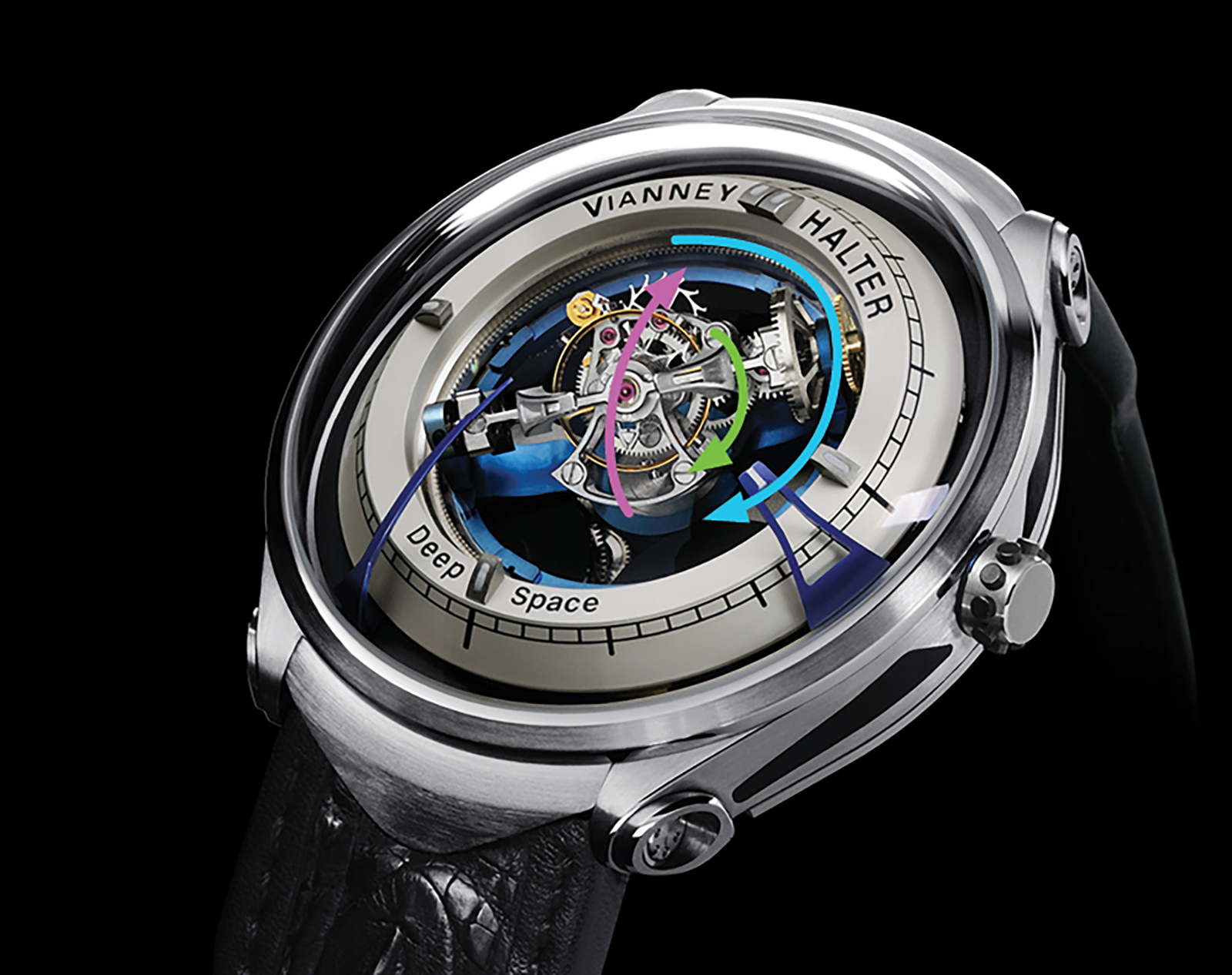
Vianney Halter Deep Space Tourbillon (Caliber VH113) — Key Specifications
- Case: Titanium; 46mm × 48mm × 20mm; 40.6mm sapphire dome
- Movement: In-house manual winding
- Total components: 317
- Jewels: 41 rubies
- Power reserve: 60 hours
- Frequency: 21,600vph (3Hz)
- First axis: One revolution per 40 seconds
- Second axis (horizontal): One revolution per 6 minutes
- Third axis (vertical/cradle): One revolution per 30 minutes
- Functions: Hours, jumping minute display and triple-axis tourbillon
- Production: Approximately 2 pieces per year; unique-piece production by specification
2021: The Deep Space Resonance
The Deep Space Resonance (2021) is the watch Halter had been working toward for a quarter century — a fact that tells you everything about the kind of watchmaker he is. The concept originated in 1996 when he began learning piano and became fascinated by resonance — the phenomenon by which two oscillating bodies in close proximity synchronize their frequencies, each reinforcing the other. Halter’s ambition was to combine resonance with the triple-axis tourbillon. Two balance wheels are mounted opposite and co-axial to each other inside the innermost cage while the outer terminals of the hairsprings are fixed to a common rigid bridge. He tested a prototype in a vacuum chamber. The resonance occurred.
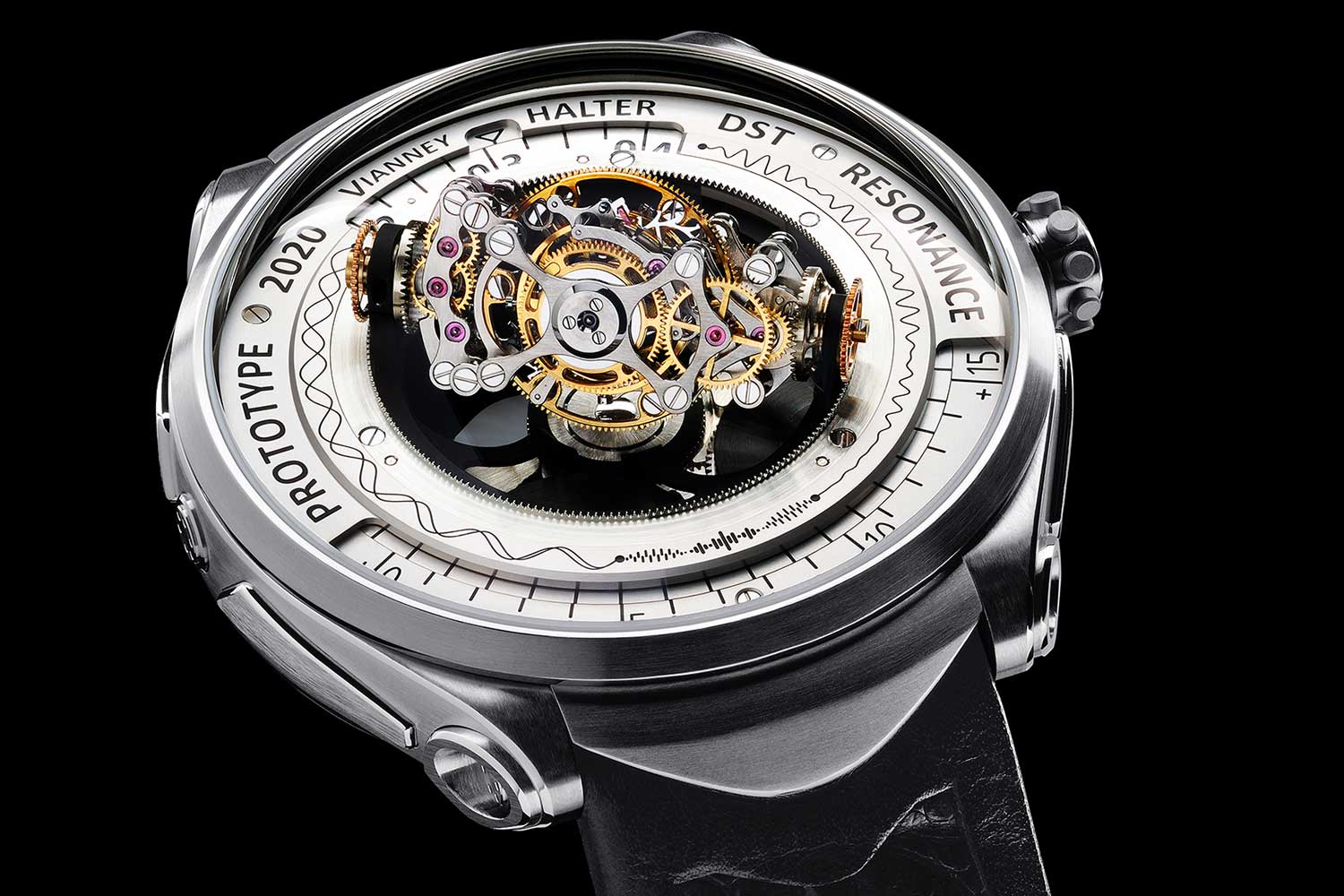
2021: Vianney Halter Deep Space Resonance
The development consumed eight years of intermittent work, interrupted by the chaos of running an independent business. The Deep Space Resonance uses the same case and architecture as the Deep Space Tourbillon, but the tourbillon cage now contains 371 components. Two hairsprings are fixed to the same stud and power the two balance wheels beating in acoustic resonance. These can beat in phase or out of phase while still entering into resonance, according to Halter. At the moment, Halter’s output is around two pieces per year with the watch costing CHF 1.1 million each. For those wishing to commission one, expect to wait so long as to potentially experience the fourth temporal dimension of space itself.
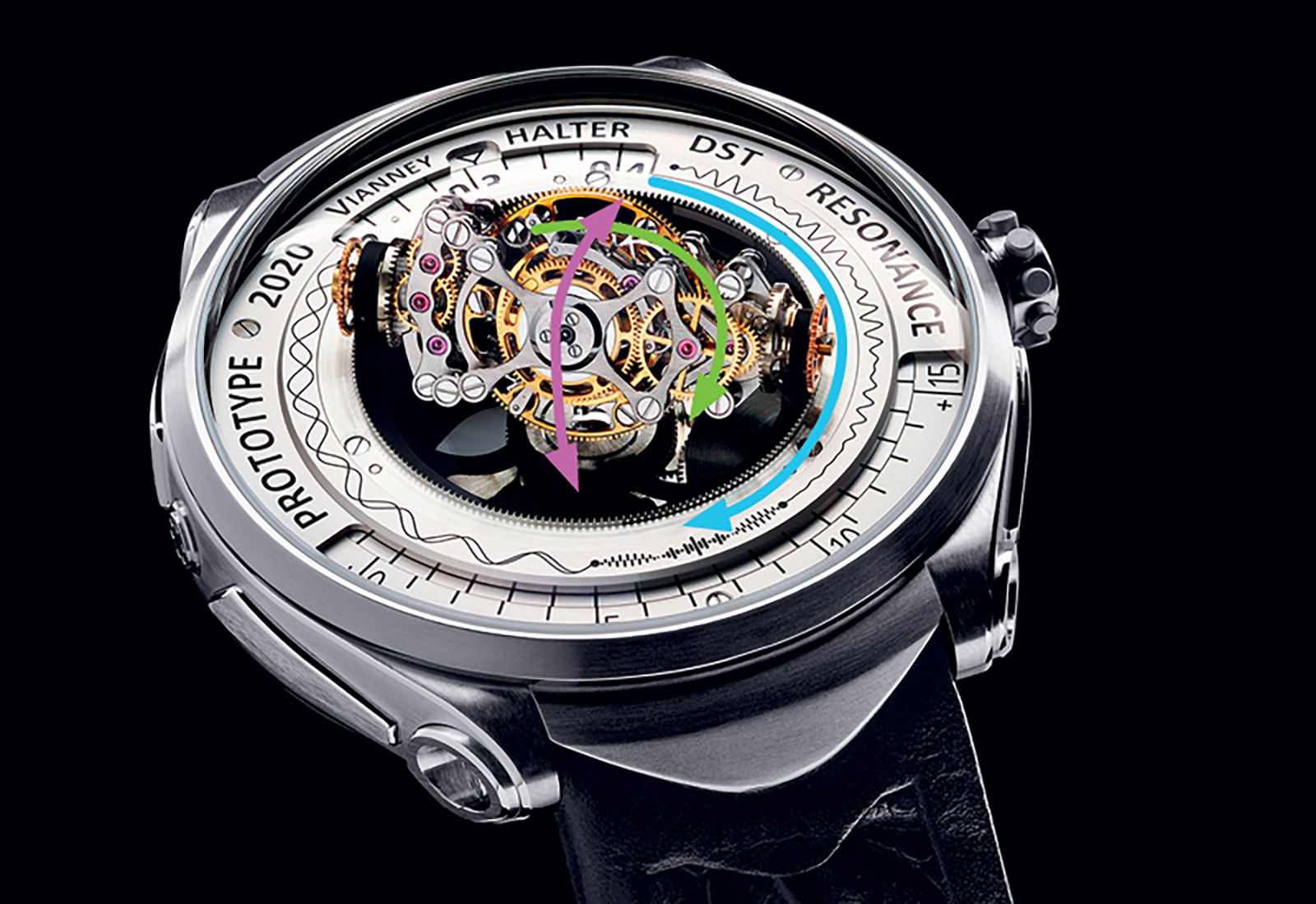
The two balance wheels are mounted opposite one another on a common axis within the innermost cage. Their hairsprings are fixed to a rigid bridge through a common stud, allowing vibrations to pass between the two oscillators
Vianney Halter Deep Space Resonance (Revised Caliber VH113) — Key Specifications
- Case: Titanium; 46mm × 48mm; sapphire dome architecture shared with Deep Space Tourbillon
- Movement: Manual winding
- Total components: 371 (triple-axis tourbillon assembly)
- Power reserve: 65 hours
- Frequency: 21,600vph (3Hz)
- Tourbillon configuration: Triple-axis tourbillon with twin balance wheels in acoustic resonance
- First axis (innermost): One revolution per 60 seconds
- Second axis (traverse/horizontal axis): One revolution per 6 minutes
- Third axis (cradle/vertical axis): One revolution per 30 minutes
- Functions: Hours and minutes
- Production: Approximately two pieces per year
- Price: CHF 1.1 million
The Deep Space Resonance represents the fullest statement of Halter’s philosophy: that a watch can be a vehicle for pure scientific ideas expressed with immense artistic vision, so that beauty and intellectual content are not in opposition but in resonance.
Jacob & Co.
2014: The Astronomia Tourbillon
Jacob Arabo — Jacob the Jeweler, founder of Jacob & Co. and one of the most significant figures in high-jewelry watch culture of the past three decades — had a vision for the Astronomia that was unlike anything in the vocabulary of traditional watchmaking. He wanted a watch whose movement was the spectacle: a three-dimensional mechanical solar system, visible from every angle, in constant orbital motion, carrying the tourbillon as one of four celestial bodies revolving around a central axis. It was an idea from another dimension — and it required the most ambitious partners.
Jacob Arabo
The first Astronomia Tourbillon debuted in 2014 and entered production in 2015, launching what has since become the most prolific and varied multi-axis tourbillon franchise in watchmaking history — over 35 distinct Astronomia movements incorporating tourbillon complications of varying axes and speeds, each one more extravagant than the last.
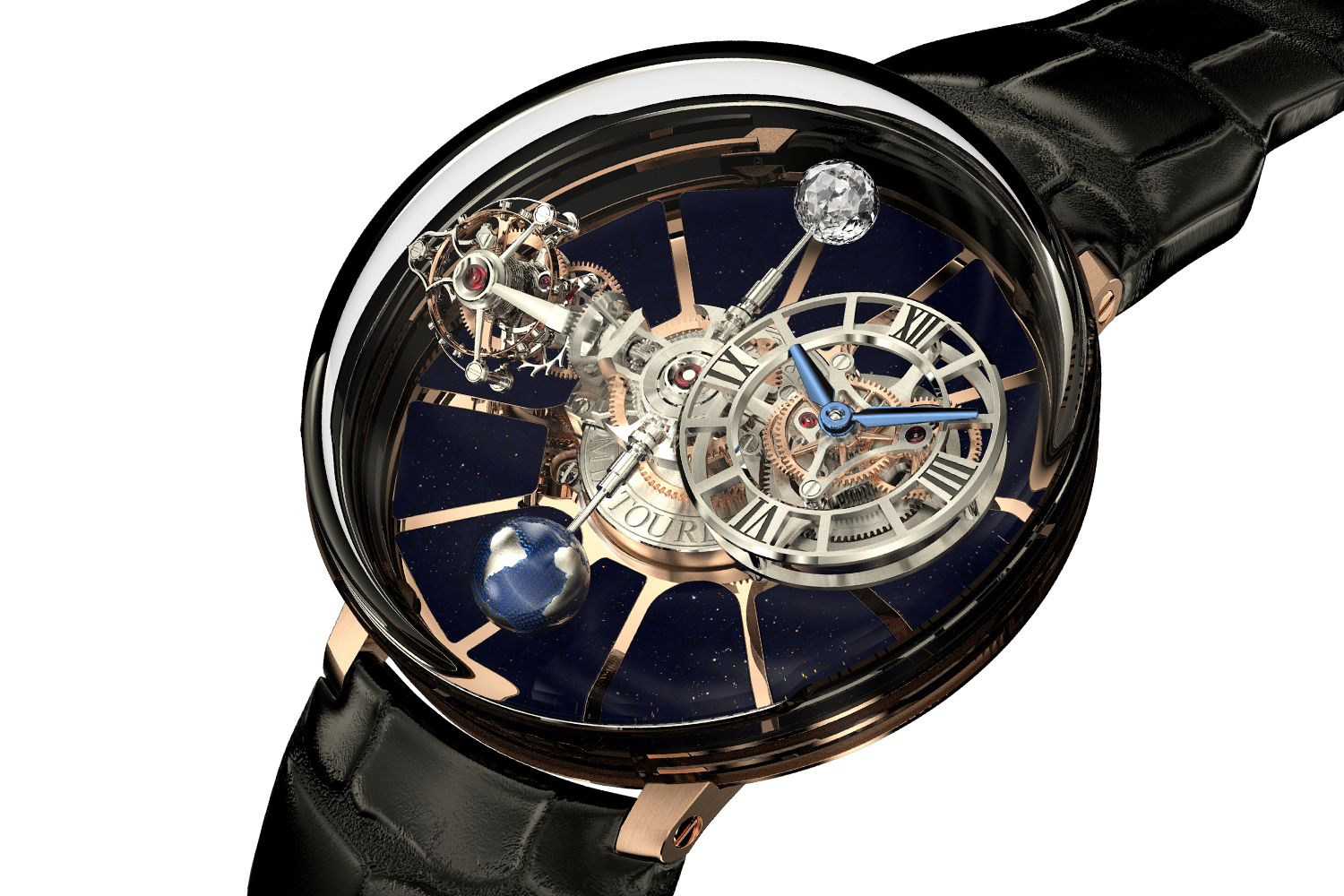
2014: Jacob & Co. Astronomia Tourbillon
The realization of Arabo’s vision required two distinct creative partners whose roles are worth understanding precisely, since both are central to the Astronomia’s story. The first is Luca Soprana — a fourth-generation Italian watchmaker who had trained at WOSTEP, worked at Vulcain and then with Vianney Halter, though the two did not end on good terms. Soprana then headed the prototyping workshop at BNB Concept (yes, that one with the aforementioned messieurs Buttet, Navas and Barbasini) before founding Ateliers 7h38 in a castle near Neuchâtel. He was the man who translated Arabo’s cosmological vision into functioning mechanical architecture. Soprana developed the Astronomia concept and built the first prototypes, approaching the work entirely by hand: components filed, wheels cut, bridges finished one by one. The prototypes were impressive. They were also, by definition, irreproducible at scale. Arabo wanted 10 to 15 pieces a year. For that, a different kind of partner was needed as the artisanal Soprana was unable to meet his goal.
To manufacture the Astronomia at series scale, Soprana turned to Concepto Watch Factory, selecting a Concepto base movement as the platform on which the extraordinary Astronomia satellite architecture would be built. That decision proved transformative for both parties. Concepto, founded and owned by the brilliant Valérien Jaquet — a master watchmaker who built his company from a standing start into a fully vertically integrated facility of 160 employees producing 30,000 to 40,000 movements per year for more than 40 clients — became Jacob & Co.’s principal movement partner and has remained so for nearly two decades. Today, Concepto produces almost the entire Astronomia series, including the Revolution and the Revolution Fourth Dimension. Jaquet has described the partnership with characteristic directness: “For almost 20 years, I and the Concepto Watch Factory team have enjoyed a deep and intense partnership with the Jacob & Co. label and with Jacob Arabo himself. As tourbillon specialists, we are very proud to co-sign with Jacob & Co.”
The fundamental Astronomia architecture deserves unhurried appreciation. From a baseplate of aventurine glass resembling a starry sky at night, a vertical four-armed satellite platform rotates once every 20 minutes around a central axis. Each arm carries a distinct element: a triple-axis tourbillon; a magnesium earth globe lacquered by hand; a one-carat white diamond cut with 288 facets in the Jacob Cut, spinning on its own axis once per minute; and a subdial for hours and minutes. The time display is driven through a patented differential system that counter-rotates the subdial at exactly the speed of the platform, keeping it always level and legible regardless of where it is in its orbit.
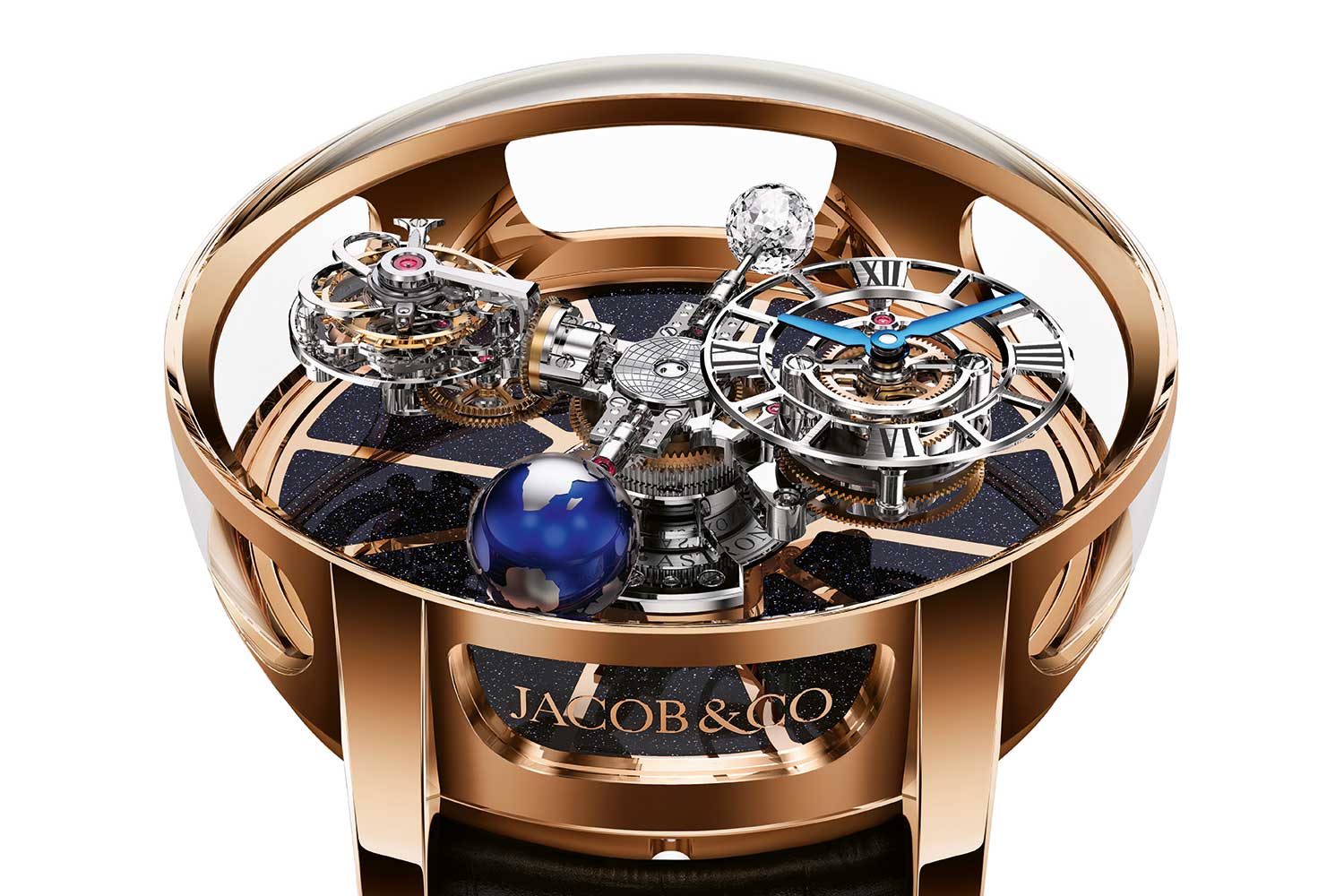
2025: Jacob & Co. Astronomia Revolution Four-Axis Tourbillon “Fourth Dimension”
In early configurations of the watch, the tourbillon’s two-axis structure — inner cage rotating in 60 seconds, outer cage in 5 minutes — gains a third axis from the platform’s own 20-minute revolution. It is a triple-axis tourbillon by architecture rather than by nested cage design. Subsequent Astronomia models refined and accelerated aspects of the system, with later versions adopting revised rotational timings and more complex multi-axis constructions. Gravity, once the enemy, has become the choreographer.
Says Santa Laura, aka watch collecting legend Ali Maghami, “The Astronomia is the watch I own that people are most drawn to. It is absolutely mesmerizing to have this timepiece on your wrist.”
Jacob & Co. Astronomia Tourbillon (Caliber JCAM10) — Key Specifications
- Case: Platinum 950, 18K white, rose or black gold; 50mm × 25mm; sapphire dome and sapphire caseband panels; aventurine glass baseplate
- Movement: Manual winding
- Total components: 365; titanium construction
- Jewels: 42
- Power reserve: 60 hours
- Frequency: 21,600vph (3Hz)
- First axis (inner tourbillon cage): One revolution per 60 seconds
- Second axis (outer tourbillon cage): One revolution per 2.5 minutes
- Third axis (platform rotation): One revolution per 10 minutes
- Diamond moon: One revolution per 30 seconds on its own axis
- Earth globe: One revolution per 30 seconds on its own axis
- Time differential: Counter-rotating subdial remains level and readable
The Astronomia Revolution Four-Axis Tourbillon “Fourth Dimension” (first presented as a pièce unique in 2023, entering production in 2025) represents the current apex. This watch built on the Astronomia Revolution powered by Caliber JCAM48B, which featured not only a multi-axis tourbillon, but also an integrated constant-force device. In that earlier model, the entire satellite arm rotated once per minute, while the tourbillon itself added two further axes rotating every 60 seconds and 15 seconds, creating a dynamic triple-axis system.
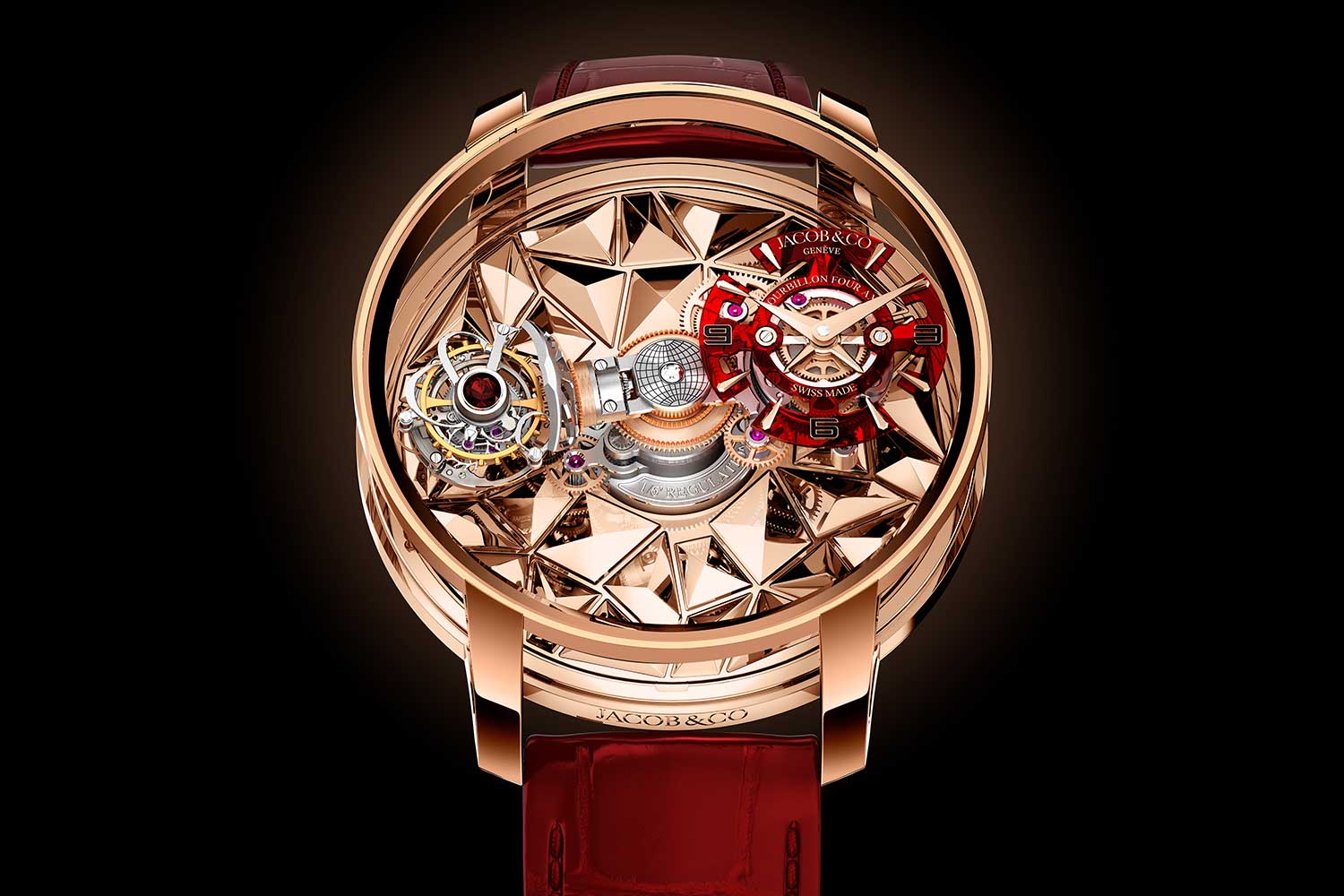
The “Fourth Dimension” model, powered by Caliber JCAM54, evolved the concept into a genuine four-axis tourbillon in which the satellite arm itself still rotates once per minute as the outermost axis, while the tourbillon adds three further axes (60 seconds, 18 seconds and 15 seconds) on top of that orbital motion.
In both models, to manage the enormous mainspring torque required to spin the entire satellite assembly, the movement incorporates a constant-force mechanism. Without it, the energy would simply overwhelm the escapement. To ensure that power to the balance wheel is constant over the entirety of the watch’s power reserve, Valérien Jaquet created a remontoir d’égalité on his escape wheel. As such, at six times per second, regulated energy is delivered constantly.
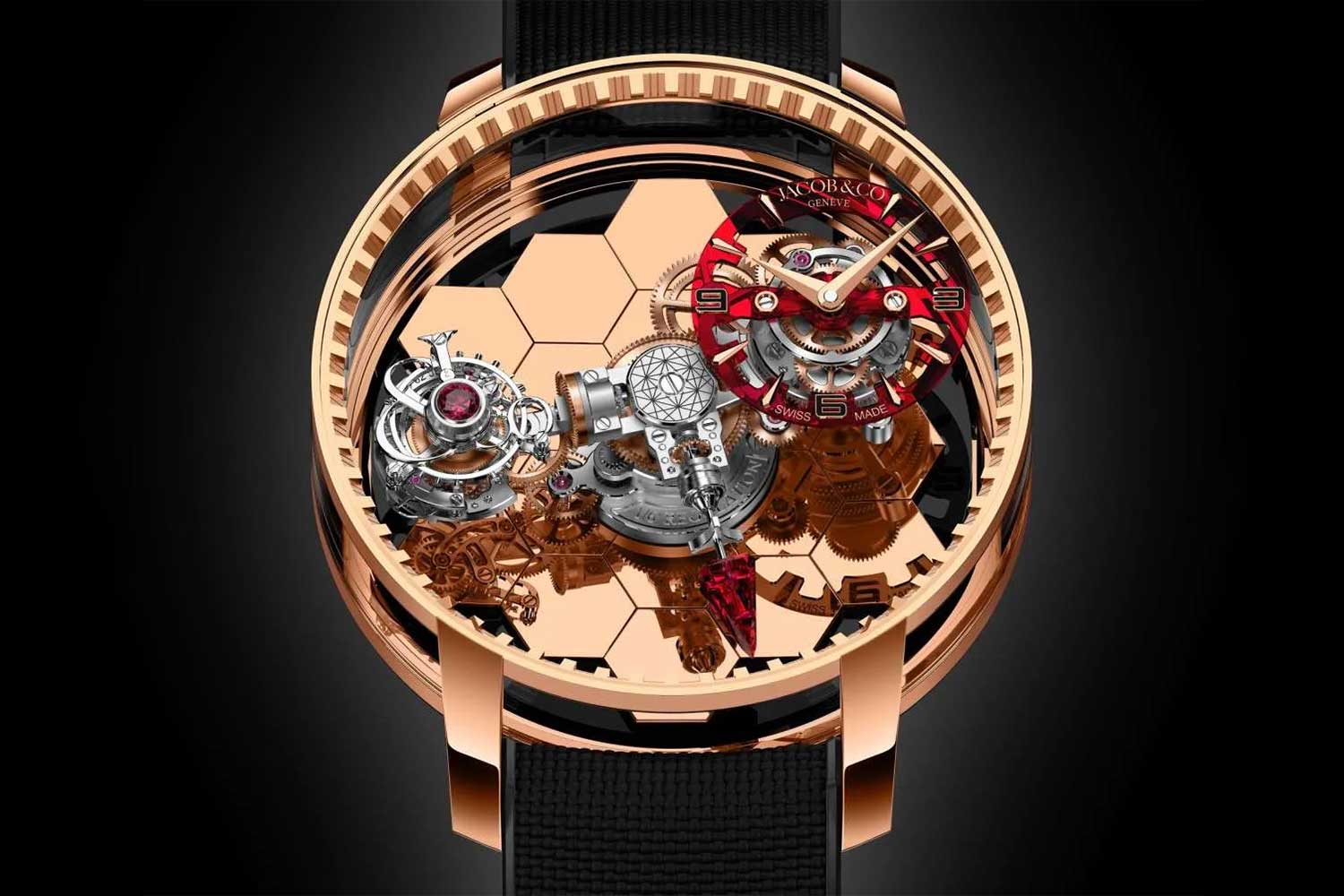
2023: Jacob & Co. Astronomia Revolution
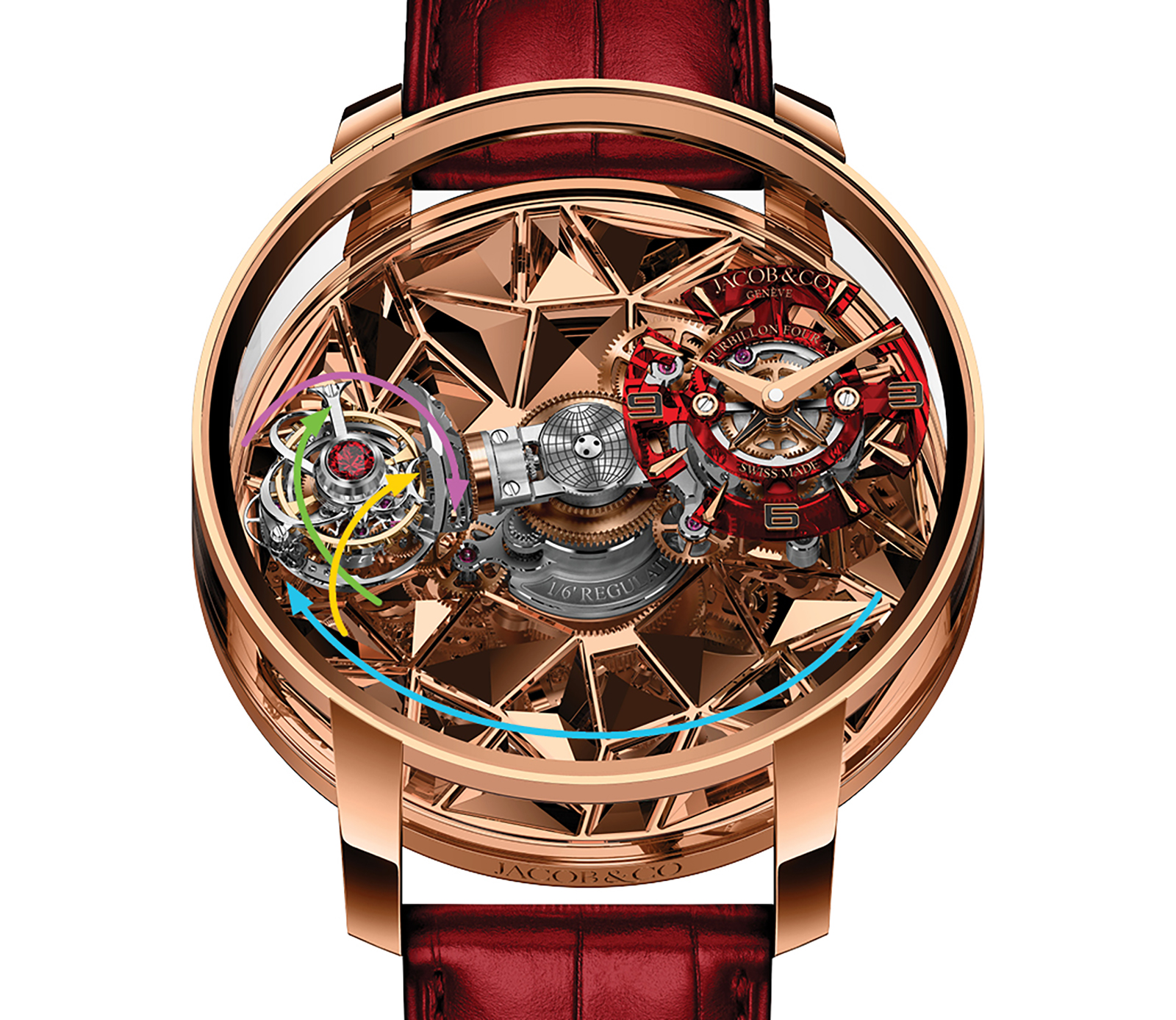
The balance rotates about its own axis within an inclined intermediate carriage carried by two further outer carriages. Offset arms accommodate the inclined carriage while keeping the rotating masses in balance, and a remontoir ahead of the innermost cage partially compensates for the energy losses of the four-axis transmission by restoring energy at every beat of the balance
How does it work? I’ve excerpted this detail from Sheng Lee’s article for Revolution on the Jacob Astronomia:
“The one-minute central carrier is an energy monster that requires a significant amount of power to keep it running. Despite having twin large barrels, the watch’s short 36-hour power reserve indicates the amount of energy consumed by the carrier. However, having two large barrels means that the escapement is locking and unlocking with significant force, which is too ‘violent,’ according to Bahman [Tagharrobi, Jacob’s lead watchmaker]. He also noted that the original prototype felt like an old pocket watch that was wound up too much, causing everything to shake and resulting in poor timekeeping. With the acceleration and deceleration at the escapement being profoundly great, the impact that occurs toward the end of the gear train is too large and negatively affects timing. Therefore, a constant-force mechanism is necessary to act as a buffer, dividing the large amount of torque into smaller portions to deliver to the escapement.”
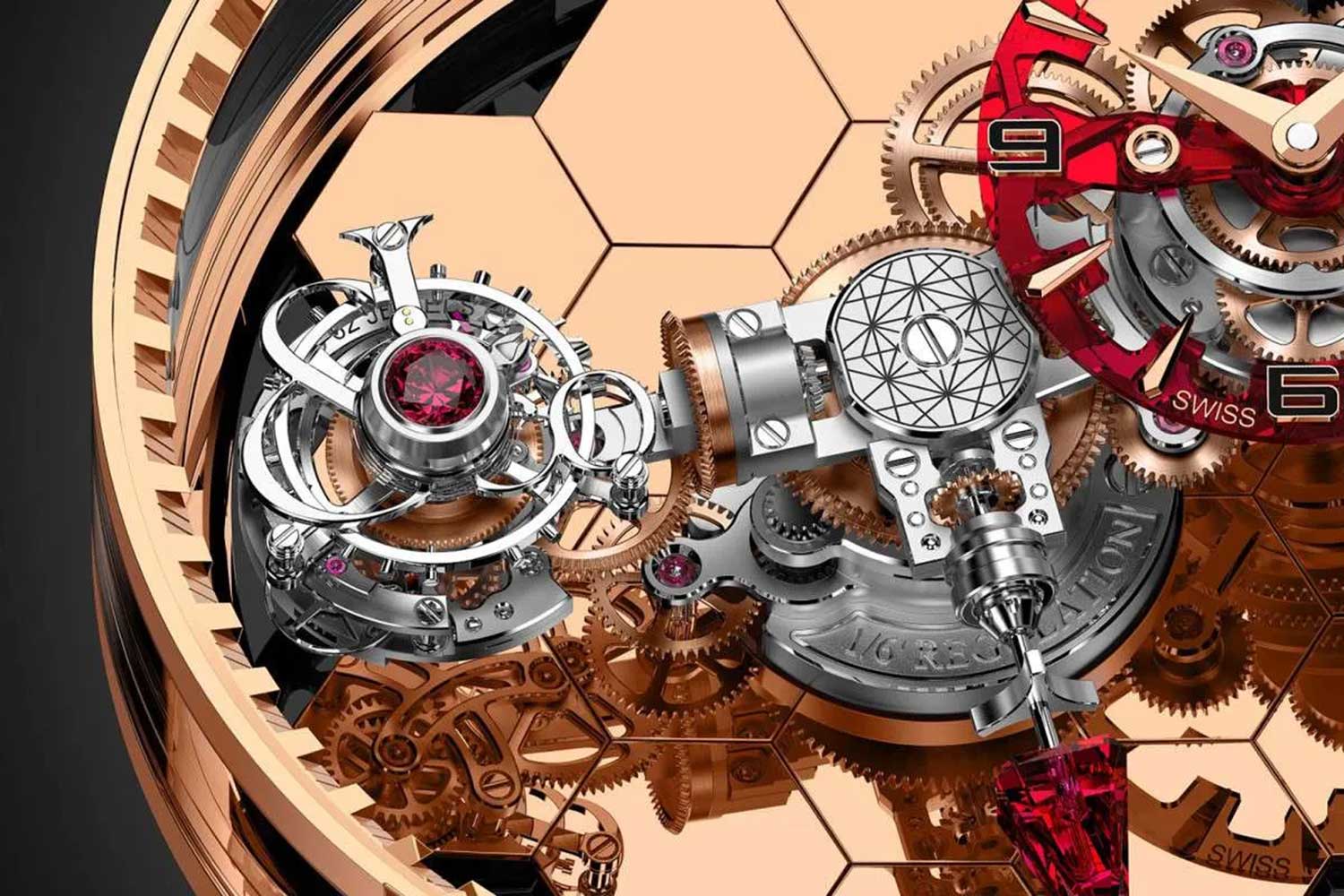
2023: Jacob & Co. Astronomia Revolution
Further, according to Sheng, “Thanks to the assistance of Concepto, the new patent-pending remontoir system (not shown in the press images) consists of two primary components. First, a remontoir spring stores a small amount of energy that is sufficient to advance the escape wheel by one tooth. Second, a four-armed, star-shaped wheel known as the ‘whip’ regulates the recharge of the remontoir spring. The remontoir spring is linked to the fourth wheel, which powers the tourbillon cage from below. Importantly, there’s a buffer between the remontoir and the balance wheel, as it is not directly connected to the escape wheel, to prevent any disturbances caused by the high-speed device.”
Intriguingly, this also means that Valérien Jaquet and Jacob’s Astronomia Revolution is the first multi-axis tourbillon since Thomas Prescher’s timepieces from 2004 to add an escapement-mounted, impacted remontoir d’égalité.
For more on the Astronomia read Lee Sheng’s excellent article here.
2016–18: The Twin Turbo Series, A Different Kind of Double
While the Astronomia pursued the idea of the tourbillon as a celestial body in orbital motion, Jacob & Co. asked a separate and equally provocative question in 2016: what would it look like to build a grand complication watch around not one but two triple-axis tourbillons — and pair them with a decimal minute repeater? The answer was the Twin Turbo, conceived by Le Cercle des Horlogers, the complications specialist in Neuchâtel co-founded by Alain Schiesser. The Twin Turbo’s double-tourbillon architecture is technically distinct from any other double tourbillon in existence — and patent-protected. In a conventional double tourbillon, both regulators are driven by a single barrel and gear train, a differential splitting power between them. In the Twin Turbo, each triple-axis tourbillon has its own dedicated mainspring barrel and gear train running in parallel. No differential. Instead, the two tourbillons are coupled by a friction clutch: when one oscillator’s rate diverges, the clutch wheels — driven together by friction rather than hard gearing — allow one to directly influence the other, drawing both back toward synchrony. Mutual rate correction through friction. Sufficiently original to have earned its own patent.
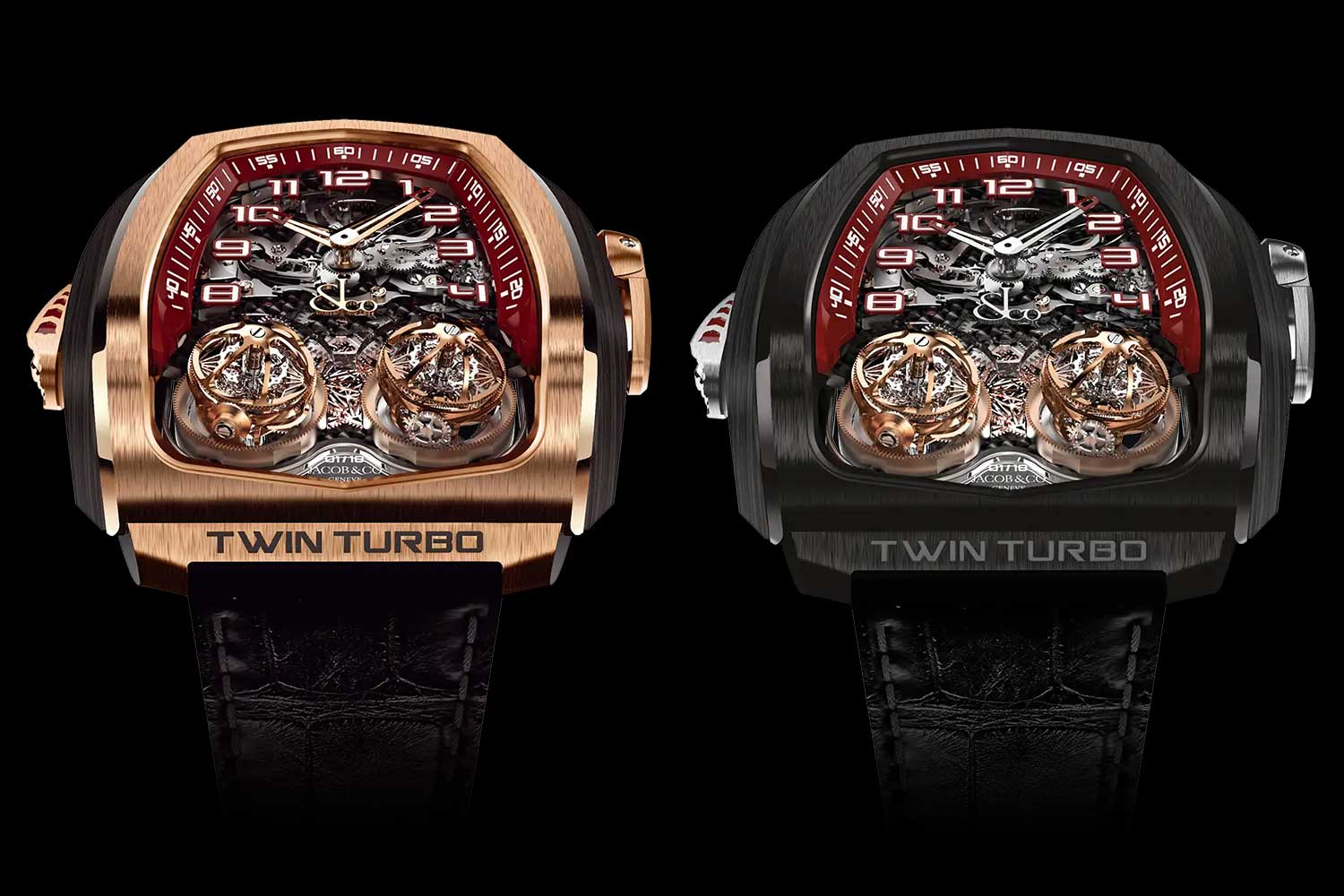
2016: Jacob & Co. Twin Turbo
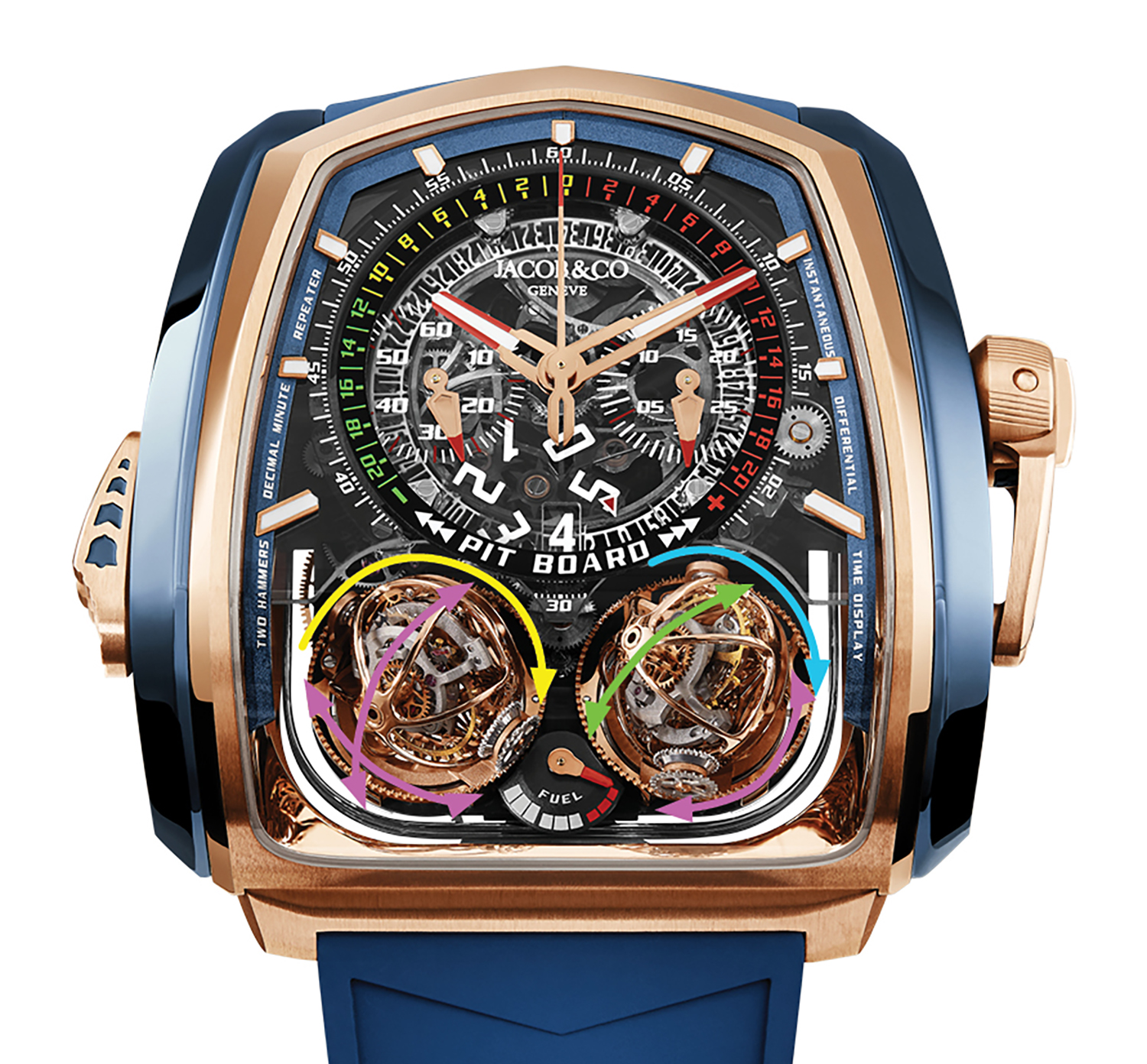
The tourbillons are flying, triple-axis and fast — 40 seconds, 3 minutes, 8 minutes on the three axes. A regulator mechanism between the two carriers ensures they remain in constant symmetrical motion. They stare out from the smoked dark gray sapphire dial through a large curved windshield sapphire crystal like a pair of animated eyes, flanked by a red Neoralithe inner ring. The case is inspired by a supercar’s bonnet: 57.3mm × 51mm, 16.9mm thick. The crown is shaped like a crank handle, engraved with the word “POWER.” The decimal minute repeater sounds through cathedral gongs running almost twice as long as standard ones, producing a resonance that is deeper, longer and more unapologetically operatic.
Jacob & Co. Twin Turbo (Caliber JCFM01) — Key Specifications
- Case: Black DLC Grade 5 titanium or 18K gold; 57.3mm × 51mm × 16.9mm; domed sapphire crystal front and back
- Movement: Manual winding; 34.43mm × 13.2mm
- Total components: 572, in titanium and steel
- Jewels: 49
- Power reserve: 72 hours
- Frequency: 21,600vph (3Hz)
- Tourbillon configuration: Dual triple-axis tourbillons; each with independent barrel and gear train, linked via patented friction clutch
- First axis: One revolution per 40 seconds
- Second axis: One revolution per 3 minutes
- Third axis: One revolution per 8 minutes
- Decimal minute repeater: Cathedral gongs; two hammers at 12 o’clock; chimes hours, 10-minute intervals, then minutes; double mechanical safety during chiming
- Production: Limited edition of 18 pieces per reference
- Price: CHF 360,000 at 2016 launch
If the Twin Turbo wasn’t enough, the Twin Turbo Furious (2018) added to the mix a monopusher chronograph and the “pit board” reference time indicator — inspired by the timing panels at the side of motor-racing tracks, allowing the wearer to set a reference time and read the difference in seconds against a timed event. Eight hundred and thirty-two components. Tourbillon axes accelerated to 24 seconds, 8 seconds, 30 seconds.
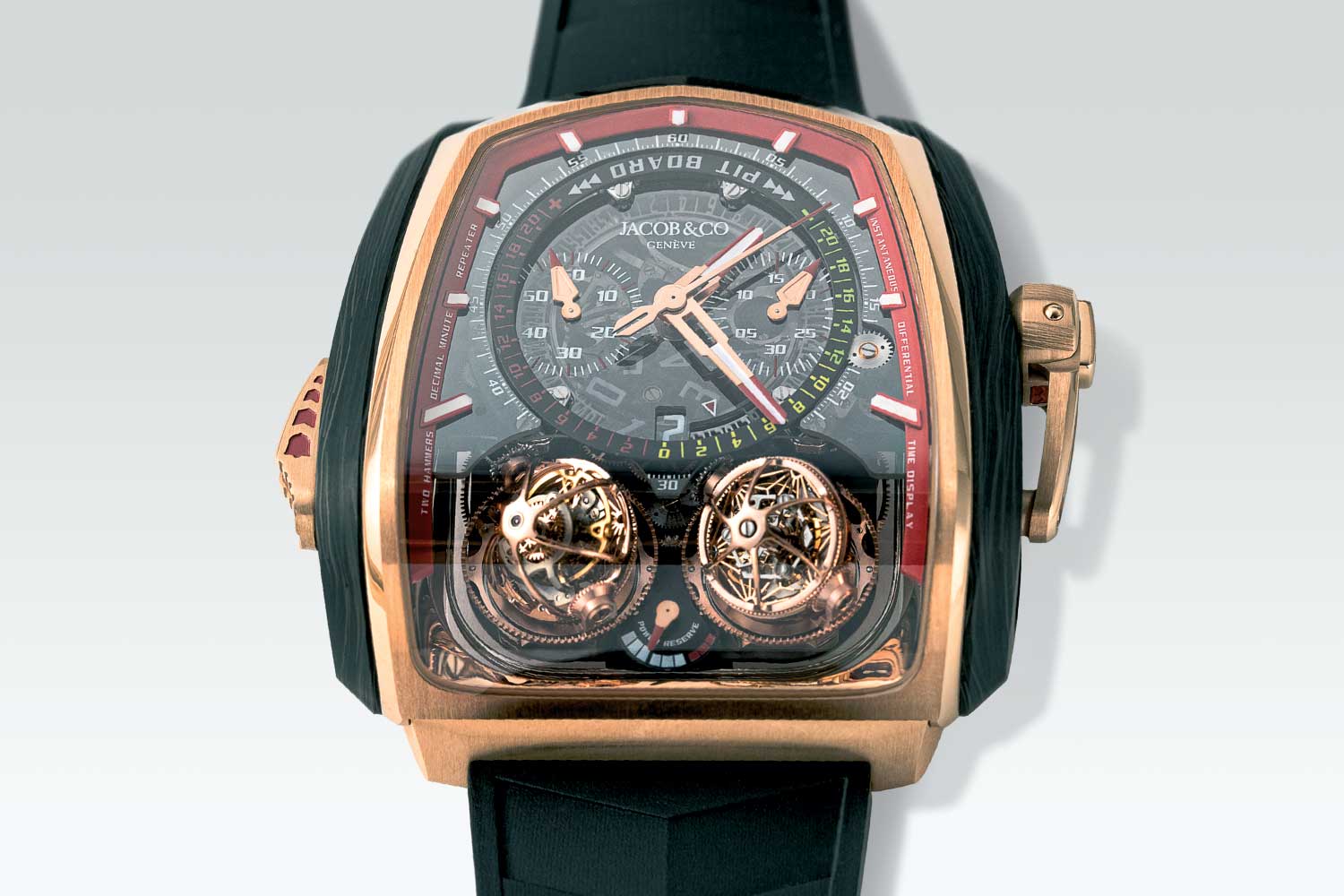
2018: Jacob & Co. Twin Turbo Furious
Jacob & Co. Twin Turbo Furious (Caliber JCFM05) — Key Specifications
- Case: Black DLC titanium and forged carbon or 18K rose gold; 57mm × 52mm × 17mm; double-curved sapphire crystal
- Movement: Manual winding; 34mm × 46mm × 13.7mm
- Total components: 832
- Jewels: 75
- Power reserve: 50 hours
- Frequency: 21,600vph (3Hz)
- Tourbillon configuration: Dual triple-axis tourbillons; each with independent barrel and gear train
- First axis: One revolution per 24 seconds
- Second axis: One revolution per 8 seconds
- Third axis: One revolution per 30 seconds
- Each cage: 104 components; 1.15 grams
- Decimal minute repeater: Cathedral gongs; chimes hours, 10-minute intervals, then minutes
- Monopusher chronograph: Includes pit-board reference time differential up to 5 minutes 59 seconds
- Winding: Crank-handle crown engraved “POWER”
- Price: CHF 525,000 at 2018 launch
Notable expressions include the Twin Turbo Furious Sapphire Crystal — with a full sapphire case and the entire 832-component movement visible from every angle — and the Twin Turbo Furious Bugatti La Montre Noire, covered entirely in black baguette-cut sapphires set in black gold. Jacob & Co. never stops.
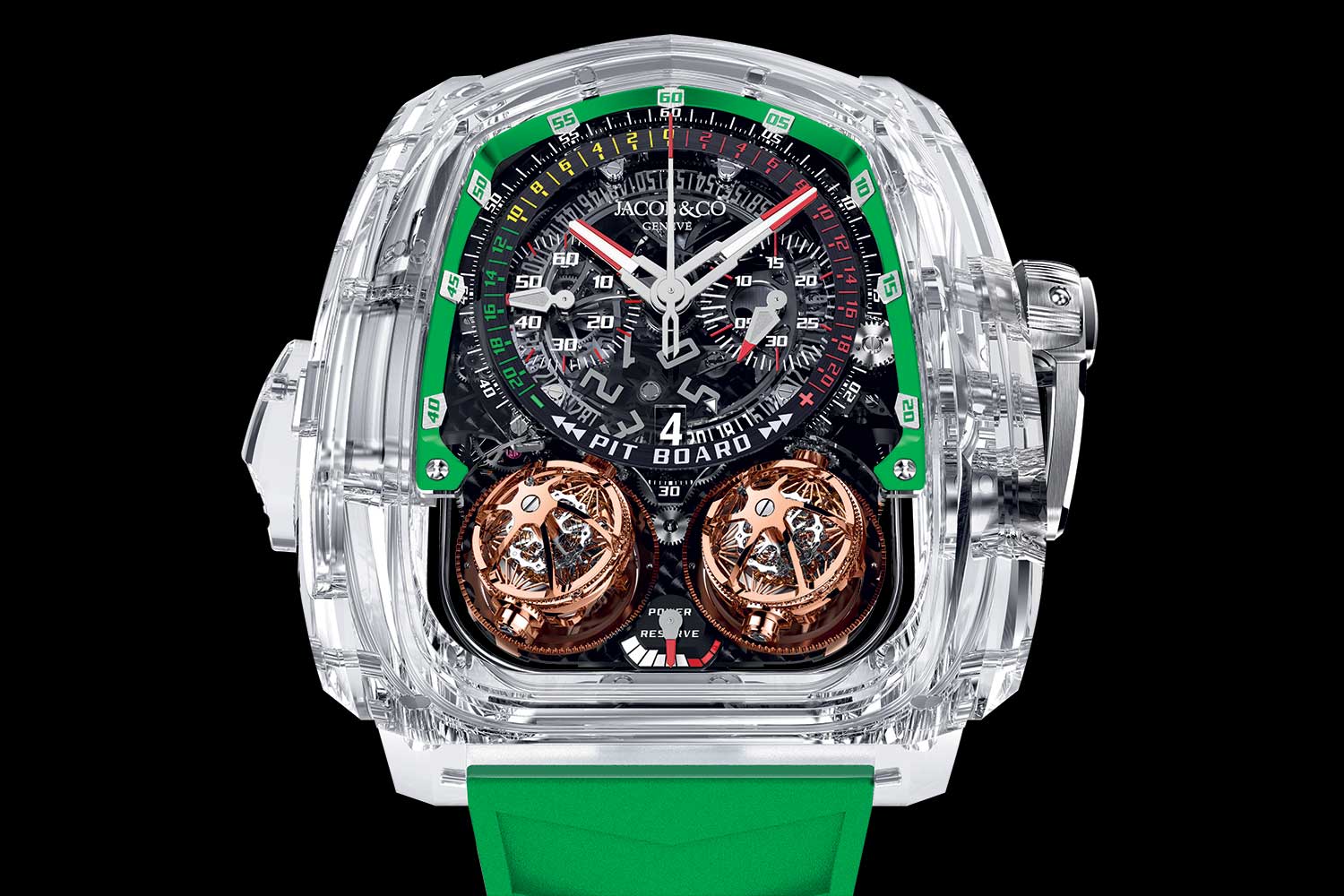
Jacob & Co. Twin Turbo Furious Sapphire Crystal
Jacob & Co.’s contribution to this story is philosophically distinct from all the others. Where Prescher, Coudray, Halter and Becsei approached the multi-axis tourbillon as a precision instrument or a research problem, Arabo approached it as performance — as theater, as time-telling jewelry, as proof that mechanical horology can be as spectacular and emotionally overwhelming as any other art form. The Astronomia does not merely display a tourbillon; it dramatizes gravity itself, turning the complication’s function into a cosmic metaphor. That this theatrical framework has produced genuinely innovative mechanics — Valérien Jaquet’s 1/6th-second remontoir, aka “the whip,” the dial differential, the quadruple-axis architecture — makes Jacob & Co.’s commitment to the Astronomia one of the most productive creative obsessions in contemporary watchmaking.
Fam Al Hut
2025: Möbius Mark I
The story of the multi-axis tourbillon has, until recently, been told almost entirely in a European key: British theorists, Swiss manufacturers, German independents, a French-Swiss design visionary, an Italian-Swiss movement architect, a Hungarian soloist and even an American jeweler turned horological impresario. The arrival of Fam Al Hut in 2025 represents something genuinely new — not merely a Chinese brand producing a complicated watch, but a Chinese independent atelier winning the GPHG Audacity Prize at the 25th GPHG with a debut double-axis tourbillon that the industry had not seen coming.
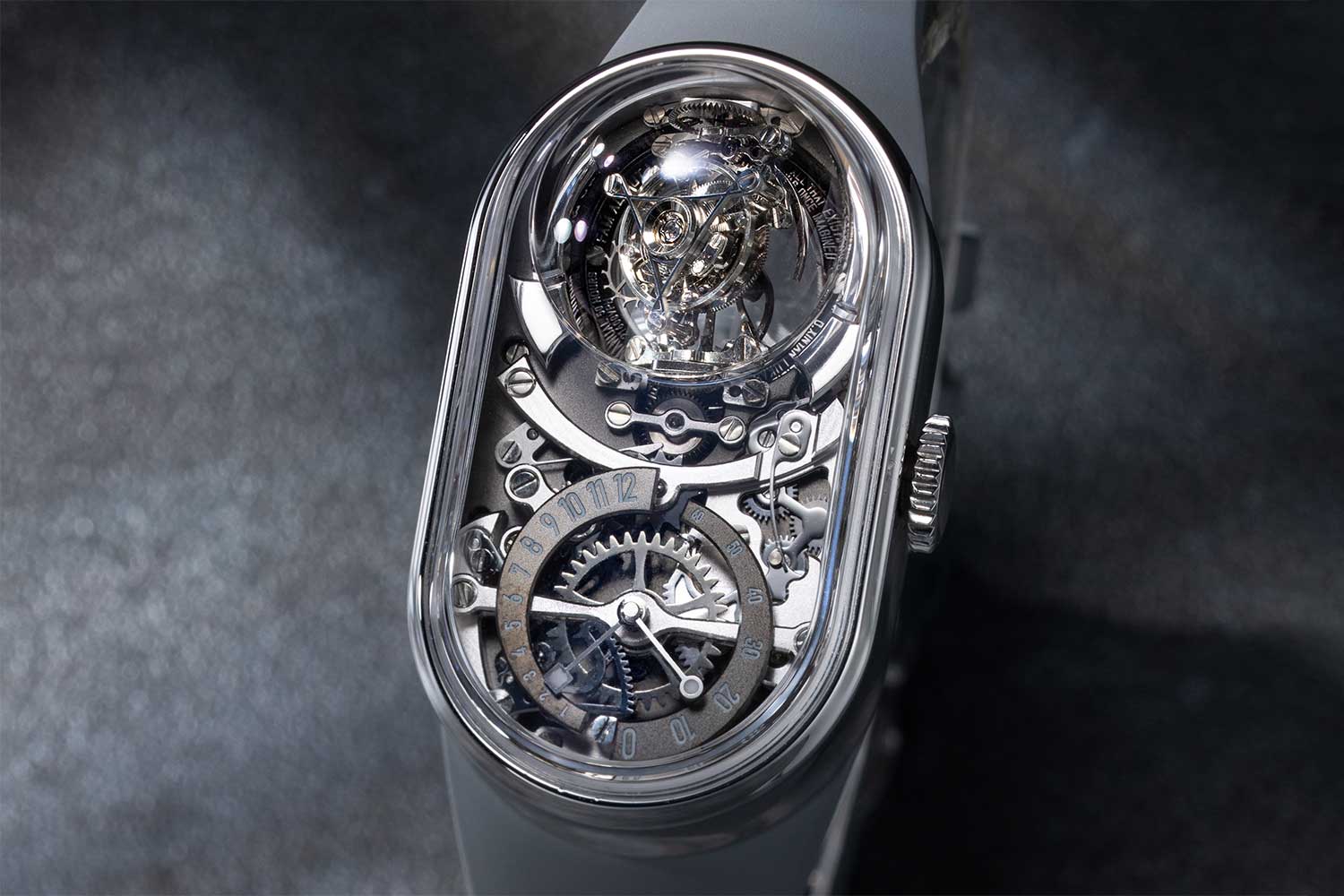
2025: Fam Al Hut Möbius Mark I (©Revolution)
The brand was founded in Chongqing in 2024 by three friends who met in an online community of watch collectors: Xinyan Dai, who studied decorative arts and design in Italy and brings a painter’s sensibility to form and proportion; Lukas Young, who studied in Germany, worked in Switzerland, and spends his nights exploring the sky through a telescope; and Zoe, who grew up in China, studied in Paris, and contributes fluency in both French and European watchmaking culture. None of them came through a traditional Swiss atelier path. Their backgrounds are in design, engineering, science fiction, jazz, astronomy and painting — and that heterodoxy of influence is visible in everything about the Möbius.

Dai, one of the co-founders of Fam Al Hut (©Revolution)
The brand’s name comes from Fomalhaut — in Arabic Fam al-Hut, meaning “mouth of the fish” — the brightest star in the constellation, Piscis Austrinus, which burns alone in a region of sky notably sparse in bright stars. In Chinese astronomical tradition, the same star was known as Bei Luo Shi Men, or “Northern Camp Army Gate,” a poetic image of a lone soldier guarding the outskirts. The name was chosen deliberately: independent watchmaking, they felt, is a solitary but luminous journey, charting one’s own path through the dark. That an Arabic name was chosen for a Chinese brand was not a gimmick but a tribute — to the shared astronomical heritage that transcends national watchmaking traditions.
The Design Philosophy and Architecture
Fam Al Hut’s approach to movement design inverts the conventional Swiss logic. Where most established manufactures begin with the movement and adapt the exterior accordingly, Dai and Young begin with the concept and the external design, then develop the movement architecture around it. The result is a coherence between case, dial and mechanism that is immediately apparent but difficult to define — everything visible from the front feels as though it belongs exactly where it is, because the exterior and interior were conceived simultaneously.
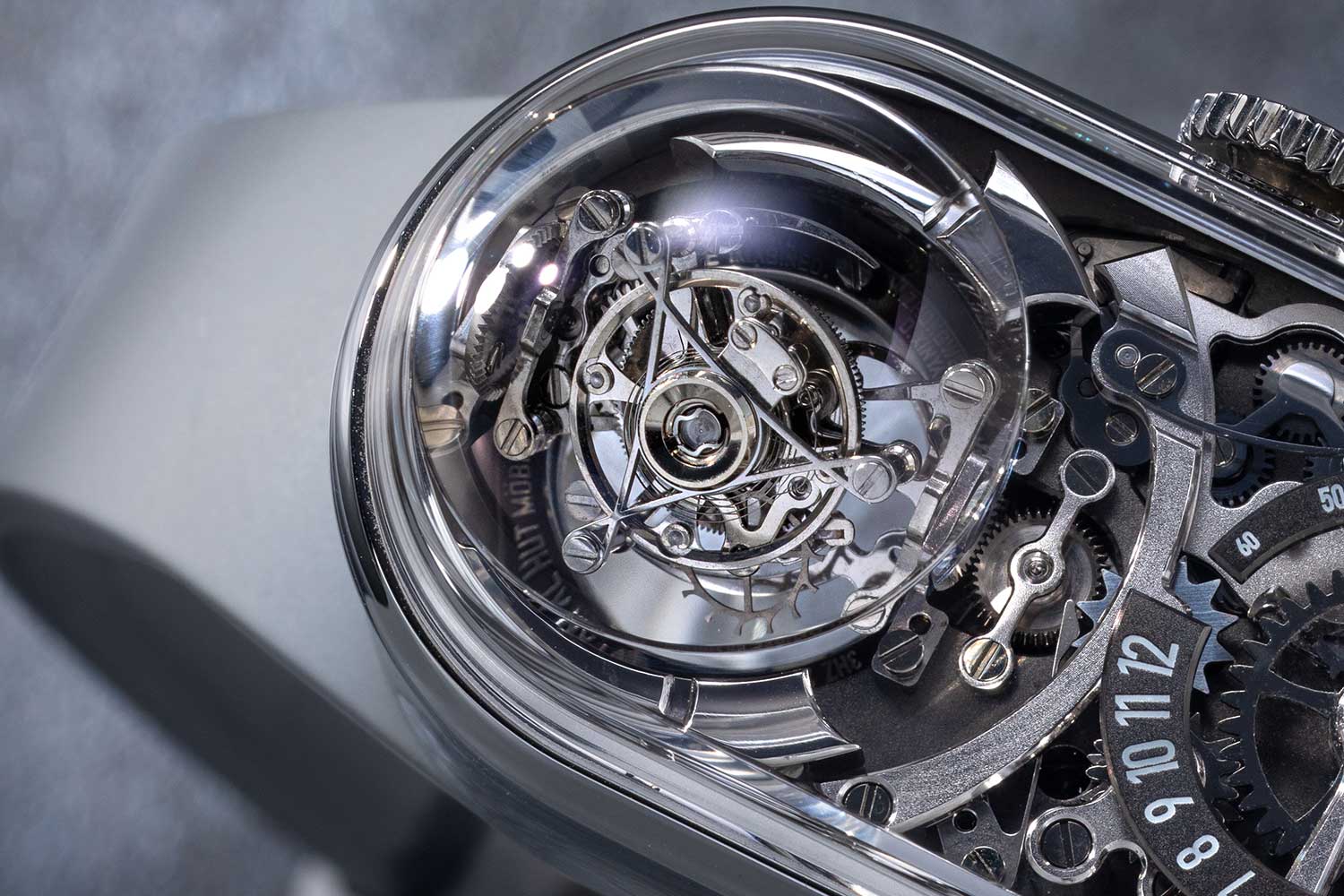
2025: Fam Al Hut Möbius Mark I (©Revolution)
The Möbius Mark I takes its name and its central metaphor from the Möbius strip — a surface with only one side and one edge, representing infinity, an endless loop of time and space. The concept is expressed on three levels simultaneously: the capsule-shaped case, which has no conventional front and back in the usual sense; the open-worked movement, whose two functional zones flow visually into each other without a conventional dial interrupting them; and, above all, the tourbillon cage itself, which is shaped as a subtle twist evoking the continuous ribbon of a Möbius form rather than the conventional spherical or cylindrical geometry of most multi-axis cages. The cage is made from a proprietary titanium alloy, chosen for its sculptural lightness — titanium’s elasticity and sensitivity to temperature variation made achieving perfect concentric balance a significant engineering challenge, requiring a complete rethink of machining tolerances.
The movement is divided into two distinct zones. The upper half — presided over by a 4.5mm sapphire bubble dome that rises above the case surface to accommodate the rotating cage — houses the double-axis tourbillon at 12 o’clock. The lower half contains the time display: retrograde hours and minutes, both with jumping mechanisms. As each hand reaches the end of its retrograde arc, it snaps instantly back to the beginning — a gesture that mirrors the Möbius strip’s own logic of endless return. The jumping hour, combined with the retrograde minutes, constitutes a world first in wristwatch complication design. On the caseback, a gourd-shaped sapphire aperture reveals the movement from the reverse — the gourd being a symbol of blessing and protection in Chinese culture, its name phonetically close to the words for fortune and official rank. However, all of this would still not have created the impact the Möbius made, if not for one very key difference from every multi-axis tourbillon watch that had come before it, and that was its size. At 42.2mm × 24.3mm with no lugs, it is, in length and width, no bigger than a shaped Cartier watch, which made it immediately stand apart from the totemic, overbearing, ursine heft of every other watch discussed here. The Möbius was something all the others were not — it was elegant. Of course, the height still needed to cater to the double-axis tourbillon, but here the Fam Al Hut team did something smart. Their case was 12mm in thickness, except for a domed sapphire bubble over the tourbillon itself, which was 17mm at its height, enabling their timepiece to remain very wearable.
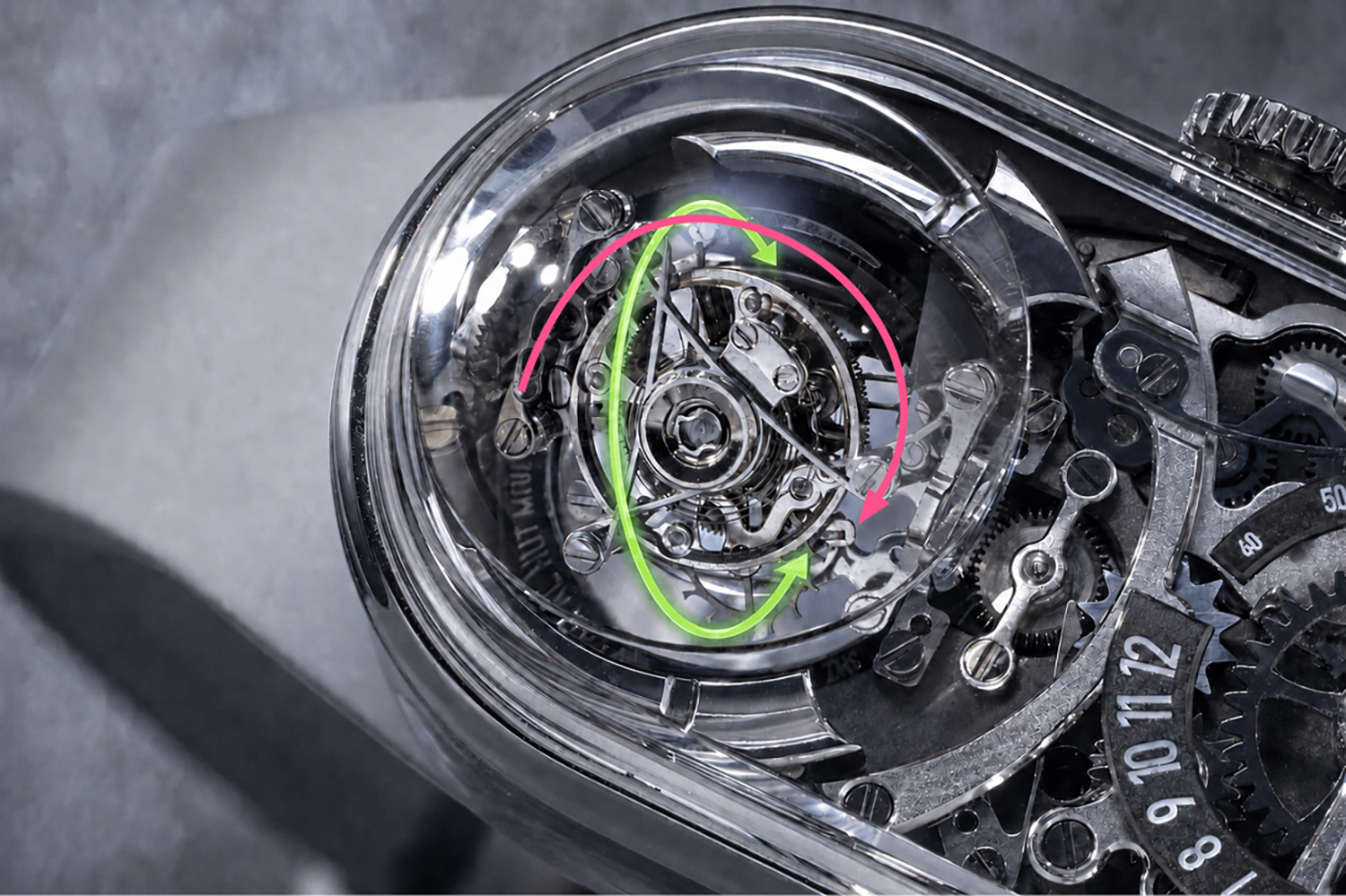
The Fam al Hut Möbius features a double-axis tourbillon with two nested cages rotating on perpendicular axes. The inner cage carrying the balance completes one revolution every 60 seconds, while the outer cage rotates every 90 seconds
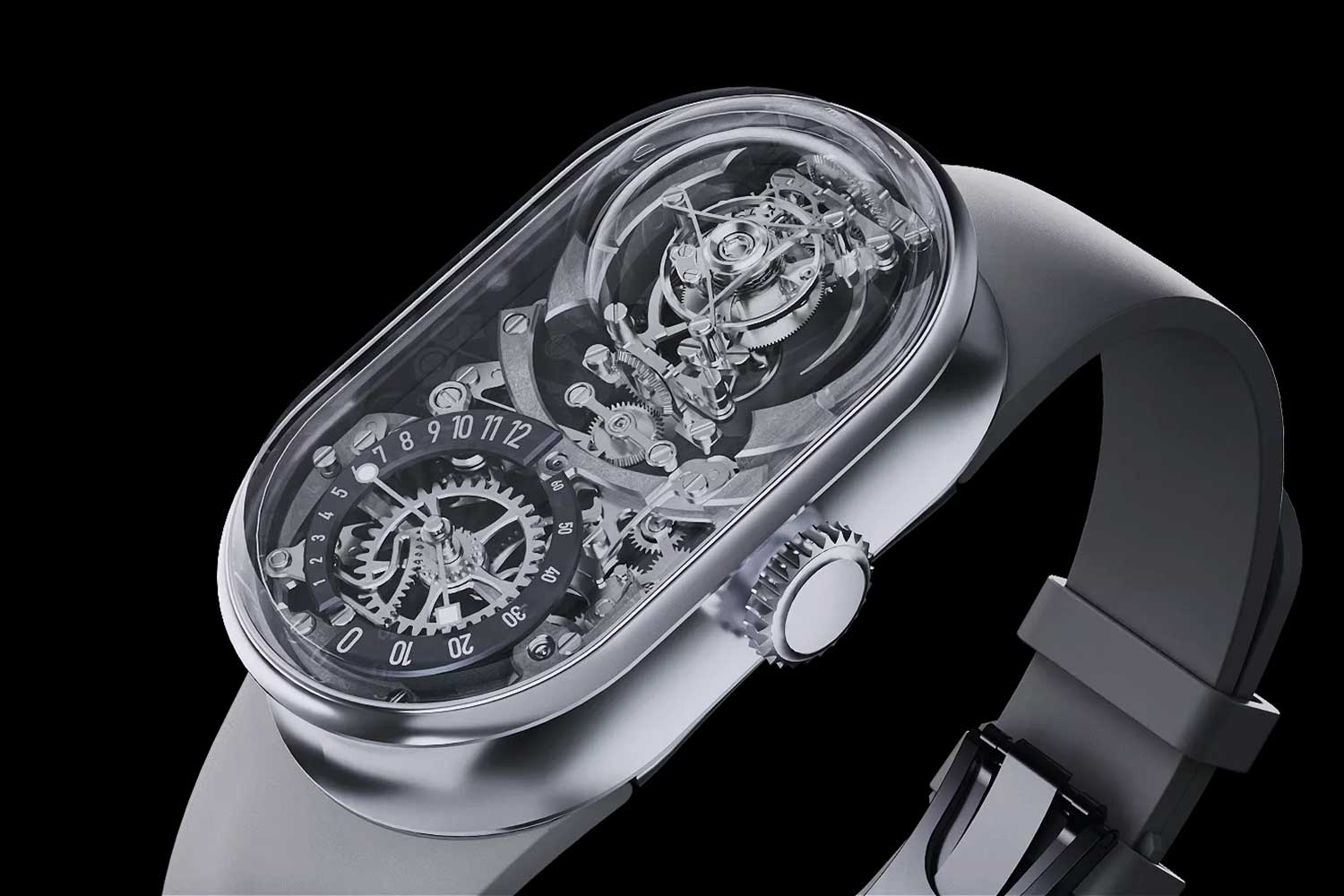
2025: Fam Al Hut Möbius Mark I
Fam Al Hut Möbius Mark I (Caliber M01T) — Key Specifications
- Case: Stainless steel or amorphous zirconium; 42.2mm × 24.3mm × 12.9mm (17mm at sapphire bubble peak); capsule-shaped lugless construction with ultra-thin rubber strap
- Movement: In-house manual winding Caliber M01T; open-worked capsule-shaped architecture matching the case
- Total components: 297
- Power reserve: 50 hours
- Frequency: 21,600vph (3Hz)
- First axis (inner axis): One revolution per 60 seconds
- Second axis (outer axis): One revolution per 90 seconds
- Tourbillon cage material: Proprietary titanium alloy with Möbius-strip-inspired geometry
- Display: Double retrograde with jumping hour and jumping minute
- Caseback: Gourd-shaped sapphire aperture
- Production: Approximately 70 pieces per year maximum; more than 200 hours of handcraft per watch
- Price: USD 32,000 – USD 42,000 depending on configuration and case material
- Award: Grand Prix d’Horlogerie de Genève 2025 Audacity Prize (25th edition)
The GPHG Audacity Prize was not awarded for marketing, heritage or brand weight. It was awarded for exceptional creative boldness, on purely horological grounds. Dai’s stated hierarchy of values — creativity first, innovation second, chronometric performance third — places Fam Al Hut firmly in the tradition of watchmakers for whom the complication is a vehicle of expression before it is a precision instrument. In spirit, it has more in common with Vianney Halter than with Éric Coudray, more in common with Jacob Arabo than with Thomas Prescher — though it shares none of their aesthetic vocabularies. Indeed, upon setting eyes on the Möbius in the metal, I immediately congratulated Dai on creating the most interesting all-new original voice in highly contemporary watchmaking. It is, honestly, the type of timepiece that brands like Richard Mille and Hublot, which are both feeling a bit bucolically classic now, need to create.
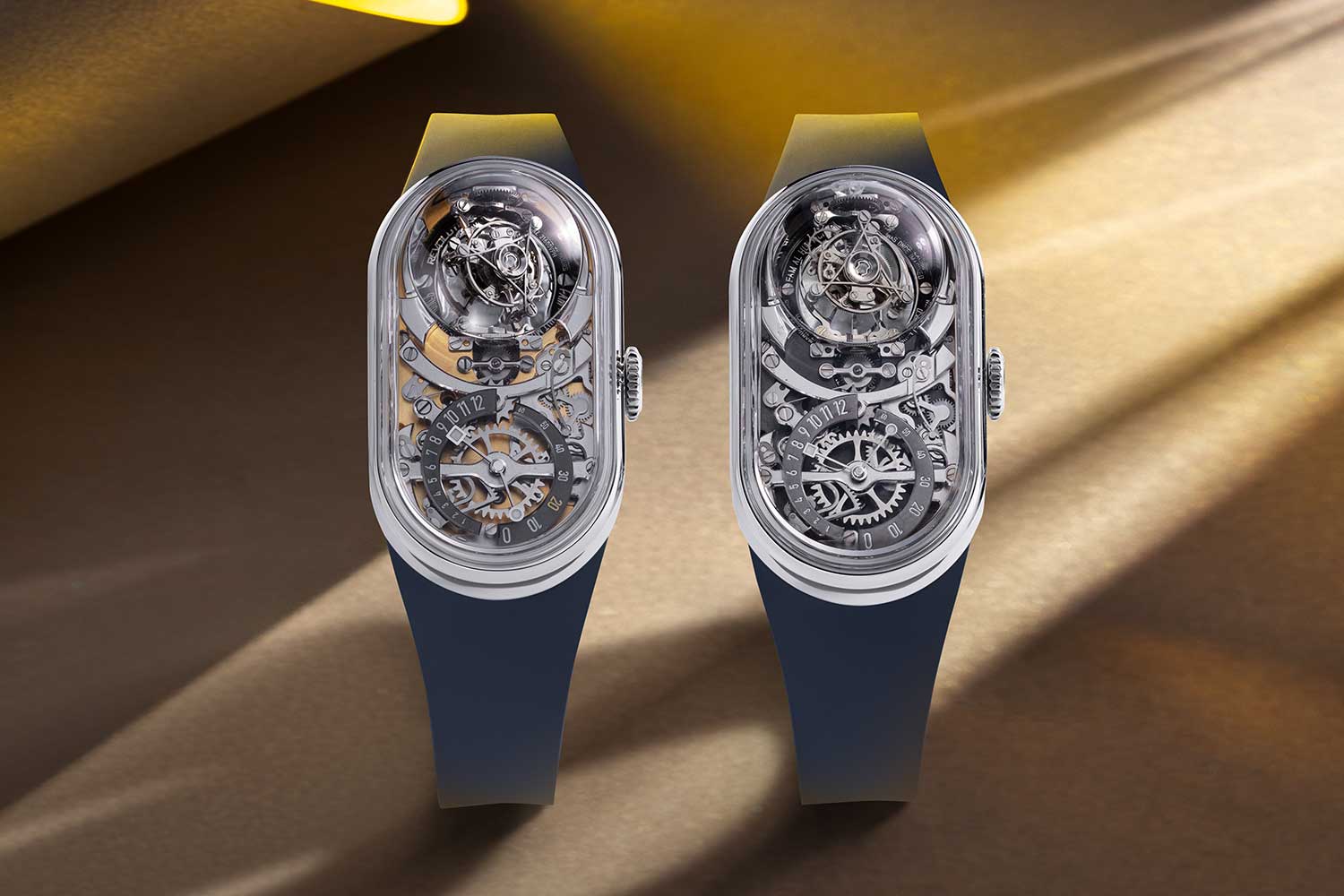
From left: Fam Al Hut x Revolution Möbius Mark I Nebula Limited Edition and Fam Al Hut Möbius Mark I (©Revolution)
What distinguishes Fam Al Hut from every other entrant in this story is geography. Until 2025, the multi-axis tourbillon had been a story told entirely within the European watchmaking tradition — European craft infrastructure, European training academies, European conceptions of what haute horlogerie is for. Fam Al Hut arrives from outside that tradition entirely, drawing on Chinese aesthetic philosophy, Italian design education, German engineering rigor and Swiss technical ambition. That the debut piece won the GPHG’s highest prize for creative courage in the same year it was released suggests that the story of the multi-axis tourbillon has not finished finding new voices — and that the next chapter may well be written somewhere other than the Vallée de Joux.
Coda: Who Matters Most?
Across the half-century arc of the multi-axis tourbillon — from Randall’s patent application to the Gyrotourbillon à Stratosphère, from Prescher’s Baselworld debut to Becsei’s Budapest atelier, from the diamond moon of the Astronomia to the vacuum chamber of the Deep Space Resonance — one question naturally arises: which individual has contributed most to this story?
It is not a simple question, and it deserves an honest answer rather than a diplomatic one.
Anthony Randall is the story’s undisputed intellectual father. Without Patent GB2027232 in 1978, and without Richard Good’s working carriage clock proving the principle two years later, there is no foundation on which anyone builds anything. Every watchmaker in these pages — without exception — stands on Randall’s shoulders. Coudray himself acknowledged as much, describing his inspiration for the Gyrotourbillon as a pendulum clock by Randall encountered during watchmaking school. The industry took nearly a quarter century to act on Randall’s insight — which does not diminish its primacy but rather underscores it. The best ideas often wait patiently for the world to be ready. Randall is irreplaceable: the story cannot begin without him.
Thomas Prescher deserves recognition that history has not always been careful enough to bestow. He worked entirely alone, at the exact moment that the workshops of Franck Muller, Jaeger-LeCoultre and Greubel Forsey arrived at their own 2004 debuts with the resources of established manufactures behind them. Prescher had a bench in Twann, conical gears, and a conviction that the impossible was merely very difficult. His achievement is heroic in the most literal sense. Let’s not forget, he also implemented an escapement-mounted remontoir in his timepieces — an achievement not equaled until 20 years later by Valérien Jaquet and the Jacob & Co. Astronomia Revolution.
Greubel and Forsey took the most philosophical path — rejecting straightforward perpendicular-axis multiplication entirely and inventing the spherical differential, the Quadruple Tourbillon, and a chronometric argument for the multi-axis complication that might be the most technically defensible in the entire field. Hang on to that thought — as we will see, they proved their watch’s chronometric merit.
We have to pause to applaud Golay, Buttet, Navas and Barbasini even if the Revolution 2 and 3 were simply the meeting point for these great men who would all go on to other greater achievements. We can’t help but smile when we think of the remarkable Aaron Becsei making every part of his Primus triple-axis watch with his own hands. We have to acknowledge the bad-assery of Alain Schiesser’s Twin Turbo with its double triple-axis tourbillons and decimal minute repeater. We have to single out Valérien Jaquet as a true creative force in watchmaking for his 1/6th of a second remontoir in the Astronomia Revolution and give props to Jacob Arabo for his creation of this now-iconic complication. We cannot help but be seduced by the romantic allure of Vianney Halter’s Deep Space Tourbillon Resonance and we are charmed by how Lukas, Zoe and Dai of Fam Al Hut connected the multi-axis tourbillon to an all-new younger audience.
But when the full arc of the story is considered — not just one landmark but the cumulative weight of contribution across time, across different makers, and across fundamentally different technical architectures — the figure who emerges most distinctly is the amazing Éric Coudray.
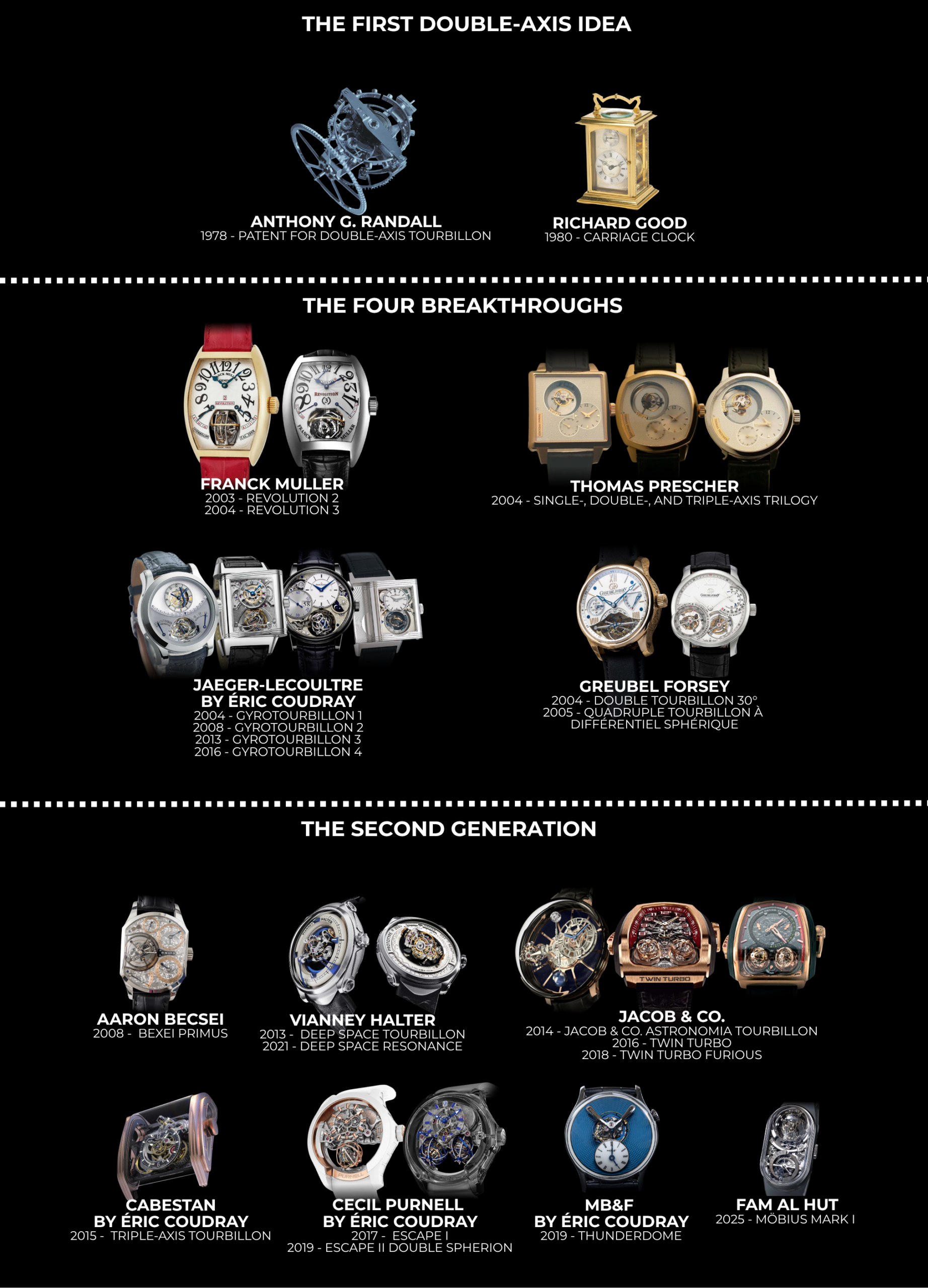
No other individual appears in so many chapters of the narrative, and no other appears in them as a primary creative force. He conceived the Gyrotourbillon at Jaeger-LeCoultre — the most architecturally radical of all the 2004 debuts, introducing the spherical cage geometry, the perpendicular balance mounting, and the two-fixed-wheel power transmission that no one else had attempted or has since replicated. He then rescued and realized the Cabestan Winch Vertical Tourbillon when others had failed, then developed a multi-axis tourbillon driven by a chain and fusée. He invented the Spherion for Cecil Purnell, the Thunderdome for MB&F — the world’s fastest multi-axis tourbillon — and then the bonkers Purnell Escape II’s six-cage double-Spherion system with counter-rotating assemblies linked by a differential..
What elevates Coudray above a simple count of contributions is the qualitative character of each invention. He has not refined the same idea repeatedly; he has reinvented his approach from first principles each time, producing architecturally distinct solutions that share a common intellectual rigor but look nothing like each other. The Gyrotourbillon, the Cabestan Multi-Axis, the Spherion, the Thunderdome and the double Spherion are five different answers to related questions — and each answer has expanded what the multi-axis tourbillon is understood to be capable of. He has kept finding new questions to ask long after the field had settled into established positions, and his answers have consistently surprised people who thought they already knew what this complication could do.
The fairest summary may be this: Randall originated the idea but Coudray has been, across the broadest span of time and the greatest range of creative invention, its most important and most restless practitioner. The story requires all of them. But if one watchmaker’s absence would leave the largest hole — not in the foundation of the idea, but in the richness, variety and ambition of everything built upon it — that watchmaker is Éric Coudray.
Technical Postscript: Do Multiple Axes Improve Accuracy?
This is the question that has accompanied the multi-axis tourbillon since Randall’s patent — and it is the question that separates the believers from the sceptics, the engineers from the aesthetes. It deserves a direct answer.
In theory, yes. An oscillator swept continuously through all positions in three-dimensional space averages gravitational error more completely than one confined to a single plane. A triple-axis tourbillon with well-chosen rotation rates will, in a static position, eventually occupy every orientation — in Prescher’s case, with a repeat cycle measured in hours. In Jaeger-LeCoultre’s Stratosphère, the three-cage system covers approximately 98 percent of the positional sphere.
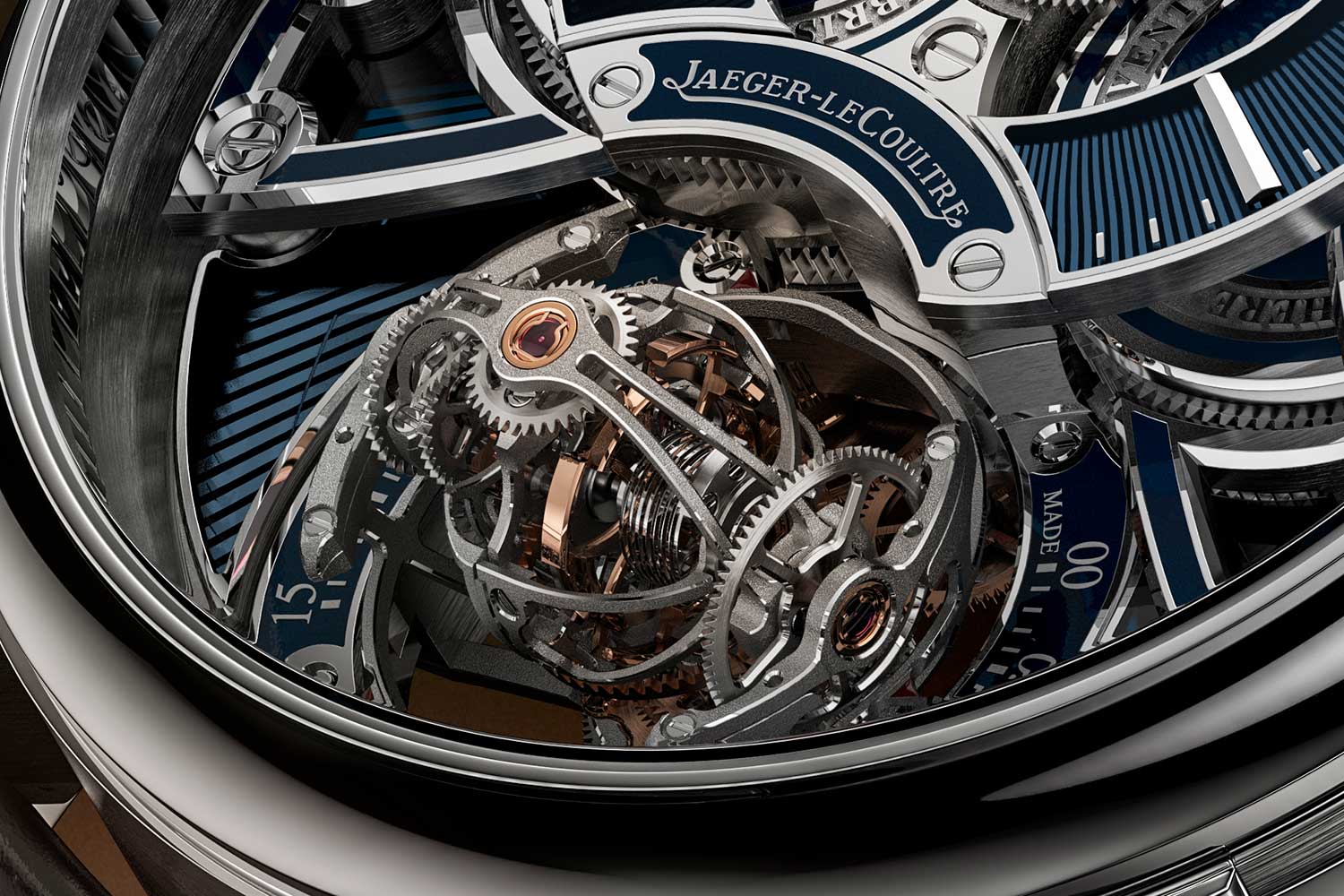
Jaeger-LeCoultre Gyrotourbillon à Stratosphère
In practice, on a wrist in motion, the picture is more complicated. A wristwatch is continuously in motion, which means even a standard single-axis tourbillon is never truly static. The precision claims of multi-axis tourbillons are most meaningful when the watch is at rest — on a nightstand, or in a display case — where positional errors are fixed and the multi-axis sweep provides genuine averaging benefit.
The importance of such a complicated watch is rather to be found in the creation of art for art’s sake than in a further improvement of rate values. A triple-axis tourbillon occupies many more positions in space than the single- and double-axis designs — and the unobstructed view makes it seem to float almost freely in the air. It is not only a technical masterpiece but, first and foremost, a work of art.
That assessment captures the honest position most serious horologists now hold. But the story of accuracy and the multi-axis tourbillon has a more specific, and more vindicating, chapter — one that requires a brief excursion into the history of competitive chronometry itself.
The Observatory Trials: A Brief History
Precision in timekeeping has always been a matter of national and commercial competition, rooted originally in the most practical of military necessities. The ability to determine longitude at sea was inseparable from the accuracy of the ship’s timekeeper. Marine chronometers were once as strategically significant as any weapon — the nations that produced the most accurate ones could navigate the world’s oceans most effectively, project power further, colonize faster, trade wider. It was, in the deepest sense, a race.
By the 20th century the battlefield had shifted from the quarterdeck to the laboratory. European observatories — at Kew in England, Besançon in France, Geneva and, most famously, Neuchâtel, both in Switzerland — became the arenas where watch manufacturers competed to demonstrate the finest mechanical precision ever achieved. In these trials, chronometer movements of every configuration — lever escapements, precision regulators and the finest tourbillons — were subjected to sustained testing across multiple positions and temperatures over periods of 45 days or more. It was from these crucibles that legendary movements made their reputations: the Omega 47.7, the 5Hz Longines 360, the Zenith Caliber 135. The régleurs — the precision timers who prepared movements for competition, juggling conflicting parameters of rate, positional variation and temperature sensitivity — were the grand masters of their craft, names revered among horologists in the way that Rudolf Nureyev’s name is revered among dancers.
-

- Omega Caliber adjusted by Alfred Jaccard set a world precision record at Kew observatory in 1936 (Image: Omega)
-
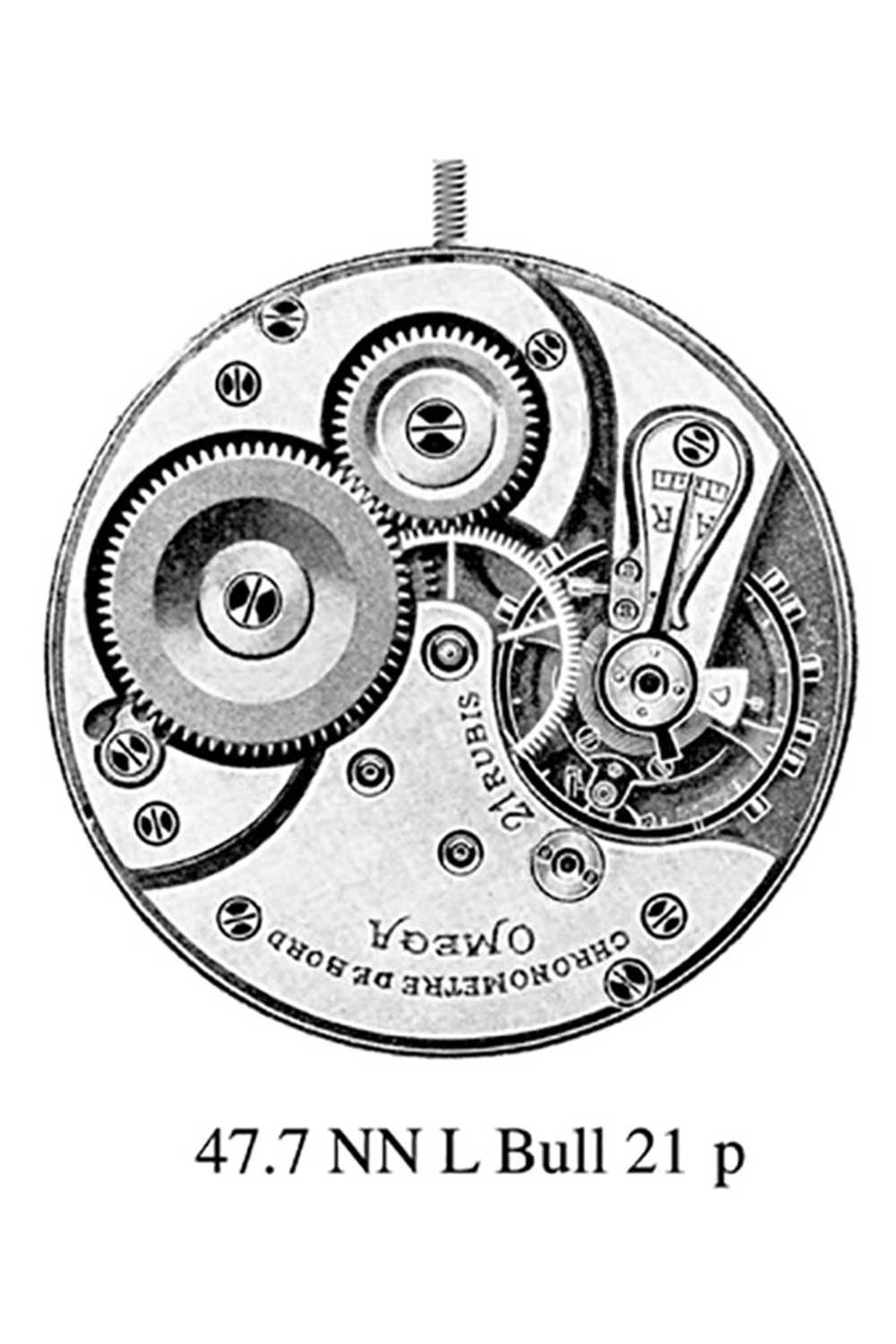
- The Omega cal. 47.7
-
- Longines Caliber 360
-
- Zenith Calibre 135
The Neuchâtel Observatory remained the preeminent battleground until a development that was simultaneously humbling and historically irresistible. Beginning in 1963, Seiko — then a regional manufacturer barely known outside Japan — began entering the Swiss Observatory trials. Their early results were poor: 144th place in their first year. But the improvement was extraordinary. By 1967, Daini Seikosha had reached 4th place individually, with Seiko placing 2nd in the manufacturer rankings overall. Then in 1968, at the Geneva Observatory competition — the Neuchâtel wristwatch competition having been quietly closed after 1967 — Suwa Seikosha swept 4th through 10th place in the mechanical wristwatch category, achieving the highest scores ever recorded by a mechanical watch at Geneva. The only timepieces that surpassed them were not Swiss mechanical watches but quartz prototypes from the Centre Electronique Horloger, precursors of the technology that would detonate the Quartz Crisis the following year.
The combination of Seiko’s mechanical dominance and quartz’s demonstration of a categorically different level of accuracy made the continuation of observatory trials essentially impossible to justify. By 1969, quartz technology had changed everything. The trials lapsed. For nearly four decades — through the entire Quartz Crisis, the rebirth of mechanical watchmaking in the 1980s, and the explosion of haute horlogerie in the 1990s and 2000s — no equivalent competition existed. The precision vocabulary that had produced the Omega 47.7 and the Zenith 135 went largely quiet. It was a long silence.
The Concours International de Chronométrie: Revival and Vindication
It was in 2009 that the Musée d’Horlogerie du Locle — the Watch Museum of Le Locle — did something remarkable: it restarted competitive chronometry in the form of the Concours International de Chronométrie. The criteria were demanding by any standard. The competition ran across multiple stages: testing first at the Besançon Observatory under ISO 3159 chronometer standards, then at COSC headquarters in Bienne under the same protocol, then exposure to shock and magnetism at the Haute École Arc engineering school in Neuchâtel — 150 shocks at 150g applied by a robot arm, plus undisclosed magnetic exposure — and finally a return to COSC for re-measurement, with the deviation between pre- and post-shock performance calculated. Watches were tested fully cased, not as bare movements — a significant distinction from COSC certification, which tests the movement alone. This carried the same risk as the rigorous Qualité Fleurier certification that Karl-Friedrich Scheufele had created in 2004: if a prestigious manufacture’s watch performed poorly, the embarrassment would be public and precisely quantified. You could not hide behind marketing language when the numbers were right there.
Very few brands chose to enter. Those that did — including Jaeger-LeCoultre, Greubel Forsey, Audemars Piguet, Zenith and F.P. Journe — deserve considerable credit simply for having the courage to submit their work to independent measurement. The competition was held four times; the most consequential editions were in 2009 and 2011.
In 2009, the results were striking. Jaeger-LeCoultre’s entries dominated the tourbillon category, taking both first and second place. The Master Tourbillon — powered by Caliber 978, then Jaeger-LeCoultre’s most accessible tourbillon at around EUR 35,000 — took first place with 909 points out of a possible 1,000, gaining an average of just 0.13 seconds per day with a maximum daily variation of no more than 0.28 seconds. Second place, with 908 points, exactly one point less, went to the Gyrotourbillon 2 — Éric Coudray’s spherical double-axis tourbillon in the Reverso case, powered by Caliber 174. The multi-axis Gyrotourbillon showed, in the words of the competition’s own report, “remarkable constancy of rate between vertical and horizontal positions” — precisely the positional stability that its two-axis architecture was designed to deliver.
-
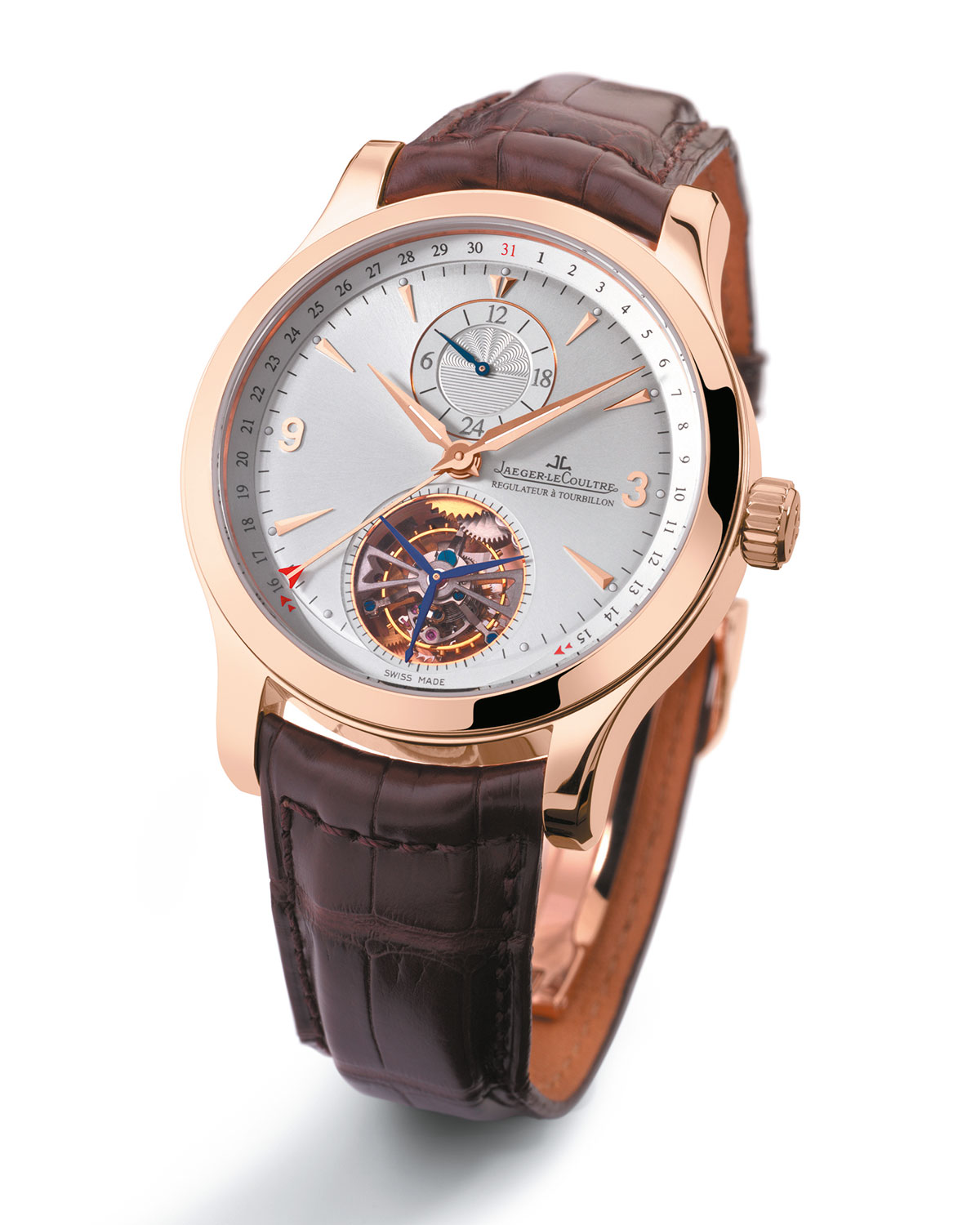
- Jaeger-LeCoultre Master Tourbillon
-
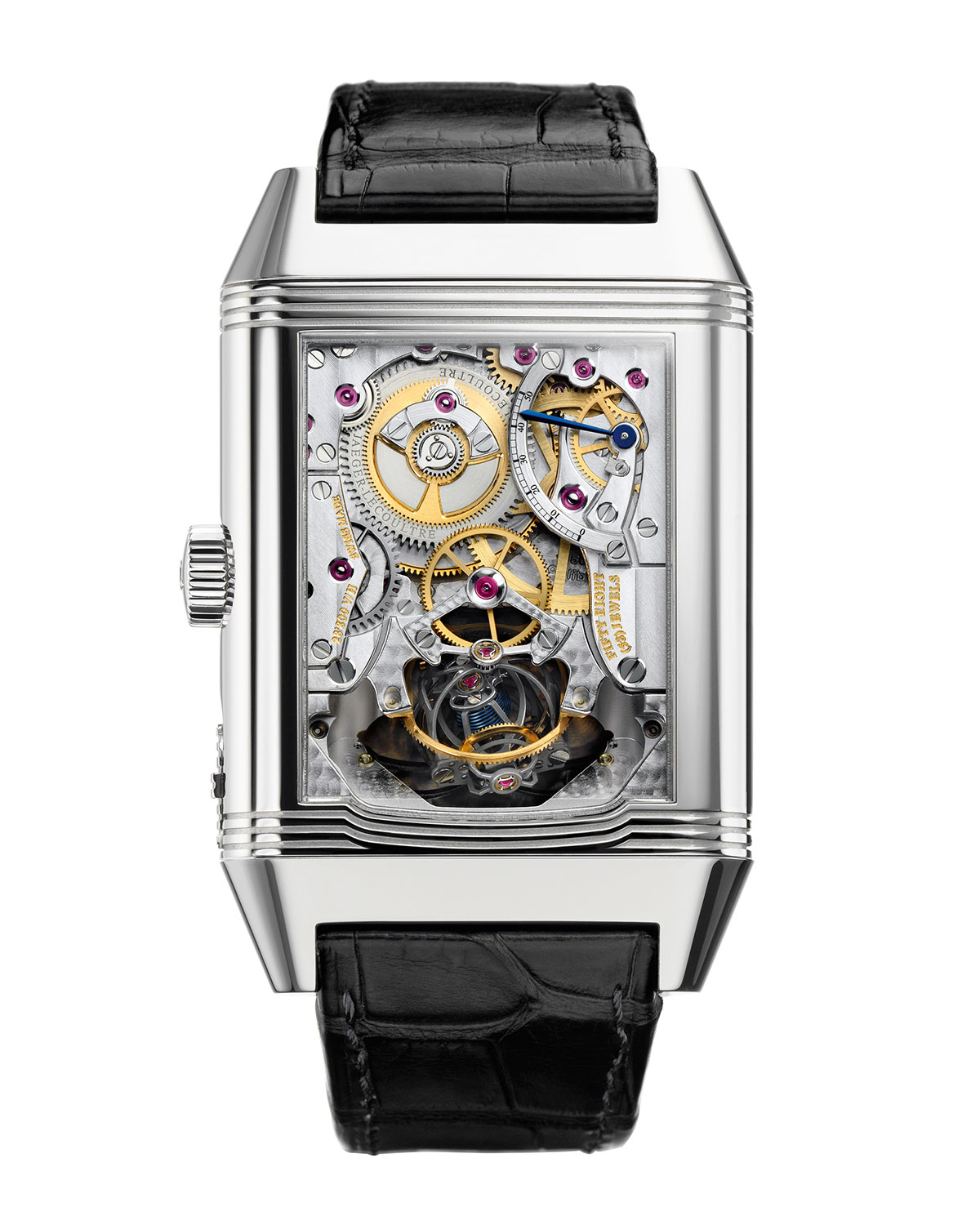
- Jaeger-LeCoultre Gyrotourbillon 2
The Master Tourbillon’s one-point margin has attracted most of the historical commentary, and Jaeger-LeCoultre’s management at the time chose — for understandable commercial reasons — to emphasize the more accessible watch. But the more significant result for the story of the multi-axis tourbillon has always been the Gyrotourbillon’s second place. Until just five years before the 2009 Concours, the entire category of multi-axis tourbillons had not existed in wristwatch form. That a double-axis spherical tourbillon could compete at this level, against the finest single-axis regulators in the world, was a genuine vindication of Coudray’s design philosophy — and of Randall’s foundational theoretical insight.
In 2011, Greubel Forsey achieved what remains the single finest result in the Concours’ four editions for a watch in official competition. Their Double Tourbillon 30° Technique took first place overall with 915 points out of 1,000 — the highest score ever recorded across all four editions of the competition for a watch openly participating in competition. (I say this because it would later emerge that a dark-horse Breguet watch using magnetic end-stones and a 10Hz vibrational speed had tested higher, but it was entered anonymously and was thus not in the official ranking. To read that story, click here.
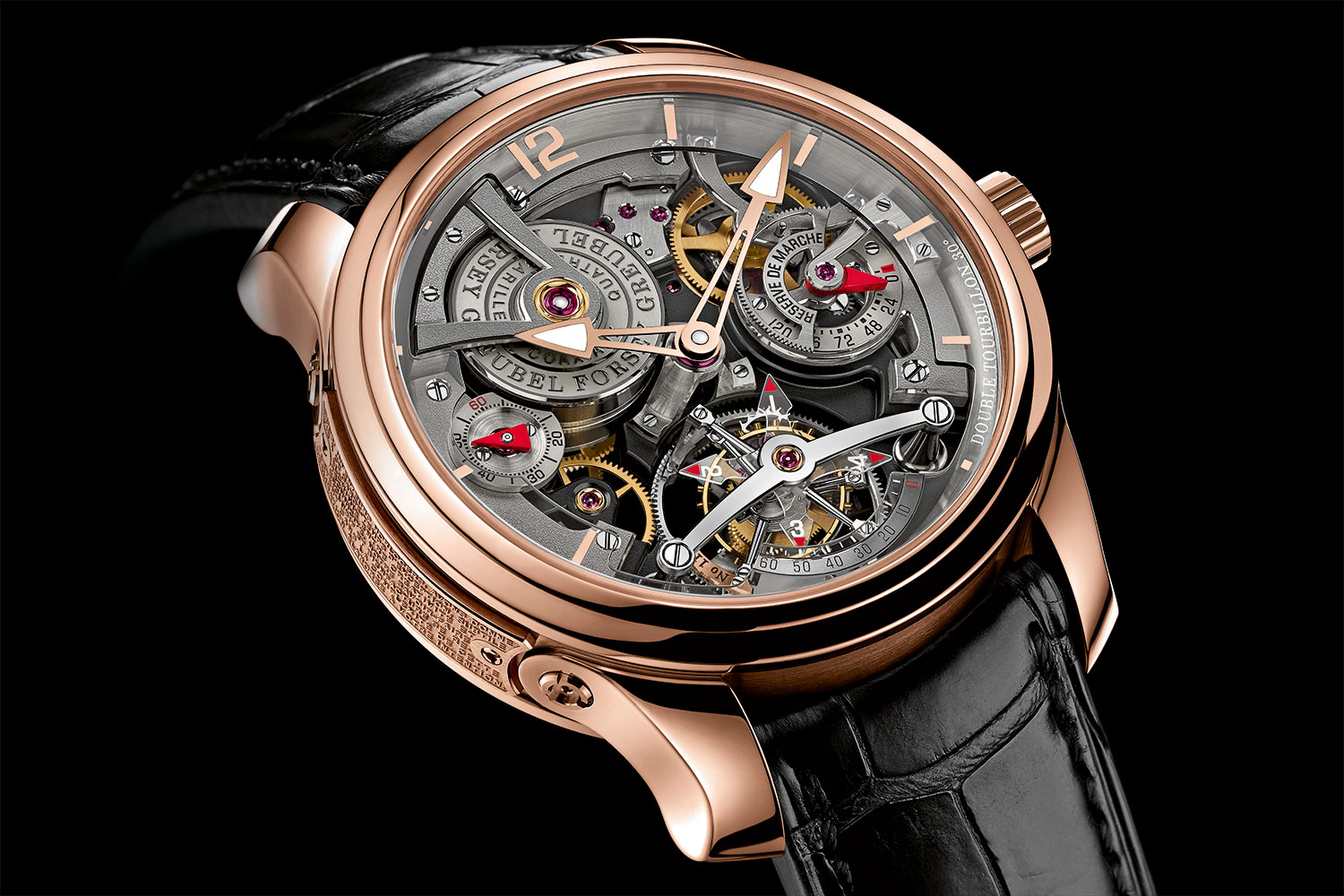
Greubel Forsey Double Tourbillon 30° Technique
Greubel Forsey’s result completed a remarkable hat trick of recognition: the Prix Gaïa for Entrepreneurship in 2009, the Aiguille d’Or at the GPHG in 2010, and the Concours crown in 2011.
Taken together, these results constitute something more than mere prize-winning. The Gyrotourbillon 2’s 908 points in 2009 and the 915 points of the Double Tourbillon 30° Technique in 2011 represent irrefutable empirical evidence — produced under independent, standardized, publicly disclosed test conditions — that multi-axis tourbillons, when well designed, well-constructed and well-regulated, deliver chronometric performance at the very highest level. The theoretical argument that a tourbillon sweeping multiple positional planes would produce superior timekeeping had been made by Anthony Randall in 1978. And Éric Coudray, Robert Greubel and Stephen Forsey had staked their reputations on it in 2004. The Concours International de Chronométrie provided the proof. That both podium finishes in the competition’s early editions went to multi-axis designs — the Gyrotourbillon 2 and the Double Tourbillon 30° Technique — is not coincidence. It is confirmation and vindication of Randall’s very original concept and the ultimate combination of gravity-defeating horological brilliance, coupled with kinetic showmanship. And perhaps we can now conclude that, thanks to these men, the demon that haunted horology for centuries — gravity — has been thoroughly vanquished.

You may also like
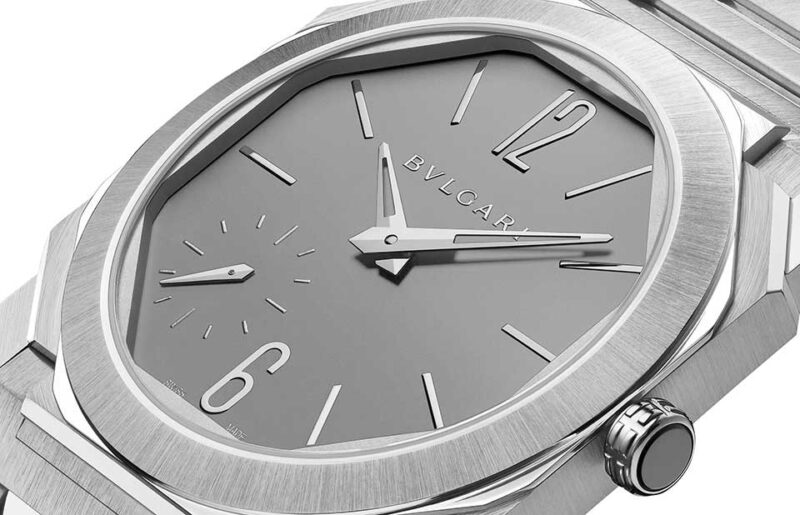
Editorial
Coming of Age: Bvlgari’s Octo Finissimo 37mm
Oct 23, 2026
Editorial
Coming of Age: Bvlgari’s Octo Finissimo 37mm
Oct 23, 2026

Editorial
Modernism On King
Oct 23, 2026
Editorial
Modernism On King
Oct 23, 2026
Editorial
Major Shakeups at Zenith, Job Losses, Retail Closure and more
Oct 23, 2026
Editorial
Major Shakeups at Zenith, Job Losses, Retail Closure and more
Oct 23, 2026