Museum Piece
Editorial
Museum Piece

Vacheron Constantin is the world’s oldest continually operating watch brand, but its history of over 270 years feels positively youthful in comparison to some of the ancient civilisations whose symbols and culture take pride of place in its Métiers d’Art Tribute to Great Civilisations collection.
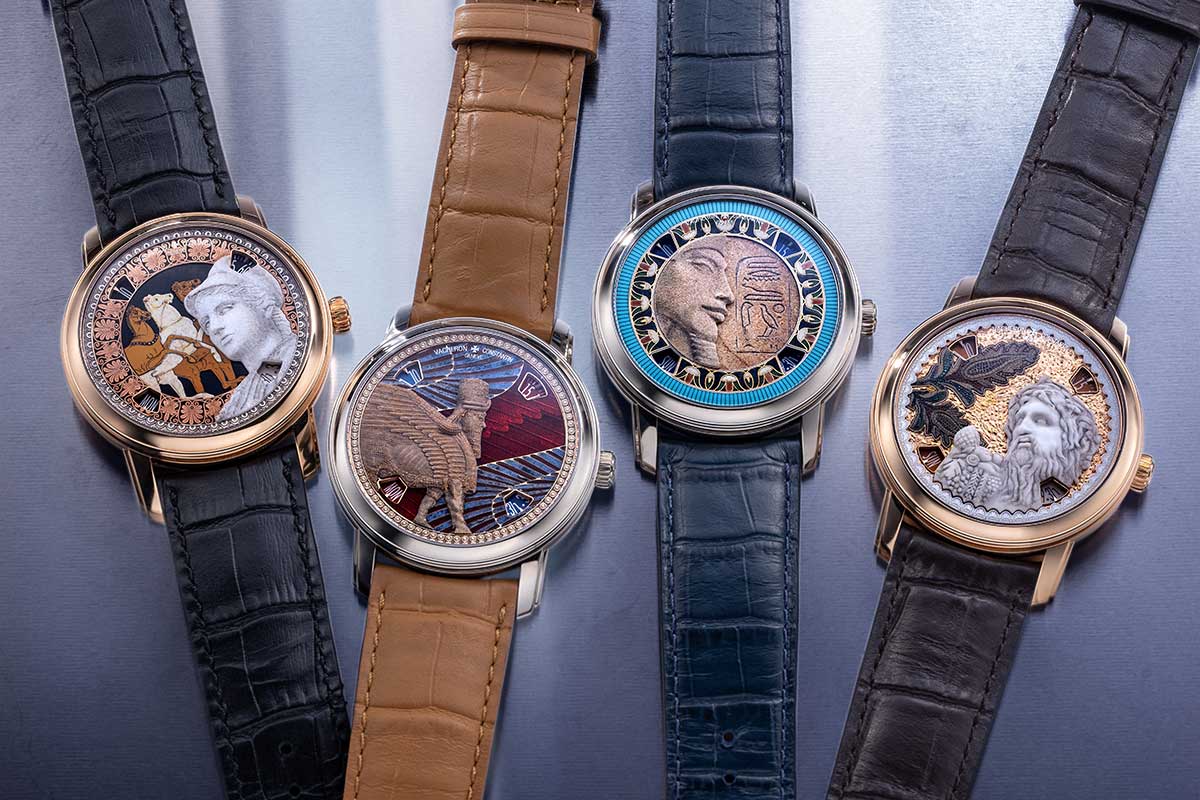
The four-piece collection marks a new chapter of Vacheron Constantin’s partnership with the Louvre Museum that started in 2019 and pays artistic and horological homage to ancient cultures. The latest chapter takes a tour through the symbolism of Pharaonic Egypt, the Assyrian Empire, Ancient Greece and Imperial Rome. The works selected from each of these represent the most monumental art from the ancient world, and are deeply significant pieces within the Louvre’s collection of priceless antiquities.
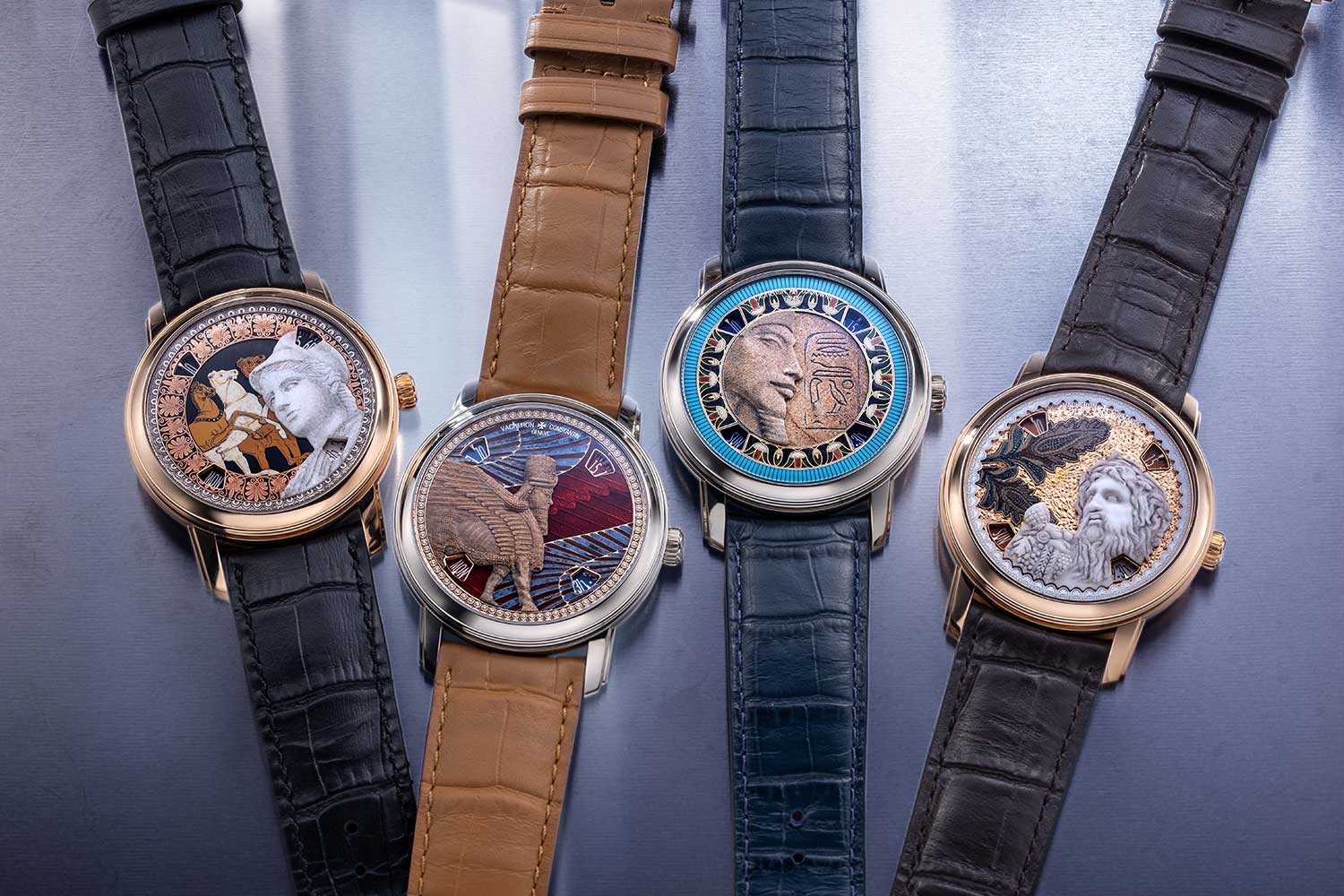
The latest chapter takes a tour through the symbolism of Pharaonic Egypt, the Assyrian Empire, Ancient Greece and Imperial Rome (©Revolution)
From the dawn of time to precious dials, these ancient works have been revisited in miniature by artisans — four civilization-defining masterpieces chosen from the Louvre’s Department of Antiquities are now on watch dials, showcasing the formidable savoir faire of Vacheron Constantin’s decorative crafts division, with each piece taking three years, a small army of watchmakers and artisans, and by Vacheron Constantin’s estimate, up to 220 hours of work per dial. Antiquity, even in its contemporary interpretations, hurries for no one.
Protecting Artistic Crafts
The partnership between the Genevan Manufacture and the Parisian museum has its foundations in 2019, when Vacheron Constantin and the Louvre formalized their shared vocation: conserving and transmitting art and artisanal knowledge. The potential for collaboration is fertile ground indeed: Vacheron Constantin restored La Création du Monde — an 18th-century astronomical clock gifted to Louis XV and displayed in the Louvre — and set aside one of their Les Cabinotiers for an online auction by the museum — the dial left tantalizingly blank, its contents to be selected by the owner from amongst the masterpieces within the Louvre’s collection. More recently, Revolution editors were invited to a once-in-a-lifetime viewing of La Quête du Temps, which Vacheron Constantin built for its 270th anniversary and displayed inside the Louvre itself. Made of 2,370 components, the stunning creation features a total of 23 horological complications and an automaton that tells the time.

Vacheron Constantin La Quête du Temps
The first Métiers d’Art Tribute to Great Civilisations quartet was revealed in 2022. It featured the Great Sphinx of Tanis, the Lion of Darius, the Winged Victory of Samothrace and a bust of Augustus on each of the four dials, in sculpted gold relief.
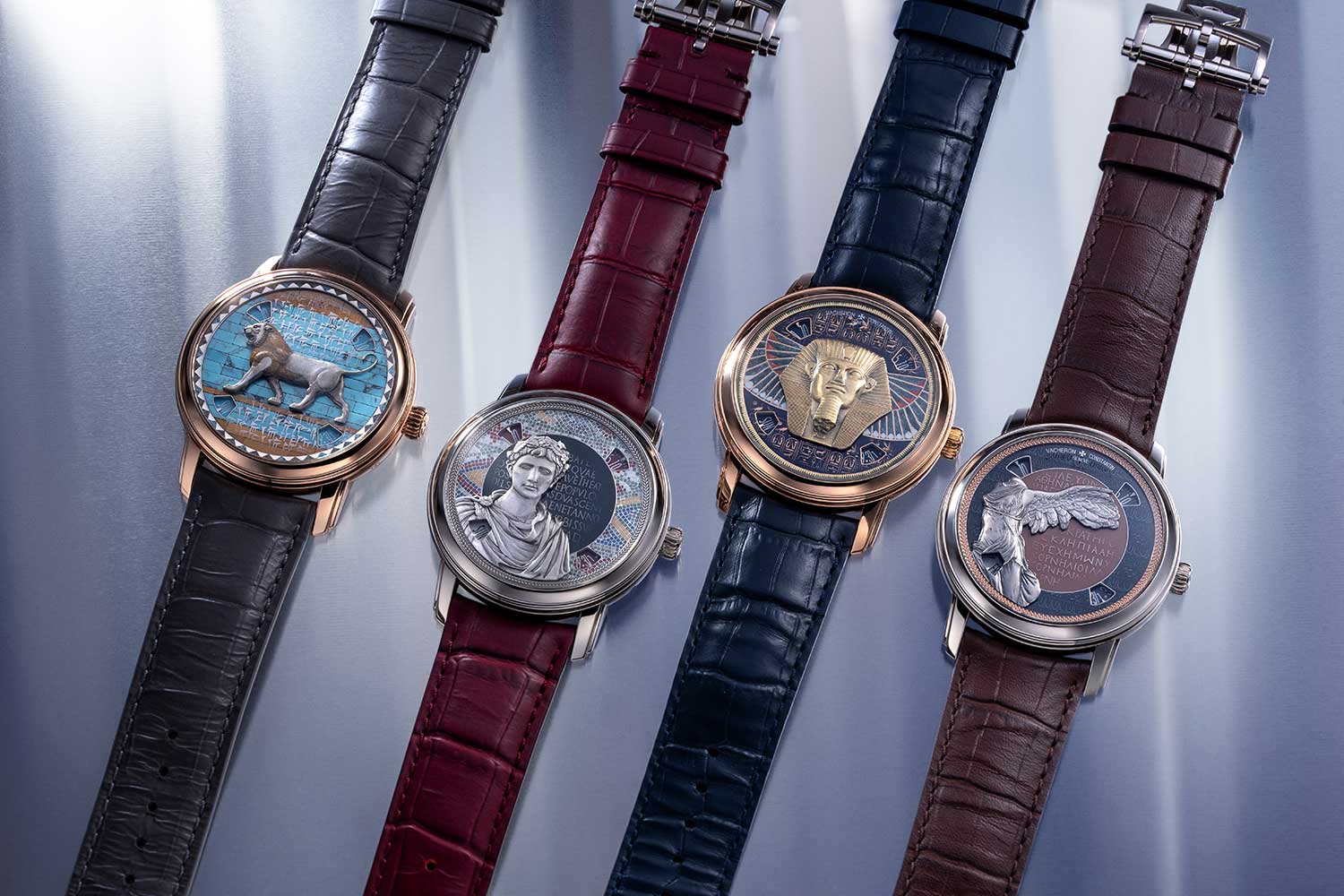
The first Métiers d’Art Tribute to Great Civilisations quartet revealed in 2022: The Great Sphinx of Tanis, the Lion of Darius, the Winged Victory of Samothrace and a bust of Augustus (©Revolution)
“The initial choice focused on the great civilizations of Antiquity, partly because of the incomparable richness of the museum’s collections, which include three departments dedicated to these cultures, and also because the works from these periods possess a universal resonance,” reveals Sandrine Donguy, the brand’s Director of Product & Creation.
“Whether the Assyrian Empire, the Egypt of the pharaohs, the Golden Age of ancient Greece or Imperial Rome, these civilizations experienced extraordinary territorial expansion accompanied by an unprecedented cultural and artistic influence. For this new series of watches, the aim was to highlight these emblematic civilizations even further.”
The new four-piece collection — Buste d’Akhénaton, Lamassu de Sargon II, Athéna de Velletri and Tibre de L’Iseum Campense — is the second chapter, one that feels very much like the unfurling of a longer story.
-
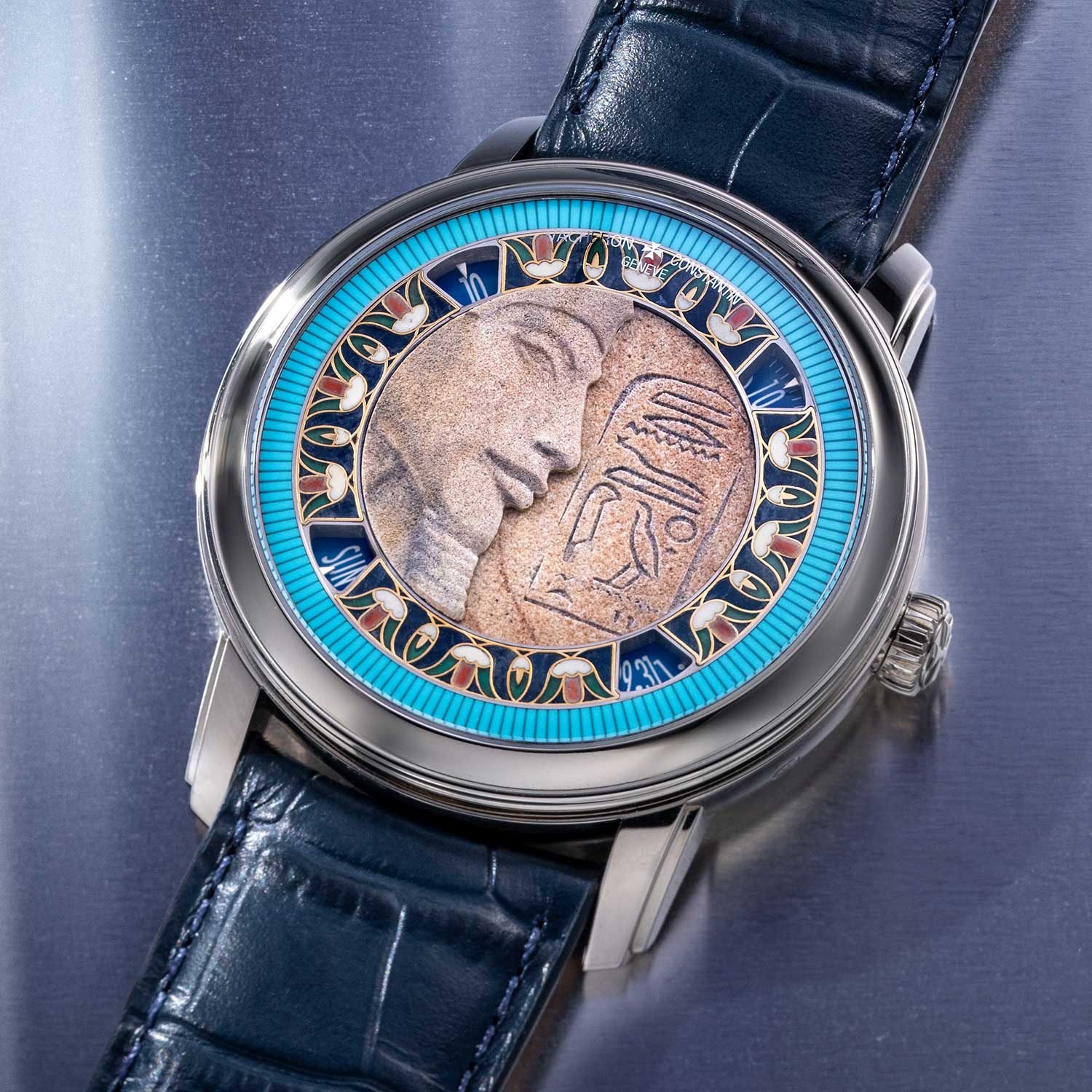
- Buste d’Akhénaton (©Revolution)
-
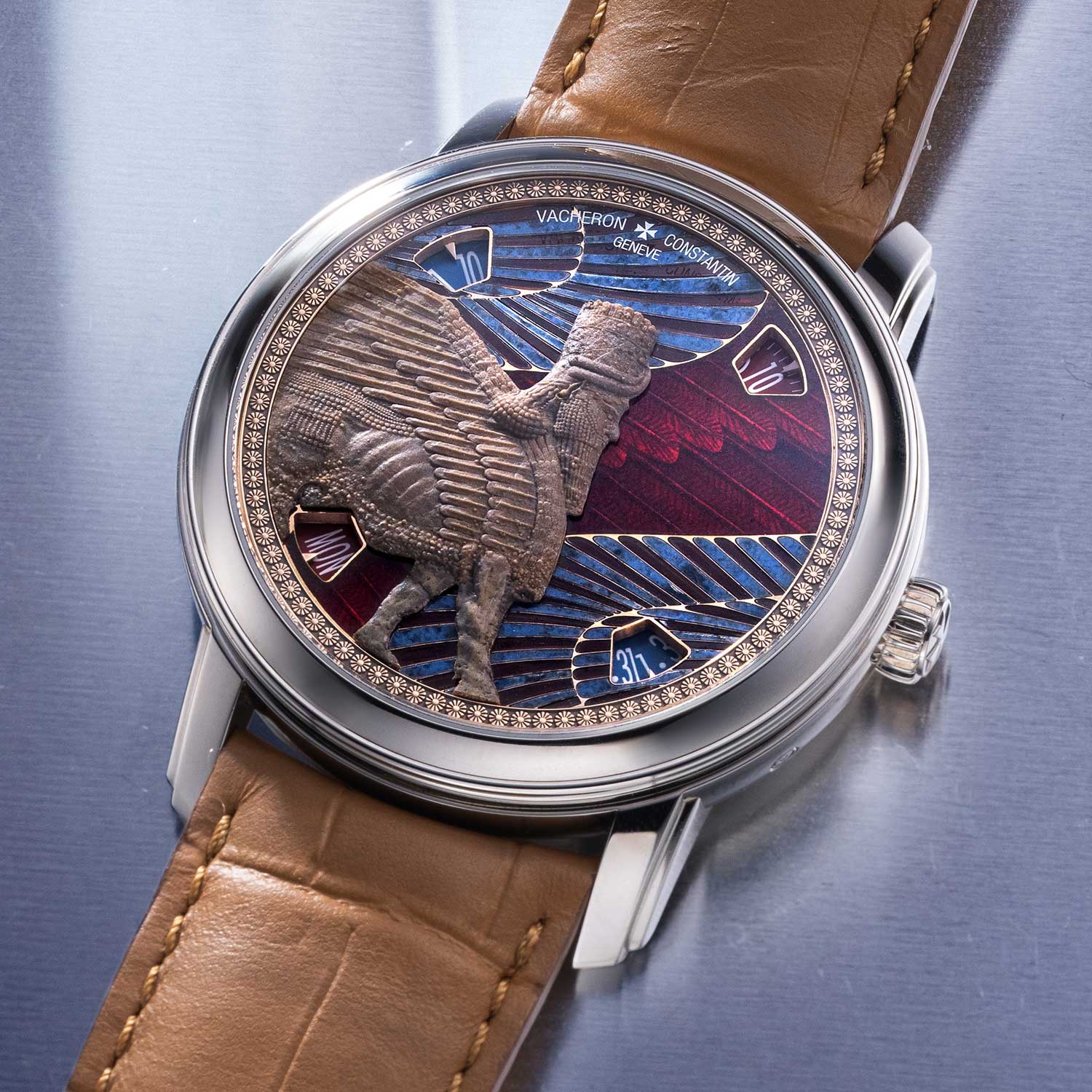
- Lamassu de Sargon II (©Revolution)
-
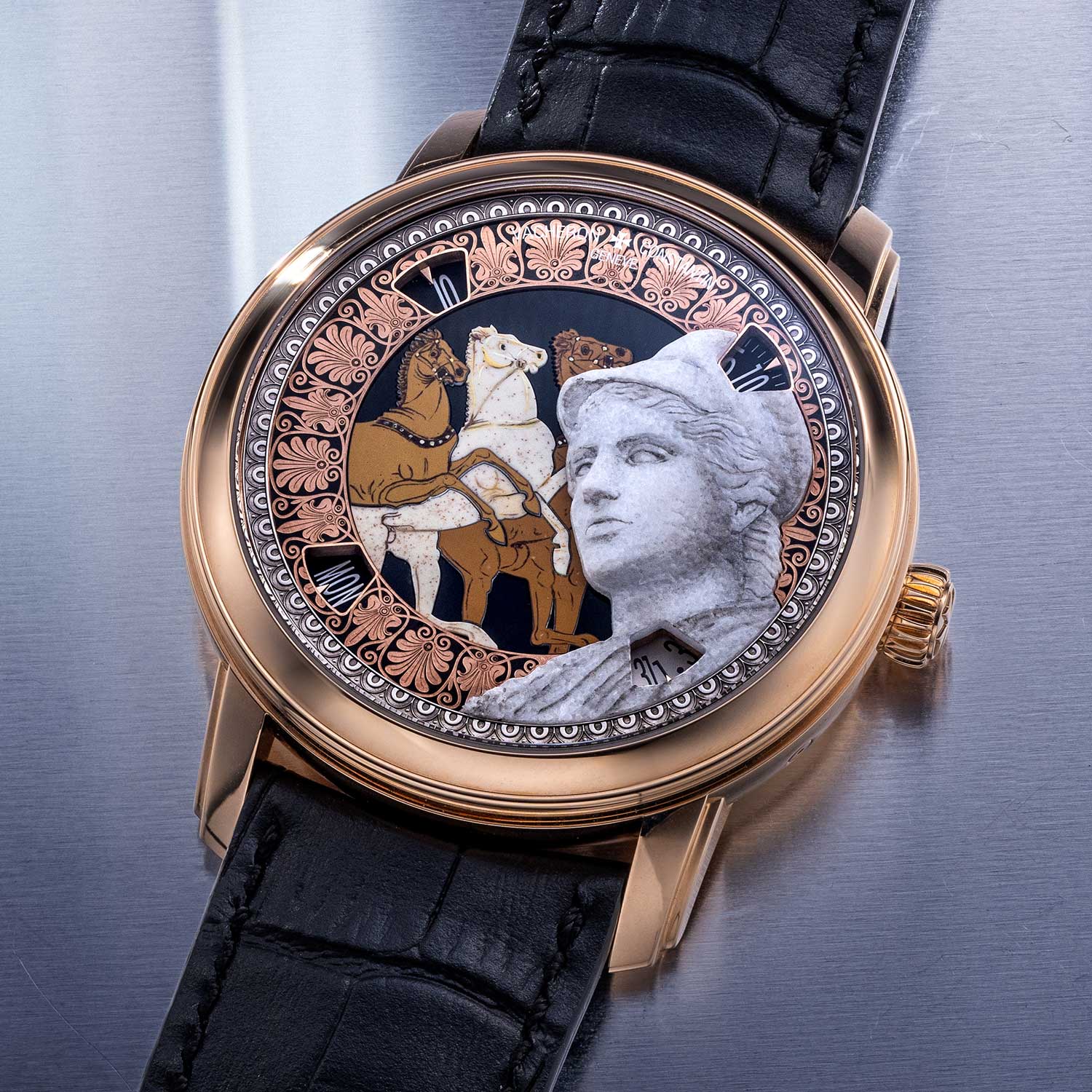
- Athéna de Velletri (©Revolution)
-
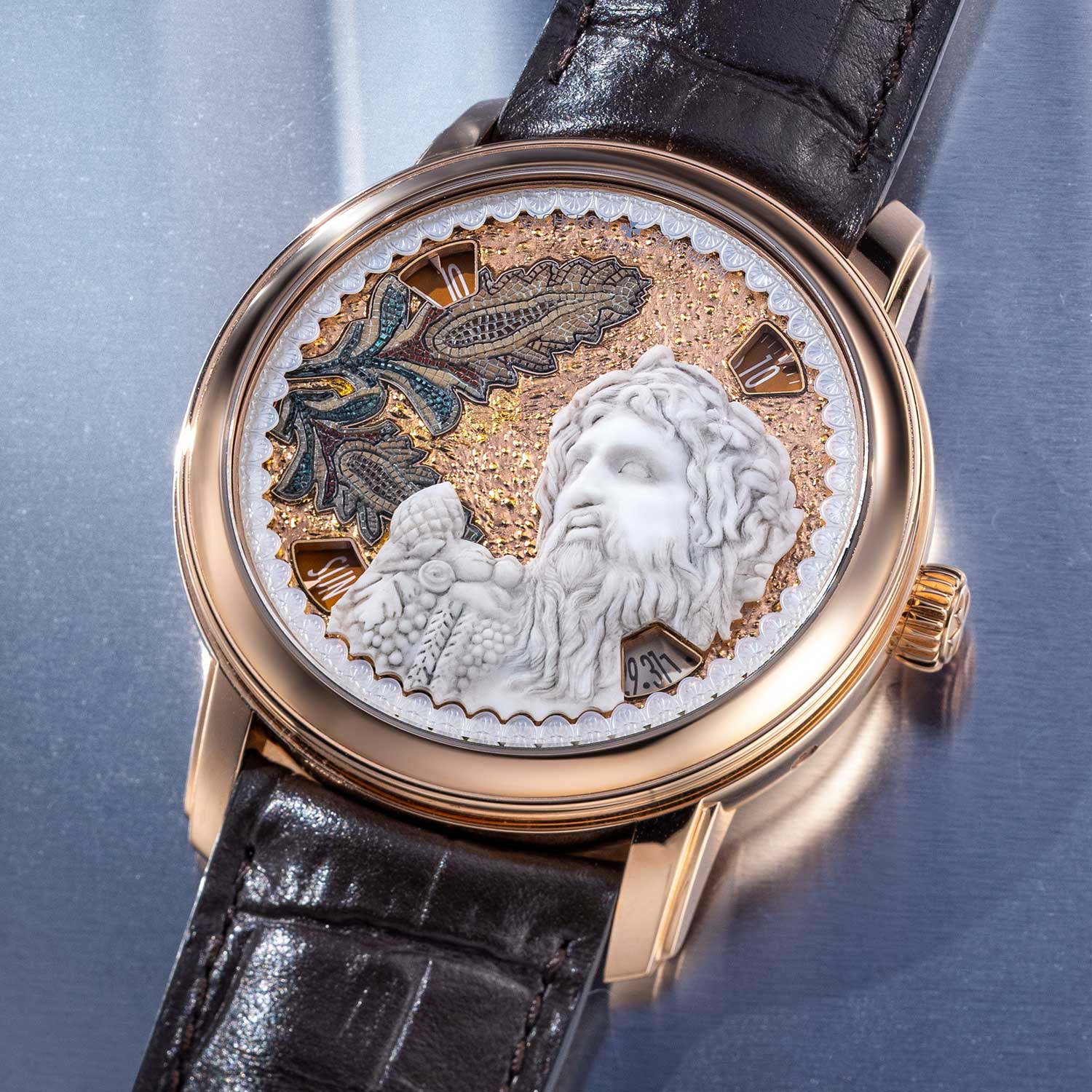
- Tibre de L’Iseum Campense (©Revolution)
Carving Out Time
This time the ancients weren’t depicted by sculpted gold appliques as in 2022, but by stone, which presented a new set of artistic challenges.
“One of them was the glyptic work on stone,” she says. “In this case marble and limestone sandstone.” The four appliques are made of stone — a first for Vacheron Constantin — using limestone sandstone and marble of the same types and even origins as those used for the original works. “Another challenge lay in combining the different artistic crafts and juxtaposing on the dial components produced using distinct techniques,” explains Donguy.
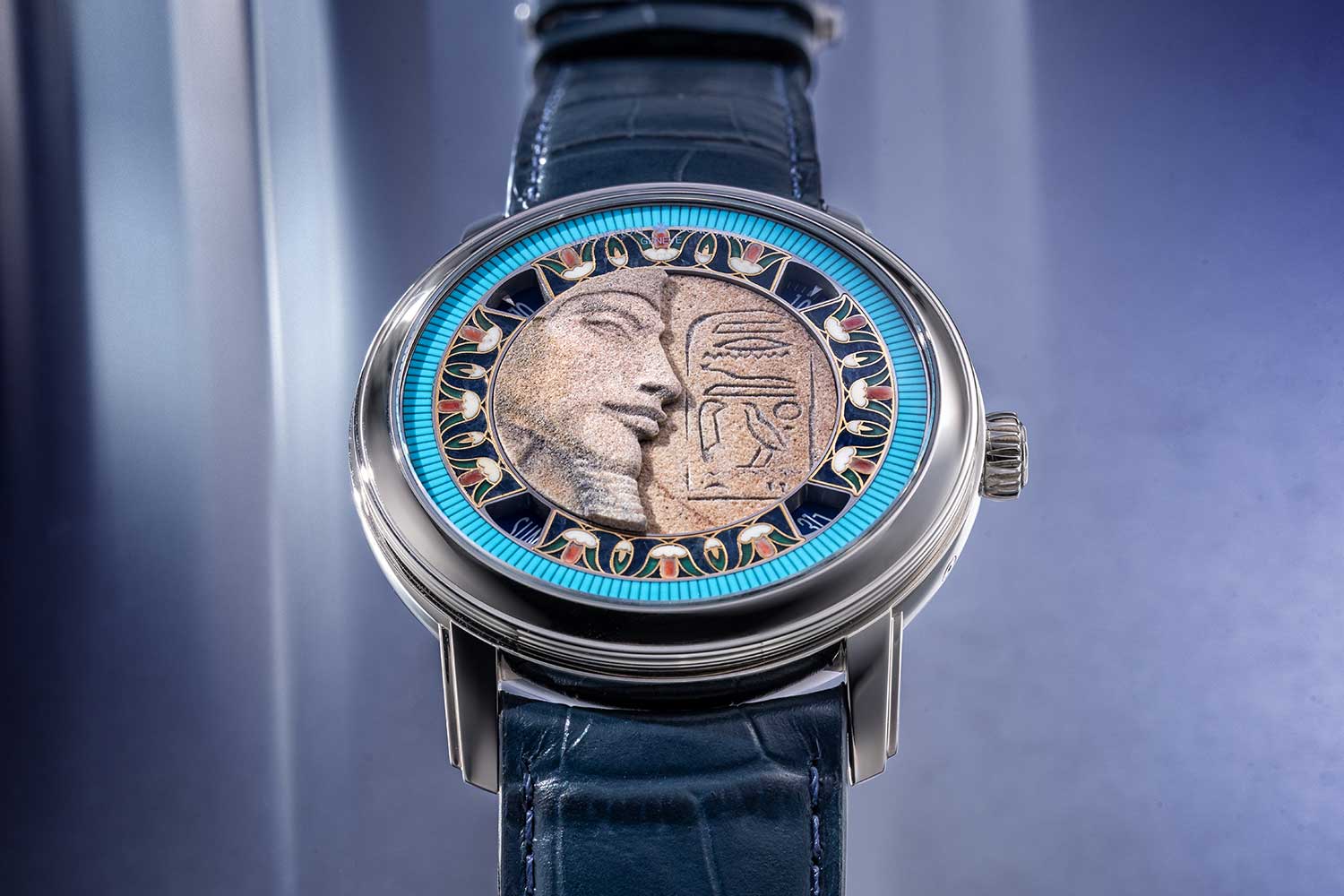
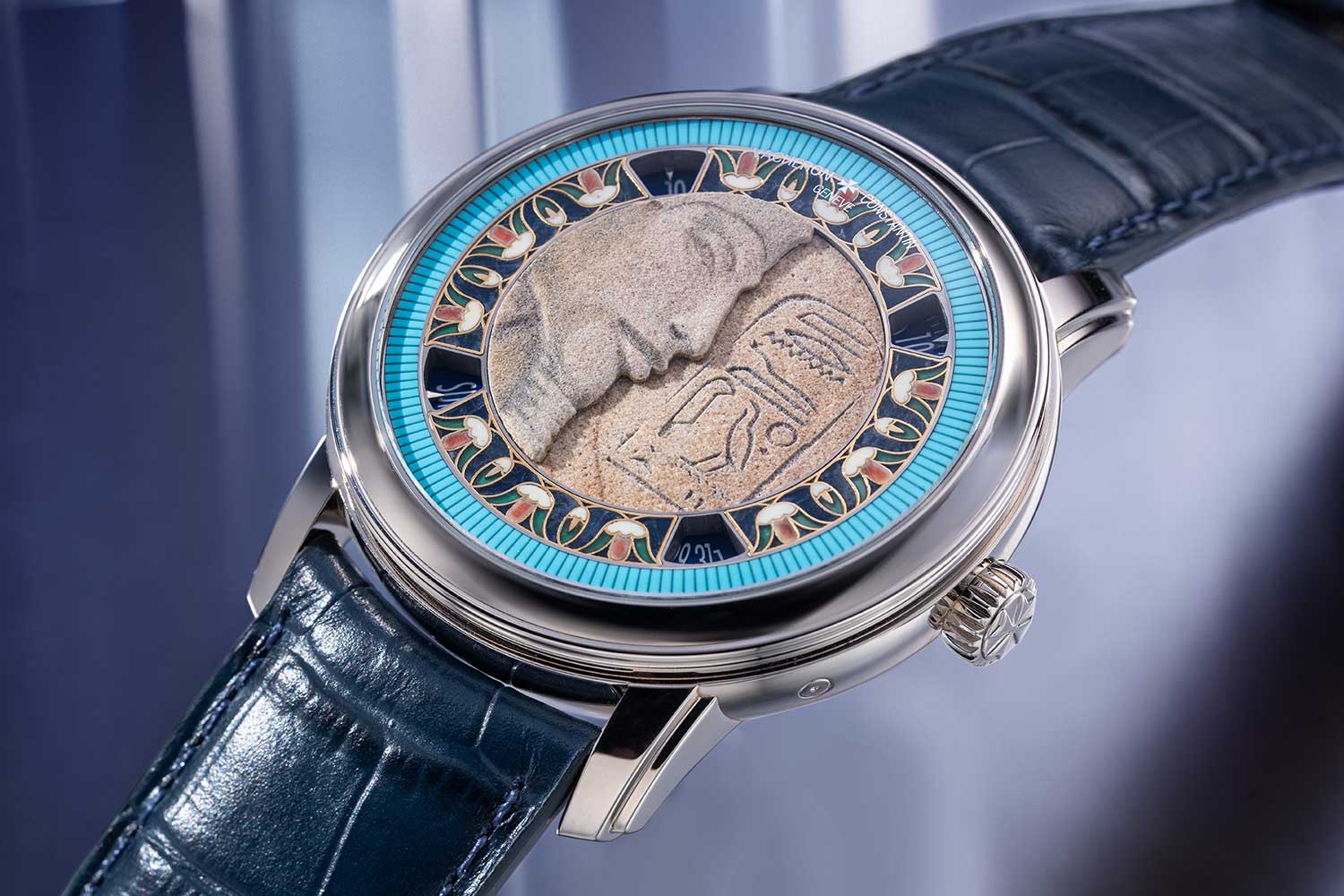
The pharaoh’s cartouche is engraved on matching sandstone next to his face and around it, two friezes — one inspired by the collar of Nakhti, drypoint-engraved on a turquoise ring; the other a champlevé composition of red mother-of-pearl, chrysoprase, opaline and sodalite (©Revolution)
The actual geological material was taken, where possible, from the same sources, such as for one of the pieces christened the Buste d’Akhénaton — a 3,000-year-old carved in miniature from Sinai sandstone, in a space that is the size of a coin.
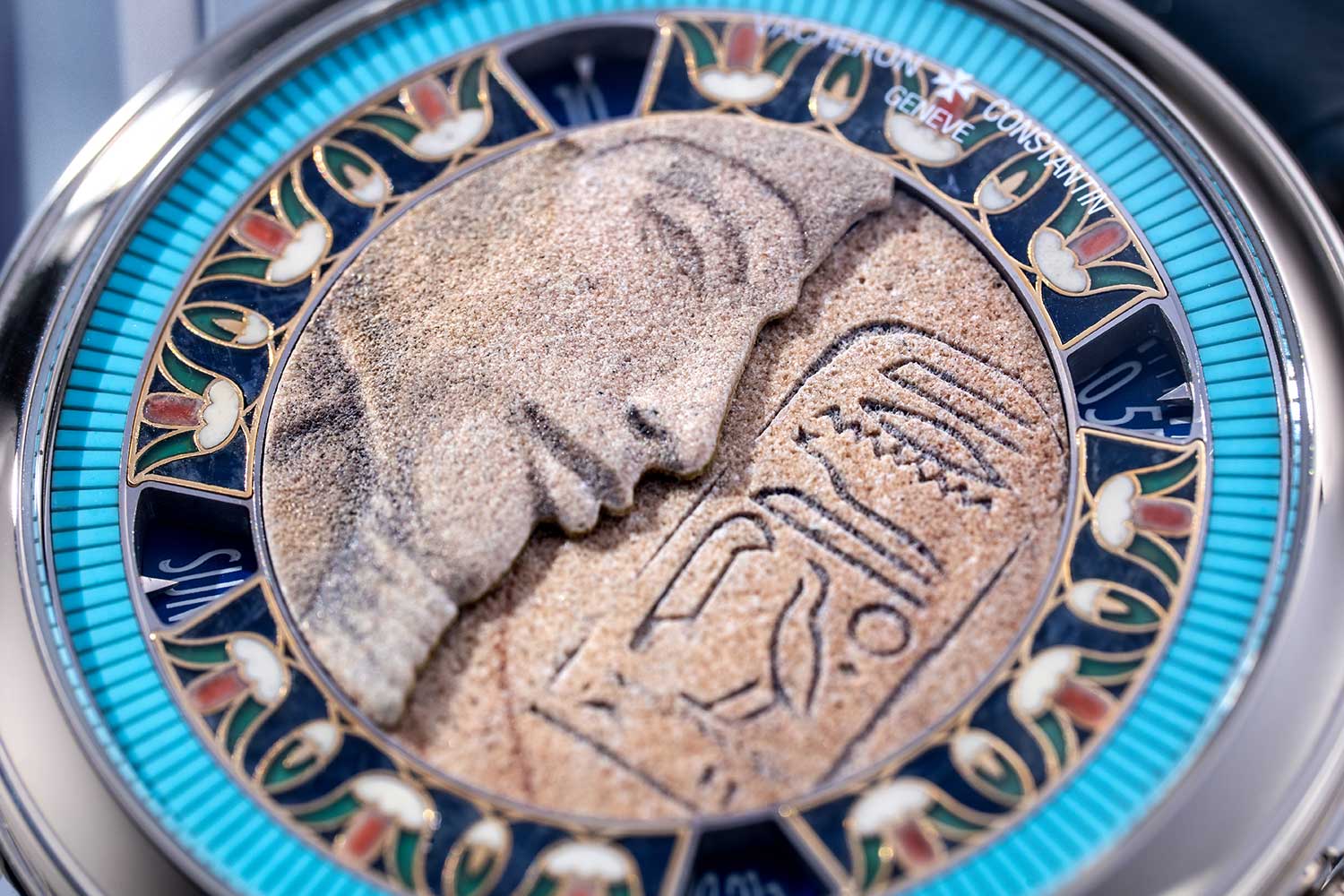
The pharaoh is carved from Sinai limestone sandstone — the same stone of the Louvre original — hand-patinated to coax out volume and shadow across roughly 60 hours of work (©Revolution)
Each of the four watches is constructed less like a dial and more like a small, fiendishly calibrated puzzle: a gold baseplate, a central effigy rendered in stone engraving and surrounded by appliques and a peripheral frieze. Every element was hand-made by a different specialist using a different traditional craft, and every element required to slot together with what Donguy calls “micron-level precision”, since any error would have meant “losing many hours of work”.
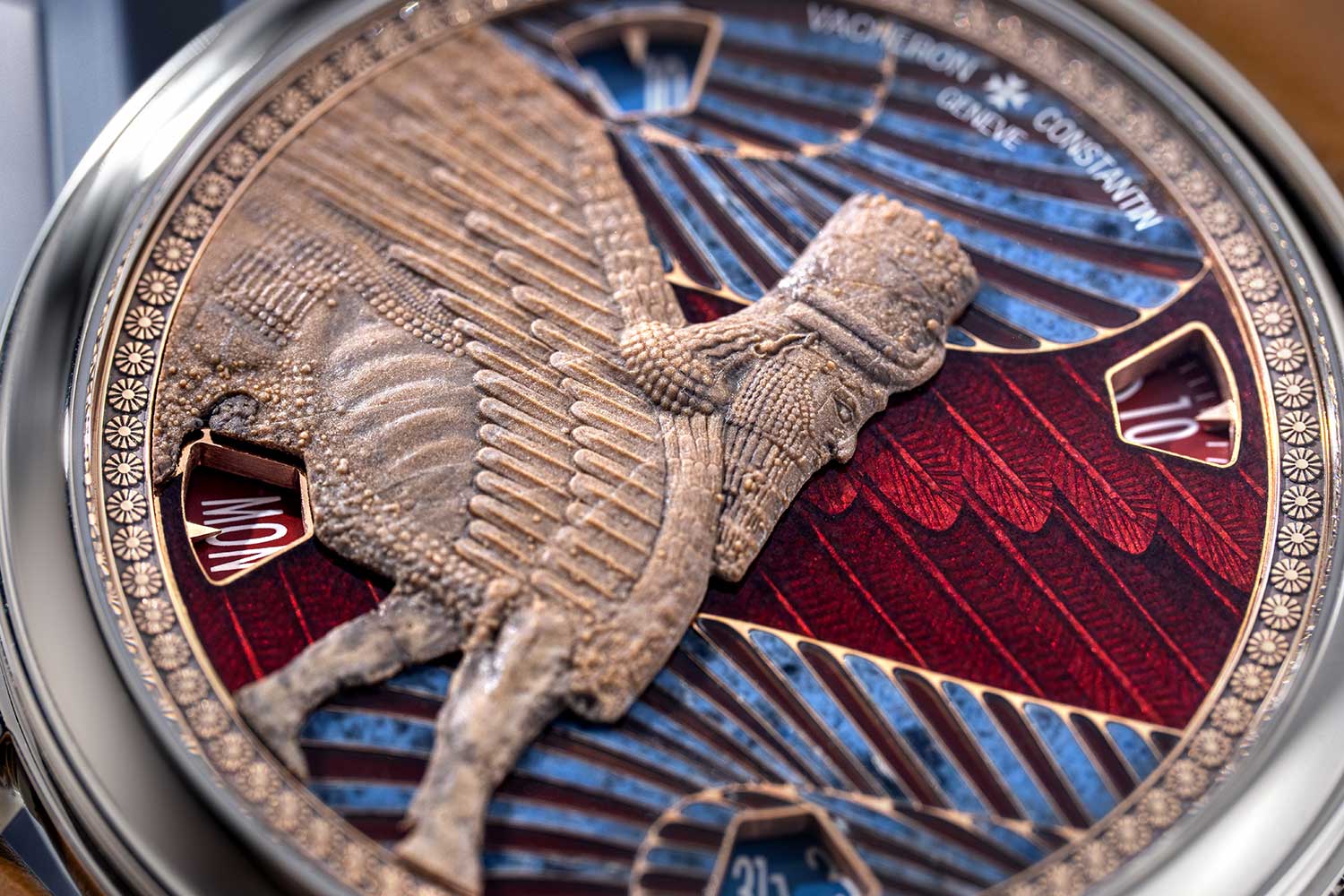
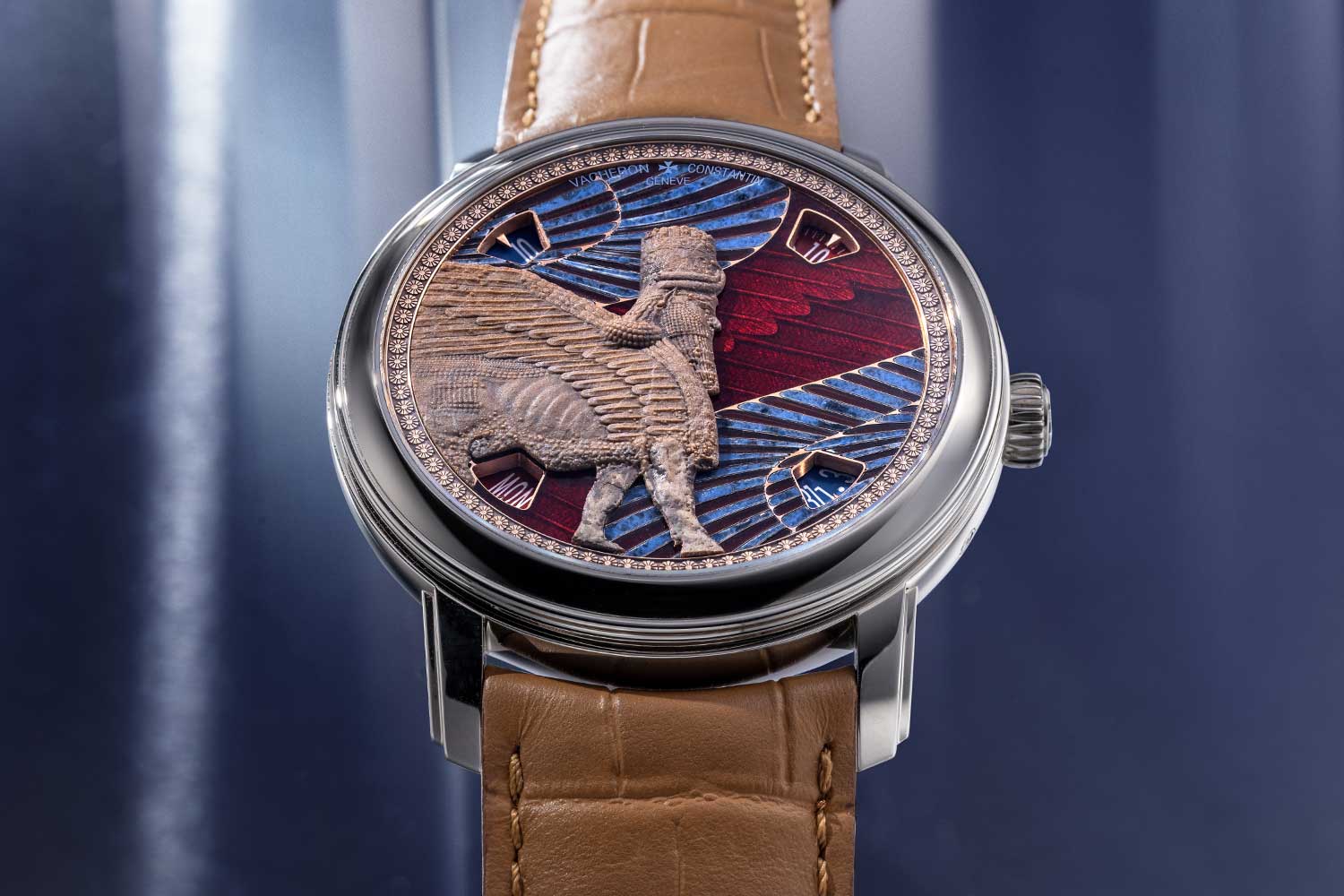
The winged, human-headed guardian of Sargon II’s palace at Khorsabad — originally five meters of alabaster muscle — is rendered in Italian limestone sandstone, hand-patinated to bring out the creature’s beard and feathers. The background is champlevé in red agate and blue dumortierite with translucent red flinqué enamel. It took approximately 152 hours before the central applique was even added (©Revolution)
The 2022 appliques were sculpted gold — a formidable undertaking, but a material the engravers are familiar with. This time, the central figures are stone, carved by abrasion rather than incision.
Before a single tool touched the stone surfaces, the team built 3D models of each design to confirm proportions and the play of light and shadow, working in close collaboration with Louvre curators to select not just the four hero works, but the secondary artworks that would inspire the friezes, appliques and backgrounds around them. Three years for four dials is, by any sensible measure, a luxuriously slow production schedule. Perhaps on reflection, though, it’s an appropriate amount of time for getting the artistic and cultural essence of four millennia right!
Moving History
All four timepieces share the same movement: Caliber 2460 G4/2, a 237-component, 27-jewel self-winding movement beating at 4Hz with roughly 40 hours of power reserve. The hours, minutes, day and date are at four apertures around the periphery of the dial so the dial center remains, in Donguy’s words, “free” for the artisans — a hands-off approach in the most literal sense. The oscillating weight visible through the caseback pays tribute via a recreation of an 18th-century engraving of the Louvre’s eastern facade.

The Caliber 2460 G4/2 (©Revolution)
Keeping Rare Crafts Alive
Four very beautiful, very exclusive, very limited watches (15 pieces each) are destined for collectors who already have everything else, but the endeavor carries another interesting story, beyond just creating something for connoisseurs. It is about what Vacheron Constantin’s Métiers d’Art department is truly for, at its heart. Glyptics, micro-mosaic, champlevé and flinqué enamel, cloisonné marquetry, gold leaf gilding — these are not techniques that are applied in meaningful commercial frequencies anywhere else. We can agree that there is no significantly large commercial demand for stone-carved cameos the size of a coin. The only reason artisans capable of this work still exist, train apprentices and pass the craft forward, is that maisons such as Vacheron Constantin keep commissioning pieces difficult enough to justify keeping the skill alive.
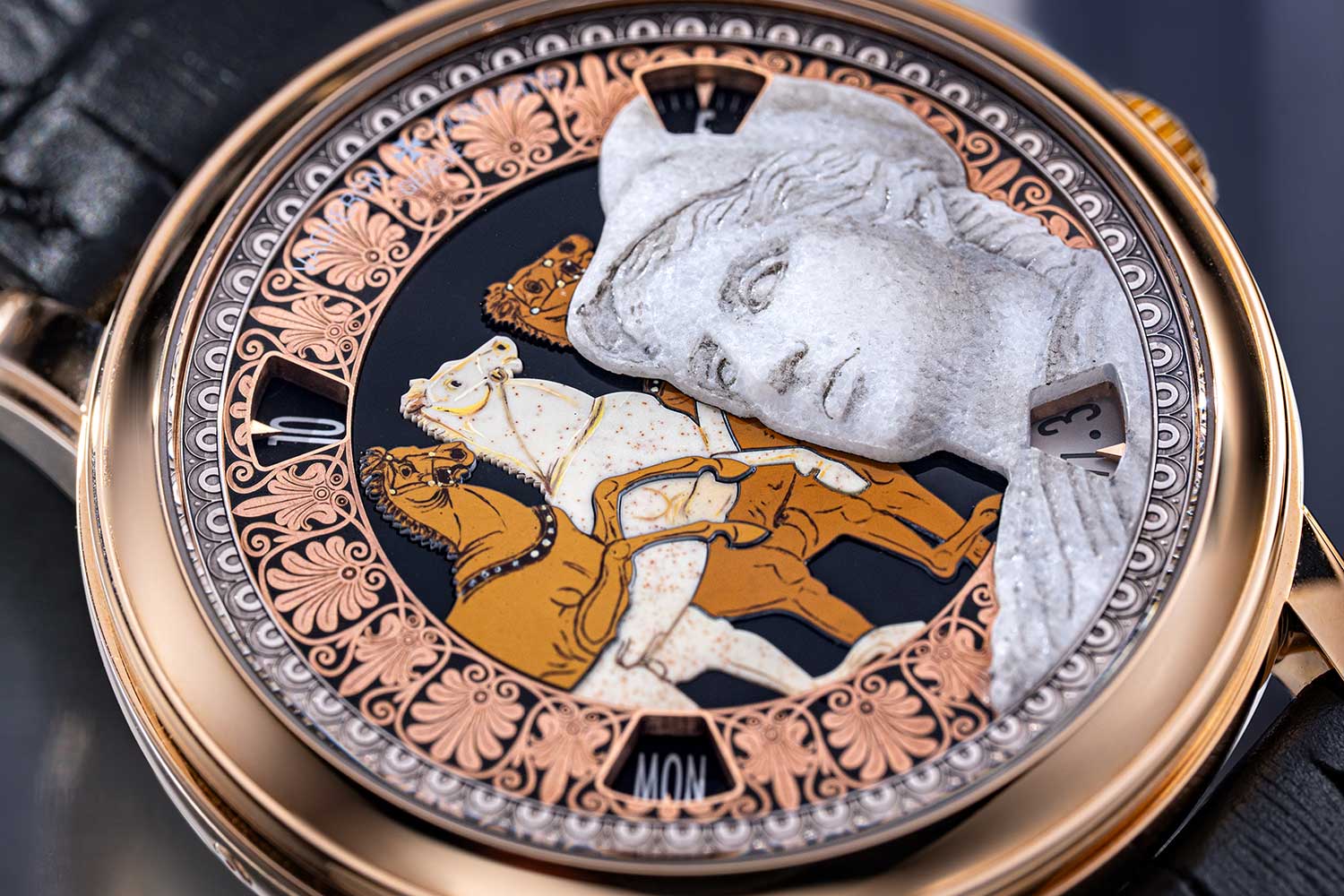
Athéna de Velletri is carved from Parian marble, the same white stone as the original statue, framed by black champlevé enamel inspired by a krater (a large vessel used in ancient Greece to mix wine and water) depicting the murder of Tityos, and centered by a stone marquetry scene of chariot horses in onyx and mookaite, finished with miniature painting. That central marquetry and miniature painting alone demanded approximately 57 hours (©Revolution)
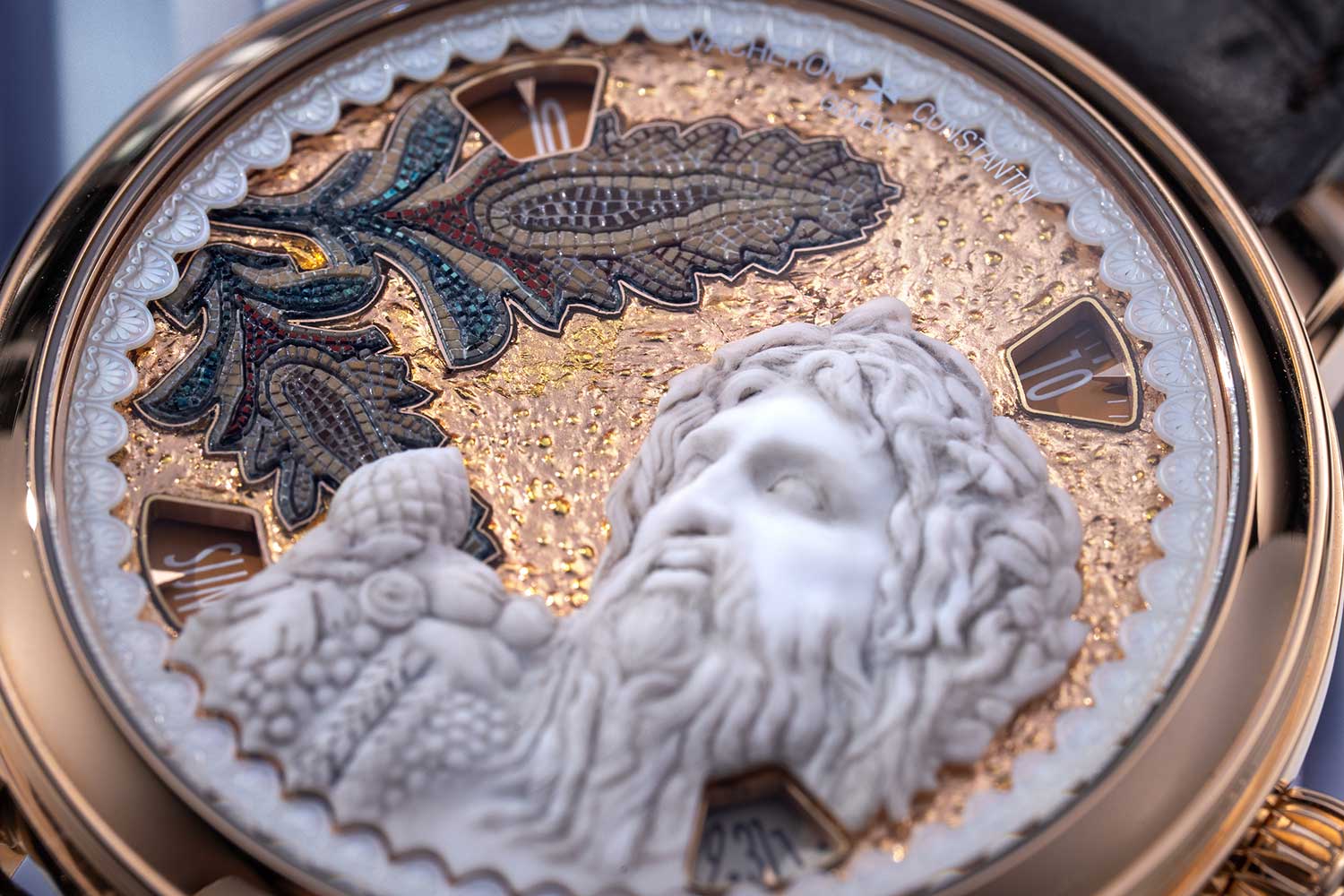
The bearded river god, with the she-wolf and twins tucked at his side, is carved in Italian marble glyptics, paired with a second applique in stone micro-mosaic depicting floral motifs in jasper, chrysocolla and opalite (©Revolution)
Seen this way, a watch like the Lamassu de Sargon II is less a rarefied piece of haute horlogerie as much as it is also a representation of the safeguarding of endangered art forms. The Métiers d’Art Tribute to Great Civilisations collection is also an expression of “Explore All Ways Possible” — the 2026 theme that expresses the conviction of Vacheron Constantin. Three years, 220 hours per timepiece, and four ancient civilizations later, the manufacture continues to ensure that this slogan reflects a true commitment to these rare and ancient crafts.
Tech Specs: Métiers d’Art Tribute to Great Civilisations – Buste d’Akhénaton
(©Revolution)
Reference 7620A/000G-H078
Movement Self-winding Caliber 2460 G4/2; approximately 40-hour power reserve
Functions Hours, minutes, day and date
Case 42mm; 18K white gold; water resistant to approximately 30m
Dial 18K gold base; central applique and background in glyptic art — Sinai limestone sandstone, hand-patinated; inner frieze with champlevé-set stones (red mother-of-pearl, chrysoprase, opaline, sodalite, 18K 3N gold thread); outer frieze in engraved turquoise stones with white-gold thread
Strap Blue mississippiensis alligator leather with alligator leather inner shell; 18K white gold folding clasp
Price Upon request
Availability Limited and numbered edition of 15; available exclusively through Vacheron Constantin boutiques
Tech Specs: Métiers d’Art Tribute to Great Civilisations – Lamassu of Sargon II
(©Revolution)
Reference: 7620A/000G-H080
Movement Self-winding Caliber 2460 G4/2; approximately 40-hour power reserve
Functions Hours, minutes, day and date
Case 42mm; 18K white gold; water resistant to approximately 30m
Dial 18K gold base; partially decorated with a feather motif using two techniques — champlevé-set stones (red agate and light dumortierite) and engraving with translucent red enamel; central glyptic applique in limestone sandstone (Italy), hand-patinated; outer frieze in engraved 750/1000 3N yellow gold
Strap Burgundy mississippiensis alligator leather with alligator leather inner shell; 18K white gold folding clasp
Price Upon request
Availability Limited and numbered edition of 15; available exclusively through Vacheron Constantin boutiques
Tech Specs: Métiers d’Art Tribute to Great Civilisations – Athéna de Velletri
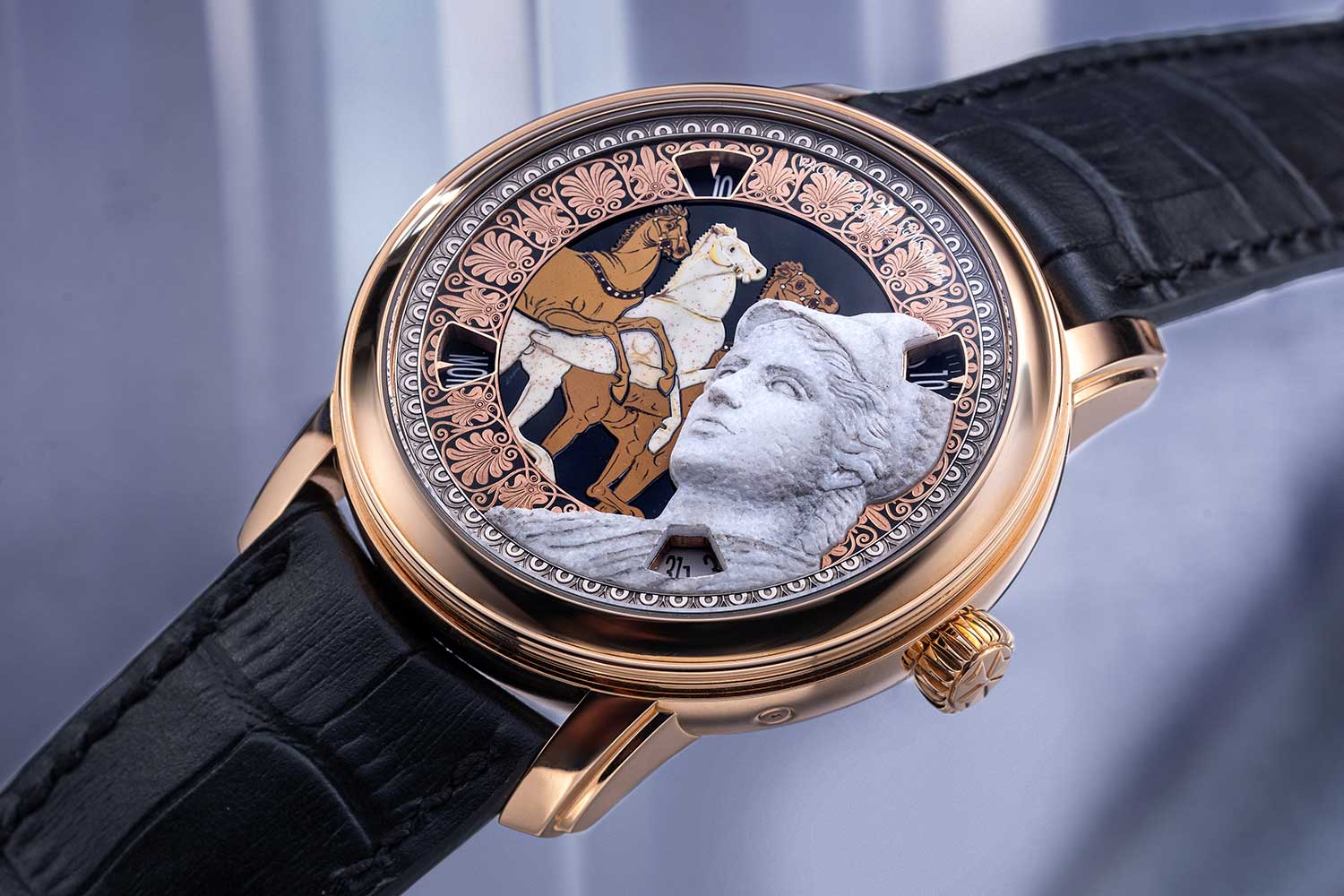
(©Revolution)
Reference 7620A/000R-H081
Movement Self-winding Caliber 2460 G4/2; approximately 40-hour power reserve
Functions Hours, minutes, day and date
Case 42mm; 18K pink gold; water resistant to approximately 30m
Dial 18K gold base; central glyptic applique in Paros marble, hand-patinated; background in stone marquetry (onyx and mookaite) and miniature painting; inner frieze in black champlevé enamel; 18K white gold engraved outer frieze
Strap Grey mississippiensis alligator leather with alligator leather inner shell; 18K white gold folding clasp
Price Upon request
Availability Limited and numbered edition of 15; available exclusively through Vacheron Constantin boutiques
Tech Specs: Métiers d’Art Tribute to Great Civilisations – Tibre de l’Iseum Campense
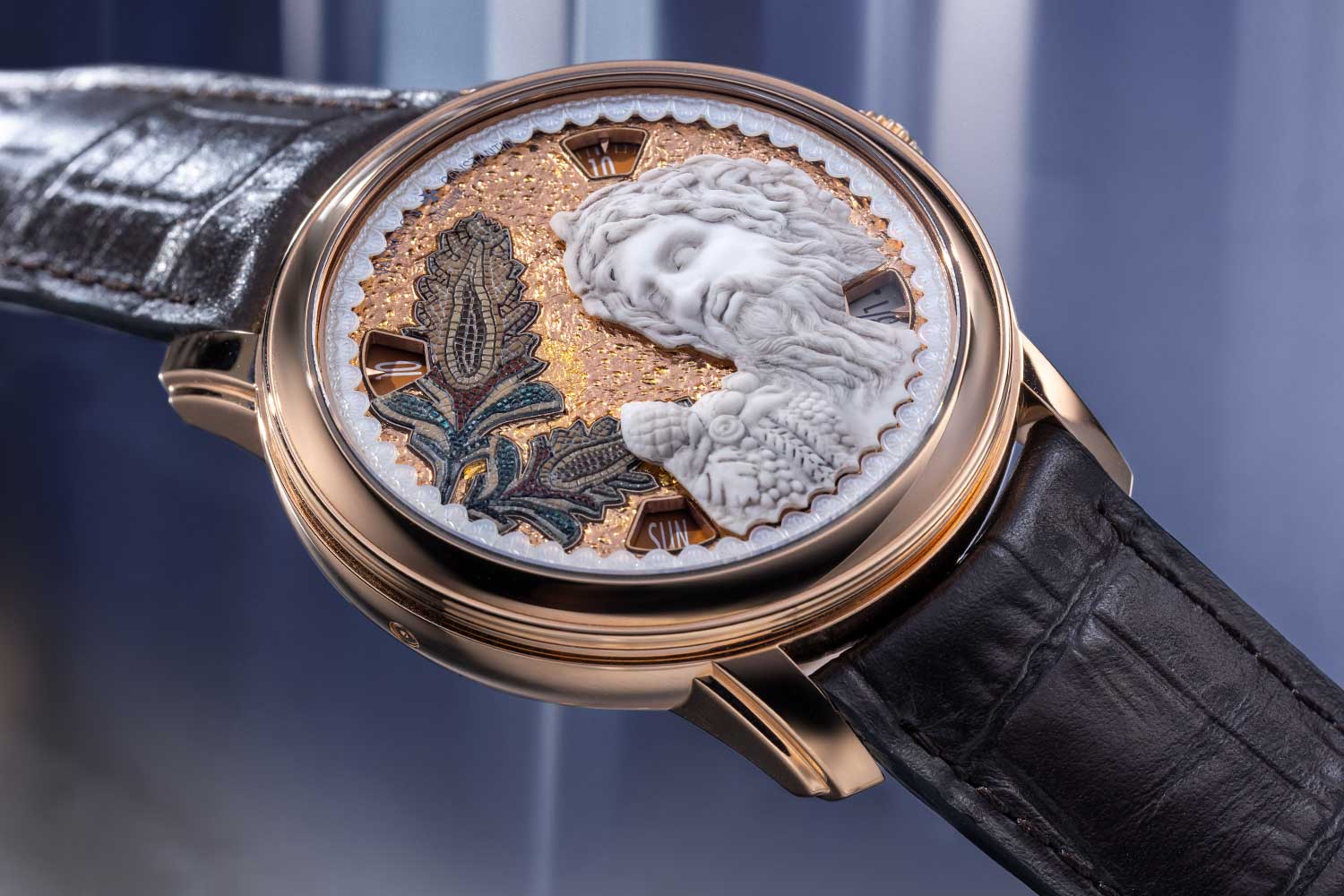
(©Revolution)
Reference 7620A/000R-H079
Movement Self-winding Caliber 2460 G4/2; approximately 40-hour power reserve
Functions Hours, minutes, day and date
Case 42mm; 18K 5K pink gold; water resistant to approximately 30m
Dial 18K gold base textured with gold leaf and translucent enamel; central glyptic applique in Paros marble, hand-patinated; secondary applique in micro-mosaic composed of five stones (light brown jasper, dark brown jasper, cream jasper, chrysocolla and opaline); engraved mother-of-pearl frieze
Strap Brown mississippiensis alligator leather with alligator leather inner shell; 18K white gold folding clasp
Price Upon request
Availability Limited and numbered edition of 15; available exclusively through Vacheron Constantin boutiques
Vacheron Constantin

You may also like
News
Last Week in Watches: Moser Goes Off-Grid, the Vacheron Constantin Overseas Turns 30
Sep 28, 2026
News
Last Week in Watches: Moser Goes Off-Grid, the Vacheron Constantin Overseas Turns 30
Sep 28, 2026
Editorial
Last Week in Watches: New Releases Ahead of Geneva Watch Days 2026
Aug 31, 2026
Editorial
Last Week in Watches: New Releases Ahead of Geneva Watch Days 2026
Aug 31, 2026
Editorial
Vacheron Constantin Miniaturises Six Crafts for the Animal Kingdom
Aug 28, 2026
Editorial
Vacheron Constantin Miniaturises Six Crafts for the Animal Kingdom
Aug 28, 2026