Jaeger-LeCoultre Introduces the Gyrotourbillon à Stratosphère
Watch Fairs
Jaeger-LeCoultre Introduces the Gyrotourbillon à Stratosphère

Since the beginning of the 21st century, no complication has inspired quite as much unconventional thinking as the tourbillon. Watchmakers have explored it in many varieties from ultra thin, to mystery, central and even cageless designs, but the most persuasive adaptation for the wristwatch has been the development of multi-axis tourbillons. A.-L. Breguet’s tourbillon, which marks its 225th anniversary this year, had to compensate for only a single axis of positional error, since a pocket watch was carried vertically and moved primarily from side to side in a gentleman’s waistcoat. A wristwatch, by contrast, inhabits a far more chaotic environment.
As the wrist turns through the course of the day, the balance constantly shifts through a wide range of orientations. In theory, allowing the tourbillon to rotate around more than one axis exposes it to a broader set of positions and helps average out the rate errors that arise from gravity acting differently in each of them. The idea is conceptually simple, though mechanically formidable. Rather than a single rotating cage, the regulating organ is mounted within multiple nested cages that revolve at different speeds and around different axes. The result is a constantly changing spatial orientation of the balance and escapement, one that comes closer to sampling the full range of positions encountered on the wrist.
One of the most significant multi-axis tourbillons was the Jaeger-LeCoultre Gyrotourbillon 1 Hybris Mechanica Caliber 177, introduced in 2004. Apart from being one of the earliest multi-axis tourbillons, it was visually and mechanically unusual. The Gyrotourbillon was distinguished by its elaborate aluminum cage, whose three-dimensional construction gave the mechanism the appearance of a miniature gyroscope suspended within the movement.
At the same time, although it was a double-axis tourbillon, the balance was not aligned with the axis of the inner cage but instead mounted perpendicular to it. In a conventional single or multi-axis tourbillon, the balance staff lies on the same axis as the inner cage, so the oscillator operates in essentially the same plane even as the carriage rotates. In the Gyrotourbillon, however, the balance is already inclined relative to the inner cage, so the plane of oscillation continuously shifts as the cage turns. The inner cage completes a rotation every 24 seconds, carrying the escapement and balance with it, while the entire assembly is mounted within a larger carriage that rotates once per minute on a second axis. Crucially, this axis is perpendicular to that of the inner cage, so as the outer cage turns, it constantly re-orients the plane in which the inner cage rotates.
Since then, four more Gyrotourbillon watches were launched over the years. Each one had its own unique features. Introduced in 2008, the Reverso Gyrotourbillon 2 Hybris Mechanica Caliber 174 was the first Gyrotourbillon to be conceived to fit a Reverso case and the first wristwatch to employ a helical hairspring. The Gyrotourbillon 3 Hybris Mechanica Caliber 176, launched in 2013, was the first flying Gyrotourbillon and features a spherical hairspring, widely regarded as the most optimal shape for isochronism.
Then in 2016, the brand presented the Reverso Gyrotourbillon 4, powered by the Hybris Mechanica Caliber 179. It remains the fastest of the series, with its inner cage completing a rotation every 16 seconds, while the outer carriage turns once per minute. This was followed in 2019 by the Master Grande Tradition Gyrotourbillon Westminster Perpétuel, driven by the Hybris Mechanica Caliber 184. This movement combined a Gyrotourbillon with a remontoir d’égalité, a perpetual calendar and a Westminster minute repeater.
The Next Generation Tourbillon
This year, Jaeger-LeCoultre has unveiled the Master Hybris Inventiva Gyrotourbillon À Stratosphère, the first Gyrotourbillon to employ three axes of rotation. At the same time, it inaugurates a new line of watches — Hybris Inventiva — dedicated to the pursuit of both technical innovation and métiers d’art. Unlike the Hybris Mechanica series, which combines multiple highly sophisticated complications, each Hybris Inventiva creation focuses on rethinking and advancing a single complication.
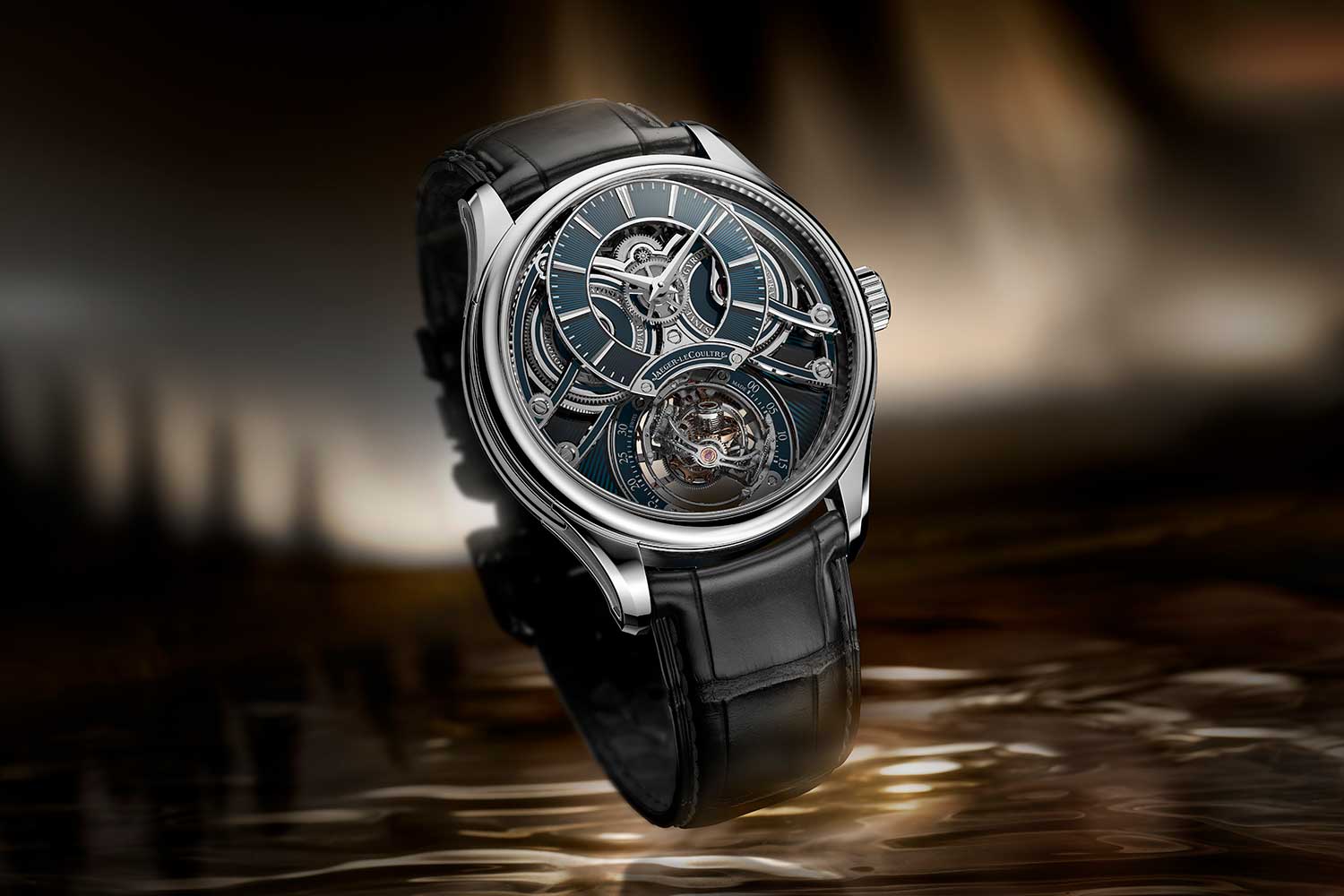
Master Hybris Inventiva Gyrotourbillon À Stratosphère
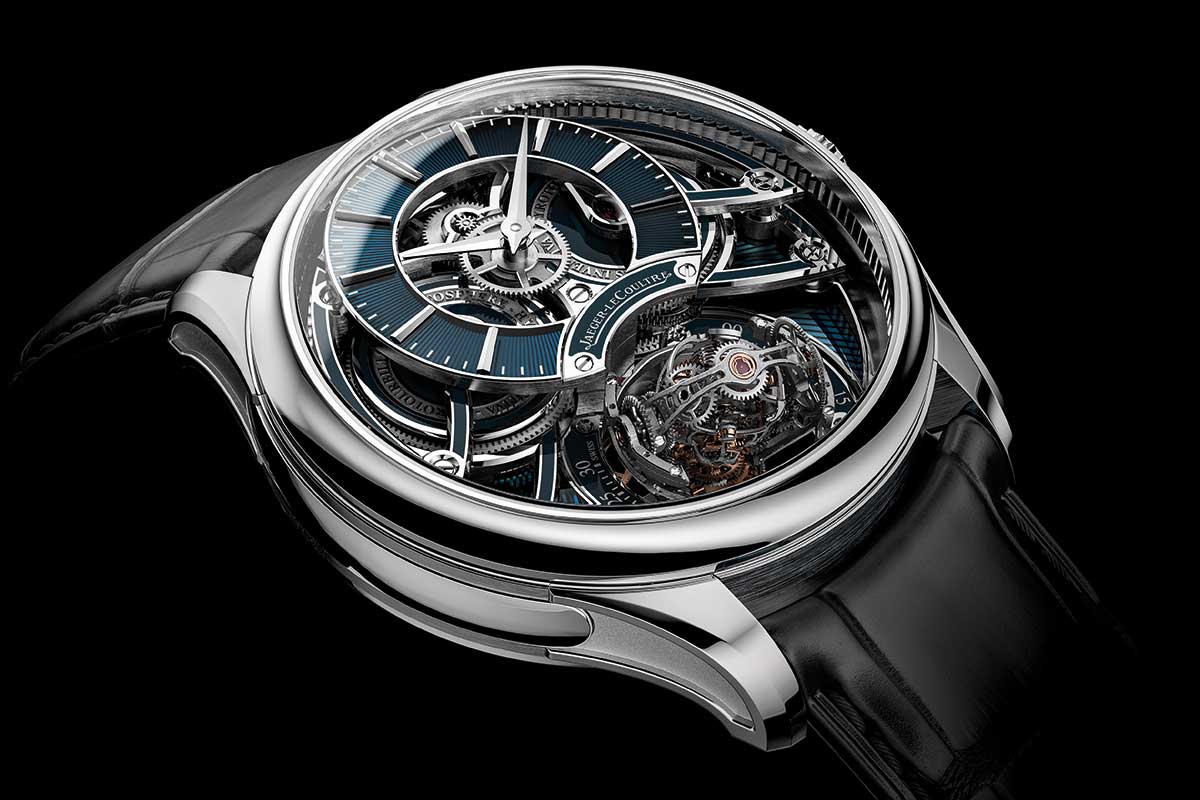
In the Master Hybris Inventiva Gyrotourbillon À Stratosphère, the Gyrotourbillon is taken a step further with the addition of a third axis. The combined motion of the three cages causes the escapement to sweep through a complex spatial trajectory, which exposes the balance to nearly all possible orientations in 3D space — 98 percent as compared with 70 percent in the Gyrotourbillon of 2004. In theory, this allows the regulating organ to experience almost every positional condition encountered on the wrist, thereby averaging the rate errors caused by gravity more effectively. Made in titanium, the inner cage completes one rotation every 20 seconds, the intermediate cage every 60 seconds, and the outermost cage every 90 seconds. The three cages will return to the same relative positions every 180 seconds, or 3 minutes.
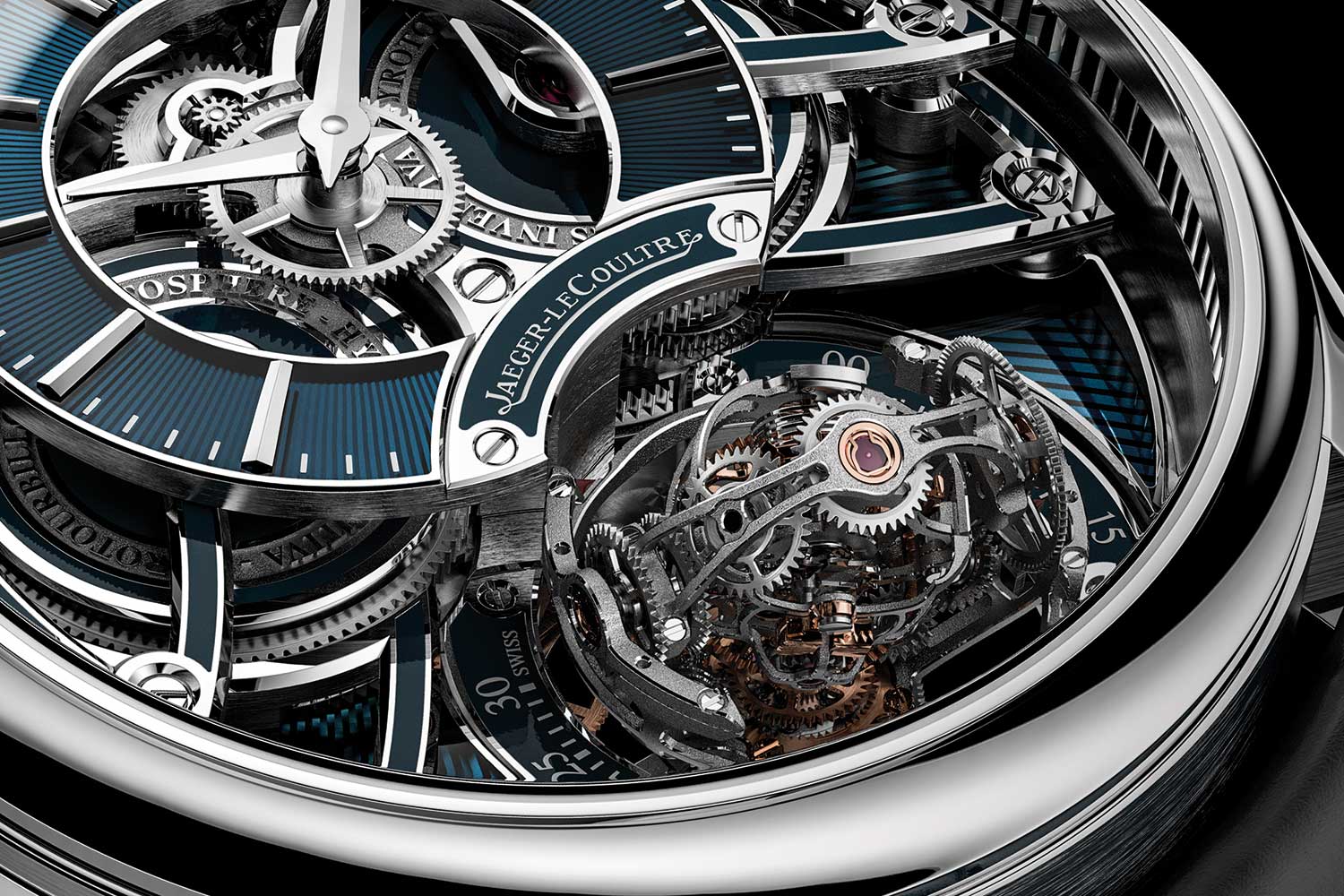
A 4Hz triple-axis tourbillon designed to cover almost every possible orientation in 3D space
More than that, the Caliber 178 offers a 72-hour power reserve with the use of double barrels while maintaining a beat rate of 28,800vph or 4Hz. Most comparable multi-axis tourbillons operate at 3Hz, as the inertia of the rotating cages places considerable demands on the movement. Achieving both a higher frequency and such extensive positional coverage makes this combination particularly notable. The result leaves gravity little opportunity to exert a sustained influence on the precision of the oscillator. Moreover, it is paired with a cylindrical hairspring. Unlike the flat spiral spring, a cylindrical hairspring is formed as a series of stacked, concentric coils of constant diameter that rise vertically around the balance staff, creating a true cylindrical shape. When the balance oscillates, the spring expands and contracts while remaining almost perfectly concentric, rather than breathing outward in an asymmetric spiral.
This geometry was historically associated with marine chronometers, where the symmetrical “breathing” of the spring helps maintain a more stable center of gravity and improves isochronism. The drawback is that cylindrical springs are difficult to manufacture and require considerable vertical space, which is why they are rarely seen in wristwatches. In the context of a multi-axis tourbillon, however, the cylindrical form is particularly advantageous. Its highly symmetrical behavior allows the oscillator to maintain consistent timing even as the balance is continually re-oriented in 3D space.
A Survey of Finishing Techniques
Aesthetically, the new Caliber 178 is about as refined as it gets. It is a showcase of both traditional finishing and métiers rares, incorporating 16 different techniques — sandblasting, perlage, polishing, flat polishing, straight graining, linear brushing, circular brushing, Côtes de Genève, diamond polishing, snailing, sunray brushing, beveling, guilloché, lacquering, lapping and enameling. The extent of finishing is apparent in the manually executed anglage alone. It is applied to 55 individual components, including 20 bridges, 18 cage parts, 11 wheels and six additional parts of the mechanism, and incorporates no fewer than 64 inner angles.
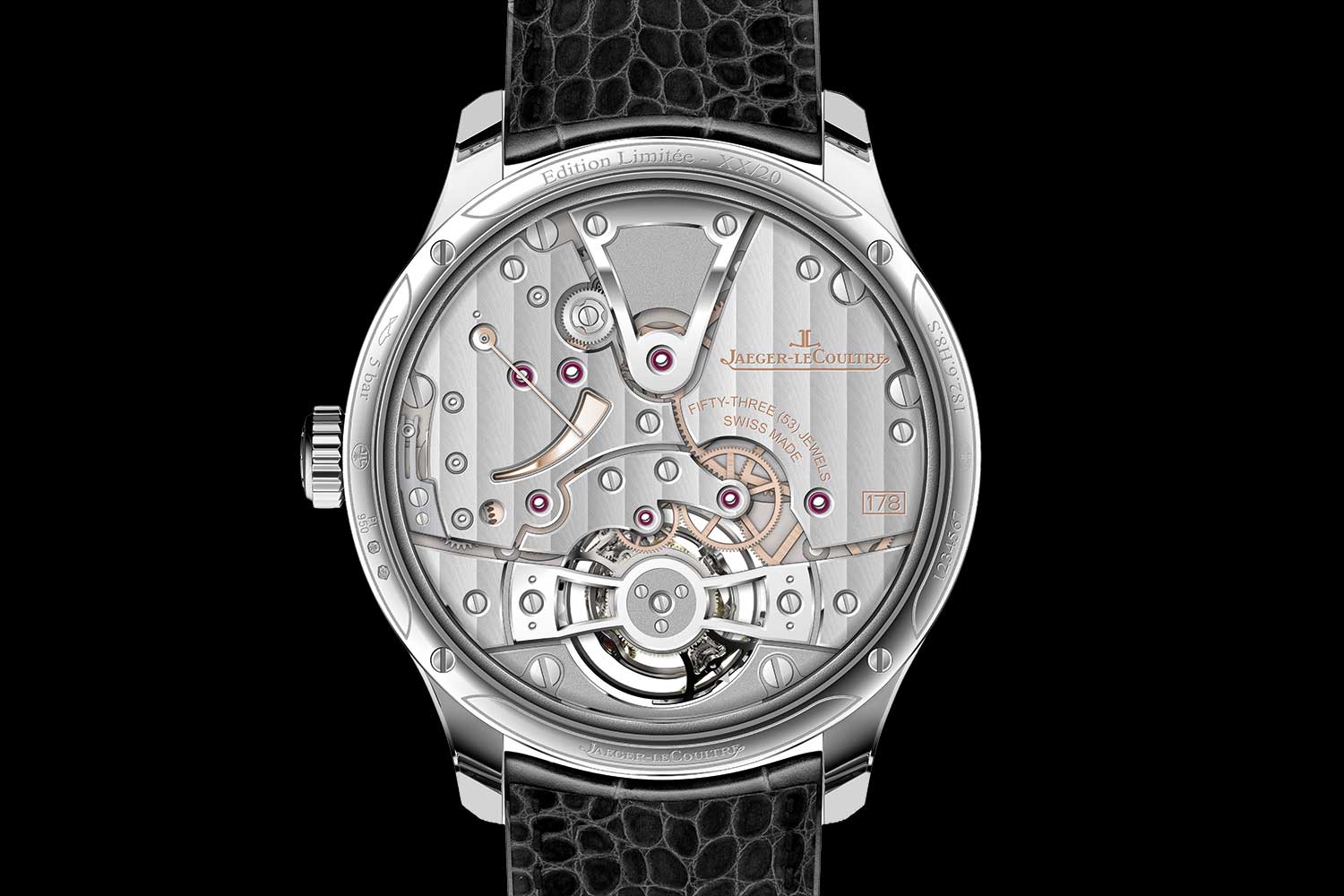
Powered by the new Caliber 178, which incorporates 16 different f inishing techniques
On the front of the watch, the chapter ring and mainplate, both in 18K white gold, are decorated with a sunray guilloché pattern and coated with translucent blue enamel. The white gold bridges are hollowed out and filled with blue lacquer, echoing the same color scheme across the movement. The barrel covers are likewise recessed at their centers and filled with lacquer in the same hue. The ring surrounding the triple-axis Gyrotourbillon À Stratosphère carries a 30-second scale, divided into two 15-second segments, over which a small red pointer travels to indicate the seconds.
On the reverse, the movement is dominated by two black-polished steel bridges — one supporting the hour-minute arbor and the other the tourbillon — each offering ample scope for sharply defined internal angles. A fan-shaped power reserve indicator is also placed on the back amidst polished domed pins, jewels and screws seated in polished countersinks. The movement is housed in a platinum case that measures 42mm wide by 16.15mm in height. It is not a compact watch by any means but a Gyrotourbillon executed with three rotating cages, a cylindrical hairspring and an architecture that invites both mechanical and decorative expression, is not the sort of mechanism that lends itself to restraint in scale. It is a showpiece, the ultimate Gyrotourbillon, intended to display the mechanism with the clarity and drama such an invention deserves.
Tech Specs: Jaeger-Lecoultre Master Hybris Inventiva Gyrotourbillon À Stratosphère
-
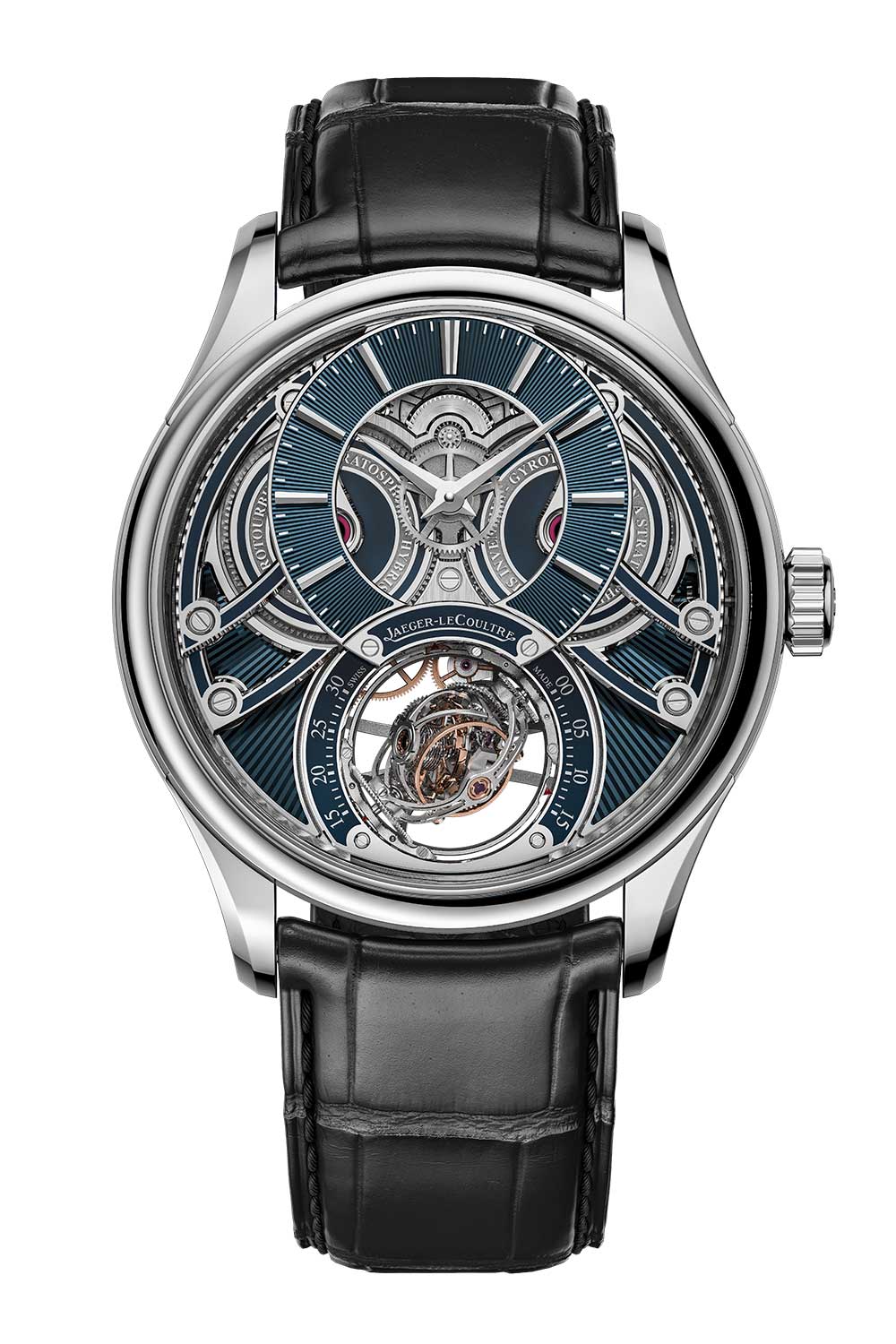
- Q5306480
Reference Q5306480
Movement Manual winding Jaeger-LeCoultre Caliber 178; 72-hour power reserve
Functions Hours, minutes, seconds; triple-axis Gyrotourbillon À Stratosphère
Case 42mm × 16.15mm; 950 platinum; water resistant to 50m
Dial Open-worked with sunray guilloché pattern and translucent blue enamel
Strap Blue alligator leather with small-scale lining; adjustable 18K white gold folding clasp
Price Upon request
Availability Limited edition of 20 pieces
Jaeger-LeCoultre
You may also like
Editorial
Last Week In Watches: TAG Heuer Carrera, JLC Grande Sonnerie, Louis Vuitton Spin Time and more
Sep 15, 2026
Editorial
Last Week In Watches: TAG Heuer Carrera, JLC Grande Sonnerie, Louis Vuitton Spin Time and more
Sep 15, 2026

Interviews
Jérôme Lambert, CEO of Jaeger-LeCoultre, explains the new Master Control Collection
Aug 14, 2026
Interviews
Jérôme Lambert, CEO of Jaeger-LeCoultre, explains the new Master Control Collection
Aug 14, 2026
Editorial
Instruments of individuality in the Patrick Parrish Collection
May 25, 2026
Editorial
Instruments of individuality in the Patrick Parrish Collection
May 25, 2026