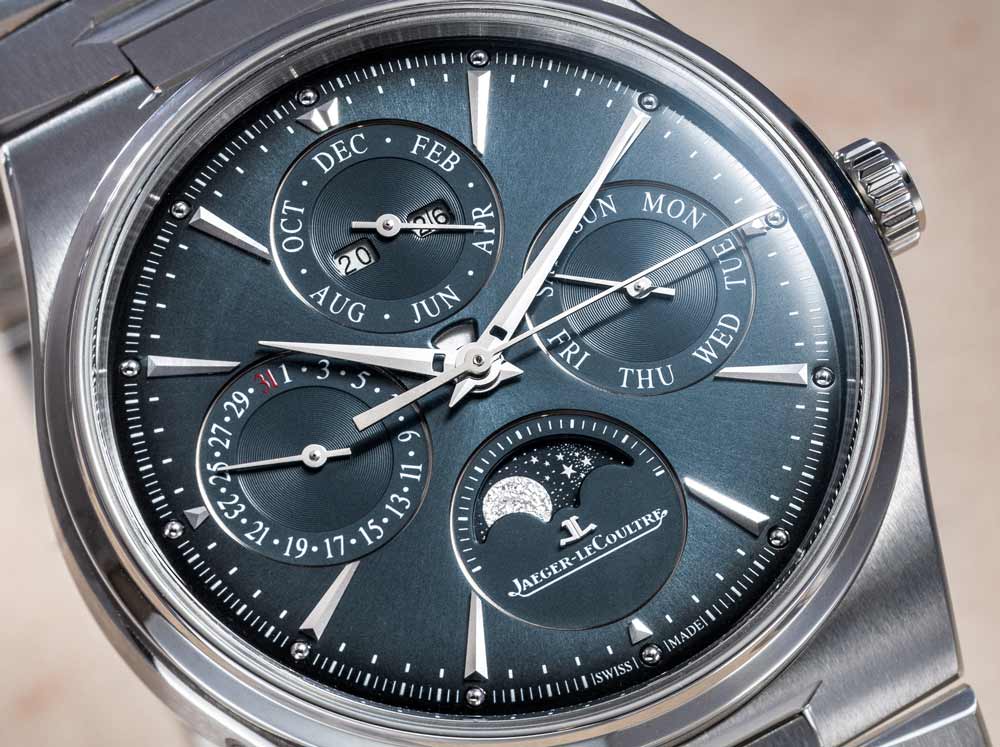
A Closer Look: Jaeger-LeCoultre Master Control Chronometre Perpetual Calendar
Reviews
A Closer Look: Jaeger-LeCoultre Master Control Chronometre Perpetual Calendar

Jaeger-LeCoultre has long offered perpetual calendars within its signature Master collection of refined, everyday elegant watches, a line that stretches back more than three decades. At this year’s Watches & Wonders 2026, however, the manufacture took a rather different approach. Unveiled was an entirely new Master Control Chronometre line-up featuring a redesigned case and integrated bracelet, alongside a new High Precision Guarantee (HPG) standard with patent-pending testing procedures.
The new lineup consists of three models: a base three hand watch, a date and power reserve variant, and finally the top of the line perpetual calendar version, which is what we are examining today.
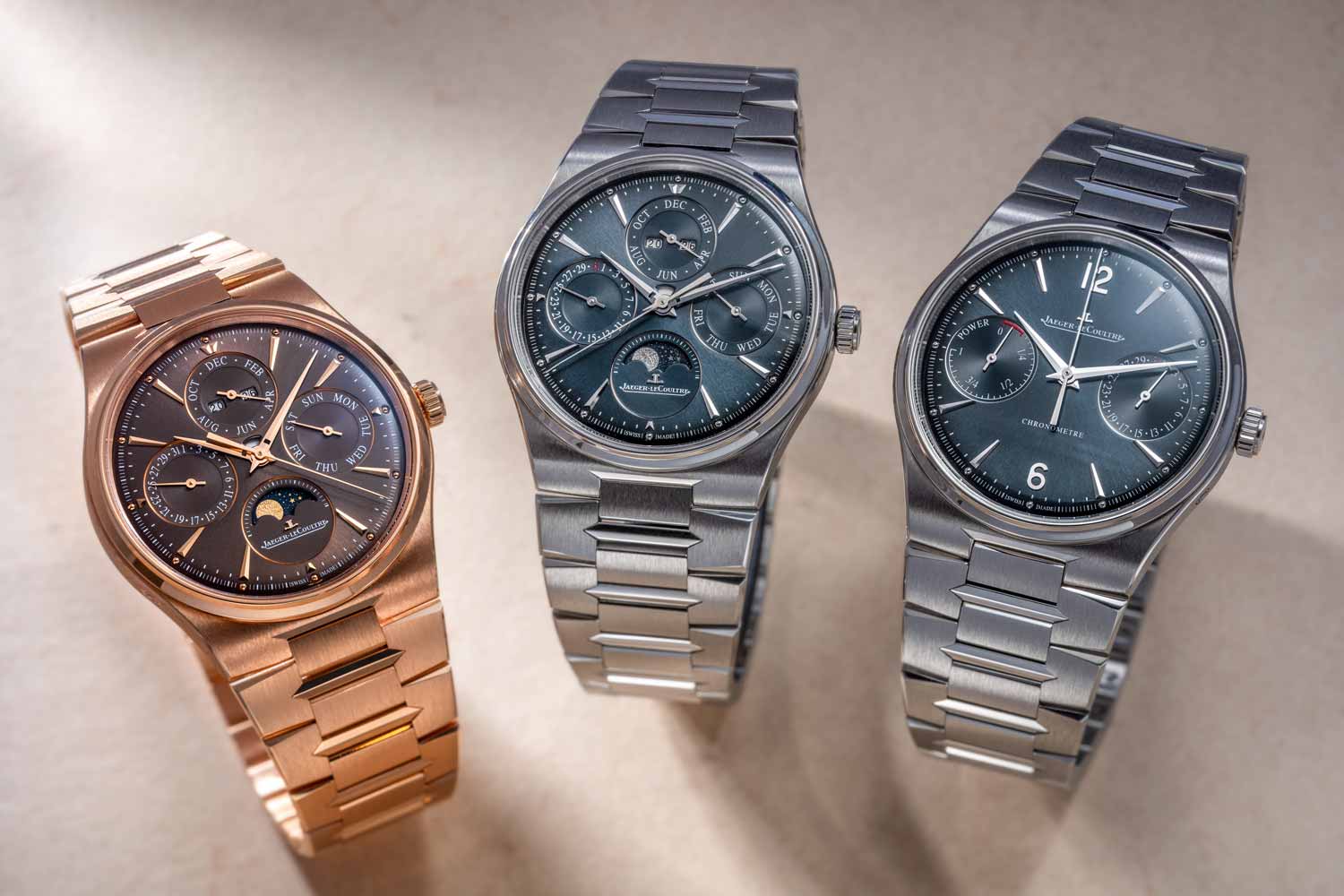
The new Master Control Chronometre Date Power Reserve and Perpetual Calendar. (Image: Revolution ©)
A new identity for the Master collection
The Master collection has long been an understated family of watches, typically defined by simple silver or black dials paired with leather straps. They are the sort of fuss-free watches that work in almost every setting, save perhaps for situations that become especially sporty or humid. Over the years, metal bracelets have occasionally appeared within the collection, though never in a way that suggested these were meant to be sports watches, or even particularly sporty in character.
Now, however, that is beginning to change.
Rather than refreshing the line, Jaeger-LeCoultre seems intent on repositioning it. The Master collection is being reinterpreted as an integrated bracelet watch, while still keeping the original dressier designs alongside it. The message is fairly clear: this is meant to be a modern luxury sports watch capable of competing with the established integrated bracelet models from rival brands.

39 mm in steel. (Image: Revolution ©)
For the manufacture, it is also a rather unusual move. JLC has rarely ventured seriously into sports watches, even if there have been occasional attempts in the past, such as the oversized Master Compressor line. That alone makes this new direction particularly interesting, and certainly worth taking a closer look at.
The redesign itself is rather subtle. The case retains the round bezel, though the lugs have now been reworked into a single integrated structure with a cut-out in the middle for the bracelet to flow into the case. Most of the effort, however, appears to have gone into the bracelet itself, which is entirely new and unlike anything else currently found in the brand’s catalogue.

(Image: Revolution ©)
At first glance, the bracelet looks like a typical three-link design. A closer look reveals otherwise. There are two types of centre links: one is the usual rectangular style, while the other is where the novelty lies: a thin V-shaped link with a facet on each side.
That V-shape motif is echoed throughout the bracelet. A. Along the outer silhouette are matching V-shaped cut-outs that subtly sharpen the overall profile. Finishing, too, has been handled thoughtfully. Flat surfaces are brushed, while the angular facets are polished to catch the light. Even the bevel running along the outer links receives a polished treatment, lending the bracelet a restrained highlight effect.

(Image: Revolution ©)
Old-school perpetual
Though the case and bracelet are entirely new, the dial remains familiar in style. The quadruple-counter layout follows that of the previous Master Control Perpetual Calendar, the dressier strap-equipped version once worn by Benedict Cumberbatch in the movie Doctor Strange, and now discontinued.
There are fairly straightforward reasons for retaining the layout. For one, it is a well-balanced design that has already proven itself over the years. Just as importantly, the underlying perpetual calendar module remains unchanged.

The pink gold version gets an attractive brown dial. (Image: Revolution ©)
And this is no ordinary perpetual calendar module. Beneath the dial sits the mechanism developed by Kurt Klaus in 1985 during his time at International Watch Company. At the time, it was the world’s first perpetual calendar that could be adjusted entirely through the crown, rather than through multiple recessed correctors on the case for the different indications.
The cleverness lies in the construction itself. Klaus designed the calendar mechanism such that each display wheel directly drives the next, eliminating the need for intermediate components and, with them, the usual corrector levers. The result is not only a far more user-friendly perpetual calendar, but also a thinner and more compact one, which helps explain how the movement was able to accommodate a four-digit year display.
Here on the Master Control Chronometre, however, the calendar is adjusted not through the crown, but via a single recessed corrector at eight o’clock, which also points to one of the mechanism’s limitations, as it can only be set forward and not backward. Interestingly enough, International Watch Company has recently updated the original Kurt Klaus module at Watches & Wonders 2026 with its new ProSet system, now allowing the calendar indications to be adjusted in both directions.
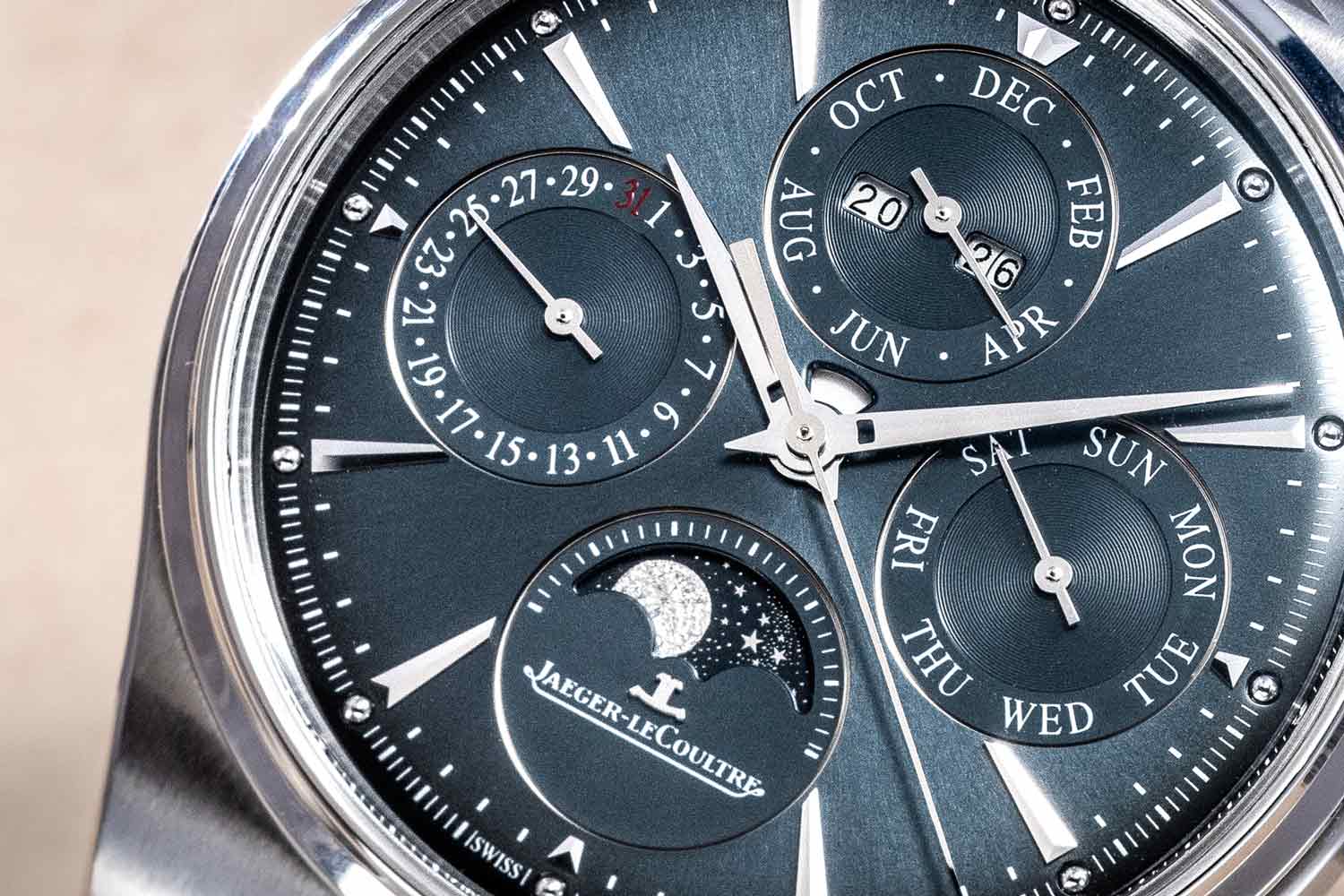
(Image: Revolution ©)
That said, a few details on the dial are worth pointing out. First are the markers, which combine applied faceted indices with intriguingly recessed polished pins on the outermost seconds track. On the moonphase disc, the gold model features a gold moon as expected, while, somewhat unexpectedly, the steel version is paired with a platinum moon.
Finally, the typography for the day, date, and month is relatively modern and suits the more sport-oriented direction of the watch. Still, it is hard to surpass the original typography used in the 1990s version of the Master Control Perpetual Calendar, which came with a simpler, more nostalgic dial finish, without the complex recessing and circular graining seen on the latest model.
Updated power reserve
The movement underneath is the cal. 868, the brand’s latest-generation automatic calibre, offering a healthy and convenient 70-hour power reserve. It is also a relatively thin movement, which helps keep the case height to just 9.2 mm despite the presence of a perpetual calendar.

The cal. 868. (Image: Revolution ©)
Finishing is typical of the brand: largely machine-executed, yet carefully refined with enough detail to feel upscale. This includes Côtes de Genève striping, polished countersinks for screws and jewels, and bevelled edges on the bridges. Taken together, the visible components are finished to a level that clearly supports its positioning as a luxury watch, even if it stops short of full hand-finishing.
One particularly appealing detail is the balance wheel, a free-sprung design with variable inertia weights on the rim. It brings a more technical and visually engaging character compared to the smooth-rim designs still found in many expensive watches from other brands.
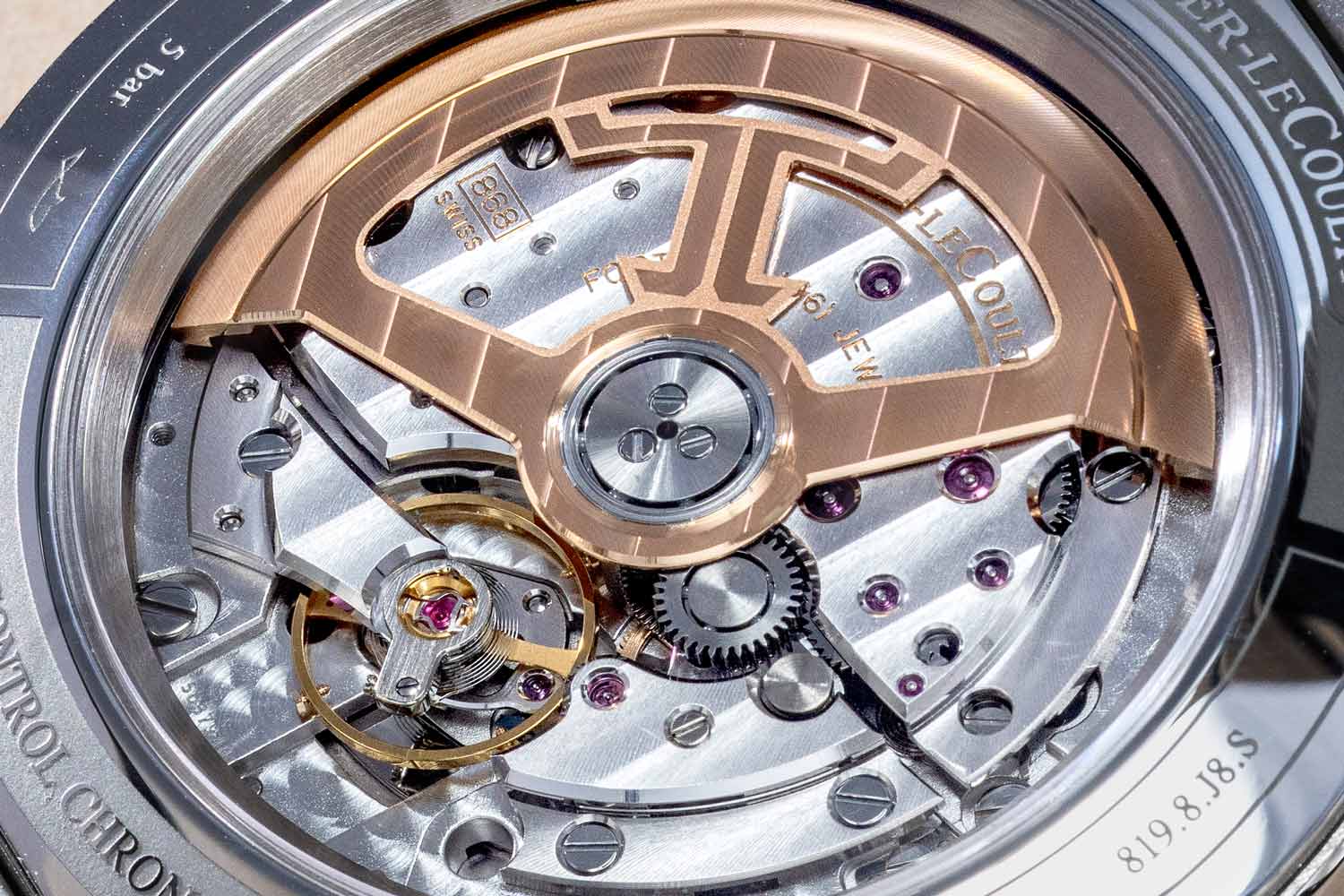
Pink gold rotor on the steel version as well. (Image: Revolution ©)
High Precision Guarantee
Finally, the biggest highlight of the movement, or rather the watch as a whole, is the new regulation standard. The manufacture has unveiled its own High Precision Guarantee (HPG) standard, replacing the previous 1,000 Hours Control testing.
Like other modern certification systems such as the Superlative Chronometer, METAS, and Excellence Chronometer, the HPG tests the watch fully cased and under simulated wearing conditions. The intention is to better reflect real-world use and ensure performance is regulated accordingly. The movement itself still begins its journey at COSC for initial chronometer certification.

(Image: Revolution ©)
From there, Jaeger-LeCoultre applies its own testing protocol across four areas: altitude, shocks, positions, and temperature. Altitude is assessed on the uncased movement, while the remaining tests are carried out once the watch is fully assembled. Weekday and weekend wearing patterns are also simulated, alongside more ordinary scenarios such as a watch left resting on a bedside table. The full process runs over three days. Shorter than the previous 1,000-hour test, yet broader in scope and more varied in conditions.
Concluding thoughts
The new Master Control Chronometre Perpetual Calendar is one of the few integrated bracelet sports watches to feature a perpetual calendar complication. The case design remains relatively understated, but the added complexity gives it a level of depth rarely found in time-only integrated bracelet sports watches. Taken as a whole, it comes across as a quietly compelling proposition rather than an obvious statement piece.
Tech Specs: Jaeger-LeCoultre Master Control Chronometre Perpetual Calendar
Reference: Q4178180 (steel); Q417216J (pink gold)
Movement: Cal. 868 automatic; 70-hour power reserve; 4 Hz
Functions: Hours, minutes, seconds, perpetual calendar, moon phase
Case: 39 mm × 9.2 mm; stainless steel or 18k pink gold; water resistant to 50 m
Bracelet: Integrated bracelet in stainless steel or 18k pink gold
Price: €39,500 (steel); €72,500 (pink gold), excluding taxes
Jaeger-LeCoultre

You may also like
Editorial
Last Week In Watches: TAG Heuer Carrera, JLC Grande Sonnerie, Louis Vuitton Spin Time and more
Sep 15, 2026
Editorial
Last Week In Watches: TAG Heuer Carrera, JLC Grande Sonnerie, Louis Vuitton Spin Time and more
Sep 15, 2026

Interviews
Jérôme Lambert, CEO of Jaeger-LeCoultre, explains the new Master Control Collection
Aug 14, 2026
Interviews
Jérôme Lambert, CEO of Jaeger-LeCoultre, explains the new Master Control Collection
Aug 14, 2026
Editorial
Instruments of individuality in the Patrick Parrish Collection
May 25, 2026
Editorial
Instruments of individuality in the Patrick Parrish Collection
May 25, 2026