
Jacob & Co.’s Gem-Set Astronomia Four-Axis Tourbillon
Editorial
Jacob & Co.’s Gem-Set Astronomia Four-Axis Tourbillon

One of the more interesting developments in modern watchmaking is that some of the most technically adventurous watches have come from places where no one expected to find them. Before Jacob & Co. became synonymous with spectacularly maximalist watchmaking, its founder was better known as “Jacob the Jeweler,” the creator of some of the most recognizable bespoke jewelry of the hip-hop era. But over the course of two decades, the company has built an equally serious reputation as one of the more inventive makers of complicated watches. Its repertoire ranges from the 31-day Quenttin and the Opera Godfather, which combines a minute repeater with a mechanical musical complication, to the Oil Pump automaton, the ultra-progressive grand complication Twin Turbo Furious and the Jean Bugatti Tourbillon Chronograph, one of the most technically ambitious chronographs of recent years. Yet no creation has come to define the brand quite like the Astronomia. With its constantly revolving satellite display carrying a multi-axis tourbillon, a self-leveling time display and a rotating globe beneath a vast sapphire dome, it has become almost inseparable from the idea of a modern hyperwatch.

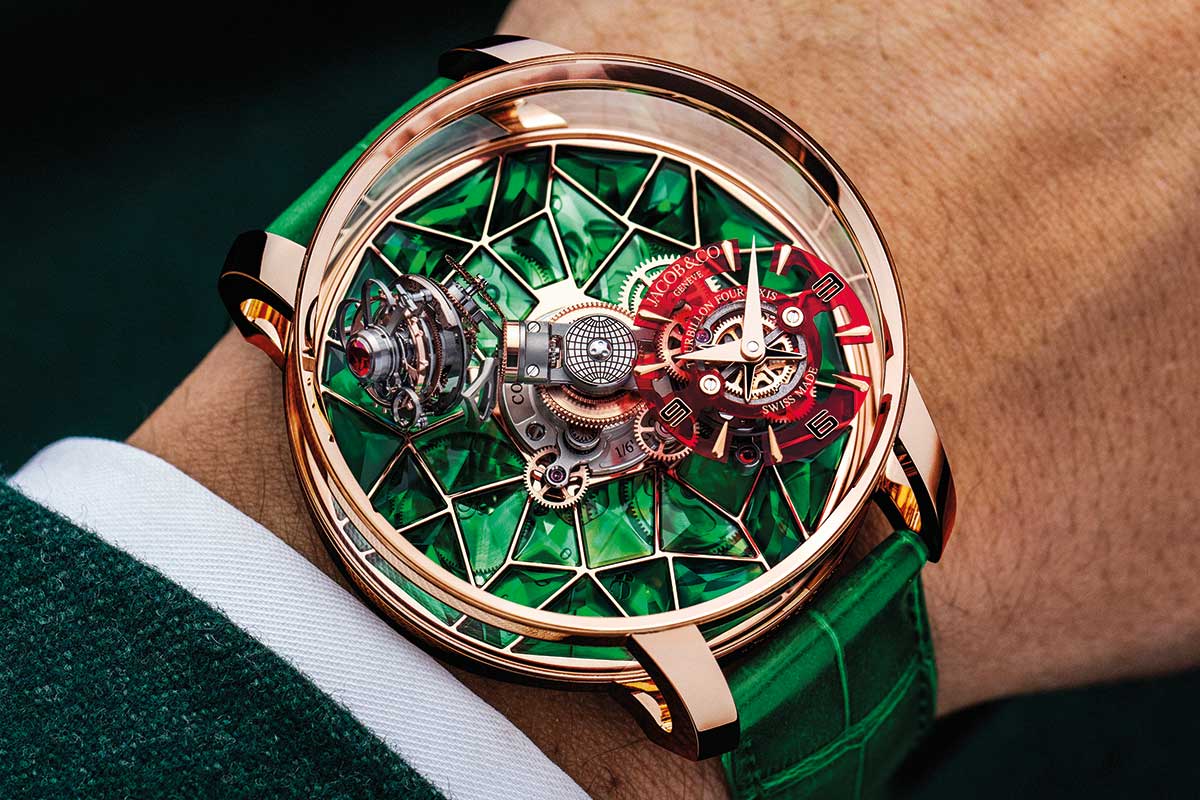
This year’s Astronomia Four-Axis Tourbillon comes in three bejeweled references
Originally launched in 2014, the Astronomia has continued to evolve through a succession of increasingly elaborate interpretations. It has accommodated astronomical indications such as sidereal time, a carillon minute repeater and even a functioning roulette wheel just to name a few. The fundamental mechanics have advanced just as dramatically. In the original Astronomia, the central carrier completed one revolution every 20 minutes. Subsequent versions reduced this to 10 minutes. With the Astronomia Revolution of 2023, the carrier accelerated to one revolution per minute — the same speed as a conventional tourbillon — allowing it to serve as a running seconds display. That watch also introduced a high frequency remontoir, which rewinds at every vibration of the balance wheel.
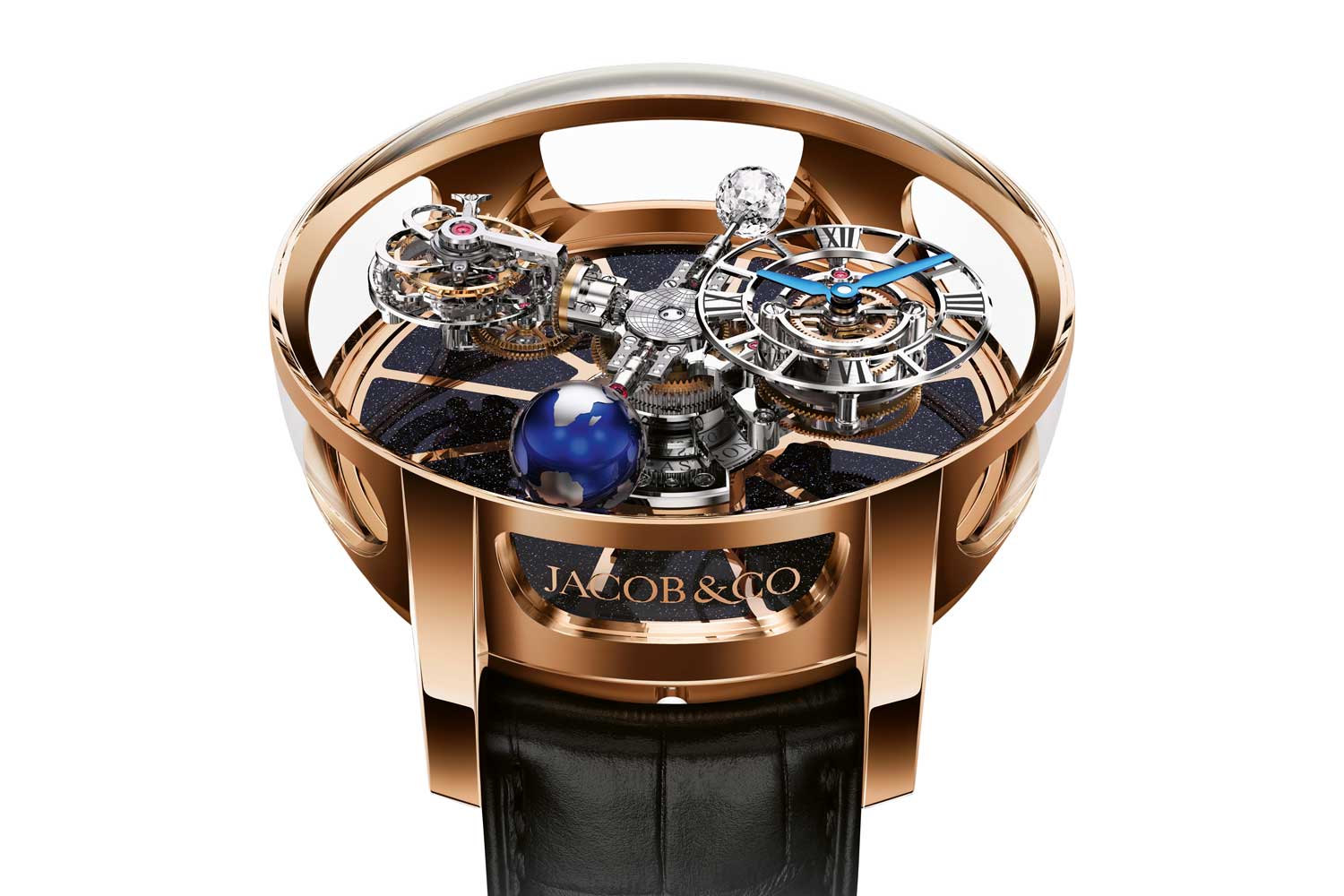
2014: Jacob and Co. Astronomia Tourbillon

2023: Jacob & Co. Astronomia Revolution
For the Astronomia’s 10th anniversary last year, Jacob & Co. pushed the concept another step with the Astronomia Revolution Fourth Dimension, the world’s first four-axis tourbillon watch. Developed by Concepto, the tourbillon now rotates on three axes instead of two, while the entire assembly continues to orbit the dial once per minute, bringing the total axes to four.

2025: Jacob & Co. Astronomia Revolution Four-Axis Tourbillon “Fourth Dimension”
This year, there are three new bejeweled references: the sculpted rose gold base of the earlier model has given way to a field of faceted crystals — colorless, green or red, respectively — each limited to six pieces. Because the Astronomia is open on every side beneath its great sapphire dome, light enters from almost every direction, while the translucent crystals reveal glimpses of the base movement beneath. The effect is one of spectacular visual richness, where time-telling seems entirely incidental.

The Astronomia Four-Axis Tourbillon is actually triple-axis by design, but gains a fourth from the rotation of the central carrier
The case measures a formidable 47mm across and 27mm thick. It is exactly as large as a watch built around a multi-axis tourbillon movement like this almost has to be. However, the experience of wearing it is considerably less intimidating than the specifications would have one believe. Much of the case is given over to sapphire crystal, with no bezel to speak of, giving the watch a light and airy appearance. At the same time, the short downturned lugs allow it to wrap comfortably around the wrist. Despite the abundance of sapphire, the case is also water resistant to 30 meters.
The Caliber JCAM54 features a two-armed satellite carrier, which gives the watch a more open appearance than earlier Astronomia models. Yet it retains the most interesting elements of the concept — the self-leveling subdial and a multi-axis tourbillon with a high frequency 1/6th-of-a-second remontoir.
The hour and minute subdial is an open-worked polycarbonate disk. As the carrier completes one revolution around the center of the watch every minute, the subdial remains permanently upright, and the numerals never seem to move at all. It appears so natural that most observers would hardly consider the mechanics. Yet if the dial were fixed rigidly to the carrier, it would rotate with it, and the numerals would continually change orientation. Instead, a pinion mounted on the carrier rolls around a fixed central wheel, driving the subdial in the opposite direction at exactly the same angular speed. The two motions cancel one another, allowing the subdial to orbit the watch while always remaining upright.

The challenge, however, is not simply keeping the dial level but allowing the hands to be set independently. To accomplish this, Jacob & Co. employs a double differential. During normal operation, the differential continuously synchronizes the self-leveling dial with the motion works, ensuring that the hands remain correctly aligned with the hour markers as the entire display revolves around the watch. When the hinged setting tab on the back of the case is engaged, the differential locks the dial to preserve its orientation while uncoupling the motion works, allowing the hands to be adjusted independently. Once time-setting is complete, the differential re-establishes the link between the hands and the dial, and the display resumes its self-leveling orbit.
The result appears almost effortless. Yet what seems to be a simple upright display is in fact the product of a complex interplay between the indexing pinion, fixed wheel and differential that remain virtually invisible to the wearer.
Four-Axis Tourbillon
The most technically ambitious feature of the watch is the tourbillon. It is triple axis by design, but gains a fourth axis from the rotation of the central carrier. The innermost cage contains the escapement and balance. It is mounted inside a second cage on an inclined axis, which is itself carried by a third cage rotating on an orthogonal axis.
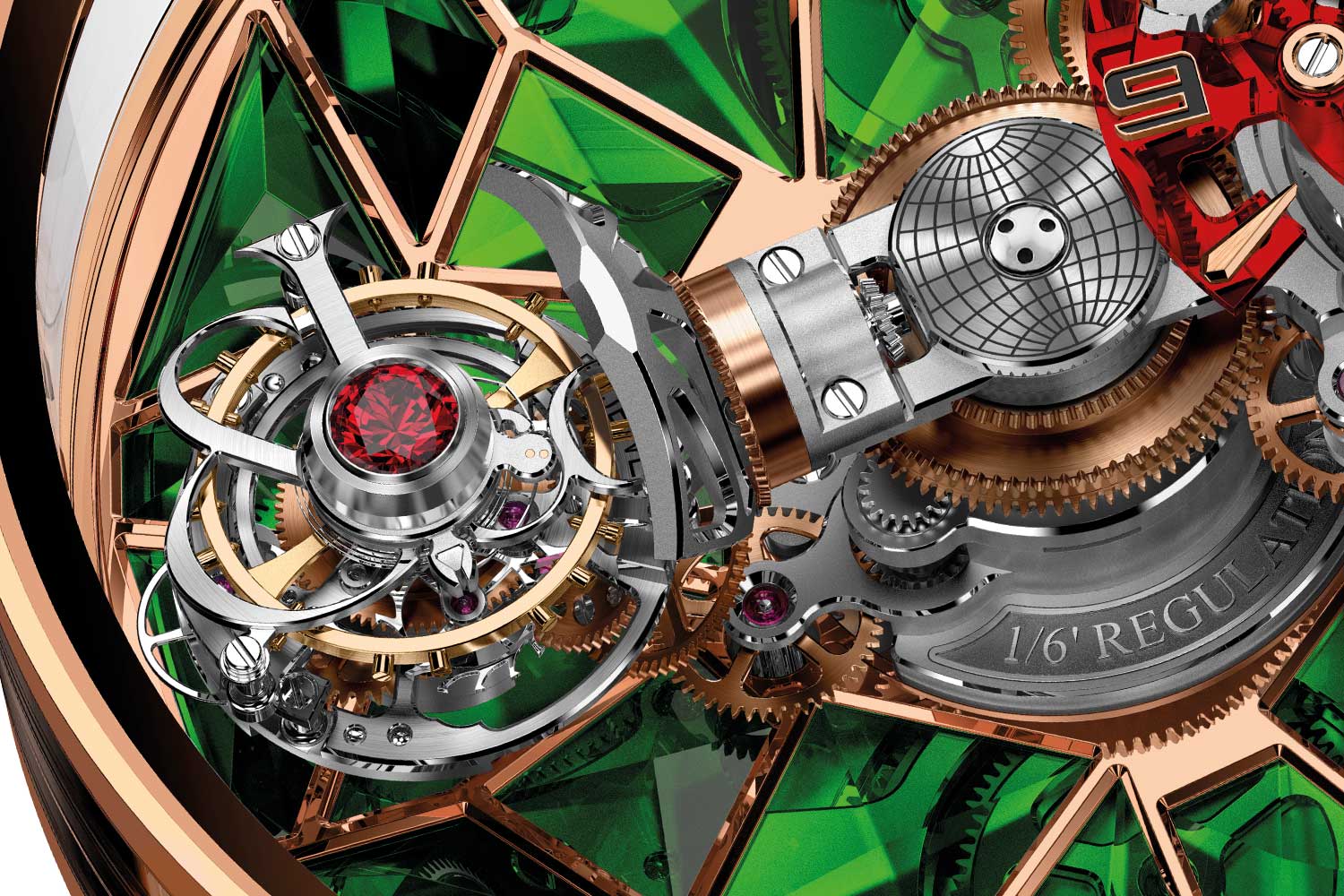
Multi-axis tourbillons are often reduced to their visual effect, but they are an extreme form of micromechanics. Each cage must support the mass of everything contained within it while transmitting power to the next stage. The engagement must remain constant as the cages rotate in different planes, while the pivots must remain rigid and precisely aligned despite the changing loads imposed by the moving assembly.
The three cages in the Four-Axis Tourbillon each incorporate a rigid offset arm to support the pivot of the next inner cage. By separating the inclined and orthogonal axes, these extensions create the clearance required for the nested cages to rotate without interference. Their dimensions and mass are also carefully balanced so that the center of gravity of the entire assembly remains constant despite the continuously changing orientation of the three cages.
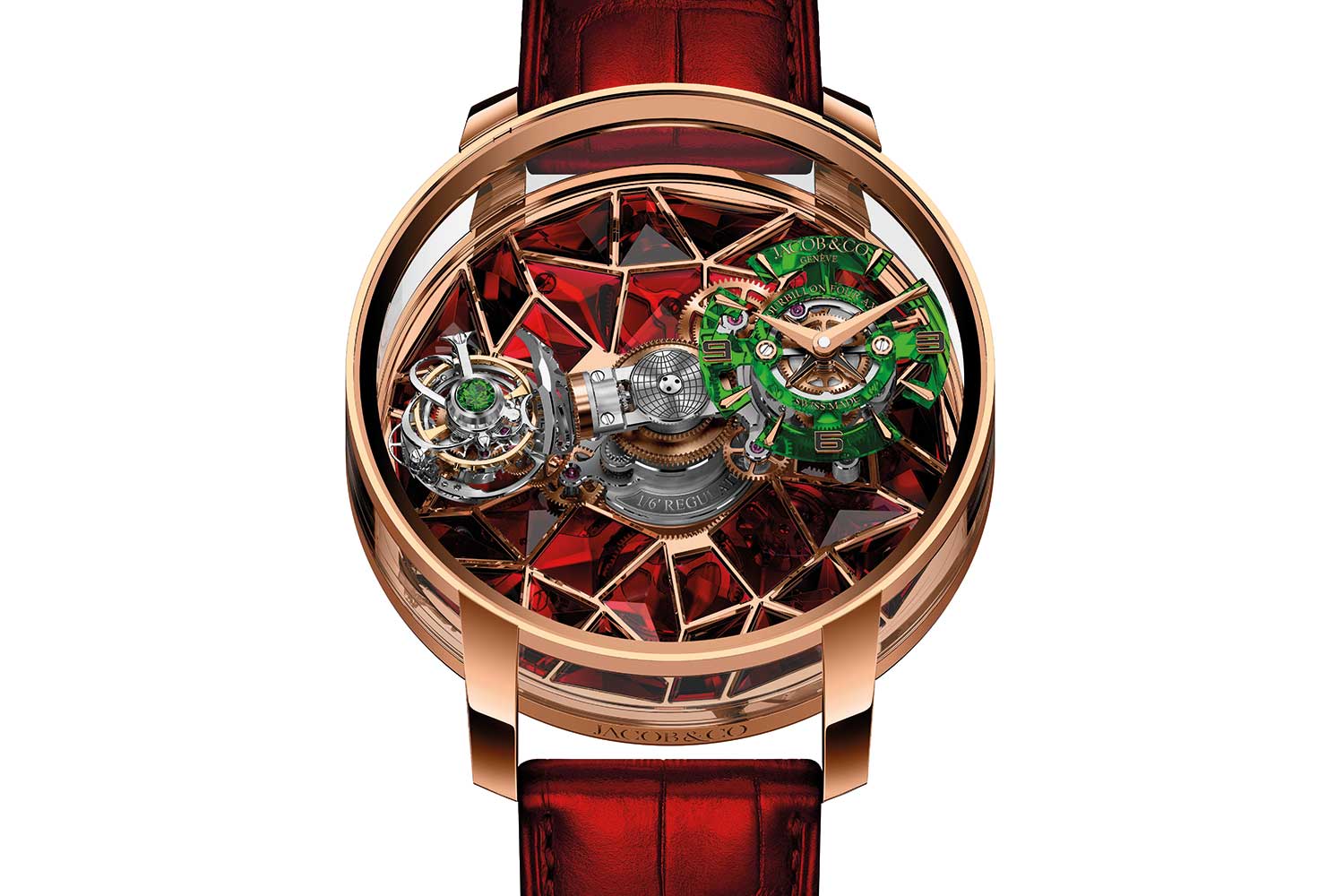
The Astronomia Four-Axis Tourbillon is available in three colourways, limited to six pieces each
Power is transmitted progressively inward through a succession of fixed wheels and drive wheels. Each cage carries a drive wheel that meshes with a fixed wheel on the next outer cage, allowing the nested assembly to rotate about multiple axes while progressively transmitting power to the escapement.
The basis for a tourbillon, and by extension a multi-axis tourbillon, lies in the fact that the rate of a mechanical watch varies with its orientation because gravity acts differently on the regulating organ in each position. Slight imperfections in the poise of the balance, the geometry of the hairspring, friction at the pivots, as well as changes in balance amplitude cause the watch to run at different rates in different positions. Breguet’s solution was to mount the balance, hairspring and escapement inside a rotating cage. Instead of allowing the regulating organ to remain in a single vertical position long enough for its positional error to dominate, the cage continuously rotates it through every vertical orientation, allowing the individual rate errors to be averaged into a single mean rate. The watch could then be regulated in the horizontal position to match this average, reducing the overall variation in timekeeping.
The rationale behind a multi-axis tourbillon is to expose the regulating organ to an even broader range of spatial orientations. A conventional tourbillon averages positional errors about a single axis of rotation and is most effective when the watch remains upright. A wristwatch, however, spends much of its time at many intermediate positions as the arm moves. By introducing additional axes, the balance continually assumes new orientations relative to gravity, producing a more representative average of positional errors over the course of wear.
In the Astronomia Four Axis, the central carrier and innermost cage each complete one revolution per minute, while the third cage rotates every 15 seconds and the second every 18 seconds. The four rotations combine to produce a constantly changing sequence of orientations that repeats only every three minutes.
Such an arrangement naturally places enormous demands on the going train. Jacob & Co. addressed this with twin mainspring barrels. Such torque, however, is unsuitable for direct delivery to the delicate escapement. The movement hence incorporates a remontoir d’égalité, which acts as a buffer between the high-torque going train and the oscillator. At the same time, it isolates the escapement from fluctuations in mainspring force, supplying it instead with small, constant bursts of energy.
Constant Force
Conventional remontoirs place a small energy reservoir between the barrel and the escapement. Instead of allowing the mainspring to drive the escapement directly, the barrel periodically rewinds an intermediate spring, which then delivers a nearly constant torque to the oscillator regardless of the state of wind of the mainspring. Traditionally, a remontoir spring is recharged once every second. During the interval between recharging, it gradually unwinds before being tensioned again, producing the familiar stop-and-release action.
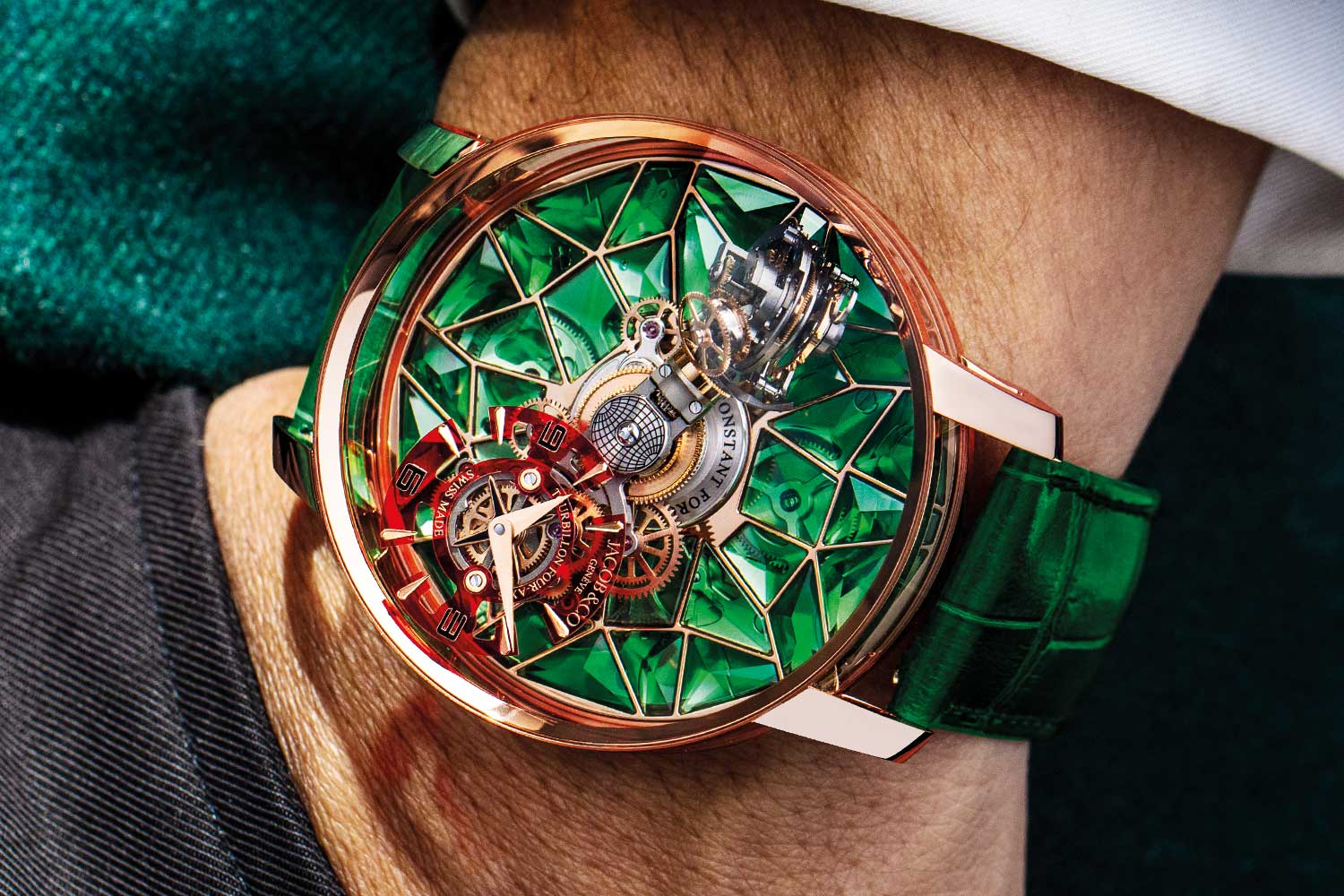
Jacob & Co. Astronomia Four-Axis Tourbillon
Jacob & Co.’s remontoir maintains this basic principle, but changes the way the remontoir is recharged. The barrel drives a winding pinion and winding wheel, which continually tension a small spiral spring positioned between the gear train and the tourbillon cage. The novelty lies in the locking mechanism that controls the recharging of this spring. It employs two superimposed levers, or “whips” mounted on the same axis. Each has two arms, with the second rotated approximately 90 degrees relative to the first, creating four locking points around the pivot. A stop star fixed to the driving wheel periodically releases these arms. Each release allows the lever to rotate and briefly unlock the winding wheel so that the barrel can re-tension the spiral spring before the mechanism locks again. Using two overlapping levers instead of one allows the stop star to be made significantly smaller. This reduces the torque transmitted each time an arm contacts it, thereby reducing the disturbance fed back into the regulating organ during each unlocking event.
The second departure from a conventional remontoir is the charging frequency. Rather than recharging the intermediate spring once per second, the mechanism can release the winding wheel on every beat of the balance wheel, or six times per second, thanks to the four successive locking points. The remontoir spring is replenished in much smaller increments and at much shorter intervals, allowing it to deliver an even more constant torque throughout the power reserve. Additionally, because the remontoir continuously regulates the torque reaching the oscillator, the barrel can deliver greater overall power without compromising timekeeping.
Both aesthetically and mechanically, the Astronomia Four-Axis Tourbillon is about as antithetical to the current preference and trend toward classic time-only watches as any watch can be, despite being, technically speaking, a time-only watch itself. The contrast in approach, the refusal to dilute an idea or commit to anything other than its own convictions, is ultimately what sets the company and its watches apart. It is, as with most of Jacob & Co.’s creations, a dazzling spectacle of horological pyrotechnics. Yet once the novelty of its appearance has worn off, there is, unlike many time-only watches out there, much in the watch to engage the mechanically minded collector. Within the constantly revolving display is a succession of exceedingly difficult engineering problems, and it is those solutions, no less than the spectacle itself, that make the Astronomia such a compelling watch.
Tech Specs: Jacob & Co. Astronomia Four-Axis Tourbillon
Movement Exclusive Jacob & Co. manual winding Caliber JCAM54; 36-hour power reserve
Functions Off-centered hours and minutes, constant-force mechanism and four-axis tourbillon
Case 47mm × 27mm; 18K rose gold with single-block sapphire caseband; water resistant to 30m
Dial Colorless, red or green gemstones, with skeletonized subdial featuring red or green polycarbonate; applied 5N gold indexes
Strap Alligator leather; 18K red gold folding clasp
Price USD 700,000
Availability Limited edition of six pieces per reference
Jacob & Co.

You may also like

News
Last Week in Watches: Omega Plays Both Sides, Seiko Takes Panda Literally
Oct 12, 2026
News
Last Week in Watches: Omega Plays Both Sides, Seiko Takes Panda Literally
Oct 12, 2026

Editorial
The Jacob & Co Palatial Flying Tourbillon Minute Repeater Goes Back to the Beginning
Oct 7, 2026
Editorial
The Jacob & Co Palatial Flying Tourbillon Minute Repeater Goes Back to the Beginning
Oct 7, 2026

Editorial
Last Week In Watches: TAG Heuer Carrera, JLC Grande Sonnerie, Louis Vuitton Spin Time and more
Sep 15, 2026
Editorial
Last Week In Watches: TAG Heuer Carrera, JLC Grande Sonnerie, Louis Vuitton Spin Time and more
Sep 15, 2026