Vacheron Constantin Updates the Twin Beat Perpetual Calendar with a 70-Day Power Reserve
News
Vacheron Constantin Updates the Twin Beat Perpetual Calendar with a 70-Day Power Reserve

Vacheron Constantin has revived its highly innovative Twin Beat Perpetual Calendar with a series of refinements to the movement that extend its already extraordinary power reserve to 70 days, a five-day gain over its predecessor. Although introduced in 2019, the original Twin Beat was produced only in very small numbers. Its return suggests that the brand has succeeded in bringing one of its most ambitious modern movements closer to series production.
The Twin Beat remains today one of the most ingenious perpetual calendars around. It offers an unusual solution to a problem that has followed the complication since its earliest days. Perpetual calendars are at their most useful when they are running, yet many spend long periods unworn and once stopped, the owner is often faced with the exasperating task of resetting a web of indications, often requiring a tool, a memory of what the correctors do and due regard for the movement’s dead zone, during which adjustments should not be made. Rather than make the calendar easier to set, Vacheron approached the problem from the opposite direction. Its aim was to keep the watch running long enough that the need for correction would rarely arise at all, and it notably achieved this without relying on automatic winding.
In general, achieving a very long power reserve in a watch comes with stubborn technical constraints. Once a watch is expected to run for more than a month, the usual solution is simply to store more energy, whether through multiple barrels or a smaller number but larger barrels fitted with exceptionally long mainsprings. Both approaches tend to produce movements of substantial size and often require compromises in balance power. Vacheron Constantin, however, took a more imaginative approach. Instead of increasing the energy available to the movement, it reduced the energy the movement required by allowing it to operate at a much lower frequency when the watch is not being worn.
The manual-winding 3610 QP comprises two going trains and balances powered by the same power source in the form of twin co-axial barrels coupled in series. Only one balance wheel and going train operate at any given time. A pusher at 8 o’clock actuates a V-shaped brake lever that alternately stops one balance roller and releases the other, switching the movement between its two operating modes.
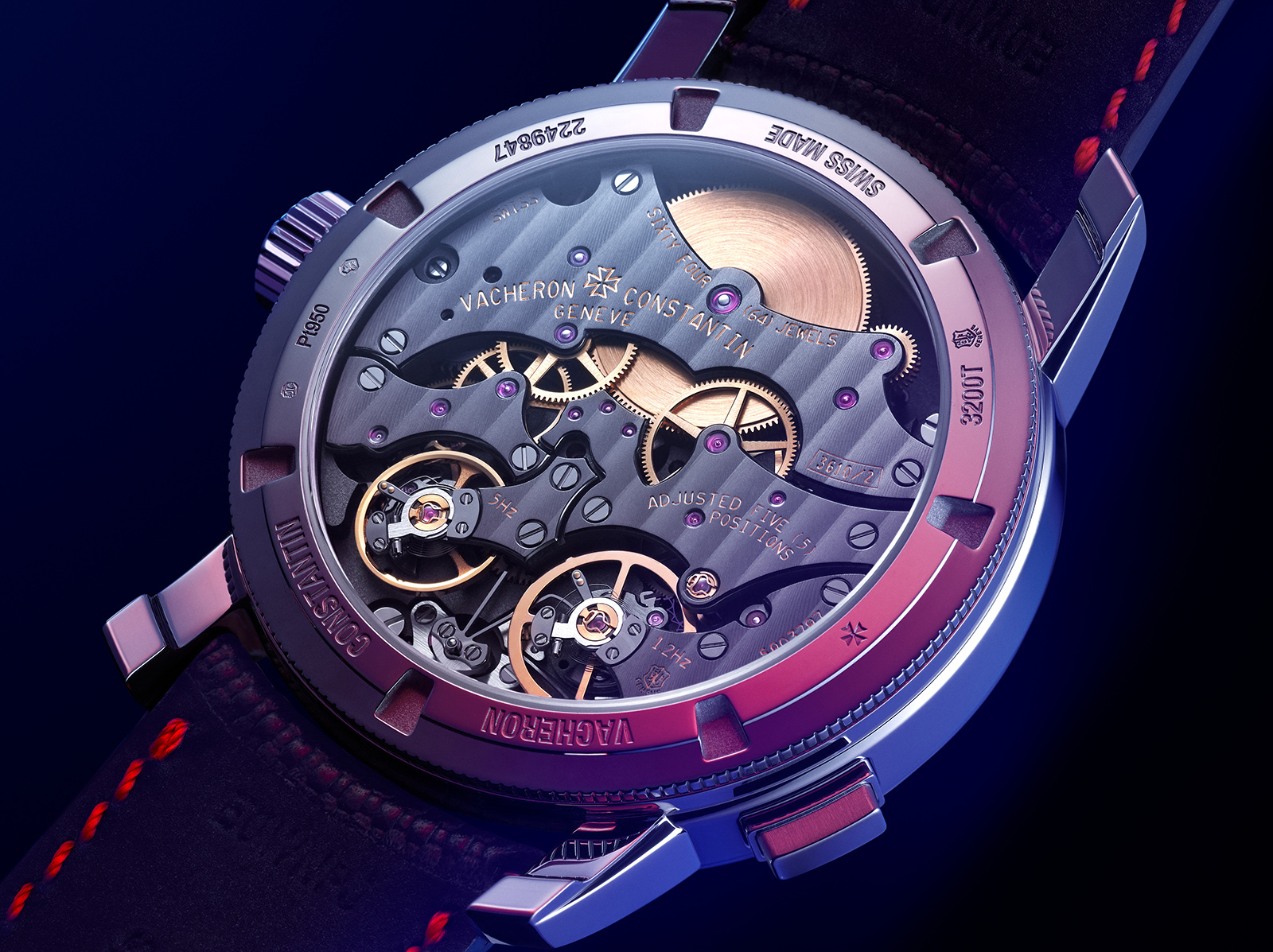
A V-shaped brake lever, visible at 6 o’clock, alternately stops one balance roller while freeing the other, switching the movement between its two modes
In active mode, a high frequency 5Hz balance governs the movement while in standby mode, a second balance oscillating at just 1.2Hz takes over. It is immediately recognisable by its larger diameter and is fitted with a hairspring only 0.015mm thick. Under normal wear, a balance of such low inertia oscillating at 1.2Hz would present obvious concerns about chronometry. However, the watch is intended to operate in standby mode while it rests undisturbed rather than on the wrist. A silicon escape wheel is also used in this train to reduce inertia. The reduction in energy consumption is dramatic enough that the perpetual calendar can continue running for up to 70 days on a full wind, compared to 4 days purely on active mode.
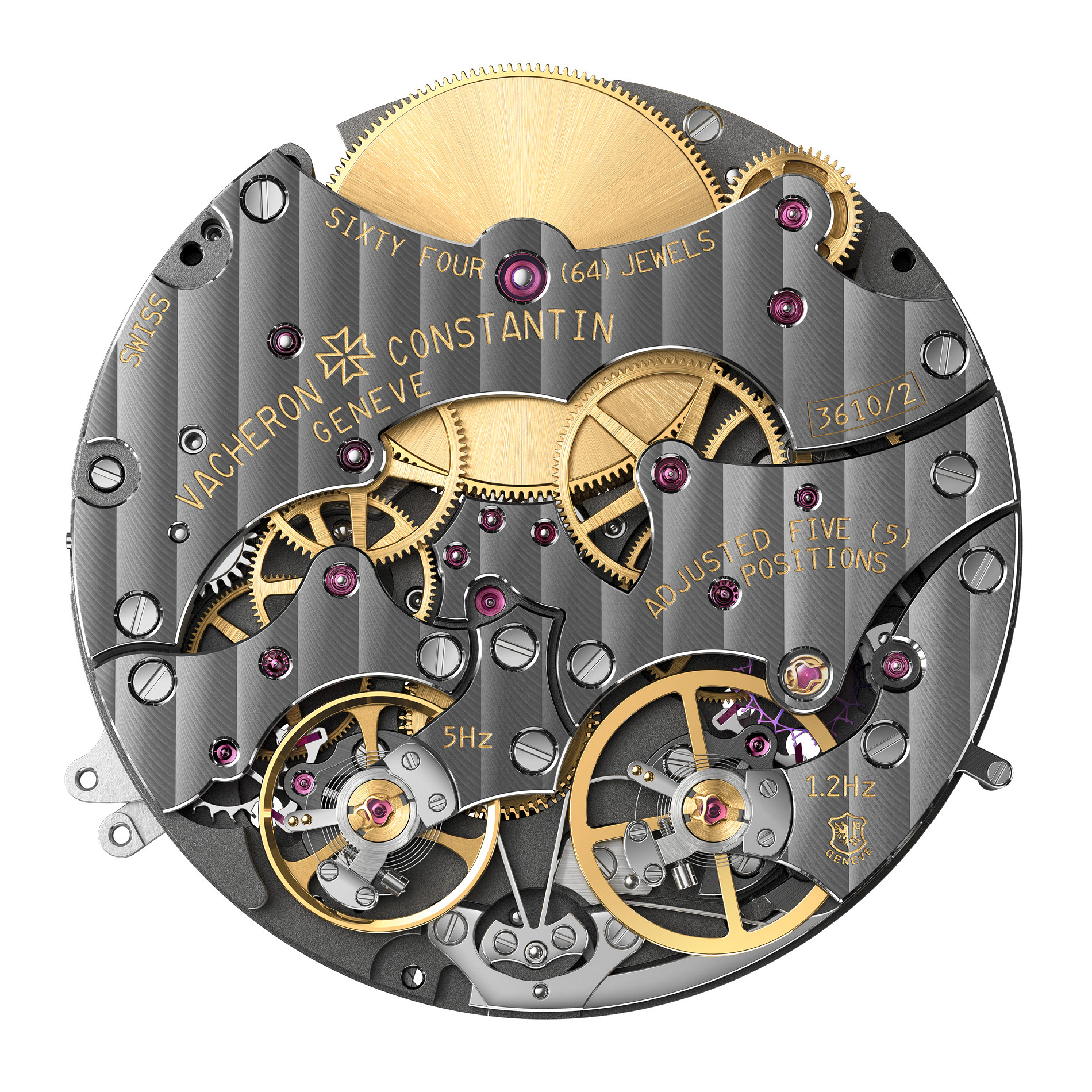
The active 5Hz regulator (left) employs a conventional steel escape wheel, while the 1.2Hz standby regulator (right) relies on a silicon escape wheel with a shock absorber. Notably, the 1.2Hz balance is planar and not dramatically larger than the 5Hz balance despite operating at a much lower frequency, suggesting that its inertia is very low
According to Vacheron Constantin, the differentials in the movement have been further refined in the new watch, though the specifics were not disclosed. Their functions, however, remain unchanged.
When one balance is immobilised, the first differential ensures that the mainsprings can continue to unwind normally, with power transmitted through the active going train. The second differential sits on the display side and combines the outputs of the two going trains into a common display train, ensuring that the hands and perpetual calendar advance at the same rate regardless of which regulator is active. Together, the two differentials allow the movement to alternate between regulators operating at vastly different frequencies all while keeping the indications continuously driven.
The third differential serves the power reserve display in a usual manner. The challenge is that a very long power reserve requires a correspondingly large reduction between the motion of the barrels and that of the indicator. Several revolutions of the barrel must ultimately translate into the modest arc of the power reserve hand. Rather than relying on a lengthy train of reduction wheels, the mechanism employs a second differential as a reducer. Both of its inputs are driven by the same state-of-wind differential but through slightly different gear ratios. The differential then compares two nearly identical rotational speeds and outputs only their small difference.
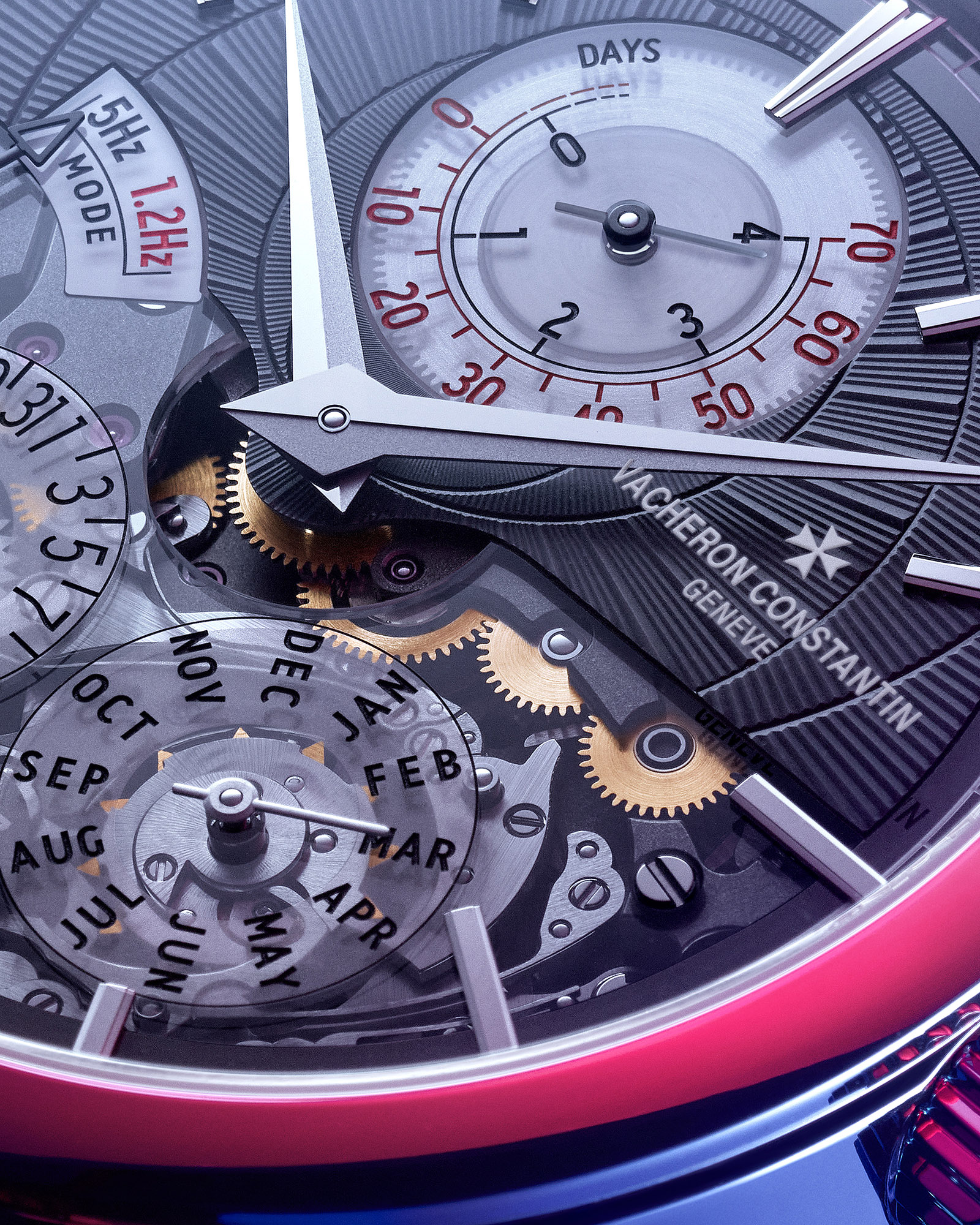
The increase in power reserve stems primarily from refinements to the instantaneous jumping calendar mechanism, which now consumes less energy. The brand has not disclosed the details of the revision but says that it remains based on the same underlying principle as the original.
Instantaneous displays require energy to be accumulated and then released all at once, creating a sudden demand on the going train that can affect balance amplitude. To address this, Vacheron Constantin developed a spring-arming mechanism that differs fundamentally from the cam and spring-loaded lever typically found in such calendars and is in some aspects reminiscent of how a spring is wound in a remontoir.
At its heart are two co-axial wheels connected by a spiral spring. The first is driven at a rate of one revolution per day, while the second is driven through a different gear ratio and rotates slightly slower. The resulting phase difference gradually tensions the spring over the course of 24 hours. At the moment of changeover, the mechanism temporarily disconnects from the driving train and releases the stored energy to execute the jump. A regulating train ending in a flywheel, visible on the dial side of the movement, governs the release, ensuring that the calendar indications advance in a controlled manner.
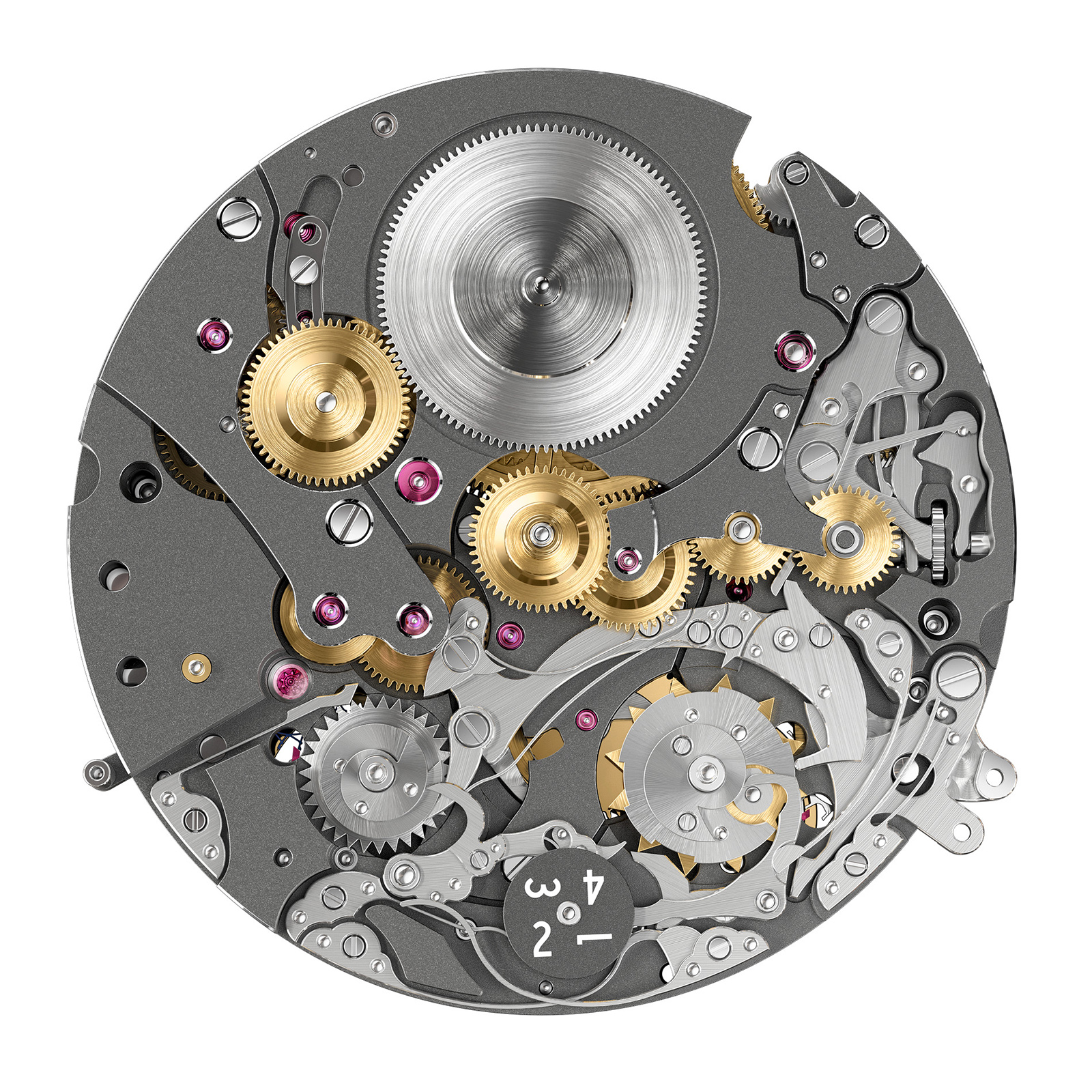
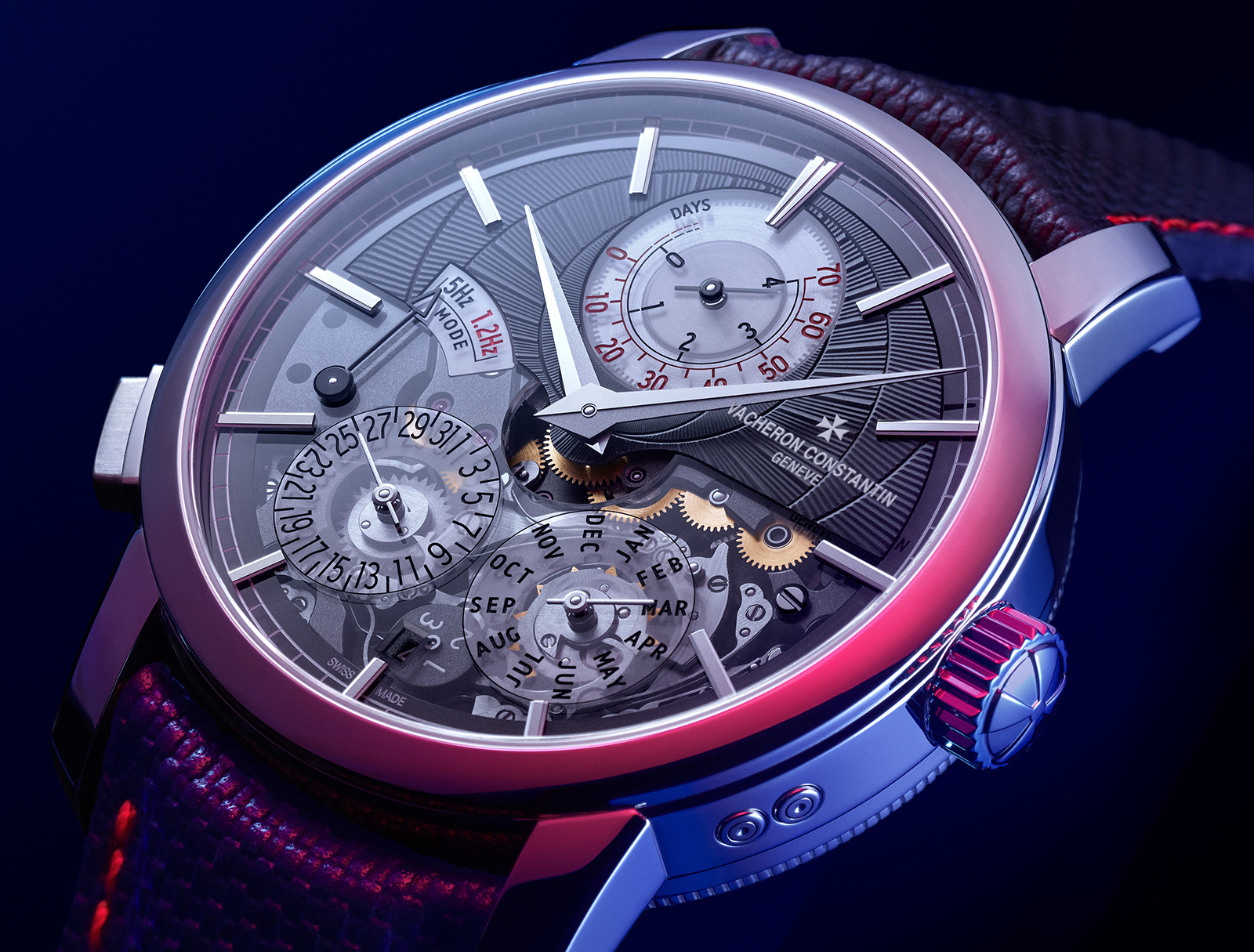
The spring arming mechanism for the instantaneous jump sits beneath a bridge, between the month star and the motion works. A flywheel visible above the 31-tooth date star regulates the release of energy stored in the spring during the switchover at midnight
The perpetual calendar is governed by a 12-month cam and a Maltese-cross satellite responsible for the varying length of February. Thanks to the sapphire dial, these components are visible from the front, offering a rare opportunity to watch the calendar works perform their instantaneous jump.
Externally, little has changed apart from the power reserve sector, which has been updated to reflect its increased running time. The platinum case remains 41mm x 12.3mm, dimensions that continue to be relatively restrained for a watch containing two large stacked barrels, two balances, two going trains and a perpetual calendar.
Seven years on from its debut, the Twin Beat remains unlike anything else on the market. The enormous power reserve is impressive in its own right, but it is the unusual chain of ideas and mechanisms behind it that makes the watch most compelling.

Tech Specs: Vacheron Constantin Traditionnelle Twin Beat Perpetual Calendar Ref. 3200T/000P-H167
Movement Manually wound Calibre 3610 QP; 4-day power reserve in active mode, 70-day power reserve in standby mode; 36,000vph (5Hz) in active mode, 8,640 vph (1.2Hz) in standby mode
Functions Hours, minutes, instantaneous perpetual calendar, dual-scale power reserve indicator, frequency mode display
Case 42mm diameter × 12.3mm height; platinum; sapphire crystals front and back; water-resistant to 30m
Dial Sapphire dial; inner plate in hand-guilloché 18K gold, slate grey finish
Strap Black calfskin with textured finish; platinum pin buckle
Availability Not limited
Price: Upon Request
Vacheron Constantin
You may also like
News
Last Week in Watches: Moser Goes Off-Grid, the Vacheron Constantin Overseas Turns 30
Sep 28, 2026
News
Last Week in Watches: Moser Goes Off-Grid, the Vacheron Constantin Overseas Turns 30
Sep 28, 2026

Editorial
Last Week in Watches: New Releases Ahead of Geneva Watch Days 2026
Aug 31, 2026
Editorial
Last Week in Watches: New Releases Ahead of Geneva Watch Days 2026
Aug 31, 2026

Editorial
Vacheron Constantin Miniaturises Six Crafts for the Animal Kingdom
Aug 28, 2026
Editorial
Vacheron Constantin Miniaturises Six Crafts for the Animal Kingdom
Aug 28, 2026