A Closer Look: Credor Goldfeather Porcelain Dial
Editorial
A Closer Look: Credor Goldfeather Porcelain Dial

Credor, the high-end watchmaker under the Seiko umbrella, has long been a Japanese domestic-market brand that remained largely out of sight for collectors around the world. The exception has been its top-of-the-line dress watch, the Eichi, which is available internationally and has arguably put Credor on the map with finishing that reflects the expertise it developed under the guidance of none other than Philippe Dufour.
In the last couple of years, Credor has begun opening itself to the international market, much as Grand Seiko did when it expanded beyond Japan in 2010. Its international catalogue remains relatively concise, with the Locomotive serving as the sports watch, the Eichi as the dress watch, and the Goldfeather offering a more everyday expression of classical Japanese elegance.
This year at Watches & Wonders, Credor unveiled two new versions of the Goldfeather. The collection has traditionally featured precious-metal cases, including platinum, making this year’s stainless steel model something of a departure. More striking still is its painted porcelain dial, which deserves a closer look. The only catch is that it is a limited edition, with just 60 pieces available worldwide.
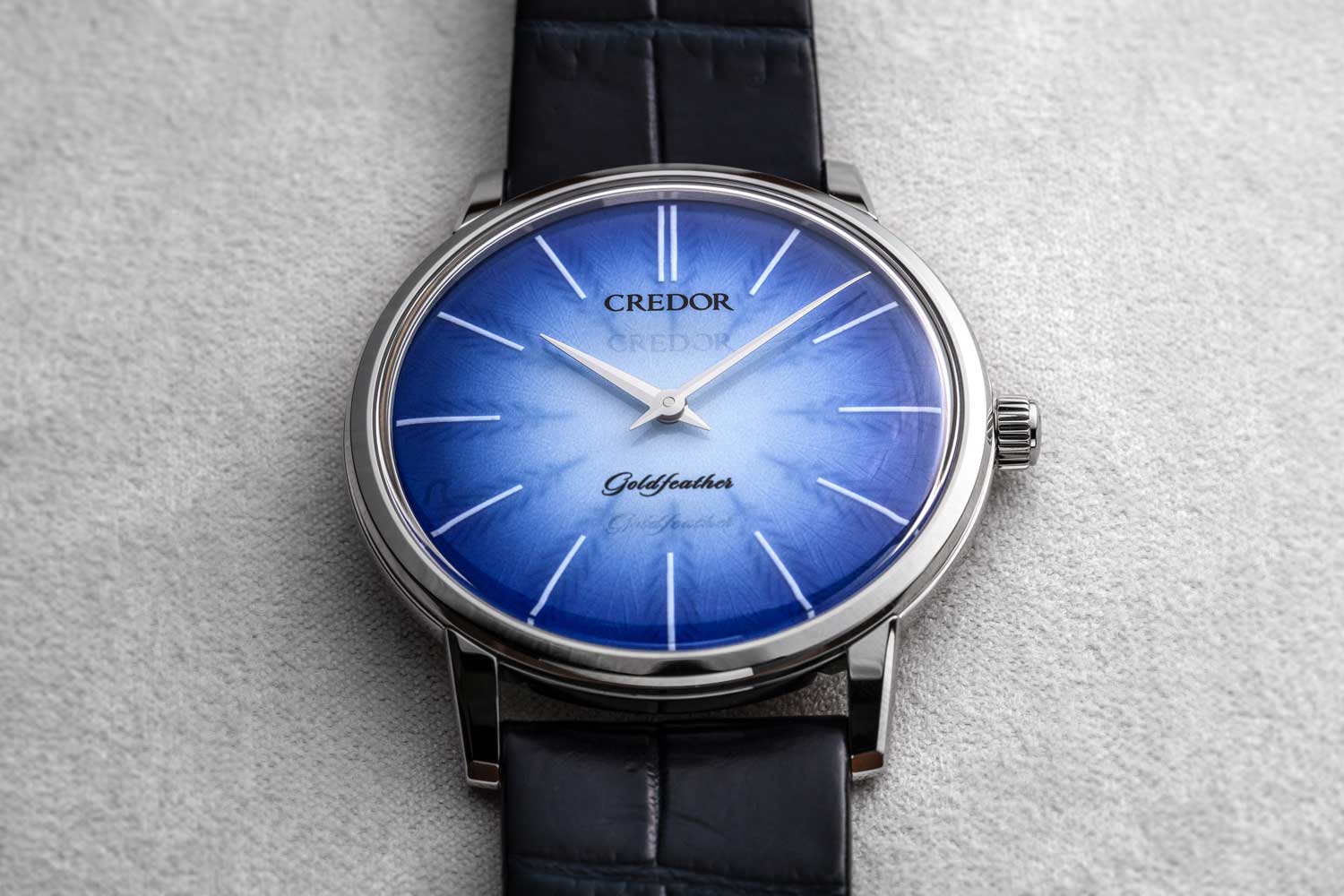
The new Goldfeather in stainless steel with a porcelain dial (Image: Revolution ©)
Traditional porcelain makes its way into watches
We have known Credor as a brand deeply committed to artisanal materials when it comes to dials. It has produced urushi (lacquer), raden (mother-of-pearl inlay), and, of course, porcelain, which is famously used on the Eichi and subsequently the Eichi II.
For the latest edition, Credor has turned to the traditional porcelain village of Okawachiyama, located in Imari, Saga Prefecture. The village is known for producing porcelain for the shogunate, the feudal military government of Japan, from the early 17th to the late 19th century. It continues to thrive as a centre of porcelain art and is still home to many workshops producing beautiful porcelain pieces.
One such workshop is Hataman Touen, which not only produces dining pieces for locals but is also a prestigious and renowned kiln that collaborates with fine dining restaurants to create custom dining ware. For example, it has worked with Restaurant Maison in Paris to produce a series of minimalist yet expressive painted plates.
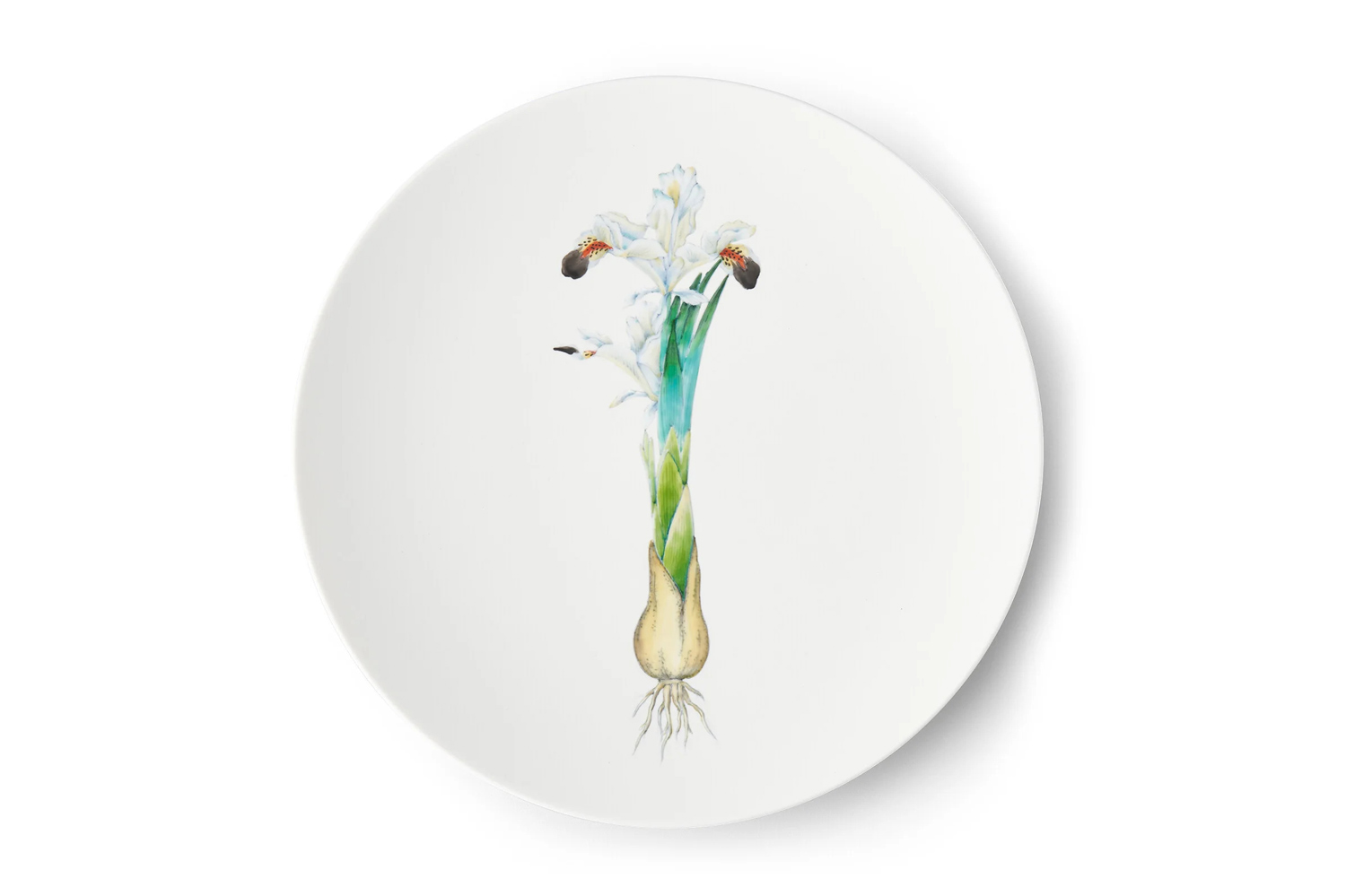
The result of a collaboration between Hataman Touen and Restaurant Maison in Paris is a large 29 cm-diameter plate depicting an iris (image: Hataman Touen)
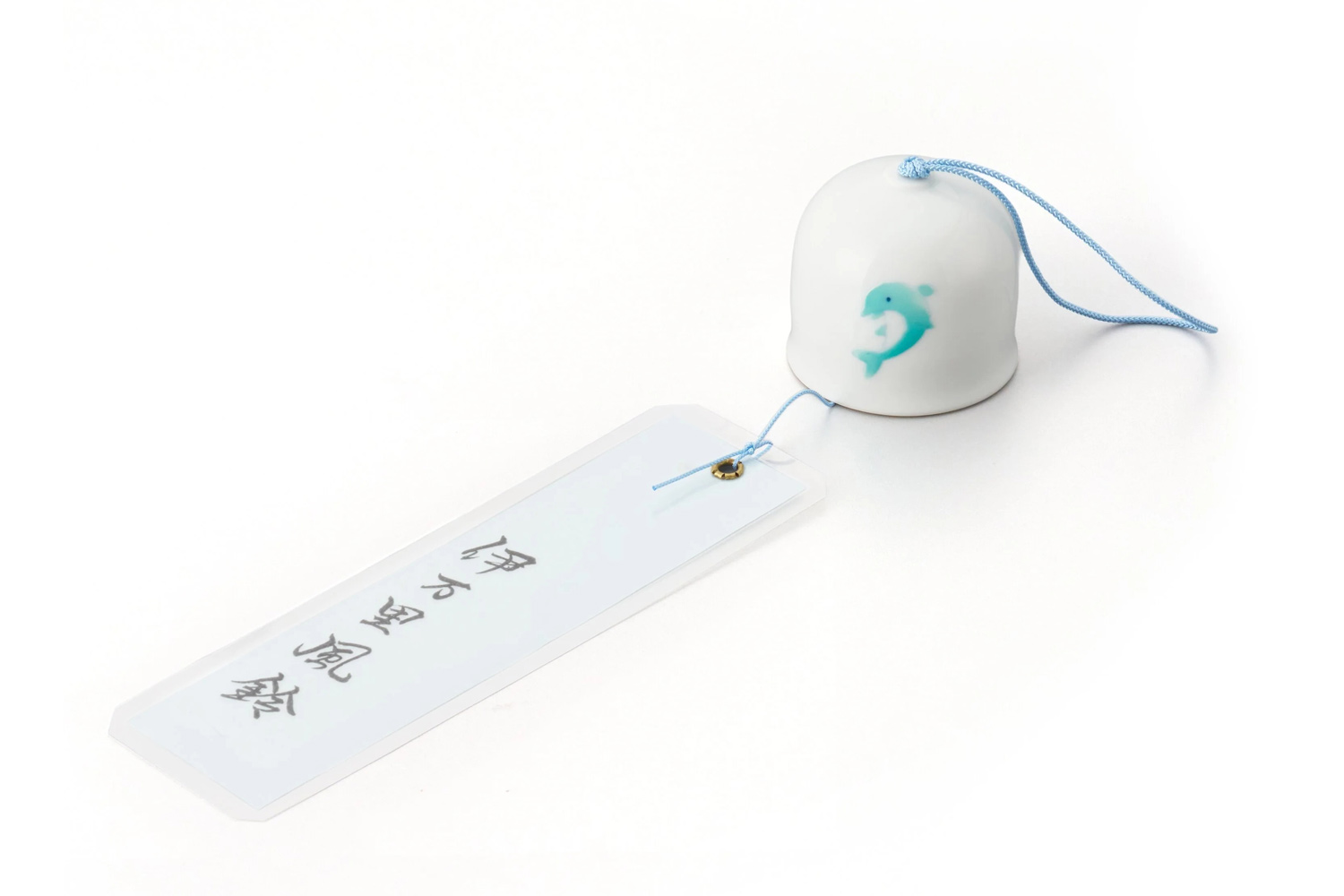
A cute, tiny wind bell with a light blue dolphin (Image: Hataman Touen)
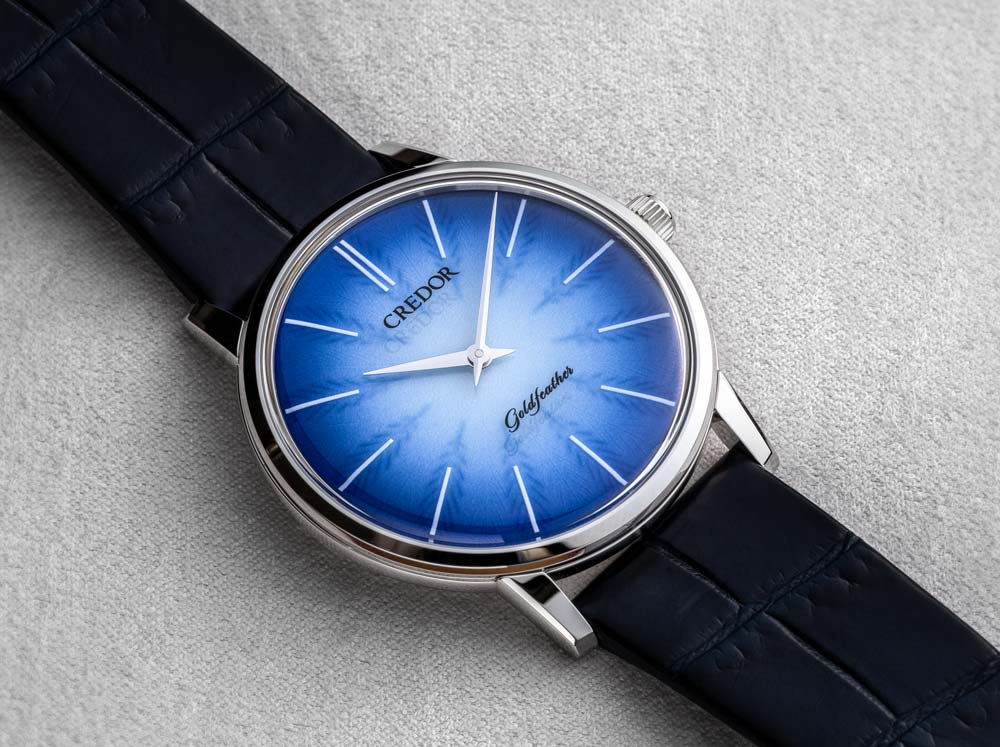
For the project, Credor turned to Hataman Touen to create a very thin porcelain piece that could fit into a watch, yet still be painted with layers of glaze to give it visual depth. The result is a fascinating dial that appears to have two porcelain layers stacked on top of each other. The feather motif around the edge has two tones, one darker and the other lighter, giving the impression that they sit at two different levels.
The truth is that the feathers are indeed applied at two different levels, but they remain on the same porcelain dial. First, the darker blue feathers are painted onto the plain white porcelain, while the edge is painted in dark blue to create the gradient effect. A layer of glaze is then applied, after which the transparent feather motifs are added between the dark blue feathers, along with the indexes. This layered approach is what makes the white hour markers appear to sit above the dark blue feathers. The result is an alternating pattern of colour and translucency, creating a sense of depth that is particularly interesting in porcelain, let alone on a watch dial.
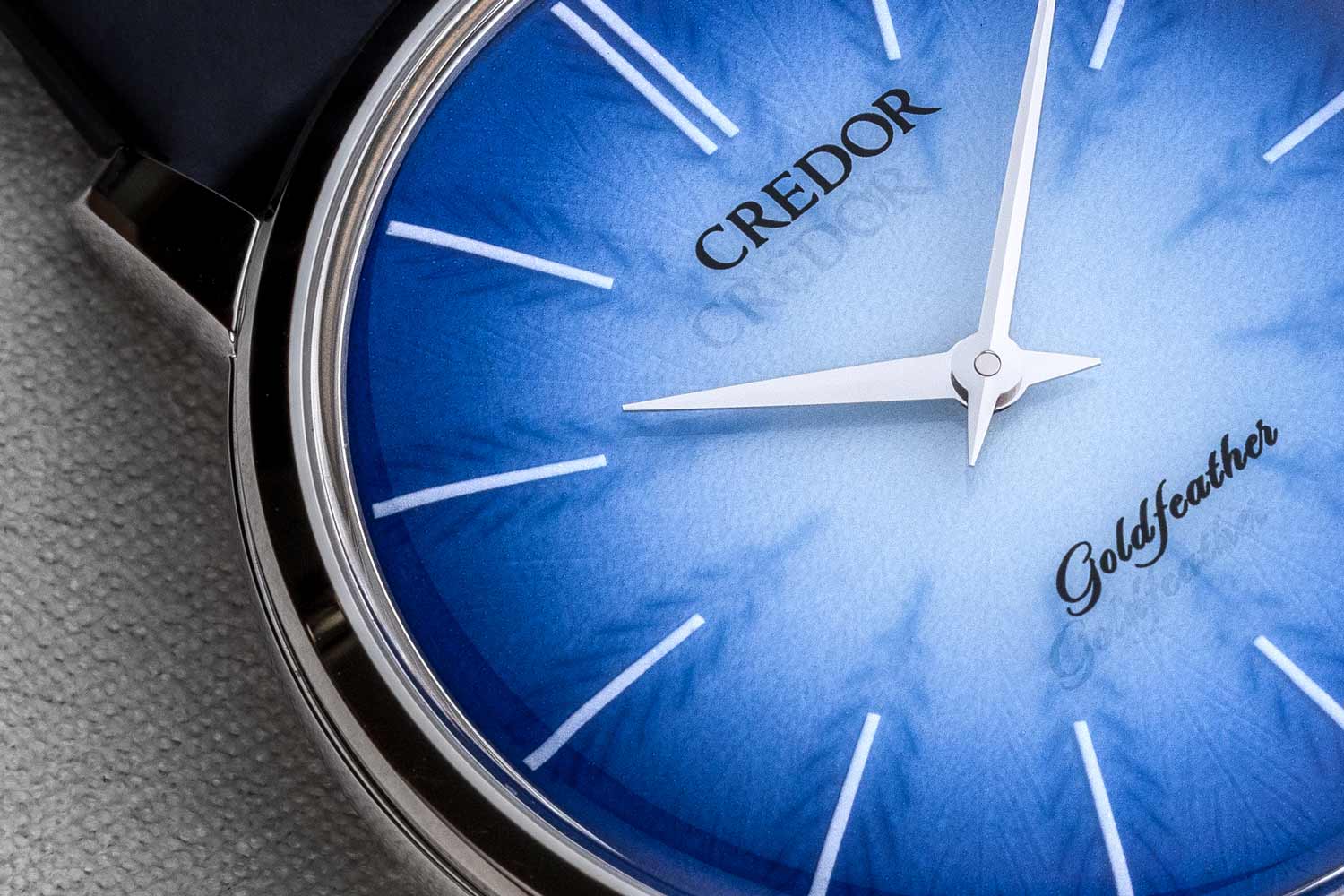
The depth of colour and texture is unusual for a watch dial (Image: Revolution ©)
One of the reasons this layered approach is so intriguing is that porcelain needs to be fired, much like enamel, and each additional firing increases the risk of cracking or other imperfections. To help counter the risk of warping, the workshop first creates a thicker dial to give it greater integrity during firing. Once the firing process is complete, the dial is carefully shaved and polished down to the required thickness, around 1 mm, so that it can be fitted into the watch.
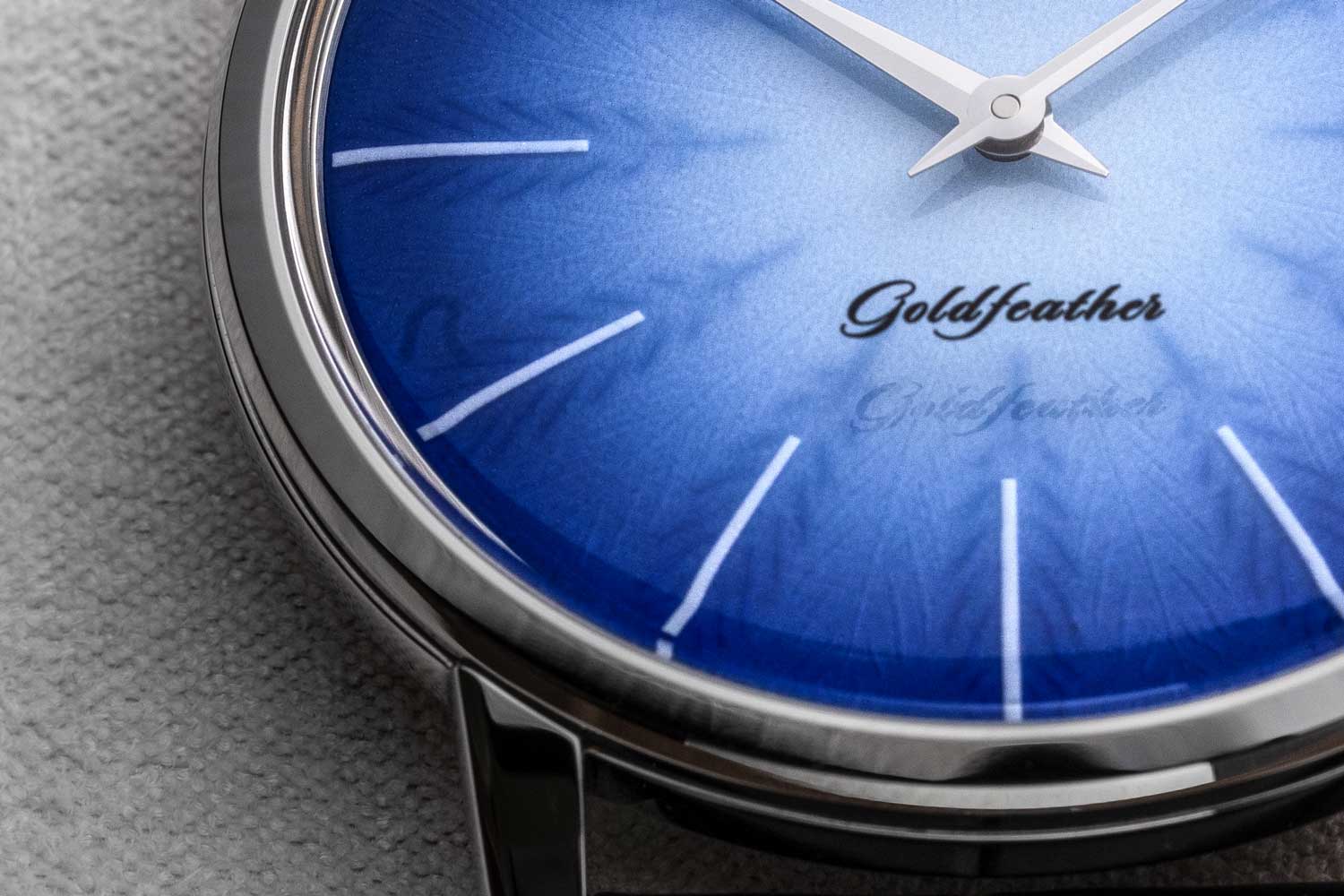
Notice how the white hour markers sit above the blue feathers, with the subtle translucent feathers in between (Image: Revolution ©)
Finally, there is another interesting detail. The Credor logo and Goldfeather name are absent from the dial itself. Instead, they are printed underneath the sapphire crystal, allowing them to cast a shadow onto the dial. Whether this is a plus, adding an interesting visual effect, or a minus, making the dial feel distracting or gimmicky, ultimately comes down to the collector’s taste and preference.
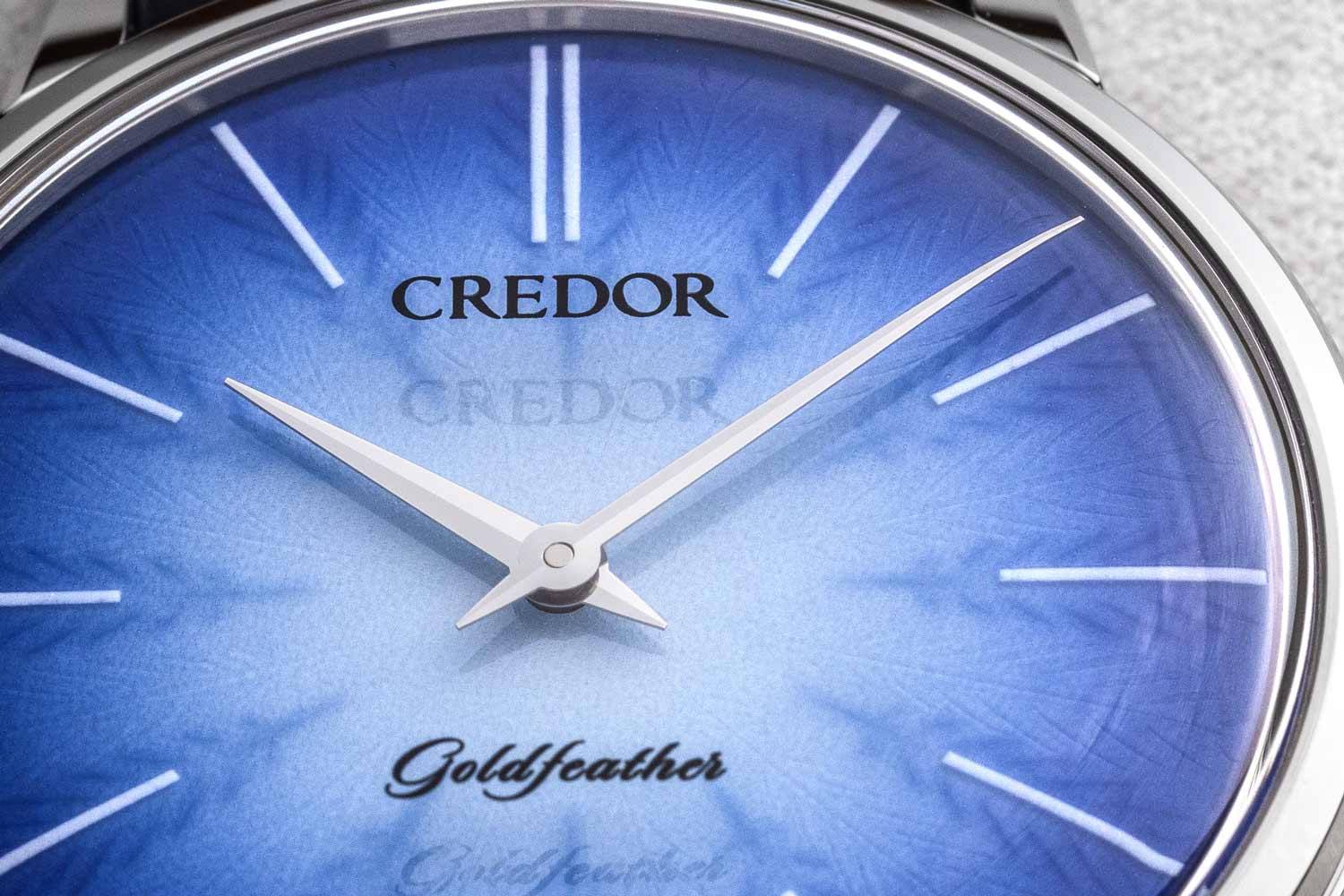
Floating logo (Image: Revolution ©)
An unusual turn to steel
Surveying Credor’s global lineup, one finds the Goldfeather family almost exclusively clad in precious metal, with platinum making up a significant proportion of the collection. This latest release therefore comes as a pleasant surprise: it is the first Goldfeather in stainless steel to be offered internationally. While steel variants do exist within the collection, they have historically been confined to the Japanese domestic market, remaining elusive to the rest of the world.
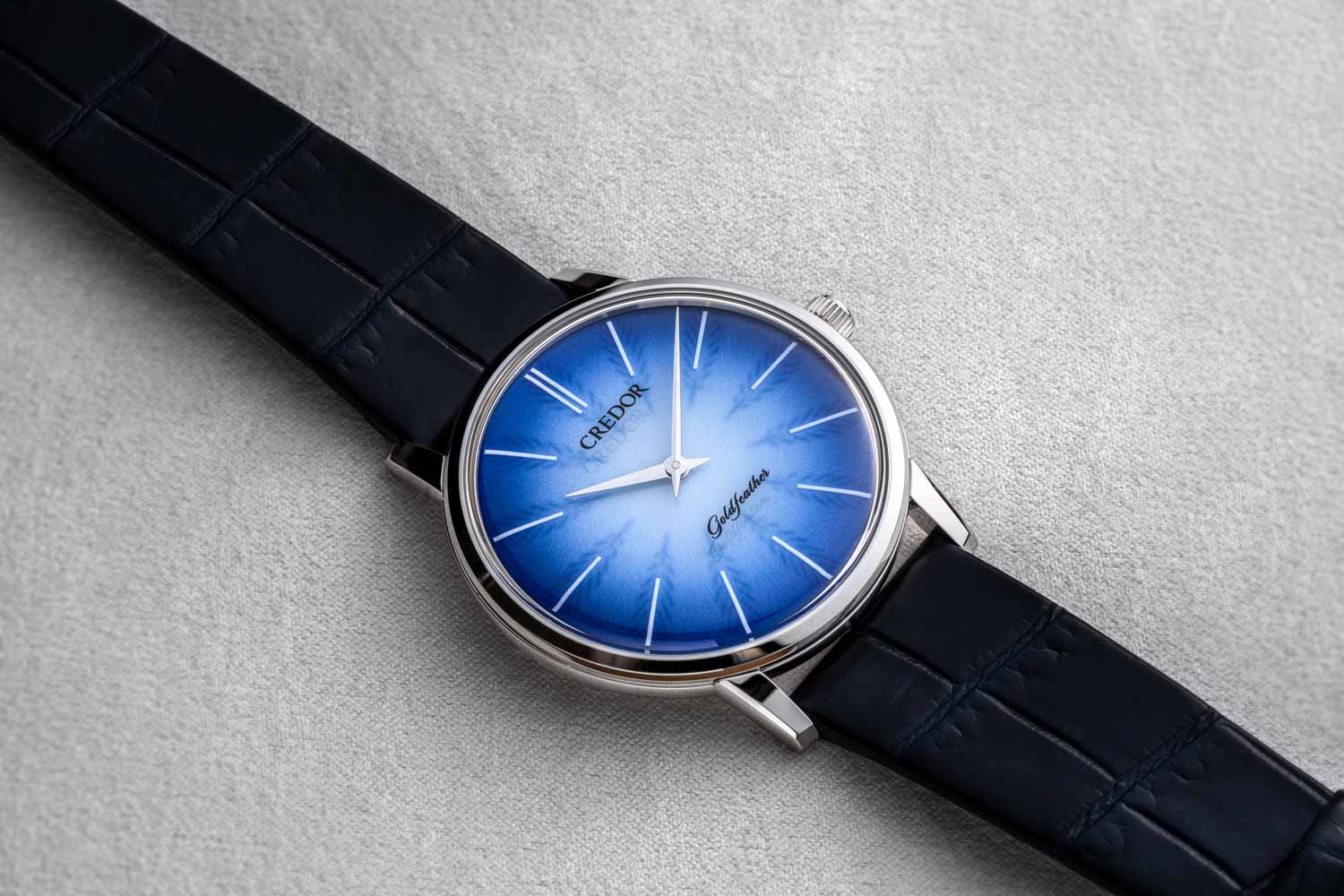
The blue dial and steel case make a handsome combination (Image: Revolution ©)
In keeping with its identity as a classical dress watch, the case dimensions remain restrained. At 37.1 mm in diameter, it strikes a harmonious balance between vintage character and contemporary presence. Perhaps more crucial is the slender 8.3 mm profile. For devotees of the Seiko family, this thinness is a defining characteristic that distinguishes Credor from the often bulkier proportions of Grand Seiko. Even the recent Evolution 9 SLGW007, despite its latest-generation thin movement, measures nearly 10 mm thick, underscoring Credor’s preference for a more delicate wrist presence.
Despite the thinness of the case, the architecture remains unmistakably Japanese, defined by a narrow bezel that gives it an elegant outline. Subtle complexity emerges in the lugs, which are finely faceted despite their slender form. The polished beveling is particularly attractive, giving the otherwise simple case a surprising degree of definition. It is the kind of detail that invites closer inspection, revealing itself gradually rather than all at once.
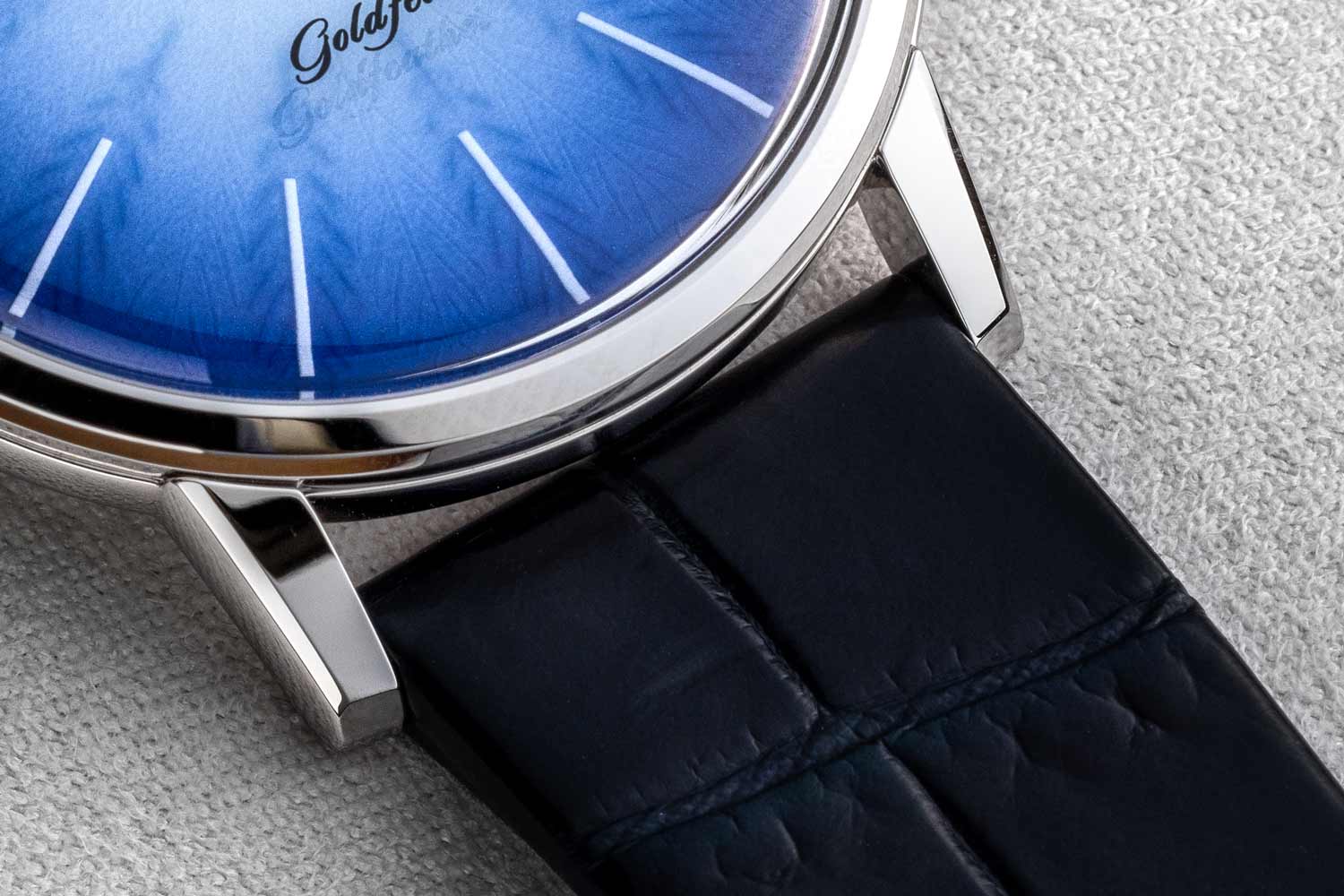
Distinctive lugs in classic Seiko style (Image: Revolution ©)
Manual-wind movement
One of the biggest reasons the Goldfeather is so thin is the old-school movement within. The Cal. 6890 is a long-standing manual-winding movement introduced by Credor in the late 2000s, but it is actually based on something much older: the Seiko Cal. 68 from the 1960s.
That historical lineage also explains why the Cal. 6890 has several old-school traits that are seldom found in modern watches. For one, the movement comprises multiple plates. Then there is the relatively slow beat rate of 21,600 vibrations per hour (3 Hz), along with a relatively short power reserve of just 37 hours. There are ups and downs to this construction, but nevertheless, it is a tried-and-tested movement that does its job of keeping the case thin.
If you look closely, the movement is relatively small, even within a 37mm case. Credor has cleverly used a two-layer caseback construction, along with a domed tube around the crown, to break up the broad expanse of metal surrounding the movement. This prevents the caseback from appearing like one large block of metal, which would otherwise make the movement look even smaller.
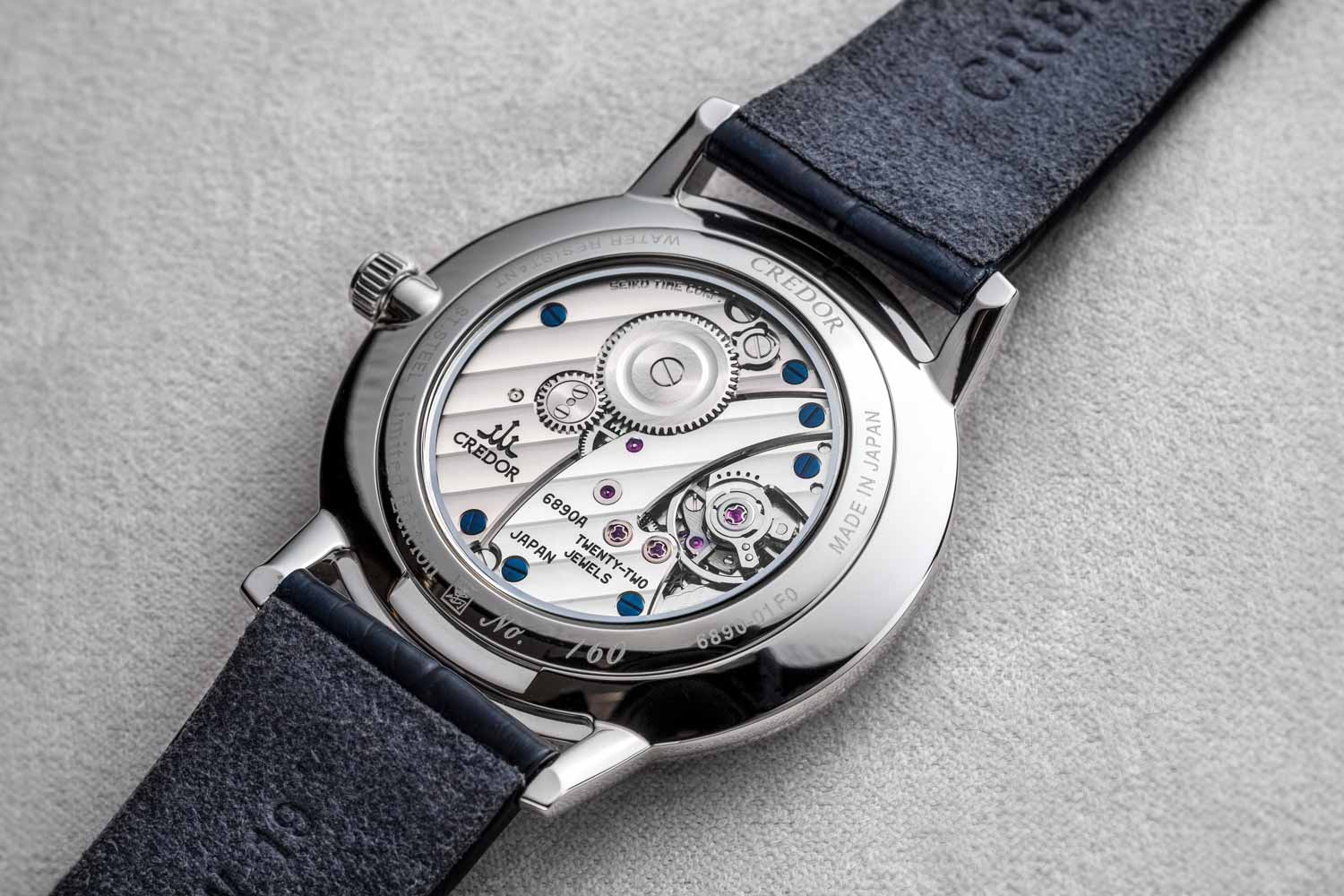
The manual-winding cal. 6890 (Image: Revolution ©)
In terms of decoration, Credor does offer a largely machine-finished movement at this price point. The good news is that the finishing is thorough, and nothing looks jarringly cheap. There are no obvious pitfalls. The plates are finished with stripes that are quite cold and machine-like, as is the beveling along the edges of the bridges. At least they are clean, and this is also the common standard across many Swiss brands at this price range and even further up.
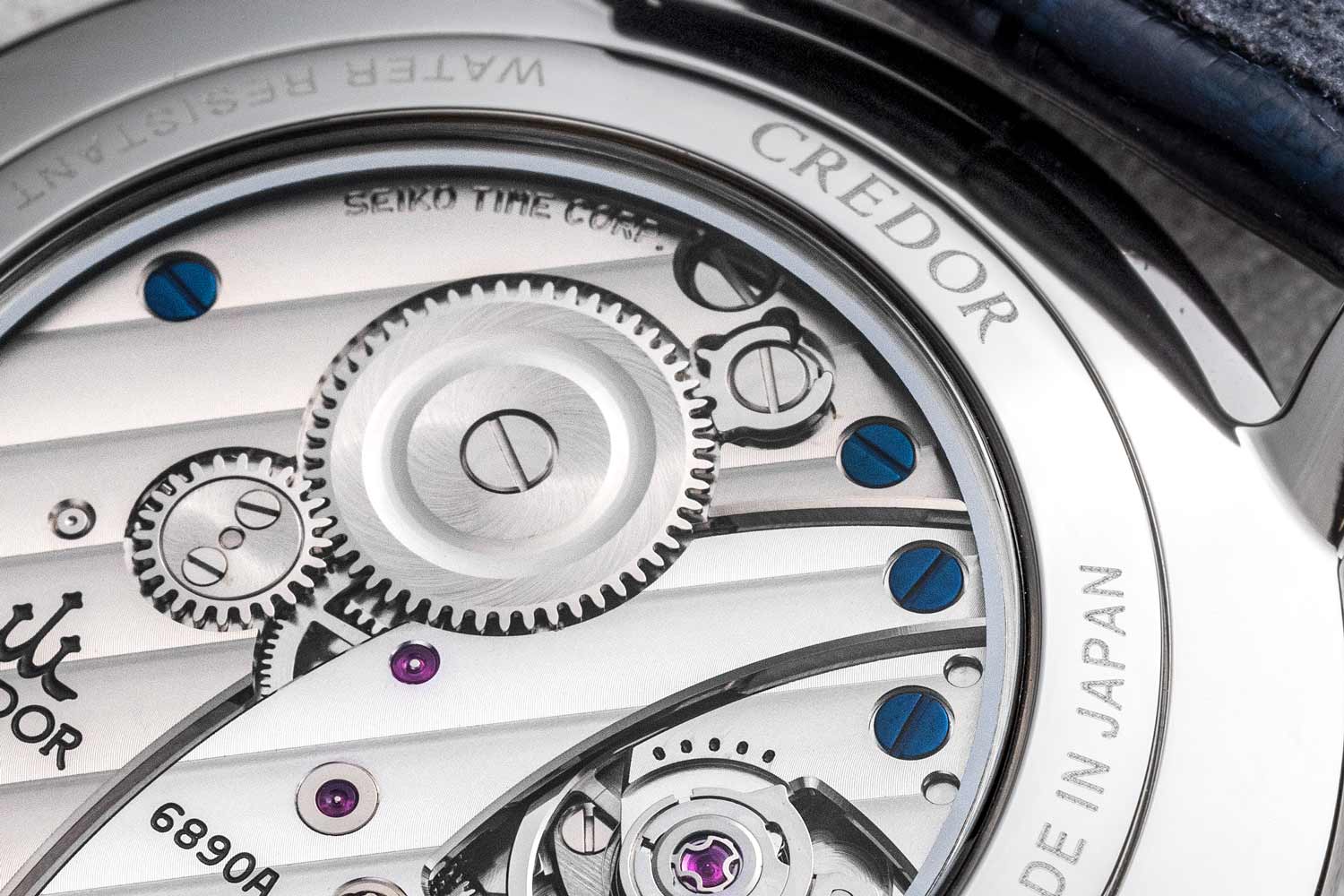
Nicely finished barrel cover (Image: Revolution ©)
There are, however, a few interesting highlights. One is the spiral brushing on the barrel cover, which becomes more interesting here because a groove divides the cover into two portions, yet the spiral pattern remains continuous across both surfaces. Then there are the blued screws.
Finally, one detail that is both interesting and useful is the double shock-protection cap on both the escape-wheel and fourth-wheel jewels. It adds a bit of colour while also helping to protect the accuracy of the relatively thin, smallish movement. This is a trait commonly found in Credor watches, even in its top-of-the-line Eichi, so it is quite cool to see it here on the Goldfeather as well.
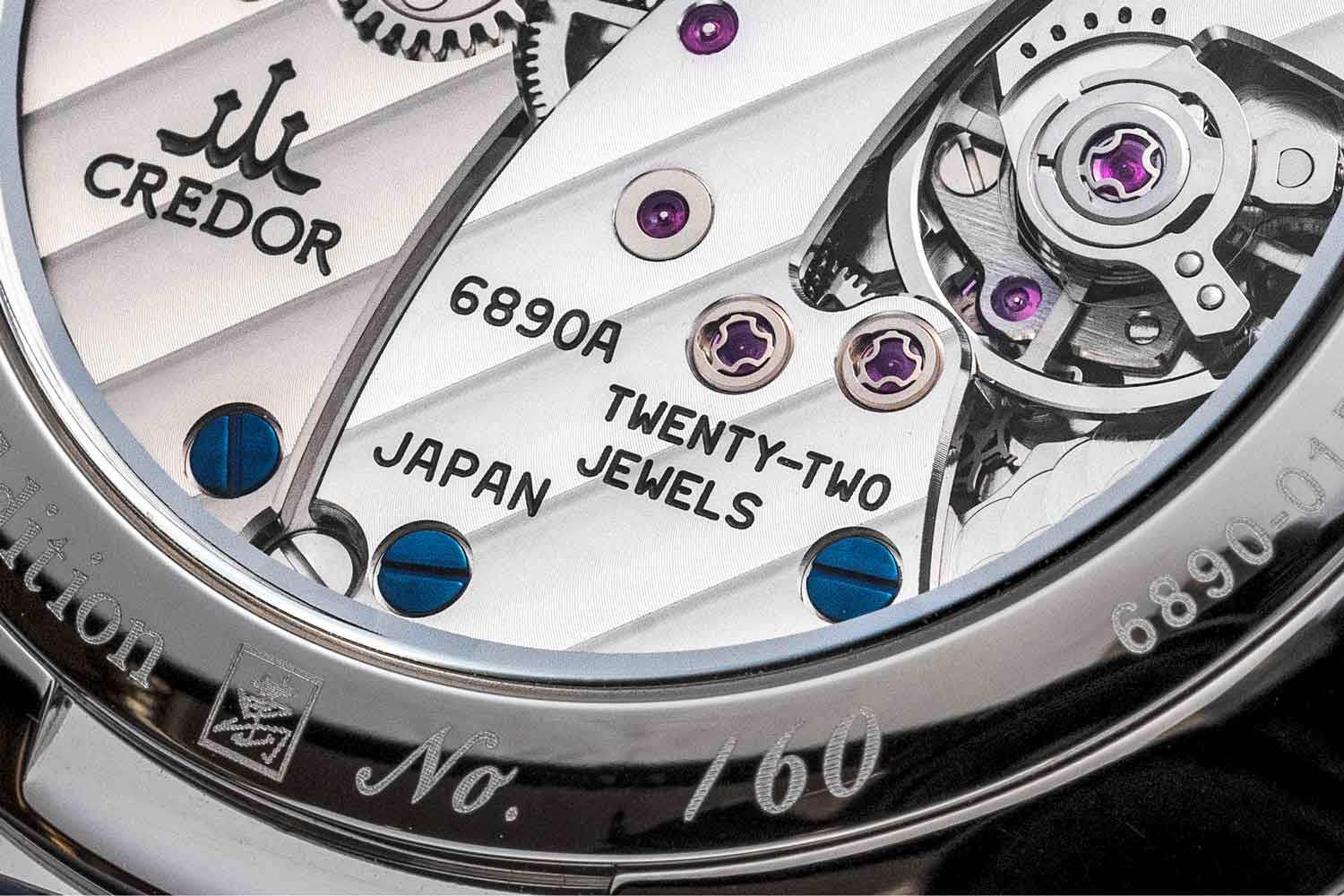
Extra shock protection (Image: Revolution ©)
It is also worth mentioning that the steel and precious-metal Goldfeather models receive roughly the same level of movement finishing. That makes the steel model particularly good value in comparison.
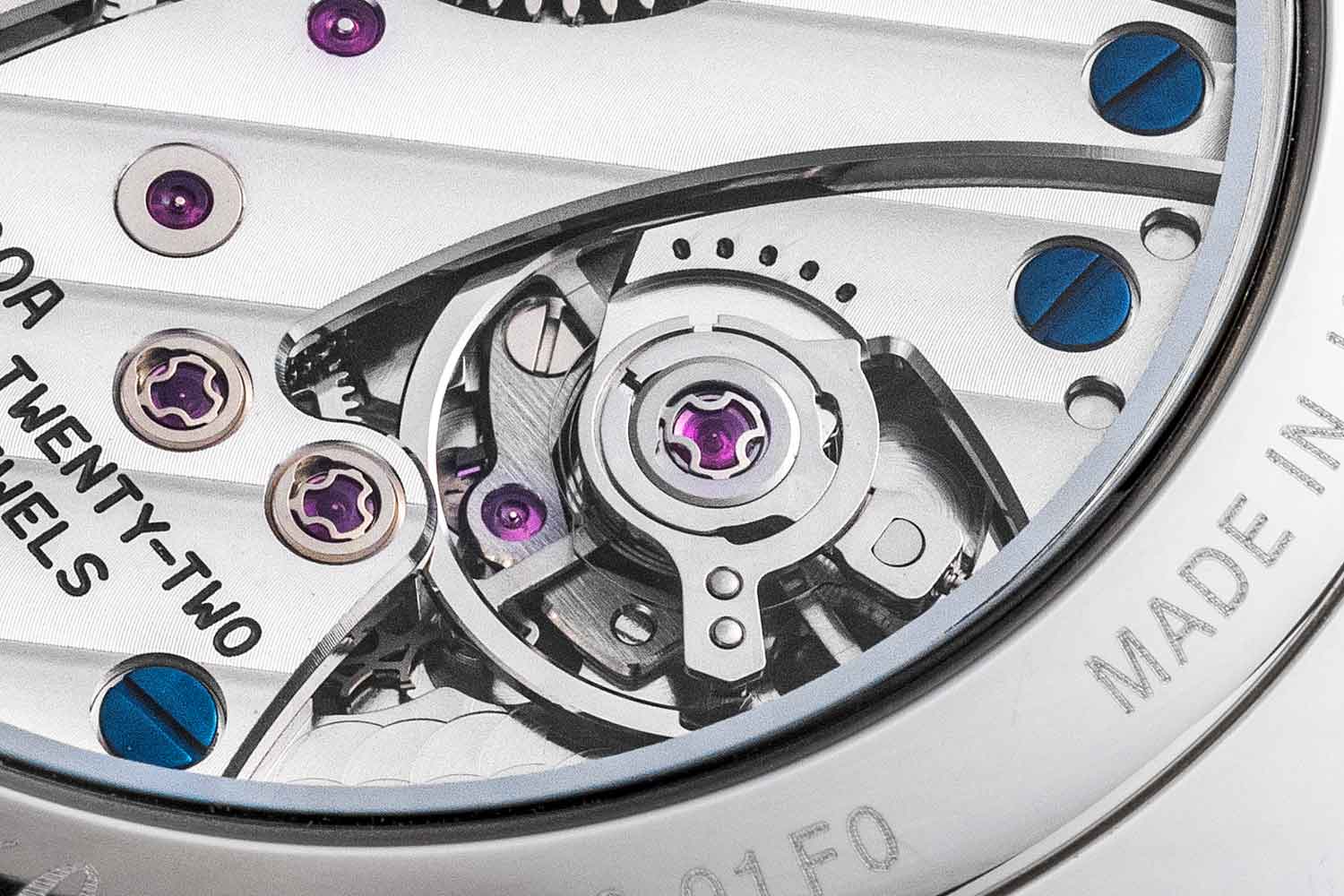
Old-school regulator index, but not the typical Etachron. This one is slightly more refined (Image: Revolution ©)
Concluding thoughts
The Credor Goldfeather is a nice classical package that blends elements from yesteryear with those of modern watchmaking. On one hand, there is the smallish case and short power reserve; on the other, a solid construction and an elaborate dial. Together, they make for an unusual proposition in the world of modern watchmaking, and one that will certainly attract its fans. I count myself among them.
The Goldfeather’s position is therefore quite clear. It offers something distinctly different from what Grand Seiko has on offer, filling a niche for very thin, high-quality daily dress watches. And for those who follow Grand Seiko closely and love what the brand does, it is good to see Credor offering something different, with its own distinct character and approach.
Tech Specs: Credor Goldfeather Imari Nabeshima Porcelain Dial
Reference: GCBY991
Movement: Cal. 6890; manual wind; 37 hours power reserve; 21,600 beats per hour (3 Hz)
Functions: Hours and minutes
Case: 37.1 mm x 8.3 mm; stainless steel; water resistant to 30 m
Strap: Leather strap with folding buckle
Availability: At Credor boutiques and retailers
Limited edition: 60 pieces
Price: €15,000
Credor
You may also like
News
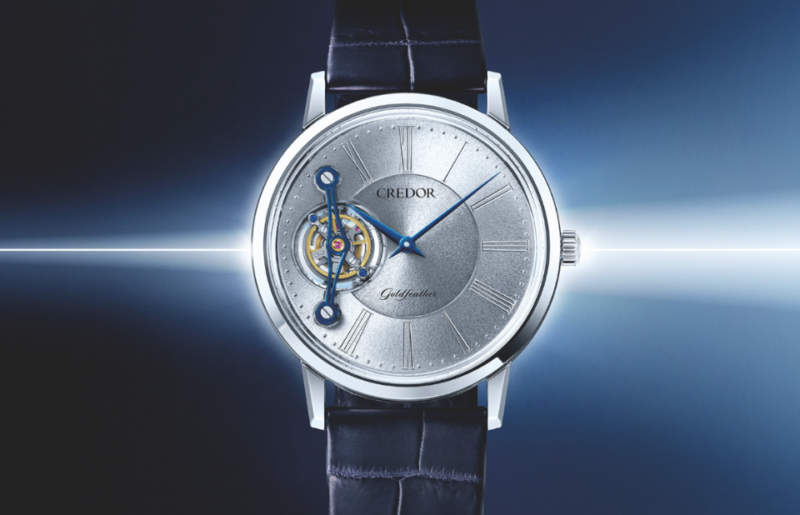
Credor at Watches & Wonders 2026: Goldfeather Porcelain, Urushi, and Hand-Engraved Tourbillon
Apr 14, 2026
News
Credor at Watches & Wonders 2026: Goldfeather Porcelain, Urushi, and Hand-Engraved Tourbillon
Apr 14, 2026
Interviews
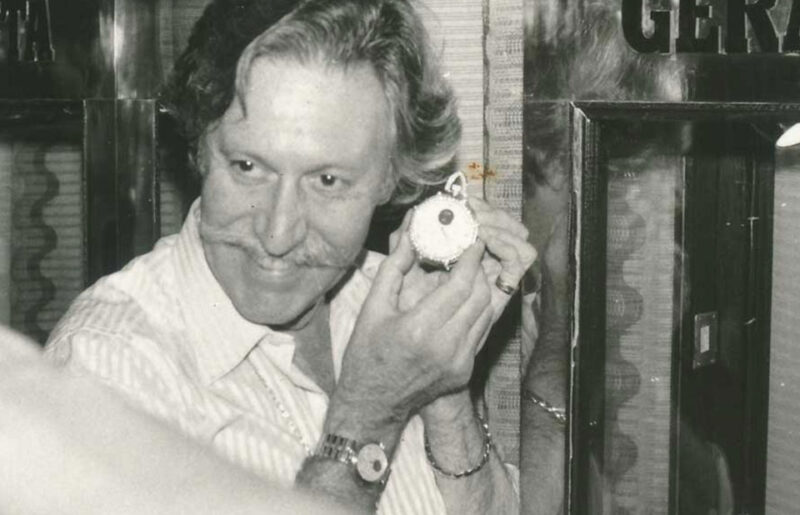
The Enduring Legacy Of Gérald Genta And The Ingenuity Behind His Credor Locomotive, As Told By Evelyne Genta
Sep 11, 2025
Interviews
The Enduring Legacy Of Gérald Genta And The Ingenuity Behind His Credor Locomotive, As Told By Evelyne Genta
Sep 11, 2025

News
The New Credor Locomotive Is A Bold, Permanent Addition To Credor’s Lineup
Feb 6, 2025
News
The New Credor Locomotive Is A Bold, Permanent Addition To Credor’s Lineup
Feb 6, 2025