

A Closer Look: Vacheron Constantin Les Cabinotiers Le Temps Divin ‘Ode to the Four Guardians’
Reviews
A Closer Look: Vacheron Constantin Les Cabinotiers Le Temps Divin ‘Ode to the Four Guardians’

With a hyper-interconnected world thanks to the internet, it has become harder to stand out with mass-produced timepieces. What better option than watches that simply defy replication on large scale? That’s where métiers d’art pieces come in.
Interestingly, the métiers d’art scene has grown fiercely competitive as well, with more entries in guilloché and enamel dials than ever before. But there’s still something exceedingly rare, though relatively new, and that is miniature marquetry. This decorative technique, introduced to watchmaking less than two decades ago, remains the domain of a handful of independent marqueteurs.
For the latest Les Cabinotiers collection, Vacheron Constantin highlights the art of marquetry in a quartet of complicated, unique pieces: Azure Dragon, Vermilion Bird, White Tiger, and Black Tortoise. This exceptionally rare craft takes centerstage in the collection, along with its intriguing backstory, but more on that later.
We take a closer look at two of the standout pieces, the Dragon and Tiger, for a deeper appreciation of the marquetry craft.

Ode to the Four Guardians
The Les Cabinotiers Le Temps Divin draws from Chinese cosmology, specifically the Four Symbols (Sì Xiàng): the Azure Dragon, Vermilion Bird, White Tiger, and Black Tortoise. These mythological creatures embody the cardinal directions, seasons, and elements, offering a less conventional narrative framework for the collection.
Even though these are Chinese symbols, the painting – both in composition and color – does not strictly follow Chinese traditions. Instead, it blends Western and Japanese influences. It’s common for watch brands to draw inspiration from past art when creating a métiers d’art dial, with the most frequent approach being the reproduction of famous paintings. It’s less common to see an original composition or interpretation of an old idea, and this is what makes the Les Cabinotiers Le Temps Divin different.
The Art of Marquetry
That said, the theme of the watch is secondary to the real star: the wood marquetry dials, each taking a couple of weeks to create.
So, how is the wooden puzzle fixed to the dial? The artisans start by designing the motif, scaled up to four times the size of the dial on paper. This painting is then digitally reduced to the exact size of the dial and printed in as many copies as there are wooden parts.

Image by Vacheron Constantin
These printed papers are attached to wooden pieces – either in natural colors or dyed – commonly referred to as veneers. The veneers are then cut using a saw. At Vacheron Constantin, artisans choose the more traditional manual sawing method, which involves pedal operation.

Image by Vacheron Constantin
With the tiny pieces sawed out, they are carefully assembled onto the dial. Each dial includes over 200 pieces, making it clear why the process takes weeks. Once the pieces are assembled, the dial is sanded flat and coated with varnish to ensure durability.

Image by Vacheron Constantin

Image by Vacheron Constantin
Vacheron Constantin’s take stands out because it genuinely aims to recreate a real image or painting, rather than relying on repetitive geometric motifs. The composition of the images is quite well done, though not without inspiration – they are based on murals from the Kitora burial mound in Japan, a tomb built over 1,300 years ago.
Creating a painting with marquetry is undoubtedly more challenging than crafting a modern, pixelated design. This approach requires intricate curvatures and complex geometry in the sawn pieces. Vacheron Constantin managed this impressively, particularly with the Dragon watch. The nuanced form of the dragon’s body and the delicate scales show meticulous attention to detail.
What truly excels in terms of execution is the clever use of wood grain to enhance the artwork. In some marquetry dials, the grain can become a distraction, creating unwanted strokes that detract from the design. Here, however, the direction of the wood grain is carefully curated and fixed to the dial, replicating the effect of brushstrokes.

For instance, on the Dragon watch, the background grain conveys the impression of flowing air or water, adding a sense of dynamism to the dragon. The Tiger watch brings this out even more – the wood grain is arranged to resemble fur in the correct direction. This thoughtful coordination is no easy feat. It’s not just about precise cutting; it requires selecting and aligning each tiny piece of wood so the grain connects seamlessly to form complex, organic lines that aren’t naturally found in linear wood grain.

While the Le Temps Divin Japanese Culture watches presented as part of the Les Cabinotiers collection this year are time-only models, the Le Temps Divin Le Temps Divin Ode to the Four Guardians are equipped with the sophisticated automatic tourbillon caliber 2160 – one of the most of the most beautiful and unusual movements in VC’s catalogue today. There is no doubt immense appeal in a watch that combines technical watchmaking with highly technical métiers d‘Art where aesthetics are truly commensurate with its mechanics.

The Superb Automatic Tourbillon
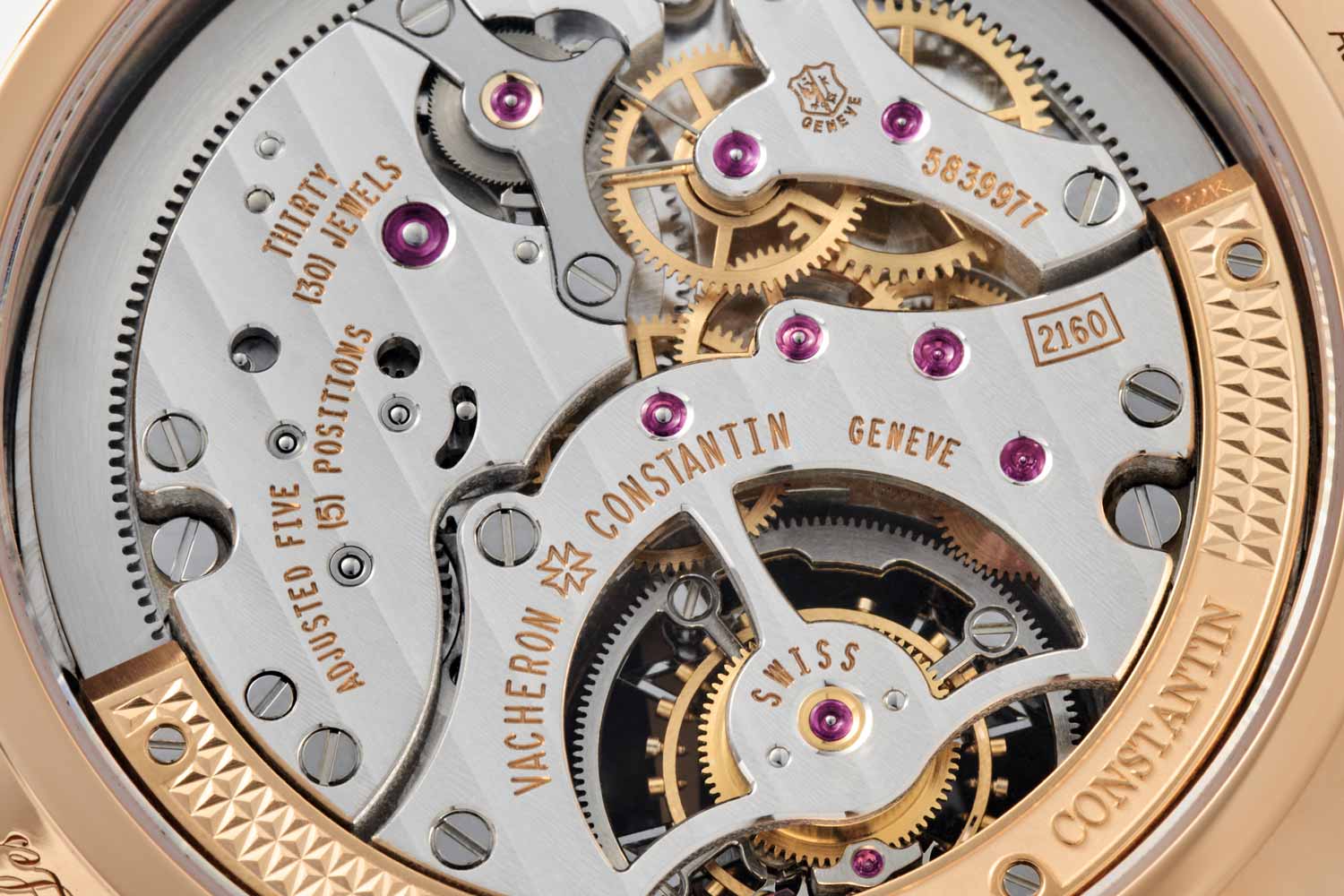
The movement within is actually quite a handsome piece. The caliber 2160 is a relatively new movement from Vacheron Constantin, introduced only seven years ago. It is an automatic movement with a traditional slow beat rate of 18,000 vibrations per hour, giving it a power reserve of over three days.
Turning the watch over will immediately capture attention just as the front does. The layout of the multiple bridges and plates is beautifully done, with graceful curves that evoke the movements of a bygone era.

Notably, it is equipped peripheral rotor automatic winding system, which remains relatively rare in modern watchmaking. This not only helps reduce the height of the movement but also allows for unimpeded view of the movement, giving it the appearance of a hand-wound piece but with the luxury of convenience. Additionally, the tourbillon cage is driven by a wheel on its periphery rather than a pinion beneath the cage. As a result, the watch is about 11.40 mm tall, offering a relatively slim profile, particularly when paired with its 42 mm diameter.
The finishing is beautifully executed, as expected from Vacheron Constantin, with a highlight being the polished steel bridges for the tourbillon and numerous interior angles on the Maltese cross logo that forms the cage itself. All the parts that should be decorated are, which is reflected in the fact that it carries the Poinçon de Genève seal. That said, for a unique piece like this, I would have expected the interior angles to receive a bit more attention. Currently, some angles lack sharp finishing and are instead soft and rounded.
Concluding thoughts
The latest Les Cabinotiers Le Temps Divin Ode to the Four Guardians is a quartet of unique pieces that stand out easily, even among artisanal timepieces. In fact, it is a clear demonstration of why timepieces can be such culturally fascinating objects worth collecting.
Simply replicating a case or dial from the past, no matter how attractive, lacks this cultural dimension. Only original creations – those that align with tradition while bringing something new – will be remembered over time as cultural milestones. Vacheron Constantin’s interpretation of the Divin Ode, especially with wood marquetry, which is a relatively new technique in dial-making, represents a thoughtful approach to watchmaking that gives timepieces deeper meaning.
Beyond its cultural value, the collection is also compelling both aesthetically and mechanically. It connects to the history of watchmaking, particularly in Geneva, while reviving the demanding and fading craft of wood marquetry to depict the mythological creatures of the Four Symbols from Chinese cosmology. One could hardly ask for more.

Tech Specs: Vacheron Constantin Les Cabinotiers Le Temps Divin
Movement: Cal. 2160; automatic; 80 hours power reserve
Functions: Hours, minutes, seconds, and tourbillon
Case: 42 mm x 11.4 mm; 18k pink or white gold; water resistant to 30 m
Strap: Brown alligator with folding clasp
Availability: Only at boutiques
Limited edition: Unique piece
Vacheron Constantin

You may also like

Reviews
Up Close: IWC Big Pilot’s Watch Perpetual Calendar ProSet Le Petit Prince
Sep 23, 2026
Reviews
Up Close: IWC Big Pilot’s Watch Perpetual Calendar ProSet Le Petit Prince
Sep 23, 2026

Editorial
A Closer Look: Rolex Perpetual Padellone
Sep 22, 2026
Editorial
A Closer Look: Rolex Perpetual Padellone
Sep 22, 2026

Reviews
A Closer Look: Parmigiani Tonda PF Chronographe Mystérieux
Jul 14, 2026
Reviews
A Closer Look: Parmigiani Tonda PF Chronographe Mystérieux
Jul 14, 2026