A Closer Look: A. Lange & Söhne Lange 1 Tourbillon Perpetual Calendar “Lumen”
Reviews
A Closer Look: A. Lange & Söhne Lange 1 Tourbillon Perpetual Calendar “Lumen”

The Lumen series from A. Lange & Söhne made its debut in 2010 with the Zeitwerk “Phantom”, and since then the company has returned to the concept every two or three years, usually in platinum or Honeygold. The Lange 1 Tourbillon Perpetual Calendar “Lumen” in platinum is the seventh edition in the series and, like the Datograph Perpetual Tourbillon Honeygold “Lumen” launched in 2024, it is limited to just 50 pieces – a notably smaller run than the earlier less complicated Lumen watches, which tended to come in at 200 pieces.
-
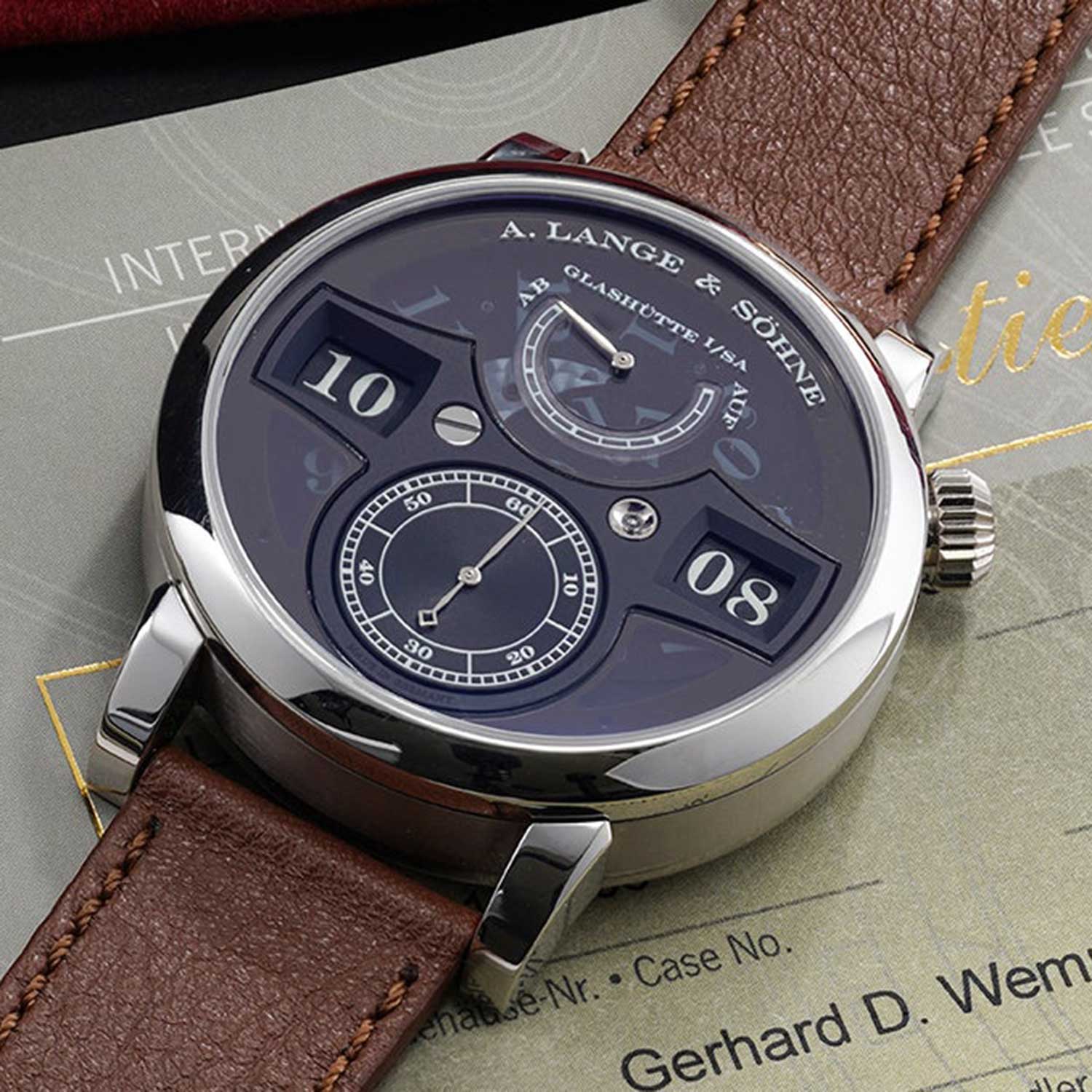
- 2010: The Zeitwerk “Luminous” ref. 140.035, better known among collectors as the Phantom (Image: Phillips)
-
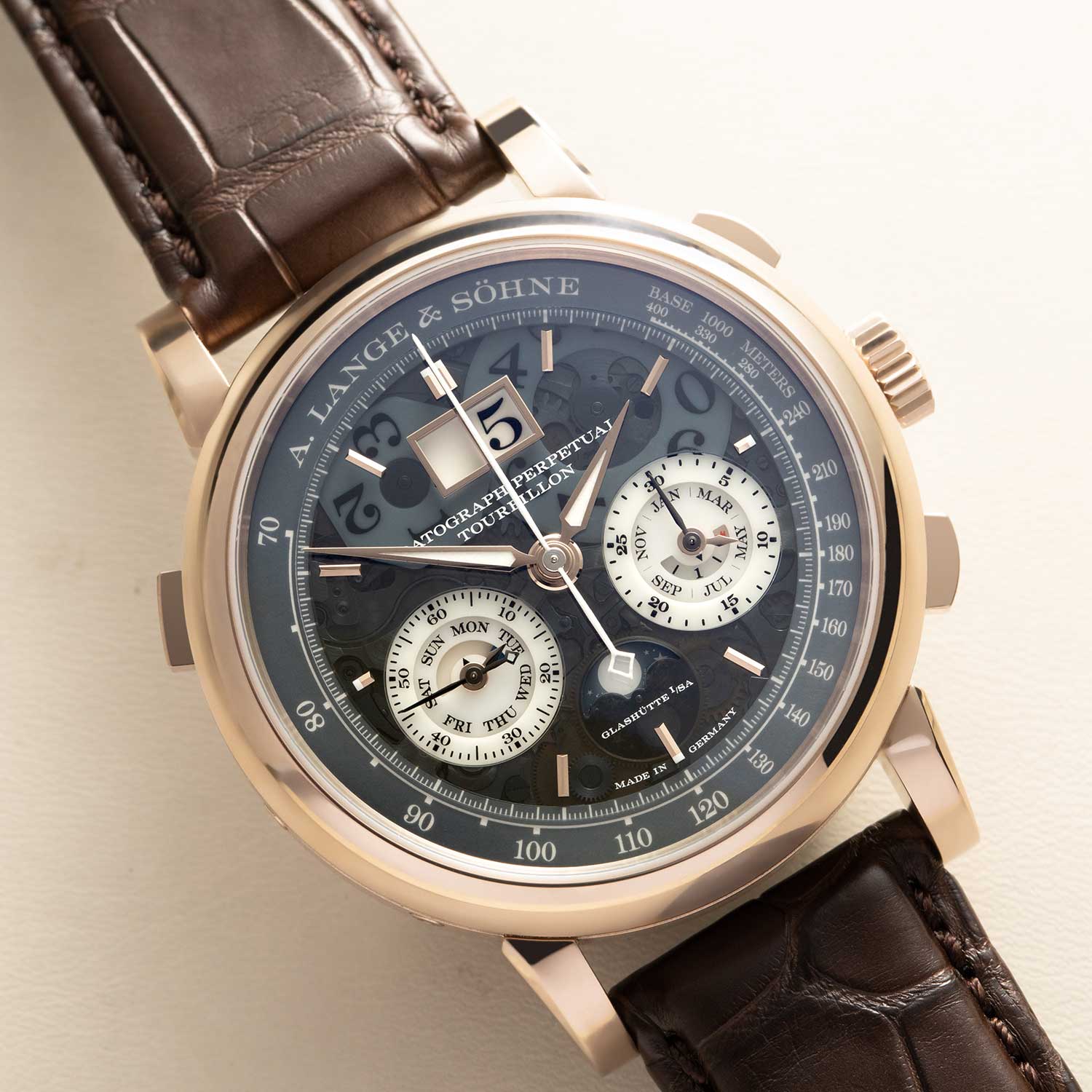
- 2024: A. Lange & Söhne Datograph Perpetual Tourbillon Honeygold “Lumen”
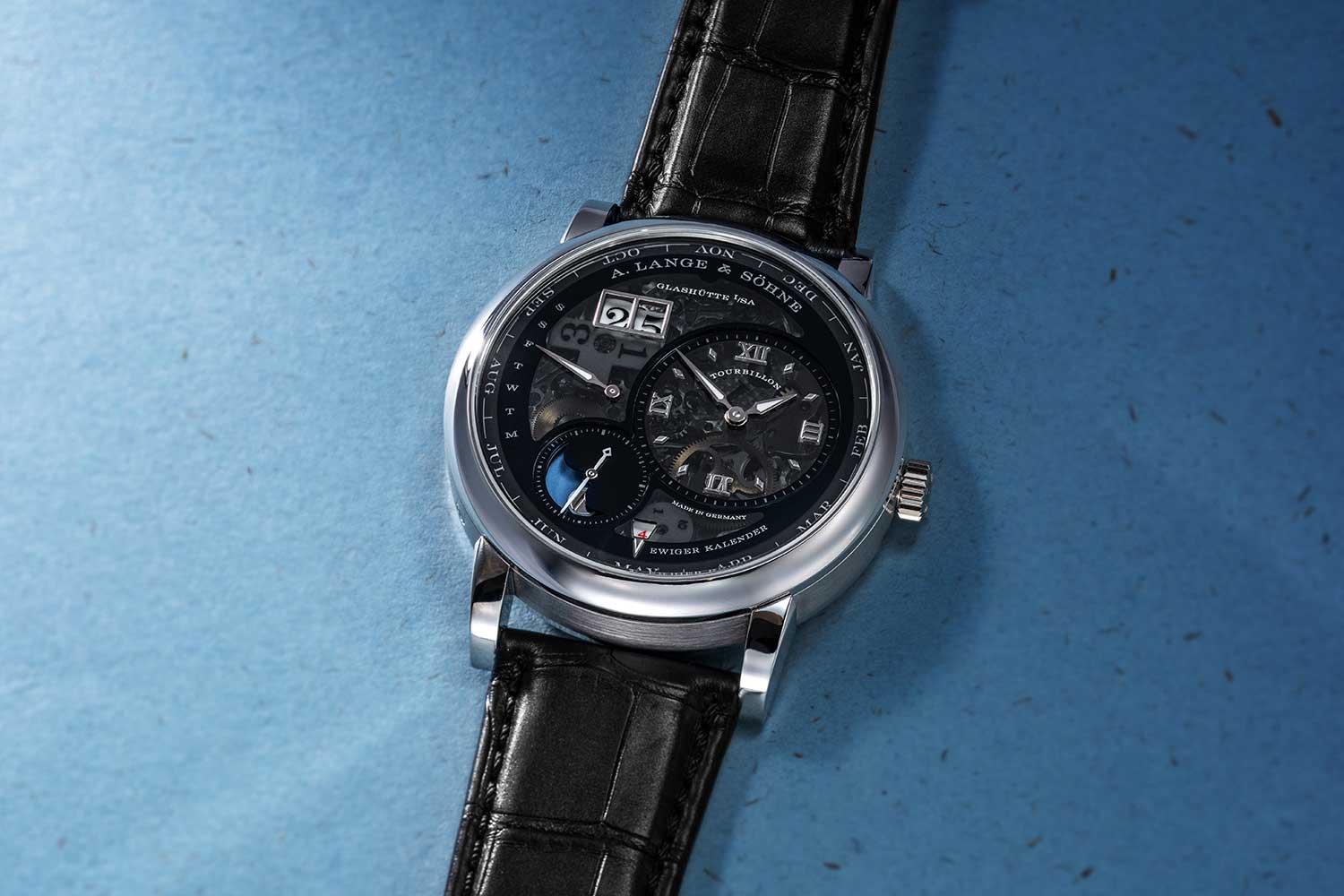
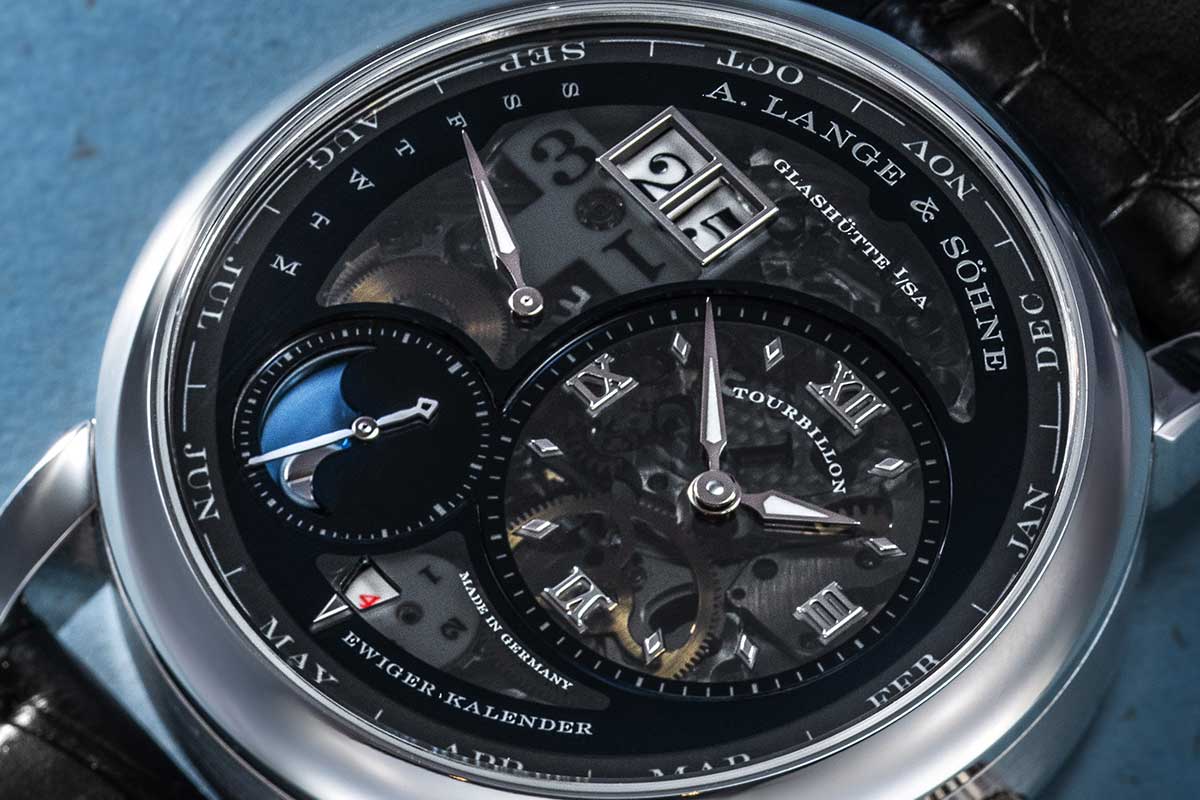
Lange 1 Tourbillon Perpetual Calendar “Lumen” (©Revolution)
While it is, to a degree, a predictable – and predictably expensive – launch, the sheer appeal of the watch to the eye or mind or in the hand is hard to deny. The Lumen series in general has a tendency to catch one off guard regardless how much time has passed and how much one has seen in that time. It takes an already solid, thoroughly engineered watch and shrouds it in a dark, smouldering dial that is somber and composed in daylight, very much in line with what one expects from Lange, only to erupt in a vivid, feral glow at night.
The Lange 1 Tourbillon Perpetual Calendar “Lumen” is one of perhaps two or three of the best Lumen watches simply because the effect works best with complex under-dial complications. With a dial crowded by indications, there is more to reveal once the light drops, and the transformation is correspondingly more dramatic. But at the same time, the underlying combination of complications in the watch is compelling in its own right – a tourbillon with stop seconds as well as an instantaneous perpetual calendar with a peripheral month ring, all within the iconic Lange 1 design. Additionally, it has an upgraded movement with a reworked going train, a luminous moon phase with an integrated day-night indicator and more striking decoration.
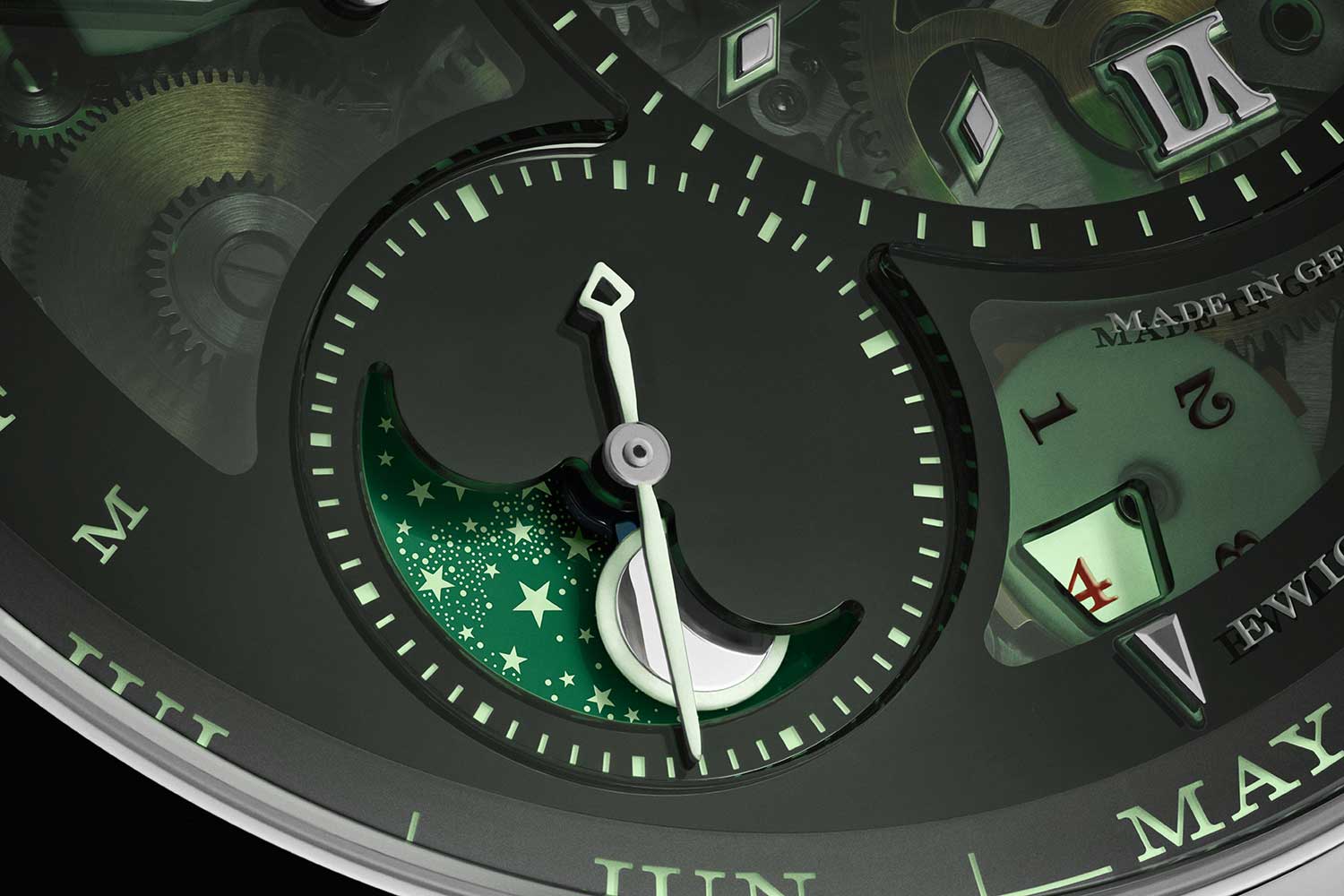
The luminous moon phase with an integrated day-night indicator
The question of price is unavoidable. At €520,000, it is priced exorbitantly, even by the standards of this rarefied segment of watchmaking. But despite both the figure and the broader climate, all 50 pieces have already been spoken for.
Nocturnal Radiance
The Lange 1 Tourbillon Perpetual Calendar “Lumen” measures 41.9mm in diameter and a height of 13mm, which is slightly thicker than the standard model at 12.2mm due to the new movement. Its proportions are very similar to the Datograph, and considering it combines automatic winding, with perpetual calendar, big date, an elaborate moon phase and a tourbillon, it is still quite reasonable. It has a satisfying heft and tactility typical of neither Lange nor platinum watches alone but of platinum Lange watches specifically, with a weight that feels indulgent even for its size.
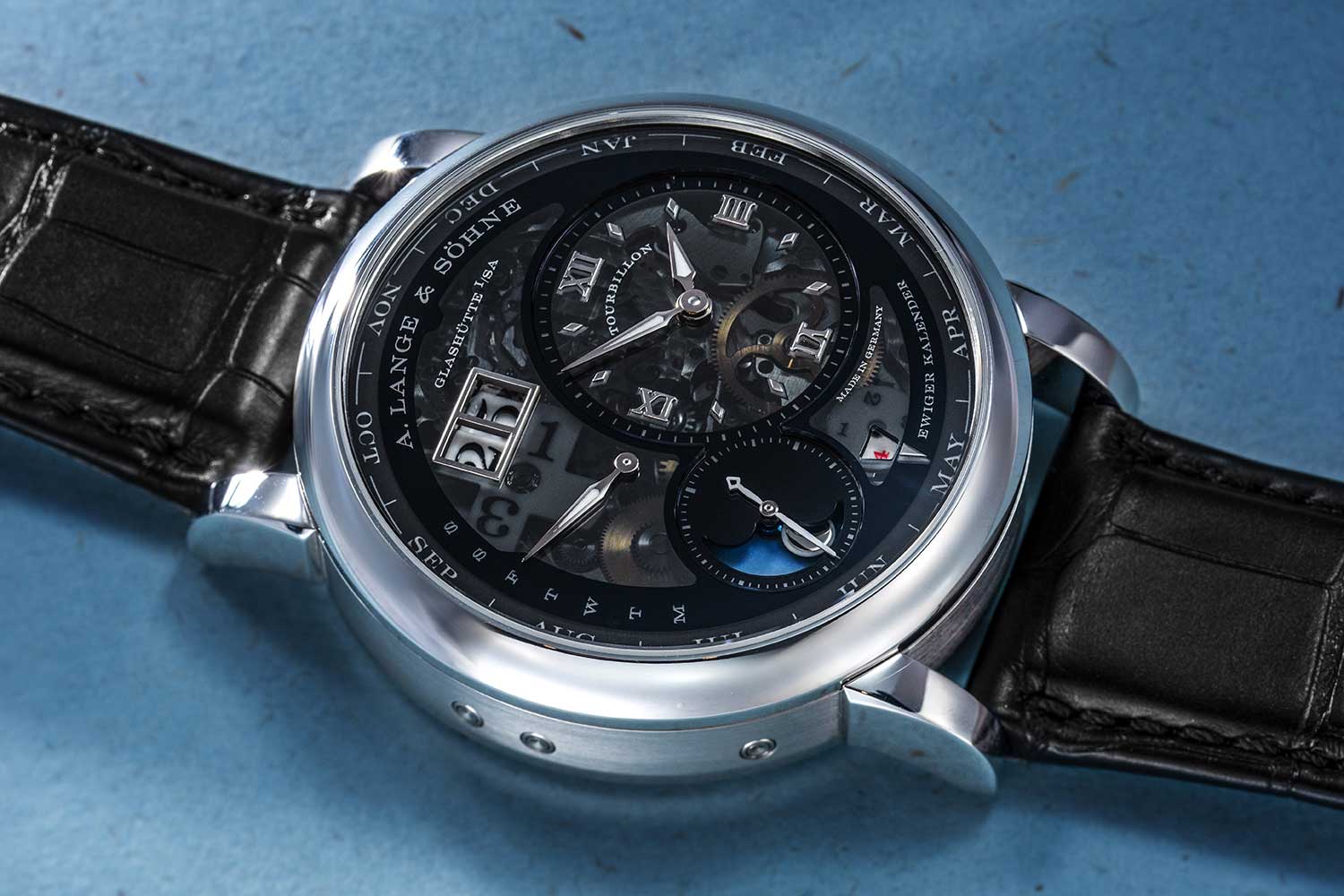
Lange 1 Tourbillon Perpetual Calendar “Lumen” (©Revolution)
The dial consists of two pieces of sapphire crystal – main dial and subdial – that are treated with a semi-transparent coating based on titanium oxide, engineered to favour the transmission of ultraviolet light while selectively attenuating the visible spectrum. To the eye, it appears as a dark, shadowy surface, yet it still allows a controlled amount of visible light to pass through.
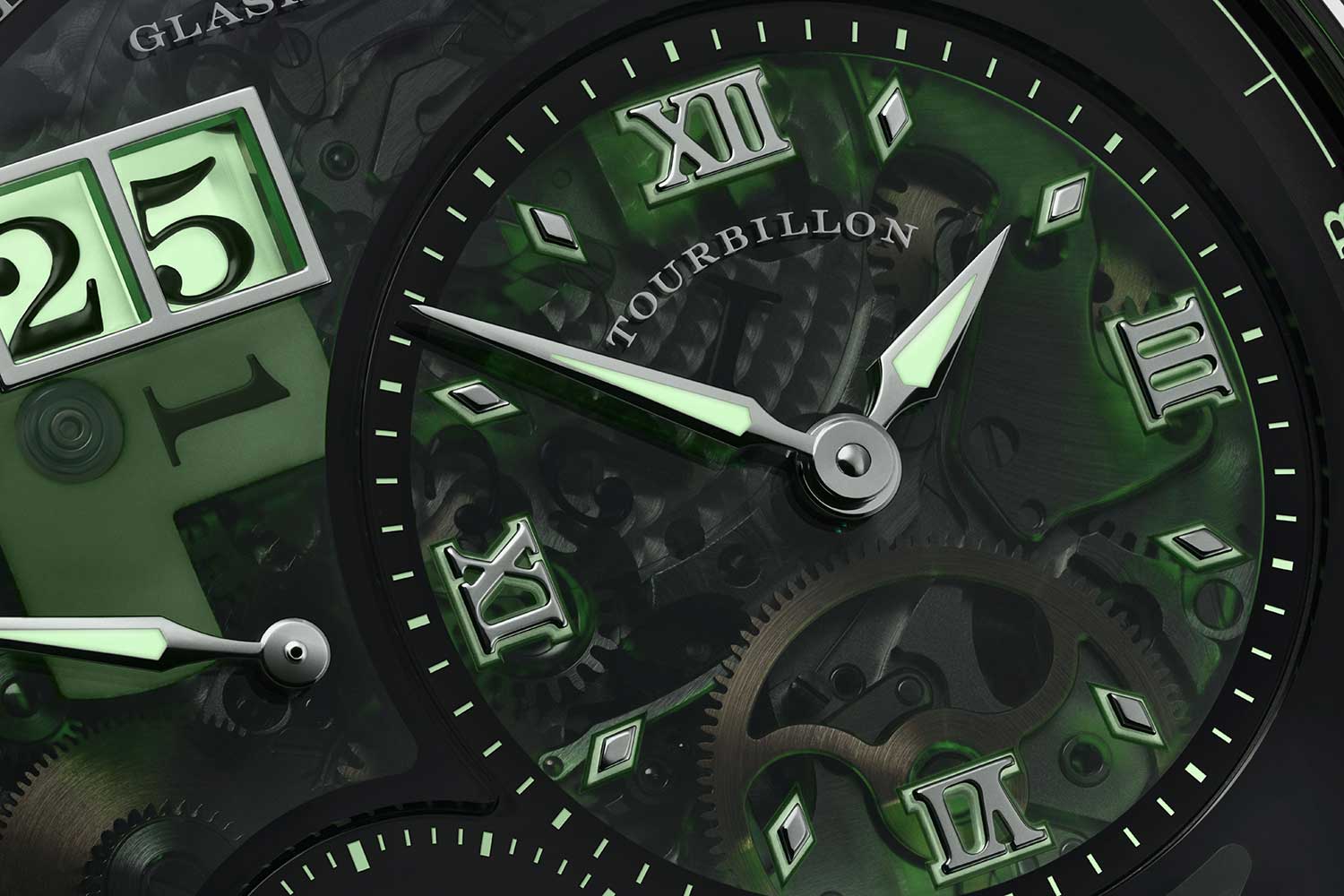
The dial consists of two pieces of sapphire crystal
It is different from conventional smoked sapphire in that the effect is not achieved by simply darkening the material to reduce overall light transmission. Instead, it relies on wavelength-selective filtering, which serves a dual purpose. Ultraviolet light passes through the dial with relatively little loss, which allows the luminous elements to be charged while the partial suppression of visible light prevents the dial from appearing washed out and maintains strong contrast for legibility. At the same time, enough visible transmission is retained to reveal the depth and parts of the movement, which gives the dial its characteristic layered, almost atmospheric quality in daylight.
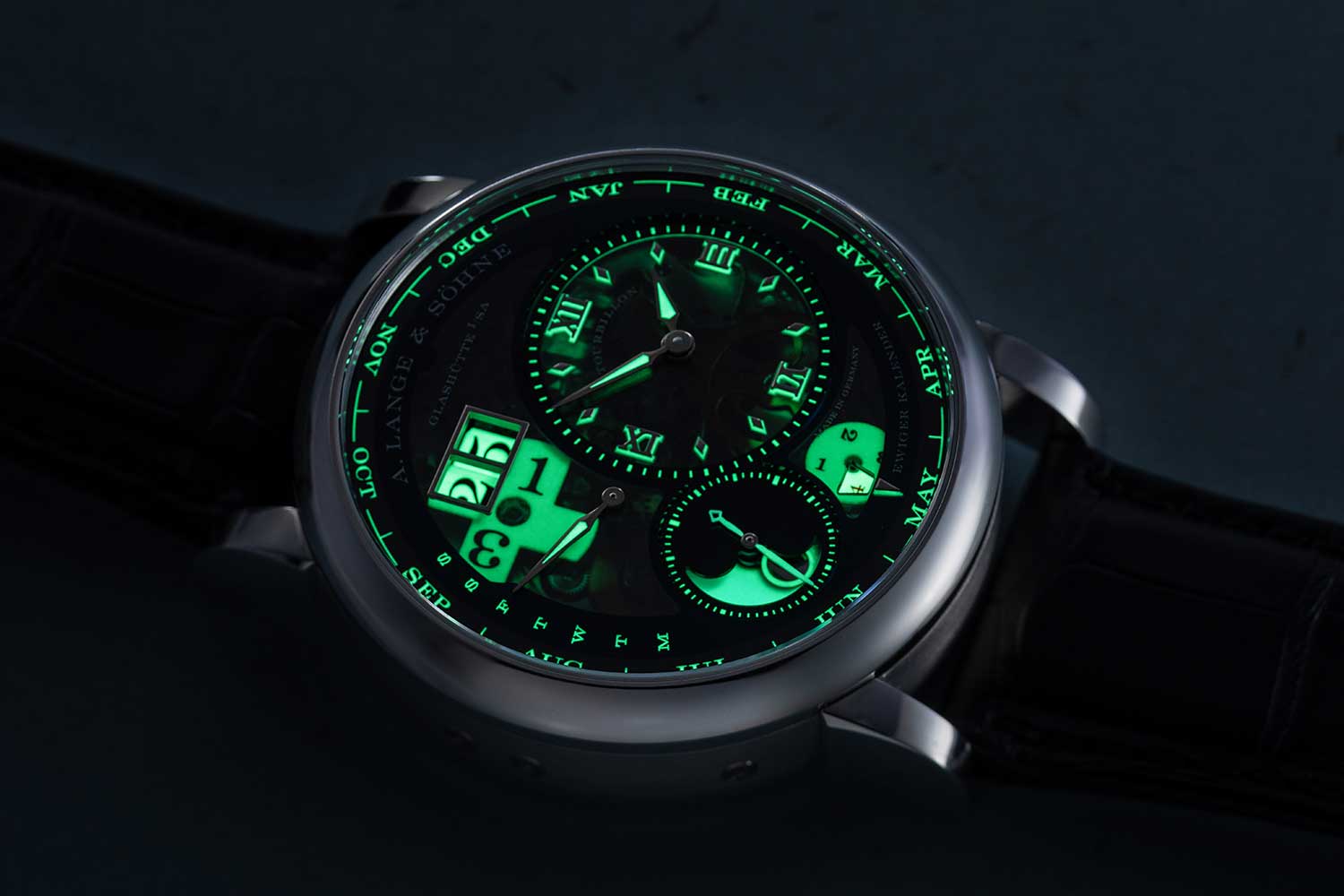
The Lange 1 Tourbillon Perpetual Calendar “Lumen” glows in the dark, with luminous calendar discs and moonphase revealing the full effect of its semi-transparent dial (©Revolution)
The application of luminous material across the dial is handled with the same level of thought and care. Various elements are lit from behind to preserve their unassuming form in daylight. The Roman numerals and markers on the subdial, for instance, are in solid gold, which provides legibility in daylight. However, each numeral and marker has a layer of luminous material beneath, effectively backlighting them. As a result, they look like conventional applied elements by day yet blaze in the dark.
The luminous moon phase display is also notable. The new Calibre L225.1 does away with a power reserve indicator, which was originally inside the subdial for the hours and minutes but it introduces an integrated day-night indication in the moon phase display, first seen in the Lange 1 Moon Phase. In place of a single disc with two fixed moons, as is convention, there is a carrier with circular ends, each fitted with a gold moon. The circular ends are coated with luminous material, which provides backlighting for the gold moons.
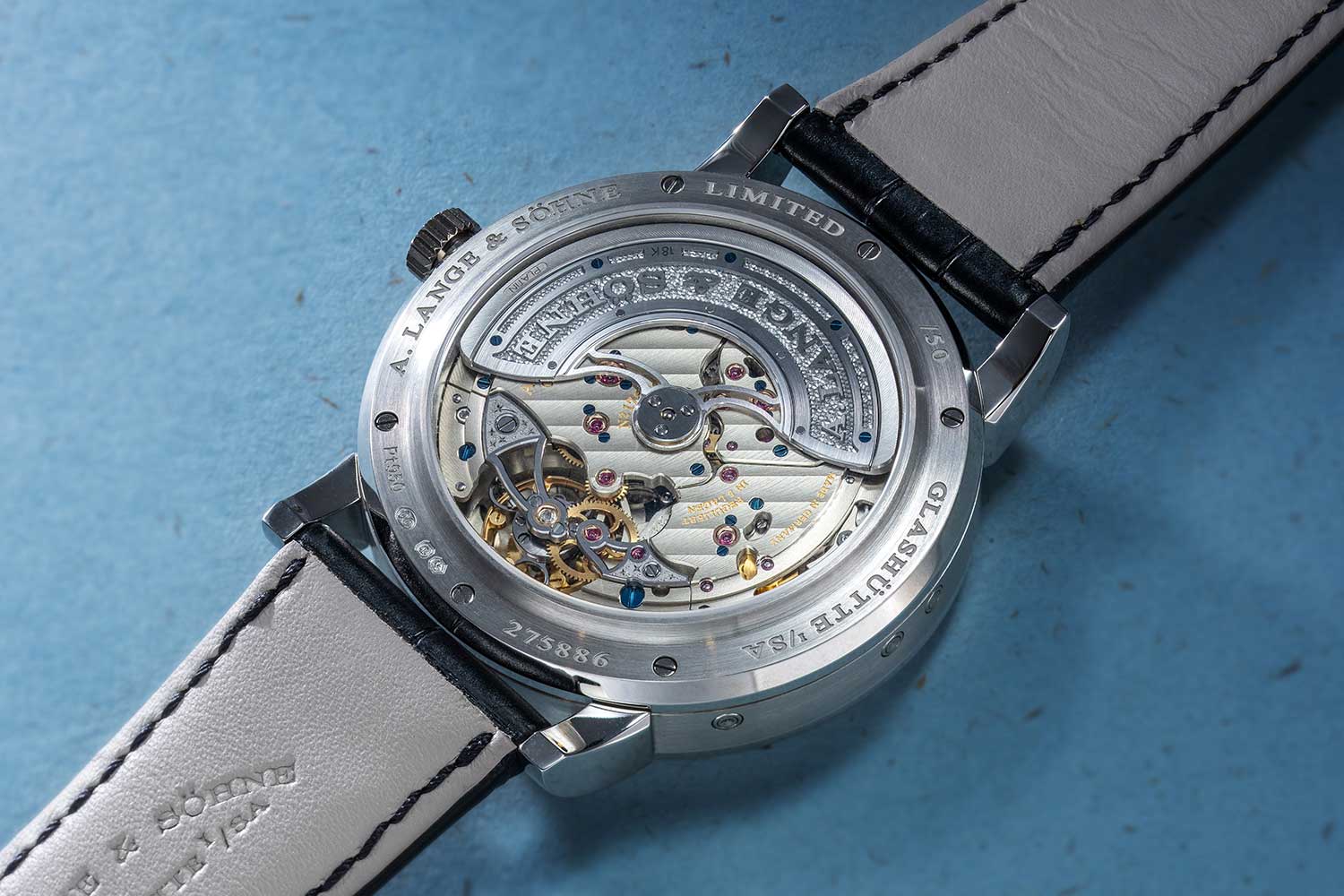
Lange 1 Tourbillon Perpetual Calendar “Lumen” (©Revolution)
This moon carrier sits above an independently rotating day-night disc that represents the sky. It is driven by the 24 hour wheel, with one half of the disc showing a starless sky for daytime, while the other is rendered as a field of luminous stars to indicate night. The disc itself is made of glass and carries a coating that forms the sky, with the star field created by selectively removing this coating. Beneath it lies a layer of luminous material, so that the stars appear as points of light, backlit from below, while the sky itself, thanks to the initial coating, glows in a darker shade of green.
All the perpetual calendar indications, including the retrograde hand as well as the leap-year and outsize date discs, are also treated with luminous material.
Instantaneous Perpetual Calendar with Peripheral Month Ring
The Lange 1 Tourbillon Perpetual Calendar is the most complicated Lange 1 model, and has its roots in the Lange 1 Daymatic. One of the most impressive aspects is how the calendar indications – day of the week, month and leap year as well as the moonphase – are absorbed into the familiar Lange 1 layout. The dial is effectively a mirror image of the original Lange 1, with the sector once used for the power reserve now given over to the day of the week, while the moon phase is integrated into the small seconds.
It is not an easy thing to do, as the Lange 1 was conceived around a very specific display, anchored by the outsize date and the asymmetrical relationship between the hours and minutes display and the sub-seconds. That architecture leaves very little freedom for additional indications, which have to be accommodated within it rather than imposed on top of it. The most ingenious aspect of the watch is the solution for displaying the month.
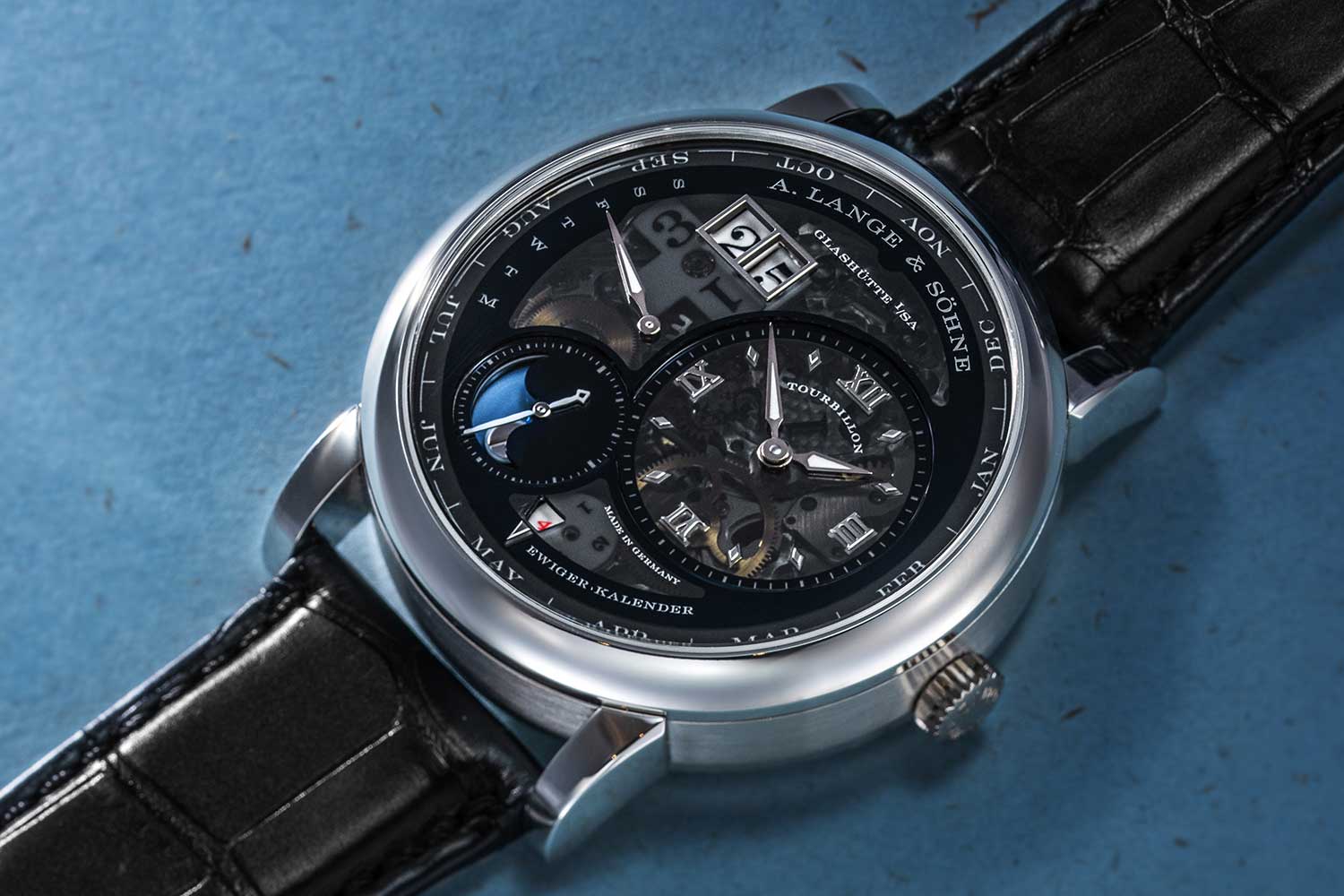
Lange 1 Tourbillon Perpetual Calendar “Lumen” (©Revolution)
Unlike all the other Lange perpetual calendar watches which rely on a traditional 48-month program wheel, the Lange 1 Tourbillon Perpetual Calendar uses a peripheral ring. It displays the month and, at the same time, serves as a 12-month program wheel, encoding the varying lengths of the months within a year.
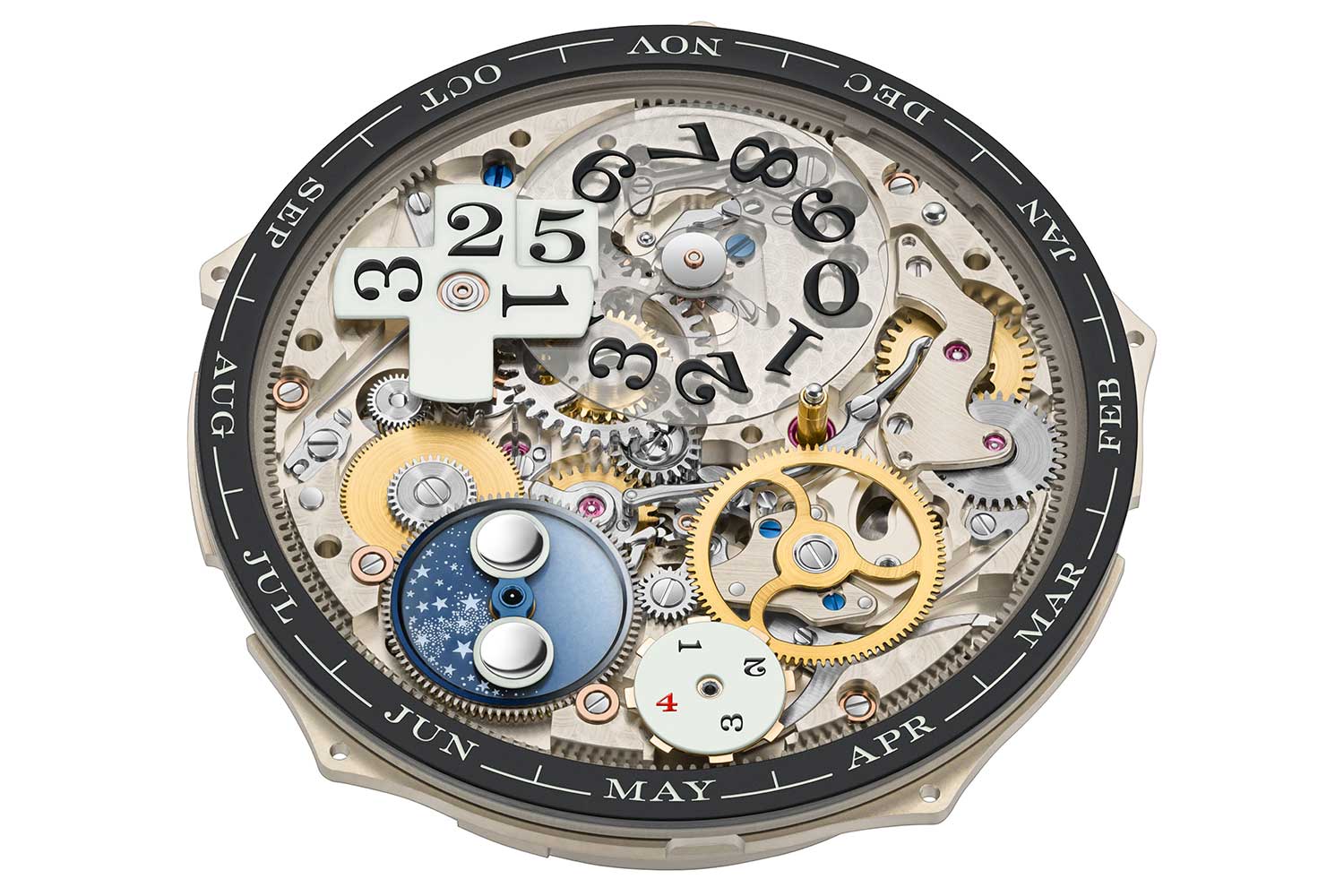
A rare dial-side view of the Lange 1 Tourbillon Perpetual Calendar “Lumen” reveals the intricate mechanics driving its oversized date and calendar displays
This ring is made up of two pieces held together by screws. The inner circumference of the lower wheel is cut with internal teeth, allowing it to be driven by a wheel from within, while the upper wheel has a continuous circumferential contour that forms the cam. The contour varies subtly around the ring, with distinct changes in radius corresponding to the months. Most of the year is characterised by gentle undulations, but at February the contour drops further inward, forming the deepest point of the track. A feeler on the grand lever bearing on this surface is displaced radially as the ring turns counterclockwise, travelling further for shorter months and shorter for longer months.
As this is a 12-month cam, it requires a separate leap year program wheel. Beneath the leap year disc is a cam with a single raised notch that alters the travel of the grand lever to account for leap year. In February, an extended arm of the grand lever contacts this cam which prevents the feeler from reaching the full depth of February in the month ring, thereby reducing its travel to account for the 29th. A small pointer at 6 o’clock indicates the current month with a leap year aperture above it.
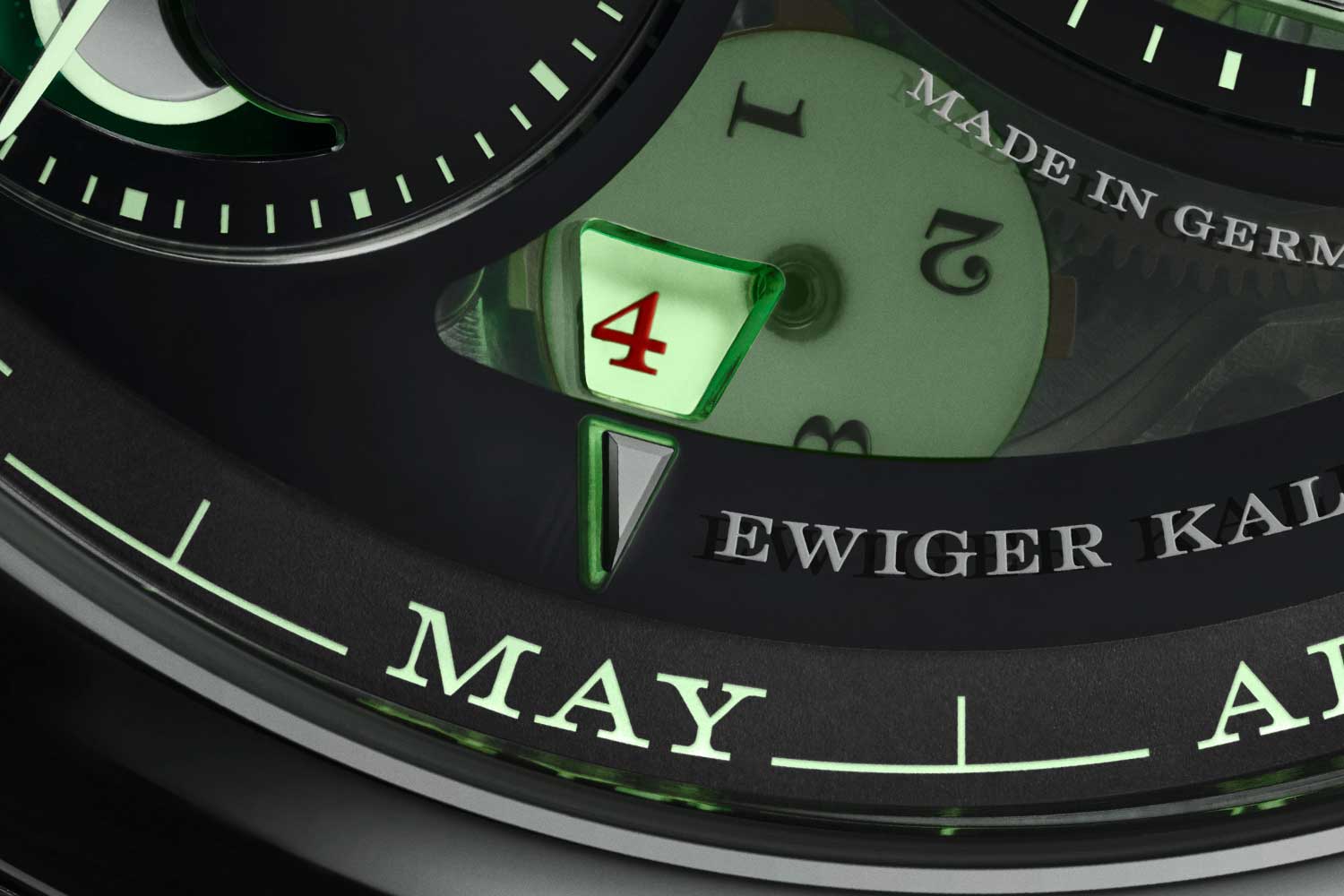
A small pointer at 6 o’clock indicates the current month with a leap year aperture above it
All calendar indications switch simultaneously and instantaneously at midnight. The energy required for this changeover is accumulated progressively over the course of the day by a pair of cams, levers and springs. One cam governs the date, day of the week and moon phase on a daily basis, while a second cam is dedicated to the month ring, which demands greater force due to its size and inertia. As the cams rotate, they gradually tension their respective springs until midnight, when the stored energy is released in a single impulse that drives all indications forward at once. While straightforward in principle, the execution is very demanding. The geometry of the cams and levers, the tension of the springs and the friction throughout the mechanism must all be calibrated with great precision.
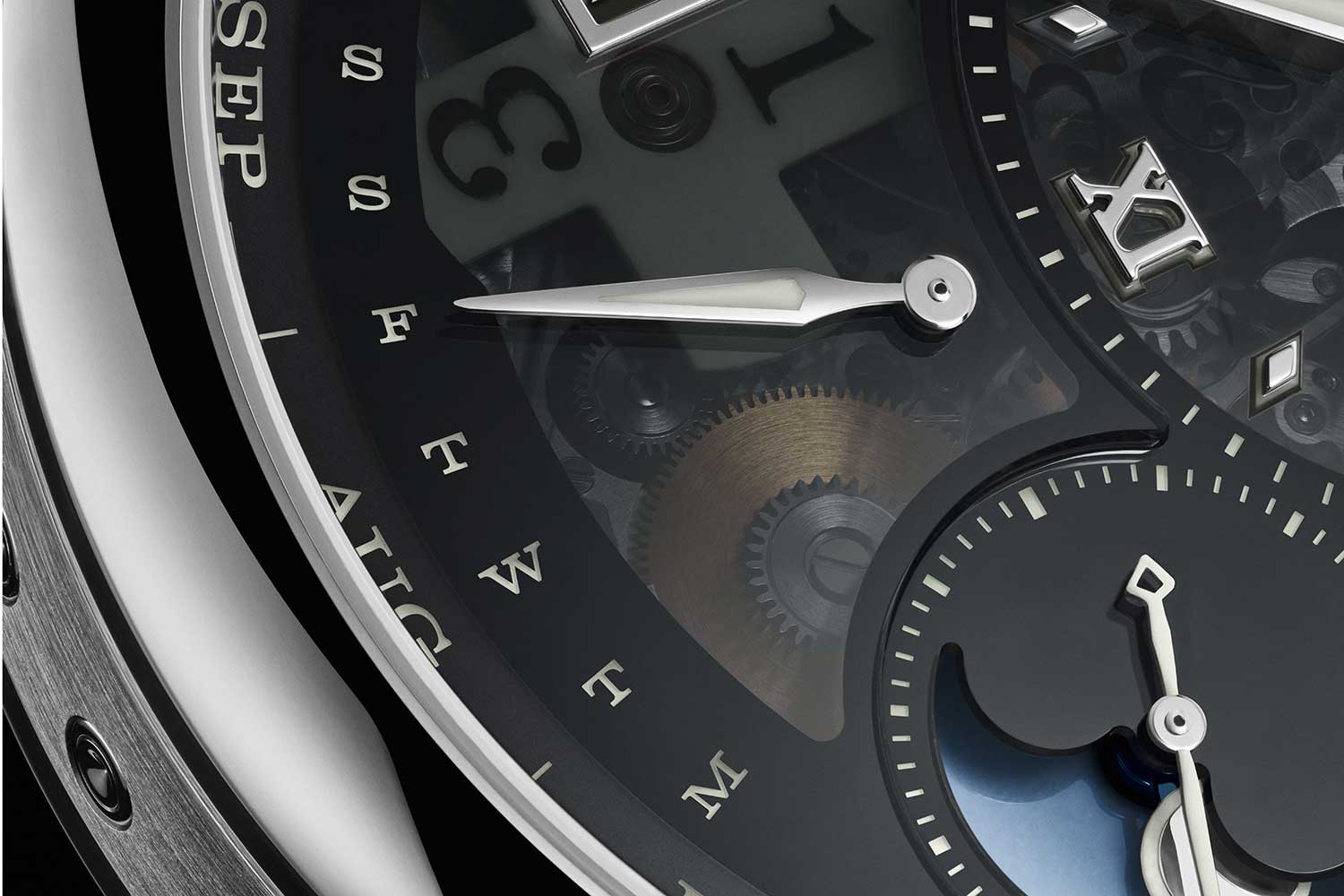
The retrograde day of the week pointer
While the calendar indications are adjusted via conventional recessed pushers, a pusher at 7 o’clock allows all indications to be advanced simultaneously.
Tourbillon with Hacking Function
The tourbillon is only visible through the caseback, as the goal was to preserve the layout of the Lange 1. What sets this model apart is that the tourbillon cage is more visible, thanks to the new gear train.
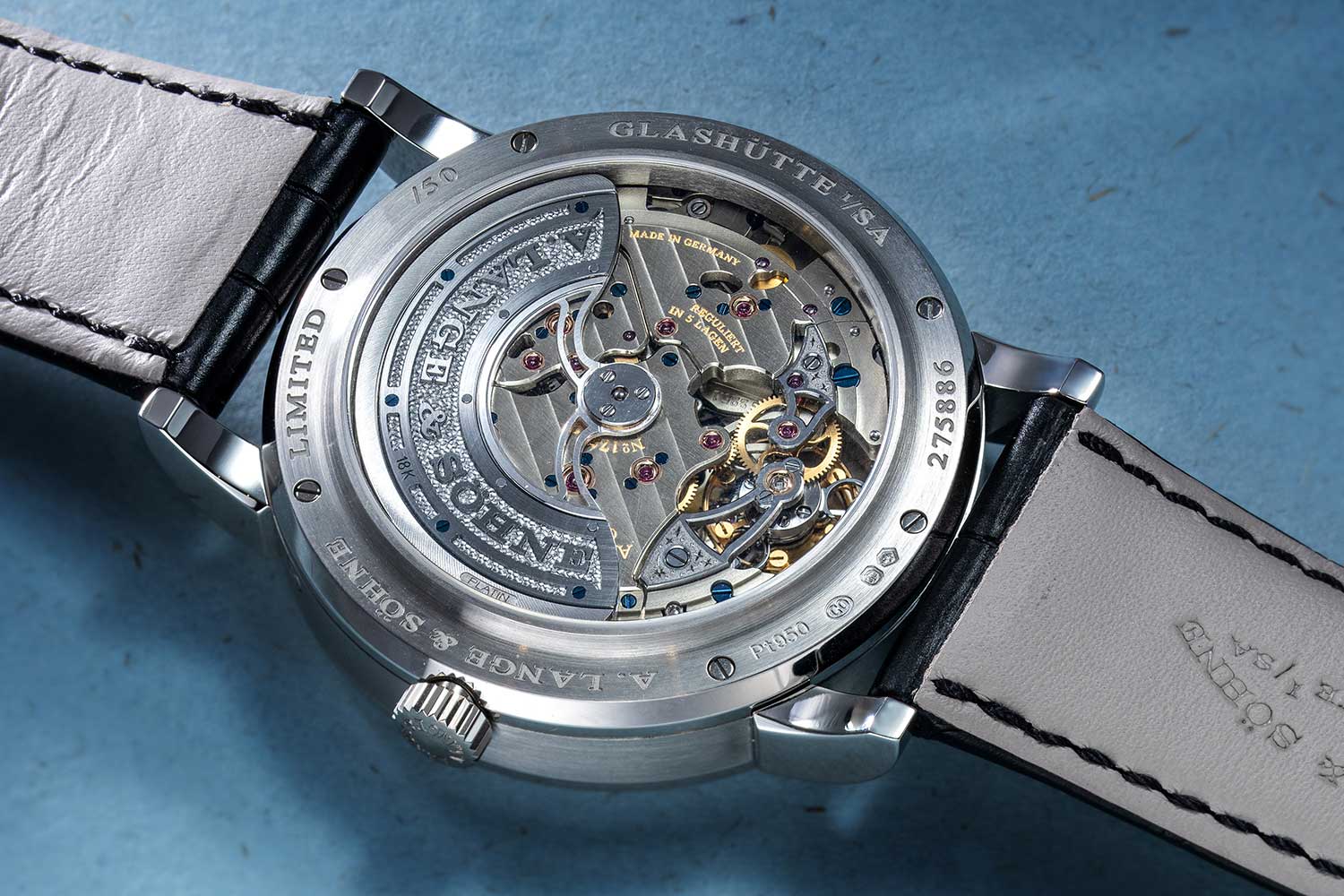
Lange 1 Tourbillon Perpetual Calendar “Lumen” (©Revolution)
In the earlier Calibre L082.1, the finishing wheel drives the cage pinion from the left. The cage pinion then drives an intermediate wheel, which in turn drives the small seconds pinion on the right, resulting in two wheels overlapping the tourbillon cage. The new train, however, drives the intermediate wheel directly and the latter drives both the cage pinion and the seconds pinon. In effect, the small seconds is now driven more directly from the train rather than through the cage.
The tourbillon cage is refined in form with curved upper arms. Unlike the 1815 Tourbillon for instance which has curved flowing arms, it is somewhat of a modern interpretation of the tourbillons A. Lange & Söhne produced in very small numbers around the turn of the 20th century. It is more compact with broad curved arms that are black polished on their top surfaces.
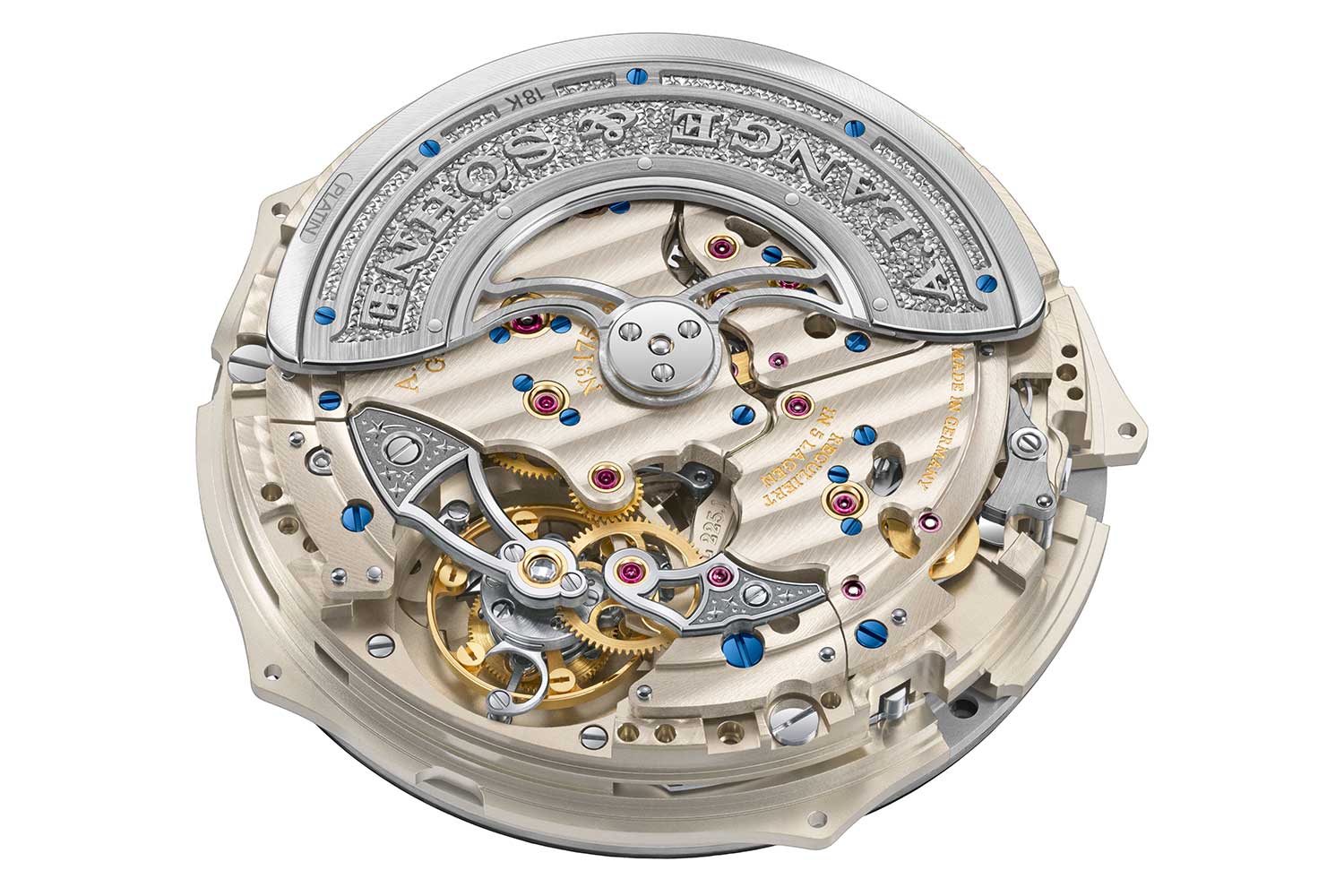
The new Calibre L225.1
The tourbillon rotates once per minute and has a diamond endstone. It houses a free-sprung, adjustable-mass balance that runs at 21,600vph. The watch is also equipped with Lange’s distinctive stop-seconds mechanism, which halts the tourbillon and consequently the small seconds hand. A V-shaped lever serves to arrest the balance. The mechanism is designed such that if one arm of the lever is obstructed by a tourbillon cage pillar, it pivots, allowing the other arm to fall onto the balance and bring it to a stop.
The most attractive aspect are the cocks for the tourbillon and intermediate wheel. Instead of the usual hand-graving on German silver, they are in steel and openworked, featuring numerous internal angles. Their top surfaces are black-polished, as are the screws, while the opposite ends of the cock are hand-engraved with stars including a shooting star.

With steel cocks and German silver bridges in the same movement, it provides a show of how anglage is executed by different means at Lange. On the German silver bridges, the bevels are first pre-polished using rubberised abrasive tools of progressively finer grit. They remove machining marks gradually while refining the surface step by step without cutting too aggressively. Once the surface is sufficiently refined, the part is finished with a polishing brush, a rotating brush charged with very fine polishing compound.
In contrast, the steel cocks, being considerably harder, are polished differently. They are brought to a mirror finish using rotating wooden wheels charged with abrasive compound, which the watchmaker brings the edge of the part into contact with by hand. Each inward point is formed individually, with the finishing carried right into the angle and terminated cleanly – something that, given the shape of the opening, has to be achieved by hand separately.
For the first time, the rotor is executed in 18k white gold and plated with black rhodium, rather than the traditional yellow gold, while the outer rim remains platinum to provide the necessary inertia.
In the end, it all makes for a watch that is rigorously engineered in itself, with each complication brought to its full measure. Today both Super-Luminova and sapphire dials are part and parcel of watchmaking but rarely are they combined, certainly not like this, and never in the service of a watch of this calibre.
Tech Specs: Lange 1 Tourbillon Perpetual Calendar “Lumen”
Movement A. Lange & Söhne calibre L225.1, self-winding, 50-hour power reserve; 3Hz (21,600 vph)
Functions Hours, minutes and subsidiary seconds; tourbillon with stop seconds; perpetual calendar with instantaneously switching displays for outsize date, retrograde day of week, month and leap year; moon-phase display with integrated day/night indication
Case 41.9mm x 13mm, Platinum
Dial Sapphire crystal; all displays luminous
Strap Hand-stitched black alligator leather
Availability Limited to 50 examples
Price €530,000
A. Lange & Söhne
You may also like
Events
A. Lange & Söhne Brings Challenging Chronographs to Singapore
Oct 13, 2026
Events
A. Lange & Söhne Brings Challenging Chronographs to Singapore
Oct 13, 2026
Editorial
A. Lange & Söhne Unveils a Platinum Triple Split and a Pair of 37.5mm 1815 Up/Down
Sep 4, 2026
Editorial
A. Lange & Söhne Unveils a Platinum Triple Split and a Pair of 37.5mm 1815 Up/Down
Sep 4, 2026
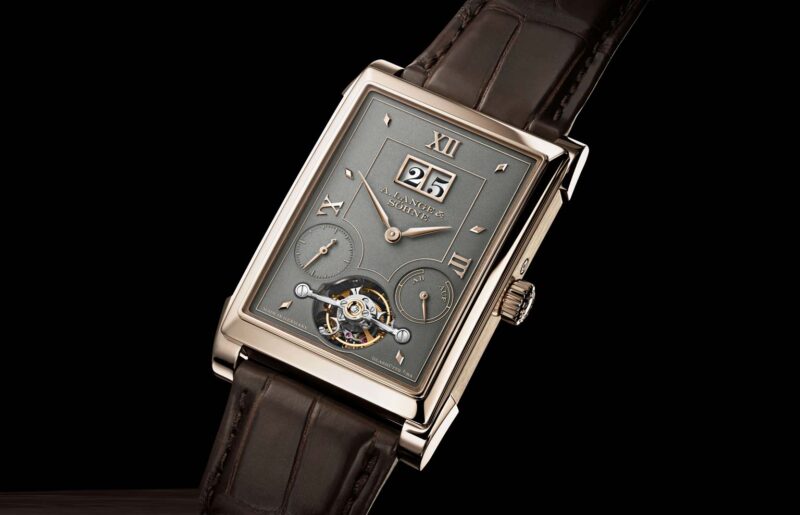
News
A. Lange & Söhne Unveils the Cabaret Tourbillon Honeygold
May 16, 2026
News
A. Lange & Söhne Unveils the Cabaret Tourbillon Honeygold
May 16, 2026