Once Upon A Time In America: The Watches of Hamilton
Editorial
Once Upon A Time In America: The Watches of Hamilton

When Hamilton returned to Lancaster, Pennsylvania with a new boutique in 2023, digital convenience suddenly lost its charm for a certain subset of collectors. Almost immediately, an influx of customers began phoning the physical store to place their orders. Why? Because they wanted the shipping box to originate from Lancaster and bear its postmark. The knowledge that their parcel had passed through the brand’s historic hometown before arriving on their doorstep was the ultimate horological gesture.
It sounds sentimental, and of course it is. But then watches are allowed to be sentimental. In fact, it may be one of the few remaining categories where sentiment improves the object rather than weakens it. Ryan Miller, President of Brent L. Miller Jewelers & Goldsmiths, whose family firm owns the Bowman building where the boutique is based, and who has grown up with Hamilton as both a Lancaster local and a retailer, puts it very plainly: “Nobody needs a watch. You buy the experience around it – the day you went to the shop, the person you were with, the city you traveled to, the way the thing felt in your hand before it became yours.”
In Lancaster, that feeling is unusually specific. Hamilton is not just a brand with a museum display and a pleasingly revived address. It is a family memory. It is a grandfather’s railroad watch in a drawer. It is an aunt who worked at the Columbia Avenue factory. It is the old Bowman building on North Duke Street, which is now part of the story again. It is the fact that people in their 80s and people just leaving school can both talk about Hamilton as something that belongs to the city, even though large-scale production left long ago. And that is the strange power of Hamilton. To understand why that attachment still has such force, you need more than brand history. You need the paper trail, the factory memory and the kind of archival patience that can separate a nice story from a true one. For this article, much of that comes from Thomas Stocker, Librarian and Archivist at the National Association of Watch and Clock Collectors (NAWCC), whose work with the Hamilton material gives the story its depth: company charters, old machinery records, technical drawings, founder names, movement histories and the small, stubborn details that keep Lancaster’s watchmaking past from slipping into nostalgia.
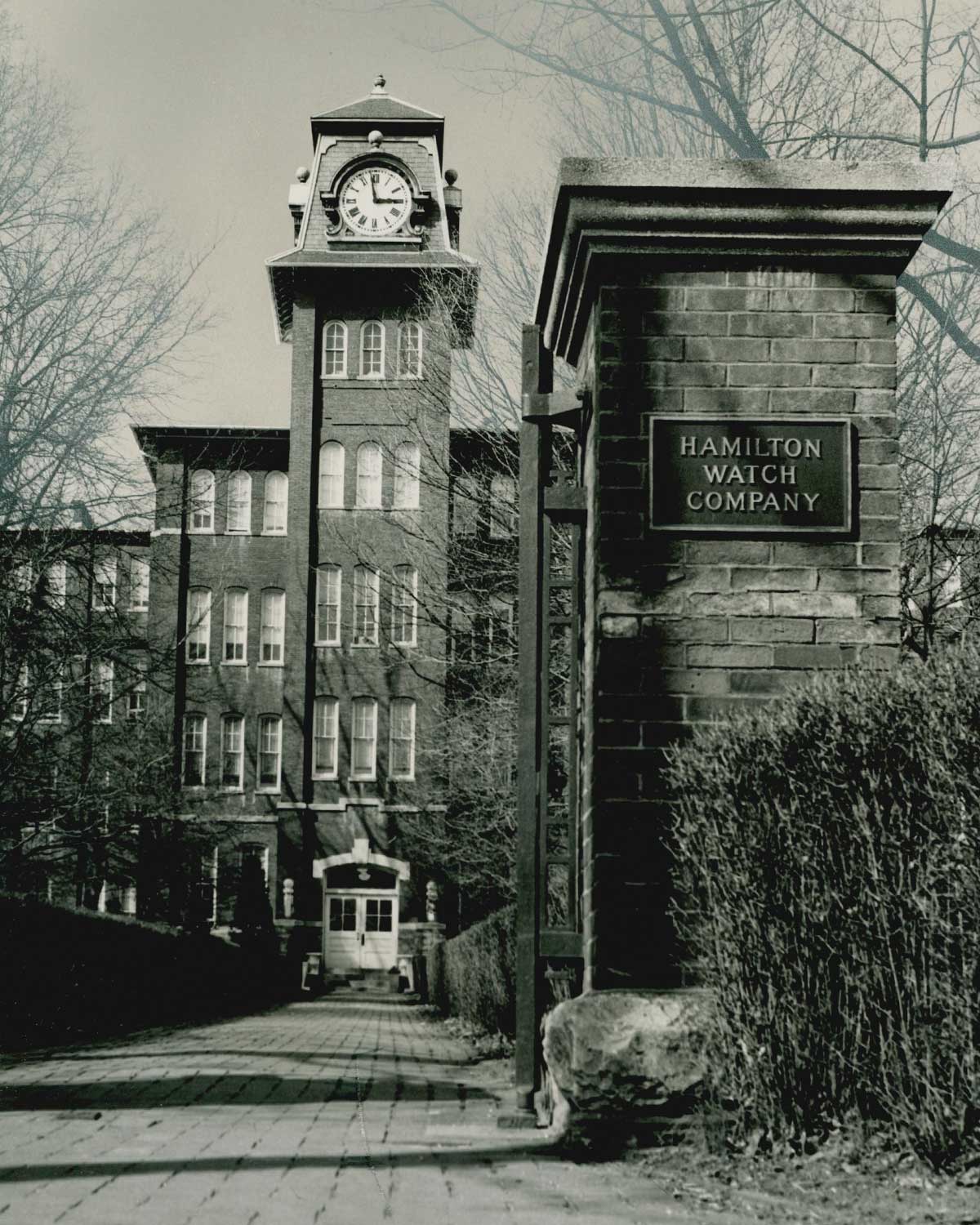
Hamilton Watch Company, 1940
The Messy Origins of Lancaster Watchmaking
The company is now Swiss-owned and Swiss-made, yet its American life remains too ingrained to be left in the past. Lancaster was never the obvious place in the way that, say, Geneva or Le Locle feel obvious now. In the late 19th century it was still rural enough to offer land and space, but not so sleepy that industry felt out of place. It had trade routes, farmland, resources, and a local culture of making. Before watches, there were rifles. The so-called Kentucky rifle, Stocker reminds me, was really a Lancaster invention that earned its name elsewhere. It is the kind of correction an archivist enjoys: small enough to be missed, large enough to change the way you understand the city.
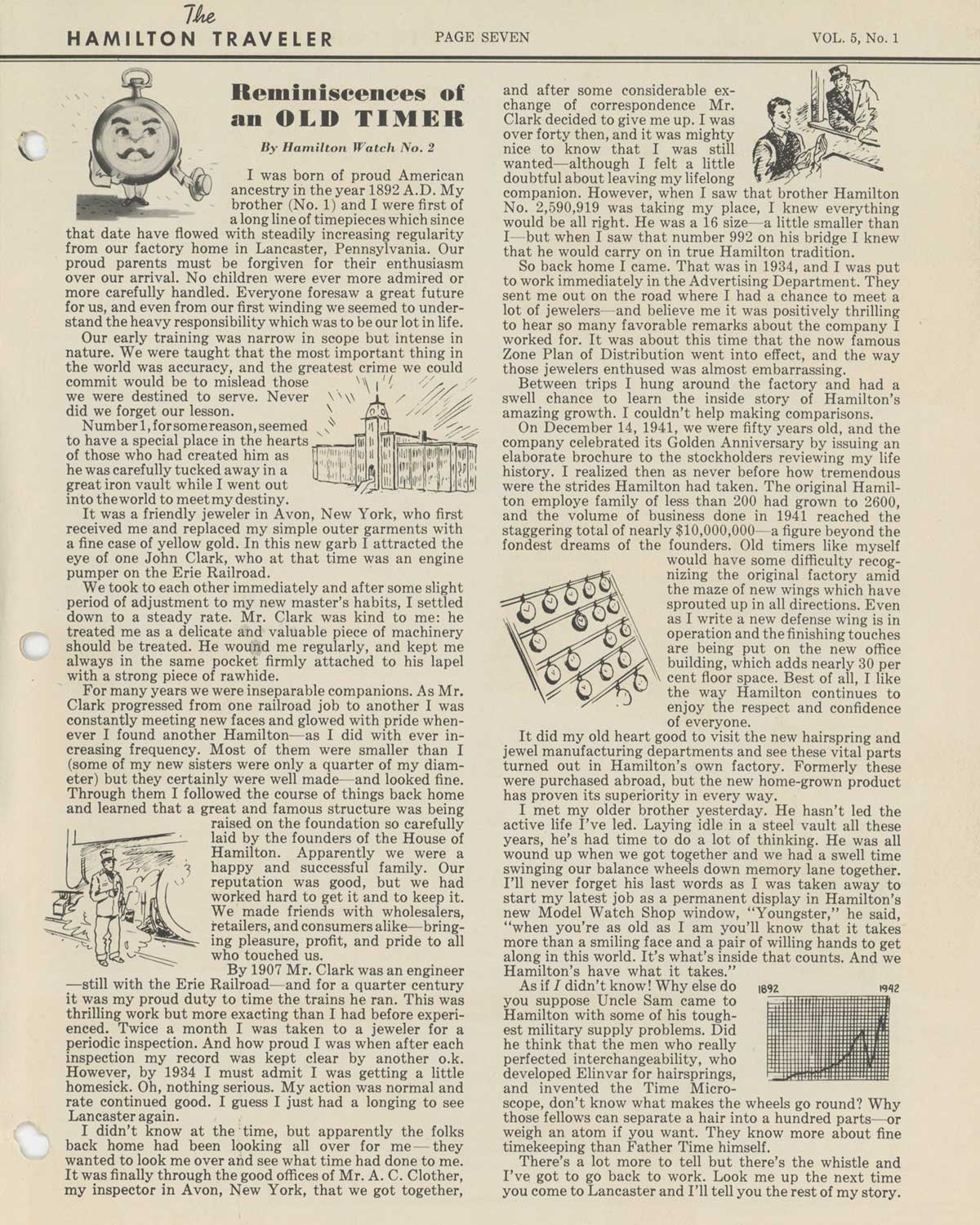
An extract from the Hamilton Traveler company newsletter, 1942
The local version of the story is split between memory and record. Miller has the street-level view: the families, the old factory connections, the people who still talk about Hamilton as if the factory only closed yesterday. Stocker has the documents, and his version of events is valuable because it does not make Hamilton appear from nowhere, fully formed and triumphant. He places it inside a longer, messier Lancaster experiment. Hamilton’s choice of location was the result of a company that finally made an old idea work. The company was incorporated in 1892 by taking over the physical assets of Keystone Standard in Lancaster and bringing in tooling and equipment from the Aurora Watch Co. of Illinois. This came after a line of earlier attempts at that same Columbia Avenue site — Adams & Perry in 1874, Lancaster Pennsylvania Watch Co. in 1877, Lancaster Pa. Watch Co. Ltd. in 1878, Lancaster Watch Co. in 1879, Lancaster Watch Co., Inc. in 1883, and Keystone Standard Watch Co. in 1886 — had failed or been abandoned.
Hamilton inherited a building, machinery, materials and, perhaps just as importantly, a local appetite for trying again. In Stocker’s telling, the brand’s great origin story is not simply that it was founded in Lancaster, but that the city had already been trying to create a watchmaking industry for nearly two decades. Hamilton was not the romantic result of a watchmaker’s dream; it was backed by local businessmen who finally gave the effort financial discipline, proper planning and industrial momentum.
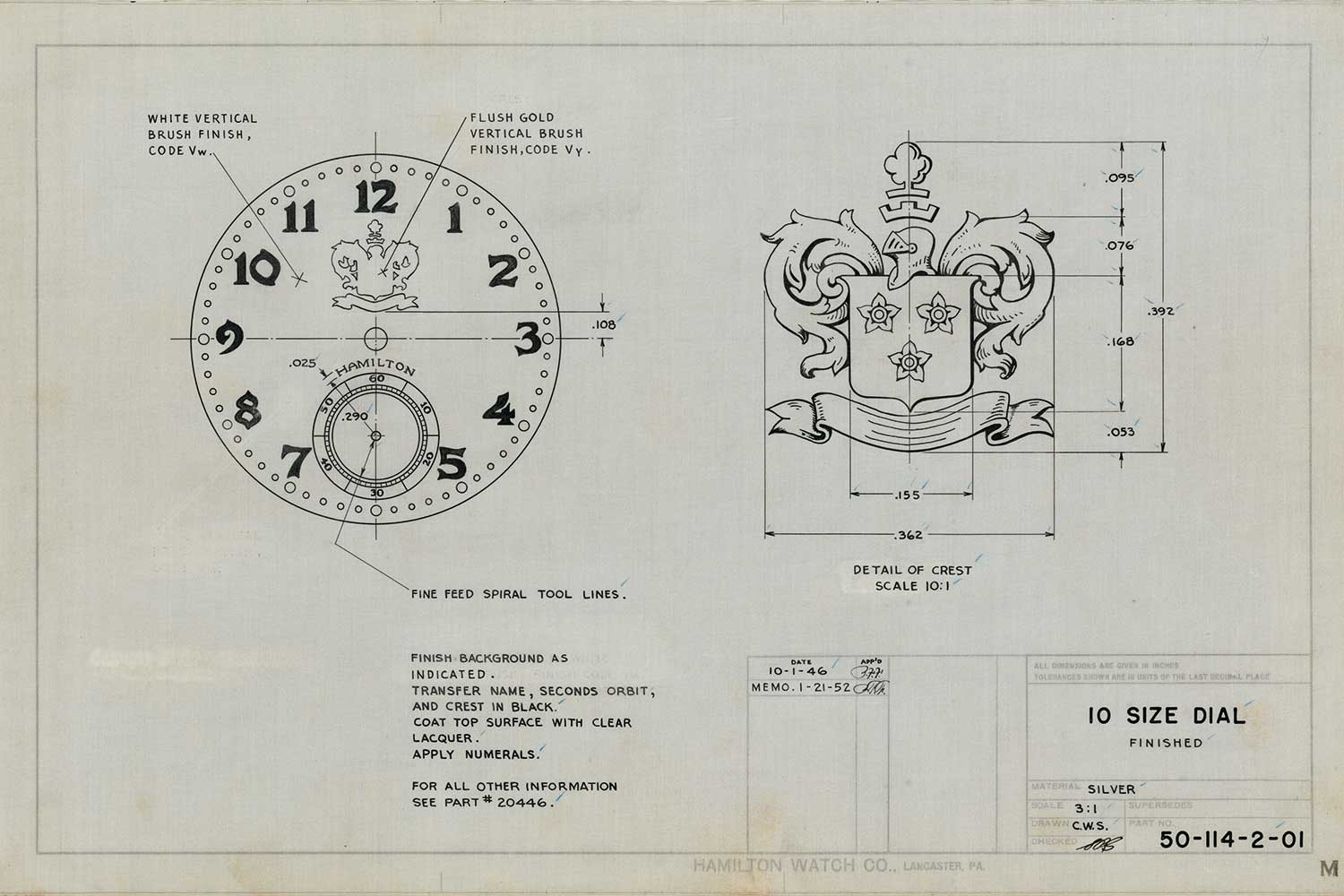
Technical blueprint for a “10 Size Dial” watch face
If that factory story belongs to the former Hamilton headquarters at 917 Columbia Ave, now the Clock Towers condominium complex, then North Duke Street is a parallel thread in Lancaster’s watchmaking history. Bowman Watch Co. operated in Lancaster between 1879 and 1882 before its tooling and designs were sold to J.P. Stevens in Atlanta, after which Ezra Bowman concentrated on his retail jewelry business and the vocational school that he founded. The school and store later shared a purpose-built building, with the store on the first floor and the school above. That building, now home to the Hamilton boutique, brings the story full circle in a return to Lancaster’s broader watchmaking ecosystem.
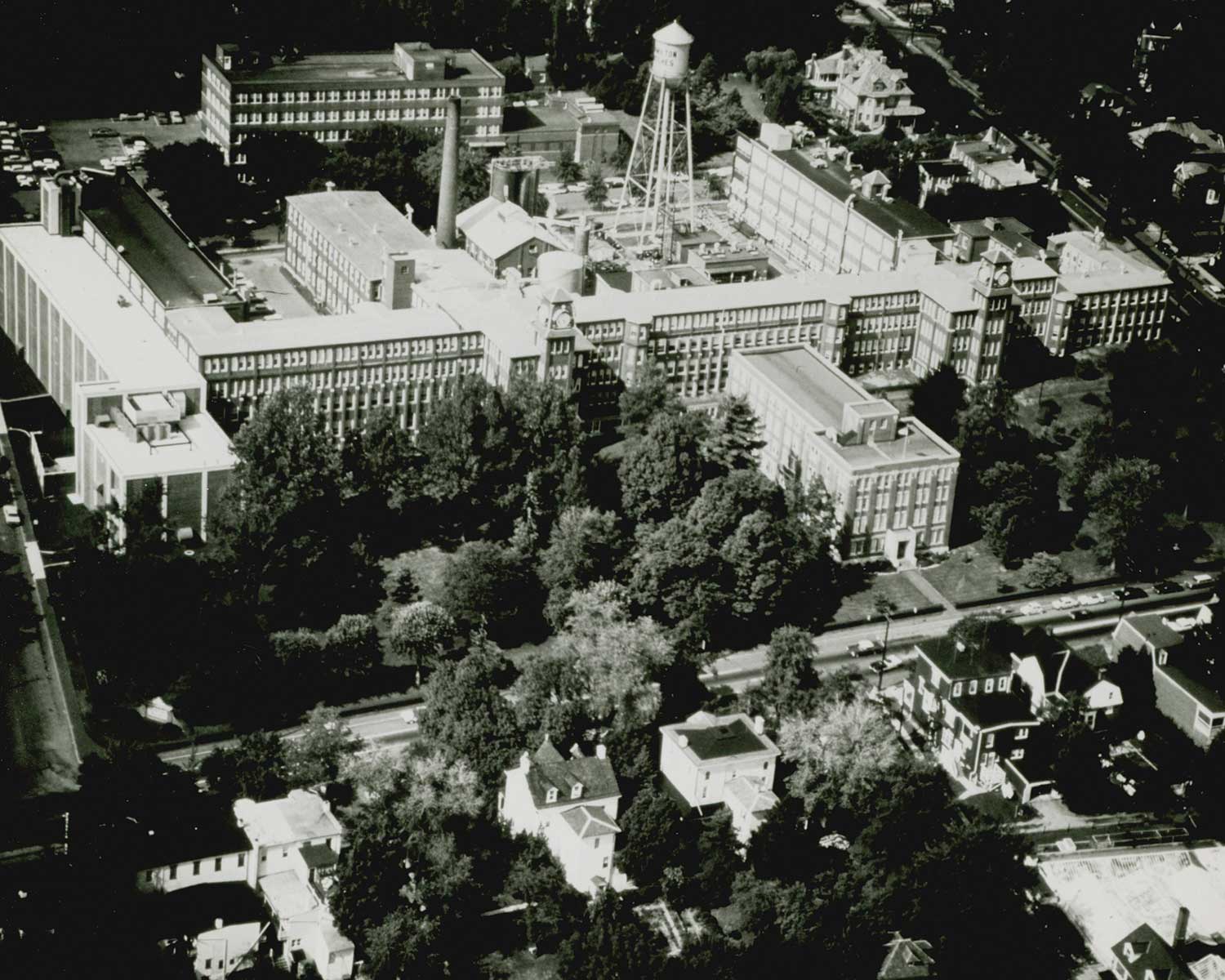
Hamilton Watch Company factory, 1951
The Railroad Era
In the 1890s, the watchmakers were already in Lancaster. The railroads were demanding better timekeeping and Hamilton came along at exactly the moment when precision was no longer a scientific gimmick for the wealthy, it was a societal requirement.
The railroad gave American watchmaking a great urgency. A watch was not merely a gentleman’s possession, it was part of a safety system. After the Kipton disaster of 1891 when a defective pocket watch led to the death of nine men during a head-on crash between a mail and a passenger train, standards tightened, inspection became more formalized, and the name Webb Ball became inseparable from the idea of railroad time.
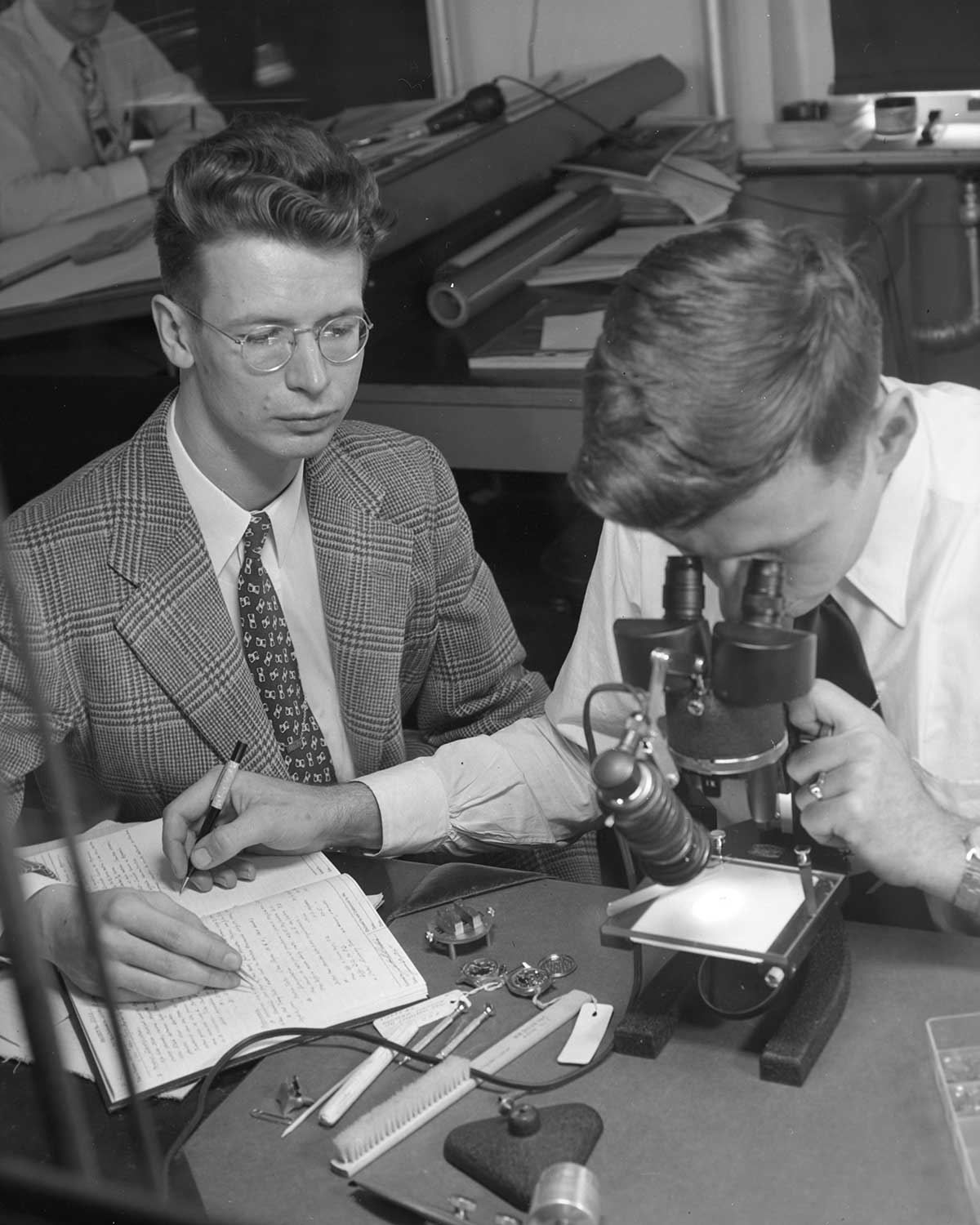
“American Made” came with a guarantee of quality
Watches had to be legible, reliable and robust. Early requirements included 16- or 18-size movements and 17 jewels; lever setting and open-face layouts followed as standards evolved. Stocker is careful about this point: a railroad watch was not made by one magic feature, but by a shifting body of rules, inspections, adjustments and trust. Hamilton’s genius was to build itself around that system rather than merely sell into it. Hamilton understood that world instinctively.
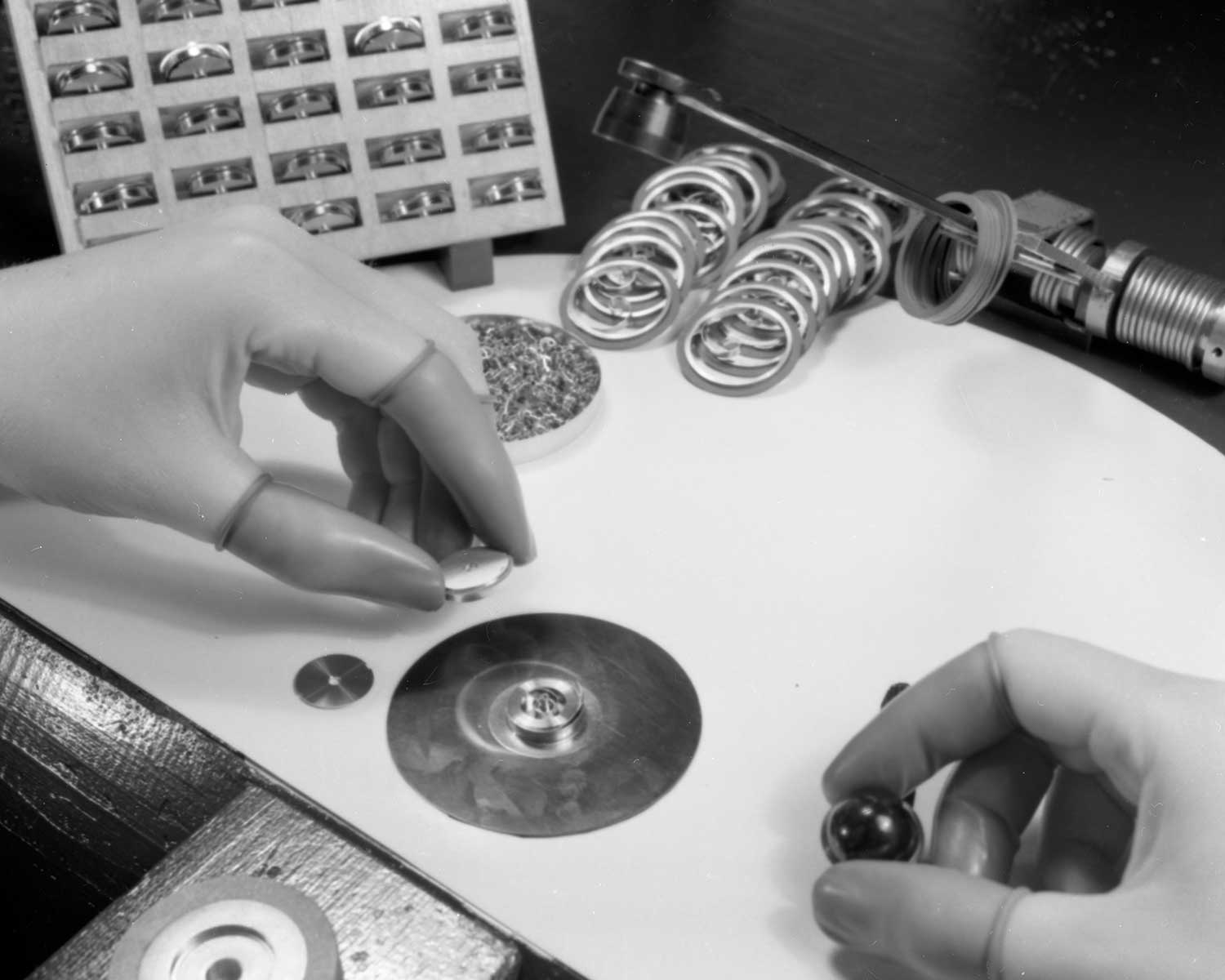
Hamilton’s watch manufacturing rivaled that of its Swiss competitors
Lancaster was a city of rail crossings as well as workshops, and the company’s famous “Watch of Railroad Accuracy” line was more than an advertising flourish pulled from thin air. Accuracy was the business model. Compared with Waltham and Elgin, Hamilton was late to the party but that may have actually helped the brand. It did not have to invent American industrial watchmaking from scratch, but it did have to prove why another American watch company deserved to exist. Its answer was trust.
For Stocker, the 936 introduced in 1893 and 940 from 1898 represent the first great Hamilton breakthroughs, although it is the 992 — the quintessential 16-size American railroad pocket watch from 1903 — that seems to live on in people’s families. He hears it in the stories visitors tell him about a grandfather’s Hamilton still keeping astonishing time decades after it left the railroad. Collectors can debate grades for hours — and usually will — but even a non-specialist can understand the appeal when the movement is revealed. The damascening and fine decorative work are there even though the owner would rarely see them. Stocker points to that hidden finishing as one of the loveliest expressions of American industrial pride: work done properly even when it would spend most of its life behind a caseback.
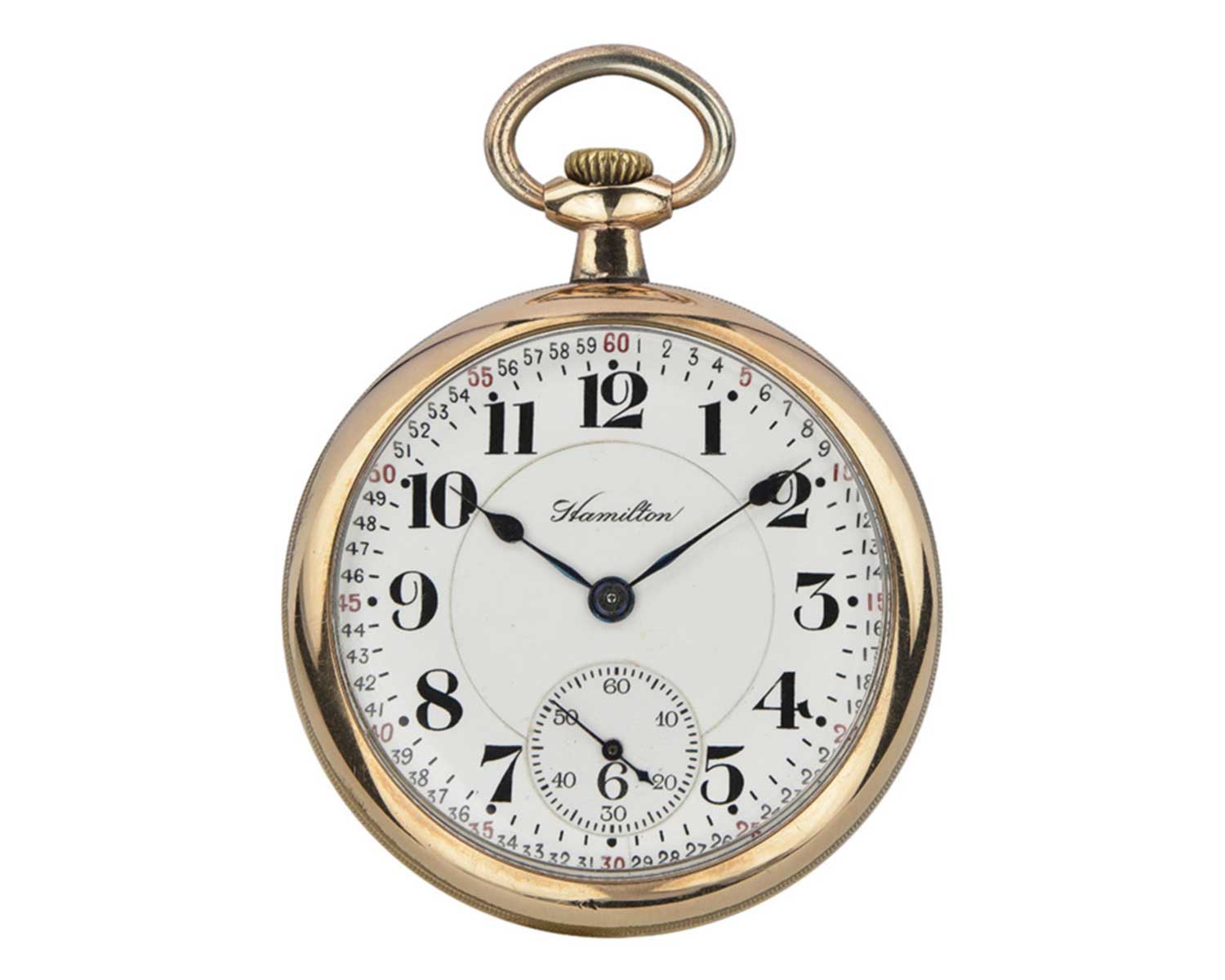
Hamilton Model 992 railroad pocket watch
 
American watchmaking in this period had an attitude that unsettled Europe. Rory McEvoy, Executive Director of the NAWCC, describes it bluntly when he says, “the Americans terrified the Europeans” and you can see why. Traditional European watchmaking had long depended on dispersed specialists, cottage workshops, inherited hand skills and a fair amount of chaos. The Swiss had already begun bringing production under one roof; the Americans pushed that model harder, with specialized machinery, tighter tolerances, interchangeable parts and watches made in high volumes to be serviced rather than merely admired. The Swiss response tells its own story. If American industrial methods and railroad watches had not been taken seriously, no one in Europe would have rushed to copy them.
The War Effort
Hamilton was not the only American name in this golden age, and any serious account has to leave room for Waltham, Elgin, Illinois, Hampden, South Bend, Bulova and others. But Hamilton’s particular genius was narrower and sharper. It became the American watch company of seriousness, whose reputation was built less on glamor than on confidence and the assertion that the watch would do the job. That quality meant that its wartime chapter was more than a mere diversion. Hamilton had supplied military timepieces before, including during World War I, but World War II demanded something else entirely. In 1942, the company stopped making watches for civilians and turned itself over to military production. The Model 21 marine chronometer remains its magnum opus from that period.
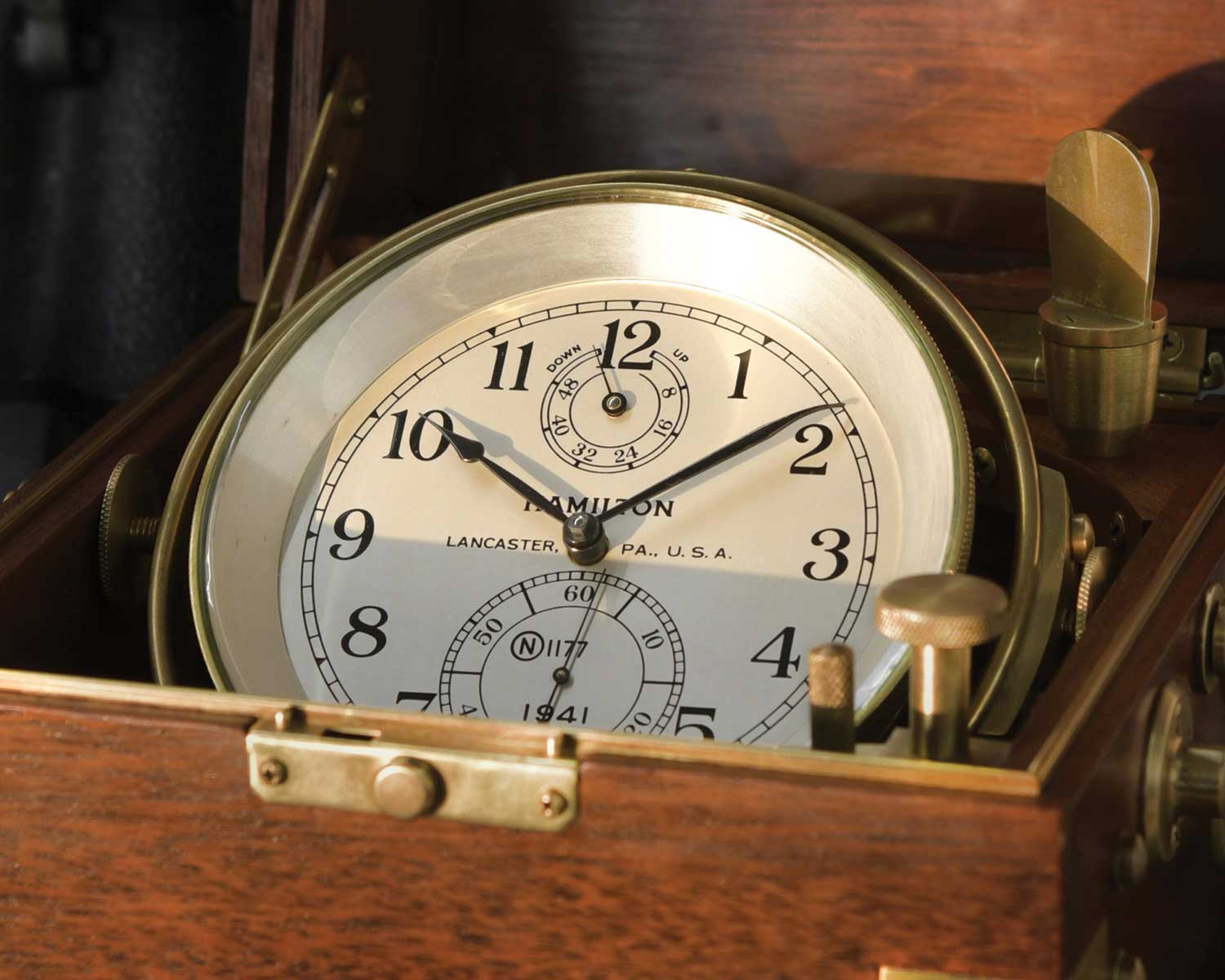
Hamilton Model 21 marine chronometer
Naval timekeeping is a matter of navigation and survival. A ship at sea needs time in a way that a dinner guest does not, and during WWII, Hamilton became the main American supplier. The scale made it impressive, while the accuracy earned it a place in military history. When Stocker talks about the Model 21, he does not frame it as a charming wartime sideline; he speaks about it as a piece of American manufacturing that belonged in the same conversation as armament, logistics and national defense. Stocker’s view is that the Model 21 was one of those rare instruments where volume and precision — thanks to a chain-fusée drive, modified detent escapement and the kind of balance-and-hairspring work that turned old-world chronometer architecture into something America could manufacture at scale — met at a level that actually altered the course of the war effort. The Lancaster factory was treated accordingly, fenced and guarded like a site of military value.
Electric Shock
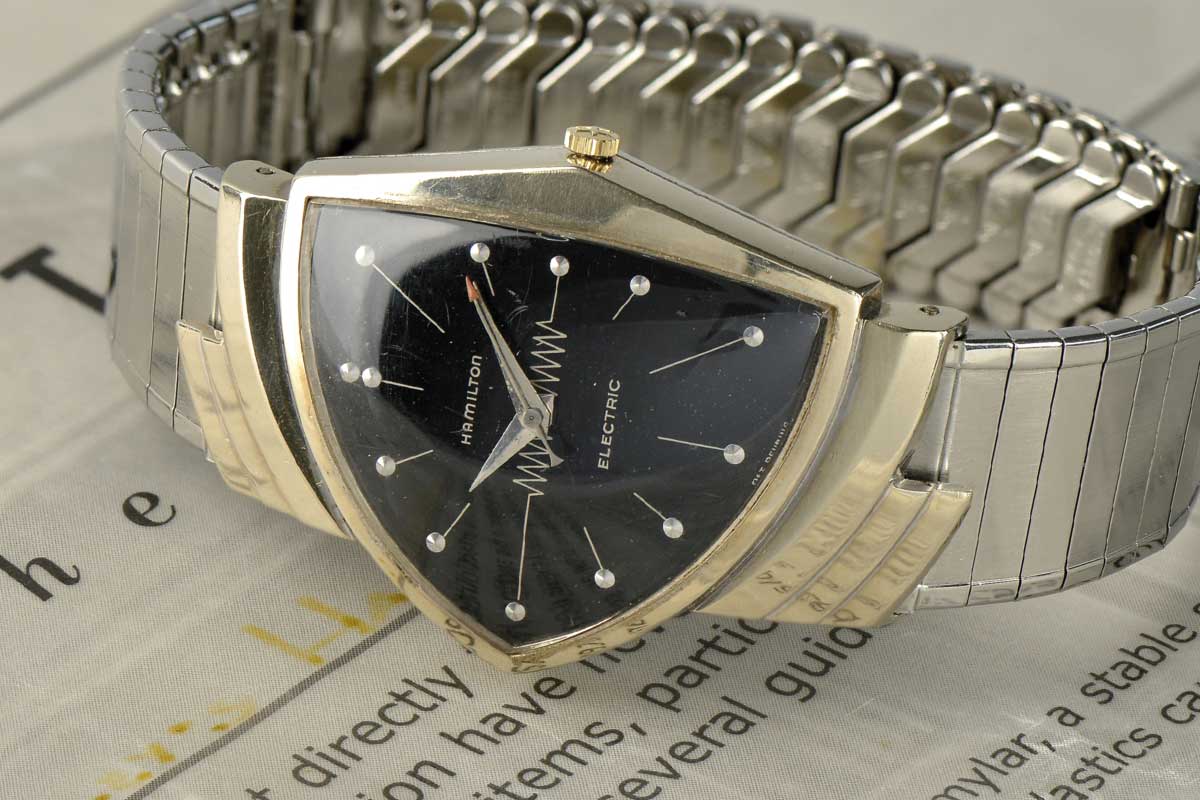
Because of the railroad watches and chronometers, there is a temptation to make Hamilton’s story too sober, but these watchmakers who took accuracy so seriously also knew when to go completely wild. Launched in 1957 and powered by Hamilton’s pioneering Caliber 500, the Ventura became the face of the world’s first electric-watch generation, but that description only gets you halfway there. The movement was the technical headline, while the Richard Arbib case provided the theatrics. Hamilton, the company of serious railroad movements and military chronometers, suddenly gave electricity a body that aligned with that of a concept car. Even now, after decades of asymmetric cases, space-age revivals and mid-century nostalgia, it still looks beautifully improbable.
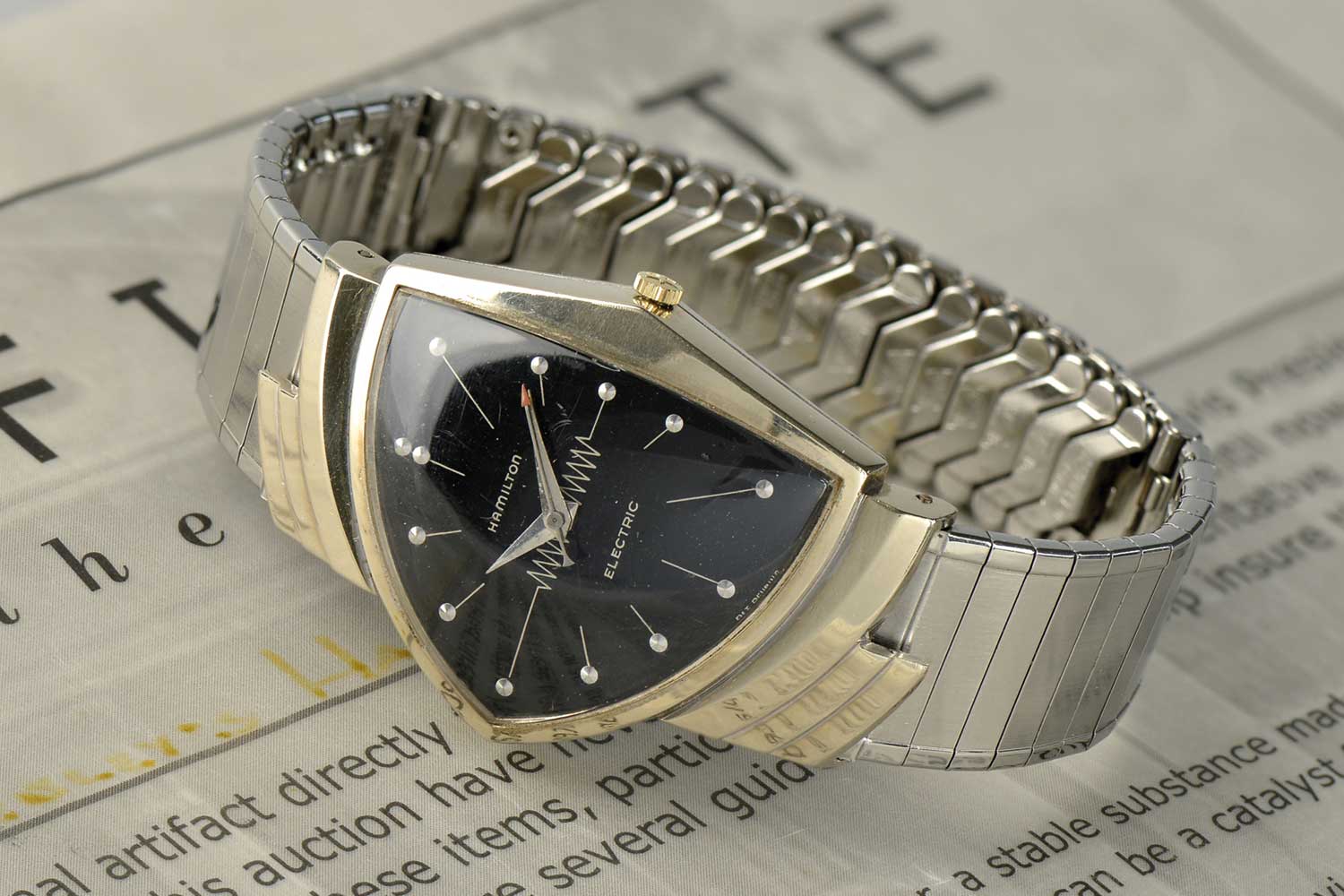
One of “The King’s” personal Ventura models
The archives apparently show that the R&D team was not entirely confident in the original Caliber 500 at launch, but that detail makes the watch even better. The Ventura was not a safe exercise in progress; it was ambition moving slightly faster than certainty. McEvoy recalls the engineers’ pride in drilling a hole through a human hair and threading copper filaments through it. Whether you come to Hamilton through a 992 pocket watch, a Model 21 chronometer or a Ventura, you arrive at the same point of detail pushed to the edge of usefulness, simply because the people in Lancaster wanted to see how far they could go.
The electric watches also carried Hamilton into popular culture, and no one did more for that than Elvis Presley. On Presley’s wrist in Blue Hawaii in 1961, the Ventura became something else: not just a technical milestone, but the triangular, futuristic wristwatch worn by “The King” at exactly the point when American youth culture was learning how to dress, move and misbehave.
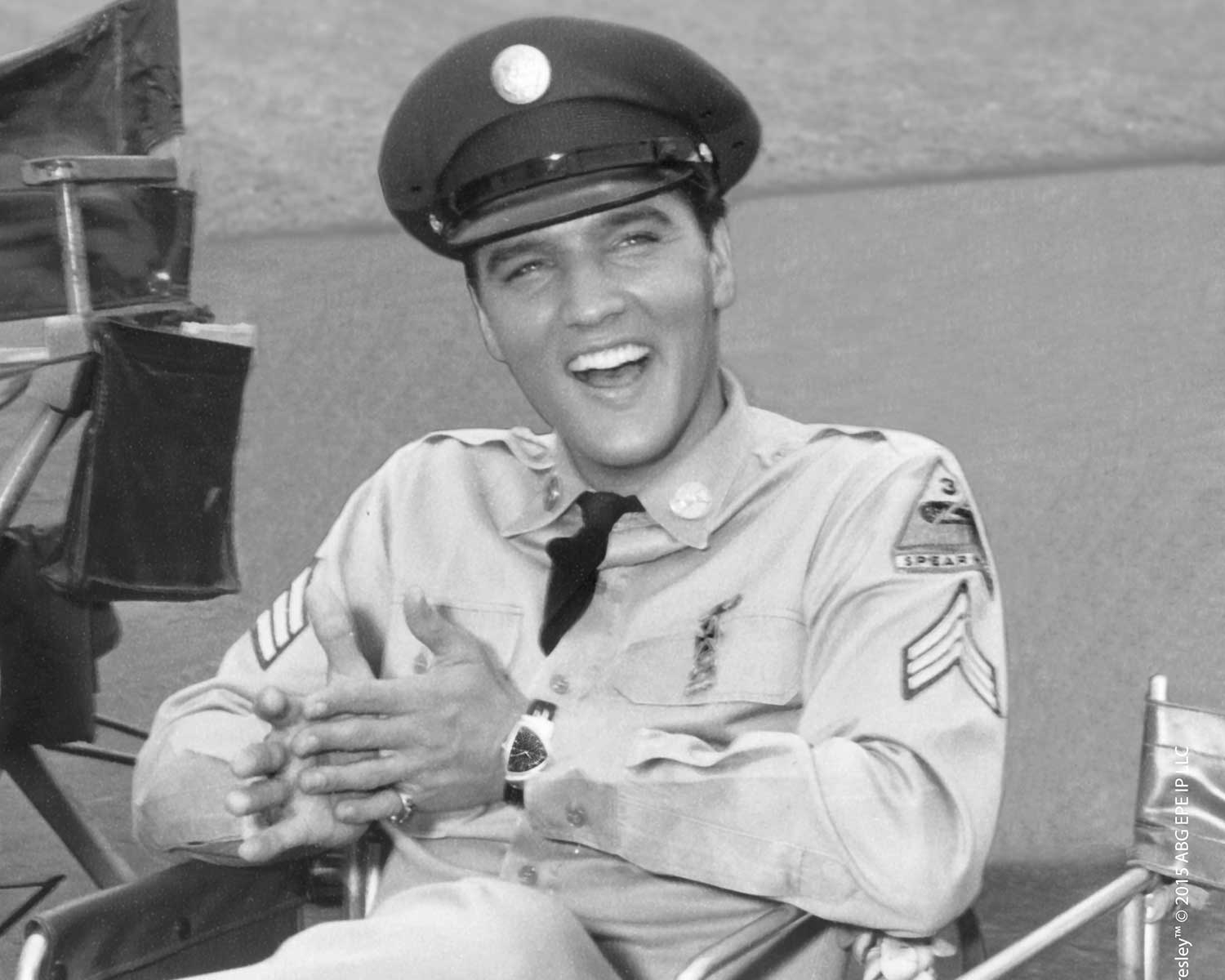
G.I. Blues: Elvis Presley and his Ventura
While Elvis supplied the pop-cultural jolt, Hamilton’s screen life had actually started long before that, in 1932 with Shanghai Express, where the Piping Rock and Flintridge appeared alongside Marlene Dietrich and Clive Brook; and the Piping Rock would return almost a century later on the wrist of Matt Damon as Lieutenant General Leslie Groves in Oppenheimer. But Elvis gave Hamilton a different kind of glamor. The railroad watches had been about trust, the Model 21 about wartime precision, and the Ventura about a future that suddenly had hips. These watches showed a side of American watchmaking that is often missed when the story is reduced to railroads and decline. American watchmaking was more than efficient, it was brave. Hamilton had one foot in the inspection room and one in the space race. Then came the long unraveling.
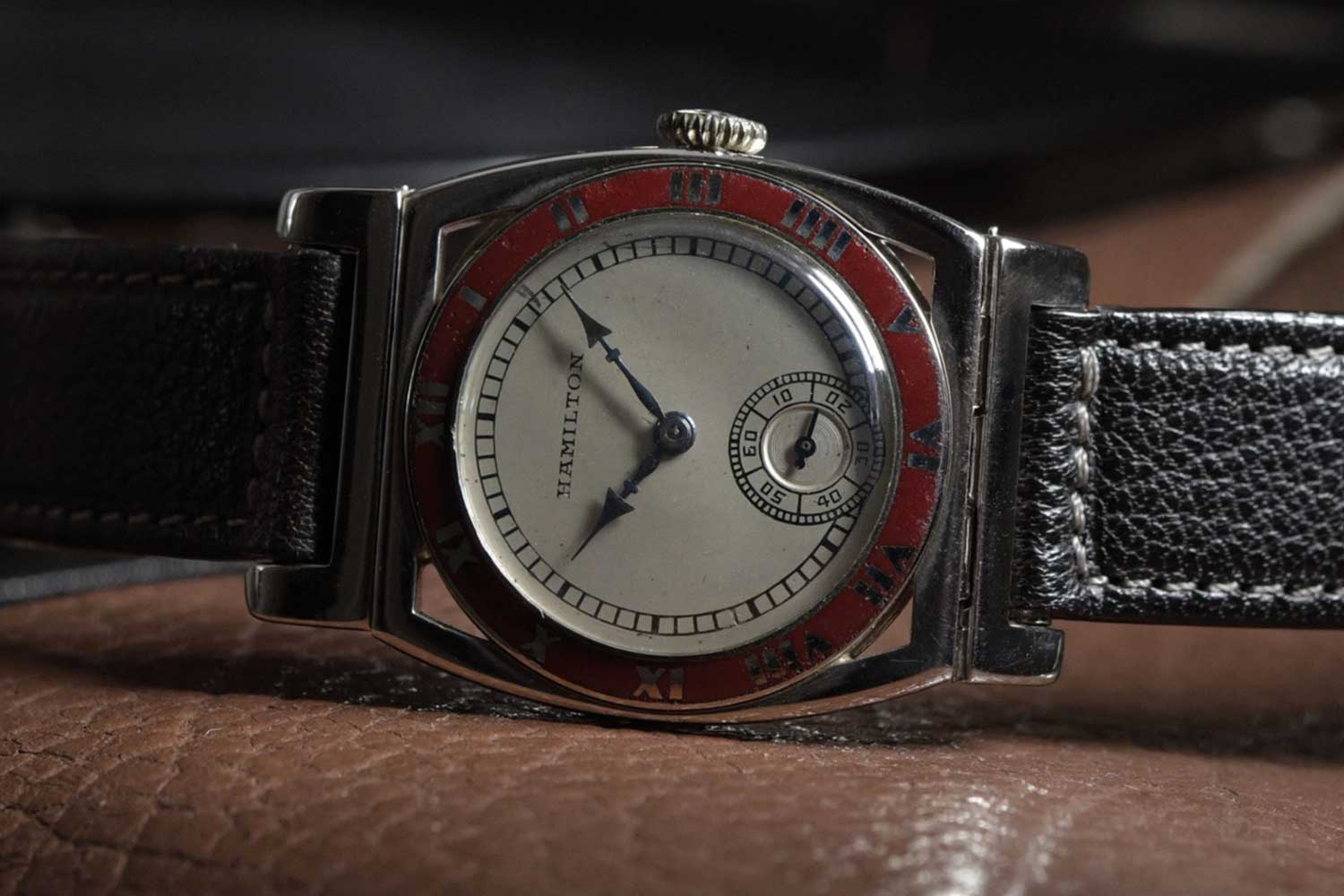
Hamilton’s original film star, the Piping Rock
Decline, Green Shoots, and The Lancaster Address
There is no single villain in the decline of large-scale American watchmaking, which is why neat explanations always sound false. Competition from Switzerland and Japan, labor costs, tariffs, consumer taste, quartz power, corporate decisions, the erosion of domestic suppliers, all played a part. Stocker’s answer to the question of what went wrong is simple: the industry was hit from too many directions at once. Hamilton lasted longer than many, but survival changed the company. The Buren acquisition brought Swiss movements and Swiss production closer to the heart of the business. Eventually the Lancaster version of Hamilton — the factory, the workforce, the localized industrial ecosystem — was gone (the last mechanical watch being made there in 1969).
The United States still has watchmakers, restorers, independents, obsessives and teachers as well as skill. What it lost was the shared machinery of watchmaking — the suppliers, mass trained labor, factories and the national confidence that allowed a company in Pennsylvania to make railroad watches, military wristwatches and marine chronometers at serious volume. That loss still hangs around Lancaster, but not in a purely melancholy way. The NAWCC Museum holds one of the richest Hamilton collections anywhere. The School of Horology is active again. Modern American independents such as RGM and J.N. Shapiro are proving that American watchmaking can exist, even if it now looks more like a high-skill, low-volume craft than the industrial might of old Hamilton.
McEvoy talks about “green shoots.” Although he avoids leaning on the fantasy of turning back the clock, he recognizes something smaller and more scattered, but nonetheless very real. Miller sees the story from a consumer perspective — Hamilton events in Lancaster are talked about and the boutique has reignited local pride. People wear a Hamilton not for status but because it means something. He remembers the Ventura he was given for his high-school graduation as a design masterpiece, a family heirloom and a tie to home.
The idea of that hometown postmark stays with me. A Hamilton bought in Lancaster today is not the same as a Hamilton made in Lancaster in 1925, 1943 or 1957. But for those of us who love them, watches have always been about more than specs, and a box sent from Lancaster carries the idea that American watchmaking, however much it has changed, still has an address.
Hamilton
You may also like

News
One of Hamilton’s Best Watches Gets Another Solid Update
Sep 19, 2024
News
One of Hamilton’s Best Watches Gets Another Solid Update
Sep 19, 2024

News
We Put Hamilton’s Most Versatile New Adventure Watch to the Test
Jun 13, 2024
News
We Put Hamilton’s Most Versatile New Adventure Watch to the Test
Jun 13, 2024

News
Hamilton’s Spicy Limited Editions for Dune: Part Two
Mar 9, 2024
News
Hamilton’s Spicy Limited Editions for Dune: Part Two
Mar 9, 2024