A Closer Look: Rolex Oyster Perpetual Yacht-Master II
Reviews
A Closer Look: Rolex Oyster Perpetual Yacht-Master II

The centenary of the Oyster this year brought with it something rather unexpected – the return of the Yacht-Master II. While the Oyster case represents Rolex at its most foundational and universal, the Yacht-Master II has always occupied the opposite extreme. It was one of the most specialised, mechanically exotic and bizarrely compelling watches the company has ever produced.
The original Yacht-Master II, introduced in 2007, was fascinating partly because, unlike the far more conventional Yacht-Master whose name it borrowed, it was so stubbornly unconcerned with broad appeal, or even with appearing especially sensible within the world it was designed to serve. Had someone merely explained the workings of the watch and the rather unmatched effort required to set the countdown duration, moreover amid the chaos of race day, it would have been difficult to believe that such a contraption would find its way into serial production. Everything about it was slightly excessive and wonderfully obstinate. The fact that its so-called Ring Command bezel had such a technical internal engineering designation that simply didn’t belong anywhere in luxury marketing – with none of the reassuring prestige of names like Jubilee or President or the playful cheek of Oyster and Cyclops or even the futuristic cool of Syloxi and Dynapulse – only added to its charm. In fact, “command,” as in “command member,” “command lever”, “command mobile,” is one of the words I would personally try to avoid in editorial technical writing. They belong unmistakably to the language of French-origin engineering documentation and patent literature.
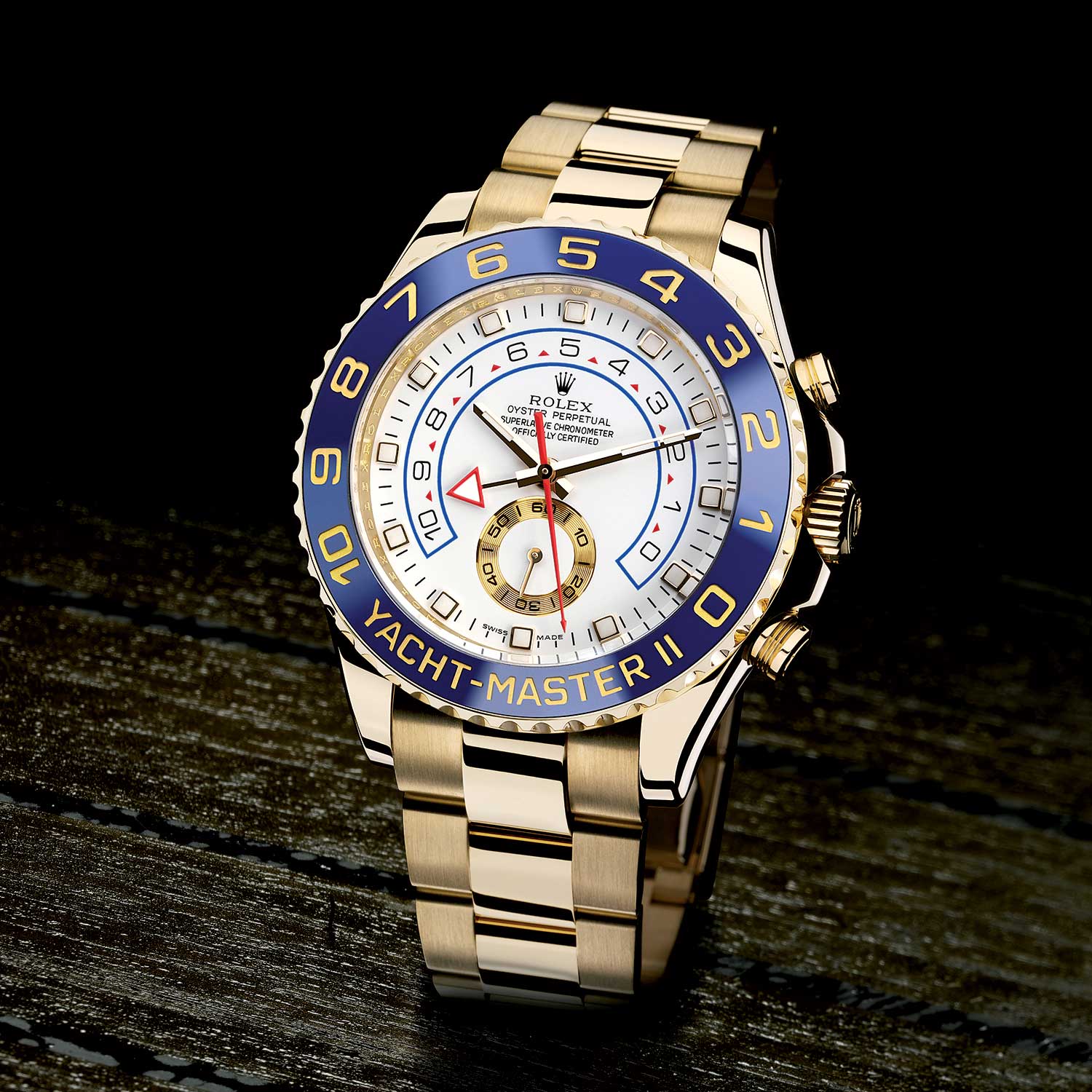
2007: Rolex Yacht-Master II
Then there is the process itself, which no one really remembers. To program the countdown timer, the bezel first had to be rotated 90 degrees counterclockwise into a dedicated adjustment position, which mechanically disabled the start pusher. The reset pusher then had to be held down until it remained depressed, which both reset the seconds hand to zero and placed the mechanism into its programming state. The crown then needed to be unscrewed and pulled to first position to set the countdown minutes anywhere from 1 to 10, before being screwed back down again, after which the bezel could finally be returned to its normal position, and the pre-start sequence could begin. Visually, its complexity was matched with confrontational exuberance. Between its immense 44mm x 14mm proportions, brightly coloured accents, crowded dial and procedural operation, it had the air of a watch that had first ignored every commercial instinct and then proceeded in total, impenetrable defiance of it.
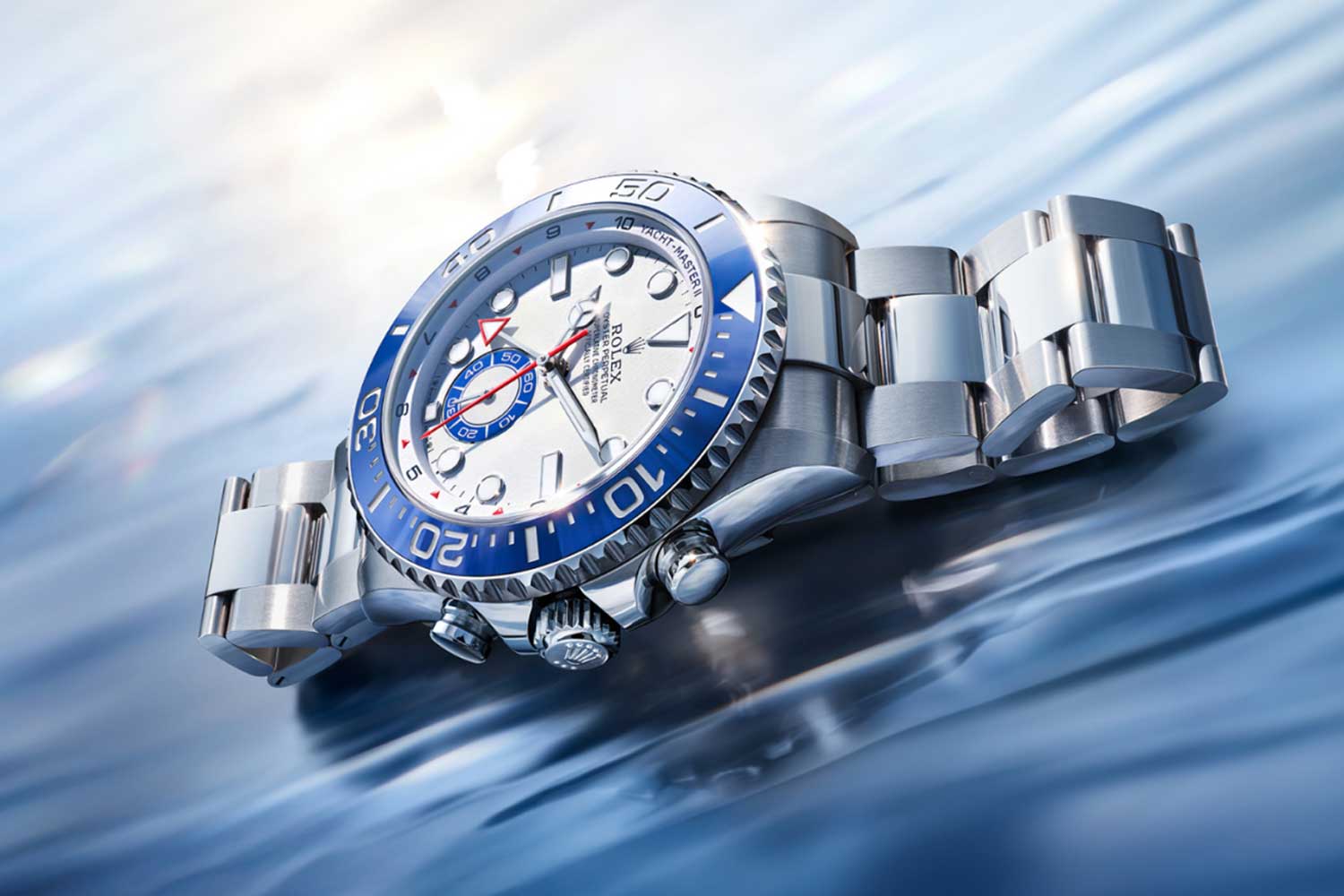
The new Yacht-Master II Ref. 126680 in Oystersteel
Yet, despite all this or perhaps because of it, the Yacht-Master II was arguably one of the most unmistakably Rolex watches Rolex had ever produced. Beneath it all was an excessively serious piece of engineering. It was the most complicated watch Rolex had ever made, and at the time of its launch, the first ever programmable regatta countdown chronograph. More than that, unlike regatta timers that came before and after it, it was capable of re-synchronising itself to official race signals while running, meaning that the timer could fly backward or forward to the nearest minute during the pre-start sequence of a race.
The new Yacht-Master II is visually and operationally far more amiable. Gone is the Ring Command system and with it much of the ceremonial complexity of the original watch. However, it still retains the ability to pre-program a countdown duration, preserve the programmed duration after reset and most importantly, re-synchronise the countdown to nearest minute while it is already running.
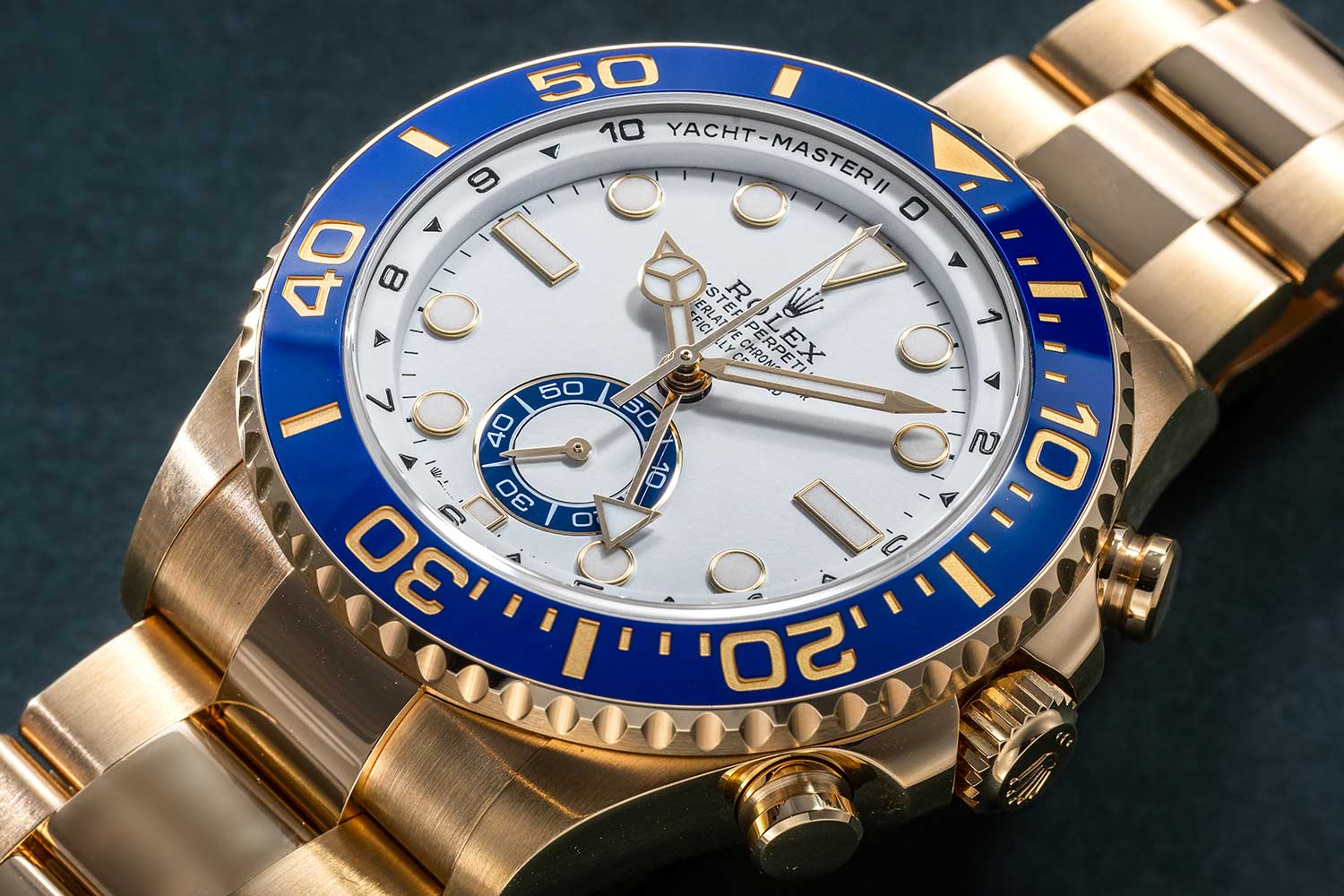
Yacht-Master II Ref. 126688 in yellow gold (©Revolution)
Programming the countdown is now performed directly through the pushers themselves, while the movement automatically transitions between synchronisation, reset and programming states. To anyone familiar with the original, the difference is astonishing and a marvel in itself. Yet what makes the new watch interesting is that Rolex does not appear to have simplified the underlying idea but rather internalised it, and characteristically, has done so in a manner that is unusually sophisticated for what it is attempting to achieve.
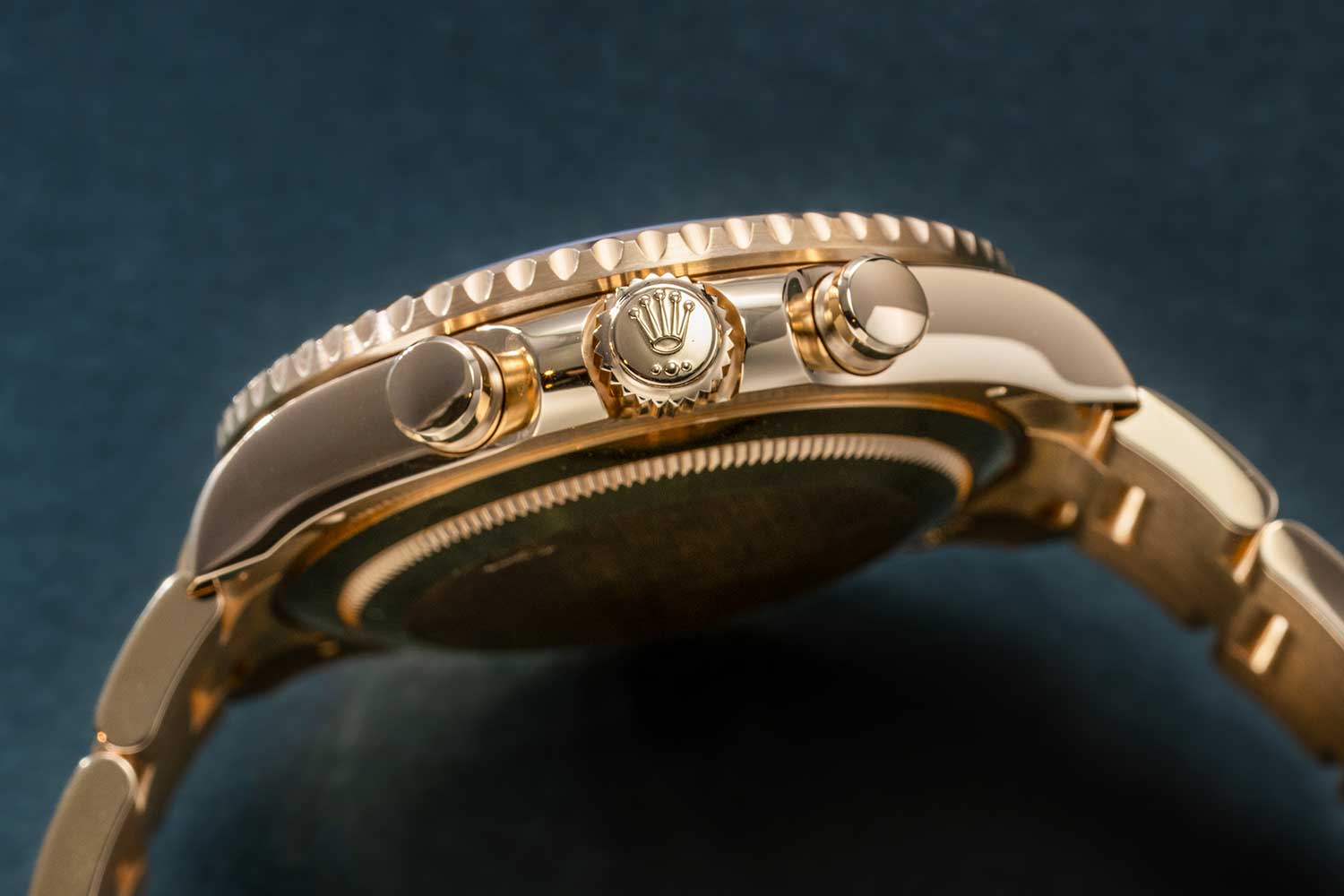
(©Revolution)
To understand why Rolex went to such lengths in the first place, it is worth understanding the highly specific environment for which both generations of the Yacht-Master II were made. The watch was not conceived to time the race itself, but the chaotic and highly tactical pre-start sequence that precedes it. Unlike Formula 1 cars that await motionless on a starting grid, racing yachts are already in violent motion long before the starting gun. In the final minutes before a regatta begins, boats circle, feint and accelerate towards the line with the aim of crossing it at maximum speed at the precise instant the countdown reaches zero. Too early and they are penalised but too late and the advantage is lost. Amid the noise, sail handling and constant manoeuvring, starting the countdown timer at exactly the right instant is far from guaranteed. Competitors often cannot react precisely enough to start the timer the moment the official signal is given. However, subsequent signals during the pre-start sequence are predictable. This gives the wearer a second opportunity to compare the timer against official race time and correct any discrepancy on the fly. It was this requirement that gave rise to the most unusual chronograph mechanism Rolex has ever produced.
The Basics
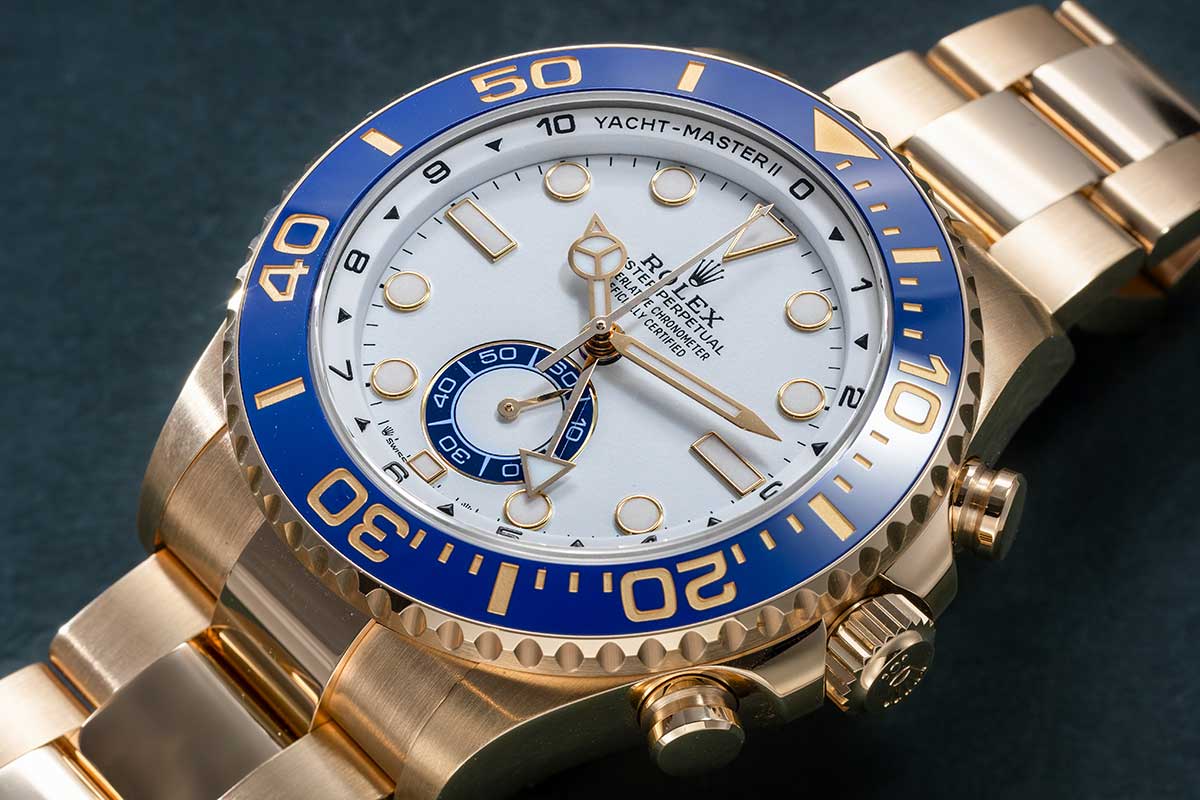
The new Yacht-Master II is offered in Oystersteel and 18k yellow gold, though both retain the nautical palette that is central to the peculiar charm of the model. Both versions pair a matte white lacquered dial with a vivid blue Cerachrom bezel insert, while the Oystersteel model retains the contrasting red accents of the original, which remain just slightly excessive in exactly the right way. The case remains 44mm in diameter, though at 13.9mm thick, it is a tad slimmer than before, down from 14mm. Despite the near identical dimensions, the watch wears smaller from lug to lug. Apart from its sheer bulk on my small 5.4-inch wrist, it sits surprisingly well, with no overhang, whereas the previous version was simply beyond what I could comfortably pull off. The bracelet itself is now slightly broader and paired with a slimmer Oysterlock clasp.
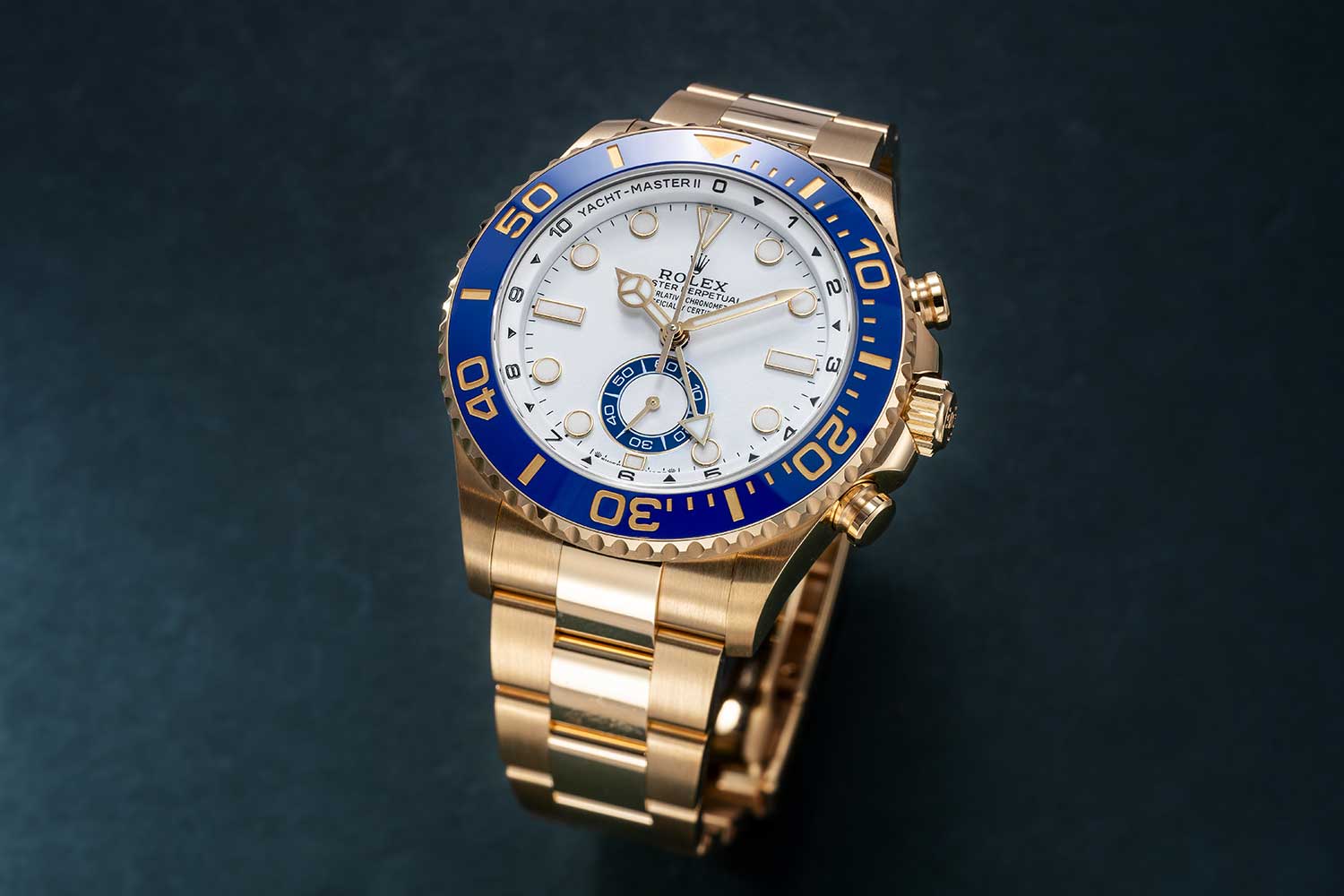
The Yacht-Master II has a bidirectional bezel with a blue Cerachrom insert with numerals and graduations coated in yellow gold via PVD (©Revolution)
The bidirectional bezel now serves a far more conventional role than the original Ring Command system. Graduated over 60 minutes, with the first 30 minutes marked by the minute for greater precision, it functions as a simple elapsed-time bezel for short sailing intervals. In practice, a sailor can align the bezel marker with the minute hand when passing a buoy and then read the elapsed sailing time directly from the bezel itself. It could also be used to read the last 30 seconds of the final minute countdown with greater precision. On the original watch, the bezel served strictly as the countdown scale, despite the fact that a large horseshoe-shaped countdown arc already dominated the dial, which gave the watch a somewhat overbearing character.
The countdown scale on the new watch has now been moved off the dial and onto an inner flange surrounding the dial, which immediately reduces the visual density of the watch. Rolex has also refined the display graphically. The 10-to-0-minute countdown and triangular half-minute markers remain, but the numerals are now smaller and arranged along the flange from 12 to 10 o’clock. Both the countdown minute and seconds hand now rotate counterclockwise, a first for Rolex, though the idea has appeared elsewhere in other regatta watches such as the Ulysse Nardin Marine Regatta. As the display is counting down towards zero rather than accumulating elapsed time, the reverse motion makes the indications more intuitive. With the applied Professional-series hour markers, the watch looks more classically Rolex while introducing far more visual quiet across the display. The sub-seconds is a separate inlay, which has a solid gold base on the yellow gold model.
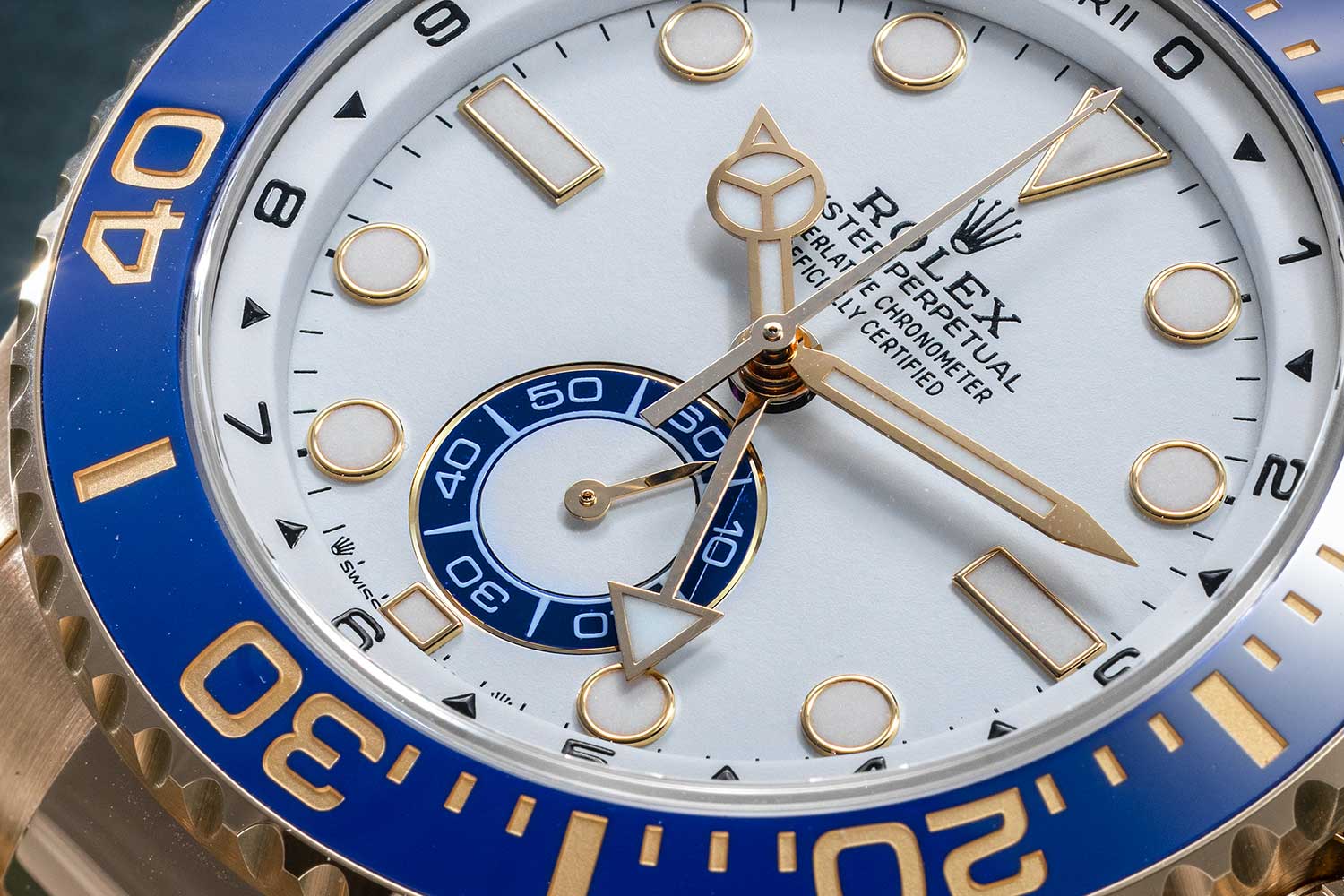
The dial is finished in matte white lacquer to reduce reflections and the countdown scale has migrated to the inner flange, where smaller numerals and half-minute markers reduce visual clutter, while the applied Professional-series hour markers give the display a more classically Rolex look (©Revolution)
Programming the countdown is performed solely through the lower pusher. Each press advances the triangular countdown minute hand by one increment along the 10-to-0-minute flange until the desired duration is reached. Once programmed, the selected countdown duration is mechanically memorised by the movement itself, meaning the wearer does not need to repeat the process before every race or subsequent regatta.
The countdown itself is initiated through the upper pusher. The countdown seconds hand immediately begins rotating counterclockwise while the countdown minute hand progressively advances towards zero. Together, the two hands continuously display the remaining time before the start line may legally be crossed.
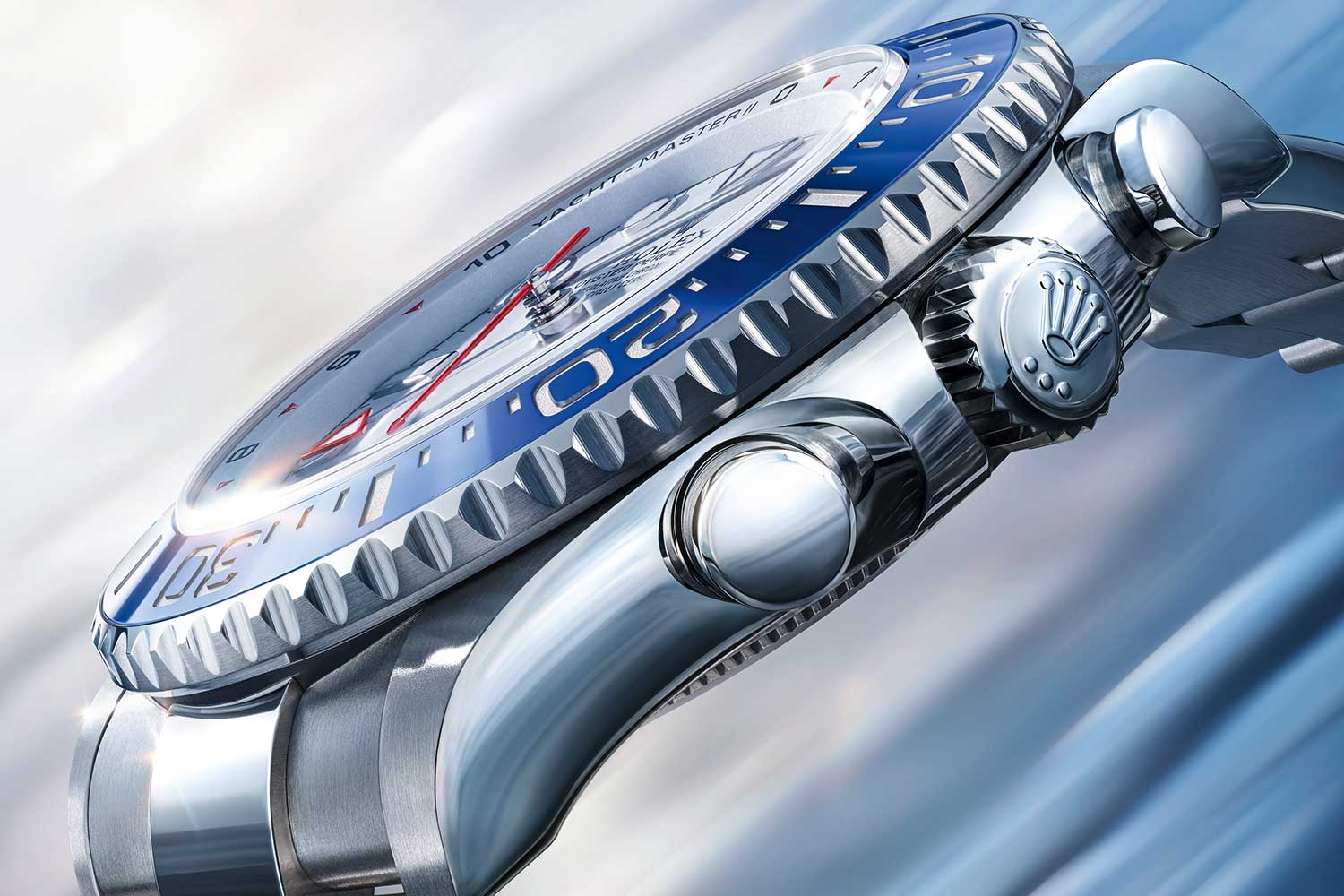
If the wearer starts the countdown slightly too early or too late relative to the official race sequence, pressing the lower pusher during operation instantly resets the central seconds hand while simultaneously synchronising the minute hand to the nearest minute to compensate for the discrepancy. The effect is still highly unusual as the watch is not simply resetting itself but actively correcting its own countdown state while remaining in operation.
At the end of the countdown, the minute hand stops automatically at zero when the official race start occurs, while the central seconds hand continues running until stopped manually via the upper pusher. Resetting the mechanism then returns the seconds hand to zero and the countdown minute hand to the previously set duration, ready for another pre-start sequence of the same duration unless re-programmed via the lower pusher once again.
The Mechanics
The Calibre 4162 is an evolution of the Calibre 4161 that powered the previous version of the model. Notably, it receives a more elaborate level of finishing, with bridges decorated in Rolex Côtes de Genève, distinguished from the traditional pattern by the polished groove running between each stripe. There is also an openworked oscillating mass. The basic specifications otherwise remain unchanged from the previous movement, including a 72-hour power reserve, a frequency of 4Hz and a blue Parachrom hairspring.
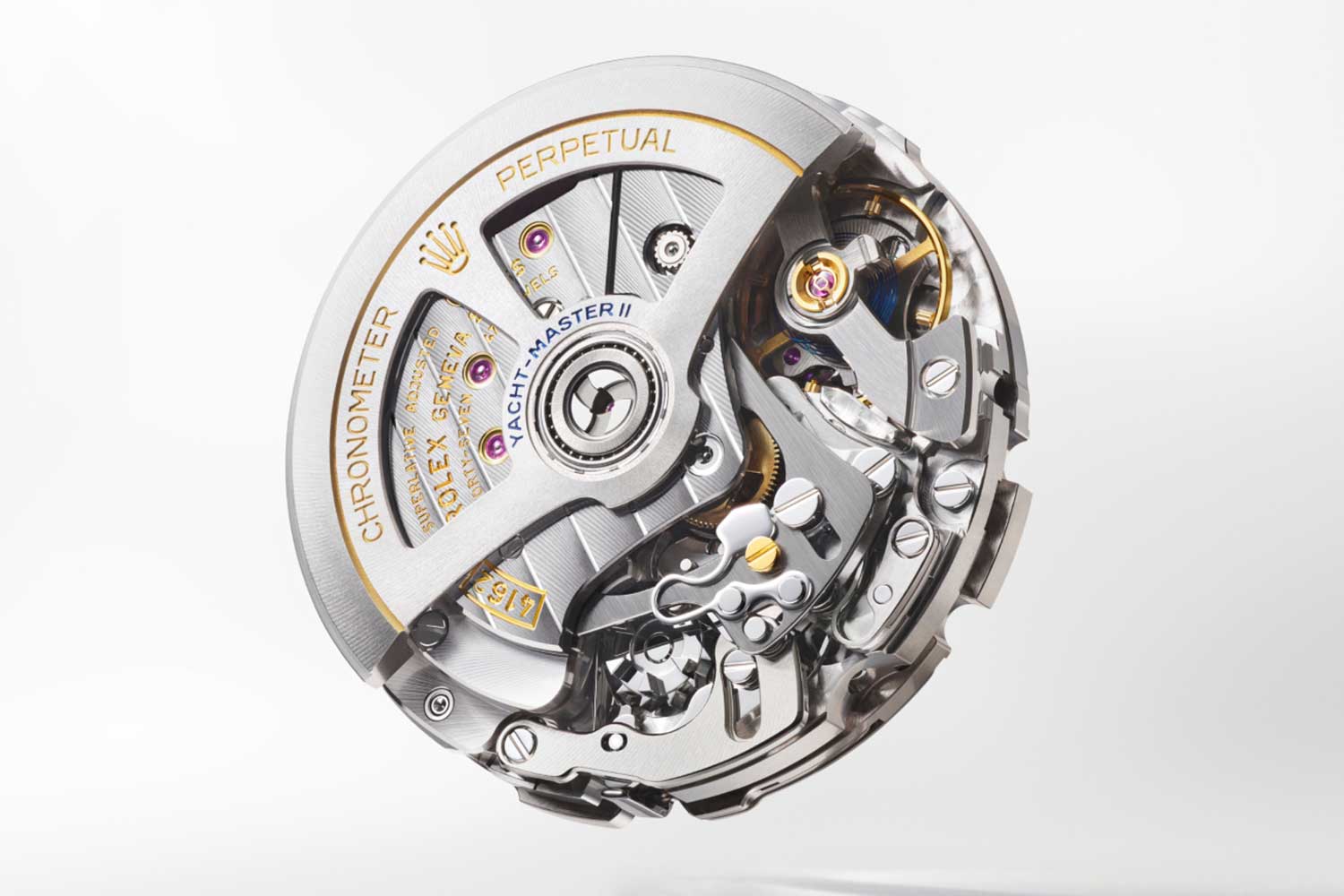
Calibre 4162
Like the 413X series, it has an off-centred vertical clutch and appears to preserve much of the same underlying chronograph architecture, including a reset hammer with a self-adjusting arm for the chronograph seconds. Additionally, the chronograph seconds wheel features sprung teeth, which eliminates play and allows the reset force applied to the heart cam to be transmitted to the central chronograph seconds wheel elastically through the gear mesh, and this enables the centrally mounted seconds hand to return to zero smoothly despite the reset hammer acting off-centre. Beneath the dial is an additional programmable countdown train with its own system of cams, levers and hammers to manipulate and preserve the programmed time, all coordinated through the same column wheel that extends through the mainplate.
At its core, while the original Yacht-Master II relies on a crown-adjusted differential relationship between the reset cam and countdown display, accessed via the bezel, the new watch replaces the entire Ring Command programming system with a pusher-operated programming train governed by a locking lever, a setting pawl and column wheel that automatically switches the lower pusher between synchronisation, reset and programming functions.
In the programming state, the countdown minutes reset hammer is pressed into the recess of the minutes reset cam, and a locking lever prevents the hammer from pivoting back out again. This immobilises the minutes reset wheel. In this configuration, the lower pusher no longer performs a reset function. Instead, each press advances the countdown setting wheel through its star wheel by one increment via a pawl.
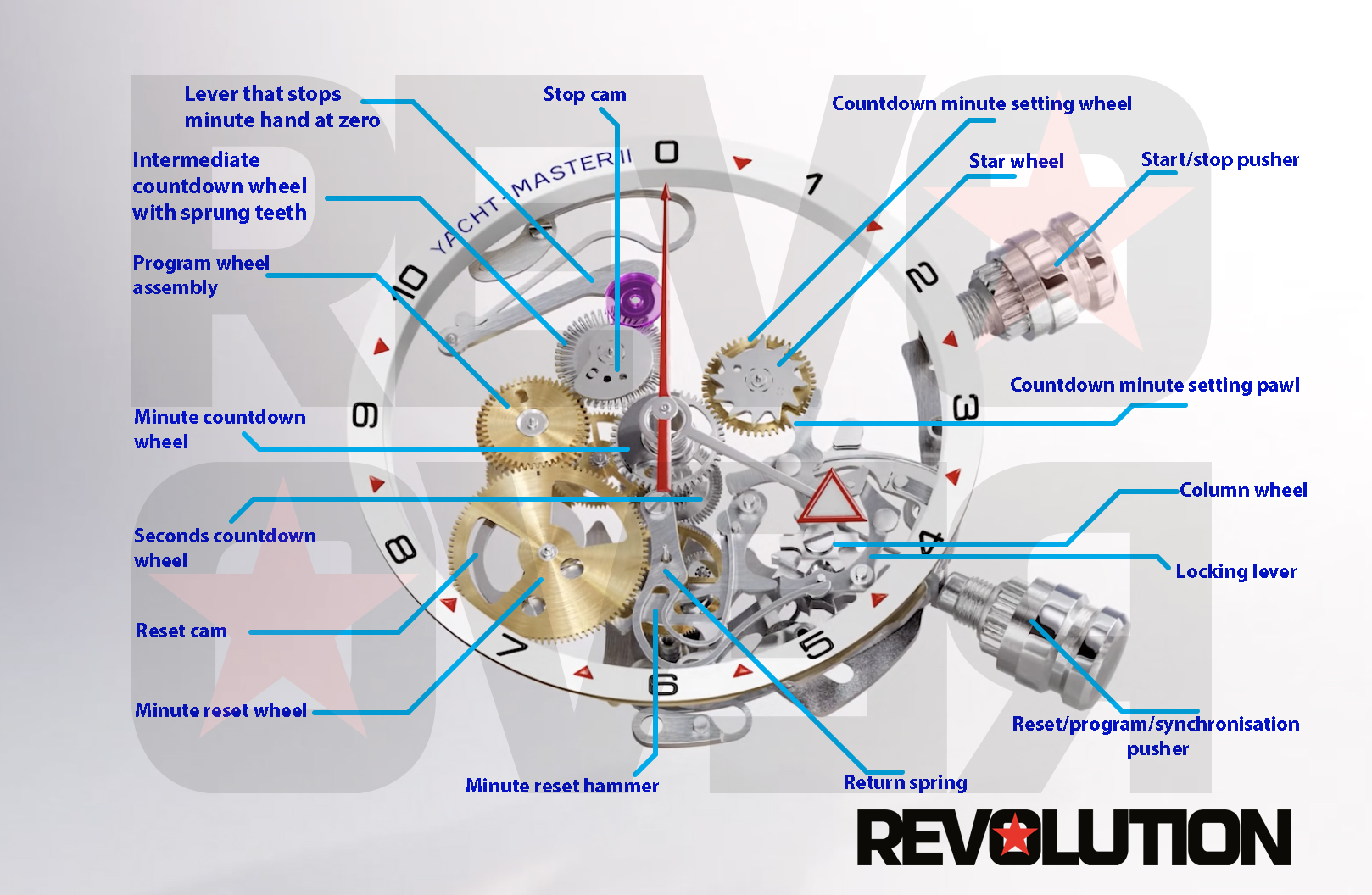
Setting the countdown duration in turn affects a unidirectional programming assembly, which lies at the heart of the system. This single mechanism, which was already present in a different setup in the original watch, remains the most unusual and ingenious aspect of the watch. It is responsible for the three defining traits of the Yacht-Master II – the ability to pre-program and preserve a countdown duration, as well as synchronise to the nearest minute while running. Additionally, it also allows the minute countdown to stop independently at zero while the seconds continue running, which could technically be used to measure elapsed time after the start of the race although this function is limited due to its short duration and counterclockwise motion.
Within this programming assembly, there are two star wheels and two pawls that work in tandem but serve different roles. The program star wheel and its pawl encode the programmed countdown duration. Separately, an incremental star wheel and its pawl manage the minute wise increments and synchronisation adjustments that occur during countdown running.
Mechanically, advancing the setting wheel changes the angular relationship between the minute program wheel and the wheel connected to the countdown minutes display. The pawl incrementally advances the program star wheel, setting and locking the countdown length as a fixed angular position.
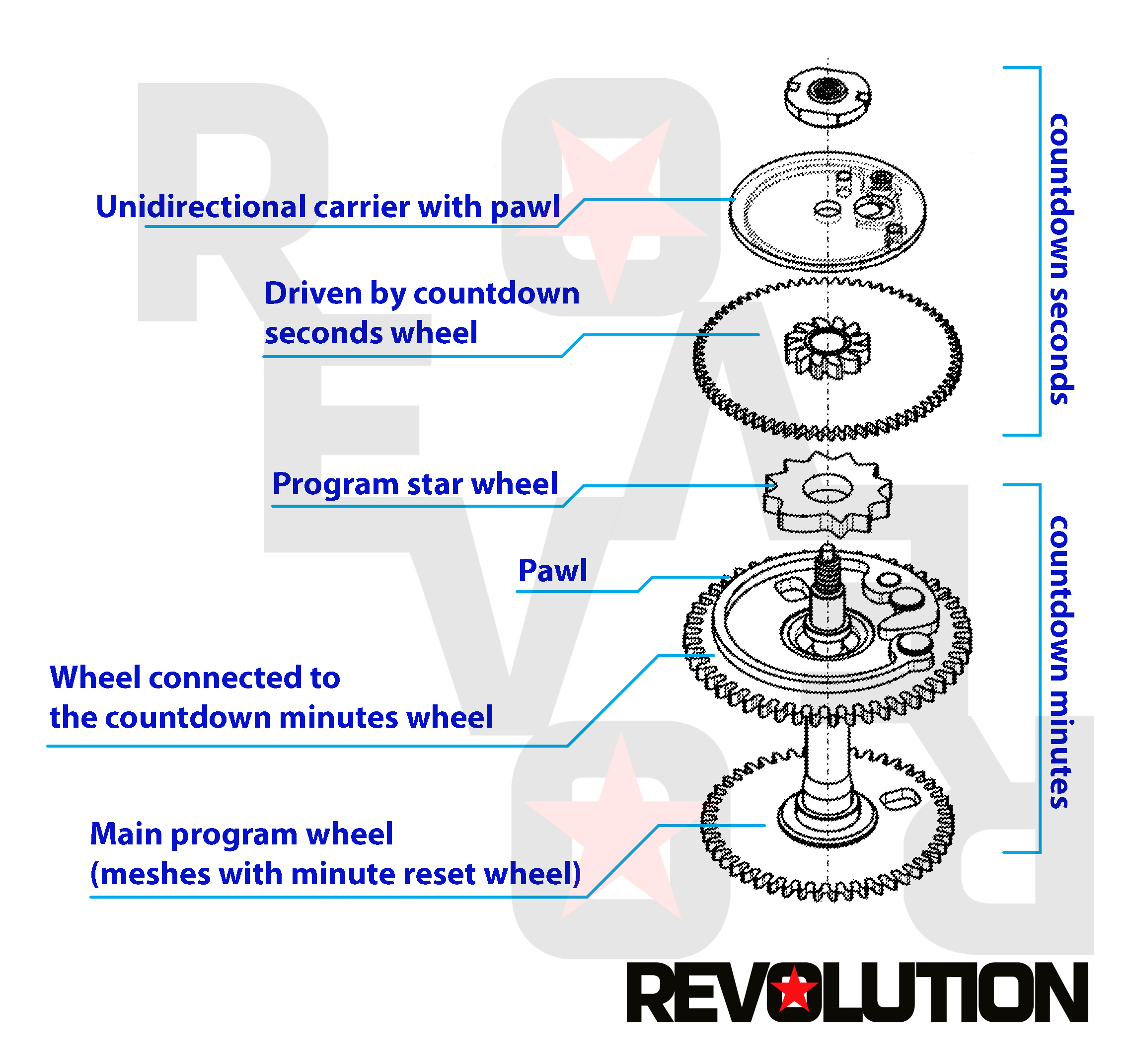
The co-axial programming stack at the heart of the countdown mechanism combines two distinct functions. The upper unidirectional connection transmits motion from the countdown seconds train while permitting synchronisation corrections, while the lower programming assembly encodes the selected countdown duration as a variable angular relationship between the reset mechanism and the countdown minutes display
Once programmed, the countdown is started via the upper pusher. The countdown chronograph seconds wheel is coupled to the going train via a vertical clutch. Motion first passes through a unidirectional coupling, which transmits torque during normal operation while enabling synchronisation, reset and stop-at-zero functions. From there, torque propagates through the programming assembly, then onward through the intermediate countdown wheel and finally to the countdown minutes wheel carrying the central countdown minute hand.
Pressing the lower pusher disengages the clutch and resets the countdown seconds hand to zero via the usual hammer-and-heart-cam mechanism. The correction imparted to the seconds train is transmitted through the programming assembly, causing the countdown minutes indication to jump to the nearest full minute. The incremental pawl in the assembly either holds the star wheel, and thus the minutes hand in its current position or advances it by one tooth, depending on whether the seconds count before reset is less than or greater than half a minute.
Unlike a conventional chronograph minute counter, the minutes display is not advanced once per minute by an indexing finger. The entire countdown train is continuously driven. However, because the programming assembly manages the minutes indication through a star wheel and pawl system, the display still advances in one-minute increments. As the countdown progresses, torque is transmitted from the program assembly to the intermediate countdown wheel which carries a snail cam. A lever rides against this snail cam and ultimately determines when the countdown is stopped. When the roller on the lever reaches the radial face of the snail corresponding to zero, the minute train is blocked and the countdown minute hand stops precisely at zero. The chronograph seconds wheel, however, continues running beneath it because the unidirectional connection transmits torque from the seconds train to the minute train but does not transmit the stopping torque in the opposite direction.
The stop state preserves the programmed countdown duration while halting the countdown itself. From here, pressing the lower pusher causes the reset hammer to act on the reset cam, which is rigidly fixed to the reset wheel, returning the countdown train to its programmed starting position. A countdown programmed for 7 minutes will return to 7 minutes remaining, as the interval was previously encoded as a fixed angular relationship within the train. Resetting returns the mechanism to the reference position, while successive presses of the lower pusher will change the relationship itself and thereby set a new countdown duration.
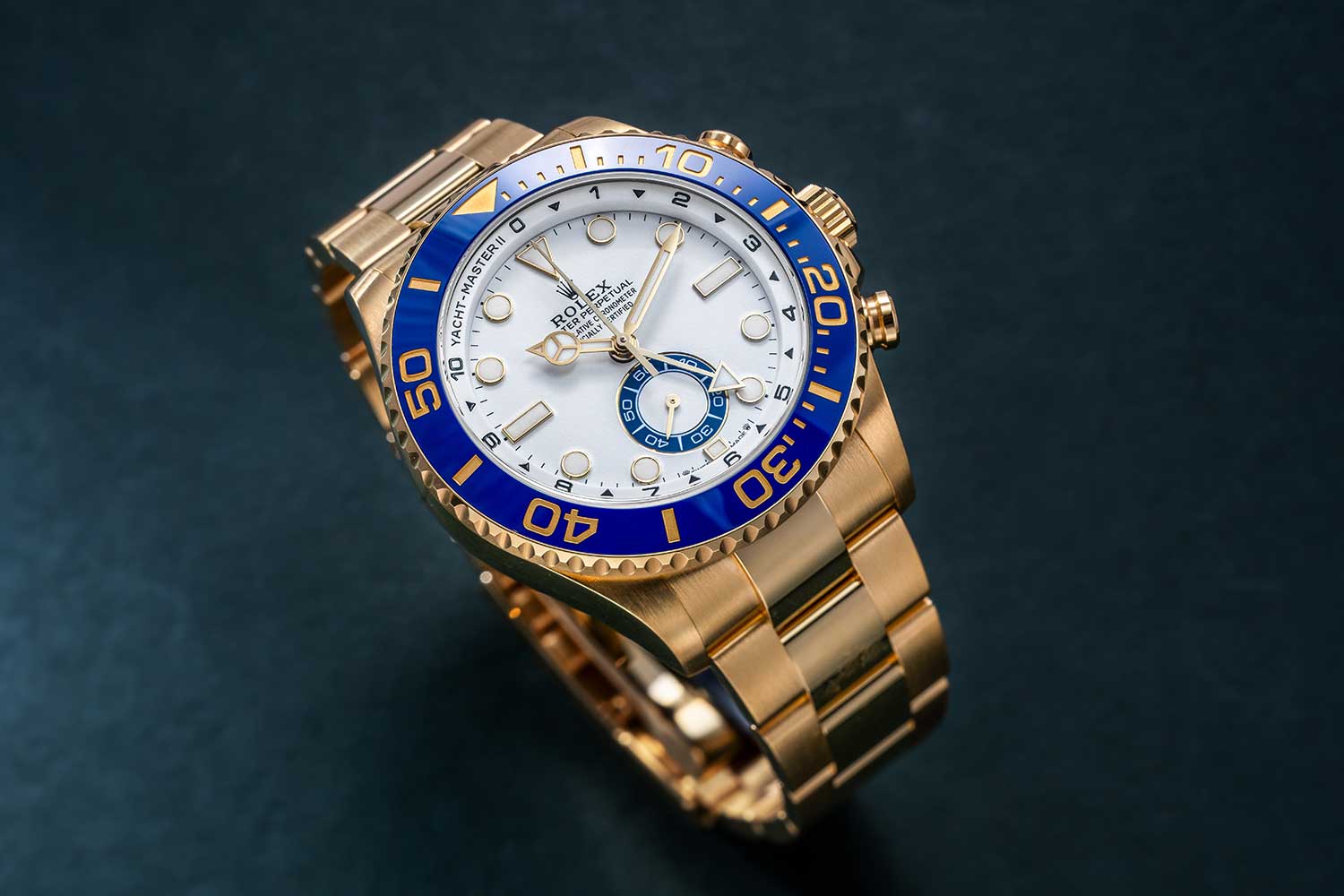
Rolex Yacht-Master II Ref. 126688 (©Revolution)
Much of the ingenuity and complexity of the original have been retained, yet the cumbersome choreography once required to access those functions has all but disappeared from the user experience. Crucially, the crown no longer needs to be unscrewed at any point in the process, which was always odd for a watch designed around the chaos and spray of open water. What remains is a remarkably ambitious niche complication with a degree of conceptual depth that feels considerably closer to haute horlogerie than to the sort of advanced fundamental watchmaking technology for which Rolex is typically admired.
Even to someone who has never set foot on a racing yacht, there is something seductive and wonderfully out of step about devoting this level of engineering effort to a watch with such a singular purpose, particularly in an era when so many luxury sports watches have gradually become variations of the same formula even as they delve into complications. Besides, it is difficult not to find the whole thing enormous fun to engage with whether one has any actual use for such a chronograph or not. It is a watch that seems to justify the usefulness of a problem most owners will never encounter purely through the ingenuity of its solution, and in that respect the Yacht-Master II is one of the most distinctive and compelling luxury sports watches there is today.
Rolex Oyster Perpetual Yacht-Master II
Ref 126680 (Oystersteel); 126688 (18K yellow gold)
Movement Self-winding Calibre 4162; 72-hour power reserve; 4 Hz (28,800 vph)
Functions Hours, minutes and seconds; regatta countdown timer
Case 44mm × 13.9mm; Oystersteel or 18K yellow gold; water resistant to 100m
Dial Matte white lacquered dial with countdown inner flange
Strap Oyster bracelet in matching metal with Oysterlock safety clasp with Easylink 5mm comfort extension link
Availability From Rolex boutiques and authorised retailers
Price US$20,300 (Oystersteel); US$57,800 (18K yellow gold)
Rolex

You may also like
Editorial
A Closer Look: Rolex Perpetual Padellone
Sep 22, 2026
Editorial
A Closer Look: Rolex Perpetual Padellone
Sep 22, 2026
News
Last Week In Watches: Rolex Revives the Padellone, Hublot Goes Full Koons
Sep 21, 2026
News
Last Week In Watches: Rolex Revives the Padellone, Hublot Goes Full Koons
Sep 21, 2026
Editorial
Rolex’s Future Is Complicated: The New Perpetual Padellone Family
Sep 16, 2026
Editorial
Rolex’s Future Is Complicated: The New Perpetual Padellone Family
Sep 16, 2026