A Closer Look: Patek Philippe Calatrava Chiming Alarm 5322G
Reviews
A Closer Look: Patek Philippe Calatrava Chiming Alarm 5322G

A first encounter with a Patek Philippe alarm watch can be quite a staggering experience. It sounds for all the world like a minute repeater and only gradually reveals that it is performing the most prosaic of tasks when the strike continues on a single note far beyond the point where a repeater would have moved on or fallen silent. This incongruity takes a moment to register, and the realisation that this is in fact an alarm watch seems to arrive afresh. The effect owes much to the quality of the chime itself, which has a resonance, clarity and cadence more readily associated with a finely tuned repeater than with a conventional alarm.
Much of my prior experience with alarm watches had been with the Vulcain Cricket and the Jaeger-LeCoultre Memovox. These are watches with considerable charm; even as the years go on, there is still an element of astonishment in hearing an alarm emerge from a mechanical watch, and they defined the genre for much of the 20th century. Their purpose, however, is never in doubt. When they sound, they sound like alarms, with a loud penetrating buzz, though a modern Memovox in particular is higher pitched, producing something closer to a school bell. Either way, they do exactly what it says on the tin. They are straightforward and remarkably effective solutions to the problem of waking a sleeping owner.
A Patek Philippe alarm, however, stems from a different premise. By the time the company turned its attention to the complication, the alarm watch had long since lost any practical contest with electronics. The goal was no longer to make a better alarm but to create one whose appeal survived the fact that every mobile phone already performed the same task with greater convenience and perfect reliability.
The alarm complication first made its debut in a Patek Philippe timepiece with the Calibre 89, a grande and petite sonnerie carillon with minute repeater that struck each quarter on four gongs, while a fifth was reserved for the alarm. Patek returned to the idea in 2014 with the Grandmaster Chime, also a grande and petite sonnerie, though this time configured as a three-gong carillon. Its alarm was even more remarkable; instead of a separate signal, it chimed the full time in hours, quarters and minutes with the same tone sequences as a minute repeater. To achieve this, Patek devised a mechanism that effectively pre-armed the repeater. When the alarm was activated, the racks were released but held just short of their respective snails. Only when the programmed time arrived were they allowed to complete their fall, read the displayed time and release the strike train.
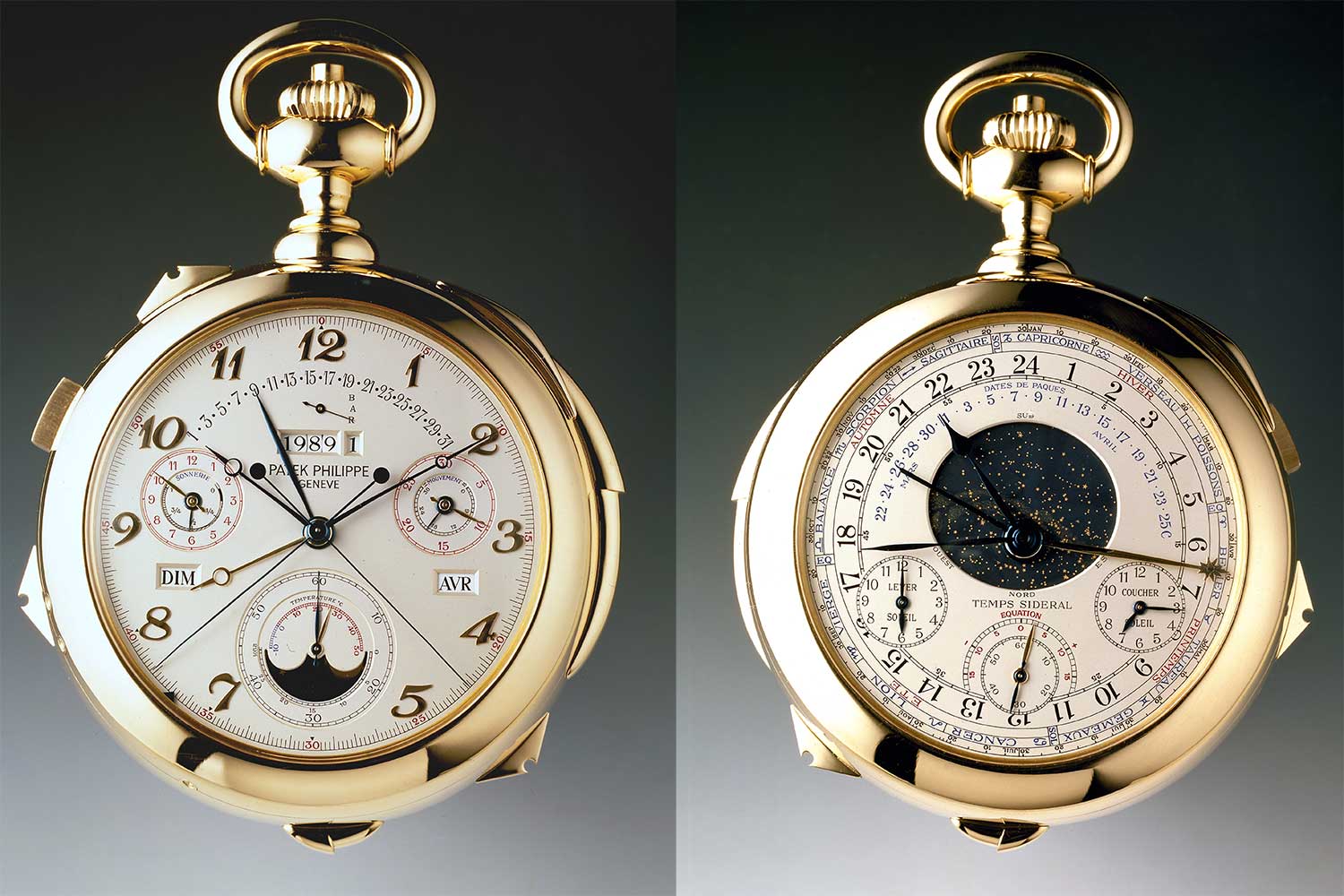
Calibre 89
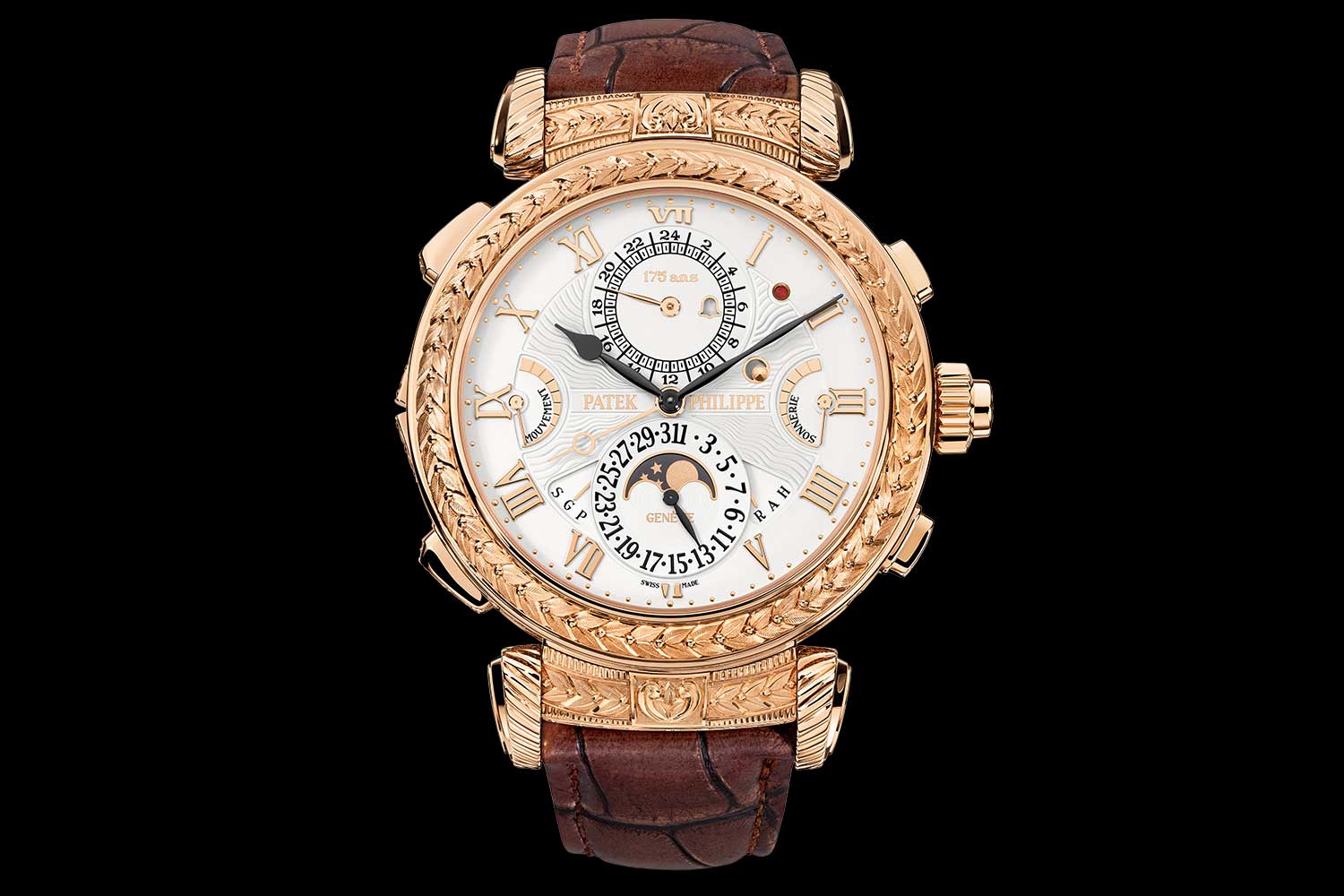
Grandmaster Chime Ref. 5175
Then in 2019, Patek launched the Alarm Travel Time Ref. 5520P which combined the alarm complication with a GMT function in a pilot-styled watch. Conceptually, it made perfect sense. Whether waking for an early flight, adapting to a new time zone or keeping track of commitments abroad, the usefulness of an alarm arguably only increases when one is travelling. The only problem was that it had three pushers and one crown arranged symmetrically on both sides of the case. Although each served a perfectly rational purpose and the watch was, in many respects, a triumph of practical watchmaking, they gave the watch a more divisive appearance than its mechanics deserved. The reference has since been fully discontinued this year.
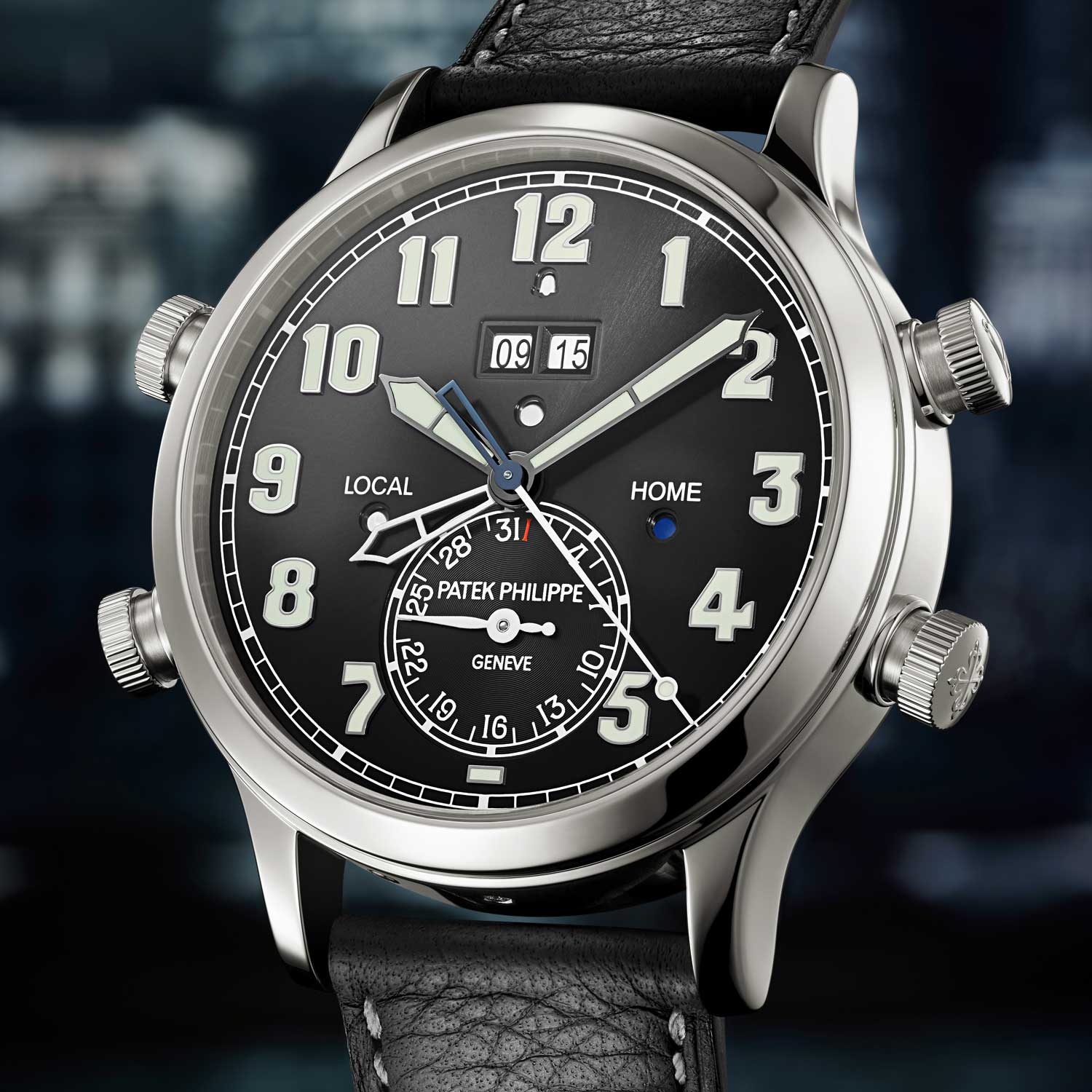
Patek Philippe Ref 5520P-001 Travel Time Alarm
In its place is the Chiming Alarm 5322G, in which for the first time, the alarm complication is the centrepiece of the watch. The most immediate difference is that it looks like a Calatrava rather than a pilot’s watch. It follows the path set by the Calatrava 5226 launched in 2022 and presents the alarm complication within the framework of a contemporary dress watch.
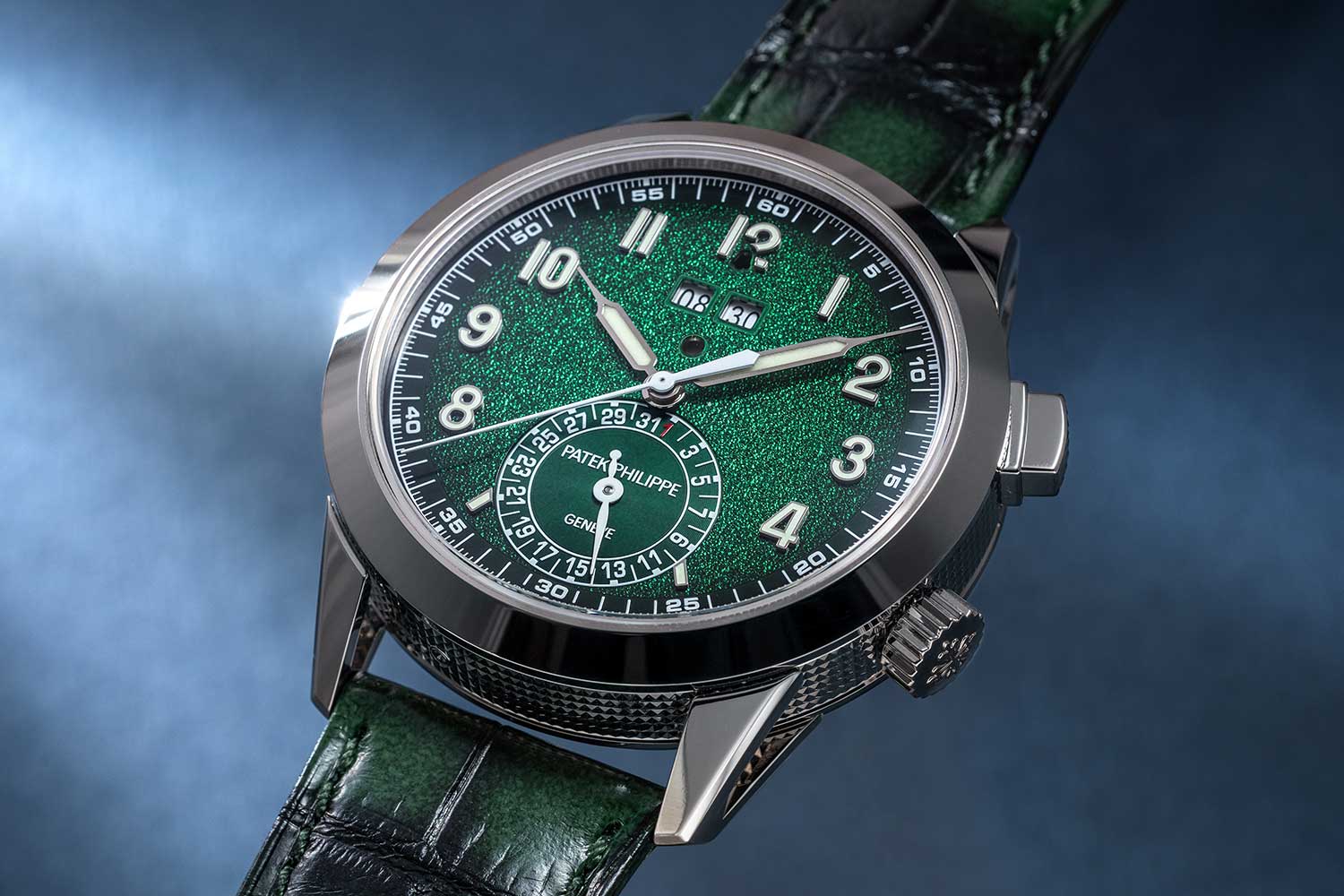
Patek Philippe Calatrava 24-Hour Alarm Ref. 5322G-010 (©Revolution)

Patek Philippe Calatrava 5226G-001
The 41mm white gold case is slightly smaller than its predecessor but thicker at 12.2mm compared to 11.6mm for the 5520, despite both watches being powered by movements of identical dimensions. In practice, however, the reduction in diameter and the absence of the 5520’s four-cornered arrangement of pushers and crown make the 5322 much less imposing on the wrist.
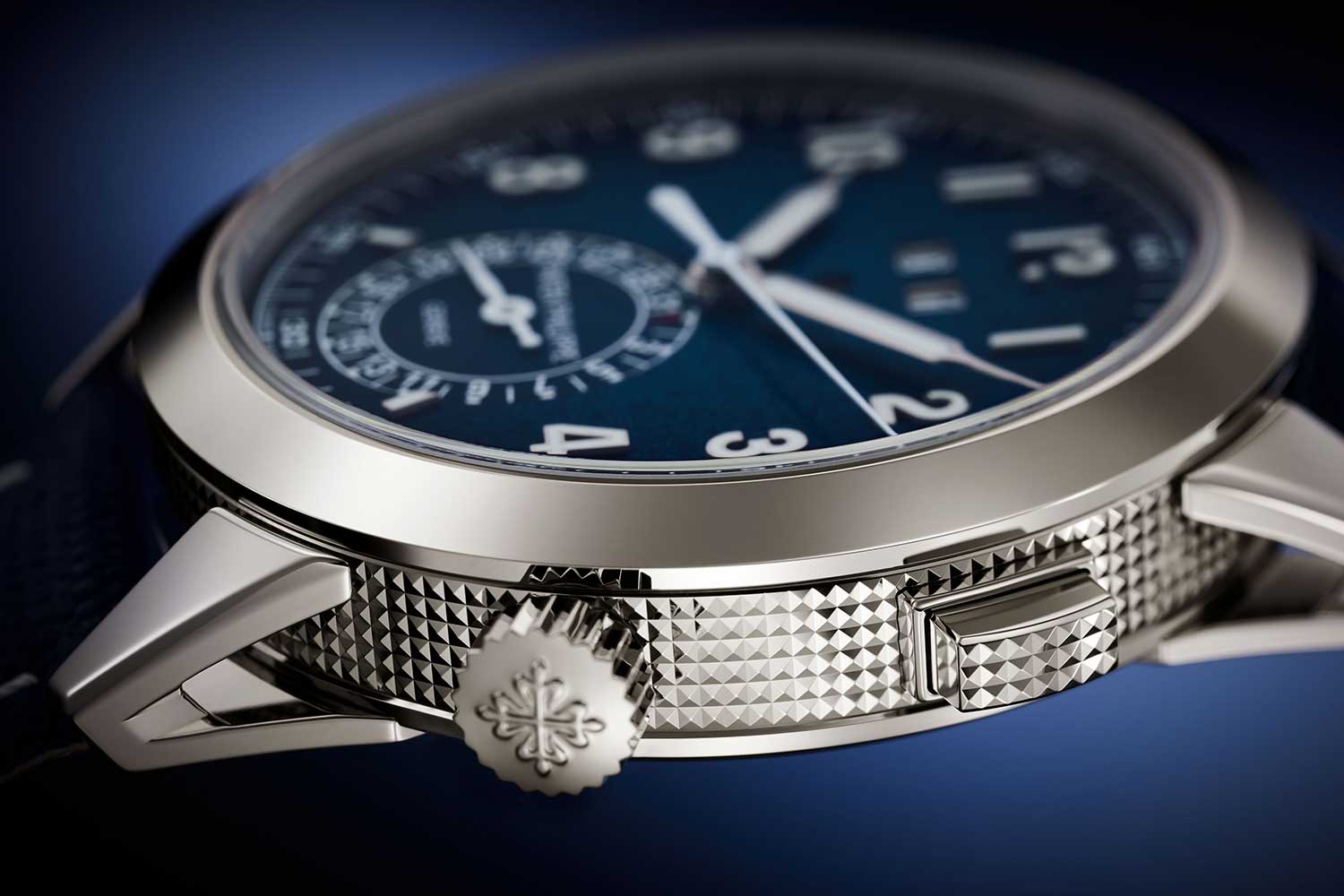
The clous de Paris hobnail pattern run uninterrupted around the entire case band
The lugs are skeletonised on their flanks, and as on the 5226, are attached only to the caseback, allowing the clous de Paris hobnail pattern to run uninterrupted around the entire case band. Even the pusher at 2 o’clock has been lavished with the same motif. Notably, the case is depth rated to 30m, which makes it the only water resistant chiming watch in Patek’s catalogue.
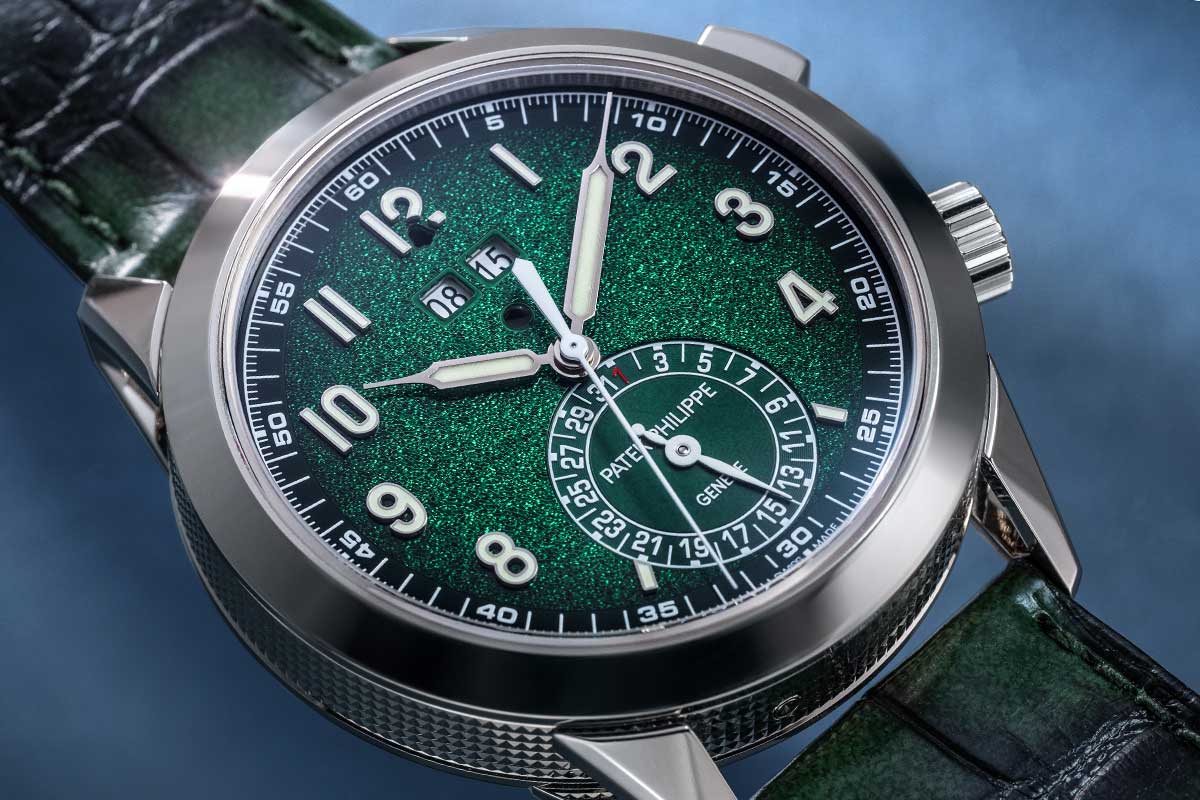
The dial begins as a brass blank that is galvanically treated with a nickel-gold coating. It is then stamped with a grained texture inspired by the surfaces of vintage camera bodies. Colour is applied next, with either blue or green lacquer sprayed onto the dial. To create the fumé effect, the dial is rotated while black lacquer is sprayed onto its outer edge, producing a gradual darkening towards the periphery. The date sub-dial with its snailed pattern, on the other hand, is made separately.
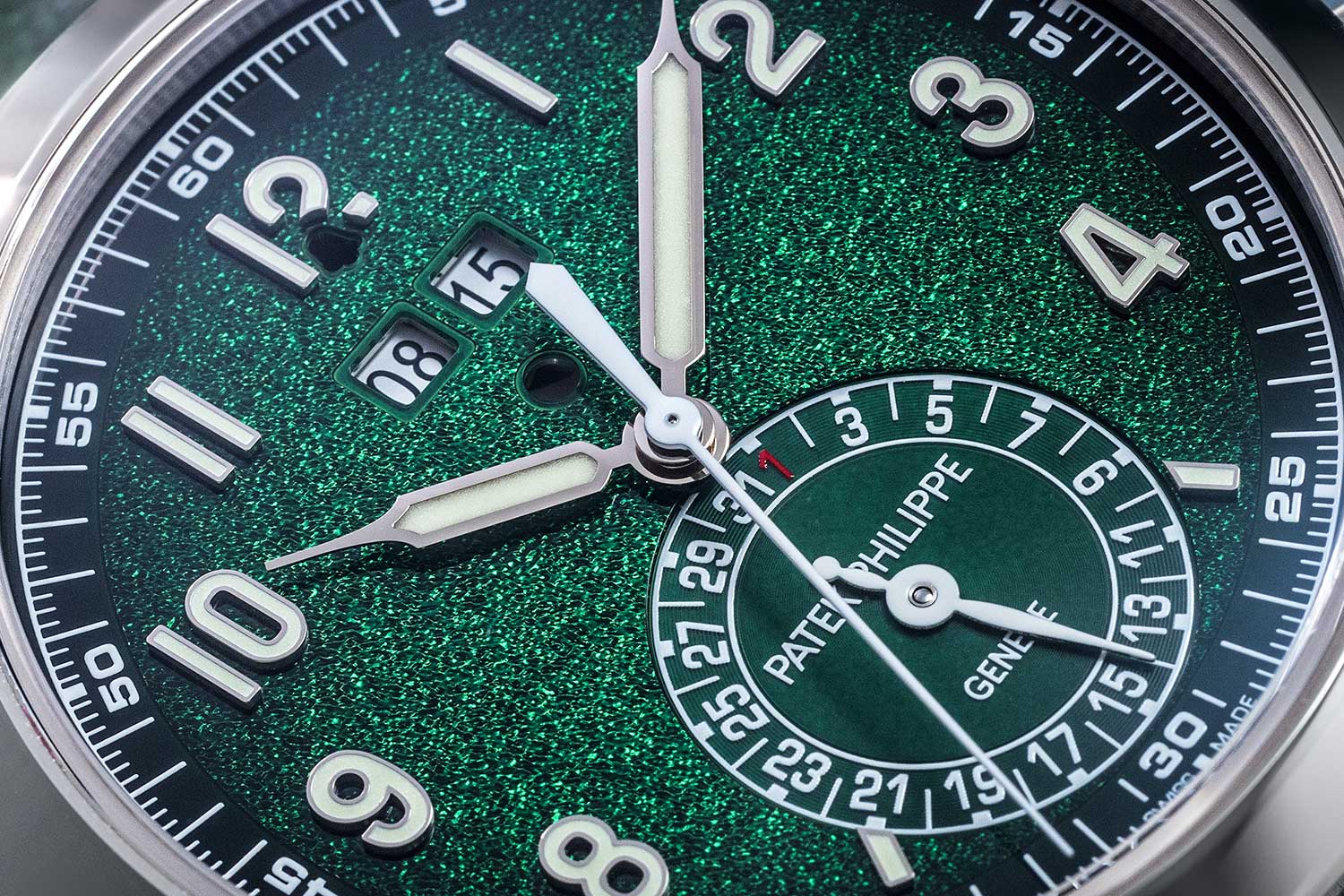
The grained texture dial inspired by the surfaces of vintage camera bodies (©Revolution)
Generous applications of Super-LumiNova on the white gold syringe hands and Arabic numerals make no attempt to disguise the watch’s utilitarian ambitions. The combination of its modern proportions, traditional clous de Paris case band, a lively grained fumé dial and luminous furniture is an idiosyncratic one. It may not be the purest expression of a dress watch but it is no doubt one that stands out.
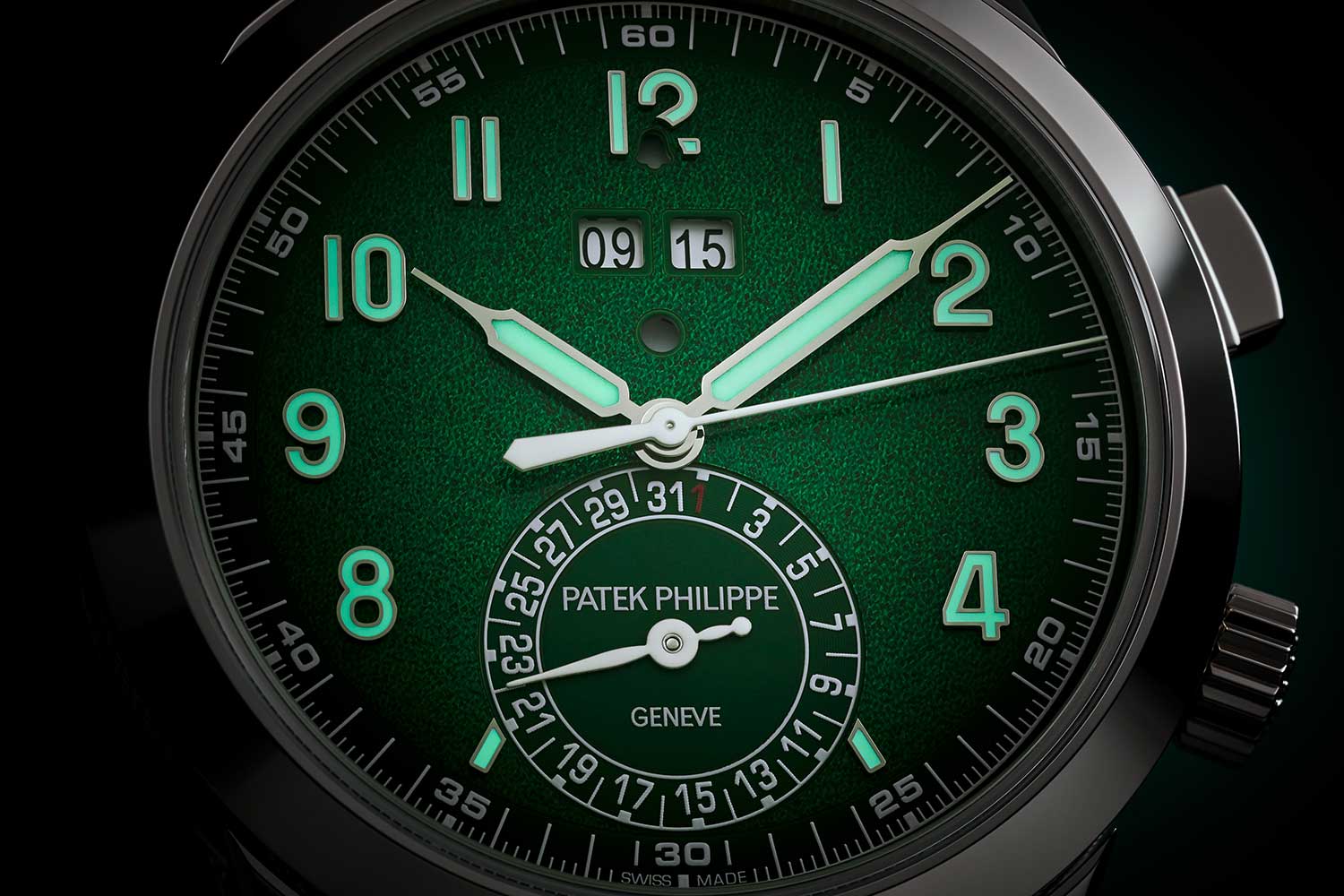
The Super-LumiNova on the white gold syringe hands and Arabic numerals
The alarm indications occupy the upper half of the dial, where a double aperture displays the selected alarm time in quarter-hour increments. Beneath it, a day/night indicator allows the alarm to be programmed across a full 24-hour cycle. Setting the alarm is straightforward: the crown at 4 o’clock is pulled to its intermediate position and turned in either direction until the desired time appears in the aperture. The display can be adjusted forwards or backwards and up to 23 hours in advance, though only in 15-minute increments. If the current time is 9:20, for example, the earliest possible alarm is 9:30, while the latest would be 8:15 the following morning.
A discreet bell-shaped aperture cutting through the 12 o’clock numeral indicates the status of the alarm, changing from black to white when activated via the pusher a 2 o’clock. Date indication is provided by a pointer date at 6 o’clock. Unlike the alarm, however, the date can only be advanced, via a recessed corrector set into the case band between 6 and 7 o’clock.
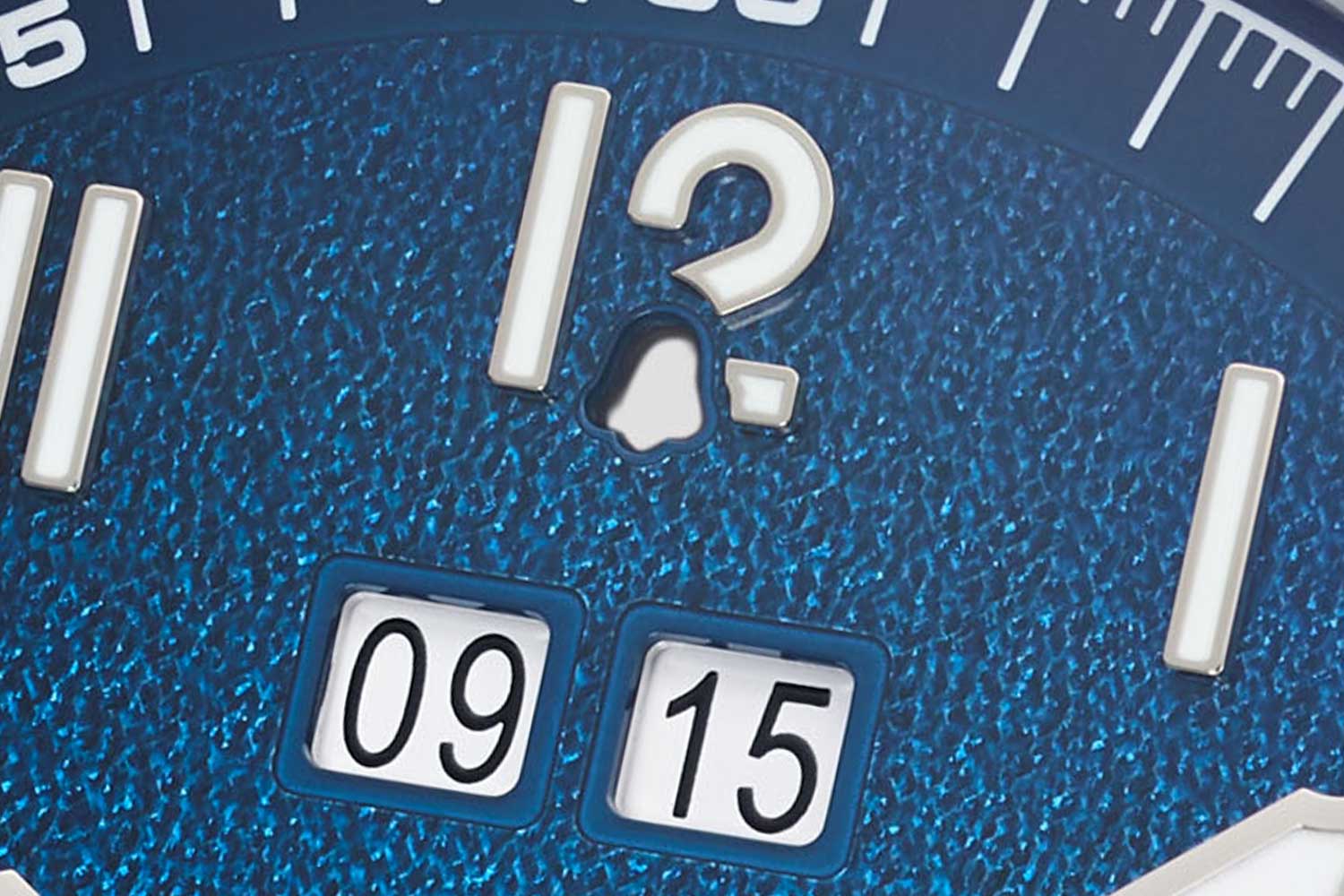
A discreet bell-shaped aperture that cuts through the 12 o’clock numeral indicates the status of the alarm
Even without the dual time function, the self-winding Calibre AL 30-660 SC is a densely engineered movement comprising 524 parts, which is comparable to, and in many cases, far exceeding that of a minute repeater, with some 250 parts dedicated to the alarm mechanism alone. There is a stop-seconds function, along with the familiar repertoire of a free-sprung Gyromax balance and silicon Spiromax hairspring.
As is typical of chiming watches, the movement is equipped with two barrels – one for timekeeping and the other for the alarm function. With the crown pushed home, clockwise rotation winds the alarm barrel while turning it counterclockwise winds the going barrel.
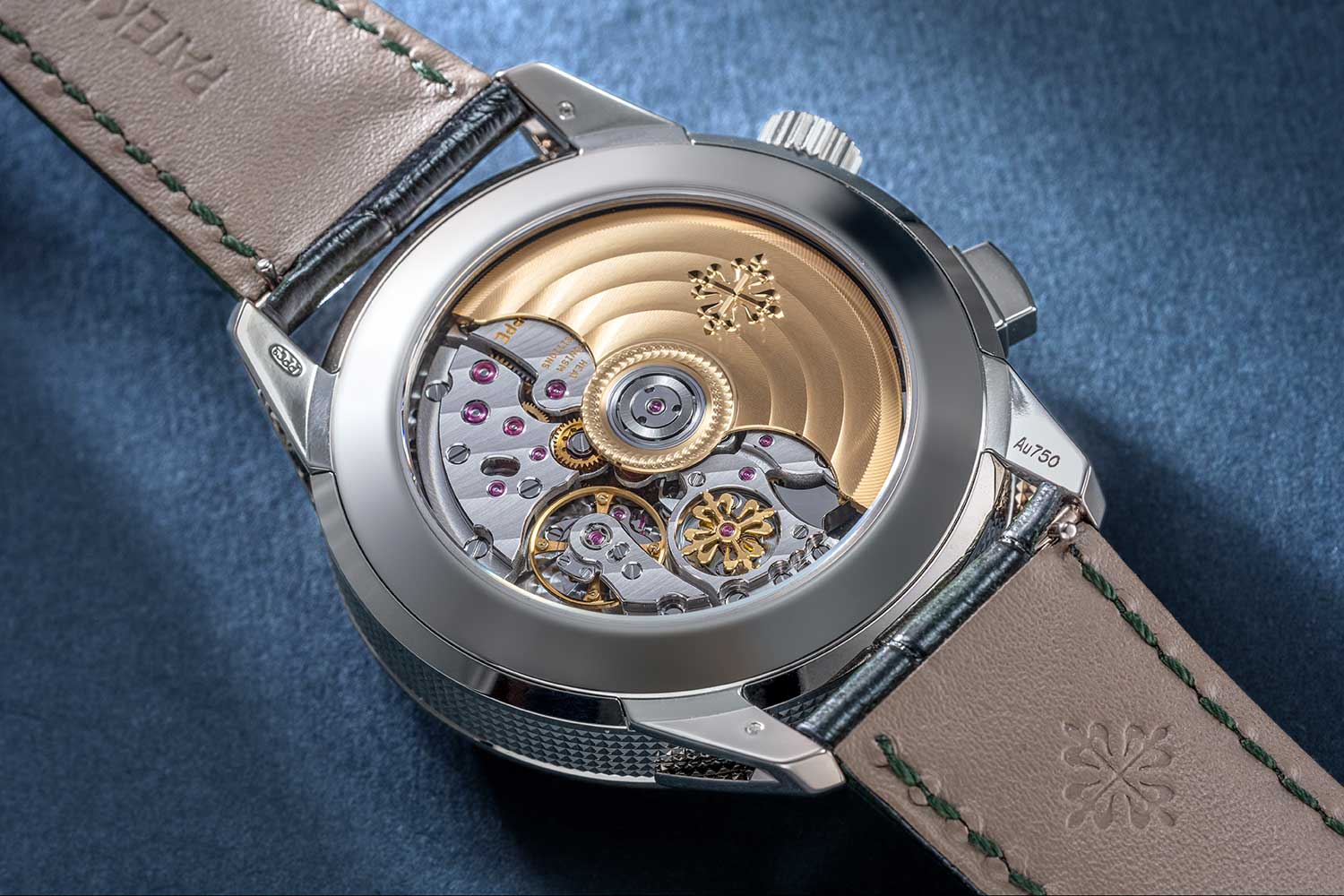
View from the caseback, the Calibre AL 30-660 SC (©Revolution)
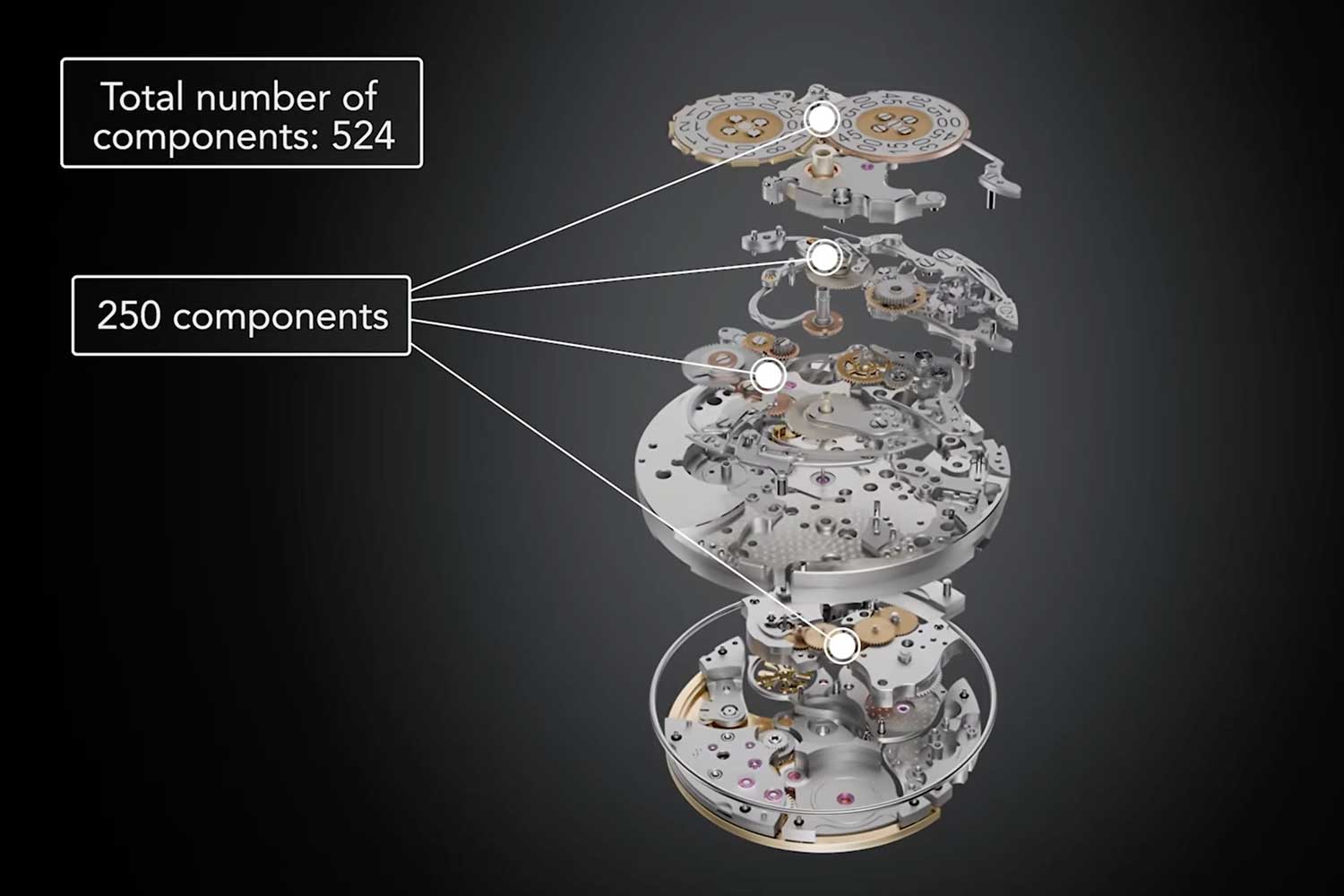
As with a minute repeater, the alarm barrel also drives a centrifugal governor, which regulates its unwinding and hence the frequency of the strikes. This sets it apart from many other alarm watches on the market that depend on a strike wheel and anchor, to which the hammer is directly attached.
The mechanism operates at 2.5 strikes per second and is capable of delivering up to 90 strikes, allowing the alarm to sound for approximately 36 seconds when fully discharged. The cadence is sufficiently measured that the sound never acquires the urgency normally associated with an alarm. Combined with the use of a circular gong, it produces a sonority that is remarkably close to that of a minute repeater and unlike anything else in the category.
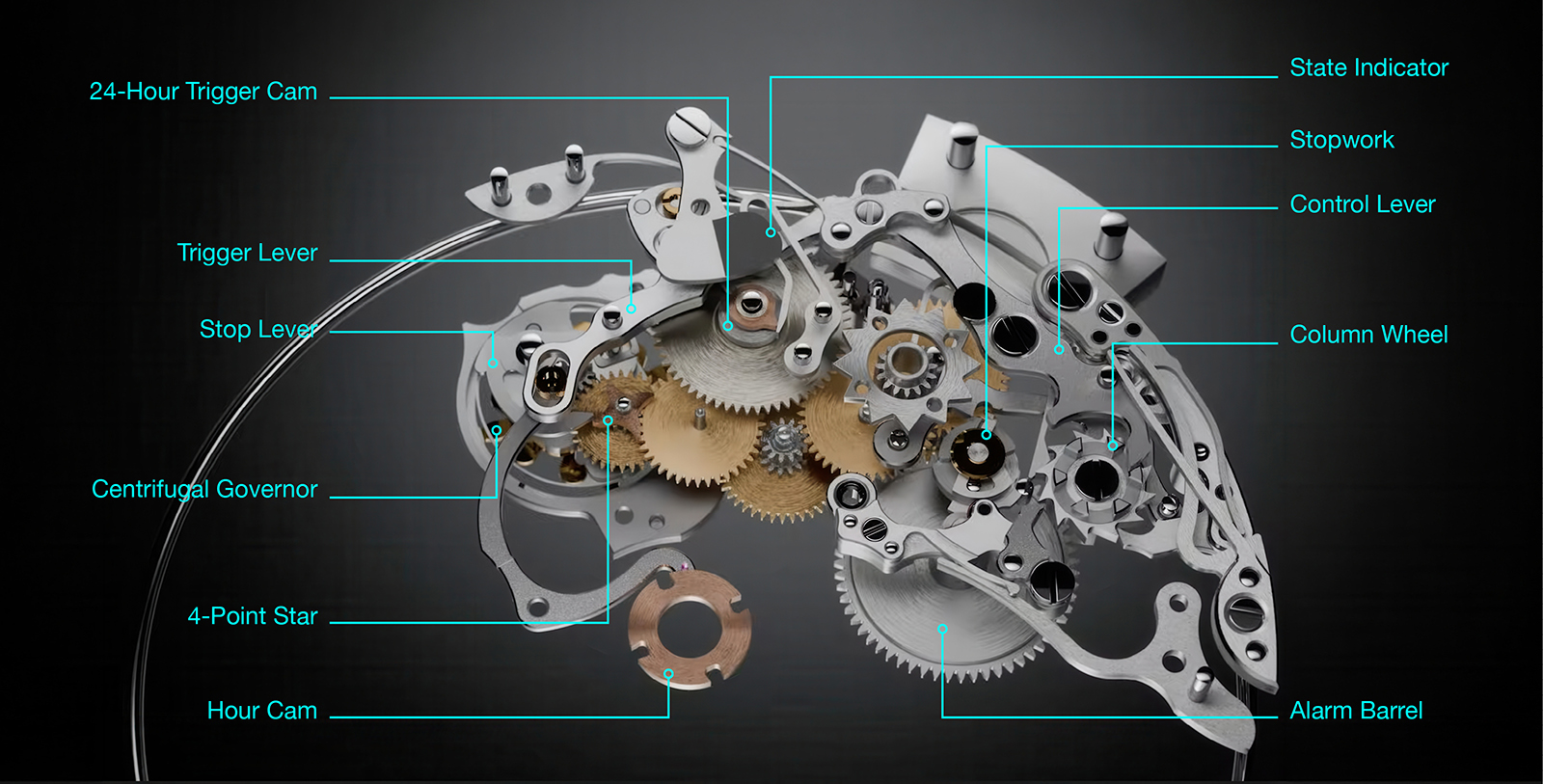
Once the alarm is released, the barrel discharges through a dedicated strike train. A stop lever normally locks the train by engaging a four-point star wheel on one of its train wheels. At the programmed time, a 24-hour alarm cam allows a trigger lever to fall into its notch, initiating the release sequence. Working in conjunction with it is a second cam that rotates once per hour and carries four notches corresponding to the four possible quarter-hour settings. The alarm train is released only when both conditions are simultaneously met, allowing the mechanism to distinguish not only between the selected quarter-hour but also between day and night. The governor then controls the rate at which the barrel unwinds, while the train transmits this regulated motion to the hammer, which repeatedly strikes a gong.
The alarm is governed by a surprisingly elaborate system centred on a double-sided column wheel. Each press of the pusher at 2 o’clock advances the column wheel by one step, alternately placing the alarm in an armed or disarmed state. When armed, a control lever is allowed to drop between the columns of the wheel, leaving the trigger mechanism free to operate when the programmed time arrives. When disarmed, the same lever is lifted by a column and physically blocks the trigger lever from falling into the notch of the alarm cam, preventing the alarm from sounding even if the programmed time is reached.
The column wheel also controls the winding mechanism of the alarm barrel. When the alarm is armed, a series of levers forces the winding train out of mesh so that the alarm barrel cannot be wound while the alarm is active. This ensures that the barrel can never begin discharging while still connected to its winding mechanism, a condition that could otherwise impede or even jam the alarm train. Only when the alarm is switched off does the winding train become available again.
Interestingly, the alarm barrel relies on a stopwork to derive the state of wind of the alarm spring. Attached to the stopwork are a pair of cams whose angular position reflects the remaining energy stored in the alarm barrel and govern whether the alarm may be armed or must automatically be disarmed. The first cam works with an isolator to create an all-or-nothing arming criterion whereby, once the remaining energy falls below a certain threshold, the alarm can no longer be armed. Importantly, this does not interrupt an alarm that is already sounding. A second cam acts at a lower threshold and automatically advances the column wheel to the disarmed position as the alarm barrel approaches exhaustion. The two thresholds create a buffer zone that allows a chiming alarm to complete its cycle while preventing subsequent activation until the barrel has been rewound.
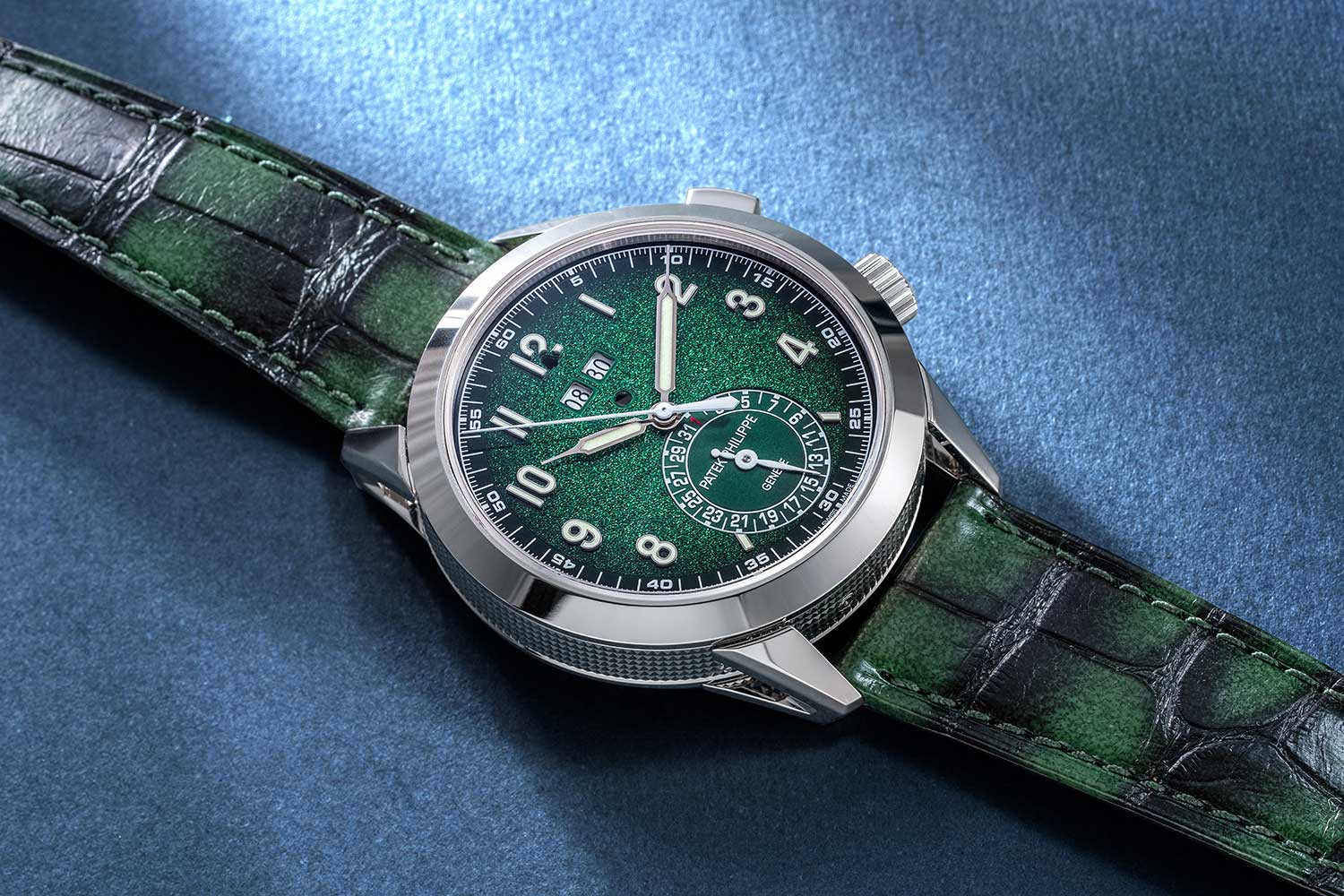
Patek Philippe Calatrava 24-Hour Alarm Ref. 5322G-010 (©Revolution)
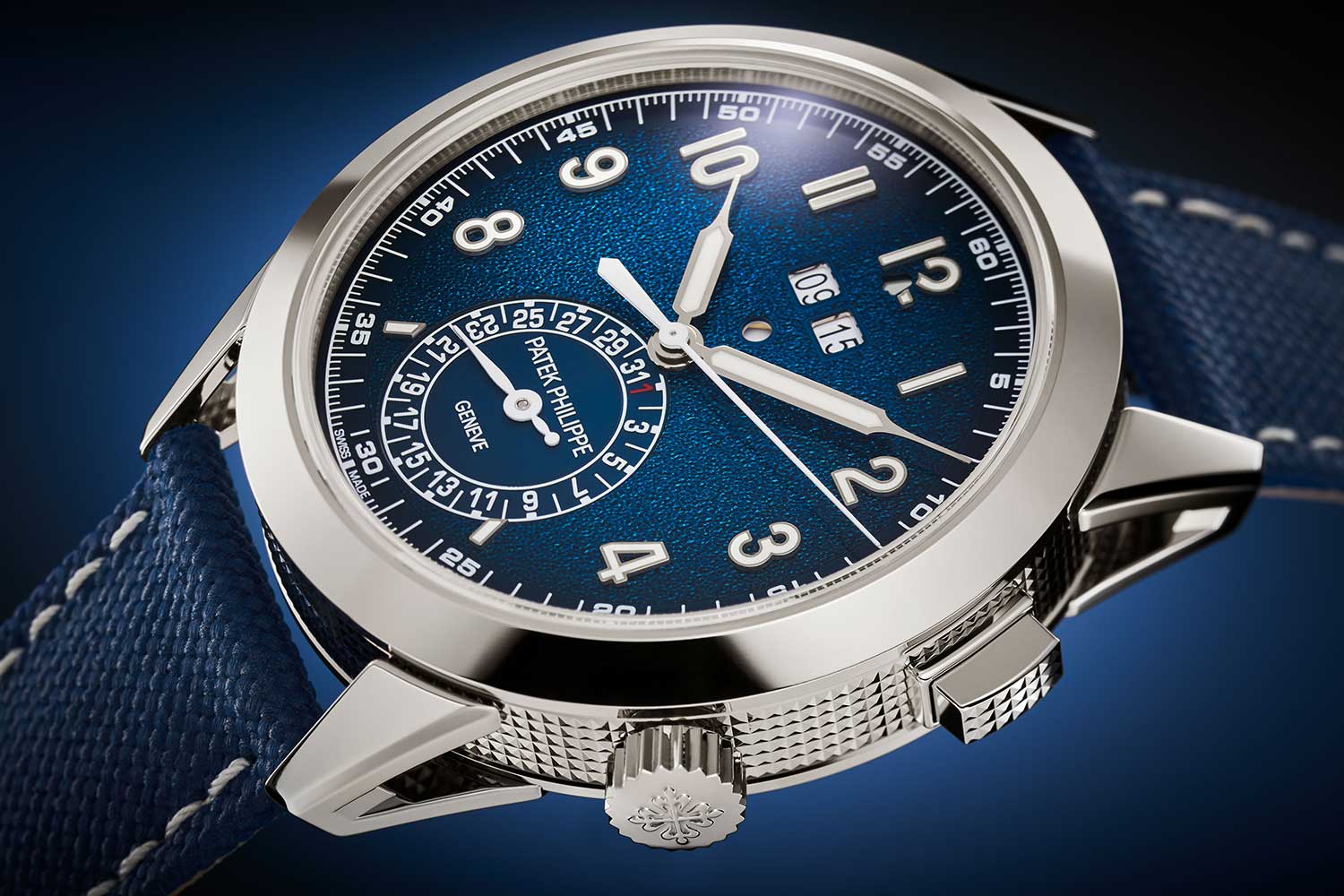
Patek Philippe Calatrava 24-Hour Alarm Ref. 5322G-001
The sophistication and completeness of the system hardly needs pointing out. It reflects a characteristic tendency within Patek’s complicated watchmaking to pursue not just the complication itself but every practical consequence of its existence. The only caveat is that the alarm can be programmed only to the nearest quarter hour. But it is hard to begrudge such a limitation in an alarm watch that is genuinely pleasurable to hear, just as it’s hard not to be charmed by the mechanical extravagance deployed just to remind its owner that it is time to be somewhere.
Tech Specs: Patek Philippe Calatrava 24-Hour Alarm Ref. 5322G-001 / 5322G-010
Movement Self-winding Calibre AL 30-660 S C; 42–52h power reserve; 4Hz (28,800 vph); alarm barrel wound separately; Gyromax balance; Spiromax silicon hairspring; stop-seconds; Patek Philippe Seal
Functions Hours, minutes, central seconds, pointer date, 24-hour alarm with day/night indication and alarm on/off display
Case 41mm diameter × 12.22mm height; 18K white gold; water-resistant to 30m
Dial Grained fumé blue (Ref. 5322G-001) or grained fumé green (Ref. 5322G-010); applied white gold numerals and hands with Super-LumiNova
Strap Fabric-pattern composite strap with 18K white gold fold-over clasp
Price CHF 225,000
Patek Philippe
You may also like
Auctions
Patek Philippe World Time: Romancing The World
Jun 29, 2026
Auctions
Patek Philippe World Time: Romancing The World
Jun 29, 2026
Auctions
A Tiffany & Co-signed Patek and the Man Who Built America
Jun 11, 2026
Auctions
A Tiffany & Co-signed Patek and the Man Who Built America
Jun 11, 2026

Editorial
Watches and Wonders 2026 Editor’s Pick: Sheng Lee, Digital Writer
May 2, 2026
Editorial
Watches and Wonders 2026 Editor’s Pick: Sheng Lee, Digital Writer
May 2, 2026