Zenith’s Calibre 135 Gets The Naoya Hida & Co. Treatment
News
Zenith’s Calibre 135 Gets The Naoya Hida & Co. Treatment

For the first release in Zenith’s new Double Signed Program, the manufacture has partnered with Naoya Hida & Co., the Japanese independent known for its rigorous, mid-century-informed approach to watch design. Here, the G.F.J. Calibre 135 is reimagined in platinum with a solid silver dial, bringing Hida’s language of engraved numerals, blue accents, and disciplined proportions to one of Zenith’s most important modern collections.
Limited to just 10 pieces, it also sets the tone for a new collaborative series that invites selected independent watchmakers to reinterpret the G.F.J. while preserving the essence of the original.
A Modern Chapter For The Calibre 135
For Zenith, the Calibre 135 occupies a special place in its history. Developed during the golden age of observatory chronometer competitions, it became one of the manufacture’s most celebrated precision movements, widely associated with Zenith’s success in formal timing trials.
In 2022, Zenith released an ultra-limited series powered by ten vintage Calibre 135-O movements from the 1950s. These were competition-grade calibres that were restored by Kari Voutilainen, bringing one of Zenith’s most revered historic movements back into the spotlight.
Then, in 2025, a full modern revival began with Zenith re-engineering the Calibre 135 for the G.F.J. collection, named after the manufacture’s founder, Georges Favre-Jacot. That watch translated the spirit of the original calibre into a contemporary wristwatch, combining a manually wound chronometer movement with classical finishing, modern reliability, and carefully considered case and dial materials worthy of the movement inside. Zenith continued to build on that momentum at Watches and Wonders 2026 with new G.F.J. executions in yellow gold with bloodstone and tantalum with onyx.
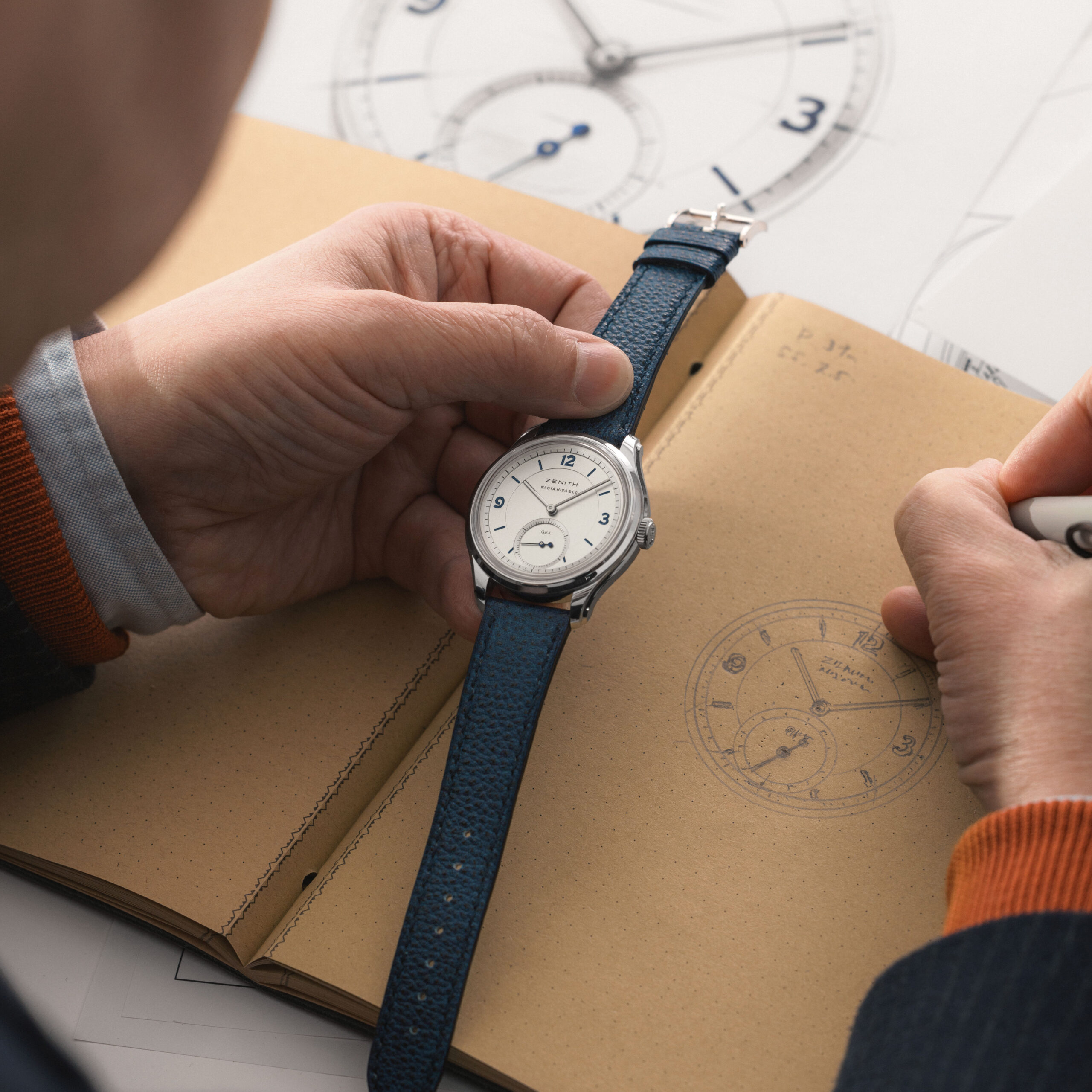
Naoya Hida reviews the finished G.F.J. Calibre 135 against his original design sketches
The Partnership with Naoya Hida & Co.
Founded in 2018, Naoya Hida & Co. has built a distinct identity around classical watchmaking values viewed through a contemporary Japanese lens. Hida’s watches are not nostalgic in a decorative sense. His incredibly deep affection for the golden age of mechanical watchmaking
translates into watches that are complete studies in elegance, proportion, typography, and detail.
That makes Hida an empathetic collaborator for the Calibre 135. This is a movement celebrated for its history in chronometry, housed within the G.F.J., a watch that benefits from nuanced and subtle details.
Naoya Hida has also noted that he has been captivated by the Calibre 135 since discovering it in the 1990s. In developing this edition, he describes the aim as capturing “the atmosphere and spirit of the Calibre 135 era in a modern way.”

Naoya Hida, founder of Tokyo-based independent Naoya Hida & Co.
The Zenith G.F.J. Calibre 135 Double Signed with Naoya Hida & Co.
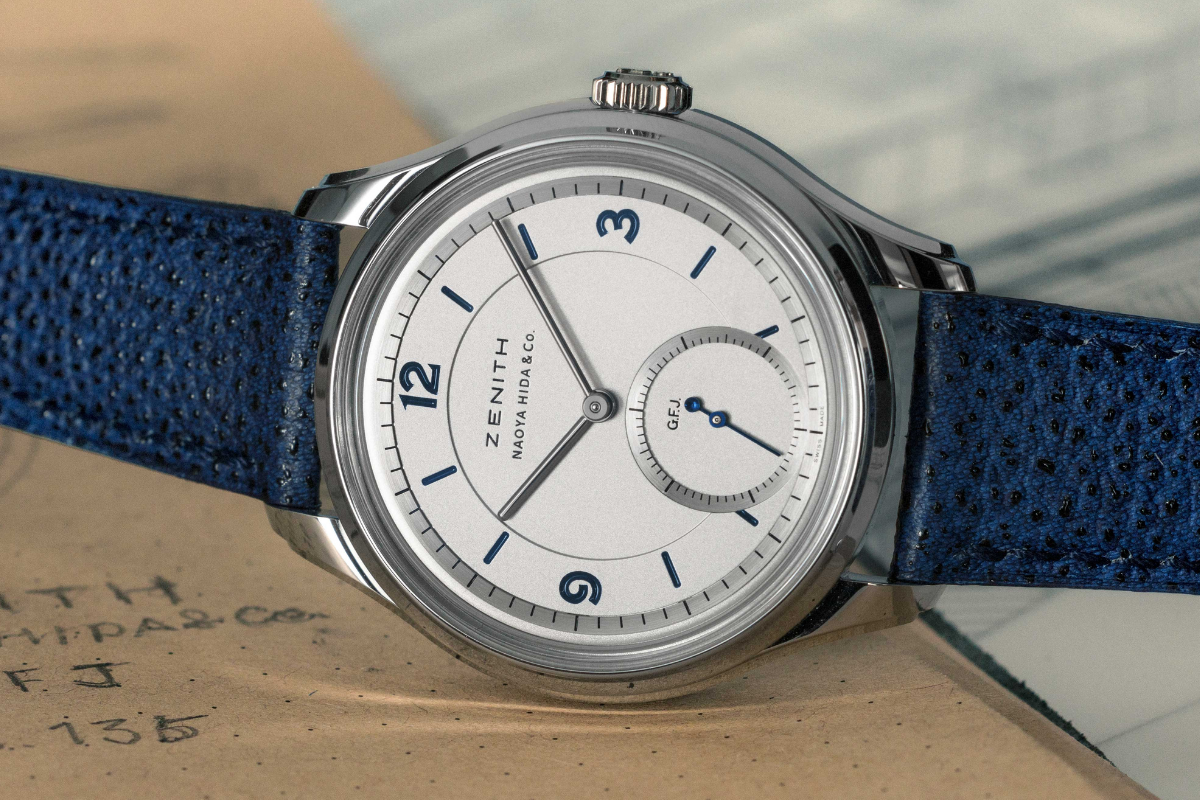
The most immediate expression of Naoya Hida’s influence is the dial. Made from solid silver, it adopts the understated layout inspired by the spirit of Hida’s NH Type 1 and NH Type 2.
The double signatures of Zenith and Naoya Hida & Co. appear on the dial, along with indications engraved using a traditional pantograph engraving machine. The three Arabic numerals are then individually hand-finished by Japanese engraver Keisuke Kano before being filled with blue Japanese urushi lacquer. The numerals have lots of depth, texture, and presence because they are cut into the dial rather than applied to its surface.
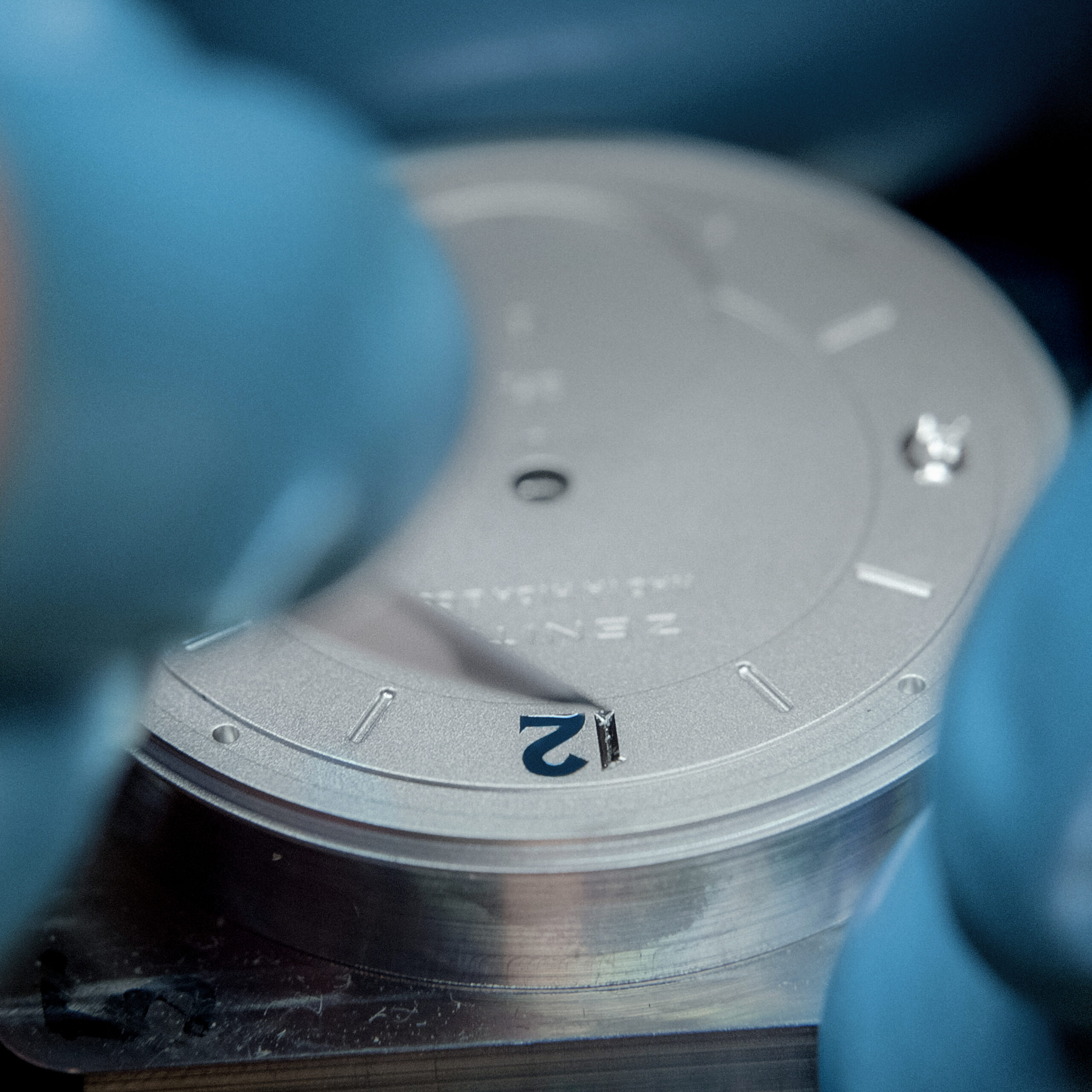
Blue urushi lacquer being applied to a hand-engraved Arabic numeral on the solid silver dial
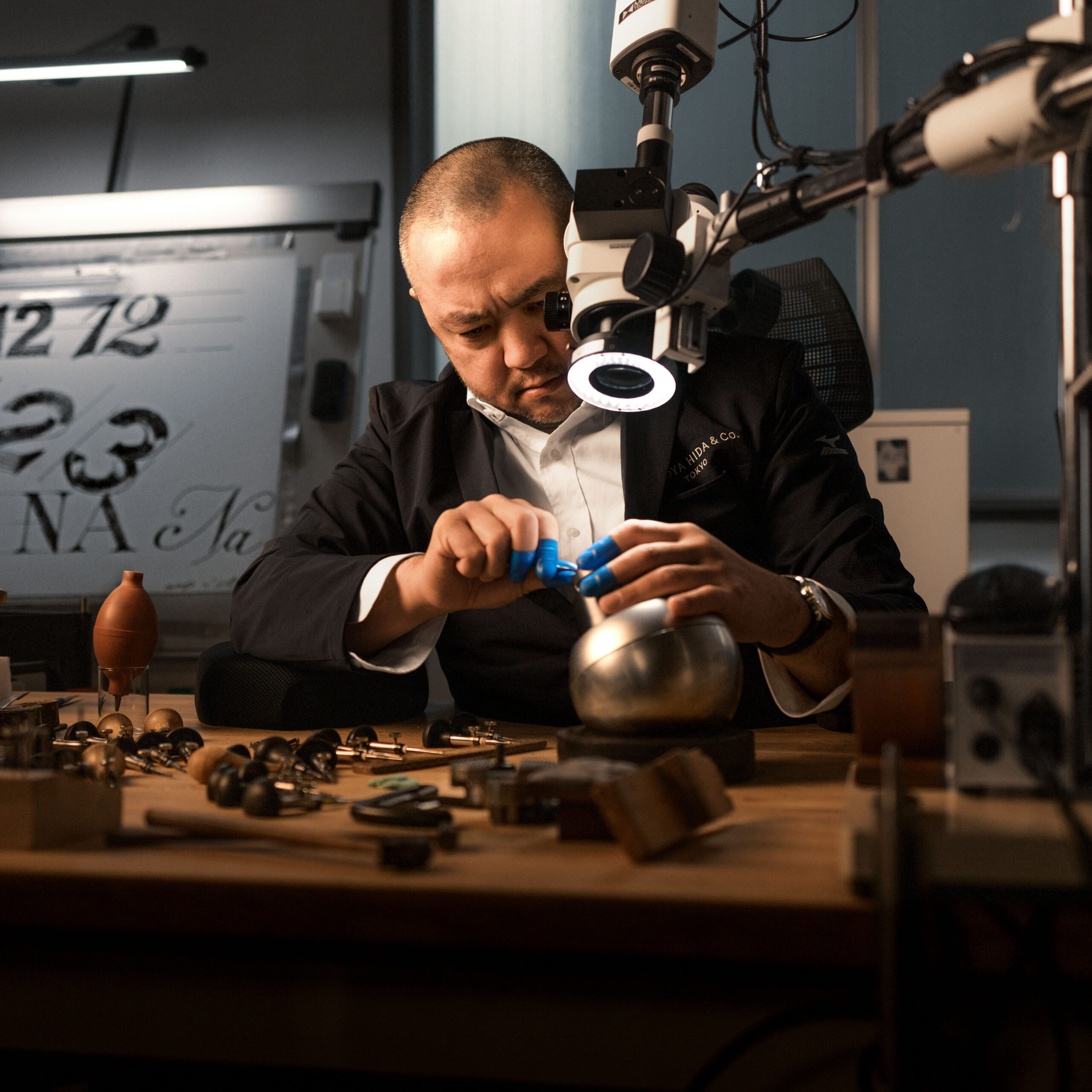
Japanese engraver Keisuke Kano hand-finishing the dial numerals under a microscope at the Naoya Hida & Co. atelier
The hands follow the same philosophy. The hour and minute hands are milled from solid gold using CNC machining, then hand-polished by a team led by master watchmaker Kosuke Fujita. The small seconds hand, placed at six o’clock, is made from steel and heat-blued to a deep tone that echoes the lacquer-filled dial markings.
A Platinum G.F.J. with a Japanese Accent
The watch is housed in a platinum G.F.J. case measuring 39.15mm in diameter, 10.5mm thick, and 45.75mm lug-to-lug. Those dimensions suit the project well. Though not a miniature dress watch, it remains compact and classical enough to keep the focus on the dial and movement.
Zenith supplies the watch with three straps.The first is made from Himeji Kurozan leather, a textured Japanese leather finished with repeated applications of urushi lacquer. The second is crafted from Wagyu leather by Kyoto Leather. The third is a deep indigo strap made from Japanese non-stretch denim by Kaihara, the renowned mill based in Fukuyama, Hiroshima. A platinum pin buckle engraved with the G.F.J. initials completes the package.
Each detail is carefully chosen, reinforcing the watch’s distinctly Japanese sensibilities through subtle choices rather than overt gestures, and without turning it into a caricature of Japanese craft.
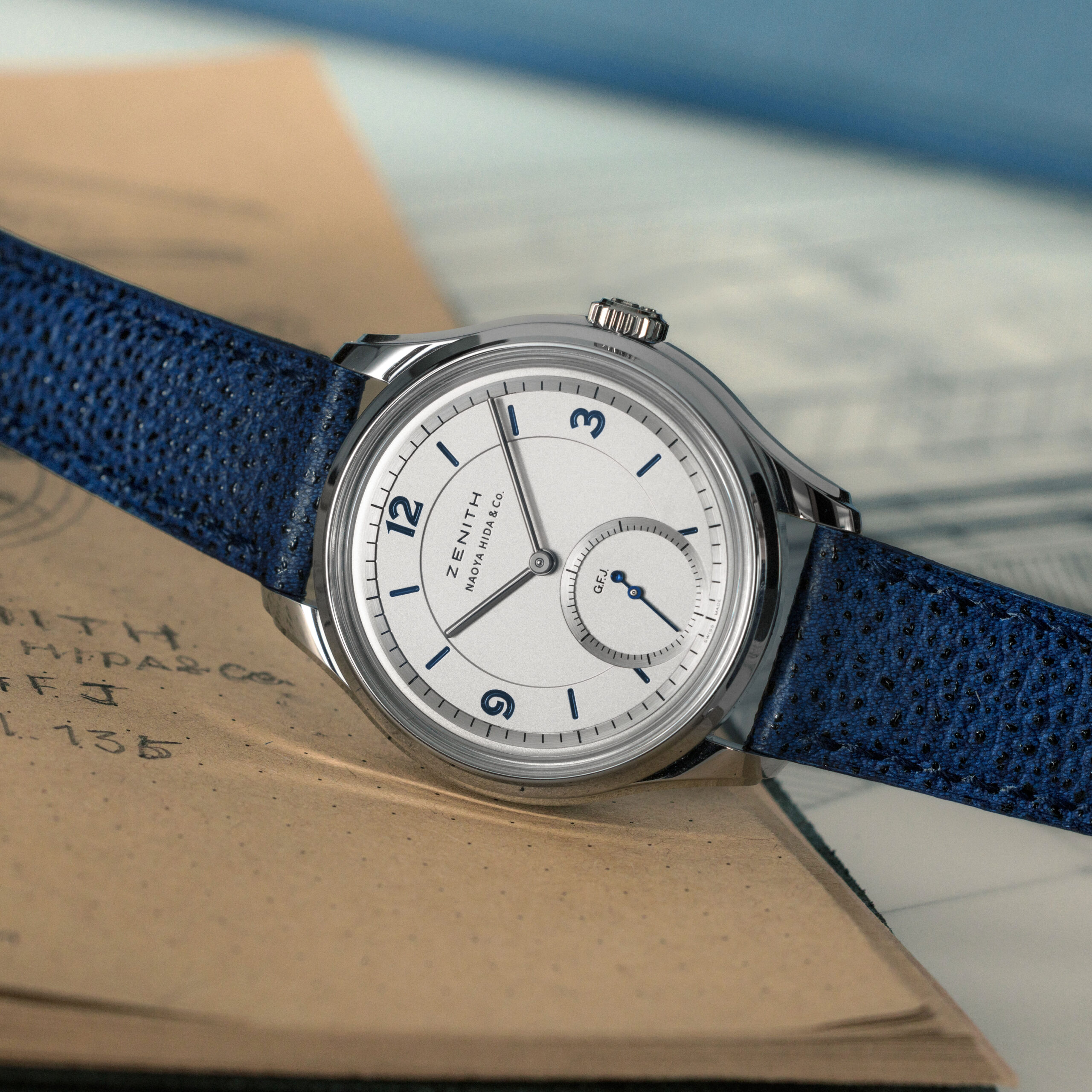
The solid silver dial with blue urushi-filled numerals and heat-blued small seconds hand, mounted on the Japanese denim strap
The Chronometer Heart Remains The Point
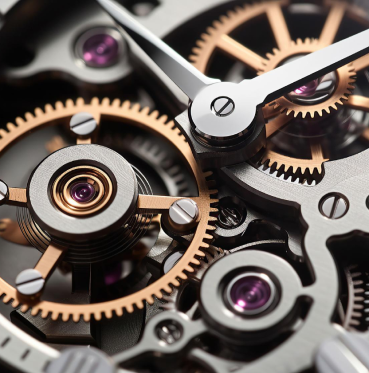
Visible through the sapphire caseback is the manually wound Calibre 135. In this modern form, the movement beats at 18,000 vibrations per hour, or 2.5Hz, and offers a 72-hour power reserve.
It features a large variable-inertia balance wheel with a Breguet overcoil, stop-seconds, spring-mounted jewel settings for the balance staff, and Charles Fleck’s distinctive double arrow-shaped regulator for fine adjustment.
The movement is regulated to +/-2 seconds per day and is COSC-certified. Finishing includes broad Geneva stripes, hand-chamfered bridges, and a dark ruthenium treatment accented by yellow gold-coloured engravings.
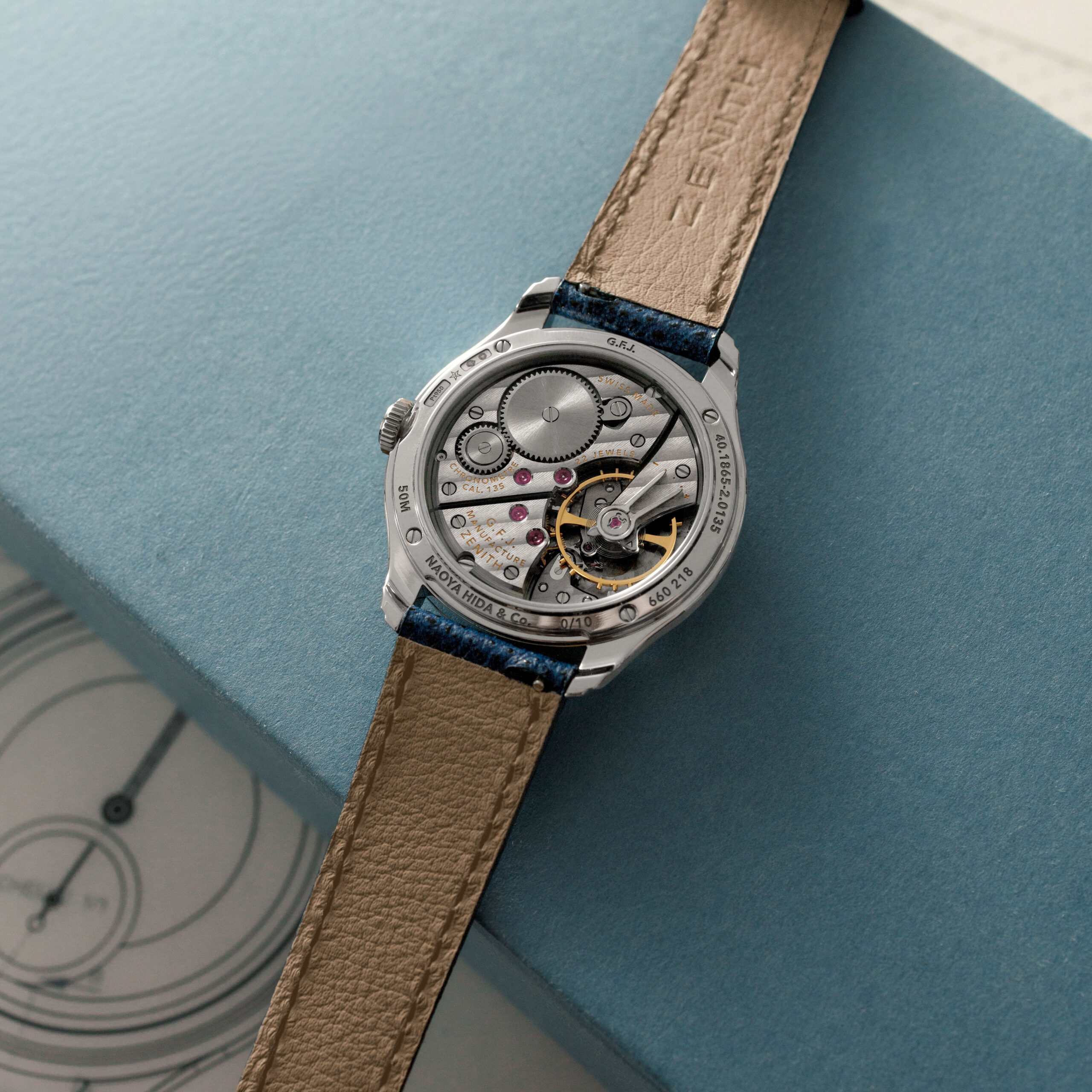
The manually wound Calibre 135 visible through the sapphire caseback, finished with broad Geneva stripes and ruthenium treatment
The First in Zenith’s Double Signed Watch Program
Beyond the watch itself, this release introduces Zenith’s Double Signed Program. Historically, double-signed watches occupy a special place among collectors, often representing relationships between watchmakers and retailers, distributors, or important partners. Zenith’s interpretation of the idea is slightly different. Rather than reviving the double signature purely as a retailer-driven tradition, the manufacture is using it as a platform for collaboration with independent watchmakers.
It’s a smart move, particularly with the G.F.J. The watch is already a statement about Zenith’s past, so inviting outside voices to reinterpret it gives the collection room to evolve without losing its connection to the Calibre 135. Naoya Hida & Co.’s first example gives the programme a strong start.
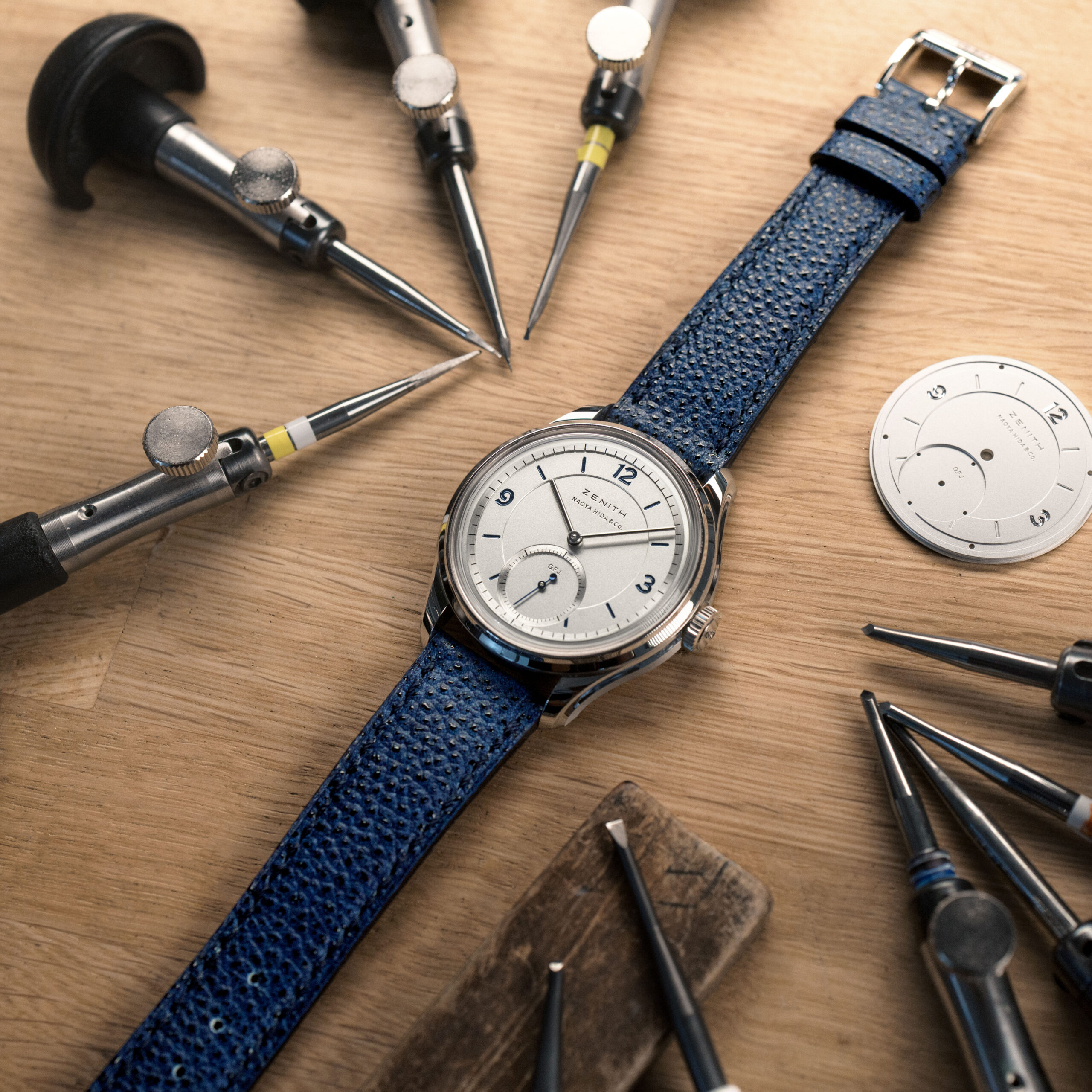
The G.F.J. Calibre 135 Double Signed alongside watchmaking tools, shown on the blue Himeji Kurozan leather strap
You may also like
Editorial
Major Shakeups at Zenith, Job Losses, Retail Closure and more
Oct 23, 2026
Editorial
Major Shakeups at Zenith, Job Losses, Retail Closure and more
Oct 23, 2026
Editorial
Zenith’s Latest Takes the Chronograph Out of the Chronomaster
Sep 2, 2026
Editorial
Zenith’s Latest Takes the Chronograph Out of the Chronomaster
Sep 2, 2026
Editorial
Naoya Hida × The Armoury Type 4A-2 “Floating Feathers”
May 11, 2026
Editorial
Naoya Hida × The Armoury Type 4A-2 “Floating Feathers”
May 11, 2026