The Cartier Roadster: On The Road Again
Editorial
The Cartier Roadster: On The Road Again

In the stratified and compartmentalized taxonomy of timepieces, there’s a perception that Cartier is the watchmaker of elegance, refinement and the finer things in life. Now, that’s not untrue, but the problem with this sort of categorization is that it typically fails to encapsulate the sheer depth and complexity of a watchmaker that has been designing watches for over a century. Thanks to changing tastes and the rosy-tinted glasses of nostalgia, it’s easy to see why we look back at well-dressed men and women of yore wearing dainty (by 2026 standards) gold watches, and immediately jump to defining these Cartier watches as something akin to modern dress watches — formal, reserved and with function coming a distant second after form.
Except, what we’re looking at here is a little historical horological revisionism. Cartier’s watches have always been made for a practical purpose, not just to be hidden away behind a shirt cuff. And, to take it a little further, the design of Cartier watches has always been a reflection of the world in which they’re worn, and frequently take inspiration from the mechanical. No watch exemplifies the contemporary relevance and functionalism better than the one that started it all — the Santos. The oft-written refrain about Cartier’s first wristwatch is that it was made for the pioneering Brazilian aviator Alberto Santos-Dumont in 1904.

Alberto Santos-Dumont, pioneering aviator
The story goes that Santos-Dumont approached Louis Cartier with a problem — a traditional pocket watch would not do when you’re flying a loose assembly of wood, fabric and metal across French fields. Cartier’s response was to create a watch for the wrist — and thus, the maison’s history was forever changed. Ignore the facts that this happened well over a century ago and reframe the narrative through a modern lens. If Santos-Dumont were alive today, he’d be experimenting with spaceflight, and his request for a custom timekeeper would likely include cutting-edge materials and techniques. It’s a narrative that followers of watches will be familiar with, but the distance of history has dulled just how radical Cartier’s creation was at the time.
Another example pops up a few years later, with the now-iconic Cartier Tank. Again, the inspiration is there, clear for us to see. Created close to the chaos of World War I, Cartier looked to the completely new technology of the military tank, took that bold form and interpreted it into wrist-worn form. Again, in a time when the automobile was still a relatively young invention, looking to the dramatic and deadly silhouette of tanks and seeing their relevance for product design was pioneering. If you widen the scope beyond watches, there’s plenty of links to more utilitarian mechanisms to be found. For example the humble nail is elevated into the legendary Juste Un Clou.
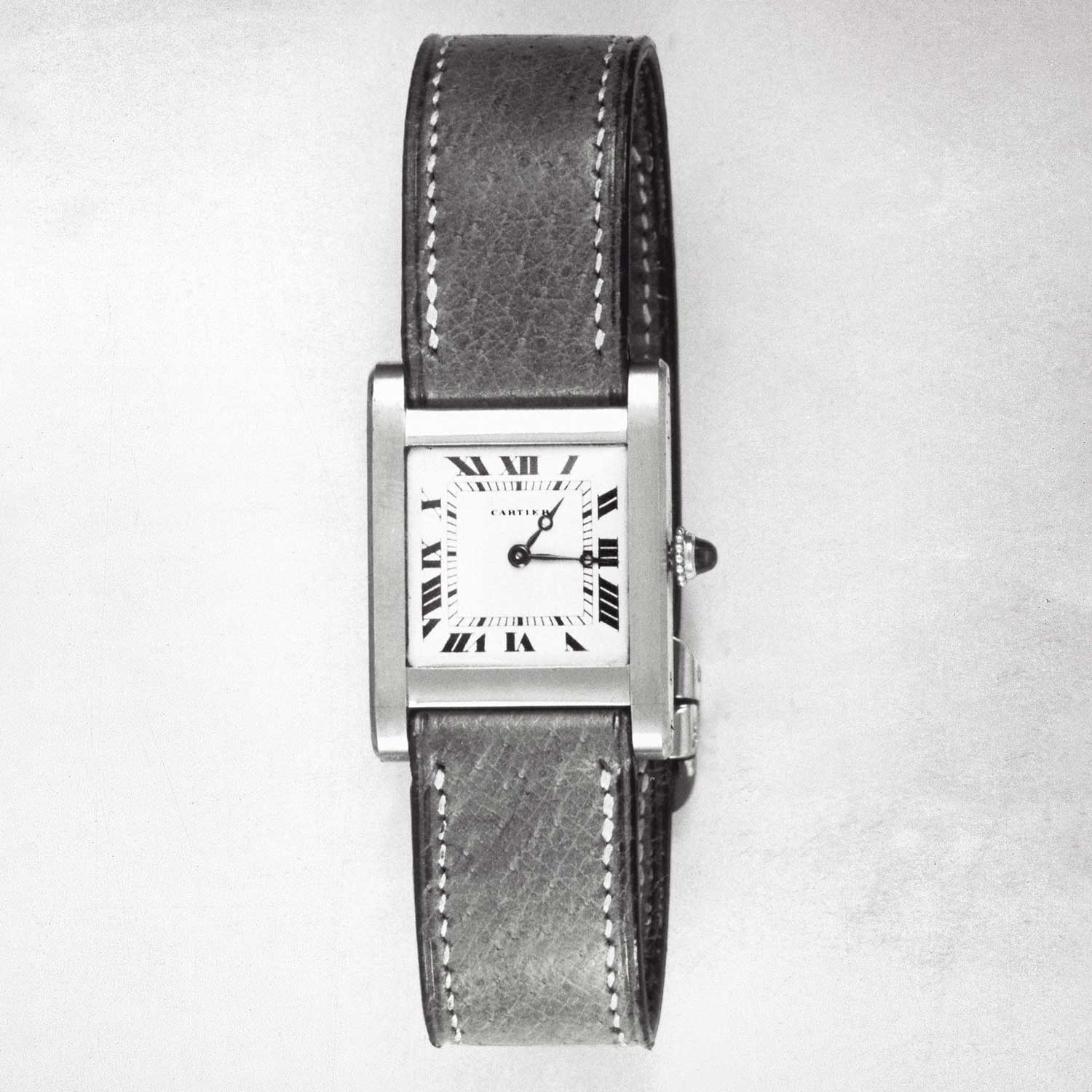
The original Cartier Tank from 1919
Roadster Origins
This is where the Roadster comes in. Before we talk about the latest iteration of Cartier’s own take on motorsports, we need to go back to the beginning of the model. And, unlike many of Cartier’s shapes, the start of this story is much more recent. The Cartier Roadster debuted in 2002, offering an entirely new shape and model for a new millennium. Nearly a century after Cartier looked to the nascent world of aviation, the brand turned its attention to a product category that had defined the last century — the automobile.
Automobiles, just like watches, are a staggeringly vast and diverse category, full of models and designs that have become iconic through function or fashion. The challenge then is what sort of vehicle inspired Cartier’s debut automotive watch. While we have no insights into the process that went into that design, we can only imagine that part of the rationale was to seek inspiration from a period and chapter of automotive history that felt aligned with Cartier’s own style, image and values. The roadster is a very apt pick. What constitutes a roadster has changed over the generations, but the style dates back to the earliest days of the automobile, when dedicated “speedsters” were created for racing, with cut-down bodies, minimal bodywork and seating open to the elements. That said, the Cartier Roadster’s stylistic inspirations come not from the earliest days of cars, but a little later in automotive history. The swooping, aerodynamic lines of Cartier’s creation look more to the middle of the 20th century, to designs such as Erwin Komenda’s Porsche 356, a masterpiece of curves that didn’t just go fast, but looked fast. More than any single specific reference point, the Roadster is an evocation of speed; both the cars and the timepieces share a complicated, elegant dance of perpetual motion, one on the road, the other on the wrist.
The Evolution of The Roadster
The timing of the Roadster’s debut in 2002 is interesting. Not only is it significant for being Cartier’s first new collection of the 21st century, but it also speaks to the broader context of watchmaking at that time. The 1990s were defined largely by the Swiss watch industry’s response to the quartz revolution that crippled it in the ’70s and ’80s. That decade has come to be seen as something of a renaissance in mechanical watchmaking, with Swiss watchmaking shifting from a place of utility to one of desire and status. Of course, this had always been true, but the ’90s saw a great flourishing of mechanical innovation, new shapes, materials, colors and the growing importance of the connoisseur or collector as a category.
All of this is to say that, at the turn of the millennium, watchmaking wasn’t just looking at its roots; it was, in a very real way, looking to the future, and how those traditions could be made exciting and relevant for a new era. One of the most telling examples of this intersection was the renewed interest in the tonneau case shape. The tonneau takes its name from the French word for barrel, and certainly the tall silhouette with its swelling flanks resembles the work of a cooper. In watchmaking, it’s a very old shape, dating back to the earliest days of the wristwatch. Within Cartier’s oeuvre, the curved case of the Tank Cintrée, introduced in 1921, can be traced back to the Tonneau of 1906. Many other watchmakers also utilized the shape, and it makes sense from a design and ergonomics perspective. The long case works well on the wrist, while the curves allow for a larger movement and dial than smaller cases with straight lines.
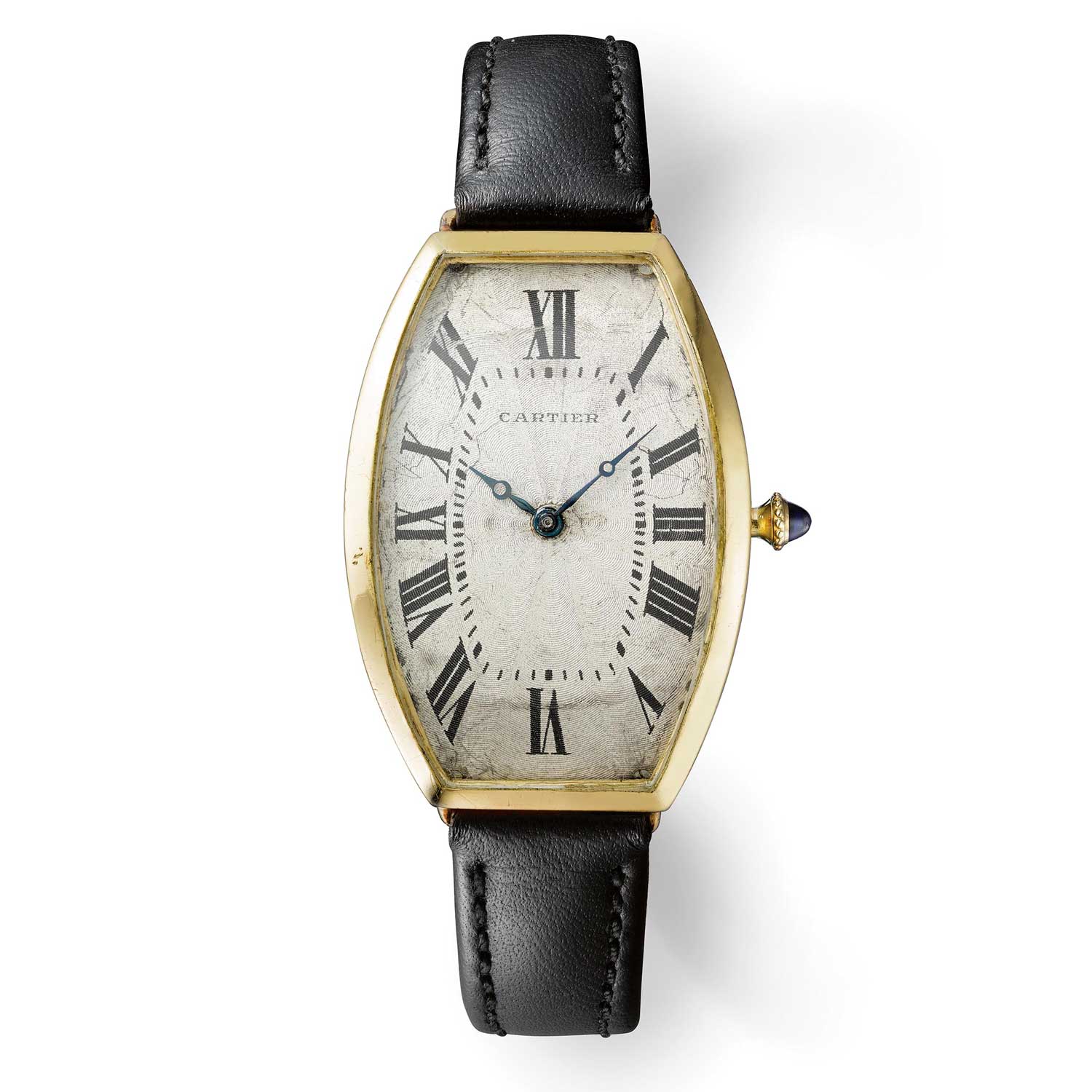
Cartier Tonneau, 1906
While the tonneau remained a familiar watch case shape throughout the 20th century, its popularity soared in the 1990s and early 2000s, much as integrated-bracelet watches have enjoyed a resurgence in recent years. The reasons for this are varied, with one of the most obvious being the fact that the shape was simply novel. In a world of round watches, why not take the tonneau? Beyond the sheer wrist factor, the tonneau is a smart way for emerging brands to evoke the rich heritage of horology without needing to have the archive to back it up.
Of course, this isn’t a problem Cartier has — as mentioned, the maison’s history with the tonneau dates back to the turn of the last century, so reintroducing it in a modern form for the 21st century makes perfect sense. And the Roadster is nothing if not modern.
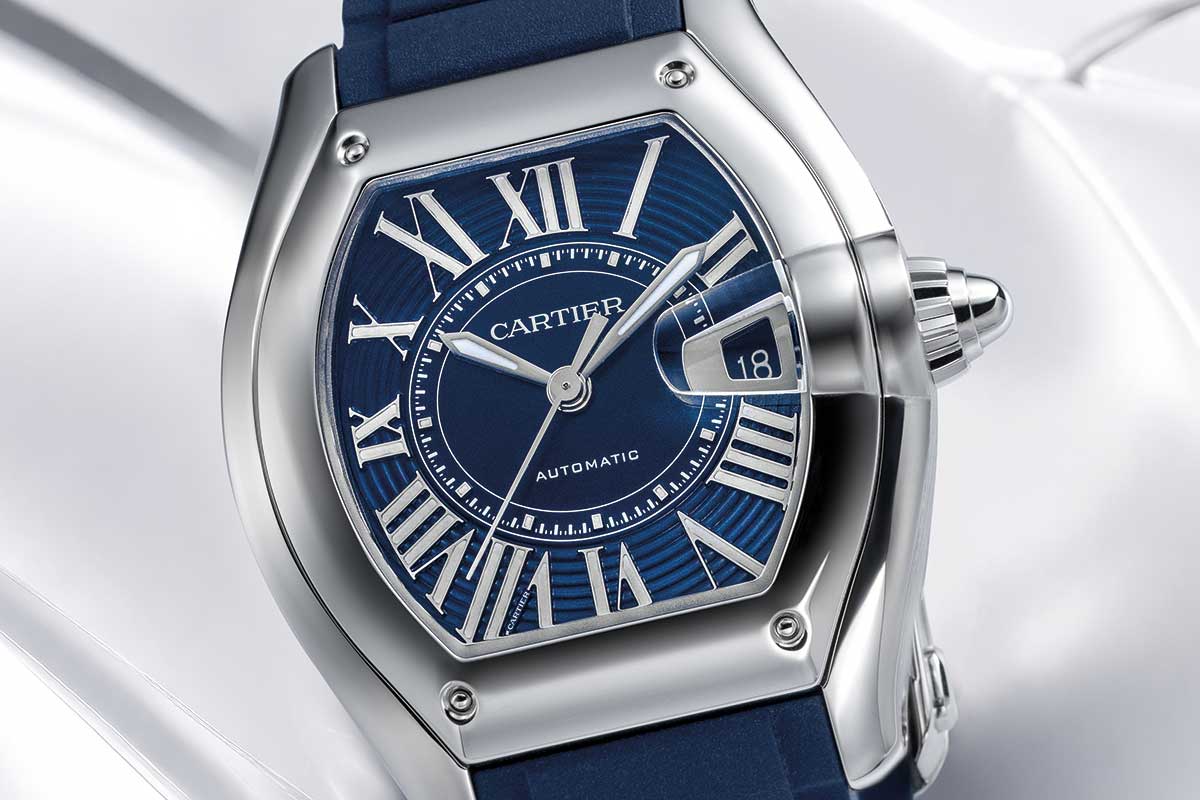
This was the context when Cartier revealed its brand-new Roadster in 2002. The shape, blurring the lines between more classical tonneaus with notes of Cartier’s other iconic shapes, was entirely new, and the most dramatic part of it was the crown. Most of the time, the winding and setting crown is a purely functional add-on, separate from the case. On the Roadster, it was integrated. Integrated not just to the case, but also to the dial and the crystal. It’s instantly recognizable and unmistakable for something else. The lessons Cartier learned from this crown must surely have been taken in stride a few years later when the maison released the Ballon Bleu de Cartier, with an equally iconic crown.
From a design point of view, this crown, which flows into and over the case and towards the date magnifier, is emblematic of the golden era of automobile design, evoking the streamlined headlight designs of iconic cars like the Corvette C1 or, hailing from the other side of the pond, the Porsche 356. The success of this design element is its versatility. The reference is broad yet specific. Looking at the crown, you can tell it’s a reference to some of the all-time great car designs, but it’s not so specific as to be a homage to any one particular design. What might be more interesting to aficionados of Cartier is the dial on this early Roadster. Cartier’s dial design is as famous as its shaped cases, and much more consistent.
The earliest Roadster does away with the familiar format of pale dial, sword-shaped hands and Roman numerals in favor of something much sportier — an Arabic dial with radial hour markers, alternating between more prominent hours and smaller minute markers, set against an outer track with inner minute hashes. The effect is very reminiscent of an early speedometer, and while the dial appeared in several versions, one featured luminous hour markers and alternating red-printed minutes that look very much like the sort of gauge you would find in a classic Porsche.
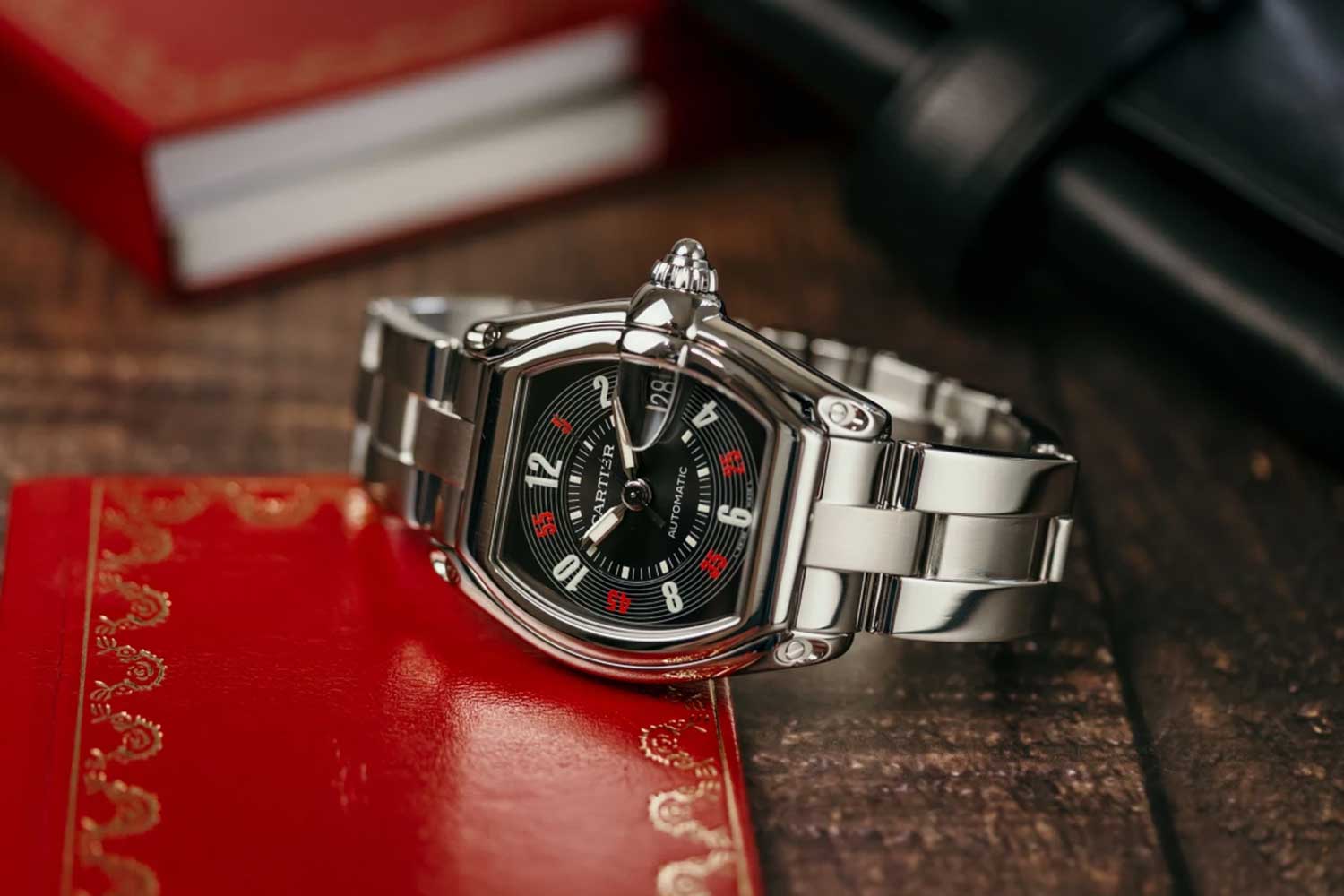
Cartier Roadster with Arabic Numerals Dial (Image: The Diamond Box)
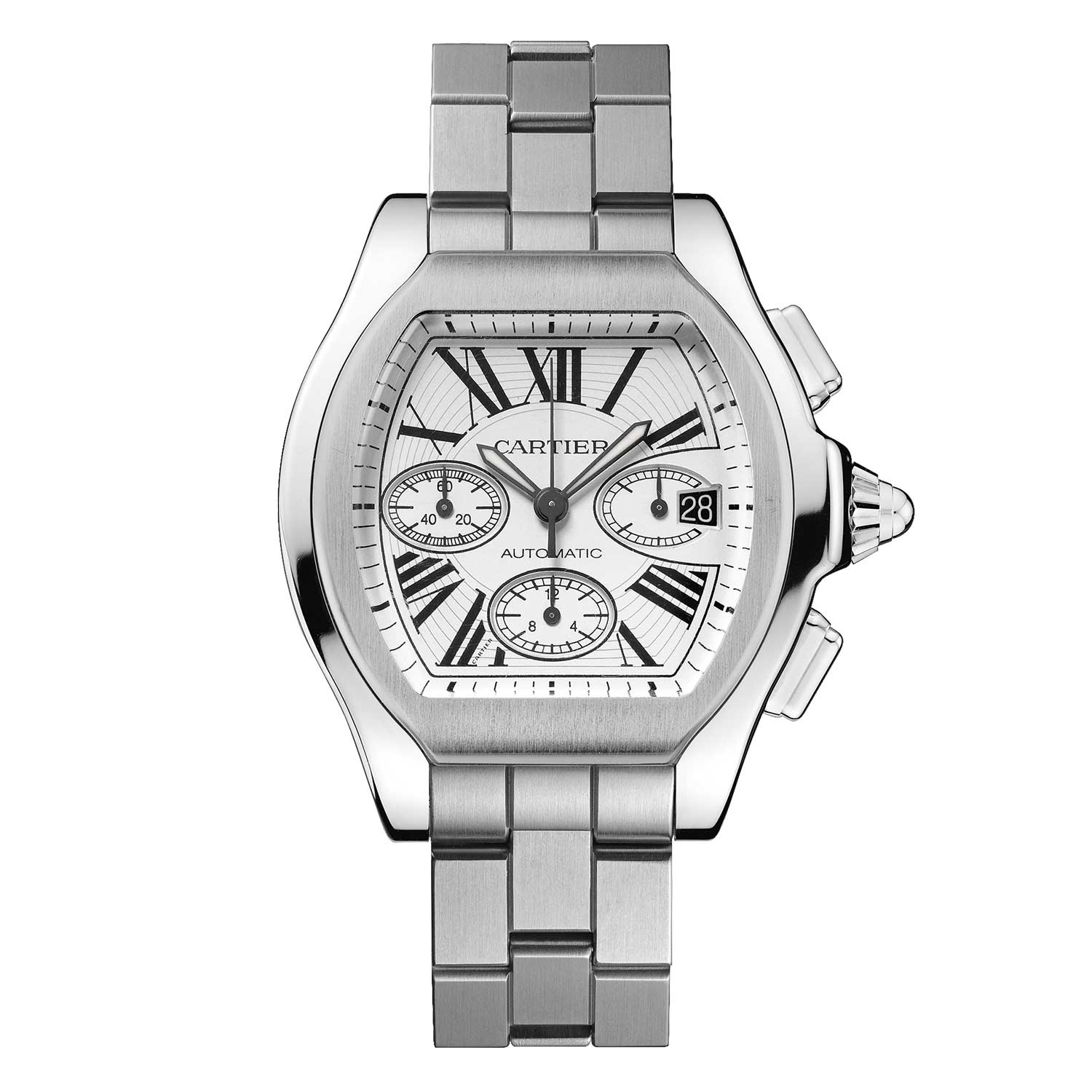
After this dramatic debut, Cartier continued to expand and iterate on the Roadster concept. In 2003, we saw the most natural complication to include in the collection, a chronograph. The instrument panel motif was much toned down here; the dial returned to the familiar Roman numeral pattern, but there were still nods to the automotive inspiration, such as the slightly ovoid sub-registers, and of course the crown, case and crystal array was unchanged, though now flanked by sporty chrono pushers.
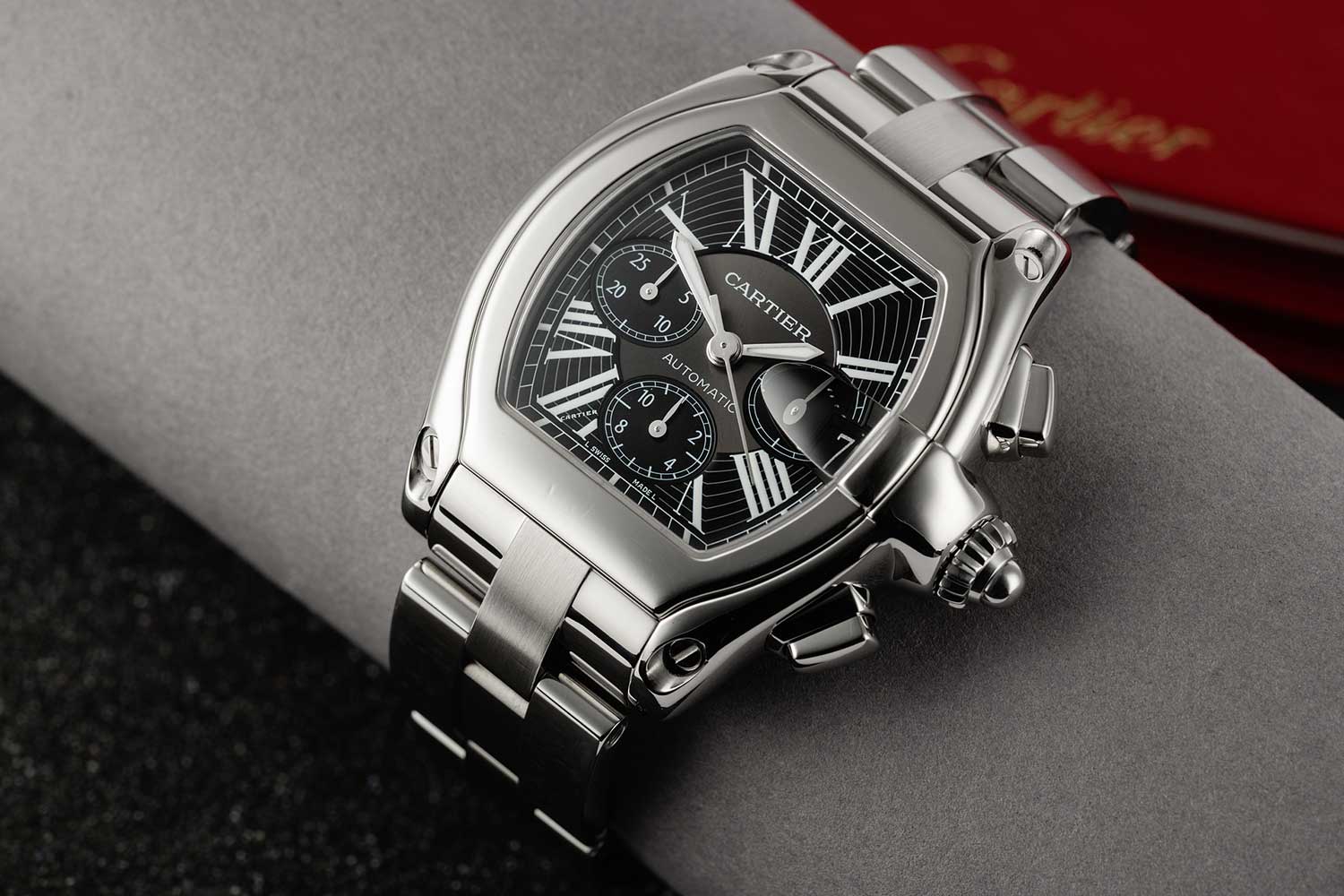
Cartier Roadster XL Chronograph (Image: The Watch Club London)
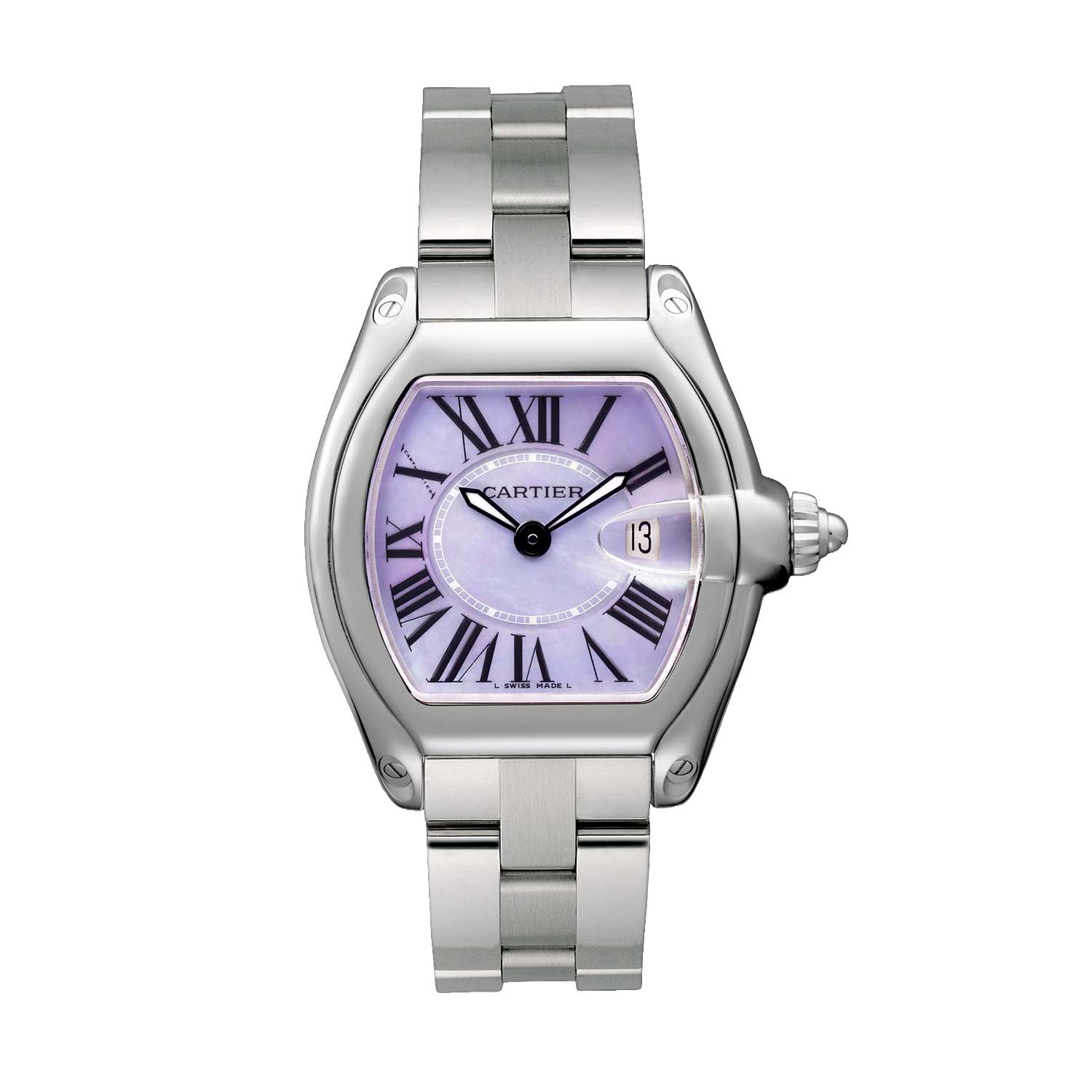
In 2005, the Roadster was released in a smaller size, and a year later, in 2006 it was offered in steel and gold, as well as a GMT. Color entered the collection from 2008, with soft blues, pinks and purple takes adding summery vibes to the sporty aesthetic. One of the most dramatic changes to the Roadster was announced towards the end of its initial run, with the introduction of the Roadster S in 2010.
-
- Roadster de Cartier
-
- Cartier Roadster S
The Roadster S pared back some of the Roadster design details in significant ways. Most notable was the removal of the sculptural, integrated crown. From the top down, the crown silhouette remained unchanged, but the crystal and case were flatter, a simpler, more streamlined construction, though elements of the original design language were retained in the dial. Likewise, the case screws disappeared, and we get versions in steel with a black ADLC-coated bezel and bracelet-like rubber strap. While the Roadster S offered a trimmed down interpretation of the Roadster concept, it still very much got the point across with its sporty personality and that unmissable shape.
By 2012, Cartier had discontinued the original Roadster after a respectable 10 years on the track, but, as with all things Cartier, the Roadster never went away. As interest in the maison’s historic offerings over the years grew, so too did secondary market interest in this modern classic. At some point, Cartier decided to take the Roadster out of the garage, and earlier this year, it was ready for its big reveal.
Roadster Redux
If you’ve been following Cartier’s pattern of releases over the last decade or so, you will know the maison has been, in its very careful and considered way, revisiting and refreshing some of its most well-regarded shapes. The 1980s “It” watch, the Panthère de Cartier, was revived in 2017. In 2018, the Santos de Cartier, itself a 1970s interpretation of the 1904 Santos, was refreshed. In 2020, it was one of Gérald Genta’s less well-known designs, the Pasha, that was smartly updated. In 2023, it was the Tank Française’s turn, and now, the Roadster is back.
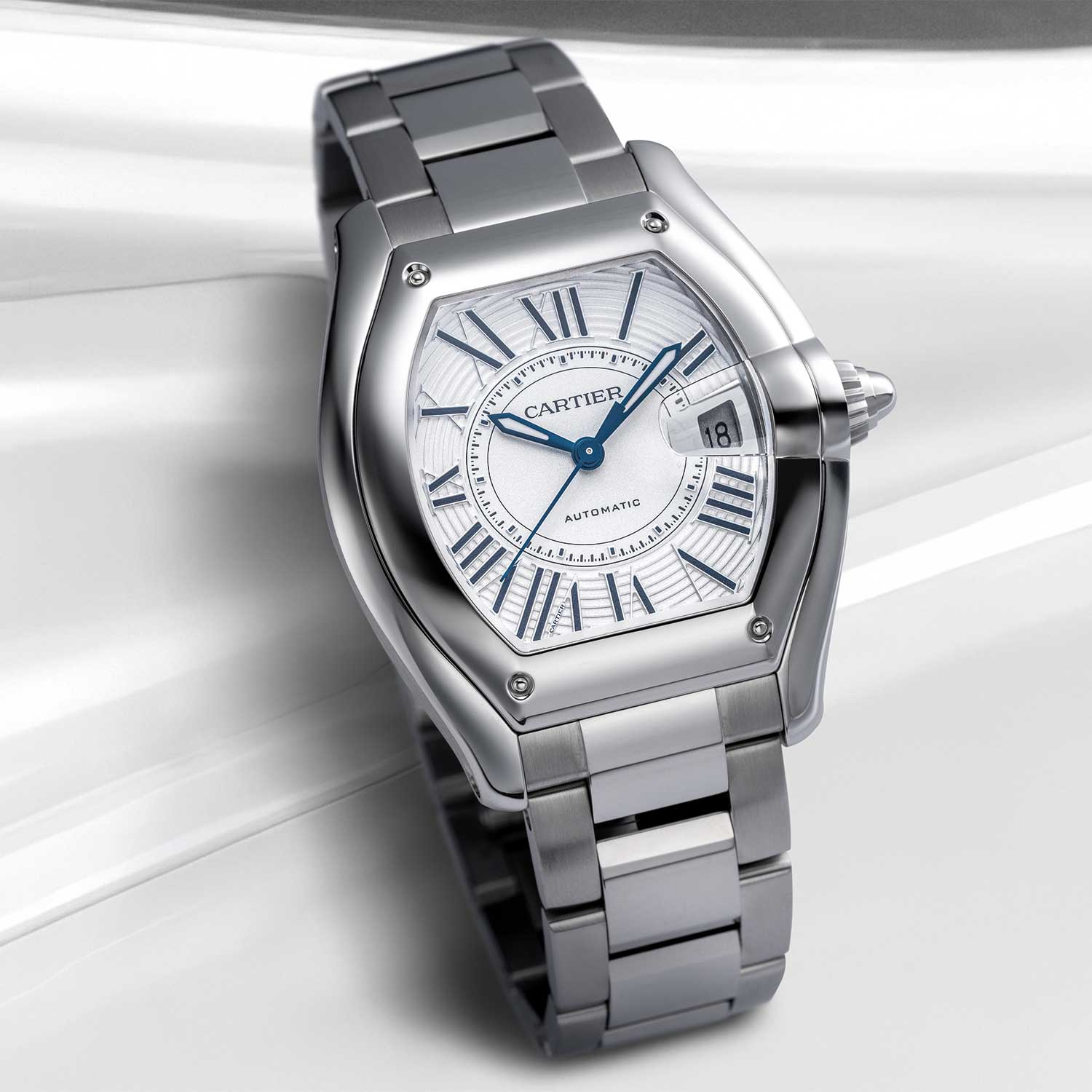
The Roadster is the latest in a long line of Cartier creations inspired by the mechanical world. In this case, mid-twentieth century automobile design (©Revolution)
For this celebratory return, Cartier has focused on the classic iteration of the Roadster. We only see time-and-date models at the moment (though the chronograph is surely only a few release cycles away). Two sizes, medium and large, are offered, with three case options: steel, steel and yellow gold, and full yellow gold. The large size measures 47.2mm by 38.8mm and is 10.06mm tall, while the medium model is 42.5mm by 34.9mm and only 9.71mm tall. Both sizes wear well on the wrist, thanks to the curved shape. Six of the seven models have white dials, all with Roman numerals. All six watches are equipped with bracelets and leather straps, easily swappable thanks to Cartier’s QuickSwitch system.
This core of the collection offers a tremendous amount of versatility for what is a tight and cohesive range. That’s six of the seven watches, but what about the seventh? The poster child (or cover watch, in our case) of the Roadster redux is the large model in steel, but instead of the familiar white dial, it is offered in a deep blue dial. In addition, the active aesthetic is amplified with the inclusion of a blue rubber strap alongside the familiar bracelet. Much like earlier iterations of the Roadster, this rubber strap echoes the links of the bracelet for a surprisingly dressed down look.
So that’s the top line of the new collection, but if we dig a little deeper into the details, what’s changed? In some ways, it’s easier to talk about what has stayed the same, because as is typically the case with a revamped version from Cartier, the core of the design remains the same, but amplified and improved. Take, for example, the conical crown. Every element of the original Roadster’s integrated crown is present, but the details have been tweaked to make them more pleasing to the eye. Slightly broader angles on the dial side give a more trapezoidal appearance, and the case integration is crisper. Underneath the sapphire, Cartier has added a reflective surround to the shaped date aperture to enhance the appearance. Another iconic element of the model has been changed a little. Earlier models had topside case screws sitting recessed into the lugs.
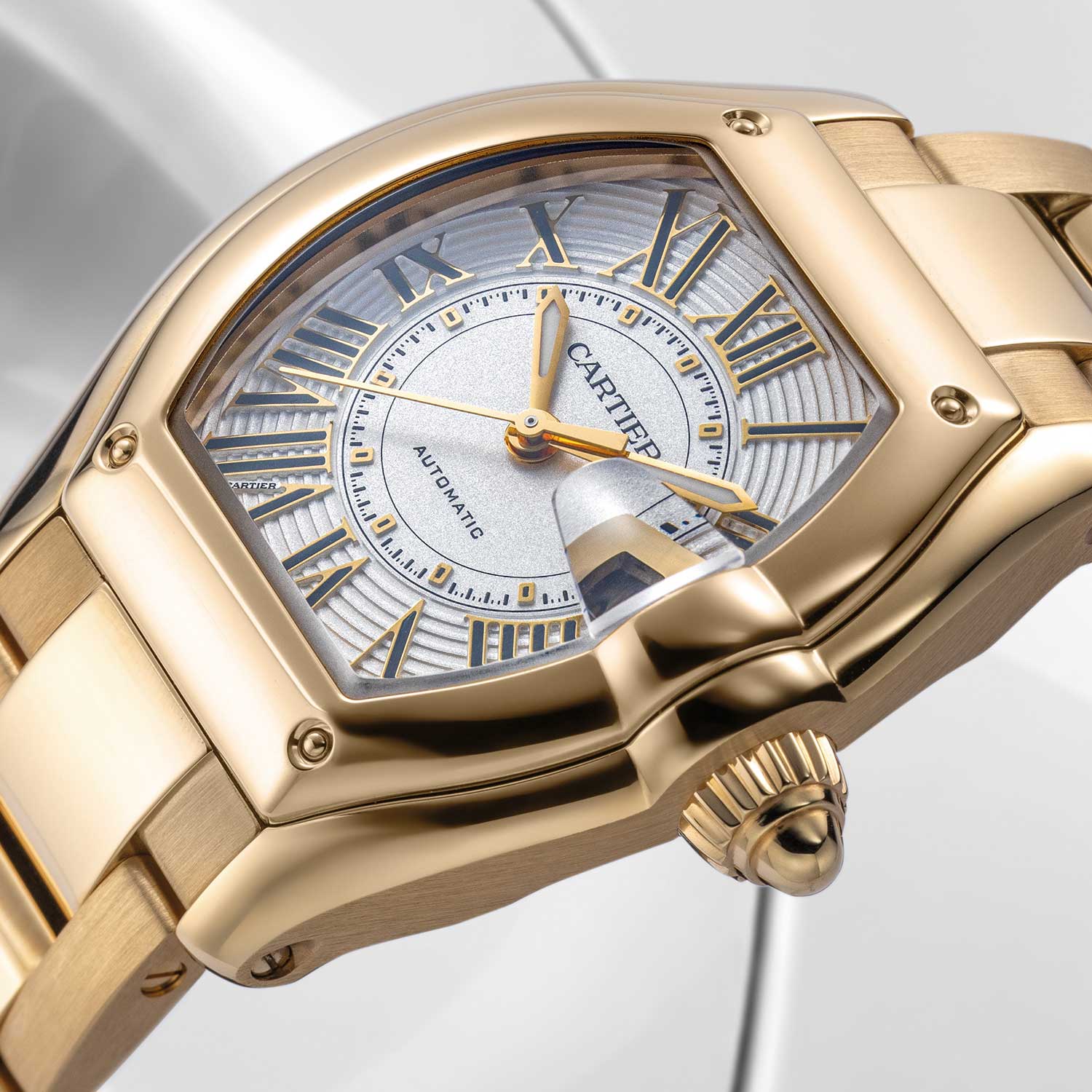
The gold execution of the Roadster highlights the sophisticated case finishes and dial design (©Revolution)
Now, these fixtures have moved onto the bezel, giving a cleaner profile while still preserving some of that automotive, industrial charm. There’s plenty of other small tweaks to the shape. The flanks flare out around the lugs and the polished bezel is broader all around, adding a feeling of solidity to the case. Taken incrementally, these changes are small, but all together they add up to a watch that looks and feels like a substantive update, with the proportions and quality we’d expect from a contemporary release from Cartier. The same level of care continues onto the dials. All the models feature luminous sword-shaped hands and Roman numerals, with the blue dial model also featuring Super-LumiNova filled numerals. Most of the models have blued hands and matching markers, while the blue dial flips the switch with silvered indexes and rhodium hands. Inside the hour markers sits a minute track that moves away from the brand’s traditional railroad layout, opting for a series of variously sized hash marks, with applied luminous markers at every five minutes. The center of the dial is plain and matte, while the outer section has a circular striated pattern, an ever-so-subtle nod to dashboard instrumentation.
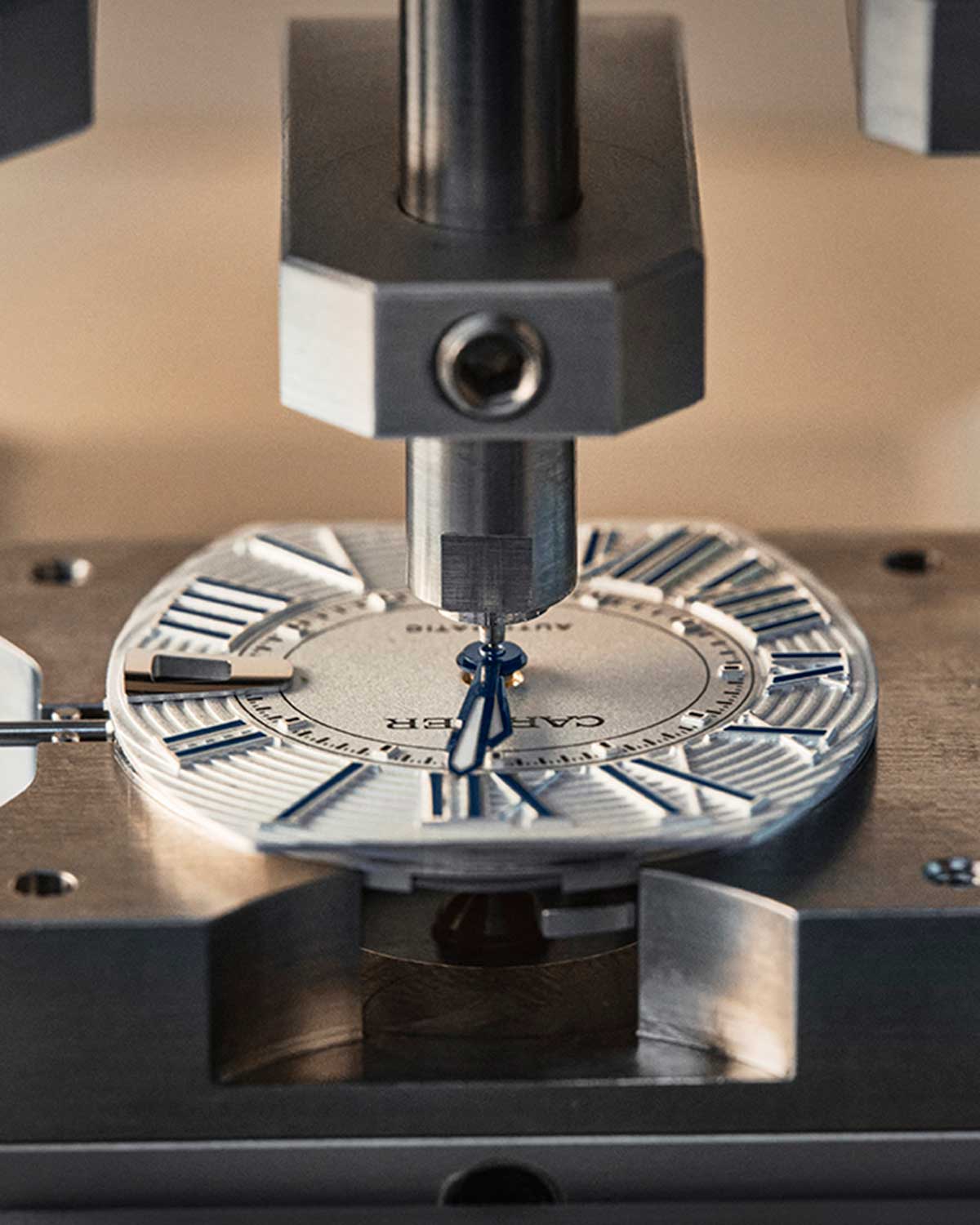
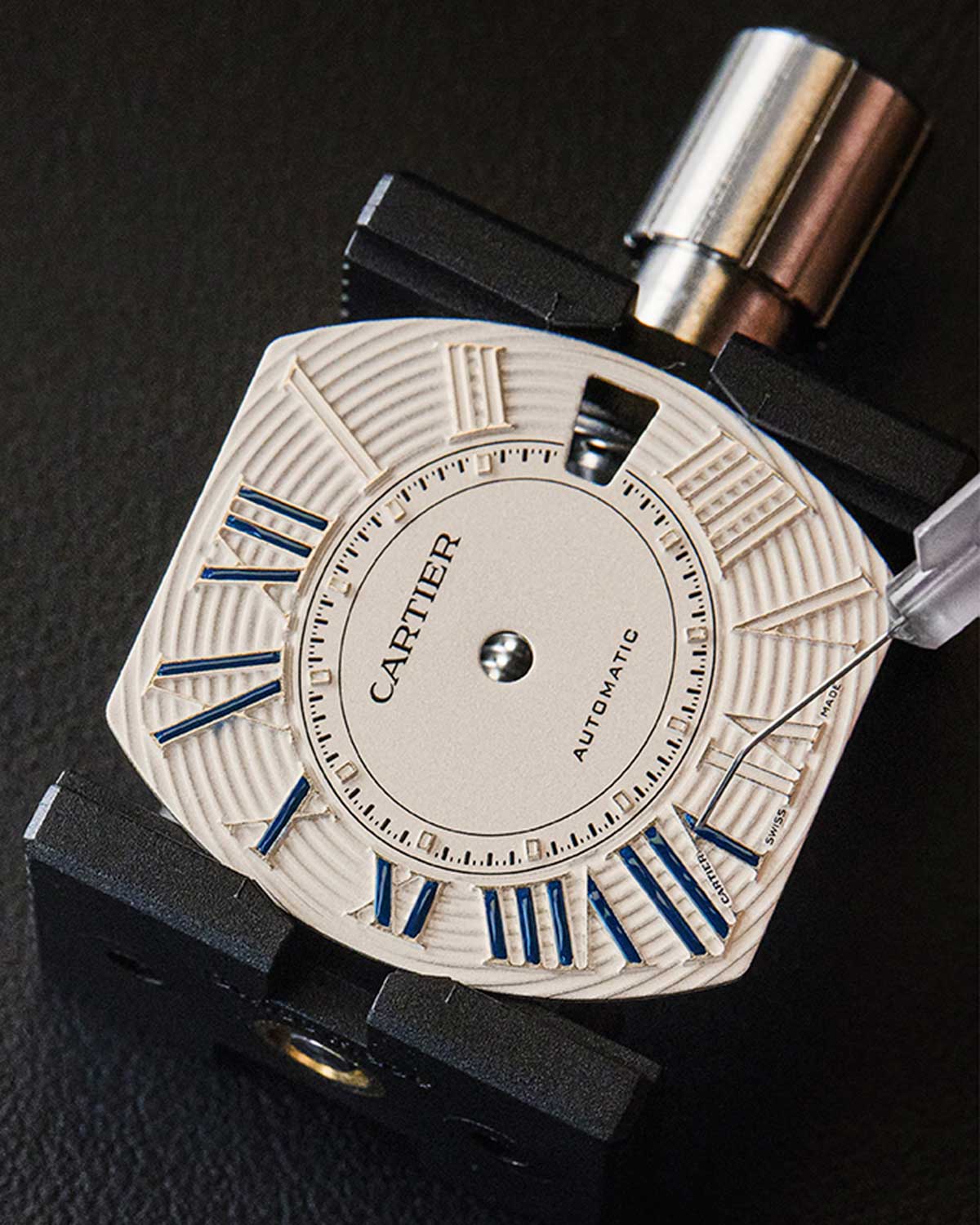
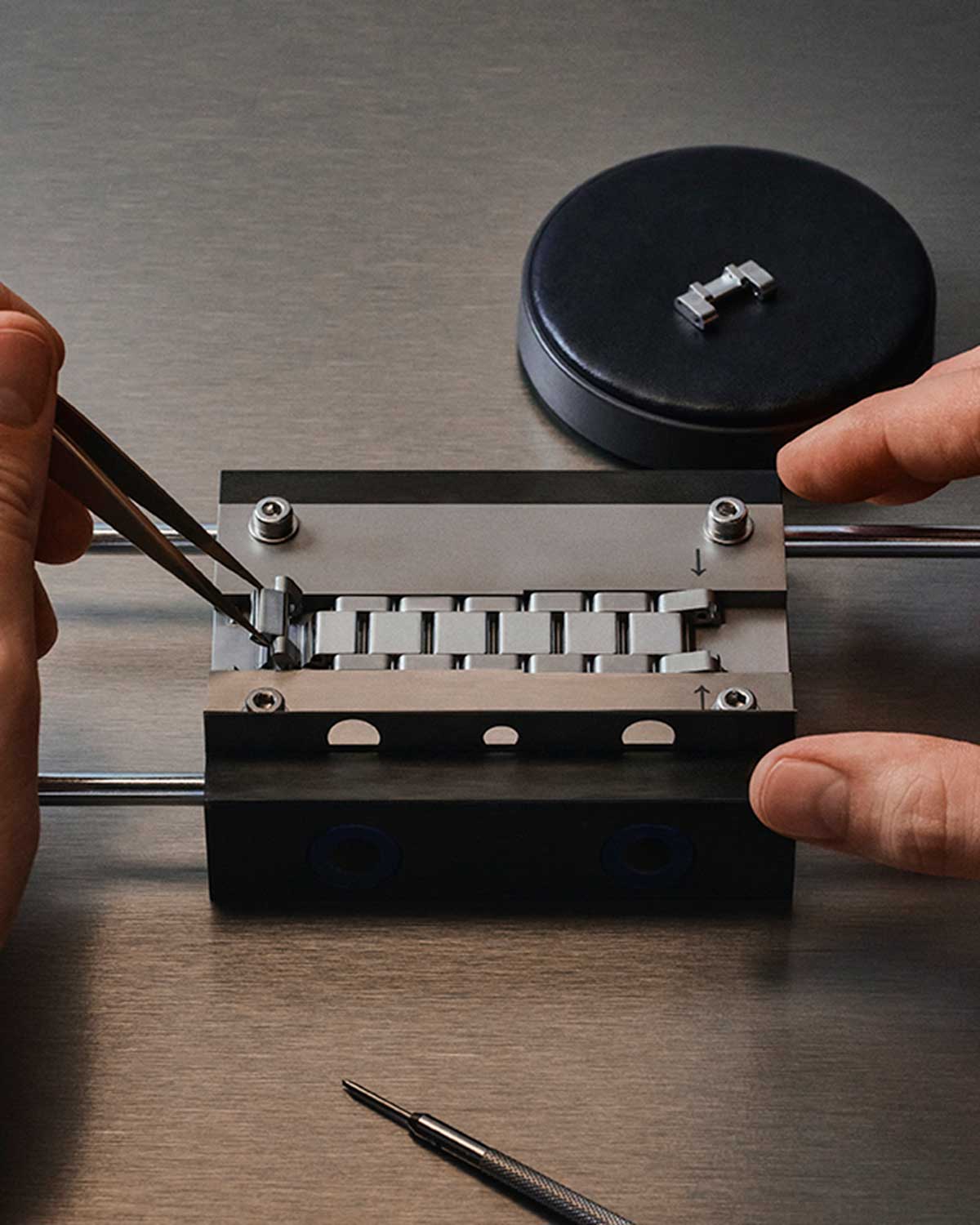
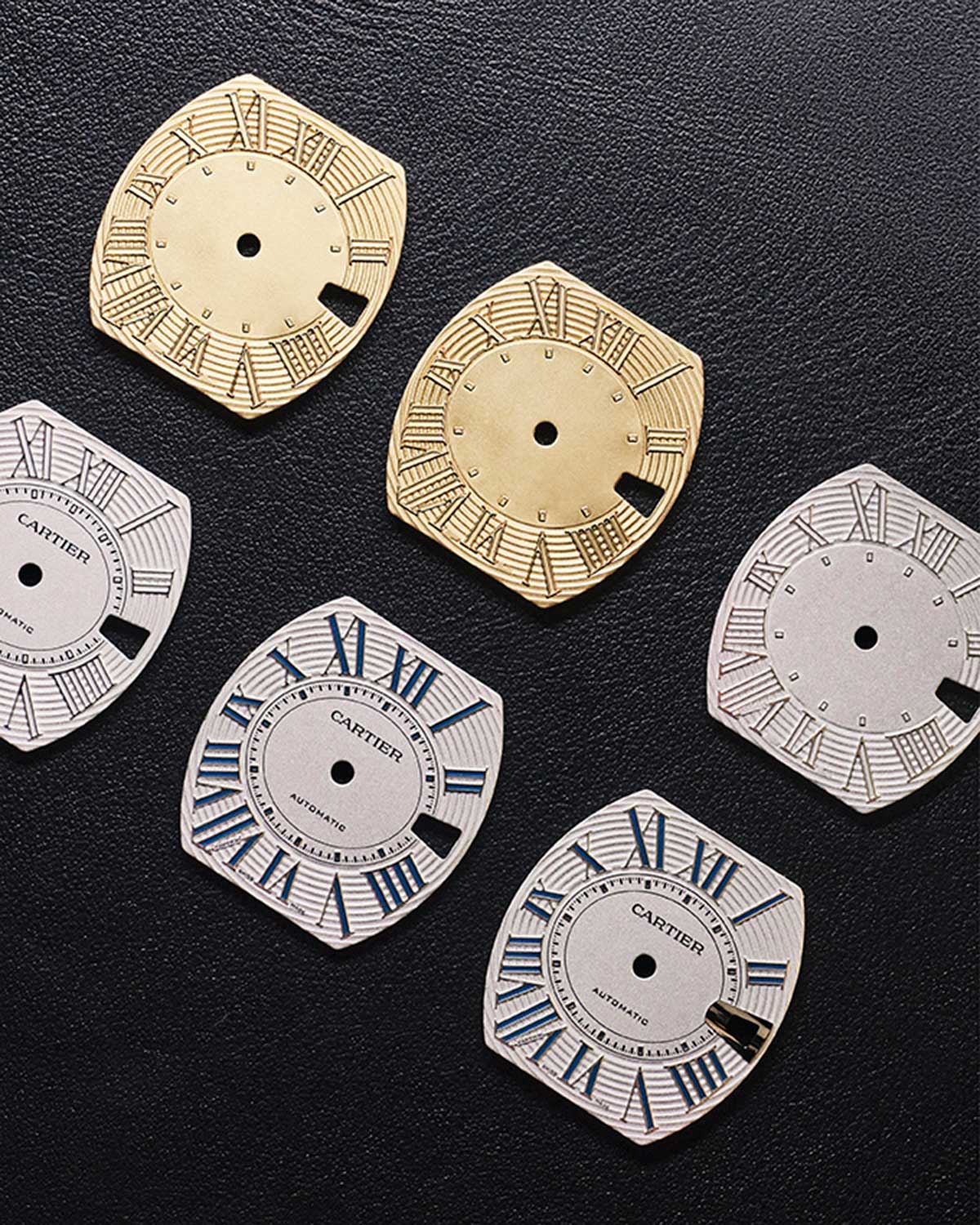
After the sophisticated case, the dial is the most remarkable and accomplished element of this watch. It strikes just the right note by offering something a little different from Cartier, while still remaining true to the codes of the house without pushing the automotive angle too hard. As usual, Cartier has given us a masterclass in balance and restraint.
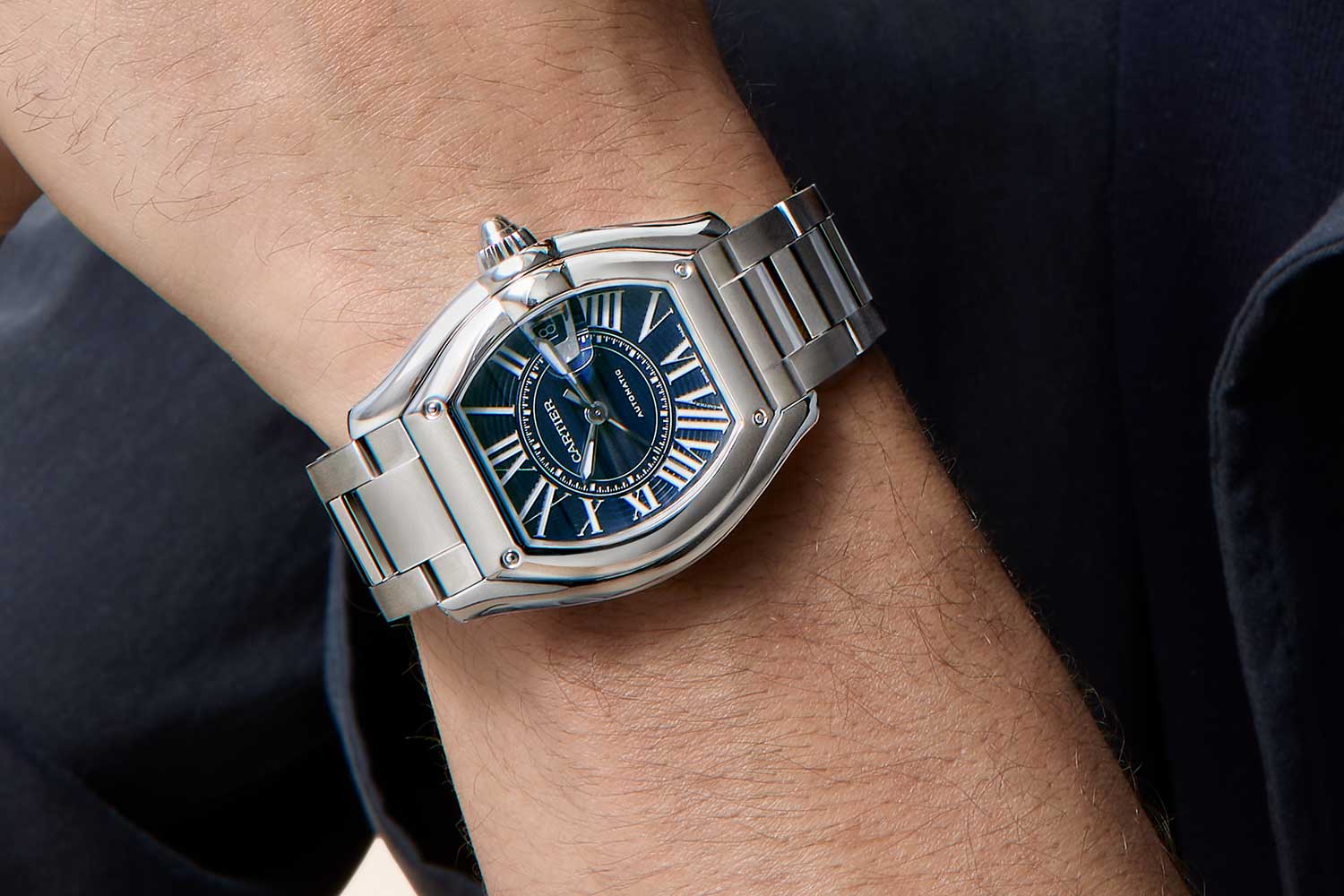
Regardless of model, the Roadster is perfectly positioned as an everyday companion, versatile and capable
Of course, this wouldn’t be an article about an automotive timepiece without a few overwrought references to the “engine” of the watch, more often referred to as the movement. In this case, we can keep it quite simple, as at this level, Cartier is more about reliability and design rather than fine watchmaking bells and whistles. The larger model is powered by the Caliber 1847 MC, while the medium comes with the Caliber 1899 MC. Both are competent automatics offering around 42 hours of power (a little less on the 1899 MC).
The new Roadster is a well-articulated and solid revival of the original. But for enthusiasts of the maison, there are a few questions worth asking. Why is this watch returning over a decade later? Who is it for, and why now? Well, from our perspective as armchair prognosticators, Cartier, which has been experiencing increasing popularity on the watchmaking front in recent years, has a delicate task ahead of it. The brand is known, overwhelmingly, as the watchmaker of elegant shaped watches. So the natural impetus must be to consistently iterate on new ones. But as any watchmaker will tell you, there are only so many shapes a watch case can take, and the risk of getting them wrong is high.
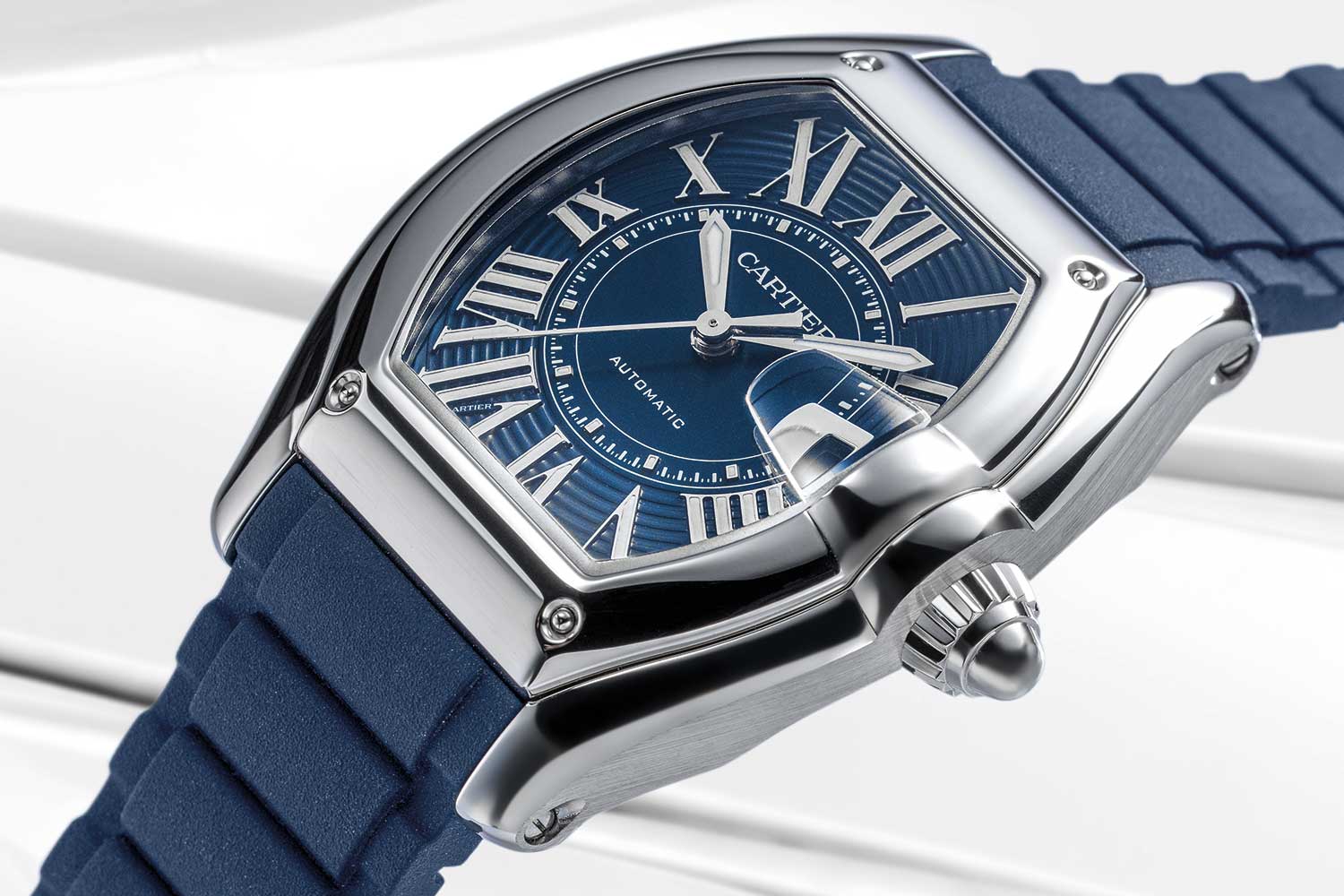
With its dark blue PVD dial, rubber strap and bold integrated crown, the bold shape of the Cartier Roadster marries form and purpose to tremendous effect (©Revolution)
The more rational path is to return to models of yore — models, it must be said, that had elicited much positive sentiment from those who admired and wore them the first time round. It’s a strategy that’s worked well with previous updates like the Panthère de Cartier, so there’s every reason to think the Roadster will roll out with similar success. Of course, the offering of the Roadster is dramatically different to the slinky Panthère, which brings us to the second question. Who’s it for? Well, obviously it’s for anyone; it’s versatile enough that it will look good on any wrist. But the slightly broader answer is that the watch is pitched as a sort of everyday, utilitarian timepiece, stylish yet solid, versatile in every situation. In this context, it occupies a similar space to the Santos de Cartier, though the Roadster has a distinctly curvier personality.
Perhaps the most exciting question is, where will the long and ever-winding road lead next for the revived Roadster? While there’s certainly some rich history in the archive, it’s a younger model than most in the catalog, so there’s plenty of potential for the Roadster to forge its own path.
Tech Specs: Cartier Roadster Watch (Large Model)
-
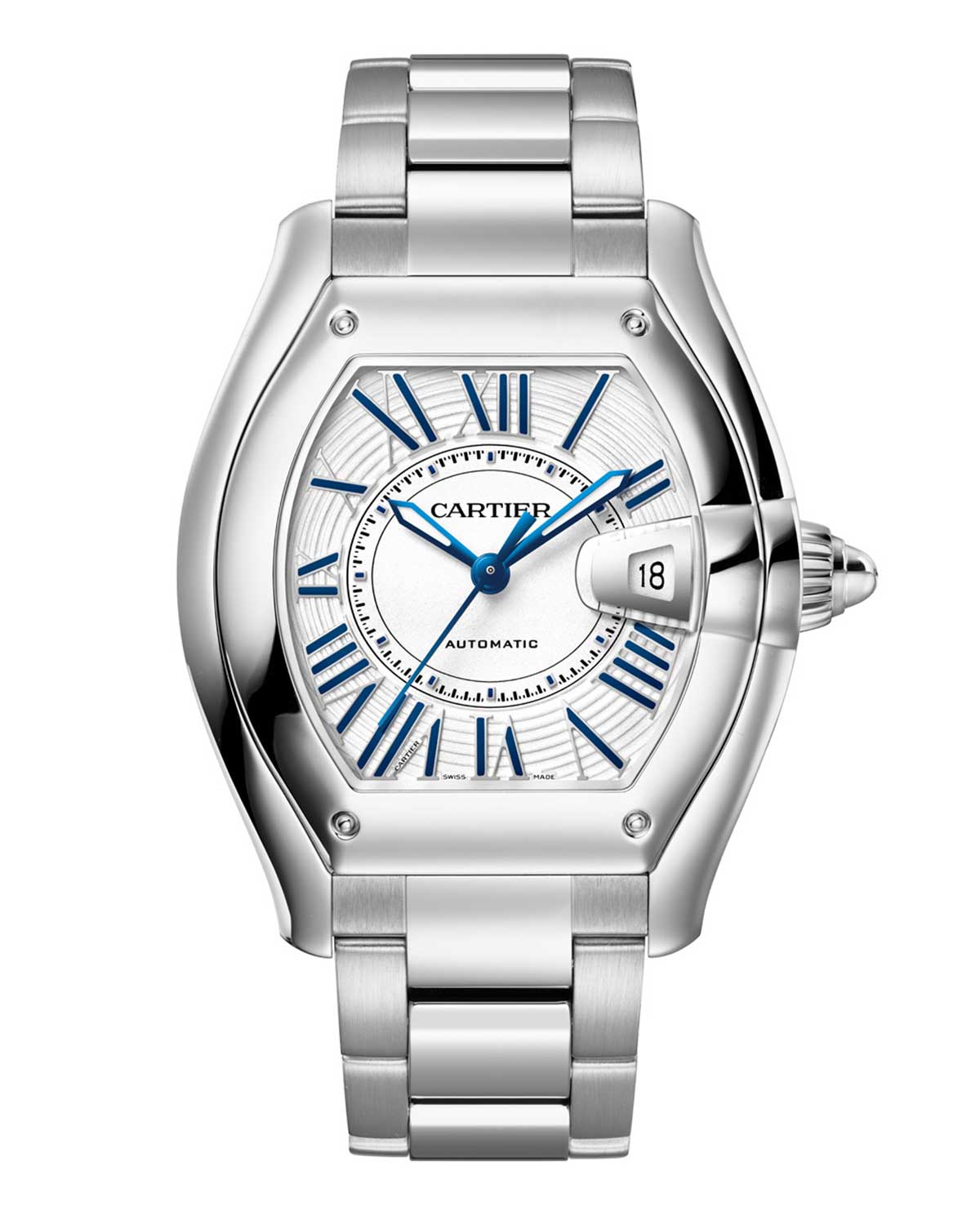
- WSRD0020
-
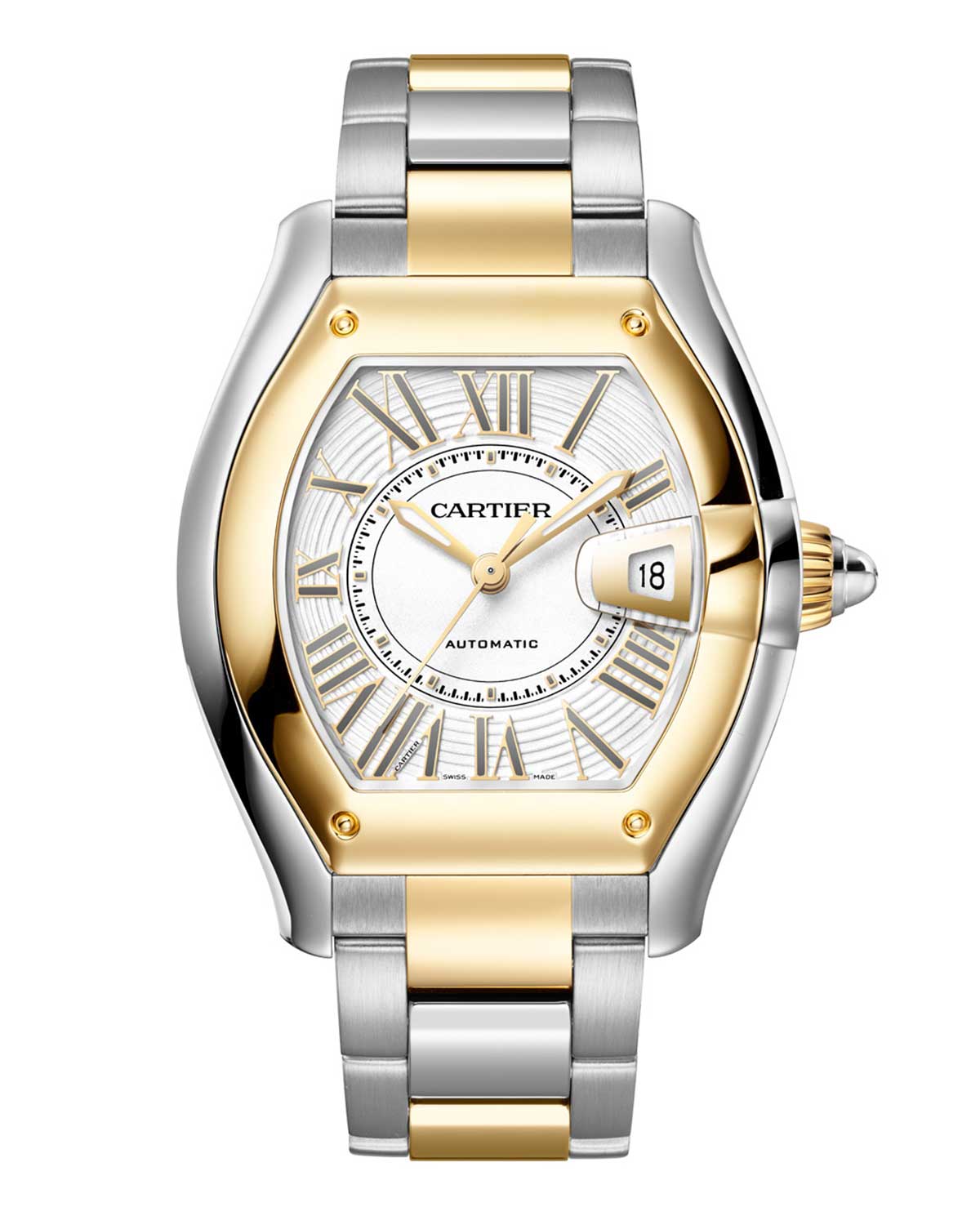
- W2RD0010
-
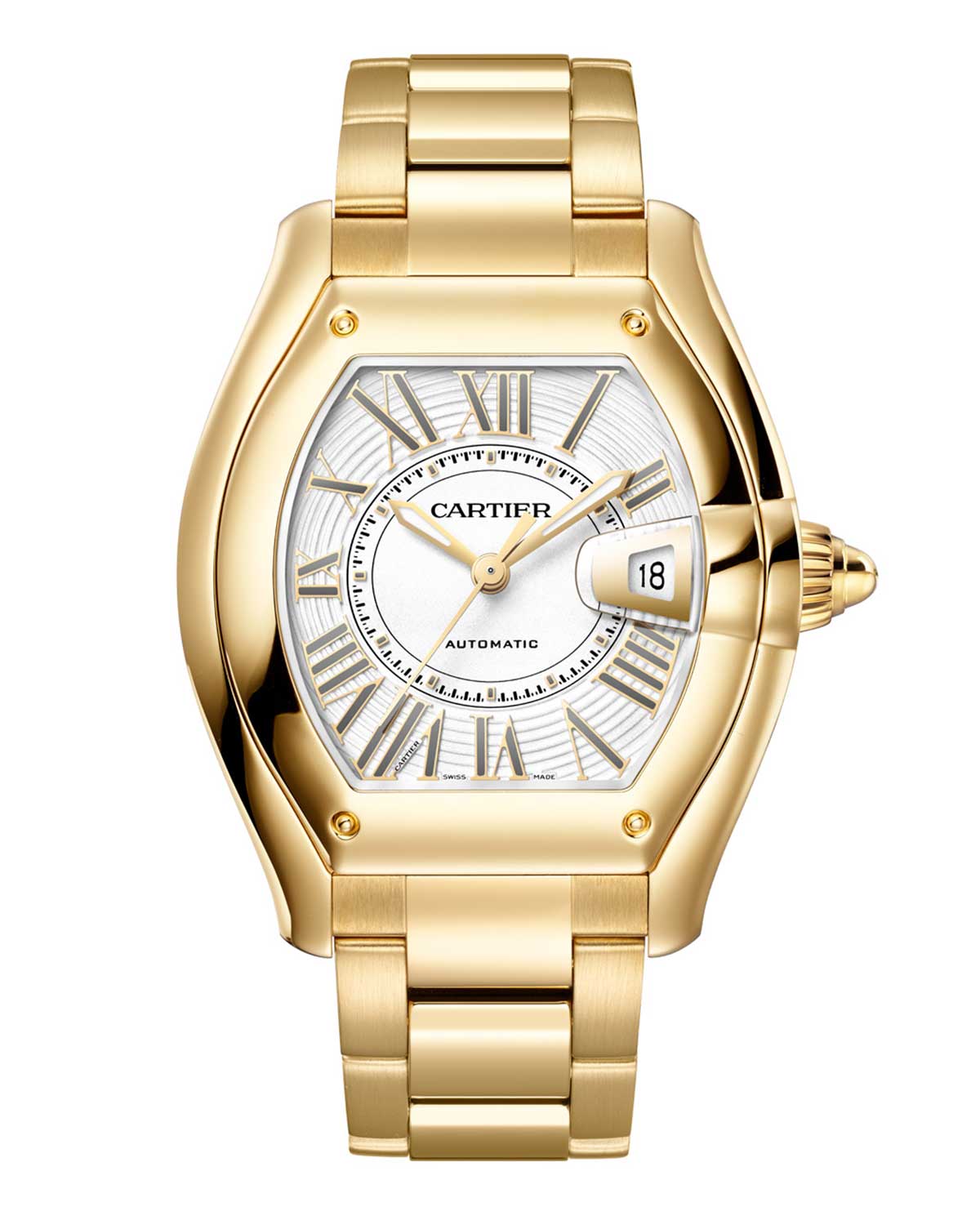
- WGRD0012
References WSRD0020 (steel); W2RD0010 (18K yellow gold and steel); WGRD0012 (18K yellow gold)
Movement Self-winding Caliber 1847 MC; 42-hour power reserve
Functions Hours, minutes, seconds and date
Case 47.2mm × 38.8mm × 10.06mm; steel, 18K yellow gold and steel, or full 18K yellow gold; water resistant to 100m
Dial White; applied Roman numerals; sword-shaped hands filled with green Super-LumiNova
Strap Steel bracelet and navy blue alligator leather with steel deployant buckle (WSRD0020); 18K yellow gold and steel bracelet, and gray alligator leather with yellow gold and steel deployant buckle (W2RD0010); 18K yellow gold bracelet and gray alligator leather with yellow gold deployant buckle (WGRD0012); all fitted with QuickSwitch interchangeable system
Price AUD 16,000 (steel); AUD 31,600 (18K yellow gold and steel); price upon request (18K yellow gold)
Tech Specs: Cartier Roadster Watch (Medium Model)
-
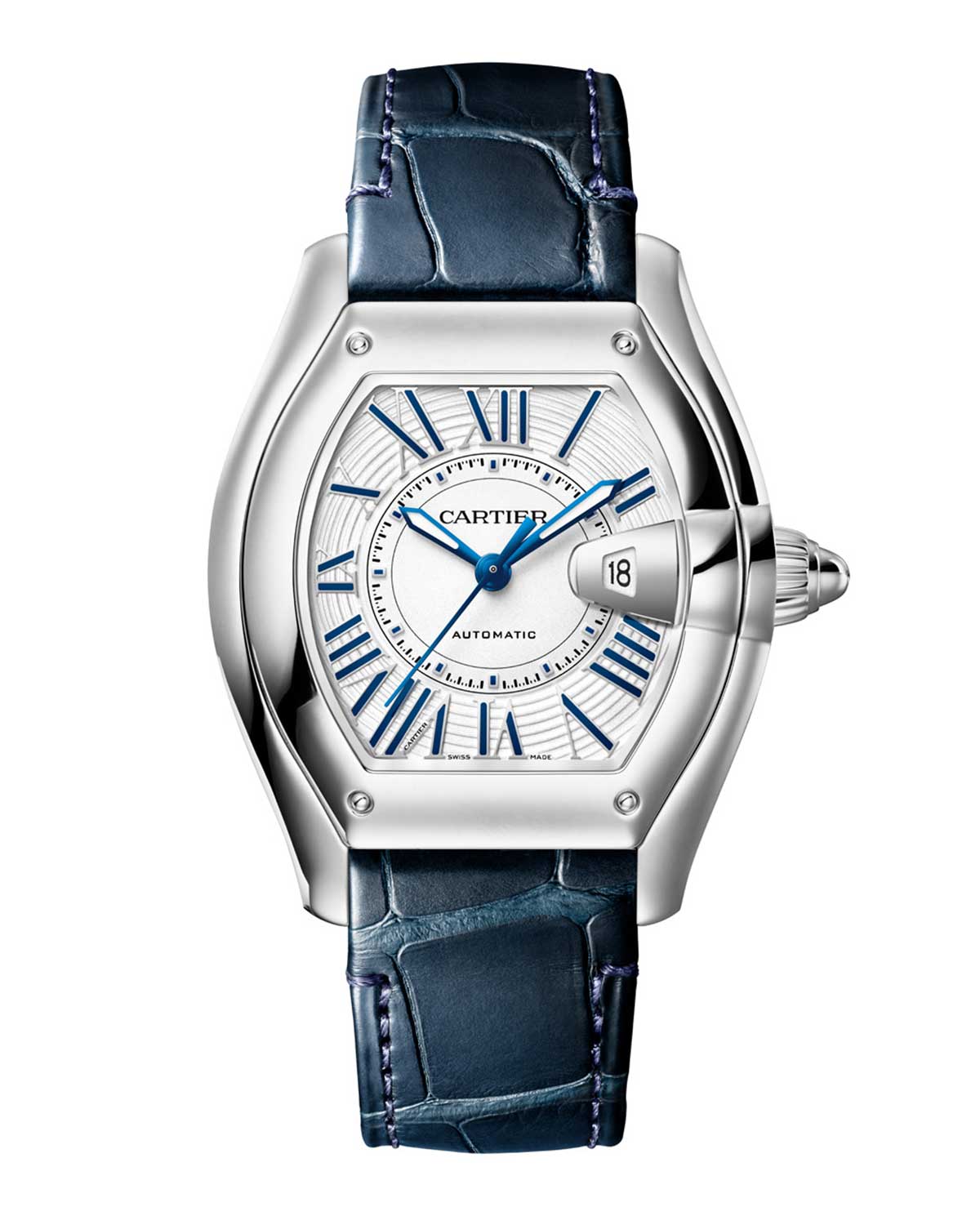
- WSRD0019
-
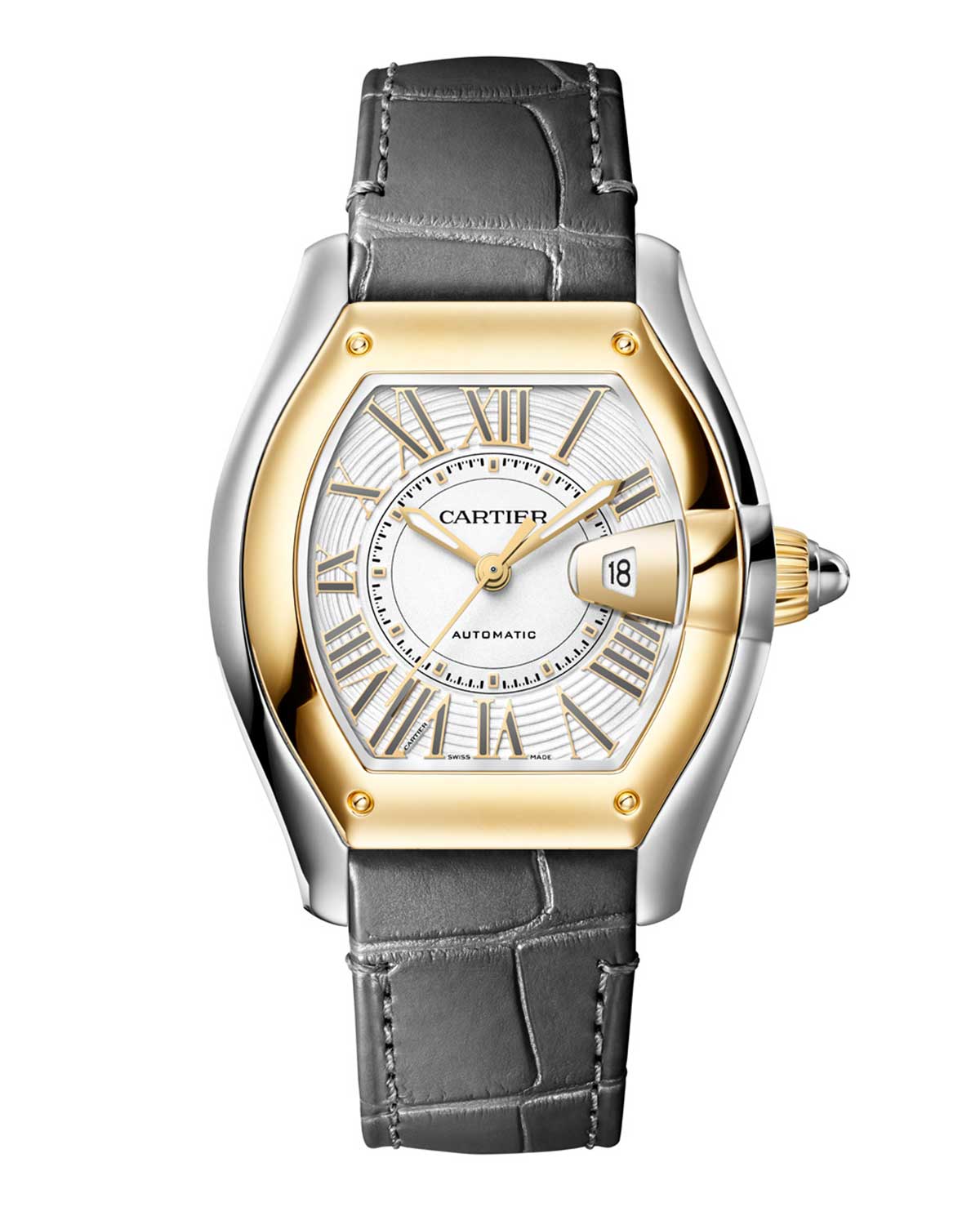
- W2RD0009
-
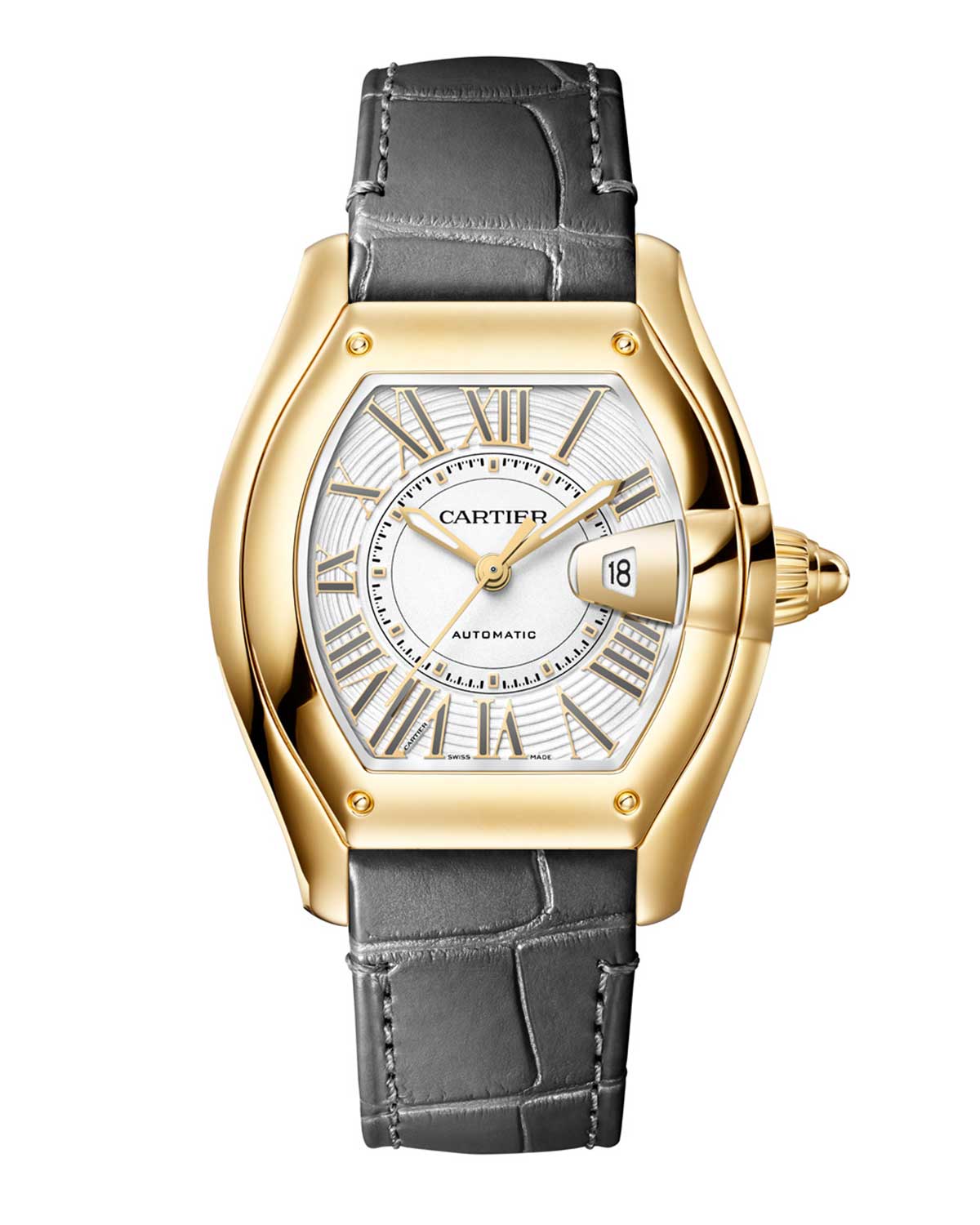
- WGRD0011
References WSRD0019 (steel); W2RD0009 (18K yellow gold and steel); WGRD0011 (18K yellow gold)
Movement Self-winding Caliber 1899 MC; 40-hour power reserve
Functions Hours, minutes, seconds and date
Case 42.5mm × 34.9mm × 9.71mm; steel, 18K yellow gold and steel, or full 18K yellow gold; water resistant to 100m
Dial White; applied Roman numerals; sword-shaped hands filled with green Super-LumiNova
Strap Steel bracelet and navy blue alligator leather with steel deployant buckle (WSRD0019); 18K yellow gold and steel bracelet, and gray alligator leather with yellow gold and steel deployant buckle (WGRD0009); 18K yellow gold bracelet and gray alligator leather with yellow gold deployant buckle (WGRD0011); all fitted with QuickSwitch interchangeable system
Price AUD 14,700 (steel); AUD 28,800 (18K yellow gold and steel); price upon request (18K yellow gold)
Tech Specs: Cartier Roadster Watch (Large Model)
-
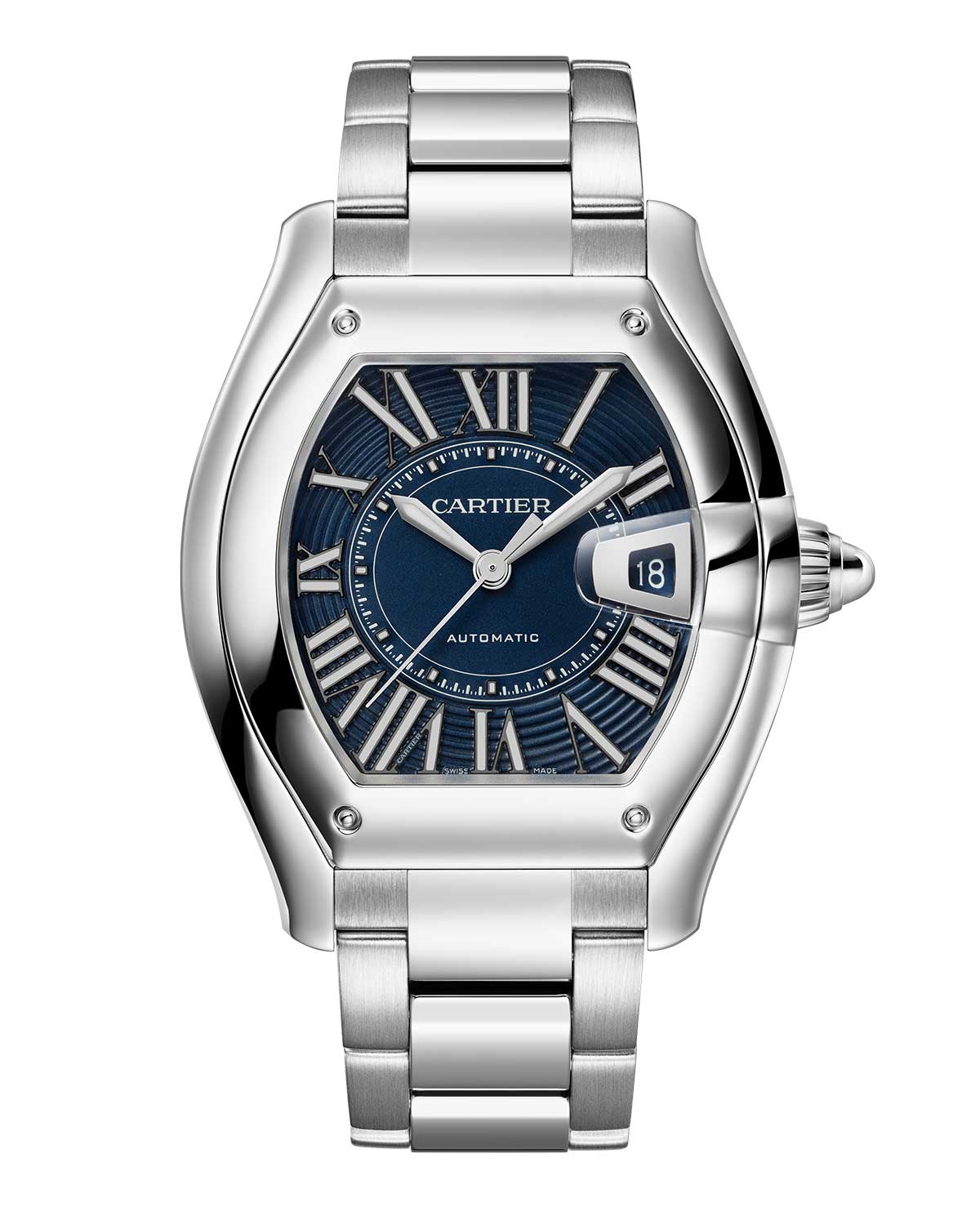
- WSRD0014
-
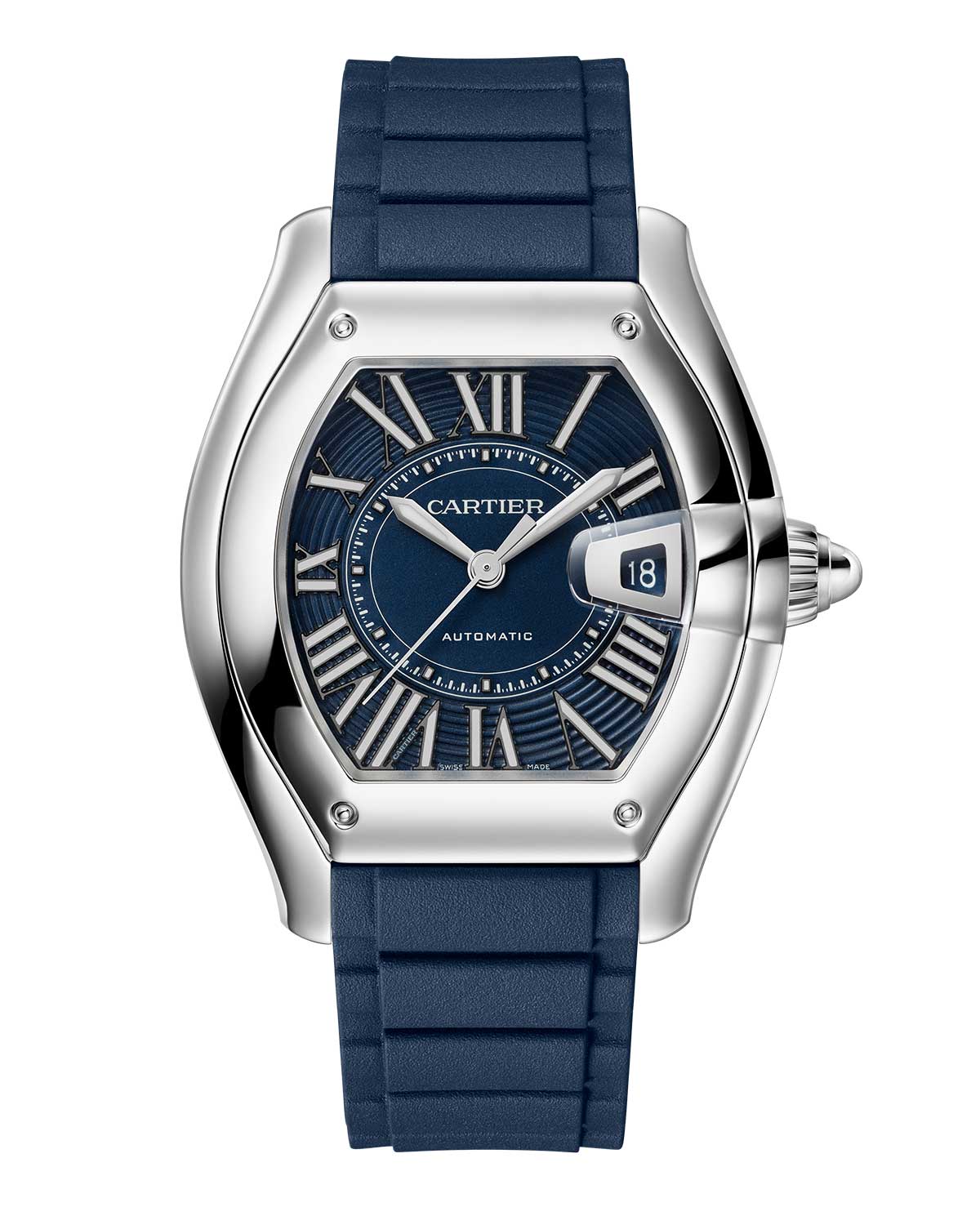
- WSRD0014
Reference WSRD0014
Movement Self-winding Caliber 1847 MC; 42-hour power reserve
Functions Hours, minutes, seconds and date
Case 47.2mm × 38.8mm × 10.06mm; steel; water resistant to 100m
Dial Blue PVD; applied Roman numerals and sword-shaped hands, all filled with blue Super-LumiNova
Strap Steel bracelet and navy blue rubber with steel deployant buckle, both fitted with QuickSwitch interchangeable system
Price AUD 16,000

You may also like
Editorial
The Long View with Alex Rosenfield, Urban Jürgensen
Oct 8, 2026
Editorial
The Long View with Alex Rosenfield, Urban Jürgensen
Oct 8, 2026
Editorial
The Jacob & Co Palatial Flying Tourbillon Minute Repeater Goes Back to the Beginning
Oct 7, 2026
Editorial
The Jacob & Co Palatial Flying Tourbillon Minute Repeater Goes Back to the Beginning
Oct 7, 2026
Editorial
Bond is Back: The New Omega Seamaster Bond Watches are Perfect for Heroes or Villains
Oct 5, 2026
Editorial
Bond is Back: The New Omega Seamaster Bond Watches are Perfect for Heroes or Villains
Oct 5, 2026