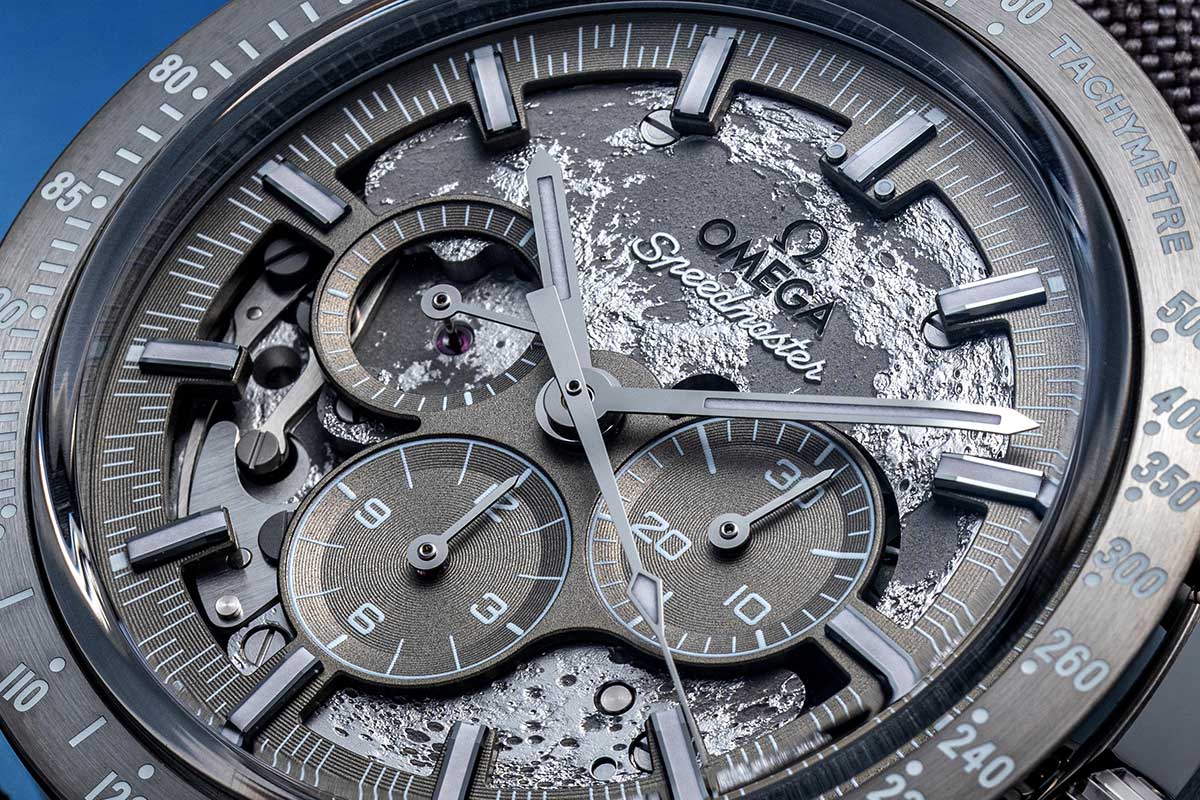
Six Decades Beyond Earth: Omega Speedmaster
Editorial
Six Decades Beyond Earth: Omega Speedmaster

There are many timepieces associated with moments when the limits of human endeavour extended beyond what had previously been thought possible. They have crossed open oceans, guided flight, summited mountains and descended into the deep. But the first time man left the world that had contained all of history and stood on another celestial body, the watch that made the journey was the Omega Speedmaster.
Today the standard Speedmaster Professional is known simply as the Moonwatch. However, when the Speedmaster was introduced in 1957, it was merely one of several chronographs intended for the burgeoning world of motor racing, no more destined for flight, let alone space, than the Rolex Daytona or Heuer Carrera that would follow. But within a decade or so, it would accompany astronauts into space, become the first watch worn on the Moon and earn a reputation that no marketing department could have manufactured even if they tried.
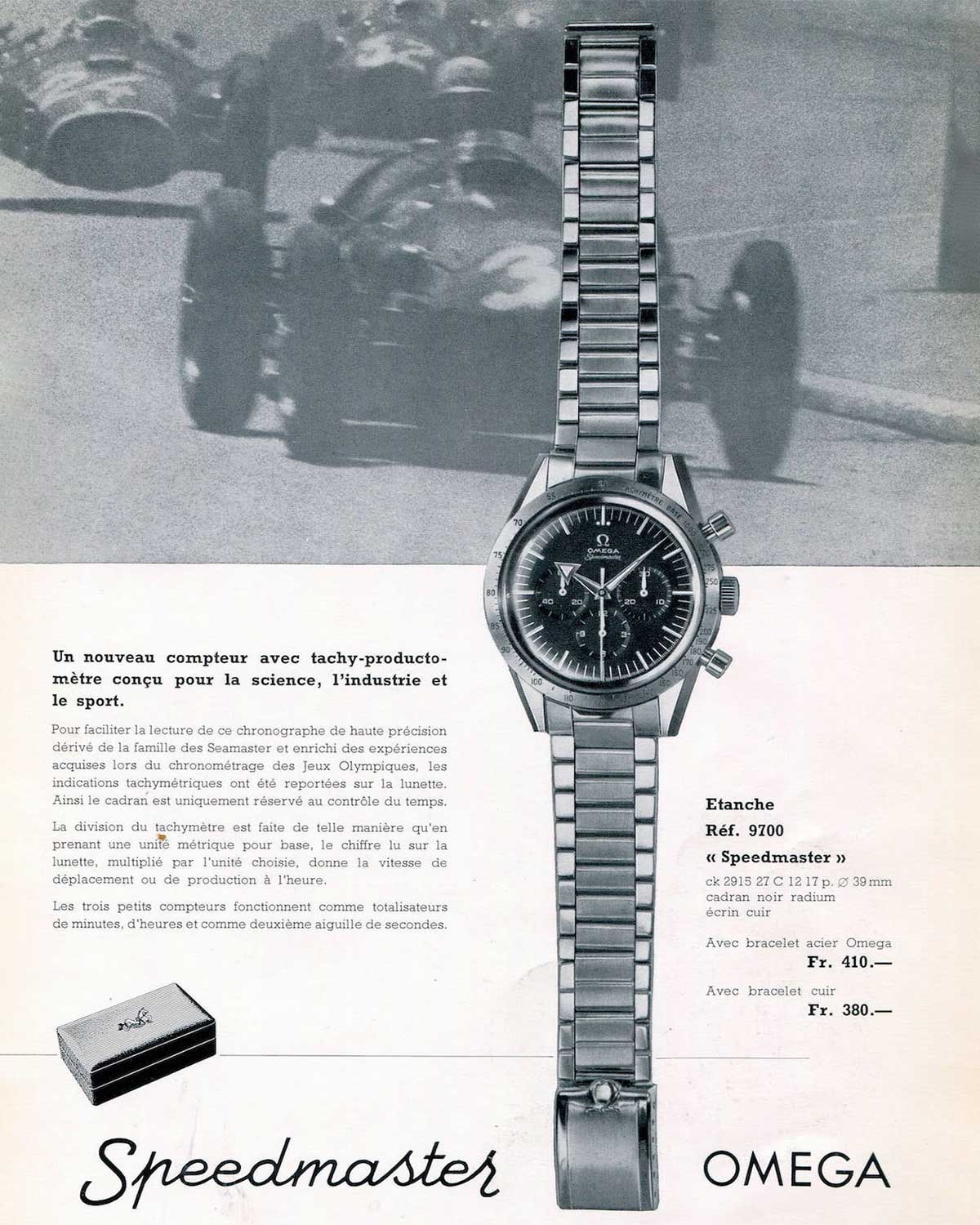
A 1957 advertisement for the Omega Speedmaster CK2915 (Image: Omega)
For more than six decades, the Speedmaster has remained in service. It also remains to this day the only wristwatch NASA has qualified for spacewalks, meaning it is trusted not only within the life-supporting confines of a spacecraft but in the vacuum of space itself. As a second space age rushes towards us, and the Moon becomes the focus of a new generation of missions as well as a rehearsal for Mars, it seems fitting to look back at the watch that got there first.
The Early Beginnings
The Speedmaster was originally launched as part of the trilogy of 1957. Together with the Seamaster 300 and Railmaster, the Speedmaster CK2915 formed a collection of purpose-built instruments intended, respectively, for motor racing, diving and work in the presence of magnetic fields. It was distinguished by several features that are now taken for granted but were novel at the time.
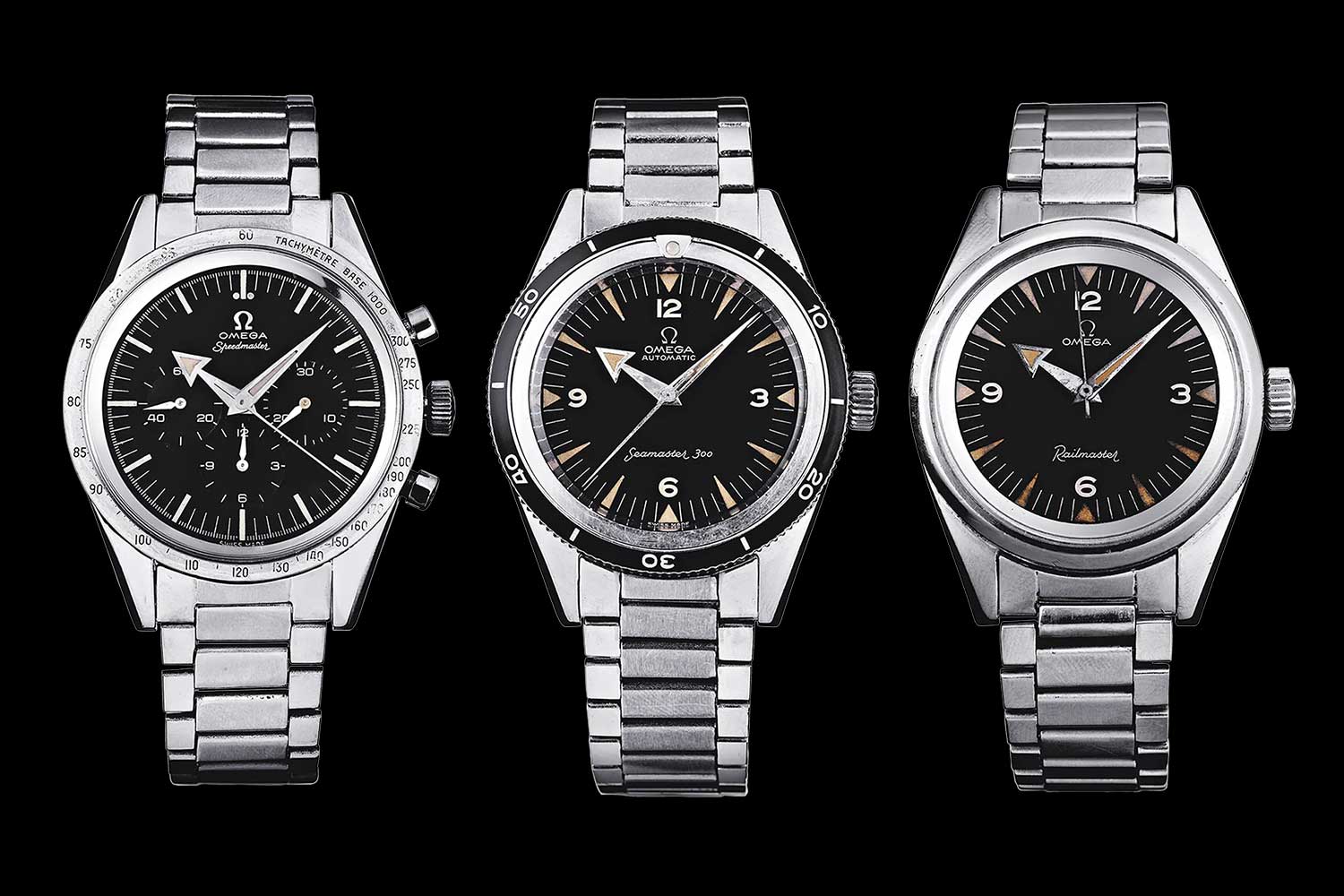
The Omega Trilogy of 1957: Speedmaster CK2915, Seamaster 300 and Railmaster (Image: Omega)
Most obvious was the tachymeter scale or, as Omega called it at the time, the Tacho-Productometer scale engraved on the bezel rather than printed on the dial, leaving more room for a cleaner, more legible display. The broad arrow hands and high-contrast dial were designed for rapid reading, while the robust manually wound Caliber 321, based on the Lemania 2310, provided a level of reliability that would later prove invaluable in circumstances far removed from the racing circuit. At 38.5mm in diameter, the CK2915 was also unusually large for its day. It was the first of four straight-lug Speedmaster references before the introduction of the now familiar asymmetrical 42mm case with lyre lugs.
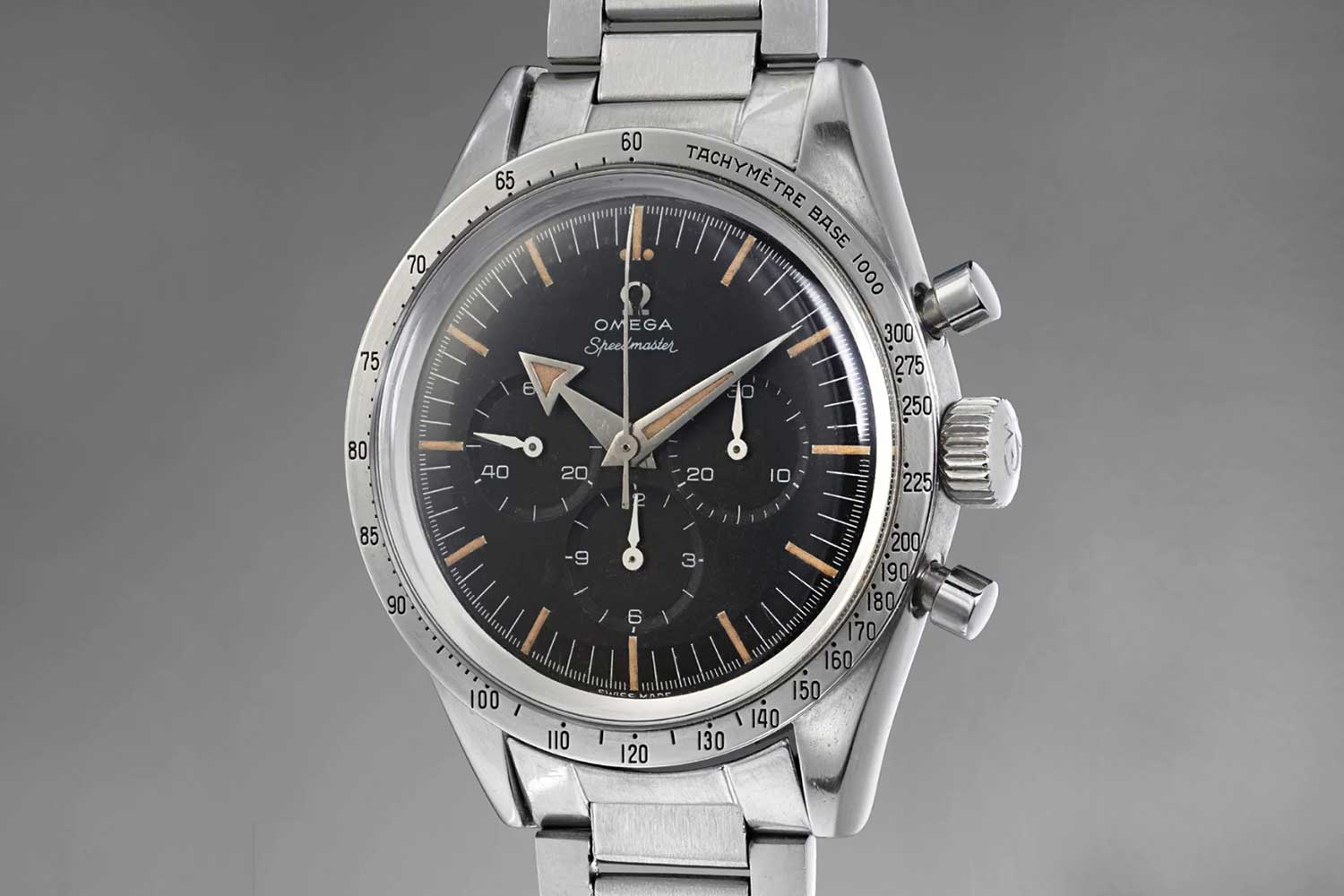
1957: Omega CK2915-1 with Tacho-Productometer scale engraved on the scale (Image: Phillips Watches)
The CK2915 remained in production until 1959 and evolved through three generations identified by the suffixes -1, -2 and -3. The differences between the first two were slight, but the CK2915-3 served as a transitional model. Some examples retained the broad arrow hands and steel tachymeter bezel of the earlier watches, while others adopted features that would become standard on its successor.
That successor was the CK2998, introduced in 1959. It replaced the engraved steel bezel with a black anodized aluminum insert, substituted the broad arrow hands for alpha hands and introduced the hippocampus medallion on the caseback. During its production, the CK2998 underwent a series of incremental revisions, with a total of eight sub-references.
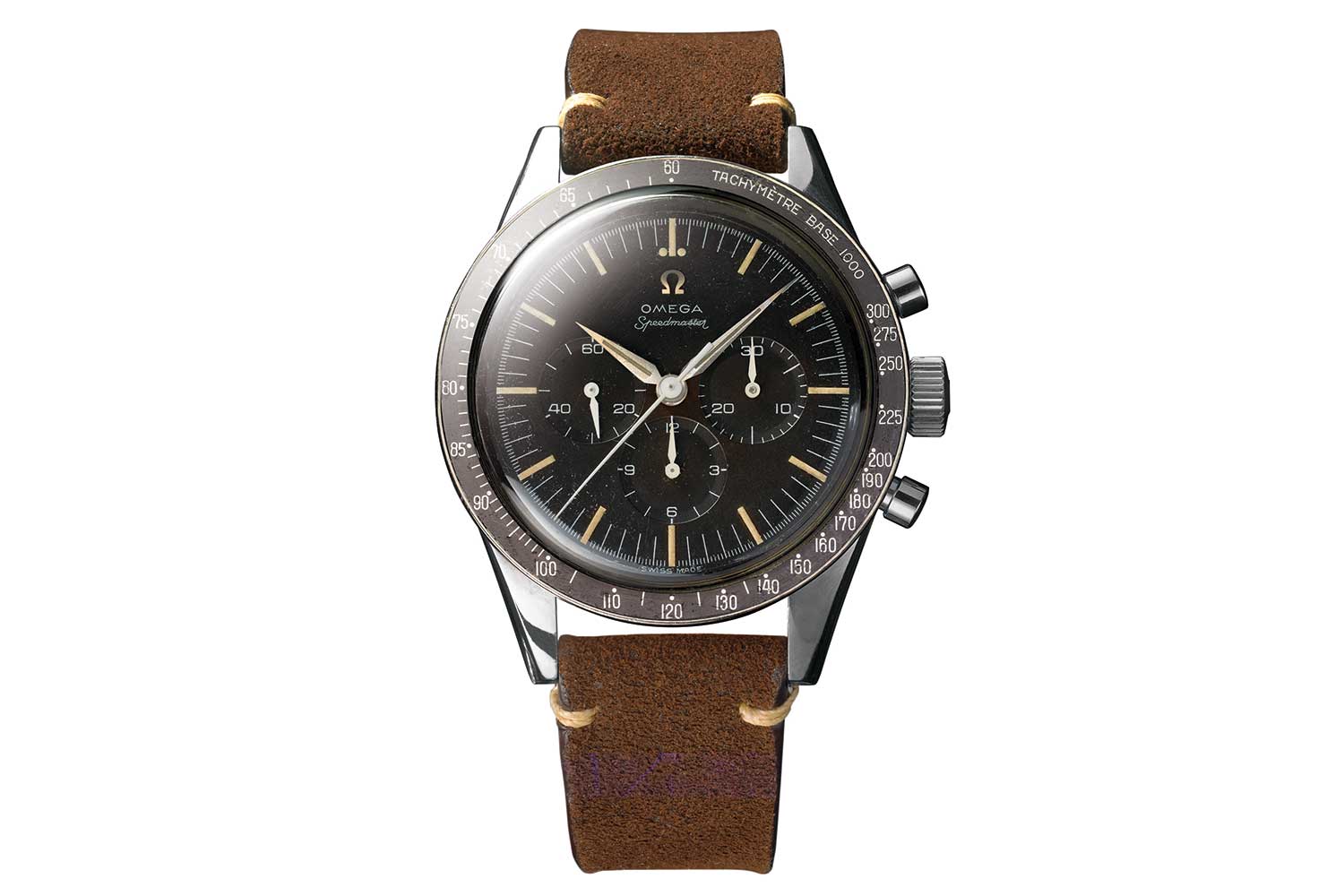
The Omega Speedmaster CK2998
In 1962, Omega adopted a new reference numbering system, and the CK2998 gave way to the ST105.002. The watch itself changed little, retaining the straight-lug case, black tachymeter bezel insert and Caliber 321. It can be found with either alpha or baton hands and was also the last Speedmaster to use radium luminous material before the transition to tritium. It was succeeded a year later by the ST105.003, otherwise known as the “Ed White”, which replaced the alpha hands permanently with baton hands for improved legibility while otherwise remaining largely unchanged. It was this reference that NASA would subject to its qualification program. The next evolution came in 1964 with the ST105.012. It was the first Speedmaster to bear the word “Professional” on the dial, a designation adopted before Omega had any knowledge of NASA’s qualification results. Although it retained the Caliber 321, it introduced the asymmetrical case with integrated crown guards and lyre lugs that would become synonymous with the Moonwatch.
-
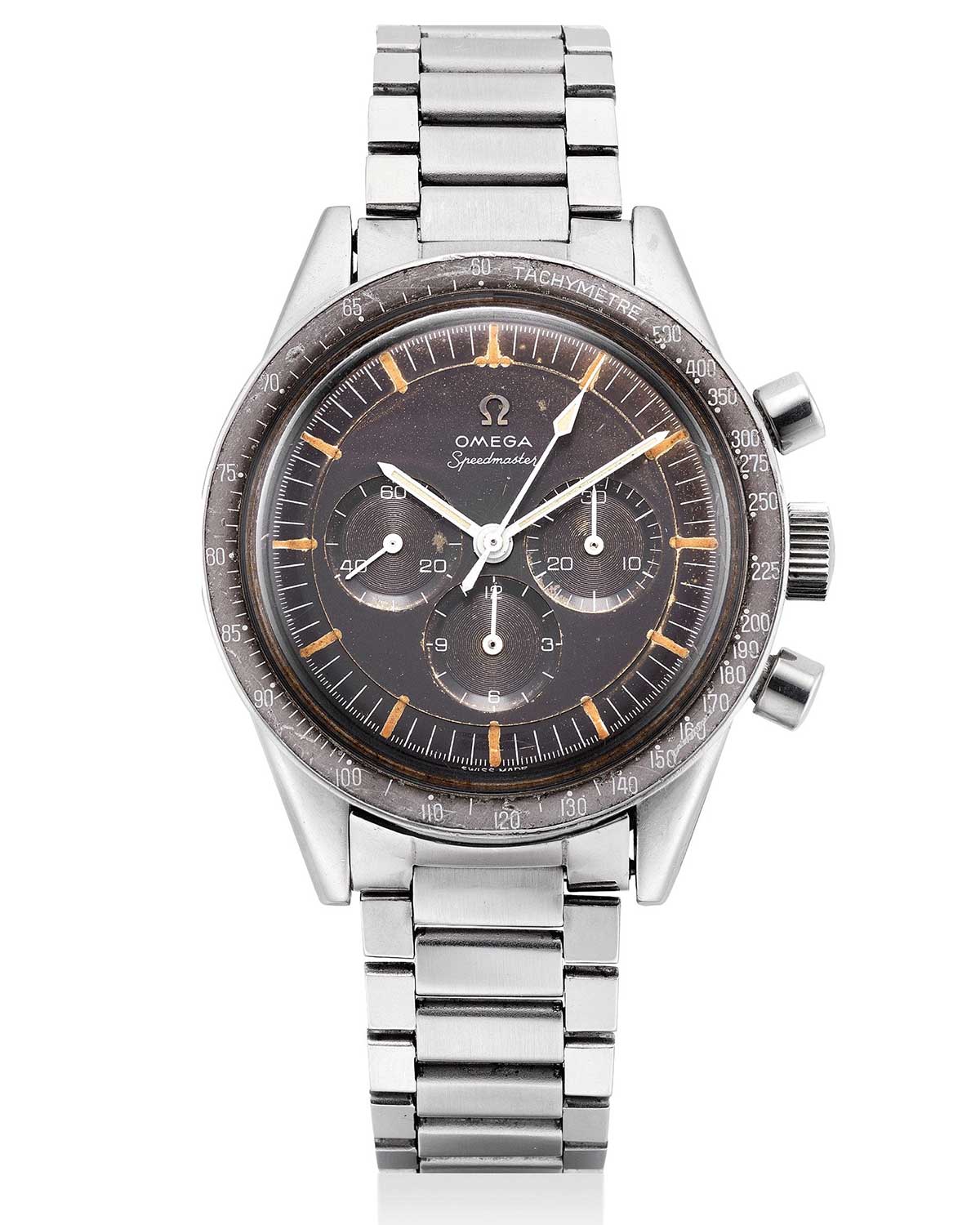
- Omega Speedmaster ST105.002 (Image: Phillips)
-
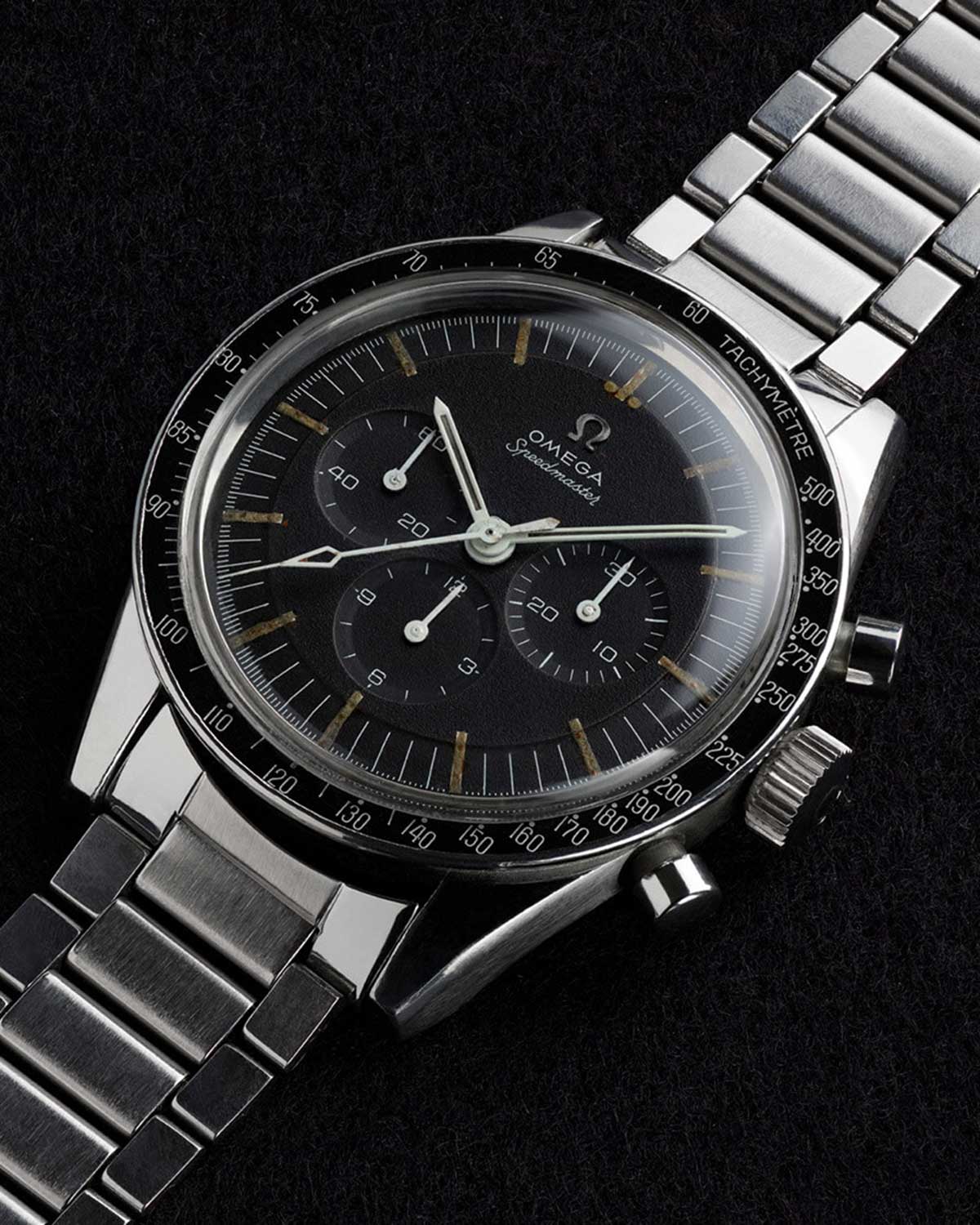
- Omega Speedmaster ST105.003 (©Revolution)
-
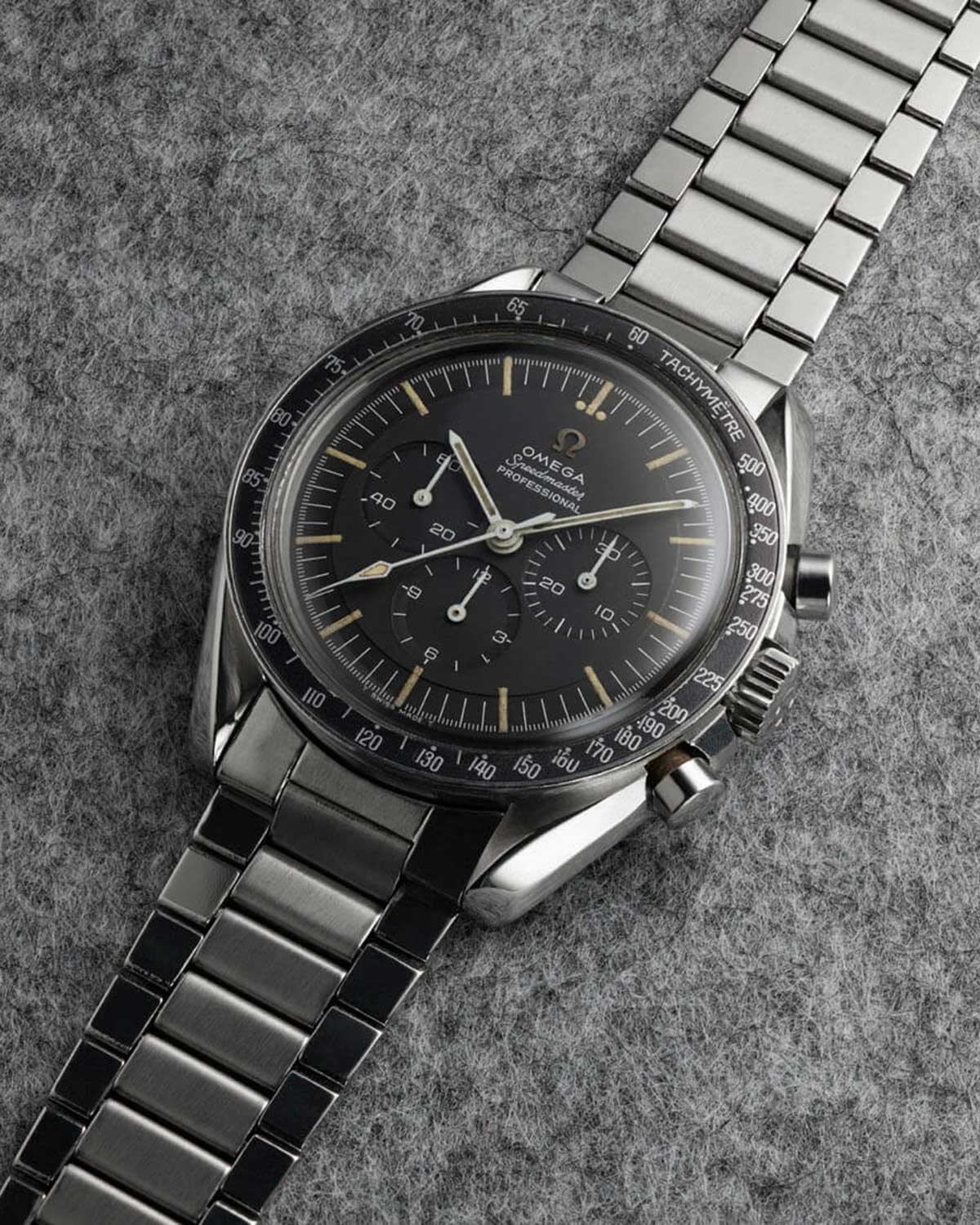
- Omega Speedmaster ST105.012 (©Revolution)
The First Omega in Space
As the Speedmaster was undergoing this steady process of refinement, events beyond the watch industry were unfolding at a far greater pace. The launch of Sputnik in October 1957 marked the beginning of the Space Race, and the following year the United States established NASA. Within only a few years, spaceflight had progressed from brief suborbital flights to orbital missions, and the demands placed upon astronauts grew with equal speed. Reliable timing instruments were essential, whether for engine burns, rendezvous maneuvers or scientific experiments.
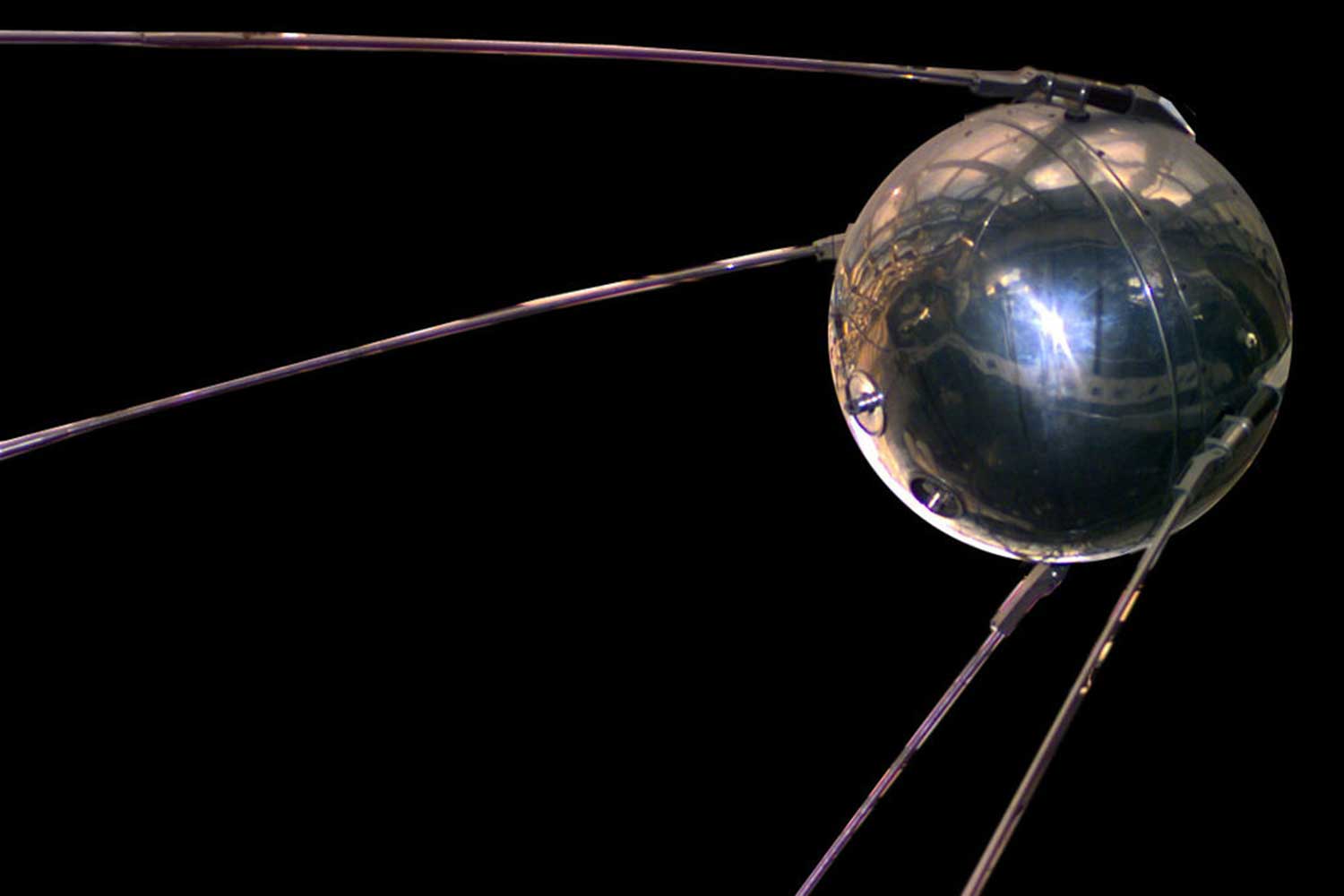
A replica of Sputnik 1, the first artificial satellite in the world to be put into outer space: the replica is stored in the National Air and Space Museum (Image: Wikipedia)
The Speedmaster entered the story by chance. As the Space Race gathered momentum, Project Mercury demonstrated the United States’ ability to conduct crewed orbital spaceflight. It was followed by Project Gemini, which served as the essential bridge to Apollo by developing the techniques required for a lunar landing, including long-duration flight, orbital rendezvous, docking and extravehicular activity. Apollo itself pursued the ultimate goal of landing humans on the Moon and returning them safely to Earth.
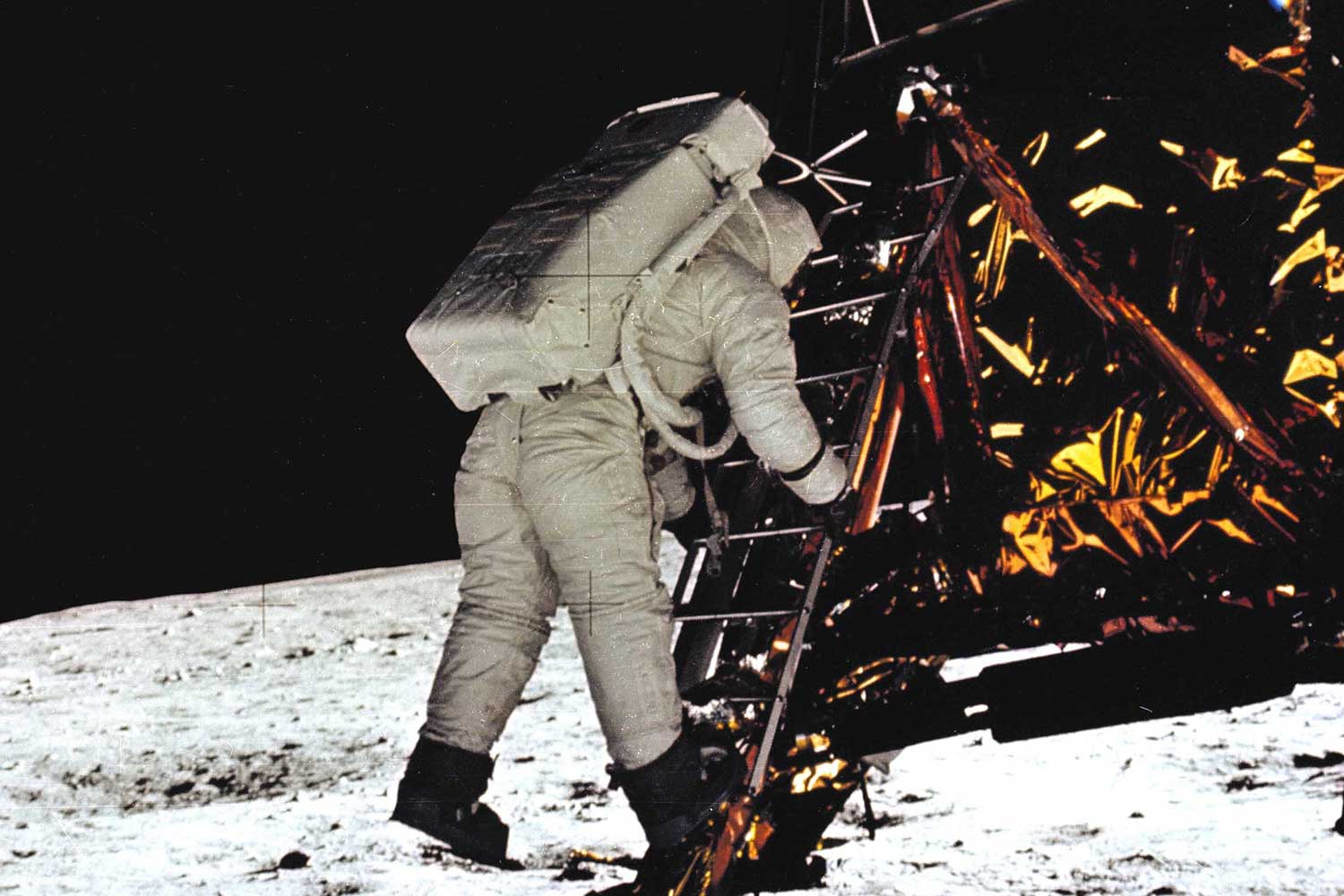
Astronaut Aldrin (Apollo 11’s crew) makes the first step onto the surface of the moon (Image: NASA)
Before any of this came to pass, the Speedmaster made its first journey into space through the personal choice of an astronaut. In October 1962, during the Mercury-Atlas 8 mission aboard Sigma 7, Walter “Wally” Schirra wore his own CK2998. It had not been supplied, tested or approved by NASA. Schirra had simply purchased the watch himself, making it the first Speedmaster to travel into space, a few years before NASA formally qualified the model for all crewed space missions.

A Speedmaster CK2998 on the wrist of Mercury Atlas 8 Astronaut Wally Schirra (Photo by Space Frontiers/Getty Images)
How a Racing Chronograph Became the Moonwatch
As Project Gemini took shape, NASA recognized that astronauts would require not just any watch but a chronograph as a backup timing instrument should communication with Mission Control be interrupted during a critical phase of a mission. Rather than commissioning a purpose-built watch, the agency elected to evaluate commercially available chronographs. Flight Crew Operations Director Deke Slayton issued an internal memo that listed the need for a “highly durable and accurate chronograph to be used by Gemini and Apollo flight crews.” James Ragan, an aerospace engineer responsible for crew equipment, was tasked with finding a chronograph capable of surviving the conditions of spaceflight. A formal request for proposals was issued to 10 manufacturers, inviting submissions of off-the-shelf wrist chronographs. Surprisingly, only four responded. Hamilton was immediately disqualified after submitting a pocket watch chronograph instead of a wristwatch, leaving the Omega Speedmaster ST105.003, Rolex Cosmograph Ref. 6238 and Longines-Wittnauer 235T to undergo testing. The same watches were also supplied to the astronauts themselves for evaluation.
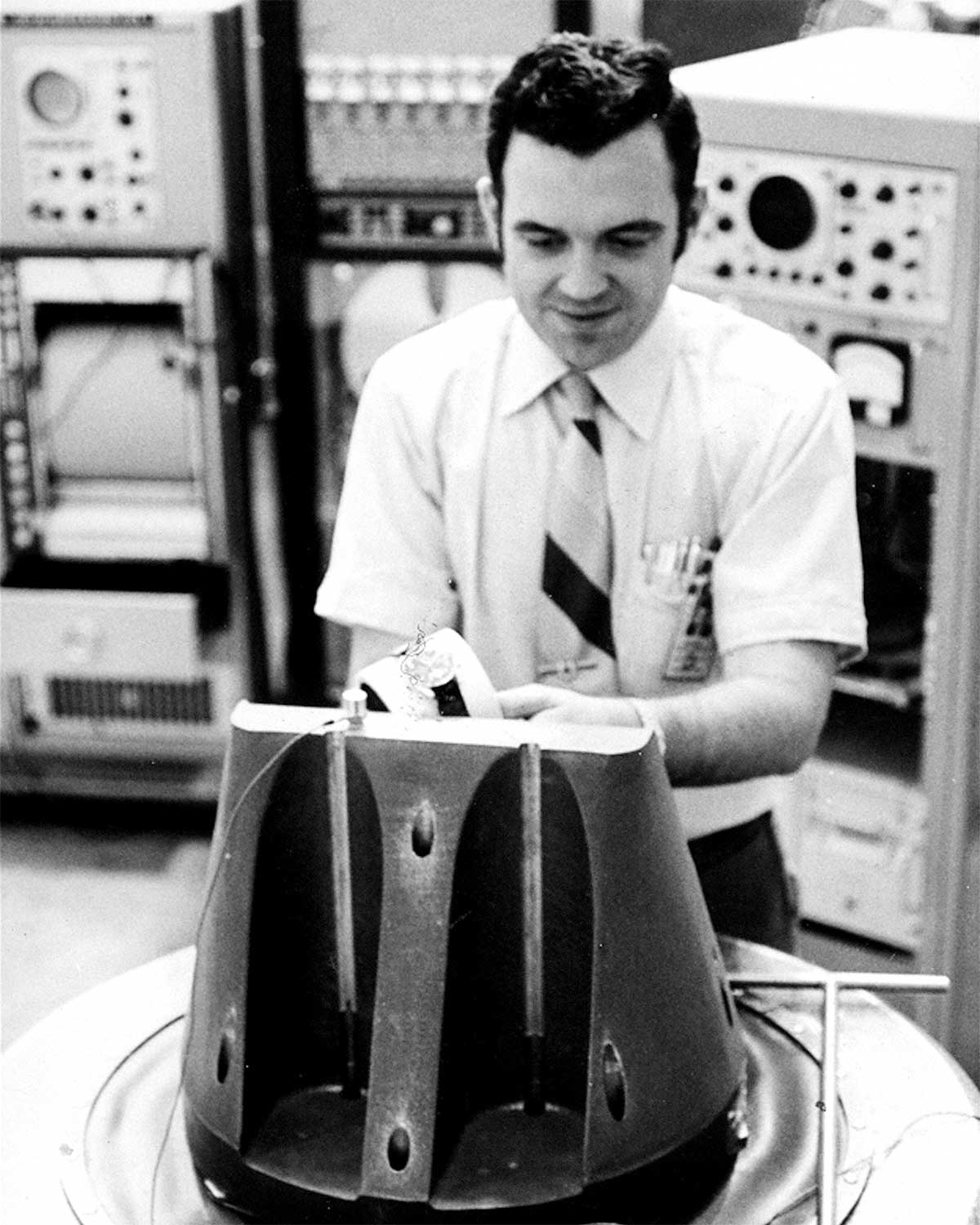
NASA’s test engineer, James Ragan putting the Speedmaster through its paces at NASA
Space is a hostile environment for a mechanical watch. In orbit or on the lunar surface, a watch exposed to direct sunlight can become intensely hot, only to cool rapidly when it passes into shadow. The absence of an atmosphere removes the moderating effect of convection while launch and re-entry subject equipment to intense vibration, acceleration and shock. Spacecraft themselves operated in oxygen-rich cabins, making resistance to corrosion and fire equally important.
To simulate these conditions, the candidates were first exposed to prolonged heat at 70°C before being briefly raised to 93°C, then cooled to −18°C and repeatedly cycled between heat and cold in a vacuum chamber. They then had to endure 10 days in 95 percent humidity, 48 hours in a hot oxygen atmosphere, shocks of 40G from six directions, acceleration up to 16G, pressures ranging from 1.6 atmospheres to near vacuum, vibration across frequencies from 5 to 2,000 Hz and 130 dB of acoustic loading across frequencies from 40 to 10,000 Hz. Ragan himself later questioned whether some of the requirements were unnecessarily severe, observing that a watch worn on an astronaut’s wrist would experience less punishment than equipment bolted directly to the spacecraft. NASA nevertheless insisted that every item of flight hardware meet the same standard.
In a 2019 interview, Ragan recalled, “Of all the environments that they made me do, the one that stood out [as] the worst was the thermal vacuum test. You pull the watch down to a hard vacuum. And then we put a heater around it, I had to test the watches at 0°F to 160°F. That’s tough on anything, let alone a watch. The Longines and the Rolex failed on the first test.”
He continued, “So the first test, I got rid of all but one. And now, I was worried about not knowing whether this one was going to pass or not too. I wasn’t sure if we’d ever find one that did all of that, I figured out a waiver of some kind, but Omega made it through with flying colors. And then, I went back to the astronauts and said, ‘Okay, please tell me what’s your evaluation of the three that I gave you.’ And everyone preferred the Omega, they were easier to use.”
On March 1, 1965, the Speedmaster was officially declared “Flight Qualified for All Manned Space Missions.” Its first assignment came only three weeks later. Virgil I. Grissom and John Young wore the Speedmaster ST105.003 aboard Gemini 3, the first crewed flight of the Gemini program. A little over two months later, Ed White wore the same reference outside the spacecraft during Gemini 4, becoming the first American to perform an extravehicular activity. By the time Apollo missions began carrying astronauts to the Moon, the ST105.003 had given way to the asymmetrical Speedmaster ST105.012. It was this reference, with its newly introduced lyre lugs and crown guards, that accompanied the Apollo astronauts to the lunar surface.
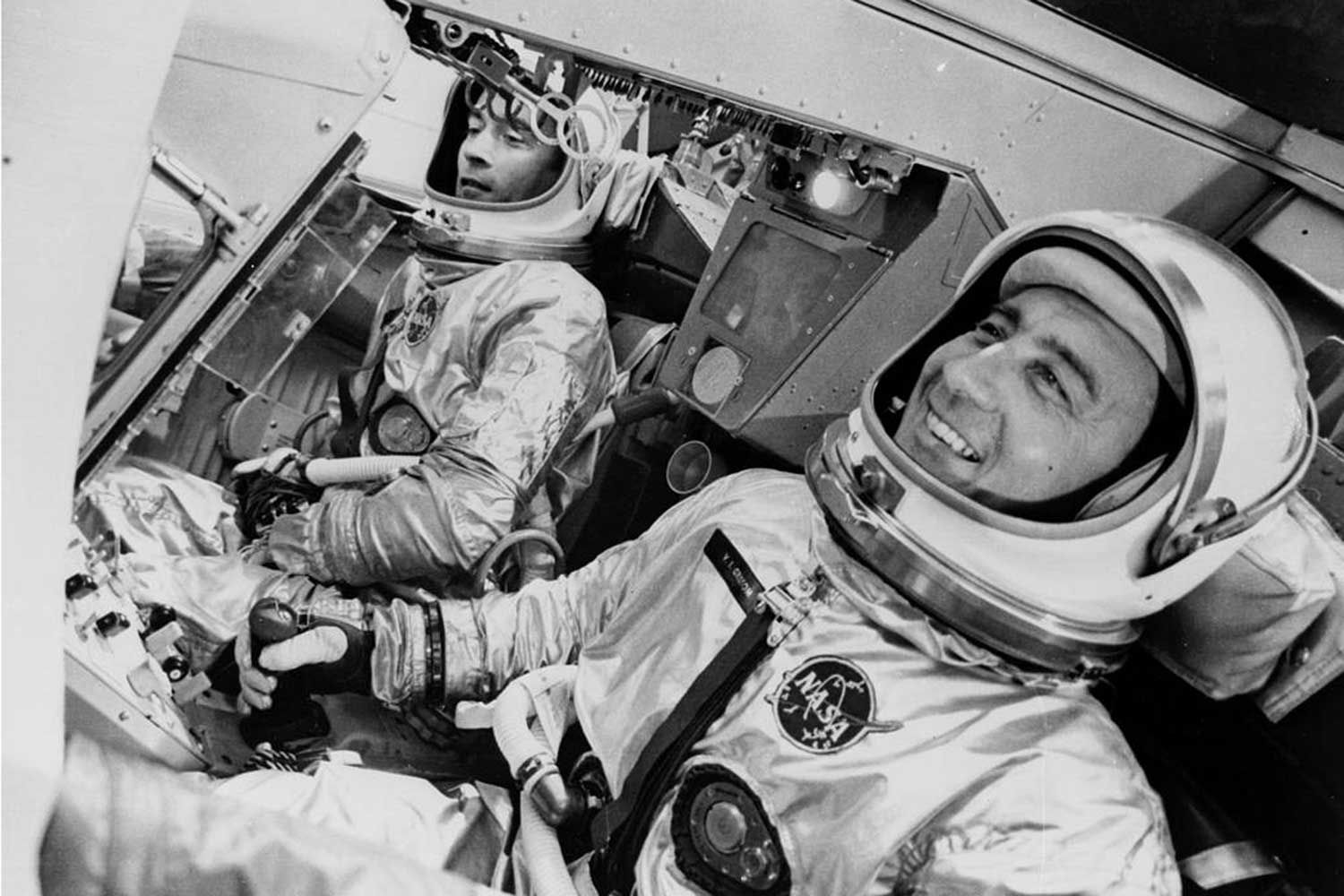
Virgil I. “Gus” Grissom and John W. Young on the Gemini III, March 23, 1965 (Image: NASA)
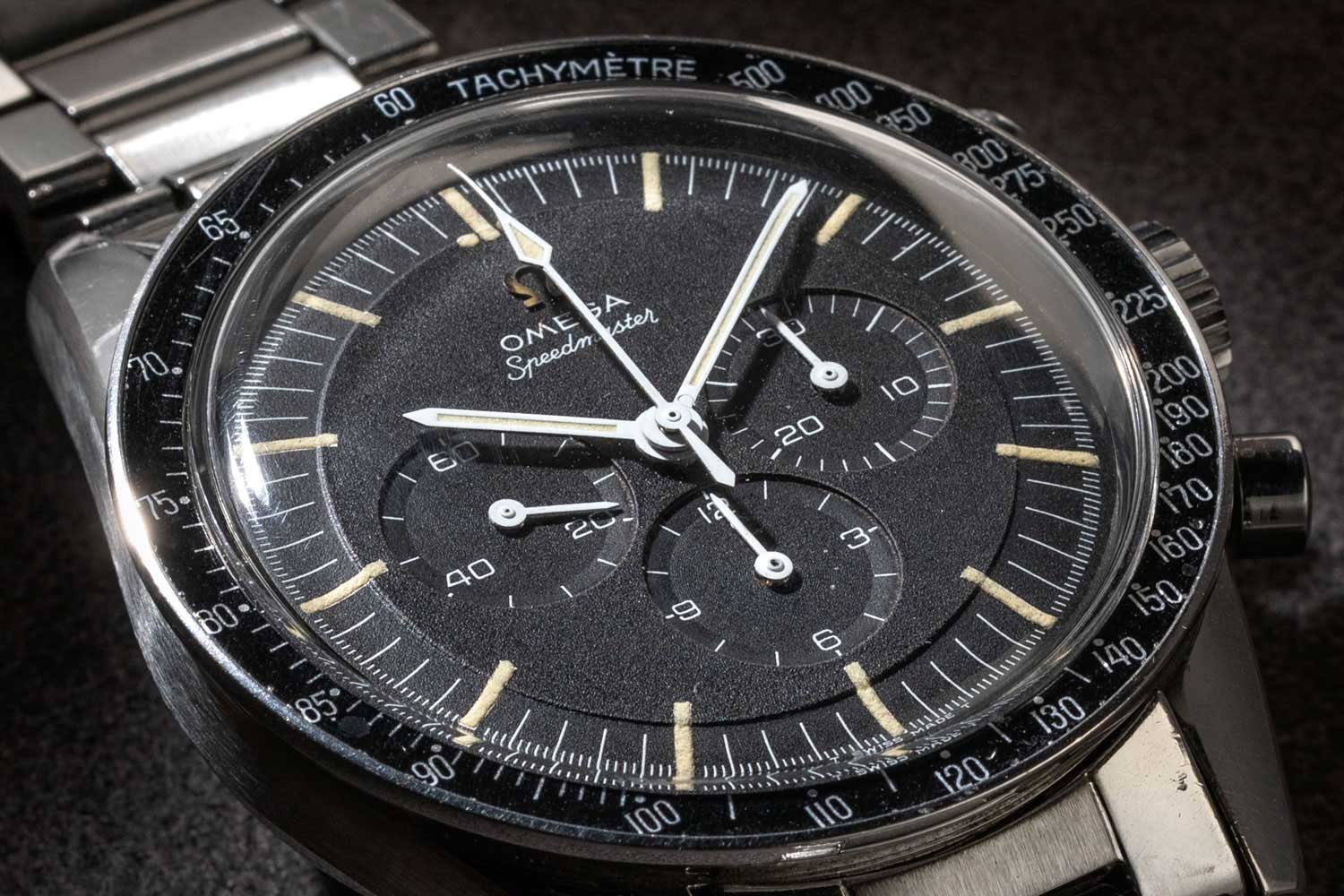
A closer look at the stepped dial of the ST105.003 a.k.a. The “Ed White” (©Revolution)
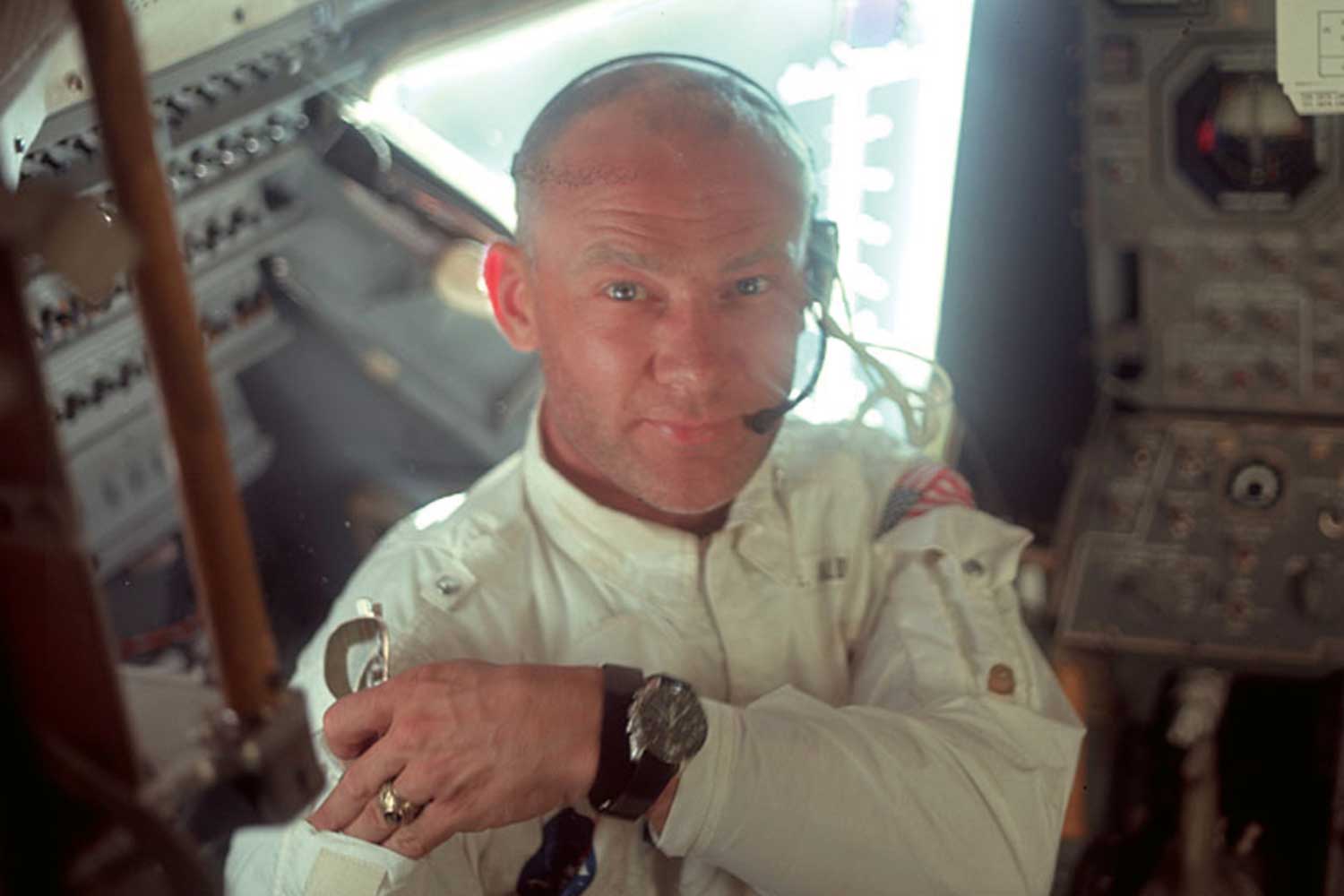
Buzz Aldrin in the Apollo 11 Lunar Module wearing his Omega Speedmaster ST105.012 (Image: NASA)
The first Speedmaster to reach the Moon was not worn by the first man to step onto its surface, but by the second. When Neil Armstrong and Buzz Aldrin landed in the Sea of Tranquility on July 20, 1969, Armstrong left his Speedmaster inside the Lunar Module as a backup timer after concerns about the reliability of the onboard electronic timer. Aldrin hence became the first person to wear a Speedmaster on the lunar surface. Command Module Pilot Michael Collins wore the 145.012, the update of the 105.012 and the last Speedmaster to be powered by the famous Caliber 321 movement. However, he remained in lunar orbit while his crewmates descended.
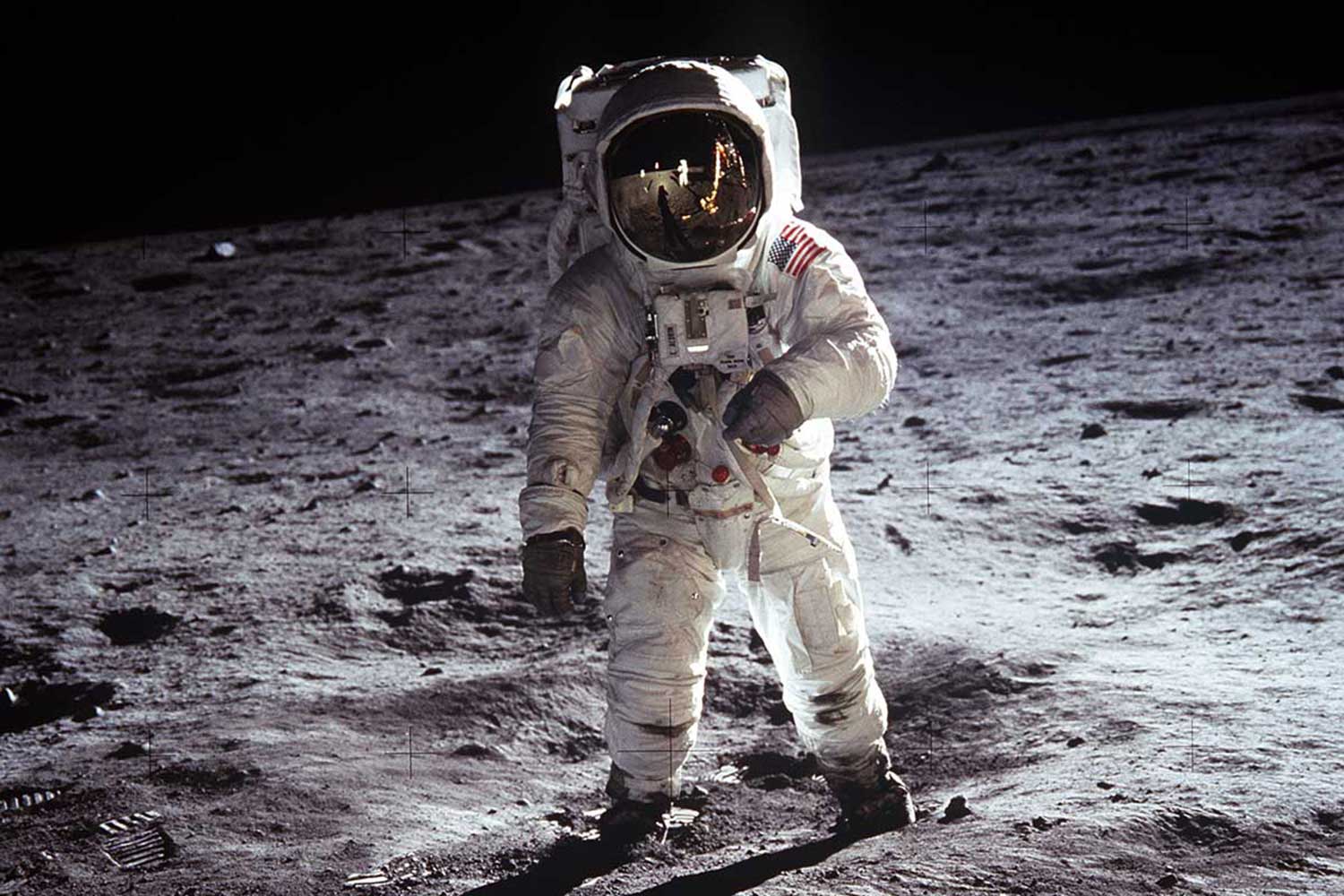
Astronaut Edwin E. Aldrin Jr., lunar module pilot, walks on the surface of the moon near the leg of the Lunar Module (LM) “Eagle” during the Apollo 11 extravehicular activity (EVA) (Image: NASA)
While Apollo 11 gave the Speedmaster its place in history, the Apollo 13 mission in April 1970 showed what the watch could do when called upon. Following the explosion of an oxygen tank, the crew were forced to power down the Command Module and rely on the Lunar Module as a lifeboat. Although the Moon’s gravity would carry them back towards Earth, their re-entry trajectory still had to be corrected. Too steep and the spacecraft would be destroyed by the intense heat of atmospheric entry but too shallow and it would skip back into space. Using Command Module Pilot Jack Swigert’s Omega Speedmaster 105.012, the crew timed a 14-second manual burn of the Lunar Module’s descent engine to refine their trajectory, helping place Apollo 13 on a safe path for re-entry and contributing to one of the most remarkable rescues in the history of spaceflight. In recognition of its role, Omega received NASA’s Silver Snoopy Award later that year, one of the agency’s highest honors for contributions to flight safety and mission success.
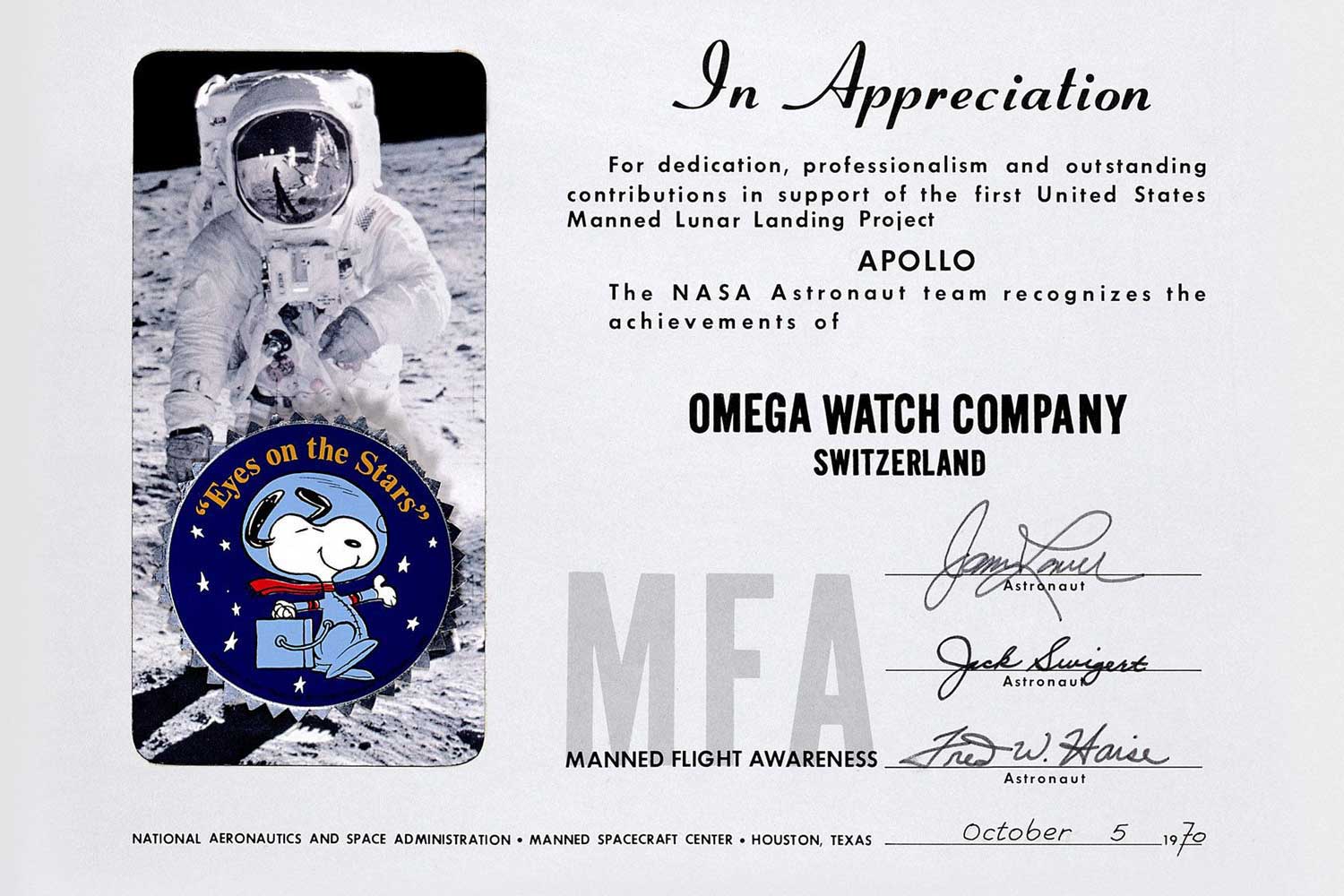
Omega was presented with the “Silver Snoopy Award” in 1970 (Image: Omega)
On Apollo 16, John Young and Charlie Duke each wore the 105.012 on the surface across three days of moonwalks. Edgar Mitchell had worn a 145.012 on Apollo 14. Then, on Apollo 17 in December 1972, Eugene Cernan wore a ref. 105.003 during the final Apollo moonwalk, making it the last Speedmaster reference to be worn on the Moon.
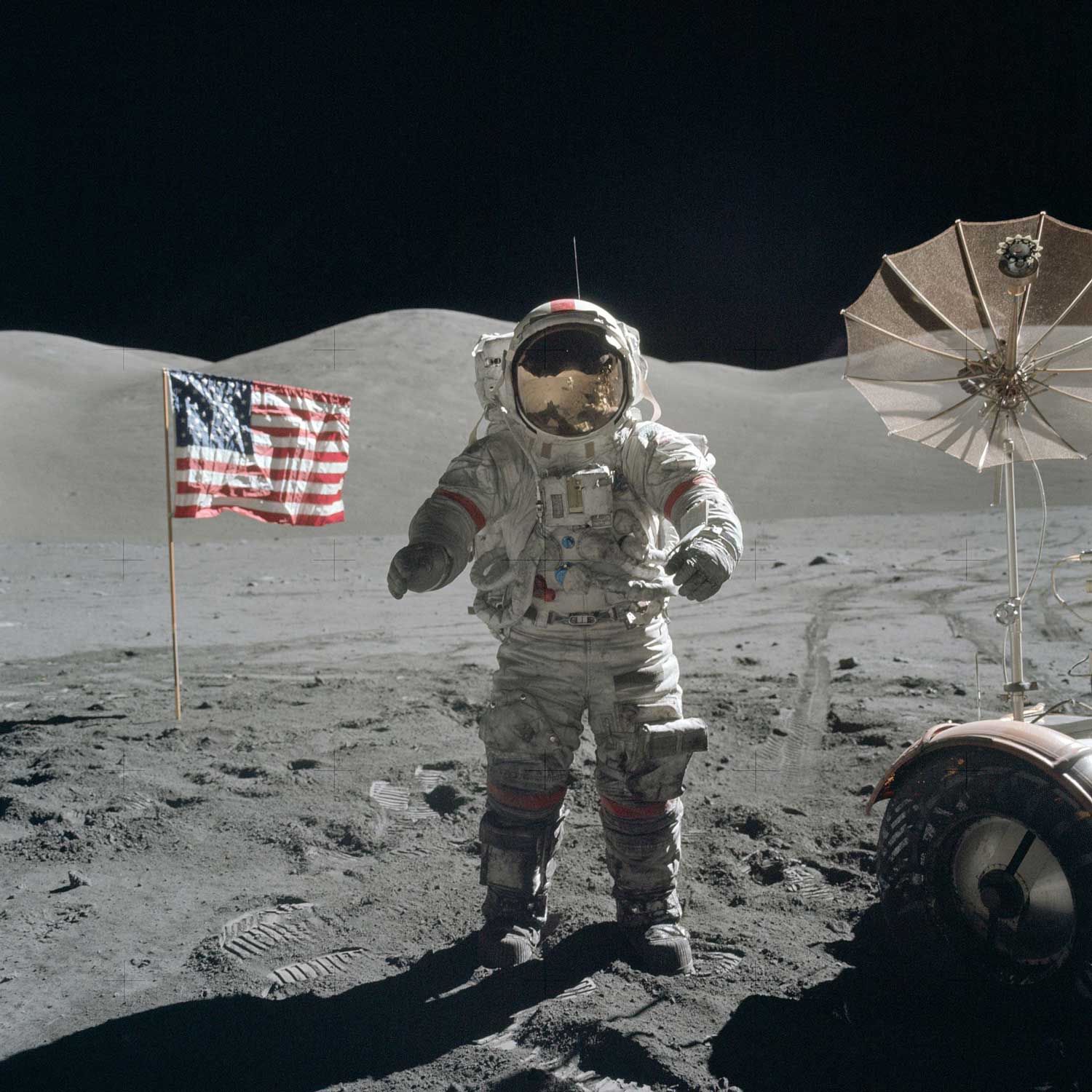
Astronaut Cernan pictured next to the American flag. He was the last man to set foot on the Lunar surface (Image: NASA)
The Speedmaster’s story did not end with Apollo. Both crews wore it during the 1975 Apollo-Soyuz mission, when American and Soviet spacecraft met and docked for the first time, and it was re-certified for the Space Shuttle in 1978, remaining standard issue across that program’s three decades of flights. It remains part of standard equipment on crewed missions today, where it continues in two forms: the classic hand-wound Moonwatch for extravehicular activity, and the quartz Speedmaster X-33 for use inside the spacecraft. Developed in collaboration with astronauts, the X-33 adds digital functions such as Mission Elapsed Time, multiple alarms, and an exceptionally loud 80 dB alarm designed to be heard above the constant background noise of a spacecraft. It was the X-33 that accompanied the crew of Artemis II.
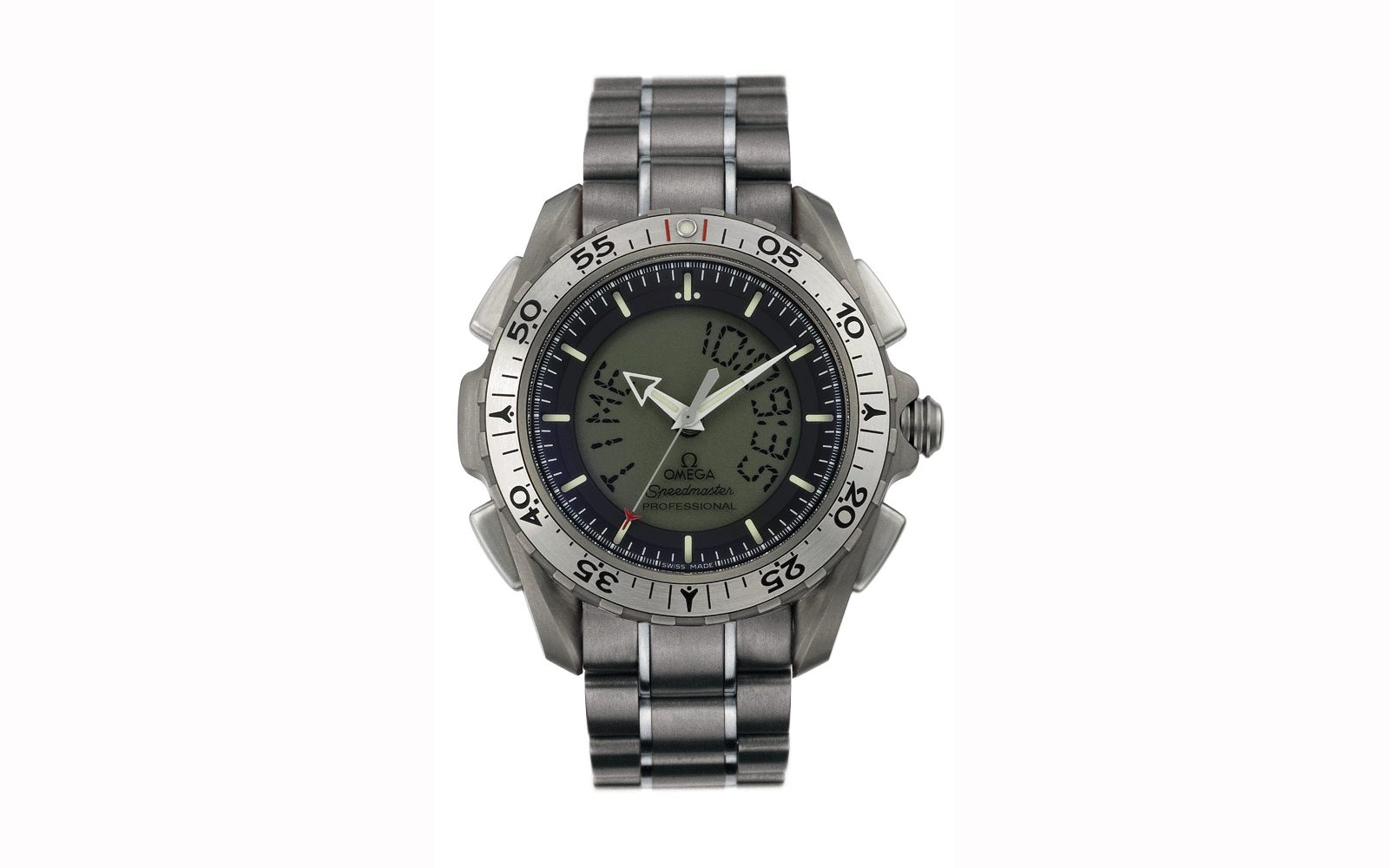
Speedmaster X-33
Movement Evolution
The Omega 321 is widely considered to be one of the greatest chronograph movements ever produced. It was based on the Lemania 2310 — originally the 1942 Caliber 27 CHRO C12 — conceived by Albert-Gustave Piguet, the technical director of Lemania.
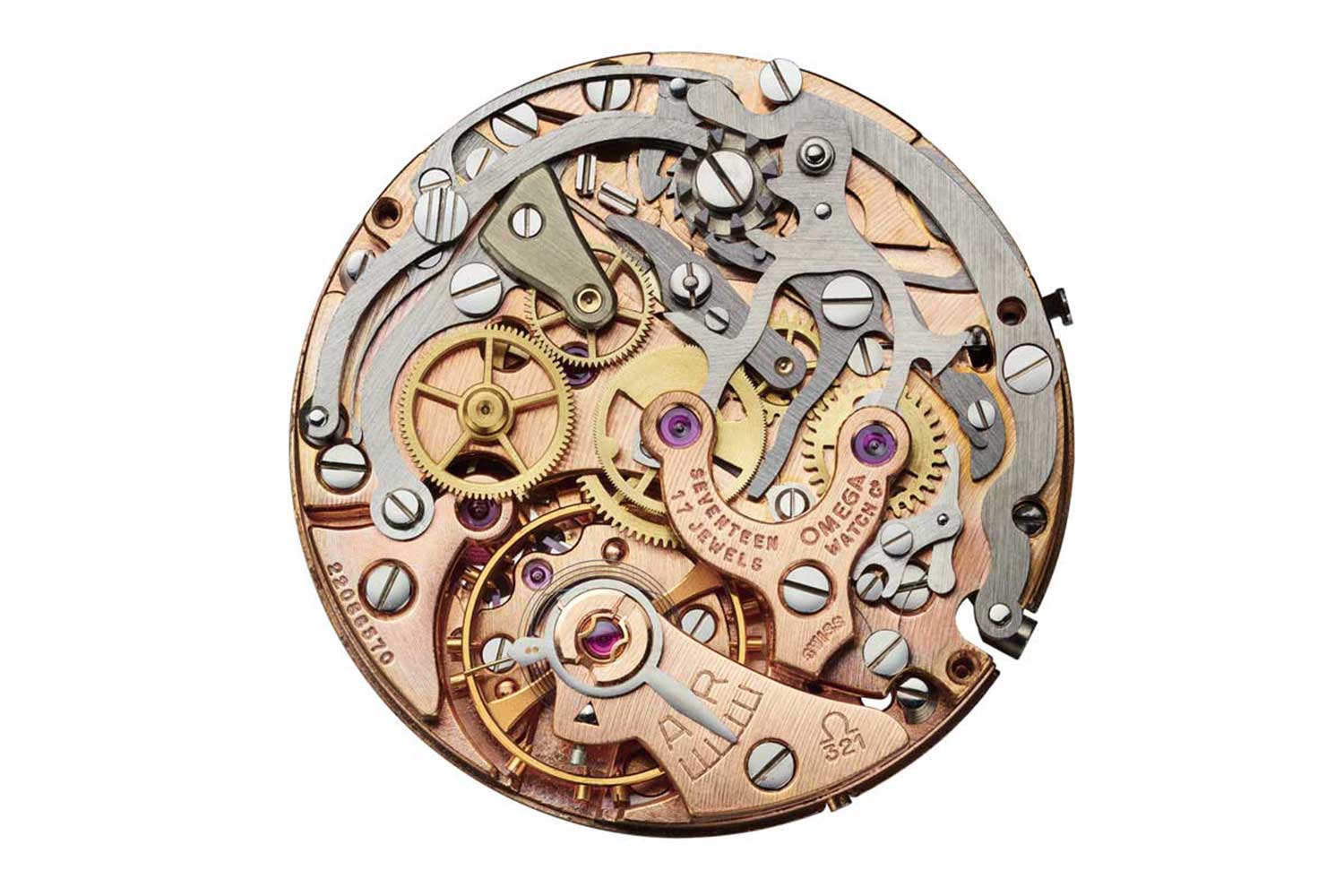
The original Omega 321
While it shares the traditional column wheel and horizontal coupling common to chronograph movements of its period, such as the Valjoux 72 and Venus 175, the Omega 321 was the smallest of the three, measuring only 27mm, or 12 lignes in diameter. Its compactness, however, was not gained at the expense of toughness. The train was carried beneath substantial bridges and cocks, secured by generously proportioned screwheads, and the movement was constructed with the robustness required of a precision instrument intended for years of hard-wearing. The going train was proportioned for efficiency, driving a large balance at 18,000 vibrations per hour. It was further equipped with a Breguet overcoil hairspring and Incabloc shock protection.
In terms of chronograph componentry, the hammer was designed with a hook that is held by a retaining pin against the force of its spring while the chronograph is running. Pressing the reset pusher causes the pin to be withdrawn, releasing the spring-loaded hammer. This is in contrast to driving the hammer directly onto the heart cams against the force of a spring during reset, as in the Valjoux 72.
A rigid finger mounted beneath the chronograph wheel advances an intermediate sliding gear, which in turn indexes the minute counter. The minute counter jumper was among the most elaborate features of the movement. Instead of a straightforward detent spring, the minute jumper comprises a separate bridge carrying the jumper, while a separate spring is mounted around a screw. An eccentric screw allows the position of the jumper to be adjusted. This is one of several mechanisms throughout the movement that provide for fine adjustment, allowing a skilled watchmaker to precisely regulate the interaction of the chronograph components.
The 321 powered the Speedmaster from its introduction in 1957 through the straight-lug references, from the CK2915 and CK2998 to the ST105.002 and ST105.003. It remained in the Speedmaster Professional from 1965 until 1968, powering the ST105.012 and ST145.012 before giving way to the Omega 861 in the Reference 145.022.
The Caliber 861 was an evolution of the 321, retaining its horizontal coupling system and much of its underlying layout while being redesigned to simplify manufacture and assembly. The most obvious change was the replacement of the column wheel with a switching cam. The elaborate sliding gear of the 321 was also replaced by a spring-loaded finger on the chronograph wheel, which deflects during reset, allowing the intermediate minute counting wheel to remain permanently fixed in position. The redesign eliminated several parts and adjustment points, while replacing the complex minute jumper with a simpler post, flat spring and jumper. The result was a chronograph that required less adjustment during assembly and considerably less time to service.
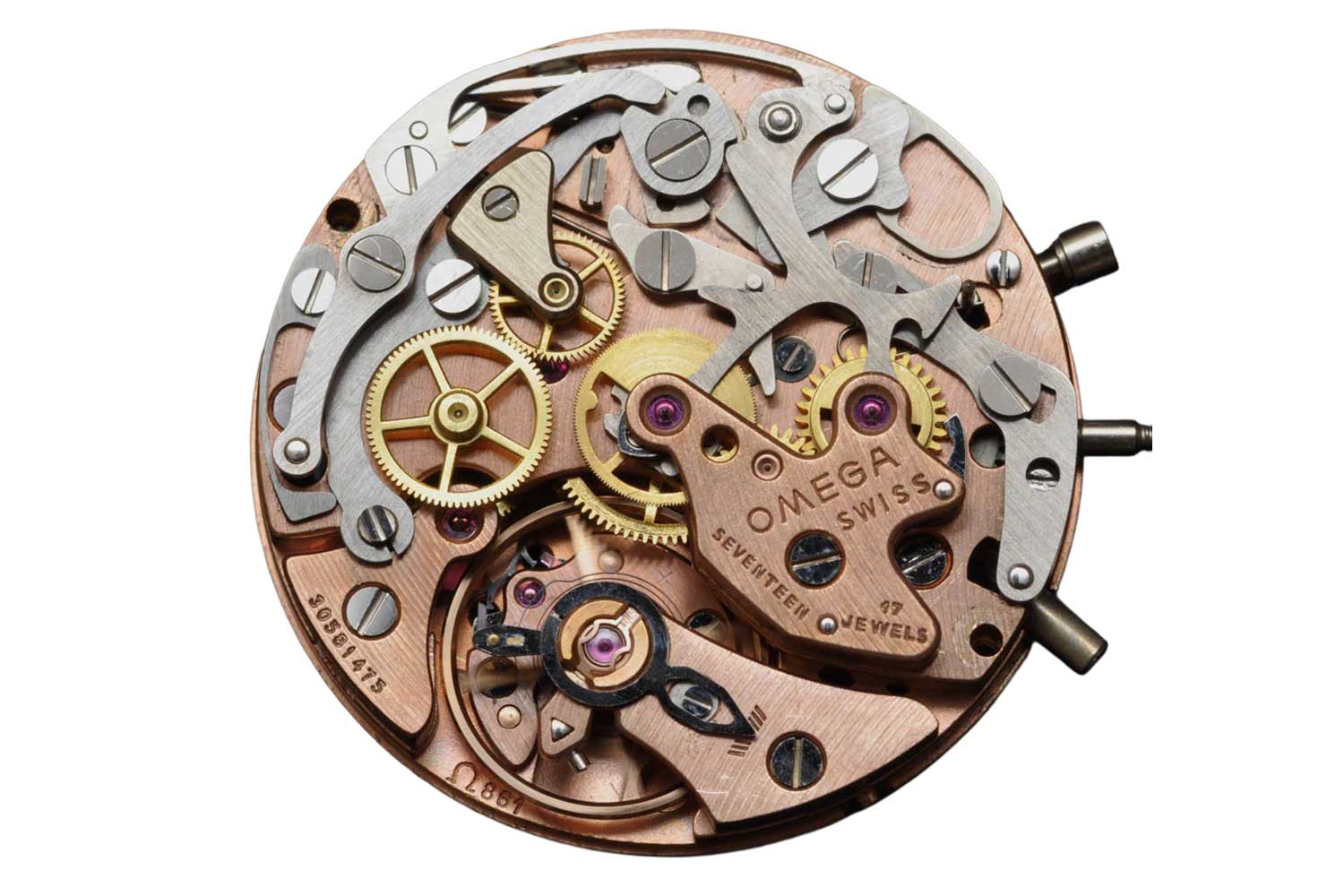
Omega Caliber 861 (Image: Urdelar)
The regulating organ was also revised. The Breguet overcoil and adjustable-mass balance with friction fit regulator of the 321 gave way to a flat hairspring, a solid-rimmed balance and a micrometer-screw regulator, while the beat rate was increased from 18,000 to 21,600 vibrations per hour. The 861 went on to power almost every manually wound Moonwatch for nearly three decades, including the well-known references 145.0022, 3590.50 and 3592.50, as well as numerous limited editions and derivatives. It also served aboard the later Apollo missions after Apollo 11, the Apollo–Soyuz Test Project and the Space Shuttle program, giving it an equally distinguished history of spaceflight.
In 1996, it was succeeded by the Calibre 1861. The essential construction remained, including the switching cam, the 21,600vph balance and the fundamental layout of the movement. The main alterations were the adoption of rhodium plating in place of the earlier copper finish, together with a number of refinements to individual components, including a Delrin brake for the chronograph seconds wheel, which was introduced in later examples of the 861. These were practical improvements intended to simplify manufacture and enhance durability without altering the fundamental qualities of the movement. The Caliber 1861 continued to power the Speedmaster on missions aboard the Space Shuttle and the International Space Station, remaining in production for almost a quarter of a century until 2021.
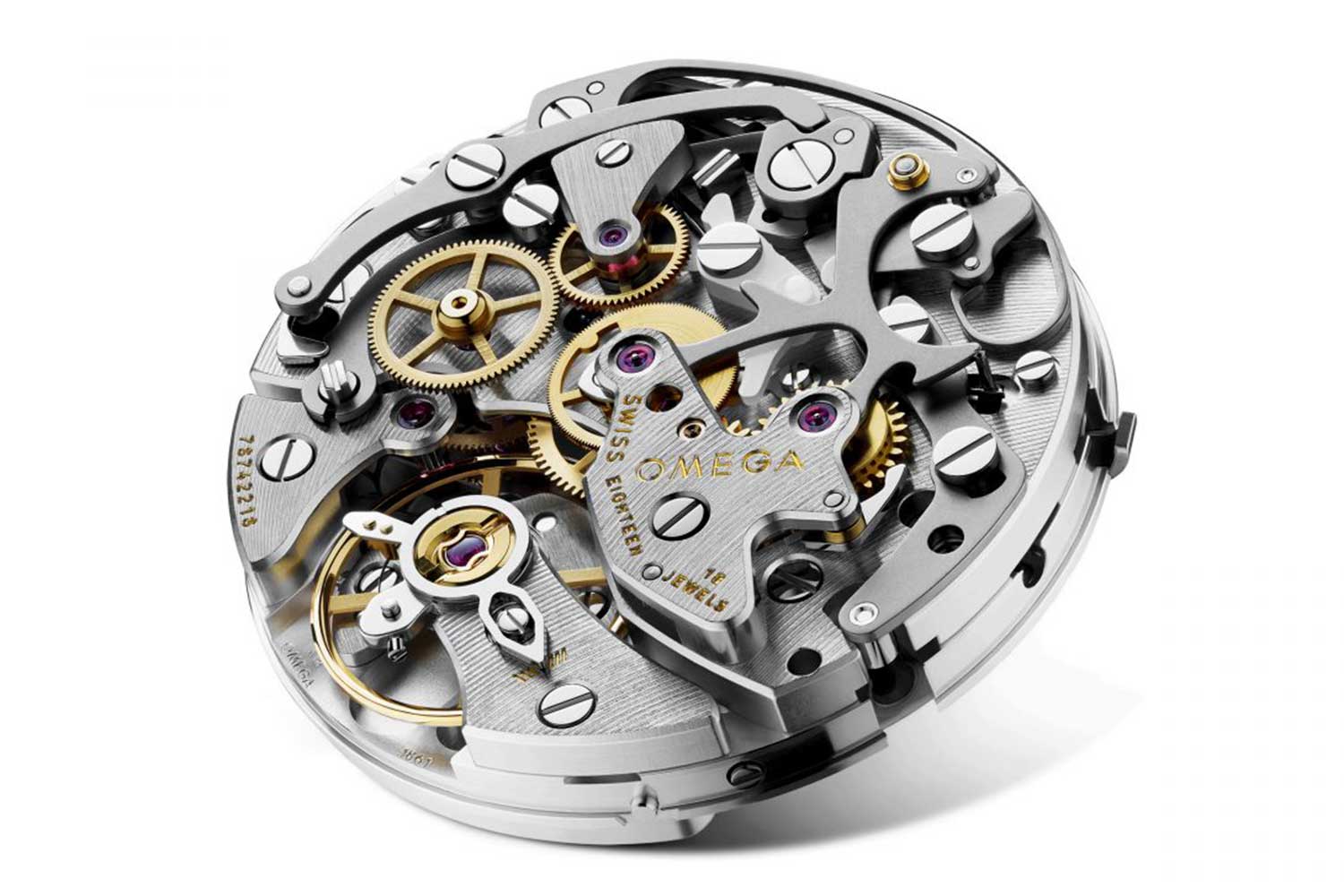
Omega Calibre 1861
Its successor was the Caliber 3861, which introduced the Co-Axial escapement, a free-sprung balance, a silicon hairspring and hacking seconds while retaining the familiar architecture of its predecessors. It also replaced the Delrin chronograph brake with an all-metal brake and became the first Speedmaster to achieve Master Chronometer certification. In addition to a daily rate of 0 to +5 seconds, the certification requires both the movement and the fully cased watch to continue operating while exposed to magnetic fields of up to 15,000 gauss. The watch must remain running throughout the test, while the difference between its daily rate when magnetised and after demagnetisation must not exceed five seconds. These developments represent a significant advance in the practical performance of the Speedmaster while preserving the essential qualities of the movement that has served the model for more than half a century.
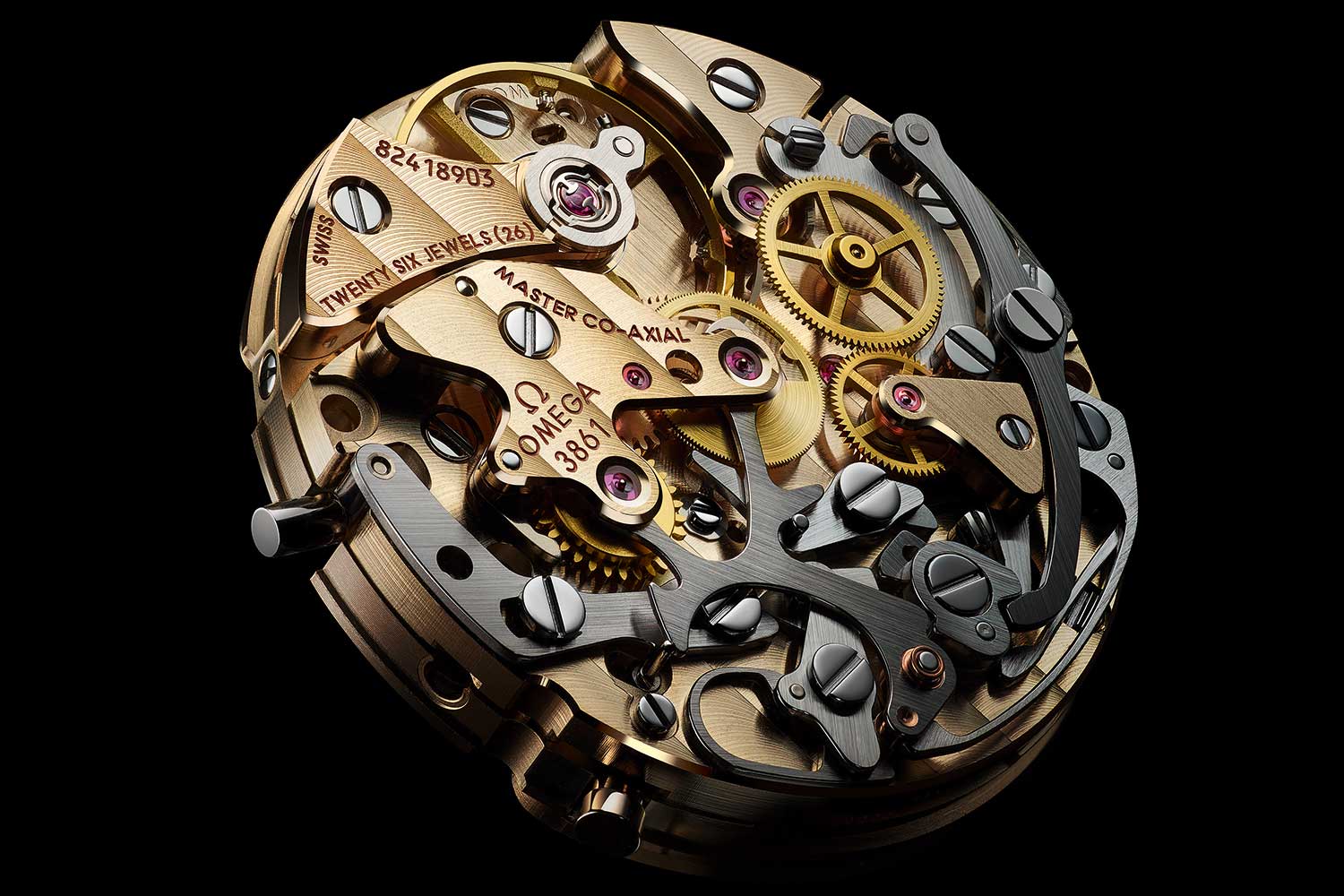
Omega Caliber 3861
Modern Speedmasters
The Speedmaster has spawned a collection of unusual breadth. Some look back to the earliest days of spaceflight, some commemorate defining moments in the story, while others show how the Speedmaster continues to evolve materially. These five capture something of that remarkable range.
Speedmaster Moonwatch
For most of us, the classic Moonwatch is as close as we will ever get to the Moon. It is odd to think that for the Apollo astronauts, the Speedmaster was simply one of the last ordinary objects to leave Earth with them. Unlike the spacecraft, the life-support systems and the countless specialized instruments developed for the program, the watch belonged as much to everyday life even as the circumstances surrounding it could scarcely have been more extraordinary. The Moonwatch offers at least an opportunity to experience, in some small way, the same watch that accompanied mankind on its first journey to another world and has served NASA astronauts for more than six decades.
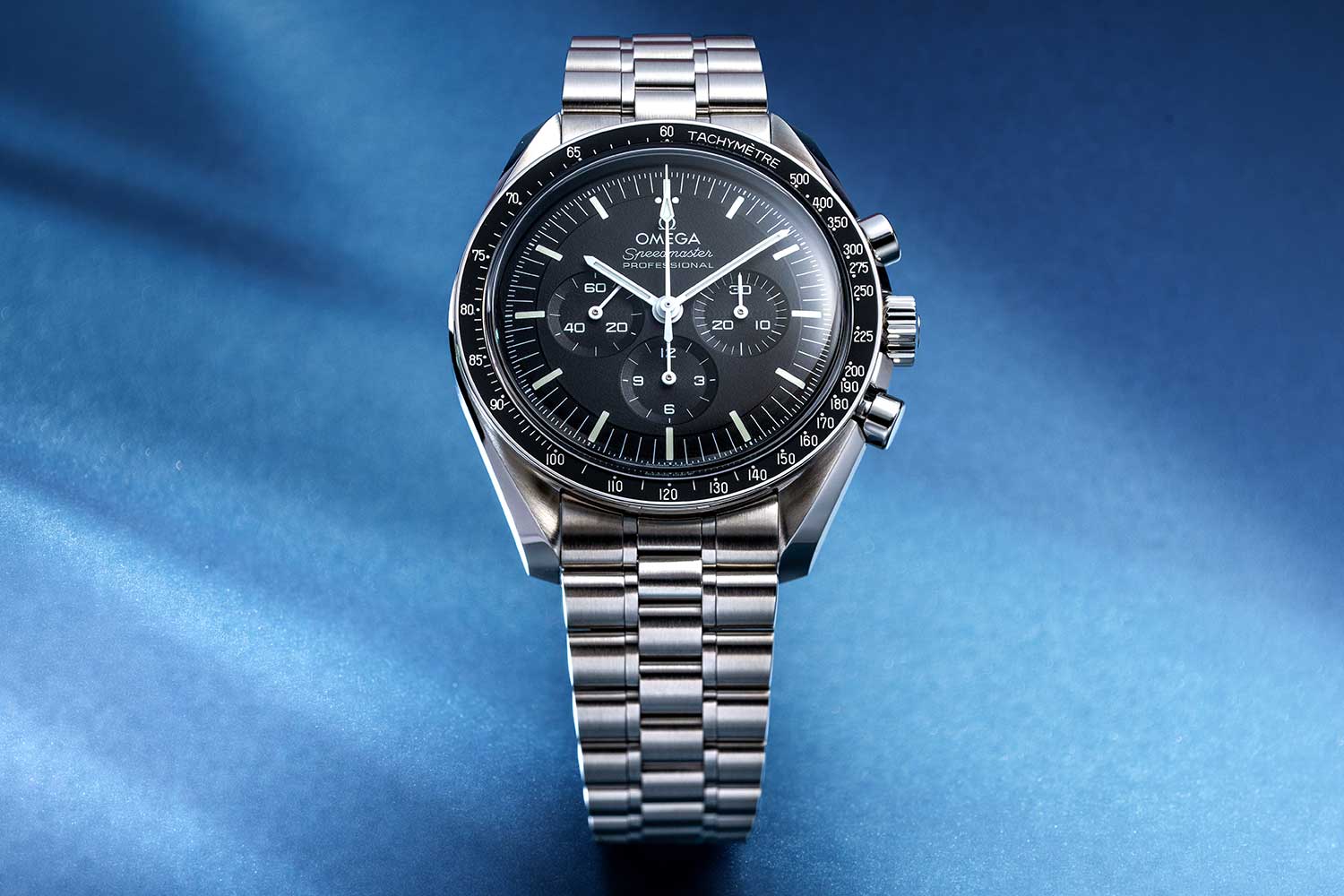
Omega Speedmaster Moonwatch Professional (©Revolution)
Watchmaking has since produced chronographs that are more complicated, more elaborately finished and, in many cases, vastly more expensive. In contrast, the Moonwatch, with its mid-century design, remains as unassuming as it was before it earned its place in history. Its high-contrast execution remains surprisingly distinctive even today, and despite all that has followed, it continues to stand alone as the only watch ever certified by NASA for extravehicular activity.
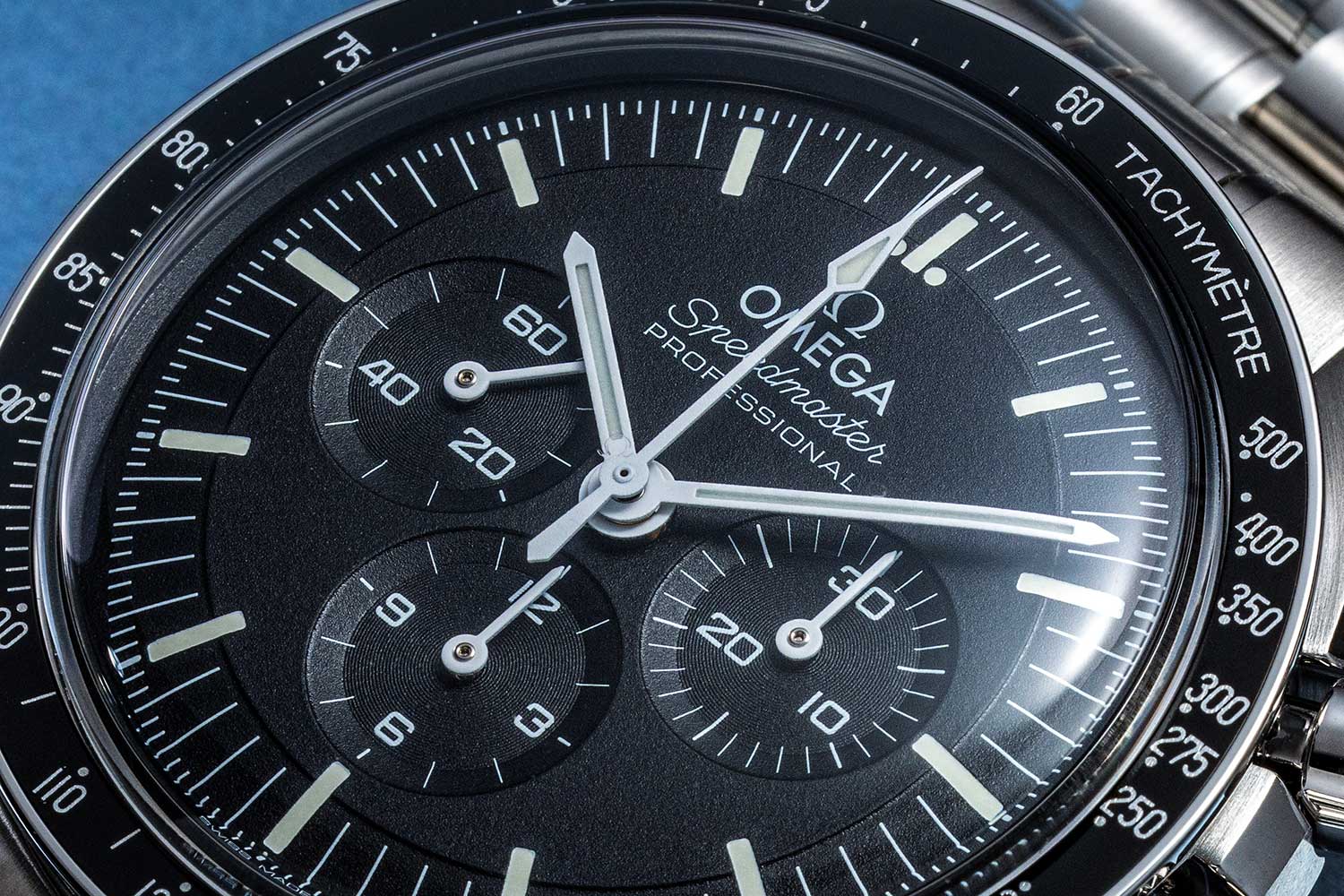
Omega Speedmaster Moonwatch Professional (©Revolution)
Beneath the familiar exterior is now the Caliber 3861, the most technically accomplished movement ever fitted to the Moonwatch. It combines the Co-Axial escapement with a silicon hairspring, two of the most significant advances in modern mechanical watchmaking, and is certified as a Master Chronometer. Such performance would have been almost unimaginable when the Speedmaster first accompanied astronauts into space.
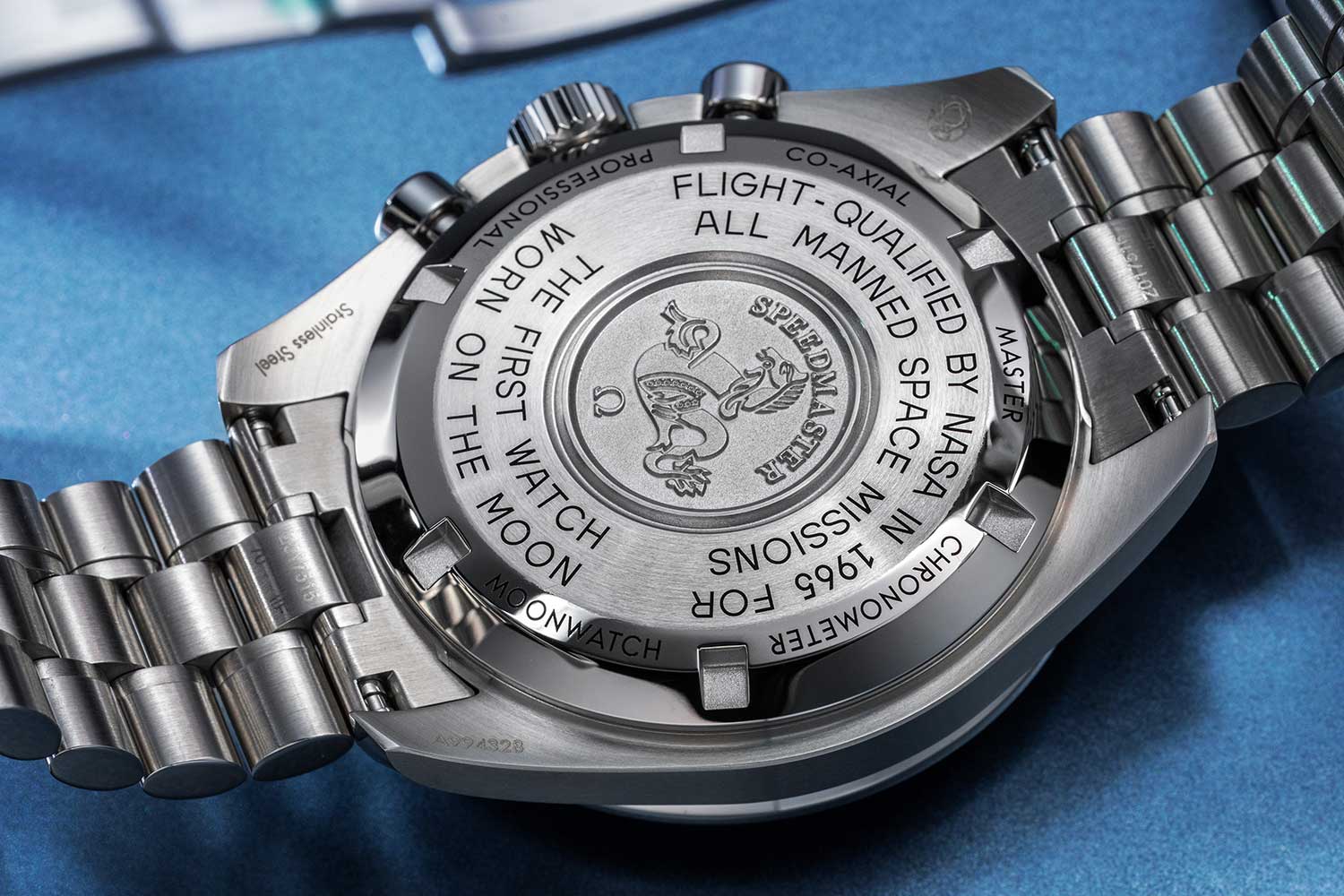
Omega Speedmaster Moonwatch Professional (©Revolution)
Speedmaster Moonwatch in Moonshine Gold
It is easy to assume that the gold Speedmaster was simply the inevitable luxury version of a successful steel watch. But gold Speedmasters came about for a much more specific reason. Omega created the original yellow gold model (BA145.022) to commemorate the Apollo program and presented the first examples at the Astronaut Appreciation Dinner in Houston on November 25, 1969. Further presentation watches were awarded to astronauts from later Apollo missions over the following years. Production was limited to 1,014 pieces, with the watches individually engraved with each recipient’s name, mission history and the inscription, “To mark man’s conquest of space with time, through time, on time.”
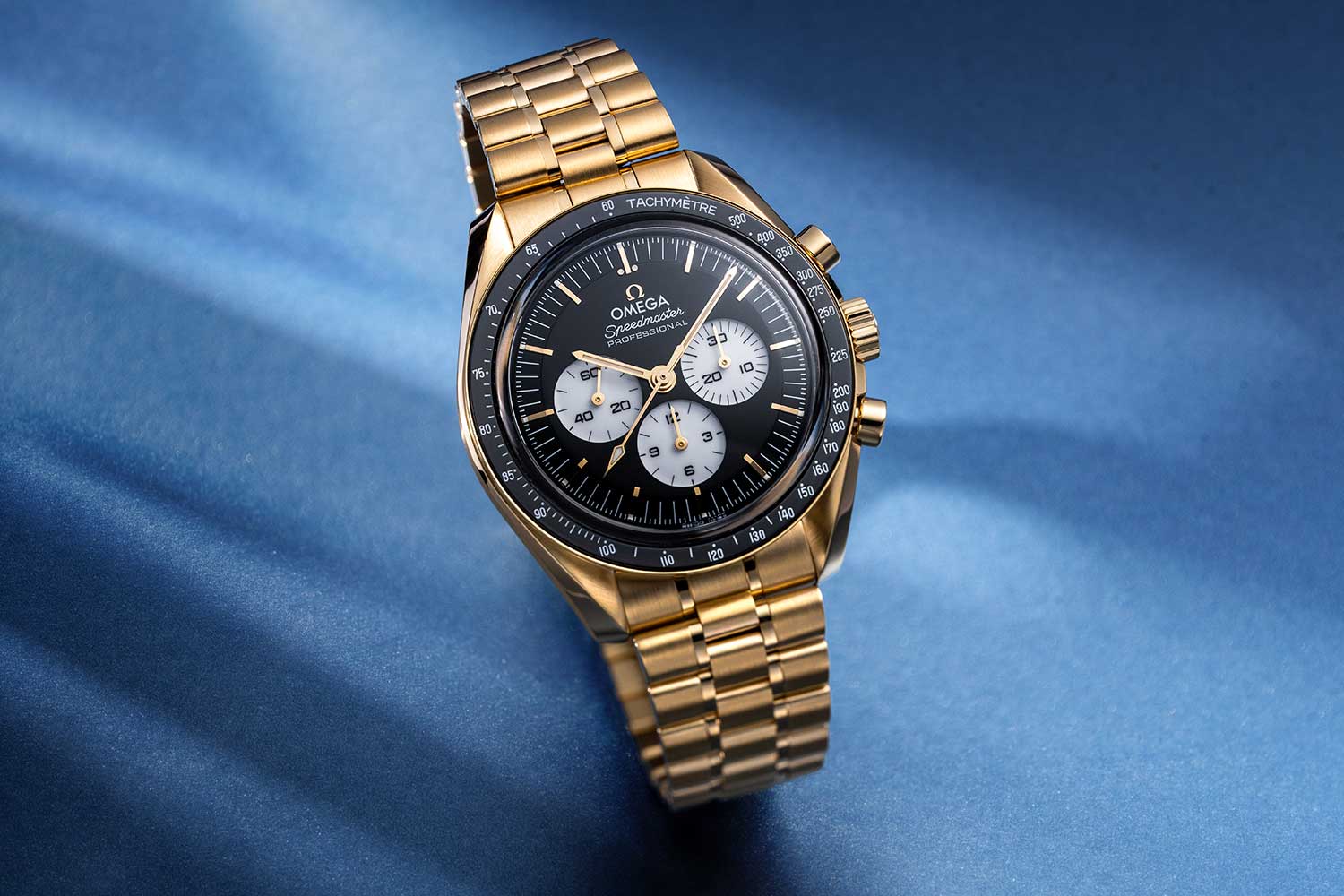
Omega Speedmaster Moonwatch Professional in Moonshine Gold (©Revolution)
Omega has returned to that watch only once in any direct sense. It was a limited edition introduced in 2019 to mark the 50th anniversary of Apollo 11 and debuted the Moonshine Gold alloy. The latest Moonwatch in Moonshine Gold pairs the proprietary alloy with a reverse panda dial. Moonshine gold is an 18K yellow gold alloy with a slightly paler tone than conventional yellow gold, and a small amount of palladium that helps preserve its color over time. The reverse panda dial consists of two lacquered layers where glossy surfaces catch the light in a way no matte Moonwatch ever has. A sapphire crystal replaces Hesalite and a ceramic bezel insert replaces aluminum. It is hard to think of another Moonwatch that has looked quite this handsome, and somehow the design carries it off without seeming overdone.
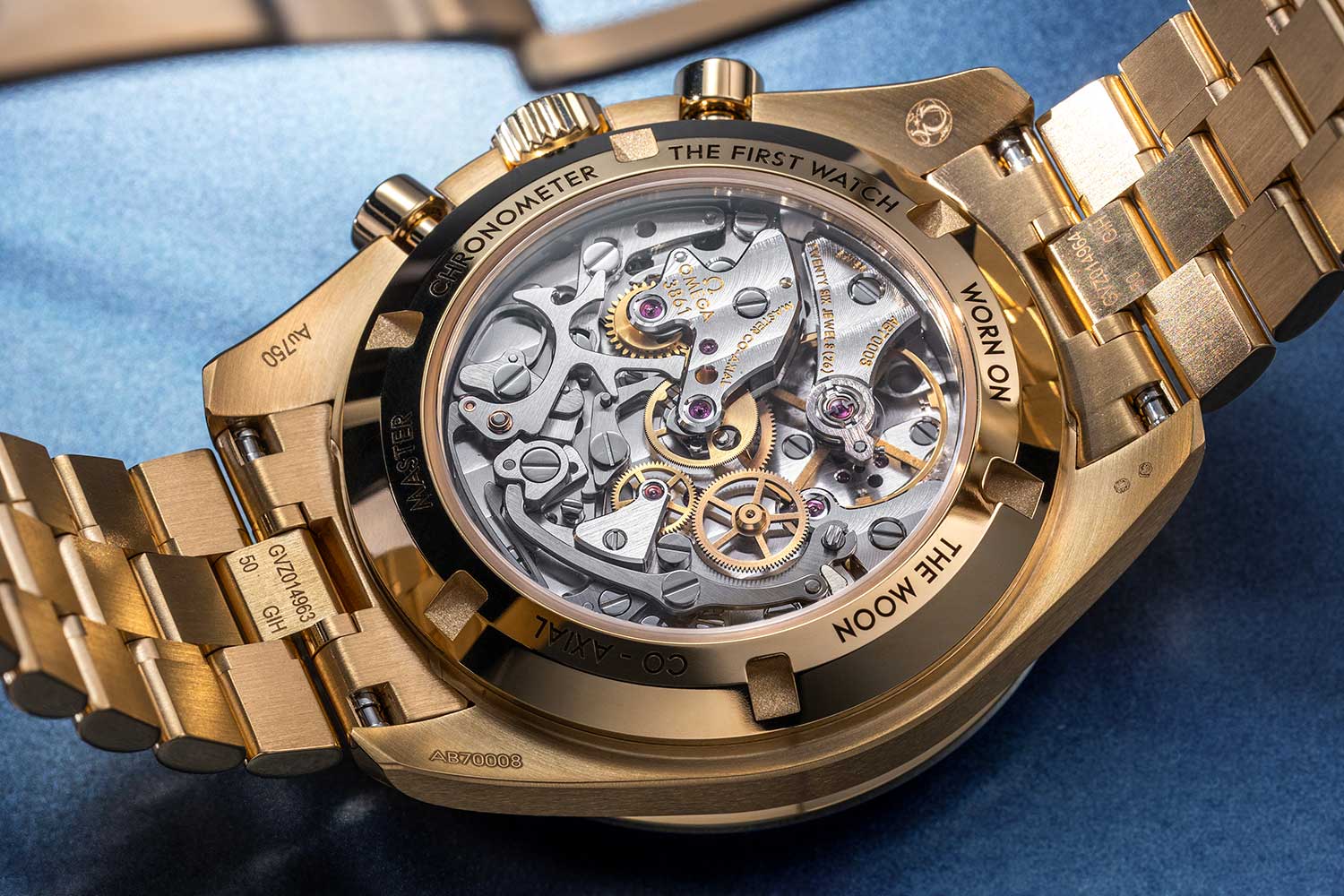
Omega Speedmaster Moonwatch Professional in Moonshine Gold (©Revolution)
Speedmaster First Omega in Space
The Speedmaster FOiS is not a Moonwatch, but it is one of, if not the most, appealing Speedmasters launched in recent years. It is a faithful re-creation of astronaut Wally Schirra’s personal Omega CK2998-4, which accompanied him aboard Sigma 7 during the Mercury-Atlas 8 mission in 1962. Schirra orbited the Earth six times over just more than nine hours, demonstrating that an American astronaut could work in orbit for extended periods, an important milestone on the path to the Gemini and Apollo programs. In the process, the CK2998 became the first Omega to travel into space.
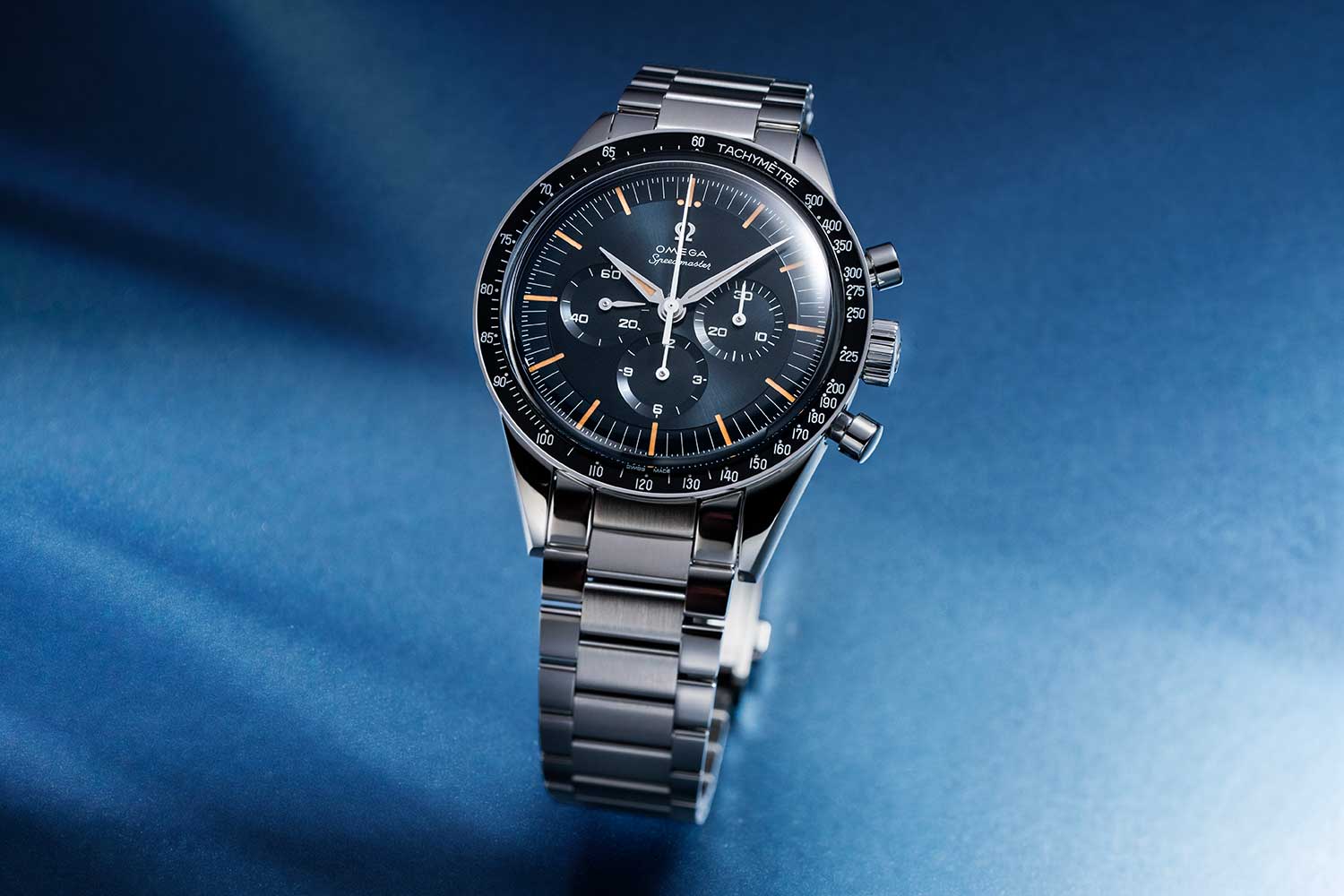
First Omega in Space (©Revolution)
Measuring just 39.7mm, the watch faithfully reproduces the straight-lug case, alpha hands, applied Omega logo and needle chronograph seconds hand of the original. Its distinctive gray-blue dial recreates the appearance of a small number of vintage CK2998s whose dials left the factory in that color. It was achieved here using chemical vapor deposition, while the lume reproduces the warm tone acquired by aged tritium over the decades. Another thoughtful detail is that the case is topped by a domed sapphire crystal shaped to mimic the look of Hesalite crystal on the original.
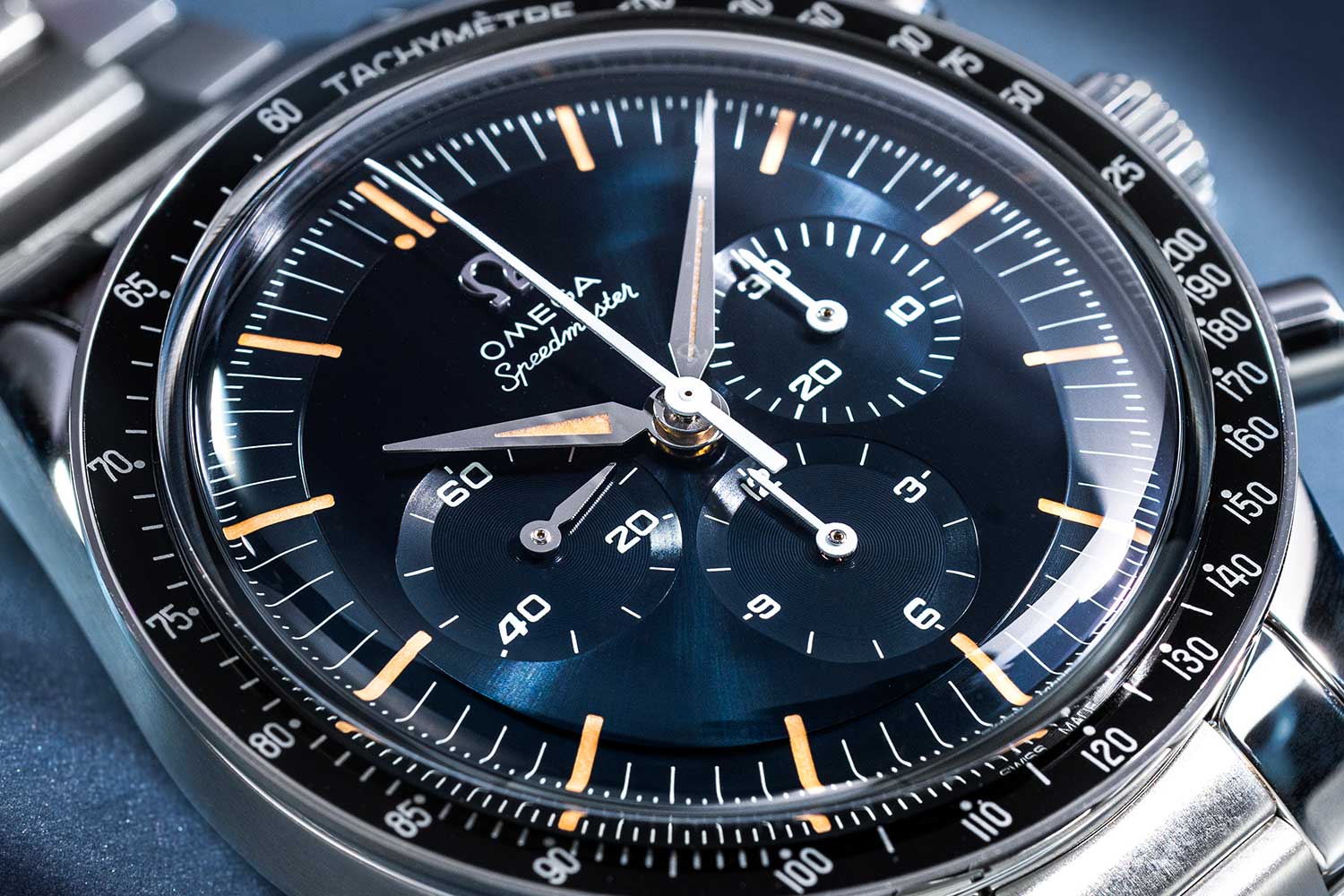
First Omega in Space (©Revolution)
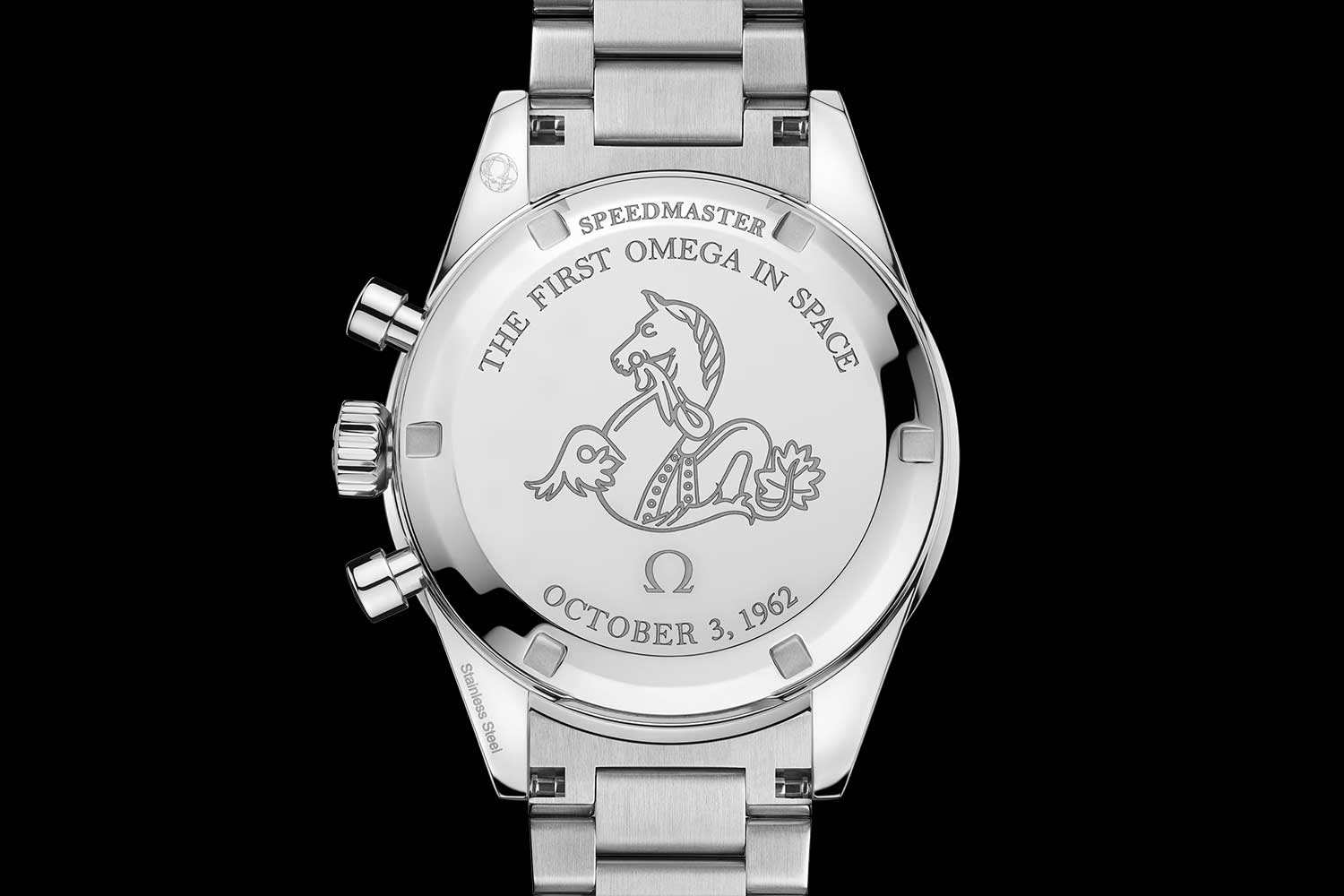
First Omega in Space
Speedmaster Gray Side of the Moon
The Dark Side of the Moon Speedmasters are essentially high-tech ceramic tributes to the 1968 Apollo 8 mission, the first crewed flight to orbit the Moon and witness its mysterious “dark” or far side. The Gray Side of the Moon takes its inspiration from the Moon itself. The case is made from plasma-treated gray ceramic. Unlike conventional coloured ceramic, it has a metallic appearance, created by chemically modifying the surface of the zirconia in a plasma furnace. The color is hence permanent rather than coated, while the material itself offers exceptional scratch resistance, low weight and complete immunity to corrosion. Its color also echoes Apollo 8 Commander James Lovell’s observation that “the Moon is essentially gray.”
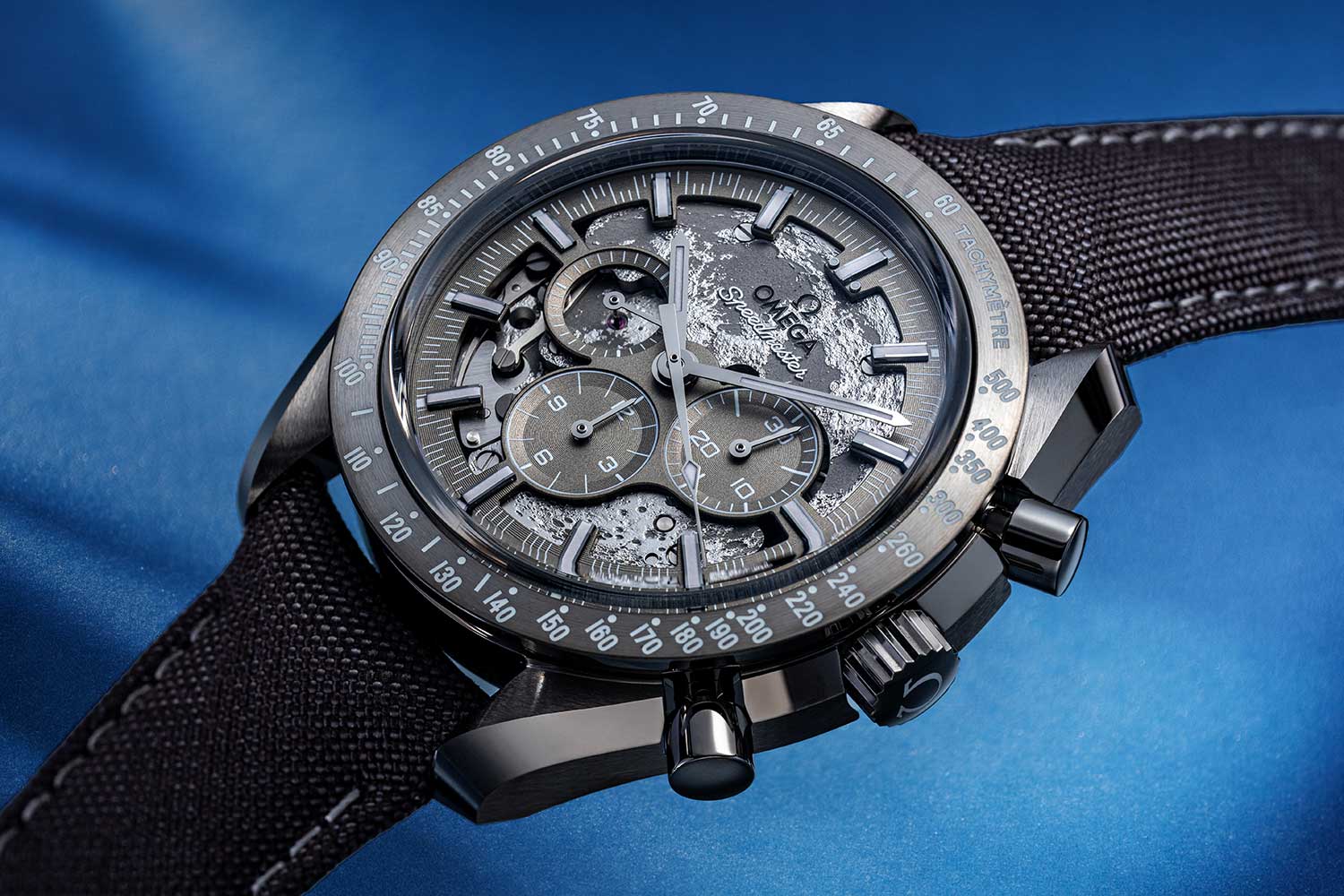
Omega Speedmaster Grey Side of the Moon (©Revolution)
Instead of the smooth ceramic surface found on earlier Dark Side of the Moon models, Omega uses laser ablation to reproduce the topography of the lunar surface directly into the dial. Craters, ridges and plains emerge in relief, while the dial is partially open-worked to reveal bits of the movement beneath. The lunar motif continues onto the movement on the reverse, where the mainplate, bridges and even the escapement bridge receive the same laser treatment. Subtle it is not, but the full commitment and attention to detail are hard to resist.

Omega Speedmaster Grey Side of the Moon (©Revolution)
Speedmaster “Silver Snoopy Award” 50th Anniversary
The most evocative of all Speedmasters in the present catalog, apart from the classic Moonwatch, is undeniably the “Silver Snoopy Award” 50th Anniversary. It captures one of the Speedmaster’s greatest stories that began as another attempt to reach the Moon but ended as one of the most remarkable demonstrations of ingenuity and composure in the history of human spaceflight. The story is well known. An oxygen tank exploded nearly 56 hours into the Apollo 13 mission, forcing the crew to abandon the lunar landing and concentrate instead on getting home. Among the many problems they faced was the need to execute a precisely timed manual engine burn to place the spacecraft back on the correct trajectory for re-entry. With the onboard timing systems unavailable, the astronauts turned to the Speedmaster. Six months later, NASA presented Omega with the Silver Snoopy Award in recognition of the role the watch had played.

Omega Speedmaster “Silver Snoopy Award” 50th Anniversary
On the silver dial, Snoopy appears in the running seconds register as an embossed silver medallion, modeled after the pin presented by NASA to recipients of the Silver Snoopy Award. The sapphire caseback is decorated with a representation of the far side of the Moon using micro-structured metallization, while a tiny Command and Service Module carries Snoopy over the lunar surface each time the chronograph is engaged. An Earth disk rotates once every minute in step with the running seconds while the words “Eyes on the Stars” appear above. Every time the chronograph is started, the watch seems to retell a story that is worth hearing all over again.
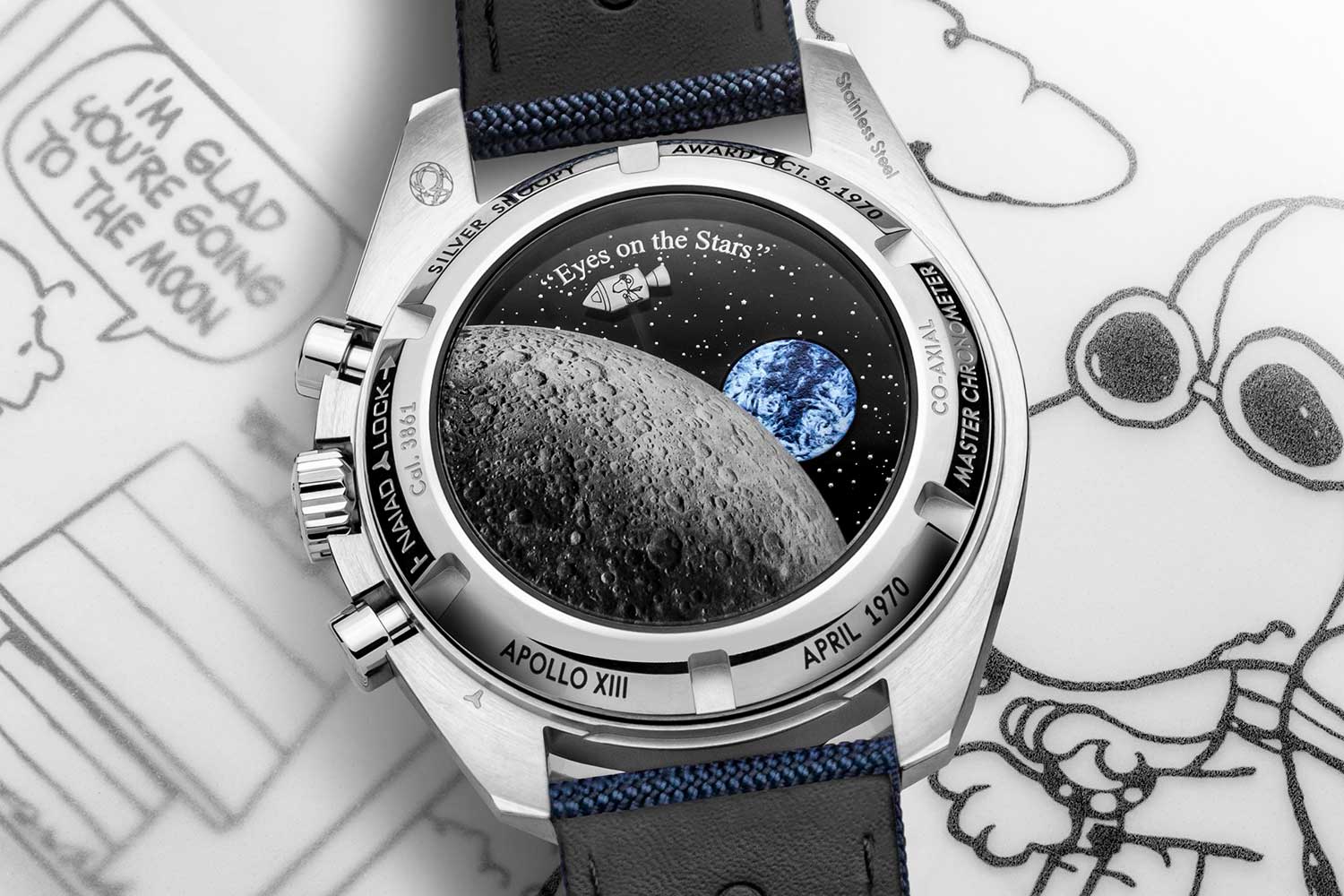
Omega Speedmaster “Silver Snoopy Award” 50th Anniversary

A chronological timeline of 66 distinct Speedmaster models that have shaped its legacy
Omega

You may also like
News
Last Week in Watches: Omega Plays Both Sides, Seiko Takes Panda Literally
Oct 12, 2026
News
Last Week in Watches: Omega Plays Both Sides, Seiko Takes Panda Literally
Oct 12, 2026
Editorial
Bond is Back: The New Omega Seamaster Bond Watches are Perfect for Heroes or Villains
Oct 5, 2026
Editorial
Bond is Back: The New Omega Seamaster Bond Watches are Perfect for Heroes or Villains
Oct 5, 2026
Editorial
Last Week in Watches: New Releases Ahead of Geneva Watch Days 2026
Aug 31, 2026
Editorial
Last Week in Watches: New Releases Ahead of Geneva Watch Days 2026
Aug 31, 2026