A Closer Look: Krayon Anywhere Magnolia

Of all the things an astronomical watch can depict, the times of sunrise and sunset are among the easiest to imagine wanting to know. They are also among the more difficult to work out mechanically, especially when the watch has to account for different locations. The Krayon Everywhere, introduced in 2017, is still completely unique in letting the owner set the latitude, longitude and time zone on the watch itself. The Anywhere, which followed in 2020, gives the times for sunrise and sunset one place at a time, and a watchmaker can set it for another latitude without replacing a single part. Both watches are relatively less talked about amid the broader enthusiasm for independent watchmaking, much of which has centred on time-only watches. This may have something to do with their high prices, but given the amount of engineering that goes into them and the commensurate level of finishing, the prices are defensible.
-

- Krayon Everywhere
-

- Calendar and Astronomy Watch Prize: Krayon, Anywhere
Rémi Maillat and his wife, Fei Hou, founded Krayon in Neuchâtel in 2013 as a movement engineering firm before it became a brand. Maillat studied micromechanical engineering in Le Locle and spent five years in Cartier’s technical office, where he was responsible for some of the brand’s most complicated watches, including the Rotonde de Cartier Mysterious Double Tourbillon. Fei Hou studied mechanical engineering in Lyon and worked in research and development at Rolex. Their backgrounds go some way towards explaining their appetite for complex problem solving.

Rémi Maillat
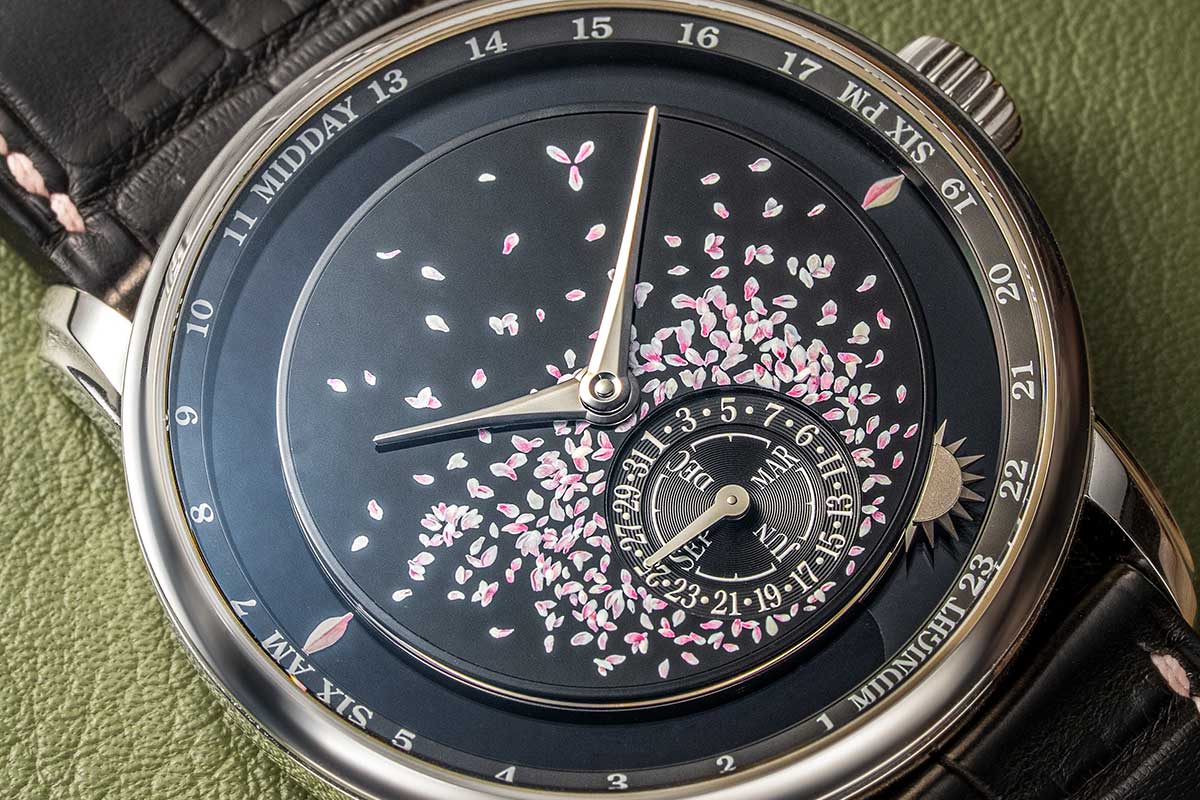
At IAMWATCH this year, Krayon introduced the Anywhere Magnolia, a platinum edition of 15 watches with a black onyx dial hand-painted with magnolia petals. This is the third métiers d’art edition of the Anywhere, following the mosaic-style hand-painted Azur and Arborea. Krayon also made two unique pieces for Only Watch, one inspired by Claude Monet’s Impression, Sunrise in 2021 and the other by Théo van Rysselberghe’s Pointillism for the 2023 edition. In 2024, Krayon made a unique piece for Jean Todt inspired by the swirling sky in Vincent van Gogh’s The Starry Night.
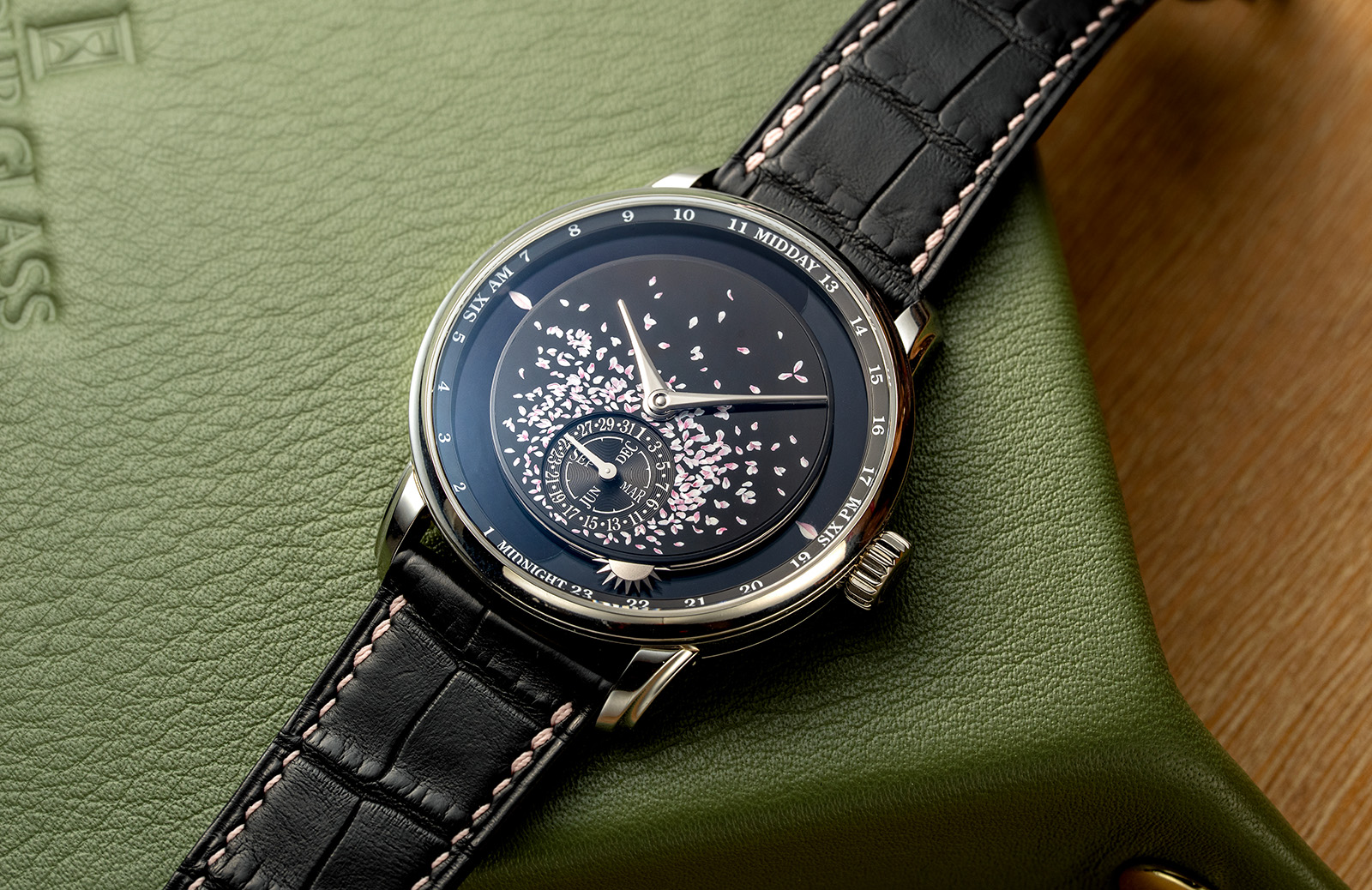
Krayon Anywhere Magnolia (©Revolution)
Sunrise and sunset suggest all sorts of possibilities for bright colour, which is what makes a scattering of magnolia petals against black onyx an unexpected choice. The scene is a familiar one at Krayon’s manufacture in Neuchâtel. After a spring rain, the magnolia tree across the street begins to shed its petals.
The dial is a thin slice of polished black onyx, hand-painted by a miniature painter from the Neuchâtel region. The petals gather around the calendar subdial and scatter across the dark surface, leaving much of the upper half open. Seen close up, the painting is wonderfully detailed. Some petals are little more than a sliver of ivory, while others have a deep pink fold that fades towards a pale, curled edge. Above the hands, three petals form Krayon’s Y, while two larger petals carry the motif out to the 24-hour ring, where they mark sunrise and sunset.
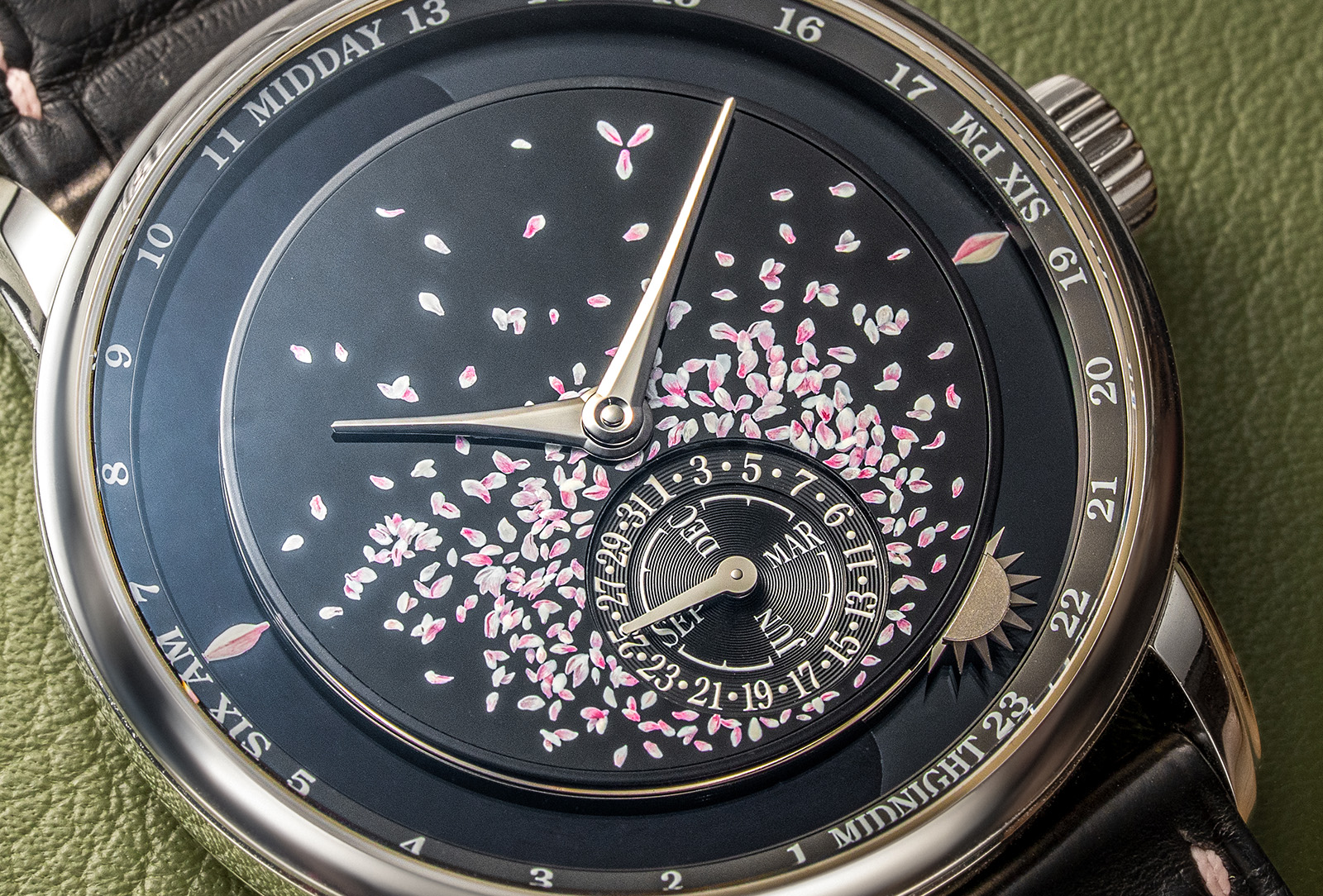
On the original Anywhere, sunrise and sunset are read where the light and dark sectors meet. On the Magnolia, both sectors are black, and the two petals painted on the moving discs mark those same transitions. The upward-facing petal on the left marks sunrise and the downward-facing one on the right marks sunset, with both times read against the 24-hour scale on the dial flange. The small sun is a 24-hour hand that provides a visual representation of the sun rising and setting, so its position between the two petals shows how much daylight remains.
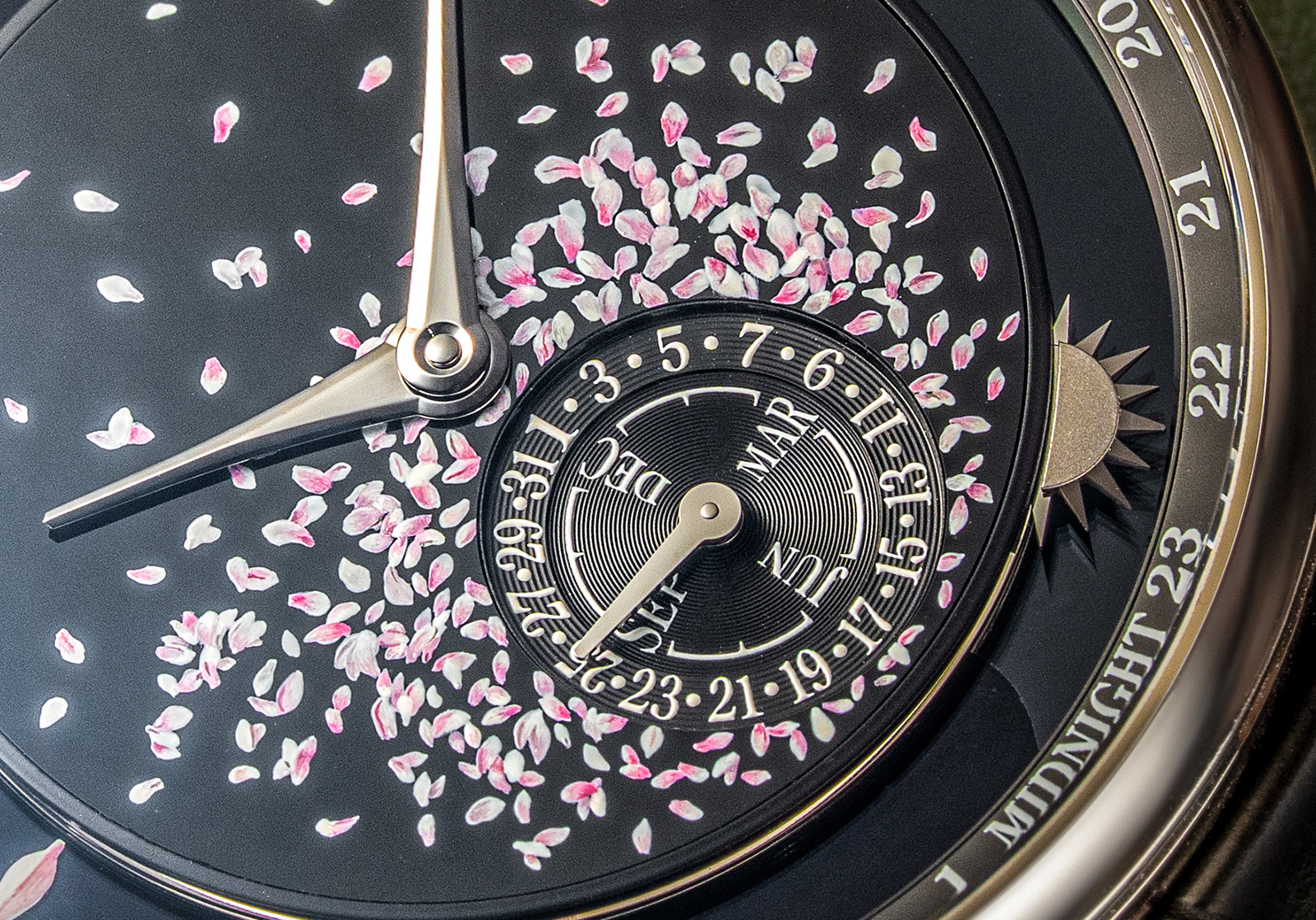
Once a watchmaker has calibrated the mechanism for the chosen latitude, longitude and time zone, the calendar automatically drives the changes in sunrise and sunset times over the course of the year. The owner corrects the date through the crown in the second position, forwards or backwards, and sets the time in the third. The calendar is a simple calendar that treats all 12 months as having 31 days, thus needing to be adjusted five times a year.
The platinum case keeps the original Anywhere’s dimensions of 39mm in diameter and 9.5mm thick, which gives it the proportions of a time-only watch despite the complex astronomical complication. The case is elegantly designed, with a slim concave bezel and lugs that are fluted along their outer edges and soldered to the case middle.
The Mechanics of Sunrise and Sunset
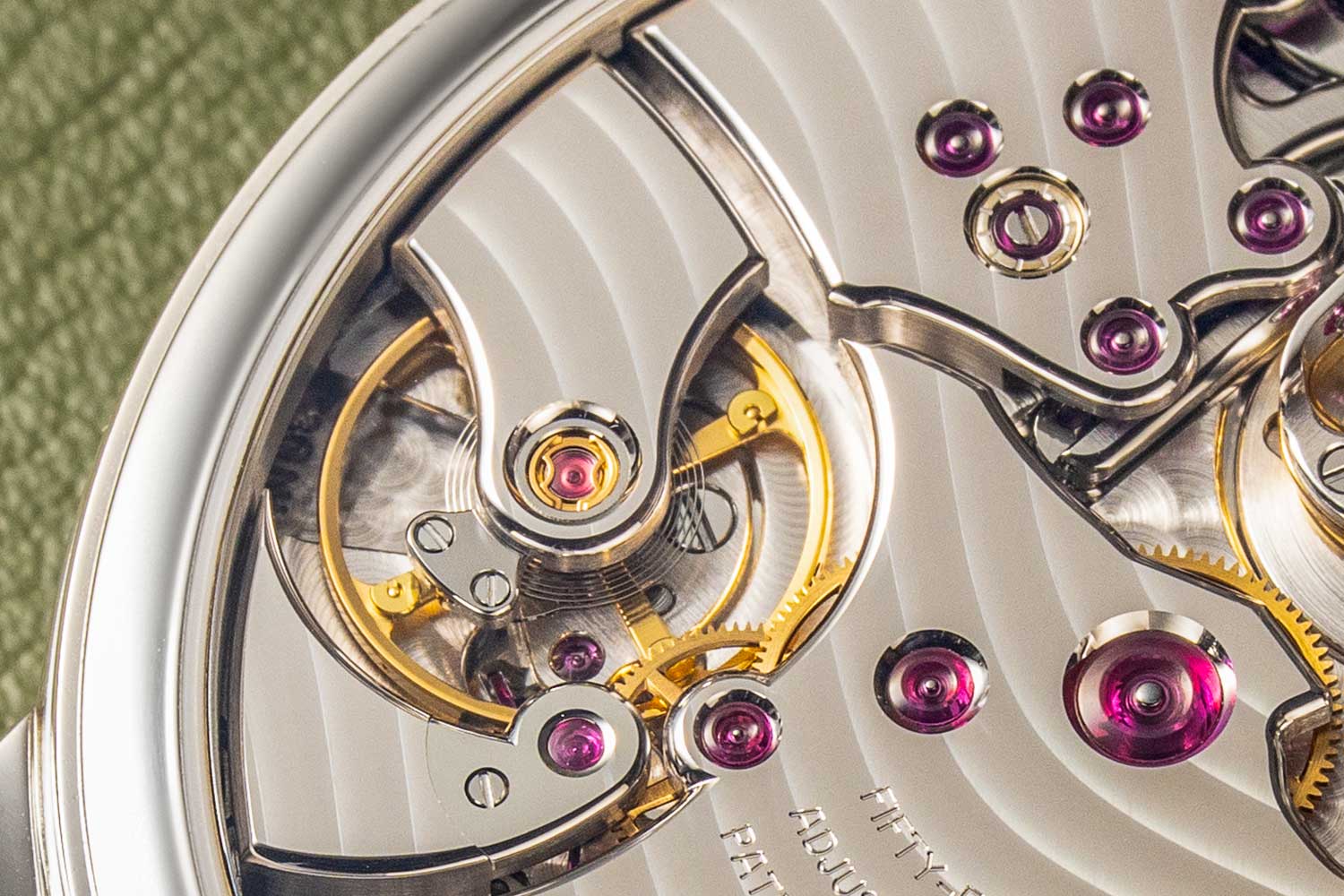
The Magnolia uses the same hand-wound calibre C030, a large 35.4mm movement that fills out the case nicely. There are 432 parts in the calibre, a striking number given that the Patek Philippe ref. 5270 perpetual calendar chronograph movement has 456. The movement measures just 5mm thick thanks to the integration of the complication directly into the mainplate.
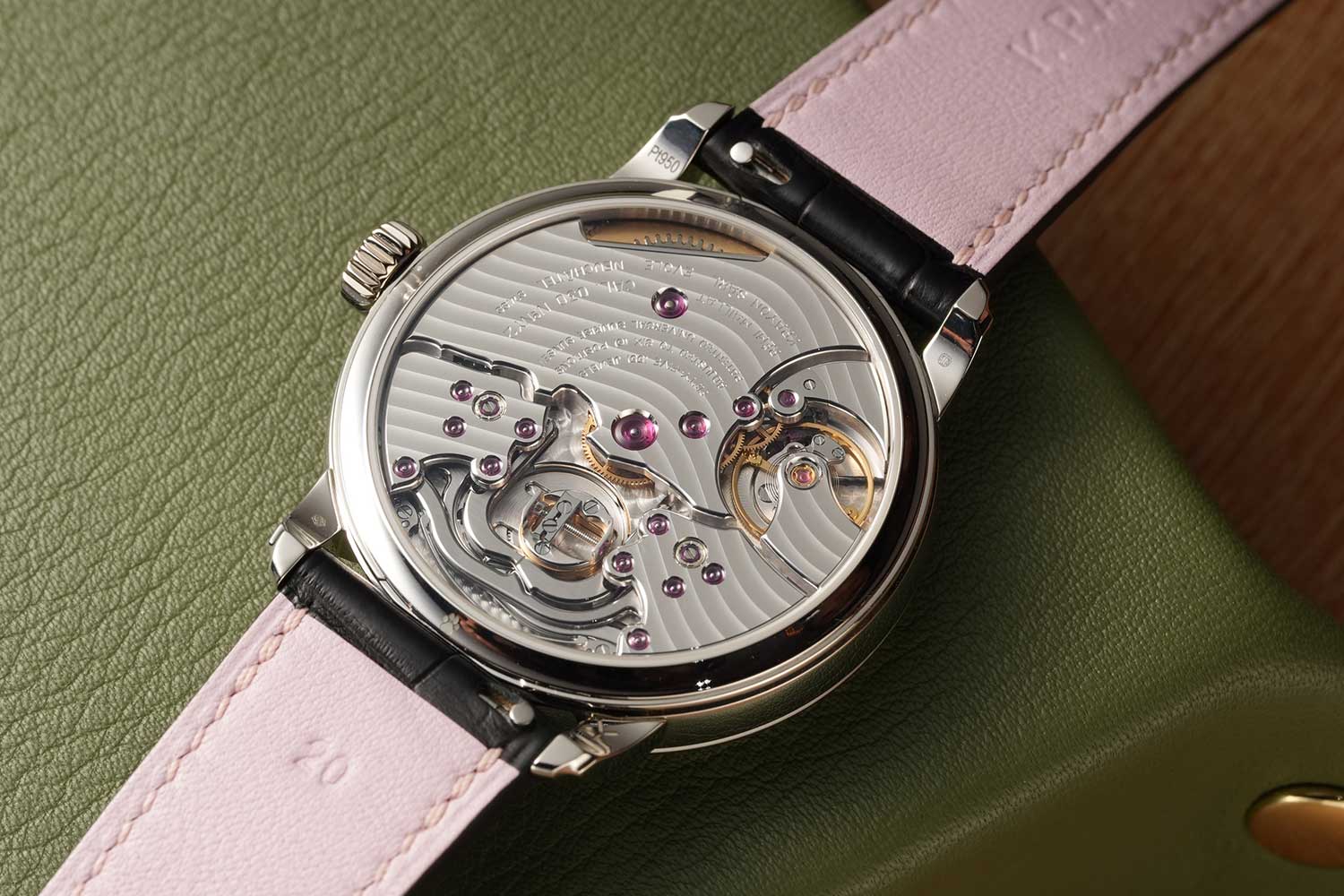
The C030 is smartly organised, with the sunrise and sunset mechanism below and the going train and balance above. A bridge covers most of the going train, with a large jewel that supports the centre wheel pivot. The barrel, which oppcupies nearly half the diameter of the movement, gives the watch a 72-hour power reserve and uses a Maltese cross stopwork that limits the mainspring’s usable range.
The calendar drives the sunrise and sunset indications so they change with the date. The further from the equator, the greater the seasonal variation in daylight. Hence, a change in latitude gives the watch a different pattern of sunrise and sunset to reproduce over the course of the year. In a conventional mechanism, that pattern is cut into two cams rigidly mounted on an annual wheel. One profile determines the time of sunrise on each date, and the other determines the time of sunset. Setting the watch for a different latitude typically means fitting a new pair of cams. The latest Patek Philippe Celestial Sunrise and Sunset ref. 6105G, for instance, uses two cams profiled for Geneva’s latitude, and must be swapped for another location.
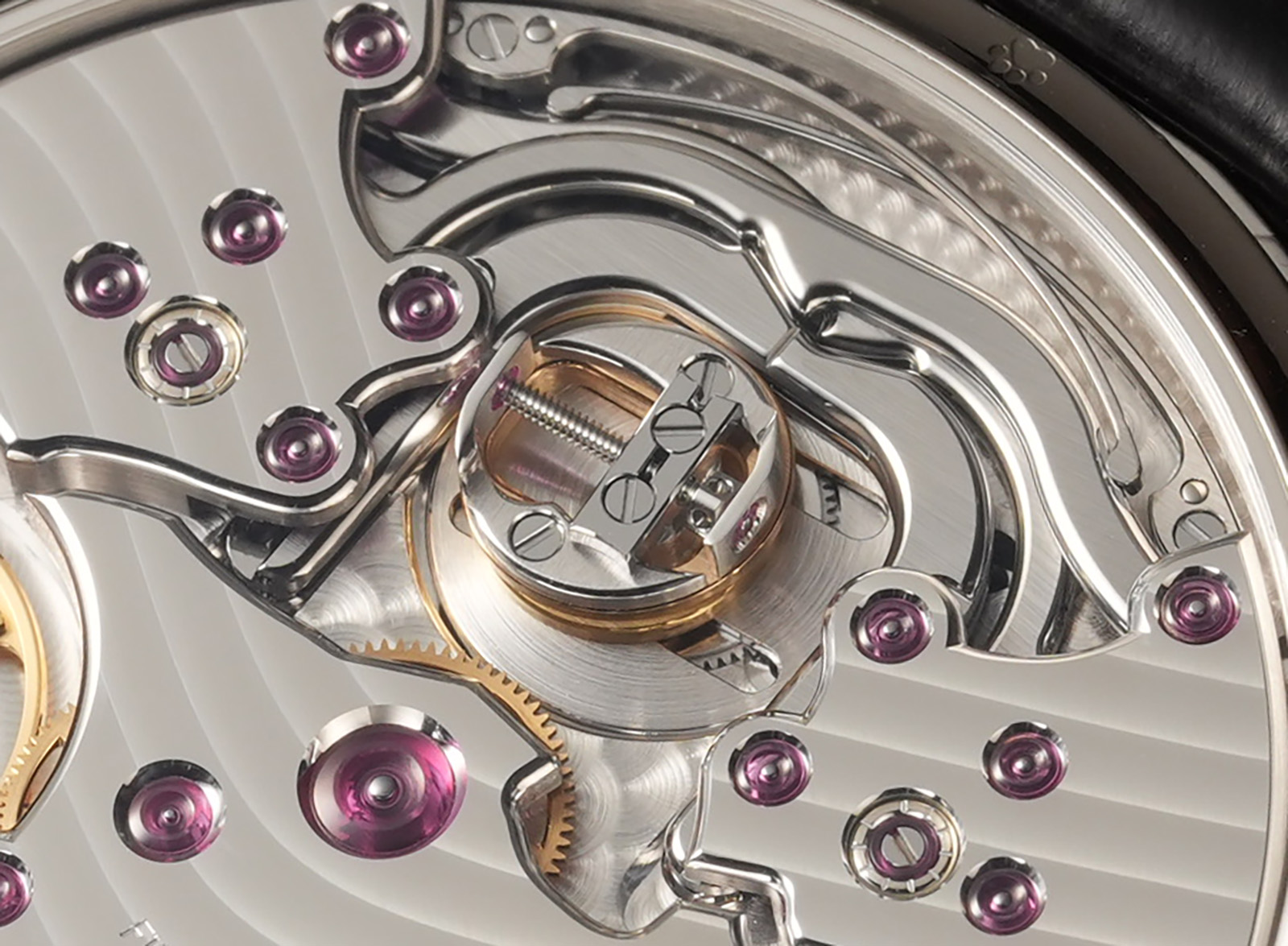
The Anywhere reprises the Everywhere’s most important innovation. A two-level cam rides on linear guides so it can slide sideways on the annual wheel. The upper profile governs sunrise and the lower one governs sunset. The calendar turns the wheel to the angle corresponding to the date, and the latitude setting determines how far the cam sits off-centre. In the Everywhere, the wearer selects latitude with the pusher and turns the crown, which adjusts the offset of the cam through a differential. In the Anywhere, a watchmaker can set the offset directly with a screw.
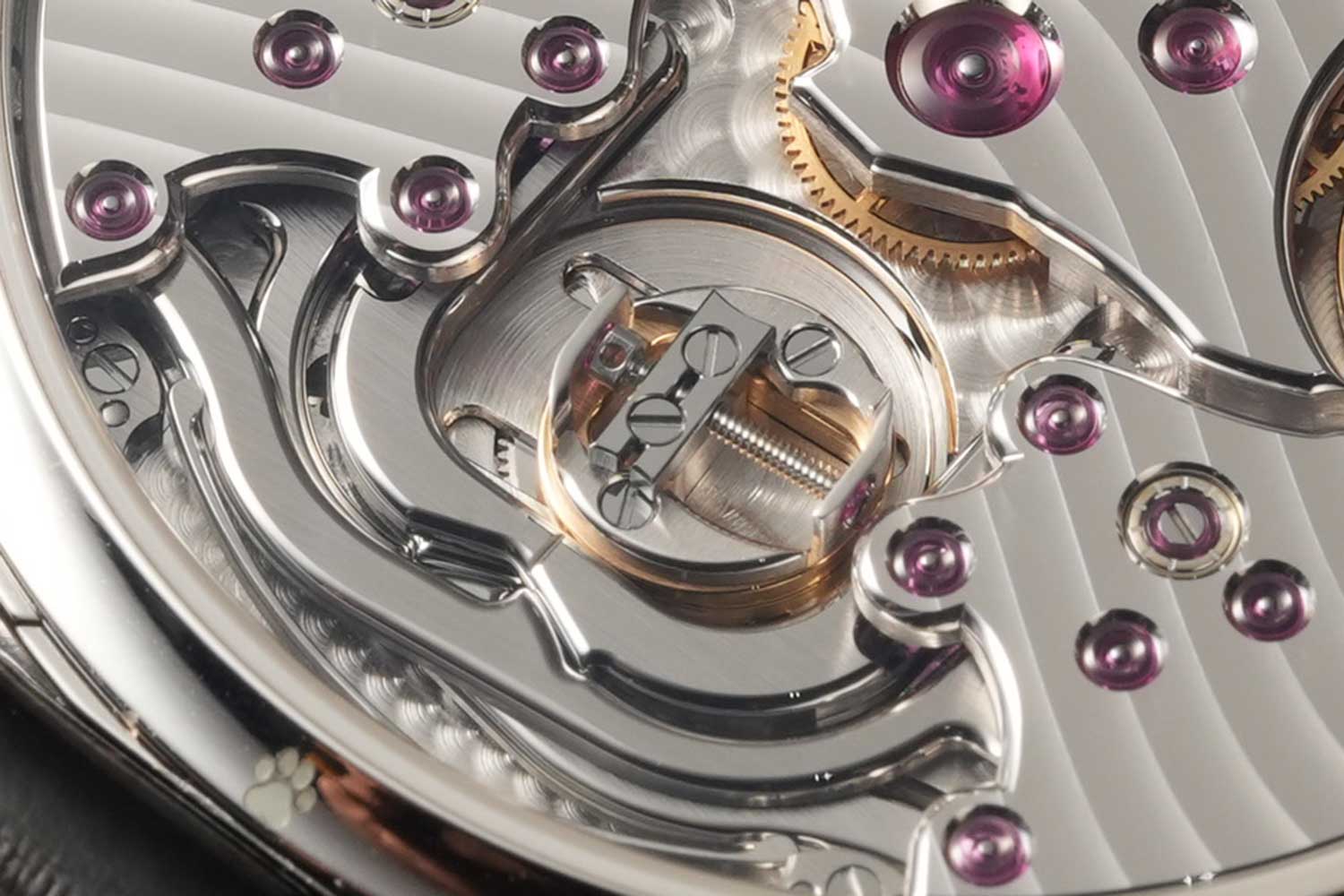
The linear guides are two parallel tracks on the annual wheel. They let the cam slide in a straight line across the face of the wheel and keep it from turning relative to the wheel. When the watchmaker turns the latitude screw, the cam slides along those tracks to a new offset. Once set, the cam and guides rotate together with the annual wheel.
For any given date, each feeler bears on the same point of its cam profile even when the cam is shifted sideways. What changes is where that point sits relative to the axis of the wheel, so the feeler is pushed to a different position. As the wheel turns through the year, the direction of the offset turns with it. Setting the cam further off-centre increases the amount the feelers move over the year, which reproduces the larger seasonal swings in daylight at higher latitudes. The same cam can thus serve any latitude.
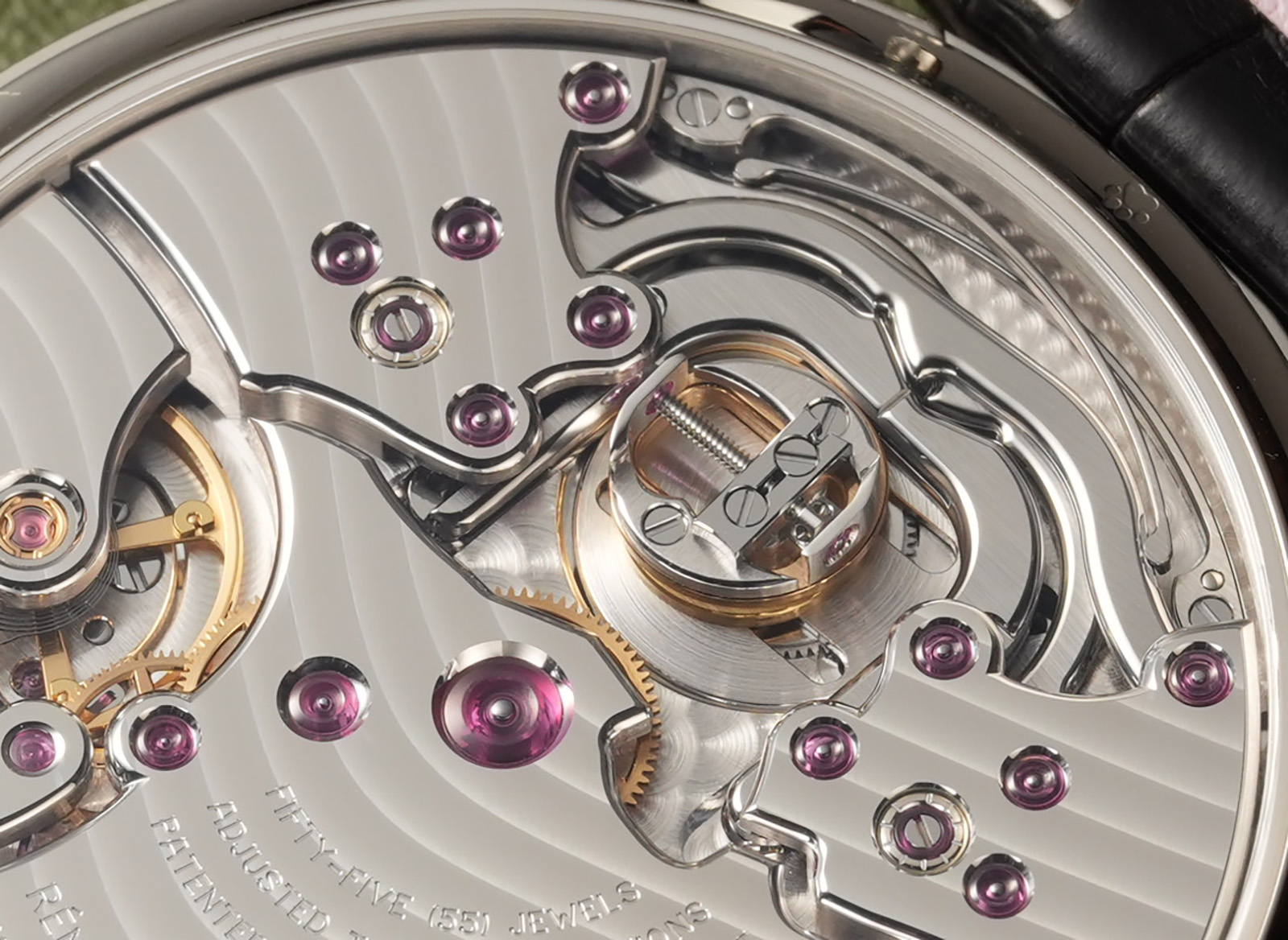
The two feelers are superimposed. The upper feeler follows the sunrise profile, and the lower one follows the sunset profile. Each feeler forms part of a curved sliding rack. As the cam turns, each sliding rack pushes against a spring-loaded rack. The spring-loaded rack pivots, and its toothed tip turns the pinion that drives the corresponding sunrise or sunset disc.
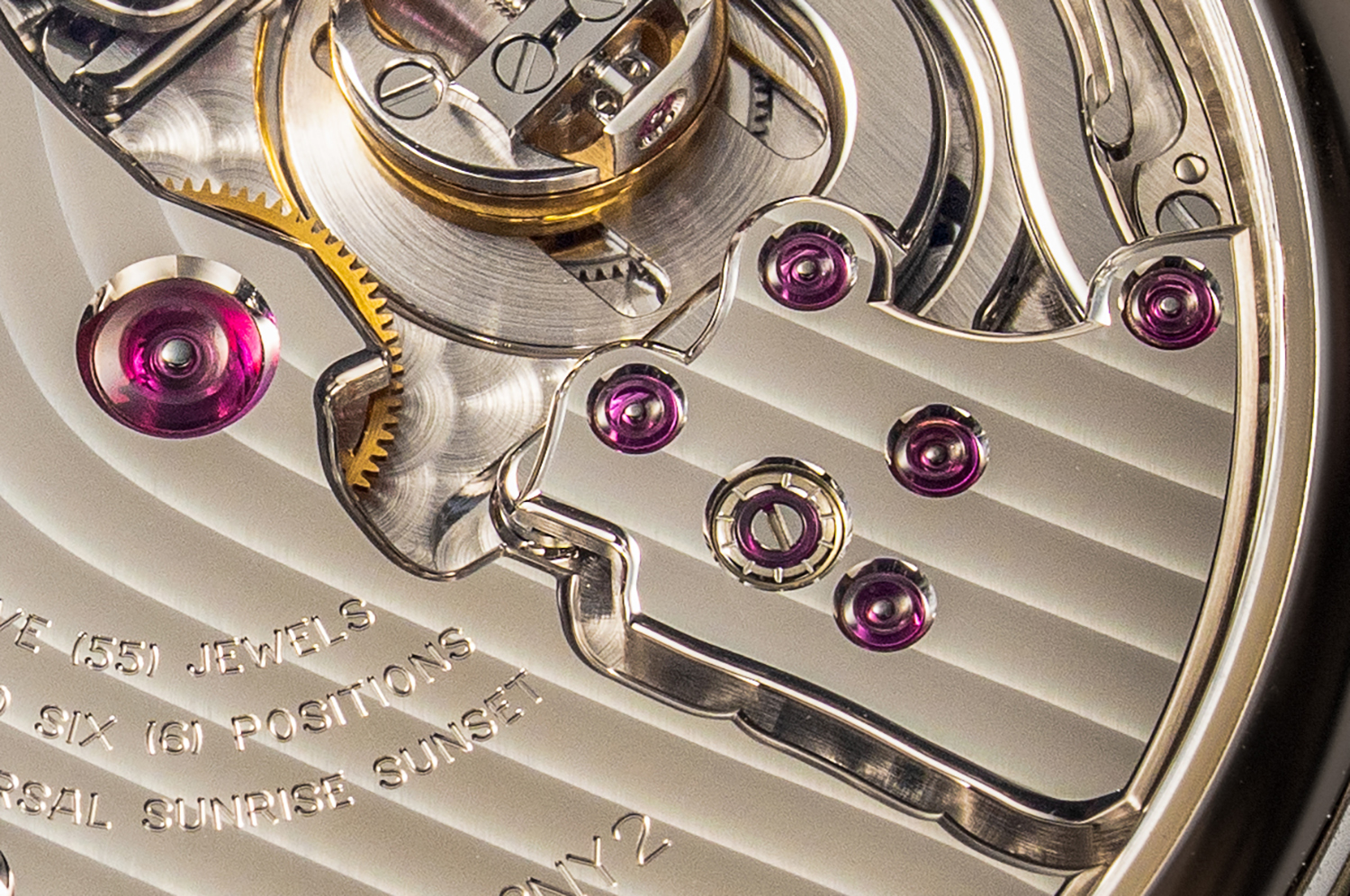
Longitude and time zone determine where the hours of daylight fall on the 24-hour scale. Spain and Italy, for instance, share a time zone even though Madrid and Naples are nearly 18 degrees apart in longitude. The two cities lie at nearly the same latitude, but the Sun rises and sets about an hour and 12 minutes earlier in Naples. The watchmaker is able to account for this using two screws on the movement’s bridges, one for each disc. Each screw turns the gearing for its disc and is graduated in 15-minute intervals on the rim of the small collar around each screw. Both discs are shifted by the same amount, so the hours of daylight begin and end later while their total duration stays the same.
Fine finishing
Krayon works two references to its home into the movement. The irregular outline of the barrel bridge echoes a stretch of the Lake Neuchâtel shoreline, and the curved côtes de Genève follows a graph of sunrise and sunset times in Neuchâtel. The bridgework might seem a little ungainly at first, especially if one is accustomed to seeing anglage follow more sinuous curves (of which there is no shortage in the movement), but it is so beautifully bevelled and polished that it’s easy to warm to its shape.
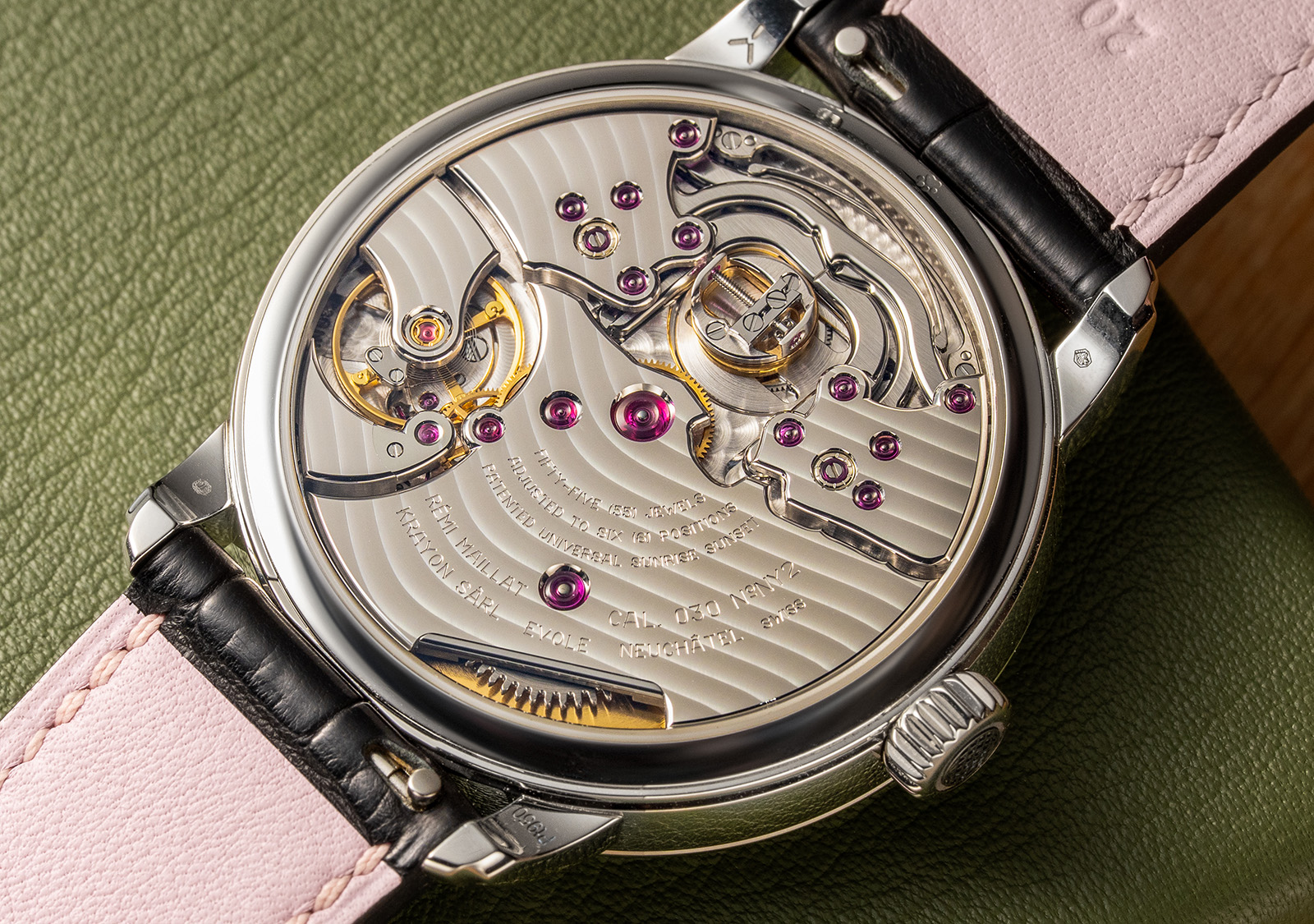
In fact, the movement is finished to an exemplary standard throughout, with a degree of care rarely seen in a watch of such technicality. The anglage, for instance, is broad and rounded, with numerous crisp inward and outward angles. All jewel and screw sinks are mirror-polished, and even the teeth of the barrel ratchet wheel are polished. The train-wheel spokes are likewise finished with particularly wide, polished bevels and sharp inward angles. Elsewhere, the crossbar winding click, hairspring stud cover and the cap over the escape wheel jewel are all black polished.
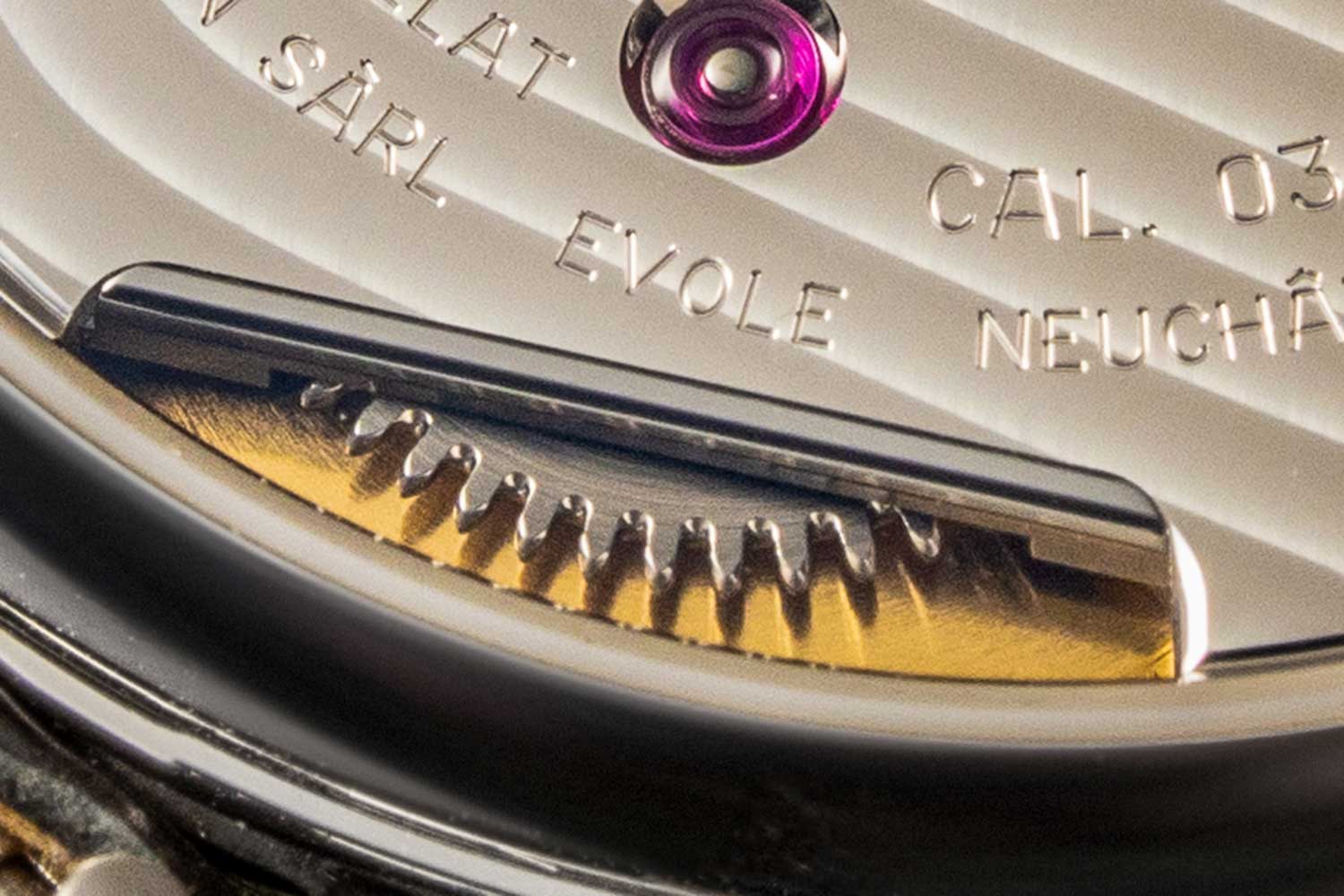
There is a good deal to look at in the sunrise and sunset mechanism itself. Anglage traces the cam itself, which has an opening that exposes the latitude adjustment screw. The guide plate beneath it is circular-grained, and the racks have straight-grained faces bordered by polished bevels. The rounded anglage makes the sweep of those curves all the more conspicuous.
The bevels throughout the movement give it a luminosity that is still a rare sight, even with the proliferation of hand-finished watches coming from independent makers today. Looking at a movement like this, one is reminded why hand finishing came to be so prized in the first place.
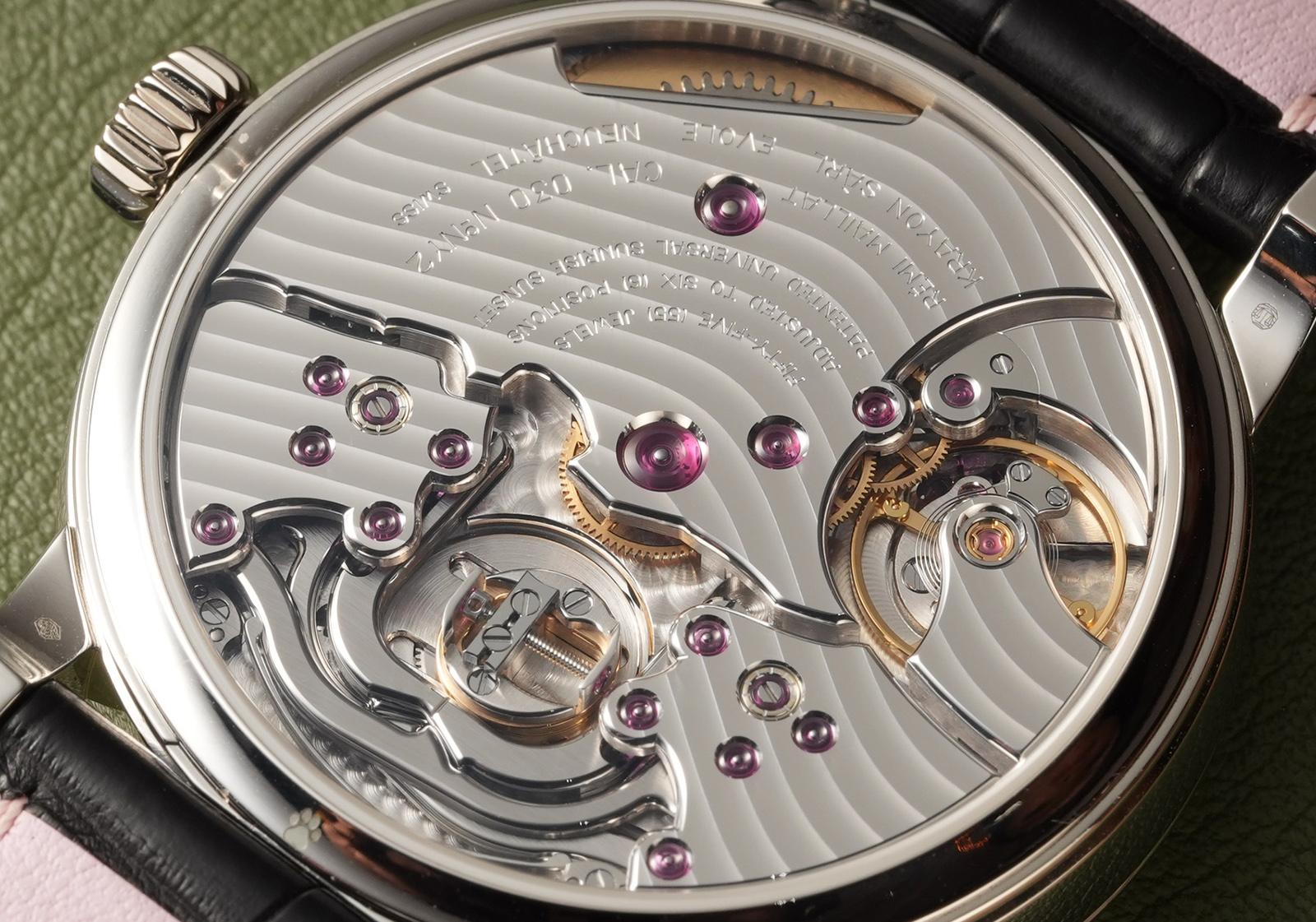
The sunrise and sunset mechanism would be reason enough to take an interest in the Anywhere. Yet the movement finishing is every bit as accomplished, and in this version there is the added pleasure of a rather lovely miniature painting on a hardstone dial. The palette is subdued enough for everyday wear, which seems entirely fitting for a watch that follows the changing length of the day.
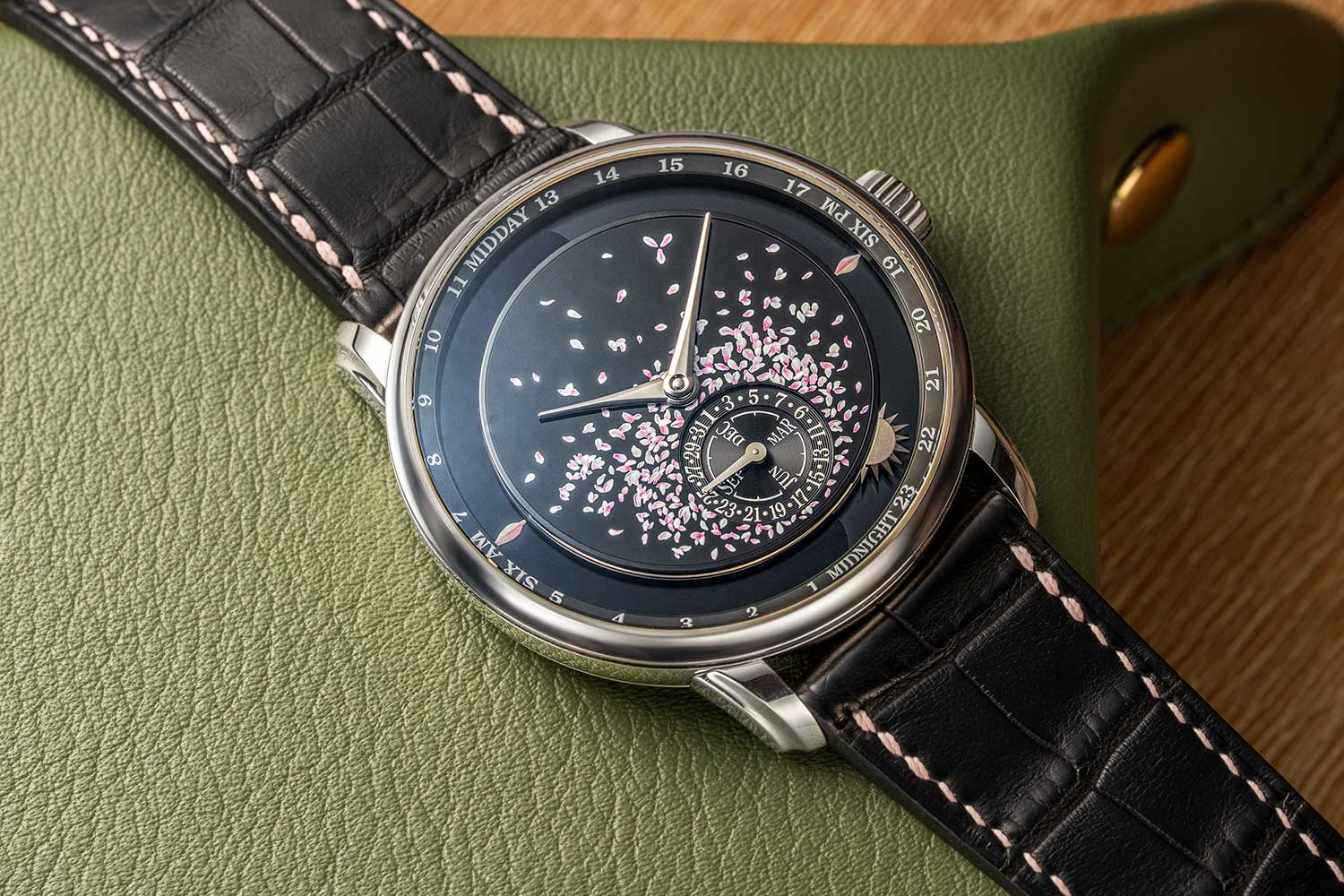
Krayon Anywhere Magnolia (©Revolution)
Tech Specs: Krayon Anywhere Magnolia
Movement Hand-wound calibre C030 (35.4mm × 5mm), 21,600vph (3Hz), 72-hour power reserve
Functions Hours, minutes, 24-hour display, date and month, sunrise and sunset times for a location set by a watchmaker
Case 39mm × 9.5mm, platinum, water-resistant to 30m
Dial Black onyx with hand-painted magnolia petals
Strap Hand-stitched black alligator leather with a platinum pin buckle
Availability Limited to 15 pieces
Price CHF 178,000

Advertisement