
URWERK UR-100V LS Ceramic Speed of Light
Editorial
URWERK UR-100V LS Ceramic Speed of Light

In the hands of Felix Baumgartner and Martin Frei, aka URWERK, time is never really quite what it seems. Instead, it is challenged on all fronts… in its passing, its telling and as a nebulous metaphysical concept.
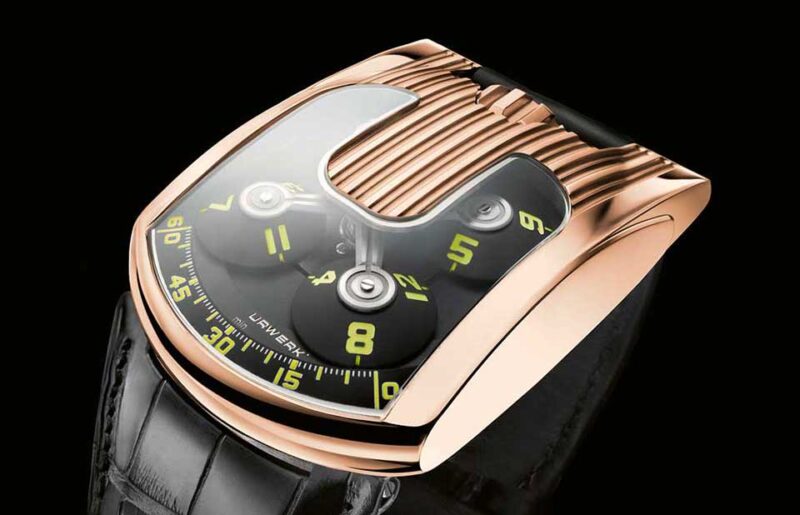
Beginning with the UR-101 and UR-102, which introduced the first rotating satellite hour indicators that were read along fixed minute tracks, albeit disguised in conventional round watches, and then with UR-103.03, which turned the concept on its head by showcasing the intricate workings of that wandering hour display, URWERK has pushed the boundaries of time and the telling of it.
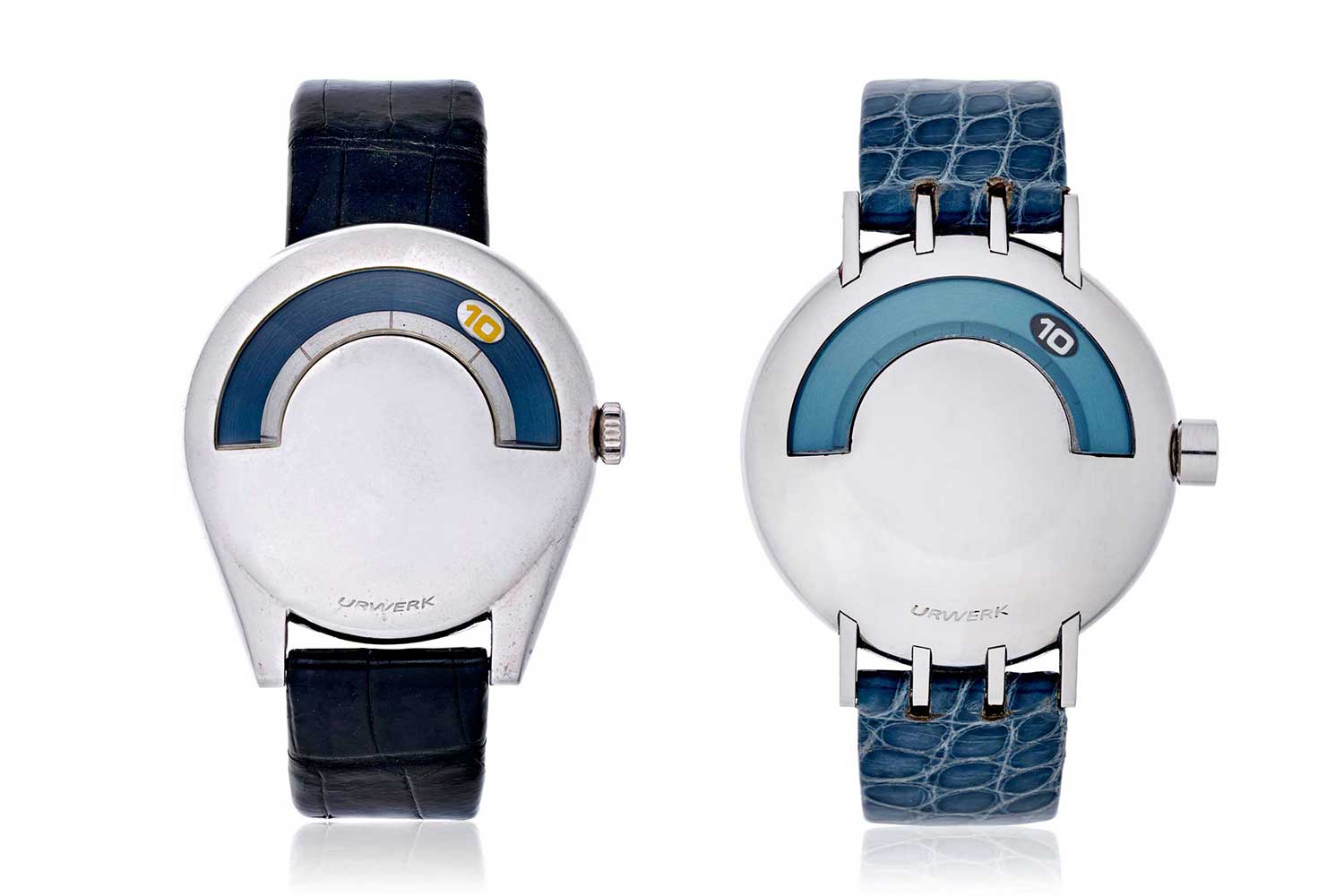
UR-101 and UR-102 (Image: Christie’s)
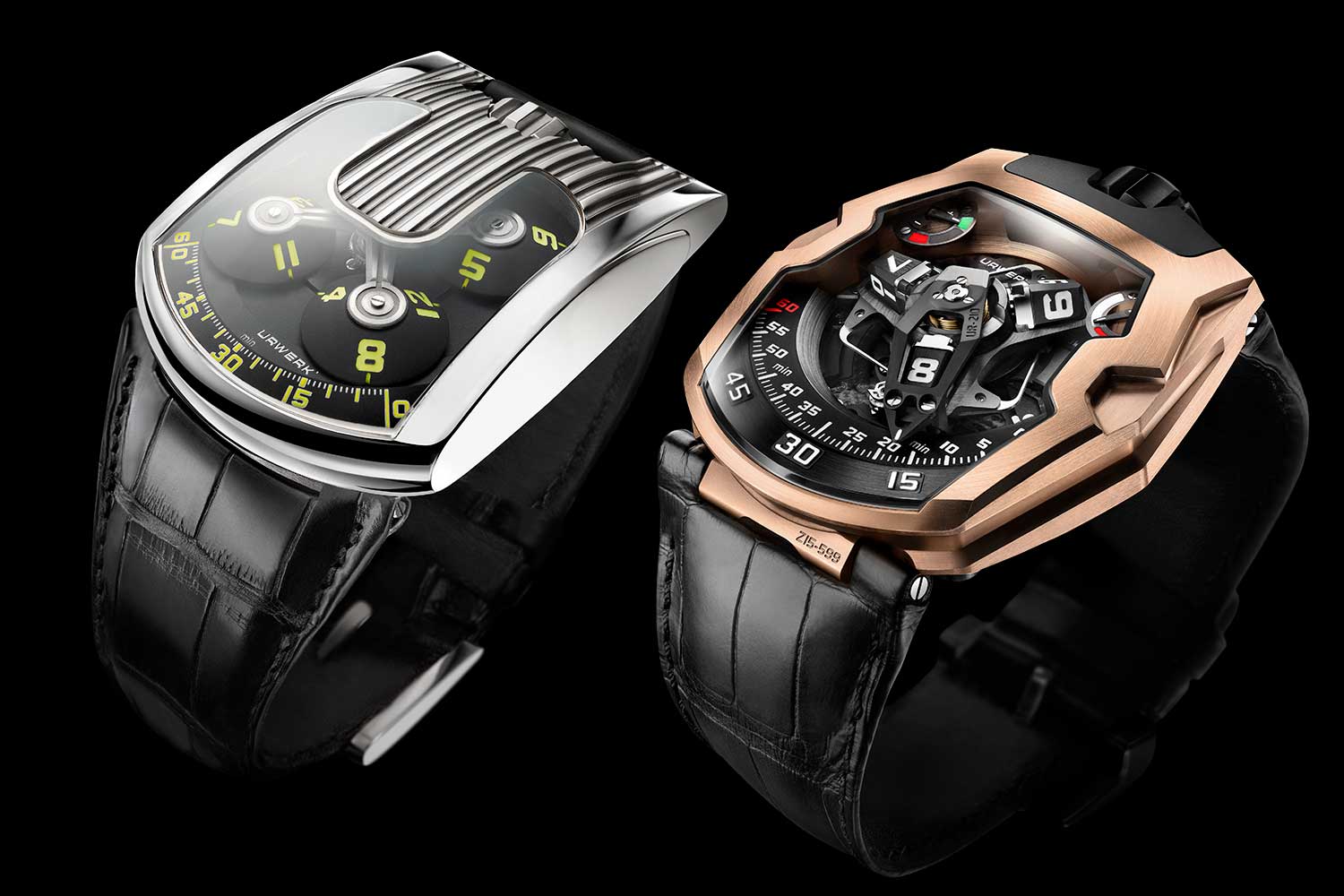
UR-103.03 and UR-210
The UR-210, meanwhile, paired three-dimensional satellites with a retrograde minute hand. The wild EMC of 2013 (it stands for Electro Mechanical Control) had an electronic oscillator that lets you regulate the balance wheel. In short, it’s been a restless, relentless exploration of time.
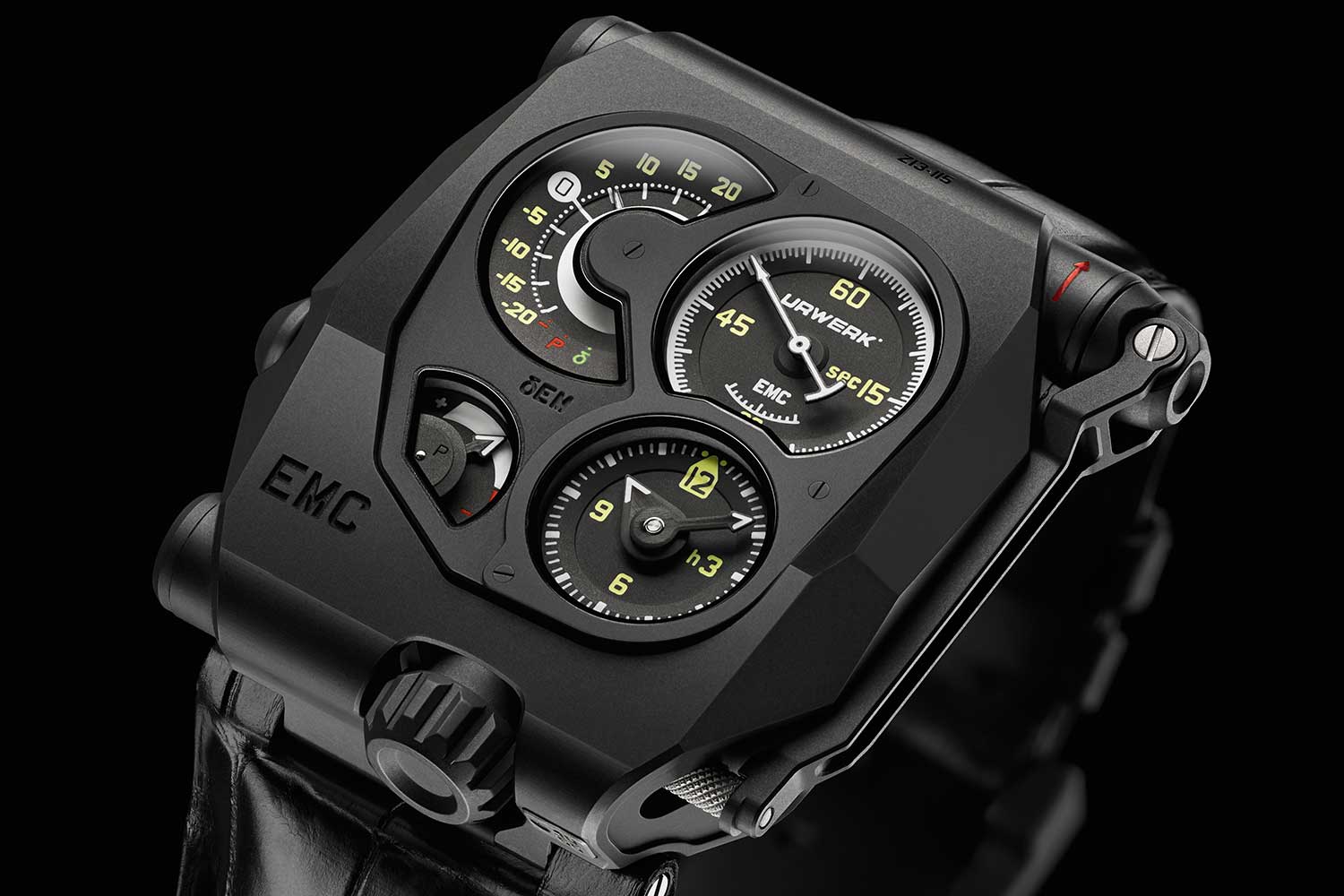
URWERK EMC
The latest UR-100V iteration continues this trek, crossing into cosmic territory quite literally. First released in 2019, the UR-100 “SpaceTime” was one of URWERK’s slimmest watches at 14mm and perhaps its most ergonomic, which also made it one of its bestsellers. Early members of the family featured the signature URWERK wandering satellite disk for hours and minutes but with an added twist. On the left, an indicator showsthe distance traveled by the Earth along its equator due to rotation, approximately 555km every 20 minutes. On the right, a corresponding indicator shows the distance Earth travels along its orbit around the Sun, which is approximately 35,740km every 20 minutes.
Admittedly, these figures are hardly practical in the day to day, but we appreciate them as a contemplation on space, time and indeed the meaning of life — a gentle reminder of our place in the world lodged amidst these massive numbers.
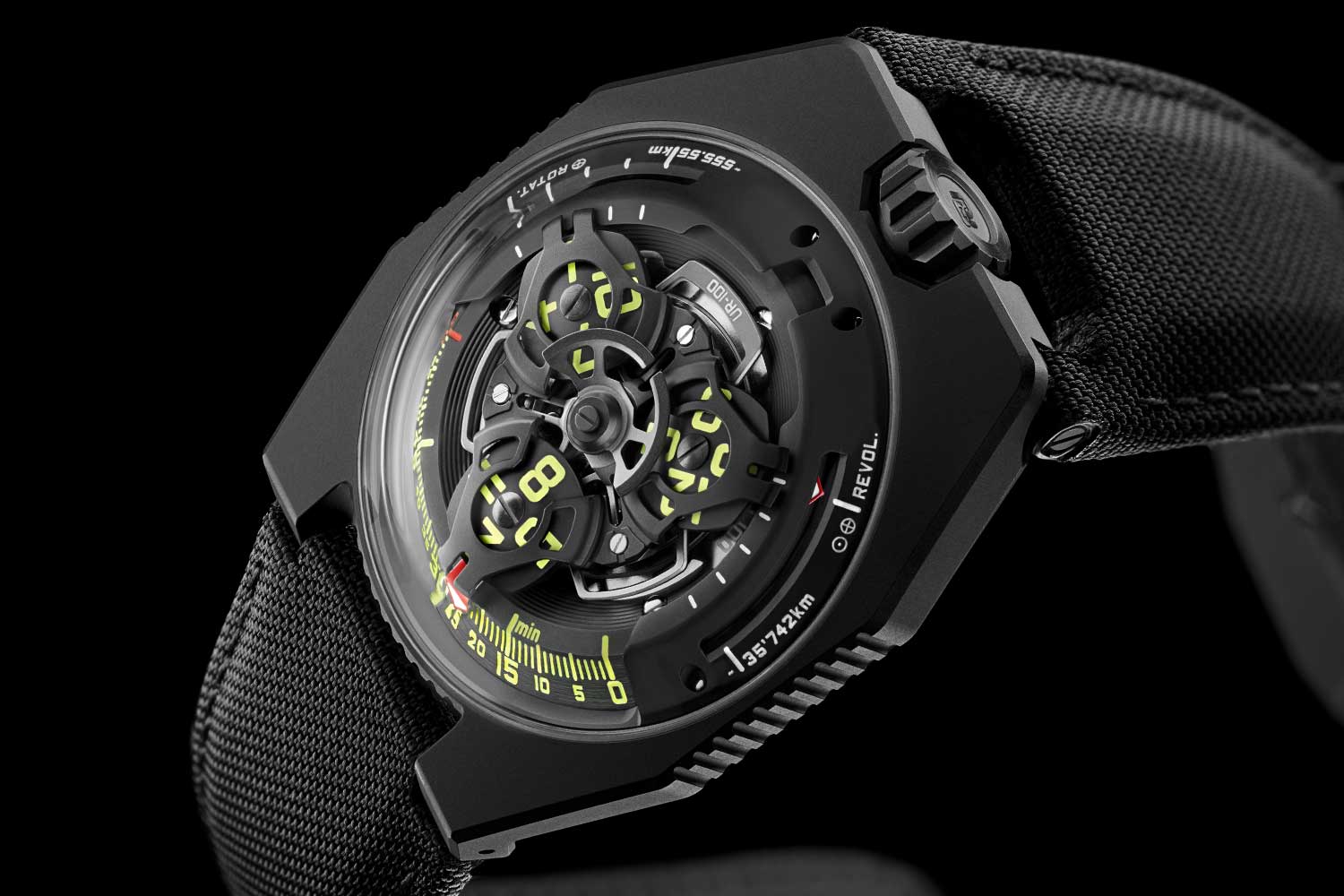
UR-100 “SpaceTime”
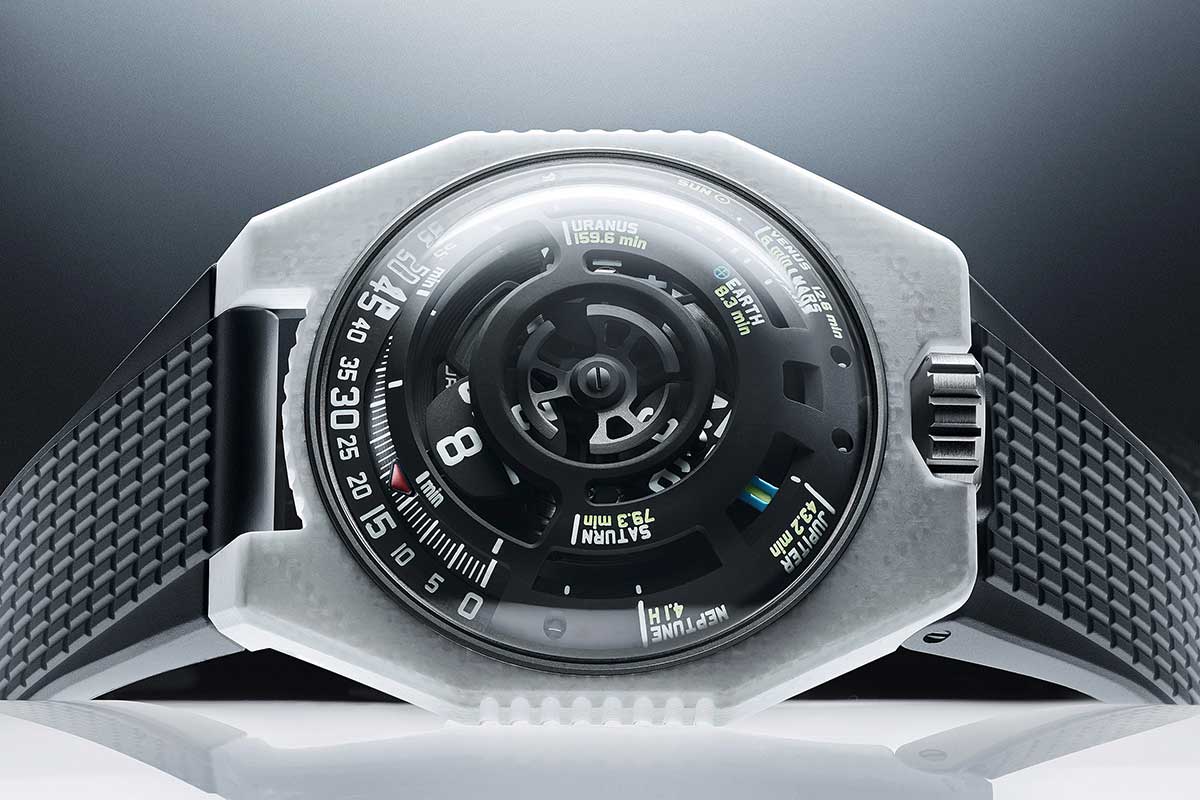
URWERK’s 2023 UR-100V “LightSpeed” model expanded that perspective manifold. It did away with the twin indicators and the marking of orbital distance. Instead, it mapped out, at a glance, the time required for light to travel from the Sun to each planet in the Solar System. Unlike its predecessors, which measured elapsed distances in the indicators, here it shows a fixed scale of planets scattered around the dial and the distance it takes a light photon to travel from the Sun to said planets. Each position corresponds to the time required for light to travel from the Sun to that planet, calculated mathematically.
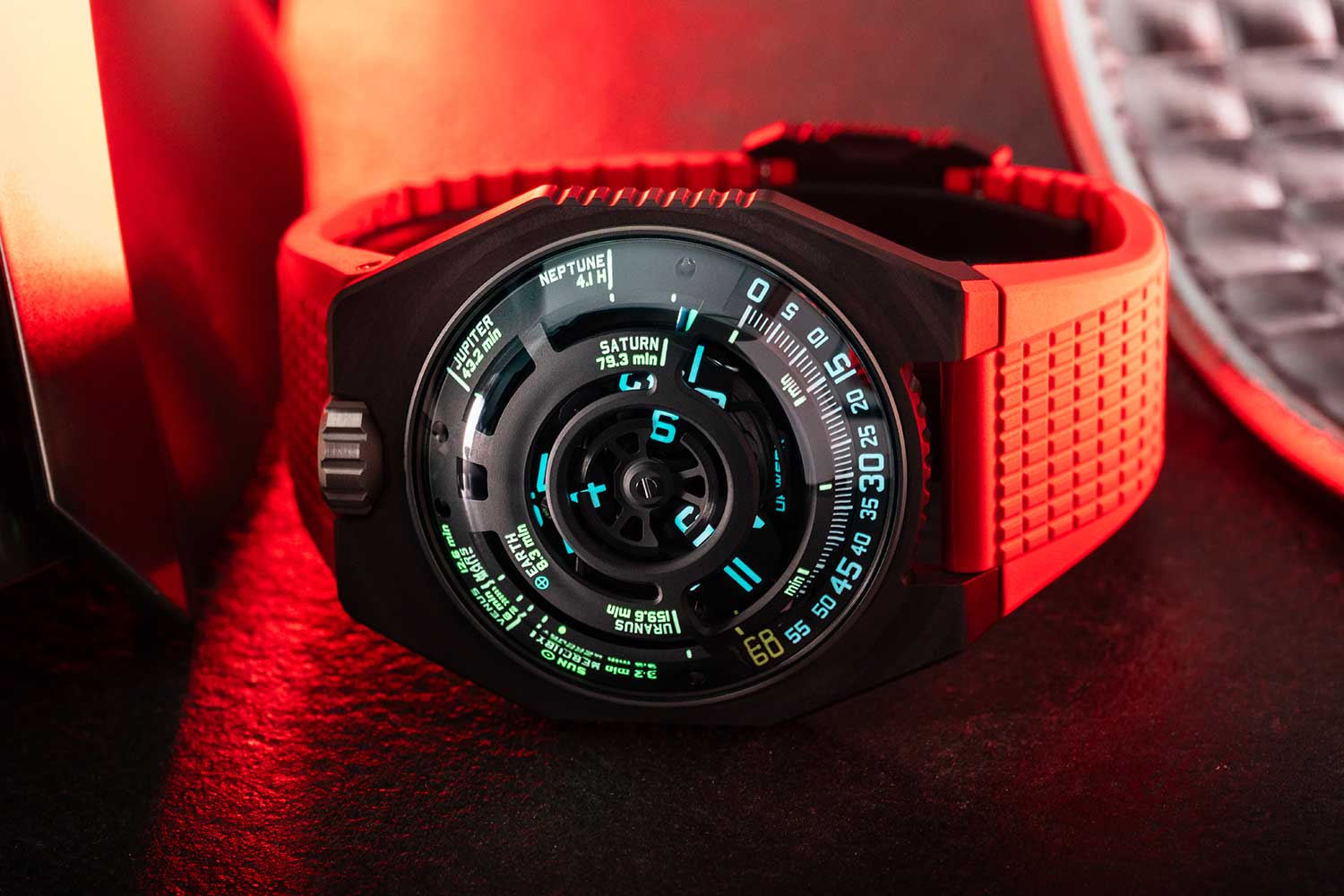
UR-100V “LightSpeed”
So, for instance, Mercury, that messenger of the gods, is a Sun’s beam away at just 3.2 minutes. Earth is a slightly longer 8.3 minutes. Neptune, perched on the murky edges of the Solar System, demands a mighty trudge at 4.1 hours away.
Practical? No — save for space cowboys, perhaps. Cosmic, romantic and all the wonderful spiel that add to the compelling appeal of a mechanical watch? We think so.
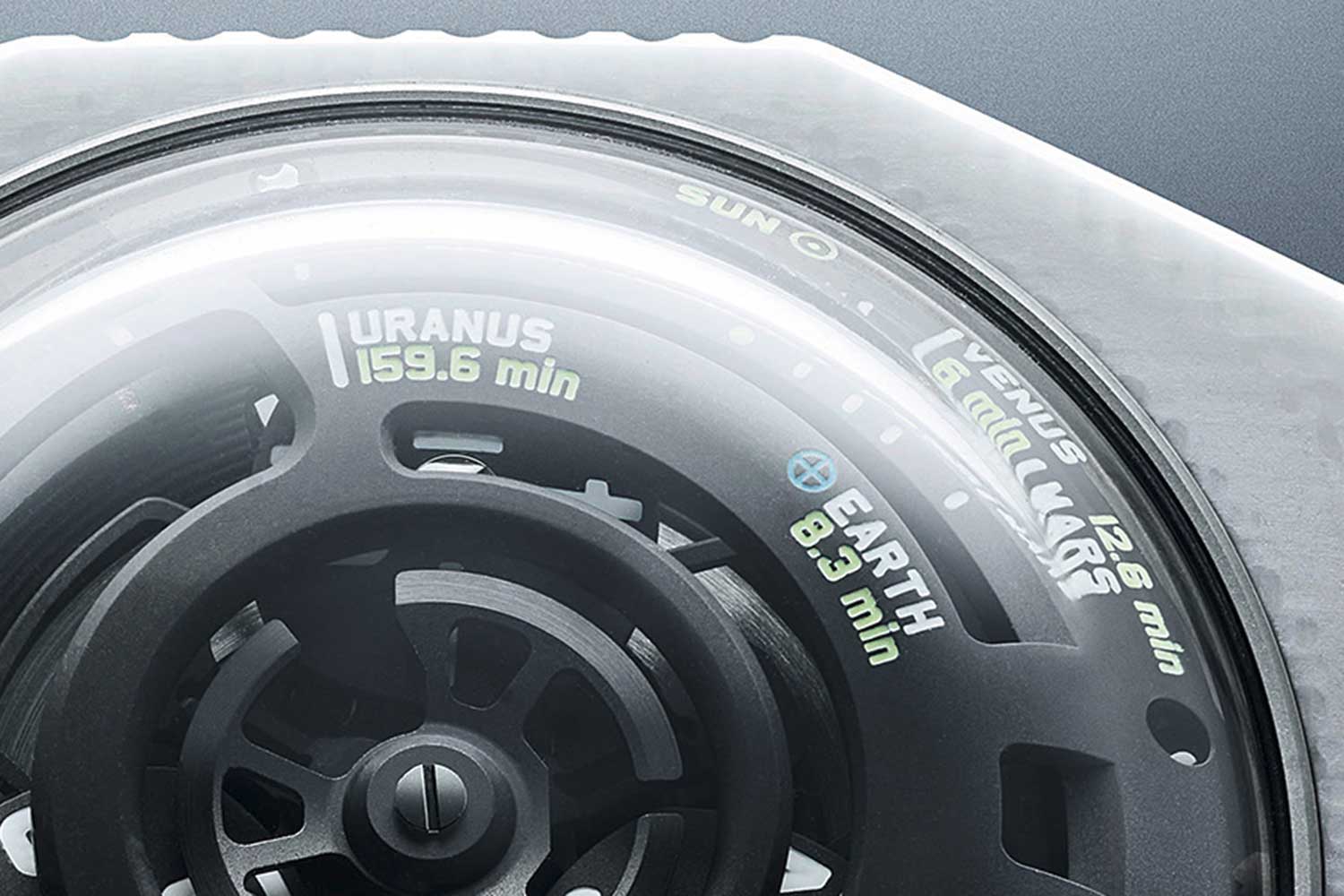
The distance it takes a light photon to travel from the Sun to Earth is 8.3 minutes, as clearly marked out
As with URWERK’s standard wandering satellite display, time is read off the wandering hour satellite sweeping across the lower arc of the dial, which shows a 120-degree minute track. A satellite, each bearing four numerals lit in Super-LumiNova, sweeps the minute track in 60 minutes. When it reaches the end, it is replaced by another satellite at the start of the track. Your current time is determined by reading the numeral on the satellite that’s aligned with the minute track. As soon as the satellite moves away from the minute track, it is in cosmic territory.
Indeed, it is as URWERK’s Artistic Director and co-founder Martin Frei says, akin to “carrying a fragment of the universe on the wrist.”

Felix Baumgartner and Martin Frei
Felix Baumgartner, Master Watchmaker and co-founder, references a childhood story that likely resonates with many. “When the light of a distant star reaches us, that star may have long since ceased to shine. What we see no longer exists and is never the present — only a memory.” The planetary system as mapped on the UR-100V “LightSpeed” is a salient, if somewhat unconventional and avant garde, reminder of that.
A Material Shift
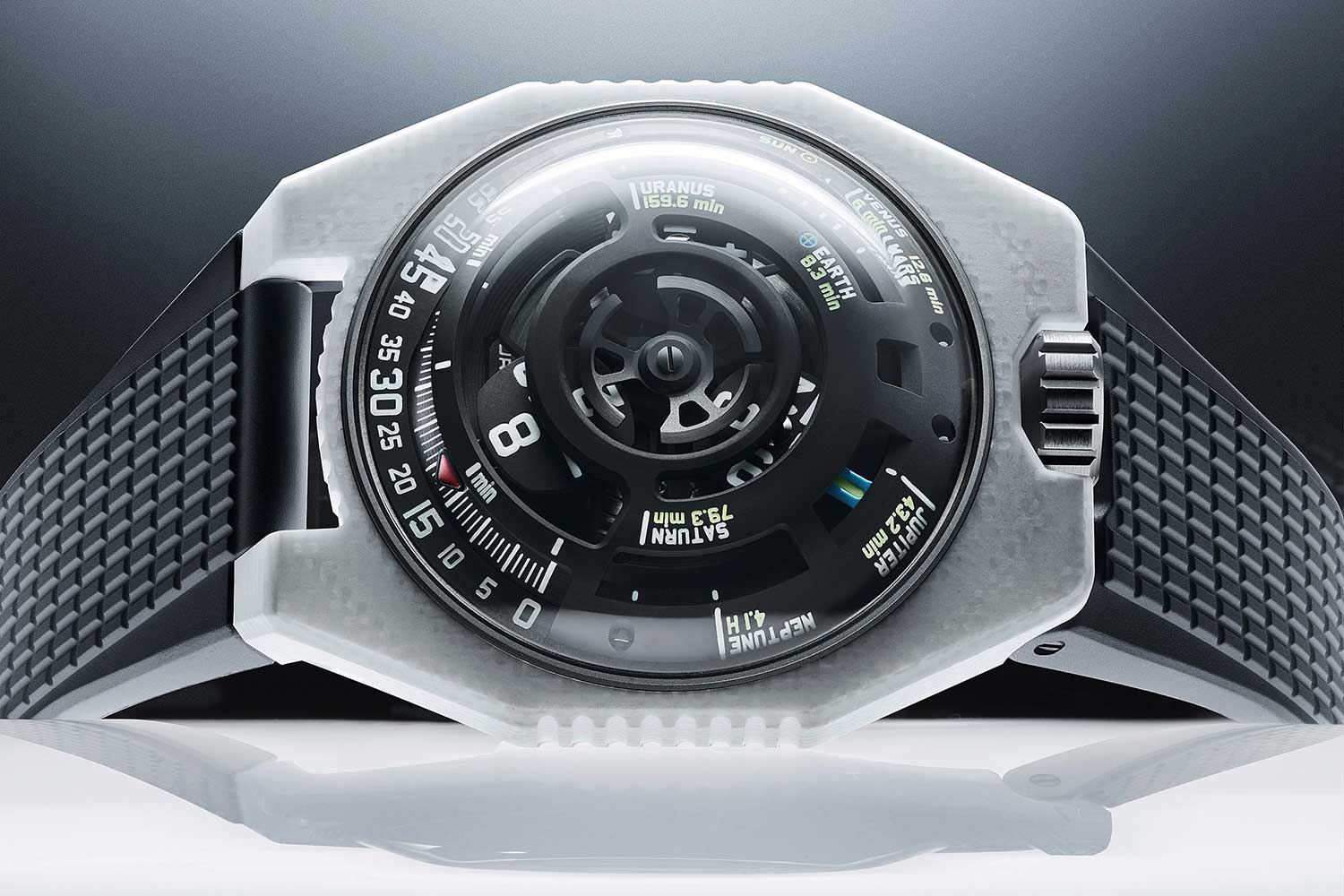
URWERK UR-100V “LightSpeed” Ceramic
This year’s release of the UR-100V “LightSpeed” is the second edition in the series, and it ups the ante with a material change to white ceramic, giving the watch a visual contrast that makes the dial pop on the wrist. Beyond a cosmetic color change, the case is made from an all-new ceramic composite developed by URWERK. A polymer matrix that integrates ceramic fibers with glass and carbon fiber, it has improved shock resistance and durability.
Baumgartner explains, “The extreme hardness of traditional ceramics is also their weakness due to their inherently brittle nature. When sintered at high temperatures, they can shatter under violent impacts. We wanted to move beyond that limitation, so we developed our own material. Thanks to the glass and carbon fibers it contains, our all-new ceramic composite does not break.”
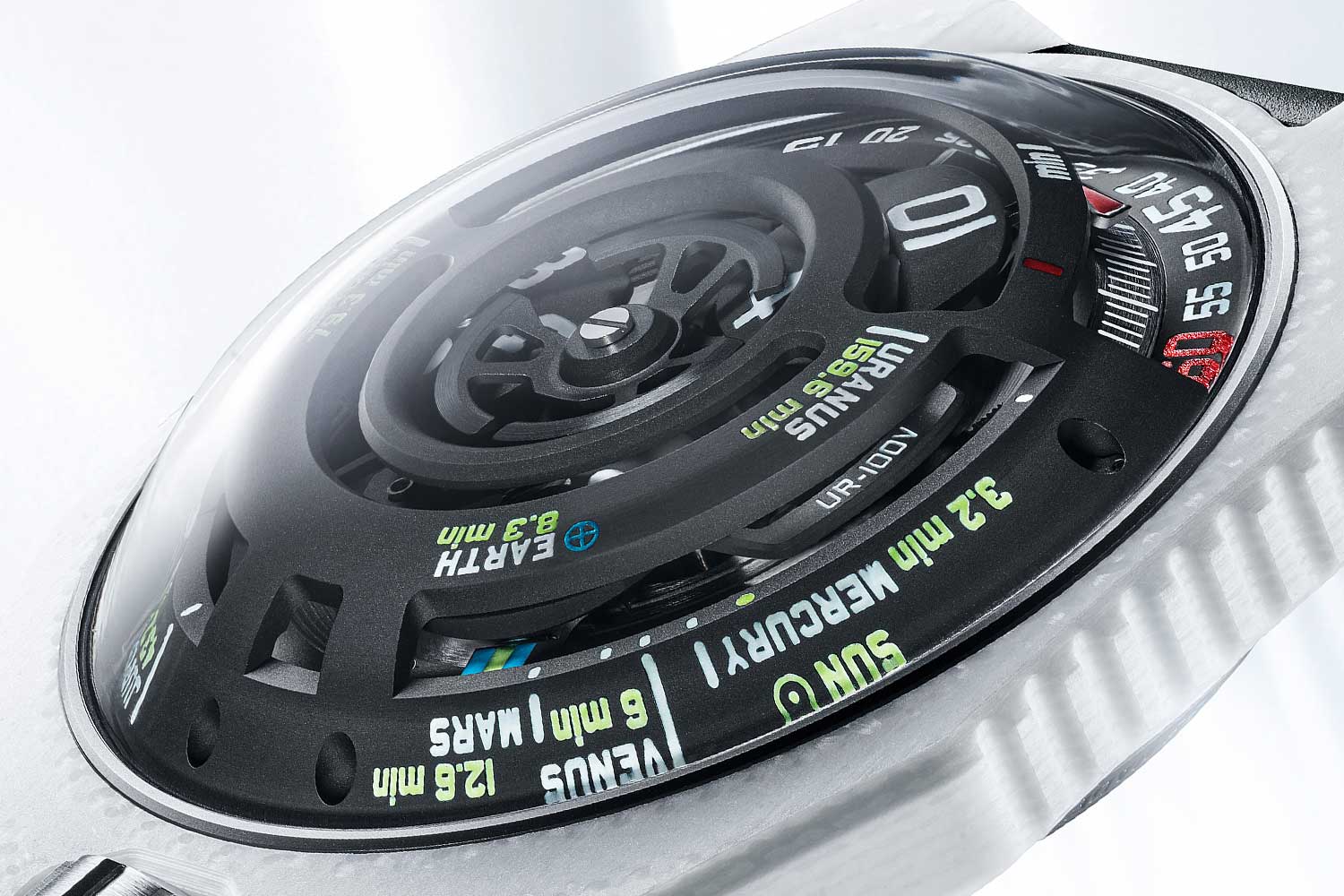
A textured white case that shifts from matte to softly luminescent depending on the light
As befits a watch that marks the passing of light, the white on the UR-100V “LightSpeed” Ceramic is textured and depending on — you guessed it — the ambient light, it comes across variously as matte or softly luminescent. Frei points out, “In materials, white results from surfaces that reflect and scatter most incoming light. There is no absolute white: it changes with illumination and contrast. White is therefore not a substance, but a state of light.”
URWERK continues the journey through the cosmos with a black PVD-treated aluminium rotor that’s a gorgeous abstract evocation of the Sun, framed by the sandblasted, shot-blasted DLC-treated Grade 5 titanium caseback.
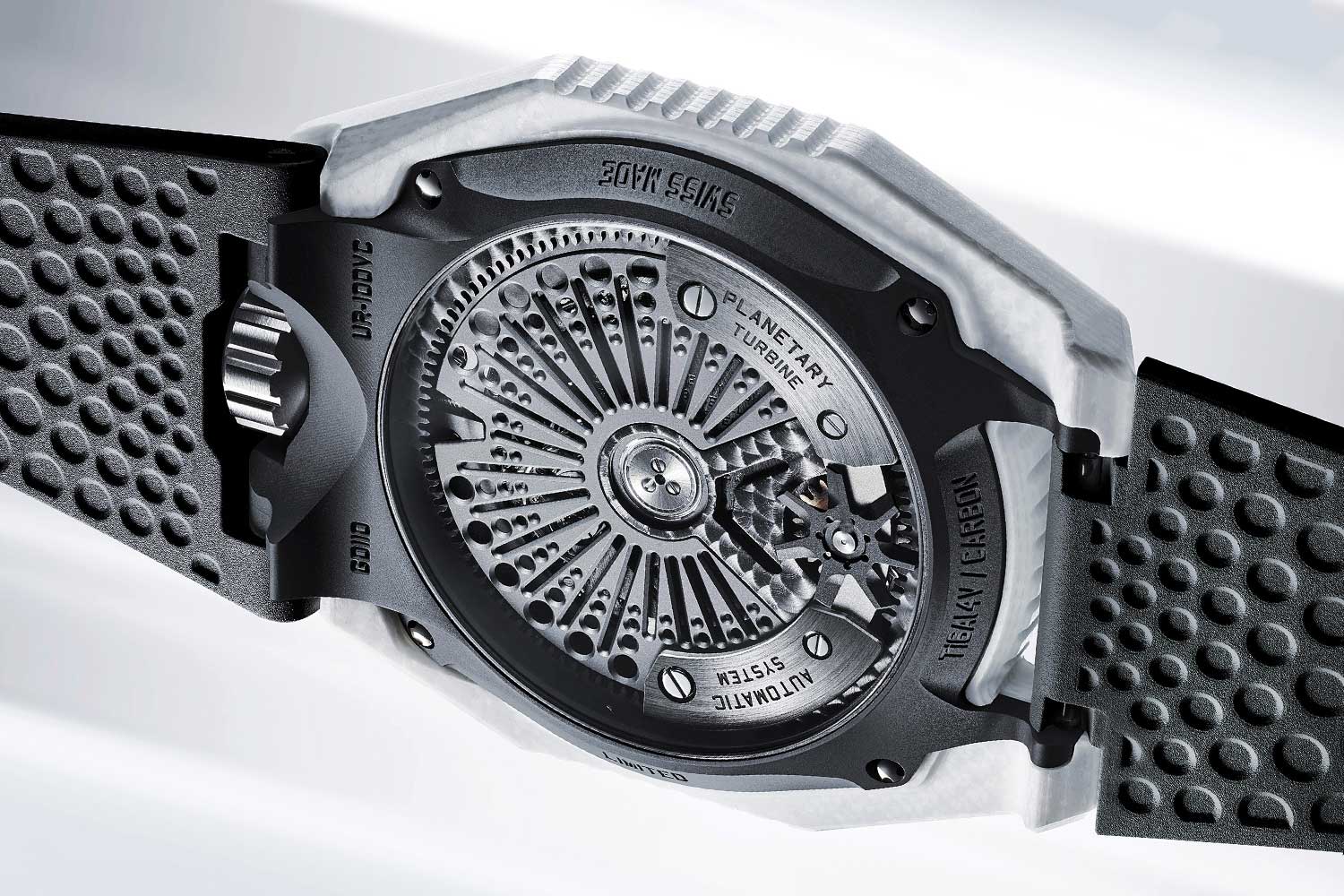
A gorgeous abstract evocation of the Sun
Beneath, the automatic UR 12.02 beats at a steady 4Hz, regulated by URWERK’s longstanding Windfänger system that’s marked out by the six-pronged wheel at the rotor. Literally a miniature air resistance turbine, it helps to regulate the winding and thereby stabilize the satellite system.
Twin barrels deliver a respectable 48-hour power reserve and while traditional finishing might not be top of mind here, we appreciate the evident attention paid to detail with perlage, satin finishing and chamfered screwheads.

URWERK’s longstanding Windfänger system
Tech Specs: URWERK UR-100V “LightSpeed” Ceramic
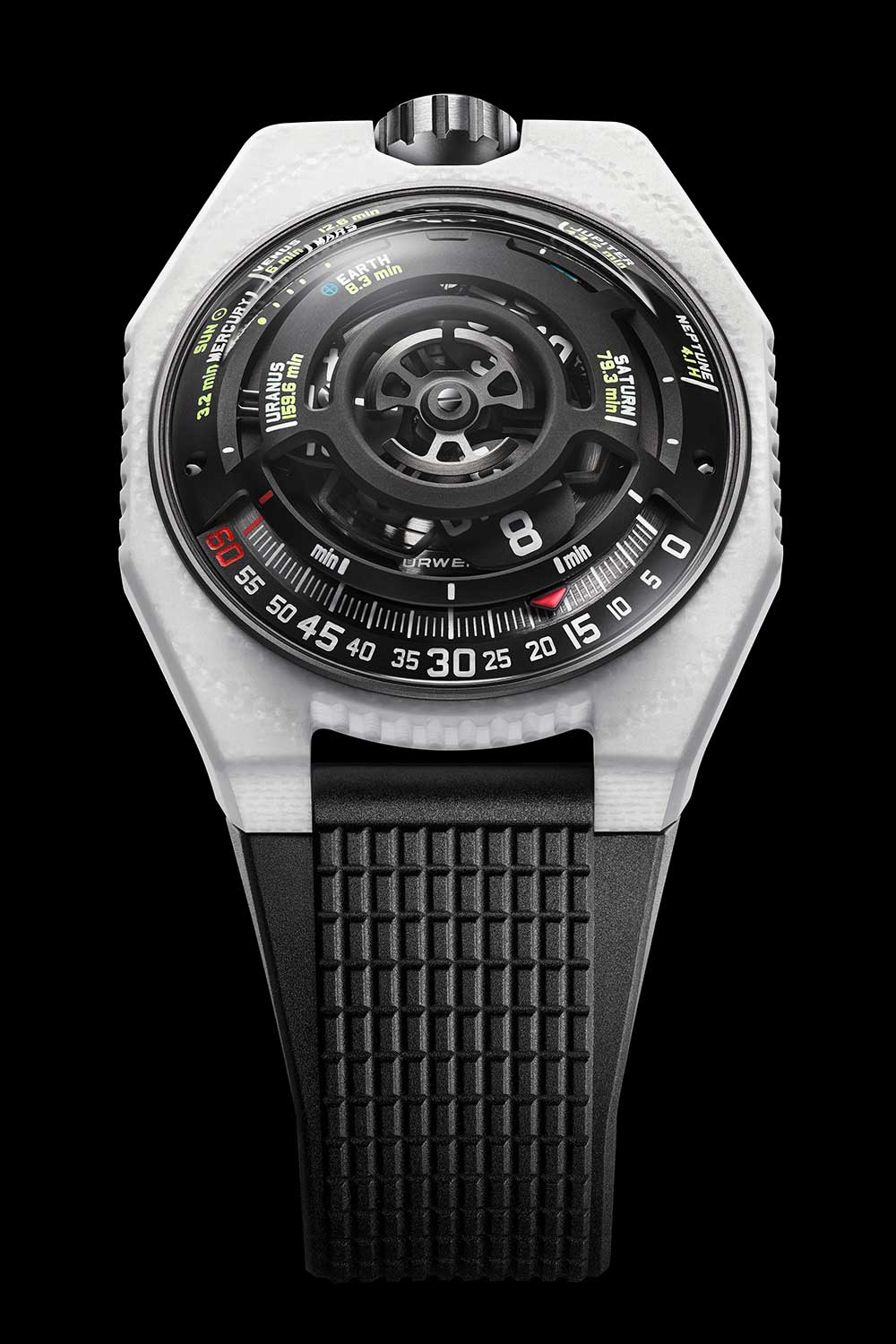
Movement Self-winding Caliber UR 12.02 governed by a Windfänger airscrew; 48-hour power reserve
Functions Satellite hours; minutes; time required for a sunbeam to reach eight of the planets in the Solar System
Case 43mm × 51.73mm × 14.55mm; white ceramic with silver fibreglass fabric and carbon inserts; inner case in titanium; caseback in sandblasted, shot-blasted DLC-treated Grade 5 titanium; water resistant to 50m
Dial Three-dimensional display with sapphire crystal revealing the movement
Strap Textured rubber (available in black or white) with deployant buckle
Price CHF 67,000, excl. taxes
Urwerk
You may also like

Editorial
The Revolutionary List: 25 Watchmakers and Construction – Felix Baumgartner & Martin Frei
Dec 15, 2025
Editorial
The Revolutionary List: 25 Watchmakers and Construction – Felix Baumgartner & Martin Frei
Dec 15, 2025
Editorial
The Revolutionary List: 30 Pioneering Watches – the URWERK UR-103
Dec 2, 2025
Editorial
The Revolutionary List: 30 Pioneering Watches – the URWERK UR-103
Dec 2, 2025

News
A Collision of Creativity: Ulysse Nardin X URWERK UR-FREAK
Nov 20, 2025
News
A Collision of Creativity: Ulysse Nardin X URWERK UR-FREAK
Nov 20, 2025