The Audemars Piguet 150 Heritage Pocket Watch: The Universe at your Fingertips
Editorial
The Audemars Piguet 150 Heritage Pocket Watch: The Universe at your Fingertips

The pocket watch, once cherished as an emblem of another age, is being rediscovered as a contemporary canvas for mechanical expression. Audemars Piguet’s 150 Heritage resonates with modern collectors not only for revisiting a historic form, but for making it highly relevant: traditional fine watchmaking made wearable and user-friendly. The pocket watch showcases the Manufacture’s extraordinary savoir-faire, uniting technical sophistication with the kind of mechanical clarity and artistic excellence that expresses the very best of their in-house haute horlogerie. It celebrates humanity’s journey with timekeeping: how we have interpreted and measured time throughout history, through astronomy, craftsmanship, science and mathematics and in doing so, represents the most complicated contemporary pocket watch ever created.
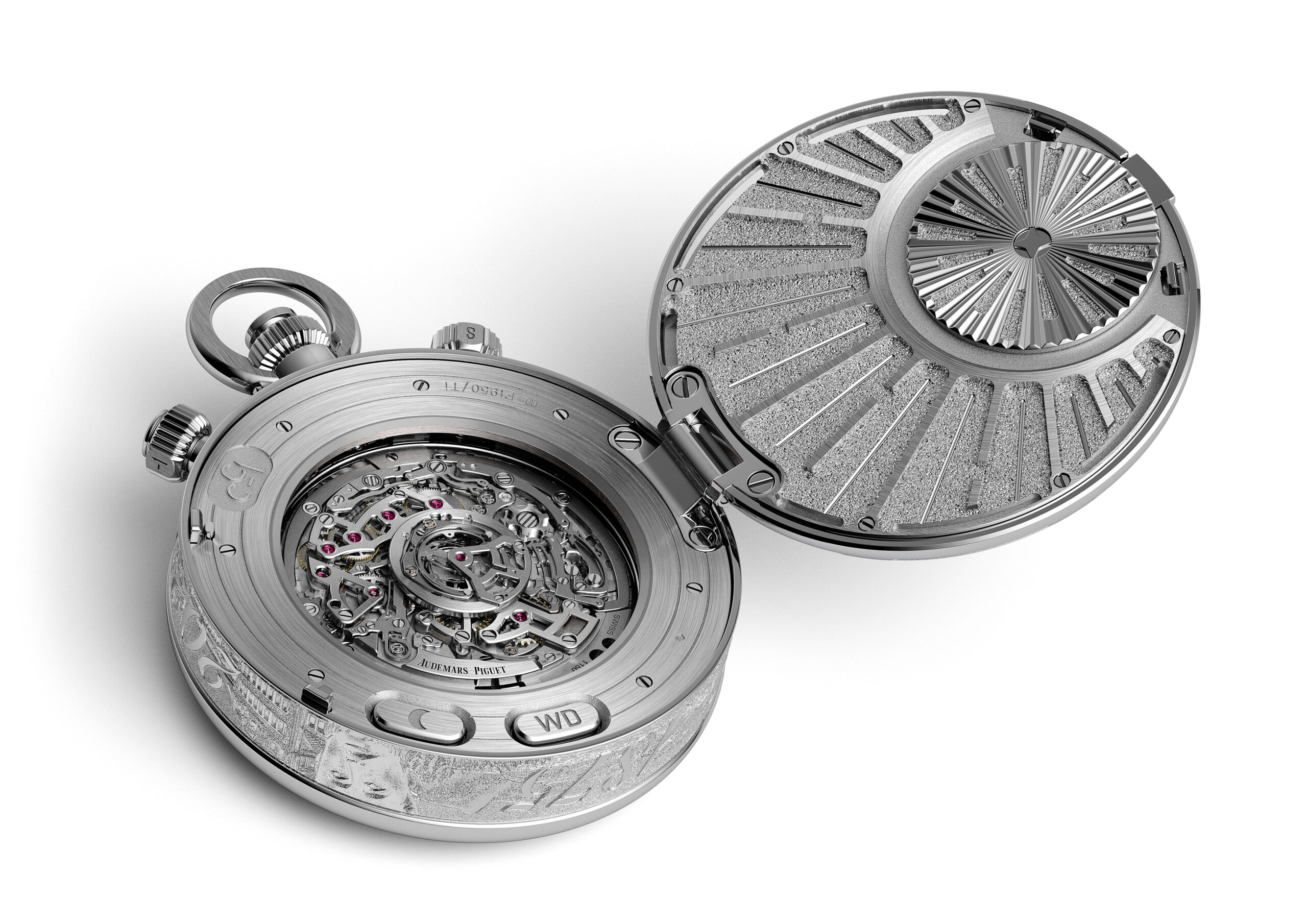
This design reveals the back of the (Calibre 1150) calibre and the world calendar mechanism, showing the inner surface of the hidden decoration in the back cover, which also acts as a sound enhancer
The 150 Heritage is a two-part horological object: the pocket watch houses Calibre 1150 and its ultra-complicated timekeeping functions, while the cover of the secret caseback contains the independent Universal Calendar, a separate mechanical system devoted to solar, lunar, and lunisolar cycles. Together, they allow Audemars Piguet to unite traditional high complication with a broader astronomical and cultural reading of time in a single creation.
And just as noteworthy is the watch’s devotion to métiers d’art. Hand-engraved platinum, Grand Feu enamel, engraved numerals reflect a commitment to artistic crafts. In preserving these endangered crafts, Audemars Piguet perpetuates entire languages of human skill, patience and beauty. The pocket watch asserts that haute horlogerie is not just mechanically brilliant, but profoundly human at its core. And, yet, in creating this masterpiece, Audemars Piguet expresses profound respect for the wearer, by ensuring that the design is user-friendly and ergonomic. You do not need to carry a user manual or miniature keys and tools in your other pocket, to harness its incredible time-telling.
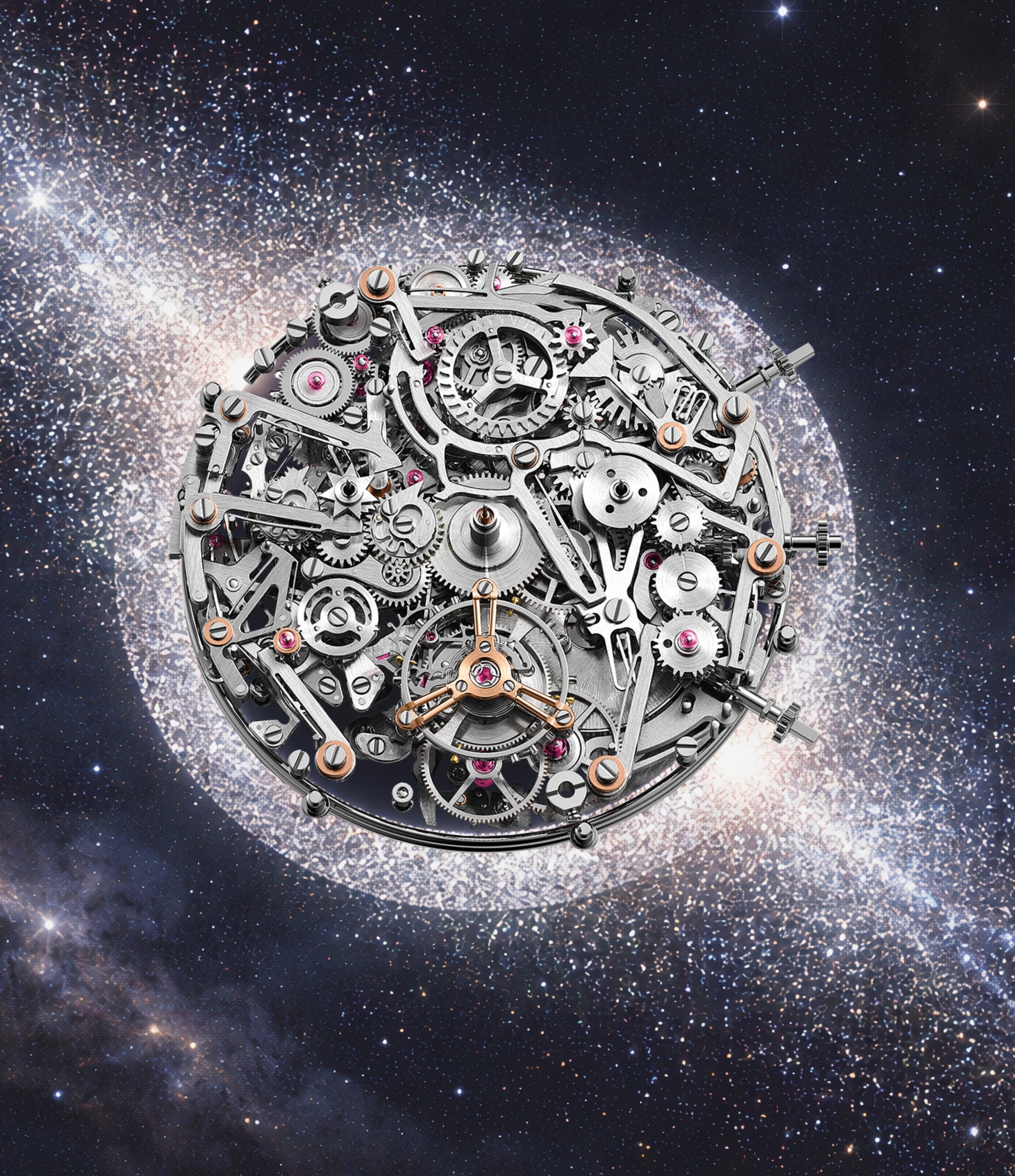
The manual-winding calibre (Calibre 1150) consists of 1099 components and provides a power reserve of approximately 60 hours
It started with a sketch…
Giulio Papi, the brand’s Director of Watch Conception, recalled how the pocket watch was initially conceived and created:
“At the end of 2023, I showed Ilaria Resta, Chief Executive Officer of Audemars Piguet, a simple sketch.”
Resta laughs at that. “It was not simple!”
Papi’s initial draft proposed something ambitious: a pocket watch with “a kind of analogue mechanical computer to link different calendars” – lunar, solar and lunisolar. A system capable of visually combining traditions developed on continents and sometimes years apart.
This ‘computer’ (a.k.a the Universal Calendar) is housed within the caseback cover, with Calibre 1150 on the other side. Essentially, the 150 Heritage comprises two separate mechanisms, each working independently of the other.
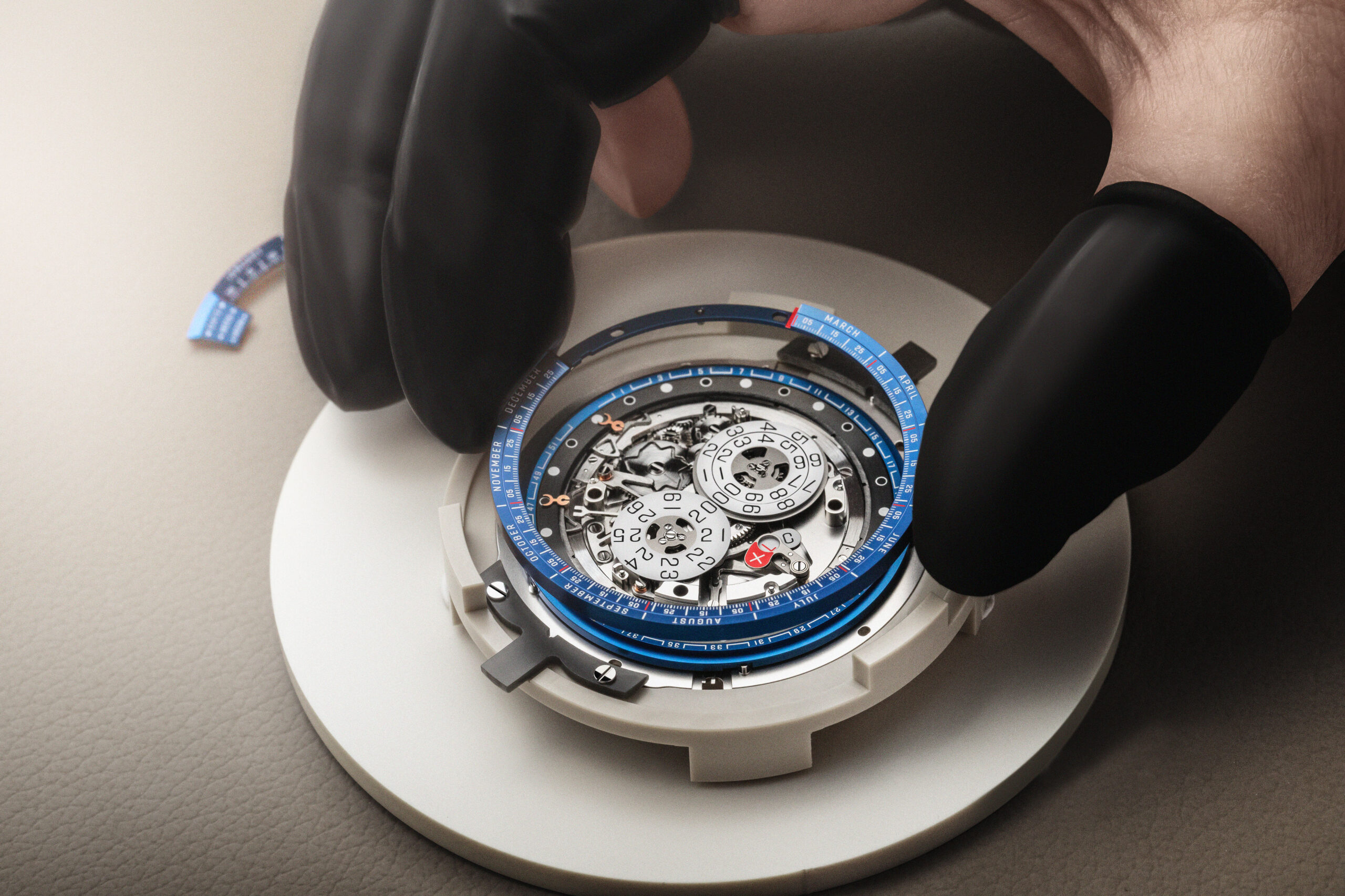
The world calendar dial combines solar, lunar, and lunisolar cycles into a single display. The outer ring indicates the months and the sequence of seasons, while the inner ring provides information on dates, weeks, moon phases, and cultural events
The Universal Calendar
As a species that has made measuring time a cornerstone of our lives since the dawn of civilization, the sheer scale and diversity of the solutions we have arrived at in our attempts to do so is nothing short of astonishing. From the earliest simple sundials to complex calendrical systems founded on the natural rhythms and cycles of nature, our cultures are organised around looking to the stars and segmenting our seasons in months and days which are then split down to seconds, minutes and hours. Solar calendars, such as the Gregorian system, aligned civil time (which is man-made and an approximation) with the Earth’s revolution around the Sun, whilst lunar ones tracked the waxing and waning of the Moon. Lunisolar calendars incorporated both.
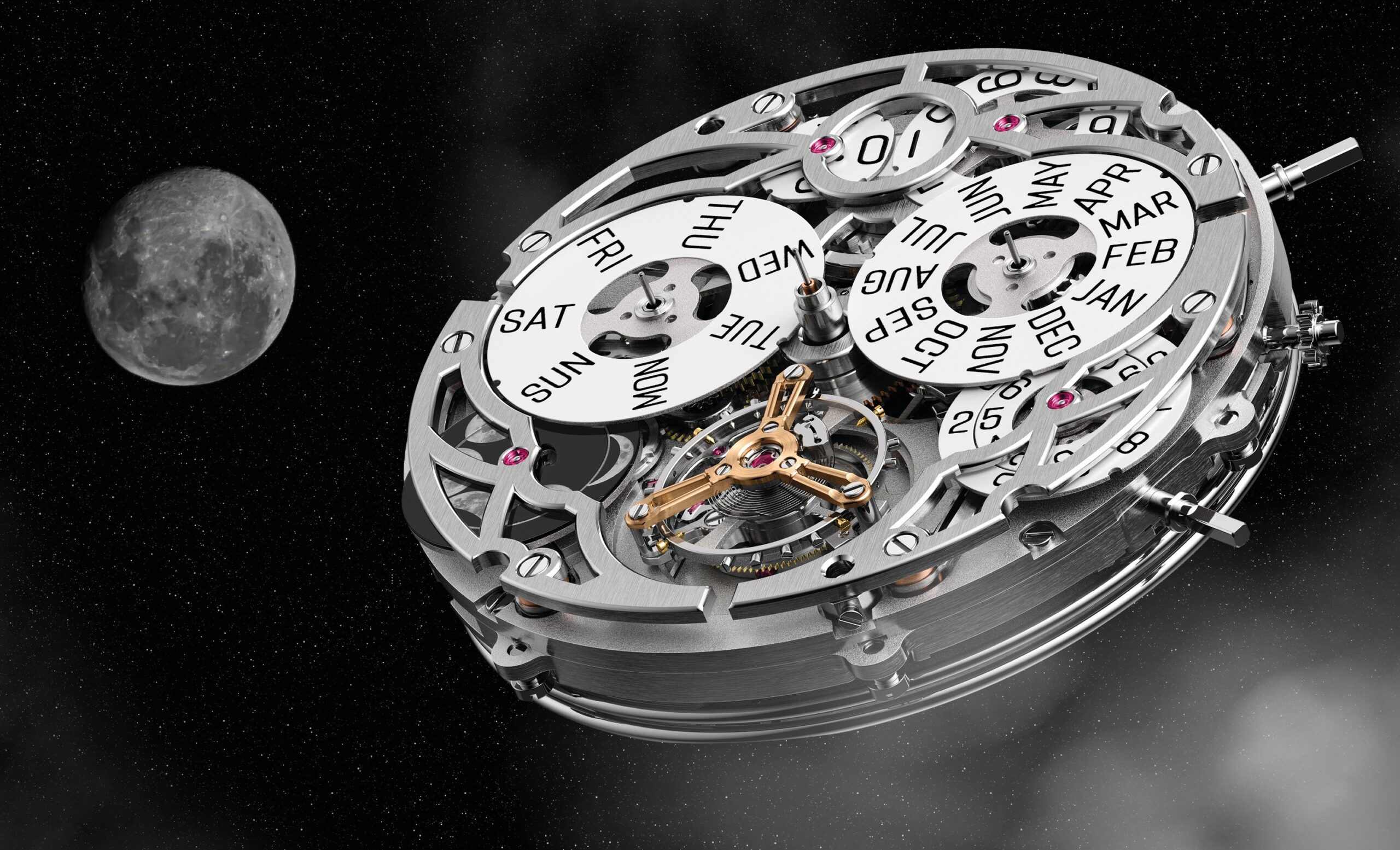
With the (Calibre 1150), Audemars Piguet based its fundamental structure on the (Calibre 1000) calibre, reimagining and adapting it specifically for a pocket watch
The 150 Heritage unites the diversity of some timekeeping traditions explored for millennia in a single timepiece. Through its Universal Calendar, it brings together the different systems through which humanity has sought to understand time, honouring these overlapping traditions and offering a poetic meeting point between artistry, culture and science. What Audemars Piguet achieves with the Universal Calendar by placing the different calendars side by side, is also to demonstrate that different traditions are often variations of the same astronomical observation.
The Universal Calendar spans two centuries – from 1900 to 2099 – with a single rotation corresponding to a complete Metonic cycle . (The Metonic cycle is a period of 19 years that aligns lunar and solar cycles, resulting in the moon’s phases repeating on the same calendar dates. It consists of 235 lunar months, which corresponds to 19 solar years. This cycle is crucial for creating and maintaining a lunisolar calendar, as it helps reconcile the different lengths of the lunar and solar years.)
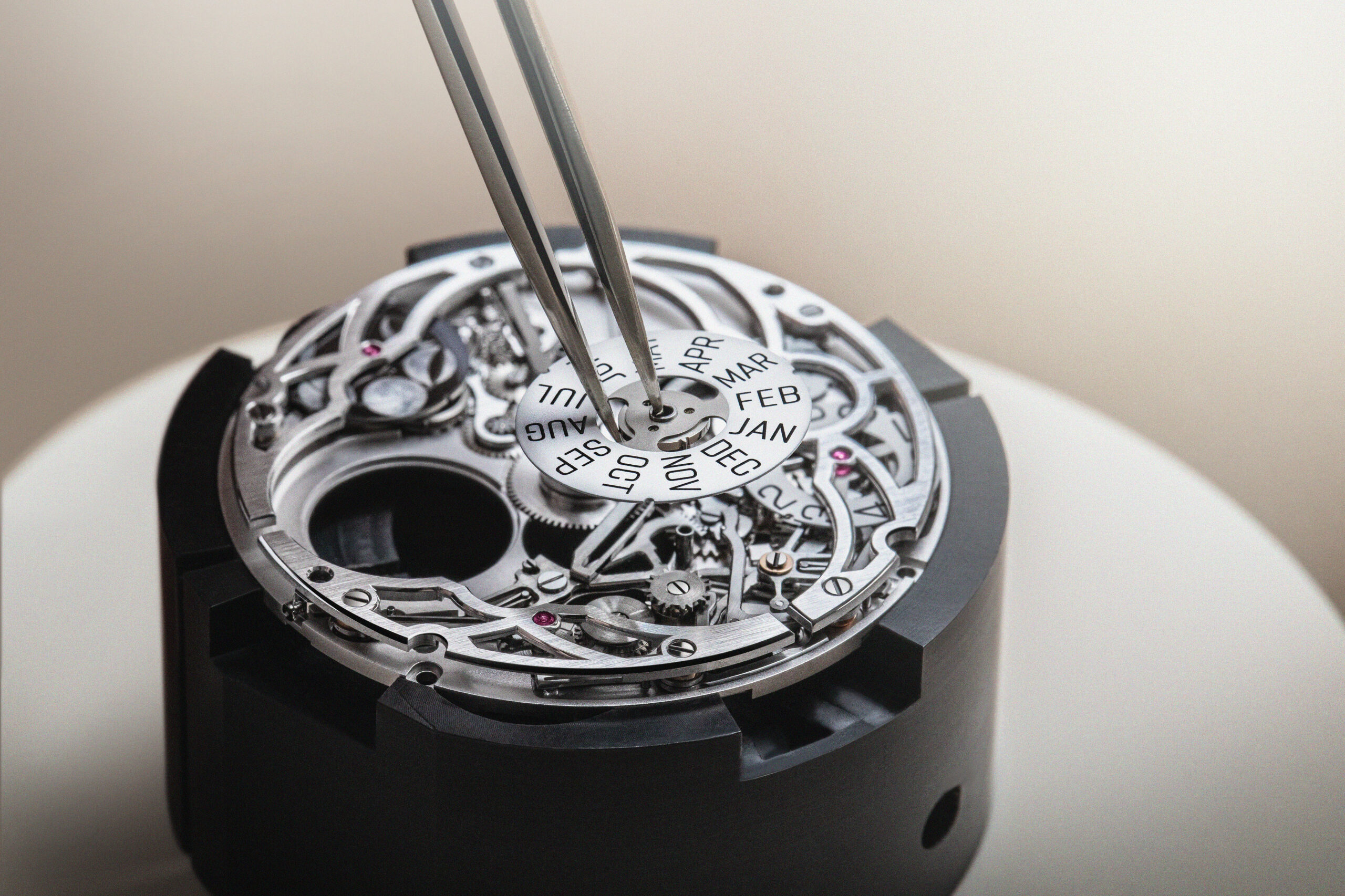
With the (Calibre 1150), Audemars Piguet based its fundamental structure on the (Calibre 1000) calibre, reimagining and adapting it specifically for a pocket watch.
It presents 18 indications: year, leap years, months, dates, weeks, moon phase and seasonal markers, such as solstices and equinoxes and nine cultural celebrations. Some celebrations are based on the Sun – Christmas (Sol Invictus) and Saint John’s Day (Inti Raymi); some on the Moon – the beginning of Ramadan; and others are lunisolar, including Diwali, Rosh Hashanah, Pesach, Vesak, Easter and the Chinese New Year. It is adjustable via a simple turn of the bidirectional wheel that instantly makes all the corresponding indications change. Its display is organised in concentric rings. Around it sit two fixed outer rings: the outermost marks the solstices and equinoxes, while the next combines the months, dates and weeks. Dates are shown in five-day intervals, with red hash marks indicating the start of each month, allowing different month lengths to be read without interrupting the ring. Inside this construction, a rotating ring shows the numbered weeks of the year. It advances incrementally when the calendar is adjusted, including leap years, so the week count stays aligned. A second rotating ring tracks the lunar cycle, with alternating new moon and full moon symbols, positioning the moon phases against the fixed date scale for the selected year.
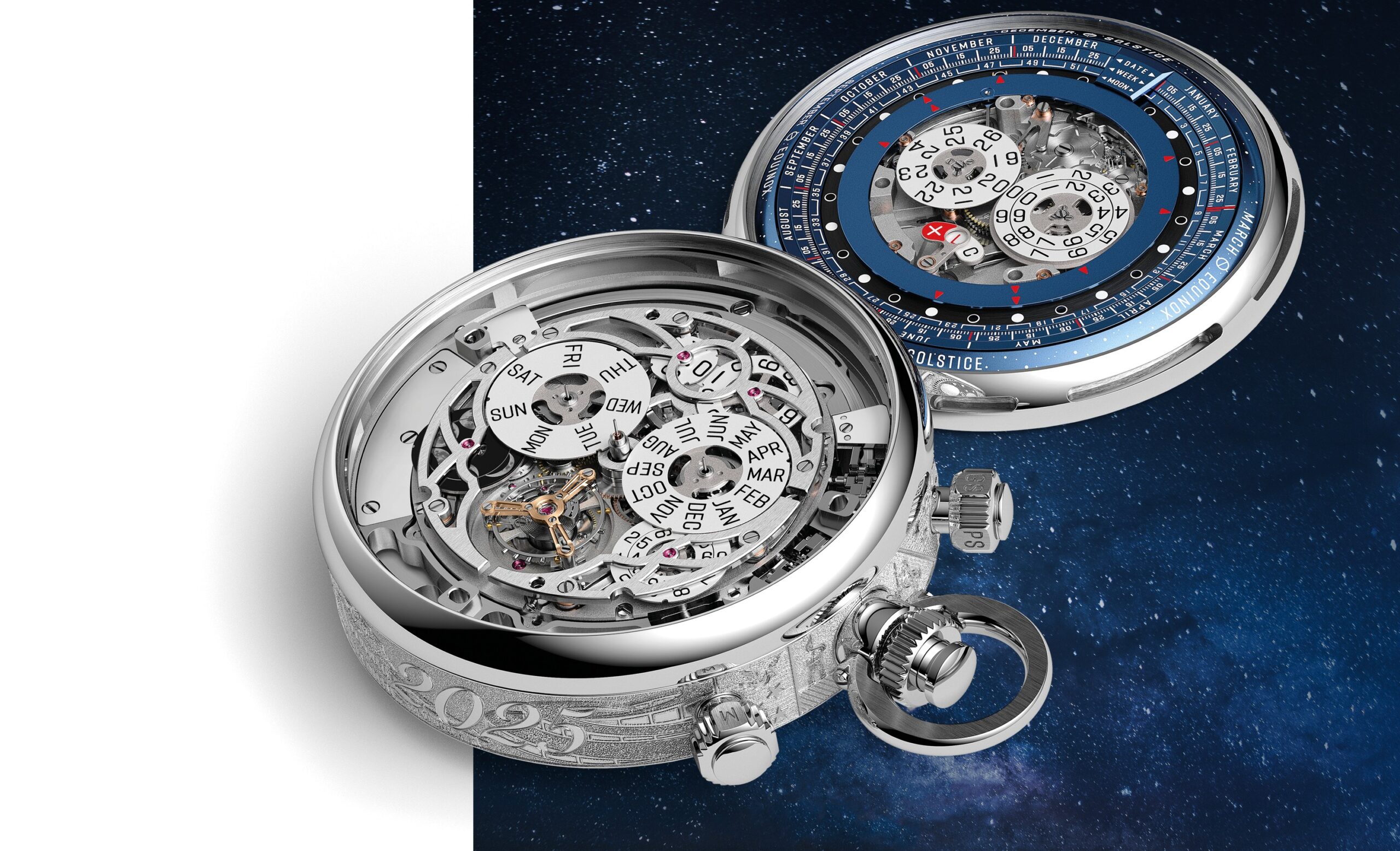
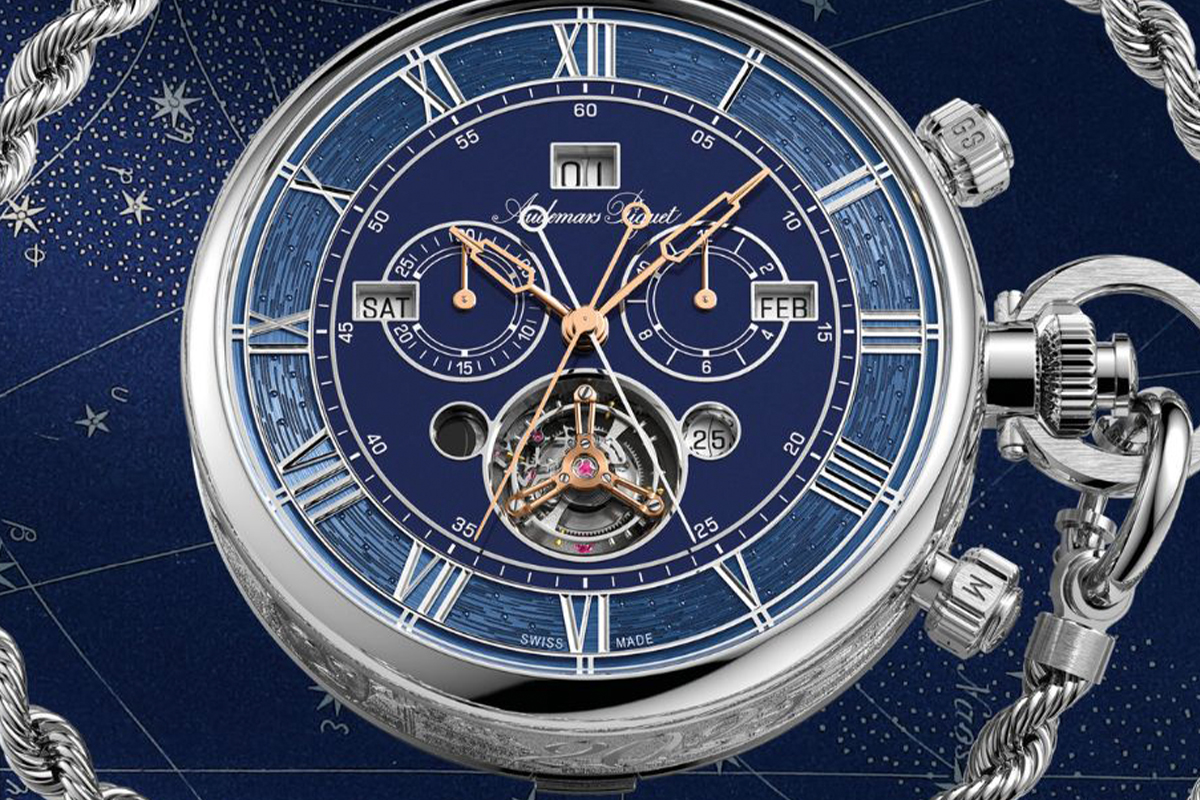
The ‘Audemars Piguet 150 Heritage’ watch with a world calendar, which unites solar, lunar and lunisolar time into one integrated display
The beating heart of 150 Heritage
Calibre 1150 is a hand-wound variation that builds on the architecture of Calibre 1000 (RD#4) but reimagines technical solutions for the pocket watch format. Finished by hand, with inward angles, openworked bridges and high-polished surfaces, the movement contains 1,099 components. Calibre 1150 showcases the technical mastery of Audemars Piguet across 40 functions, including 22 complications that are displayed on the main dial. The 22 complications total one fewer than Calibre 1000, because it replaces automatic winding with manual winding. It retains an impressive suite of mechanisms and reads like a Who’s Who of watchmaking achievements: Grande and Petite sonnerie, Supersonnerie, minute repeater, flying tourbillon, semi-Gregorian perpetual calendar (day, large date, month, year, astronomical moon, moon phases), flyback chronograph, split-seconds, hours and minutes.
Its calendar is described as semi-Gregorian: unlike standard perpetual calendars, which follow the Julian rule of a leap year every four years, Calibre 1150 correctly treats century years as common years. However, it does not apply the full Gregorian correction that restores a leap year every 400 years, meaning it will require adjustment in 2400.
This is achieved through a 36-month programme wheel rather than the usual 48. February is fixed at 28 days, while a separate leap-year cam extends it to 29 days every four years. Once per century, an additional lever blocks that correction so century years not divisible by 400 remain common years. The architecture is compact, with the year display driven directly from the secular gear train, while paired-tooth pinions allow month and date to be adjusted both forwards and backwards.
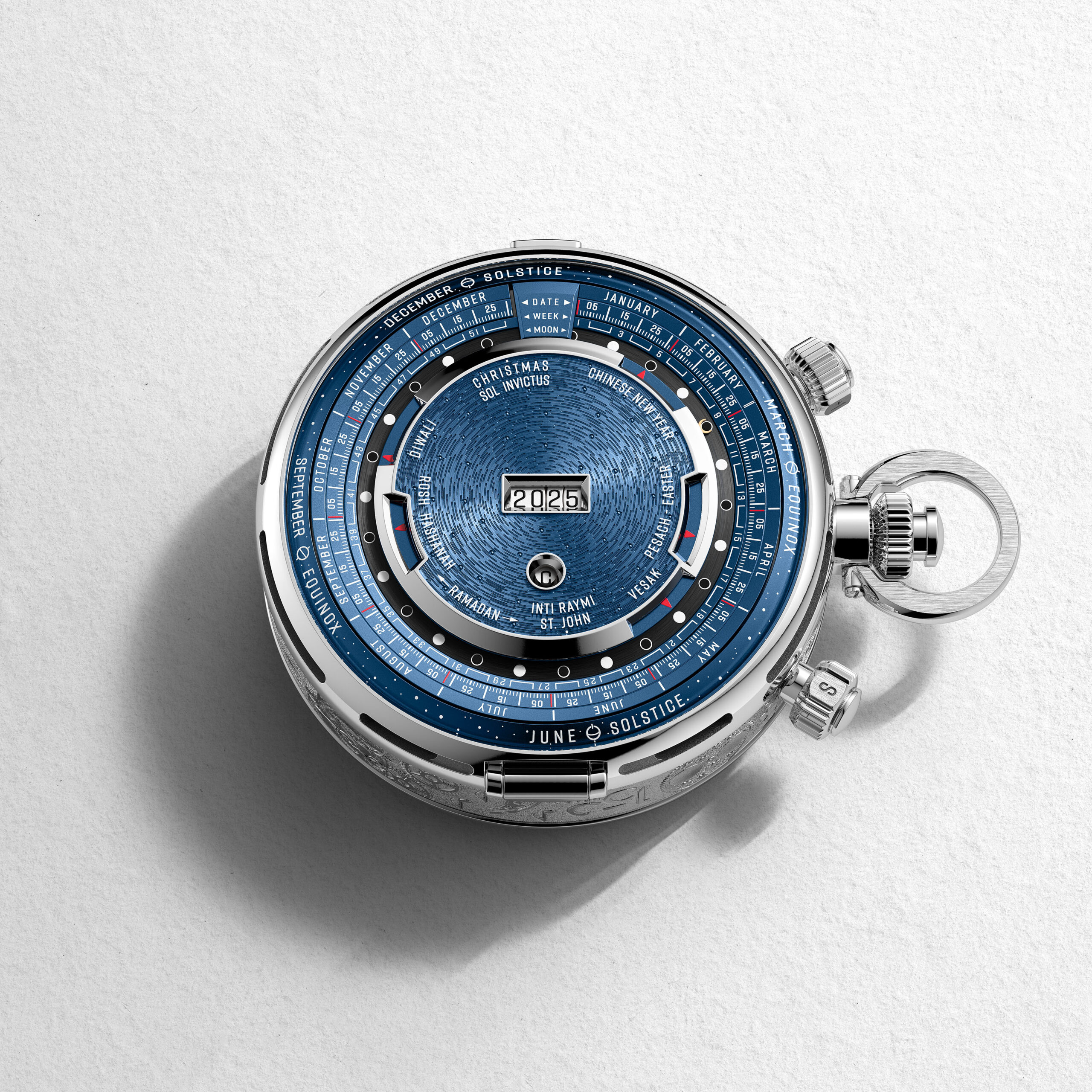
The world calendar can display dates for events such as Christmas, Ramadan, St. John’s Day, Diwali, Easter, and Chinese New Year, for any year from 1900 to 2099
To reduce height, the perpetual calendar follows the logic of the RD#2 by combining functions that are traditionally spread across several layers. The date and month wheels each serve as both gears and cams, allowing them to be driven while also governing calendar corrections.
The moonphase display is similarly inventive. Instead of a conventional two-moon disc, Calibre 1150 uses two concentric discs carrying partially illuminated and shadowed forms. Together, they create 10 more realistic lunar phases.
The grande et petite sonnerie and minute repeater benefit from Audemars Piguet’s Supersonnerie technology. Here, the gongs are mounted on a sapphire crystal soundboard between the movement and caseback, amplifying resonance while leaving the calibre visible. The striking mechanism was also refined to eliminate the dead time often heard between hours and minutes when no quarters are struck.
At 6 o’clock is a flying tourbillon with a free-sprung balance beating at 3 Hz, fitted with the tourbillon lever escapement first seen in the RD#3. Reworked geometry improves shock recovery, isochronism, and tolerance for high amplitudes without sacrificing reliability. The lateral-clutch, flyback, split-seconds chronograph is carried over from Calibre 1000, though here the rotor and automatic winding system have been removed.
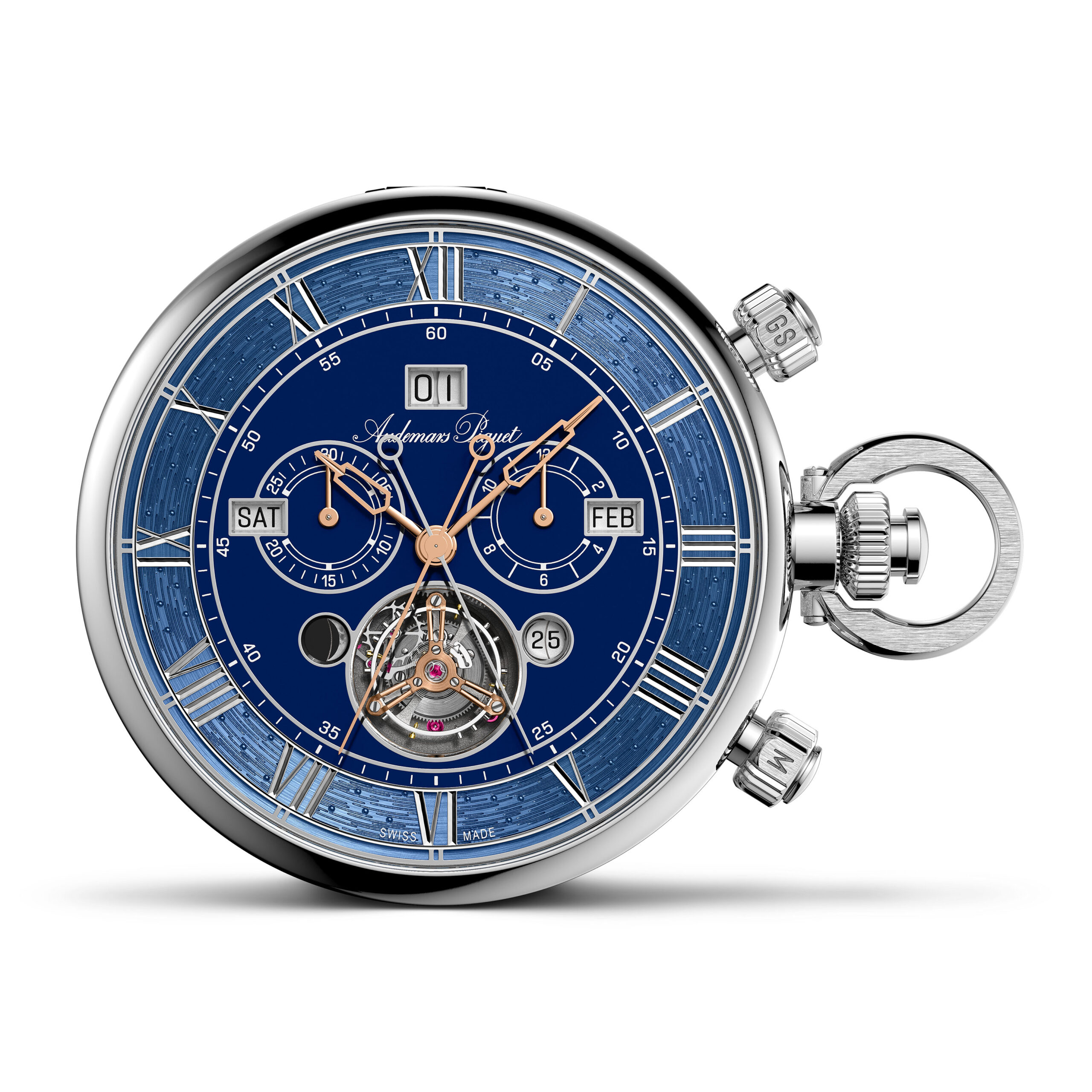
A very accurate display of the phases of the moon, thanks to two concentric discs. One disc holds a portion of the illuminated surface, while the other holds the shape of the complementary shadow
Designed for intuitive use
Yet despite all of the achievements contained within its stunning platinum case, Calibre 1150 exemplifies strict respect for user-friendliness.
“Ultra-complication” in watchmaking can sometimes imply more functions and more displays, but the 150 Heritage doesn’t seek to put its wearer through a cosmic wringer in order to reveal its time-telling prowess. Quite the opposite – a core of the design approach was to ensure ease of use. Calibre 1150 is designed for intuitive operation. Just three crown pushers (repositioned and consolidated to preserve ergonomic clarity) and two discreet correctors (concealed within the caseback, accessible through a dedicated push-piece) control all functions: the pusher at 2 o’clock operates the chronograph, sonnerie selection, and minute repeater; the bow-fitted crown-pusher at 3 o’clock handles winding, time-setting, bidirectional date correction, and split-seconds control; and the pusher at 4 o’clock resets the flyback chronograph and adjusts the month. Two hidden correctors inside the caseback set the weekday and moonphase. As with the RD#4, the achievement lies not only in mechanical density, but in making that density remarkably user-friendly.
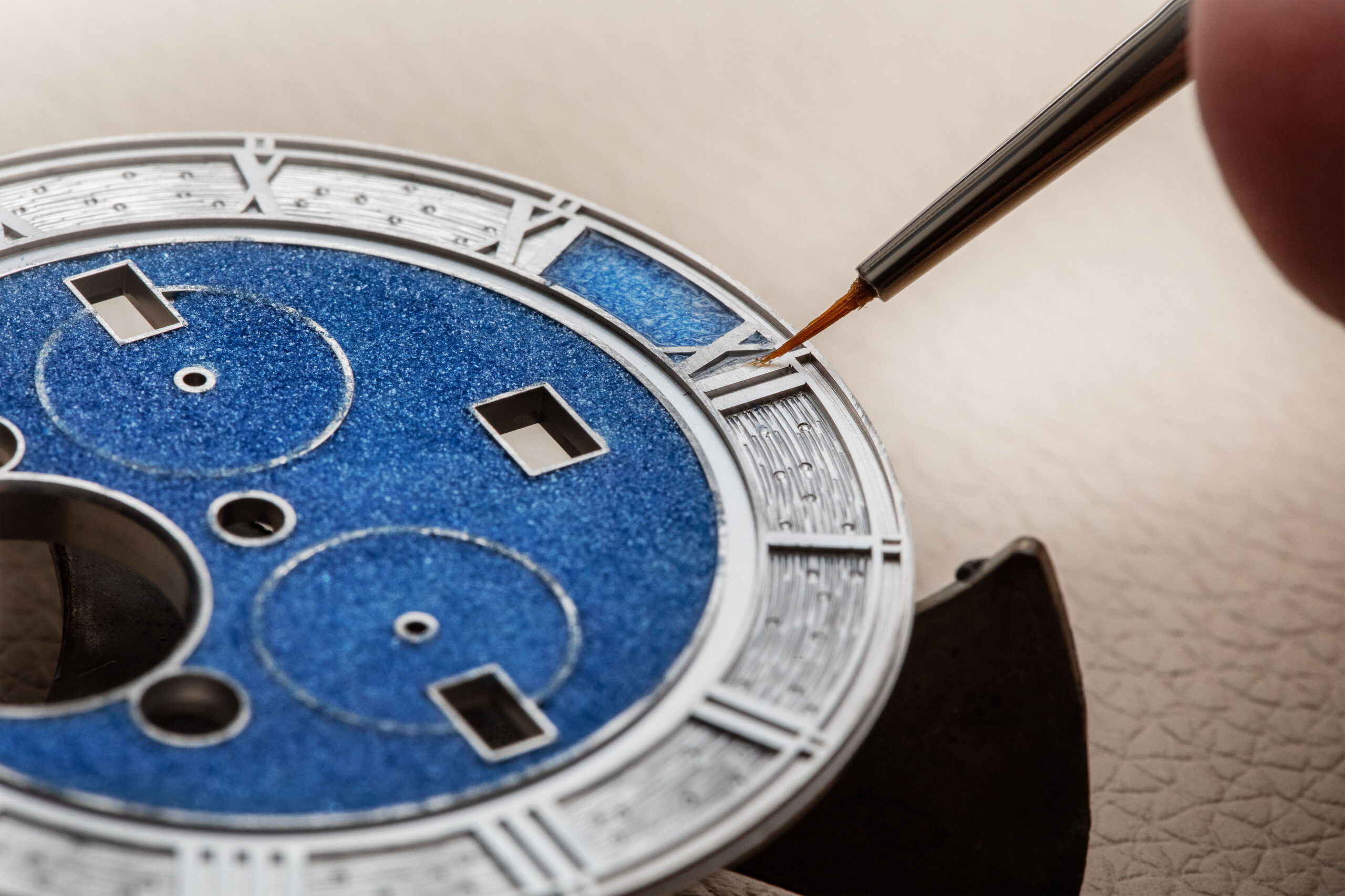
The dial is made of 18-karat white gold, and it embodies the finest artistic craftsmanship, adorned with a transparent blue Grand Fou thermal enamel coating and hand-engraved patterns
Putting comfort and intuitive ergonomics at the heart of the experience is a pillar in the brand’s approach to mechanical development:
“We deliver usable functions – complexity that is useful, user-friendly, easy to read and easy to use with ergonomic mechanisation,” says Papi. “We want to avoid a race to make the highest number of complications. Our idea is to create complexity but make it easy to use. The key sentence is: “The last stage of complexity is simplicity.”
The Manufacture has spent years refining what it calls “mechanised ergonomics,” and it is expressed through the user experience. Crown-pushers have been: “optimised through 3D modelling to enhance tactile comfort and ease of use, while also ensuring each element is perfectly centred when the pocket watch is closed”, in other words: designed to be worn and used rather than simply admired.
“This is maybe the most important point, what we call mechanised ergonomics: an invisible mechanical system that makes the watch user-friendly, so you can use it without a manual,” adds Papi. This is how AP will approach its future developments – making them accessible and simple to use to enhance the experience for the wearer.
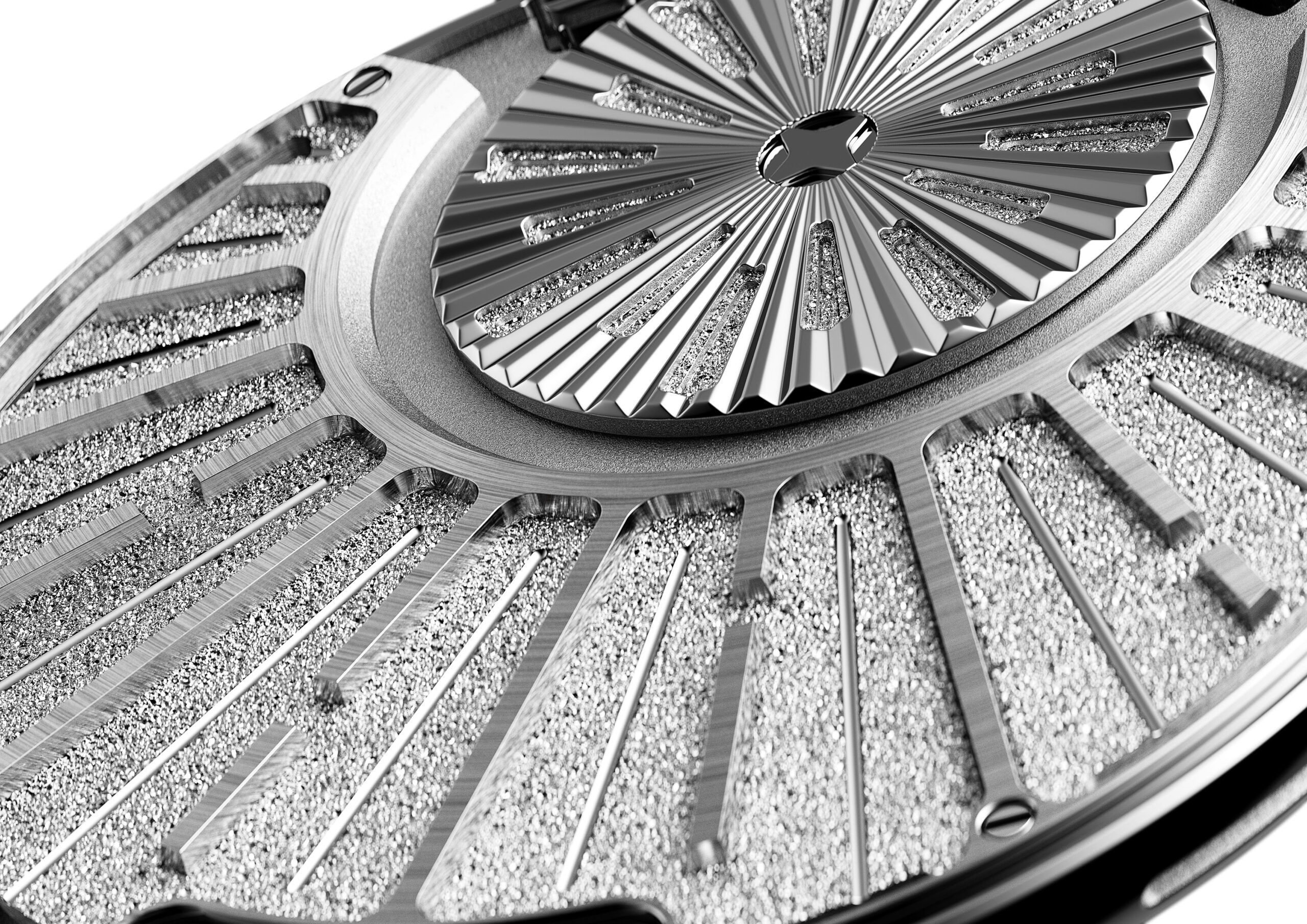
Every detail of the platinum case, which is 23.4 mm thick, was engraved by hand by exceptionally skilled craftsmen
Métiers d’art sketch
A sense of temporal and cultural magnitude is expressed by the watch’s decoration. The platinum case is entirely hand-engraved, its surface transformed into a commemorative canvas depicting Audemars Piguet’s founders, complete with anniversary emblems and celestial motifs. The main dial, crafted in 18-carat white gold, is finished with translucent blue Grand Feu enamel, fired repeatedly to achieve depth and luminosity, while engraved Roman numerals and star-trail motifs echo the astronomical theme. Even the chain, handmade in platinum, is a reminder that this creation belongs to a tradition of pocket watches as complete, self-contained works – celebrating traditions that characterise haute horlogerie.
Audemars Piguet has made just two unique platinum 150 Heritage pocket watches (one of which is destined for the Musée Atelier Audemars Piguet). Eight in 18-carat white gold will also be created.
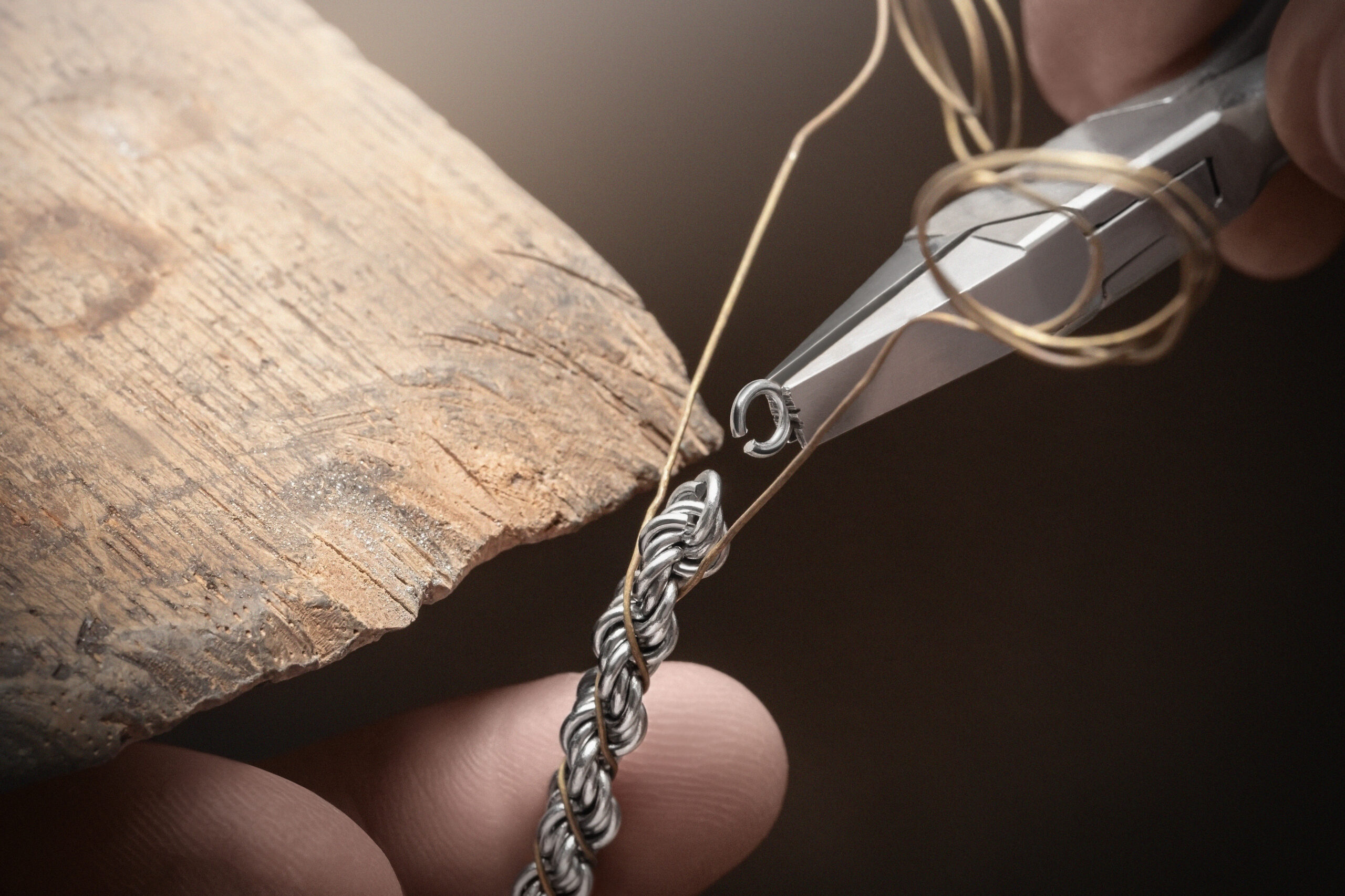
The handcrafted platinum chain reminds us that this work belongs to the heritage of pocket watches as a complete and independent masterpiece, celebrating the traditional craftsmanship that characterizes Audemars Piguet’s fine watchmaking arts
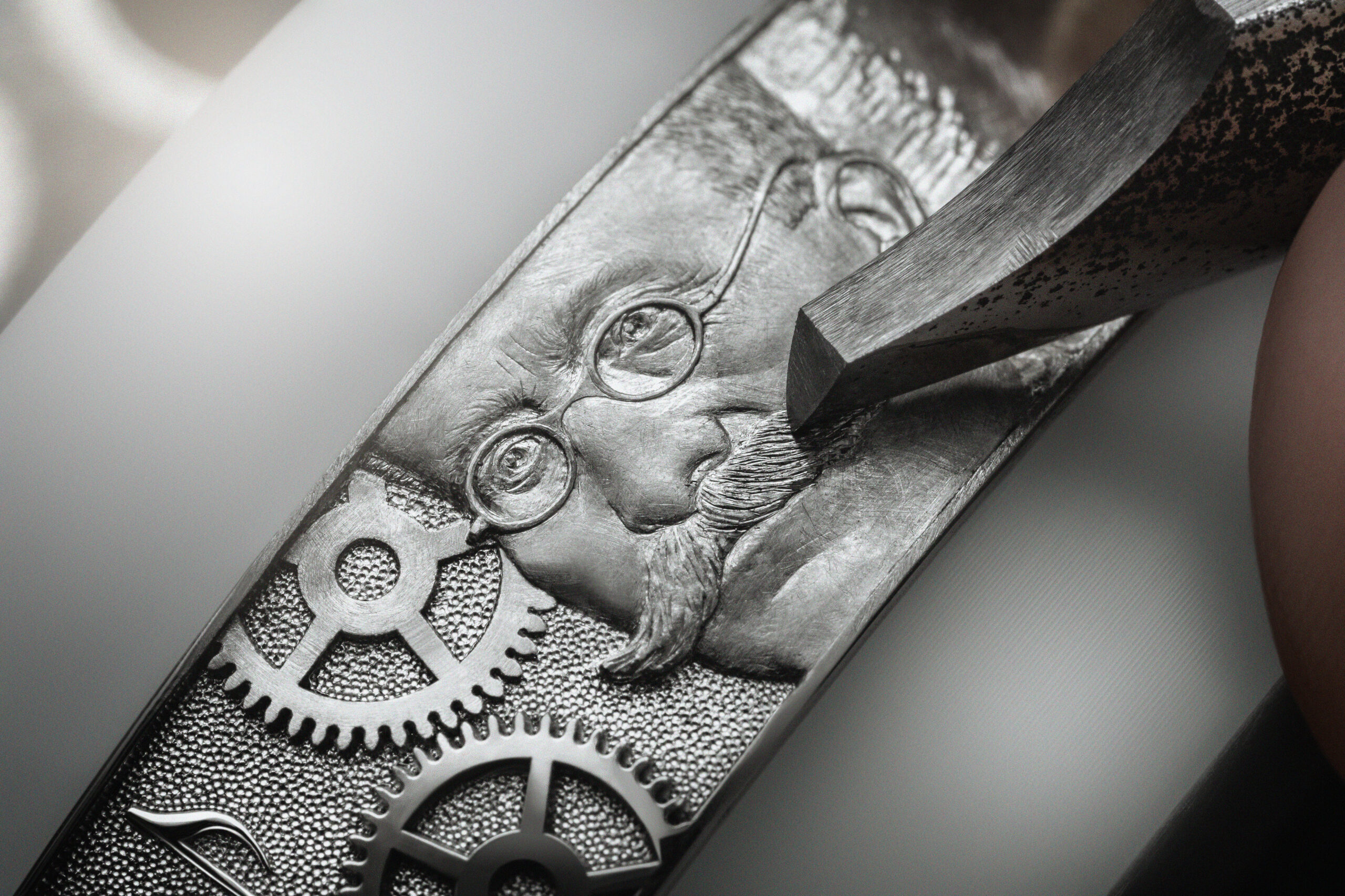
The platinum incubator case is meticulously hand-engraved with symbolic elements from the company’s history, including images of its founders and the anniversary celebration logo
A pocketful of history
In concluding our exploration of the 150 Heritage, it feels fitting to come full circle and pay tribute to one of its historical inspirations. Audemars Piguet has a history of formidable pocket watches – such as L’Universelle of 1899 and the formidable La Grosse Pièce of 1921, which recently returned to the museum in Le Brassus. The 150 Heritage enjoys a coherent place in that line-up, becoming the Manufacture’s third ultra-complicated pocket watch and the first conceived for modern use. The 2026 chapter is written at a time when the wristwatch reigns supreme; to present an analogue pocket watch invites engagement and consideration in an age of digital omnipresence.
Made from 18-carat yellow gold, La Grosse Pièce is, according to the brand: “the most comprehensive astronomical timepiece ever created by Audemars Piguet and among the earliest to feature a sky chart. It depicts the night sky over London with 315 stars, alongside sidereal time, a perpetual calendar, moon phases and the equation of time.”
The only ultra-complicated Audemars Piguet watch of the 20th century, it also includes a minute repeater, Grande and Petite sonnerie, chronograph, and the brand’s only tourbillon in a pocket watch of that era.
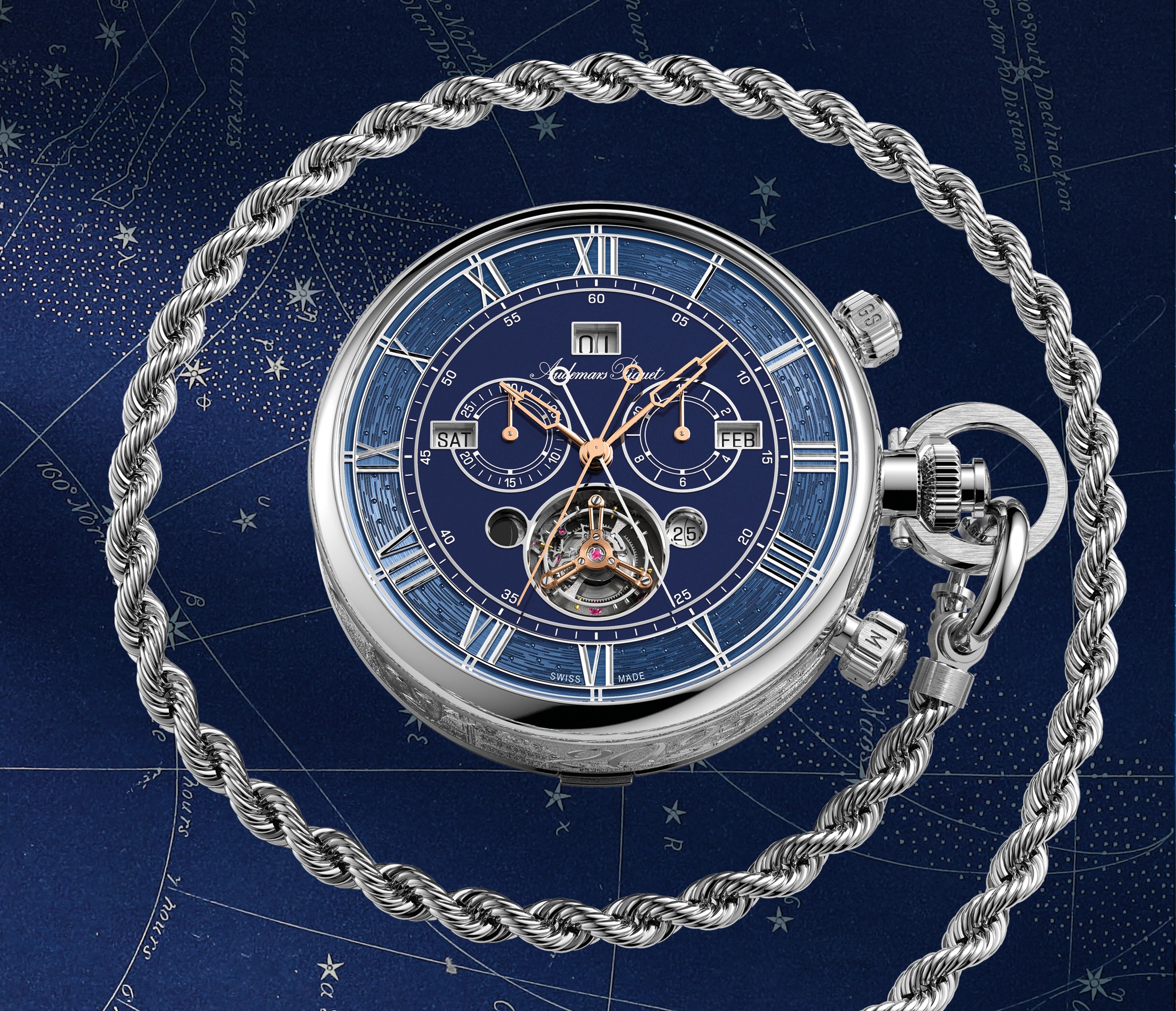
The ‘150 Heritage’ watch artfully combines the richness and diversity of timekeeping traditions that have evolved over thousands of years, all embodied in one exceptional timepiece
With 19 complications, La Grosse Pièce ties with the legendary L’Universelle of 1899 as the most complicated pocket watch ever created by Audemars Piguet. Like L’Universelle , it is a living testament to the établissage system of the Vallée de Joux, which brought together specialised artisans to create some of the most complicated timepieces of the early 20th century. This thread of craftsmanship, mechanical mastery and groundbreaking horology is tangible from past to present. Ilaria Resta explains how L’Universelle gave inspiration for the creation of 150 Heritage.
“Encountering L’Universelle at the Musée Atelier Audemars Piguet instantly brought back memories of my grandfather’s pocket watch – a simple moment that became the starting point of an extraordinary journey. More than a tribute to the past, the 150 Heritage […] stands as a testament to the collective energy and unwavering passion that continue to shape the brand’s future.”
That future, it is clear, stands on this very deep commitment to watchmaking – perpetuating its heritage, skills and technical crafts, while exploring new territories. A bold vision… that fits very neatly into your pocket.
Audemars Piguet
You may also like
News
Last Week In Watches: Rolex Revives the Padellone, Hublot Goes Full Koons
Sep 21, 2026
News
Last Week In Watches: Rolex Revives the Padellone, Hublot Goes Full Koons
Sep 21, 2026
Editorial
Padel Is Now Watchmaking’s Newest Court of Play
May 18, 2026
Editorial
Padel Is Now Watchmaking’s Newest Court of Play
May 18, 2026
Editorial
The Audemars Piguet x Swatch Royal Pop Was Never Going To Be A Simple Royal Oak
May 13, 2026
Editorial
The Audemars Piguet x Swatch Royal Pop Was Never Going To Be A Simple Royal Oak
May 13, 2026