


The Angle of the Angels: The 165-Year Quest for the Inclined Tourbillon
Editorial
The Angle of the Angels: The 165-Year Quest for the Inclined Tourbillon

Marty DiBergi: Why don’t you just make ten louder and make ten be the top number and make that a little louder?
Nigel Tufnel: [pause] These go to eleven.
– This Is Spinal Tap, 1984
The Watch That Goes to 11
There is a great scene in the mockumentary This Is Spinal Tap, where the band’s lead guitarist Nigel Tufnel, played by Christopher Guest, is showing off one of his treasures — a rare set of Marshall amplifiers that go to 11 — to documentarian Marty DiBergi, played by the film’s actual director Rob Reiner. When asked if that means the amps are more powerful than normal, Tufnel replies: “Well, it’s one louder, isn’t it? It’s not ten. You see, most blokes, you know, will be playing at ten. You’re on ten here, all the way up, all the way up, all the way up, you’re on ten on your guitar. Where can you go from there? Where? Nowhere. Exactly. What we do is, if we need that extra push over the cliff, you know what we do? Put it up to eleven.”
I could imagine watchmaker Andrew H. Potter ensconced in elegant salons where the watch collectors would one by one extract their horological marvels from their waistcoats. The most accomplished amongst them would hold in their hands timepieces that featured that most extraordinary of chronometric devices: the tourbillon — where all the regulating organs, including the balance, the hairspring and the escapement, are placed inside a cage that rotates on its own axis, thereby averaging errors caused by gravity. In the vertical position, the breathing of the hairspring was less concentric, and there was additional friction on pivots caused by their positional displacement. Because there was no force on the planet that could defeat gravity, in 1801 Abraham-Louis Breguet created this device to trick gravity into defeating itself. And yet clearly, even early on, there was a debate about the tourbillon’s efficacy in anything other than the vertical position when in the waistcoat or hung by the bow on a pedestal.
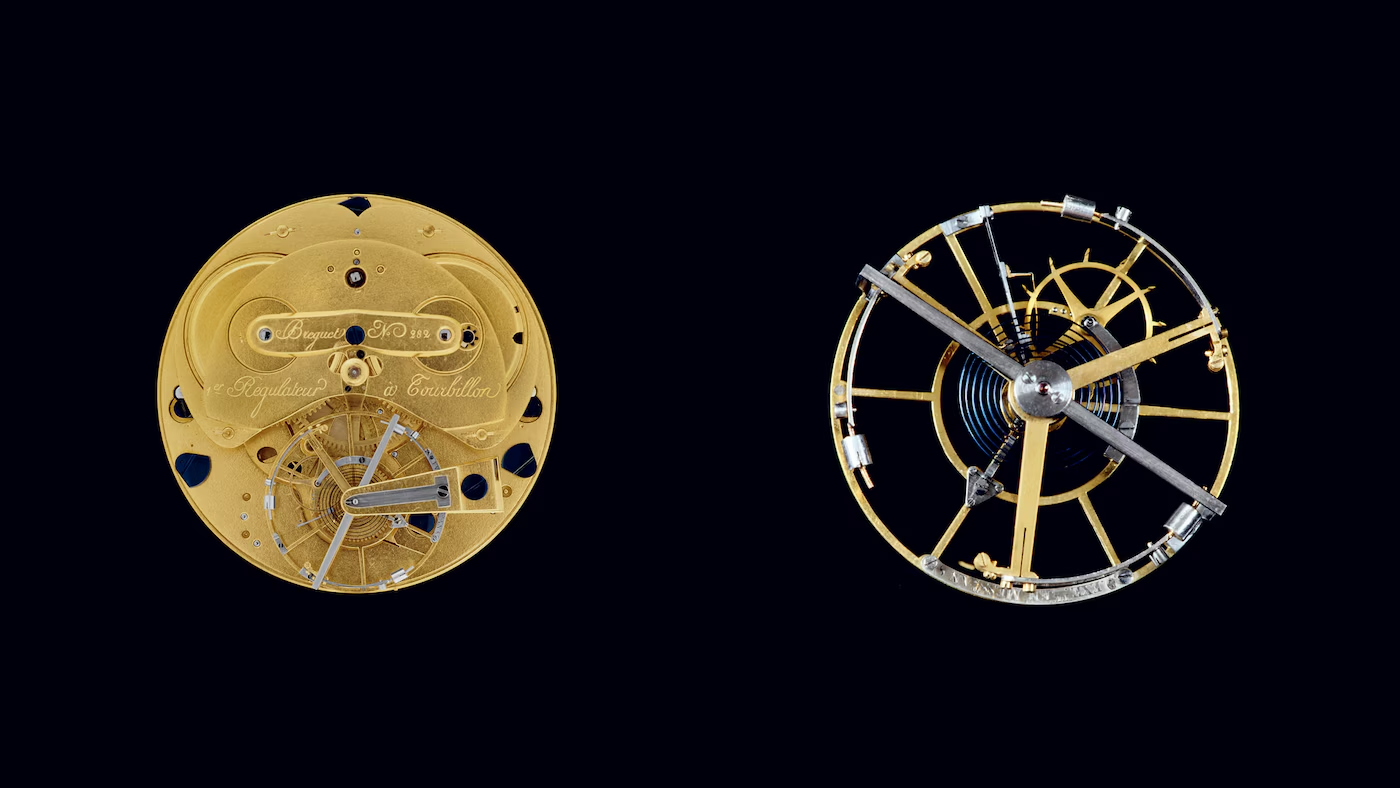
Breguet No. 282, the first experimental pocket watch prototype in history to feature Abraham-Louis Breguet’s tourbillon complication
Because the tourbillon was solving a problem peculiar to watches held primarily in one orientation — vertical, upright in the fob pocket, for most of the day. In that specific positional environment, a cage rotating in the plane of the movement plate is nearly ideal: it sweeps through all the relevant positions methodically, averaging the gravity-induced errors over each revolution. What it does not address is anything else. When the same pocket watch is laid flat on a desk, the balance staff is vertical. Gravity acts along the staff, so essentially one pivot tip bears on its endstone. The contact area is extremely small, and the balance encounters relatively little pivot friction. This is generally the most favorable orientation for an oscillator, which is why a watch is often recommended to be laid flat at night.
But the tourbillon cannot average this horizontal position against the vertical ones, so any rate difference between them remains. The cage continues to consume energy despite no longer performing the positional averaging for which it is most effective. It would then seem that the energy and space consumed by the cage might be put to better use elsewhere. When the watch is set down at any angle away from the pure vertical and horizontal positions, the cage’s rotation becomes irrelevant to the positional errors it is accumulating. The balance is in a position the cage was never designed to compensate for.
The theoretical argument was always there, waiting in the geometry: what if you tilted the oscillator? What if the balance was not parallel to the movement plate but inclined — angled away from it, so that when the watch is in the pure horizontal and vertical positions, the balance spends as little time as possible at either extreme? The greatest deviation in rate occurs between the pure horizontal and vertical positions. By inclining the tourbillon, the balance passes through either extreme for only a fraction of each revolution, and this minimizes the time in which the most pronounced rate deviations can occur.
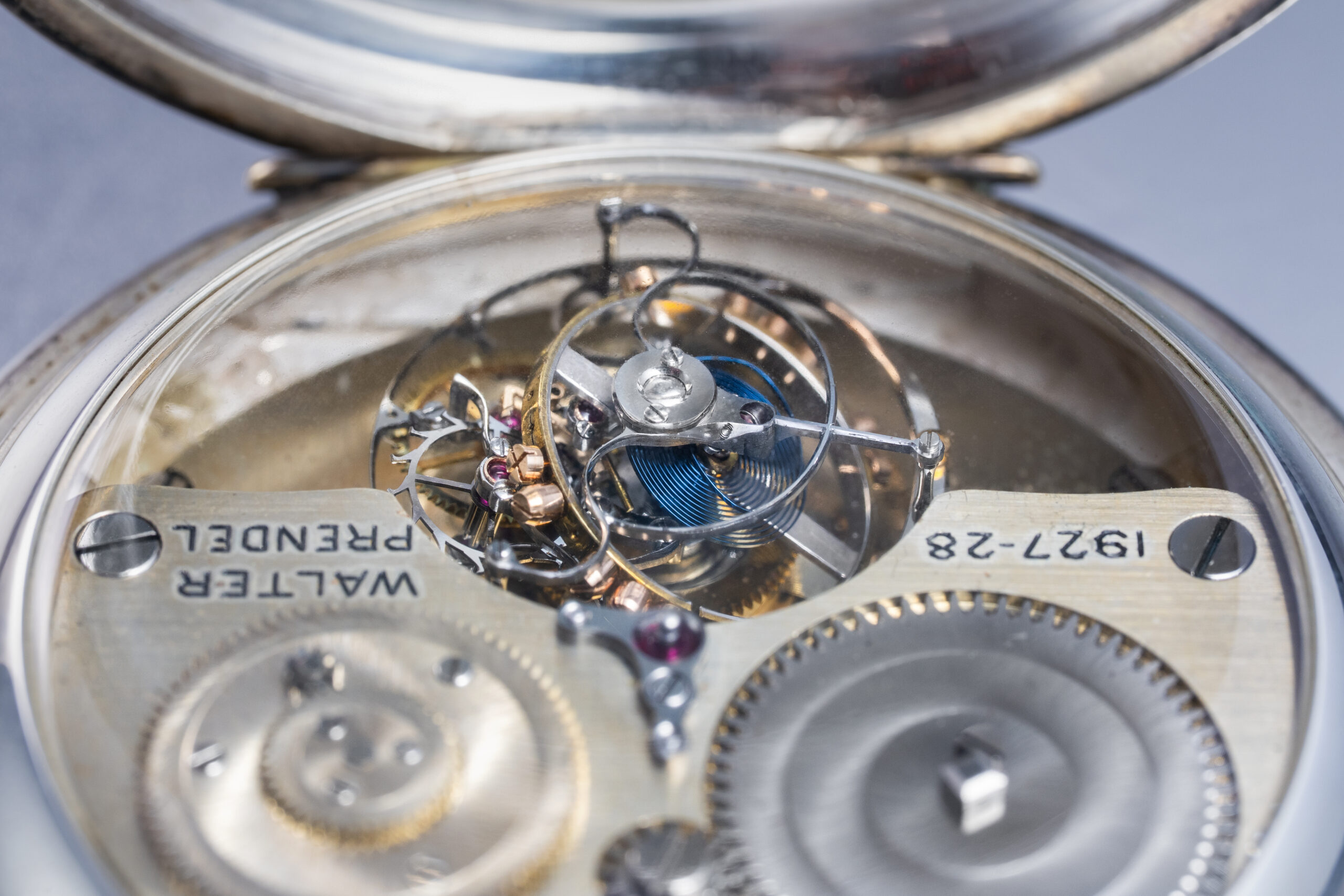
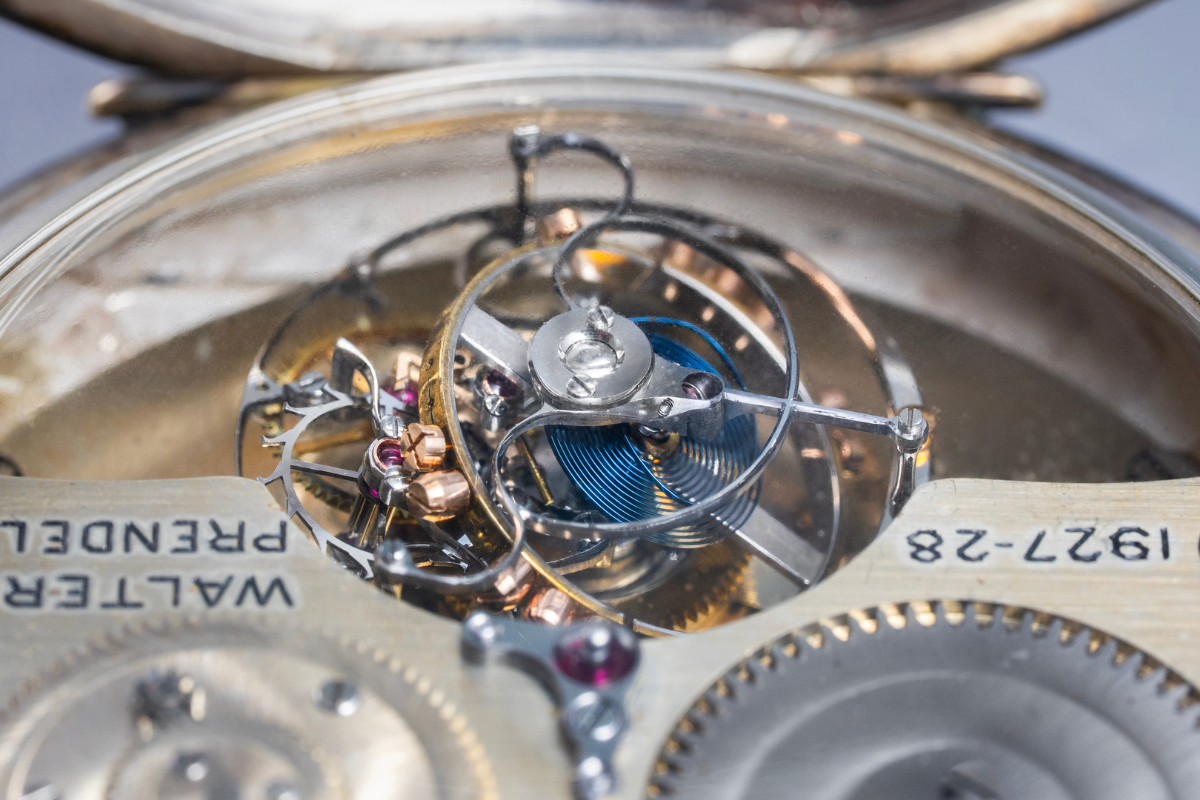
Walter Prendel’s 6-minute tourbillon pocket watch with an inclined tourbillon
The balance, viewed from the side, would trace a cone as the cage rotates, carrying the oscillator through a much broader range of orientations to gravity. The argument applies with equal force to a pocket watch carried in a coat pocket and set down on a writing desk, and later to a wristwatch worn on a moving arm. The geometry does not know what century it is.
The first man to actually build an inclined tourbillon was a watchmaker in Boston whom almost nobody has heard of, working in a city that had almost no tradition of independent watchmaking, making a pocket watch that was misattributed to another man for 165 years. His name was Andrew Holden Potter.
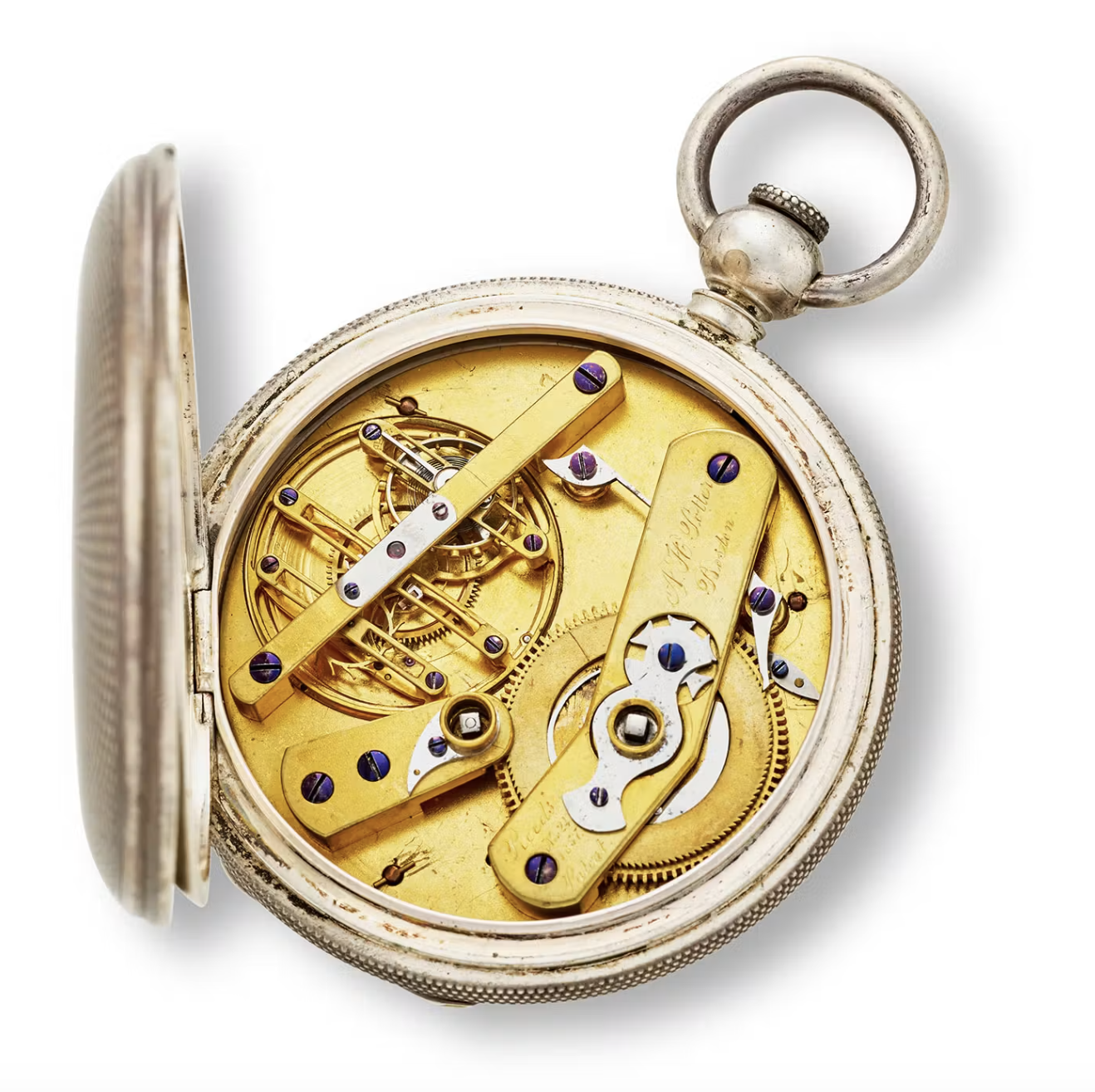
A pocketwatch housing the earliest known tourbillon with an inclined balance axis by Andrew H. Potter (Image: Bonhams)
The year was approximately 1860. The story of what happened to his idea — where it went, who found it, who lost it again, who reinvented it independently, and who finally gave it the commercial machinery and chronometric proof it deserved in the 21st century — is one of the most extraordinary narratives in the entire history of the tourbillon. It always brings a smile when I think of Potter in that room full of the loftiest aristocratic watch connoisseurs, each unveiling their tourbillon pocket watches, turning them over to reveal the extraordinary micro-mechanical microcosm within that Breguet dubbed “the Whirlwind,” only to hear Potter’s voice state, “I’ve got one too, but mine is slanted at 25 degrees” — with the same quiet confidence of Nigel Tufnel saying, “These go to eleven.”
The Man Nobody Confused with the Other Potter
Here is a fact that will cause a small but measurable amount of distress to every serious student of American horological history: there were two A. H. Potters. Both were watchmakers. Both were active in the second half of the 19th century. Both were extraordinary craftsmen. And both have been confused with each other, in the trade press and in auction catalogs, continuously and sometimes spectacularly for over a century.
Albert Henry Potter — born 1836 in Mechanicville, New York, died 1908 in Geneva — is the famous one. He is the American who went to Geneva and built pivoted detent pocket chronometers of such refinement that Paul Berner, one of the finest watchmakers in Switzerland and an escapement maker for Ulysse Nardin, visited his shop with two of his own best pieces specifically to show Potter what he could do, but was so thoroughly impressed by what he found that he never took them out of his bag. Albert Henry Potter is the man who sold lever watches for 250 dollars in an era when the going rate for a gold watch was 50. He also conceived a tourbillon with a fixed escape wheel and the anchor rotating around it inside the cage five times per minute — an audacious design that would resurface in the 21st century, first deployed by Jean-Pierre Golay in the Franck Muller Thunderbolt five-second tourbillon.
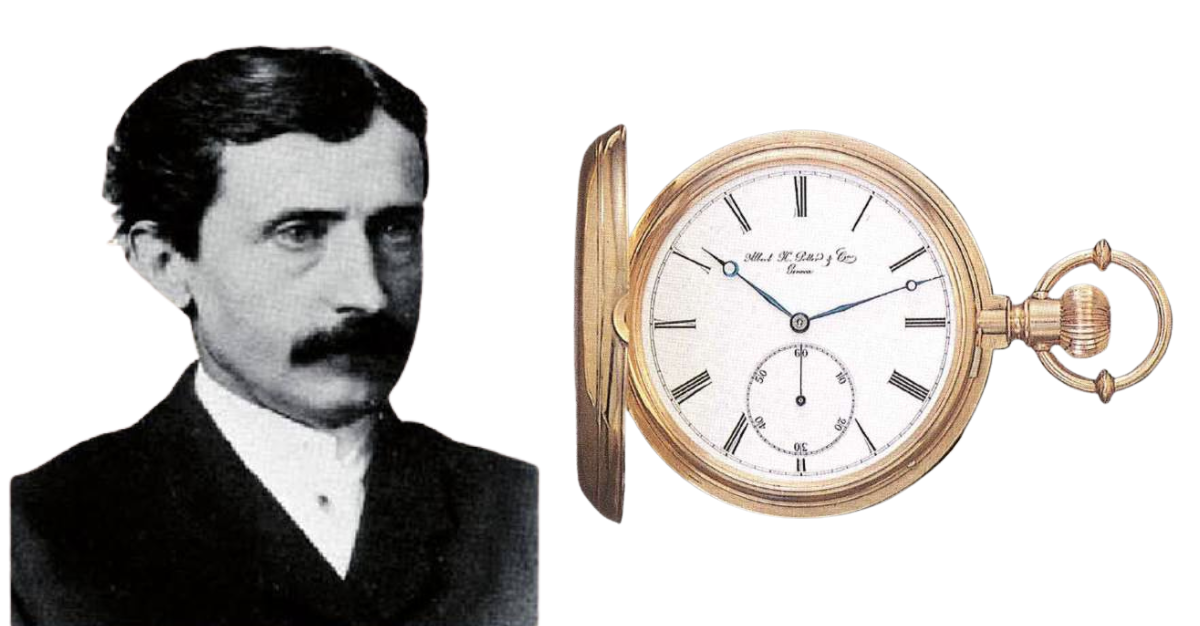
Albert H Potter and his pocketwatch that had a tourbillon with a fixed escape wheel and an anchor rotating around it inside the cage five times per minute (Image: Antiquorum)
Andrew Holden Potter — born 1834 in Boston, died 1893 — is the other one. He appears in the Boston directories as a watchmaker and jeweler, operating with various partners over the decades: Potter, Drake & Co. in 1870, Potter & Pike in 1875, Andrew H. Potter & Co. from 1885. He was an early collaborator of George P. Reed, the Boston watchmaker and inventor whose patented barrel with maintaining power appears on Andrew Potter’s movements. Scholars of the National Association of Watch and Clock Collectors (NAWCC) believe he may have finished several Reed-marked movements. He is not, to put it plainly, the household name that Albert Henry Potter is — even within the small household of people who know who Albert Henry Potter is.
But Andrew Holden Potter did one thing that his more celebrated near-namesake never managed. He built the first inclined-balance tourbillon in horological history, somewhere around 1860, on a modified Series I Howard ébauche with George Reed’s patented barrel, in a 54mm silver hunter case numbered 1857, with the oscillator inclined approximately 25 degrees to the plane of the flat tourbillon carriage. He understood — and this is the important part, the part that makes this not merely a curiosity but a genuine horological achievement — exactly why he was doing it.
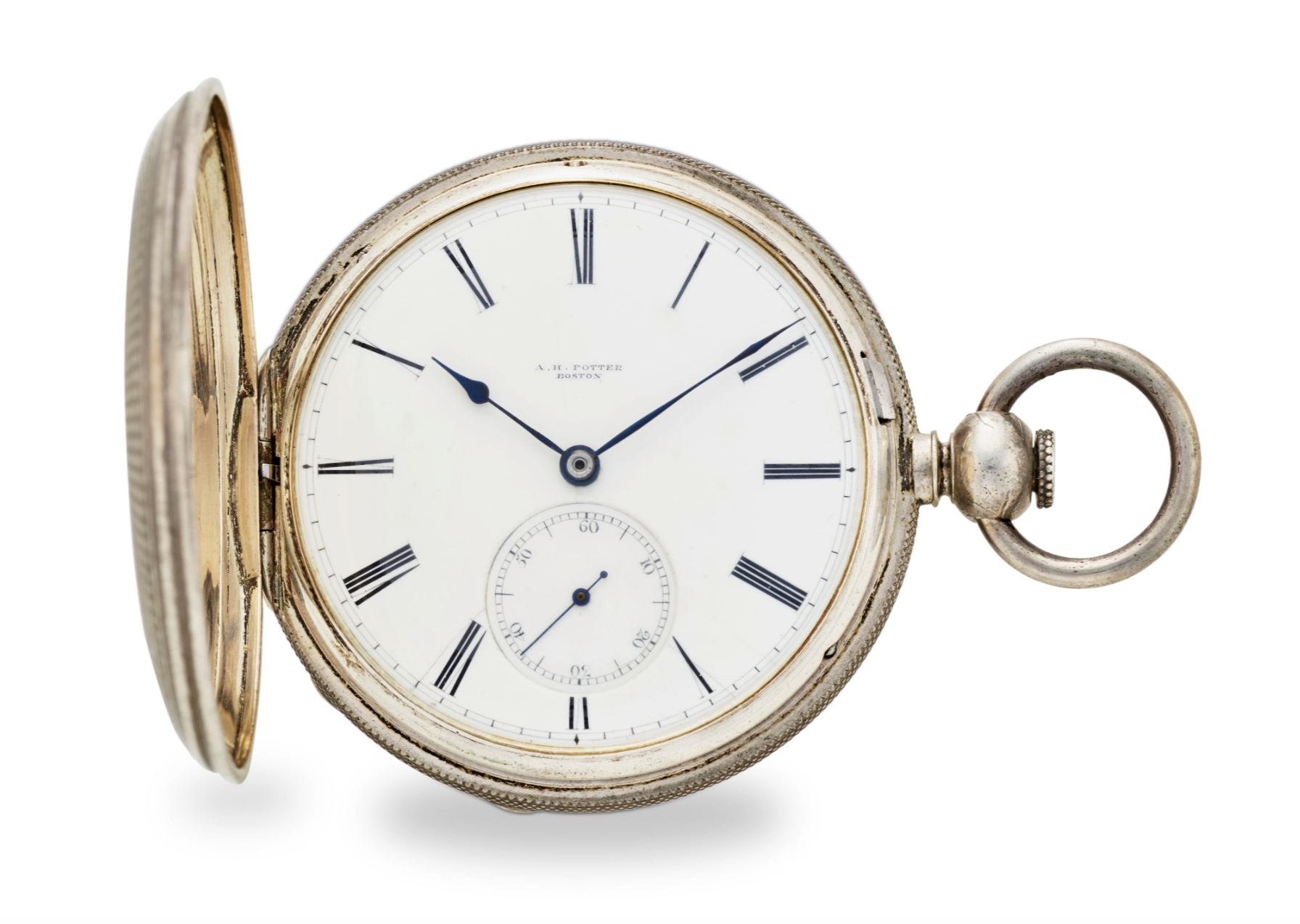
Andrew H. Potter’s inclined-balance tourbillon pocketwatch (Image: Bonhams)
The Bonhams auction catalog of December 2020, where this watch appeared as Lot 105 and sold for USD 24,062.50, states the matter precisely: the inclination was intended to alleviate the rate difference between the horizontal and vertical positions. The theoretical ideal would be 45 degrees, which places the oscillator symmetrically between the two extremes as the cage rotates, but 25 degrees was chosen to avoid excessive thickness. He was trading geometric perfection for pragmatism. He was thinking about the watch as an instrument to be used, carried and set down, not as a demonstration of mechanical virtuosity.
That is the thinking of a serious watchmaker. The technical execution reveals an architectural creativity that has been consistently underappreciated in the literature — and that the Bonhams catalog description, read carefully, confirms.
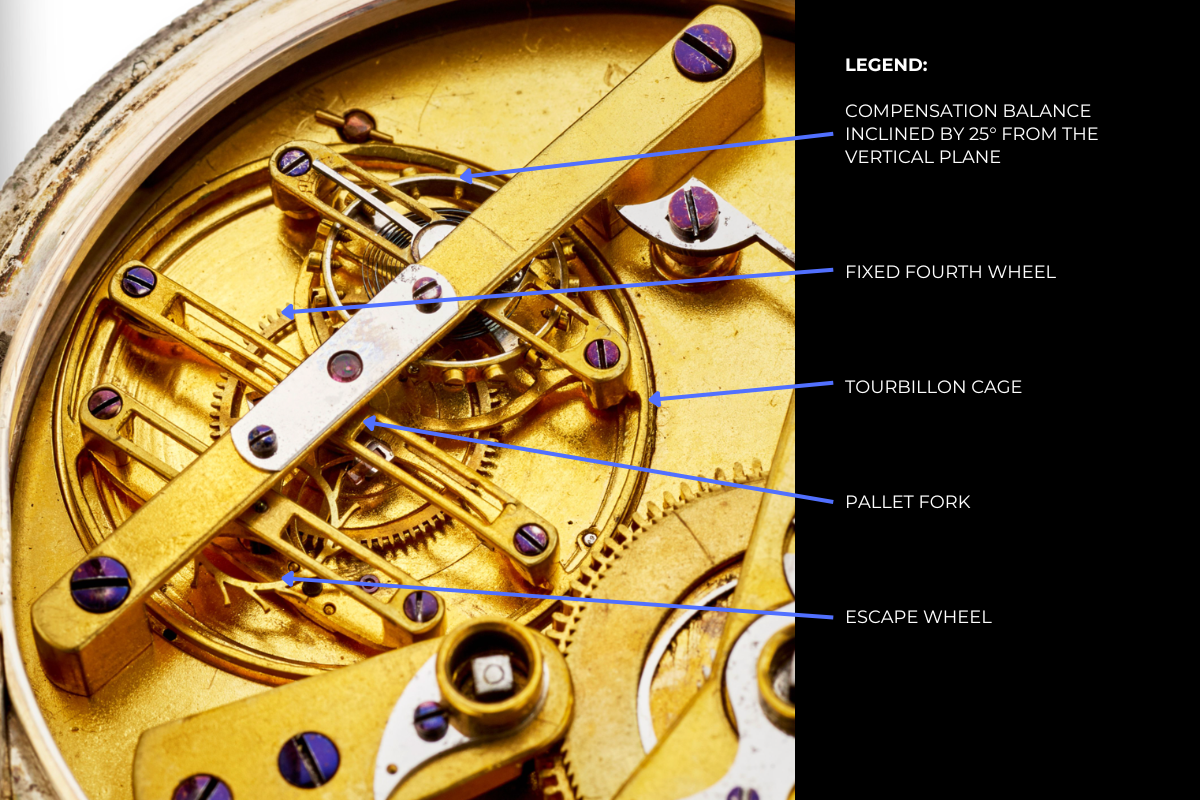
Andrew H. Potter decentralized the entire tourbillon layout: balance off-axis to one side, escape wheel off-axis to the other, and have the lever traversing the space between
The cage has three skeletonized bridges, and those three bridges are the key. The first bridge holds the inclined balance, positioned to one side of the cage rather than at its center. The second bridge, at the center of the cage, carries the rotation axis and a full-length straight-line lever escapement. The third bridge holds the escape wheel, geared to the fixed fourth wheel of the movement in the conventional tourbillon manner. As the cage rotates, the escape wheel is driven around the fixed fourth wheel, transmitting power to the roller of the inclined balance through the lever. What Potter did was not simply tilt a balance wheel on a bridge inside a conventional cage. He decentralized the entire tourbillon layout: balance off-axis to one side, escape wheel off-axis to the other, lever traversing the space between. The cage itself rotates in its standard flat plane. The inclination lives entirely within the off-center arrangement of components inside it. This is a solution of genuine structural originality — the inclined balance is not fighting the geometry of a central layout but is enabled by the deliberate creation of asymmetric space within the cage through de-centering.
The watch passed into the collection of Seth Atwood and the Time Museum in Rockford, Illinois. Anthony G. Randall — the distinguished British watchmaker who, in a remarkable convergence of horological biography, had himself invented the double-axis tourbillon in January 1977 and subsequently compiled the Time Museum’s catalog of chronometers — cataloged the Potter watch with a note that it was attributed to A. H. Potter but “probably another”: meaning not Albert Henry Potter of Geneva, whose watches were also in the collection. Donald Hoke’s catalog of American pocket watches attributed it correctly to Andrew H. Potter. The Time Museum closed in 1999. The watch went to auction. And for most of its life, from Boston around 1860 to Bonhams New York in 2020, it was either misidentified, correctly identified but obscure, or simply unknown to the makers who would most have benefited from knowing about it.
The Europa Star article from August 2004, written to cover the explosion of three-dimensional and multi-axis tourbillons triggered by Greubel Forsey’s Basel launch that year, credited “Albert Potter” with building a tourbillon with an inclined balance around 1860. Wrong Potter, wrong watch. The misattribution persists in the trade press to this day. Andrew Holden Potter, the actual inventor of the inclined tourbillon balance, remains one of the great footnote figures of American watchmaking: a craftsman whose achievement went largely unrecognized for 165 years, whose name is systematically given to his more famous near-namesake, and whose single documented masterwork sold for 24,000 dollars at an auction that most of the people who should have cared about it probably missed.
The Saxon Angle: Walter Prendel Goes Further
Between Andrew Potter’s inclined tourbillon, made in his Boston workshop circa 1860, and the next documented inclined tourbillon, there is a gap of approximately 70 years. The idea did not propagate. Nobody wrote it up. Nobody built on it. Breguet’s original flat cage became the industry standard in its essential geometry, and there it sat, largely unchallenged in its orientation, for the better part of a century.
The man who finally took up the mantle was Walter Prendel, and he did so from an entirely unexpected quarter: the Saxon town of Groïtzsch, a place most people outside serious horology would struggle to locate on a map, but which sat within the orbit of the most important watchmaking school in German history. Prendel had trained at the German Watchmaking School in Glashütte under Alfred Helwig — the inventor of the flying tourbillon of 1920, the single-sided suspension system that dispensed with the upper bridge of the cage and gave the tourbillon its characteristic appearance of floating freely within the movement. Helwig’s flying tourbillon was one of the great aesthetic and technical achievements of the Glashütte tradition. Prendel took Helwig’s architecture and did something his teacher had not done: he tilted it.
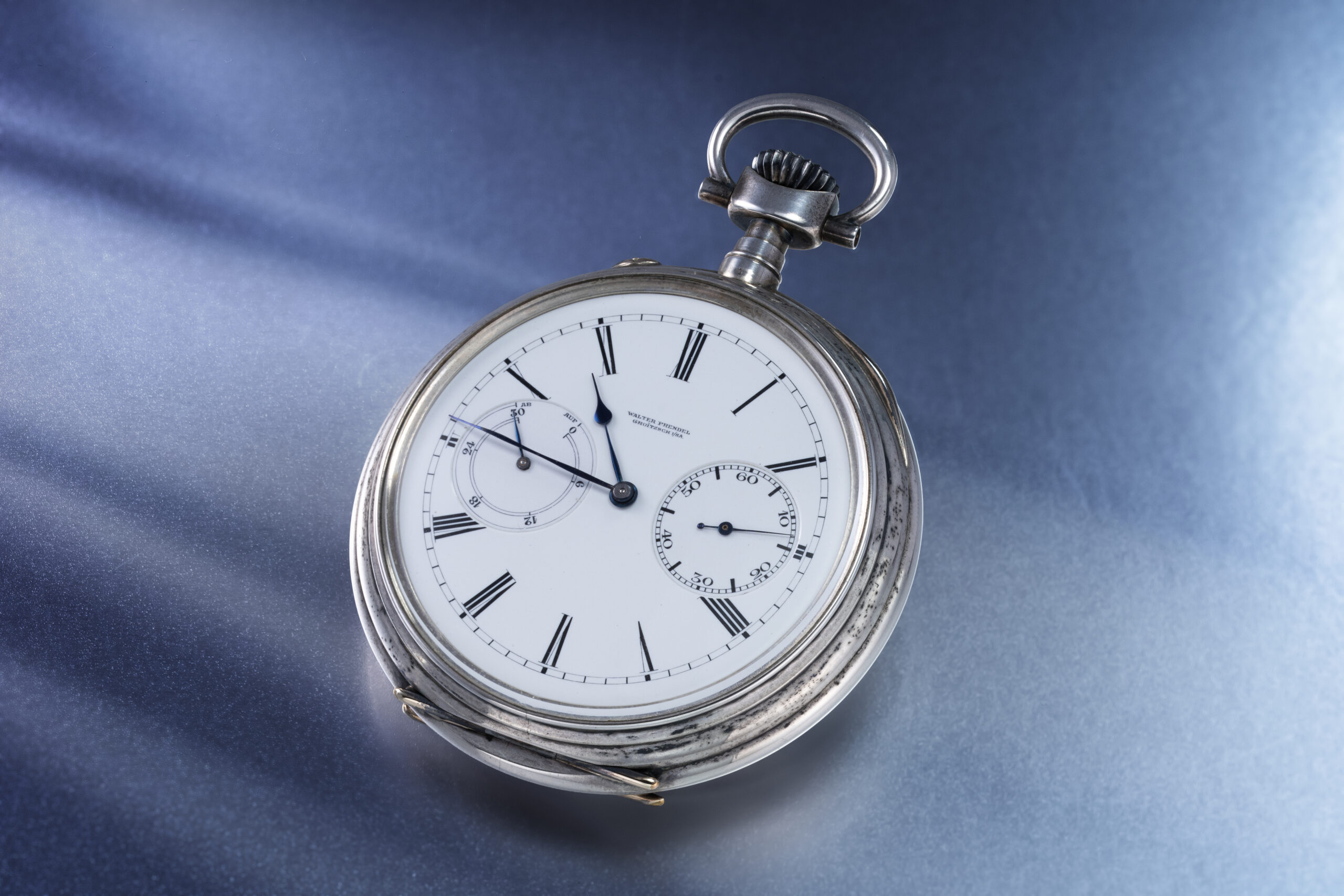
Walter Prendel 6-minute tourbillon pocket watch with double barrels and a classic face, with an AUF/AB power reserve indicator at 9 o’clock and a sub-seconds at 3 o’clock
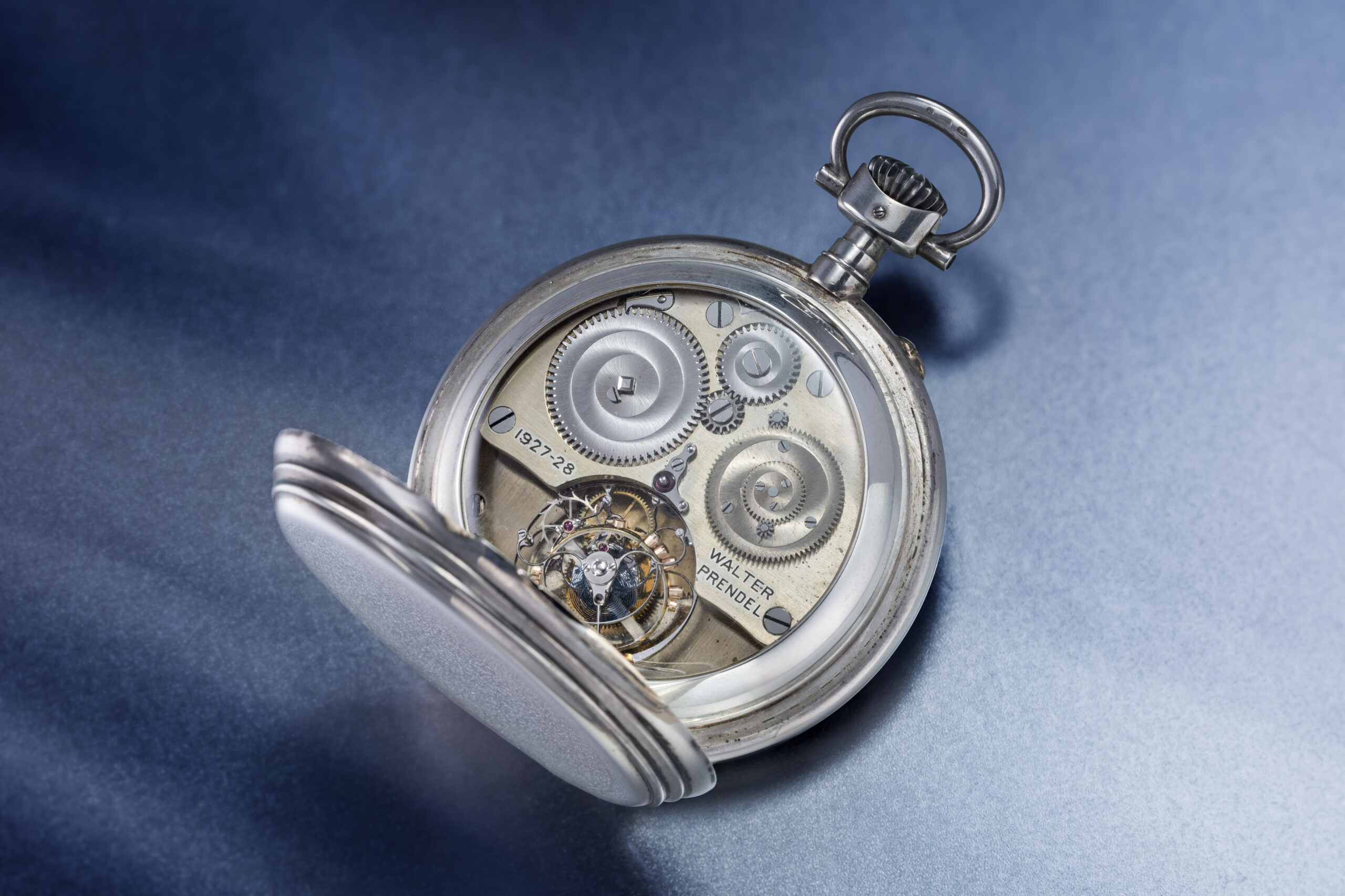
It features an unusually large center wheel that drives the tourbillon cage through its pinion at a 10:1 step-up ratio, so the cage completes one revolution every 6 minutes. The fourth wheel travels within the cage; its pinion rolls around the fixed third wheel.
The result, started in 1927 and finished in 1928, is a pocket watch of almost hallucinatory technical ambition for a single craftsman working by hand in a small Saxon town. The movement, 47.2mm in diameter and 13mm thick, uses a Helwig two-barrel system, each barrel with six turns of which only four are utilized by a stop-work — the standard Glashütte method of ensuring the mainspring operates only in its most consistent middle range.
The going train uses involute teeth of almost triangular profile throughout. The tourbillon cage, of the Helwig flying type, is driven from the center wheel — note that this is unusual: most tourbillons are driven from the third wheel, and the choice of the center wheel as the driving source for the cage changes all the downstream gear ratios and is the reason the cage takes six minutes rather than one minute to complete a revolution.
The purpose of a slower cage is primarily to reduce the energy required to rotate the tourbillon and to lessen wear on the escapement. Every acceleration and deceleration associated with the escapement ultimately has to be supplied by the mainspring, and the entire cage has to be stopped at every beat of the balance wheel. At the same balance frequency, a slower cage advances through a much smaller angle at each escapement impulse. A one-minute tourbillon, for instance, has to carry the cage through a complete revolution in just one minute, so each beat of the balance permits a relatively large advance. By extending the rotation to 6 minutes, the same revolution is divided among six times as many beats. The cage therefore moves only one sixth as far each time the escapement unlocks, making each advance smaller and reducing the momentum that has to be arrested when it locks again.
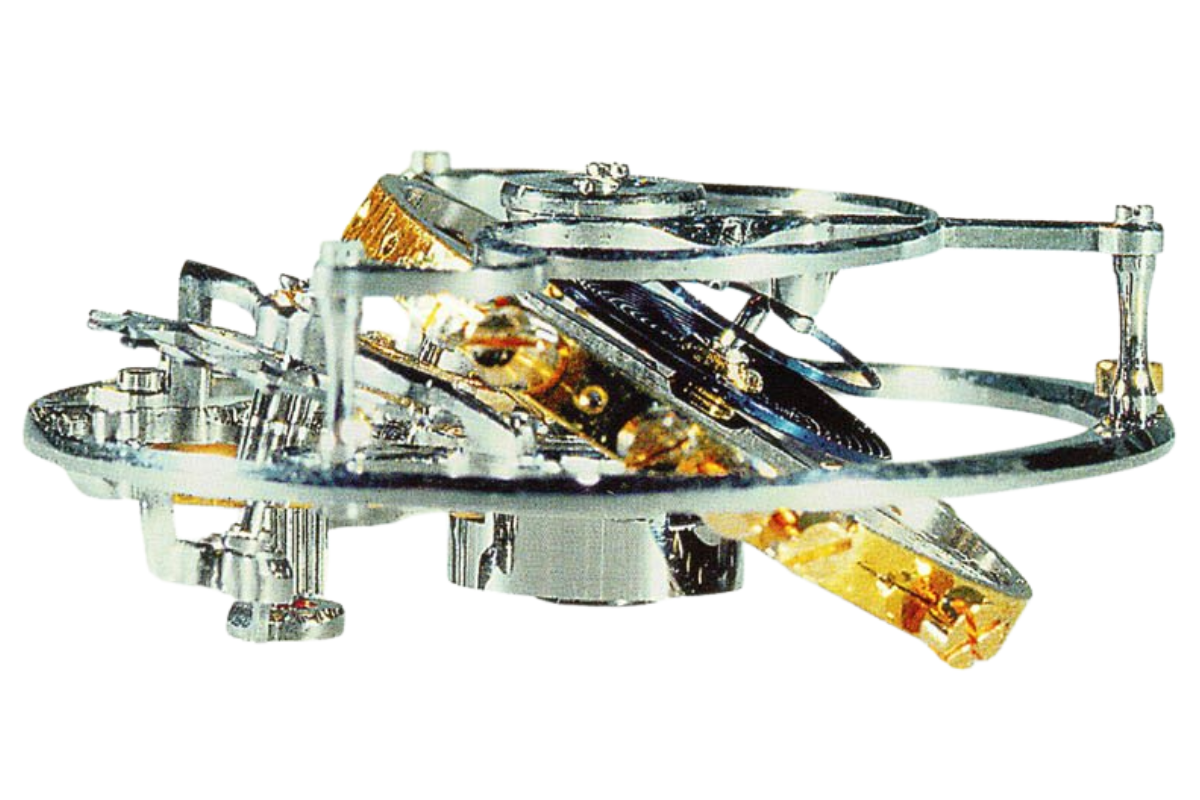
A closer look at the various inclined axes in Walter Prendel’s tourbillon, with the balance staff tilted 30° from the vertical plane, the escape wheel arbor 15° and the pallet arbor 23°, all within a carriage that completes one revolution every 6 minutes. (Image: Antiquorum)
The Antiquorum catalog specifies that the cage is built around the third wheel pinion and carries the fourth wheel and the lever escapement. Inside the cage, the balance is inclined 30 degrees from the horizontal, the pallet fork 23 degrees, and the escape wheel 15 degrees. These three angles are not arbitrary. The fourth wheel revolves in the carriage while meshing with the fixed third wheel, and the connection from this wheel to the inclined balance is made through the canted escape wheel and pallet. Because their axes are not parallel, the escapement itself is unusual. One escape wheel pivot is lightly thrust against its endstone, the escape wheel teeth sweep in a curved path across the pallet stones, and the impulse jewel acquires a slight vertical motion in the fork in addition to its normal radial movement. The different inclinations therefore allow the escapement to operate between components with axes that lie in different planes.
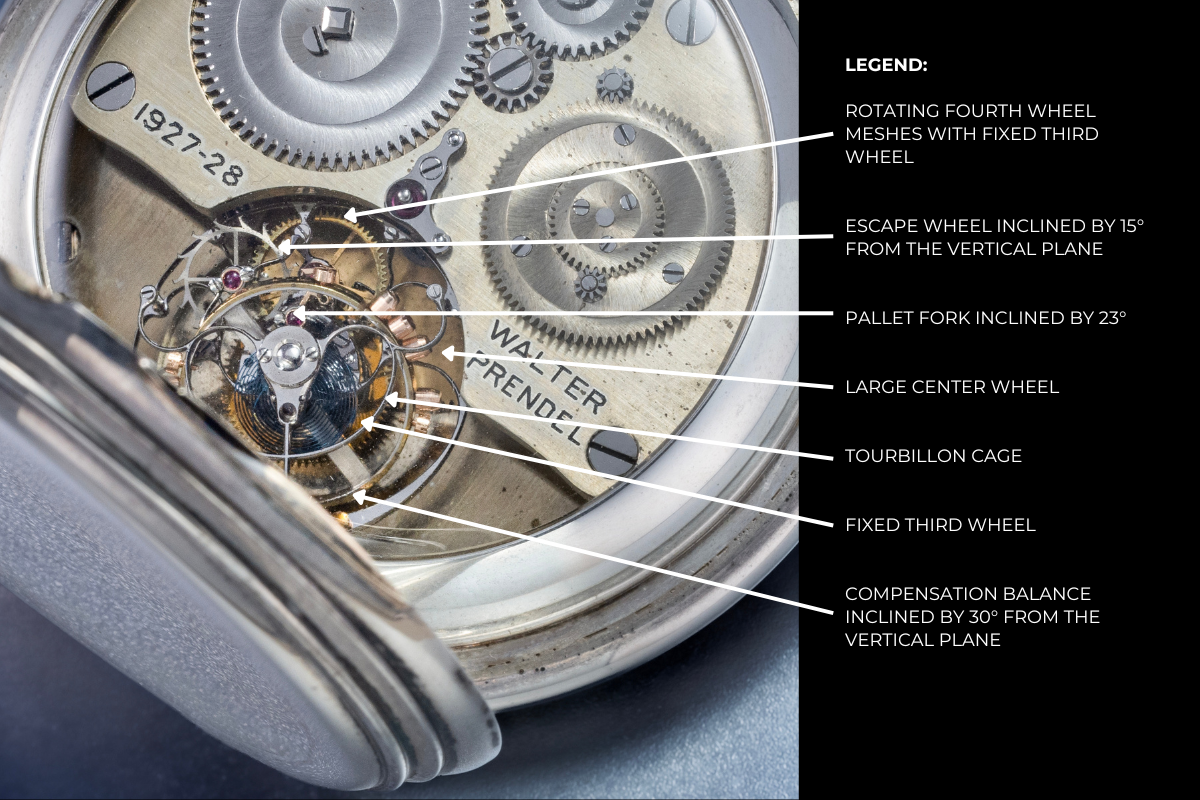
Walter Prendel’s 6-minute tourbillon pocket watch layout
The compensation balance is a cut bi-metallic Guillaume Anibal-brass design — the most sophisticated temperature compensation available at the time, using the specific nickel-iron alloy that eliminates the middle-temperature error of ordinary bi-metallic compensation — fitted with eight gold timing screws and four gold quarter screws. The balance spring is free-sprung with an outer terminal curve. The case, No. 1928, was made by Karl Richter of Glashütte.
The Prendel watch adds a further layer of technical ingenuity in solving the problem of unequal lift — a problem that arises directly from the inclination and deserves explanation. When the pallet fork is tilted away from the plane in which the escape wheel rotates, the entry pallet approaches and receives its impulse from a different spatial angle than the exit pallet does. The tooth-to-pallet geometry is asymmetric in three dimensions. Left uncorrected, the two pallets would deliver impulse over unequal arcs of balance rotation on alternate beats. Prendel’s solution was to use a convex entry pallet and a concave exit pallet — opposite curvatures on the two pallet faces — combined with a special poising pin protruding between the lever and the escape wheel to equalize both lifts. These are not crude compensations. They are the refinements of a man who understood the consequences of inclination at the level of individual tooth profiles.
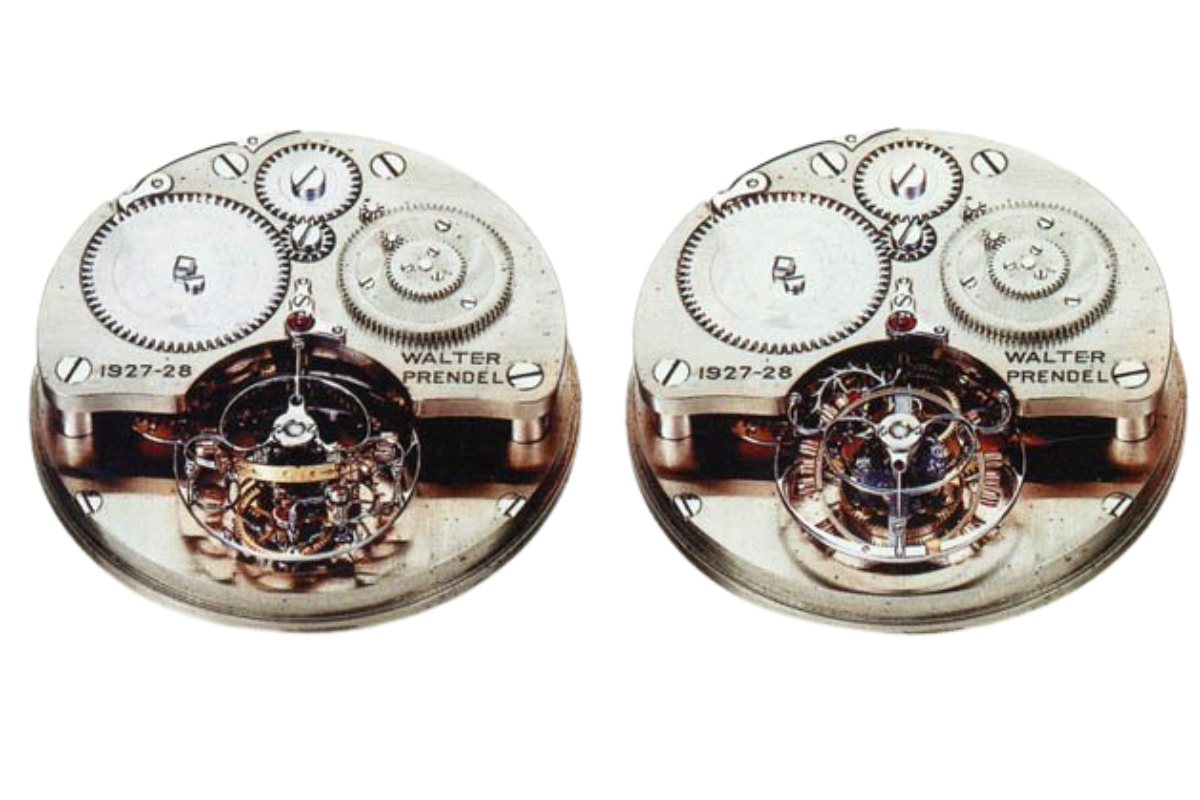
Walter Prendel’s inclined balance axis tourbillon after 3 minutes, and after a full revolution at 6 minutes (Image: Antiquorum)
The critical technical distinction between Potter’s approach and Prendel’s is worth stating precisely — and it is equally worth stating that neither approach is simply superior to the other; they are different solutions to the same problem.
In the Potter watch, the cage rotates in its standard flat plane. The inclination is achieved by decentralizing the components within it: the balance off to one side, the escape wheel on the other, the fixed fourth wheel driving the cage in the conventional manner and the escape wheel orbiting around it as the cage turns, driving the lever which impulses the inclined balance. Potter’s innovation is spatial and architectural.
In the Prendel watch, the cage also rotates in its standard flat plane — the cage is not inclined. What Prendel inclined was the balance and escapement assembly inside the cage, using differently inclined axes for the balance, pallet fork and escape wheel described above. The challenge Prendel solved — accommodating these three axes, then correcting the resulting unequal lift with opposing pallet curvatures — is a precise and demanding piece of escapement geometry. The challenge Potter solved — creating a workable straight-line lever escapement in a decentralized cage layout that accommodates an off-axis inclined balance without requiring any unusual gear geometry at all — is a precise and demanding piece of spatial architecture. Both are genuinely difficult. Neither reduces to the other.
Prendel himself is a figure whose later biography adds a further dimension to the story. According to his own account published in the NAWCC Bulletin in July 1949 — the source is Prendel’s own writing, which should be noted — he was one of only four students ever to graduate from the German Watchmaking School in Glashütte with honors. He subsequently moved to the United States, certainly by 1949 when his NAWCC article was published, and became Technical Director of Engineering at the Waltham Watch Company, a position he held until his death in 1966. The man who built the most sophisticated inclined tourbillon of the prewar era spent the second half of his career at an American watch manufacturer — making it almost certain that his watch was known to the American horological community during his lifetime. Whether anyone connected it during those years to Andrew Potter’s Boston watch, dating from around 1860, is not recorded. The two watches occupy successive chapters in American watchmaking history, separated by seven decades of technique but united by the same geometric argument. The connection, if anyone made it, left no trace.
The story of the Prendel watch’s two auction appearances tells the story of changing context perfectly. In April 2002, when the watch made CHF 1.2 million at Antiquorum, it was selling into a market that still had a vibrant passion for collecting important pocket watches, and the inclined tourbillon was an extraordinary historical artifact without a contemporary reference point — Greubel Forsey did not yet exist. In May 2021, when the same watch reappeared at Christie’s Geneva with a low estimate of CHF 45,000 — a figure that remains bewildering given the 2002 result — it sold for CHF 150,000 (including buyer’s premium) into a world that had been transformed by exactly the ideas it had anticipated. Greubel Forsey had launched, won a chronometry competition, and demonstrated that the inclined tourbillon was not a curiosity but an engineering optimization. Prendel’s angles — 30, 23, 15 degrees — were being reproduced in contemporary manufacture by tourbillon specialist Éric Coudray. And the watch that had first expressed those angles in 1928 sold for a fraction of what it had fetched 19 years earlier, to a market that should by now have understood it perfectly but was somehow more focused on hyped wristwatches than truly remarkable pocket watches. This is not a fact about the watch. It is a fact about markets. The watch is extraordinary. The market was simply not paying attention — except for one very smart individual who now owns this timepiece.
Two Men, One Idea, Zero Communication: Greubel and Forsey
Robert Greubel and Stephen Forsey had been working together at Renaud & Papi, the complications specialist that became part of Audemars Piguet, when they began developing what would become their founding invention. The idea was for a tourbillon cage inclined at 30 degrees rotating inside a second outer cage — a double-axis system that would average gravity-induced errors across a far wider range of positions than any single cage could achieve. Before launching Greubel Forsey as an independent entity, they considered developing the mechanism in collaboration with an existing manufacturer. They decided against it. The concept was, in their judgement, sufficiently important to the development of precision watchmaking that it needed to exist as an independent intellectual contribution rather than as an addition to someone else’s product line. This is not the typical motivation for starting a watch company. It is the motivation of people who are genuinely, immodestly, and in this case entirely correctly convinced that they have worked out something important.
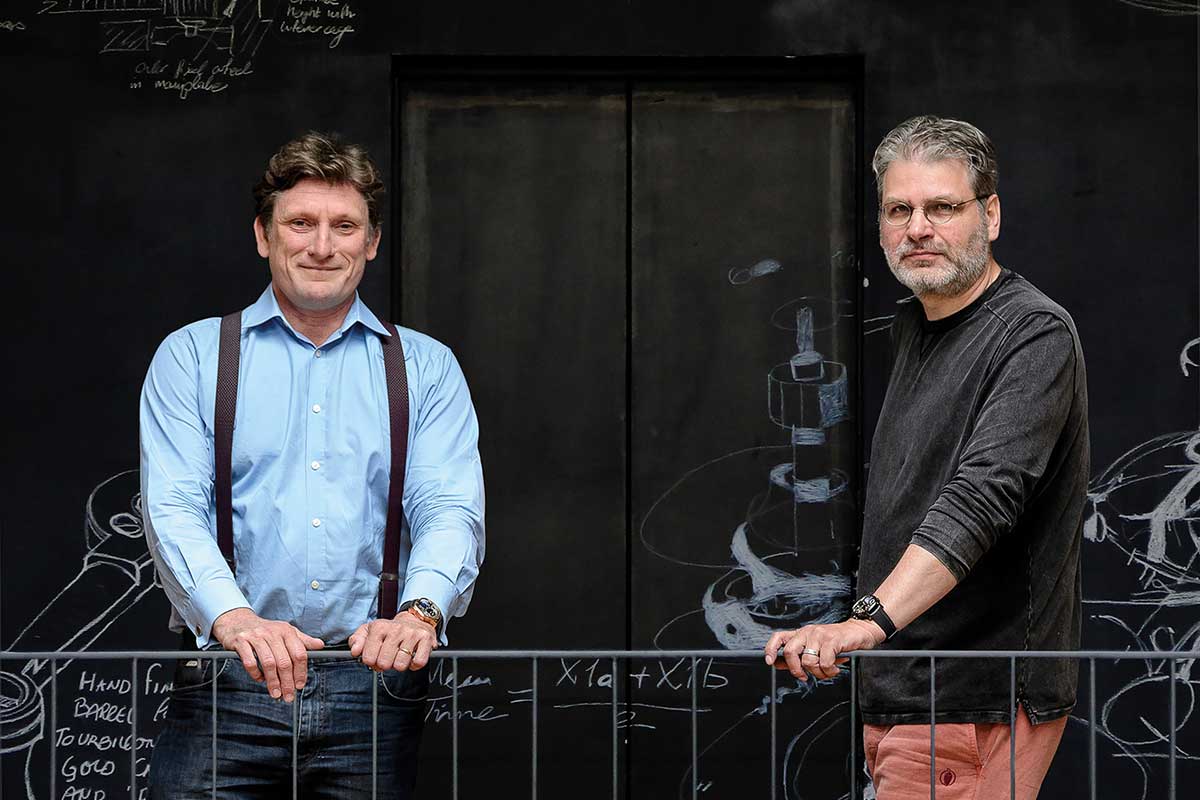
Stephen Forsey & Robert Greubel
The Double Tourbillon 30° debuted at Baselworld 2004. The mechanism is worth understanding precisely, because it is architecturally different from both Potter’s and Prendel’s approaches in a fundamental way. In both of their watches, the tourbillon cage rotates in its standard flat plane — the inclination is achieved through the internal arrangement of components within it. In the Greubel Forsey Double Tourbillon, the inner cage is genuinely physically inclined: it is mounted on an axis tilted 30 degrees relative to the outer cage’s plane of rotation. The outer cage rotates conventionally, driven by the going train around its own fixed fourth wheel. As the outer cage turns, it carries the inner cage’s own fixed wheel around with it. The escape wheel pinion carried by the inner cage in turn meshes around this fixed wheel.
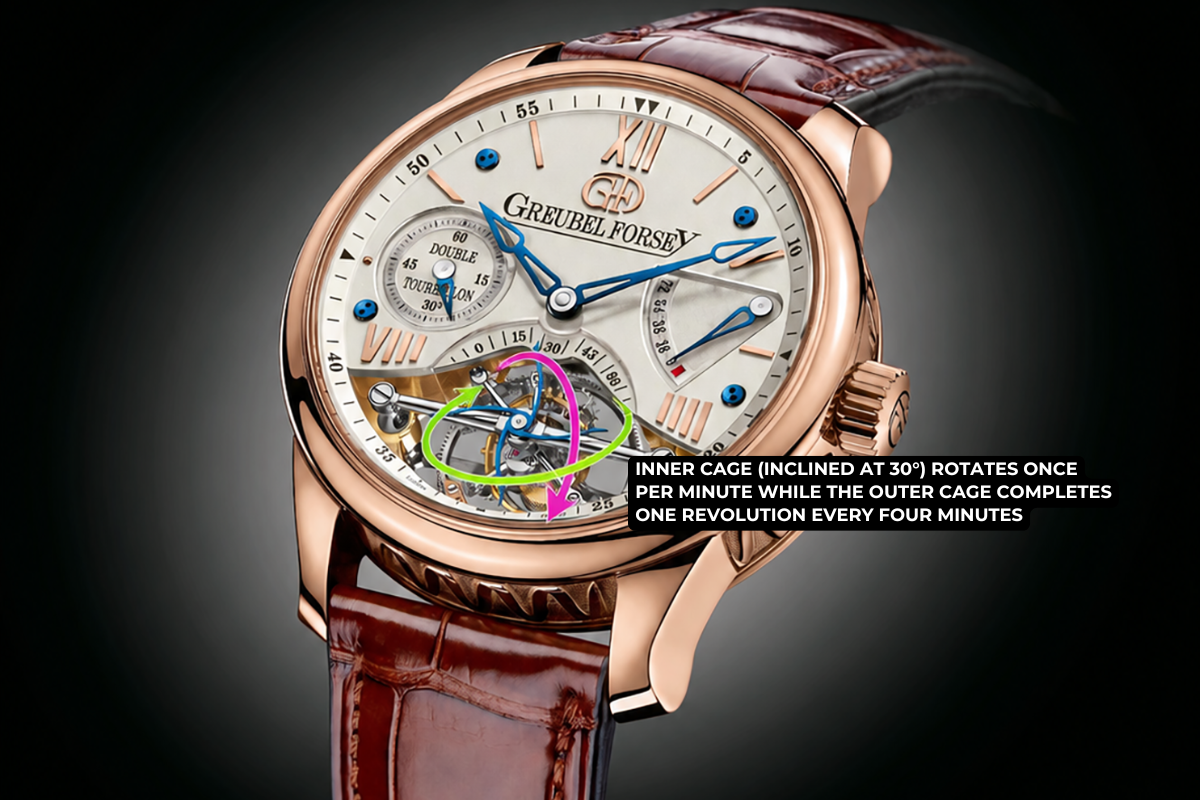
Greubel Forsey’s Double Tourbillon 30° housing a tourbillon at a 30° angle and in an outer cage that rotates on the same plane of the movement.
The drive pinion of the inner cage, being carried by the outer cage, is forced to mesh with a wheel with conical toothing fixed to the movement plate. The inner cage’s drive pinion rolls around this fixed wheel — but because the inner cage is inclined at 30 degrees relative to the outer cage’s plane, the gearing between the inner fourth wheel and the inner cage’s drive pinion cannot use conventional flat teeth. Greubel Forsey’s technical specification describes the solution as conical gearing with profiled teeth — bevel gear geometry cut to mesh correctly across the 30-degree angular interface. The inner fixed wheel sits flat relative to the outer cage’s plane; it is the conical tooth profile that allows the inclined inner cage to receive its rotational drive from a wheel that is not inclined with it. The outer cage completes one revolution every four minutes; the inner completes one revolution every 60 seconds. Because these two rates are non-commensurate, the balance traces a complex three-dimensional path through space that no single-cage tourbillon can replicate. The 30-degree inclination was chosen through systematic chronometric testing. In 2011, the Double Tourbillon 30° Technique won the Concours International de Chronométrie with a score of 915 out of a possible 1,000 points over a 45-day timing test. That score is not a marketing number. It is a demonstrably more accurate tourbillon.
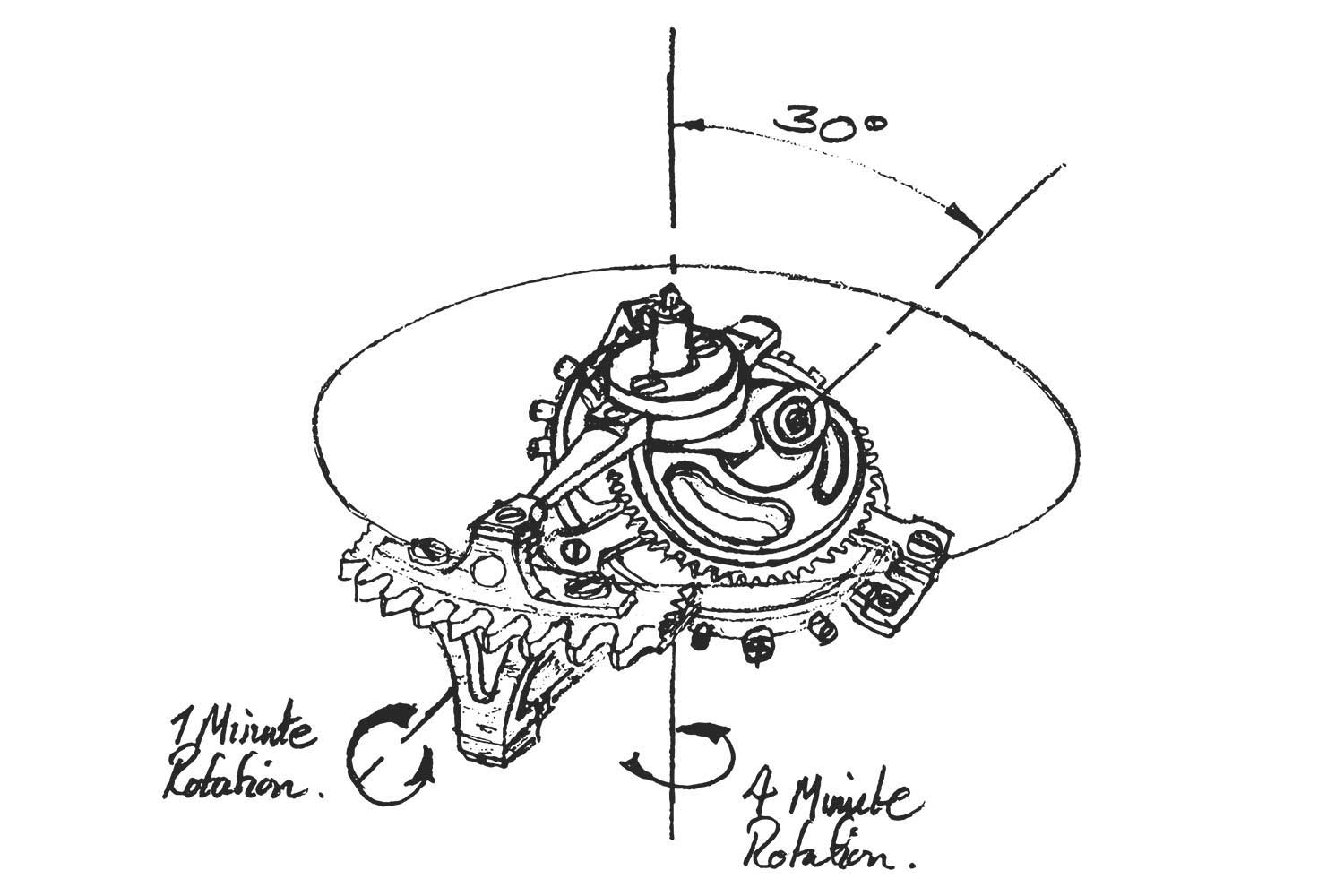
Greubel Forsey’s Double Tourbillon 30° has an inner cage that rotates once per minute on an axis inclined at 30° to that of the outer cage, which completes one revolution every four minutes
Greubel Forsey’s own history describes the Double Tourbillon as paying homage to Breguet’s original invention while making a decisive technical advancement. Prendel’s solution was not unknown to them. The patent underlying the Double Tourbillon, filed in 2001 by Complitime with Robert Greubel and Stephen Forsey named as inventors, explicitly cites Prendel’s 30-degree inclined balance tourbillon as prior art and describes its progressively inclined axes. It notes that inclining the balance staff by 30 degrees relative to the tourbillon carriage limits its orientation to roughly 30 to 60 degrees when the watch is tested in the pure horizontal and vertical positions, thereby reducing the difference between those extremes. But it also points out that actual wearing positions are arbitrary, so the positional problem is modified rather than eliminated. The inclination also imposed considerable complexity. To keep the balance running, the escapement components had to be inclined as well, with the inclination increasing from the escape wheel toward the balance. It then states that “such a solution is difficult to control from the technical point of view and the working conditions of the escapement are not very favorable.” Their goal was thus to retain the chronometric benefit of an inclined oscillator while avoiding these drawbacks.
Prendel’s 1928 watch had been at Antiquorum Geneva in April 2002 — two years before Basel 2004, in the same city where Greubel Forsey would launch. Greubel and Forsey describe their development as beginning from first principles: they were trying to build the highest-performance tourbillon for a wristwatch, they identified that the classical flat cage fails to compensate for the full range of positions a watch occupies, and they derived the inclined double-cage solution from the geometry. The underlying chronometric argument has the same premise that Andrew Potter explored around 1860 with a pocket watch on a writing desk, and the one Prendel revisited in 1927 in a Saxon atelier. The wristwatch sharpened the commercial urgency because the positional environment of the wrist is more varied and more violent than that of the waistcoat pocket. But the physics was identical. The same problem, approached with the same rigor, in the same city, nearly 70 years apart.
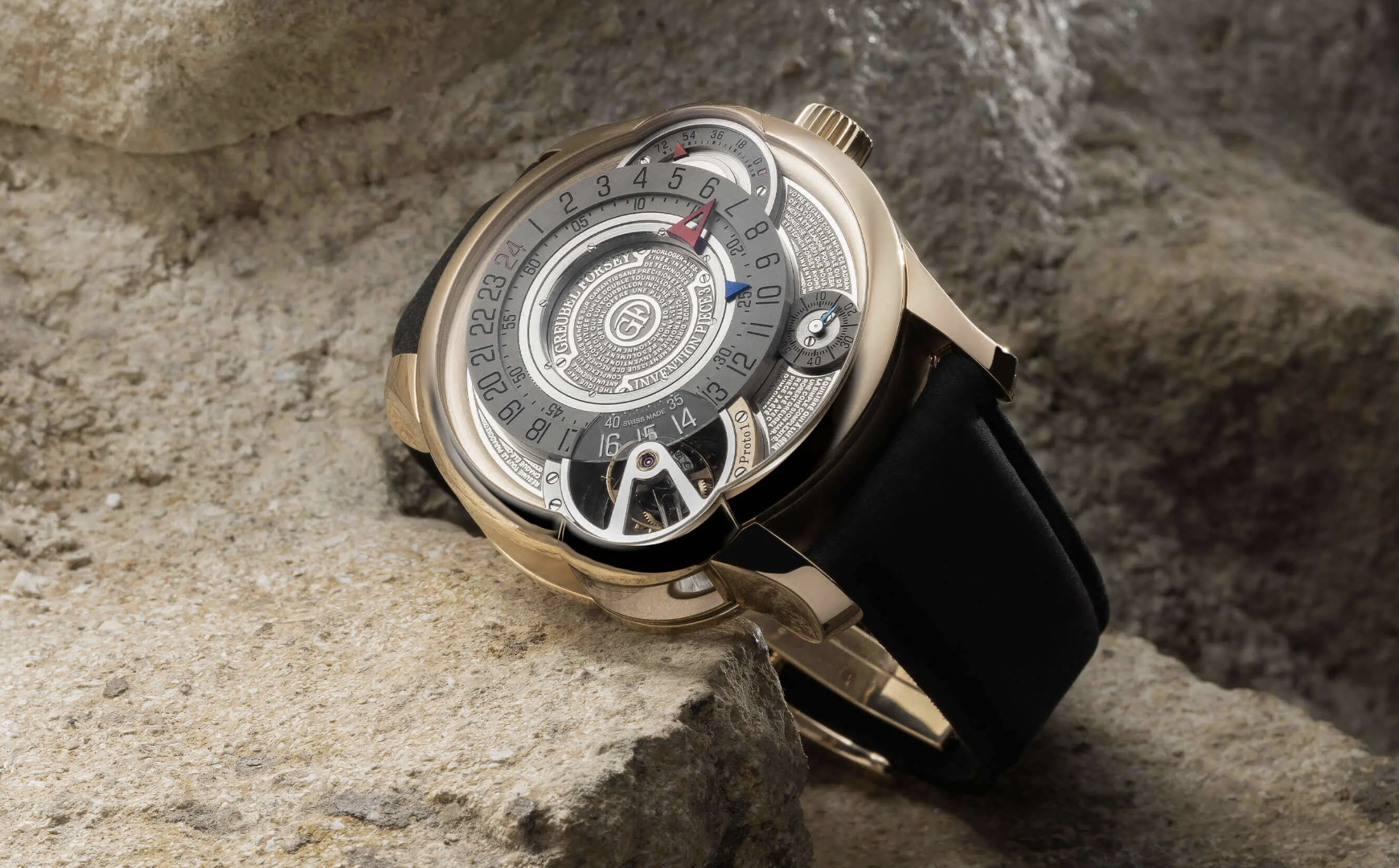
Greubel Forsey’s Invention Piece 3: the Tourbillon 24 Secondes
In 2009, Greubel Forsey introduced their third fundamental invention, first shown in the Invention Piece 3: the Tourbillon 24 Secondes. This is a single inclined tourbillon — one cage, genuinely tilted at 25 degrees, rotating every 24 seconds. The power flow is conventional up to the third wheel, which drives the cage pinion around a fixed fourth wheel in the normal tourbillon manner. But because the cage is inclined at 25 degrees while the fixed fourth wheel sits parallel to the plane of the movement, both the fixed wheel’s teeth and the cage’s escape wheel pinion teeth must be cut at an unconventional incline to mesh correctly across the angular interface. This is precisely the same angular drive problem that Prendel had solved in 1927 with his graduated two-step transmission — using two interfaces at 15 and 23 degrees to build up to 30 degrees incrementally because he could not cut inclined teeth with the precision required by hand tools. Modern CNC manufacturing made Greubel Forsey’s single inclined-tooth solution possible. Additionally, because the cage completes a revolution every 24 seconds rather than 60, it cannot serve as the seconds hand — so the third wheel also drives an auxiliary pinion which powers a conventional seconds indication on the dial. The gear ratio between the third wheel and the cage pinion is 2.5 times larger than between the third wheel and the seconds pinion, which is precisely how 60 divided by 2.5 gives 24. The cage comprises 87 components and weighs 0.39 grams. Twin barrels provide 72 hours of power reserve because a single barrel cannot sustain the energy consumption of a cage rotating this fast.

The 25° angle minimizes the time the oscillator spends in the pure vertical – a position where hairspring breathing is least concentric and escapement friction is greatest (Video credit: Greubel Forsey)
That 25-degree figure deserves particular attention. In describing why 25 degrees was chosen, Greubel Forsey notes that this angle minimizes the time the oscillator spends in the pure vertical — the position where hairspring breathing is least concentric and escapement friction is greatest. This is precisely the reasoning Andrew Potter applied in his Boston workshop around 1860. The 25-degree figure is not arbitrary or aesthetic. It is the result of the same geometric analysis of the watch’s positional error problem, arrived at 150 years apart, on opposite sides of the Atlantic. Potter got to 25 degrees with a modified Howard ébauche, a clear mind, and a commitment to not making the case too thick. Greubel Forsey got to 25 degrees with modern chronometric testing equipment and three years of systematic measurement. They got the same answer. The geometry does not lie.
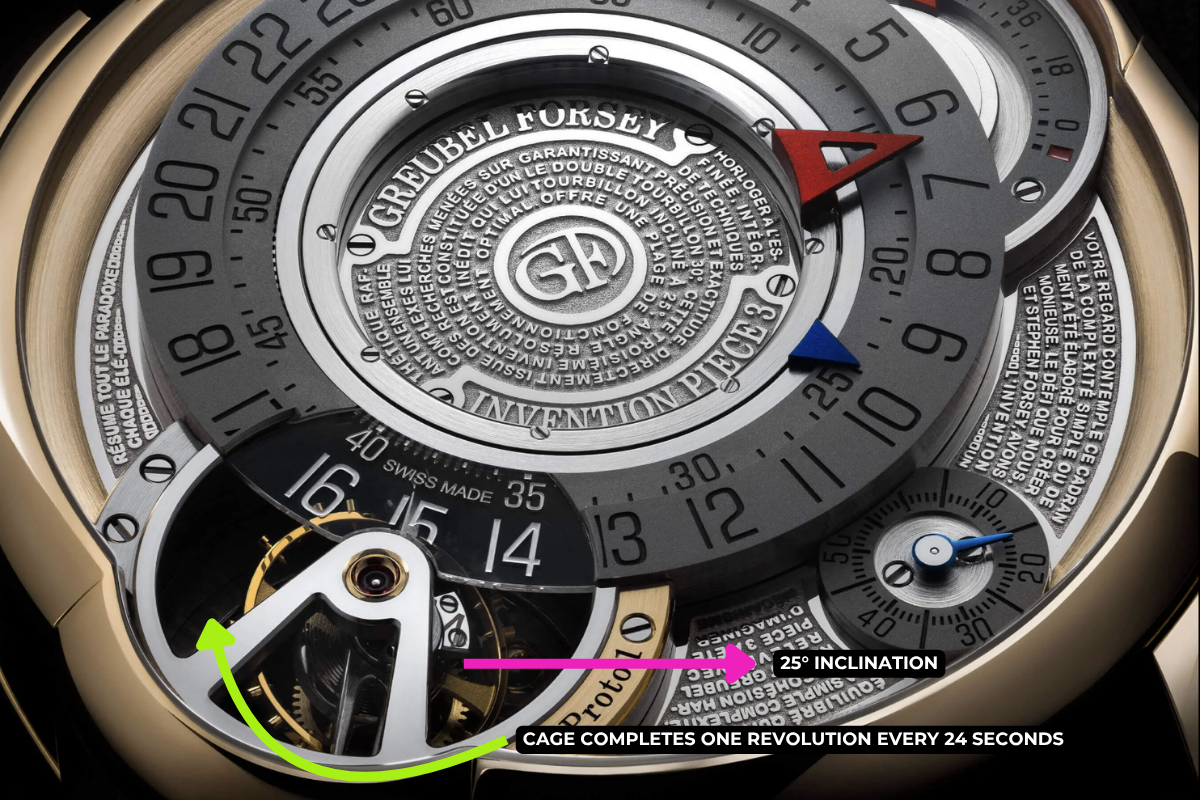
The Tourbillon 24 Secondes features a single tourbillon inclined at 25º, with a cage that completes one revolution every 24 seconds. While the solution differs from the double tourbillon, the underlying rationale is the same. Here, the rapid rotation limits the time the balance spends in the extreme positions where its rate errors are greatest.
Greubel Forsey did not stop there. Their eighth Fundamental Invention, the Tourbillon Cardan of 2023, takes the inclined tourbillon into territory that neither Potter, Prendel, nor the Double Tourbillon had reached. The power flow begins conventionally: four co-axially stacked fast-rotating mainspring barrels — because the energy demands here are extraordinary — drive the going train, the third wheel drives a gimbal system, and as that happens, a pinion attached to the tourbillon shaft travels around a fixed wheel. This causes the tourbillon cage to rotate every 16 seconds at an inclination of 30 degrees, thereby carrying the escape wheel whereby the escape pinion meshes with its own fixed wheel. The gimbal is a two-axis articulated mounting comprising of two nested rings that allows the inclined tourbillon shaft to self-align as its pinion travels around the fixed wheel. The two rings are set at 90 degrees to each other — that physically tilt the entire tourbillon housing backward and forward through a controlled arc of plus and minus 30 degrees on a 48-second cycle.
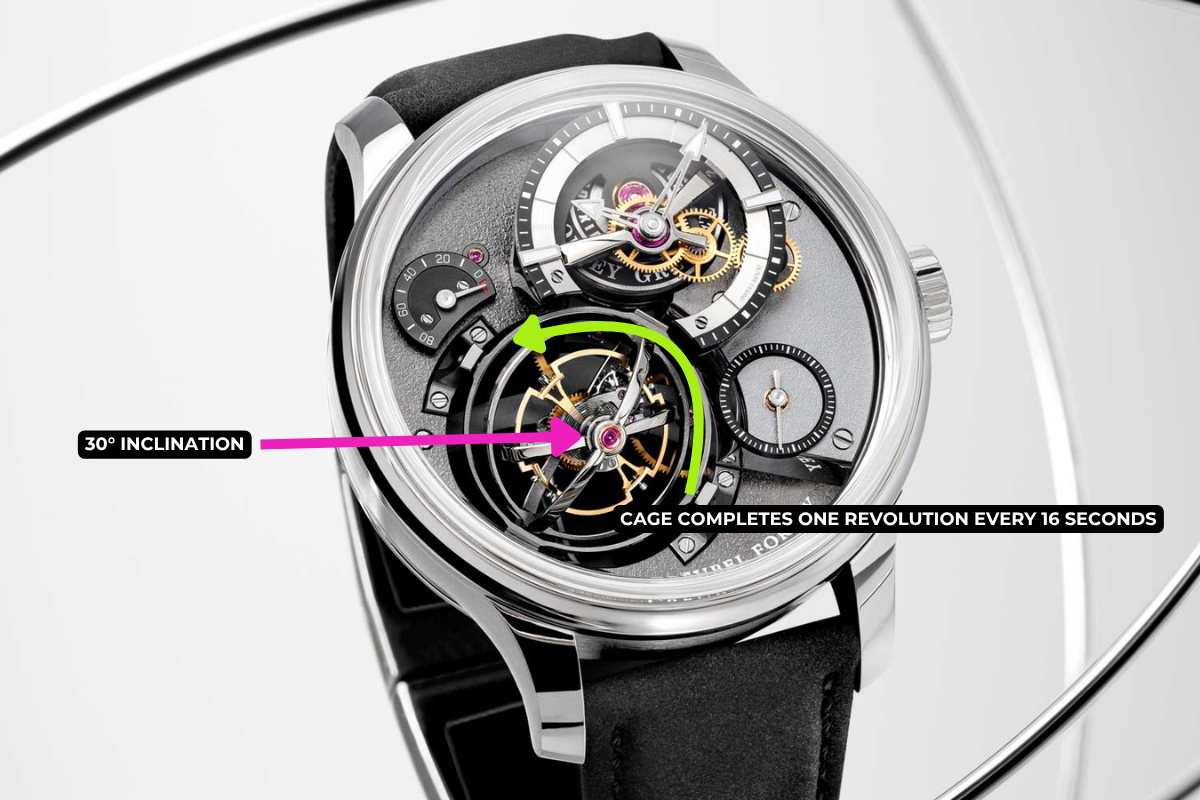
Greubel Forsey’s Tourbillon Cardan places a tourbillon inclined at 30° and rotating once every 16 seconds within two mobile rings mounted on axes 90° apart.
The rings are not freely pivoting under gravity, as in a marine chronometer’s gimbal suspension. They are actively powered, precisely controlled, each tilting through its arc in a motion that is deliberate, metronomic, and mechanically driven by the same energy source that runs the escapement. The result is a tourbillon whose 30-degree inclination angle never changes, but whose orientation relative to gravity is continuously and deliberately varied as it rotates. The oscillator is not merely averaging its errors over one inclined rotational axis; it is averaging them over a continuously shifting three-dimensional orientation that the gimbals impose on it with each 48-second cycle. It is the furthest expression of the idea Andrew Potter first had around 1860 — that the oscillator should be freed from the tyranny of a fixed positional relationship with gravity — and it is the most mechanically ambitious realization of that idea yet built.
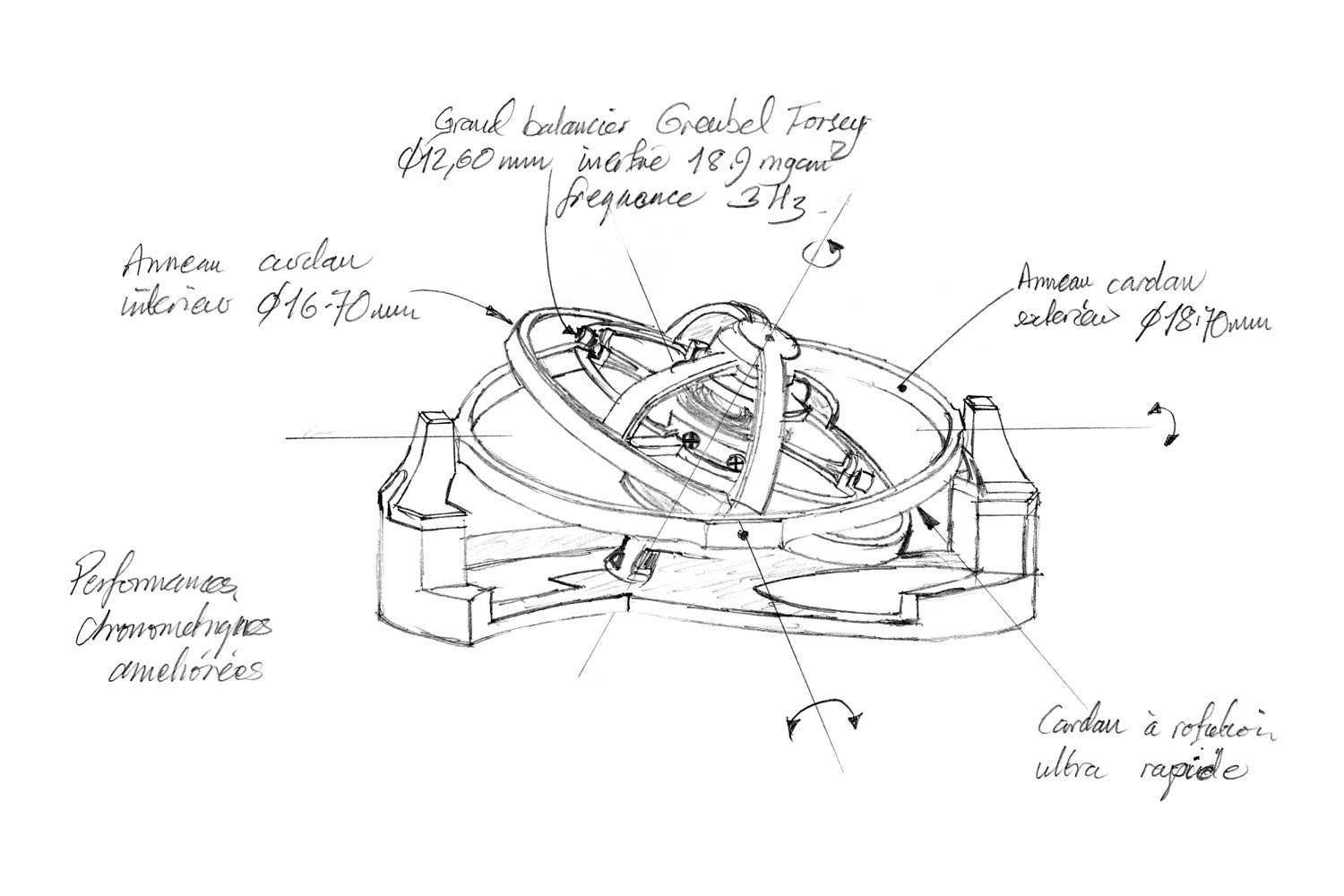
The Greubel Forsey Tourbillon Cardan, inclined at 30°, incorporates a large 12.6mm balance with a (very) high moment of inertia of 18.9 mg·cm² and a frequency of 3Hz, supported within inner and outer gimbal rings that measure 16.7mm and 18.7mm respectively. The arrows indicate the rotational axes of the tourbillon and the two rings, whose rapid motion changes the orientation of the regulating organ.
The Acknowledged Heirs: Éric Coudray for HYT, ArtyA and Jaeger-LeCoultre
Not everyone reinvented the wheel. Some people found Prendel’s wheel and built directly on it. For the HYT Conical Tourbillon, its creator Éric Coudray credits Walter Prendel with complete candor: the inspiration was taken directly from the inclined balance tourbillon he developed in 1928. The mechanism replicates his geometry almost exactly: the balance inclined 30 degrees to horizontal, the escape wheel at 15 degrees, the pallet fork at 23 degrees. Prendel’s angles are applied in the 21st century to a hydro-mechanical watch with fluid-filled tubes as the display medium. The escapement geometry is 1928. Everything else is contemporary.

HYT Conical Tourbillon

Éric Coudray
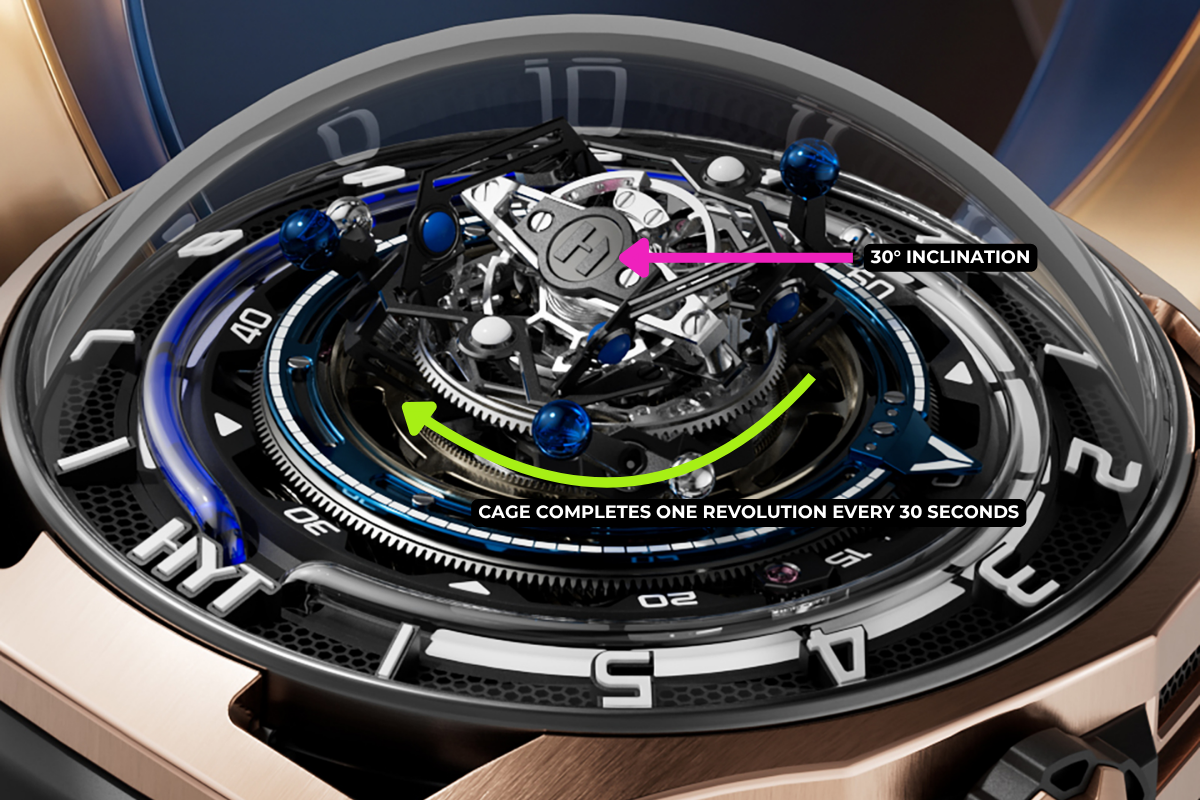
A central tourbillon with the balance inclined at 30° to the horizontal plane, the escape wheel at 15°, the pallet at 23°, and the cage makes a clockwise revolution every 30 seconds. The tourbillon carries three spheres (hand-blown glass, 2.5mm across, each filled with blue liquid in the Midnight Blue version) around once every 30 seconds while each spins on its own axis at four, five and six turns a minute.
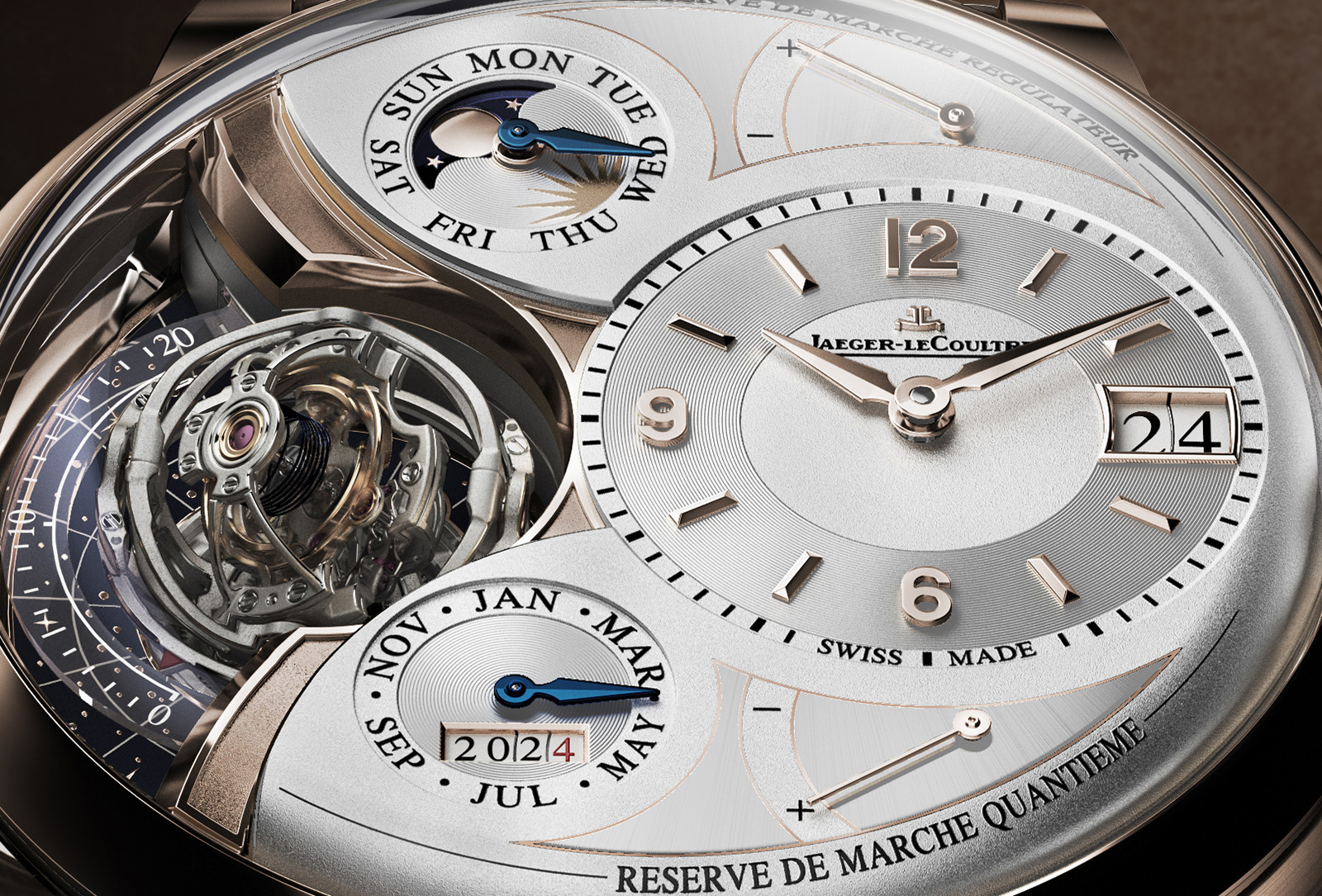
The inclined tourbillon is no longer an eccentric sub-specialty of independent watchmaking. It has become one of the central technical preoccupations of the entire haute horlogerie world. Jaeger-LeCoultre’s Heliotourbillon, first presented in the 2024 Duometre Heliotourbillon Perpetual Calendar, is perhaps the clearest evidence that the concept has reached the highest levels of Swiss horology. The watch’s power flow begins with a fundamental architectural decision that sets it apart from every other instrument in this lineage: the use of Jaeger-LeCoultre’s Duometre system, with two completely separate mainspring barrels and two completely separate gear trains, one dedicated entirely to powering the time and calendar display, the other dedicated entirely to the tourbillon regulator. The two trains are connected by a star-and-flirt. One barrel powers the time display and perpetual calendar. The second barrel drives another train that delivers energy to the Heliotourbillon cage system exclusively. This means that the fluctuating power demands of the perpetual calendar — the jumping of the date disk, the month wheel clicking forward, the leap-year mechanism advancing — never disturb the energy delivery to the balance. It is the constant-force principle pursued through energy segregation rather than through a remontoir.
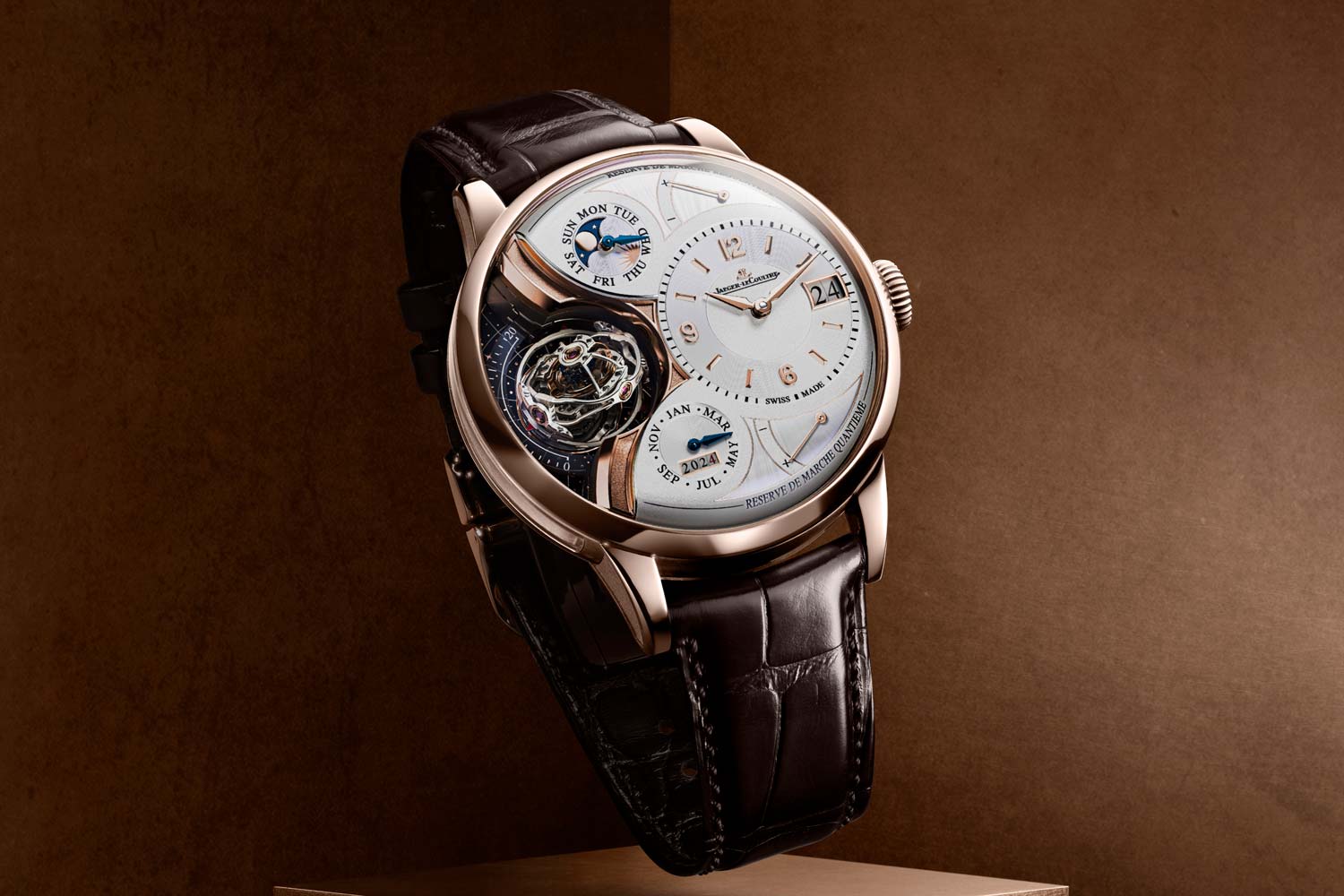
Jaeger-LeCoultre’s Duometre Heliotourbillon Perpetual Calendar
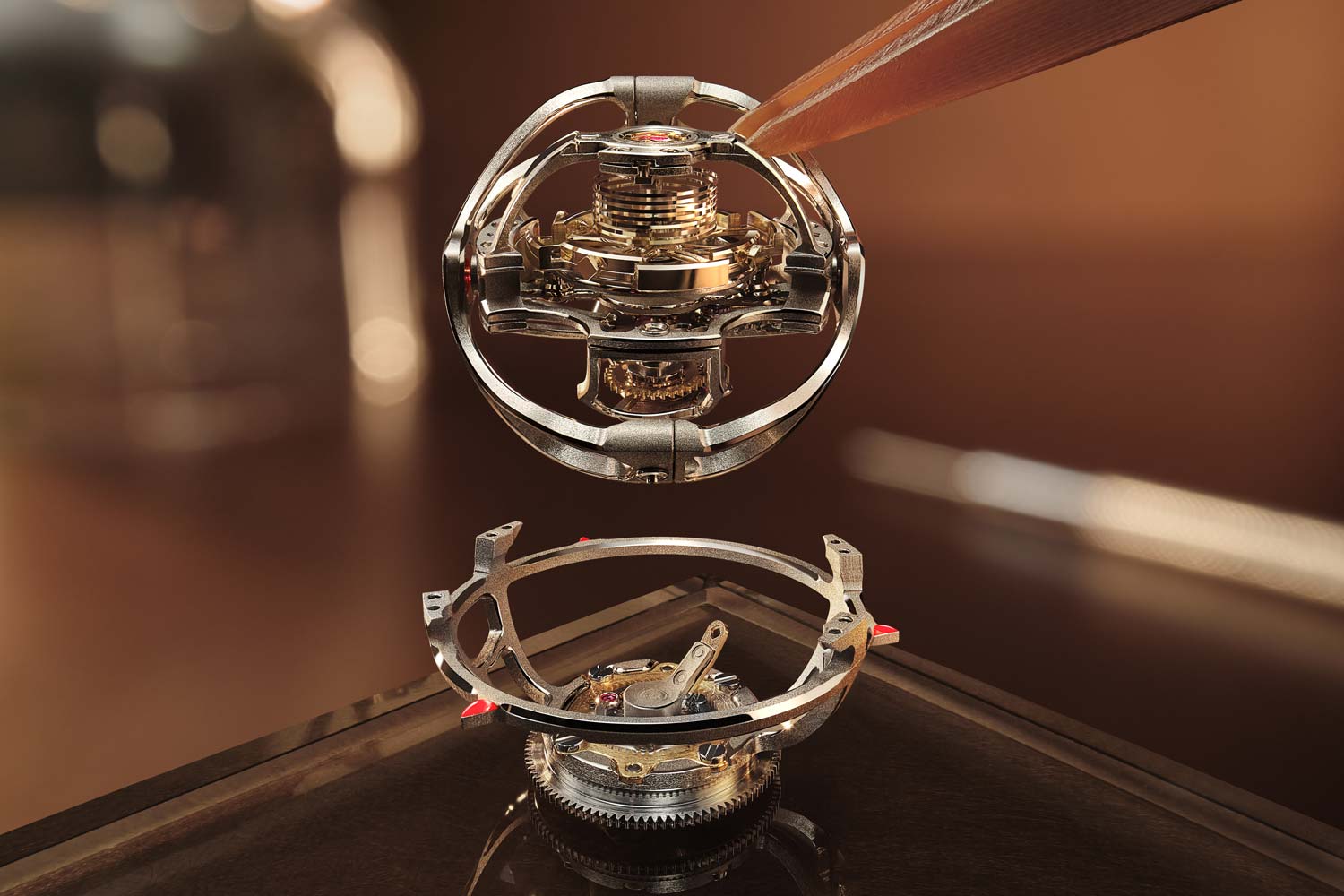
The inner cage pivots about an axis perpendicular to the balance staff, while the second cage pivots about an axis perpendicular to the first. A bent shaft inclined at 40° guides their combined motion through a complete cycle every 30 seconds while the outermost cage rotates the entire suspension once every 60 seconds.
The three-axis tourbillon at the end of that private power supply is a construction of considerable geometric originality. Three titanium cages are nested inside each other on ceramic ball bearings, weighing under 0.7 grams in total. The first cage is set perpendicular to the balance wheel. The second cage is set 90 degrees to the first. Together these first two cages are constrained by a common axis tilted at 40 degrees — this is the inclination element — and they complete one revolution together every 30 seconds. The third cage is perpendicular to the second and rotates every 60 seconds. The 40-degree tilt means the entire nested assembly traces a conical path through space as it rotates, ensuring the balance is continuously swept through both vertical and non-vertical orientations. The ceramic ball bearings are not a luxury detail: under the continuous loading of a three-axis rotating structure, conventional pivot friction would consume the energy that the dedicated barrel is trying to deliver precisely. The Heliotourbillon as a complete instrument is therefore two interlocking answers to the same problem — the Duometre ensuring clean, consistent power delivery; the three-axis inclined structure ensuring complete positional averaging of whatever that power drives.
Power from the movement enters an epicyclic gear train (differential) beneath the assembly. Its outer ring gear drives the outermost cage, while planet gears on a fixed carrier transmit power to the central sun gear attached to the bent shaft inclined at 40° from the vertical plane. This makes the bent shaft turn faster than the outer cage.
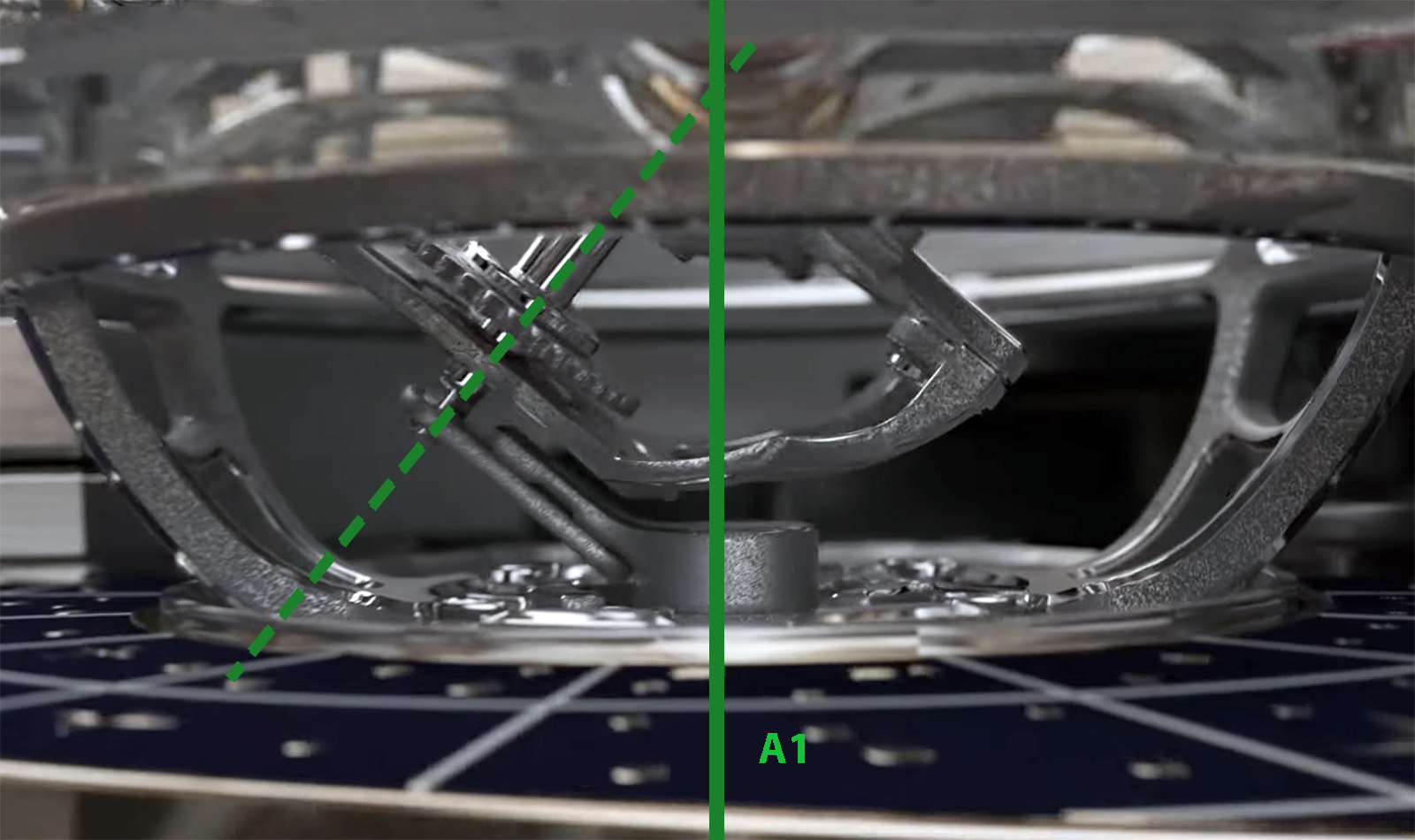
The bent drive shaft rotates about a vertical axis (A1), while its upper end, inclined at 40°, turns in bearings within the inner cage and sweeps out a cone. This forces the cage to change orientation as the shaft turns, while gearing inside the cage transmits power to the escapement
At Watches and Wonders Geneva 2026, ArtyA presented the Complexity — a watch that takes the inclined tourbillon in a direction none of the preceding instruments had explored: coupling two inclined tourbillons via a differential system. ArtyA calls the inclined tourbillon a Cônillon, and in the Complexity there is one at 12 o’clock and one at 6 o’clock. The power flow from a single manual-wind barrel feeds not directly to either cage but to a differential gear placed between them. The differential splits the torque from the barrel exactly equally and continuously between the two Cônillon regulators regardless of the state of wind of the mainspring. Each cage receives identical torque at every moment. The two cages then each orbit their respective fixed wheels, each completing one 30-second rotation, but in opposite directions to each other. The differential then averages the rates of the two regulators, so that deviations in one are moderated by the behavior of the other rather than being transmitted directly to the time display. For instance, if one Cônillon is running at a perfect rate and the other at +3, the differential produces an average rate of +1.5. If one is at -3 and the other at +3, their errors cancel completely.
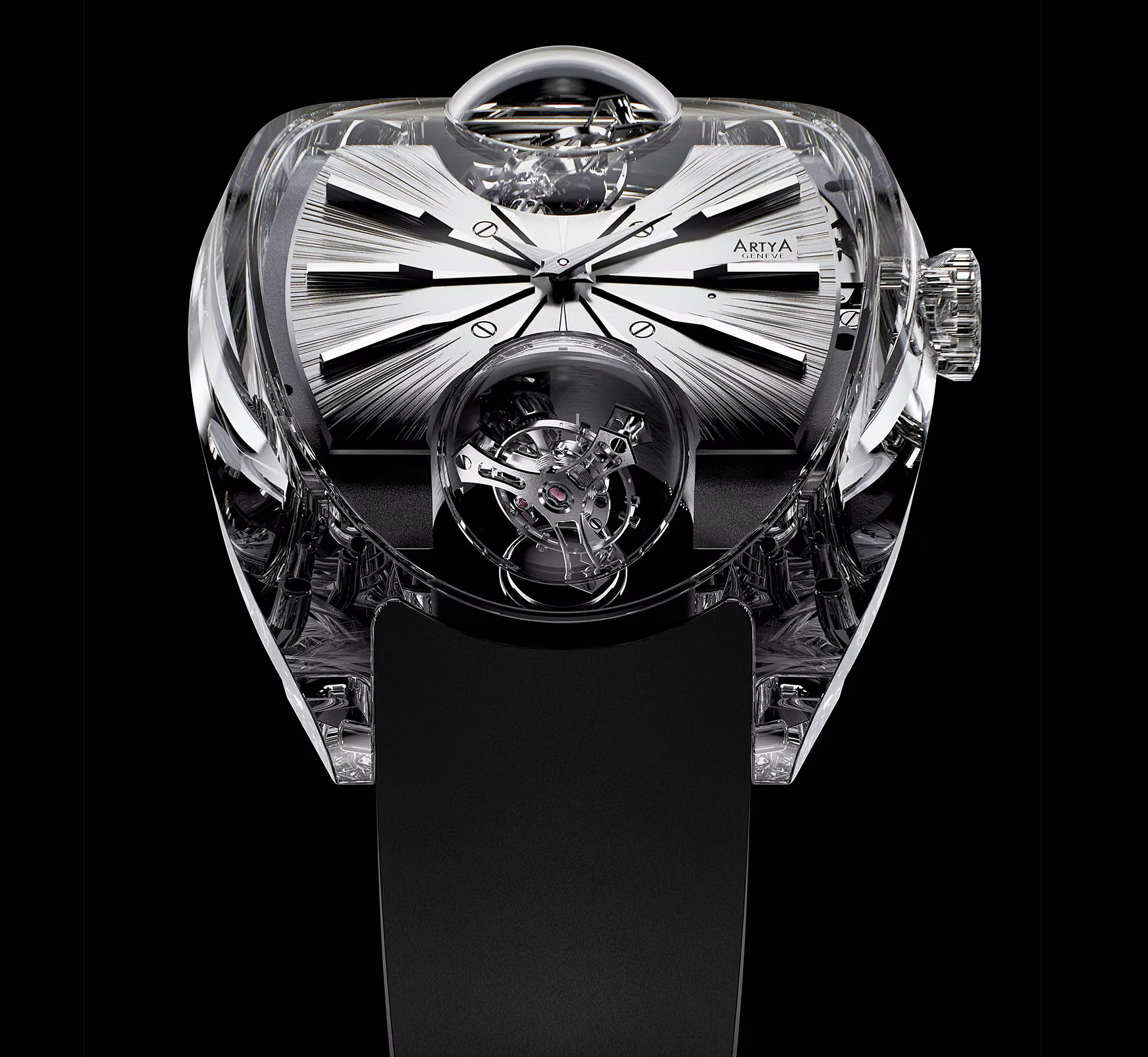
ArtyA’s Complexity
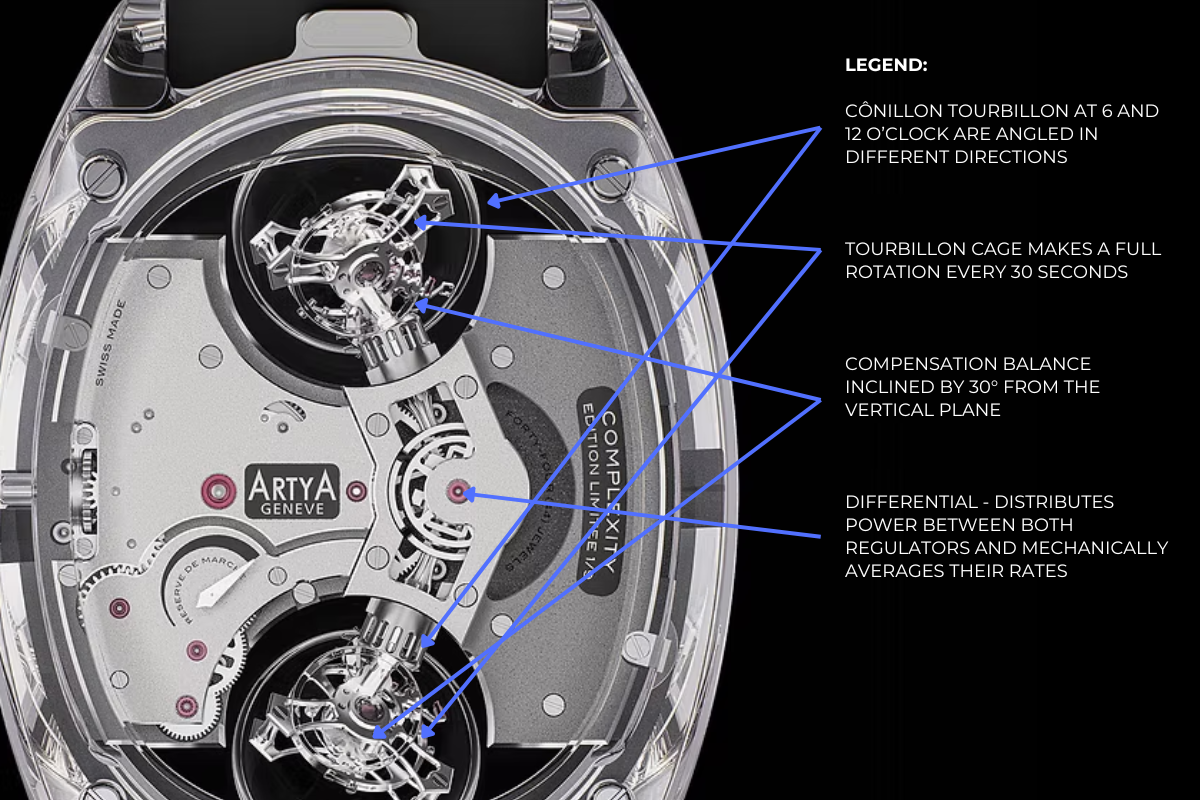
ArtyA’s Complexity on the movement sides, showing the two tourbillons at 12 and 6 o’clock linked by a differential visible on the movement side. The two tourbillons are angled in different directions, so that when one balance approaches a position where its rate deviates most, the other may partly offset that deviation through the differential
The movement was built by Purtec Sàrl of Vallorbe — also Éric Coudray’s own manufacturing partner for his independent work — and ArtyA explicitly credits Coudray as the inspirational lineage running through the watch, back through HYT to Prendel and to Andrew Potter. ArtyA’s own press materials date the Cônillon concept to approximately 1860. The Complexity is limited to nine pieces at CHF 190,000 in sapphire.
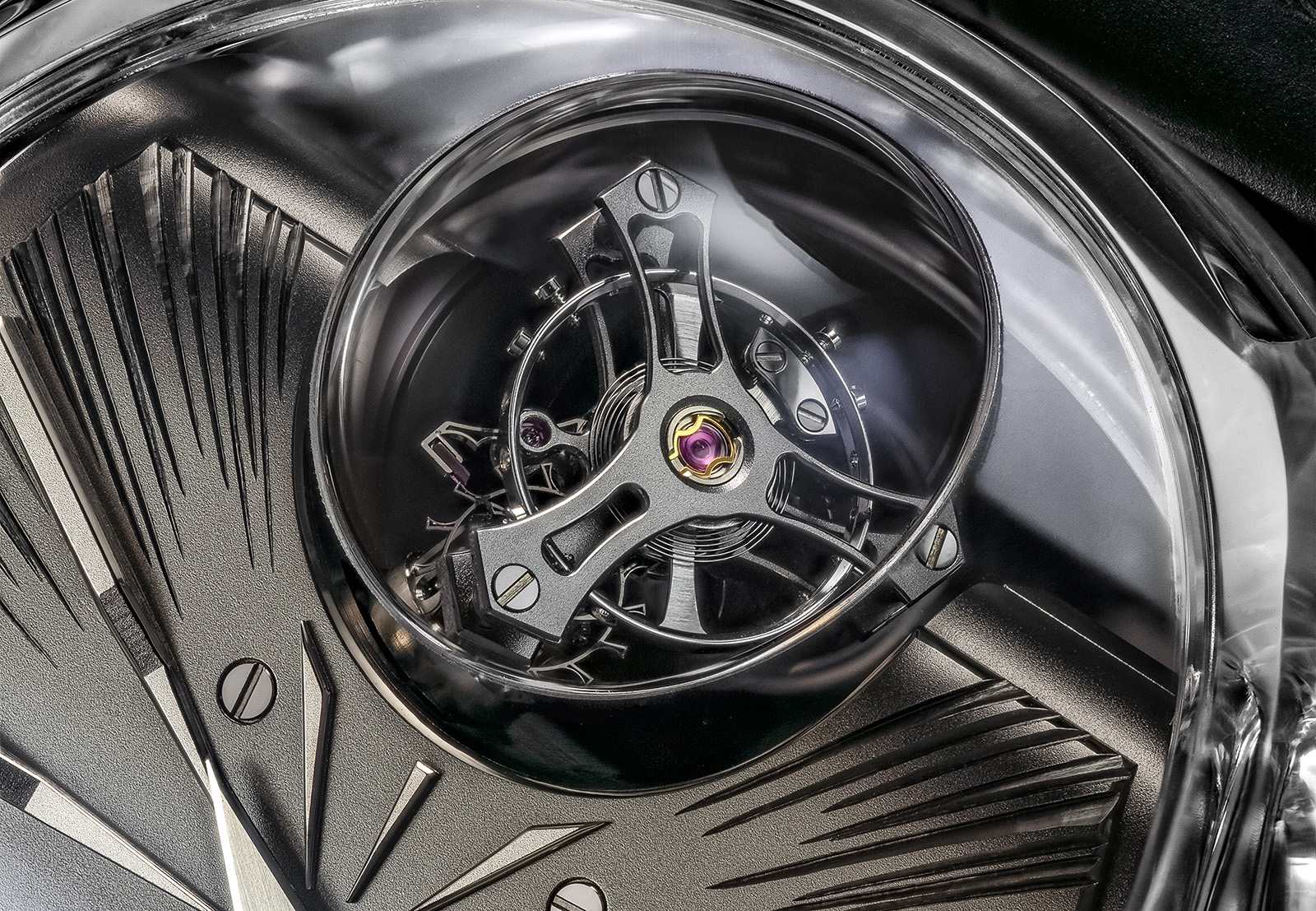
In each, the cage and balance share the same inclined axis, while the entire assembly rotates about a single axis parallel to the movement, allowing the inclined tourbillon to trace a conical path
I applaud Éric Coudray, Purtec and my friend Yvan Arpa of ArtyA for courageously writing the next chapter of inclined tourbillons and creating watches that indeed go to “11.”

You may also like
Editorial
The Impossibly Smooth Ressence Type 10 DN (Dark Night)
Oct 21, 2026
Editorial
The Impossibly Smooth Ressence Type 10 DN (Dark Night)
Oct 21, 2026

Editorial
Master of Control: Robert Pattinson
Oct 21, 2026
Editorial
Master of Control: Robert Pattinson
Oct 21, 2026

Editorial
The Family Business Rewritten
Oct 20, 2026
Editorial
The Family Business Rewritten
Oct 20, 2026