Monaco in Motion: TAG Heuer Monaco Split-Seconds Chronograph Air 1
Editorial
Monaco in Motion: TAG Heuer Monaco Split-Seconds Chronograph Air 1

There are few silhouettes in watchmaking as instantly recognizable as the Monaco’s. All sharp planes and square defiance, it arrived in 1969 as the antipode to polite horology — a rebellious block of steel representing the world’s first water resistant square case and one of the first automatic chronograph movements. It didn’t whisper its arrival, it roared it through the whine of an engine and the flicker of film. Seen on Steve McQueen’s wrist in Le Mans, it became shorthand for precision under pressure, for cool and for risk.

Steve McQueen wearing the Heuer Monaco in a scene from Le Mans (1971)
Half a century later, TAG Heuer hasn’t mellowed. It has refined, recalibrated, re-imagined, but it has never stopped pushing. And with the new Monaco Split-Seconds Chronograph Air 1, the brand has taken the spirit of that 1969 original and rebuilt it for an era defined by materials science and the relentless pursuit of lightness. This is not nostalgia, it’s acceleration.
Unveiled at Dubai Watch Week 2025, the Air 1 is totally familiar and, at the same time, completely original. The discernible square case has been hollowed and sculpted into something aerodynamic and skeletal, its Grade 5 titanium case weighing just 85 grams, even with its flashes of solid gold. That figure alone would be impressive, but the real achievement lies in how it was achieved. Using Selective Laser Melting (SLM) — a technique borrowed from aerospace engineering — TAG Heuer’s team built the case layer by layer from powdered titanium, fusing each level with a laser so precise it can draw in microns. The result is not a solid block but an exoskeleton: a lattice of tension that looks as if it were shaped by speed itself.
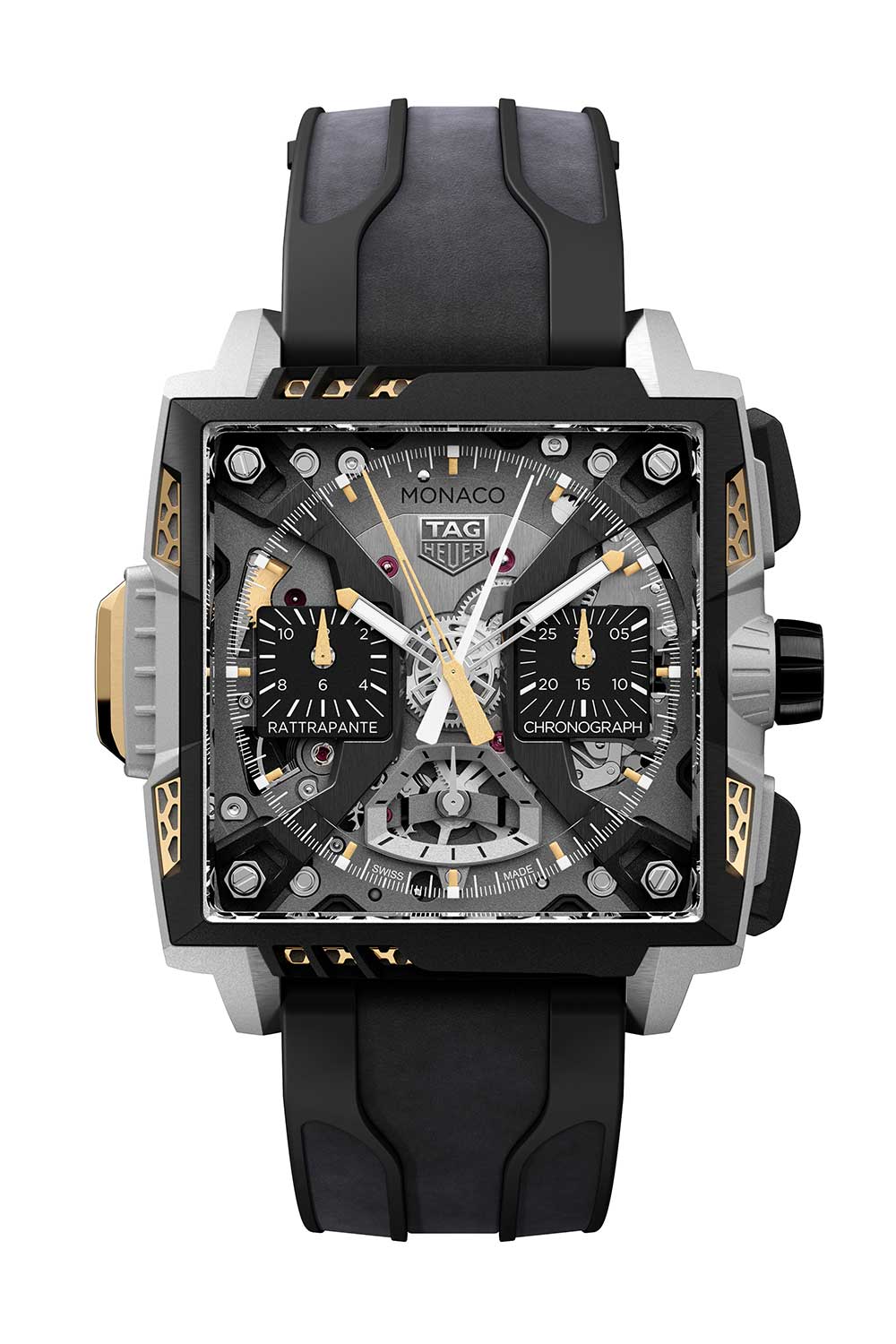
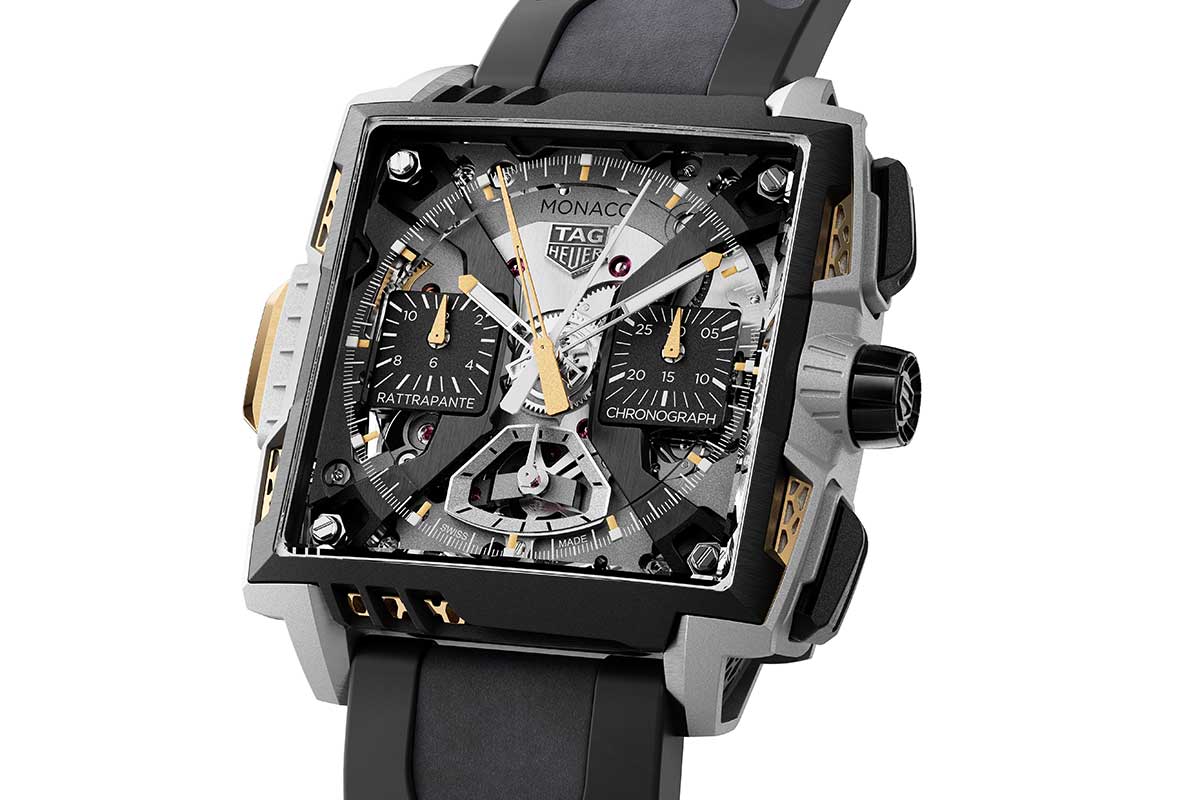
TAG Heuer Monaco Split-Seconds Chronograph Air 1
Every decision within this structure serves weight reduction, but never at the cost of strength. Inside, bridges have been lightened and hollowed, screws shortened and tolerances tightened to the edge of possibility. Even the sapphire crystal and strap buckle have been pared back to minimum mass. The result is not just a lighter case, but one in which the internal architecture works like a chassis — redistributing stress, improving rigidity and giving the watch a new kind of structural efficiency.
The weight reduction goes beyond a number; it changes how the watch wears, how it moves and even how it feels on the wrist. In the hand, the case feels paradoxical — muscular yet floating, the grain of sandblasted titanium cool against the skin, the golden lattice under the bezel glowing like engine heat. TAG Heuer CEO Antoine Pin calls it “a watchmaking revolution — the first time a watch engineer has been able to deliver a designer’s wildest creation.” The Air 1, in other words, is design unshackled.
Light as Air
Inside beats the Caliber TH81-00, a high-frequency automatic rattrapante movement developed with Vaucher Manufacture Fleurier. It runs at 36,000vph and stores 65 hours of power, yet the entire mechanism weighs only 30 grams. Built primarily from Grade 5 titanium, the movement is the lightest ever used by TAG Heuer — a feat that extends the philosophy of the case to the very core of the watch. This is the brand’s most sophisticated chronograph to date, and its function, the split-seconds complication, encapsulates TAG Heuer’s long-standing relationship with precision timing.
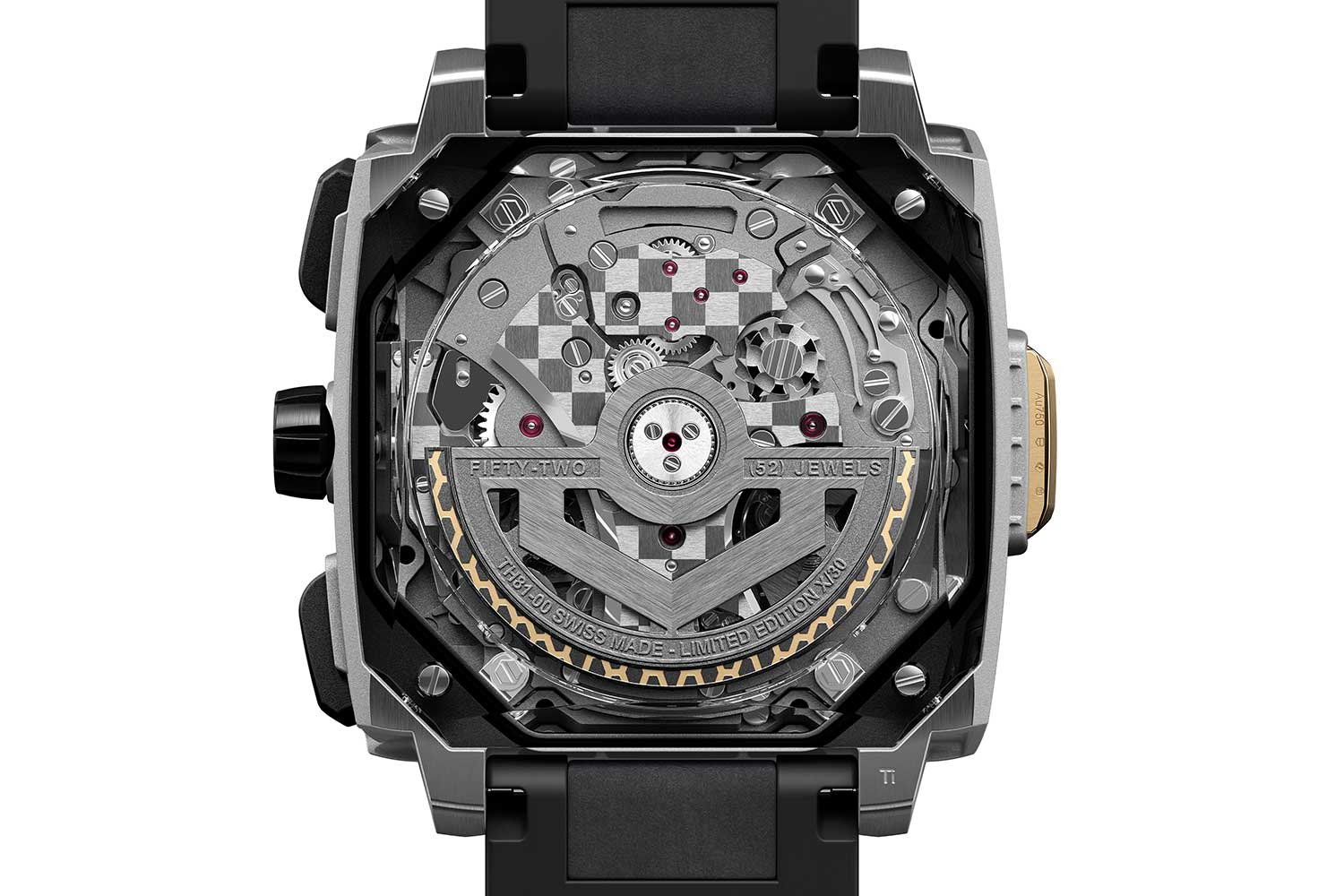
View from the caseback, the Caliber TH81-00
The rattrapante — from the French rattraper, meaning “to catch up” — is among watchmaking’s most demanding complications. It allows two events that start simultaneously to be measured independently, by means of twin chronograph seconds hands: one running continuously, the other that can be stopped and restarted to record lap times. It is the mechanical embodiment of the racing mindset — to measure difference, to find the marginal gains between near-perfection and victory. The split-seconds pusher on the Air 1, fashioned from solid 2N yellow gold at 9 o’clock, is not only an aesthetic nod to the original Monaco’s left-side crown but a symbolic one too: the link between timekeeping and competition, between the past and the perpetual chase for precision.
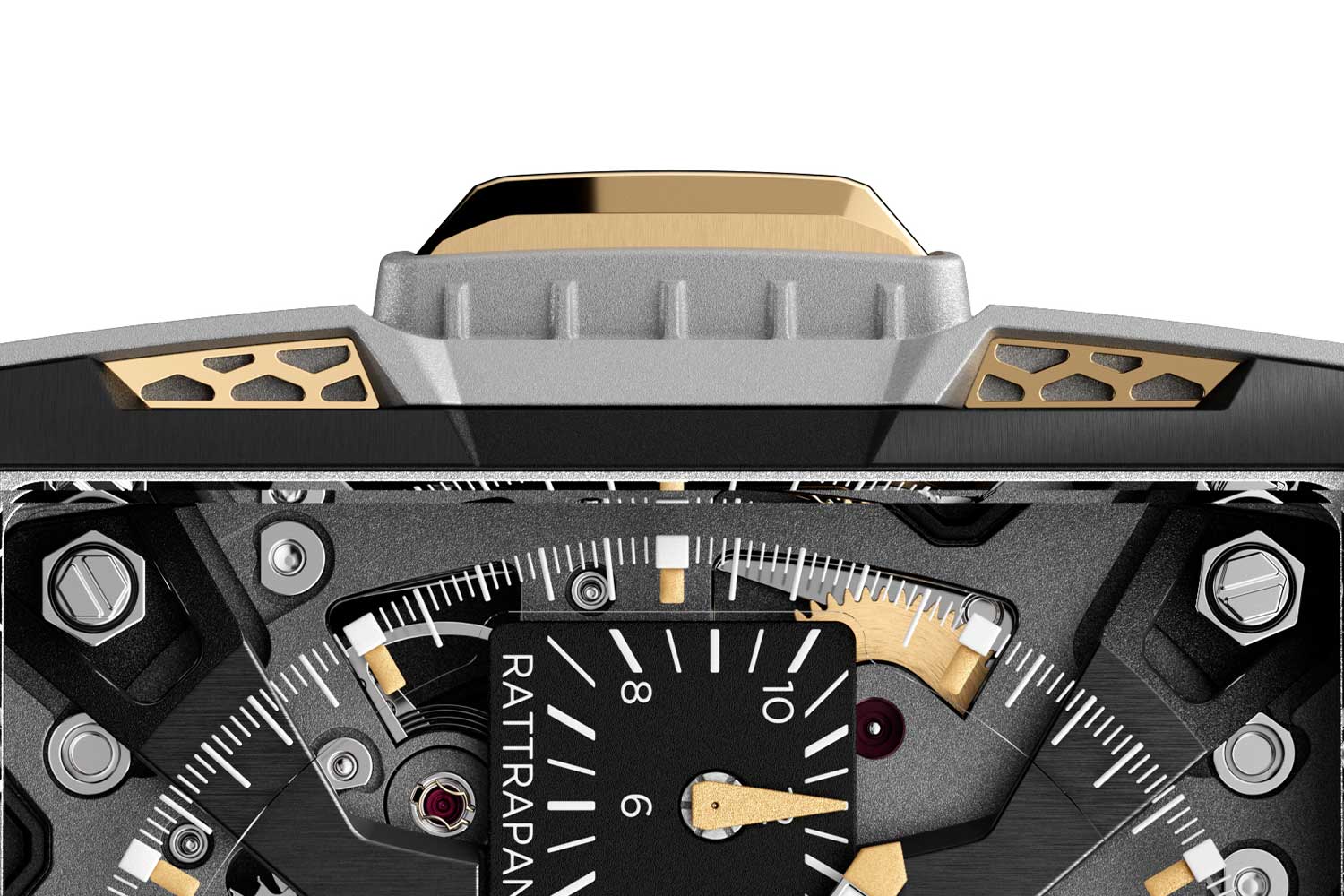
The solid 2N yellow gold pusher
In use, the mechanism is pure theater. Activate the chronograph and the twin golden seconds hands move as one; press the split-seconds pusher and they separate, one freezing while the other continues. Press again, and the first hand flies forward to “catch up,” aligning perfectly — a miniature choreography of precision and power. The sensation of engaging the pusher, the mechanical resistance beneath the fingertip, is addictive. It’s not merely a function; it’s a dialogue between the wearer and the machine, an echo of racing’s constant interplay between control and release.
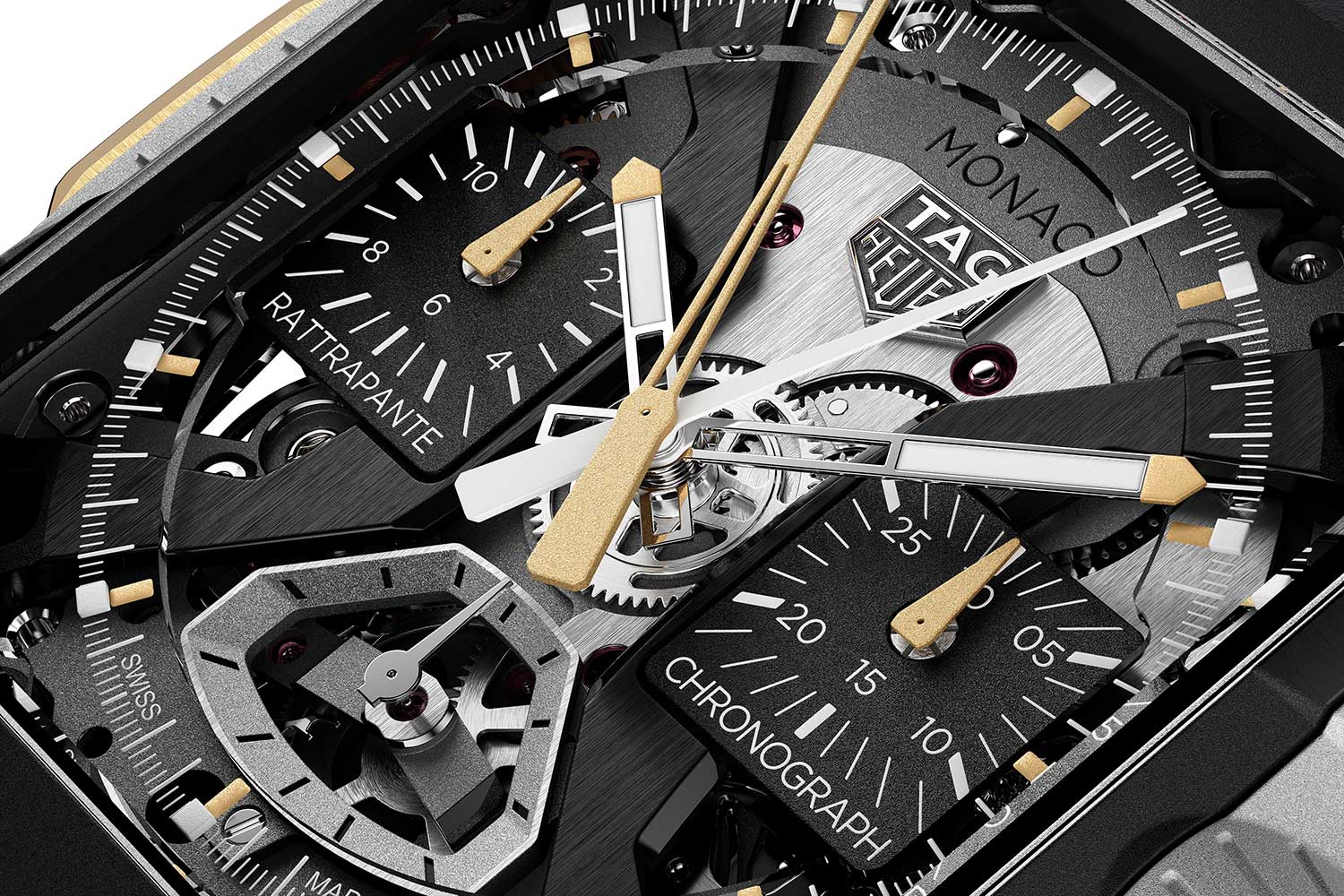
Close up on the dial
Weight reduction, in this context, becomes purpose rather than spectacle. The lighter construction reduces mechanical drag, helping the chronograph to reset more smoothly and lessening long-term wear on the movement. The Air 1 is not light for vanity’s sake but in order to maximize energy efficiency and performance. The case’s hollowed geometry, the movement’s titanium bridges, the reduced mass of the oscillating weight — each refinement contributes to a smoother, faster transmission of power, ensuring stability even at 5Hz.
The black rubber and Alcantara strap adds a tactile warmth that offsets the industrial chill of titanium, while the black DLC-coated clasp closes with a click that reminds you this is still a machine built for timing laps. Through the sapphire dial, golden chronograph hands sweep across the honeycomb structure like sunlight caught in motion. The visual depth is almost architectural: a transparent façade revealing the complex latticework that supports the engine within.
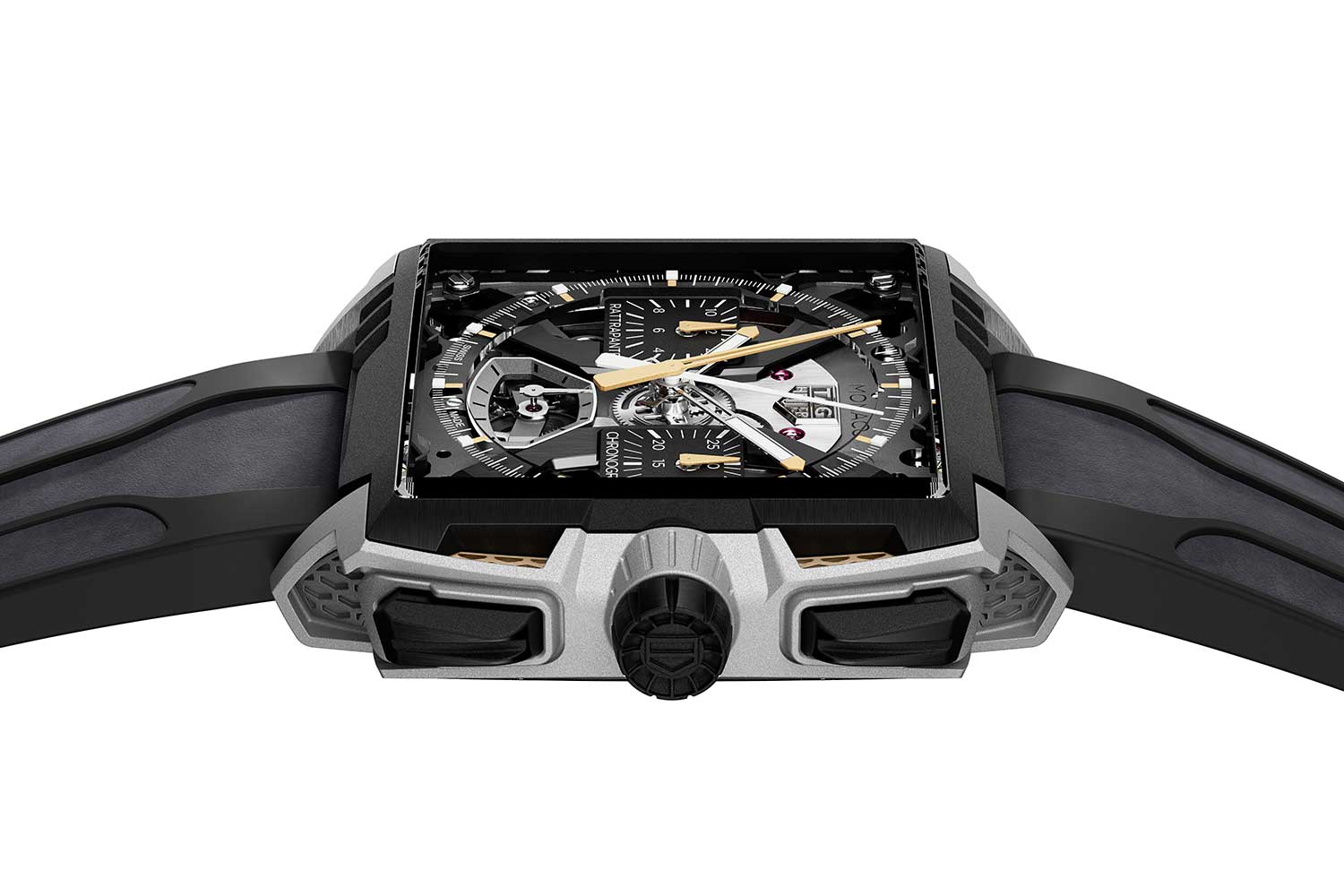
Side view of TAG Heuer Monaco Split-Seconds Chronograph Air 1
And yet, for all its futurism, this is unmistakably a Monaco. The square case, the left-side echo in the gold rattrapante pusher, the muscular symmetry — all the codes remain, reinterpreted through 21st-century materials. Since 1969, the Monaco has been TAG Heuer’s laboratory for disruption: the first square chronograph, the first automatic of its kind, the watch that proved function could also be attitude. With the Air 1, that attitude matures into a philosophy, no longer a rebel without a cause. The new Monaco redefines watchmaking by rebuilding from the atoms up.
Only 30 pieces will be made, each proving that craftsmanship and engineering no longer occupy separate worlds. The Air 1 is design serving technology and technology serving imagination — the circle finally complete. If the original Monaco captured the optimism of a mechanical age, this one captures the clarity of the material age: lighter, faster, more precise.
The Monaco Split-Seconds Chronograph Air 1 is not a fuzzy tribute to the past. It’s about momentum — and the courage to keep moving when standing still would be easier. In an era obsessed with revival, TAG Heuer has chosen reinvention. The result is a chronograph that doesn’t just measure time; it measures progress itself.

TAG Heuer Monaco Split-Seconds Chronograph Air 1
Tech specs: TAG Heuer Monaco Split-Seconds Chronograph Air 1
Reference: CBW218B.FT8124
Movement: Self-winding Caliber TH81-00; 65-hour power reserve (chronograph off) / 55 hours (chronograph on)
Functions: Hours, minutes and small seconds; chronograph with split-seconds function
Case: 41mm × 41mm; brushed Grade 5 sandblasted titanium with 18K 2N yellow gold lattices, and titanium bezel with black DLC coating; water resistant to 30m
Dial: Sapphire with white markings; white applied Super-LumiNova blocks and gold marking indexes
Strap: Black rubber and Alcantara; black DLC-coated Grade 5 titanium butterfly folding clasp with safety push buttons
Price: CHF 150,000
Availability: Limited edition of 30 pieces, from December 2026
TAG Heuer

You may also like
Editorial
Revolution Awards 2025: Material Innovation — TAG Heuer Carbon Hairspring
Jan 27, 2026
Editorial
Revolution Awards 2025: Material Innovation — TAG Heuer Carbon Hairspring
Jan 27, 2026
Editorial
Revolution Awards 2025: Best Collaboration — TAG Heuer Carrera Chronograph × Fragment Limited Edition
Jan 27, 2026
Editorial
Revolution Awards 2025: Best Collaboration — TAG Heuer Carrera Chronograph × Fragment Limited Edition
Jan 27, 2026
Watch Fairs
LVMH Watch Week 2026: TAG Heuer Puts All Eyes on Carrera
Jan 19, 2026
Watch Fairs
LVMH Watch Week 2026: TAG Heuer Puts All Eyes on Carrera
Jan 19, 2026