Introducing the Rado True Square Skeleton and the Rado Anatom
News
Introducing the Rado True Square Skeleton and the Rado Anatom

It’s almost impossible to overstate the importance of being known for doing something well. Being the “go-to” brand for XYZ in the minds of not just consumers but, perhaps more powerfully, unbiased observers is something very few companies or individual masters can claim as clearly and indisputably as Rado when it comes to ceramic technology.
Of course, flashier players in the same space exist. Bigger, shoutier brands have been known to make a real song and dance of their ceramic offerings. It’s arguable that the odd effort exists that is more impressive than Rado’s relentless output, but maybe that’s the key: Rado has so thoroughly bossed the serial production of ceramic pieces that it doesn’t feel anywhere near as special an achievement as it still is.
Making the remarkable commonplace is no mean feat. It is the nature of all high performers to have a preposterously elevated baseline but it’s easy to forget just how impressive that is unless you get up close and personal with the product or the process and experience it for yourself.
Having spent years of my life servicing and repairing the Rado product I can say this: they are extremely well-made things. While it’s true that every so often (especially when it comes to the bracelet construction), you do find yourself wondering whether the designers had been experimenting with mind-expanding substances before picking up their pencils, when you appreciate that ceramic does not behave anything like steel and needs to be treated very differently, the odd workarounds become more understandable, charming, even.
Rado’s expertise is on full display with both the True Square Skeleton and the Anatom, which have recently debuted. Both models express the Swatch Group brand’s command of ceramics in very different ways. The sleek, almost retro-style Anatom stands in stark contrast to the bolder True Square Skeleton.
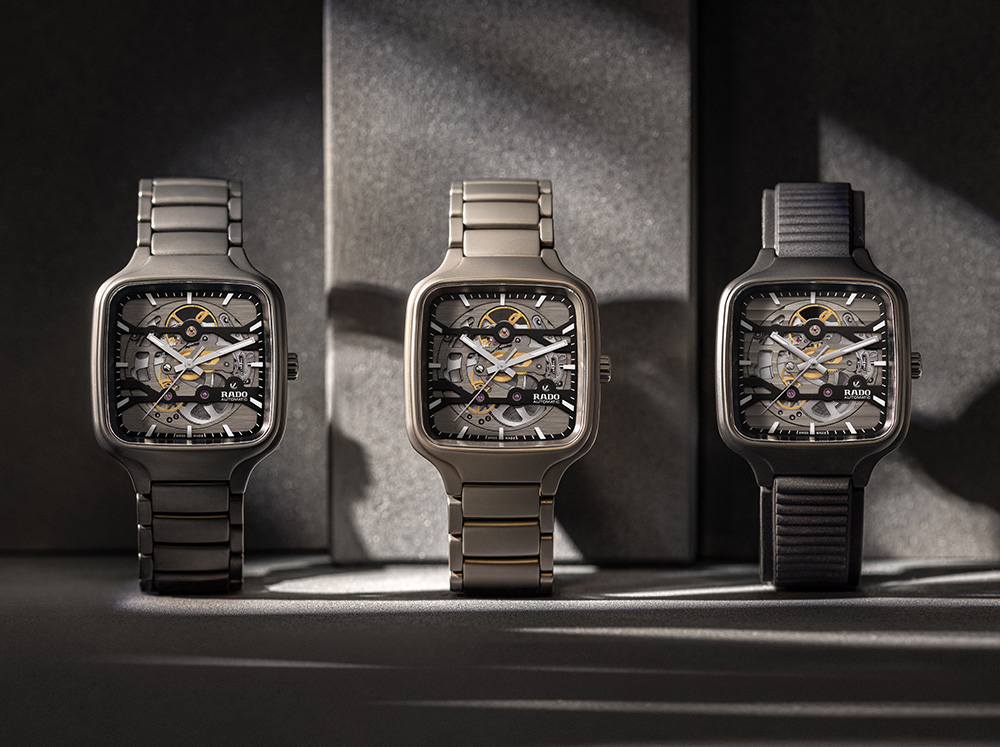
The Rado True Square Skeleton collection sees three new models join the lineup, each boasting an exposed movement. Despite using round calibers as one would expect at this price point, Rado has taken pains to disguise this by surrounding the watch’s engine with a form-fitting casing ring that is also finished with a horizontal straight grain in an attempt to blend it in to the movement. The aesthetic is rather successful in this regard, but it would have been interesting to see how much more convincing the illusion could have been if Rado had opted to hide the line break between the movement and the casing ring with a floating chapter ring that could quite easily have been supported by the striking horizontal bridges that give the watch an aggressively futuristic character.

Rado True Square Skeleton
What is particularly cool about those bridges (which run from ten to two o’clock and also eight to four o’clock) is how the jewels they would otherwise have obscured are instead highlighted by outlining rings. The brand’s wordmark and logo appear near the four o’clock marker, which is, for me, a pleasing position that bestows prominence upon the movement while fulfilling branding obligations.

Dial design aside, however, it is the cases (38 mm wide, 44.2 mm lug-to-lug, and 9.7 mm thick — water resistant to 50 meters) of these three models that make the biggest impact. These matte plasma high-tech ceramic cases, crowns, and (for two of the models) bracelets offer an edgy aesthetic that Rado confidently leans into. The star of the show is a gunmetal gray model that has a satisfyingly warm tone. The other two pieces both have matte black cases. One of them comes on a bracelet, but the other is deployed on a ribbed rubber strap, which is an extremely interesting twist on the collection. Generally, Rado seems to apply the “more ceramic the better” principle, but this unexpected dash of restraint has resulted in a model that might well be the most versatile and wearable of the bunch.

As always, Rado’s high-tech ceramic guarantees scratch-resistance and colorfastness, which means these pieces will be looking as fresh as they did when they emerged from the oven for years to come.
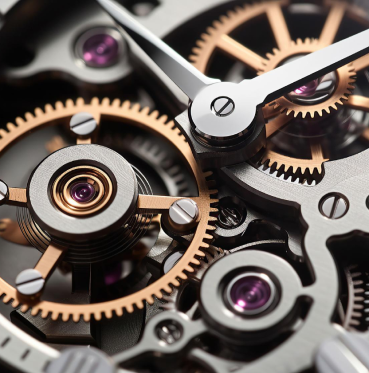
The movement enjoying pride of place on the dial (because it is the dial, effectively), has been given the in-house designation R808 and has a souped-up 80-hour power reserve.
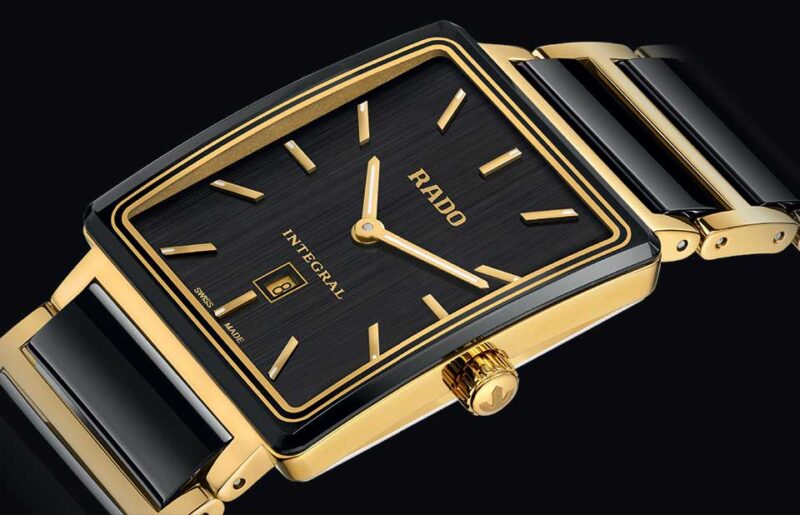
This differs slightly from the automatic R766 caliber powering the Rado Anatom collection, which has a slightly lower power reserve of 72 hours and a date window at 6 o’clock. However, when it comes to the Anatom, the movement is far from the main selling point. Instead, we have a glossy, angular homage to the trailblazing Rado watches from the 1980s and 1990s.

Rado Anatom

As a watch collector, I always gravitate towards the most on-brand products within a catalog. It makes sense to me to go to Omega for a chronograph, to Certina for a diver, or to Rado for a ceramic watch. And when it comes to ceramic watches, few make as much of the material as the Rado Anatom.
Available in three colorways, each one has a lot going for it. The most unusual of the trio is certainly the gray and rose gold variant. This is a color combination Rado has enjoyed considerable success with in the past, rolling it out in other watch families with aplomb. Here, although it is subtle and handsome, it is perhaps not quite as “Rado” as the two black versions, one accented with silver and the other with gold.
My personal preference when it comes to Rado is to embrace the ‘90s vibes of black and gold, but any of these watches, with their wearable dimensions (32.5 mm diameter, 46 mm lug-to-lug, and 11.3 mm thickness) and surprisingly sufficient 50 meter water resistance are willing and able ambassadors for the brand that everyone knows as the king of ceramics.
Rado

You may also like
News
Rado: Master of Materials
Apr 11, 2026
News
Rado: Master of Materials
Apr 11, 2026
Editorial
Design in motion with Rado and Tej Chauhan
Dec 4, 2025
Editorial
Design in motion with Rado and Tej Chauhan
Dec 4, 2025

Editorial
A Winter Wonderland of Watchmaking
Nov 14, 2025
Editorial
A Winter Wonderland of Watchmaking
Nov 14, 2025