
Examining The Dual Transmission System Of The Breguet Tradition Chronographe Indépendant 7077
News
Examining The Dual Transmission System Of The Breguet Tradition Chronographe Indépendant 7077

The Breguet Tradition Chronographe Indépendant 7077 is a complicated yet understated watch, exemplifying the kind of timepiece that the Swatch Group’s crown jewel is increasingly known for. Breguet has an unusual knack for making open-work dials that reveal the innards of a movement look demure and reverential rather than many more modern brands’ habit of making them look loud and disruptive. And this execution of the caliber 580DR is no exception.
Perhaps it is the architectural honesty of the stepped cocks of the beguiling but unflashy frosted finishing of the surfaces. Maybe it could be something as simple as the timeless shade of “Breguet blue” chosen for this piece (which, in fact, is all that’s new about it).

Tradition Chronographe Indépendant 7077 released in "Breguet Blue" in November 2024
To avoid talking about nothing but the color, I thought it would be a good opportunity to dive into the main feature of this watch’s movement and walk through exactly how it works and why that might be preferable for a connoisseur of haute horlogerie.
Two transmissions, one watch
It’s not something we’re used to seeing every day, but it’s also something we’ve become more and more familiar with in recent years as the boundaries of what is known to be possible in watchmaking expand evermore.
There are several reasons for dual escapements in one watch (with my personal favorite being an ingenious power reserve prolonging solution conceived by Vacheron Constantin (as referenced in this article by Cheryl from 2022).
In the Vacheron Constantin Traditionnelle Twin Beat Perpetual Calendar, one can toggle between two modes: active and standby. When being worn, the “active” setting should be selected, engaging an escapement that runs at 36,000 vibrations per hour (or 5 Hz). In standby, the watch can be set to run off an ultra-low frequency (and thus ultra-low consumption) escapement (operating at 1.2 Hz), which will allow this complicated calendar watch to keep on ticking for up to sixty-five days without attention. One of the most popular uses, however, is to power different functions, namely, the time and one additional complication such as a chronograph which is exactly what we see in the Breguet Tradition Chronographe Indépendant 7077.
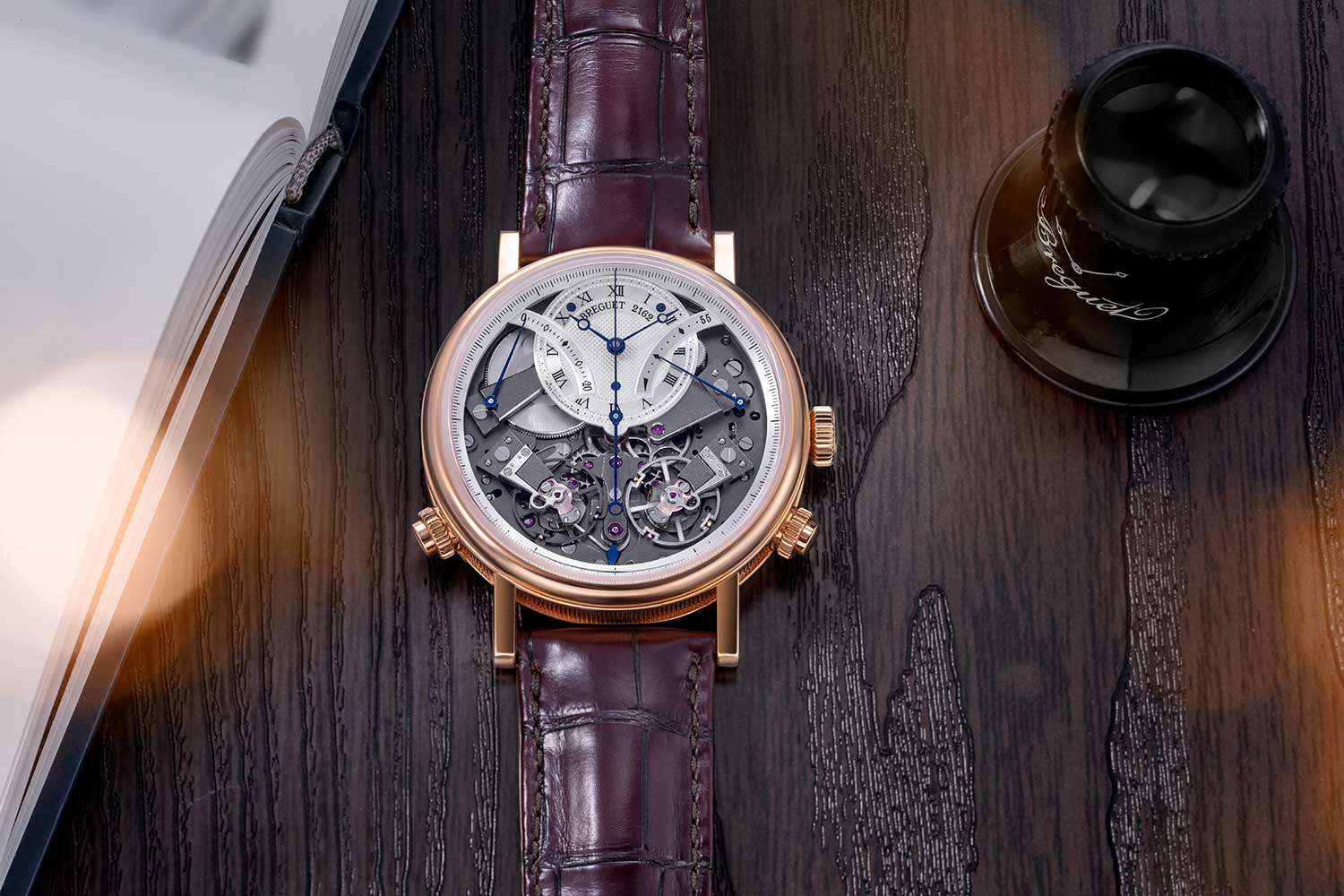
Breguet Tradition Chronographe Indépendant 7077 released last year in rose gold. Image: Revolution ©
It is particularly desirable to separate a chronograph from the time-telling gear train as the complication’s application has a significant effect on the amplitude of the balance wheel (often dropping it by around twenty degrees) due to the additional friction suddenly introduced into the equation, which can affect the watch’s ability to keep time evenly across all positions of wear (isochronism — literally meaning “in the same time” in Greek).
But what is amplitude?
While we’re used to talking about power reserves, operating frequencies, and accuracy parameters, one of the many crucial aspects of a watch’s healthy operation that doesn’t get mentioned all that often is amplitude. That’s mostly because it’s a rather unsexy element of a watch’s function and hard to build a good story around on its own.
When it comes to the aforementioned specifications, a power reserve can (theoretically) be infinitely increased (check out this incredible effort by Stéphane von Gunten for a good example of strides in this field). The same is theoretically true of an operating frequency (albeit with diminishing returns). Of course, timekeeping accuracy is frequently wheeled out as a reason for you to spend your hard earned cash on XYZ, because, of course, everyone still uses their mechanical wristwatches for precision timekeeping …
When it comes to amplitude, “it” cannot be improved, per se. Instead, only its consistency and stability are improvable. There is the odd fuseé-and-chain mechanism designed to provide a constant impulse to the escapement of the occasional remontoire system that also delivers nice even chunks of power to the watch’s regulating organ, but even then, we rarely talk about the amplitude itself.

Image: Beyond The Dial
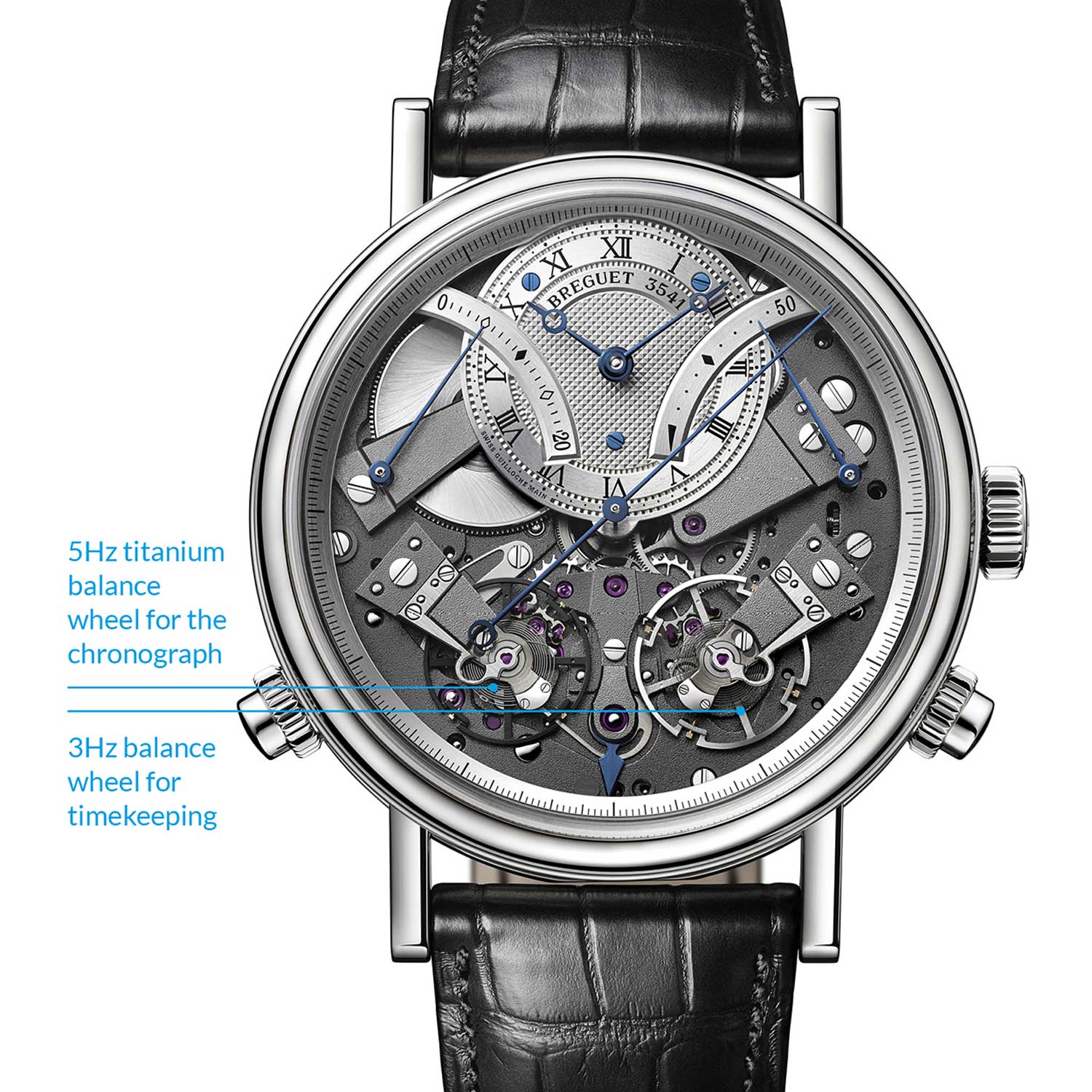
The Breguet Tradition Chronographe Indépendant 7077 with two independent transmission systems; one for timekeeping and one for the chronograph
While consistency and stability might be ideal qualities in an heirloom watch and/or life partner, they aren’t the qualities we generally lust over. Rockstars, athletes, the Zenith Defy Extreme chronograph. Those are the things likely to send you weak at the knees (and possibly even bring you to them). Conversely, detailed analyses of balance wheel amplitudes tend to be the preserve of buttoned-up-polo-shirt-wearing shed-bound middle-aged men huddled around an expansive train-centric diorama poring over a degree here or a degree there as their virginities grow back apace — trust me, I should know.
As you’re probably aware, the beating heart of a watch is its escapement. The escapement controls the release of the mainspring’s power. Sitting between the mainspring (in its barrel) and the escapement is a series of wheels known as the gear train. These wheels are under constant tension because of all that power the mainspring is trying to force through them at all times. If it weren’t for the escapement drip feeding that power to those wheels (and thus the hands), the wheels of the gear train would spin wildly and the hands would windmill around the dial for a few seconds until all the power of the mainspring had “escaped”.
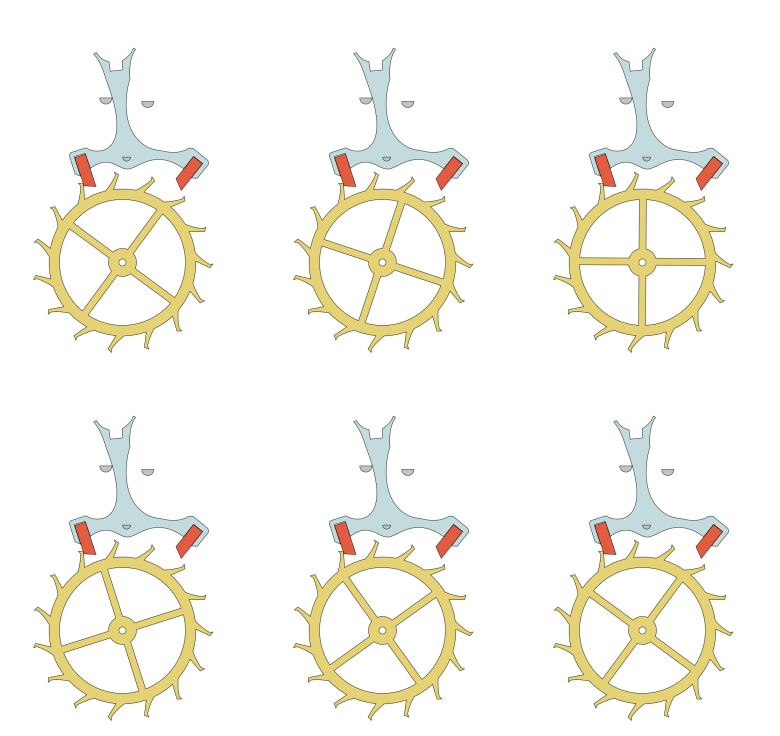
Animation of a lever escapement, showing motion of the lever (blue), pallets (red), and escape wheel (yellow). (Image: Wikipedia)
The escapement works by “unlocking” and “locking” the gear train. When the escapement unlocks, a small unit of power escapes from the mainspring in its barrel and advances the gear train. This locking and unlocking occurs thanks to the interaction of several components that comprise the escapement. The escape wheel makes direct contact with the last wheel of the gear train via its pinion. Its teeth are very oddly shaped — they look a bit like Italy (at least they do to me). These vaguely Italian teeth make contact with one of the strangest but most essential components in a watch movement: the pallet fork (also known as the anchor due to its shape).
The (almost always) jeweled tips of the pallet fork’s horizontal bar slam into the sole of Italy’s boot as the fork is moved from side to side by the balance wheel, which vibrates back and forth thanks to the regular coiling and uncoiling of the hairspring that sits atop it.

A close-up of the two independent transmission systems on the Breguet Tradition Chronographe Indépendant 7077. Image: Revolution ©
Read: The Detent Escapement in Wristwatches: Dream A (Big) Little Dream
Operating frequency is measured in vibrations per hour. Every complete movement from the theoretical point of rest to the maximum point of travel is regarded as one vibration. An oscillation is two vibrations (a rotation in one way and back in the other). So, for example, a 28,800 vph caliber vibrates (and ticks) eight times per second, but only oscillates four times per second (which is why a 28,800 vph caliber is also referred to as 4 Hz).
But really … What is amplitude?
I’m getting to that … The amplitude of a balance wheel equates to the “distance” (expressed in the degrees of a circle) of every vibration (so how much of a full rotation does it make when you measure from extreme (the theoretical point of rest, or “the beginning”) to extreme (the point of maximum distance of travel, or “the end”).
Imagine you took a marker pen and put a dot on the outer edge of the balance wheel. If the dot began and ended its rotation in the same place, the amplitude would be 360; if the dot only made it halfway around the circle before beginning its return journey, the amplitude would be 180 degrees.
Generally speaking, most modern watches will run at about 300 degrees amplitude in the dial-up and dial-down positions, with the edge positions coming in around 20 (ish) degrees lower than that.
Many watchmakers would argue that an operational amplitude of 280 degrees in the dial-up, dial-down positions is actually the optimum figure when it comes to maintaining elite isochronism. Therefore, while fully wound, the 20-degree drop-off in amplitude you might expect from activating a chronograph is hardly disastrous.
However, that theory in principle can only be applied confidently to self-winding watches. For watches using manually-wound movements, it’s a different story entirely.
Breguet’s independent transmission systems
Power is precious. Its consumption is something designers of manual watches strive to avoid. In fact, because of that, it is very common for manual movements to operate at a lower frequency as fewer ticks per hour equates to lower power consumption. The problem is that when it comes to chronographs, you want high accuracy. Being able to split a second into five pieces (18,000 vph), six pieces (21,600 vph), or even eight pieces (28,800 vph), isn’t as good as ten (36,000 vph). Or even more, for that matter …

Image: Revolution ©
Here, the Breguet Tradition Chronographe Indépendant 7077 has two entirely separate gear trains that share a single barrel, which transmits power to the chronograph train by way of a tensioned spring, allowing for highly precise measurements over a short period thanks to the chronograph train’s 36,000 operating frequency. Meanwhile, the time-telling gear train’s count comes in at 21,600 vph (3 Hz) and offers a sufficient 55-hour power reserve.

The back of the manual-winding Caliber 580DR. Image: Revolution ©

Image: Revolution ©
Considering how much is going on inside this Tradition Chronographe Indépendant 7077, the fact it is only 44mm wide and 14.1mm thick is rather impressive. Additionally, the open dial and finely finished movement components give the whole appearance an airier feel.
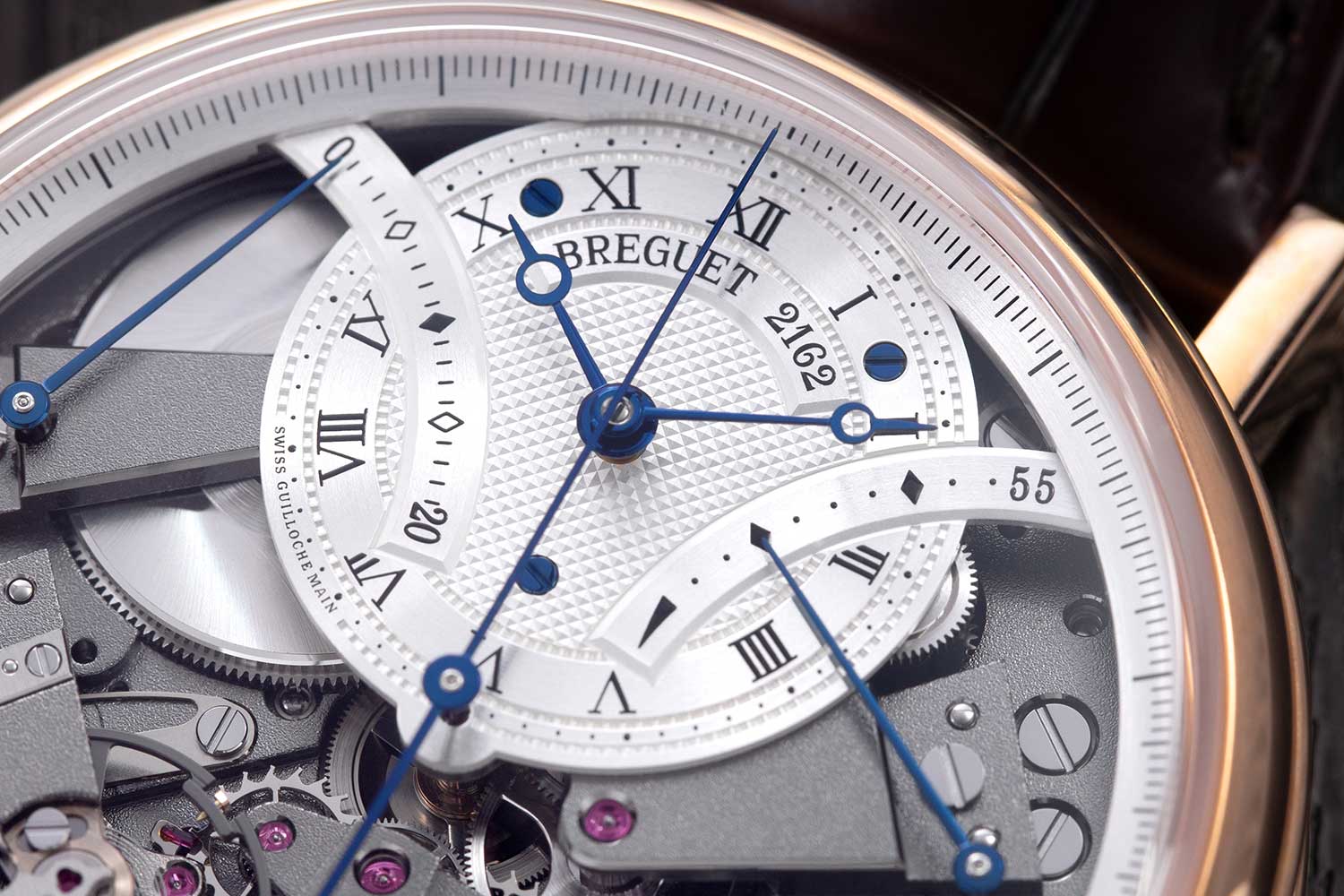
Main hours are read at the top of the dial, with a 20-minute retrograde counter at 10 o'clock and a 55-hour power reserve at 2 o'clock. Image: Revolution ©
Aside from the fact this is exactly the kind of watch Breguet should be producing (because the world needs Abraham-Louis Breguet’s legacy to continue in this modernized guise), this subtle 18K white gold entrant in the brand’s signature shade of blue is a delight that has the potential to send a conversation about its design or operation in many different directions.


Tech Specs: Breguet Tradition Chronographe Indepéndant 7077
Reference: 7077BB/GY/9XV
Movement: Manual-winding Caliber 580DR; 55-hour power reserve
Functions: Hours and minutes; small seconds; chronograph; power reserve indicator
Case: 44mm × 14.1mm; 18K white gold; water-resistant to 30m
Dial: “Breguet Blue” galvanic treatment and Clous de Paris guilloché
Strap: Alligator leather in “Breguet Blue”/blue/brown
Price: CHF 86,500 (incl. VAT)
Breguet
You may also like
News
Last Week in Watches: Moser Goes Off-Grid, the Vacheron Constantin Overseas Turns 30
Sep 28, 2026
News
Last Week in Watches: Moser Goes Off-Grid, the Vacheron Constantin Overseas Turns 30
Sep 28, 2026
Reviews
Breguet Marks the 225th Anniversary of the Tourbillon with Four New Watches
Jun 26, 2026
Reviews
Breguet Marks the 225th Anniversary of the Tourbillon with Four New Watches
Jun 26, 2026
Editorial
Breguet Classique Chronométrie Ref. 7727: The World’s Most Accurate Mechanical Watch?
May 29, 2026
Editorial
Breguet Classique Chronométrie Ref. 7727: The World’s Most Accurate Mechanical Watch?
May 29, 2026