
Why Are Hardstone Dials Everywhere?
Why Are Hardstone Dials Everywhere?

You might have noticed that, recently, many watch brands, both young and old, have been releasing models fitted with stone dials. While this practice is far from new, the sudden refocusing of attention on this particular aesthetic is striking.
Perhaps due to the restrictive nature of the canvas with which watch designers must work, it is far from uncommon to see ancient arts resurrect time and time again. For years, enamel dials were out of fashion, with consumers favoring a more ascetic, modern, highly-technical composition. But times have changed. Brands ranging from the entry-level luxury bracket such as Glasgow’s anOrdain, up to haute horlogerie maisons like H. Moser & Cie, have embraced the warm, inviting tones and textures of enamel to great effect. Similarly, stone dials are suddenly the order of the day, with recent examples from heavyweights such as Rolex, Audemars Piguet, and Piaget, and smaller up-and-coming independents like Berneron, Toledano & Chan, and even Formex.
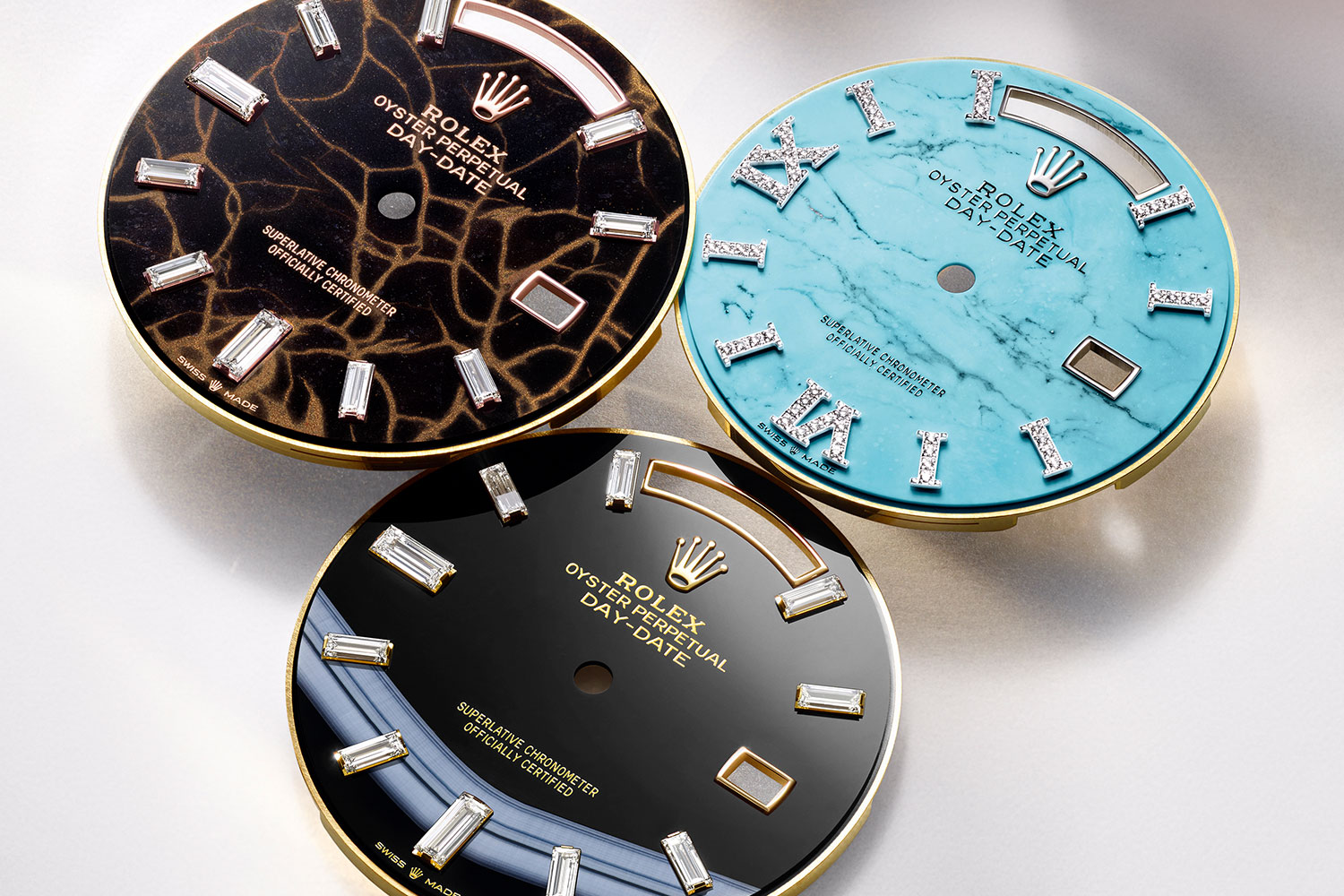
Dials in decorative stone: eisenkiesel (Day-Date 40), onyx (Day-Date 40) and turquoise (Day-Date 36) ©Rolex/Ulysse Fréchelin
What is particularly interesting is that both Toledano & Chan and Formex produce watches with genuine stone dials retailing for less than US$5,000, proving that while this particular craft skill was once the preserve of major brands with deep pockets, it is becoming more accessible than ever.
That’s good news for the consumer who may have found themselves lusting over but unable to afford an onyx dial Rolex Day-Date or a Coral-faced Piaget in the past. They are now more able to buy into this returning trend.
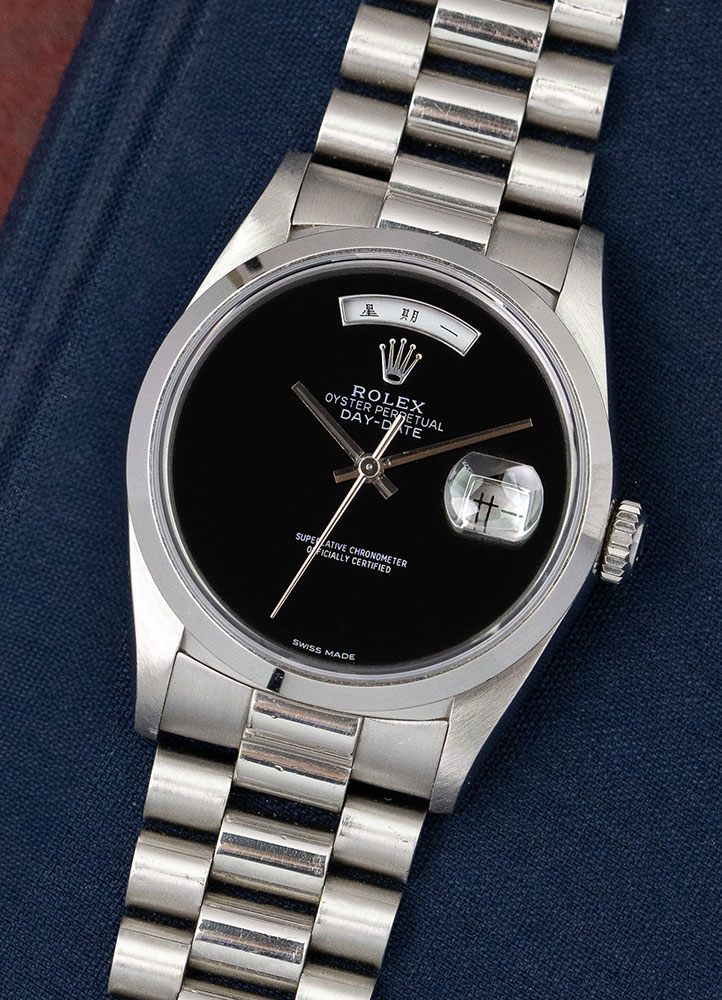
Rolex Day-Date with an onyx dial in platinum from 1990. This reference was sold via Singaporean retailer The Hour Glass, thus featuring the "day" disc in Chinese (Image: Amsterdam Vintage Watches)

Piaget 'Coral' Octogonal Dress Watch circa 1980s (Image: Analog Shift)
But why are stone dials making such a comeback in a big way? What conditions have arisen that make 2024 such a suitable moment to release pieces that, just ten years ago, might have been seen as regressive or passé?
The answer is a mixture of trends and market virility. Following the boom times of the pandemic, the watch market has cooled considerably. Buyers went from ultra-confident to highly skeptical as many of them were burned by skyrocketing prices that seemed, at the time, only to be going in one direction but then crashed. That which went up has, in almost all cases, returned to Earth with a bump.
Huge, reputable maisons are struggling. Newer, previously optimistic brands on the cusp of reinvesting for their next round of production have been given pause for thought. No one is safe. In this era, the most important thing one can do to appeal to a cautious consumer is to add tangible value to a product without jacking up the price unreasonably. And this may be where we find our first explanation for the sudden popularity of stone dials.
A stone dial adds aesthetic value
Not only is the raw cost of an attractive stone higher than a sliver of painted brass, the failure rate is high, which pushes up the cost of producing stone dials considerably. The natural pattern of the stone cannot be foreseen prior to cutting and may not be suitable to function as a legible watch face, and then, perhaps even more of an issue, the cutting and finishing process itself.

Piaget Altiplano featuring the use of malachite in a mesmerizing arrangement in marquetry
In the old days, very few brands countenanced the use of stone dials and almost all watches that did employ them were very expensive pieces. Nowadays, though, with the advancements in technology, stone dials are becoming cheaper to produce. That’s good news for everyone as watch companies of lesser means can now explore this attractive style of display and consumers can buy into it at a lower price, which, strangely, doesn’t seem to diminish the perceived uptick in the value of the piece.
Take the recent release from Formex Essence ThirtyNine Automatic Chronometer “Malachite”, which boasts a malachite stone dial. At just US$2,450, there was a theoretical risk that the Formex could devalue the stone, rather than the stone adding value to the watch. It would have been fair to ask if having such an accessibly priced piece with a genuine malachite dial would have somehow ruined the mystic of the material. Was it too cheap? As it turns out, judging by the response to this extremely well-received model, the answer is no.

Formex Essence Automatic Chronometer "Malachite" in 39mm retails for US$2,600

Omega Seamaster 300 in yellow gold
People aren’t stupid. Malachite is malachite. It’s the same in a US$42,000 Omega and a US$2,500 Formex. And that makes the latter a serious value proposition.
And so the improvements in technology and the associated reduction in production costs, along with the intrinsic, immovable perceived value of hard stone dials, and the brutal market conditions that have reduced the average watch buyer to a nervous wreck, eagle-eyed in their pursuit of a bargain, have all contributed to the resurgence. But one other, perhaps less obvious trend that has made using stone dials more viable is the return to smaller watch diameters.
Size matters. Also, to vein, or not to vein?
The smaller the dial, the less chance there is to mess it up. Smaller dials require less raw material, less time to produce, have better aesthetic homogeneity, and look more refined at smaller and mid-size diameters (although that last point is admittedly more subjective).
Of course, this is largely dependent on what you’re looking for and what you do with what you’ve got. Many different maisons approach the task of selecting a stone dial differently and there can be many reasons for each of the different objectives they may choose to set. My point is that the optimum dial depends on your aesthetic and emotional goals.

HublotClassic Fusion Elements II Special Edition for The Hour Glass comprises five new models in 42mm titanium, featuring dials in nephrite jade, turquoise, pink jasper, sodalite, and lunar meteorite
For example, some brands, such as Van Cleef and Arpels, especially prefer really clean stone. Patterns, inclusion, natural deviations, color blemishes, and the like are avoided. Only the purest, crispest, richest colors make the grade. This gives the impression of perfection. The objects look like they’ve been hewn by the hands of God, conjured from thin air, born not made. They are designed almost to remove us from reality; to wrestle a natural material into absolute submission and revel in its constrained beauty. And that’s an entirely valid strategy. It tells a story of mastery over the elements rather than a celebration of their natural beauty, which is the other way brands can go with stone selection.

Van Cleef & Arpels Sweet Alhambra watch in 18K yellow gold with diamonds and turquoise dial

Van Cleef & Arpels Perlée Toi & Moi secret watch, small model
Take the Day-Date models released by Rolex at Watches and Wonders in 2023 that featured three 36mm stunners — one with a natural green aventurine dial, one with a warm carnelian dial, and one, quite importantly, with a turquoise display that embraces the stones’ natural imperfections.
So why might a watchmaker take the opposite tack to Van Cleef & Arpels and deliberately draw attention to the inconsistencies in the stone dial that they’ve deemed the appropriate choice to compliment a watch worth tens of thousands of dollars in total?

Rolex introduced new stone dials in Day-Date 36 models in 2023, including this turquoise dial in white gold ...
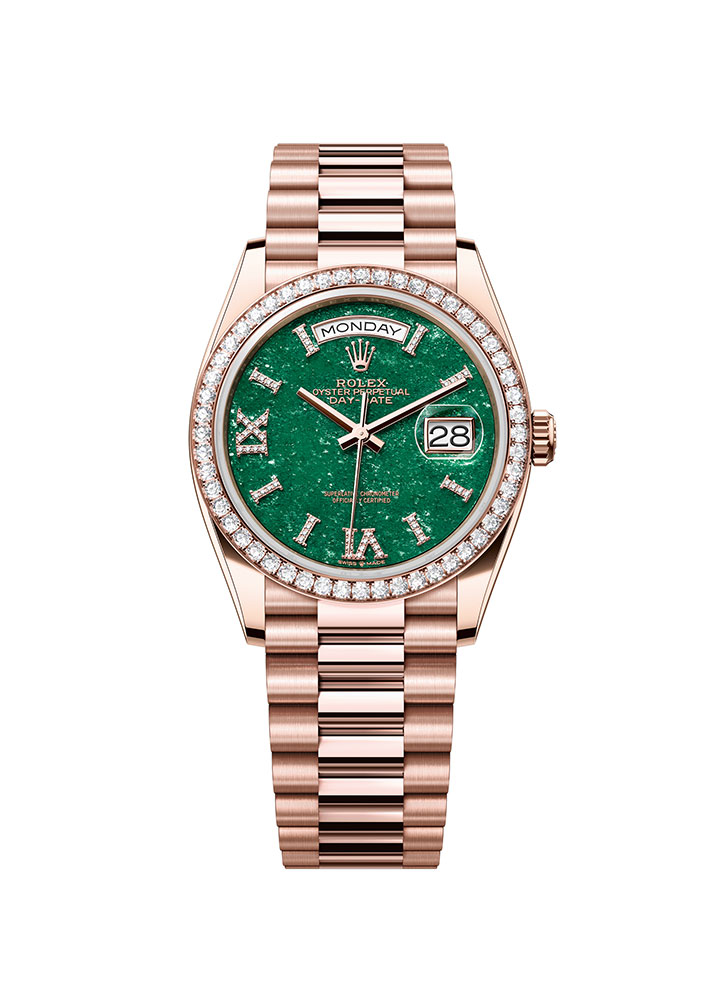
... a rose gold model with green aventurine ...

... and a carnelian in yellow gold
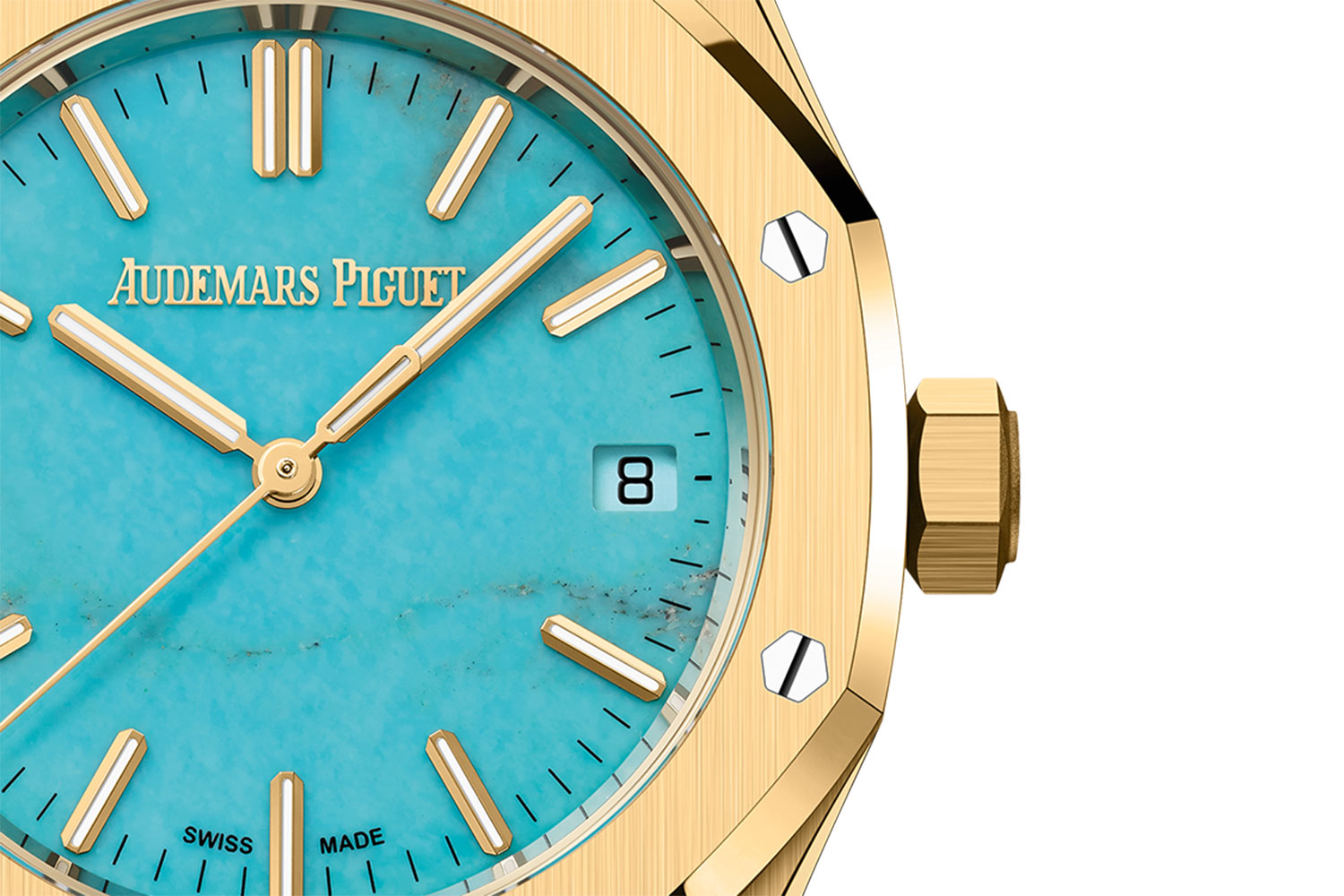
Audemars Piguet embraced using natural turquoise stone in the 37mm Royal Oak Selfwinding yellow gold model, resulting in one-of-a-kind dials due to the differing composition, texture and color in the stones selected
Two words: emotional resonance. It’s all about inviting a natural state onto the wrist. By containing an imperfect slice of turquoise within a perfectly machined precious metal case and adorning it with diamond hour markers and precious metal indices, the brand is honoring the value of the material and presenting the wild beauty of nature in contrast to the sterility of industry. Interestingly, this connection to nature through the use of natural stone dials is also likely something that touches a younger audience which is more attuned to environmental issues than previous generations.
Returning to the different ways in which natural stone dials can be finished to achieve different visual effects and stir different emotions, I would point to the latest release from Jean-Claude Biver and son’s eponymous brand’s latest release, which totes a frosted obsidian dial.

Biver Automatique in platinum with a sanded obsidian dial
I’d never heard of frosted obsidian before this release hit the market. I didn’t even know the finishing technique we’re used to seeing on tactical watches would work on a stone we’re more used to seeing polished to a high gloss. The effect is mesmerizing, ethereal. It transforms the character of the stone entirely. What was originally noble, refined, and traditional, becomes rebellious, edgy, and ultramodern. In itself, this material and finishing combination tell the story of the Biver brand. It is tradition and modernity in perfect harmony. The material is the old master (Biver); the finishing is the flame of the future (his son Pierre, head watchmaker of the brand). Through a single component, a narrative can be delivered.

Kross Studio KS 06 Turquoise
Even ultramodern brands like Kross Studio are dipping into this trend, having identified a way to perhaps subdue the outlandishness of their wild, complication-focused design language with a dollop of good old-fashioned class. The Kross Studio KS 06 Turquoise is the perfect example of a forward-thinking, design-driven brand paying lip service to the old crafts and acknowledging that nothing in watchmaking can ever stray too far from whence it came, without looking back over its shoulder and tossing a respectful nod in its direction.
The price of good stone
And speaking of design, it has never been more important. High concept, ambitious design can cut through some of the skepticism in a market that is becoming increasingly suspicious of the same old releases from the same old brands. They’ve been stung too many times before by a “sure thing”. Surely it’s more likely then, that a brand pairing truly novel aesthetics with the added value of a hard stone dial at an attractive, accessible price, is likely to meet with success.
Here we have two recent examples at opposite ends of the pricing spectrum. Let’s start with the Toledano & Chan B/1 watch with its lapis lazuli dial. It is, almost certainly, the most ambitious debut piece the watch industry has seen this year and quite possibly ever (with its closest competition the next model I will mention). It flew off the shelves and will surely be returning in the future, with new dials in store. The case and its multi-faceted bracelet are a testament to brutalist architecture. The flat, jutting surfaces, unapologetically intersect at angles one is quite unused to seeing on the wrist. It is totally new. It is challenging. It is art. And all this, for a snip under US$4,000.

Toledano & Chan opted for a lapis lazuli dial in their debut piece, The B/1
Meanwhile, if you have US$64,000 (CHF 55,000) burning a hole in your pocket alongside a burning desire to support one of the most inspiring emerging talents of the industry, former Creative Director of Breitling, Sylvain Berneron, then you can put your name down for one of his recently announced Lapis Lazuli or Tiger’s Eye stone dial Mirage pieces.

Berneron's The Mirage Lapis Lazuli (left) and Tiger's Eye (right)
The appeal of stone dials today have sparked an interest in young generation collectors
What else matters to the buyer of today that might somehow have influenced this resurgence of stone dials? Well, ask anyone behind the scenes of the industry and they’ll likely tell you that the modern consumer, especially those of a younger generation, don’t care as much about the technology of a watch as much as they used to. Instead, the character of the watch and the brand matter more. And not just in terms of its design, but also the lifestyle to which it speaks.
For example, 2024 saw the release of a mosaic dial capsule collection of Bvlgari Serpenti pieces in collaboration with Japanese artist, Tadao Ando. Among four stunning references, each one representing a season, two models featured the use of green aventurine and tiger’s eye. The press material for these pieces was a fashionista’s dream. The photoshoot looked Vogue-magazine-ready! Through the look and texture of those dials, a whole way of life was able to be communicated.

Bvlgari x Tadao Ando Serpenti in yellow gold with tiger's eye dial

Bvlgari x Tadao Ando Serpenti in two-tone steel and yellow gold with green aventurine dial
This leads on to another shift in society that has had a significant effect on purchasing patterns. The gender fluidity of fashion and the openness of young people to wear ungendered watches is increasing. Stone dials, especially more extravagant materials like aventurine, sunstone, carnelian, or even turquoise, to name but a few, which once would have been seen as far too “feminine” for a man to wear, are now entirely in play.

A Piaget ad from the 1970s that championed stone dial watches for the female audience
With stars of the stage and silver screen like Harry Styles and Timothée Chalamet blazing trails with their androgynous styles and watch choices, more and more Gen Z and Gen Alpha males are likely to feel emboldened to walk a similar path and embrace their more flamboyant side.
This suggests, therefore, that for that reason and the many more discussed above, stone dials might very well be here to stay.