
Introducing the Vacheron Constantin Les Cabinotiers Temporis Duo Grand Complication Openface
News
Introducing the Vacheron Constantin Les Cabinotiers Temporis Duo Grand Complication Openface

The work of the Les Cabinotiers workshop is without question among the most thrilling to uncover – and cover. As Vacheron Constantin’s bespoke division, it represents the pinnacle of watchmaking knowhow where mechanical ingenuity, métiers d’art, and often singular vision converge to produce one-of-a-kind masterpieces that exist outside the bounds of conventional production. Its most recent releases The Berkley and the Solaria offered a glimpse into the very edge of horological possibility, on top of setting world records.
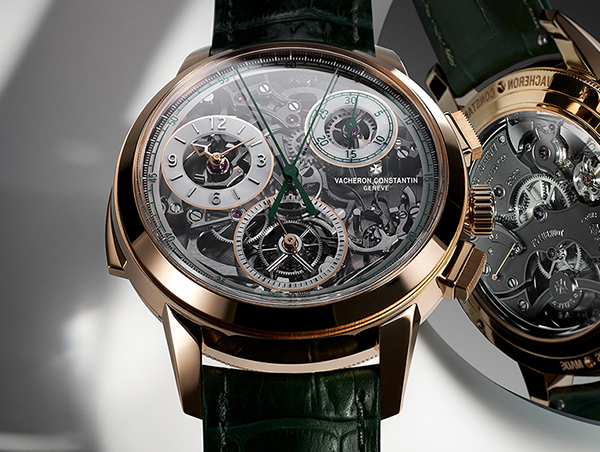
Now it revisits a grand complication originally launched in 2022 which combined a tourbillon, minute repeater and a monopusher split seconds chronograph. A sapphire dial now exposes the dial-side split-seconds chronograph mechanism, while the tourbillon is paired with a spherical hairspring.
Given the complexity and unconventional architecture of the movement, the case is substantial at 45mm in diameter and 16.4mm thick. Like the 2022 piece, it remains in pink gold, which is generally thought to be the most ideal material for a chiming watch, offering both roundness and clarity. The hours and minutes are shown on a sub-dial at 9 o’clock, with separate registers for the running seconds at 6 o’clock and a 30-minute chronograph counter at 2 o’clock. The counters are framed by pink gold rings applied via metallisation to the underside of the sapphire discs. Grey NAC-coated hour markers and engraved, ink-filled chronograph scales add further contrast. The chronograph hands including the 30-minute counter and both central seconds hands are rendered in green PVD-coated aluminium, matched to the accompanying green alligator leather strap.

Vacheron Constantin Les Cabinotiers Temporis Duo Grand Complication Openface
The manual winding Caliber 2757 S (S for spherical) is of a very unusual design. Traditionally, when a watch combines a tourbillon, minute repeater and chronograph, the tourbillon is on the base plate with the chronograph works located directly above it on the bridge side, while the striking mechanism is on the dial side. However, in the Les Cabinotiers Temporis Duo Grand Complication Openface, the chronograph mechanism is mounted on a separate plate that is screwed to the movement above the chiming works, creating a semi-integrated layout. A seconds wheel attached directly to the tourbillon cage drives the chronograph, meaning this part of the chronograph is not contained within the module itself.

The Calibre 2757 S has the minute repeater and tourbillon on the base plate while the chronograph is mounted on a separate plate screwed to the movement over the striking mechanism
This construction stems from the use of the existing Caliber 2755, a minute repeating tourbillon movement, as the base. The Calibre 2755 can be found in a variety of watches including the Les Cabinotiers Grande Complication Bacchus and the most recent Overseas Grand Complication Openface.
The architecture is particularly well-suited to a sapphire dial, as it places the chronograph mechanism on the dial side, making it fully visible from the front. In addition, the going train is arranged so that the tourbillon cage also faces forward, allowing both complications to be seen at a glance. Moreover, the additional height from the modular construction allows room for a spherical hairspring, which is an ideal technical and philosophical match to a tourbillon. It enhances the chronometric potential of a tourbillon by improving concentricity, symmetry, and isochronism. A spherical hairspring expands and contracts in three dimensions, remaining perfectly concentric throughout its oscillation. This contrasts with flat hairsprings, which tend to shift their centre of gravity slightly as they breathe. In a tourbillon, which averages positional errors by rotating the balance, having a hairspring that naturally minimises positional error complements its purpose.

The wheel train in the base movement is straightforward. The mainspring barrel, which provides a power reserve of 58 hours, is located on top right quadrant of the movement when viewed from the bridge side and it drives a gear train arranged along the centerline, with the third wheel engaging the cage pinion.
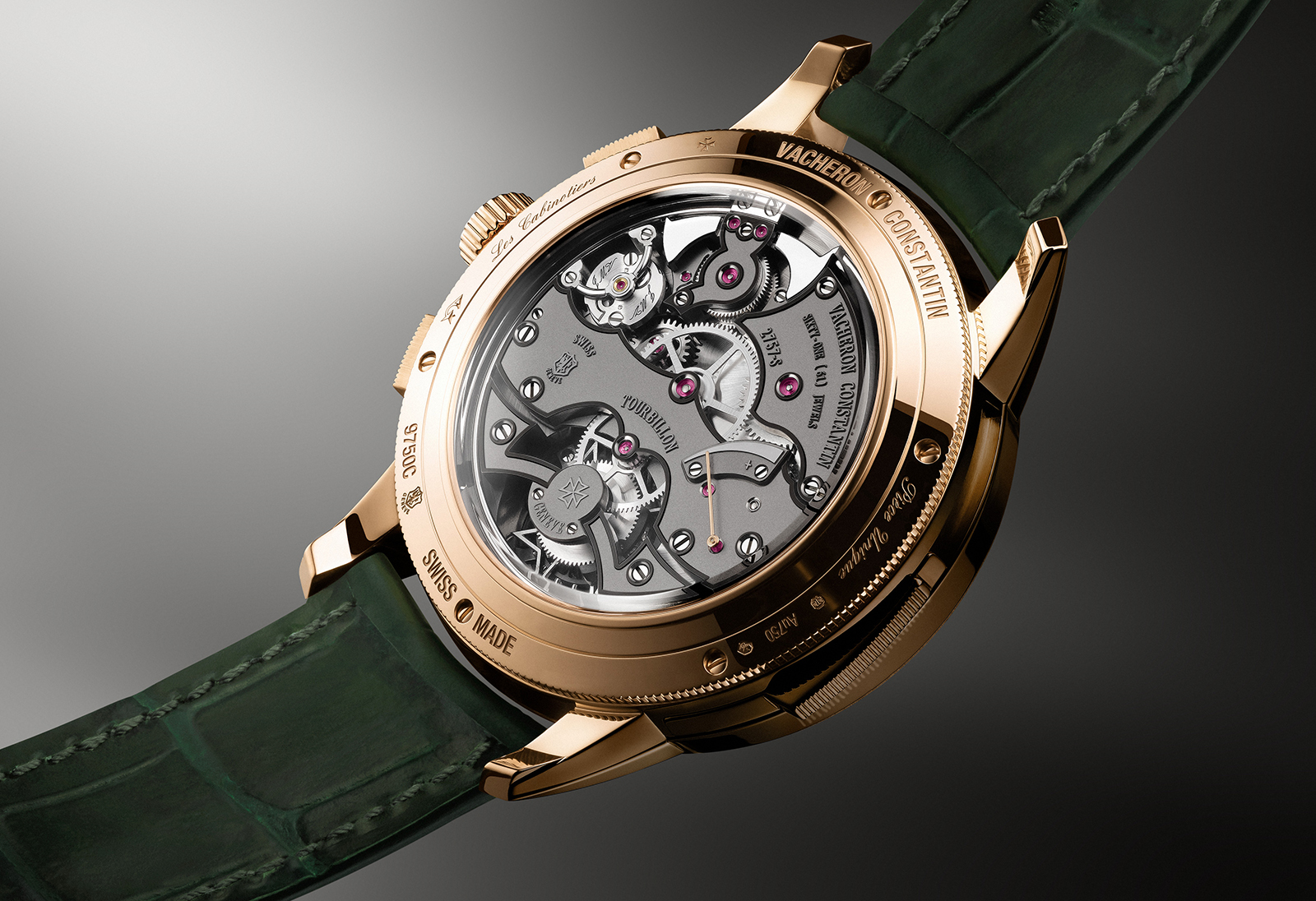
The display back reveals the main gear train, along with the repeating train, governor, hammers and gongs
The relocated motion works are driven by a central pinion while the tourbillon drives the running seconds indicator. Due to the nature of its construction, the most straightforward way to drive a chronograph without modifications to the base movement is off the tourbillon cage itself. In general, this is quite a rarity; only two other movements come to mind where the chronograph is driven off the cage rather than the fourth wheel in the going train – the tourbillon chronograph movement by BNB concept which can be found in AK-01 and the Bulgari Octo Finissimo Tourbillon Chronograph Skeleton Automatic.


The under dial chronograph works
As with the majority of tourbillons from the Maison, the cage takes the shape of a Maltese cross, which lends itself to numerous internal angles. However, in this particular movement, the lower cage forms a Maltese cross while the upper cage, which accommodates the vertical height of the hairspring, features two of arms of a Maltese cross, creating distinctive structure. The cage is supported by a beautifully bevelled and polished two-armed bridge.

A seconds wheel attached to the cage drives the chronograph works
Split-seconds chronograph
A minor quirk as a result of positioning the chronograph mechanism on the dial side is that the central uppermost wheel is the chronograph seconds wheel rather than the split wheel. The chronograph remains otherwise traditional, operating via a horizontal clutch. Notably, the split-seconds mechanism incorporates an isolator even though it is not immediately obvious. The isolator wheel sits lower in the stack, beneath the split wheel, and is equipped with asymmetrical ratchet teeth that permit rotation in only one direction.

The isolator wheel with ratchet teeth is visible at the bottom of the central stack
This wheel interacts with a pivoted rocker driven by the column wheel which advances the isolator wheel step-by-step. A pin mounted eccentrically on the isolator wheel swings into place to push the split-seconds lever away from the heart cam when the split hand is stopped, eliminating friction between the roller and heart and preventing energy loss. When the split-seconds function is re-engaged, the rocker resets the isolator wheel, and the pin retracts, allowing the lever to resume contact with the heart cam and resynchronise the hands. According to the press announcement, silicon was used for the one of the split seconds levers and the isolator, though it is unclear which from the images provided.
The details seen on the chronograph plate itself are exquisite. Put simply, no opportunity to incorporate an internal angle is shied away from. The chronograph seconds and the minute counting wheel are supported by individual openworked bridges with numerous internal angles, and the clutch wheel itself is held by a bridge in the shape of a Maltese cross arm that is screwed to the clutch lever. Even the intermediate counter lever pivots beneath a bridge sculpted with the same abundance of internal angles, while the split seconds clamp levers continues the same angular vocabulary.

No-expense-spared finishing now visible through the dial

Vacheron Constantin Les Cabinotiers Temporis Duo Grand Complication Openface
Minute repeater
The minute repeater, as with virtually the rest of the movement, is of a traditional design. The striking mechanism is located on the dial side of the base movement while the repeater gear train, along with the hammers and gongs, is visible on the bridge side. The repeating barrel is positioned between the hammers and features a ratchet mechanism, much like that of a mainspring barrel. This unidirectional system ensures that the repeater train is engaged only during striking, preventing any motion during winding.

The strike train ends in a governor that controls the unwinding rate of the barrel and consequently the speed of the chimes. Notably, Vacheron’s governor is among the few in watchmaking that is completely silent. Rather than relying on traditional friction against a fixed housing, which often produces a faint buzz, this design uses a pair of pivoting weights that apply braking force directly onto the rotating shaft itself. As the governor spins, centrifugal force causes one end of each weight to swing outward, while centripetal force resists this motion. The result is a carefully modulated balance. The outward swing of the weights causes the opposite ends to press inward onto the shaft, applying just enough friction to regulate the speed without introducing audible noise. The mechanism achieves a smooth and silent cadence, allowing the full tonal clarity of the chimes to emerge. To top it off, it is held by a semi-circular bridge that has been round-polished by hand which took over eight hours.
Even though the dial side of the base where the strike works are located is not visible, it has received the level of attention one would expect from such a watch. A seemingly trivial component, the bridge for the power reserve indicator train here has been shaped with numerous internal angles.

Below the off-centred motion works is the power reserve gear train which is held by bridge with an abundance of inner angles
Certain wheels in the movement were made of titanium, in which case, special tools were required for bevelling. The bridges on the reverse side of the movement have been hollowed out and treated with a blackened, hand-sandblasted finish with contrasting edges. Ultimately, thanks to the sapphire dial that reveals the chronographs works and the clever use of colour, the watch is instantly appealing. It makes any exposition of any kind such as this redundant, if not entirely self-indulgent.
Tech Specs: Vacheron Constantin Les Cabinotiers Temporis Duo Grand Complication Openface
Reference: Ref. 9750C/000R-215C
Movement: Manually wound Calibre 2757 S, 58-hour power reserve; 2.5 Hz (18,000 vph)
Functions: Hours, minutes and seconds, split-seconds chronograph, minute repeater, tourbillon, and power reserve indicator
Case: 45mm diameter by 16.4mm thick, 18K pink gold
Dial: Sapphire crystal; 18K 5N pink gold hours, minutes, and seconds hands; Green-coloured titanium chronograph and split-seconds chronograph hands
Strap: Green Mississippiensis alligator leather with 18k pink gold half Maltese cross-shaped folding clasp
Availability: Single-piece edition
Price: Upon Request
Vacheron Constantin
You may also like

News
Vacheron Constantin Updates Overseas Tourbillon With Deep Red Dial
Feb 3, 2026
News
Vacheron Constantin Updates Overseas Tourbillon With Deep Red Dial
Feb 3, 2026
Editorial
Revolution Awards 2025: Brand of the Year — Breguet and Vacheron Constantin
Jan 27, 2026
Editorial
Revolution Awards 2025: Brand of the Year — Breguet and Vacheron Constantin
Jan 27, 2026

Editorial
Revolution Awards 2025: Leader of The Year — Laurent Perves
Jan 27, 2026
Editorial
Revolution Awards 2025: Leader of The Year — Laurent Perves
Jan 27, 2026