The Revolutionary List: 24 Technically Brilliant Watches – IWC Portugieser Constant-Force Tourbillon
Editorial
The Revolutionary List: 24 Technically Brilliant Watches – IWC Portugieser Constant-Force Tourbillon

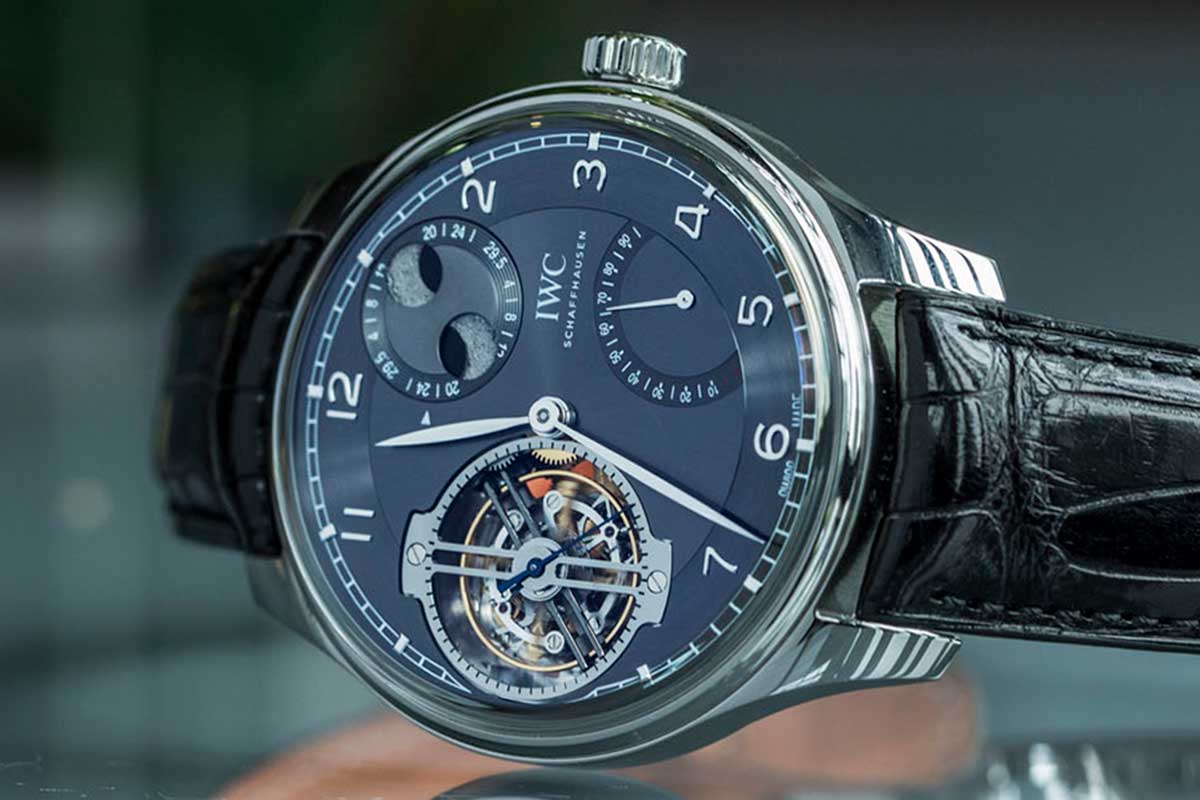
A tourbillon and a remontoir make for a natural pairing in the same movement, as they address different problems that nevertheless converge on the same goal. The remontoir was devised to even out the flow of energy, parceling it to the escapement in steady doses, as the mainspring goes from fully wound to an unwound state. The tourbillon, on the other hand, was Breguet’s answer to the vagaries of gravity, averaging out the variations in rate as the watch shifts from one position to another. Each, however, is difficult and costly to execute. Thus, watches with both, while conceptually elegant, are uncommon, and within this small fraternity, the IWC Constant-Force Tourbillon is the most advanced, if also the most obsessively exacting.
When the constant-force tourbillon first appeared in the Portugieser Sidérale Scafusia in 2011 and in subsequent iterations such as the Portugieser Constant-Force Tourbillon, they were among the earliest wristwatches to house a remontoir within the tourbillon cage itself. For a brand better known for its pragmatic engineering than for excursions into exotic chronometry, it was startling in every respect. Moreover, it did not simply unite the two mechanisms but pursued the problem of constant force to its limits, devising a geometry that sought to deliver torque not merely smoothed, but mathematically corrected. It was, in essence, a statement that even a remontoir spring requires its own remontoir. In that light, it was less a departure from IWC’s mechanical identity than pragmatic engineering taken to its furthest edge.
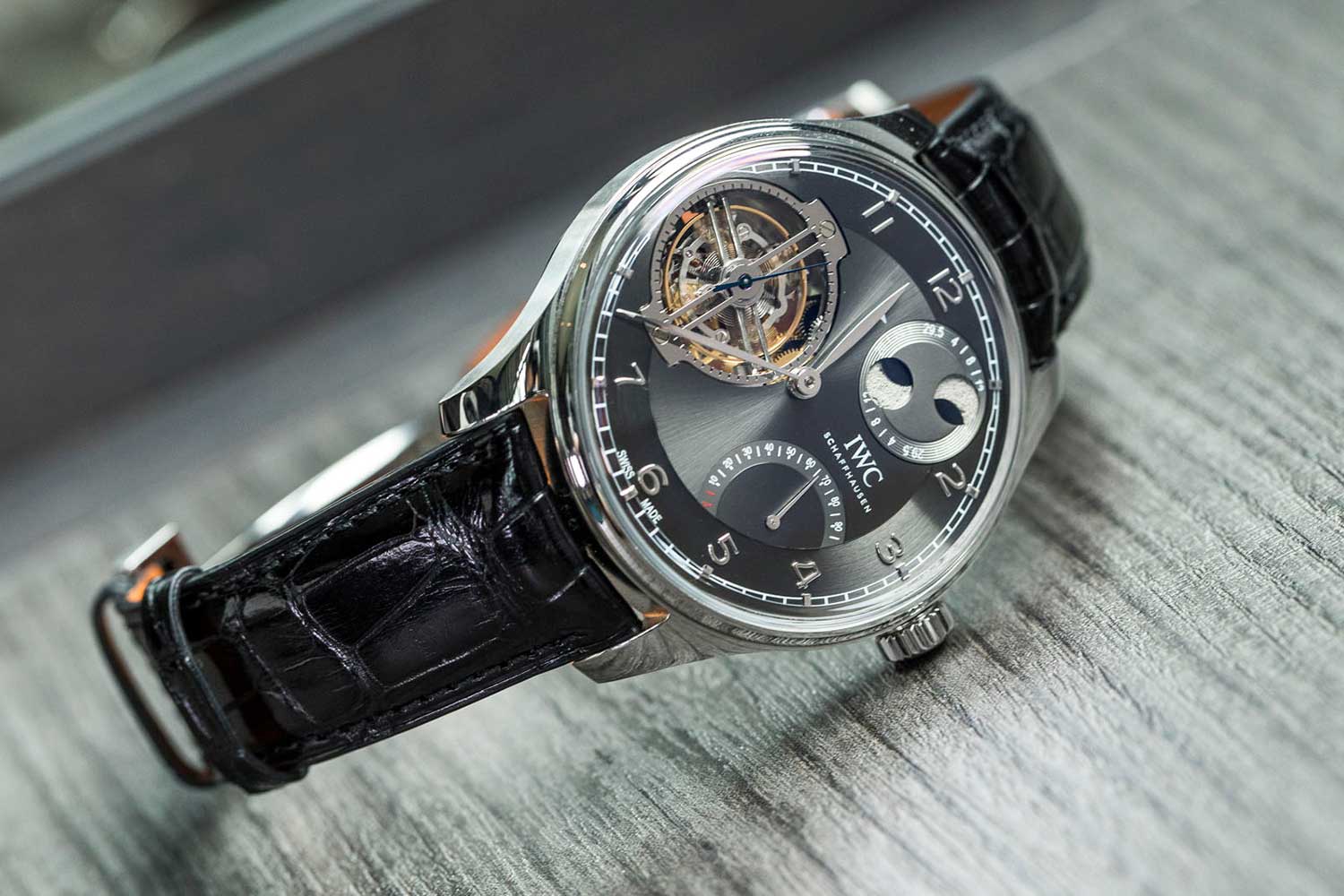
IWC Portugieser Constant-Force Tourbillon
The basis for the unique remontoir arises from the observation that even within its brief cycle, the remontoir spring inevitably loses a fraction of its tension as it unwinds. The torque it delivers is thus not perfectly constant but falls off slightly until it is rewound.
The remontoir spring is mounted co-axially with the escape wheel inside the tourbillon cage, positioned between the escape wheel and a rotating tension ring that rewinds it every second. The tension ring is carried on its own pinion, which meshes with the fixed fourth wheel on the mainplate. Each time the tourbillon cage is released, it advances by a set angle, and this controlled motion turns the tension ring through its pinion. The rotation of the ring, in turn, recharges the remontoir spring by exactly the same increment once every second, ensuring a precise and repeatable cycle of discharge and rewind.
-
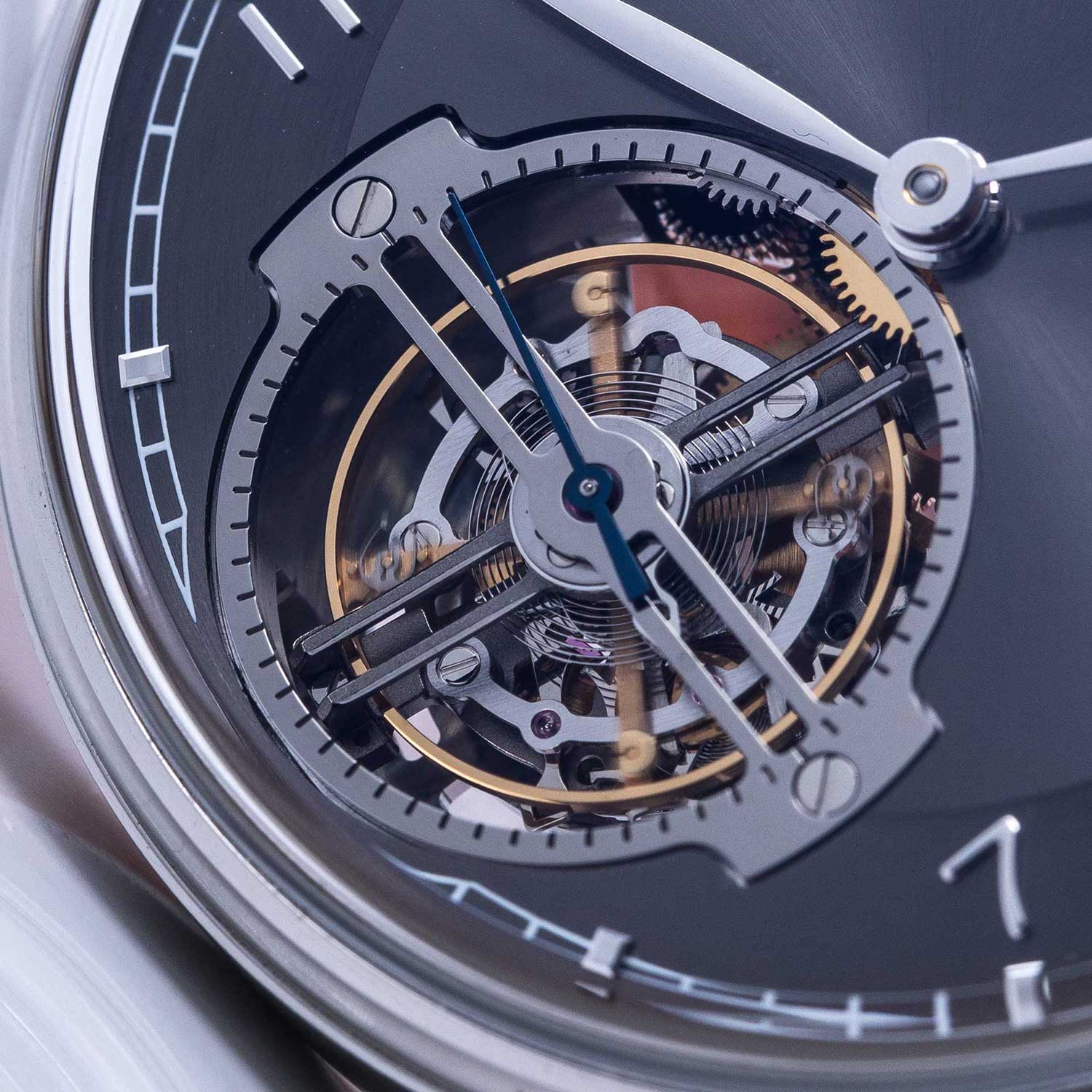
- The tourbillon cage
-
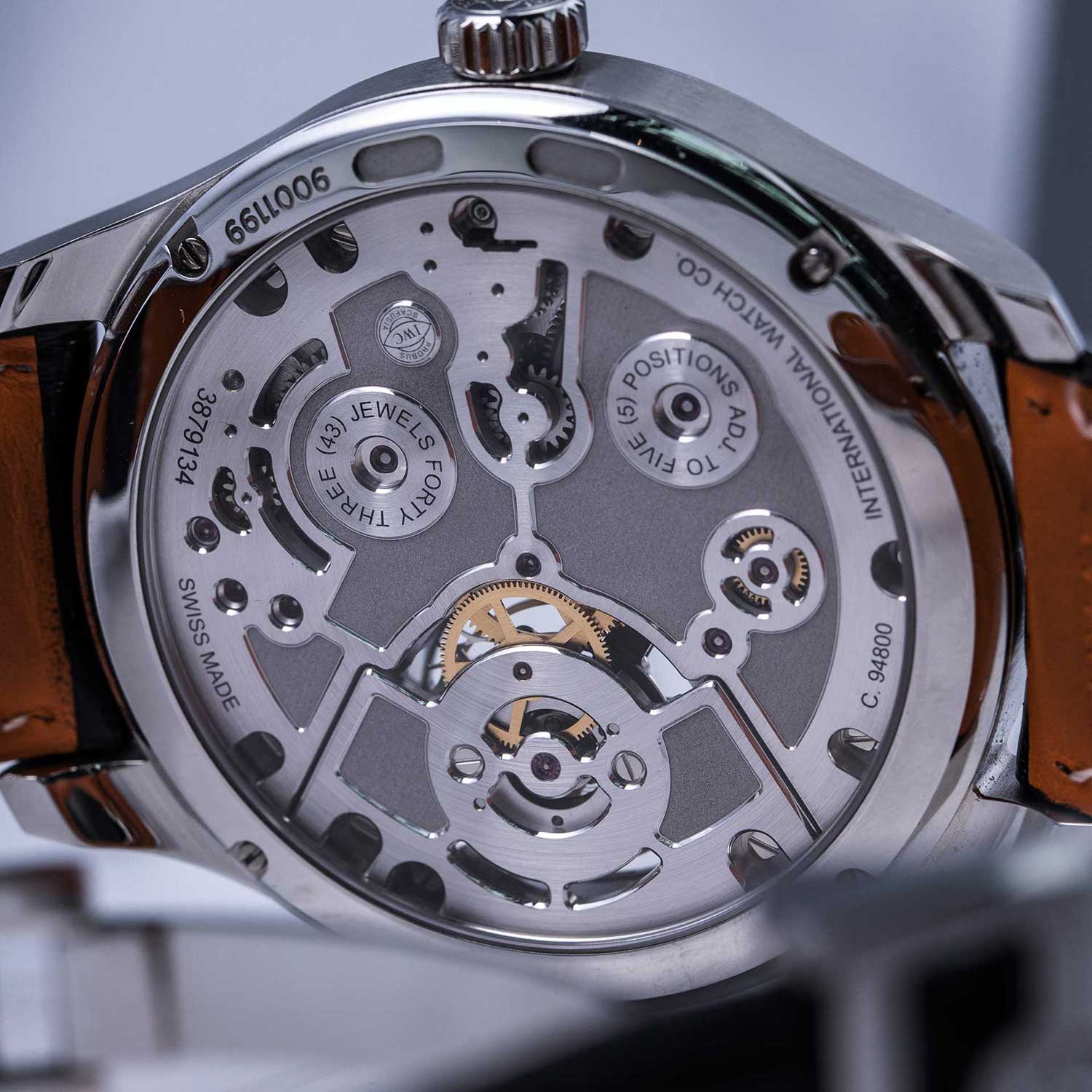
- The caliber 94800
Mounted on the same escape wheel shaft above the remontoir is a Reuleaux cam, whose lobed profile drives a secondary anchor. This anchor governs a stop wheel, mounted eccentrically within the cage, that alternately locks and releases the cage against the fixed fourth wheel. When the cam lifts the anchor, the stop wheel disengages, the cage rotates forward, and the tension ring is rotated just enough to wind the spring back. Meanwhile, the escape wheel itself remains under the control of the Swiss lever, so the locking and unlocking of the cage never interrupts the beat of the escapement.
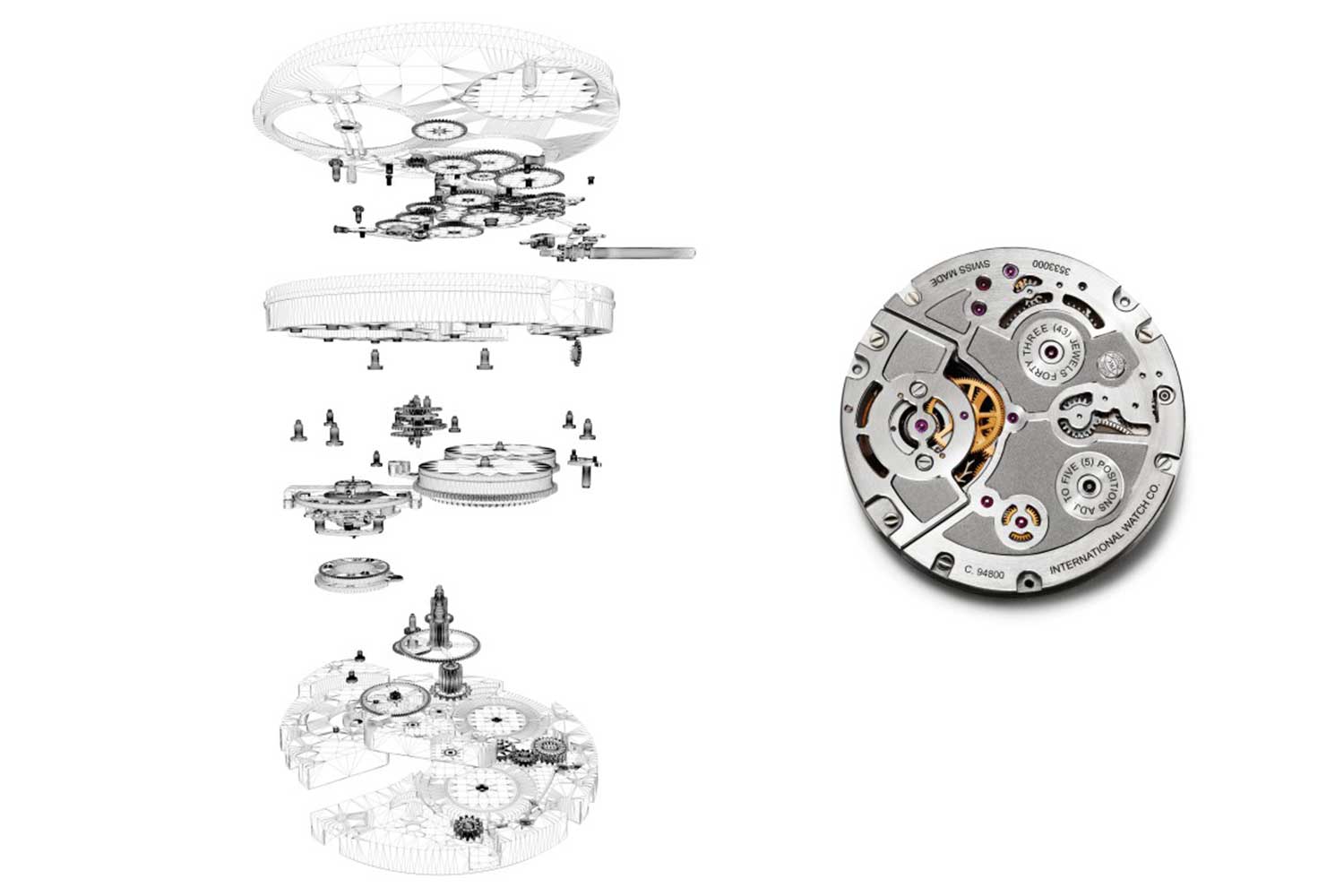
The key innovation, however, lies in the force-balancing system added to the escape wheel shaft. This consists of an eccentric cam mounted off-center and a balancing disk with two arms that pivots around it. The free end of the remontoir spring is attached to a mobile collet with a pin pressing on one arm of the disk, while the other end is secured to a fixed collet with a second pin acting on the opposite arm. As the spring relaxes and its tension drops between recharges, the eccentric geometry alters the lever arms, causing one to lengthen while the other shortens. This shift in mechanical advantage offsets the loss of tension, so that the torque delivered to the escape wheel remains constant throughout the full one-second cycle. In effect, it transforms the remontoir from a device of approximate regularity into one capable of delivering mathematically constant force.
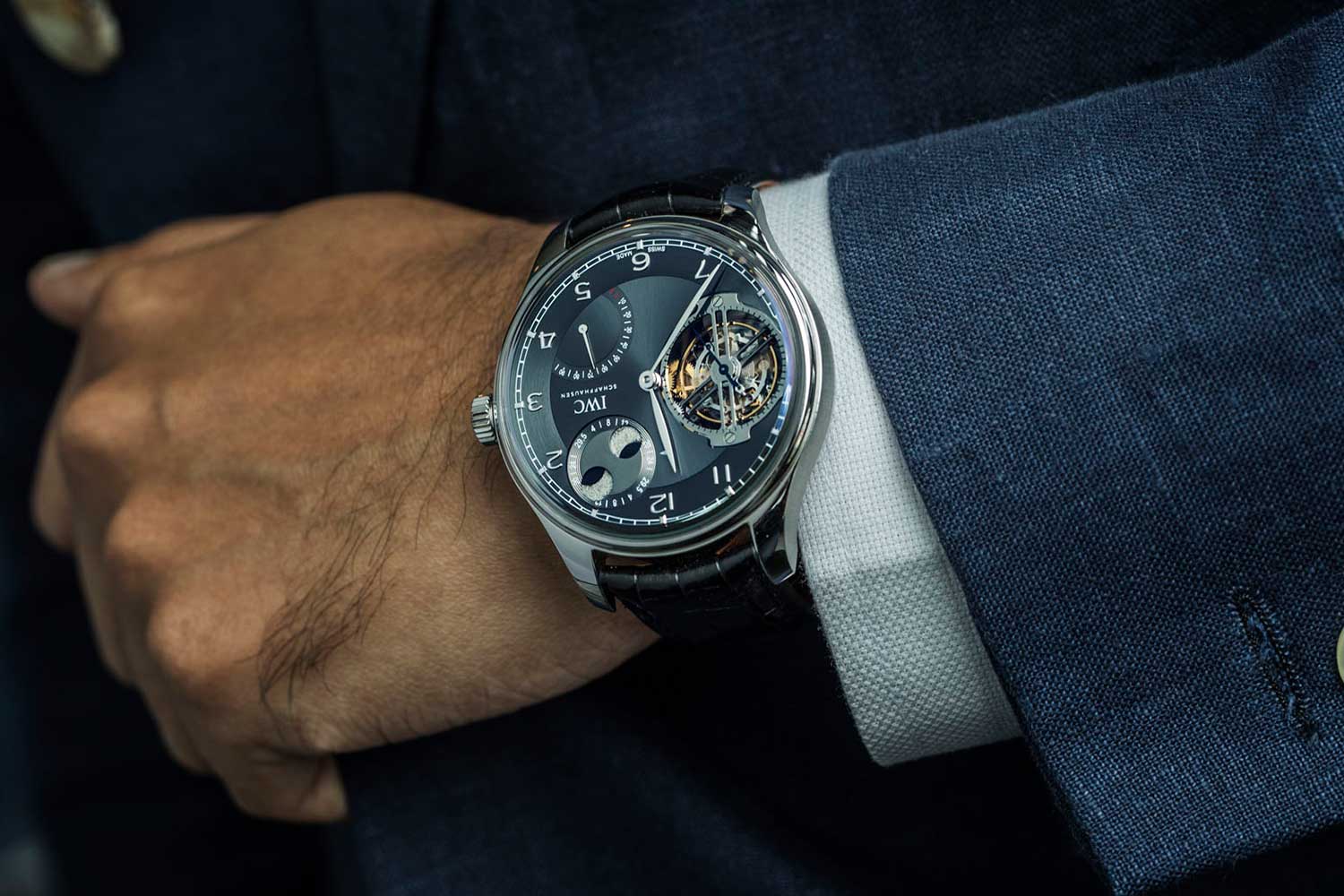
IWC Portugieser Constant-Force Tourbillon
Tech Specs: IWC Portugieser Constant-Force Tourbillon
Movement Manual winding Caliber 94800; four-day power reserve
Functions Hours and minutes; small seconds with constant-force tourbillon; double moonphases for Northern and Southern Hemispheres
Case 46mm × 13.5mm; platinum or 18K red gold; water resistant to 30m
Dial Customizable
Strap Santoni alligator leather
IWC

You may also like
Editorial
The IWC Portugieser Chronograph Ceratanium emerges from the shadows
Feb 26, 2026
Editorial
The IWC Portugieser Chronograph Ceratanium emerges from the shadows
Feb 26, 2026

Editorial
Revolution Awards 2025: Best Sport Watch — IWC Ingenieur Automatic 40 “Sonny Hayes”
Jan 27, 2026
Editorial
Revolution Awards 2025: Best Sport Watch — IWC Ingenieur Automatic 40 “Sonny Hayes”
Jan 27, 2026

Editorial
Holiday Horology: Something Old, Something New, Something Special — Felix Scholz, Revolution Australia Editor-in-Chief
Dec 20, 2025
Editorial
Holiday Horology: Something Old, Something New, Something Special — Felix Scholz, Revolution Australia Editor-in-Chief
Dec 20, 2025