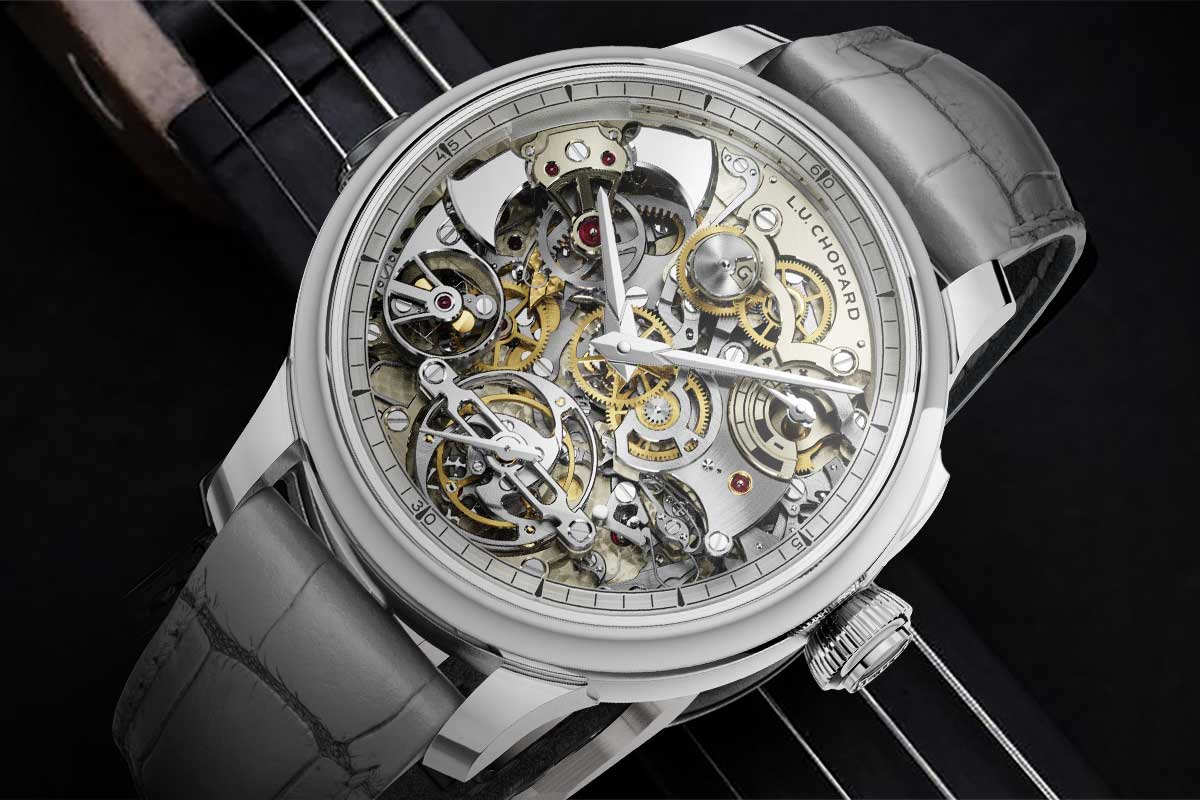
The Revolutionary List – 24 Technically Brilliant Watches: the Chopard L.U.C Grand Strike
Editorial
The Revolutionary List – 24 Technically Brilliant Watches: the Chopard L.U.C Grand Strike

This year, Revolution turns 20. Two decades of chronicling watches, people and ideas have given us a front-row seat to a remarkable story: how an age-old craft has both preserved its soul and reinvented itself for the 21st century. To celebrate, we’ve chosen over 100 names and milestones that, for us, define the era so far. From leaders to watches, you can see the whole list here.
When Chopard unveiled its first in-house movement — the L.U.C Caliber 1.96 — in 1996, it did more than inaugurate a new manufacture in Fleurier. It marked a decisive shift in the brand’s identity, transforming a house best known for “Happy Diamonds” into one founded on the highest expressions of horological craft. With that single movement, Chopard signaled that it intended not merely to participate in the world of high watchmaking, but to stand alongside its most revered names. The L.U.C collection, named for founder Louis-Ulysse Chopard, became the vessel for that transformation, a platform on which the brand would steadily build a vocabulary of serious watchmaking, from tourbillons and perpetual calendars to chronographs and, ultimately, to the most demanding of all complications – the chiming watch.
Its journey through the realm of chiming complications has followed a steady arc that reflects both the evolution of the manufacture and the deepening of its technical ambition. It is a discipline that simply does not yield easily to newcomers. The knowledge required to create a chiming watch is cumulative, built over decades of patient trial, refinement and intimate familiarity with the invisible nuances of sound, power and motion. Without the long continuity of experience, it is almost impossible to bring such a mechanism to life within the walls of a manufacture. That Chopard has built, from the ground up, the intellectual, technical and practical foundation required to create such mechanisms is, in itself, a rare achievement in modern watchmaking.
The journey began in 2006 with the L.U.C Strike One, a passing strike that sounds a single note at the top of each hour on traditional metal gongs, and reached a new level of sophistication a decade later with the L.U.C Full Strike, a full minute repeater that earned the Aiguille d’Or at the Grand Prix d’Horlogerie de Genève (GPHG) for its innovative use of sapphire gongs cut from the same block as the crystal, giving the chimes both exceptional clarity and resonance. In 2022, the manufacture unveiled the L.U.C Full Strike Tourbillon, combining its award-winning acoustic system with a tourbillon regulator. Now, 20 years after its first chiming watch and three decades on from the movement that started it all, that journey has culminated in the L.U.C Grand Strike, which confronts the most complex and demanding of all horological achievements – the grande sonnerie.
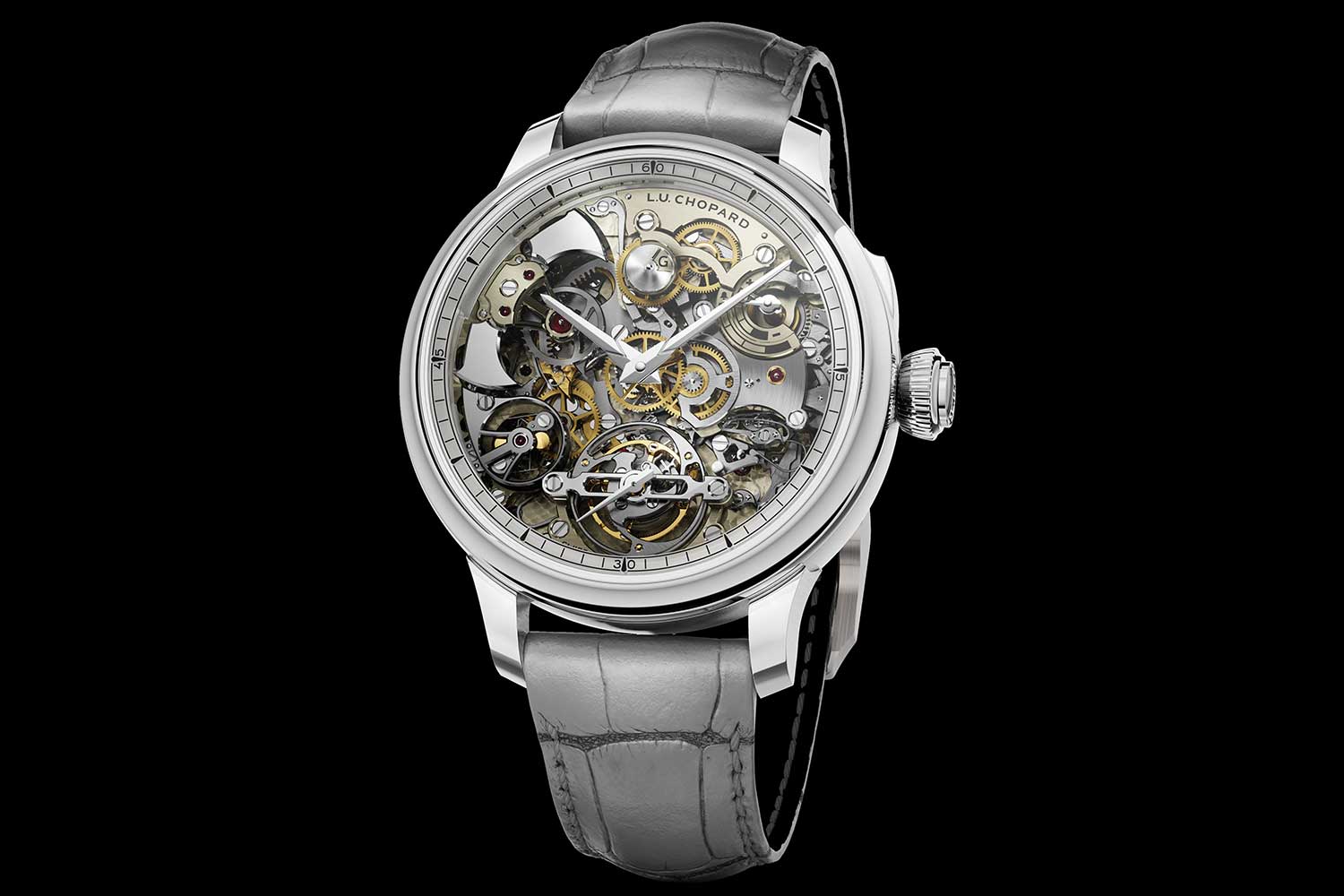
2025: The latest Chopard L.U.C Grand Strike
To understand the scale of what Chopard has achieved, it is worth considering why chiming complications have always stood apart in the landscape of watchmaking. Their outward action seems simple enough as hammers fall in turn upon their gongs, yet behind this lies the most complex of mechanisms in watchmaking. The minute repeater, which on demand strikes the hours, quarters and minutes, is the most familiar expression of this art. The difficulty lies not only in the multitude of parts within the strike works and strike train, but in the way they must behave together. Every component depends upon the next, and the smallest fault in form or proportion is enough to silence the whole. The order of assembly and the precision of each fit are critical. Even a slight irregularity in a pivot, spring strength or lever shape can cause the mechanism to misfire or jam. Great skill is required in adjusting positions, depths and tensions of the various parts, while the quality of the chime itself also rests on a host of other factors such as the shaping and tuning of the gongs, the force with which the hammers strike them, and the character of the case in which the movement sits. Design, material and size of the case all shape the final sound.
From this foundation rises the grande sonnerie, which extends the challenge in every direction. A grande sonnerie automatically strikes the hours on the hour, and both the hours and quarters at each quarter. In petite sonnerie mode, it only strikes the hours on the hour and the quarters at each quarter, while retaining the ability to strike a full sequence down to the minute on demand. The system of racks, snails and strike train is the same, but it no longer suffices. Auxiliary devices must be introduced to govern the flow of power and decide when the chimes occur. An automatic release mechanism ensures the sonnerie sounds of its own accord; a suppressor governs the petite sonnerie when only the quarters are struck; a manual release preserves the repeater function; and finally, a silencer grants the wearer discretion. Each of these devices must not only work but work together without disturbing the fragile sequence already in place.
The result is a mechanism of forbidding intricacy. It is a dense order of interlocking causes and effects. For this reason, the grande sonnerie has long been regarded as the summit of horology. Each sub-mechanism interacts with others in ways that must be understood through repeated trial, observation and correction. There is no shortcut. The mastery of it is the product of long study, practice and even longer patience.
The scale of Chopard’s latest work reflects the magnitude of the task. The Caliber L.U.C 08.03-L in the Grand Strike, which also includes a tourbillon, comprises a staggering 686 parts, compared to 568 in the Full Strike Tourbillon. Such a work admits no compromise. It is the highest expression of watchmaking because it gathers into one mechanism the principles of construction, the demands of acoustics and the discipline of proportion, adjustment and tuning. But further still, as with the L.U.C Full Strike, the Grand Strike bears witness to a host of innovations. No fewer than five patents have been secured for its construction, while another five, first introduced in the Full Strike, were carried forward.

Caliber L.U.C 08.03-L
In fact, almost 11,000 hours were invested in the project, of which 2,500 hours were spent fine-tuning the prototype. The watch has an 18K ethical white gold case that measures a 43mm across and 14.08mm in height. The dial has been reduced to a minute track which is directly printed on the sapphire crystal and, due to the construction of the Caliber L.U.C 08.03-L, the most interesting and crucial parts of the chiming mechanism are fully visible. A discreet selector beside the crown allows the choice of grande sonnerie, petite sonnerie or silence. The strike barrel is wound by the crown while the push-piece set within the crown serves to activate the minute repeater.

A view from the caseback, the 18K ethical white gold case in 14.08mm of height
When fully wound, the strike barrel is able to deliver 12 hours of continuous chiming in the grande sonnerie mode. Turning the crown clockwise winds the main timekeeping barrel and counterclockwise, the strike barrel. As with the Full Strike, this is made possible by a reverser — a co-axial three-wheel module with one bidirectional input and two unidirectional outputs. When the crown is turned, its rotation is transmitted through the input wheel equipped with unidirectional pawls on each face, allowing energy to be directed according to the direction of rotation. Turning the crown clockwise engages the upper set of pawls, transmitting energy through a train of wheels to wind the going barrel. Turning it counterclockwise engages the lower pawls, which in turn drive the striking barrel. The disengaged pawls simply click over their respective ratchet teeth, allowing each train to remain stationary when the other is being wound. The power reserves of both the main timekeeping barrel and sonnerie are displayed concentrically at 2 o’clock.
In the end, this is a watch that speaks for itself. A grande sonnerie, even in its most conventional form, represents the terminus of watchmaking effort and skill. It is the summit reached by only the few who can bring order to hundreds of interdependent parts, each one capable of throwing the mechanism out of order by a fraction of a millimeter. Yet, the L.U.C Grand Strike goes beyond this. It reimagines the architecture of the chiming watch from its foundations upward, addressing problems that most makers have long accepted as givens.
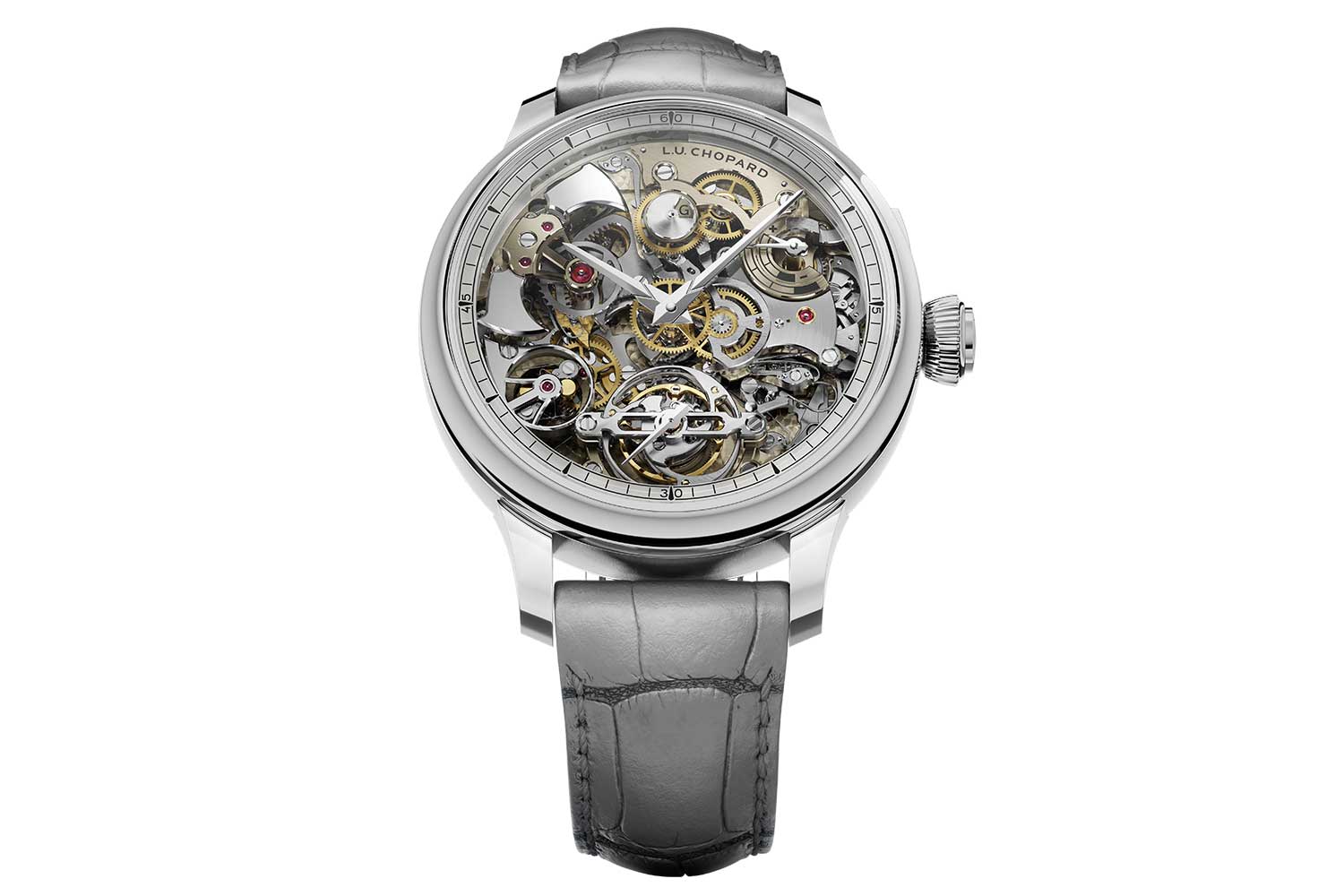
Chopard L.U.C Grand Strike
This is what makes the Grand Strike such an extraordinary accomplishment. It doesn’t rest on the mastery of skills that are already near impossible to acquire and master but pushes past them. Every layer has been reconsidered from the acoustics of transmission to the strike works to the train, the coupling and the all-important safety systems. It proves that with great patience, ingenuity and appetite for hard problems, progress remains possible even in the most complex of complications, where part counts are daunting and the underlying logic borders on the intractable. As an anniversary marker, the Grand Strike offers proof of accumulated judgment, of mastery over the hardest problems and of a workshop now capable of work at this level as a matter of course.
Tech Specs: Chopard L.U.C Grand Strike
Movement: Manual winding L.U.C Caliber 08.03-L; 70-hour power reserve (timekeeping); 12-hour power reserve (sonnerie); 4Hz or 28,800vph
Functions: Hours and minutes; tourbillon with small seconds; grande and petite sonnerie, minute repeater
Case: 43mm × 15.58mm; 18K ethical white gold
Dial: Open-worked; 18K ethical white gold hour markers
Strap: Interchangeable gray alligator leather or gray calfskin; 18K ethical white gold folding clasp
Price: CHF 780,000
Chopard
You may also like

Editorial
Holiday Horology: Something Old, Something New, Something Special — Felix Scholz, Revolution Australia Editor-in-Chief
Dec 20, 2025
Editorial
Holiday Horology: Something Old, Something New, Something Special — Felix Scholz, Revolution Australia Editor-in-Chief
Dec 20, 2025

Editorial
The Revolutionary List – 26 Inspirational Leaders: Karl-Friedrich Scheufele
Dec 1, 2025
Editorial
The Revolutionary List – 26 Inspirational Leaders: Karl-Friedrich Scheufele
Dec 1, 2025
Editorial
The Striking Genius of Chopard L.U.C Grand Strike
Nov 19, 2025
Editorial
The Striking Genius of Chopard L.U.C Grand Strike
Nov 19, 2025