
The Revolutionary List: 24 Technically Brilliant Watches – Armin Strom Mirrored Force Resonance
Editorial
The Revolutionary List: 24 Technically Brilliant Watches – Armin Strom Mirrored Force Resonance

This year, Revolution turns 20. Two decades of chronicling watches, people and ideas have given us a front-row seat to a remarkable story: how an age-old craft has both preserved its soul and reinvented itself for the 21st century. To celebrate, we’ve chosen over 100 names and milestones that, for us, define the era so far. From leaders to watches, you can see the whole list here.
Armin Strom’s 2016 Mirrored Force Resonance marked a turning point in the long, scattered history of resonance in watchmaking. Unlike earlier efforts by Antide Janvier, A.-L. Breguet or F.P. Journe that relied on incidental coupling through shared structures, Armin Strom introduced a purpose-built, dynamically articulated spring linking the twin balances. Housed in a 43mm case with dual counter-rotating gear trains to favor anti-phase synchronization, it formalized the phenomenon through what is essentially a compliant mechanism that not only encourages synchronization by regulating energy transfer between them, but also sustains it under real-world conditions.

Armin Strom Mirrored Force Resonance First Edition
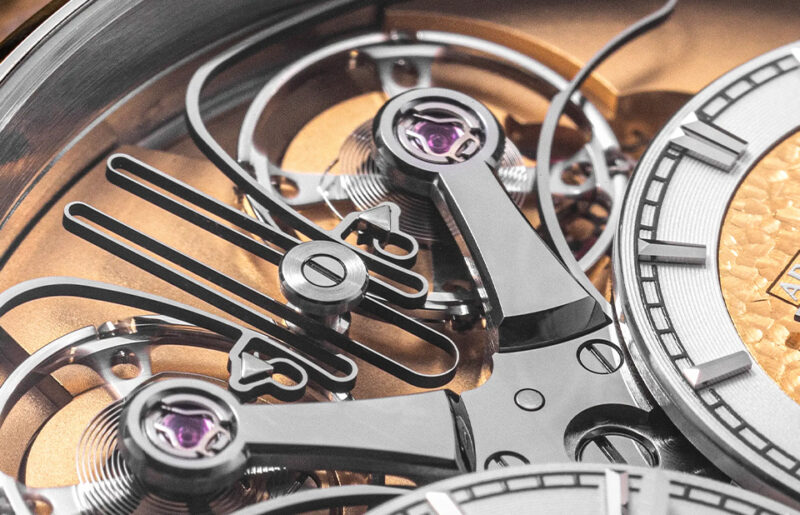
While other modern resonance watches, such as those by Beat Haldimann and Vianney Halter, placed twin balances in a shared tourbillon cage and linked the outer terminals of the hairsprings for coupling, Armin Strom’s solution was a compliant spring bridge. Not a bridge in the conventional sense supporting a wheel or gear, it is a flexible carbon steel element anchored at both ends to a holding bracket on the balance bridge. The hairspring studs are not fixed, as in traditional watches, but suspended along the spring bridge that spans both balances. A spring clip at the center of the bridge allows the structure to pivot and stretch as it flexes outward during oscillation. This ensures that tension remains consistent throughout the cycle by compensating for the slight change in length.

Armin Strom’s patented Resonance Clutch Spring connects two independent balances and lets them find their natural resonance within minutes
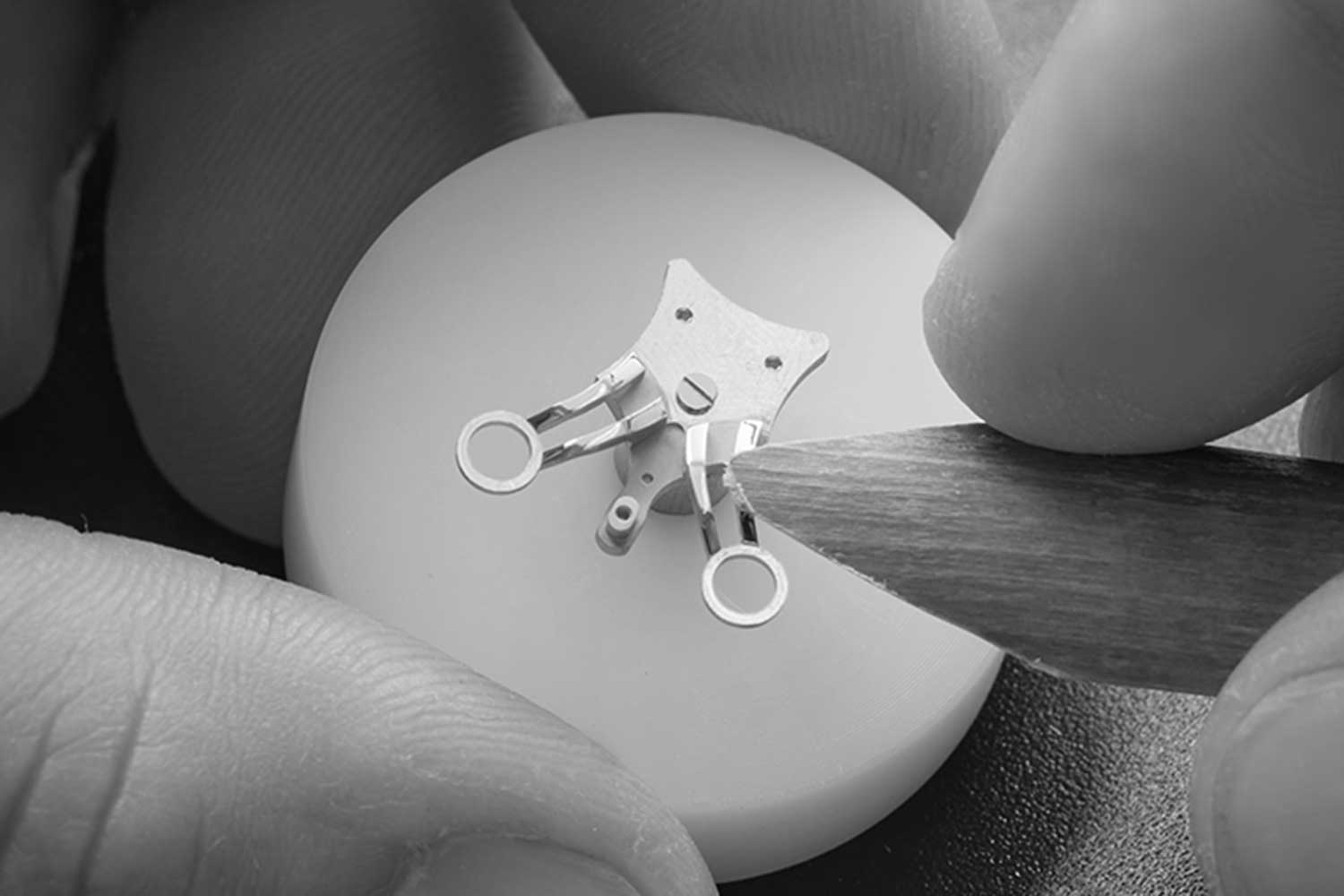
The three-dimensional balance bridges are hand-polished, highlighting their sculptural presence
When the balances oscillate, always in opposite directions in Armin Strom’s configuration, the hairsprings exert force through their terminal curves, which are linked to this shared, elastic bridge. As the balances reach their maximum amplitudes at opposite extremes, the spring bridge flexes in one direction when the balances reach one end of their arc, and in the opposite direction when they reach the other. Crucially, if the balances are not oscillating in synchrony, this motion is uneven, and the spring bridge responds dynamically. One hairspring may be slightly ahead, the other slightly behind. In such cases, the bridge acts simultaneously as a brake and an accelerator, absorbing a fraction of the energy from the early-arriving spring and imparting that energy to the lagging one.
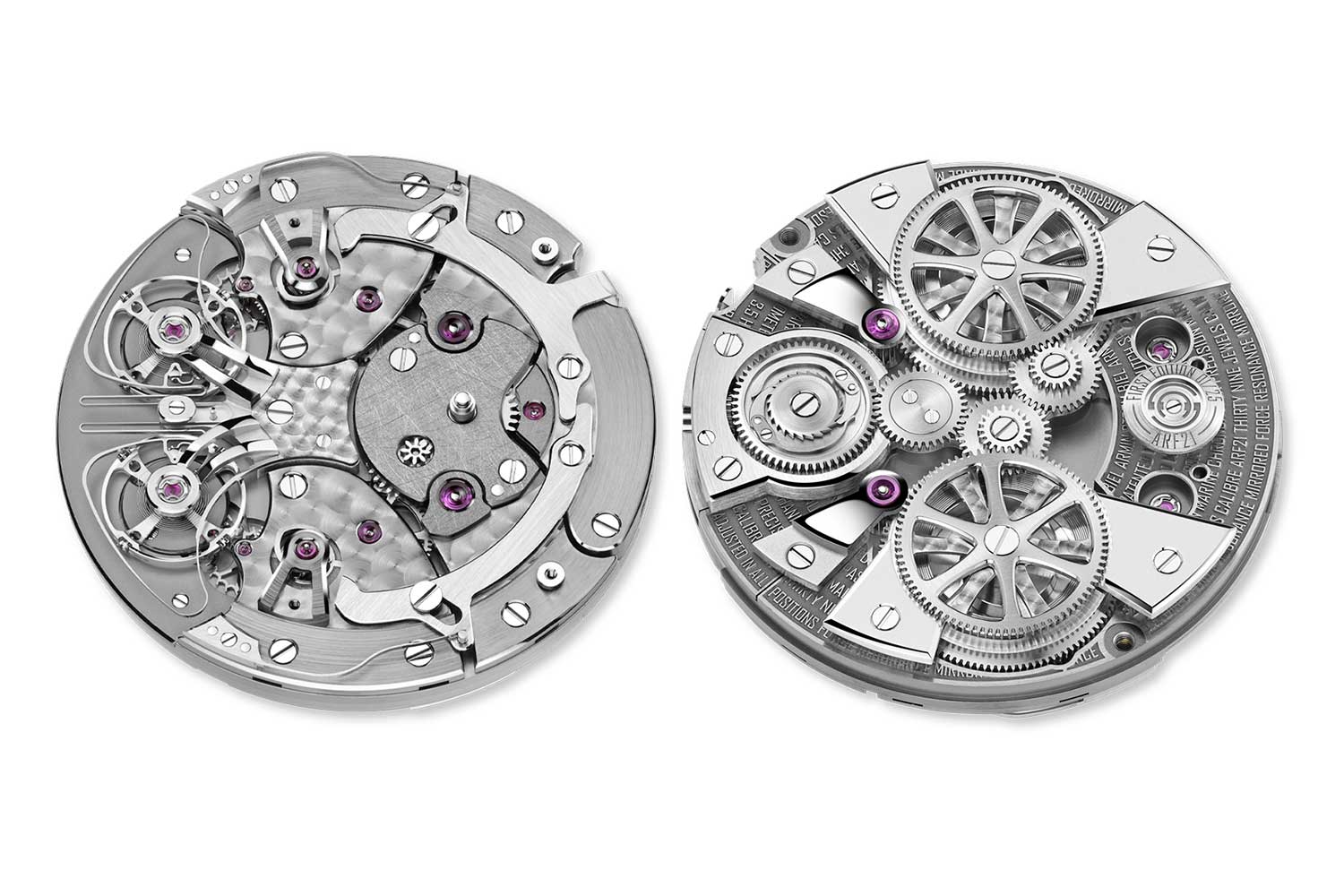
The ARF21 caliber
The mechanism thus acts as a corrective feedback system, continuously nudging the oscillators into synchrony. Over time, the balances naturally settle into anti-phase synchronization, and the flexing of the bridge becomes symmetrical. At this point, energy transfer between the balances becomes stable, reinforcing their mutual rhythm.
Traditionally, resonance requires the rates of both balances to be meticulously adjusted within a very tight margin. Journe, for example, noted a threshold of five seconds per day for effective coupling in a wristwatch. In Armin Strom’s configuration, however, no such fine-tuning is necessary. The corrective action of the spring bridge allows the balances to start out with greater deviation, and the spring bridge will gradually align them through dynamic energy transfer. The mechanism is forgiving, but crucially, not imposing. It does not rigidly lock the balances together but allows them to self-regulate via mechanical interaction.
Synchronization is not left to chance or confined to a narrow range of conditions. It is the result of an engineered bias designed to bring the balances into step reliably and repeatedly across all examples of the mechanism. It is also robust; synchronization occurs quickly, often within minutes and holds under wrist-borne conditions.
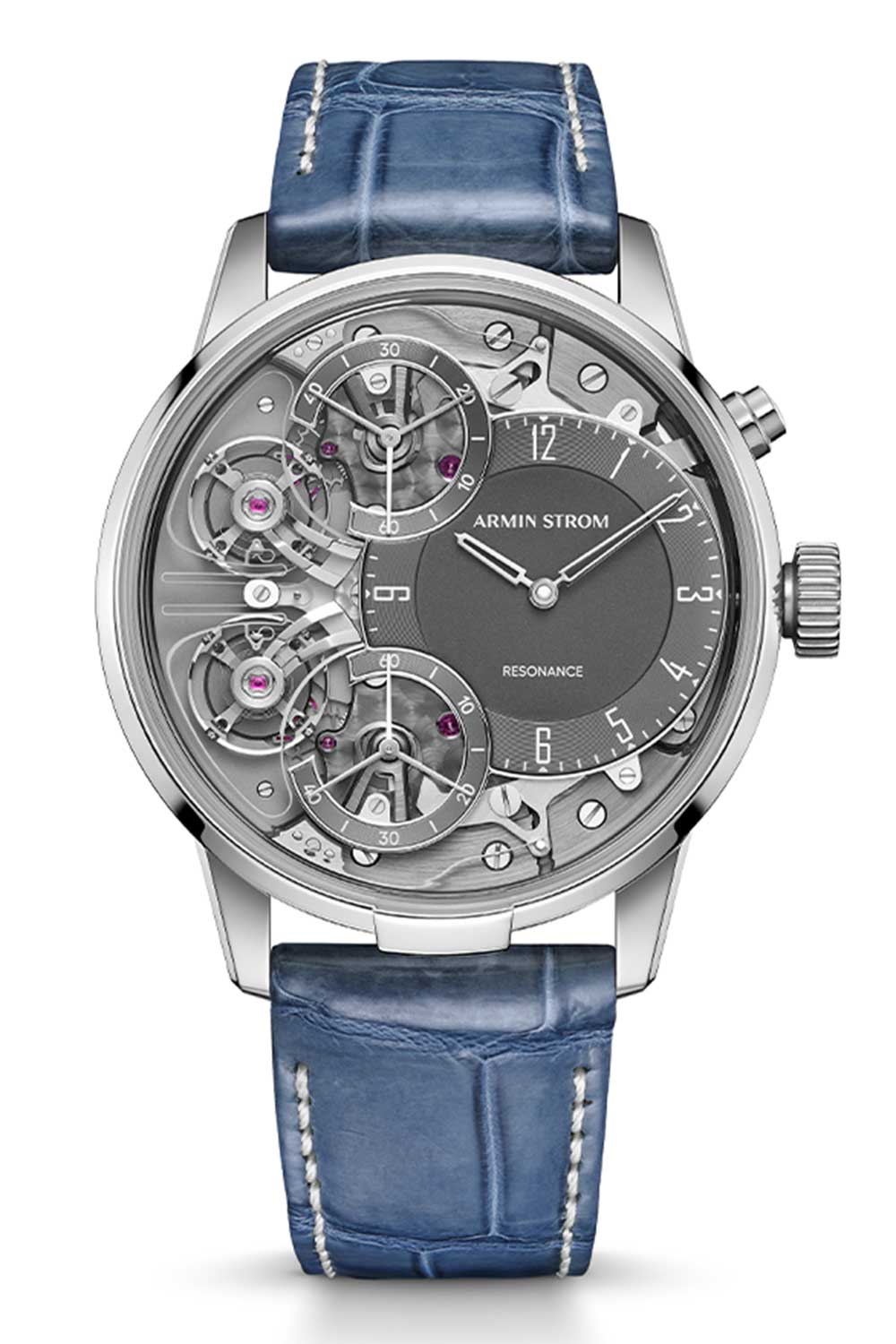
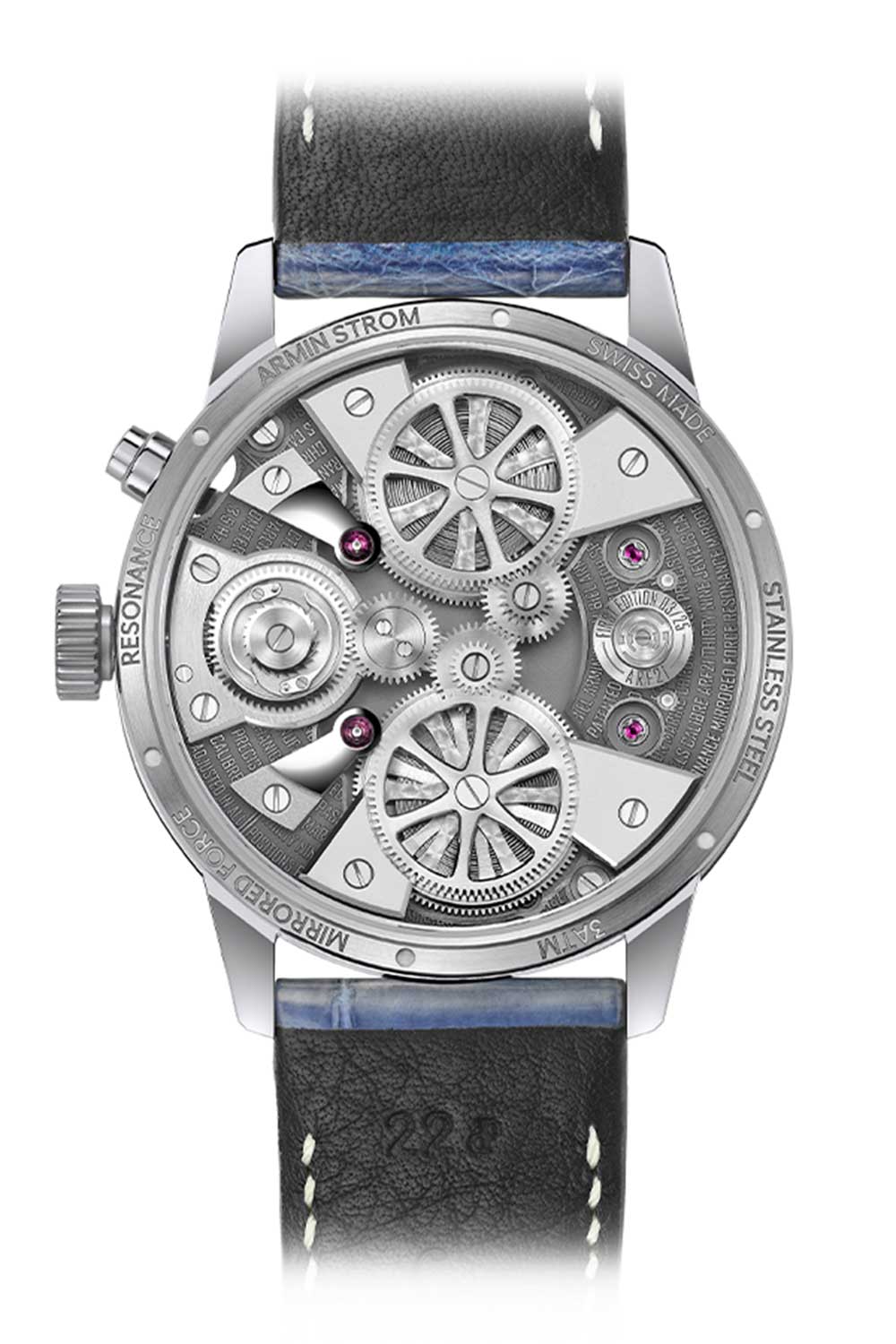
Tech Specs: Armin Strom Mirrored Force Resonance First Edition
Movement Manual winding Caliber ARF21; 48-hour power reserve
Functions Hours, minutes and small seconds
Case 43mm × 11.55mm; stainless steel; water resistant to 30m
Dial Open-worked with off-centered time display in black gold
Strap Dark blue alligator leather; stainless steel pin buckle
Armin Strom

You may also like

limited
Lederer CIC 39 “Eddy Jaquet & Yann Von Kaenel” for Revolution
Dec 29, 2025
limited
Lederer CIC 39 “Eddy Jaquet & Yann Von Kaenel” for Revolution
Dec 29, 2025
limited
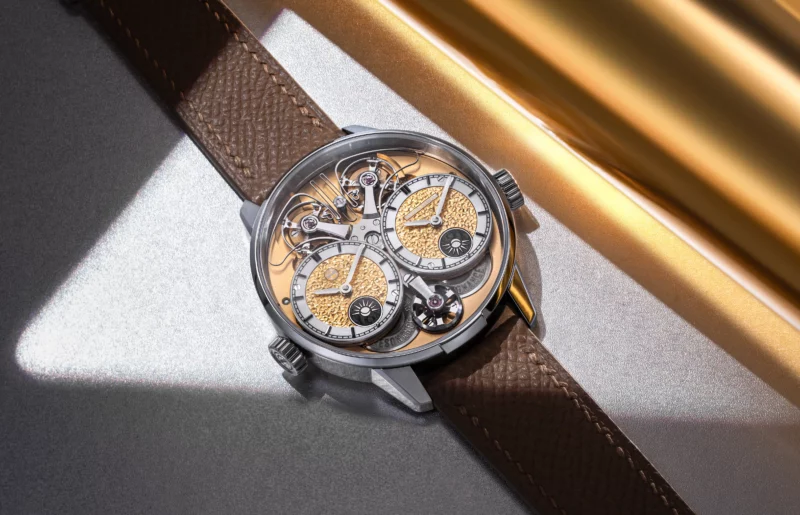
Armin Strom × Revolution Dual Time GMT Resonance ‘Tremblage’
Sep 2, 2025
limited
Armin Strom × Revolution Dual Time GMT Resonance ‘Tremblage’
Sep 2, 2025
Limited Edition
Smitten by Art: Armin Strom × Revolution Dual Time GMT Resonance ‘Tremblage’
Sep 2, 2025
Limited Edition
Smitten by Art: Armin Strom × Revolution Dual Time GMT Resonance ‘Tremblage’
Sep 2, 2025