
The Revolutionary List: 24 Technically Brilliant Watches – A. Lange & Söhne Double Split
Editorial
The Revolutionary List: 24 Technically Brilliant Watches – A. Lange & Söhne Double Split

This year, Revolution turns 20. Two decades of chronicling watches, people and ideas have given us a front-row seat to a remarkable story: how an age-old craft has both preserved its soul and reinvented itself for the 21st century. To celebrate, we’ve chosen over 100 names and milestones that, for us, define the era so far. From leaders to watches, you can see the whole list here.
In 2004, Lange did something no one else had attempted. The Double Split took the rattrapante, a complication long confined to the seconds and extended it to the minutes. It was also a flyback, which meant that timing could be reset and restarted instantly, even if one of the hands was held in split. Nothing like it had ever been made, and nothing like it has been made since.
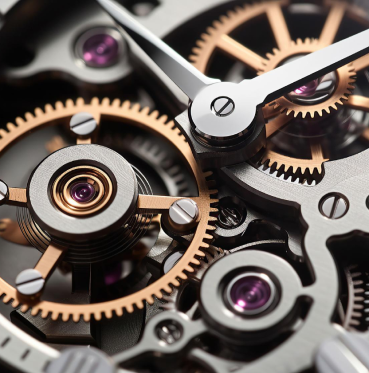
Its base architecture starts off with the familiar rattrapante design. The split seconds wheel is set in the tube of the chronograph arbor with the split seconds heart cam rigidly fixed to the tube. Attached to the rim of the split seconds wheel is a drive lever, which is kept in constant contact with the heart cam by the pressure of a spring, allowing both the chronograph seconds wheel and split wheel to run together. The same logic is duplicated for the minutes register.

A. Lange & Söhne Double Split with both split seconds and split minute hands, allowing the measurement of twin elapsed times up to 30 minutes
While the split seconds wheel is clamped between jaws, as is traditional, the split minutes wheel has ratchet recesses on its rim into which a spring-loaded catch drops to hold it fast. Because the recesses match the minute increments, the split hand always stops in perfect alignment with the running minute hand. The uppermost wheel in the minutes and seconds stacks are isolator wheels. When the rattrapante is activated, the isolator wheels pivot a post against the drive lever, lifting it away from the heart cams so the frozen split wheels are completely decoupled. A single column wheel controls the entire split sequence.

View from the caseback

The Double Split Caliber L001.1
At the same time, both split hands and main chronograph hands can be reset and restarted instantly, regardless of wheel positions via the lower pusher. When pressed, the lower pusher acts on a system of two levers, one of which carries a pawl. The pawl engages the saw tooth wheel of the column wheel and advances it by one step, which in turn indexes the column. As the column wheel turns, the grippers lift away from the rattrapante wheels. With the clamps released, the reset hammers fall on the heart cams of the chronograph and rattrapante wheels, driving all four hands — seconds and minutes, both main and split — back to zero in unison.
When the pusher is released, the levers return to their rest positions under spring tension. The column wheel remains indexed so the grippers stay unblocked, allowing the rattrapante wheels to rejoin the chronograph train instantly. This enables the system to reset and restart in a single motion from any state, making it a true flyback even in split seconds operation. Moreover, it retains the instantaneous jumping minutes mechanism of the Datograph. The minute hand clicks forward once per revolution of the chronograph seconds hand, rather than creeping.
No other chronograph has attempted this blend of complexity and completeness, and for nearly two decades it has stood alone, matched only by its own successor in 2018, the Triple Split, which extended the logic into the hours.


Tech Specs: A. Lange & Söhne Double Split
Movement Manual winding Caliber L001.1; 38-hour power reserve
Functions Hours, minutes and small seconds; flyback chronograph with double rattrapante (split seconds and split minutes)
Case 43mm × 15.3mm; 18K pink gold or platinum; water resistant to 30m
Dial Argenté (pink gold version) or black (platinum version)
Strap Alligator leather with pin buckle
A. Lange & Söhne
You may also like
News
A. Lange & Söhne Unveils the Cabaret Tourbillon Honeygold
May 16, 2026
News
A. Lange & Söhne Unveils the Cabaret Tourbillon Honeygold
May 16, 2026
Reviews
A Closer Look: A. Lange & Söhne Lange 1 Tourbillon Perpetual Calendar “Lumen”
May 7, 2026
Reviews
A Closer Look: A. Lange & Söhne Lange 1 Tourbillon Perpetual Calendar “Lumen”
May 7, 2026

Editorial
Watches and Wonders 2026 Editor’s Pick: Sheng Lee, Digital Writer
May 2, 2026
Editorial
Watches and Wonders 2026 Editor’s Pick: Sheng Lee, Digital Writer
May 2, 2026