
The Chronograph Reimagined: TAG Heuer Monaco Evergraph Calibre TH80-00
Editorial
The Chronograph Reimagined: TAG Heuer Monaco Evergraph Calibre TH80-00

Chronographs are, by and large, one of the most common complications after simple calendars, but they are also among the most complex mechanisms to develop and produce. Beneath the seemingly straightforward act of starting, stopping and resetting an elapsed time display is a dense choreography of levers, springs, coupling and indexing systems, whose geometry and timing must be correct not only individually but in relation to one another. Additionally, a chronograph requires delicate adjustment to ensure that the forces of the springs involved, the shapes of the levers and hammers, as well as the positioning of their pivot centers are correctly calibrated to allow proper functioning.
A chronograph hence does not present a single engineering problem so much as a series of tightly coupled ones. This is why, for more than a century, the architecture of the chronograph has remained remarkably consistent, and a testament to its difficulty is that even in more mature designs, the problems are never quite “solved” once and for all. Instead, progress tends to come in the form of incremental refinements. Tooth profiles, for instance, are optimized to improve the meshing of the clutch wheel and chronograph wheel, lever shapes are adjusted to improve synchronization, and hammers are reworked to ensure the counters return to zero with greater precision and reliability, so on and so forth. Each improvement addresses a particular constraint yet rarely reduces the underlying complexity of the mechanism itself. This is why the new TAG Heuer Monaco Evergraph is such a striking development. It is the first timepiece to feature a compliant chronograph mechanism — relying on bistable components built from flexible blades — to carry out the traditional start, stop and reset functions of the complication and, in so doing, achieves greater durability and reliability in its operating kinematics, as well as high-end handling for the user.
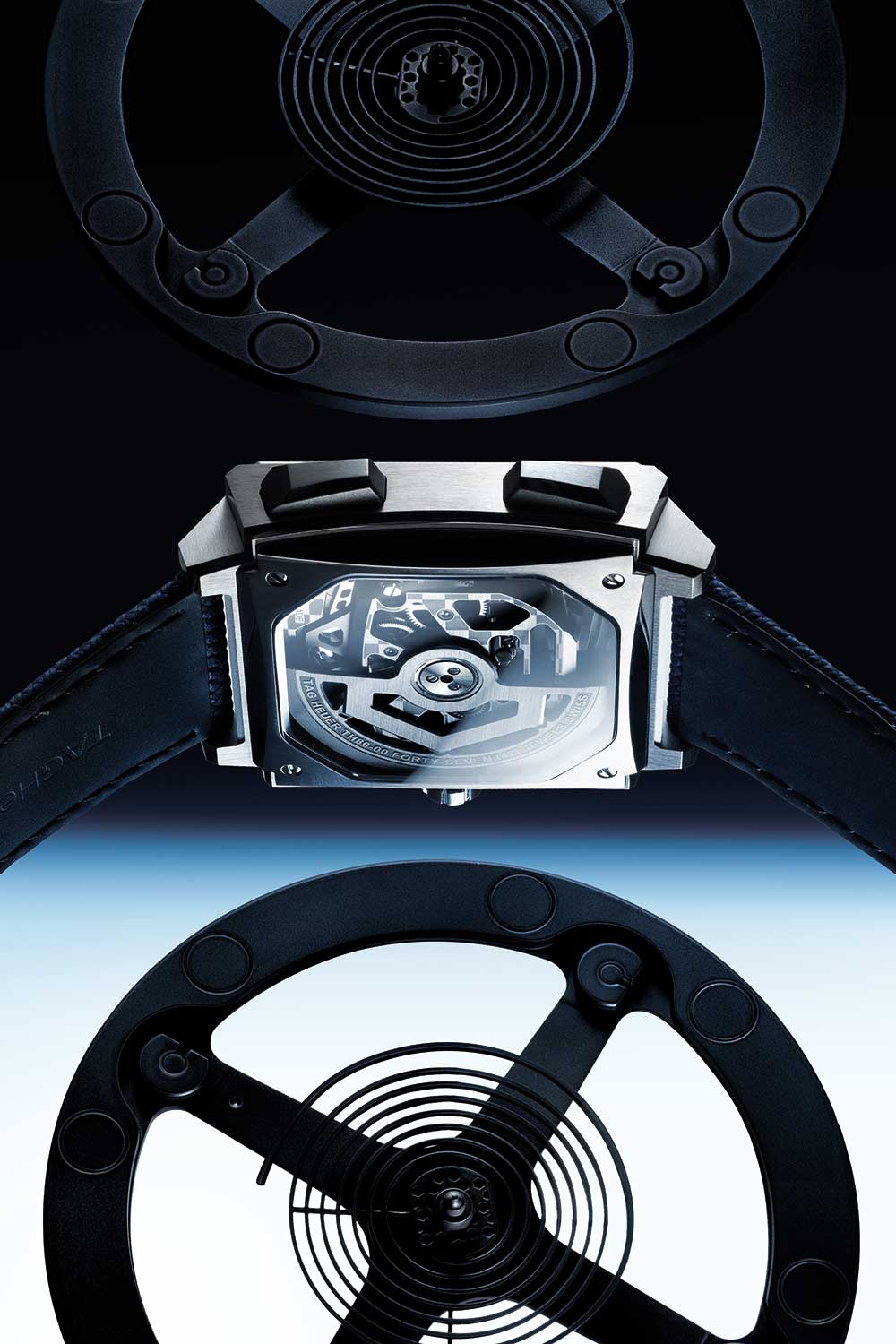
The TAG Heuer Monaco Evergraph pairs its landmark TH-Carbonspring with a chronograph governed by bistable compliant components
“We wanted something very durable and very reliable. We also wanted something highly ergonomic in terms of pusher pressure. It’s super smooth, and you immediately feel the precision of the mechanism compared with a conventional chronograph. There is nothing comparable. Even the sound is special,” says Carole Forestier-Kasapi, Haute Horlogerie & Movements Strategy Director.
Developed over five years in partnership with Vaucher Manufacture Fleurier, the new Calibre TH80-00 is a high-frequency chronograph beating at 5Hz with a 70-hour power reserve. It is also a square-shaped movement, built specifically for the TAG Heuer Monaco. It is equipped with a vertical clutch but dispenses with a column wheel or cam that traditionally governs the various states. In this scenario, start and stop are governed by a flexural switch, while zero reset is controlled by another. The two are mounted in close proximity, but do not share the same axis.
In engineering, such structures are known as bistable compliant mechanisms. They are systems that toggle between two stable positions through the elastic bending of a thin blade rather than through articulated joints, levers or springs. The blade bends and stores elastic energy until it reaches a critical point at which it moves to its alternate position, switching the mechanism from one state to the other.
How The Compliant Chronograph Mechanism Works
The control of the start and stop is built around a pivoting switch mechanism that has a thin, integrated flexural blade. This switch is mounted on a fixed pivot on the movement plate and is acted upon by the chronograph pusher at 2 o’clock. At the other end of the elastic blade is a tab that carries a pin. This pin bears against one of the clamps of the chronograph clutch. When the 2 o’clock pusher is pressed, the switch rotates slightly about its pivot, bending the blade and storing elastic energy along its length. As the deformation increases, the blade eventually passes through a critical point and moves forward. The movement of the pin then drives the clamps outward, freeing the clutch and allowing the chronograph wheels to be driven by the going train.
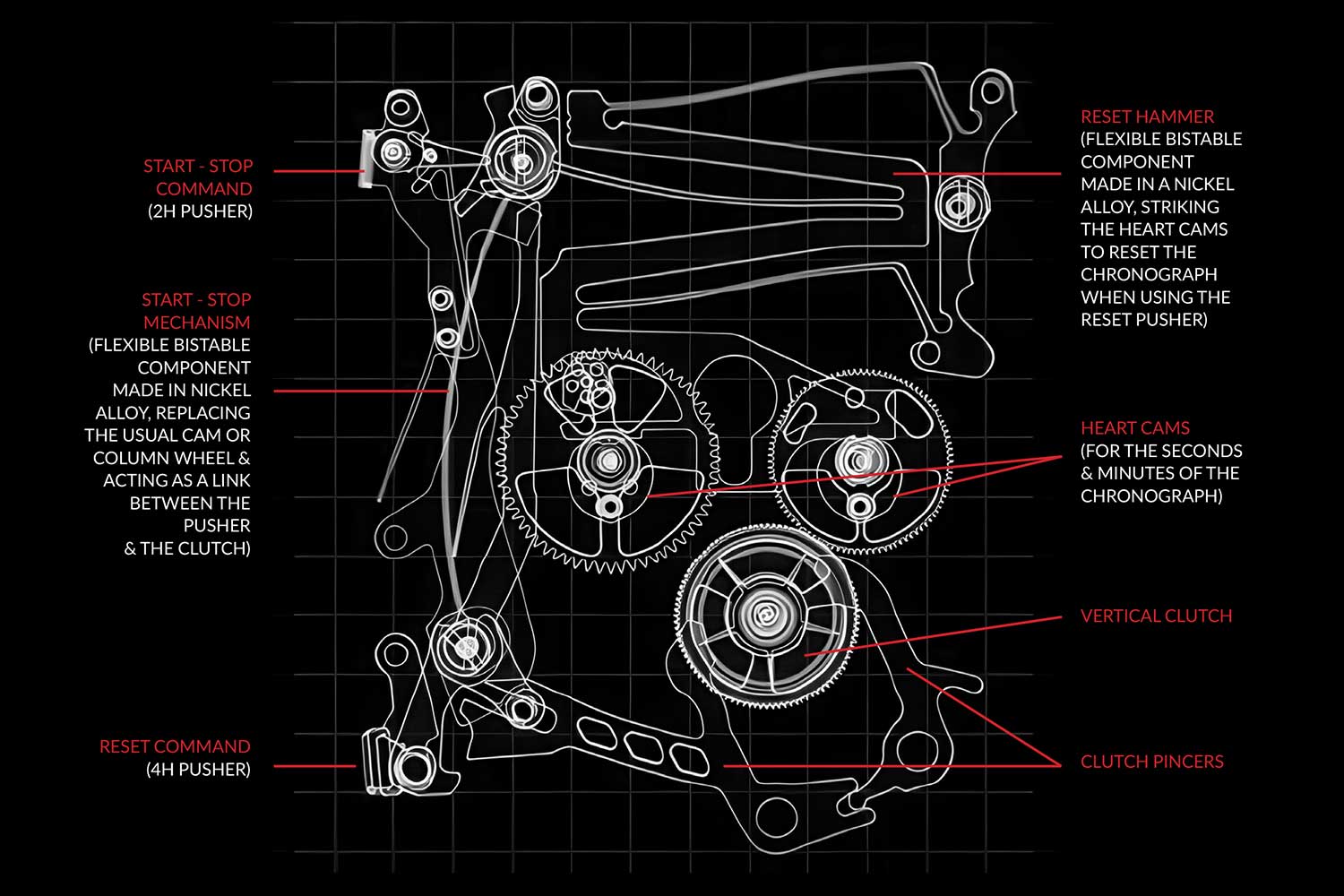
The chronograph mechanism employs two bistable flexible components, which respectively govern the start–stop and reset functions
The blade is deliberately offset relative to the pivot axis of the switch so that it is already preloaded in the resting position. As a result, the structure possesses two stable equilibrium states. Pressing the pusher again to stop the chronograph reverses this process. The switch rotates back, the blade once again passes through its unstable midpoint and switches to its original position, allowing the clutch clamps to close and isolate the chronograph wheel from the train.
The sensation at the pusher hence feels quite remarkable. In a conventional column wheel chronograph, pressing the start/stop pusher sets several components in motion at once. The pusher first drives the operating lever, whose pawl advances the column wheel by one step. The position of the pawl is ensured by its spring while a jumper spring is forced out of one of the ratchet teeth gap and snaps into the next. At the same time, the rotation of the column wheel shifts the clutch lever while also cocking the reset hammer. The finger must therefore overcome the resistance of several springs simultaneously, which produces the familiar firm and abrupt click of a traditional chronograph. In this mechanism, however, the pusher does not index a wheel or displace a train of articulated levers. It simply bends a thin elastic blade until the structure moves into its second stable state.
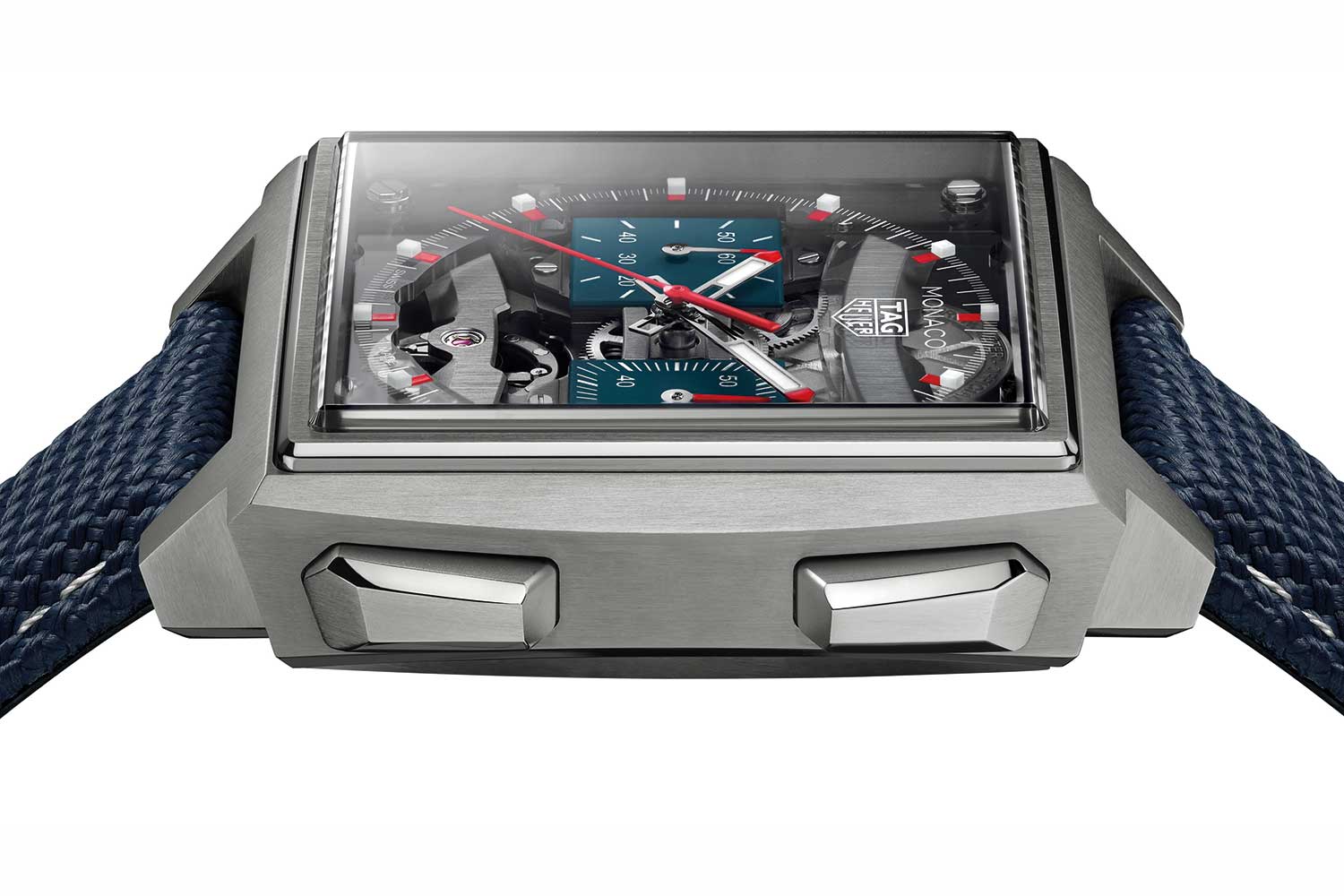
A key advantage of the compliant bistable components is the reduced pusher force required. The pushers have also been elongated to improve ergonomics
The reset function is handled by a second switch connected by a thin flexural blade to the reset hammer, which is formed as a rectangular flexural frame composed of two long beams joined at their ends. The right side of the frame is fixed to the movement plate, while the beams are each accompanied by an elastic blade. When the reset pusher at 4 o’clock is pressed, the switch rotates slightly, bending the first blade and progressively storing elastic energy in the structure. Because the reset hammer is also supported by the two other elastic blades, all three deform simultaneously. As the deformation increases, the entire component reaches a critical configuration and snaps through, causing the rigid front section of the hammer to move suddenly downwards. The hammer faces then strike the heart cams of the chronograph wheels, forcing them to turn until their lowest point aligns with the hammer surfaces, returning the counters precisely to zero.
This attribute is crucial as it solves a classic problem in chronographs. The reset hammer must strike the heart cams decisively. If the hammer approaches the cams slowly or hesitantly, the reset can be incomplete or imprecise. In this approach, the elastic energy accumulated in the flexural blade is released suddenly, ensuring that the hammer falls quickly with sufficient force. From the switch onward, the entire reset mechanism is formed as a single monolithic structure, eliminating joints, pivots and separate springs that would otherwise introduce friction, tolerances and wear.
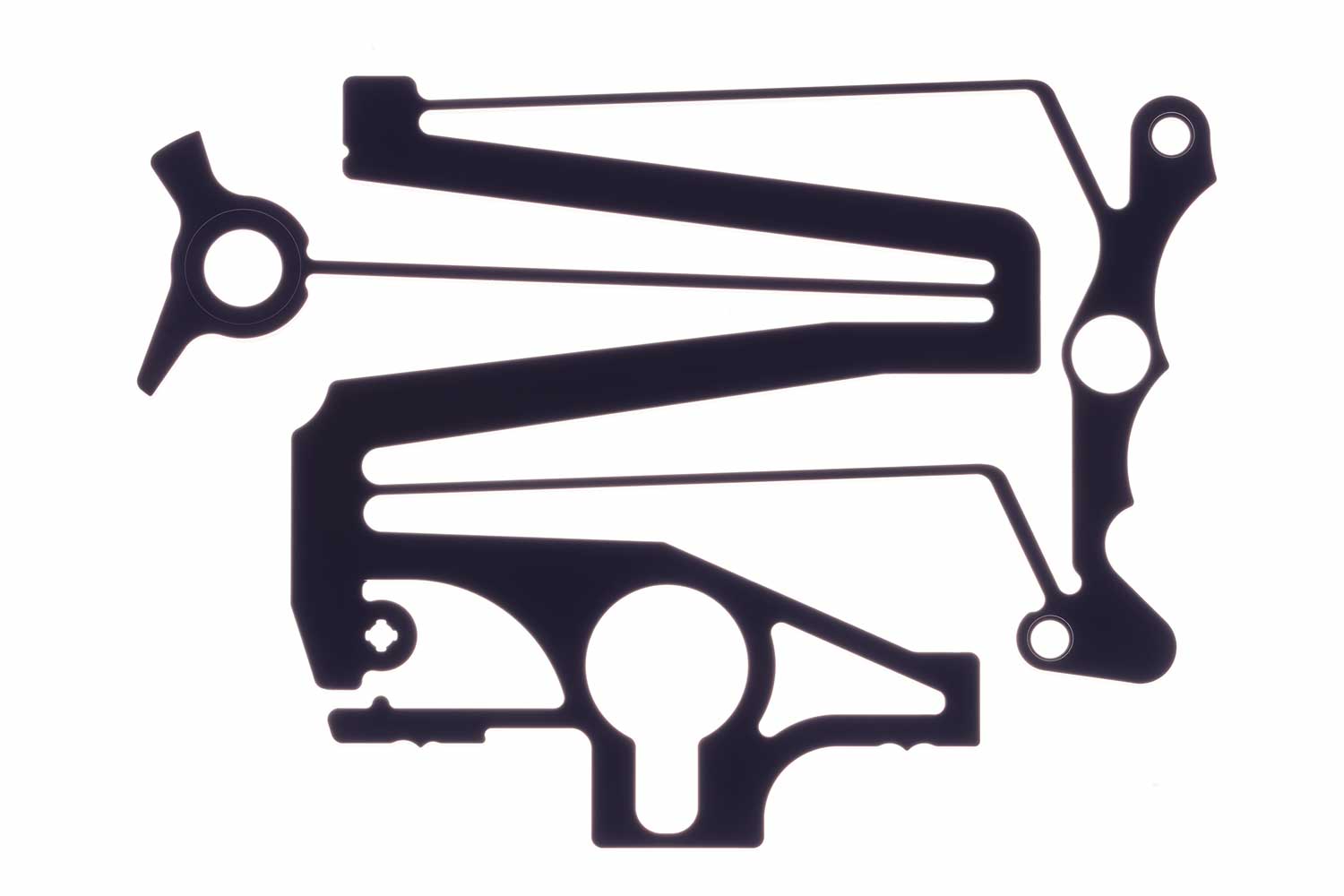
The monolithic bistable reset hammer developed by TAG Heuer LAB
Importantly, the pivot axis of the switch is once again offset relative to the blade, which means the flexural assembly is already preloaded in its resting state, which gives the system two stable states. Thus, pressing the reset pusher merely loads the compliant structure. The stored energy in the blades is then released to propel the hammer onto the heart cams.
Notably, a pin attached to the start/stop switch interacts with the reset mechanism. When the chronograph is started, the pin briefly contacts the reset switch and forces it to pivot, causing the bistable reset hammer to move upwards. Once this occurs the pin disengages and leaves the hammer clear of the heart cams while the chronograph is running. The entire design is genuinely ingenious, and it replicates what the column wheel normally guarantees.
Both start-stop and reset compliant mechanisms are fabricated from nickel-phosphorus using the LIGA process, an additive micro-electromechanical technique capable of producing extremely precise micro-structures with intricate geometries. Nickel-phosphorus is particularly well suited to this application because it combines high hardness, excellent fatigue resistance and very stable elastic behavior, qualities essential for parts that must repeatedly flex without permanent deformation. “There were three prototype runs and more than 300 rounds of testing to simulate 10 years of activation, so the watch can maintain a 10-year service interval. It is a huge improvement over a regular chronograph,” says Forestier-Kasapi.
This astonishing design is paired with a vertical clutch, which offers several clear advantages over a horizontal one. Instead of coupling the chronograph train laterally through meshing gears, a vertical clutch transfers energy through axial contact between the finishing wheel in the going train and a clutch disk connected to the chronograph seconds wheel. When the chronograph is engaged, the clamps open and the spring-loaded clutch disk is lifted into contact with the finishing wheel, transmitting torque through friction between the two surfaces. This arrangement produces very little kinetic friction during engagement because there is no teeth meshing, and the chronograph begins running immediately without the “stutter” common in horizontal chronographs.
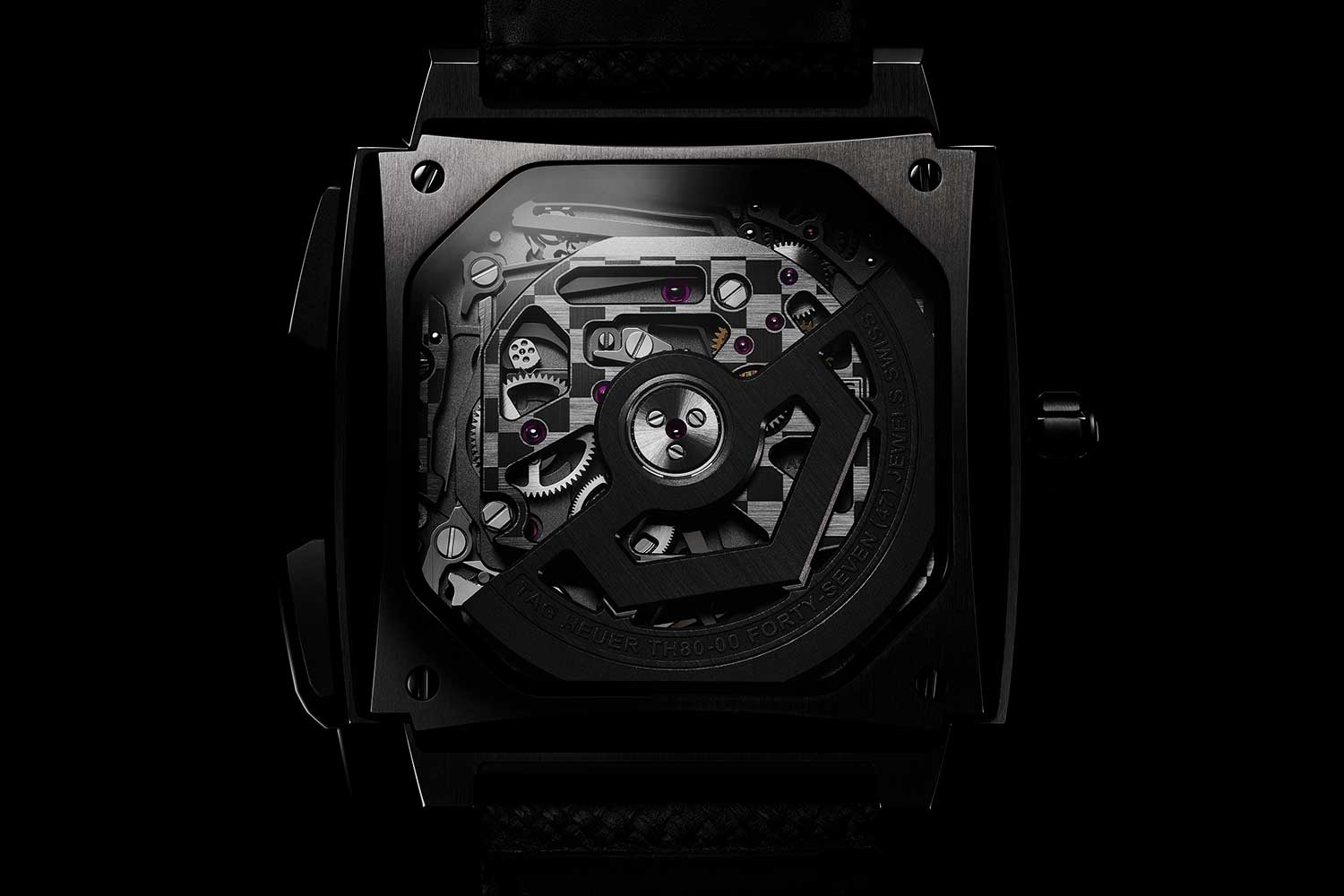
As the movement is inverted, with the barrel, gear train and balance arranged on the dial side, the chronograph mechanism occupies the full expanse of the back, while the automatic winding train is positioned in the upper right quadrant
Return of The Carbon Hairspring
Another highlight of the movement is the TH-Carbonspring, first seen last year in the TAG Heuer Monaco Flyback Chronograph TH‑Carbonspring and the TAG Heuer Carrera Chronograph Tourbillon Extreme Sport TH‑Carbonspring.
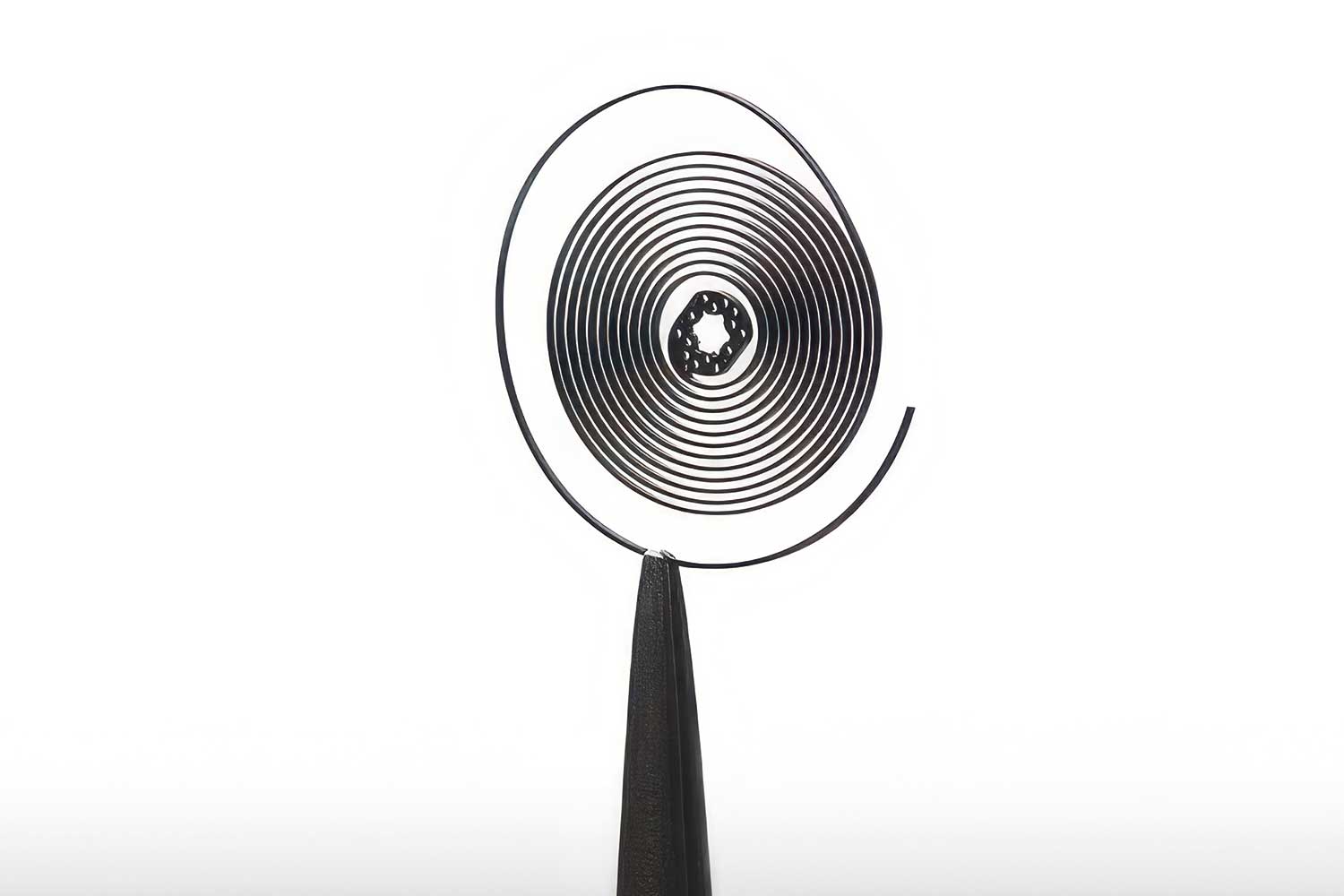
The TH-Carbonspring developed by TAG Heuer LAB
The significance of the TH‑Carbonspring lies in both the inherent properties of the material and the way TAG Heuer has engineered it to behave predictably in a watch. Carbon shares several of the qualities that made silicon attractive to watchmakers in the first place. It is anti-magnetic, extremely light and intrinsically stable across temperature changes. Unlike silicon, however, carbon is far less brittle and hence better able to tolerate shocks and the rigors of assembly.
The carbon hairspring is paired with a free-sprung aluminum balance wheel, fitted with gold weights. Its 5Hz frequency means the balance motion is more stable in the face of the shocks a sports watch is likely to encounter. The oscillator is visible on the dial side and is supported by a full balance bridge, which secures the balance staff at both ends, likewise for greater stability. The movement is officially certified chronometer by the COSC and the watch is delivered with a five-year extended warranty.
In all, the movement is a tremendous achievement, all housed in one of the most iconic chronographs of all time. There have been a couple of chronographs over the years that have drastically altered the fundamental construction of the complication, but they often seem to do so by adding layers of complexity that feel disproportionate to the practical result achieved. By replacing assemblies of levers, springs and articulated joints with compliant structures that flex to perform the same functions, the Evergraph reduces the mechanism to something both simpler and more direct. It is a rare instance where a genuinely new solution offers real practical benefits for the user while also retaining an ingenious simplicity. In watchmaking, as in engineering generally, that kind of ingenuity is perhaps the most satisfying kind of all.
TAG Heuer

You may also like
News
Last Week in Watches: MB&F Revives LM1, Hublot Revisits 1980
Oct 19, 2026
News
Last Week in Watches: MB&F Revives LM1, Hublot Revisits 1980
Oct 19, 2026
Editorial
Last Week In Watches: TAG Heuer Carrera, JLC Grande Sonnerie, Louis Vuitton Spin Time and more
Sep 15, 2026
Editorial
Last Week In Watches: TAG Heuer Carrera, JLC Grande Sonnerie, Louis Vuitton Spin Time and more
Sep 15, 2026

Editorial
The Cult of Cool: TAG Heuer Carrera Chronograph x Team Ikuzawa
Jul 30, 2026
Editorial
The Cult of Cool: TAG Heuer Carrera Chronograph x Team Ikuzawa
Jul 30, 2026