
The Breguet Tradition: A Modern Interpretation of 18th-Century Watchmaking
Editorial
The Breguet Tradition: A Modern Interpretation of 18th-Century Watchmaking

Modern movements are almost universally visible through sapphire backs, and if the dial itself were likewise made transparent on most watches, there would be very little of consequence to see besides the motion works and the keyless works doing their modest but necessary jobs. The real traffic of power — the barrel, gear train, escapement and balance — would not be seen because in a conventional movement those live on the other side of the mainplate, properly out of sight.
The Breguet Tradition is one of modern Breguet’s great achievements. It was among the most inspired watches to emerge from the first decade of the 21st century, a time when mechanical watchmaking, long overshadowed by quartz, rediscovered both its nerve and its imagination. The previous decades had been spent in reflection, with brands looking backward to move forward. The 2000s were different. They marked a return of confidence, a moment when watchmaking began to think freely again, taking the vocabulary of tradition and using it to say something new.
It was in this context that Breguet, drawing from the very foundations of its own history, created a watch that not only exposes the movement but inverts its construction. The barrel, which ordinarily sits in the underside of the mainplate, is brought to the visual center on the dial side while the train is arranged around it with the center wheel and balance wheel forming a clear symmetry. In this way, the architecture of function becomes the architecture of form, and the labors of the wheel train can be followed as plainly as the hands they serve.
The Tradition was inspired by one of Abraham-Louis Breguet’s most ingenious ideas. It reproduces both the arrangement of the train and orientation of the dial found specifically in his montres à tact, or tactile watches, themselves derived from the architecture of his souscription movements.

Breguet montres à tact No. 2292
Roots in the Souscription and Montres à Tact
The souscription watches produced by Breguet from 1796 were single-hand timepieces named for the method by which they were sold, with a quarter of the price paid in advance and the remainder upon delivery. Conceived in the aftermath of the French Revolution to make high-grade watches more accessible, they were priced at around 600 francs, with a choice of either a gold or silver case, and proved highly successful, with some 700 examples ultimately produced.

The original Souscription Pocket Watch No. 3424 from 1797 (Image: Breguet)
The majority were fitted with enamel dials, and the single hand was mounted on a hollow tube that projected through the front plate, enclosing the winding square. The barrel can be wound from both the front and the back. The key engaged the central square directly, winding the mainspring through the barrel arbor while the hand would turn along with it. Once it is set to time, winding can be continued on the movement side. Later iterations introduced refinements such as Breguet’s pare-chute suspension and échappement isolé, which was his own version of the ruby cylinder escapement.

Breguet Souscription No. 3424 movement
In the montres à tact, however, produced from 1799 onwards, we see the appearance of a small dial located at the 12 o’clock on the bridge side of the movement, just above the central barrel, allowing the time to be read by sight in addition to touch. Different varieties were produced but generally they had a single tact hand on the front or back cover that allowed time to be felt by reference to the touch pieces set around the case edge. In these watches, the barrel directly drove the motion works for the small offset dial, independent of the gear train arranged beneath it. The barrel was wound by its square, accessible once the caseback was released, while the single hand was either fitted to the tube projecting through the front in those with subscription-type dials or set on a revolving back.

Breguet montre à tact No. 1052, with pearls set along the case edge, recently surfaced at Sotheby’s. It is remarkable for its previously unknown co-axial double-wheel escapement. (Image: Sotheby’s)
A plain montre à tact ranged from 1,000 to 2,000 francs, which was comparable to his repeating watches, while the most elaborate examples could cost up to 5,000 francs. Some had diamond touch pieces with cases engine-turned and covered in enamel, such as No. 611 sold on February 18, 1800, to Mrs. Bonaparte, later Empress Josephine.

Breguet médaillon à tact watch No. 611 sold to Mrs. Bonaparte, later Empress Josephine
The Tradition Collection
Two centuries later, in what can only be described as a stroke of genius, Breguet, now part of the Swatch Group and with major development prowess, reinterpreted the design for the wrist. The first Tradition model, the hand-wound 37mm Ref. 7027 with a power reserve indicator, was introduced in 2005, followed a year later by the automatic 38mm Ref. 7037. Over the years, the collection underwent various incarnations, including both hand-wound and automatic models, some with retrograde seconds or retrograde date, gem-set or enlarged cases.
-

- 2005: Breguet Tradition Ref. 7027
-

- 2006: Breguet Tradition Ref. 7037

Breguet Tradition Quantième Retrograde 7597

Breguet Tradition Dame 7038 with a Tahitian mother-of-pearl dial and diamond-set bezel and the Tradition Seconde Rétrograde 7097 with a 40mm case
Beyond that, the Tradition collection evolved to encompass highly innovative executions of traditional complications. What began as an inversion of the souscription layout became a foundation for exploring how far the idea could be stretched without losing its elemental clarity.
The Tradition Fusée Tourbillon 7047, launched in 2010, is one example and was inspired by Breguet’s own pocket watches which paired the fusée-and-chain transmission with a tourbillon. In the 7047, both are visible on the dial side, along with an offset time display and a quietly innovative, compact power reserve indicator on the barrel. In both visual style and construction, it is a watch that Breguet himself would have recognized as being very much in the spirit of his own timepieces.

Breguet Tradition Fusée Tourbillon Ref. 7047
A tourbillon and a fusée-and-chain make for a natural pairing in the same movement as they address different problems that nevertheless converge on the same goal. The fusée-and-chain was devised to regulate the flow of energy as the mainspring unwinds. The varying diameter of the fusée cone provides an increasing mechanical advantage as tension diminishes. The tourbillon, on the other hand, was Breguet’s answer to the vagaries of gravity, averaging out the variations in rate as the watch shifts from one position to another.
The 7047 employs a reverse fusée in which the positions of the barrel and fusée are swapped so that the chain crosses over. This configuration makes winding easier, while at the same time the pull of the chain opposes the thrust of the fusée pinion, balancing the forces at the pivots and reduces frictional losses. At the same time, the barrel houses two mainsprings that unwind in parallel to provide higher and therefore more constant torque. The power reserve indicator is integrated into the barrel cover, made possible by a miniature differential built coaxially within it. The tourbillon, on the other hand, has a shock protection system in the form of a lever designed to prevent the tourbillon carriage from dislodging or damaging its pivots when subjected to strong impacts.

The fusée-and-chain was devised to regulate the flow of energy as the mainspring unwinds
Another notable landmark was the Tradition Chronographe Indépendant 7077, introduced in 2015. It remains one of the most conceptually striking chronographs on the market even a decade on. It dispenses with a clutch and column wheel or cam, essentially abandoning the very framework on which the conventional chronograph is built. The chronograph has its own gear train, escapement and 5Hz balance, powered by a flat blade spring. However, there is more than meets the eye, and the subtleties are both complex and ingenious.

Breguet Tradition Chronographe Indépendant Ref. 7077
When the reset pusher is actuated, a set of levers pivots a rack that simultaneously resets the minute counter and winds the blade spring. The same action also releases a hammer that returns the seconds hand to zero via a traditional heart cam. Once the chronograph is started, the stored energy in the blade spring drives the entire chronograph train directly through the minute and seconds counters, escapement and its own regulating organ without robbing energy from the main barrel.

The blade spring is mounted horizontally within the movement, acting as the energy source of the independent chronograph. It is charged via a cascade of levers each time the chronograph is reset to zero (©Revolution)
The mechanism eliminates the need for the usual heart cam and hammer for the minute counter to reduce the torque needed during reset. Instead, the minute hand is rigidly fixed to its arbor, and the reset is achieved through a rack mechanism. During the reset, a unidirectional coupling system based on a planetary wheel assembly automatically uncouples the seconds train from the minute train, allowing the minute hand to return to zero freely without disturbing the rest of the mechanism.

On the right is a planetary wheel holder carrying freely rotating planetary wheels that mesh with the drive wheel, itself driven by the minute counter via its rack. During operation, the planetary wheels lock to transmit motion from the minutes to the seconds pinion; during reset, they roll freely, isolating the seconds from the minutes (©Revolution)
As the blade spring unwinds, the force it delivers naturally decreases. To counter this, Breguet adopts a very clever solution. The gearing between the intermediate rack and the minute rack isn’t perfectly concentric. As they pivot, the point of contact between the two changes, subtly altering the leverage. This variation offsets the loss of power, keeping the torque reaching the escapement steady and ensuring the chronograph runs with a consistent amplitude and rate from start to finish. At the same time, an adjustable cam at the anchoring point of the spring allows fine calibration of its pre-tension during assembly.
When the chronograph is started, the pusher releases a brake lever that holds the balance at rest. Stopping the chronograph re-engages the brake, halting the balance instantly without affecting the going train. The system essentially allows the chronograph to function as a self-contained mechanism drawing no power from the primary gear train and does so in a manner that is intensely engineered.

The balance on the left is made of titanium to reduce inertia, allowing it to oscillate at a higher frequency of 5Hz for greater precision, while the timekeeping balance on the right maintains a steadier 3Hz for regular time display (©Revolution)
Ultimately, the watches in the Tradition collection are both charming and thought-provoking, offering a fascinating study in how each model balances fidelity to the heritage of A.-L. Breguet’s work and workshop practices with the forward-looking spirit of Breguet himself, whose pursuit of technical innovation never ceased.
A New Chapter
The Seconde Rétrograde 7035, released for Breguet’s 250th anniversary, returns to that original idea of an inverted souscription movement with a flinqué enamel dial and a 38mm case in a new proprietary Breguet gold alloy. It was an apt choice, a new expression of what is perhaps the most complete statement of what a Breguet wristwatch should be in the modern era.

Breguet Tradition Seconde Rétrograde 7035 (©Revolution)
Inherently, the brilliance of the Tradition lay not merely in the concept but in the manner of its adaptation. As mentioned, the Tradition models adopted the basic gear train layout of the montres à tact and souscription watches, and transposed them to the dial side. Likewise, the motion works for the hands on the small dial are driven directly by the barrel. Yet what is less immediately apparent is the quiet ingenuity required to preserve the simplicity and clarity that defined Breguet’s original conception.
In his pocket watches, winding and setting were carried out by means of a key fitted directly to the square of the barrel arbor. The simplicity and clarity of the movement were hence inherent in the absence of keyless works, setting and winding trains. In a wristwatch, where all these mechanisms are necessary, achieving the same effect requires further thought.

The keyless works, winding and setting trains are relegated to the back of the movement, allowing the dial side to remain visually clean, showcasing only the wheel train (©Revolution)
The keyless works and setting train were moved to the back of the movement, and although the caliber is inverted, the winding train also had to remain on the reverse to preserve the simplicity on the dial side. An elongated bridge on the left carries the winding wheels while simultaneously supporting the pivots of the setting train. Because the setting train must engage the motion works on the front, an intermediate extension wheel connects the two layers.

The elongated bridge carries the winding pinions while supporting the setting train in the main plate (©Revolution)
There is also a retrograde seconds indicator at 10 o’clock with a flame-blued hand, driven by a mechanism that is entirely visible on the back of the movement. The fourth wheel is linked to a cam that is traced by a feeler, itself rigidly attached to a pivoting rack. As the seconds advance, the rack is gradually tensioned by a return spring. At the top of each minute, the feeler drops abruptly from the highest point of the cam to the lowest, releasing the stored energy and snapping the hand back to zero.

The retrograde seconds mechanism is fully visible on the back. Driven by the fourth wheel, a cam at 6 o’clock is traced by a feeler attached to a spring-loaded rack, which builds tension as seconds advance. At the top of the minute, the feeler falls off the highest point of the cam, and stored energy is released to return the hand back to zero. (©Revolution)
The oscillating weight in the Seconde Rétrograde 7035 is made of platinum, echoing Breguet’s original perpétuelle watches. Those early self-winding mechanisms employed a hammer-style system, in which a platinum weight was pivoted at the edge of the movement. When carried in a pocket, the motion of walking caused the case to move while the heavy platinum weight remained still. This relative motion drove the winding mechanism. Platinum gave the weight enough inertia to resist motion and wind the mainspring effectively. The weight swung through only a limited arc, with buffer springs on either side to absorb shocks and control motion. The Caliber 505SR retains the distinctive rotor shape of Breguet’s original perpétuelle design and winds in one direction, but unlike it, the rotor now makes a full 360-degree rotation.
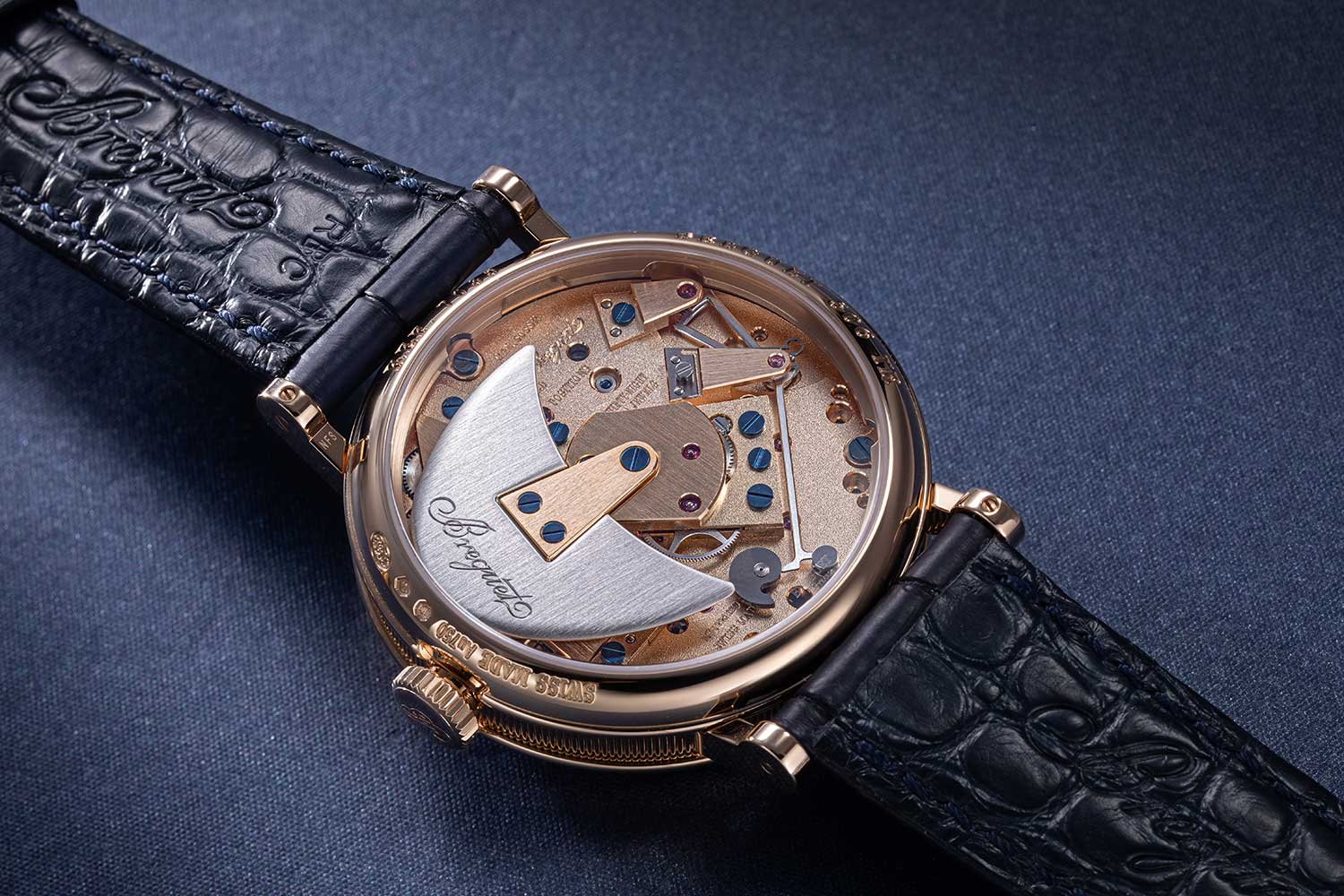
The oscillating weight is now in platinum, echoing the material choice used by A.-L. Breguet in his original perpetuelle winding system (©Revolution)
The balance wheel can be stopped when the crown is pulled out for time-setting. It is free-sprung but beat error can be adjusted with the screw in the curved slot. Breguet even goes so far as to recreate the pare-chute shock protection system, and even the curved spokes of the train wheels are just as they were in the original souscription movements. Notably, the overcoil hairspring is no longer made of silicon. Earlier models used a silicon spring with a separate overcoil segment joined by a connector. In this version, it is fashioned from blued Nivachron, a titanium-based alloy developed by Swatch Group and Audemars Piguet. It offers similar magnetic resistance while being less brittle and easier to handle.

Free-sprung balance with a blued Nivachron overcoil hairspring and Breguet’s pare-chute shock protection system, which incidentally was invented for his perpetuelles (to protect the balance staff from shocks caused by the heavy platinum oscillating weight, especially when the watch was jostled or shaken) (©Revolution)
Enduring Codes of Design
The anniversary edition also introduces several refinements to the externals that reinforce the already enormous appeal of the Tradition. The case is fashioned from Breguet gold, a newly developed proprietary alloy composed of 75 percent gold and remaining 25 percent a mixture of silver, copper and palladium. The resulting alloy has a more neutral tone that sits somewhere between yellow and rose, while the presence of palladium improves resistance to oxidation and maintains color stability over time.

(Revolution©)
Elaborate in form and classic Breguet, the case has a fluted caseband made by pressing the pattern into the metal by a cold-rolling process before being individually refined and finished by hand. The straight welded lugs and screw-pinned bars, another of Breguet’s enduring hallmarks, give the case its strong geometry.

The movement plate and bridges are plated in 18K Breguet gold, while the dial and hands are in solid gold. The dial is a display of the same devotion to craft that has defined Breguet, past and present. It features a newly developed engine-turned pattern known as Quai de l’Horloge. Its design draws inspiration from the curve of the Seine as it encircles the Île de la Cité — the historic heart of Paris where Breguet established his workshop — as depicted on the Turgot map. Each dial is engraved by hand on a rose engine equipped with custom rosettes made expressly for this pattern. After engraving, the dial undergoes grand feu enameling. A layer of translucent blue enamel in a specific Breguet blue shade is applied over the guilloché base and then fired in the kiln at over 800 degrees Celsius. While engine turning is often the craft most closely associated with A.-L. Breguet, enameling was no less integral to his work during his most prolific years.

The new Quai de l’Horloge pattern is turned manually on a rose engine, with custom rosettes made specifically for this design

Once the enamel is applied, the dial is placed in a kiln and fired at over 800°C
As always with the Tradition, the finishing hews closely to the original’s movements. The movement plate and bridges are given a frosted finish, achieved through shot blasting. For the first time, the top surfaces of the bridges are satin finished, which produces a subtle contrast that enhances the depth of the movement.

(Revolution©)
The Architecture of Modernity
It suffices to say that even two decades on, the Breguet Tradition remains one of the most compelling watches that connect us to one of the greatest minds ever to work in the field. It feels both traditional and modern, rooted and restless, looking back only to imagine what Breguet himself might have done next. In that, it bridges two centuries of horological thought with a coherence and originality that few modern designs can claim. Its inversion transformed mechanics into design, creating an entirely new typology of watchmaking where the movement became both the engine and the expression.
This approach was quietly radical. It redefined transparency in mechanical terms because until then, most movements relied on skeletonization to reveal their inner workings. But Breguet did so instead through structural, architectural legibility, where the entire movement is reconfigured so that its most active elements became part of the dial composition. It introduced an aesthetic of mechanics that would ripple far beyond Breguet’s own atelier, influencing both independent and mainstream makers alike to treat their movements as three-dimensional spaces rather than flat, two-dimensional mechanisms.
In doing so, the Tradition established one of the most enduring contemporary design languages in modern horology. In fact, it has become so entrenched in the visual vocabulary of watchmaking that its originality is almost taken for granted, obscured by the extent to which it reshaped the idea of what a movement could look like. Yet it all traces back to this very watch, which so instrumentally showed how mechanics and aesthetics, the past and the future, can be seamlessly integrated.
Breguet
You may also like
Editorial
Revolution Awards 2025: Brand of the Year — Breguet and Vacheron Constantin
Jan 27, 2026
Editorial
Revolution Awards 2025: Brand of the Year — Breguet and Vacheron Constantin
Jan 27, 2026

Editorial
Revolution Awards 2025: Revolutionary of The Year — Gregory Kissling
Jan 27, 2026
Editorial
Revolution Awards 2025: Revolutionary of The Year — Gregory Kissling
Jan 27, 2026
Editorial
Revolution Awards 2025: Best Concept Watch — Breguet Expérimentale 1
Jan 27, 2026
Editorial
Revolution Awards 2025: Best Concept Watch — Breguet Expérimentale 1
Jan 27, 2026