
Rado & Le Corbusier: Forward Thinkers in Design
Without question, the early to mid-20th century era offered the biggest transformations in the artistic fields. This was due to a variety of factors. Post-war liberation gave life to bold color palettes, but also challenged resource management. The two world wars, having consumed the world’s resources in the buildup of military needs, meant that recovering economies had to be smart about how it spent its existing wealth.
At the same time, design expounded on a new era of modernist language, one that was previously caught up in the crossover from a new modernism to the deconstruction of a post-modern world. The language of design was reduced to its raw, natural and minimalist form, which would later lend itself to a rough-hewn Brutalism that swiftly gave way to naturalist styles of a refined modern bent. It was in this era that modern architecture prevailed, with names like Le Corbusier and Frank Lloyd Wright constructing everything from homes to cities, all of which shared this need for authenticity, simplicity and a colorful elegance, an ideology that Rado has embraced.
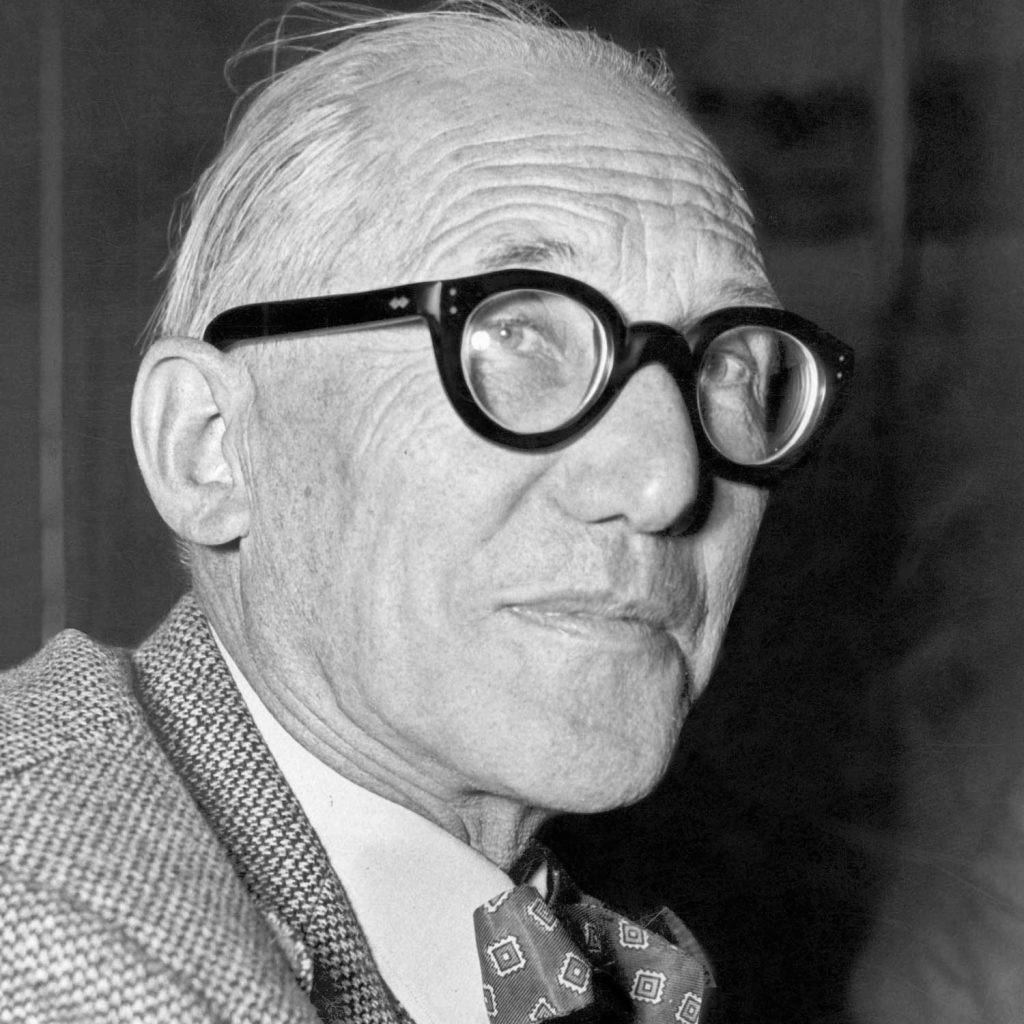
Le Corbusier
Inspired Design
Till this day, the gardens of Chandigarh are considered one of the seven man-made wonders of the world. Le Corbusier was personally contacted by India’s most famed prime minister, Jawaharlal Nehru to come up with a design for the city.
He famously wrote, “It will be a city of trees, of flowers and water, of houses as simple as those at the time of Homer, and of a few splendid edifices of the highest level of modernism, where the rules of mathematics will reign.” He would later write in a personal letter to his mother that Chandigarh was “an architectural symphony which surpasses all my hopes, which flashes and develops under the light in a way which is unimaginable and unforgettable. From far, from up close, it provokes astonishment; all made with raw concrete and a cement cannon. Adorable, and grandiose. In all the centuries no one has seen that.”
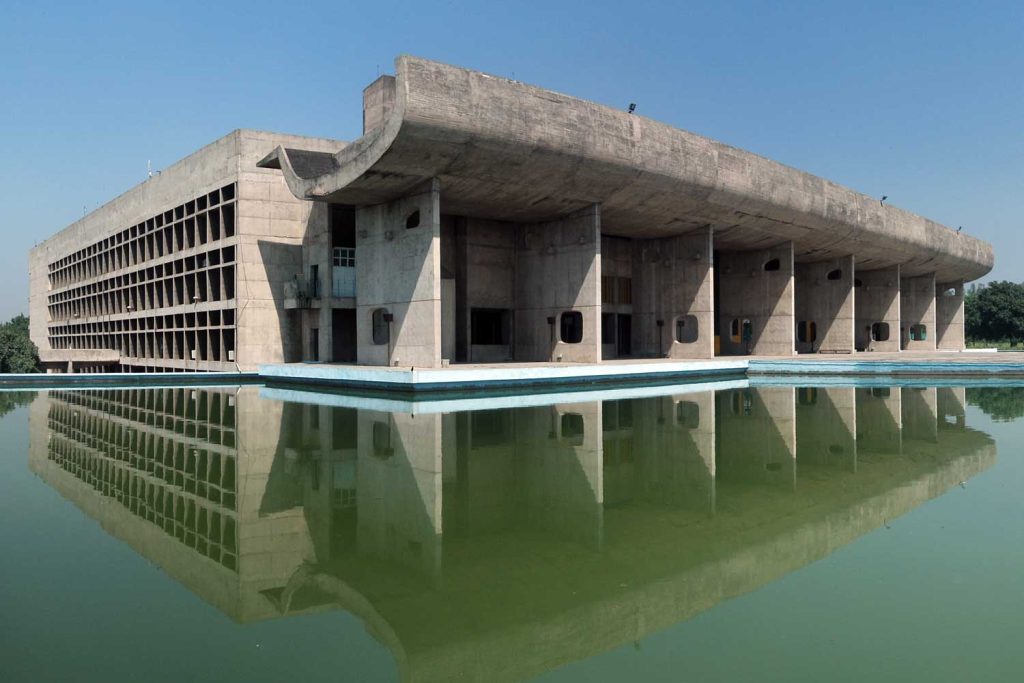
Palace of Assembly in Chandigarh, India; designed by Le Corbusier
A Theory of Color
Le Corbusier wasn’t just an architect or designer, but he was also an avid painter. During his early 30s, just after he’d established his practice with his cousin Pierre Jeanneret, he encountered Cubist painter Amédée Ozenfant who inspired him to start painting and together they developed a new movement called Purism.
Purism evoked simpler forms and shapes than the Cubist style of art seen through the lens of geometry, and a more vivid use of color compared with its predecessor. Through his work, Le Corbusier would go on to develop the Architectural Polychromy color theory, still regarded as the most important in his field. While the practice of decorating architectural elements in a variety of colors (known as polychrome) dates far earlier in history, Le Corbusier was the first to create a coherent system of how they could work in unison.
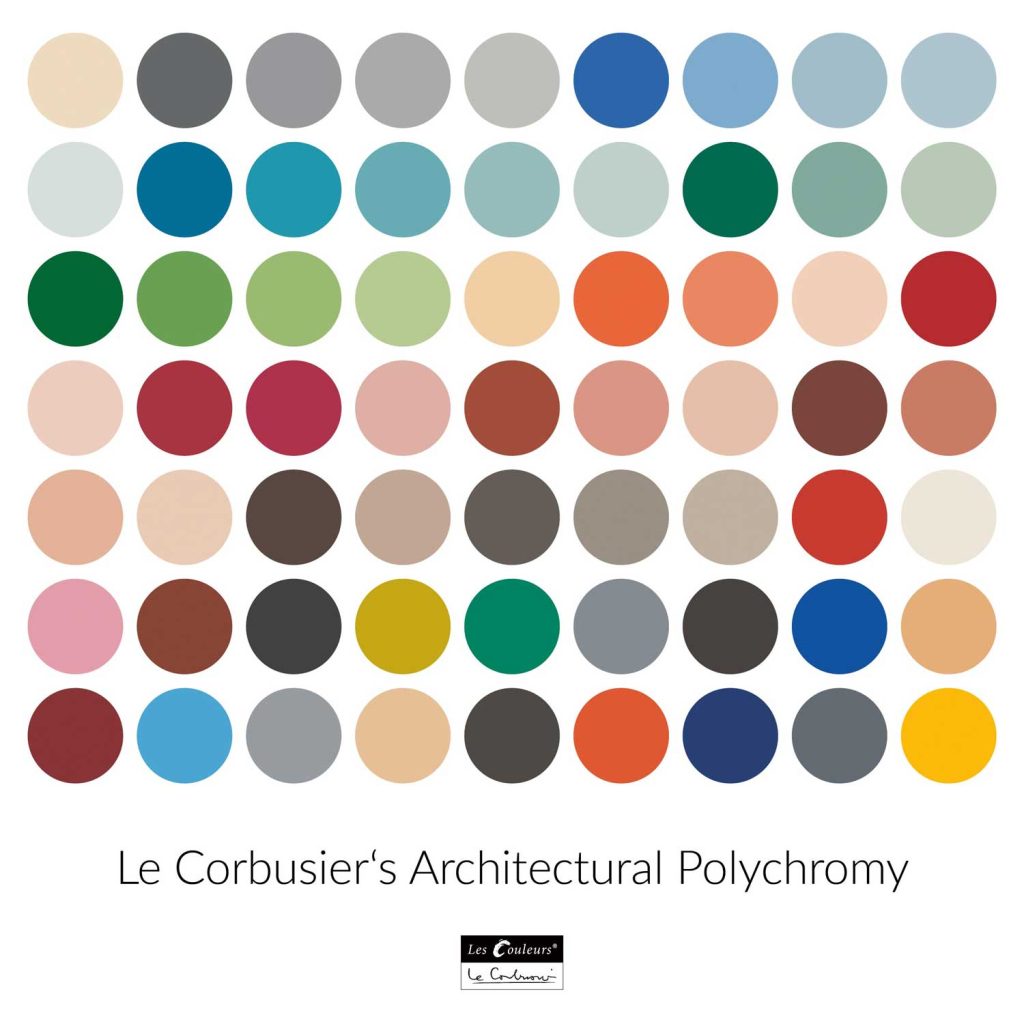
The complete color palette of Architectural Polychromy
The purity of design also began to shape watchmaking from the ’70s into the ’90s. Rado rendered design down to its most minimal, relying on the same ideas of mathematics determining design as Le Corbusier did. The Rado True Thinline collection represents this best, a simple and refined circular case, with needle-like hands and an integrated bracelet that fuses into the watch like a stylish bracelet. The True Thinline renders the watch into a sliver of a case, thin as a wafer and made in high-tech ceramic.
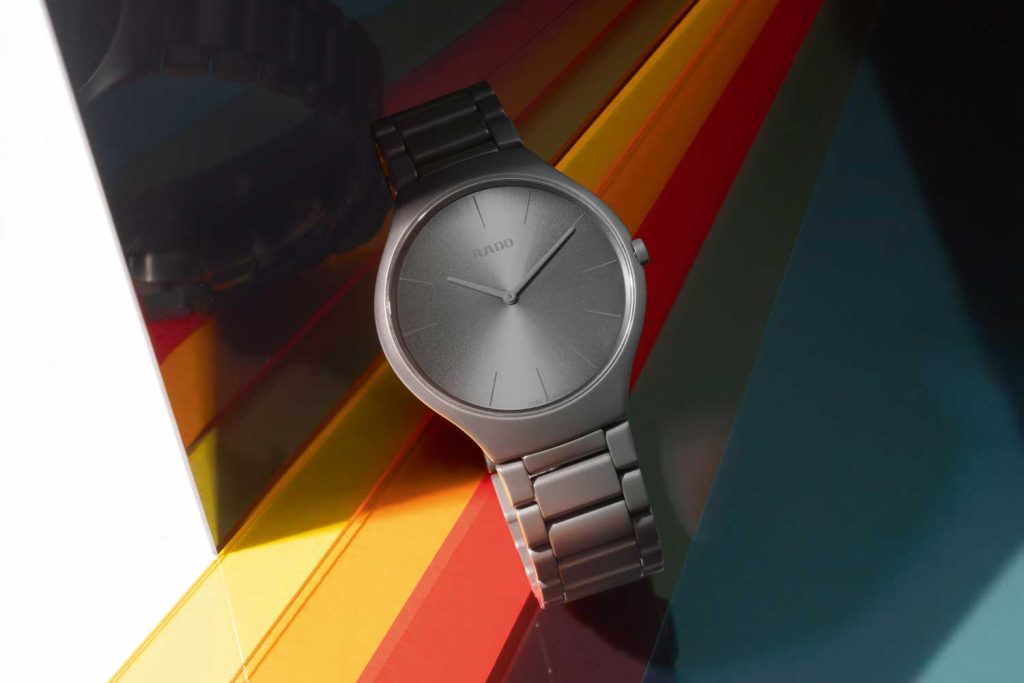
Rado True Thinline Les CouleursTM Le Corbusier Iron Gray 32010 (Image © Revolution)
“We decided to develop a collection based on Le Corbusier’s Architectural Polychromy because of its significance to our modern urban environment today. This meant greater challenges as the Foundation and Les Couleurs Suisse required us to match the nine key colors precisely.”
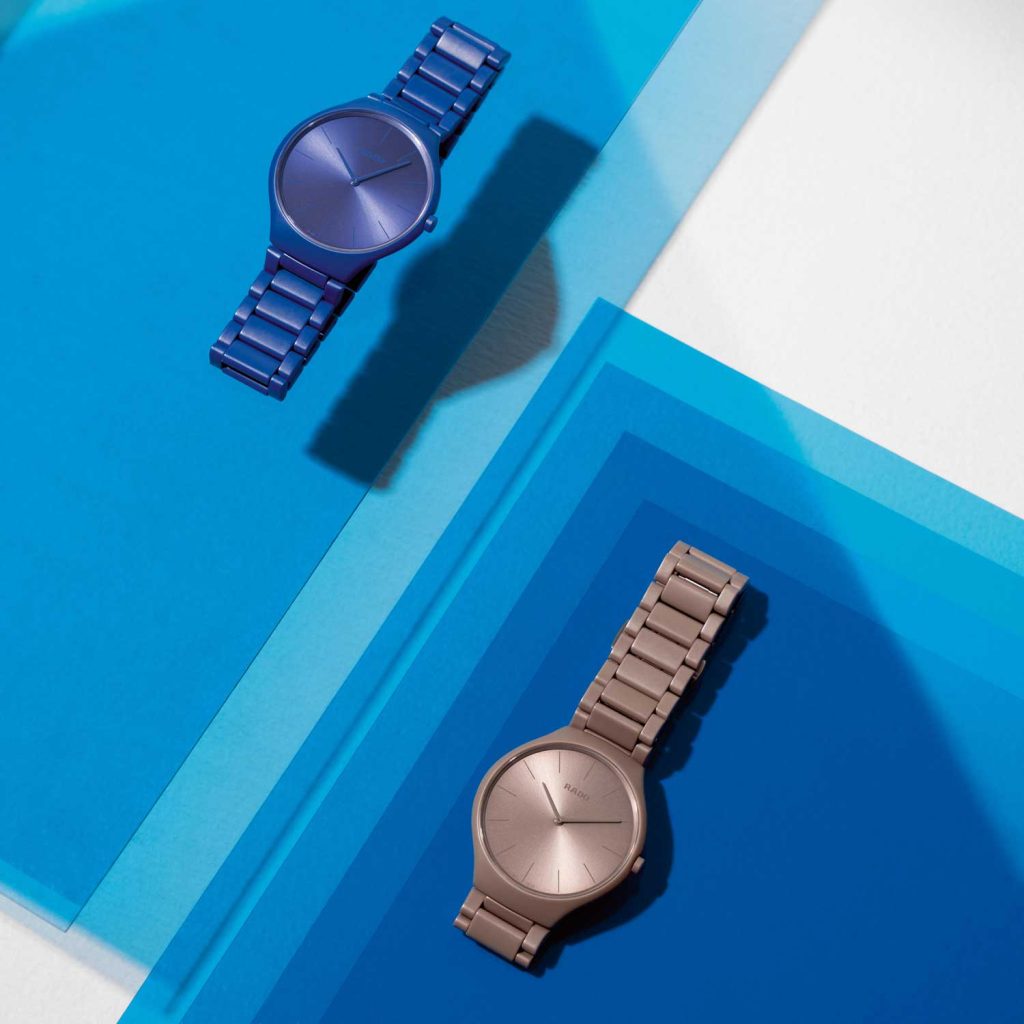
Rado True Thinline Les CouleursTM Le Corbusier Spectacular Ultramarine 4320K and Gray Brown Natural Umber 32141 (Image © Revolution)
Rado, Les Couleurs Suisse and Le Corbusier
The Rado True Thinline Les CouleursTM Le Corbusier is a collection designed to be unisex and uni-age, timepieces that transcend demographic ideology. Breschan adds, “We don’t think of our customers in terms of demographic breakdowns anymore. We want them to connect with our watches on an emotional level, and that meant rethinking how we start to develop watches completely.”
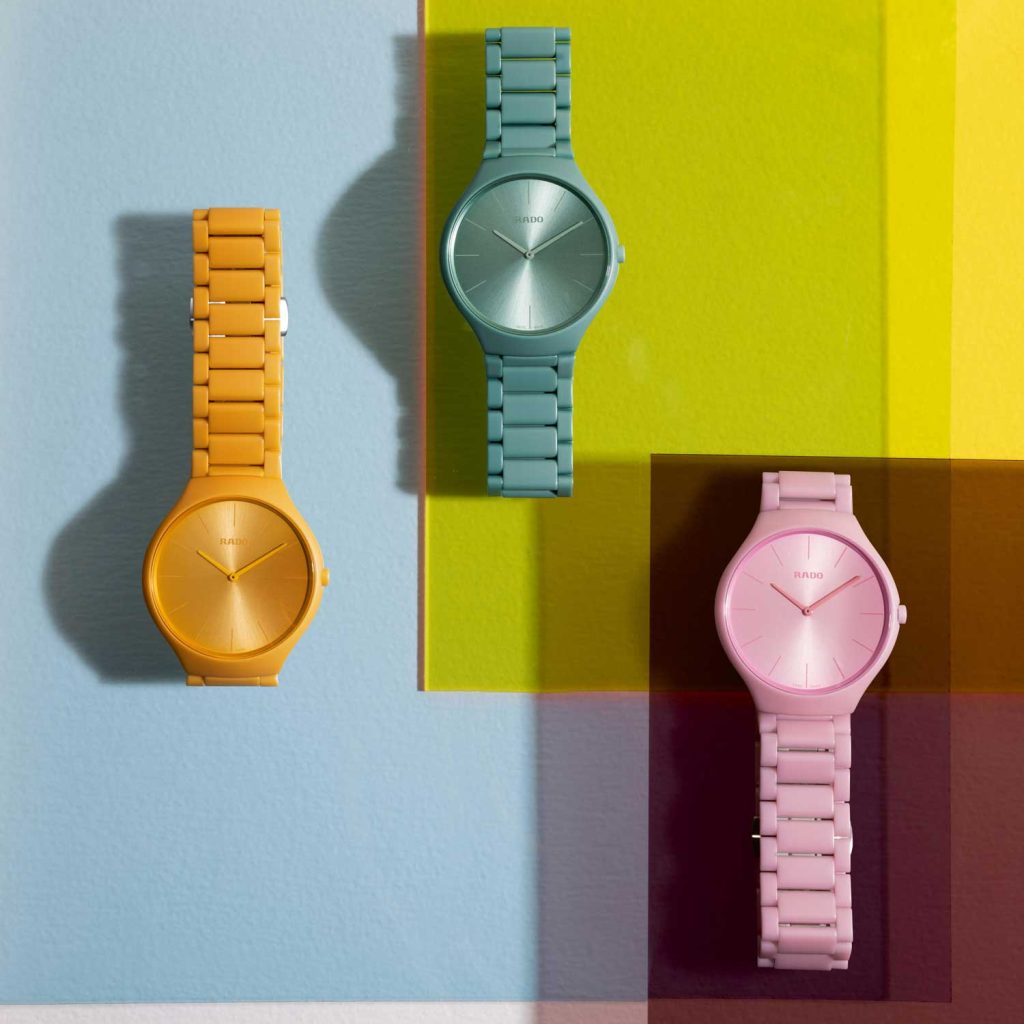
Rado True Thinline Les CouleursTM Le Corbusier Sunshine Yellow 4320W, Slightly Greyed English Green 32041, and Luminous Pink 4320C (Image © Revolution)
Breschan adds that the project had been ongoing for a while, even before the company signed the agreement with Les Couleurs Suisse. “We actually started on this project five years ago on our own, and the decision to base the watch colors on Architectural Polychromy was made without any discussion with them. It feels completely appropriate, especially since Le Corbusier lived just a few miles away from where we manufacture our high-tech ceramic, to pay homage to his work.”
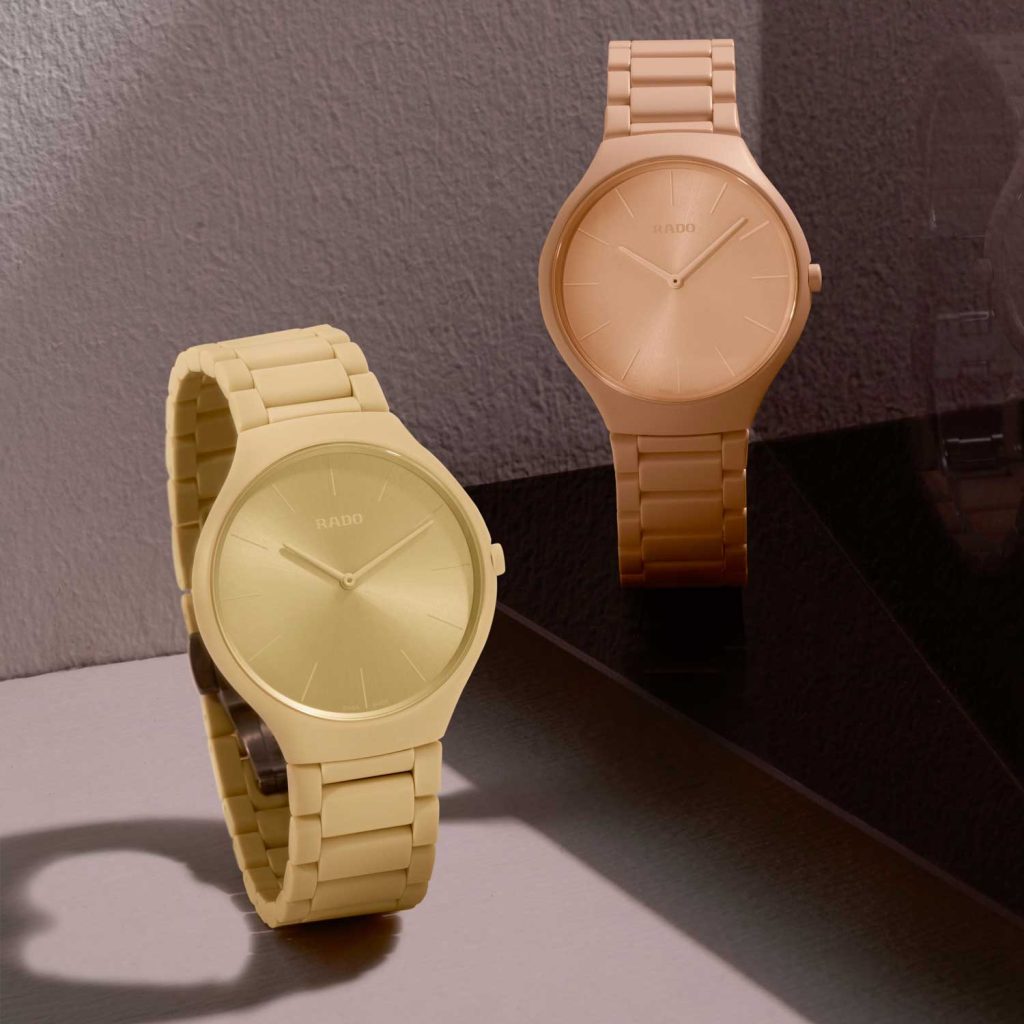
Rado True Thinline Les CouleursTM Le Corbusier Cream White 32001 and Pale Sienna 32123 (Image © Revolution)
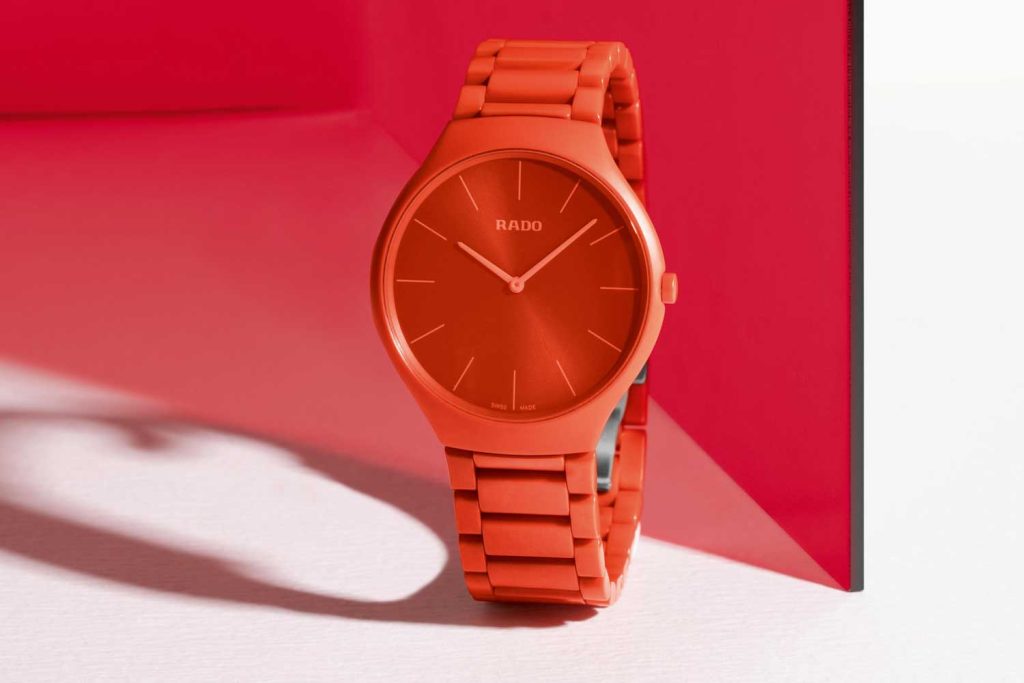
Rado True Thinline Les CouleursTM Le Corbusier Powerful Orange 4320S (Image © Revolution)
The collection is available in a total of nine colorways, with five from Le Corbusier’s initial work from 1931, and four additional tones that have a more vibrant, almost hipster-friendly presence released in 1959.
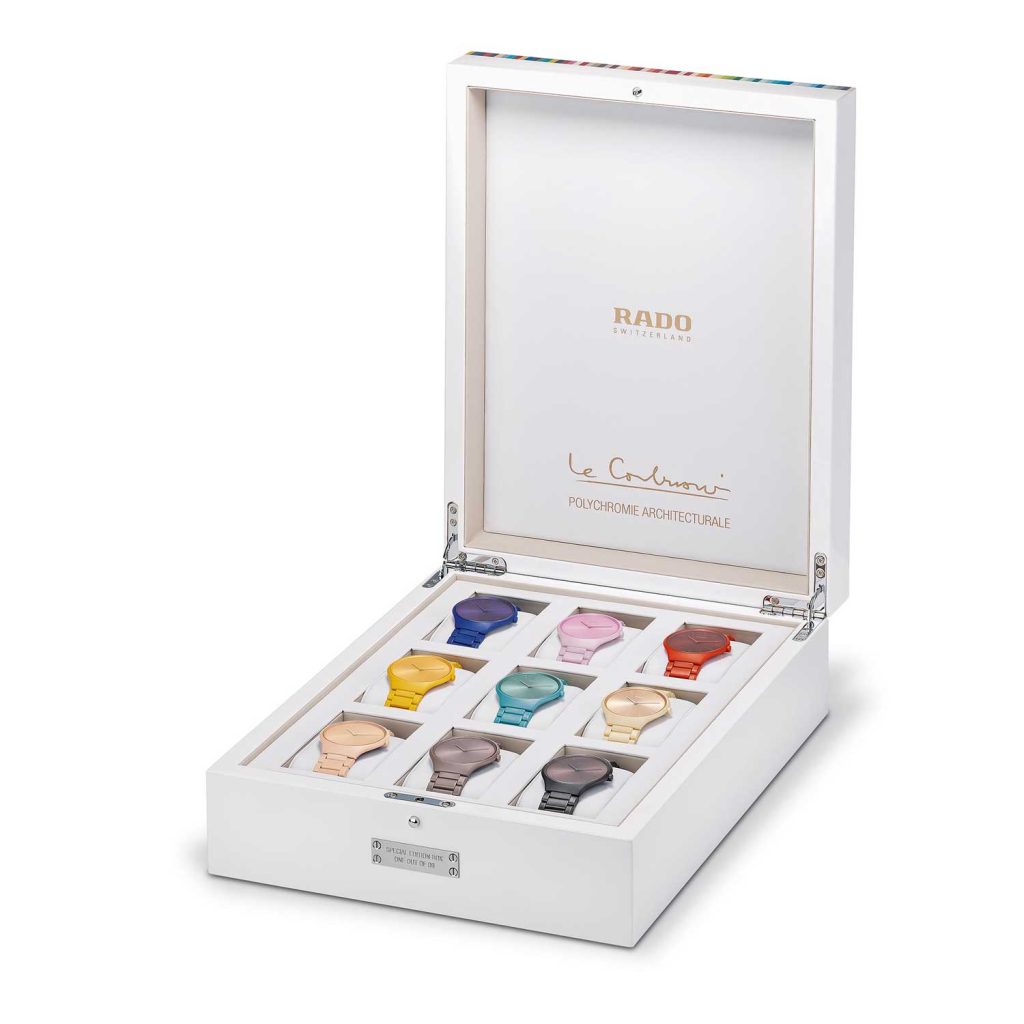
The complete Rado True Thinline Les CouleursTM Le Corbusier collection, available as a boxed set (limited to 99 pieces)
You may also like
News
Rado: Master of Materials
Apr 11, 2026
News
Rado: Master of Materials
Apr 11, 2026
Editorial
Design in motion with Rado and Tej Chauhan
Dec 4, 2025
Editorial
Design in motion with Rado and Tej Chauhan
Dec 4, 2025

Editorial
A Winter Wonderland of Watchmaking
Nov 14, 2025
Editorial
A Winter Wonderland of Watchmaking
Nov 14, 2025