
Louis Vuitton Unveils The Tambour Convergence
Louis Vuitton Unveils The Tambour Convergence

The Tambour has served as a means for Louis Vuitton to approach a wide range of watchmaking categories since its inception and has been home to some of the most unapologetically exotic and florid complications. In 2023, it underwent a modern transformation, reemerging as an integrated bracelet sports watch for daily wear. Today, Louis Vuitton has begun a new chapter in the history of the Tambour with a highly classical interpretation: the Tambour Convergence.
Launched alongside the new Tambour Taiko Spin Time collection, the watch pays homage to the montres à guichet (French for “aperture watches”) that emerged during the Art Deco era. The “Convergence” in the name is meant to reflect the full force of Louis Vuitton’s in-house expertise: La Fabrique du Temps for movement design, La Fabrique des Boîtiers for case production, and La Fabrique des Arts for métiers d’art. Most notably, the Tambour Convergence is equipped with a brand-new, full-rotor automatic base movement that was developed entirely in-house.
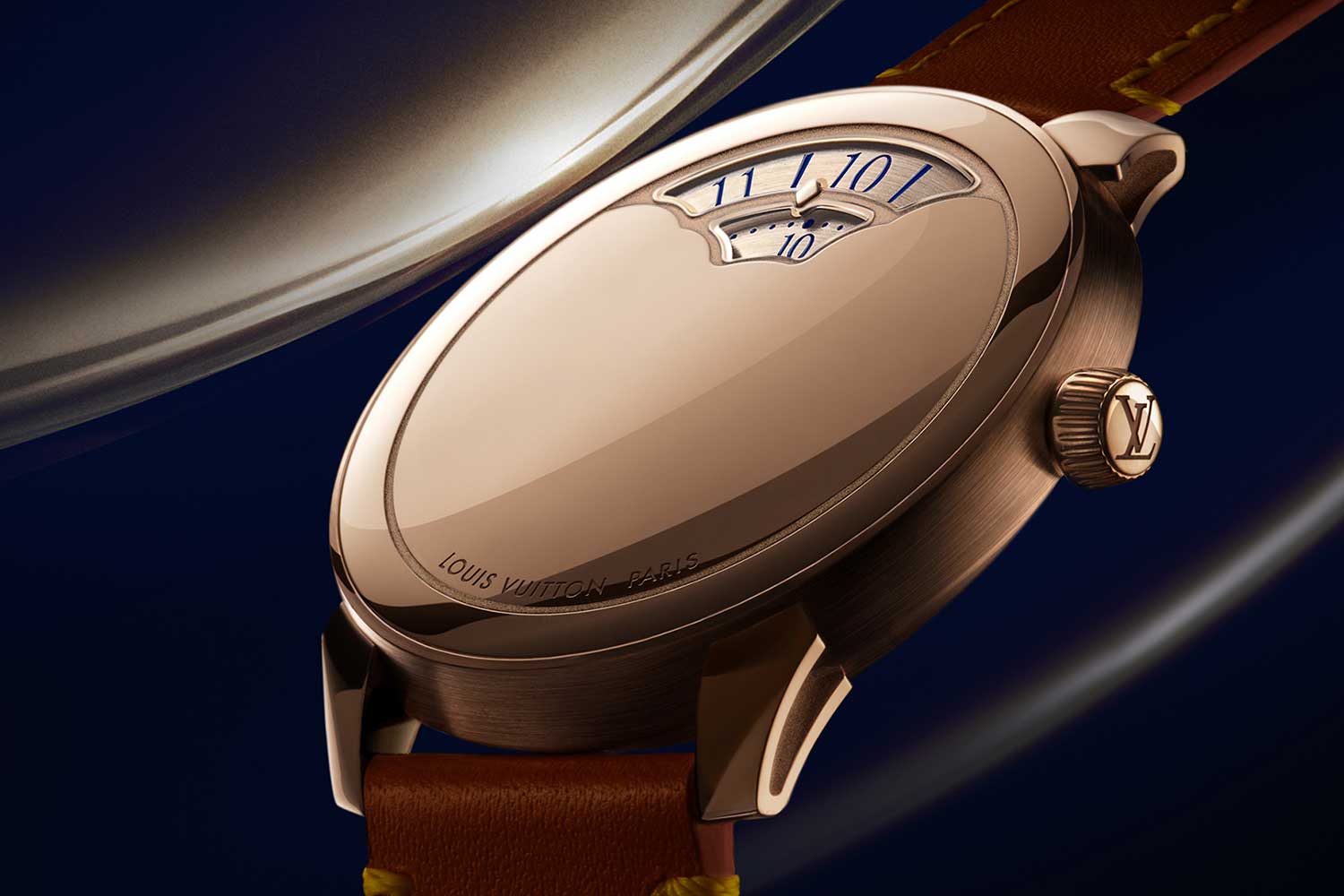
Louis Vuitton Tambour Convergence in rose gold
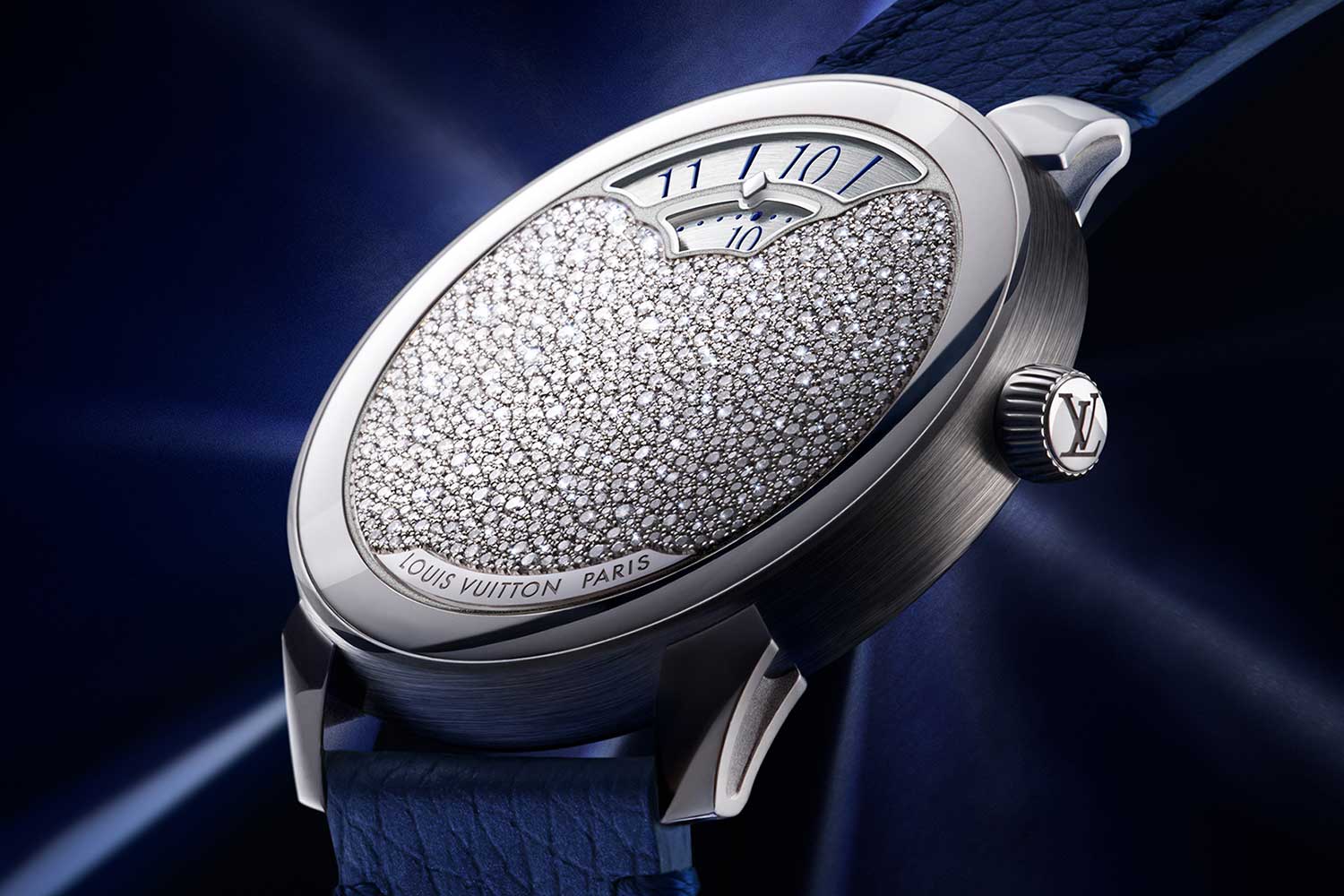
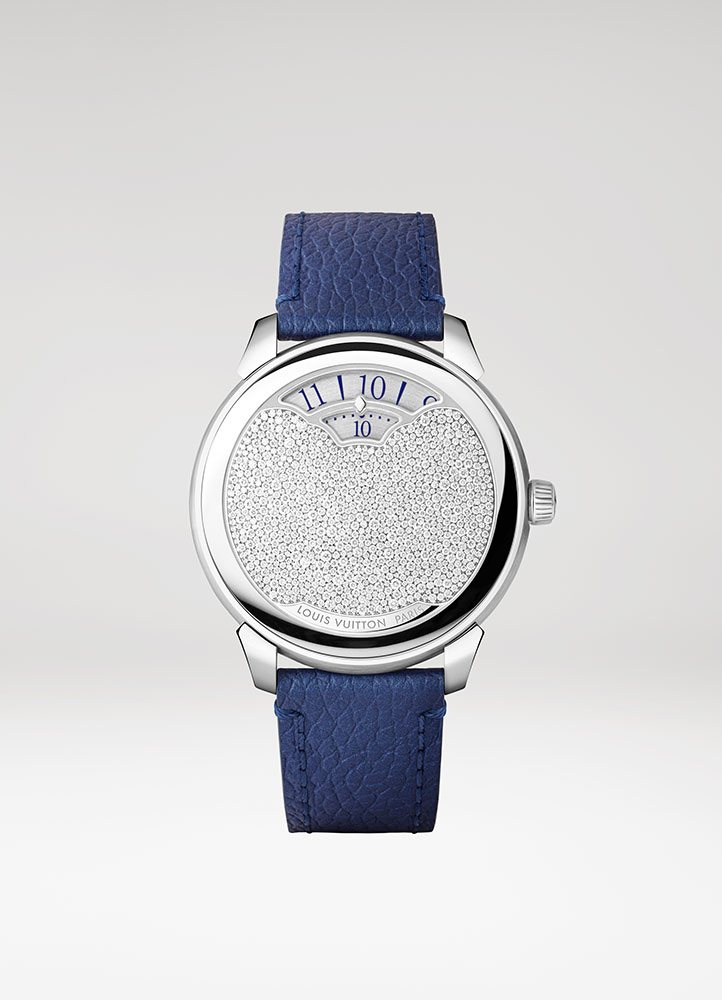
Louis Vuitton Tambour Convergence in platinum set with 795 diamonds
Two versions of the watch have been presented — rose gold and platinum, with the latter set with 795 diamonds. Produced entirely in-house by the newly integrated case-making facilities of Louis Vuitton in Geneva, the case is classically sized, measuring 37mm in diameter and 8mm in high. It retains the basic shape of the original with a slight taper from the bezel to the case back with a wider base, allowing it to sit snug on the wrist.
However, the case includes three parts with individually soldered lugs. The fluted crown follows the shape of the case, with a wider base. The watch builds on the tradition of guichet watches, a category of pocket and wristwatches characterized by closed-off dials with time displays framed within apertures, which date back to the first quarter of the 20th century. These watches gained prominence during the Art Deco era with digital displays, including jumping and wandering hours, becoming popular in both pocket and wristwatches. Notable makers such as Audemars Piguet, Breguet, Patek Philippe, and Vacheron Constantin embraced this innovative approach in pocket watches, while the Cartier Tank à Guichets stands as perhaps the most famous wristwatch example.

Traditional digital watches in general tended to be quite stark and unadorned, but the real estate here has been well utilized to showcase finishing, allowing the basic architecture and carefully chosen elements of the case to shine. The case band has a satin-brushed finish while the upper surfaces of the lugs are hand polished. The lateral exterior surfaces of the lugs are hollowed and micro-sandblasted, and the dial plate is mirror-polished, with sandblasted recesses.
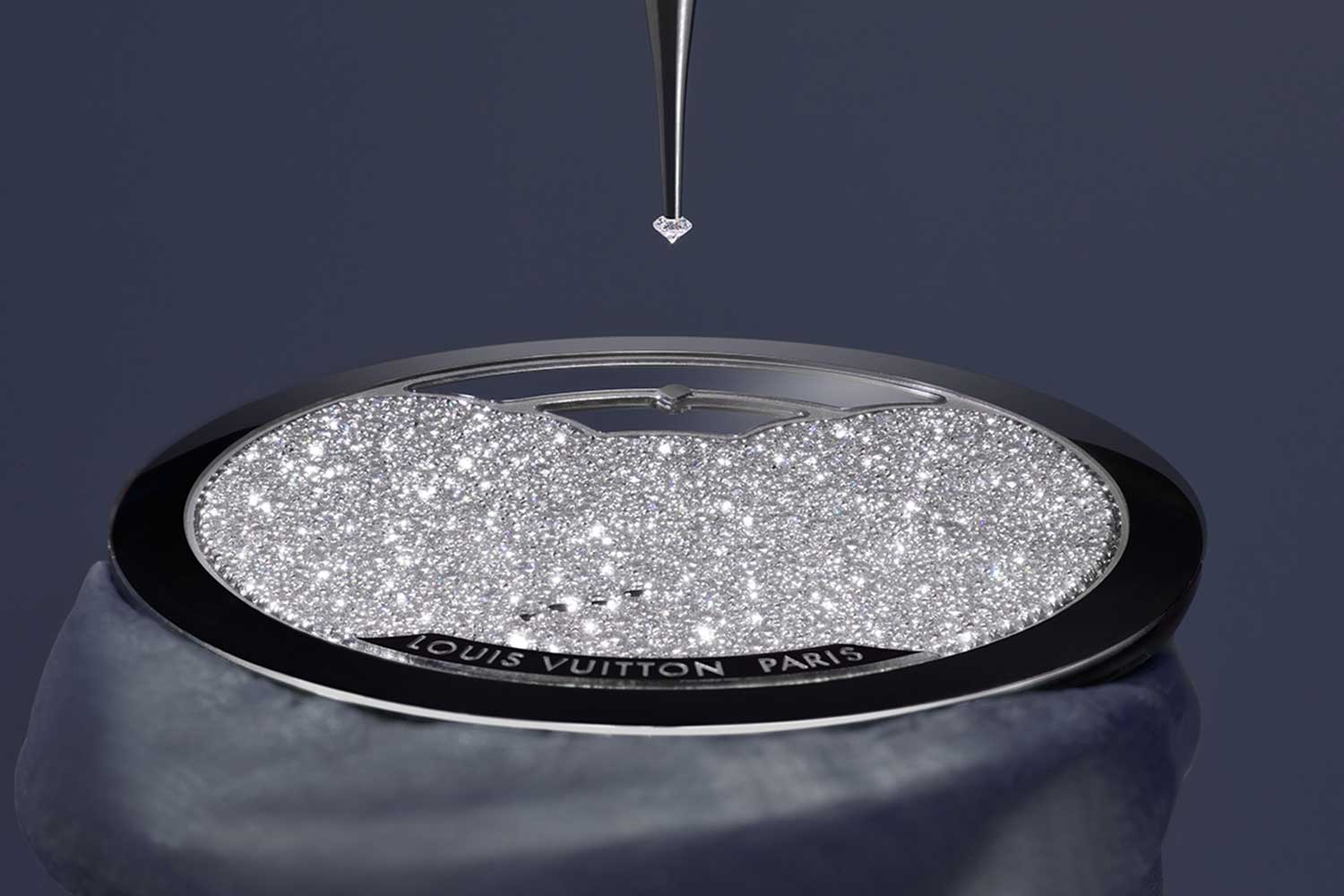
On the platinum model, the dial plate is set with 795 diamonds using a technique known as snow-setting. Unlike traditional pavé setting, which arranges stones in uniform rows or patterns, snow-setting places stones of varying sizes randomly or irregularly to fill the surface. This creates a natural, fluid look, mimicking the appearance of snowflakes on a surface. Seven different stone sizes were used, and the process is exceptionally time- and labor-intensive, requiring 32 hours to complete each dial.
The shape of the aperture framing the time display, according to the brand, draws inspiration from sunlight streaming through the gilded edges of clouds and the decorative arabesques featured in the interior architecture of the Louis Vuitton family home in Asnières. The hours and minutes are displayed on two rotating discs and are indicated by a lozenge marker. While digital watches typically feature a jumping hour and dragging minutes, both indications are dragging in the Tambour Convergence. As tempting as it might be to wish for a pure jumping hour indication, especially since LFdT has created numerous jump hour watches, the shape of the aperture simply doesn’t call for it, and if there’s one thing LV is known for in the world of luxury, it is being an aesthete, where design takes a certain precedence, to put it mildly. The discs are made of brass, galvanically treated for the rose gold model and rhodium-plated for the platinum version, both featuring blue printed numerals and markers.
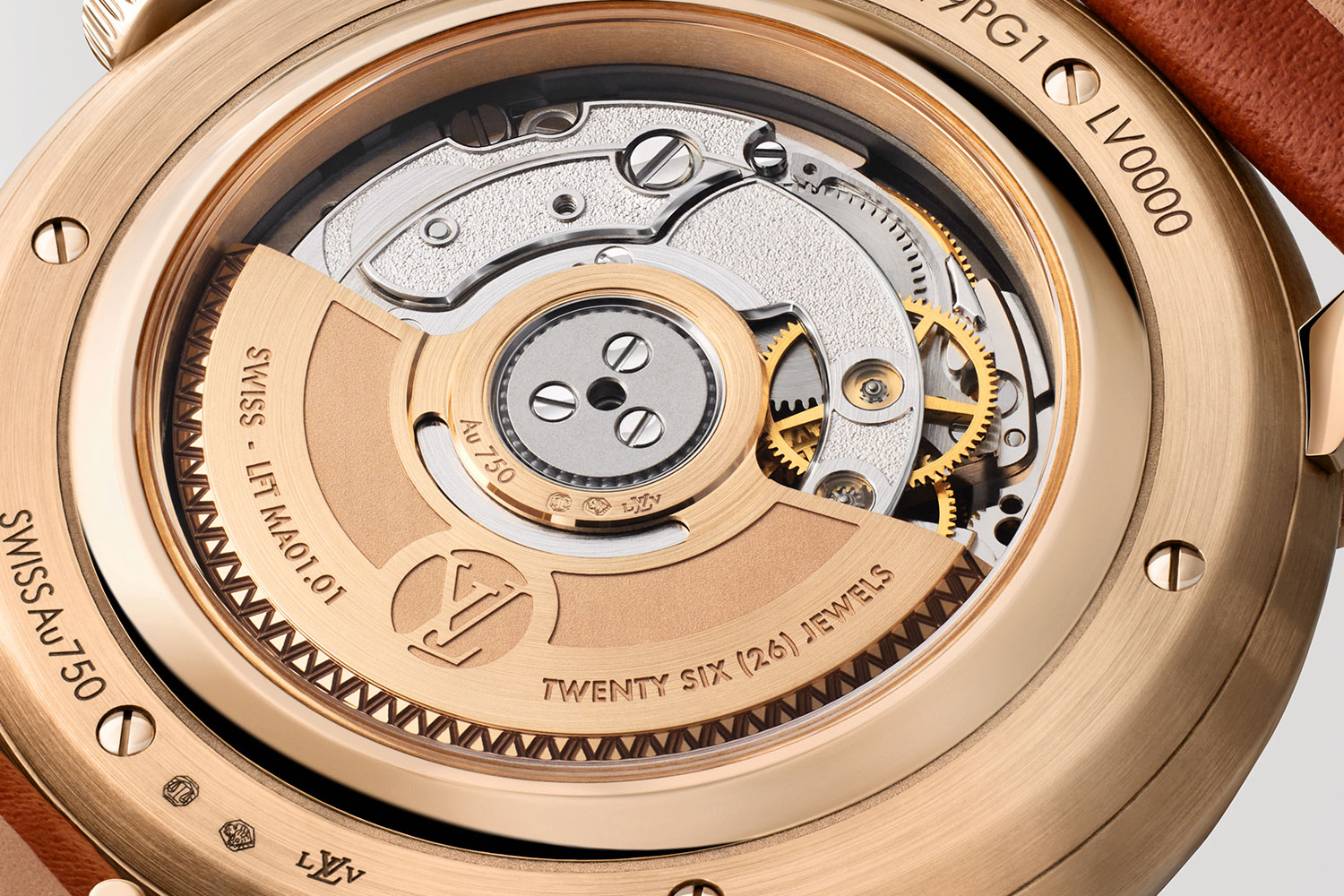
The display back showcases the new full-rotor automatic Caliber LFT MA01.01 entirely developed by LFdT. It runs at 28,800 vph in 26 jewels, with a 45-hour power reserve. The rotor is in 18k rose gold in both watches and has a free-sprung balance with inertia weights. The bridges for the automatic winding train have a similar style of finishing to the micro-rotor LFT023 in the integrated bracelet Tambour watch; they have a brushed border and frosted recesses. Particularly unusual for automatic movements is the elegantly shaped winding click.
Beyond its use in integrated bracelet sports and dive watches, the Tambour has served as a canvas for some of the most visually dynamic and extraordinary complications and crafts. With the Tambour Convergence, however, it assumes a new identity — still assuredly luxurious, but now eminently classical while highlighting the harmony and quality of a few meticulously selected design elements.

Tech Specs: Louis Vuitton Tambour Convergence
Movement: Self-winding Caliber LFT MA01.01; 45-hour power reserve
Functions: Dragging hours and minutes
Case: 37mm (8mm thick); 18K pink gold or platinum set with 795 diamonds; water-resistant to 30m
Strap: VVT camel calf leather and beige calf leather lining (pink gold); blue calf leather and black calf leather lining (platinum)
Price: €37,000 (pink gold) and €67,000 (platinum)
You may also like

Editorial
Louis Vuitton × De Bethune LVDB-03 Louis Varius Project
Feb 2, 2026
Editorial
Louis Vuitton × De Bethune LVDB-03 Louis Varius Project
Feb 2, 2026

Editorial
Revolution Awards 2025: Horological Heroes — Michel Navas and Enrico Barbasini
Jan 27, 2026
Editorial
Revolution Awards 2025: Horological Heroes — Michel Navas and Enrico Barbasini
Jan 27, 2026

Editorial
Revolution Awards 2025: Best Métiers d’Art — Louis Vuitton Escale en Amazonie
Jan 27, 2026
Editorial
Revolution Awards 2025: Best Métiers d’Art — Louis Vuitton Escale en Amazonie
Jan 27, 2026