Christiaan van der Klaauw × Revolution
Grand Planetarium Eccentric Si14 (Silicium)
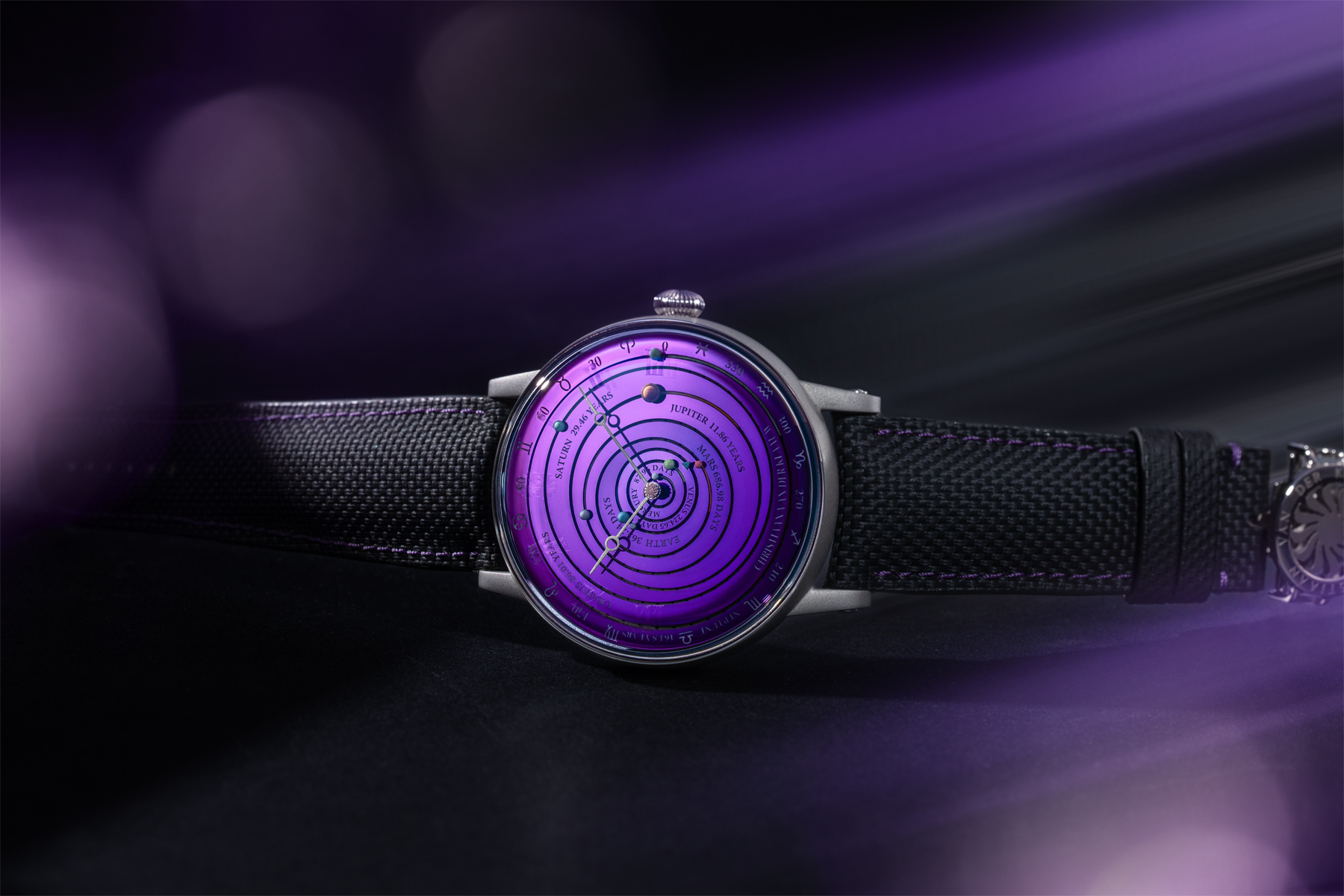
With a dial cut from iridescent silicon and planets rendered in luminous paint, the CVDK × Revolution Grand Planetarium Eccentric Si14 (Silicium) turns celestial mechanics into a shifting theater of the night.
It gives us great pleasure to introduce our latest collaboration with Christiaan van der Klaauw, the Dutch maison renowned for its astronomical complications. The Christiaan van der Klaauw x Revolution Grand Planetarium Eccentric Si14 (Silicium) is the first and only mechanical wristwatch capable of displaying the real-time orbits of all eight planets in our Solar System, from Mercury all the way out to Neptune, across a dial crafted from iridescent oxidised silicon. This extraordinary watch is created in a limited edition of just six numbered pieces and priced at EUR 157,000 (excl. taxes).
Astronomical complications represent one of the most expansive and satisfyingly rich areas of watchmaking. The most evocative of them all are mechanical planetariums, or orreries. Wristwatch planetariums are exceedingly rare and rarely kept in continuous production. The single foremost exponent of this art today is none other than Christiaan van der Klaauw.
Limited to just six pieces, our latest collaboration with the brand is the CVDK × Revolution Grand Planetarium Eccentric Si14 (Silicium), which is based on a model first introduced in 2024 to mark the 50th anniversary of CVDK.
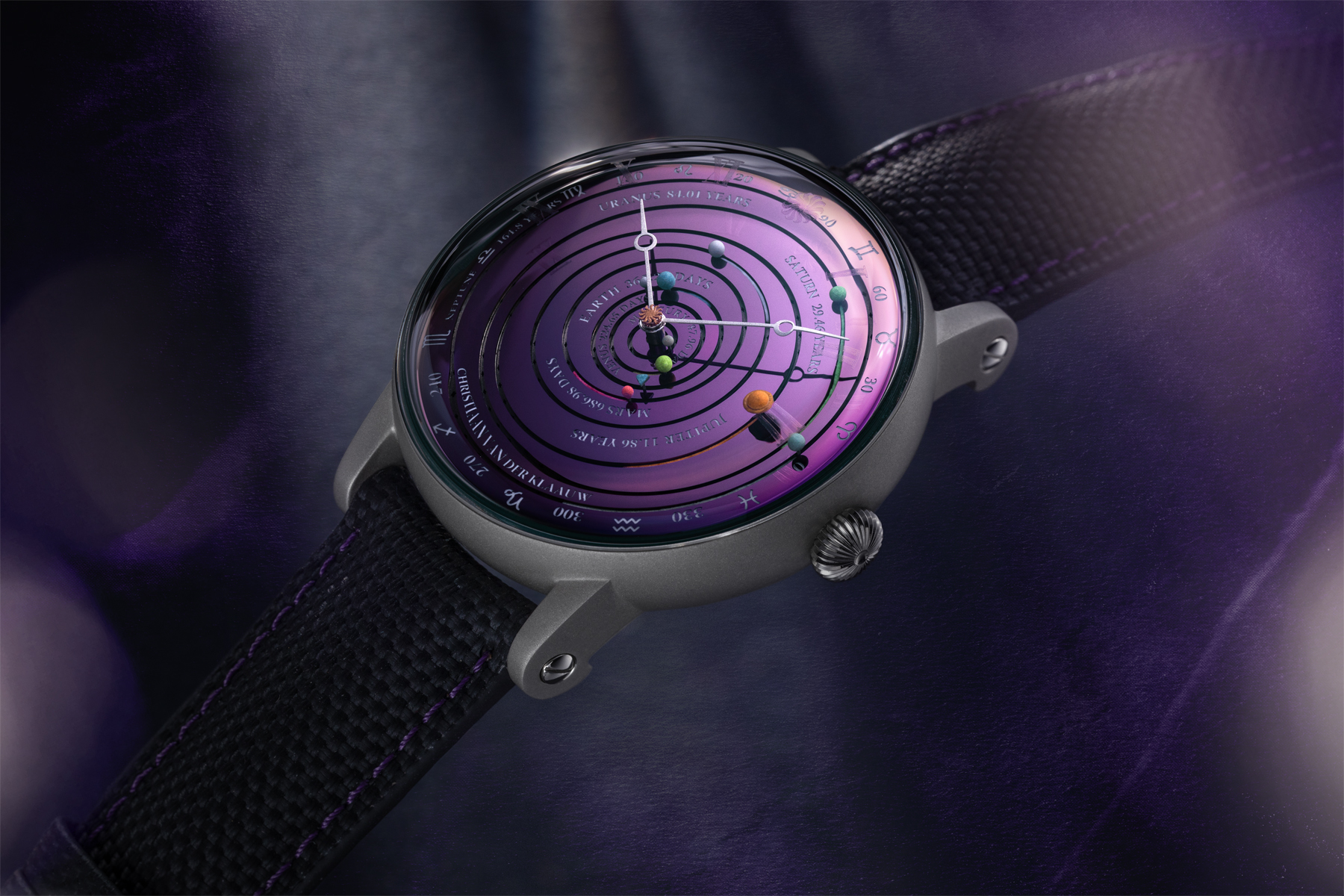
The case of the CVDK × Revolution Grand Planetarium Eccentric Si14 (Silicium) is machined from 316L stainless steel and then subjected to low-temperature carbon diffusion, a process that raises surface hardness to roughly 1,200 Vickers — about six times that of untreated steel.
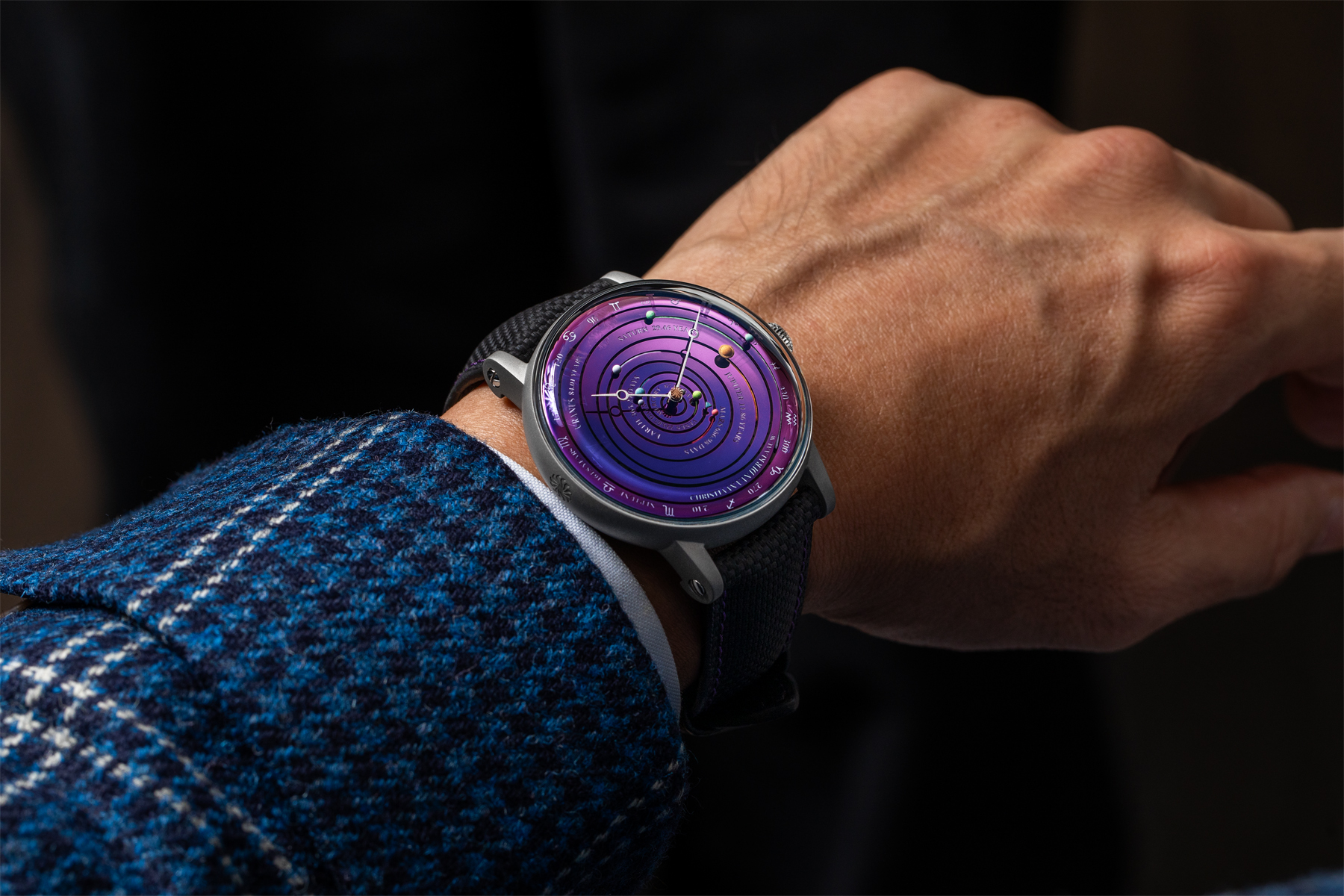
The case is finished with bead-blasting, giving it a matte, gray-toned surface that diffuses light. It measures 44mm wide and 14.3mm high; much of the height is a direct consequence of the complex astronomical module beneath.
To evoke the cosmos, the dial is made from nine separate pieces of oxidized silicon which gives it an iridescent surface that shifts between deep blue and violet depending on how the light strikes it.
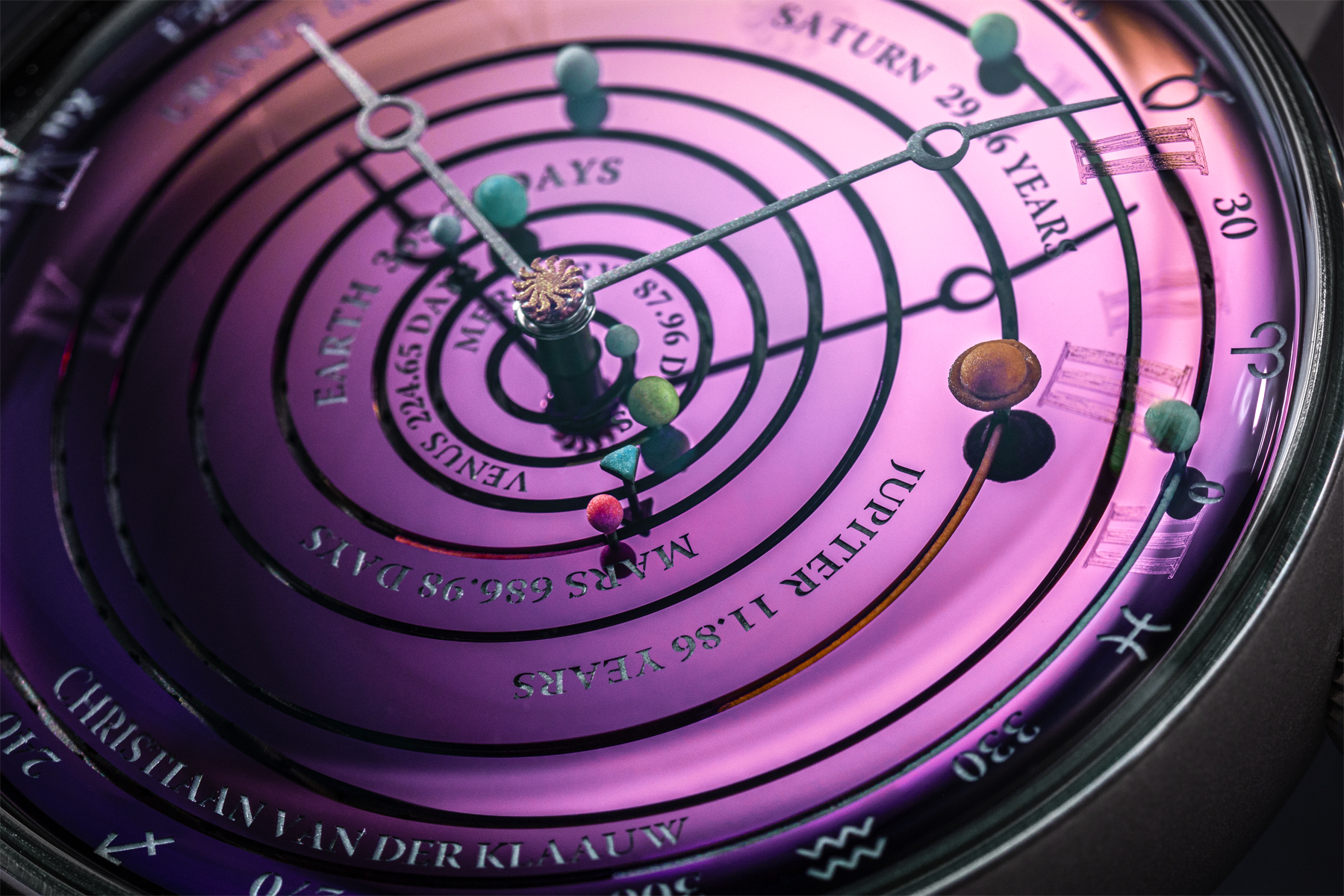
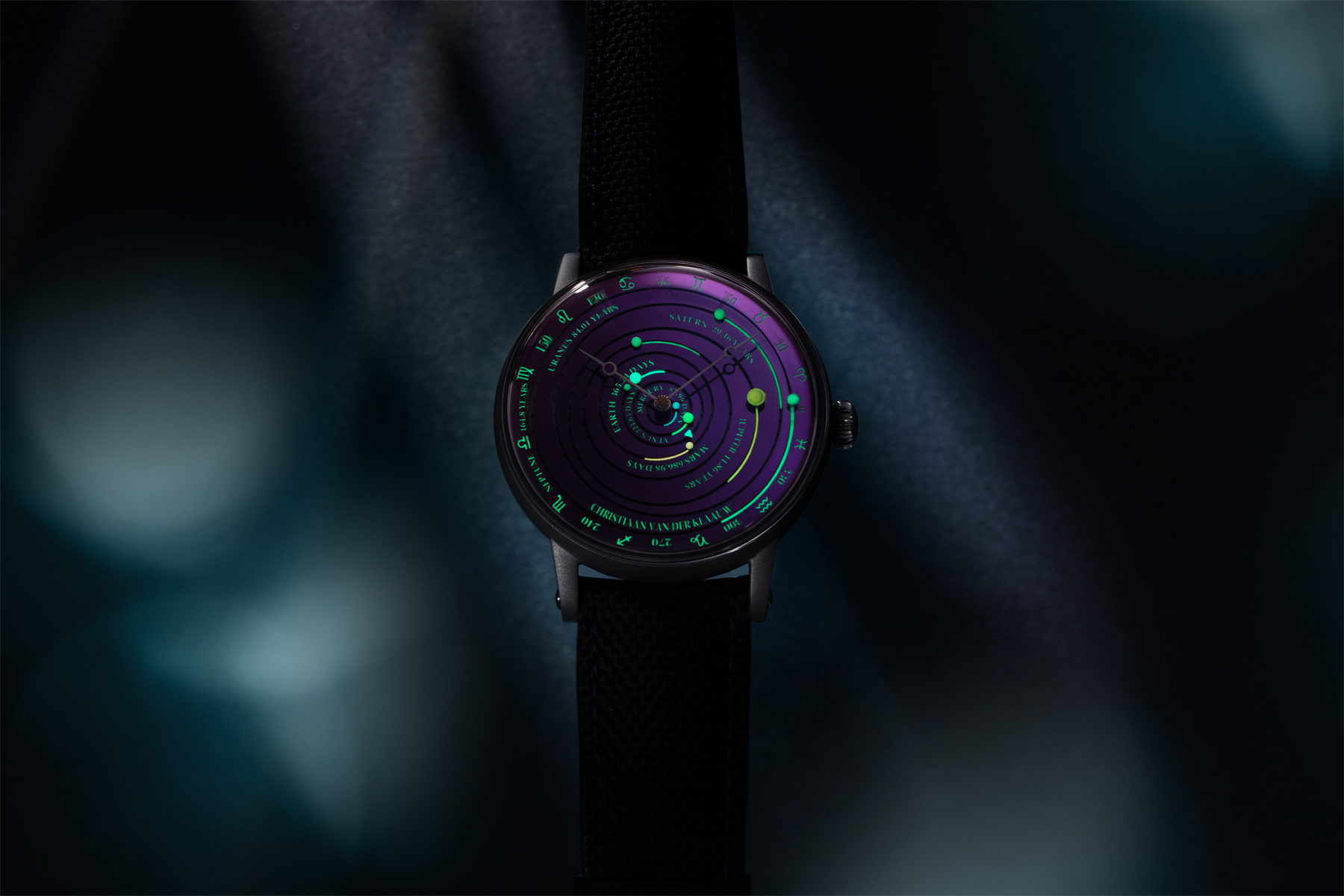
The planets are painted by hand in Super-LumiNova by the maison’s master watchmaker.
Notably, small engraved luminous markings indicate the orbital period of each planet: Mercury completes its orbit in 87.97 days, Venus in 224.70 days, Earth in 365.24 days and Mars in 686.98 days, while the outer planets move on a far more patient scale, with Jupiter taking 11.86 years, Saturn 29.46 years, Uranus 84.02 years and Neptune 164.80 years to circle the Sun.
Even the Earth’s Moon is represented on the dial right next to Earth.
The raised colored segments on the paths themselves are also luminous, and it all makes for a spectacular miniature light show of the cosmos.
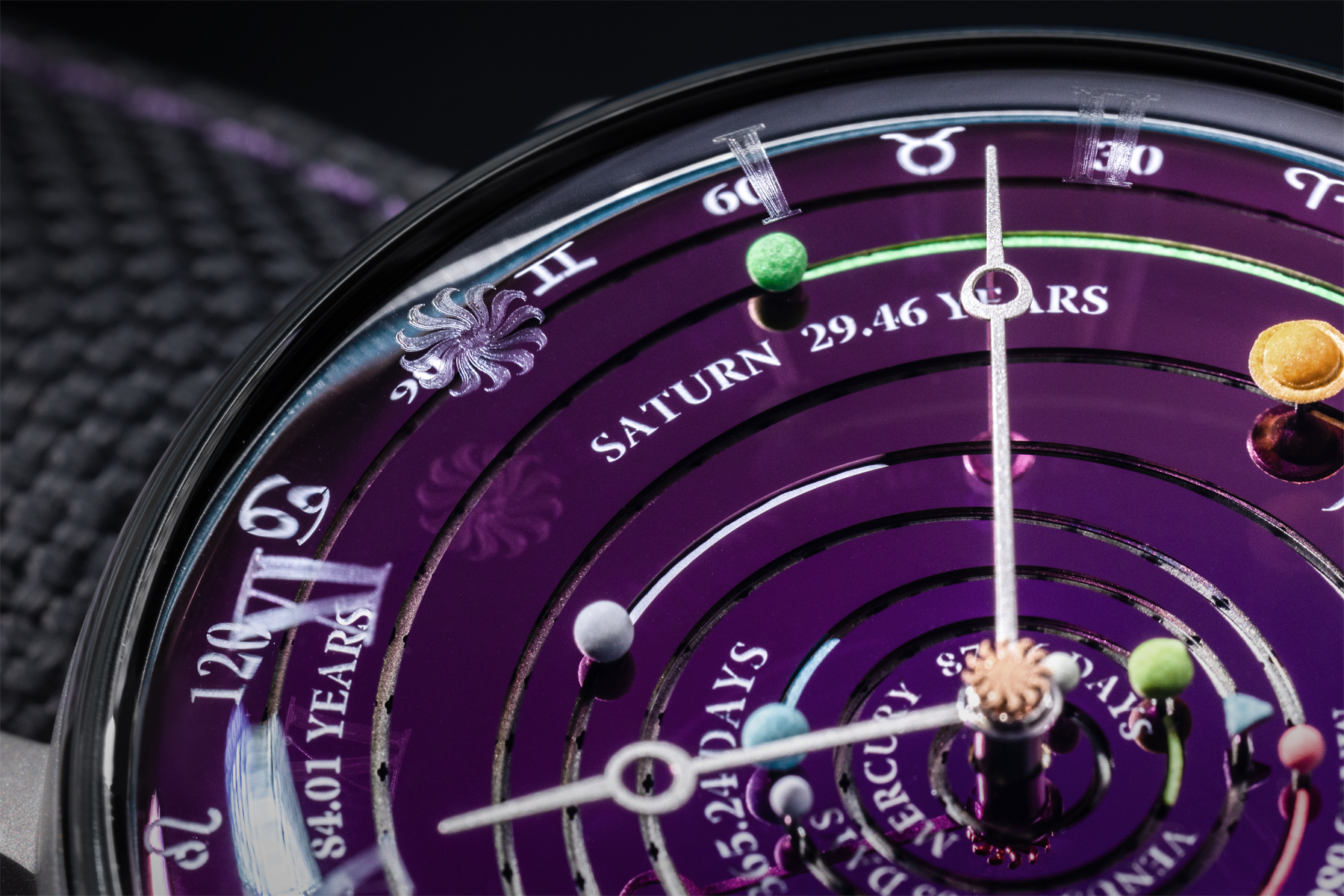
The Grand Planetarium Eccentric Si14 (Silicium) also includes an outer zodiac scale, read via a blue triangular indicator positioned opposite Earth. The indicator reveals the portion of the zodiac in which the Sun appears from Earth at any given time of the year.
The wearer can read not only where Earth sits in its orbit, but also which region of the sky the Sun currently occupies. The constellation directly behind the Sun is hidden in daylight, but the one opposite it becomes visible in the night sky.
The zodiac scale also provides a rough but functional indication of the current month, since the Sun appears to progress through the 12 zodiac signs, each spanning 30 degrees of the ecliptic, as the Earth advances along its orbit.
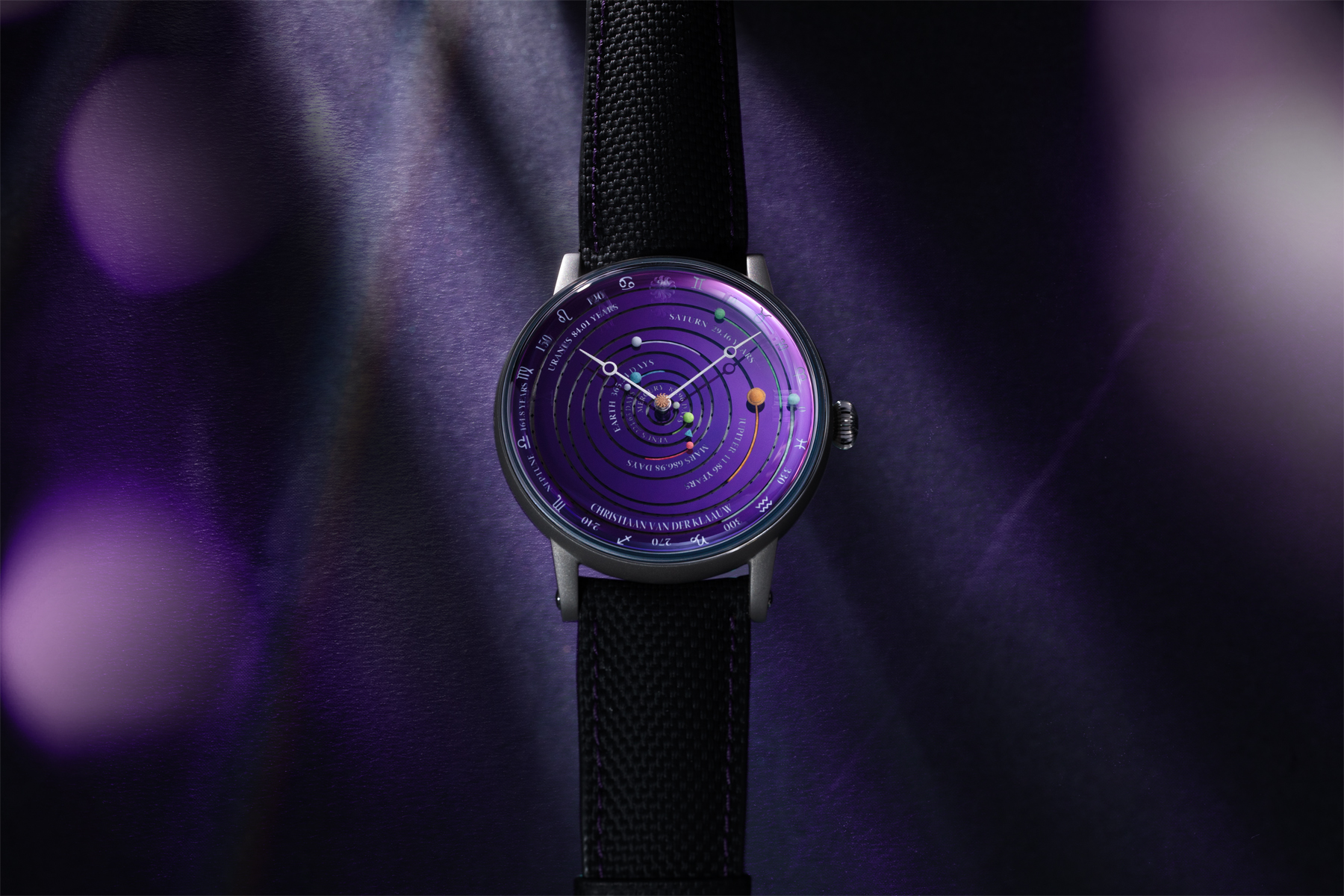
Christiaan van der Klaauw × Revolution Grand Planetarium Eccentric Si14 (Silicium)
Limited edition of 6 numbered pieces
EUR 157,000 (excl. taxes).

Pim Koeslag, CEO and master watchmaker of Christiaan van der Klaauw
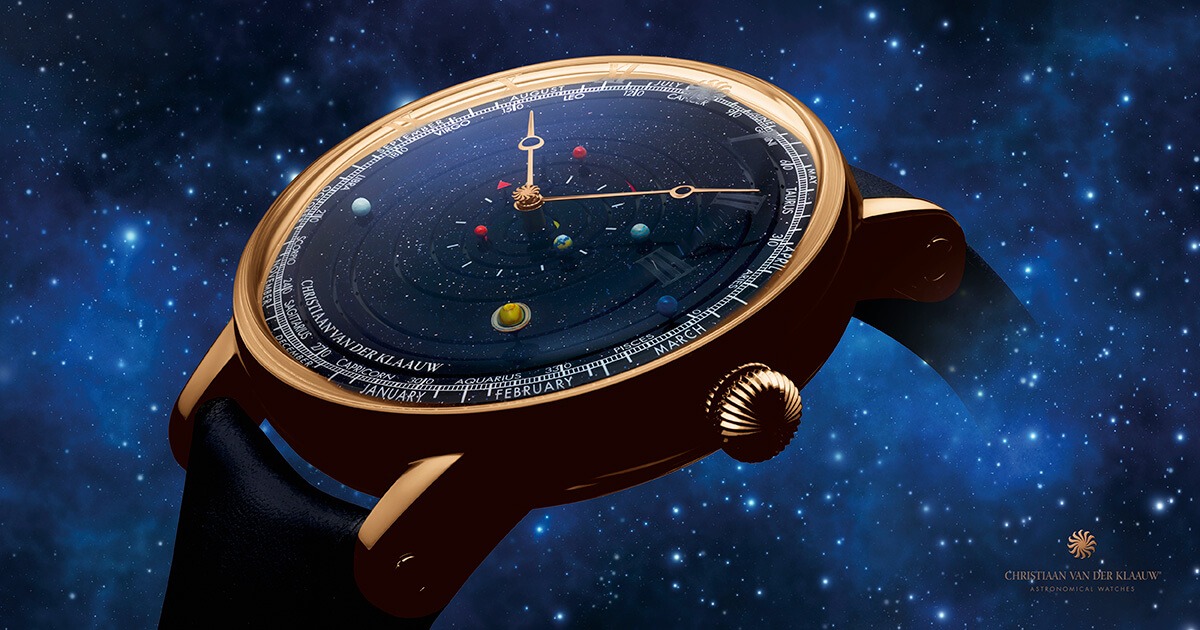
CVDK Grand Planetarium Eccentric Manufacture in Rose Gold
The planetarium module was originally conceived by Christiaan van der Klaauw himself. A few months after Pim Koeslag acquired the company in 2022, van der Klaauw mentioned that he had been working on the concept. Koeslag proposed developing it as a piece to mark the brand’s 50th anniversary.
In contrast to van der Klaauw’s most celebrated wristwatch — the CVDK Planetarium — which features the world’s smallest mechanical planetarium measuring just 15mm, the Grand Planetarium Eccentric Si14 (Silicium) spreads the display across the entire dial. Each planet follows a circular track arranged slightly off-center, intended to evoke their elliptical paths around the Sun.
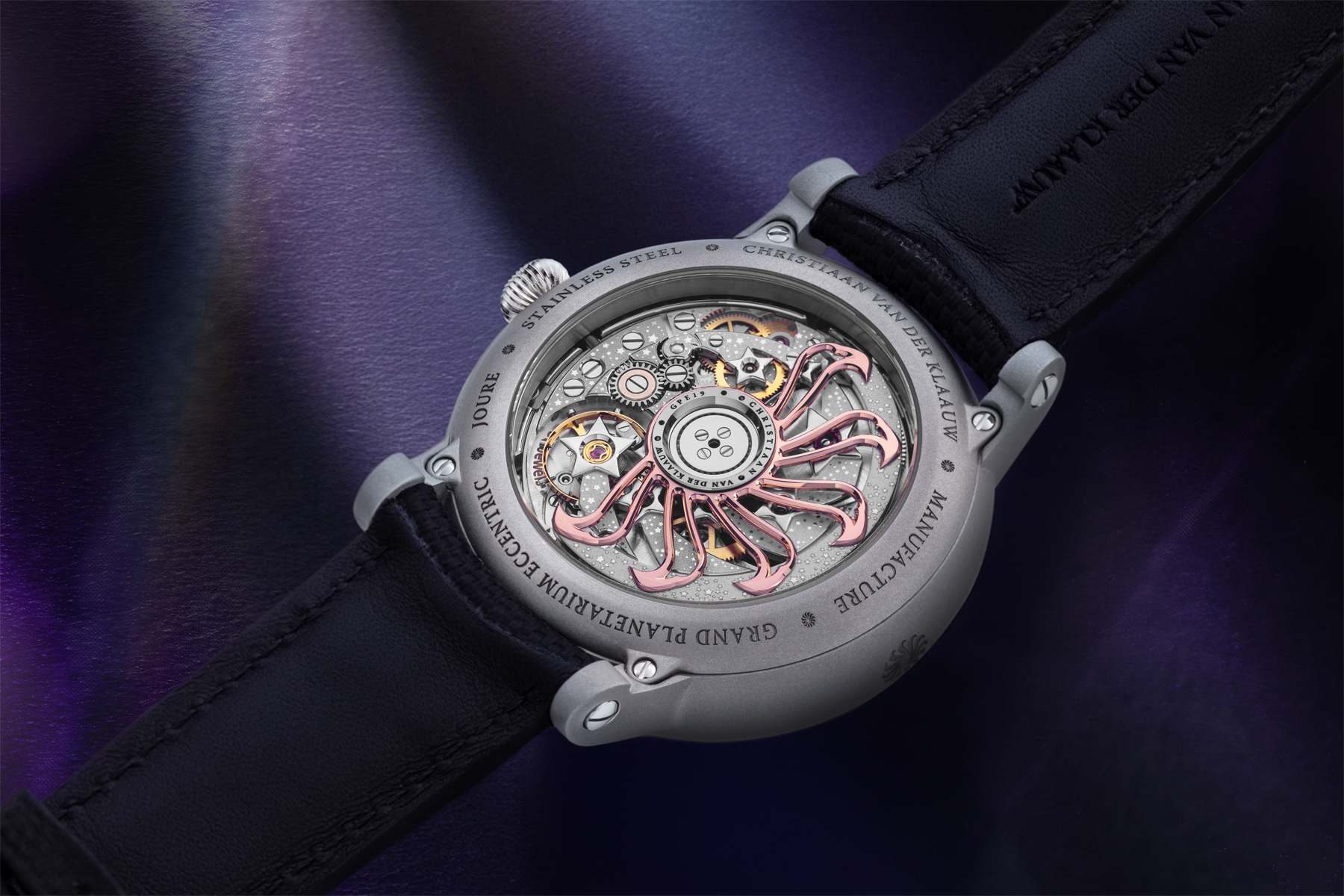
The module is mounted atop the brand’s proprietary automatic movement, which provides a power reserve of 60 hours. It runs at a frequency of 3Hz and is equipped with a free-sprung balance.
The movement is visually striking. It is dominated by a gold rotor in the shape of the brand’s logo. Beneath it, the bridges are decorated with a field of stars produced by laser engraving. Each wheel in the going train, along with the balance wheel, is supported by a bridge tipped with a star, forming a depiction of a shooting star with a jewel sitting at the center.
The stars themselves are circular grained, and the baseplate is finished with perlage.
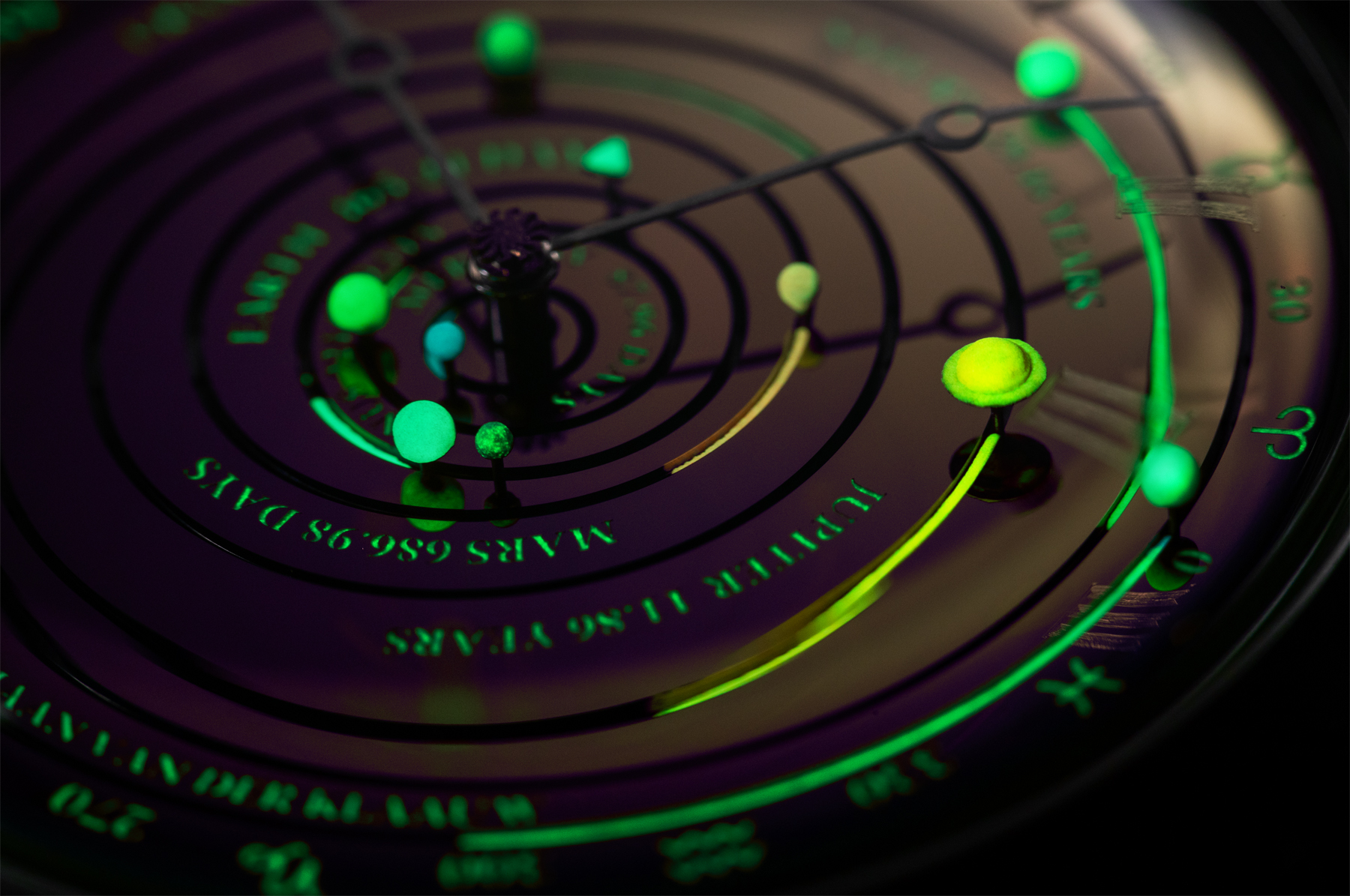
The design and execution both front and back make this an especially romantic watch. Planetarium watches have always occupied a special place in horology. They are not especially practical, nor were they ever intended to be, but they capture, within the confines of a watch, a small reflection of the much larger clockwork that governs the heavens. In the CVDK × Revolution Grand Planetarium Eccentric Si14 (Silicium), what was already an intricate mechanical model of the Solar System comes vividly to life when darkness falls.
It is a reminder perhaps that the universe we observe — its rhythms, its order, its beauty — comes to us written in light.