Jaeger-LeCoultre at Watches and Wonders 2026: Crafting Precision and Art Under One Roof
News
Jaeger-LeCoultre at Watches and Wonders 2026: Crafting Precision and Art Under One Roof

It is hailed as the “Watchmaker of Watchmakers.” From its earliest days, Jaeger-LeCoultre has set the pace for the watch world in its pursuit of chronometry — from Antoine LeCoultre’s invention of the millionomètre in 1844, capable of measuring the micron, to the establishment of various watchmaking ateliers under one roof. Jaeger-LeCoultre was one of the first integrated manufactures that could produce all the watch components at the time, which gave it tremendous advantage in developing new movements, each exactly spec-ed to its requirements. Between 1860 and 1900, for instance, the manufacture produced more than 350 different calibers, including the first calendar calibers in the 1860s and complicated calibers, and grand complication movements. Today, that figure runs upwards of 1,400 calibers, with over 430 patents awarded.
This year, the Grande Maison’s Watches and Wonders novelties showcase clearly pays tribute to the legacy built over two centuries, marking the breadth and scope of its expertise and vision. From a renewed pursuit of chronometric precision to exquisite métiers rares and high horology, it brings together the different pillars of the maison that have guided its path since its founding days.
Guaranteeing Chronometric Precision
By the late 19th century, Jaeger-LeCoultre was already producing chronometer-certified pocket watches and at the forefront of timekeeping precision and innovation. In 1895, it presented the Chronomètre de Torpilleur, a certified marine chronometer with a deviation of ±4 seconds a day for longitude calculation. The following decades would see the introduction of the Mark XI Pilot Watch (1949), the Geophysic (1958) and the Geomatic (1964), all conceived for chronometric precision.
Chronometry defines a watch’s theoretical precision, and reliability over time proves it in the real world. In 1992, Jaeger-LeCoultre set out to do just this when it established its famous “1,000 Hours Control,” a grueling battery of tests conducted in-house to ensure the watches perform to their optimal best over time. Since 1976, the industry baseline established and run by the Contrôle Officiel Suisse des Chronomètres (COSC) tested a watch movement over 15 days in five positions and three temperatures, before stamping it worthy as a chronometer. With the “1,000 Hours Control” protocol, Jaeger-LeCoultre upped the ante by testing the fully cased-up watch over 42 days (equivalent to 1,000 hours as per its moniker) in six positions and under conditions simulating daily wristwear, alongside power reserve verification, and resistance to shock, water, temperature and magnetic fields, among other checks. It was a phenomenal flex of watchmaking rigor that literally out-tested the COSC chronometer standard.
Jaeger-LeCoultre’s rigorous testing placed the maison years ahead of its counterparts in the industry. Consider this: it would take another 17 years before Patek Philippe launched the Patek Philippe Seal in 2009, replacing the earlier Geneva Seal, and another 23 years before Omega paired up with the Swiss Federal Institute of Metrology (METAS) to introduce the Master Chronometer certification in 2015, also testing the fully assembled watch. COSC itself has only recently announced a higher-tier, more stringent certification process named the “Excellence Chronometer,” which is set to be rolled out later this year.
The 1,000 Hours Control certification was unveiled alongside the maison’s new flagship Master Control collection, and the first watch to bear it was the Master Control Date. A classic understated 37mm steel dress watch, it proved a simple point — that a watch can be elegant, precise and dependable. The fact that the strictest standards were applied to an accessible core collection rather than high horology simply reiterated the maison’s commitment to reliability and chronometric performance across its entire production. The 1,000 Hours Control test was eventually applied across the rest of the collection and, eventually, all Jaeger LeCoultre’s watches.

Master Control Chronometre Date
More than 30 years later, Jaeger-LeCoultre is once again raising the bar with a new and improved in-house certification. Called the “High Precision Guarantee,” or HPG, it boasts an even more stringent protocol that tests the performance of a watch against four key variables over three days. The movement is first tested against atmospheric pressure variations between sea level and 1,004 meters, the altitude of the manufacture. Thereafter, the watch is cased up and evaluated on three key criteria: multi-directional shocks from 25G to 50G in various positions, fluctuating temperatures from 18ºC to 35ºC and, lastly, alternating positions between rest and movement, to mimic the daily wear of a watch. The accepted deviation is the same as that of COSC’s chronometer standard.
Beyond performance, HPG is also a seal of decorative excellence. Each caliber bearing the HPG receives a range of eight traditional finishing techniques, such as circular graining, Côtes de Genève and polished screw heads. In doing so, it bridges the maison’s two defining pillars: chronometric precision and the decorative traditions of high horology.
Mastering Control
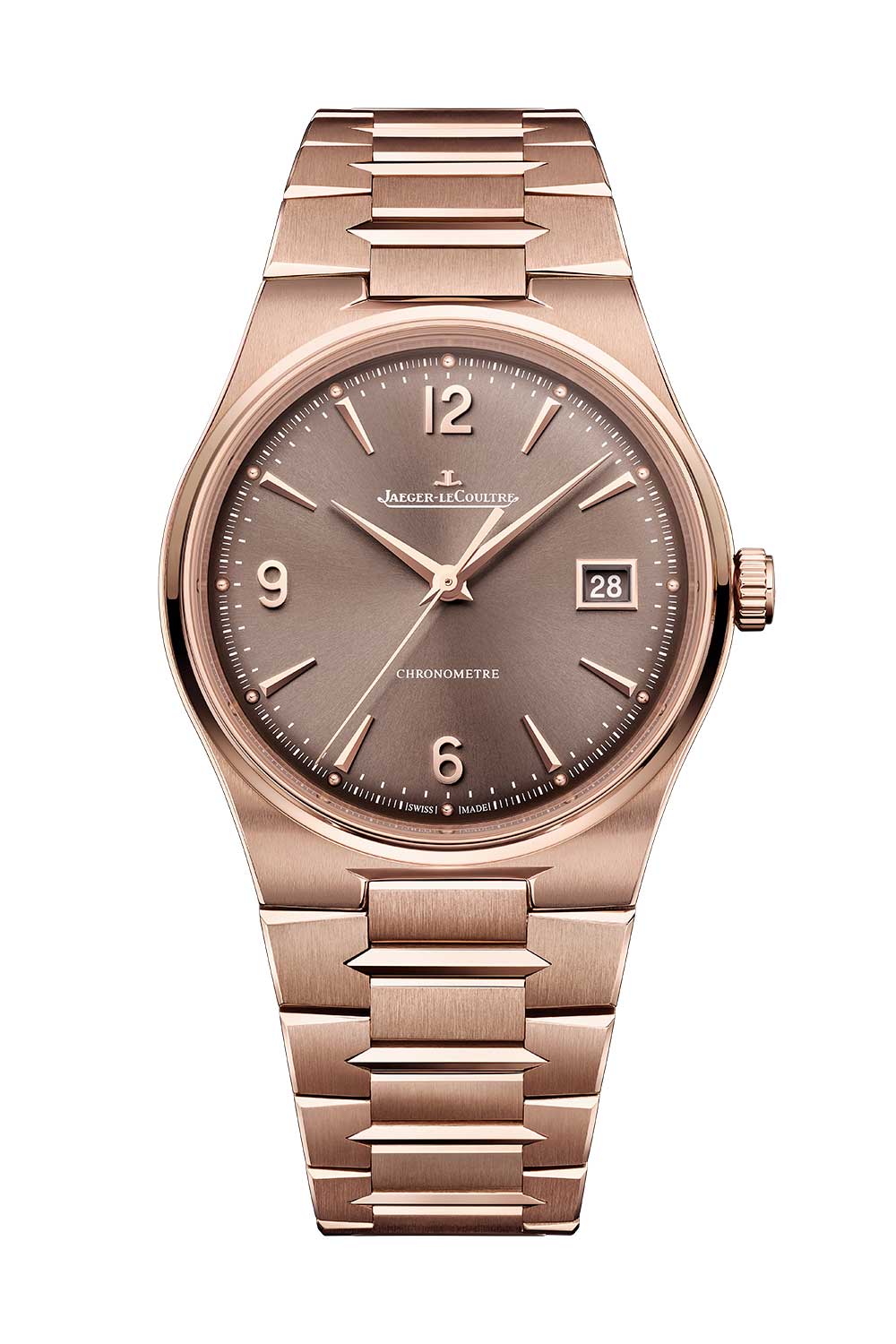
As a nod to its original 1,000 Hours Control in-house certification, the first collection to display the HPG Seal is, aptly enough, this year’s new Master Control Chronometre. Of course, to bear the chronometer moniker in its name, each of the new references must also pass the COSC certification as mandated. There are three new iterations: a date and power reserve model featuring a new in-house Caliber 738; a perpetual calendar with full calendar display; and, last but not least, a classic date iteration.

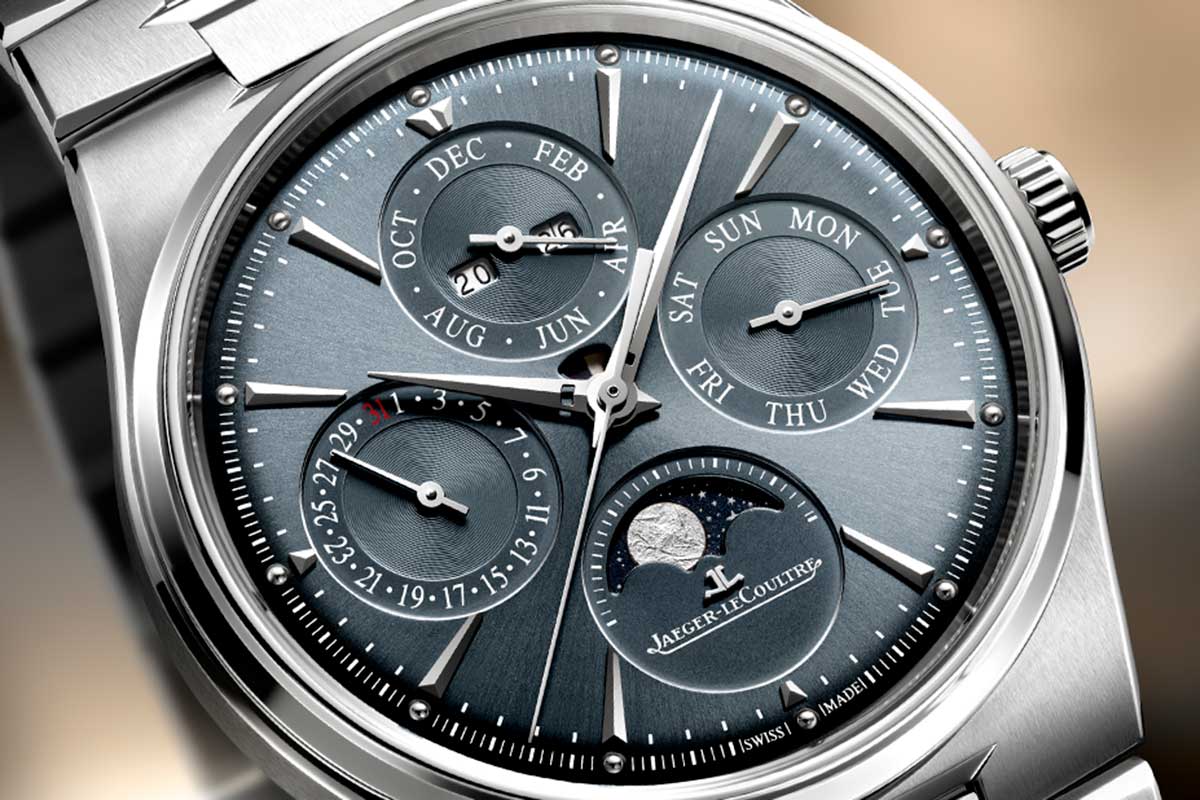
Master Control Chronometre Perpetual Calendar in stainless steel
Design-wise, Jaeger LeCoultre has retained the hallmarks of the Master Control, such as the classic round case, the finely finished dials and the signature dauphine hands, channeling an almost purist aesthetic. The most significant change is perhaps the introduction of a brand-new integrated bracelet, the first in the Master Control family. It instantly elevates the watch for a more contemporary, sporty chic look, but without compromising its classic appeal.

The three-row bracelet itself is finely executed and finished, with contrasts between flat satin-brushed surfaces and high-polished links shaped like triangular prisms. The latter is echoed on the outer links with sharp V-shaped bevels. In comparison to the sharp angles on the bracelet, the lugs are gently curved so that the watch sits comfortably. In profile, it hugs the wrist and wears slimmer than what it says on the box.
The dials, meanwhile, are sunray-brushed in pale grayish blue or bronze, depending on the reference. The effect is that of a lightly textured canvas, richly colored without stealing the spotlight: chronometric precision. Accordingly, the peripheral chapter ring is carefully marked in 15-second and one-minute intervals, while dots highlight five-minute intervals, which also corresponds to the hour.
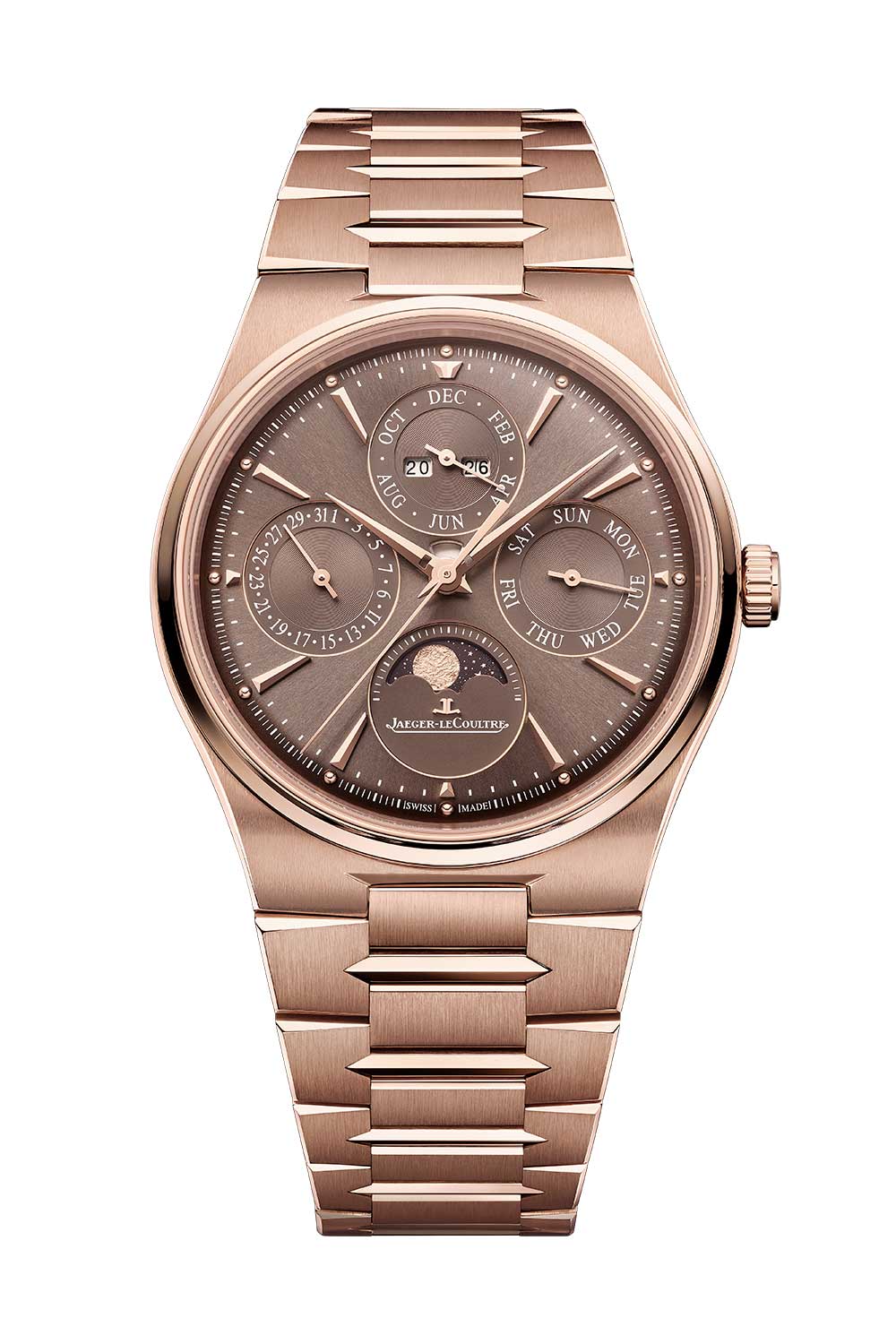
On the perpetual calendar model, four subdials featuring meticulous azure finishing share the stage: month and year at 12 o’clock, days of the week at 3 o’clock, a shimmering moonphase crafted out of hammered gold (for the pink gold version) or platinum leaf (for the stainless steel) at 6 o’clock, and date at 9 o’clock. It is powered by the in-house Caliber 868, the maison’s integrated perpetual calendar first unveiled in 2013’s Master Ultra Thin Perpetual.
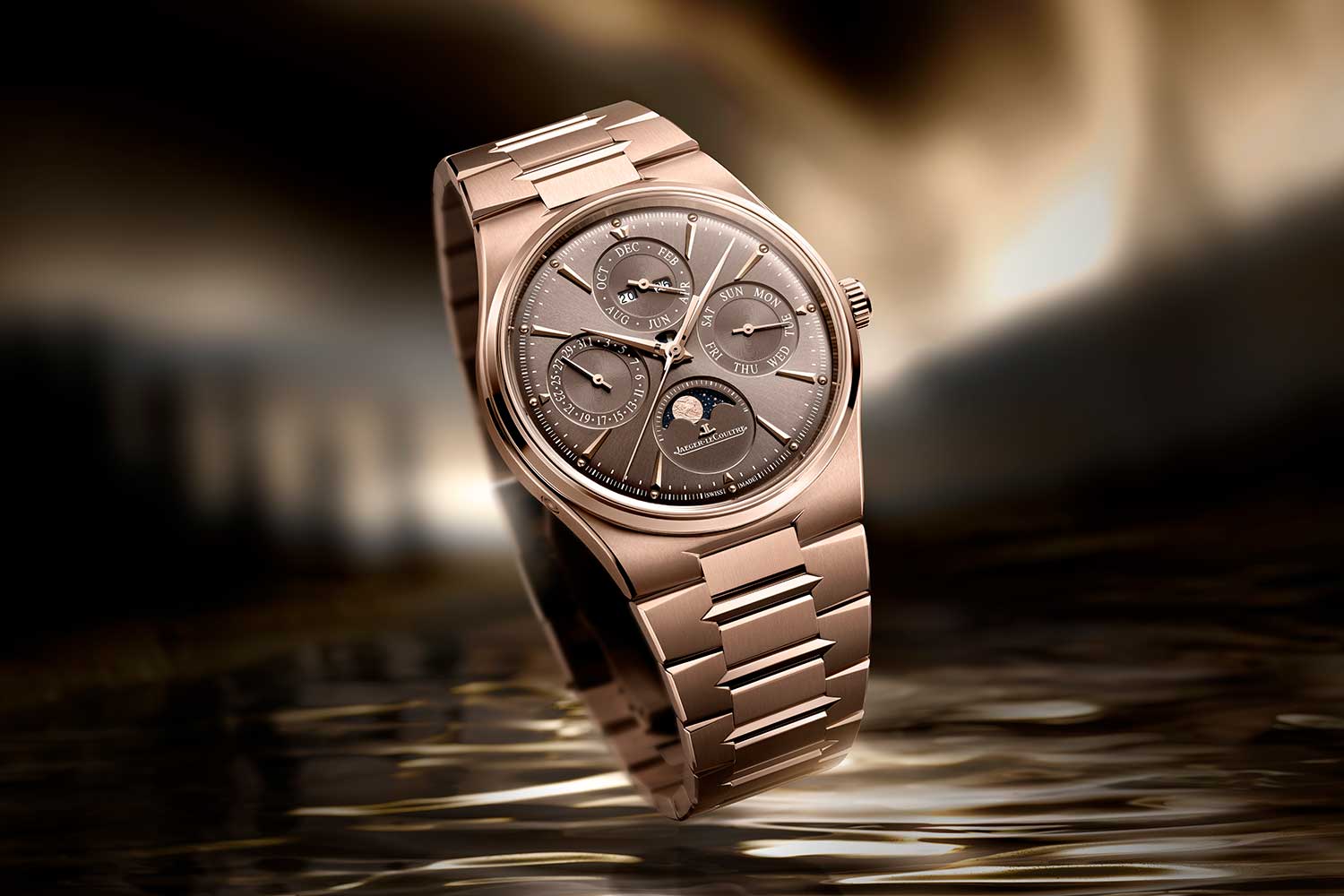
Master Control Chronometre Perpetual Calendar in pink gold
This latest generation of the caliber maintains its slim 4.72mm thickness and 4Hz beat rate, while offering an improved power reserve of 70 hours from the original 38 hours. As it is a perpetual calendar, no manual adjustment of the calendar indications is required until the year 2100 as long as the watch remains wound. The perpetual calendar is available in two 39mm variations: a stainless steel case with blue dial, and 18K pink gold case with bronze dial.
For its date and power reserve model, Jaeger-LeCoultre takes a leaf from its 1951 Futurematic model, which similarly bore power reserve at 9 o’clock. When launched, the Futurematic was ahead of its time as the world’s first watch without a crown for winding the mainspring. The flat crown at the back was solely for setting the time, and as it was an automatic, you simply shake the watch to kickstart the self-winding motion. Its power reserve told how much power was left at a glance, which is particularly useful when the watch is at rest. The Master Control Chronometre Date Power Reserve references this history with its power reserve subdial at 9 o’clock. Its symmetrical layout is another tip of the hat to the Futurematic, although here, the 3 o’clock subdial shows date instead of running seconds.
The last of the Master Control Chronometre trio is a classy date watch with the date counter at 3 o’clock, available in both stainless steel and 18K pink gold. At 38mm, it is just slightly smaller than its compatriots and is suitably versatile for different wrist sizes. The watch is also unexpectedly slender at 7.9mm thick despite the central seconds display, which typically requires extra gearing that increases the thickness of the movement. Here, the movement is redesigned using superposed wheels without compromising on the thin profile.

Master Control Chronometre Date
All three models bear a sapphire crystal caseback and an open-worked 22K pink gold winding rotor to properly showcase the fine fishing on the movements. Bridges are beveled at 45 degrees and decorated with Côtes de Genève that are perfectly aligned with those on the rotor. Jewels are sunk and screw heads are polished for a flawless finish, while gold wheels add visual depth and contrast against the bridges.
Tech Specs: Master Control Chronometre Date Power Reserve
-

- Q4168120
Reference Q4168120
Movement Self-winding Manufacture Caliber 738; 70-hour power reserve
Functions Hours, minutes, seconds and date
Case 39mm × 9.2mm; stainless steel; water resistant to 50m
Dial Blue gray sunray-brushed gradient; symmetrical display of subdials with azure finishes
Strap Integrated three-row tapered bracelet in stainless steel
Price €14,700 excluding taxes
Tech Specs: Master Control Chronometre Perpetual Calendar
-

- Q4178180
-
- Q417216J
Reference Q4178180 (steel); Q417216J (pink gold)
Movement Self-winding Manufacture Caliber 868; 70-hour power reserve
Functions Hours, minutes, seconds; perpetual calendar with moonphase
Case 39mm × 9.2mm; stainless steel or 18K pink gold; water resistant to 50m
Dial Blue-gray gradient or bronze-colored sunray brushed; opaline and azure finishes on the subdials
Strap Integrated three-row tapered bracelet in stainless steel or 18K pink gold
Price €39,500 (steel); €72,500 (pink gold), both excluding taxes
Tech Specs: Master Control Chronometre Date
-

- Q4158120
-
- Q415216J
Reference Q4158120 (steel); Q415216J (pink gold)
Movement Self-winding Manufacture Calibre 899; 70-hour power reserve
Functions Hours, minutes, seconds and date
Case 38mm × 8.4mm; stainless steel or 18K pink gold; water resistant to 50m
Dial Blue-gray gradient or bronze-colored sunray brushed Strap Integrated three-row tapered bracelet in stainless steel or 18K pink gold
Price €12,200 (steel); €45,200 (pink gold), both excluding taxes
A Tribute to Edo Art
Since 2018, Jaeger-LeCoultre has paid homage to one of Japan’s most celebrated artists in its Reverso Tribute Enamel Watches. Hokusai (c.1760–1849), a master of the Edo era, was known for his ukiyo-e woodblock prints, the most famous of which is probably The Great Wave off Kanagawa from his Thirty-Six Views of Mount Fuji series. An original example set a record last year when it hammered for USD 2.8 million at Sotheby’s Hong Kong auction. The artwork had been captured by Jaeger-LeCoultre’s artisans in 2018, in an exquisite limited edition Reverso Tribute Enamel Hokusai.
This year, Jaeger-LeCoultre completes its tribute to Hokusai’s eight-piece Waterfalls series that began in 2021 with the Reverso Tribute Enamel Hokusai “Kirifuri Waterfall.” The new releases depict the final four images in the series, offered in limited edition of 10 pieces each: Rōben Waterfall at Ōyama in Sagami Province; Kiyotaki Kannon Waterfall at Sakanoshita on the Tōkaidō; Yōrō Waterfall in Mino Province; and The Falls at Aoigaoka in the Eastern Capital.

(From left) Reverso Tribute Enamel Hokusai Yōrō Waterfall; Rōben Waterfall; Kiyotaki Kannon Waterfall; The Falls at Aoigaoka
Each Reverso pairs an exquisite miniature enamel painting of Hokusai’s waterfalls on one side with a hand-turned guilloché and enamel dial. The former is a demanding process that requires 80 hours of very precise application of enamel paint, stroke by delicate stroke on the dial. It takes up to 14 layers, each fired at 800ºC and cooled between layers, before the painting is considered completed. Extreme skill and artistry are necessary, not just to replicate the original painting but to accomplish it on a canvas that is just 2 square centimeters small. It is a testament to the incredible expertise of the Jaeger-LeCoultre Métiers Rares atelier that even the original Japanese captions are accurately and legibly reproduced on the miniatures.

There are four different guilloché patterns paired with different shades of grand feu enamel on the dial face, each chosen to match the paintings on the reverse face. Barleycorn guilloché is paired with a light walnut grand feu enamel for the Rōben Waterfall; a herringbone pattern in cyan blue enamel is chosen for the Falls at Aoigaoka; a wavy pattern in emerald green makes the match for Kiyotaki Kannon Waterfall. Perhaps the most exquisite of them all is that for the Yōrō Waterfall, an unusual bamboo-style guilloché pattern in olive green grand feu enamel that perfectly matches the salubrious colors in Hokusai’s scenery.
Tech Specs: Reverso Tribute Enamel Hokusai Waterfall Series
References Q39334T7 (Rōben Waterfall); Q39334T8 (Kiyotaki Kannon Waterfall); Q39334T6 (Yōrō Waterfall); Q39331T9 (The Falls at Aoigaoka)
Movement Manual winding Jaeger-LeCoultre Caliber 822; 42-hour power reserve
Functions Hours and minutes
Case 45.6mm × 27.4mm × 9.73mm; 18K white gold; water resistant to 30m
Dial Recto – Barleycorn, wavy, bamboo or herringbone guilloché, and grand feu enamel; Verso – Miniature-painted grand feu enamel
Strap Black alligator leather with small scale lining and 18K white gold folding clasp, or 18K white gold Milanese bracelet, both interchangeable
Price Upon request
Availability Limited edition of 10 pieces for each reference
Jaeger-LeCoultre

You may also like

Editorial
Last Week In Watches: TAG Heuer Carrera, JLC Grande Sonnerie, Louis Vuitton Spin Time and more
Sep 15, 2026
Editorial
Last Week In Watches: TAG Heuer Carrera, JLC Grande Sonnerie, Louis Vuitton Spin Time and more
Sep 15, 2026

Interviews
Jérôme Lambert, CEO of Jaeger-LeCoultre, explains the new Master Control Collection
Aug 14, 2026
Interviews
Jérôme Lambert, CEO of Jaeger-LeCoultre, explains the new Master Control Collection
Aug 14, 2026
Editorial
Instruments of individuality in the Patrick Parrish Collection
May 25, 2026
Editorial
Instruments of individuality in the Patrick Parrish Collection
May 25, 2026