
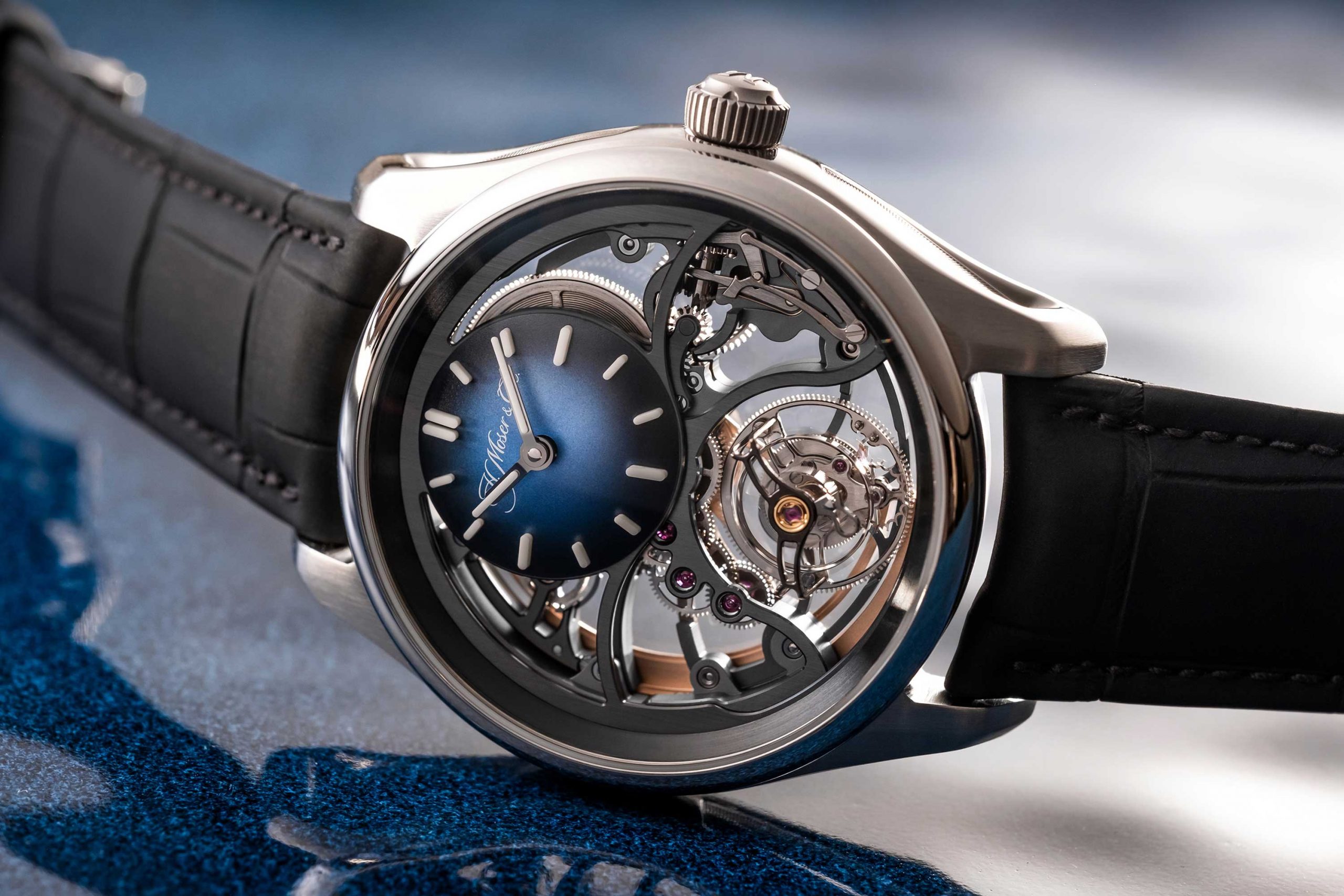
Introducing the H. Moser & Cie. Pioneer Cylindrical Tourbillon Skeleton
The Lowdown
H. Moser & Cie.’s watches are best known for their elegant simplicity on the front, all sorts of high watchmaking finery at the back and a little bit of fun thrown in between for good measure. Sure, there has been the odd flying tourbillon kept in full view on the dial from the Pioneer, Endeavour and Heritage collections, but for the most part, Moser has chosen the path of discretion for their watch faces.
That being said, you may recall a very special piece first unveiled to the public at Baselworld 2015 that was completely unlike the Moser we know and love today. That watch was the Venturer Tourbillon Dual Time Sapphire Skeleton. It had a skeletonized in-house movement with a Straumann double hairspring tourbillon at six o’clock, and was completely encased in sapphire crystal — and by that we mean the whole watch case was made of the stuff and completely see-through, with the movement seemingly stretching right to the edge of the caseband. It’s the kind of watch you throw down the gauntlet with as a young company and also Moser’s most complicated watch at the time. The price? CHF 1,000,000.
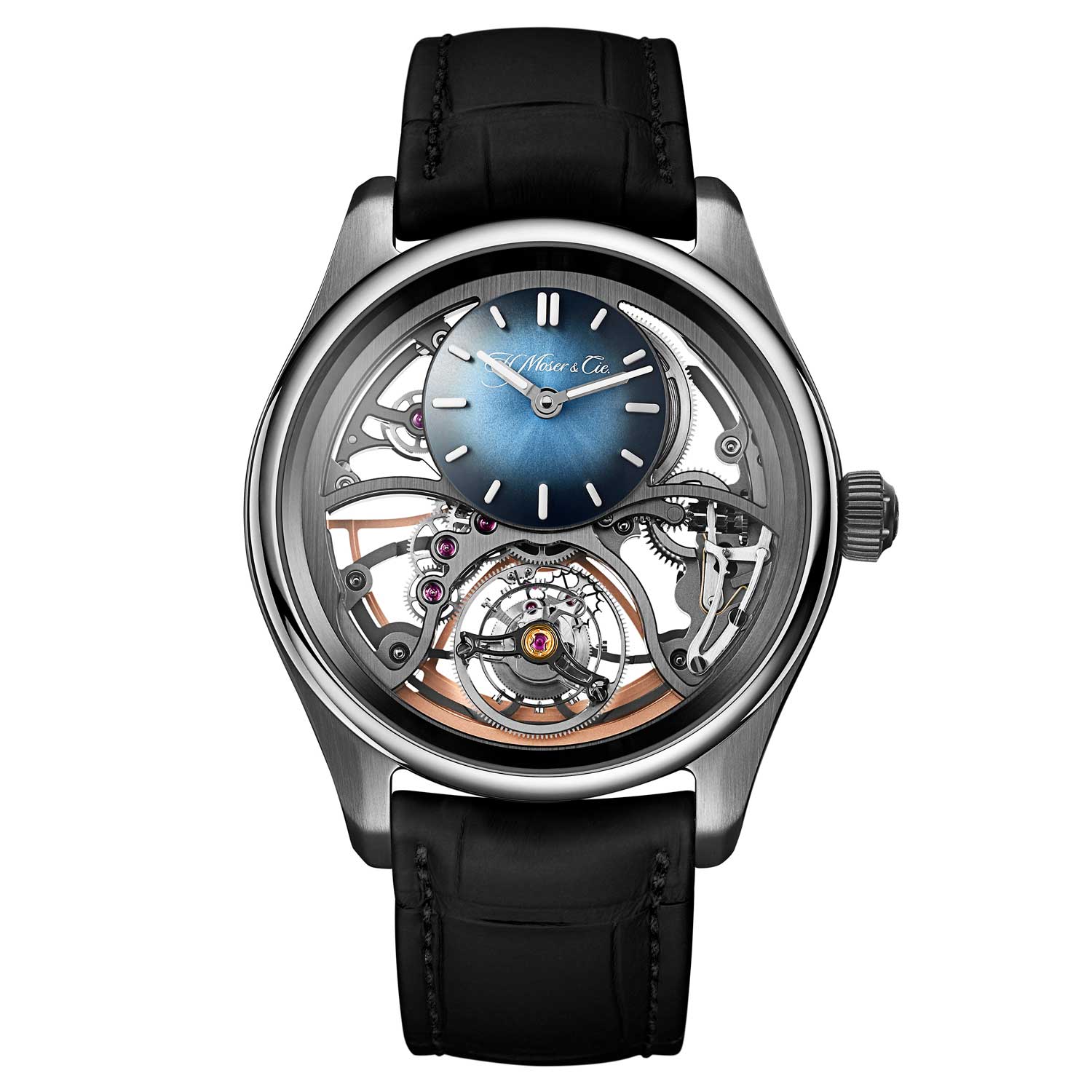
For the Pioneer Cylindrical Tourbillon Skeleton, Moser picked its 42.8mm stainless steel Pioneer case, which is kind of like a cross between the outright sporty, brushed Streamliner case and the exquisitely polished Endeavour case. The Pioneer case has a polished bezel, with brushed soft facets on the top of the lugs, and polished, fluted indentations in the side of the caseband. Incorporating facets that are not sharp and angular into a case is a lot harder than it looks. They have to look like they were done intentionally and not mistaken for over-polishing. To top it all off, the brushing of the lugs that Moser has decided to apply has to be consistent across the whole lug and the rest of the case as well. Overall, it gives the Pioneer case an excellent sculptural quality to it and it is the perfect candidate to house the stunning, fully skeletonized caliber HMC 811.

Moser's Pioneer case may look basic from a distance but take a closer look and the subtleties of its lug facets begin to show. (Image: H. Moser & Cie)
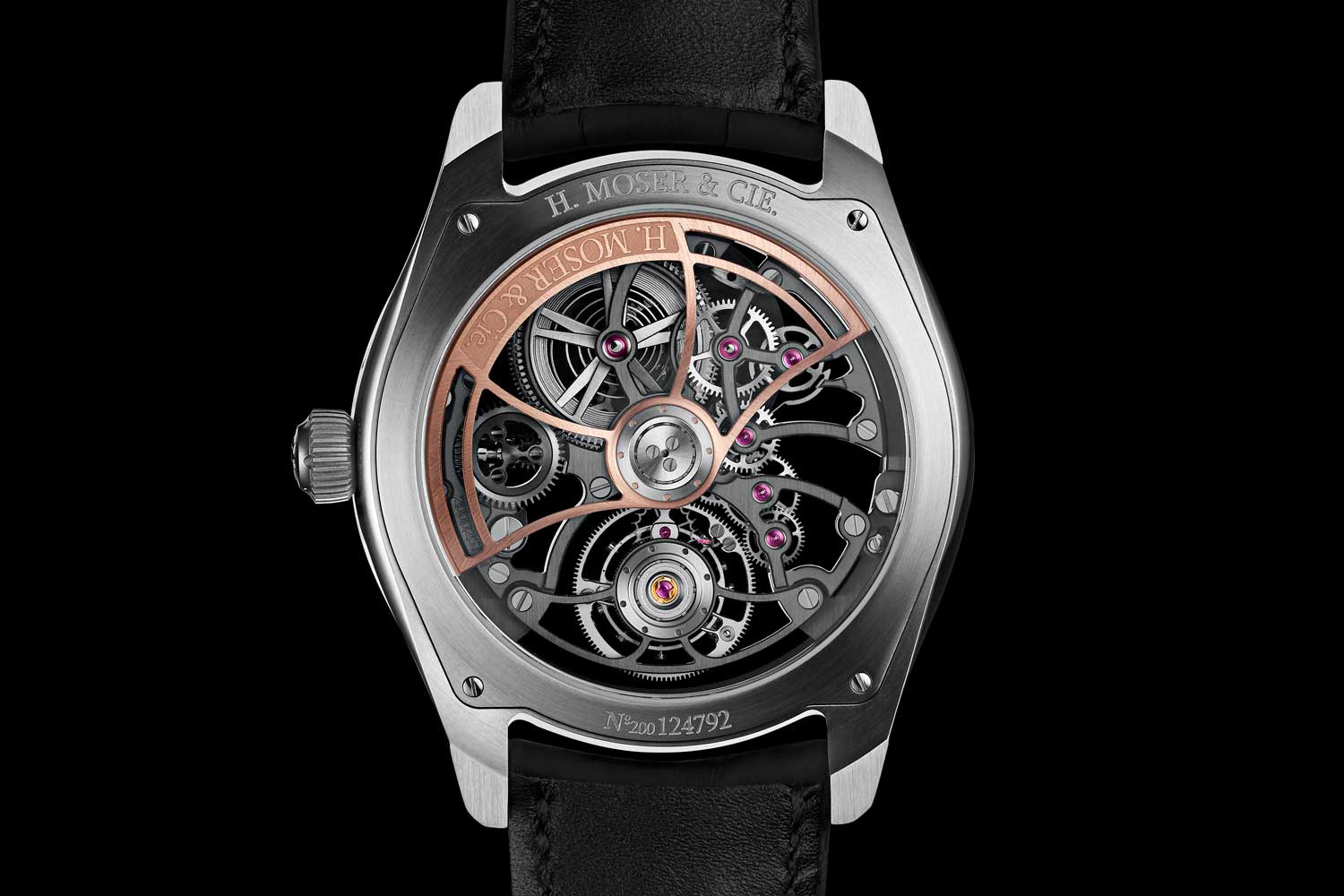
The fully skeletonized caliber HMC 811. It employs a clever use of bridge-securing screws but only from the back, which means there is less polished surfaces to take away from the anthracite PVD finish of the skeleton. (Image: H. Moser & Cie)
How did the cylindrical hairspring enable the marine chronometers to be the amazing timekeepers that they are? Due to its shape, it vibrates in a concentric manner — meaning, the oscillations move in a direction perpendicular to the balance wheel swings instead of laterally like in a traditional flat hairspring. This concentrates the center of gravity of the oscillations toward the balance staff. Add to that Moser’s use of two Breguet overcoils at both ends of the hairspring, which only increases the concentric motion and gravity centering effect. With reduced lateral forces — or less sideways pull, so to speak — there is less friction experienced by the balance pivots. Couple this hairspring with its cylinder shape and Breguet overcoils, with a tourbillon cage that constantly rotates the balance and escapement, and you have a gravity-defying, accuracy-improving triple threat. Unfortunately, the complexity and difficulty of curving a cylindrical hairspring by hand means it takes 10 times as long to produce than a traditional hairspring; and, just like the Straumann, it will only make an appearance in truly exceptional releases.

Incorporating a cylindrical hairspring in to a wristwatch and making it wearable is a pretty darn good achievement. (Image: H. Moser & Cie)

Due to the hairspring's cylinder shape, the balance bridge and the balance staff have to increase in height in order to accommodate it. The balance bridge is skeletonized with hand-bevelled chamfers and gives an unobstructed view to the dance of the tourbillon. (Image: H. Moser & Cie)
Moving on to the subdial, it has a curved profile and is rendered in Funky Blue fumé with a beautiful sunray finish, Moser’s now iconic and instantly recognizable color that was first seen in 2015. However, instead of lume dots at the base of each hour marker like the other Pioneer watches in the collection, Moser has made each marker entirely out of a material called Globolight®. Globolight® is essentially Super-LumiNova mixed with a ceramic-based material to give the lume structural integrity when shaped into a three-dimensional form. The minute and hour hands also feature sticks of Globolight® that extend past their metal frame and act as glowing pointer tips. With that many glowsticks present, this subdial is sure to light up in the dark, allowing the wearer to enjoy the flying tourbillon at any hour.

The use of Globolight® gives the lume plots a three-dimensional form. We think the hour indexes look like Tic-Tacs and the hand lume like glow sticks. Who said science can't be fun? (Image: H. Moser & Cie)
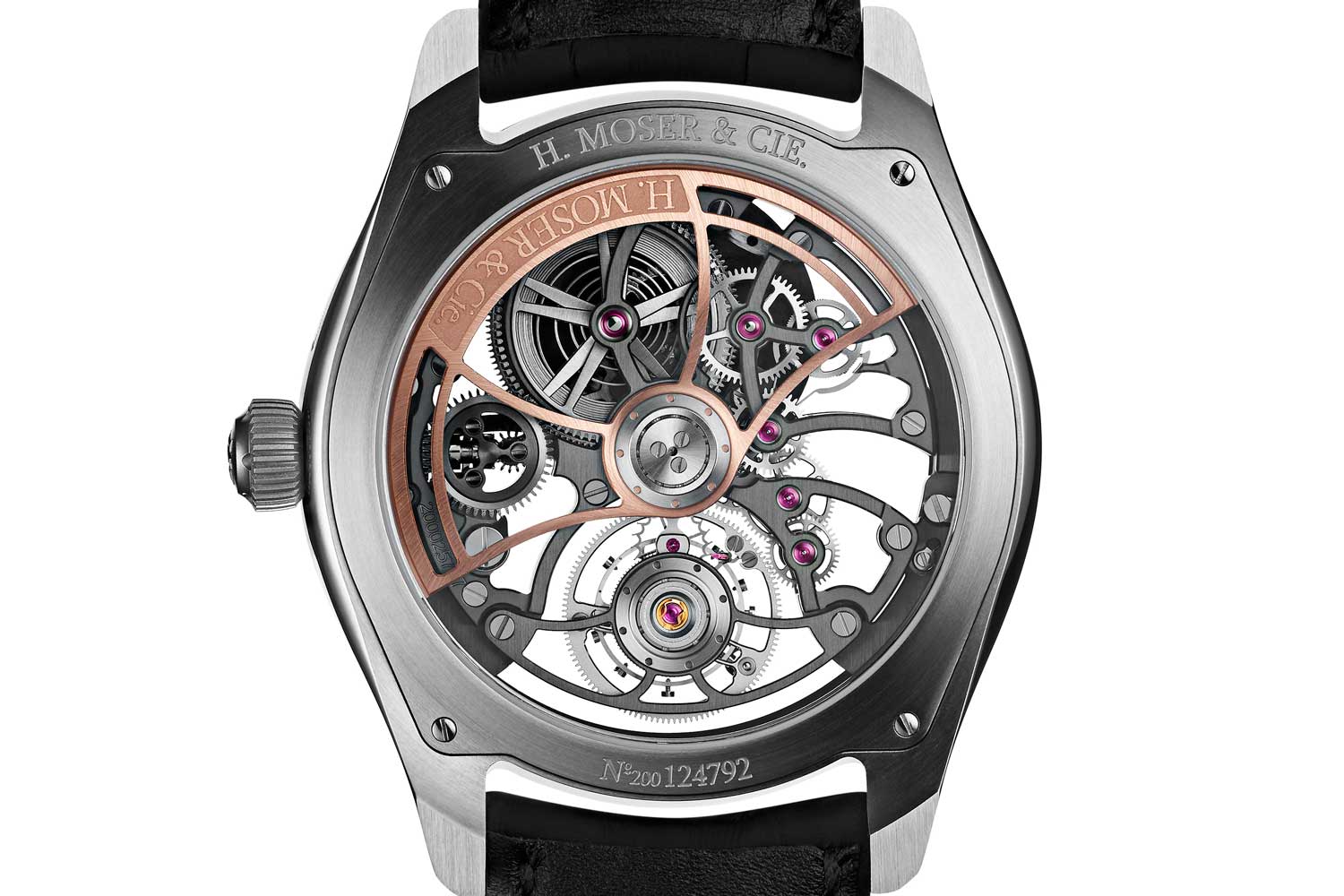
Heightening the effect of transparency is not only achieved through removing as much material from the bridges without losing structural integrity but increasing the distance between the bridges themselves as well. (Image: H. Moser & Cie)
IMHO
We’ll just come right out and say it. This is the best-looking watch that Moser makes. Period. It is such a departure from the dial-side simplicity it has painstakingly tried to cultivate over the past decade, and now its watchmaking savoir-faire that we always knew was there, is on full display. How Moser has managed to maintain wearable case dimensions of 42.8mm by 15.3mm (including the sapphire crystal) while keeping their pawl winding system (which adds width) and adding a cylindrical hairspring tourbillon (which adds height), is simply precision engineering. If you think 15mm is thick, that’s about the height of most sports chronographs by the way.
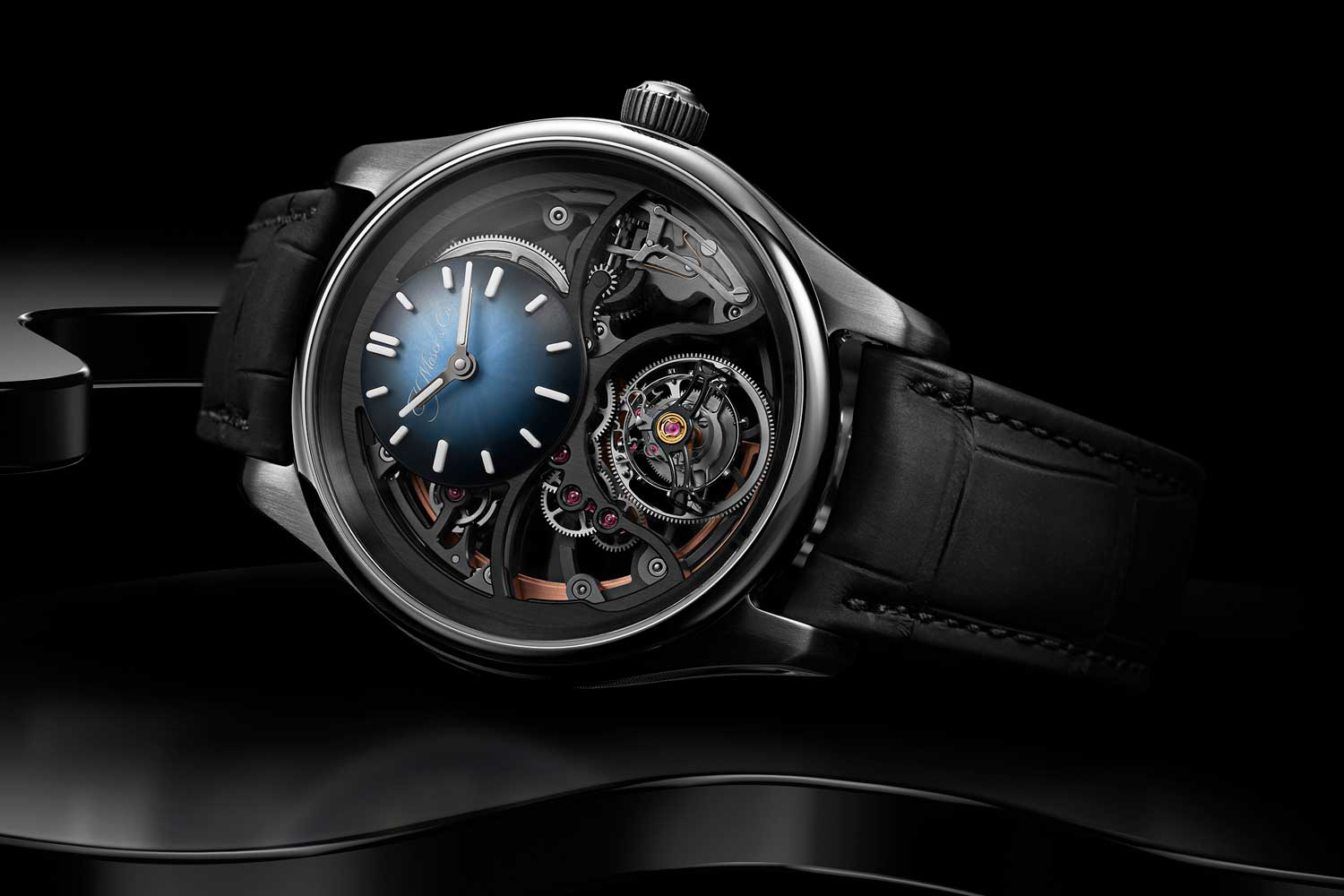
We really do hope a future owner of this watch takes it into the ocean to test its capabilities. Or at least to the pool. (Image: H. Moser & Cie)
The Pioneer Cylindrical Tourbillon Skeleton comes on a black alligator leather strap with a stainless steel folding clasp, but if you would like to be more active with it and use it as Moser intended, you could easily swap it out for a rubber or textile strap that Moser makes, or your own stainless steel bracelet with the Pioneer’s even 22mm lug width.

The Pioneer Cylindrical Tourbillon Skeleton is incredibly wearable and is the perfect balance of aesthetic simplicity and complicated watchmaking. And we want one, price notwithstanding. (Image: H. Moser & Cie)
Tech Specs
H. Moser & Cie Pioneer Cylindrical Tourbillon Skeleton, Ref: 3811-1200
Functions: Hours, minutes, one-minute flying tourbillon with cylindrical hairspring
Case: 42.8mm x 15.3mm; stainless steel; water resistant to 120m
Dial: Funky blue fumé subdial; Globolight® hour indexes
Strap: Handstitched black alligator leather; stainless steel folding clasp
Price: TBC
Availability: TBC

You may also like
Editorial
A Closer Look: H. Moser & Cie. Streamliner Perpetual Moon Concept Meteorite
Feb 25, 2026
Editorial
A Closer Look: H. Moser & Cie. Streamliner Perpetual Moon Concept Meteorite
Feb 25, 2026
Editorial
Inside the H. Moser & Cie. Manufacture in Schaffhausen
Feb 6, 2026
Editorial
Inside the H. Moser & Cie. Manufacture in Schaffhausen
Feb 6, 2026
Editorial
The Revolutionary List: 30 Pioneering Watches – the H. Moser & Cie. Perpetual 1
Dec 2, 2025
Editorial
The Revolutionary List: 30 Pioneering Watches – the H. Moser & Cie. Perpetual 1
Dec 2, 2025