Introducing the Greubel Forsey Hand Made 2
News
Introducing the Greubel Forsey Hand Made 2

In a watchmaking landscape where manual craftsmanship is both currency and creed, the terms “hand-made” and “hand-finished” are often used interchangeably, as though they are synonymous. However, the skill, time and labour required for a hand-made watch is dramatically different from those needed for one that starts with pre-machined parts, which then receive a surface hand-finish.
Hand-making reflects a level of dedication that begins with raw materials and culminates in a watch entirely created, finished, assembled and adjusted by hand. A hand-made watch is a rarity among rarities; even within the ranks of the most prominent players in independent watchmaking, the process of hand-making is virtually absent, as its labor-intensive nature simply makes it impossible to scale.
One exception is the Greubel Forsey Hand Made 1 Tourbillon, launched in 2019 and recently thrust back into the spotlight thanks to Mark Zuckerberg, who appears to have realized earlier in his journey than many that not all watches are laboriously crafted by hand, even if they are hand-finished. Every one of the 272 movement parts and 36 case components in the Hand Made 1 was produced by hand, which translates into 6,000 hours of work, as even the simplest parts demand exhaustive attention to detail – not only to be made by hand but also to be finished to an extraordinary level.
Now Greubel Forsey has unveiled the Hand Made 2, a time-only version with a power reserve indicator. Despite forgoing the complexity of a tourbillon, the Hand Made 2 retains the same philosophy of near-total manual fabrication – 96 percent of components are made from scratch, with the remaining 4 percent comprising sapphire crystals, mainspring, spring bars, most jewels, and case gaskets.
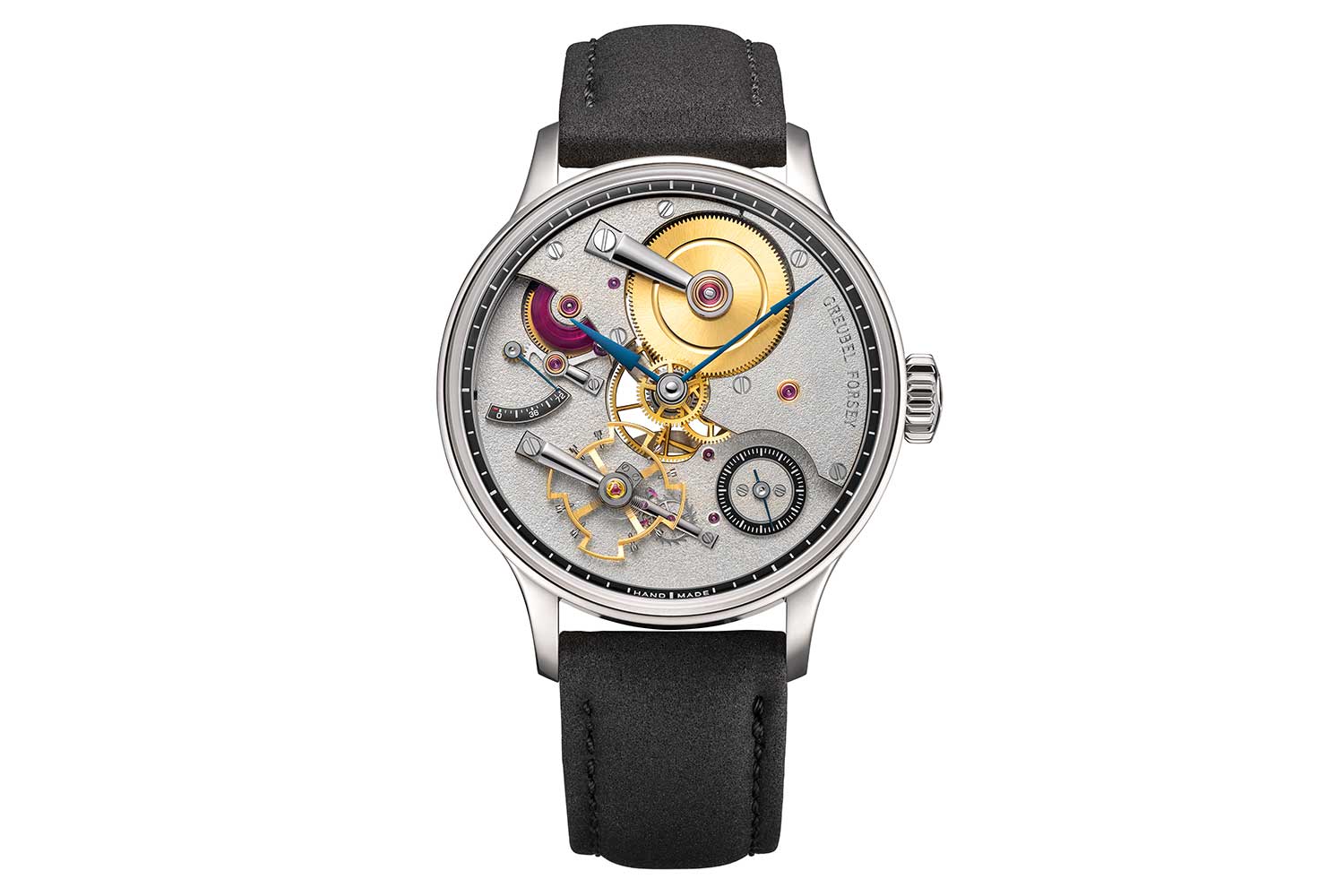
In practice, this translates to 5,000 hours of labour required to complete the 270 components. To put this into perspective, crafting a single screw takes around 8 hours, illustrating how quickly the hours can accumulate. Meanwhile, a single wheel in the going train demands over 600 times the man-hours required for a standard industrially made gear, which itself involves a multi-step process.
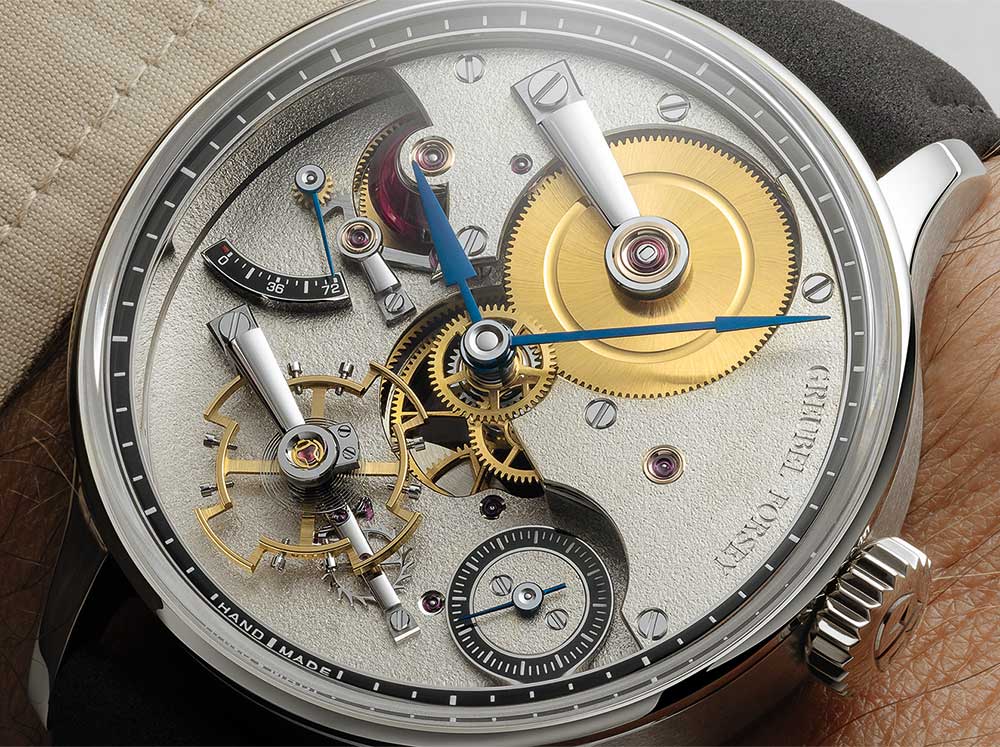
The tools used to make the Hand Made 2 are either hand held or manually powered such as precision lathes, jig-borers, and pantographs. The case is in 18k white gold and measures 40.9mm in diameter and 12.8mm high. As with a large number of Greubel Forsey watches, the dial is the movement. The bridges and plates are made of German silver that has been hand-frosted, which provides a beautiful contrast to the polished and domed steel bridges.
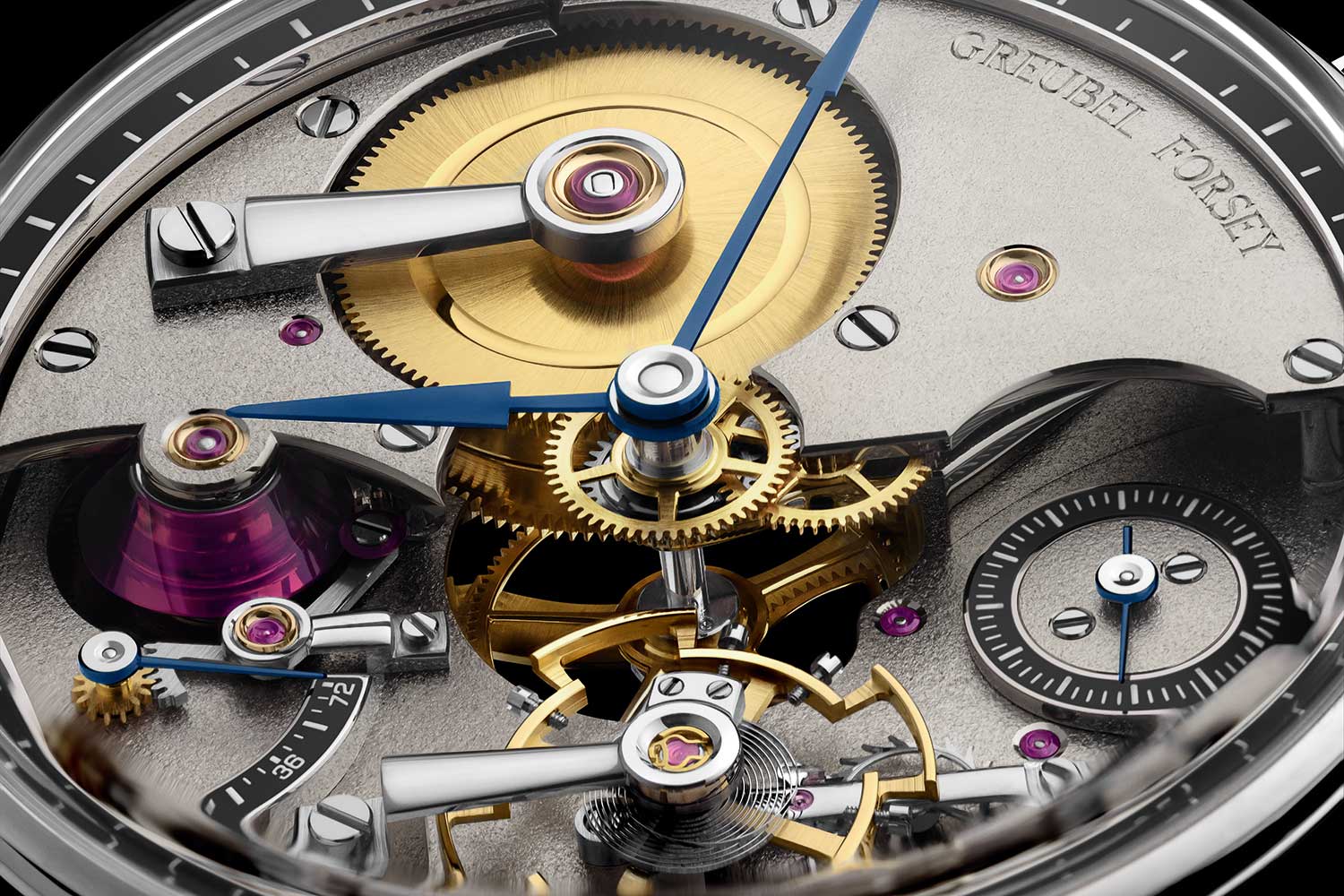

The movement construction is classic Greubel Forsey. The gear train is arranged diagonally across the movement on different levels, resulting in a visually complicated composition despite being a time-only watch. The third wheel drives both the small seconds and an additional fourth wheel, and as the latter is hidden beneath the dial, the escapement and balance appears to be somewhat mysteriously disconnected from the rest of the movement. Power reserve is 72 hours and frequency is 3 Hz. The free-sprung balance is made using tools such as a jig-borer, which is renowned for its ability to drill and bore holes with micrometre-level precision. Meanwhile, the hairspring wire alloy is rolled using a hand-operated rolling mill, which progressively flattens the material and carefully reduces its thickness until it achieves the exact dimensions required.

One of the first things that grabs your attention in the new watch is the massive jewel right next to the barrel at 10 o’clock. It is handcrafted in the shape of a cone as part of a traditional differential screw mechanism for the power reserve indicator. Making a jewel by hand is an exceedingly rare and labour-intensive process, and modern technology has largely replaced this practice. Historically, when natural ruby or sapphire jewels were used in watches, or in the rare case a watchmaker has to craft a jewel manually for restoration work, they are cut using handheld saws, drills and grinding wheels that are manually powered and glossed with polishing compounds to achieve a smooth, precise surface. Greubel Forsey describes the massive conical jewel as a major milestone and there’s no reason to doubt that. Each step demands exact control over angles and dimensions to ensure perfect alignment with the screw mechanism and the jewelled feeler arm it interacts with. As the cone is driven upward during winding, it displaces the feeler arm which through a driving rack, supported by a small polished domed bridge, turns the power reserve hand through the sector on the dial.

The sector, small seconds sub-dial as well as minute track are executed in Grand Feu enamel. While internal angles and lavishly applied anglage have become deeply ingrained in our horological vocabulary – and are indeed executed here to a remarkably high standard – they are seamlessly integrated, serving to highlight the three-dimensionality of the movement for which the firm is known rather than drawing attention solely to themselves.
It’s a very singular beauty achieved through equally singular means, even in the increasingly crowded space of independent watchmakers who’ve thrown their hats into the ring of artisanally finished time-only watches. It knows no time, shortcuts, or cost—only two or three pieces of the Hand Made 2 are made each year, and while the Hand Made 1 Tourbillon currently retails for CHF 788,000, the Hand Made 2 carries a price tag of CHF 580,000.

Tech Specs
Movement: Manually wound, 72-hour power reserve; 3 Hz (21,000 vph)
Functions: Hours, minutes, small seconds; power reserve indicator
Case: 40.9mm x 12.8mm high, 18K white gold; water-resistant to 30m
Strap: Calfskin leather with white gold pin buckle
Availability: 2 to 3 pieces a year
Price: CHF 580,000
Greubel Forsey
You may also like
Editorial
Revolution Awards 2025: Best Handmade — Greubel Forsey Hand Made 2
Jan 27, 2026
Editorial
Revolution Awards 2025: Best Handmade — Greubel Forsey Hand Made 2
Jan 27, 2026
Editorial
The Revolutionary List: 25 Watchmakers and Construction – Stephen Forsey & Robert Greubel
Dec 15, 2025
Editorial
The Revolutionary List: 25 Watchmakers and Construction – Stephen Forsey & Robert Greubel
Dec 15, 2025
Editorial
The Revolutionary List: 30 Pioneering Watches – the Greubel Forsey Double Tourbillon 30˚
Dec 2, 2025
Editorial
The Revolutionary List: 30 Pioneering Watches – the Greubel Forsey Double Tourbillon 30˚
Dec 2, 2025