In Conversation with Bernhard Lederer
Interviews
In Conversation with Bernhard Lederer

Dual direct impulse escapements are among those ideas in watchmaking that never quite release their grip on the imagination. In 2021, Bernhard Lederer unveiled the Central Impulse Chronometer and with it, an escapement that sits within a lineage that runs from Breguet’s natural escapement to George Daniels’ independent double-wheel escapement.
Daniels’ key departure was to eliminate the geared connection between the two escape wheels and instead drive each by its own barrel and gear train, preserving the dual direct principle while freeing it from the constraints of a shared transmission. Lederer took the next step, which was to resolve what had remained a persistent limitation by rendering the system self-starting. He did so by adding an additional impulse surface on either side of the principal locking stone, so that a tooth of the escape wheel that previously rested on the locking stone is guided across a shallow lateral incline, and in passing, it nudges the lever sideways and initiates oscillation.
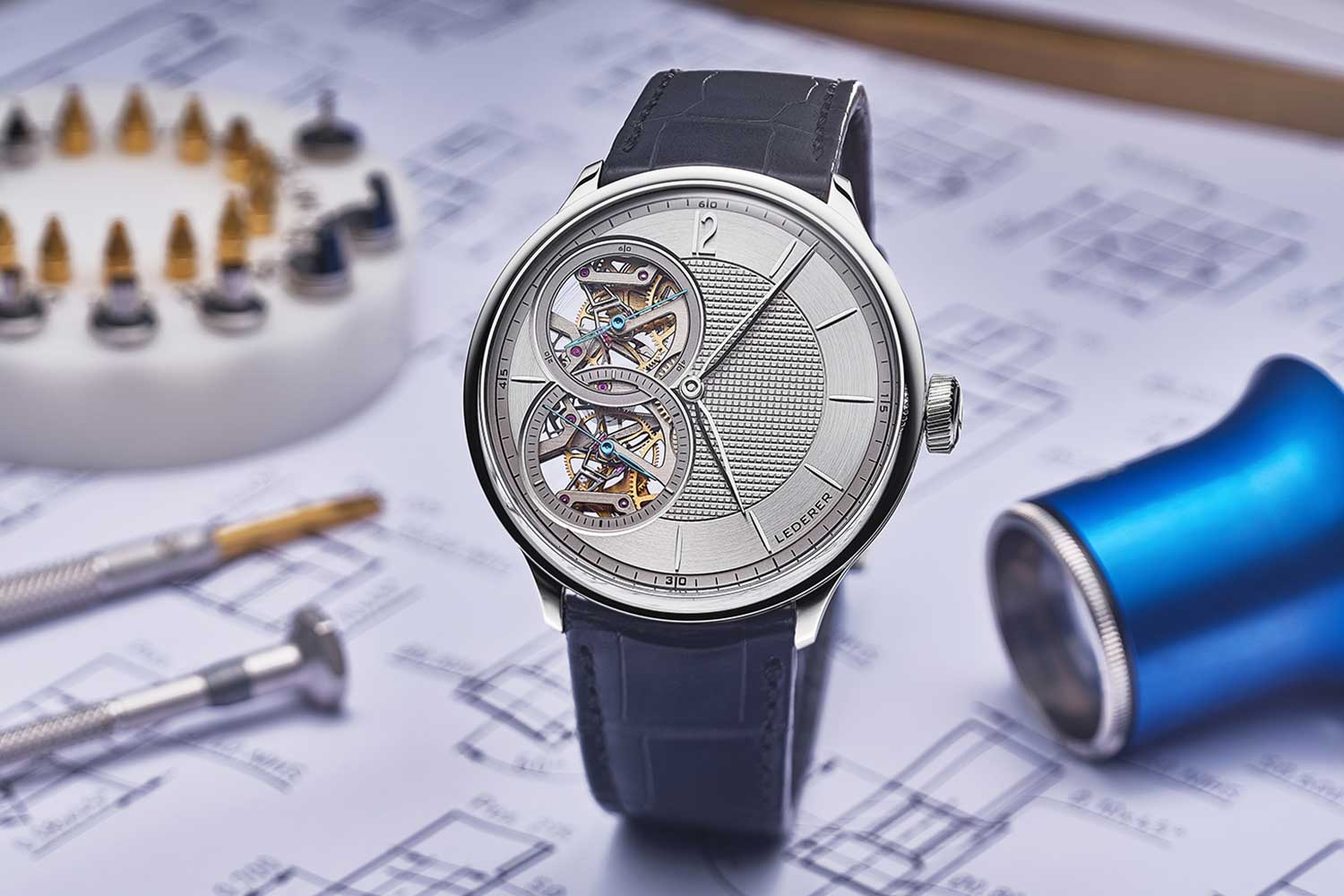
2021: Bernhard Lederer Central Impulse Chronometer
In this wide-ranging conversation, the independent watchmaker reflects on how an early fascination with the sound of escapements became a lifelong pursuit of alternative regulating organs, touching on Breguet, Daniels, tourbillons, remontoirs, escapements and the stubborn physics that govern them all. Most notably, he defines the principles of an ideal escapement and describes an ongoing development of an escapement that, by conventional understanding, should not be possible.
We’ve spoken a couple of times about escapements, and it occurred to me that I’ve never asked how you first got started in watchmaking.
How I got started in watchmaking is both a long and a short story. It began when I inherited a pocket watch from my grandfather. I’ve always been driven by curiosity, and at that age I was convinced that if I opened the watch, it would never work again. I felt as if I had two left hands. I didn’t want to destroy it, so instead I went to the library and borrowed a few books on watchmaking, hoping that understanding a little might help me preserve it.
That turned out to be a good decision, because I came across a book in which the author explained why he became a watch collector. That story changed my life. He described how his father played a game with him. He had a small collection of pocket watches, and he would wind one up and let his son listen to it without looking. Together, they would try to identify which watch it was. He wrote, in a beautiful, almost romantic way, about learning to distinguish between the sound of a cylinder escapement, a lever escapement, a duplex, a chronometer escapement. The way he described it, you immediately understood why he became a collector.
His words stayed with me, and I wanted to know whether it was a fairy tale or something real. So I began going to flea markets, winding up every pocket watch I could find, listening carefully and comparing one to the next to see if I could hear the differences myself. It takes time and quite a lot of training but eventually, you can hear it. It’s not a fairy tale; it’s real.
And in trying to follow what he experienced, I fell in love with escapements – the phonetic signature of watches. I wanted to understand the secrets behind them, and that is what ultimately led me on my path to become a watchmaker.

Bernhard Lederer
What did you do after watchmaking school in Germany?
After watchmaking school in Germany, the path is quite special. You first spend four years in an apprenticeship to become a watchmaker, then you must work another four years under a master watchmaker before you can attend the final school to qualify as a master watchmaker yourself.
After my apprenticeship, I worked under the guidance of a master watchmaker, restoring historic timepieces for auction houses and museums. He was based in a small town in Germany and would give me work to do. After four years under his supervision, I was able to attend the school to become a master watchmaker. From there, I began not only restoring watches but also building new ones – my own constructions and designs. I started with clocks, as I’ve always been fascinated by the beauty of mechanics.

1986: Lederer’s diploma masterpiece, a table clock featuring a gravity escapement and a secular perpetual calendar. A masterpiece with a millenium calender for the coming 3’200 years and a moon phase that requires correction only once every 800 years
If you go back to 1986, you won’t find any wristwatches where the movement is visible. There were skeleton watches, of course, but for me they are confusing. I can’t read the time on them, so that’s not my style. At the time, the only way I could really show the beauty of mechanics was through table clocks. That’s why I made many of them, as well as tall floor clocks – formats where it’s easy to reveal the full mechanical spectacle.
Step by step, I moved toward wristwatches. Today, there are ways to display the movement beautifully, but it took a long time to get here. Even now, people say they’ve never seen a movement presented so clearly within a wristwatch case, which only confirms that this way of showing mechanical beauty is still uncommon. For me, it has always been very important.
How did George Daniels inspire you?
He provoked me. In his book, he described this escapement [independent double-wheel escapement] we realised here for a wristwatch as the best escapement he could imagine, but one that was too difficult ever to fit into a wristwatch.
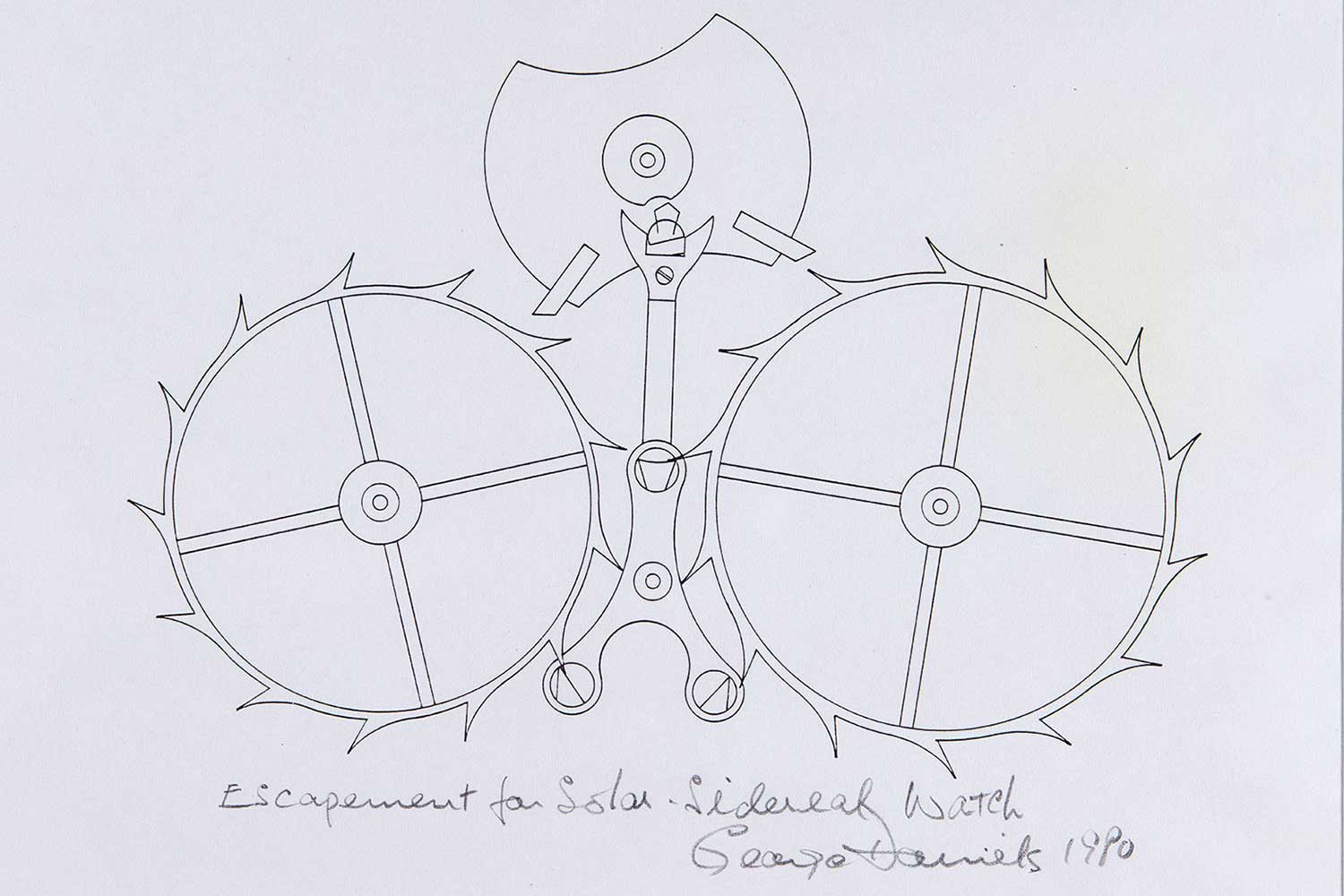
Daniels’ 1980 drawing of the independent double-wheel escapement
That statement – that it would never be possible – was the provocation. It made me want to prove the opposite, that it is possible. If you think differently, if you go deep into the essentials, there must be a way. And in the end, we showed that there is a way. So in a sense, by saying it could not be done, he pushed me to demonstrate that it could.
His escapement wasn’t self-starting.
No, it was not. There are a few differences in the way he designed the escapement. It works well for a pocket watch, but the moment you place it in a wristwatch, with all the movements the wrist introduces, his construction would not cope. You would run into difficulties.
It wasn’t shock resistant as well?
No, no. And this here [CIC] is absolutely shock resistant. We even tested it with someone who makes downhill race with the bicycle, and there was no problem. But getting there was a long, long journey.
You know, when George Daniels made it, he had no device to control. He had no idea what will happen when you put it to 3Hz and in a wristwatch. With his way of working, he was right, that it is not possible to make the movement smaller for a wristwatch. So I invented a completely different way to produce those components to be able to control the dimensions and positions in a perfect way. Without that, he could not tell where to pay attention and what to take care of because he did not know about it. This kind of development requires a certain courage and you must be a little crazy.
It is like when you go to an escape game. You know there are different challenges, but you don’t know what they are. You are in one challenge room, you solve everything there, and then the next door opens. You enter the next room, and again you have no idea what you will face. No one tells you in advance. It is the same when developing an escapement. You solve one detail, but that only opens the door to the next challenge. And then you have to be be brave and say, “Alright, another one.” You never know how many will follow, or when you will reach the point where everything is finally resolved.
How long did it take you to devise a new escapement that would address all the shortcomings?
I started working on that escapement in 2013, and the final version was ready in 2021. But I wasn’t working on it every day; I had to take on other work in between to earn a living.
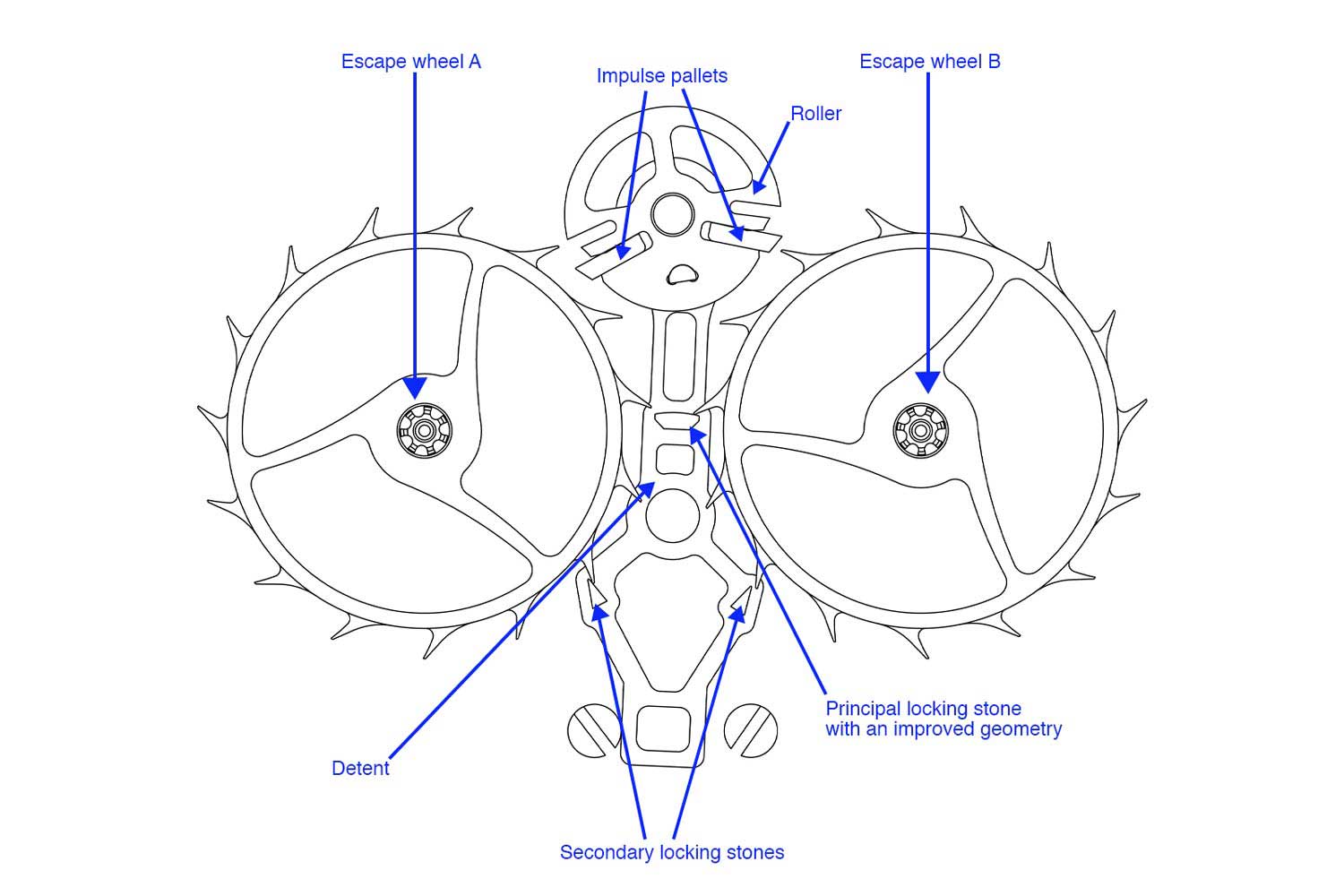
Bernhard Lederer’s version of the independent double-wheel escapement
Even so, it never really left my mind. Even when I wasn’t working on it directly, I was constantly thinking about it, turning it over in my head, searching for solutions. Ewa would shout at me, “Talk to me, say something.” And I would reply, “No, no… I’m thinking.”
I was developing movements and mechanisms for other companies, including BLU, which we had to stop in 2009 during the financial crisis. It was also when our daughters were born, so stability mattered. I wanted to be present, rather than travelling constantly.
Now, as they are starting to leave home, I feel it’s the right time to return to something more personal – this collection of different escapements. It also comes from the feeling that today, most watches are equipped with the Swiss lever escapement. There is very little choice. I believe collectors deserve that choice. And if it can be combined with a beautiful watch, then all the better. That is why we decided to create at least five or six different escapements.
That seems like a crazy number of escapements for one watchmaker to develop in a lifetime.
Always a completely new movement with a new escapement. And so yes, it’s crazy. And yeah, but why not always? There must be the first who is crazy, then the others will follow.
What is your definition of an ideal escapement? Is it the same as George Daniels’?
An ideal escapement is one that is extremely reliable and consumes very little energy. The Swiss lever escapement is certainly reliable, but it is also very energy-intensive; its efficiency is very low. Ideally, an escapement should not require oil. Even with modern synthetic lubricants, oil remains a limiting factor. It should also be highly regular while operating with minimal energy consumption.
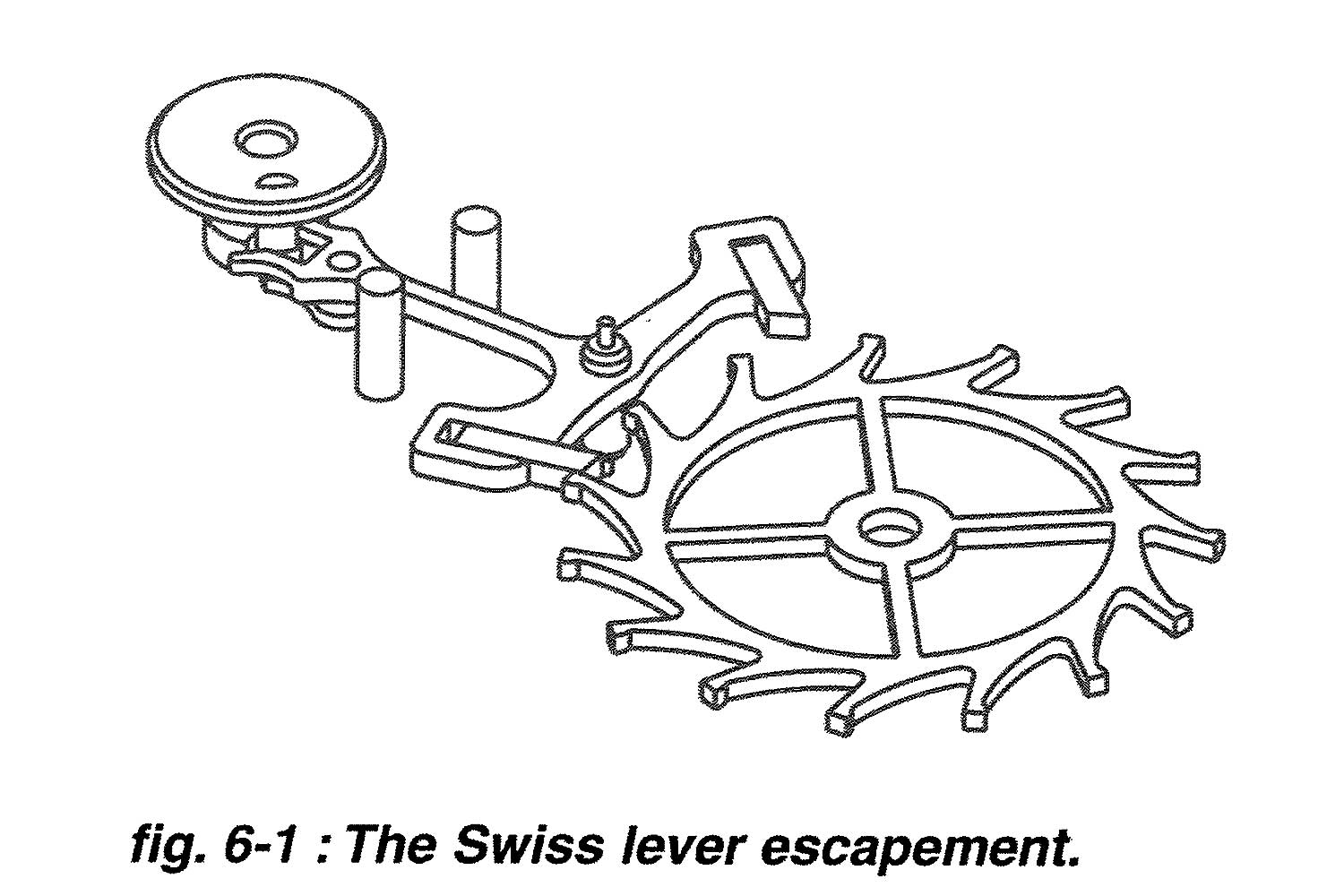
We are already on a good path, and you will see more escapements to come. Of course, I already have in mind what I consider the ideal escapement, one that will round out the collection. It is something entirely new, an escapement that has never existed before. The first pieces, like the independent double-wheel escapement, are based on earlier ideas, originating from Breguet, later modified by George Daniels, and ultimately realised by us. The next escapement will also draw from a historical concept. So there will be several inspired by important escapements from the past, followed eventually by a completely new invention.
The fundamental challenge in any escapement is that you must accelerate an escape wheel, and doing so requires energy. That is the inherent handicap. In Breguet’s natural escapement, for example, there are four wheels so the energy requirement is multiplied accordingly.
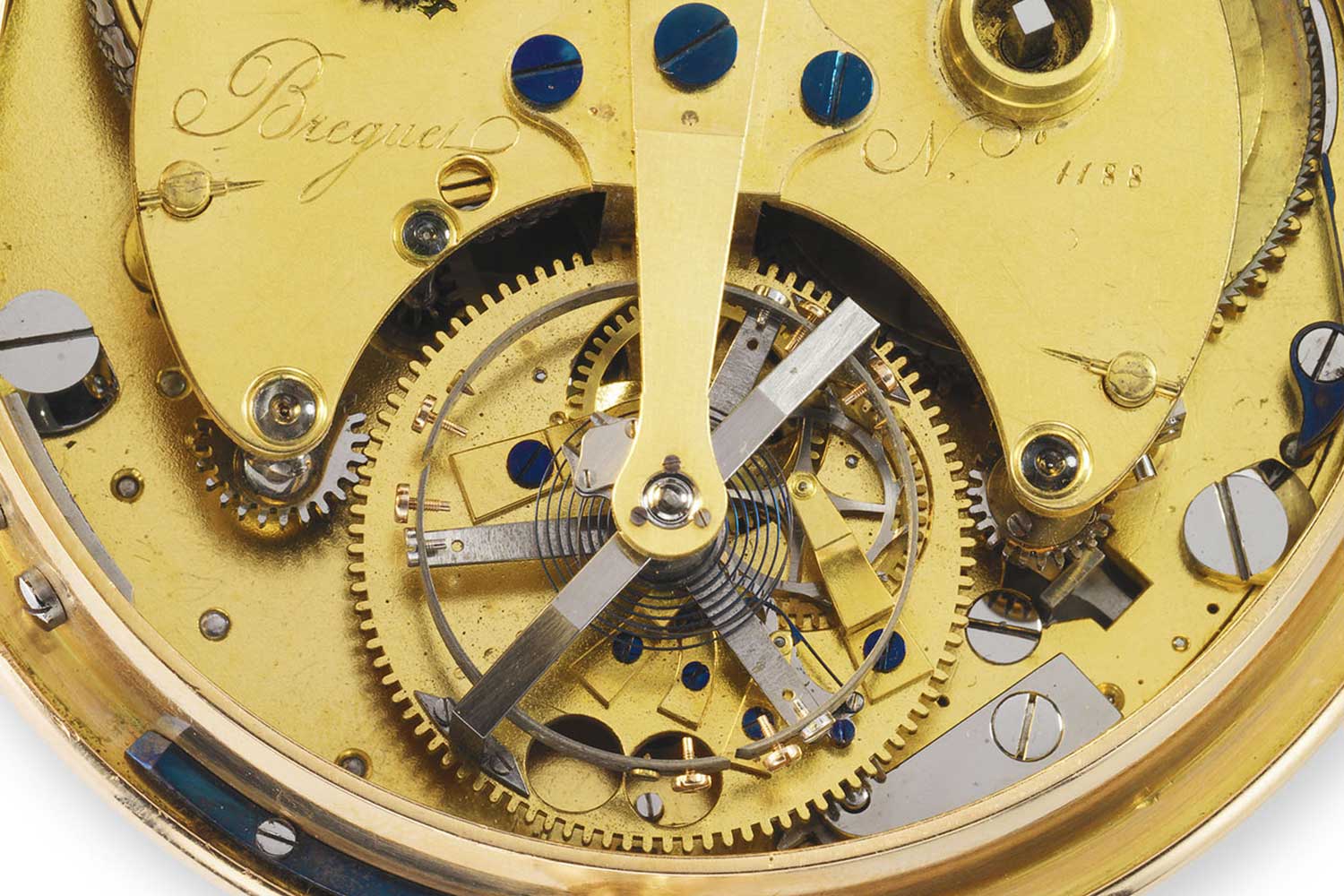
Breguet No. 1188 with a natural escapement in which a larger 12-tooth escape wheel is driven by a wheel beneath which drives a pinion. The pinion in turn drives the second escape wheel with three teeth
The idea, however, is quite simple. Why accelerate an entire wheel when only one tooth is actually active at any given moment? If you can design an escapement where only a single tooth is accelerated, you dramatically reduce the energy required. That is the principle behind this system. Instead of driving a full wheel, you move just one tooth, so you need far less energy.
I suppose you’ll never think of silicon as a solution.
No, no. Silicon is for those who – this may sound a bit harsh – don’t have good ideas. It’s a way of compensating by using ultra-light materials. I’m glad it exists, but it’s a clear sign that the underlying problem hasn’t been properly understood.
Yes, with silicon you reduce inertia, so you can more easily accelerate the multiple wheels in the natural escapement. But the fundamental issue remains unchanged. You still have to accelerate all those wheels. If instead you reduce the number of elements being driven, you need far less energy. Using silicon simply works around the problem but it doesn’t solve it.
I don’t want to use silicon because it is not repairable. If it breaks, it is gone, and it breaks very easily. I’ve received many watches for repair with silicon escapement components from one friend. Even a small mistake with tweezers can damage an escape wheel. Once damaged, it deteriorates further until it fails completely. That is not a solution.
I prefer traditional materials – brass, steel and ruby – because they can always be repaired. We know how to work with them, and future watchmakers will too. I don’t know what materials will be available in 20, 40 or 50 years, but I know these will remain serviceable.
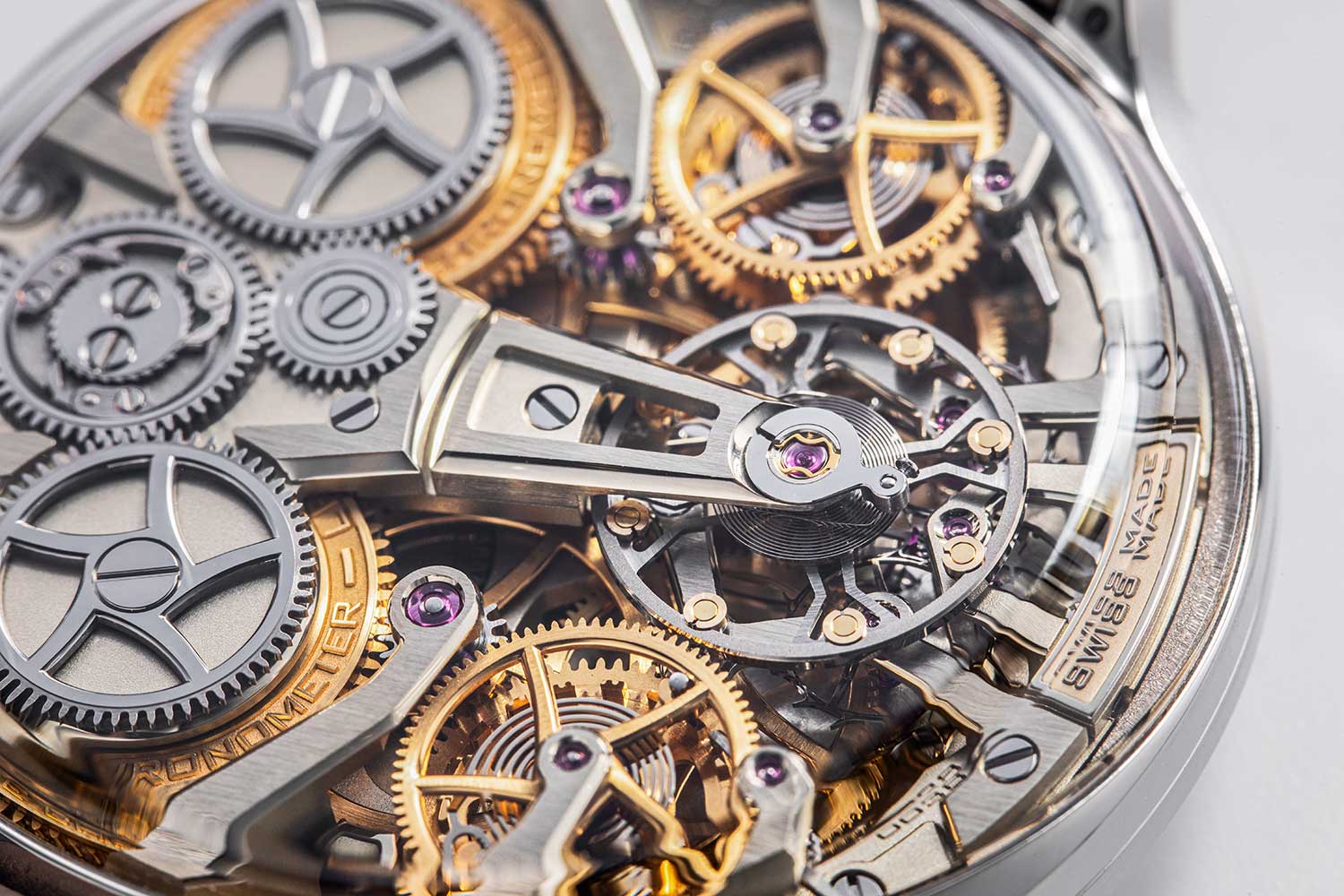
Central Impulse Chronometer 39mm (©Revolution)
There is also a very structured, perhaps very German, approach in how I work. Every component is documented in two ways: one technical drawing with all dimensions and tolerances precisely defined, and another detailing the finishing – how to polish the angles, with what materials, and to what standard. So even if spare parts no longer exist, a watchmaker in the future can reproduce any component exactly as it was, both technically and aesthetically. In that sense, there is no issue with after-sales service. The watch can be kept alive for a very, very long time.
Do you think you will ever create an escapement that can be mass produced reliably?
The escapement I just mentioned, the one where only a single tooth is accelerated, is something we still need to fully prove, but it appears that it could be suited to industrial production. If that turns out to be the case, then it would certainly be something that could be offered more broadly. But there are still a few years of development ahead before we reach that point.
For your other escapements, are you thinking in terms of single or double impulse, direct or indirect?
There will be big mixture of different types and sorts. But of course, there is a tendency that they will be direct impulse escapements, because if you are driven to make timekeeping precise, there is nothing better than having direct impulse.
But how do you make a single impulse escapement self-starting?
Now you go really deep. With a single impulse, you cannot make it self-starting in the usual way. You have to go a little bit the tricky way, because direct single impulse is not self-starting. So what we do is: you wind the watch, and it does not start. The moment you pull the crown to set the hands, that is when we turn the balance slightly. Then, when you push the crown back in, you release the balance, which has been pre-armed by this action. The escapement then starts without needing to be swung.
So you have to go a little bit the tricky way around. And again, it comes down to a very clear physical rule: with direct single impulse, you cannot achieve self-starting in a straightforward way.
What do you hope to achieve with your upcoming developments?
I don’t want to achieve anything. I think when you’ve had the chance to learn so much about the beauty of watchmaking, when you’ve seen so many truly beautiful inventions and fantastic ideas, and yet none of these can be observed on the wrist by today’s watch collectors, then you feel that this is a pity. All I would like is for a collector to have the choice, to say, “I’m happy with a standard ETA Swiss lever escapement,” or, “I would like a Fasoldt, a Robin escapement, or a Central Impulse Chronometer escapement,” or whatever the names may be. He should have that choice. And I would be happy if collectors appreciate that they have this choice, and that each might choose at least one of these beautiful escapements.
But in the end, if I make a development and nobody else loves it, that is also fine. It is my satisfaction to make what I feel is beautiful. When you look at old pocket watches, normally nobody opens them; you wind them and enjoy them. But if you open them and look at each component, they are so beautifully decorated. It is an expression of the deep love of those who made them for their profession. I have a little of that same respect and love for my profession, and I want to show it not only through decoration, but through development, by making extraordinary components and escapements. That is one step more than simply making well-decorated watches.

Bernhard Lederer
There are many who can climb a mountain to 1,000 metres, fewer to 3,000 or 4,000, and only a very few who go to Everest. It is the same in watchmaking. Many reach a certain level, but the higher you go, the fewer watchmakers there are. It requires skill and experience. It’s not only about talent. You need experience. I now have nearly 50 years of it, and 40 years making customised pieces. That is quite a lot of experience.
You’ve made several revisions to your remontoir since the original CIC prototype. Can you explain the imperfections you observed?
In technical literature, you always find a single system of how a remontoir should work. So when I decided to build a remontoir d’égalité, I naturally turned to those sources and designed a system to fit our movement. But then I realised it didn’t actually work as I had expected. The literature says it delivers a constant flow of energy, but in practice, that wasn’t what I observed. So I began to investigate why. I approached it step by step, what I call a “carpaccio analysis,” slicing everything into very thin layers, detail by detail, examining the entire construction of the remontoir. And then it became clear; the logic simply doesn’t hold.
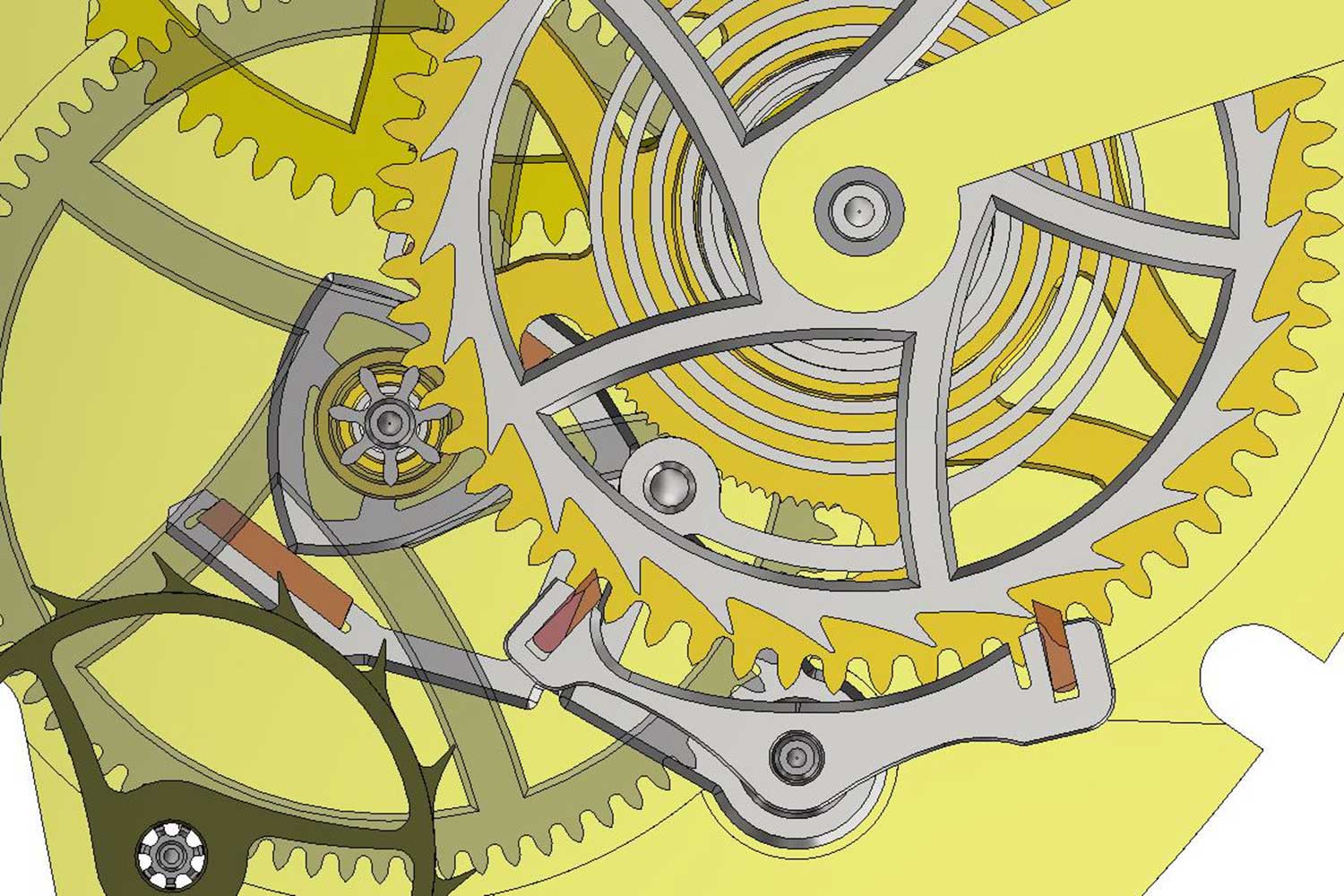
The remontoir mechanism in the original 2021 prototype. It employed a ratchet stop wheel that is locked and unlocked by an anchor, to which a jeweled fork governed by a Reuleaux triangle is attached
In the classical system, a spring delivers energy to the next axis. On that axis, there is typically a cam or triangular element that triggers the release. Through the gear ratio – say 1:7 – the energy is reduced, so on that next axle you only have a fraction of the original force. Yet it is precisely this reduced energy that is used to trigger the release of a system holding the full power of the spring.
The problem is that as the watch is wound, the friction required to release the system increases. You are then trying to unlock a high-friction system using only a small, reduced amount of energy from the following axle. The result is that the energy delivered to the escapement is not constant.
It’s as if a remontoir would need its own remontoir…
Yes, it is contradictory. So in the first step, what we did was to remove the part where the anchor moves back and forth to release the remontoir. In that classical arrangement, you have a direct, one-to-one contact, which means the full force is acting against the friction.
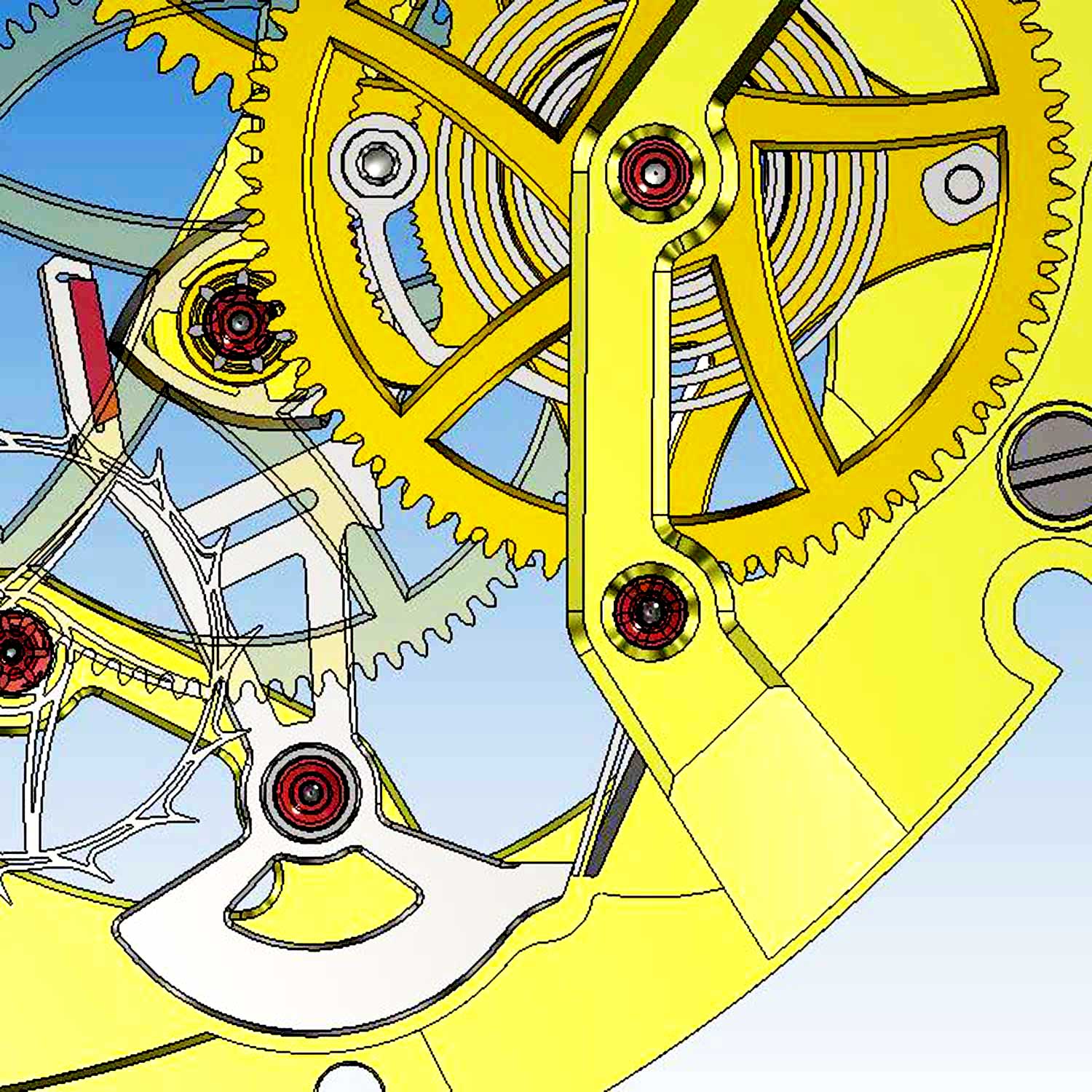
The improved remontoir mechanism in the production version has a simplified setup. The stop wheel is now a flywheel that is located on an additional axle. It is locked and unlocked by a finger on the free end of the fork
Instead, we introduced a normal wheel and pinion system. The remontoir is no longer blocked by a steel wheel and anchor, but by a flywheel that controls the locking and release. Because of the gear ratio, the force at that point is reduced to about one-seventh. So instead of dealing with 100% of the force at the point of friction, we are only dealing with a fraction of it. The influence of friction is still there, but it is much smaller, and at that point, the system begins to work as it should.
It’s actually a simple modification, but it comes from careful analysis questioning whether the existing solution is truly optimal, and where it might be improved. From there, you refine step by step. In this intermediate version, however, we are still taking the triggering information from the following axle, so again, only a fraction of the energy is available. In the next step, we changed that as well. We now take the triggering information directly from the same axle that carries the remontoir spring itself.
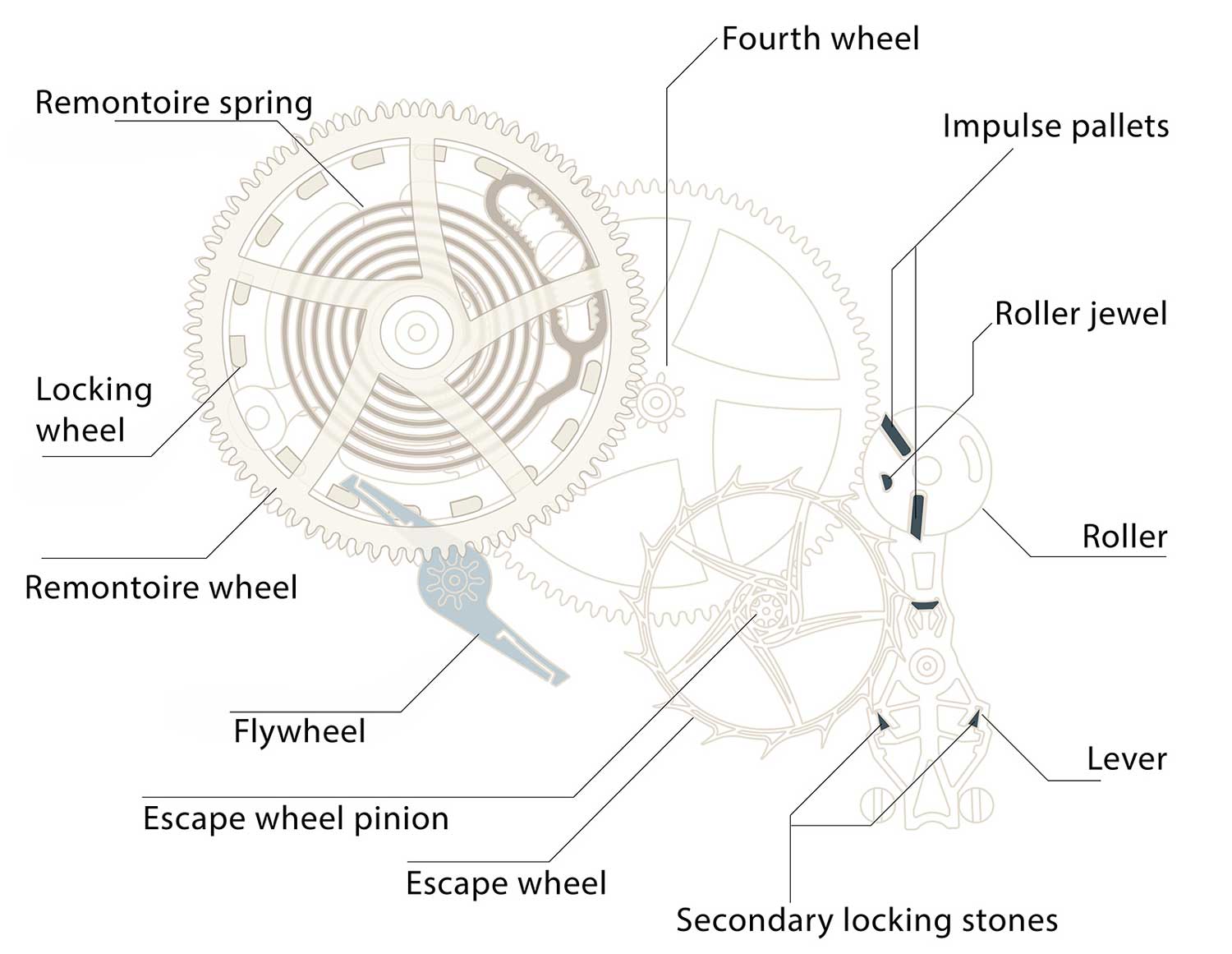
Lederer’s latest remontoir in the CIC 39mm localises all of its components on the third wheel, which features pillars acting as a stop wheel. Coaxially mounted is the remontoir wheel, connected via a spiral spring and geared to a pinion carrying a flywheel. During operation, the flywheel rests against a pillar, locking the remontoir wheel in place. As the third wheel continues to rotate, it moves the pillar out of the way, releasing the flywheel and allowing the remontoir wheel to rotate. The spring then unwinds, delivering constant torque to the downstream gear train. The cycle ends when the flywheel strikes the next pillar, halting the remontoir wheel and beginning the spring’s re-tensioning phase.
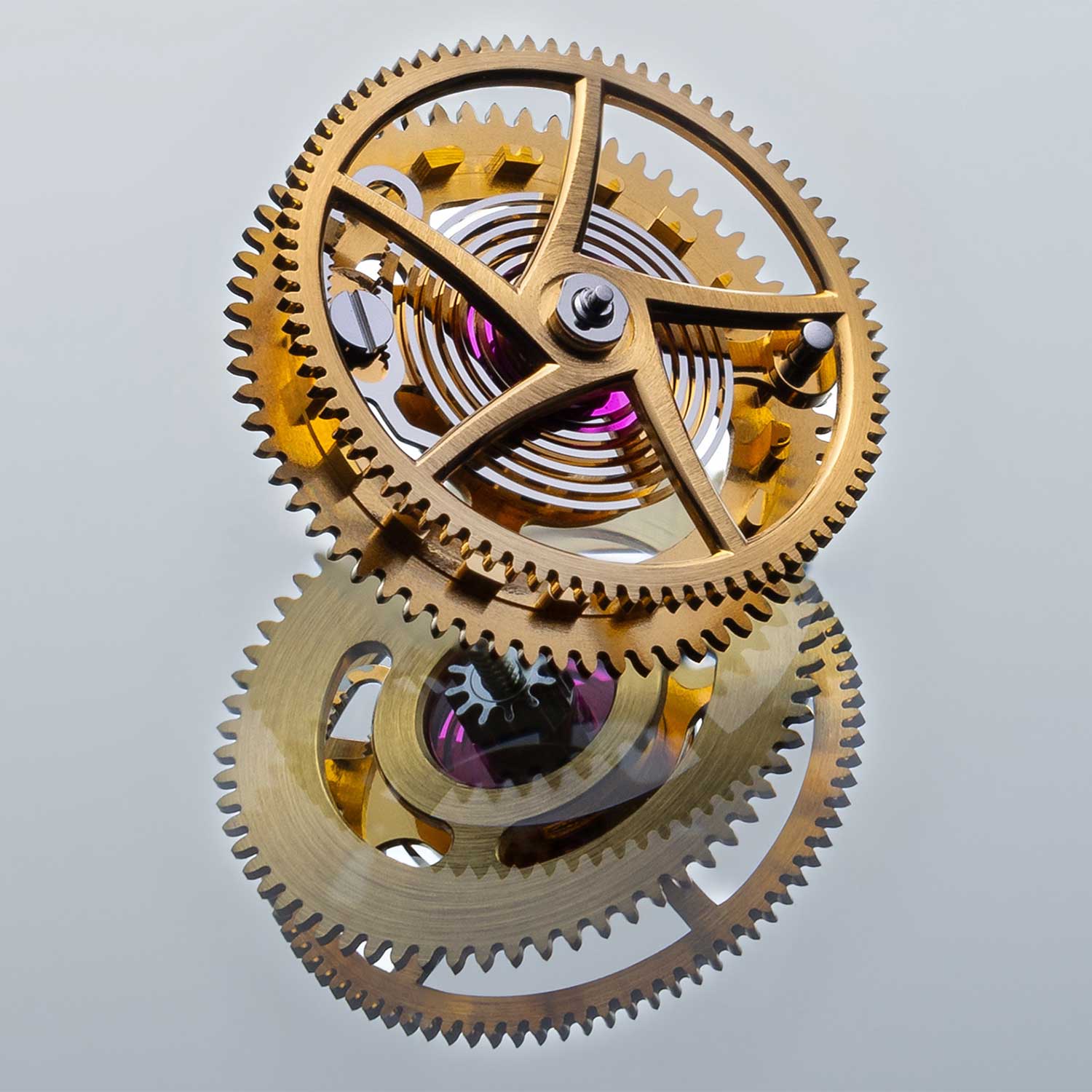
The release mechanism is located directly on the same axis as the remontoir spring, allowing the remontoir to be triggered precisely at the point where energy is introduced.
So if you compare the two, in the earlier system, the release is controlled by an axle with a triangle with only about one-seventh of the available energy. In the new system – in the 39mm CIC – we take that information from the point where we have 100% of the energy. The friction required to release the system is essentially the same in both cases, but in one instance it acts against a reduced force, and in the other against the full available force. As a result, the influence of friction is far smaller in the new system. The earlier version already worked well but this one works perfectly.
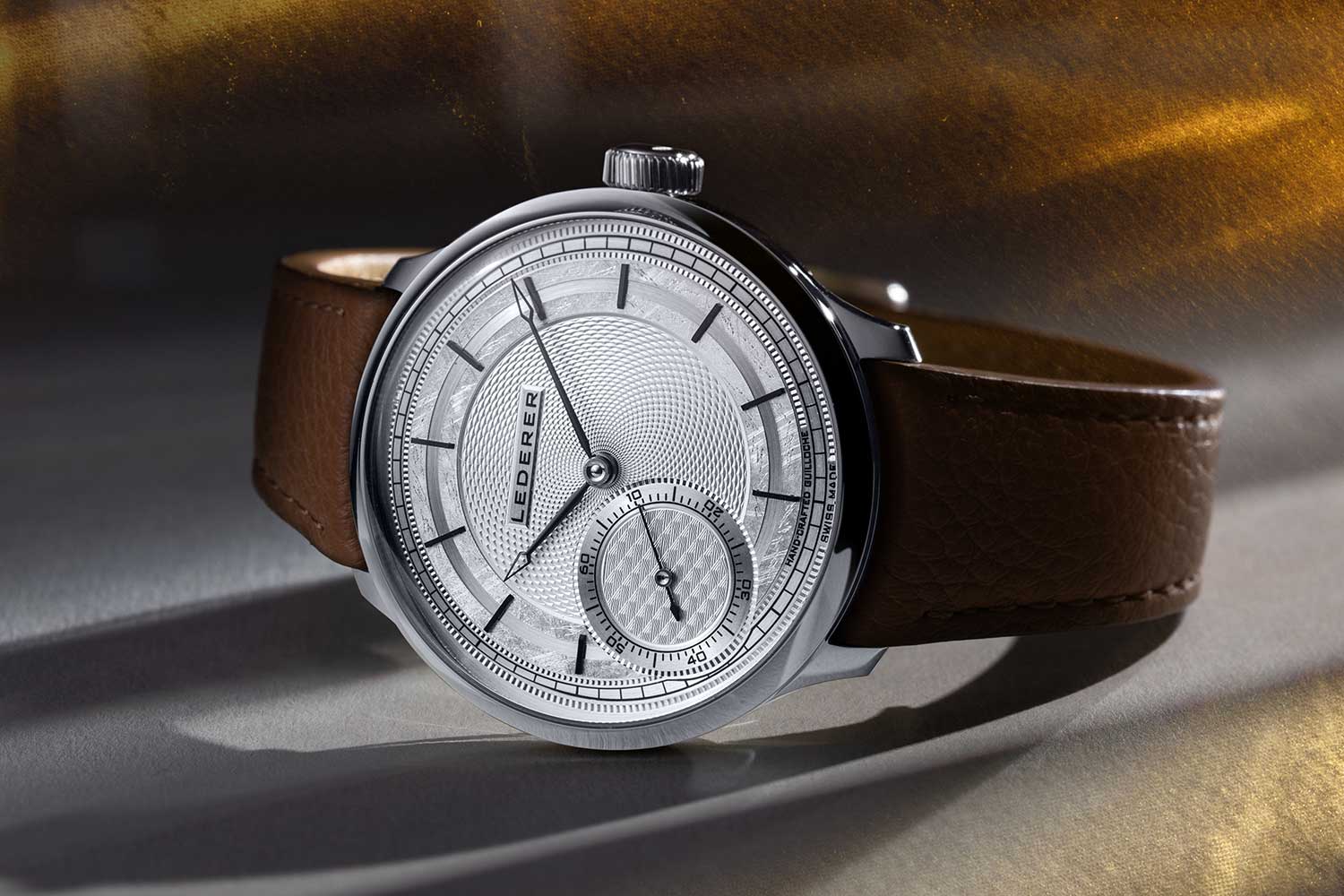
Central Impulse Chronometer 39mm “Revolution 20th Anniversary” (©Revolution)
And this is what I love about my profession. You find something in the literature that everyone praises – wonderful, fantastic – but no one writes, “It’s a good idea, but be careful, it doesn’t actually work.” You never see that. Take Breguet’s natural escapement for instance. Everyone describes it as a brilliant concept, but no one mentions how much he struggled with it. And you can see it clearly. He made several watches with that escapement, and each one is different from the last. That’s because he realised it wasn’t working, but he didn’t fully understand why. So he kept changing things – this component, then another – and still it didn’t solve the problem.
I don’t want to go through that kind of process. And if you think about it, he must have suffered enormously. Breguet often sold his watches before they were made so he had already promised them, and then he had to deliver.
It got more complicated when he put it in tourbillons. It had a larger escape wheel paired with a smaller one, and there were different levels of teeth.
Yes, he always had four wheels but he made the second escape wheel smaller. So he had an idea that it must be related to the mass to accelerate, but he had no idea how to really overcome it. But it was his decision to pre-sell the watches. He was a very good marketer.
He had a wide range of interests, both macro and micro. From the Sympathique and half quarter repeaters…
Yes, to the tourbillon and the overcoil on the hairsprings… He had a wide range of interests. And this is funny, because you see this variety, and on the other side you see this non understanding of basic physic rules. Of course, they had not been that well known in his time, but the tourbillon, sorry for that expression, but it’s a stupid idea.
You once created an exo tourbillon, a cageless tourbillon.
Yeah, I made a half-flying tourbillon. It’s a tourbillon without a cage, because the cage is the big handicap. It’s like trying to pull a very heavy trailer with a small car. It all comes down to accelerating mass. In a tourbillon, at every tick the cage has to move and then be stopped, and for the next tack it has to move and be stopped again. So tick-tack, tick-tack, always move, stop, move, stop. And all of that has to be handled by the pallet. You have to stop the entire mass with this very small pallet, which is a severe load.
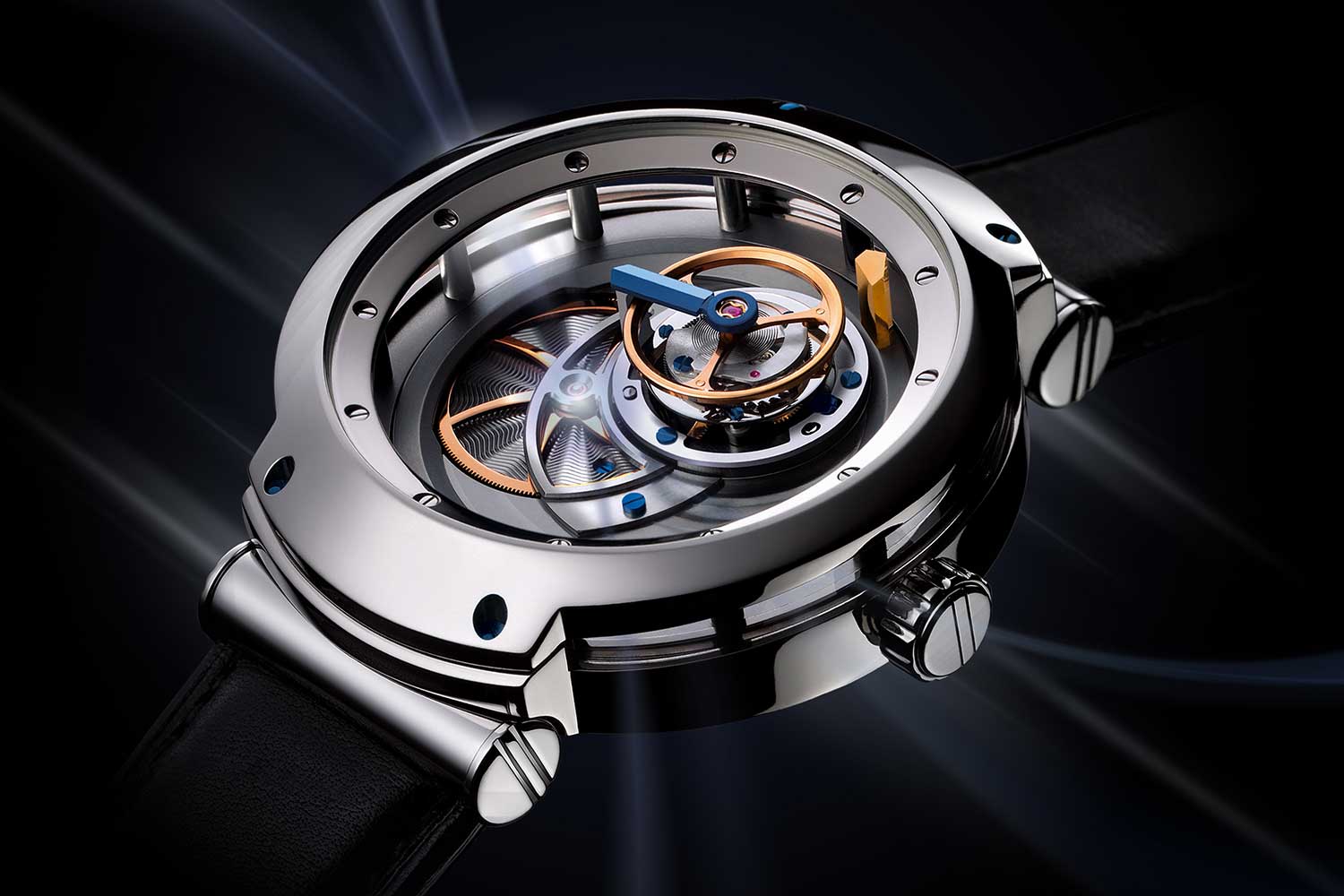
Blu Majestic Tourbillon 3 launched in 2006
That’s the idea behind the half-flying tourbillon. The problem is that you don’t see it as a tourbillon because there is no cage. People associate the tourbillon with the cage, so without it, they don’t recognise it as one. But in fact, it is the most logical form of a tourbillon, because without the cage, you eliminate that major mass-related handicap.
Then you look at carrousels. Bonniksen invented the carrousel to work around Breguet’s patent. It follows the same principle – rotating the balance – but over a longer period. If you study the observatory records, you see it clearly: carrousel, carrousel, carrousel – and then a tourbillon. The carrousels consistently performed better.
Why do you think a carrousel performs better?
It is better because the steps forward are smaller. In a tourbillon, you have the whole cage accelerating through a relatively large angle and then coming to a stop. And you know that energy depends on mass and speed. So when you have a longer distance to cover, you need a higher speed, which means more energy that then has to be brought back down to zero.
If instead you divide this into many smaller, incremental steps, each step carries less energy to stop and re-accelerate. That is why the carrousel performs better. It typically rotates over around five minutes rather than one, so the increments are smaller and the overall influence on the pallet is reduced.
It is rare for a watchmaker to truly invent. People talk about George Daniels a lot but watchmakers in the mould of Daniels are extremely rare. I find that engineers are usually the ones inventing.
We have two engineers in our company because I’m only a watchmaker, so I don’t know, and I do not want to learn about the norm and the standard of how to make a technical drawing according to the industrial standards, where the tolerances are correctly written. That’s not interesting. Therefore, we have engineers; they learned it. They know perfectly how to do that. And so they give me the freedom to sing about it so to speak. We are developing a very special escapement and a very special watch. I explained to the engineer how the escapement works. We have known each other for many, many years. He was listening, and I said, “Kevin, you’re are not very convinced.” He said, “yes and no.” I said, “What? What does that mean?” and he said, “I learned that I can believe you when you are convinced it will work, but it sounds so strange to me.” And yes, it is. It is really something a little bit strange, because it works in the opposite way to all normal escapements.
What do you mean?
All escapements in a watch work in the same direction as the balance is swinging, right? So the balance is swinging that way, but you hit in the direction it is swinging. And that’s one of the difficulties, because the balance is going at speed, and your escape wheel, what was static, has to accelerate to give an impulse. But the escapement that we are working on is working in the other direction. When the balance comes that way, we go against that direction.
I don’t understand. I don’t understand how it won’t stop the watch.
[Laughs] Don’t worry about it. We cannot understand how this can work and not stop the watch, and you will see our engineers say, “no, no, no, no.” I said, “Yes, let me explain till the very end.” And even then, they said, “Okay, we will make the prototype. Then we will see if you are right or not.” We have to test for a long time to be sure that it works perfectly. So it will be a very strange escapement, because it works the opposite.
There are so many ideas that were invented many, many years ago, and they disappeared because they didn’t have the right materials or machining, or they were a little too expensive to produce. There is nothing as easy to make and assemble as the Swiss lever; we say it costs nothing. Of course, it costs a little, but it is so simple to mass-produce the components needed for it that you can almost say it costs nothing, and you don’t even have to be a watchmaker. Someone can come in from the streets, receive 10 minutes of training, and assemble a Swiss lever escapement.
So from the perspective of industrialisation, it is excellent, and that is why it displaced all those fantastic, beautiful escapements – they had no chance to survive. And that is such a pity. It is a pleasure to bring them back and put them in the spotlight.
This interview has been edited and condensed for clarity.
You may also like
Interviews
L’Epée 1839’s Objects Of Desire
Mar 17, 2026
Interviews
L’Epée 1839’s Objects Of Desire
Mar 17, 2026
Interviews
Daniel Arsham Debuts His First Wristwatch Design For Hublot In The MP-17 Meca-10 Arsham Splash Titanium Sapphire
Oct 9, 2025
Interviews
Daniel Arsham Debuts His First Wristwatch Design For Hublot In The MP-17 Meca-10 Arsham Splash Titanium Sapphire
Oct 9, 2025

Interviews
Gagà Laboratorio: A Swiss Watch Brand with Italian Soul
Sep 16, 2025
Interviews
Gagà Laboratorio: A Swiss Watch Brand with Italian Soul
Sep 16, 2025