
Holiday Horology: Something Old, Something New, Something Special — Cheryl Chia, Technical Editor
Editorial
Holiday Horology: Something Old, Something New, Something Special — Cheryl Chia, Technical Editor

Something New: Audemars Piguet Royal Oak Perpetual Calendar
As Christmas draws near, there’s one watch that has eclipsed everything else on my wish list — the new 38mm Royal Oak Perpetual Calendar in steel (Ref. 26684ST.OO.1356ST.01), fitted with the Caliber 7136. It is derived from the landmark Caliber 7138, in which all calendar indications could be fully and independently adjusted via the crown.

Audemars Piguet Royal Oak Perpetual Calendar
Perpetual calendars have always been magnificent in theory but exasperating in practice, with adjustments typically requiring a stylus to prod at multiple recessed pushers scattered around the caseband. There have been several perpetual calendar mechanisms over the years that can be entirely adjusted by the crown and can be set forwards and backwards. Yet these systems came with their own frustrations. If the watch had stopped for any length of time, bringing it up to date could mean an inordinate amount of crown manipulation, cycling endlessly through dates just to reach the correct month, since there were no correctors which would allow you to set the indications individually. Moreover, the innovations that made those possible often disrupted the familiar, classical layout that defines the complication.
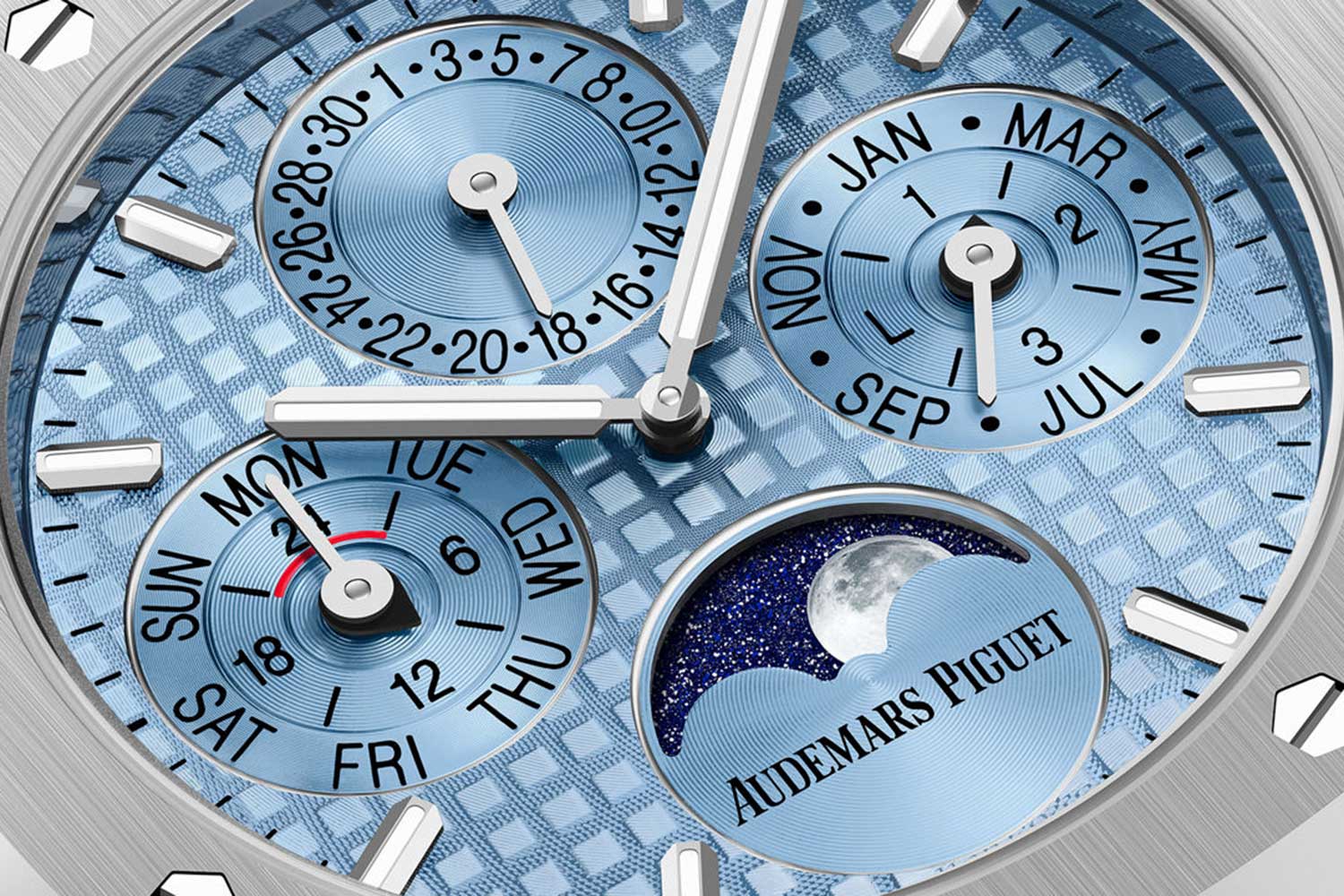
The ice-blue Grand Tapisserie dial
In the Royal Oak Perpetual Calendar, all four indications — date, month, day and moonphase — are adjusted with the crown in second position, depending on how that position is reached. The solutions that made this possible are staggering and, moreover, it carries forward the dual function program wheel and asymmetrical date wheel in the RD#2. Here the date wheel has teeth of different widths. It has narrower teeth for single-digit numerals and wider teeth for double-digit numerals so visually the numbers are evenly spaced. I can’t remember the last time I saw a perpetual calendar movement with so many unbelievably unconventional and imaginative technical solutions, and with an ice-blue Grand Tapisserie dial and 38mm case, it couldn’t be more perfect.
Something Special: Aigaki Direct Impulse Tourbillon
The Aigaki Direct Impulse Tourbillon is the debut watch of Neuchâtel-based Japanese watchmaker Takahiko Aigaki, and a watch I haven’t stopped thinking about since I saw it last year. It is the first wristwatch to combine a tourbillon with a natural escapement, and on top of that, nearly every part of the watch was made using hand-operated tools.
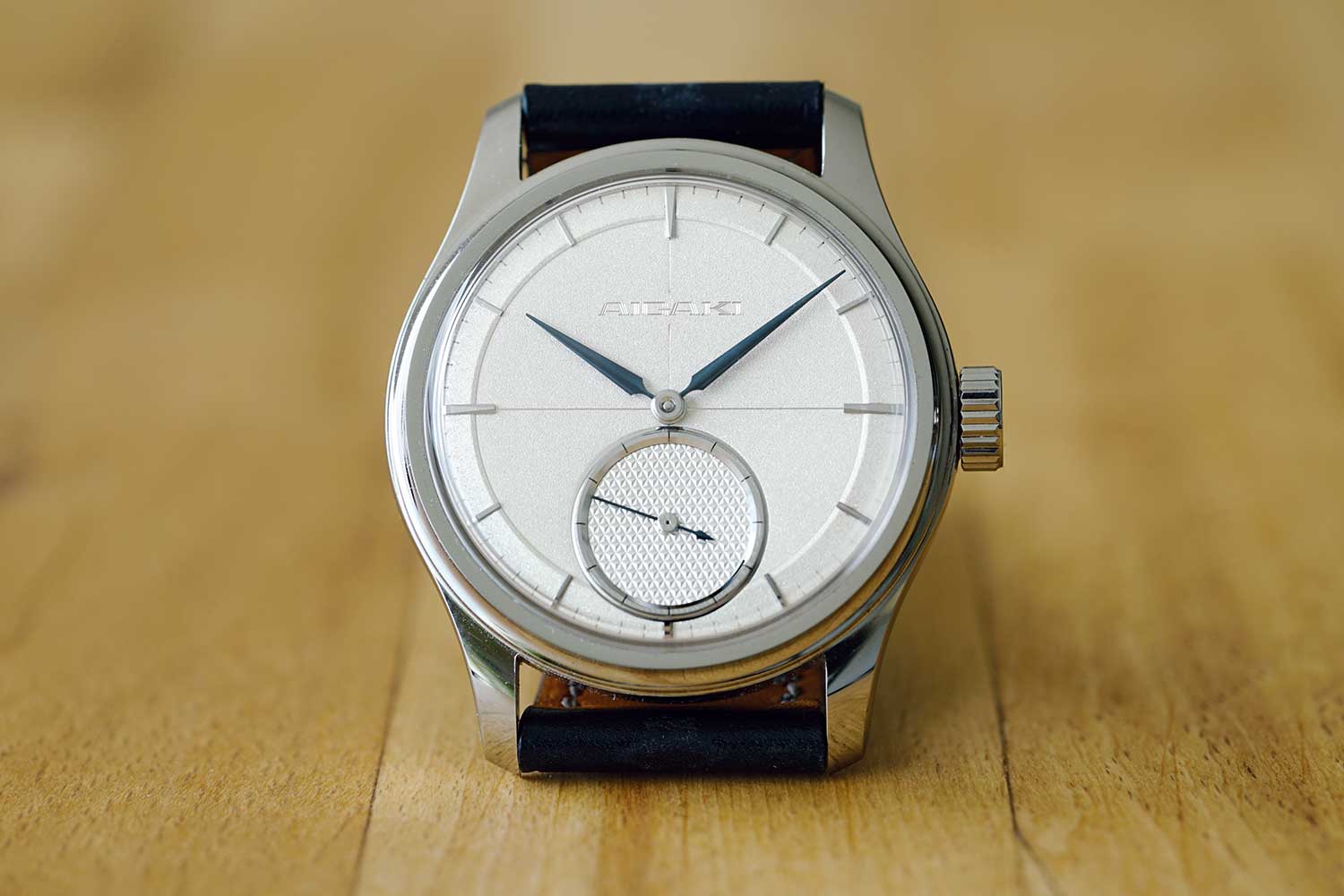
Aigaki Direct Impulse Tourbillon (©Revolution)
A natural escapement can’t be readily implemented in a tourbillon because if both escape wheels are driven against a fixed fourth wheel, they will rotate in the same direction, which simply goes against the principles of a natural escapement. Aigaki’s solution was to drive the first escape wheel against a fixed fourth wheel, while the second escape wheel is driven against a fixed wheel with internal teeth. The escapement itself is proprietary, called the Direct Impulse Escapement, in which the escape wheels are mounted on either side of the cage and are locked and unlocked by a small lever designed for a small lift angle.
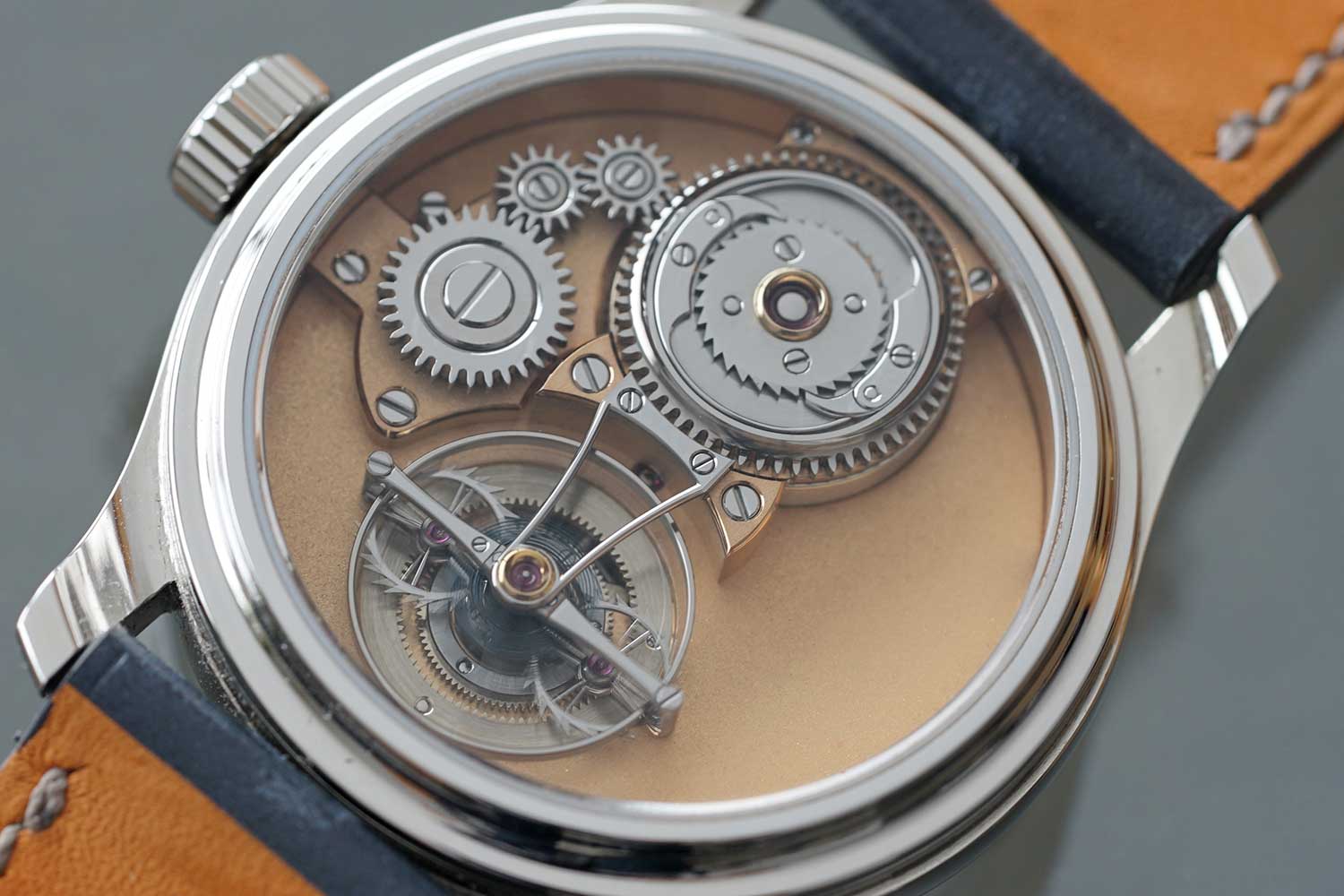
The escape wheels are mounted on either side of the cage and are locked and unlocked by a small lever designed for a small lift angle
More than that, the entire movement is exceedingly beautiful. It has a “mysterious” construction in which the going train is hidden beneath the dial, creating the illusion that the barrel and tourbillon are mysteriously disconnected. Both the baseplate and bridges are made of German silver that has been gold plated and given a frosted finish. The finishing on the steelwork is exceptional. But even before you turn the watch over, the dial itself draws you in. It is so unassuming, but everything is made in a traditional and painstaking way. It is Breguet-frosted by hand, with its markings engraved, its subdial guilloched on a straight-line engine, and its steel markers black-polished to perfection. It is hard to believe so much craft and technical originality could exist within the same watch, made by a single watchmaker, and all in a 37mm case perfectly suited to my wrist. For me, Takahiko Aigaki stands out as the most promising independent watchmaker to have emerged in recent years.
Something Old: Patek Philippe Ref. 5959
This is the grail of all time for me. The Patek Philippe Ref. 5959, in any metal, represents, in its purest form, everything I believe a chronograph, a complication, a watch or even an accessory should be — beautiful, exquisitely proportioned and mechanically transcendent. At 33mm, it may be modest in diameter, but it is monumental in what it contains. Inside is the Caliber CHR 27-525 PS, Patek’s first in-house chronograph movement, and at its debut in 2005, the thinnest split seconds chronograph ever made, measuring just 5.25mm in height. It was inspired by a 1923 Patek Philippe split seconds wristwatch, which used a 12-ligne Victorin Piguet ébauche.

Patek Philippe Ref. 5959
The movement is elaborately constructed and impossibly refined. Every bridge, lever and spring, however slight, is finished to a standard that defies practicality. The architecture is dense yet perfectly legible to the trained eye, with the chronograph mechanism designed with breathtaking grace, from the slim steel pincers and their elegantly shaped curved springs to the beautiful sinuous clutch lever that pivots concentrically with the axis of the drive wheel. It is simply a watch that wears almost like jewelry but carries the weight of watchmaking history. It remains a benchmark in classical chronograph design, where every part exists in perfect harmony between function and form — and for me, it is the most complete expression of what a watch should be.
You may also like

Editorial
Holiday Horology: Something old, Something new, Something special — Sheng Lee, Digital Writer
Dec 19, 2025
Editorial
Holiday Horology: Something old, Something new, Something special — Sheng Lee, Digital Writer
Dec 19, 2025

Editorial
Holiday Horology: Something Old, Something New, Something Special — Constant Kwong, Head of Partnerships and Video Content
Dec 19, 2025
Editorial
Holiday Horology: Something Old, Something New, Something Special — Constant Kwong, Head of Partnerships and Video Content
Dec 19, 2025
Editorial
The Revolutionary List: 25 Watchmakers and Construction – Dominique Renaud
Dec 15, 2025
Editorial
The Revolutionary List: 25 Watchmakers and Construction – Dominique Renaud
Dec 15, 2025