
Franck Muller’s Crazy Hours: “I Have Found A Way To Deconstruct And Restructure Time”
Franck Muller’s Crazy Hours: “I Have Found A Way To Deconstruct And Restructure Time”

To simply call the Crazy Hours a watch is to do it a disservice. It is less of a timepiece in the conventional sense and more of a radical reinvention of the wristwatch. What was once a precision device has now become no less than an art form, a vehicle for emotional expression and a statement of personal philosophy so strong that its influence resonates even to this day, seven years after its creation.
In the swimming pool, at the time it was first conceptualized, Franck Muller looked up into the night sky and swore to eschew all that had come before. He vowed to invent a timepiece that would shake the very foundations of horology by reinventing timekeeping — transforming it from a civil code into a pure emotional language. But, to do so, he would have to first delve into the very roots of time as we know it.
Muller explains, “Time was an invention of man to organize society so that social discourse and business could take place. Our lives became compartmentalized and divided so society could function. It is for no small reason that Geneva is the epicenter of time. Two hundred years ago, Geneva was one of the most important commercial cities in the world. The Germans, the Spanish, the French and the whole world came to Geneva to exchange merchandise. As such, civil time as we know it was created in Geneva. The traders passed through Geneva and they arranged for meetings. But the problem was that setting up meetings was similar to trying to establish a meeting in the Middle East. When you arrange a meeting with someone in the Middle East, the concept of time is very loose. When you say, ‘Let’s meet on Tuesday,’ it can mean Tuesday this week or Tuesday next week, or the week after or in a month.
“Similarly, the difficulty in Geneva was reconciling these different concepts of time. So Geneva was the first city in the world where a law was imposed that people must give specific times and dates for meetings. The history of precise time was therefore born in Geneva, where a law was passed that said, ‘If someone makes a commercial meeting for a specific date and time, they are obligated to honor it!’ As you imagine, watches became very important for anyone setting foot in Geneva.”
As a result, the Swiss became obsessed with precision and chased the elusive goal to make watches more and more accurate. This was entirely natural, because embedded in Swiss culture was an underlying pragmatic need for accuracy. Any frequent traveler who has visited Geneva in the last 200 years can attest to this. Says Muller, “This culture still exists today. This is the reason a train in Geneva that states it will leave at 12:01 will leave precisely on time, not one minute before or after. Switzerland has become the nation of precision.”
But Muller’s feeling was that civil time, the 24-hour day, binds man into a certain routine that he cannot escape from. He explains, “We are all formatted from the time we are born to follow a routine, to follow certain rules. At a certain time we wake, at a certain time we eat breakfast, at a certain time we take our bath, at a certain time we work, at a certain time we go home, we eat dinner, we go to bed.”
Ironically, it took a son of a Genevan to revolutionize the concept of time and to slip from its imperial clutches. Says Muller, “After a certain time, this becomes so much a routine that human beings are robbed of their spontaneous nature, of their creativity. You are told you should only make love to your wife in the evening, but according to what rule? Shouldn’t something like this be regulated not by the rules of society but the rules of the heart? We are so programmed in our heads that our lives become a structure that we feel we cannot escape. We become so encoded that we are moving mindlessly from one moment to the next, never reveling in the present to truly enjoy the experience.”
Indeed, the only time in our lives when human beings bestow unto themselves the freedom to enjoy life to its fullest, to exist and revel in its full sensual glory, is during the period that has become known in colloquial parlance as the “holiday”. Interestingly, it is uniquely during this period, rooted in ancient pagan ritual periods of thanksgiving and celebration, that the human heart is given its full measure of freedom. For Muller, the mental attitude evinced during the holiday is something that is at the very core of the Franck Muller Crazy Hours.
The philosophy of the Crazy Hours, according to Franck Muller
He states, “Why call it Crazy Hours? Because the Crazy Hours watch had to be a statement that you can do what you want, whenever you want. It had to be a watch that told people that life is precious and that you must enjoy each fleeting moment. It was a declaration that you should exist in the present and not constantly be thinking about the past or the future. It had to be a rupture from the structure of empirical time, an escape from the mindless regularity that we as human beings have become enslaved to. This idea came to me at that moment in the swimming pool in Mauritius, where I had come with my family to be on vacation, where we thought we could do what we wanted. But instead, we were met only with rules and more rules. The Crazy Hours is an escape from rules.”
And while at first glance, it might be easy to dismiss this philosophy as promiscuously sensualist, the very concept of the Crazy Hours has strong spiritual undertones. Muller states, “I’ve always liked the Buddhist parable of the monk who falls down a cliff. Beneath him, he sees a starving tiger waiting to eat him. Above him, he sees a snake slithering down to bite him, then suddenly, just in front of him, he sees a perfect strawberry. Slowly and with great deliberation, he reaches out and plucks this strawberry and tastes how delicious it is. To me, in modern culture, we are often too much rooted in the past or obsessed by the future. Unfortunately, the traditional format for a watch only encourages this. On the dial, you see all the time in front of you and all the time behind you. And so, you become obsessed with the past and the future, and never appreciate the moment you are in. For me, it was very important that the Crazy Hours be a watch in which the past and the future are not visible. As such, you have no choice but to be in the here and now, and to appreciate the present — this is something people have forgotten how to do!”
The world’s first emotional complication
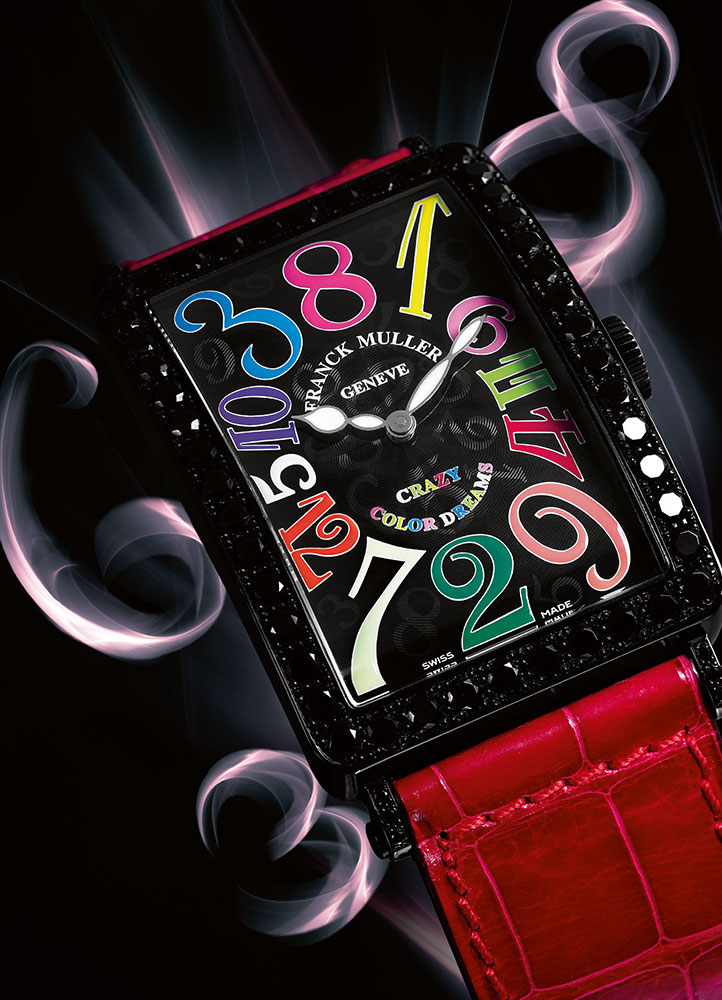
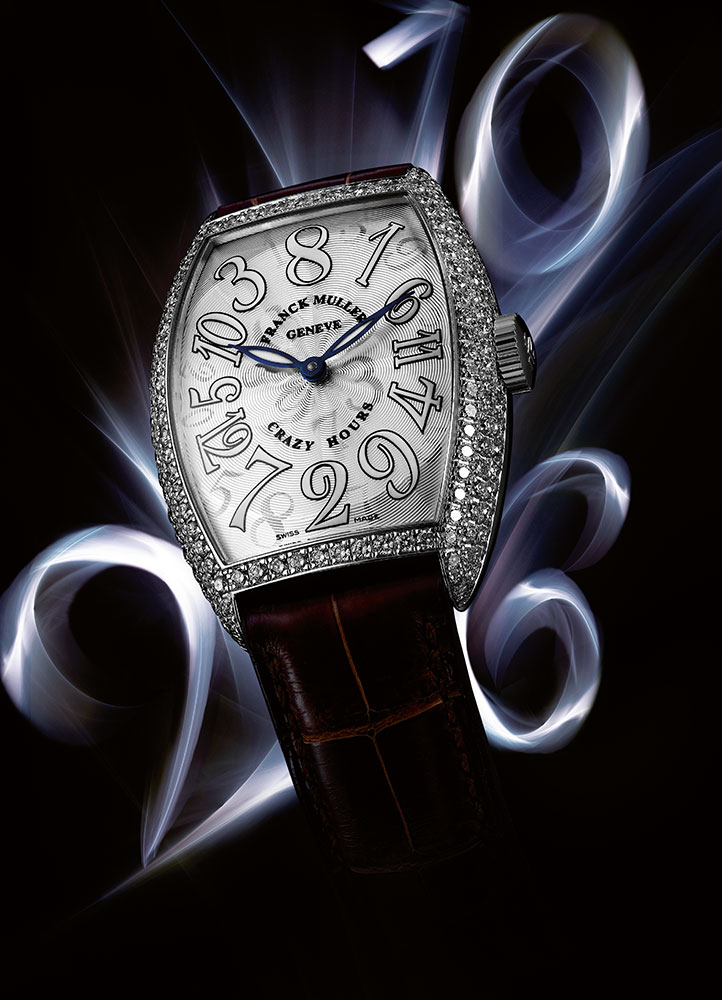
Imagine a watch where the dial adheres to no laws of order of either God or man. The cold, rational intellectualism of the 12- hour dial is dispensed with, and in its place, a whirl of randomly strewed digits each claiming their precious real estate with a free-wheeling assertion of self. At the 12 o’clock position, the number eight — the Chinese symbol for luck — stakes its claim with heady optimism. The Crazy Hours dial, as the name implies, bears no logic, it defies rationality; it could, if expanded onto canvas, be found in the Pop repertoire of Robert Rauschenberg or Jasper Johns, a vivid joyous defiance of the cold, emotionless oppression of civil time.
“With the Crazy Hours, the hour hand on the watch will always jump to the right time … I have found a way to deconstruct and restructure time.” — Franck Muller
Says Muller, “In the Crazy Hours, there appears to be no sense as to what hours come next, and so, you are compelled to focus on the moment you are in. In this way, this watch was the world’s first emotional complication in that it uses a mechanical complication to delight and engage its owners.”
But when asked what use a watch that cannot tell time has, Muller replies, “Ah, but you see, human beings are logical and they will always find their way. Similarly, with the Crazy Hours, the hour hand on the watch will always jump to the right time. With the Crazy Hours, I have found a way to deconstruct and restructure time.”

While traditional timepieces indicate time in a clockwise manner over the course of a day, the Franck Muller Crazy Hours seems to depict time in random manner. The hour hands leap around the dial from '1' to '12' throughout the day, jumping five places instead of one, while the minute hand functions normally, moving clockwise in a regular manner as the hour passes
The Crazy Hours complication finds its roots in a watch Muller created in 1986, the world’s first free-oscillation tourbillon wristwatch. What was unique about this timepiece was that it featured not just a precision device intended to combat the erosive force of gravity, but also a jump- hour indication. There are two types of jump-hour watches: watches that feature an aperture in which the hour is displayed, and watches with traditional hands that, instead of a sweeping, leap from one hour index to the next, jumping precisely at the stroke of each new hour. The Crazy Hours is similarly a jump-hour watch using a traditional hour hand. The distinction is that instead of leaping one index at the stroke of each hour, it leaps forward five places. As such, an examination of the seeming disarray on the Crazy Hours dial sheds light on the fact that the numeric jumble is actually spaced such that each subsequent number is not one but five spaces in progression around the dial.
Upon the release of the Crazy Hours in 2003, the watch-collecting world was universally stunned. The advent of the Crazy Hours, a watch whose sole purpose was the abstraction, deconstruction and reconfiguration of time with the intent to shock and delight otherwise emotionally disengaged owners, has been associated with the first Impressionist paintings that divorced themselves from replications of reality, focusing instead on the sublimation and expression of emotion as their primary objective. The Crazy Hours is the first work of watchmaking Impressionism.
Today, many brands have laid claim to the ground of emotional complications. But each of these brands owes its very existence to Franck Muller and the revelation he experienced beneath the stars of Mauritius, the determination it created in him to fabricate a timepiece that would break our enslavement to time and unearth a purer form of existence, sensuality and appreciation for life.
Read: The Craziest Story Behind The Crazy Hours, As Told By Franck Muller
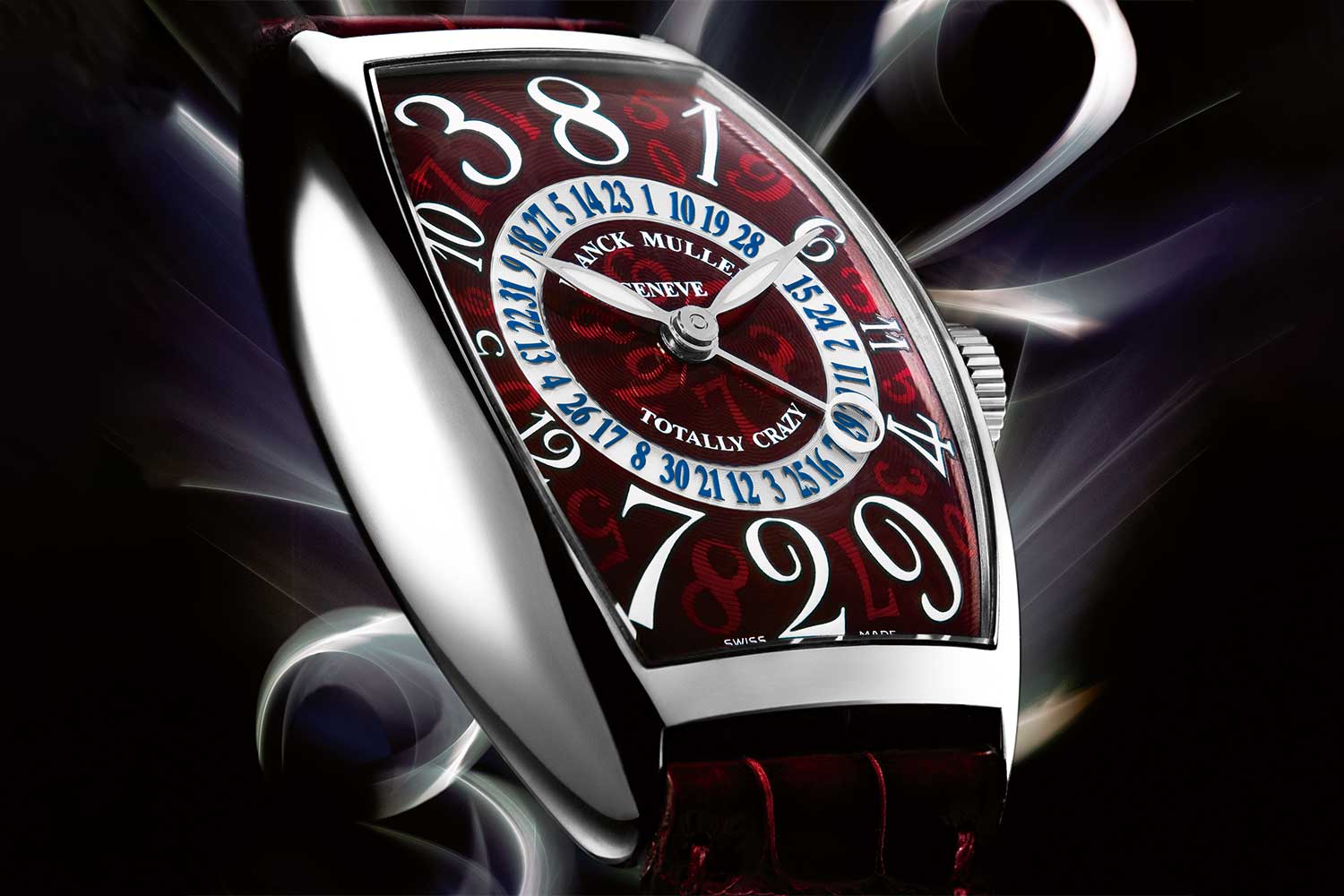
Adding the practical advantage of a date indicator, the Totally Crazy watch adds another startling pinwheel of fiery dial-side animation with a date indicator that echoes the seemingly random order of the legendary Crazy Hours dial. This time, the secret lies in the date hand leaping seven indices to always find the next number in the progression through the month. Nothing offers more entertainment than the sudden and simultaneous jump of the hour and date hand precisely at the stroke of midnight
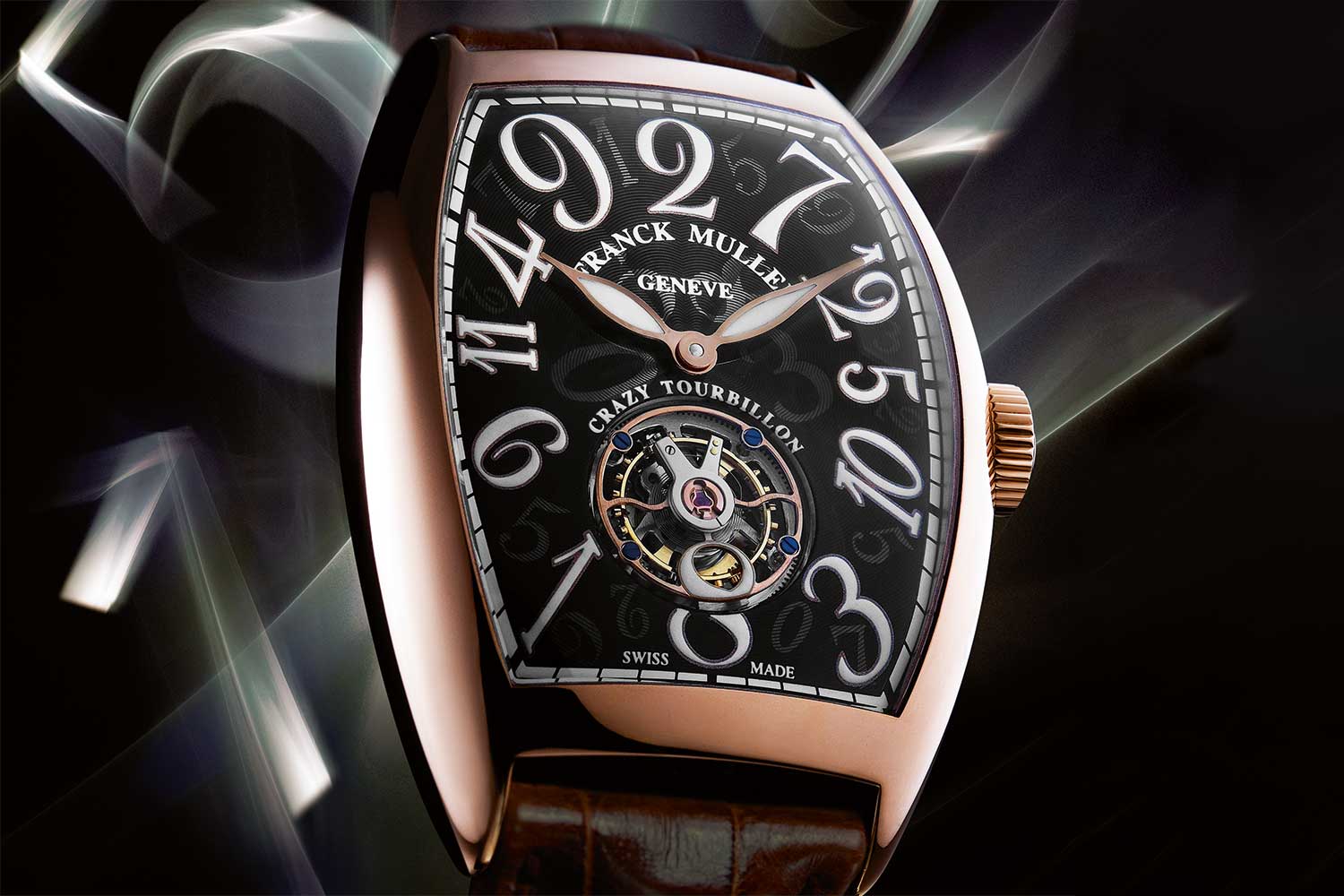
Franck Muller Cintrée Curvex Crazy Hours Tourbillon
Crazy Hours Tourbillon was an idea from a friend
The Crazy Hours Tourbillon combines two of Franck Muller’s iconic achievements, the dial-side tourbillon and the Crazy Hours complication. As with many of his timepieces, the Crazy Hours Tourbillon was inspired by a friend; in this instance, Tay Liam Wee, the former group managing director of Sincere Watch Limited, which currently manages the Franck Muller distribution in Asia.
Says Muller, “Liam Wee is very innovative and it was his idea to create a watch with the ultimate dial-side animation. To combine the Crazy Hours indication with the tourbillon, to me, is to double the visual pleasure of the timepiece. On the one hand, you have the total folly, the seeming wildness of the Crazy Hours indicator, and on the other hand, you have the world’s most famous precision device.” But the two complications work together beautifully, both combining their technicity and bravado to create what to many connoisseurs is THE ultimate Franck Muller timepiece. Adding a beautiful touch of whimsy, the “8” index has been divided into two in a King Solomon-like act of horological prowess, with half of the index placed on the dial and the other half integrated into the flying tourbillon’s cage. This “8” serves both as an index and a seconds indicator, completing a full rotation once every minute.
Regardless of which Crazy Hours complication you choose, every watch from this series is intrinsically linked to Franck Muller’s ultimate act of horological rebellion. To gaze at the dial of any of these timepieces, be it the Crazy Hours, Totally Crazy, or Crazy Hours Tourbillon, is to be reminded of the fact that time itself is the most precious commodity in life.
This story was originally featured in print, from Revolution Asia issue #22.
Franck Muller
You may also like
Editorial
Franck Muller’s Vanguard Makes Its Mark
Mar 16, 2026
Editorial
Franck Muller’s Vanguard Makes Its Mark
Mar 16, 2026

Editorial
The Revolutionary List: 25 Watchmakers and Construction – Franck Muller
Dec 15, 2025
Editorial
The Revolutionary List: 25 Watchmakers and Construction – Franck Muller
Dec 15, 2025
Editorial
The Revolutionary List: 24 Technically Brilliant Watches – Franck Muller Aeternitas Mega
Dec 12, 2025
Editorial
The Revolutionary List: 24 Technically Brilliant Watches – Franck Muller Aeternitas Mega
Dec 12, 2025