Bvlgari at Watches and Wonders 2026: Octo Finissimo Evolves While Serpenti Returns to Pure Jewelry Form
News
Bvlgari at Watches and Wonders 2026: Octo Finissimo Evolves While Serpenti Returns to Pure Jewelry Form

There was a time when the Octo Finissimo needed to arrive with a mic drop. A world record. A new “thinnest ever.” A number so aggressive it forced the rest of the industry to look up from its own obsessions and admit that Bvlgari wasn’t playing at watchmaking — it was redefining what modern ultra thin could look like.
That decade of records has done its job. It created legitimacy, then desirability, and finally something rarer: recognition. The Octo Finissimo is now one of those silhouettes you can spot across a room. Which is why the most interesting thing Bvlgari is doing at Watches and Wonders 2026 is not chasing a new record, but tightening the proportions of the piece and widening who it fits with a new model that CEO Jean-Christophe Babin describes as, “a significant evolution for Bvlgari. It is the watch of maturity. By reinterpreting the Octo Finissimo codes with this new dimension, we have created a timepiece that goes beyond technical prowess to fully embrace the contemporary art of living. It achieves a perfect balance between subtle elegance, absolute comfort on the wrist, and horological innovation. This is a true object of desire, a timeless signature for those who refuse to compromise between style and substance.”
The record chapter is well documented: Tourbillon (2014), Minute Repeater (2016), Automatic (2017), Automatic Tourbillon (2018), Chronograph GMT (2019), Tourbillon Chronograph Skeleton Automatic (2020), Perpetual Calendar (2021), Ultra (2022), Ultra COSC (2024) and Ultra Tourbillon (2025). This year, that drumbeat isn’t required. The Octo Finissimo can stand alone as a paragon of design.
That shift comes through clearly in conversation with Jonathan Brinbaum, Managing Director of Bvlgari’s Watches Division, and Fabrizio Buonamassa Stigliani, Bvlgari’s Product Creation Executive Director. This is the Octo Finissimo stepping into adulthood, a watch designed to be worn rather than measured.
-

- Designer of the Octo Finissimo 37, Bvlgari Watch Division’s Product Creation Executive Director Fabrizio Buonamassa Stigliani
-

- Jonathan Brinbaum, Managing Director of Bvlgari’s Watches Division
Brinbaum is clear that the past decade of Octo Finissimo records was fundamental in securing the watch’s place as an industry staple, but he is equally clear that this new chapter is about something else. For him, the past 10 years have been an industry first, unprecedented in their cumulative effect, but Finissimo was meant to be more than a headline grabber. It was always an architectural piece of art, which is precisely why work on the 37 started three years ago. “It isn’t designed to break a record. That’s what we love about it,” he says. “It’s an outstanding technical leap: we’ve achieved around 20 percent more power reserve in roughly 20 percent less volume.”
The Finissimo Story in Four Chapters
The new Octo Finissimo 37 arrives as a fully re-engineered platform: three automatic references powered by the new BVF 100 micro-rotor caliber, plus a 37mm Minute Repeater. The automatics are 37mm across and 6.45mm high, with sapphire casebacks, crowns set with black ceramic inserts, integrated folding clasps, and 30 meters of water resistance. In sandblasted Grade 5 titanium (Ref. 104089), the dial is opaline titanium with black hands and indexes. In satin-polished yellow gold (Ref. 104120), the dial and hands match the case material, and an 18K yellow gold disk sits on the dial. In satin-polished titanium (Ref. 104351), the opaline titanium dial is paired with rhodium-plated hands and indexes; the satin finishing is entirely done by hand. The polished titanium reference lands in September 2026, following the debut of the sandblasted titanium and gold versions in April.
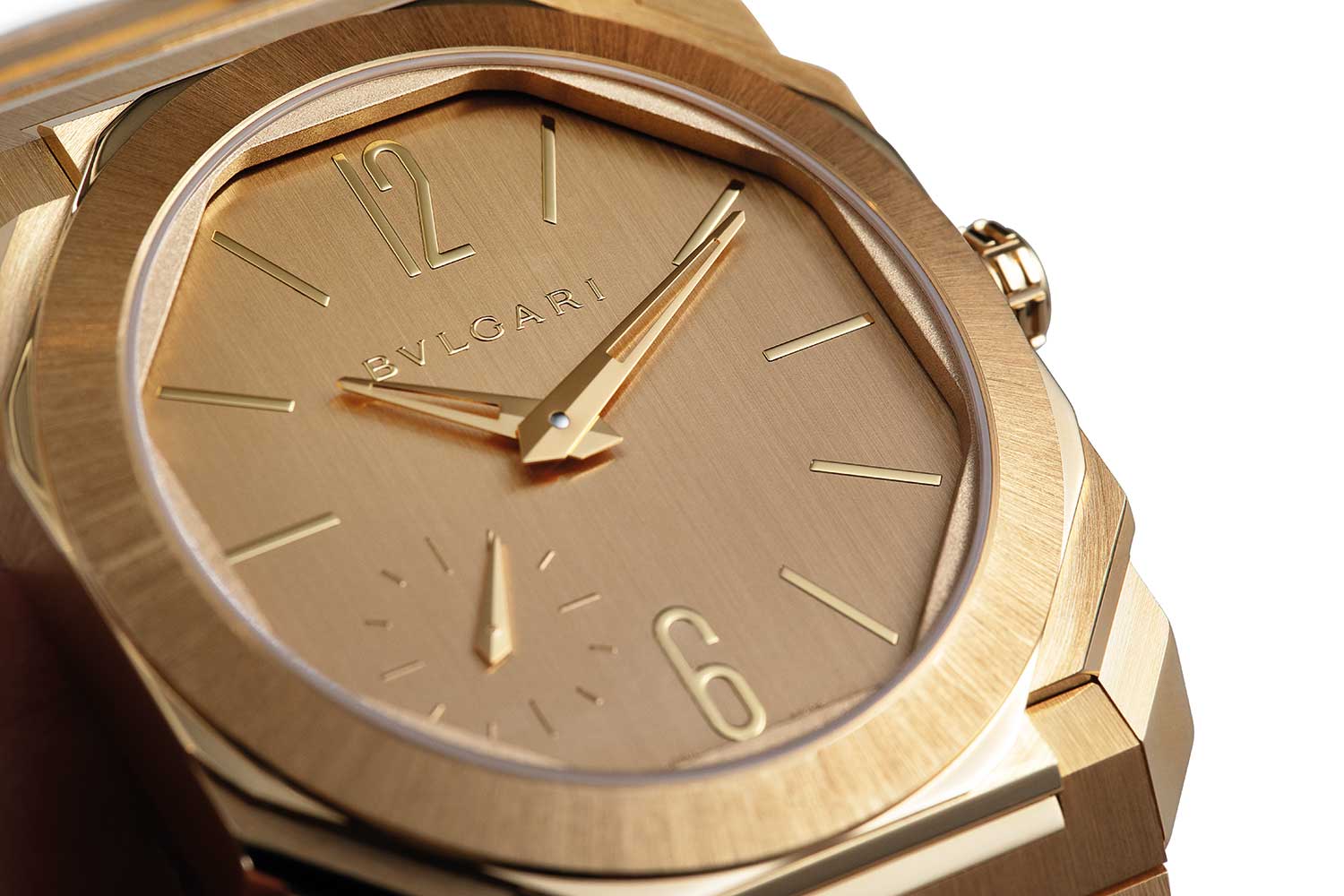
New proportions and finishing techniques bring a different sense of depth to the watches
Then there is the Minute Repeater (Ref. 104250): 37mm in diameter, 6.85mm high, sandblasted titanium, with open-worked indexes and rhodium-gray hands, powered by the 3.12mm-high hand-wound BVL 362 with two hammers and 42 hours of power reserve. On paper, those numbers are impressive. In context, the more interesting fact is that it is not being positioned as a record. The Octo Finissimo does not need that adjective any more.
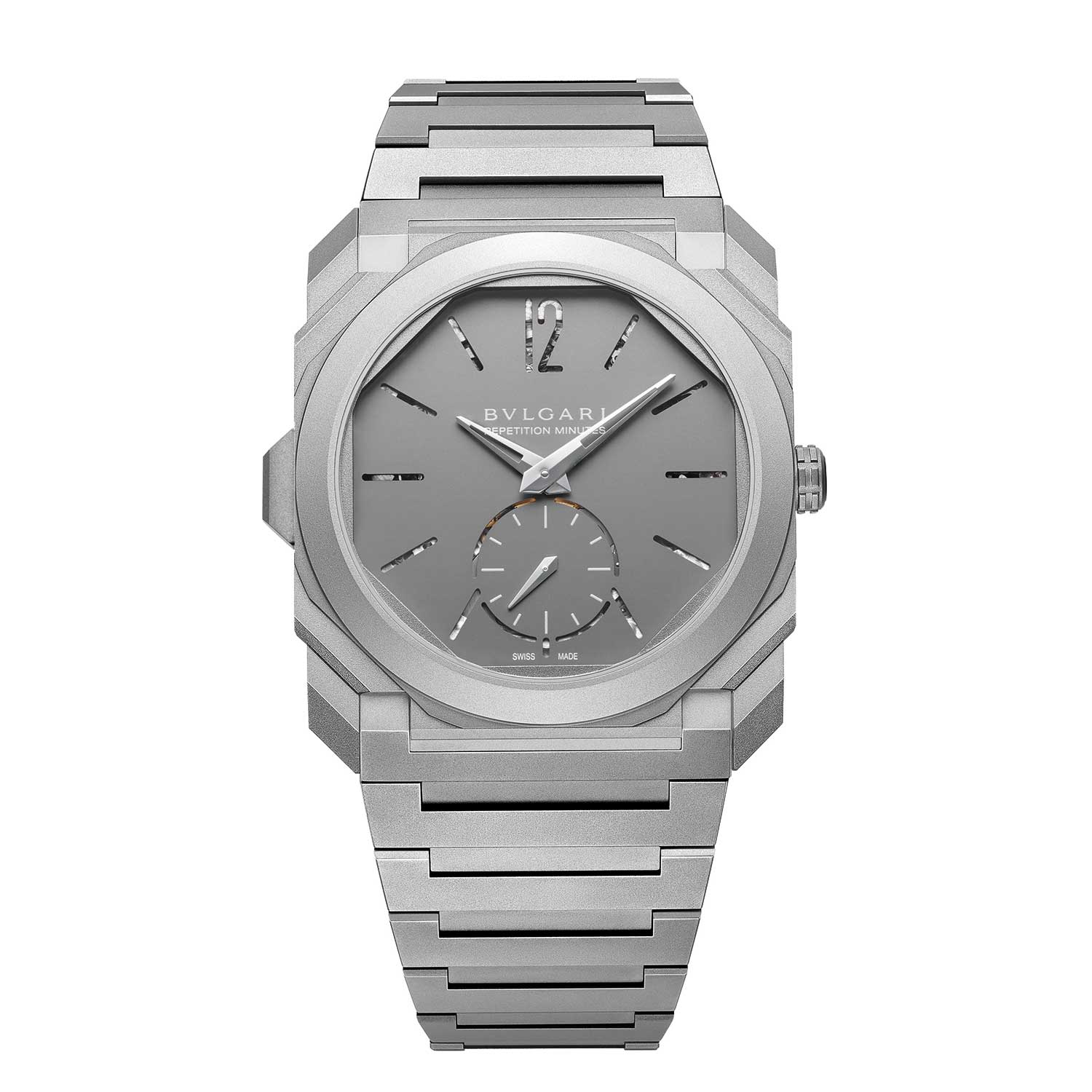
The 37mm Minute Repeater doesn’t claim any records, but it is proof that Bvlgari can deliver a high complication in a modern, wearable case
Taken together, the four launches read like a condensed Finissimo manifesto. The essential titanium automatic provides continuity and keeps the line anchored in the material with which Finissimo began. The polished titanium version introduces something genuinely new in both finish and attitude, broadening the watch’s appeal without diluting its codes. The gold model reasserts the jeweler’s hand, and the minute repeater closes the square by reminding everyone that Bvlgari can still speak fluent high complication whenever it chooses. Brinbaum describes the lineup as four watches with four jobs: the titanium 37 as the reference point, the polished titanium as the audience-expander, the minute repeater as proof that there is no compromise on technicity, and the gold as the most instinctively Bvlgari expression of all.
For Brinbaum, 37mm is not a compromise size; it is the point at which the Octo’s geometry, the new caliber and the way the watch wears finally click into balance. He describes it as the sweet spot where the magic happens, the right balance between thickness and diameter, and he is insistent that this is not simply a smaller 40. It is a different Finissimo, designed for a different clientele, but one that continues the story rather than interrupts it.
That continuity is important. Finissimo was born in titanium, so titanium had to remain the key link back to the 40, even though other materials were explored along the way. Steel was tried, carbon was tried, but for Brinbaum, Finissimo is titanium; that is the foundation. At the same time, Bvlgari wanted a finishing language that felt meaningfully different. The answer was polished titanium, which gives the wearer some of the versatility usually associated with steel, but with a different tactility, a different lightness and a subtly different quality of light.
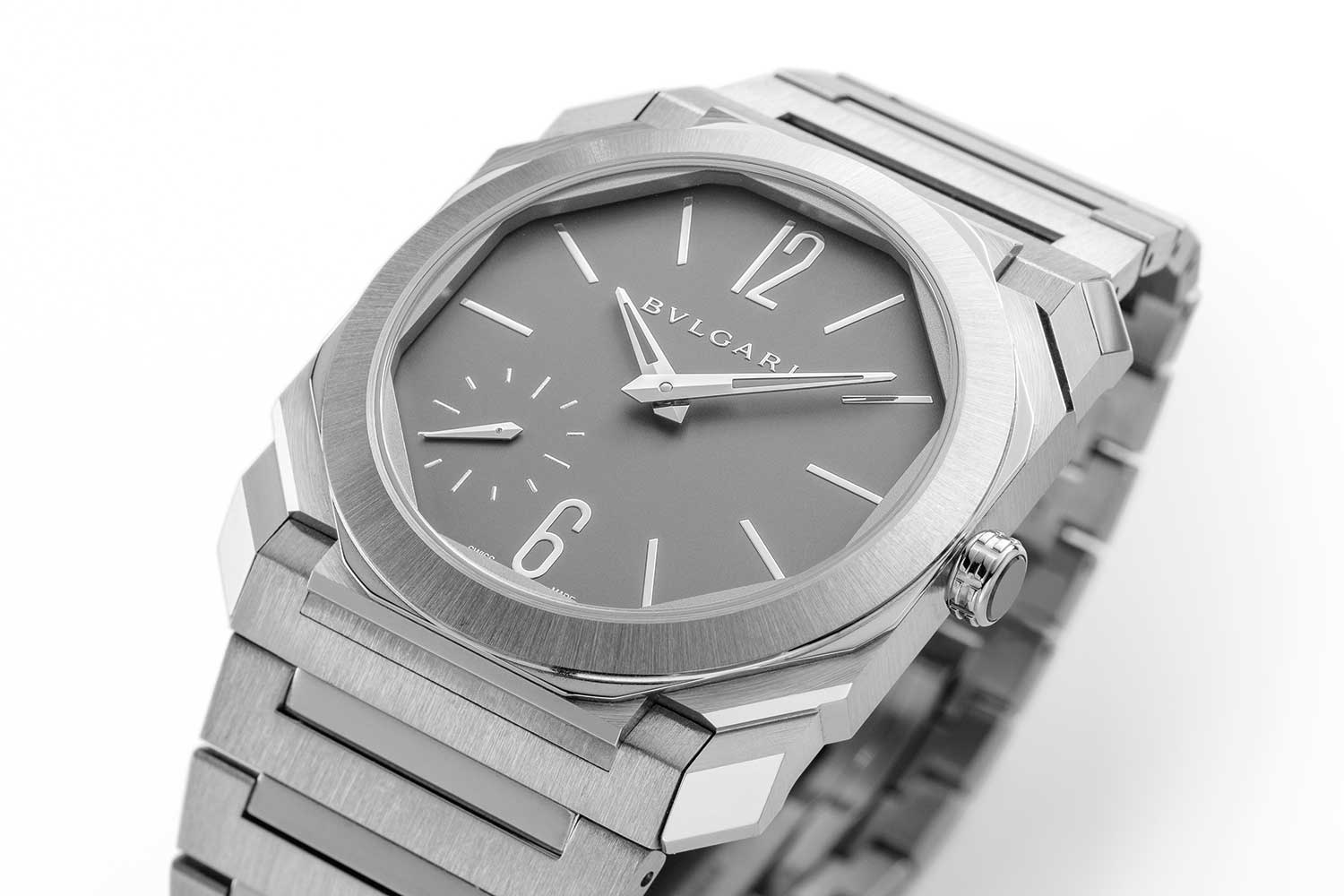
The new finishing techniques on the polished titanium model give the watch the appearance of steel with the light weight of titanium
In Brinbaum’s telling, that polished titanium also loops back to the original spirit of the 40. The first Octo Finissimo was born as a mark of Italian elegance, a thin watch intended to slide under a shirt cuff, a design project in the purest Bvlgari sense. The 37, then, is not replacing anything. It is opening a new chapter and expanding what already exists.
The Sweet Spot
While 37mm proved ideal, it was by no means a done deal from the start. “We made many prototypes over the three years of development and we tested 36, 37, 38 and 39mm,” says Buonamassa Stigliani. “We quickly saw that 36 was too small — it read like a ladies’ watch, and that wasn’t the idea. And the watchmakers told us that if we wanted a 36 case, the movement would have to be very, very small. When we tried 38 and 39, they felt almost the same as 40 on the wrist because the Octo wears like a square. So we arrived at 37: not too small, but clearly smaller than 40, and the movement being developed was perfect for that case.”
That last comment is telling. This is not a case-first exercise that later went hunting for a caliber. The case and the movement had to be created together, because the Octo Finissimo’s geometry does not tolerate guesswork. Buonamassa Stigliani says they were developed in parallel because it would have made no sense to progress the case if 37 was not the right size, or if the movement team could not produce a caliber proportioned correctly for it.
The result is the BVF 100: a manufacture automatic ultra-thin movement, developed at Le Sentier. It is 2.35mm thick, beats at 3Hz, and delivers 72 hours of power reserve — up from the 60 hours in the Octo Finissimo 40 — with hand-applied radiating Côtes de Genève and perlage. The continuity detail is the platinum micro-rotor, a small piece of DNA that keeps the 37 connected to the Finissimo story even as everything around it shifts.
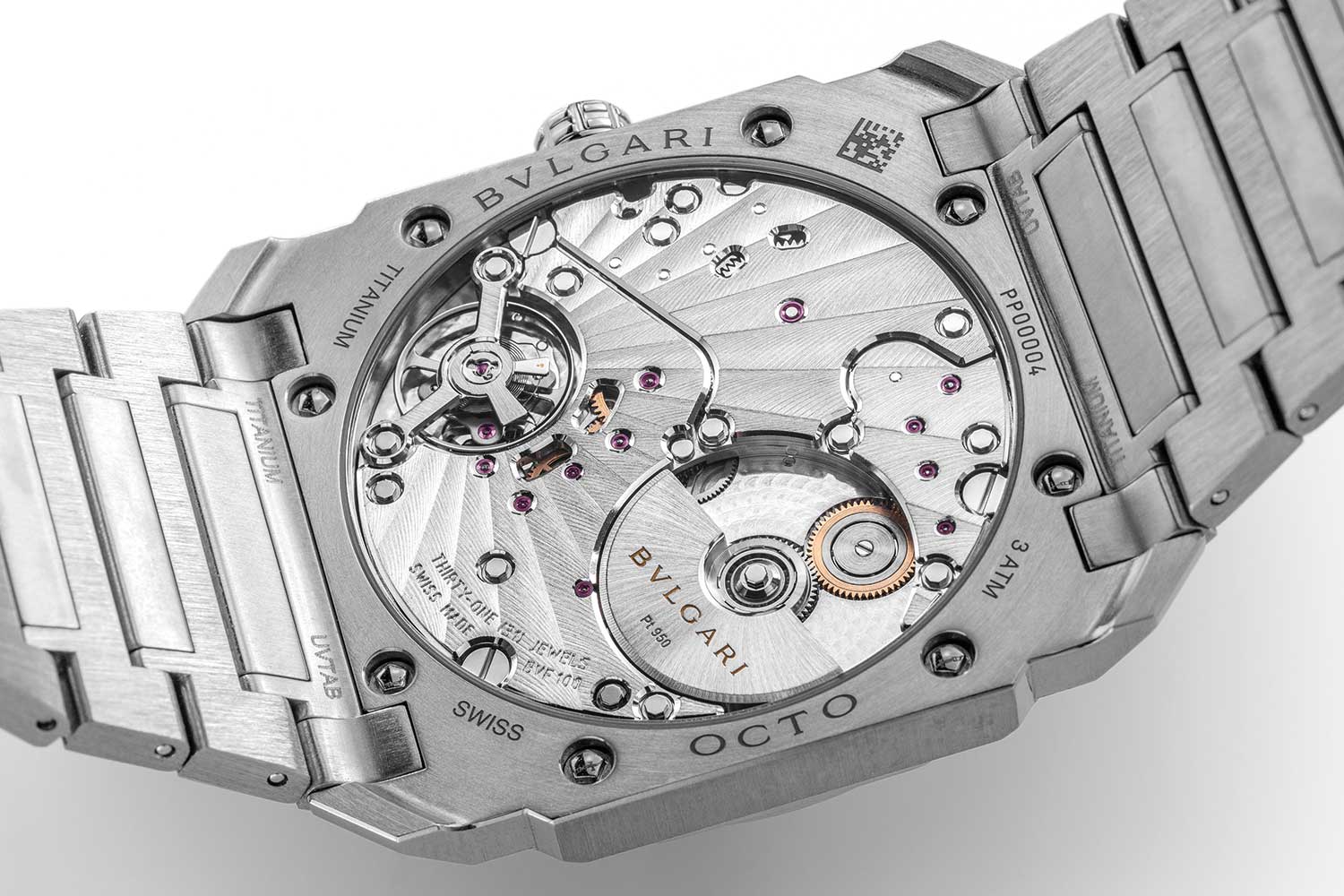
The BVF 100 ultra-thin movement powering the 37 Automatics features a platinum micro-rotor, is 2.35mm thick, beats at 3Hz, and delivers 72 hours of power reserve
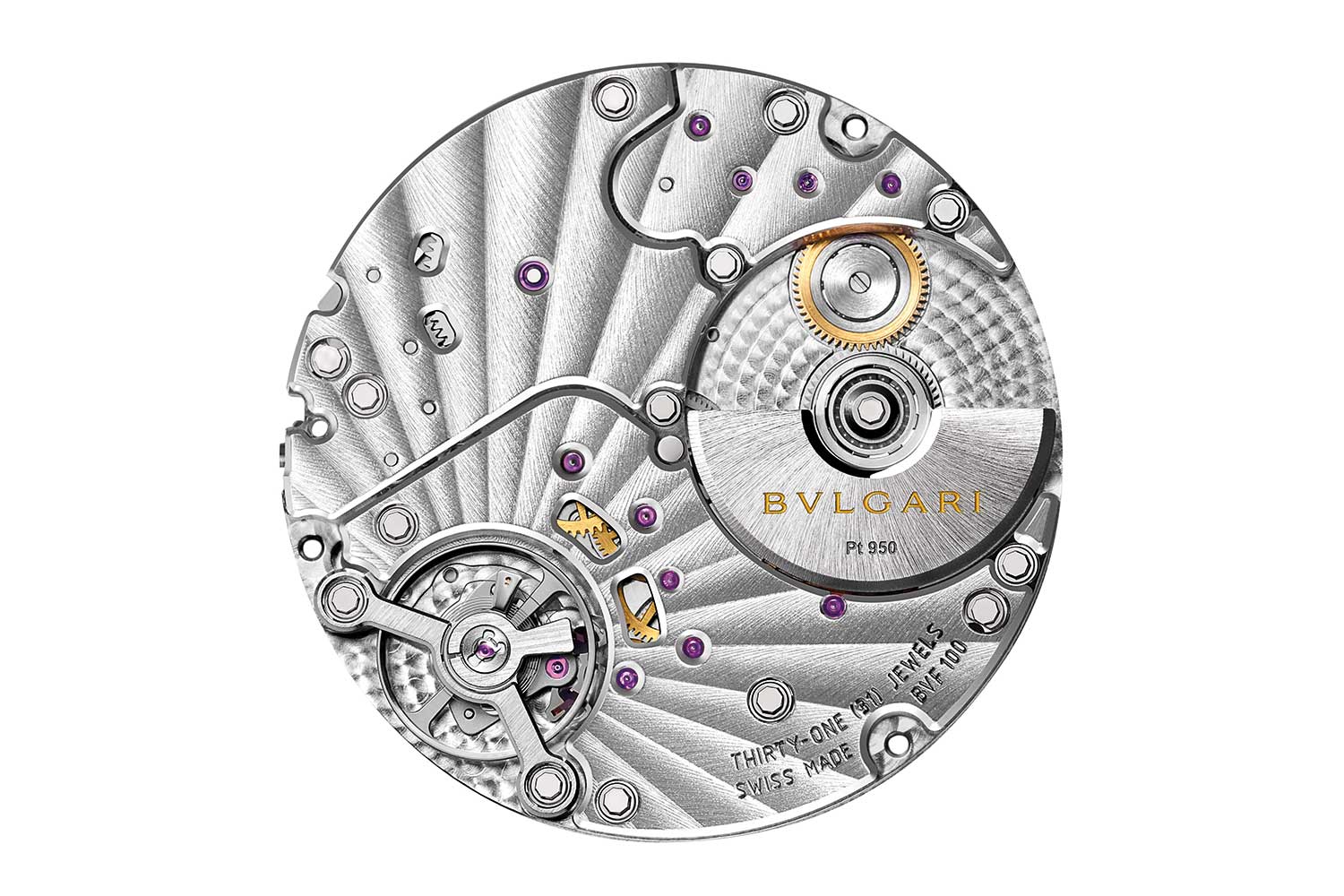
The new BVF 100 caliber is engineered to perfectly fit the watch
From Brinbaum’s side, the brief was simple: keep it Finissimo. In practice, the real technical challenge was not thinness alone but the reduction in diameter. With less diameter, energy becomes an issue very quickly. Bvlgari initially assumed it might be able simply to reduce the proportions of the existing caliber, but that did not work. The movement had to be completely re-engineered. The key design codes that make Finissimo what it is were retained, but the engineering changed dramatically, and one of the payoffs of that effort was a 72-hour power reserve — around 20 percent more than the current BVL 138 in the 40. Even as the watch moves toward a more lifestyle expression, there is, in Brinbaum’s view, no concession on technique and no sacrifice on caliber quality.
Buonamassa Stigliani, meanwhile, identifies another breakthrough: the dial. The first Finissimo dial, he explains, was 0.4mm thick; the new one is 0.8mm. That single difference opens an entire new field of play: stone dials, diamonds, applied indexes, gem-set markers, and a more decorated future than the slightly understated original could realistically support. This, he says, is one of the ideas around the Octo Finissimo 37: to be more visually adaptable than the 40.
That extra height is why the 37 is thicker than the classic automatic, but it is also why it feels like the more expandable platform. It is the difference between designing for an extreme and designing for a family. Buonamassa Stigliani says the first reaction from anyone handling the new watch is that it feels more three-dimensional than the 40. Because it is slightly thicker but smaller, the finishing and the facets read differently. The shape has not changed, the proportion has not changed, and yet, as he puts it, everything changes. “It’s like the Porsche 911 — it’s always the same, but with each new model, 90 percent of the components are new. The idea around the Octo Finissimo is to treat it like an icon.”
The Right Fit
That “90-percent new” approach runs straight through the bracelet, because an Octo Finissimo lives and dies on how it wraps the wrist. The brief was not to find a new ergonomic philosophy; it was to preserve the same drape while improving execution, assembly and future potential. The bracelet is, therefore, entirely new. For the first time, the links are made of different components rather than as monolithic pieces, a move born from one of the team’s desires to experiment. As Buonamassa Stigliani explains it, the old construction made it impossible to marry steel with gold or titanium with gold, or really to play with different materials in a satisfying way. Now Bvlgari can. Just as importantly, the first link is fixed directly to the case. No light can be seen through the gap and, for a watch that depends so much on visual continuity, that is an important step.
Brinbaum makes a similar point about the closure. Bvlgari is always looking for continuous innovation and improvement, and here the goal was to create something strong, resistant and durable in use. The new clasp achieves that, while remaining subtle and refined. This is the kind of detail that does not show up in photographs, but it does change the whole wearing experience. It also explains why the 37 is not merely smaller; it is a new platform built for the next decade of Finissimo, including the mixed-material executions collectors have been asking for since the beginning.
Interestingly, Buonamassa Stigliani says that the 37 prototypes were completed in time for Watches and Wonders 2025, but the manufacture was not then set up for full production. Launching and then asking clients to wait eight or nine months to have the watch in store was not considered acceptable, so the decision was made to postpone until Watches and Wonders 2026, with most references available in boutiques immediately. That is the quiet tell of what this release really is: a consolidation move, not a headline grab. This is not a concept piece, not a collector’s tease, but the Octo Finissimo presented as a watch you can actually buy and wear.

The smaller case size and redesigned bracelet aim to appeal to a wider range of 62 clients with different lifestyles
“Finissimo is our icon and it’s time to open the doors a little wider,” explains Brinbaum. “The record-breaking angle was the right thing to do — it spoke to the watch community and to clients who are deeply into technique, and we needed that legitimacy. Now we want to keep that audience — hence pieces like the minute repeater — but we also want to show that the Octo Finissimo is for clients who want a design and lifestyle watch. It can be for men and it can be for women. Finissimo should be for everybody and it should feel like your watch, made for you.”
Material Goals
For now, the 37 will be only in gold and titanium; there will be no steel option. The reason, according to Buonamassa Stigliani, is that Bvlgari wanted to avoid too much overlap between the 37 and the 40. The titanium double finishing, he says, is particularly compelling because it recalls the steel 40 at first glance, yet a direct comparison reveals a different character altogether: steel feels colder, while the 37 feels warmer because of the qualities of titanium and the way it is finished.
The gold version brought its own challenges. Buonamassa Stigliani explains that the development was difficult because Bvlgari decided not to remove any gold from inside the bracelet, as many brands do to save on weight and cost. The brand’s study showed that almost nothing was gained by doing so, while the internal architecture would have ended up full of holes. Bvlgari, therefore, chose what it considered the perfect execution. The reaction, he says, has been immediate and positive, especially from women who have seen it as the Finissimo they have been waiting for — the watch that finally allows them to wear the collection without aesthetic trade-offs.
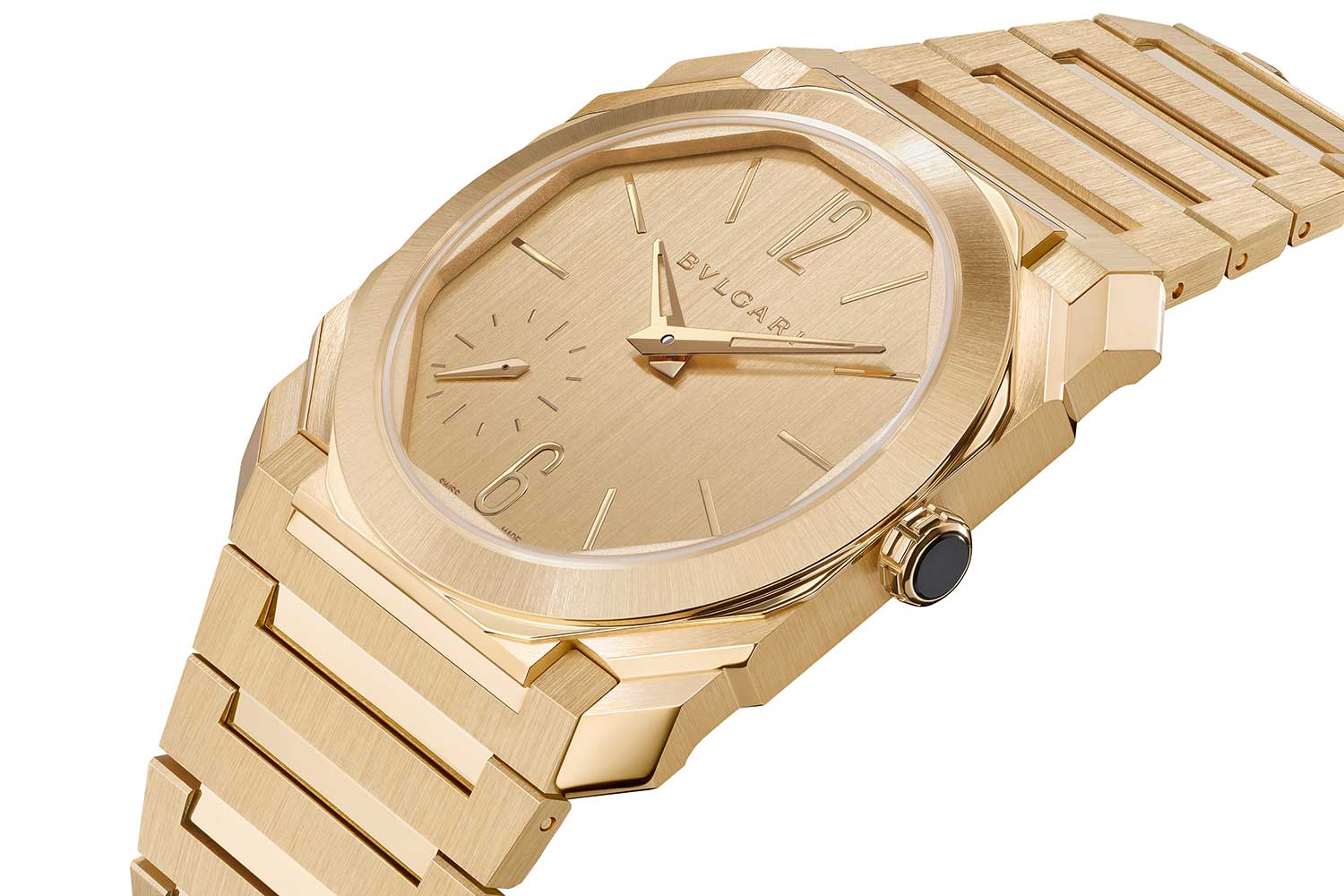
This is Bvlgari at its most Bvlgari: material decisions driven as much by integrity and emotion as by engineering. The titanium keeps the Finissimo’s architectural identity intact; the gold reframes the Octo as a modern jewel without feminizing the design. The separation between 37 and 40 becomes clearer here too: 37 as curated, 40 as the broader palette, including steel and the grand complication territory.
The decision to launch the revered minute repeater alongside the new automatics speaks to exactly that balance. Buonamassa Stigliani describes it as one of the most important movements in Octo Finissimo history, and one that was already designed for small cases, which made it ready for this new chapter. It also allowed Bvlgari to say, from day one, that the 37 was not limited to hours, minutes and seconds. There are more complications waiting in the wings where possible. He also insists that the reduced case size does not harm the acoustics; if anything, the sound may even be better. In a loud room, he says, you can still hear it, which is remarkable considering how small the movement, hammers and gongs are. That is the challenge of a repeater: if the watch looks cool but the sound disappoints, it fails; if the sound is beautiful but the aesthetics are awkward, it fails just as badly.
The 37mm Minute Repeater is not here to claim a trophy. It is here to make a different argument: that the Octo Finissimo can now deliver a classical high complication in modern, wearable, everyday proportions and do it without leaning on “thinnest” as the only reason to care.
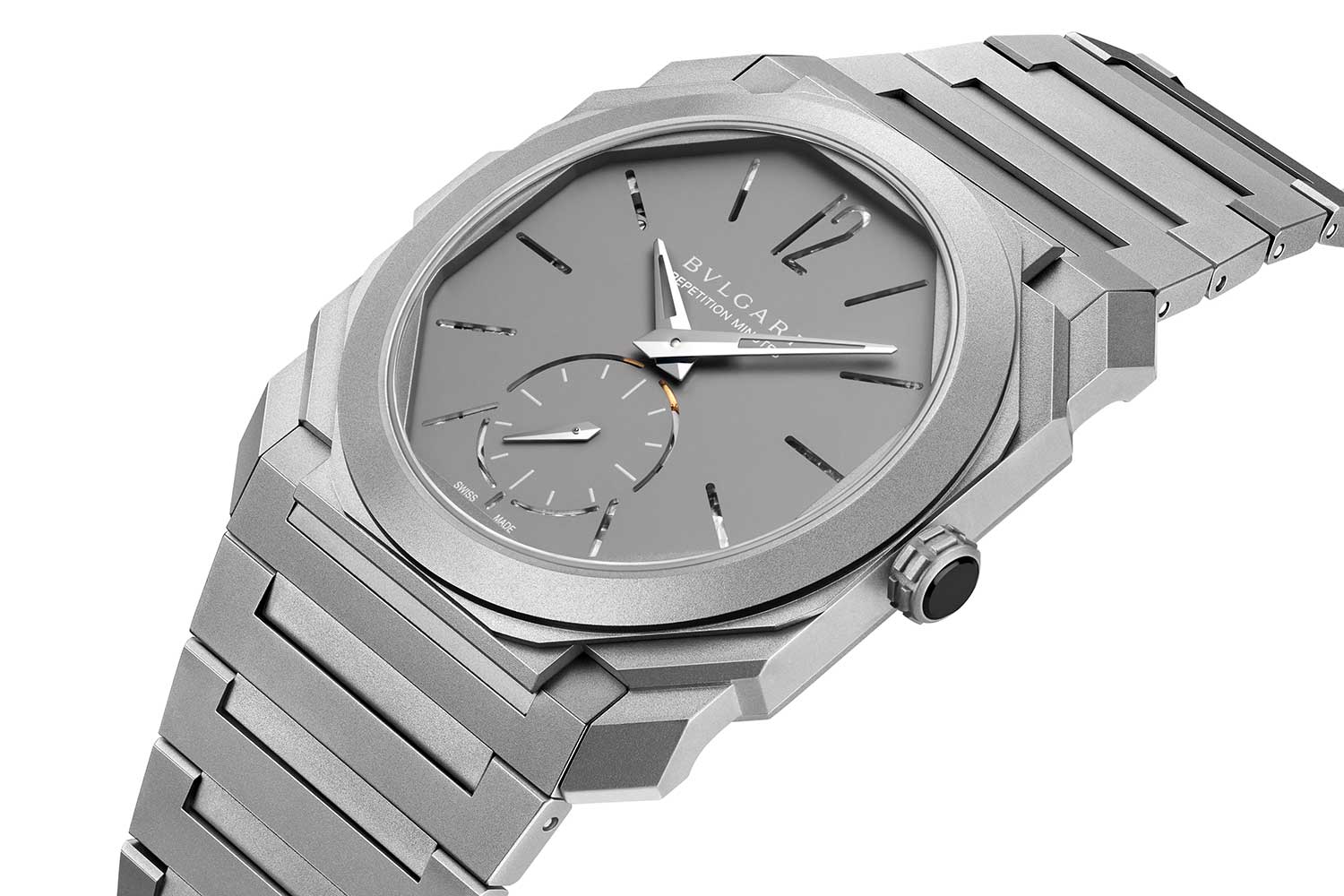
“To break records you need time, and we have already broken so many,” says Buonamassa Stigliani. “Now the idea is to establish the Octo Finissimo as an everyday watch with impressive content, including size and thickness. Maybe in the future we’ll break more records, let’s face it, that’s now part of our DNA, but this year we’re happy to concentrate on the 37. The 40 and the Ultra are the watches for records. We don’t need to break records on the 37 because we don’t want to push the concept to the extreme. The 37 is a more democratic product for the Octo franchise.”
That represents the Finissimo’s shift in one paragraph. The records remain part of the brand’s identity, but they are no longer the default narrative. This year, the product itself is the headline: proportion, comfort, finishing and a movement engineered for the case rather than tolerated by it. Brinbaum reaches for a car analogy to explain the pivot from record-breaking to proportion and wearability, not as a retreat from technique but as the natural next step once the concept has proved itself. Something extreme proves what a brand can do for collectors and connoisseurs; at a certain point, though, it becomes the right moment to open up, to become an everyday choice without compromise. This chapter, in his view, is about opening doors.
Moving On
Always respectful of the history of the brand, Buonamassa Stigliani emphasizes that Gianni Bulgari created the modern aesthetic of the maison inspired by functionalism, rationalism and the pure geometric elements of Roman architecture. “When I began working with the Octo, I played with the round shape and the octagonal shape — like the first coin jewelry collections, where a round coin sits on an octagonal base. The Octo’s rules are the combination of round and square to create the octagon, and the 45-degree corners. But today the Octo has its own aesthetic and its own soul. If you love watches you know the Octo Finissimo, even if you don’t know the story behind it. It can walk alone; it doesn’t need a story. And when we talk about the 37, we don’t talk about Roman heritage — that belongs to the 40, part of the origin.”
That, more than any measurement, is what makes the 37 feel like a coming-of-age moment. The origin story still exists, but it is no longer required. The watch has become its own reference point, and the design is now strong enough to absorb new influences, new materials and new audiences without losing its identity.
So there will be evolution on the 37 and evolution on the 40. The two watches can live in parallel. On the 40, Buonamassa Stigliani sees plenty of room for more grand complications and special editions with architects and artists. On the 37, he would like to see complications arrive precisely because the smaller format brings a different point of view. That will be more challenging because the movement is smaller but, Buonamassa Stigliani guarantees, it will deliver a comparable performance. On the duality, he keeps returning to the same question: is Finissimo a concept, or a movement?
Brinbaum’s answer is cautious but revealing. He will not say yes or no to the idea of a mini Octo Finissimo powered by something like the BVS 100 Lady Solotempo or the Piccolissimo, but he happily echoes Buonamassa Stigliani’s larger point that Finissimo is becoming more than a watch; it is becoming a concept. The 37 proves that Bvlgari is not locked into the 40mm size, so why not open territory to other sizes and other movements? For a brand that sees miniaturization as a true point of difference, that possibility seems natural. Bvlgari has spent 10 years pushing thinness for men and now wants to apply that knowledge to women’s watches as well. Miniaturization and thinness, Brinbaum argues, are core to the maison’s DNA, and future developments will continue in that field.
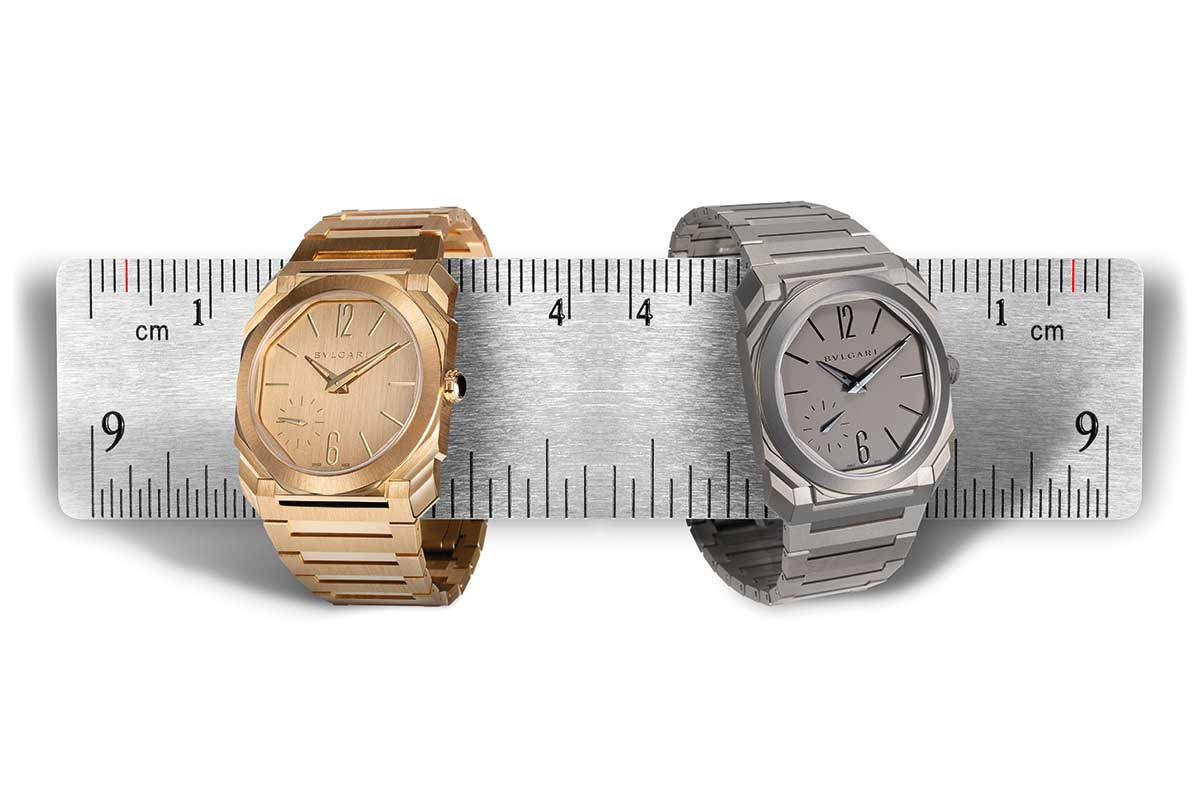
With a case 3mm smaller than its 40mm big brother, the Octo Finissimo 37 (shown above in yellow gold and sandblasted titanium) takes Bvlgari
Like Buonamassa Stigliani, Brinbaum sees the 37 and the 40 as complementary rather than competitive. The 40 remains an outstanding platform for technicity — eight days of power, skeleton versions, and the continued pushing of what thinness can be. The 37 brings versatility: more dials, more decoration, different materials and colors. Those two pillars work together. New sizes, new materials and new dials are all possible, but building the 37 into a true second platform will take a few years. That, he says, is a core priority.
For now, Octo Finissimo 37 is wonderfully clear in its aim. It is not here to beat a record. It is here to be worn. And in a collection that spent a decade proving the limits of what is possible, that may be the most confident move Bvlgari could make.
Tech Specs: Octo Finissimo Automatic 37 Yellow Gold
Movement Self-winding ultra thin Manufacture Caliber BVF 100; 72-hour power reserve
Functions Hours, minutes and small seconds
Case 37mm × 6.45mm; satin-polished 18K yellow gold with black ceramic crown insert; water resistant to 30m
Dial Yellow gold; yellow-gold-plated hands and hour markers
Strap Satin-polished 18K yellow gold bracelet with integrated folding buckle
Price EUR 50,700
Availability April 2026
Tech Specs: Octo Finissimo Automatic 37 Polished Titanium
Movement Self-winding ultra thin Manufacture Caliber BVF 100; 72-hour power reserve
Functions Hours, minutes and small seconds
Case 37mm × 6.45mm; satin-polished titanium with black ceramic crown insert; water resistant to 30m
Dial Opaline titanium; rhodium-plated hands and hour markers
Strap Satin-polished titanium bracelet with integrated folding buckle
Price EUR 18,500
Availability From September 2026
Tech Specs: Octo Finissimo Automatic 37 Sandblasted Titanium
Movement Self-winding ultra thin Manufacture Caliber BVF 100; 72-hour power reserve
Functions Hours, minutes and small seconds
Case 37mm × 6.45mm; sandblasted titanium with black ceramic crown insert; water resistant to 30m
Dial Opaline titanium; black hands and hour markers
Strap Sandblasted titanium bracelet with integrated folding buckle
Price EUR 17,700
Availability April 2026
Tech Specs: Octo Finissimo 37 Minute Repeater
Movement Manual winding ultra thin Caliber BVL 362; 42-hour power reserve
Functions Hours, minutes, small seconds; minute repeater with two hammers
Case 37mm × 6.85mm; sandblasted titanium with black ceramic crown insert; water resistant to 30m
Dial Opaline titanium; rhodium-gray-plated hands and open-worked hour markers
Strap Sandblasted titanium bracelet with integrated folding buckle
Price EUR 161,200
Availability April 2026
Bvlgari

You may also like
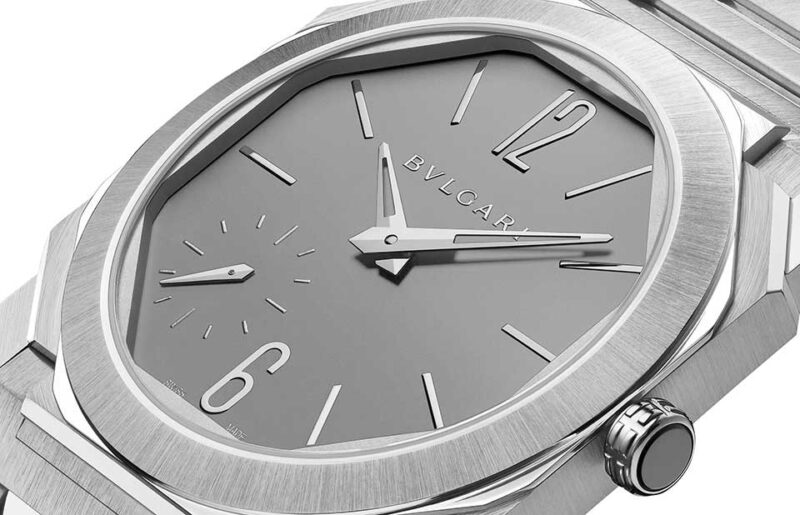
Editorial
Coming of Age: Bvlgari’s Octo Finissimo 37mm
Oct 23, 2026
Editorial
Coming of Age: Bvlgari’s Octo Finissimo 37mm
Oct 23, 2026
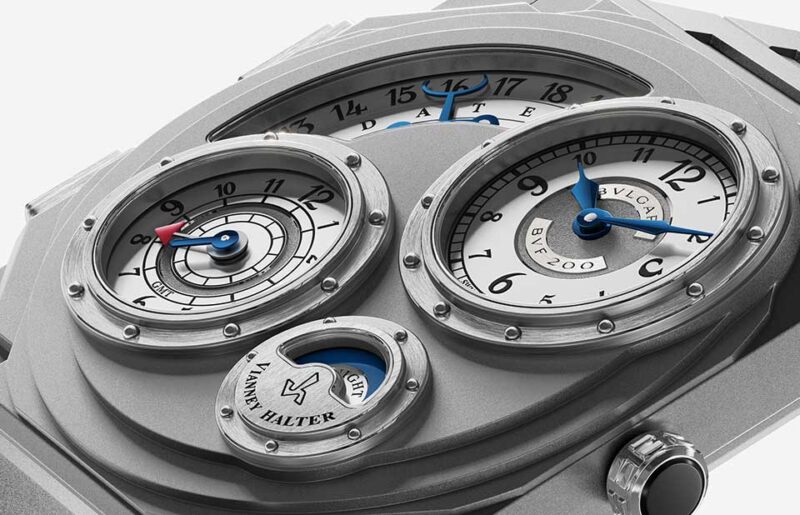
Editorial
Past Future Perfect with Bvlgari Octo Finissimo Dual Time x Vianney Halter
Sep 2, 2026
Editorial
Past Future Perfect with Bvlgari Octo Finissimo Dual Time x Vianney Halter
Sep 2, 2026

Editorial
Watches and Wonders 2026 Editor’s Pick: Joyceline Tully, Revolution Asia Editor-in-Chief
May 1, 2026
Editorial
Watches and Wonders 2026 Editor’s Pick: Joyceline Tully, Revolution Asia Editor-in-Chief
May 1, 2026