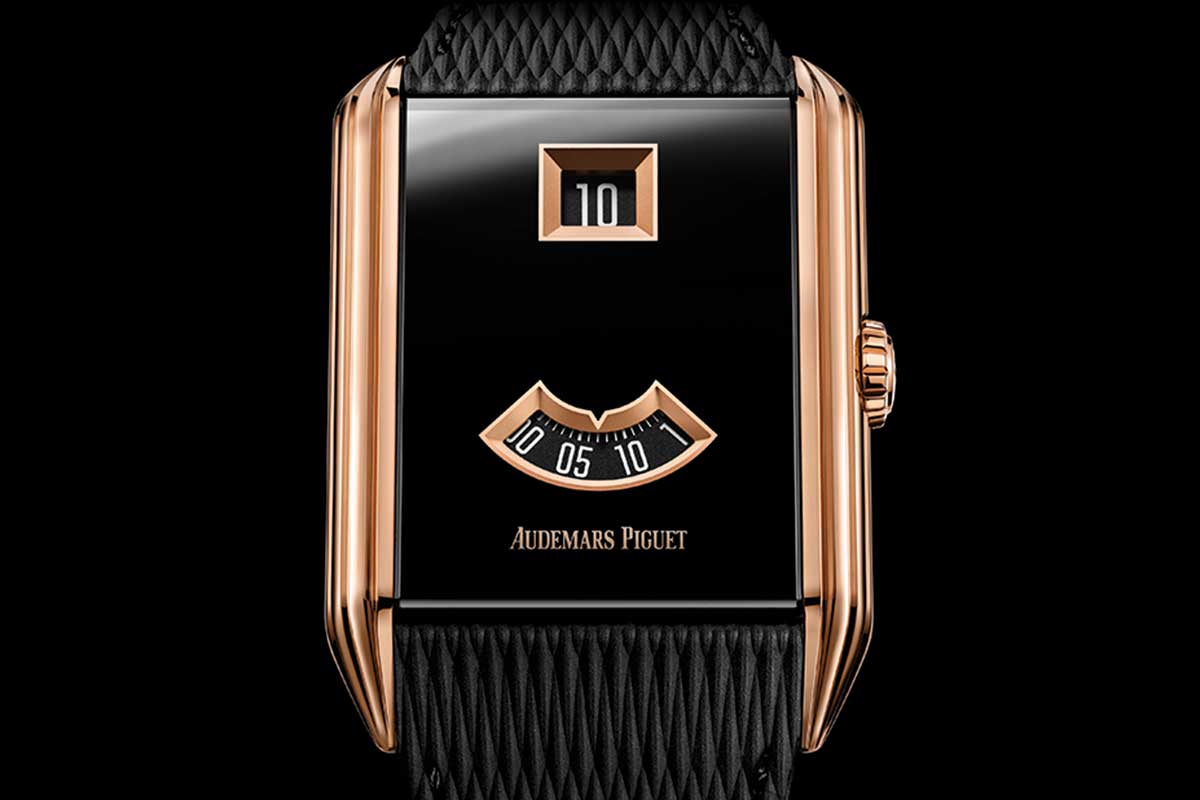
Audemars Piguet’s Neo Frame Jumping Hour
Editorial
Audemars Piguet’s Neo Frame Jumping Hour

The jumping hour is a complication that comes and goes, surfacing briefly, disappearing and then reappearing when least expected — 2025 being a case in point with examples from Cartier, Louis Vuitton and Bremont among others. At Audemars Piguet, however, it has never quite followed that pattern. It shows up instead as part of a longer stretch of work.
In the early decades of the 20th century, there was no fixed idea of what a wristwatch should look like or how it should be read. Case shapes shifted and displays were still open to experimentation. What now feels standard — a round case and two hands turning from the center — had not yet closed off other possibilities. In that context, the jumping hour wasn’t an oddity so much as one option among several, and Audemars Piguet explored it without any desire to lock it down.
According to the AP archives, the manufacture produced 347 jumping hour wristwatches between 1924 and 1951. The figure is usually cited on its own, but the real interest lies in how they were presented. These watches don’t line up neatly. They move across shapes, layouts and materials without settling into a single template. Some keep a minute hand, as if hedging slightly. In some examples, the apertures sit far apart; in others, they are drawn closer together, compressing the display into a narrower band. Square cases sit next to rectangular and cushion shapes. Lugs are fixed, hidden, reshaped, sometimes barely present at all. What looks like variety begins, after a while, to feel more like an exercise in trial and error.
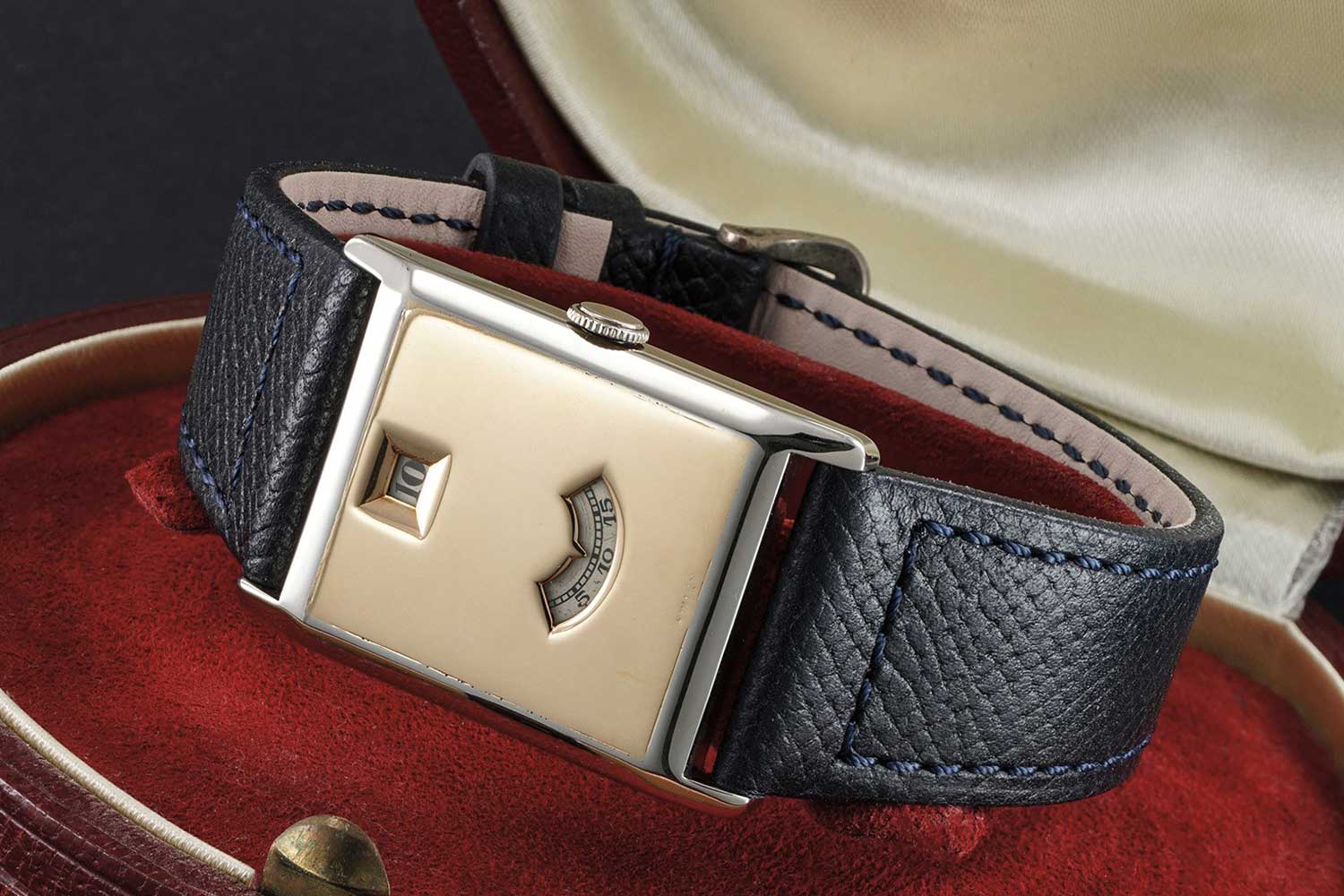
A vintage Audemars Piguet rectangular jumping hour wristwatch, circa 1929 (Image: Phillips)
In these watches, the dial stops behaving like a surface waiting to be filled. Once the hands disappear, space has to do more work. Where openings sit, how close they are to one another, and how the case carries them all become visible in a way that doesn’t exist in a conventional dial. And the Neo Frame Jumping Hour, unveiled today, grows out of that way of working.
The point of reference for the Neo Frame Jumping Hour is not a category; it is a single watch produced in 1929, known internally as pre-model 1271. Only 14 examples were made, across four variants, and nearly all were sold before the October stock market crash brought the Roaring Twenties to a sudden end.
One platinum example is now held in the Musée Atelier Audemars Piguet. It is easy to overlook, partly because nothing really stands out on its own. The apertures sit where they need to be, and the watch never screams for attention. The case runs long across the wrist, but without feeling stretched, and there’s no attempt to dress the display up beyond making it readable.
The Neo Frame is the natural successor and a watch that Audemars Piguet’s CEO Ilaria Resta refers to as, “a tribute to our rich horological heritage, reinterpreted through cutting-edge techniques and a contemporary approach.” It isn’t a shaped case with something added on top; it is a handsome and complete piece where the surfaces move into one another without interruption and, despite its century-old inspiration, the watch feels completely modern.
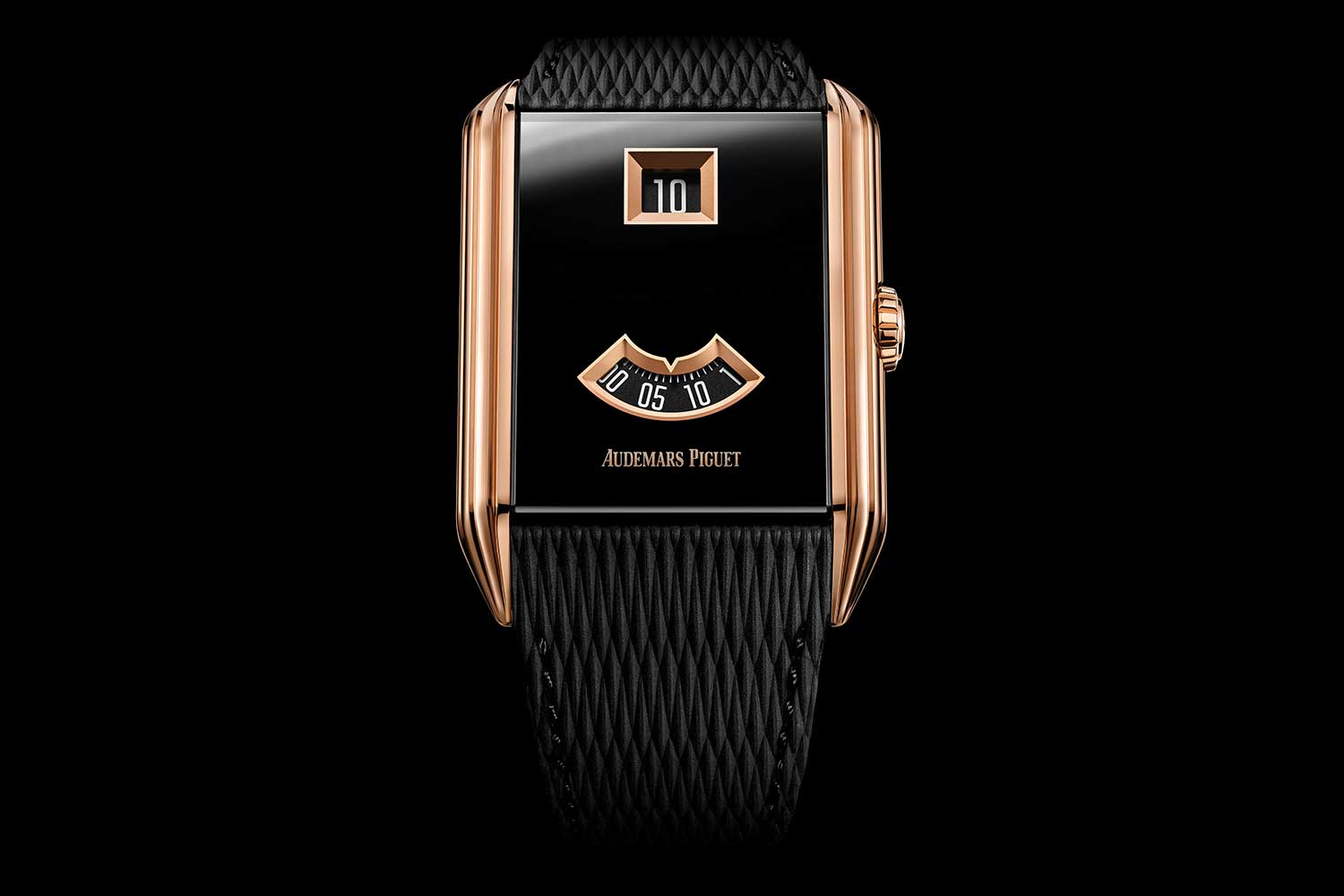
Audemars Piguet Neo Frame Jumping Hour
From Streamline to Structure
At first sight, the watch reads as a perfect example of late Art Deco. It’s only when Audemars Piguet begins talking about it in terms of Streamline Moderne that another reading opens up, one that sits slightly to the side of the obvious and takes a little longer to appreciate.
When the brand refers to Streamline in relation to the Neo Frame, they aren’t pointing to a look so much as a way of handling shape and structure, something that sits downstream of Art Deco rather than in opposition to it. Streamline emerged from the design of trains, ocean liners and aircraft where surfaces followed movement and efficiency rather than decoration. In watchmaking, that way of thinking lends itself naturally to geometric cases and minimalist displays. A guichet already removed visual complexity and Streamline offered a way for what remained to sit elegantly.
Audemars Piguet’s Chief Industrial Officer Lucas Raggi told Revolution that when AP began discussing the watch internally, “the idea was to preserve the Streamline Moderne inspiration at the core of the model while modernizing and empowering the design. This bold aesthetic allowed us to express the spirit of Streamline Moderne in a contemporary way while maintaining balanced volumes, harmonious proportions and a strong sense of modernity.”
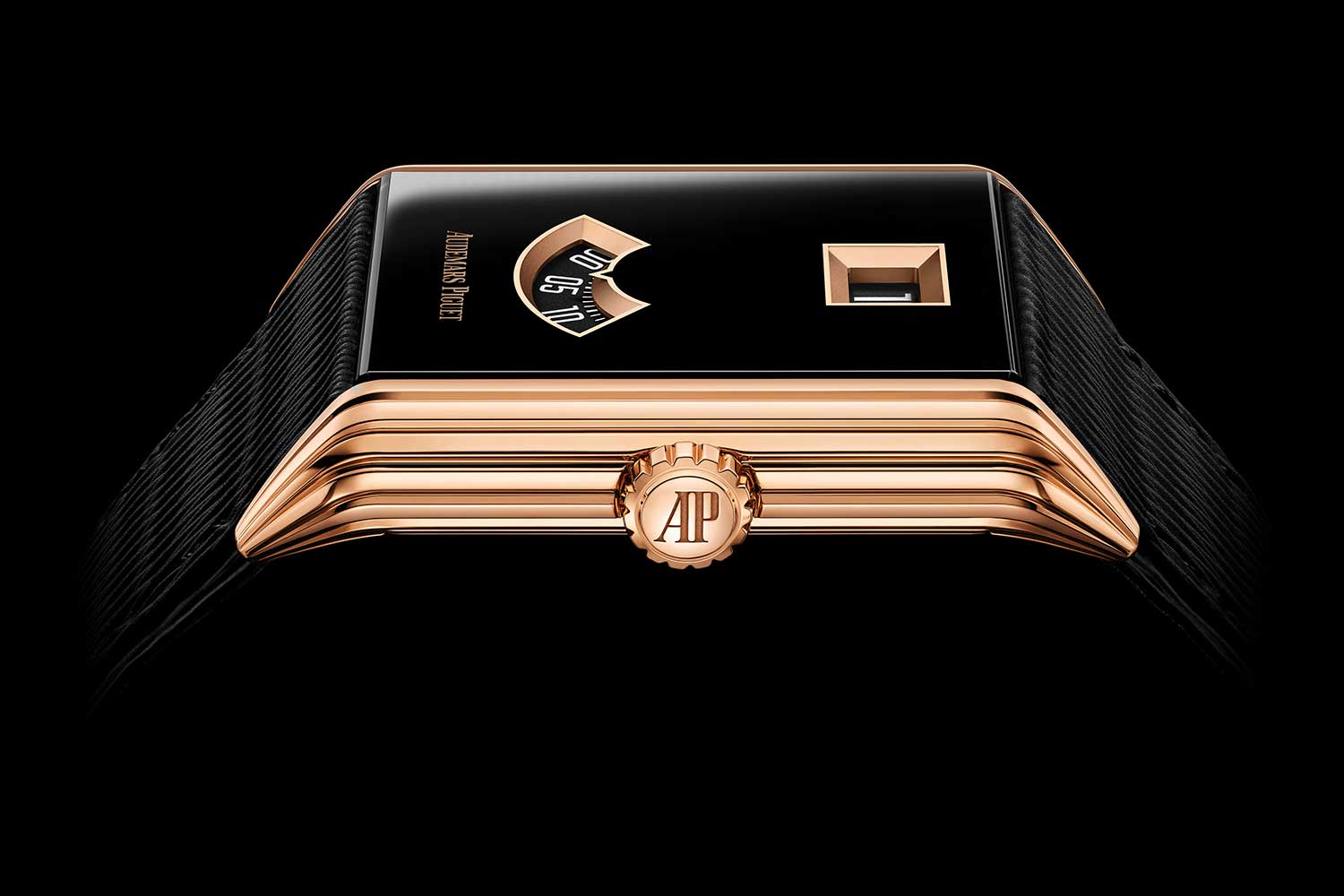
That way of thinking shows up quickly when you see the watch, particularly in the case. Rectangular and compact, it runs sideways across the wrist rather than standing upright on it. Vertical gadroons run along the sides, across the crown and onto the caseback. They aren’t applied decoration; they’re part of how the case is built. “[They] are at the heart of the watch, as they appear across multiple components,” explains Raggi. “From a structural and aesthetic perspective, the gadroons introduce depth, volume and a dynamic sense of continuity. Altogether, the vertical gadroons play a key role not only in shaping the watch’s proportions and visual identity but also in supporting its comfort and wearability.”
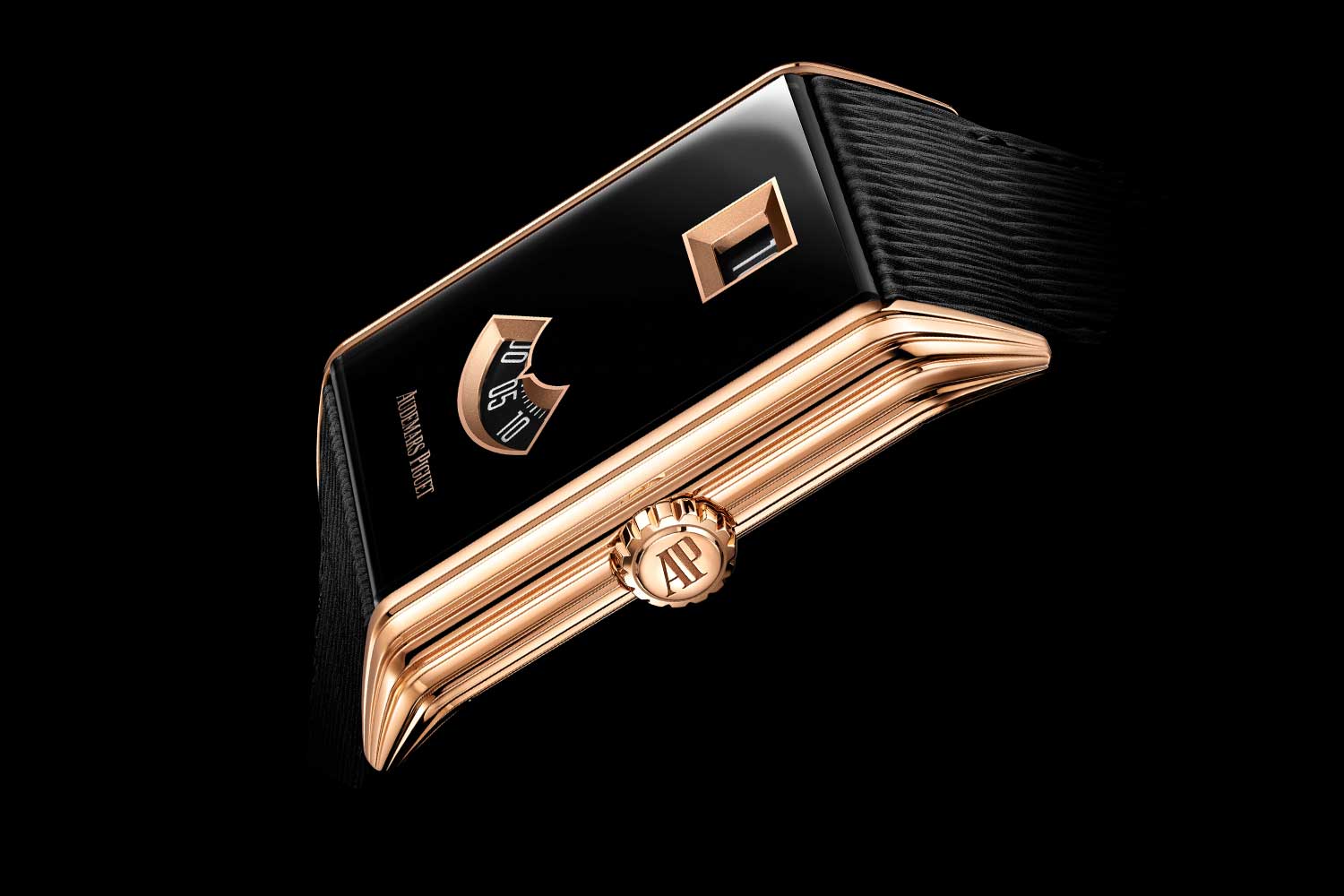
The rectangular and compact case
Because they repeat across the watch, the eye keeps moving, slipping past the edge of the case and the crown. The watch feels longer on the wrist, but never too big and it wears as a single piece rather than a stack of components. The crown is easier to grip without being enlarged, the sides feel less abrupt and even the oscillating weight carries the same treatment, so the design language continues when you turn the watch over.
The same thinking runs straight into the dial — or rather, the lack of a dial in the usual sense. Where the 1929 watch used metal, the Neo Frame replaces it entirely with a black PVD-treated sapphire crystal. Two apertures are cut directly into it at 12 and 6 o’clock. The hour indication at 12 jumps instantaneously, while the “trailing” minutes advance continuously on a rotating disk shown through an arc-shaped aperture at 6.
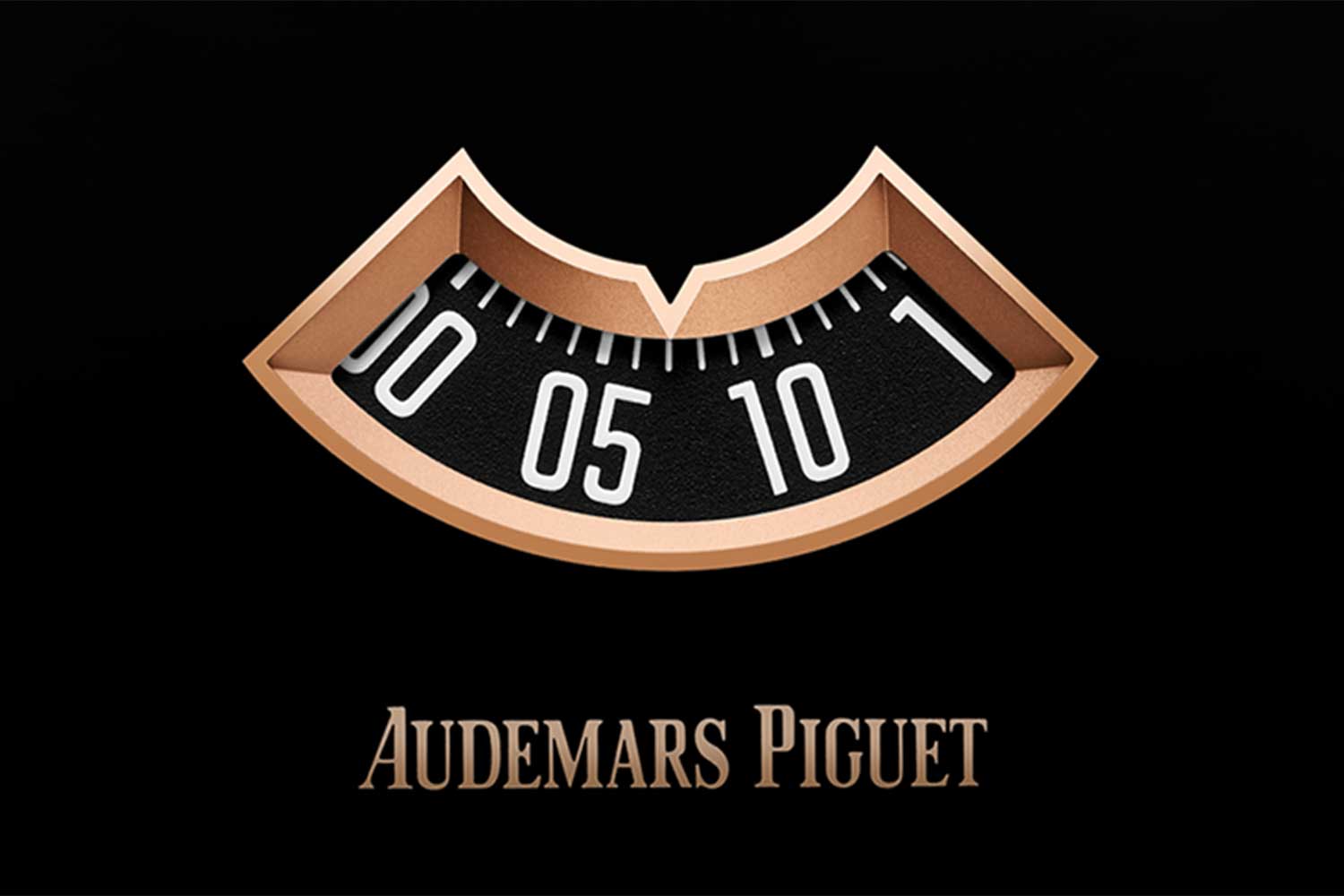
The “trailing” minutes advance continuously on a rotating disk shown through an arc-shaped aperture at 6 o’clock
The edges of the sapphire are left exposed with no metal framing, a decision that brought its own challenges. Without a traditional bezel, the crystal couldn’t be secured in the usual way, and water resistance had to be reconsidered from scratch. With sapphire, you can’t cheat. If you want the edges exposed, the construction underneath has to do all the work.
“From a technical perspective, integrating the sapphire glass was a real challenge as it required us to start a new construction from scratch,” he explains. “With the exception of the pin buckle, every visible component of the piece had to be newly conceived. One of the most delicate aspects was to preserve the graphic purity of the design while ensuring optimal legibility through the sapphire dial. It was a real challenge to coat the glass, and at the same time, keep two apertures fully transparent. Our intention is to show less in order to reveal the essentials.”
The solution was to bond the dial plate to the sapphire and then fix it mechanically into the case. It’s a complicated answer to a very quiet question, and the watch doesn’t draw attention to it. It simply behaves as if there were never an issue. The openings feel less like cut-outs and more like spaces that were planned from the start, placed to keep the watch steady on the wrist rather than to chase symmetry.
Round Movement, Shaped Case
Spend a little more time with the watch and another decision comes into focus, one that sits beneath the sapphire rather than on the surface. Caliber 7122 is a round movement inside a rectangular case, and nothing is done to disguise that. A circular movement has its own logic and here the case becomes a frame around it, not a shape it has to imitate.
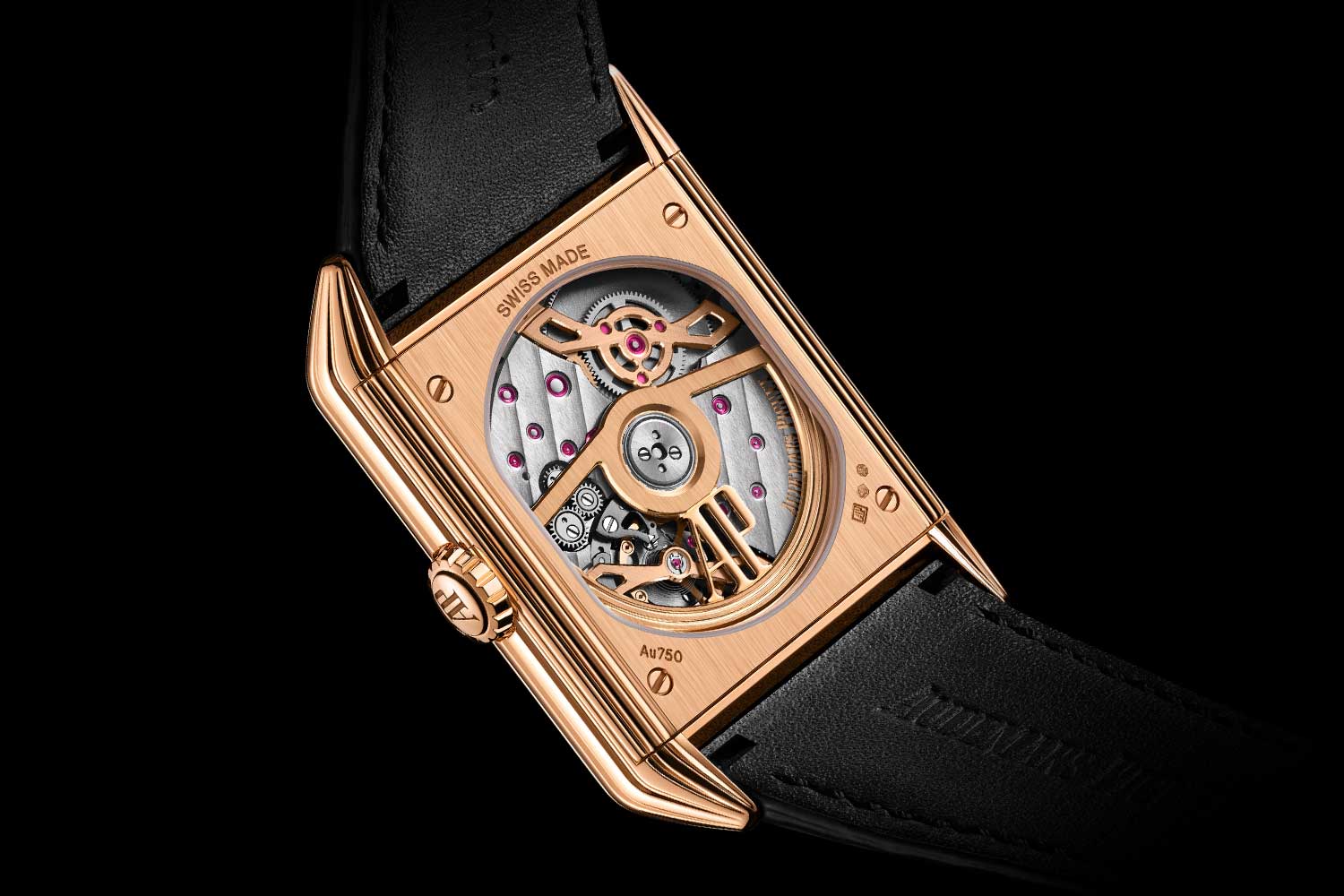
Caliber 7122
Chosen for its size and reliability, Caliber 7122 is based on the ultra thin Caliber 7121 that was introduced in 2022 and currently powers the 39mm Royal Oak Jumbo collection. It was the right choice, Raggi says, because “starting with Caliber 7121 as a base gave us an extra-thin medium-sized caliber as a starting point. This allowed us to maintain a limited overall thickness while adding functions to transform the time display.” Turning it into a jumping hour meant replacing hands with disks and integrating an instantaneous jump. Caliber 7121 made it possible to add that complexity without adding bulk.
Wearability was always a prime objective. Historically, jumping hour watches were delicate things. Disks could slip. A knock could upset the display. The idea that a watch only works when you’re careful with it wasn’t something AP wanted to romanticize. “The Neo Frame Jumping Hour was conceived to meet all technical requirements and quality standards of a conventional time display in daily use,” says Raggi. “We wanted to ensure that the watch was suitable for everyday life.”
A patented shock-absorbing system locks the hour disk after each jump, preventing accidental movement. Lightweight materials reduce inertia. The movement offers a 52-hour power reserve and the piece can be worn like any other daily watch.
There’s no artificial ageing, no period lettering, no decorative signals pointing back to the archive. The decision not to pursue a shaped caliber follows the same line of thinking. This isn’t a reissue, and it doesn’t pretend to be one. The past shows up in how things are handled, not in how they look. The Neo Frame is about how its parts sit together: a frame, two openings, a display that gives you less to look at than most.
It doesn’t try to present itself as new, and it doesn’t feel like something retrieved from storage either. It sits somewhere in between, closer to a way of working than to a finished statement — one Audemars Piguet has returned to from time to time, and never fully left behind.
Tech Specs: Audemars Piguet Neo Frame Jumping Hour
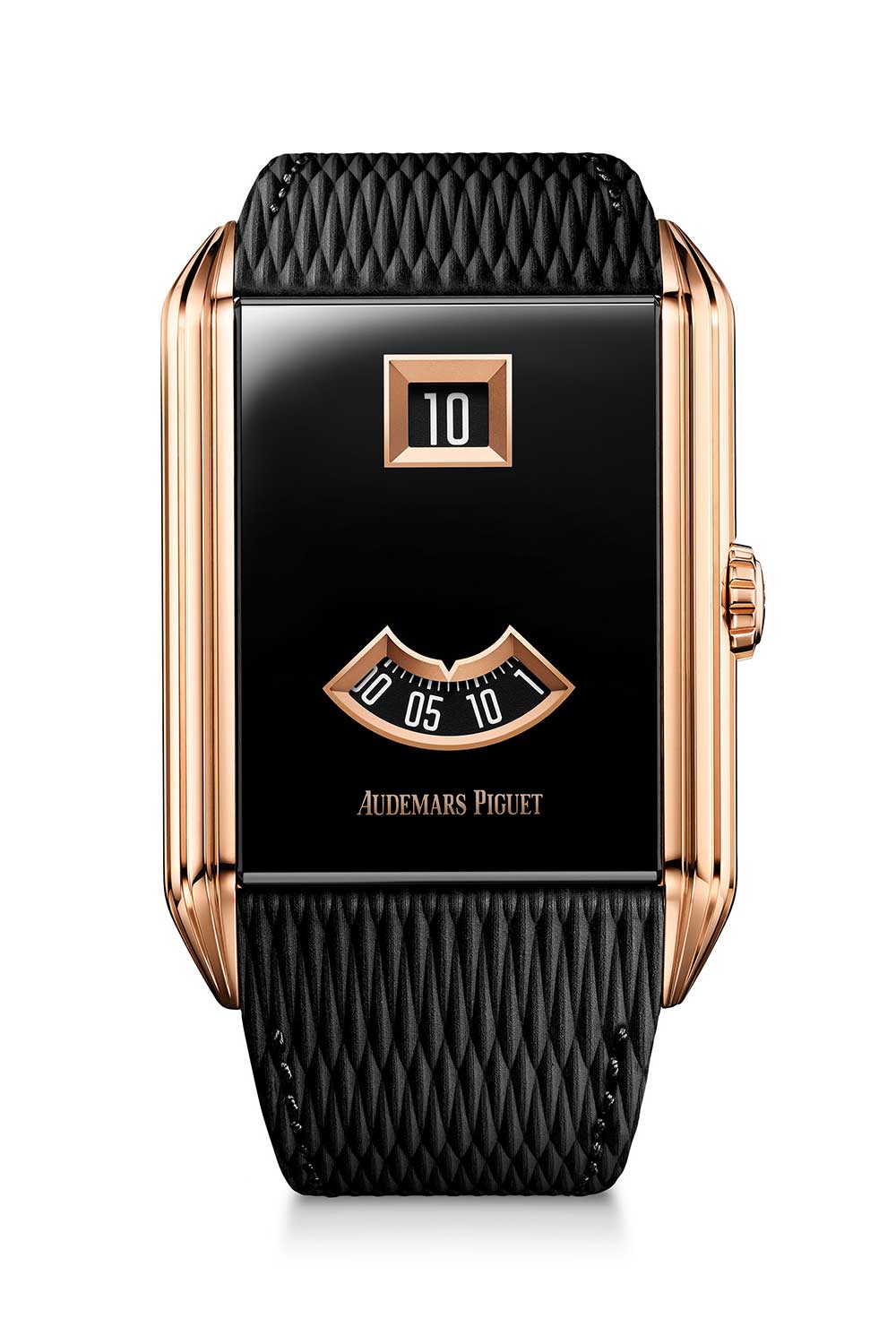
Reference 15245OR.OO.D206VE.01
Movement Self-winding Caliber 7122, with patented shock-absorbing system preventing unintended hour jumps; 52-hour power reserve
Functions Instantaneous jumping hour and trailing minutes on disk
Case 32.6mm × 34mm × 8.8mm; 18K pink gold; water resistant to 20m
Dial Black PVD-treated sapphire hour and minute apertures with gold-toned micro-blasted frames; white printed numerals
Strap Black calfskin leather with textured motif; 18K pink gold AP folding clasp
Price TBC
Audemars Piguet
You may also like
News
Watches & Wonders 2026 Looks Forward to Its Biggest Fair Yet
Feb 10, 2026
News
Watches & Wonders 2026 Looks Forward to Its Biggest Fair Yet
Feb 10, 2026
Editorial
The Audemars Piguet 2026 Releases Makes Complexity User-Friendly, And Celebrates the Skeleton
Feb 3, 2026
Editorial
The Audemars Piguet 2026 Releases Makes Complexity User-Friendly, And Celebrates the Skeleton
Feb 3, 2026
Editorial
The New Audemars Piguet Royal Oak Offshore Diver
Feb 3, 2026
Editorial
The New Audemars Piguet Royal Oak Offshore Diver
Feb 3, 2026